



Abstract
There is a rich scholarship investigating the formal regulatory independence as an outcome of particular institutional arrangements of National Regulatory Authorities for various utility sectors. In contrast, the establishment of national media authorities has only recently stimulated the academic debate on the links between formal independence and institutional design. No empirical measurements have yet been done to scrutinise the independence of audiovisual media regulators in Europe. This article addresses this gap and provides a first empirical assessment of the cross-country variations in formal independence of national media regulators. The analysis is based on an original data set comprising formal independence scores for 43 National Regulatory Authorities which were created by the year 2014. It is demonstrated that institutional differences among National Regulatory Authorities mirror different levels of formal independence, which varies across countries.
Introduction
The conventional idea that an independent media is intrinsically tied to the functioning of modern democracies is widely accepted. However, understanding the mechanisms of how and why independent media play a role in shaping an ‘effective democratic society’ requires many steps, primarily regarding the formation of media laws and institutional environments which enable ‘media to advance democratic goals’ (Price, 2006: 95). As Price (2006) suggests, setting up regulatory authorities, courts or press associations which help eliminate threats to media independence is crucially important, because threats ‘come not from bad laws, but from administrative acts that apply the laws arbitrarily or are completely outside the boundaries of the laws’ (p. 98). The interplay between independence and regulatory authorities begs the question of what kind of institutional set-ups might strengthen or undermine the regulatory independence of the state media authorities. Regulatory institutions are significant since they show the interaction between political control and the independence of the sector. Independent regulation is desirable since ‘it has long been associated with the value attributed to media independence itself and, because that is strongly associated with the democratic process, there has been heightened sensitivity to attempts to manipulate regulation for partisan purposes’ (Gibbons, 2013: 47). As argued by Irion and Radu (2013: 1), setting up independent media regulators is of crucial importance since ‘there is a perceived need to prevent politicians and executive branches of government from exercising control over regulatory authorities’. To prevent the ‘capture’ of regulators by political or private interests, enforcing formal provisions that decrease the possibility for interventions from various actors to influence media regulatory activities are considered an essential procedure.
Regulatory independence as an outcome of particular institutional arrangements is a recurrent theme in many disciplines including communication studies, political science and economics. Whereas much of scholarly research addresses the institutional design and regulatory independence of regulatory agencies for utility sectors (Gilardi, 2002, 2005; Hanretty and Koop, 2012; Maggetti, 2012), the number of studies dealing with the audiovisual media regulation is rather limited. The establishment of National Regulatory Authorities (NRAs) for the audiovisual media sector has only recently stimulated the academic debate on the links between independence and institutional setups (see Herold, 2013; Jakubowicz, 2012; Mutu and Corral, 2013). The literature of the past few decades offers explanations for why media regulation is important, with significant emphasis on the government legitimacy in regulating the audiovisual media sector (Harcourt, 2005; Humphreys, 1996; Schulz et al., 2013). So far, the investigation of institutional arrangements has been important when examining issues such as the role of the media in the democratic process (Gunther and Mughan, 2000), the media regulatory practices (Fengler et al., 2015; Hanretty, 2014; Shehata, 2010) and the role carried out by media regulators (Llorens and Costache, 2014; Mutu, 2013). Very few attempts have been made to study the media regulatory independence in comparative perspective. Systematic overviews are limited, with the exception of the INDIREG study (Hans Bredow Institute, 2011) prepared for the European Commission, which identifies indicators for independence and efficient functioning of NRAs in 43 countries. Schulz et al. (2013) drew to a substantial degree from the INDIREG study and explored the relationship between media governance and independence of NRAs across Europe. The volume edited by Sousa et al. (2013) addresses issues such as institutional design, regulatory functions, legitimising values, performance and funding mechanisms of 13 national media regulators in Western Europe. Hanretty’s (2010) study focuses on the nexus between formal and informal independence of 36 public broadcasters worldwide, revealing that a higher level of formal independence results in a high degree of actual independence, when considering the size of the market news. Hoffmann-Riem (1996) investigates the media regulatory bodies in Australia, North America and Western Europe. Robillard (1995) provides a descriptive overview of the legal framework and the powers delegated to the media regulatory authorities in 35 European countries, while Barendt (1993) compares broadcasting laws in Western Europe and the United States.
More recent studies focus on independence as an ‘institutional regulatory value’ (Irion and Radu, 2013) and particular attention is paid to the distinction between formal (de jure) and actual (de facto) independence. Whereas formal refers to legal requirements for independence embedded in the institutional design of regulatory bodies, the notion of actual independence refers to the effective independence of agencies during their day-to-day regulatory activities (Hanretty and Koop, 2012). Elements of formal independence include the terms of office of the head and management boards, the appointing procedures, the relationship with politicians, the finances and the regulatory powers. Empirical measurements of regulatory independence have been advanced with methodologies developed to study central banks. Several scholars developed universal indices in order to assess cross-country and cross-utility sector variations in formal independence (see Gilardi, 2002; Montoya and Trillas, 2007). Formal independence of regulatory agencies does not necessarily imply independence in practice. As Maggetti (2012: 4) demonstrates, ‘formal independence is neither a necessary nor a sufficient condition for explaining variations in IRAs [Independent Regulatory Agencies]’ de facto independence from political decision makers and regulatees’. Proxies of de facto independence include: political salience and policy complexity, the age of the agencies, the extent to which the agencies’ decisions have been reversed, the turnover of the members of the highest decision-making organ, membership of European networks, the number of veto players in the polity, the size of the regulatory agencies and the country’s politico-administrative tradition (Gilardi, 2008).
In contrast to the rich literature on the regulation of utility sectors, the lack of empirical data for national media regulators represents a major gap in the current research. The scarcity of comparative works is the result of numerous conceptual and methodological inconsistencies in prior research (Norris, 2009). At the theoretical level, systematic interdisciplinary analyses are scarce. The research to date has tended to focus on singular cases rather than cross-country comparative studies. From a methodological perspective, small sample sizes and the paucity of suitable methods for clear conceptualisations have been a serious limitation for many earlier studies. Quantitative indices for assessing the cross-country variation in formal independence of media regulators are not available.
Based on the above background, in this article I focus on the formal or statutory independence of national media regulators. The objective of the study is to address the gaps identified in the extant literature, adding empirical evidence regarding the cross-country variations in formal independence of audiovisual media regulatory authorities, posing the following questions: How does the formal independence of national media regulatory authorities vary across countries? How do we explain the variation in formal independence of NRAs? This study is based on an original data set on the institutional design of 43 NRAs across 43 countries which were created by the year 2014. Changes in the legislative framework that have occurred since December 2014 are not reflected in the data set. The degree of regulatory independence is measured with Gilardi’s (2002) index of formal independence that captures the extent to which the regulatory agencies are independent from political power. The index describes five clusters of issues in the following areas: the status of the agency head, the status of the management board, relationship with government and parliament, financial and organisational autonomy, and regulatory competencies (see Appendix 2). Gilardi’s index has not been previously tested on a sample including regulatory agencies for the audiovisual media sector. The most significant theoretical contributions of this study can be attributed to the interdisciplinary approach used to explore how national media regulators function. Empirically, an innovative contribution is the creation of both an original data set on the institutional settings of media regulators, and an index of formal independence (see Appendix 3 and Appendix 4).
Independence as an institutional ‘regulatory value’
Media regulatory activity in Europe originated in the late 19th century. In the first phase of regulation, as defined by Van Cuilenburg and McQuail (2003), broadcasting regulation in Western Europe was centred on programming policy, while the second phase of regulation was seen to embrace the public service paradigm. In the third phase of regulation, following the privatisation of former state-owned enterprises, National Regulatory Authorities (NRAs) have become the key institutional players for overseeing the audiovisual media sector. The rise of independent media regulators occurred as a response to the liberalisation process, in an attempt to prevent politicians from interfering in the functioning of broadcasters (Irion and Radu, 2013: 14). In Western Europe, the first independent media regulators were set up in the UK (1954), Germany (1980), France (1982), and Italy (1975). After the fall of communism in Central and Eastern European countries, intense lobbying by international experts led to the ‘battle of the [regulatory] models’ (Harcourt, 2003). On one hand, the ‘Europeans’ proposed the enforcement of the public service broadcasting, while the ‘Americans’ were interested in the creation of independent media regulators. In response, media experts ‘were fascinated with Western concepts’ (Jakubowicz, as cited in Harcourt, 2003: 319), and decided to implement the European model of regulation, since the implementation of the acquis communitaire would facilitate accession to European Union membership.
Independence is considered a central principle of good governance, among other key elements such as accountability, transparency and participation. The attempt to understand what independence is has led to a multitude of viewpoints and definitions, reflecting various interdisciplinary concerns. For communication scholars, independence and freedom are interchangeable concepts. As an example, Gunaratne (2002) considers that press freedom is associated with competition, heterogeneity, autonomy and openness. Press freedom also requires low levels of government intervention or censorship, the ability to serve as the Fourth Estate and free market conditions. On the other hand, political scientists define independence as ‘the absence of pressures from political and industry interests’, and emphasise the importance of establishing legal rules ‘that will shelter the agencies against undue pressures’ (Geradin and Petit, 2004: 230). Media regulation is essential to safeguarding ‘popular public interests’ which relate to a fair competition in the broadcasting market, transparency concerning media ownership, providing equitable access and media services, keeping authorities accountable and protecting cultural diversity in programming (Ginosar and Krispil, 2015: 6). According to Gibbons (2013: 46), media regulatory independence ‘entails a degree of separation between the enactment of policy and its implementation, by means of institutions that have exclusive responsibility for certain decisions, in the absence of bias on their part, and in the absence of threats or incentives to act differently’.
Important distinctions between the independence from government, independence from stakeholders, independence in decision-making and the autonomy of the organisation have been put forward (Johannsen, 2003). First, independence from government refers to the regulator’s formal rights to make independent decisions, without governmental constraints or pressures. To protecting the regulatory independence, several measures have been advanced: measures addressing the risk of informal pressure from the political authorities, including non-revocable appointments of regulators for fixed terms to prevent appointment and dismissal on political grounds; measures relating to the organisational autonomy, such as having maximum control of the input of resources, control of appointment, allocation, promotion, dismissal and salary policies in relation to the regulatory authority’s staff (Johannsen, 2003: 23). Second, independence from stakeholders is threatened when there is a risk of regulatory capture by the regulated parties. The political science literature devotes substantial attention to the behaviour of governmental authorities and regulatory agencies and their interaction with industries they regulate (see Levy and Spiller, 1994). Prior research has emphasised that the close relationship to industry cartels makes the agency vulnerable to ‘capture’. As illustrated by Herman and Chomsky (1988), an example of regulatory capture is when policy is biased towards the powerful elites by means of: influence of ownership, managers and stakeholders together, interests of advertisers, regulation of access to information by government agencies, ability of power holders or government authorities to punish deviators and ideology. However, in the case of the media sector, as argued by Gibbons (2013: 55), ‘the political salience of media policy and the varied nature of the media landscape, with so many different firms and institutions pressing for their own agendas, mean that it is unlikely that any one interest could dominate policy’. To limit the risks of regulatory capture by the regulated parties, regulatory bodies should impose standard rules regarding impartiality and disqualification; formal rules prohibiting informal discussions of pending cases with any of the parties involved; and formal rules prohibiting the employment of regulators in the regulated industry before, during and after their term (Johannsen, 2003: 22). Independent decision-making as a third dimension of regulatory independence relates to the regulatory competencies of agencies. Finally, the autonomy of the organisation is related to the control of resources, assignment, promotion and salary policies.
Studies of NRAs have concentrated on the major distinction between formal (de jure) and actual (de facto) independence. By way of illustration, the requirements of de jure independence are formulated in legal documents such as constitutions, legislation governing agencies’ activities and rules of procedures. Informal indicators of regulatory independence include, according to Gilardi and Maggetti (2011), the size of budgets and the regulator’s organisation, the frequency of contact between the regulator and politicians or interests groups, the incidence of the ‘revolving door’ and the partisanship of nominations to the head and management board. While some scholars have argued that a formal structure of independence is likely to be a prerequisite for de facto independence (Hanretty, 2014), other studies have shown that other factors influence the regulatory regimes, including the age of agencies, the presence of many veto players in markets, and the relationship between NRAs and international networks of regulators (see Maggetti, 2012).
A great deal of previous research into regulatory independence has focused on the formal safeguards and institutional indicators that can enhance independence. Thatcher (2005) advanced three factors considered to be of crucial importance: the powers and responsibilities of agencies should be conferred by public law, the agency should be structurally separated from ministries and the members should not be directly elected nor formally managed by elected officials. This viewpoint is also adopted by Gibbons (2013: 48), who argues that in order to ‘secure legitimacy and political acceptance, an ideal regulatory scheme has to have a number of attributes: the mandate has to be clear; the regulator’s expertise, or knowledge and experience of an industry, must be evident; appropriate procedures need to be followed; the outcome must be successful; and, importantly, all of those factors must be rendered accountable’. Another perspective is offered by Smith (1997: 3 Note no. 127), who summarises key formal safeguards of independence: ‘provisions for a distinct legal mandate, free of ministerial control; professional criteria for appointment; the involvement of both the executive and the legislative branches in the appointment process; fixed terms for appointment and rules for dismissal; staggered terms so that they do not coincide with the election cycle, and, for a board or commission, staggering the terms of the members; exemption of the agency from civil service salary rules that make it difficult to attract and retain well-qualified staff; providing the agency with a reliable source of funding’. Empirical assessments of formal independence originate from methodologies developed to study Central Banks. Prior findings show that Central Banks in transition states have higher levels of formal independence in comparison to those from developed economies (Cukierman, 2008). Various scholars have adapted this methodology for the assessment of regulatory independence in utility sectors, and the most important contribution in the study of the regulatory independence has been made by Gilardi (2002). The author drew inspiration from the independence index developed by Cukierman et al. (1992) and operalionalised the formal independence of regulatory agencies in 17 Western European by looking at five indicators: the status of the agency head, the status of the management board, relationships with government and parliament, financial and organisational autonomy and regulatory competencies.
In line with prior contributions, this study focuses on the formal independence of national media regulators. This work adds to current research as it introduces new data on a number of variables such as institutional framework, internal organisation and staffing, the powers of the regulatory bodies, financial resources and systems of checks and balances, and uses these indicators to create a proxy for the independence of regulators.
Methodology
The empirical measurement of formal independence covers 43 national media authorities from 43 countries which were created up to and including the year 2014 (see Table 1, Appendix 1). The operationalization of Gilardi’s (2002) index is summarised in Table 2 (see Appendix 2) and discussed in the forthcoming paragraphs:
The status of the agency head and management board
The first two indicators used are key to assessing how independent the head and board members are likely to be with regard to term of office; by whom they are appointed; conditions for dismissal; whether another government position can be held at the same time; whether the appointment is renewable and whether independence from any other (political or otherwise) affiliation is a formal requirement for the appointment. Taken together, the head of agency and board member status variables contribute to the assessment of how independent the executives of the agency are from undue political influence both at the appointment stage and when they serve after being appointed. A longer term of office (4 years or more) has preference over short terms (less than 4 years) in terms of independence. If the term of office is more than 8 years, the agency receives one point. If there is no fixed term, no points are given. If the agency’s management board participates in appointment procedures, then one point is awarded, while if ministers have the final decision the agency receives zero points. If there is no right of dismissal, the agency receives one point. If the appointer has discretionary powers to dismiss, then the agency receives zero points. The possibility of heads and board members of holding another office in the government is the fourth indicator of formal independence. If this is not permitted, the agency receives one point. If permitted, then the agency receives zero points. If the appointment cannot be renewed, the agency receives one point. If terms can be renewed more than once, zero points are awarded. Finally, if independence is a formal requirement, the agency receives one point, and if not, zero points. Overall, the regulatory agency is more independent if the agency head and board members are selected jointly by government and parliament for a non-renewable fixed term, with no possibility of early dismissal, rather than if they are appointed for a renewable term by a minister who has the power to dismiss them.
The relationship with government and parliament
This variable aims to define how independent the agency will be from the executive and the legislative branch in its operations. The specific indicators cover whether the independence of the agency is formally stated in law or not; the formal obligations of the agency towards the government and the parliament and whether the decisions of the agency can be overturned by anybody other than a court. The first indicator distinguishes whether independence is a formally stated requirement: the agency receives one point if independence is formally required, and zero points if not. The second and third indicators assess the formal obligations of the agencies towards the government and parliament. If there are no formal obligations, the agency receives one point. If the agency is fully accountable to the government or parliament, then the agency receives zero. Finally, the fourth indicator determines whether regulators’ decisions can be overturned by a separate body. If no such body exists, then the regulator receives one point. If the government unconditionally overturns the regulator’s decisions, then the agency receives zero points. Overall, the regulatory agency is more independent if the requirement for independence is formally stated, if there are no formal checks and balances towards the government or parliament, and if no other authority than a court can overturn the regulators’ decisions.
Financial and organisational autonomy
The fourth cluster of variables cover the source of the income of the agency, who controls the agency budget, who decides on the agency’s internal organisation and who oversees the agency’s personnel policy. If agency’s budget comes from fees levied on the regulated industries, then the agency receives one point. If the funding comes from the government, the agency receives zero points. If the budget is controlled by the agency, then the agency receives one point. If the government controls the budget, then the agency receives zero points. If the agency decides on its internal organisation, then it receives one point, but zero points are given if the government decides on the agency’s internal organisation. Finally, if the agency is in charge of its personnel policy, it receives one point, while if the government decides, the agency receives zero points. Overall, formal financial independence is higher if the agency has autonomy with regard to its personnel policy and does not have to rely on the government to finance its activities than if the size and composition of staff and the budget controlled by the government.
Regulatory competencies
The purpose of this indicator is to verify whether the agency only is competent for regulation in the relevant domain. One point is ascribed if the answer is positive, but the agency receives zero points if it has only consultative competencies.
The formal independence index is obtained by aggregating 21 institutional characteristics of regulatory agencies describing five clusters of issues such as the status of the agency head, the status of the management board, relationship with government and parliament, financial and organisational autonomy, and regulatory competencies. Each of the five indicators were numerically coded on a scale of 0 (lowest level of independence) to 1 (highest level of independence). In order to construct a single independence index, the individual indicators were aggregated in two steps. First, the indicators were aggregated at a variable level. The value of the variable-level index is the mean of the corresponding indicators. Then, variable-level indexes were aggregated into a single independence index, which is the mean of the five variable-level indexes. To each variable is attributed the same weight and the same relevance. To assess the cross-country variation in formal independence of media regulators, for each country I considered the 21 indicators of Gilardi’s Index. I averaged the indicators of countries with more than one regulator (Belgium and Switzerland). Because the data were not available for all the regulators, and because it was measured at the ordinal level, I use a non-parametric Skillings-Mack statistical test to look for significant different patterns between regulators. This non-parametric statistical test is useful for data obtained from block designs with missing observations occurring randomly. Further, I conducted post hoc analysis (Wilcoxon signed-rank test corrected according to Bonferroni) to identify the specific differences in the variation of formal independence.
The criteria for case sampling are drawn from the literature on regulatory agencies. Consideration is given to those regulatory agencies situated at arm’s length (or further) from the main hierarchical ‘spine’ of central ministries/departments of state, carrying out public tasks at a national level, staffed by public servants, financed (in principle) by the state budget and subject to public/administrative law procedures (Talbot, 2004: 5). The data set on formal independence is original and was compiled through the collection of primary and secondary data. Primary data collection consisted in examining the publicly available annual reports of national media regulators. Secondary data collection improved and validated the primary data collection through analyses of archives, reports, statutes, constitution and broadcasting laws.
The major limitations of this study relate largely to the choice of data collection methods. The lack of available data required to limit the size of the sample. In addition, longitudinal data tracing the evolution over time in regulators’ formal independence is currently not available.
Discussion of empirical findings
Significant variations in formal independence at a variable level exist across countries. The highest values for the agency head status variable are that of the national media regulator in the Former Yugoslav Republic of Macedonia with 0.91 (out of a full value of 1.00), followed by the media regulators in Italy, Montenegro and Portugal with 0.87. The lowest three values for the agency head status variable are for the media regulators in Norway, with 0.08, Denmark, with 0.12, and Switzerland with 0.33. Figure 1 (see Appendix 3) displays the average level of formal independence of heads and board members of NRAs. The high value for independence in this category stems from the fact that the board is involved in the appointment of the agency head, the agency head is not renewable, the reasons for dismissal are not related to policy and the independence is a formal requirement for appointment stage. The values for the board member status variable exactly duplicate those for the head status variable, as both the head of the agency and board members are appointed under exactly the same rules and procedures. The low values for Denmark are due to the fact that the board members can hold other offices in government while serving on the board of the media regulator. They are appointed by one or two ministers, there are no specific provisions for dismissal and the appointment is renewable more than once. Moreover, there is no formal requirement for independence, which in practice could imply that they are serving the ministers with whom they are affiliated in their main appointments. There are no boards in Finland, Slovenia and Norway, where media regulators are governed by individuals.
The maximum value of formal independence for the relationship with the government and parliament variable is 1, out of a full value of 1.00, and is given to the media regulators in Azerbaijan, Germany, Spain, Denmark, Hungary, Iceland and Latvia. The high values of formal independence are due to the fact that the independence of the agencies is formally stated, there are no reporting obligations towards the government or the parliament and agencies’ decisions cannot be overturned by any other body than a court. The lowest values of formal independence for the relationship with the government and parliament variable are 0.14 for Liechtenstein and 0.22 for Ukraine. The lowest values of formal independence are due to the fact that the independence of the agencies is not formally stated, media regulators are fully accountable towards the government or the parliament and the annual reports need approval, and agencies’ decisions can be overturn by the government, with qualifications.
In terms of the financial and organisational autonomy variable, seven national media regulators score a value of 1.00, out of a full value of 1.00. These countries are Germany, Georgia, Hungary, Ireland, Lithuania, Montenegro and the Former Yugoslav Republic of Macedonia. High levels of formal independence are due to the fact that the agencies’ budgets come from external funding, the agencies have full control of the budget, internal organisation and personnel policy. At the other end of the scale, media regulators in Azerbaijan, Denmark, Liechtenstein, Poland, Sweden and Ukraine score 0, the lowest value of formal independence in terms of the financial and organisational autonomy variable. Low levels of formal independence arise because the funding comes from the government, which controls the budget, the agencies’ internal organisation and personnel policy. Regarding the variation in formal independence in relation to the competencies that are delegated to national media regulators, all but four media regulators score 1, the highest value of formal independence in relation with the delegated competencies variable. The exceptions are Austria, Norway, Luxembourg and Switzerland, which co-regulate the audiovisual sector together with other institutions. NRAs in most of the countries surveyed have policy-implementing powers, except for regulators in Western Balkans, Ireland, Latvia, Romania, the UK, Slovakia, Switzerland and Turkey where they have general policy-setting powers.
Table 3 (see Appendix 4) displays the overall independence index of 43 national media regulatory agencies. The means differed significantly among the countries (p < 0.001). The highest overall independence index values belong to the media regulators in Former Yugoslav Republic of Macedonia, with 0.93, and Montenegro with 0.90, out of a full value of 1.00. The overall formal independence index values for 14 out of 46 media regulators are in the 0.78–0.70 range. The main outliers are the media regulators in Luxembourg, with an overall independence index value of 0.36, and Norway with 0.37.
The formal independence scores suggest that two indicators are conducive to major cross-country differences: the financial and organisational autonomy variable and the relationship with government and parliament variable. How are these two variables linked? We might find one clue when we take a look at budget of media regulators. It appears that in countries where the budget depends on external funding (for instance, in Bosnia-Herzegovina, Croatia, Germany, Georgia, Hungary, Ireland, Lithuania, Montenegro, the Former Yugoslav Republic of Macedonia, Serbia and Spain), the media regulators’ formal independence regarding accountability to Parliament has a low score. Conversely, in cases where the budget of NRAs depends exclusively on state funding, the NRAs’ formal independence regarding accountability to Parliament is very high. However, since the annual reports presented by the agencies do not need approval from the Government, but the annual reports presented by the agencies do need approval from the Parliament, NRAs are more formally independent in relation to the Government, and less formally independent in relation to the Parliament. Therefore, it can be asserted that the more financial formal independence a regulator enjoys the less formal independence it has with regard to its relationship with Parliament. Different countries have different approval processes process of annual reports (Hans Bredow Institute, 2011). In the majority of the countries where the budget of the NRA is part of the overall state budget, the budget is proposed by the Government and subsequently approved by Parliament. For instance, in Bulgaria, the NRA submits its draft budget to the Ministry of Finance for review and approval, and then sends it to Parliament. The NRA in Portugal is accountable to Parliament, to whom it presents an annual report on regulation, its activities and budget. In Sweden, the annual budget is set by Government, with parliamentary approval. With respect to the variable regulatory competencies, the analysis shows that the majority of NRAs score the maximum level of formal independence. This arises because legislatures set broad regulatory policy, which NRAs implement, rather than having the power to set policy themselves.
Conclusion
Institutional differences among NRAs mirror different levels of formal independence which varies across countries. On one hand, the formal independence scores show that most of the media watchdogs were granted considerable independence with regard to competencies and their relationship with Government and Parliament. On the other hand, it is demonstrated that media regulatory authorities in emerging democracies have higher levels of formal independence in comparison to NRAs in consolidated ones. What accounts for the high levels of de jure independence of NRAs in transition states?
A possible answer can be formulated based on prior research on media regulatory regimes. As Jakubowicz (1998: 1) observes, ‘in democratic societies, regulation with a light touch is usually confined to protection against abuse of media freedom’, while in non-democratic countries regulation serves ‘to subordinate the media to the interests of the ruling minority’. To illustrate with an example, the Nordic countries score low levels of formal independence; however, in practice there is ‘a strong [de facto] culture of independence’ that compensates for the ‘low level of rules’ (Jakubowicz, 2012). In these countries, the state is regarded as the guardian of freedom and justice, the media have been institutionally separated from political parties, resulting in a high degree of journalistic professionalisation (Hallin and Mancini, 2004). In contrast, in Eastern Europe the state has functioned as censor, has owned media enterprises and has made use of several intervention methods (Harcourt, 2003). The media changes in Central and Eastern Europe are considered to reflect the key ‘problems of transition’, as consequences of differences between ‘[the] idealised alternative normative model of media democratisation developed in the 1980s and (…) the reality which set in afterwards’ (Jakubowicz, 1998: 2). The ‘problems of transition’ as defined by Jakubowicz (1998) can also be understood in Harcourt’s (2003) terms as the ‘battle of the [regulatory] models’ imposed by the United States and Europe. According to Harcourt (2003), the media markets of CEE countries developed in a ‘regulatory vacuum’, which provides some explanation for the emergence of independent media regulators in this region. Although usually the legislation describes national media regulators as ‘independent’, de facto they are ‘[a] direct extension of the political power structure’, ‘winner-take-all’ institutions with the independence ‘open to doubt’ (Jakubowicz, 2012: 28). In addition, the shift from the state control to the liberalisation of markets was deficient in these countries, which resulted in high political polarisation. Media regulatory authorities were subject to government interference, mostly through the appointment of the heads and board members, funding mechanisms and regulatory competencies. Poland, Romania, Hungary, Albania and Italy are among the countries where board members always have political affiliations, despite laws prohibiting membership of a political party (\Hans Bredow Institute, 2011). The Greek NRA is formally independent, but it lacks policy-making powers, while the formal arrangements designed to protect the Romanian NRA’s independence do not ‘prevent politicisation and political wars around the institution’ (Mungiu-Pippidi and Ghinea, 2012: 169).
The implications of the findings of this study could be addressed in future research. An interesting step would consist in comparing formal and informal independence of audiovisual media regulators. Further analyses could explore factors that are proven to determine the actual independence of NRAs, such as political salience and policy complexity, the age of the agencies, membership of European networks, and the number of veto players in the polity. Possible explanations for the similarities and differences in institutional design choices of media regulators could be argued based on the concept of path dependency in historical institutionalism. Case studies on the political and administrative contexts could provide interesting avenues for explaining variations across countries. In addition, the replication of the formal independence index for cross-sectorial analyses could also provide valuable insights regarding the regulatory independence of NRAs.
In sum, this article gives a theoretically and empirically relevant view of formal independence of audiovisual media regulators that may lead to several hypotheses for further research.
Supplemental Material
Dataset – Supplemental material for The regulatory independence of audiovisual media regulators: A cross-national comparative analysis
Supplemental material, Dataset for The regulatory independence of audiovisual media regulators: A cross-national comparative analysis by Adriana Mutu in European Journal of Communication
Footnotes
Appendix 1
National Media Regulatory Authorities.
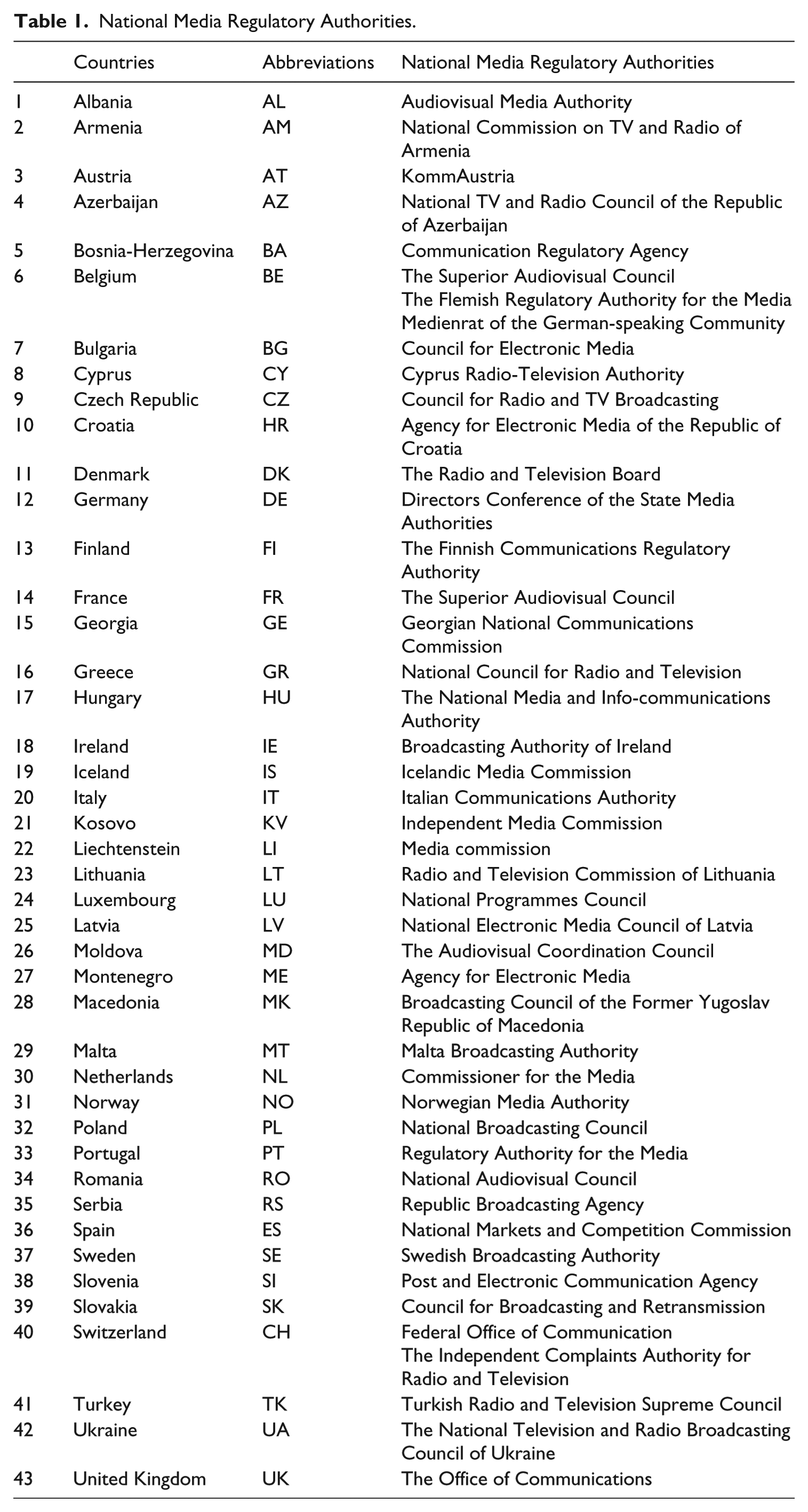
| Countries | Abbreviations | National Media Regulatory Authorities | |
|---|---|---|---|
| 1 | Albania | AL | Audiovisual Media Authority |
| 2 | Armenia | AM | National Commission on TV and Radio of Armenia |
| 3 | Austria | AT | KommAustria |
| 4 | Azerbaijan | AZ | National TV and Radio Council of the Republic of Azerbaijan |
| 5 | Bosnia-Herzegovina | BA | Communication Regulatory Agency |
| 6 | Belgium | BE | The Superior Audiovisual Council The Flemish Regulatory Authority for the Media Medienrat of the German-speaking Community |
| 7 | Bulgaria | BG | Council for Electronic Media |
| 8 | Cyprus | CY | Cyprus Radio-Television Authority |
| 9 | Czech Republic | CZ | Council for Radio and TV Broadcasting |
| 10 | Croatia | HR | Agency for Electronic Media of the Republic of Croatia |
| 11 | Denmark | DK | The Radio and Television Board |
| 12 | Germany | DE | Directors Conference of the State Media Authorities |
| 13 | Finland | FI | The Finnish Communications Regulatory Authority |
| 14 | France | FR | The Superior Audiovisual Council |
| 15 | Georgia | GE | Georgian National Communications Commission |
| 16 | Greece | GR | National Council for Radio and Television |
| 17 | Hungary | HU | The National Media and Info-communications Authority |
| 18 | Ireland | IE | Broadcasting Authority of Ireland |
| 19 | Iceland | IS | Icelandic Media Commission |
| 20 | Italy | IT | Italian Communications Authority |
| 21 | Kosovo | KV | Independent Media Commission |
| 22 | Liechtenstein | LI | Media commission |
| 23 | Lithuania | LT | Radio and Television Commission of Lithuania |
| 24 | Luxembourg | LU | National Programmes Council |
| 25 | Latvia | LV | National Electronic Media Council of Latvia |
| 26 | Moldova | MD | The Audiovisual Coordination Council |
| 27 | Montenegro | ME | Agency for Electronic Media |
| 28 | Macedonia | MK | Broadcasting Council of the Former Yugoslav Republic of Macedonia |
| 29 | Malta | MT | Malta Broadcasting Authority |
| 30 | Netherlands | NL | Commissioner for the Media |
| 31 | Norway | NO | Norwegian Media Authority |
| 32 | Poland | PL | National Broadcasting Council |
| 33 | Portugal | PT | Regulatory Authority for the Media |
| 34 | Romania | RO | National Audiovisual Council |
| 35 | Serbia | RS | Republic Broadcasting Agency |
| 36 | Spain | ES | National Markets and Competition Commission |
| 37 | Sweden | SE | Swedish Broadcasting Authority |
| 38 | Slovenia | SI | Post and Electronic Communication Agency |
| 39 | Slovakia | SK | Council for Broadcasting and Retransmission |
| 40 | Switzerland | CH | Federal Office of Communication The Independent Complaints Authority for Radio and Television |
| 41 | Turkey | TK | Turkish Radio and Television Supreme Council |
| 42 | Ukraine | UA | The National Television and Radio Broadcasting Council of Ukraine |
| 43 | United Kingdom | UK | The Office of Communications |
Appendix 2
The formal independence index adapted from Gilardi (2002).

| Weight | Coding | |
|---|---|---|
| A) Status of the agency head | 0.20 | |
| 1. Term of office | ||
| • Over 8 years | 1.00 | |
| • 6–8 years | 0.80 | |
| • 5 years | 0.60 | |
| • 4 years | 0.40 | |
| • Fixed term under 4 years or at the discretion of the appointment | 0.20 | |
| • No fixed term | 0.00 | |
| 2. Who appoints the agency head? | ||
| • The members of the management board | 1.00 | |
| • A complex mix of the parliament and the government | 0.75 | |
| • The parliament | 0.50 | |
| • The government collectively | 0.25 | |
| • One or two ministers | 0.00 | |
| 3. Dismissal | ||
| • Dismissal is impossible | 1.00 | |
| • Dismissal is possible, but only for reasons not related to policy | 0.67 | |
| • There are no specific provisions for dismissal | 0.33 | |
| 4. May the agency head hold other offices in government? | ||
| • No | 1.00 | |
| • Only with the permission of the government | 0.50 | |
| • Yes/no specific provisions | 0.00 | |
| 5. Is the appointment renewable? | ||
| • No | 1.00 | |
| • Yes, once | 0.50 | |
| • Yes, more than once | 0.00 | |
| 6. Is independence a formal requirement for the appointment? | ||
| • Yes | 1.00 | |
| • No | 0 | |
| B) Status of the members of the management board | 0.20 | |
| 1. Term of office | ||
| • Over 8 years | 1.00 | |
| • 6–8 years | 0.80 | |
| • 5 years | 0.60 | |
| • 4 years | 0.40 | |
| • Fixed term under 4 years or at the discretion of the appointment | 0.20 | |
| • No fixed term | 0.00 | |
| 2. Who appoints the members of the management board? | ||
| • The head of the agency | 1.00 | |
| • A complex mix of the parliament and the government | 0.75 | |
| • The parliament | 0.50 | |
| • The government collectively | 0.25 | |
| • One or two ministers | 0.00 | |
| 3. Dismissal | ||
| • Dismissal is impossible | 1.00 | |
| • Dismissal is possible, but only for reasons not related to policy | 0.67 | |
| • There are no specific provisions for dismissal | 0.33 | |
| 4. May the members of the management board hold other offices in government? | ||
| • No | 1.00 | |
| • Only with the permission of the government | 0.50 | |
| • Yes/no specific provisions | 0.00 | |
| 5. Is the appointment renewable? | ||
| • No | 1.00 | |
| • Yes, once | 0.50 | |
| • Yes, more than once | 0.00 | |
| 6. Is independence a formal requirement for the appointment? | ||
| • Yes | 1.00 | |
| • No | 0.00 | |
| C) Relationship with government and parliament | 0.20 | |
| 1. Is the independence of the agency formally stated? | ||
| • Yes | 1.00 | |
| • No | 0.00 | |
| 2. What are the formal obligations of the agency vis-à-vis the government? | ||
| • There are no formal obligations | 1.00 | |
| • Presentation of an annual report for information only | 0.67 | |
| • Presentation of an annual report that must be approved | 0.33 | |
| • The agency is fully accountable to the government | 0.00 | |
| 3. What are the formal obligations of the agency vis-à-vis the parliament? | ||
| • There are no formal obligations | 1.00 | |
| • Presentation of an annual report for information only | 0.67 | |
| • Presentation of an annual report that must be approved | 0.33 | |
| • The agency is fully accountable to the parliament | 0.00 | |
| 4. Which body, other than a court, can overturn the decisions of the agency where the latter has exclusive competence? | ||
| • No body | 1.00 | |
| • A specialised body | 0.67 | |
| • The government, with qualifications | 0.33 | |
| • The government, unconditionally | 0.00 | |
| D) Financial and organisational autonomy | 0.20 | |
| 1. What is the source of the agency’s budget? | ||
| • Fees levied on the regulated industry | 1.00 | |
| • Both the government and fees levied on the regulated industry | 0.50 | |
| • The government | 0.00 | |
| 2. How is the budget controlled? | ||
| • By the agency | 1.00 | |
| • By the accounting office or court | 0.67 | |
| • By both the agency and the government | 0.33 | |
| • By the government only | 0.00 | |
| 3. Which body decides on the agency’s internal organisation? | ||
| • The agency | 1.00 | |
| • Both the agency and the government | 0.50 | |
| • The government | 0.00 | |
| 4. Which body is in charge of the agency’s personnel policy (hiring and firing staff, deciding on its allocation and composition)? | ||
| • The agency 1.00 | 1.00 | |
| • Both the agency and the government | 0.50 | |
| • The government | 0.00 | |
| E) Regulatory competencies | 0.20 | |
| 1. Which body is competent for regulation in the relevant domain? | ||
| • The agency only | 1.00 | |
| • The agency and another independent authority | 0.75 | |
| • The agency and the parliament | 0.50 | |
| • The agency and the government | 0.25 | |
| • The agency has only consultative competencies | 0.00 | |
Appendix 3
Appendix 4
The overall independence index value.
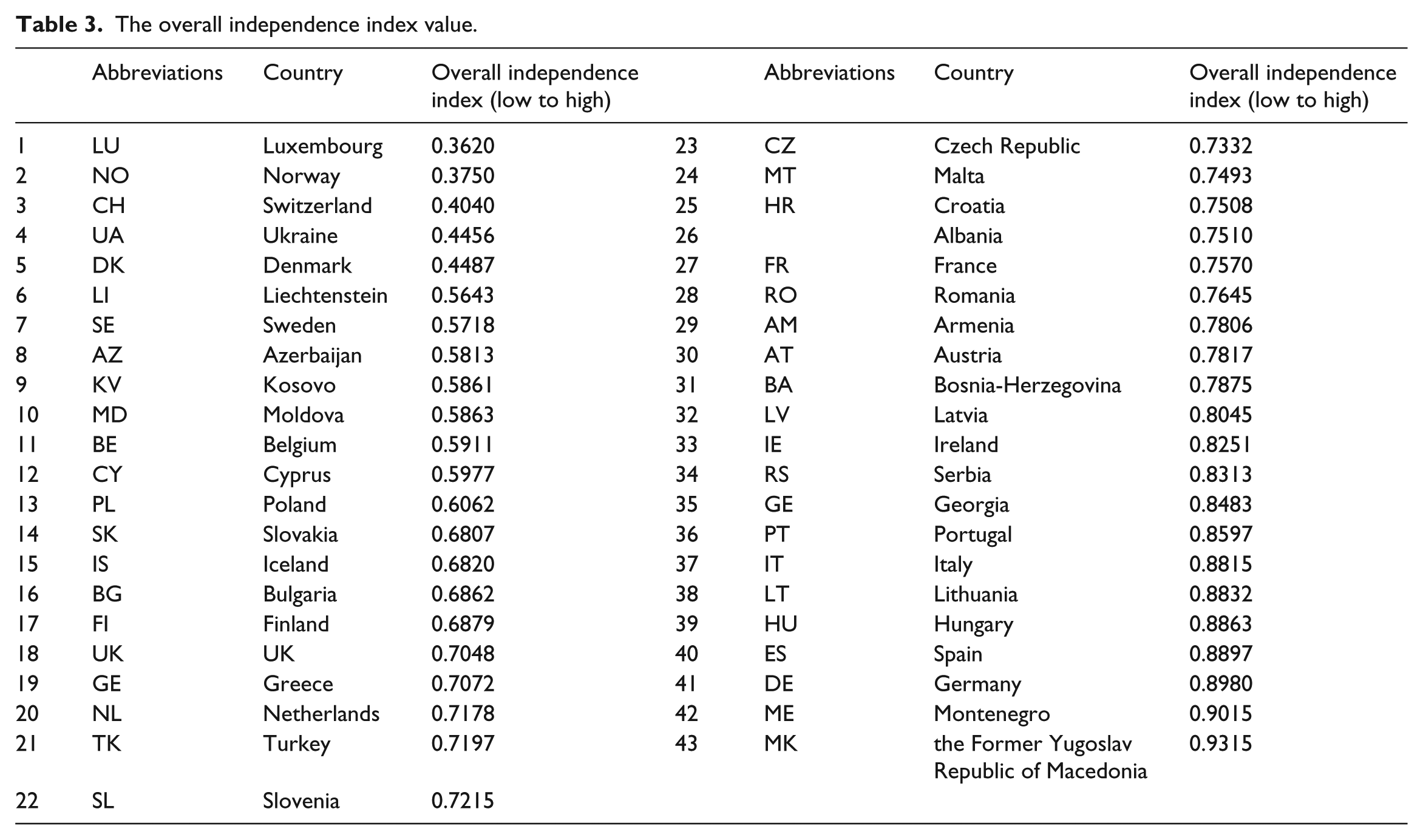
| Abbreviations | Country | Overall independence index (low to high) | Abbreviations | Country | Overall independence index (low to high) | ||
|---|---|---|---|---|---|---|---|
| 1 | LU | Luxembourg | 0.3620 | 23 | CZ | Czech Republic | 0.7332 |
| 2 | NO | Norway | 0.3750 | 24 | MT | Malta | 0.7493 |
| 3 | CH | Switzerland | 0.4040 | 25 | HR | Croatia | 0.7508 |
| 4 | UA | Ukraine | 0.4456 | 26 | Albania | 0.7510 | |
| 5 | DK | Denmark | 0.4487 | 27 | FR | France | 0.7570 |
| 6 | LI | Liechtenstein | 0.5643 | 28 | RO | Romania | 0.7645 |
| 7 | SE | Sweden | 0.5718 | 29 | AM | Armenia | 0.7806 |
| 8 | AZ | Azerbaijan | 0.5813 | 30 | AT | Austria | 0.7817 |
| 9 | KV | Kosovo | 0.5861 | 31 | BA | Bosnia-Herzegovina | 0.7875 |
| 10 | MD | Moldova | 0.5863 | 32 | LV | Latvia | 0.8045 |
| 11 | BE | Belgium | 0.5911 | 33 | IE | Ireland | 0.8251 |
| 12 | CY | Cyprus | 0.5977 | 34 | RS | Serbia | 0.8313 |
| 13 | PL | Poland | 0.6062 | 35 | GE | Georgia | 0.8483 |
| 14 | SK | Slovakia | 0.6807 | 36 | PT | Portugal | 0.8597 |
| 15 | IS | Iceland | 0.6820 | 37 | IT | Italy | 0.8815 |
| 16 | BG | Bulgaria | 0.6862 | 38 | LT | Lithuania | 0.8832 |
| 17 | FI | Finland | 0.6879 | 39 | HU | Hungary | 0.8863 |
| 18 | UK | UK | 0.7048 | 40 | ES | Spain | 0.8897 |
| 19 | GE | Greece | 0.7072 | 41 | DE | Germany | 0.8980 |
| 20 | NL | Netherlands | 0.7178 | 42 | ME | Montenegro | 0.9015 |
| 21 | TK | Turkey | 0.7197 | 43 | MK | the Former Yugoslav Republic of Macedonia | 0.9315 |
| 22 | SL | Slovenia | 0.7215 |
Acknowledgements
This article draws on the author’s doctoral thesis titled ‘The Formal Independence of National Media Regulatory Authorities: A Cross-Country Comparative Study’ and supervised by Professor Joan Botella Corral from the Autonomous University of Barcelona. The author thanks Dr Claudio Pacchierotti from the Centre National de la Recherche Scientifique (CNRS) at Irisa and Inria Rennes for his support with the statistical analysis.
Funding
The author(s) disclosed receipt of the following financial support for the research, authorship, and/or publication of this article: This work was supported by the Agency for Management of University and Research Grants (AGAUR), Government of Catalonia, Spain, under Grant FI-DGR 2012.
Supplemental Material
Supplemental material for this article is available online.
References
Supplementary Material
Please find the following supplemental material available below.
For Open Access articles published under a Creative Commons License, all supplemental material carries the same license as the article it is associated with.
For non-Open Access articles published, all supplemental material carries a non-exclusive license, and permission requests for re-use of supplemental material or any part of supplemental material shall be sent directly to the copyright owner as specified in the copyright notice associated with the article.
