




Abstract
Decision-making in public bureaucracies should be guided by rules and formal procedures, securing predictability, impartiality and fair decisions. Studies show that public bureaucracies are highly mediatised – but knowledge about media impact on political outcomes is scarce. In this article, we study if, how and why media affect agendas, resource allocation and case decisions within public bureaucracies. Empirically, we apply a mixed method approach to the case of Norway, utilising a comprehensive survey among civil servants in ministries and agencies, as well as in-depth interviews with civil servants and political leaders. The results clearly support the notion that media can influence agendas, resource allocation and decision-making in ministries and agencies. When media pressure and broad public support build up, action is particularly taken when the issues are deemed important by political actors, suggesting that both push and pull forces are involved when media influence public bureaucracies.
Introduction
Across established democracies, numerous studies report on the mediatisation of politicians and political organisations (Blumler and Esser, 2018; Esser and Strömbäck, 2014; Kepplinger, 2002; Mazzoleni and Schulz, 1999; Strömbäck and Van Aelst, 2013). Public bureaucracies such as ministries and agencies adapt to generic news formats and frames and prioritise media work over other tasks to meet rolling news deadlines (Cook, 1998; Garland et al., 2018; Pallas et al., 2016; Salomonsen et al., 2016; Schillemans, 2012, 2016; Thorbjørnsrud et al., 2014). Moreover, they spend more resources on professionalised and proactive communication strategies, resulting in the expansion of communication units in ministries (Sanders and Canel, 2013). Public agencies have also integrated the primacy of a positive media image and reputational concerns as central assets (Carpenter and Krause, 2012; Kunelius and Reunanen, 2012; Maor et al., 2013). Despite an increasing number of studies investigating the mediatisation and increasing media focus in bureaucracies (Deacon and Monk, 2001; Donges and Jarren, 2014; Figenschou et al., 2017; Fredriksson et al., 2015; Garland et al., 2018; Joly, 2014; Klijn and Korthagen, 2017; Salomonsen et al., 2016), how this media orientation influences outcomes in ministries and agencies has been largely overlooked. 1 Aiming to meet this lacuna, the present article investigates to what extent, how and why news media influence agendas, resource allocation and decision-making within public bureaucracies.
Media attention represents both challenges and opportunities for bureaucratic organisations and their political leaders. Answering the call for integrating non-media drivers and barriers to studies on mediatisation (Blumler and Esser, 2018; Deacon and Stanyer, 2014; Fredriksson et al., 2015), we distinguish between push and pull factors that may explain why public bureaucracies are affected by media. Push forces refer to the interventionist reporting methods of modern media forcing political organisations to adapt to the news media. This could not only be affected by the agendas and strategies of journalists but may also be an effect of the external strategic environment channelling its influence through the media (see Jacobs and Schillemans, 2016). Either way, from the organisations’ point of view, this refers to an external push by or via the media effecting organisational changes. Pull forces pertain to how political actors purposefully draw media logic into their world – to use media attention to their own advantage (Blumler and Esser, 2018). 2 This distinction is highly relevant for democratic normative reasons. If and when decisions in public bureaucracies are affected by the media, it matters greatly whether this is understood as a case of political actors passively giving in to media pressures or a case of proactive political actors using media pressures to tilt decision-making towards a specific direction.
To investigate these matters, we combine two main types of data and three empirical research approaches to analyse media impact on Norwegian ministries and agencies. Two empirical approaches are based on a comprehensive survey among civil servants in ministries and agencies. First, using a direct approach, we treat the civil servants as key informants and use survey items to investigate the extent to which they experience that media pressure influence agendas, resource allocation and decisions. Second, with an indirect approach, we combine survey information about changes in agendas and resource allocation within ministries and agencies with information about media attention. Finally, applying an in-depth approach, we combine survey data and qualitative interviews with high-ranking communication experts, civil servants and politicians in Norwegian ministries, to illuminate why media pressure ends up affecting decision-making in government ministries and agencies. The research design thus answers the call for innovative approaches and in-depth, empirically grounded studies on political (Karpf et al., 2015) and government communication (Sanders and Canel, 2013). Furthermore, it enables us to study insider perceptions and experiences regarding media impact among public bureaucrats across policy sectors through a combination of direct questions and indirect measures.
The results clearly support the notion that media influence government ministries and agencies, and suggest that a combination of push and pull forces must be at play to influence internal agendas, resources and decisions in government ministries and agencies. In conclusion, we thus discuss the results in relation to the previously mentioned normative implications, particularly by further unpacking media pressures (push factors), as media are most influential when pushing in combination with multiple actors.
Media influence on decision-making in ministries and agencies
Mediatisation studies have to a large degree focussed on how different types of political organisations and actors have internalised media values, practices, routines and preferences, as well as such adaptations’ consequences on activities and communication (Esser and Strömbäck, 2014; Hjarvard, 2008). Mostly, mediatisation has been understood as motivated by transformations in media systems, including commercialisation, new technologies, journalistic professionalisation and others (Asp, 2014). The dominant media actor-centric perspective in mediatisation studies, has recently included more non-media drivers (Blumler and Esser, 2018; Deacon and Stanyer, 2014; Fredriksson et al., 2015). The push by media actors and the pull by political actors operate simultaneously in a dynamic ebb and flow (Blumler and Esser, 2018).
Policy decisions in advanced democracies are complex, and influenced by a number of factors ranging from the policy of governing and coalition parties, the relationship between parliaments and governments, to the strength of interest groups and corporative arrangements. Media attention might arguably influence all parts of this complex decision-making chain. The media serve as a key source of information for politicians providing crucial information about problems in society, public opinion and the positions and actions of other politicians and stakeholders (Van Aelst and Walgrave, 2016). The news media reveal new information to politicians, and/or amplify, interpret or frame information in ways that can influence political processes (Sevenans, 2017). Further, the media attention represents both challenges and opportunities for politicians, who actively strive to use the media agenda to demonstrate agency and effectiveness (Thesen, 2017). Politicians address citizens and other political actors through the media during policymaking processes. Thus, the media play a crucial role by connecting political actors to each other and by offering an arena to promote political causes (Fawzi, 2017b). This article zooms in on ministries and agencies, and emphasises media influence on agendas, resource allocation and case decisions within such organisations.
The normative implications of media influence for decision-making processes in governmental organisation are not clear-cut, however. From an ideal Weberian perspective, decision-making in public bureaucracies should be guided by rules and formal procedures, securing predictability and fair decisions. Indeed, impartiality could be perceived as the most fundamental norm for decision-making in public administration (Rothstein and Teorell, 2008). From this perspective, media impact on decision-making processes is problematic, as the media has no formal position, authority or position in these processes, but still influence the involved stakeholders (Thesen, 2017). For example, there is undoubtedly tension between the need for complex, multi-value solutions and media’s demand for clear, simple and immediate answers (Esser and Matthes, 2013; Klijn and Korthagen, 2017). Moreover, policy negotiations often require long-term commitment, mutual trust and the willingness to compromise, which can be undermined when actors position and promote themselves in the media (Klijn and Korthagen, 2017). However, in democratic and representational theory, responsiveness is a key concept (Pitkin, 1967), and responsiveness and political effectiveness should not necessarily be restricted to elections (Esaiasson et al., 2013; Sevenans, 2017). Governments are expected to pick up and be responsive to signals from citizens. From this perspective, media influence on agendas, resource allocation and decisions can be perceived as governments’ responsiveness to journalists performing their watchdog role on behalf of citizens. This is of course normatively less problematic, perhaps even democratically appealing (Esaiasson et al., 2013).
Media influence on agendas within bureaucracies
Studies that interpret public policy making as a cycle consisting of distinct phases or stages often claim that media are most influential in the agenda-setting phase, as media affect political agendas by focussing on certain issues (McCombs and Shaw, 1972; Walgrave and Van Aelst, 2006). In the latter phases, such as formulation, decision-making, implementation and evaluation, it is claimed that media are less influential (Fawzi, 2017a). The media impact is found to be strongest on policy evaluation, problem identification and adoption but lowest on policy formulation (Linsky, 1986). However, in a more recent study, Tresch et al. (2013) investigated the correspondence between media’s attention to issues and politicians’ agendas across four phases of the decision-making process and found that media and political agendas were more strongly correlated in the latter (and most decisive) stages of the process.
In essence, these studies suggest media’s powerful impact on policy agendas although they seldom go beyond generic terms, such as ‘decision making’ and ‘policy formulation’, to examine the perceptions on media pressure among civil servants involved in bureaucratic decision-making processes. The recent strand of research on media influence inside public organisations suggests a high level of media awareness within bureaucracies and the strong media impact on political and administrative leaders’ agendas (Fredriksson et al., 2015; Garland et al., 2018; Salomonsen et al., 2016; Schillemans, 2012; Thorbjørnsrud et al., 2014). To make these changes inside government ministries and agencies is mainly the prerogative of the minister. Studies have shown that decision-makers perceive media attention as a means to increase authority and bargaining power in working groups and negotiations (Reunanen et al., 2010). Furthermore, sudden media attention can change how problems are discussed and necessarily implicate all public actors who cannot simply ignore media attention (Klijn and Korthagen, 2017: 9). All of this suggests that the media most likely have an agenda-setting effect within bureaucracies and that media attention influences how political and administrative leaders allocate their limited time and attention (Noordegraaf, 2000).
Media influence on resource allocation
Everyday life within government ministries and agencies is to an important degree marked by periodic recalibration of policy and financial priorities, as well as retrenchment and de-prioritisation (Jann and Wegrich, 2007). In the periods around elections and in the annual state budgetary process, governments make decisions on budget cuts and resource allocation within the sectors, and a similar distributional process is then repeated within government organisations. In these types of decisions, several actors are involved both at the executive and the parliamentary arenas. Following the previously described agenda-setting logic, issues on the media agenda could be expected to receive special treatment – either positive or negative – when resource decisions are made both between sectors and within bureaucratic organisations (Potter and Van Belle, 2009; Walgrave et al., 2006). In previous studies, civil servants stated that media attention might be positively related to distributional decision-making inside public service organisations (Schillemans, 2012). In conjunction with this view, some studies showed that media affected public resource allocation (Potter and Van Belle, 2009; Van Belle, 2003), as decision-makers adapted to media concerns by initiating programmes and redistributing funds (John, 2006). Consequently, even a media crisis could be beneficial for organisations over the long-term because this could eventually lead to increased resources (Jacobs, 2014). Existing studies suggest that media attention and framing, have notable effects on budgetary decisions when politicians experience strong media pressure, although empirical evidence here remain somewhat mixed (Mortensen and Serritzlew, 2006; Soroka, 2003).
Media influence on substantive decisions
The media might also influence substantive decisions regarding the drafting or the enactment policy and legislation or policy. Although the media may not affect the majority of substantive political decisions, such cases where the media actually play an important role often receive massive attention. There has been a strong belief in direct media impact, particularly on foreign policy decisions, although this model has subsequently been empirically contested and moderated (Gilboa, 2005; Robinson, 2005).
More recently, scholars have studied what characterises those cases where media pressure seems to influence substantive decisions to identify scope conditions for media influence (i.e. policy uncertainty, proximity and time pressure, see Brommesson and Ekengren (2017). Similarly, Ihlen and Thorbjørnsrud (2014) identified the following key characteristics in cases where policy decisions were revoked after massive media pressure: compelling, idealised human interest narratives; strong and resourceful support networks; and journalistic engagement. Substantive decisions can entail decisions on single issues made inside ministries by the hand of the minister, as well as larger policy decisions and legislation, which demand the support of political parties in the parliament.
Overall, from the extant literature, we expect that the media may affect substantive decisions within bureaucracies under certain conditions, but caution that the media influence is probably smaller than on other types of decisions and less than some concerned scholars fear (Meyer, 2002). The few existing studies that opened the black box of routine policy making in governments suggest that there have been a tendency within political communication research to exaggerate the media’s power (Fawzi, 2017a; Melenhorst, 2015).
Study design
The research design is based on three distinct approaches, combining two data sources. All three approaches utilise data from a comprehensive survey among Norwegian ministries and agencies. The central administration in Norway comprises 16 ministries and approximately 60 semi-autonomous structural disaggregated agencies with regulatory, control and supervisory tasks. The ministries are led by a minister, supported by two to four state secretaries and a political advisor. Communication workers in Norwegian ministries are regular civil servants although they work close with the political leadership. Although the Norwegian media system had previously been considered a prototype of Hallin and Mancini’s (2004) democratic corporatist model, in recent years, it has moved towards the commercial, liberal model (Ohlsson, 2015).
Norway is a parliamentary democracy. At the time of the study, the minority coalition government (Solberg 1), consisting of the Conservative Party and the Progress Party, was supported by the Christian Democratic and the Liberal Party in parliament. This construction of a minority cabinet with regular supporting parties in parliament has not been as common in Norway as in the other Scandinavian countries (Bale and Bergman, 2006). During its first years, the Solberg cabinet experienced internal disagreements, particularly in regards to car tax, pension benefits and refugees. The cabinet struggled with how to reach conclusions. Especially, the state budgetary process proved to be difficult, and was delayed on several occasions.
Cabinet propose legislation and state budgets to be passed in parliament. Some discretion on single issues is given to ministers and their ministries. As seen in the other Scandinavian countries, corporatism has declined over time, and interest groups’ lobbying towards civil servants in ministries have been supplemented by political lobbyism directed towards elected representatives in the parliament and the cabinet (Rommetvedt et al., 2013).
We used Questback’s online survey tools to design, distribute and collect the surveys, which were sent to five ministries and 28 agencies in late 2015 and early 2016. E-mail addresses to civil servants in Norwegian ministries are no longer publicly available online. We, therefore, approached all ministries to negotiate access and received e-mail lists from five (out of 16) ministries (Defence, Finance, Health, Justice, and Research and Education). The agencies’ e-mails were mainly available on their websites. In total, 3152 respondents answered the survey. The response rate was 40% in ministries and 28% in the agencies. To evaluate bias in the sample, we relied on civil service statistics from Statistics Norway. The sample mainly reflected the universe on relevant variables, but the group with high education was somewhat overrepresented. 3
To supplement the surveys the in-depth approach draws on 21 semi-structured qualitative interviews conducted with the civil servants and the political leaders in one of the ministries studied. One of the authors conducted the interviews with communication workers (Communication 1–11), state secretaries and political advisors (Political 1–4) and expert bureaucrats (including the secretary general and department heads, Expert 1–6). Each lasting from 60 to 90 minutes, the interviews were digitally recorded and transcribed by a research assistant. The interviews covered a broad range of issues related to the overarching topic of the mediatisation of public sector organisations, from reactive and proactive media strategies, professionalisation of communication, to how media influence processes and priorities in government ministries.
Most of the interviewees addressed media influence either indirectly or directly, and the interviewer also brought up the topic. For the analysis, all interview sections addressing media influence were sampled and analysed according to our study’s theoretical framework. The interviewees approved all direct quotations translated into English and used in the analysis. To preserve the interviewees’ anonymity, their exact job titles are not mentioned in this article; only their professional categories are provided. For the sake of transparency, each interviewee is assigned a number, so the reader can determine who is quoted in the text.
Empirical analysis: Push and pull forces of media impact
The analysis is structured based on the three empirical approaches discussed earlier. The first two (direct and indirect approaches) focus on to what extent and how the media are perceived as influencing decisions. The third one (in-depth qualitative approach) zooms in on specific decisions and discusses why the media is perceived to influence case decisions in public bureaucracies.
Direct approach: Perceptions of strong media influence
According to the civil servants, allocation of time by is the most plausible type of media influence (see Figure 1). The media are particularly believed to influence the attention of the minister, state secretaries and political advisors. For instance, if the media run a story in a certain policy area, the responsible department in the ministry might receive increased attention from the minister (in the form of meetings discussing how to deal with the issue). Allocation of internal resources is considered less common than that of attention. In other words, the minister might ask questions from the responsible department although this ministerial attention is not always followed by increased resources to the department. However, almost half of the ministry respondents report that media attention can lead to increased internal resources. Civil servants in agencies are even more inclined to believe that media pressure can lead to increased financial or personnel resources internally.

Perceptions on media-driven changes. Percentage of civil servants claiming that the media influence (to some or a great extent) allocation of time and resources and distributive and substantive decisions in their ministry or agency.
Increased resource allocation to an institution or a sector (prioritising and avoiding cuts in the state budget) is also broadly believed to occur due to media pressure. The dynamic behind such changes might be that media attention to a certain sector helps ministers argue for the importance of that area in the internal battle for funds at the cabinet level. Again, agency officials seem more inclined to believe that such changes can occur because of media pressure. The three items related to substantive decisions – changes in the outcomes of individual cases, legislation and policy – are supported by about half of the respondents who say that such changes occur at least to some degree.
Figure 1 reports the percentages of the respondents who indicate that the type of media influence occurs to at least some degree. This does not mean that the others believe the opposite; most of them indicate ‘don’t know’. For example, in ministries, 31% (highest) report ‘don’t know’ about ‘avoid cuts in the budget’, while 13% (lowest) answer ‘don’t know’ regarding increased internal attention.
Indirect approach: Media spotlight generates internal resources and attention
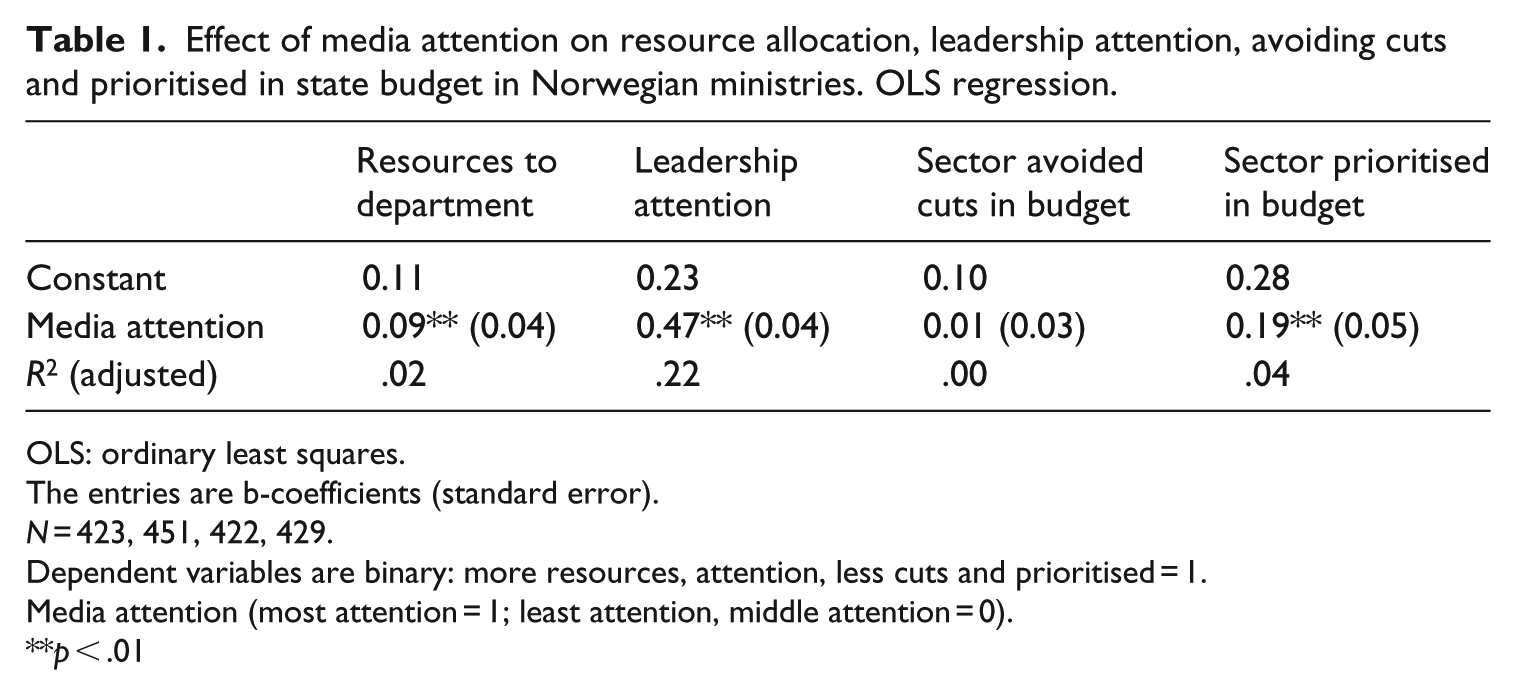
To further investigate the consequences of media attention, we designed an indirect approach in the survey. The ministry respondents were asked to what extent their department had been allocated more resources, received more attention from the leadership, avoided cuts in the budget process and had been prioritised in the budget process to a greater extent over the last years than the other departments in the ministry. The agency respondents were asked if over the last years, their agency had received increased funding and either positive or negative attention from the ministry. Elsewhere in the survey, we asked if the respondents’ department/agency generally received relatively more, about equal or less media attention than other departments/agencies to measure (experienced) media pressure. In Table 1, we regress the effect of media attention to ministries on the four dependent variables, using binary regression analysis.
Effect of media attention on resource allocation, leadership attention, avoiding cuts and prioritised in state budget in Norwegian ministries. OLS regression.
OLS: ordinary least squares.
The entries are b-coefficients (standard error).
N = 423, 451, 422, 429.
Dependent variables are binary: more resources, attention, less cuts and prioritised = 1.
Media attention (most attention = 1; least attention, middle attention = 0).
p < .01
A clear relationship exists between perceived media attention and various changes within ministries. 4 The effect is strongest regarding the attention from both political and administrative leadership in the ministries. The b-coefficient indicates a staggering 47-percentage point difference between departments, with the most media attention and others. The effects on the sector being prioritised in the state budget (their department’s areas of responsibility) and financial or personnel resources allocated to the department are also quite strong. Only avoiding cuts in the budget seems unrelated to media, and, also relates to how the Norwegian state budget tend to grow every year, and that tough financial prioritisation seldom is made.
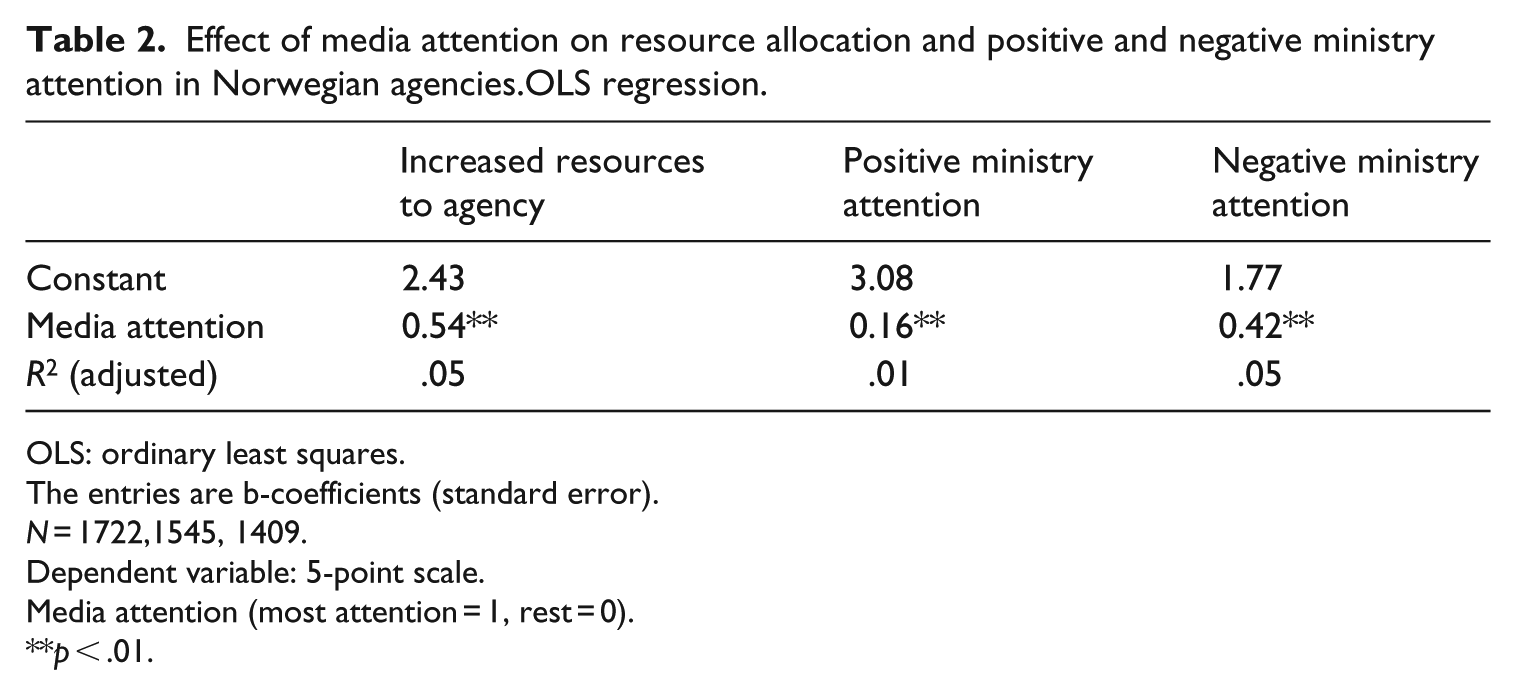
Table 2 shows the effect of media attention on agencies. Here, the b-coefficient should be interpreted as the mean change, on a scale of 1–5, between the group with the most media attention and the groups with less media attention. A clear relationship exists between perceived media attention and reported change within agencies. The effect is strongest regarding increased resources allocated to the agency (financial or personnel). The effect of media attention on negative attention from the ministry is also strong – almost half a scale point. In other words, if critical stories break in the press, spurring media pressure on the agency, it might receive negative attention from the minister who is politically responsible for its actions.
Effect of media attention on resource allocation and positive and negative ministry attention in Norwegian agencies.OLS regression.
OLS: ordinary least squares.
The entries are b-coefficients (standard error).
N = 1722,1545, 1409.
Dependent variable: 5-point scale.
Media attention (most attention = 1, rest = 0).
p < .01.
Overall, this indirect approach clearly supports the notion that the media can influence attention in both ministries and agencies, as well as resource allocation to the sectors and the agencies.
In-depth approach: Media attention is necessary, but insufficient
According to the survey, 60% of the respondents working in ministries and 40% in agencies report that the media influenced decisions in their organisation during the last year (Figure 3 in Appendix 1). This documentation of a shared experience in media impact strongly indicates the widespread media influence on individual decisions. This question was, therefore, used as a filter to ask why the respondents thought it happened. Figure 2 shows the results.
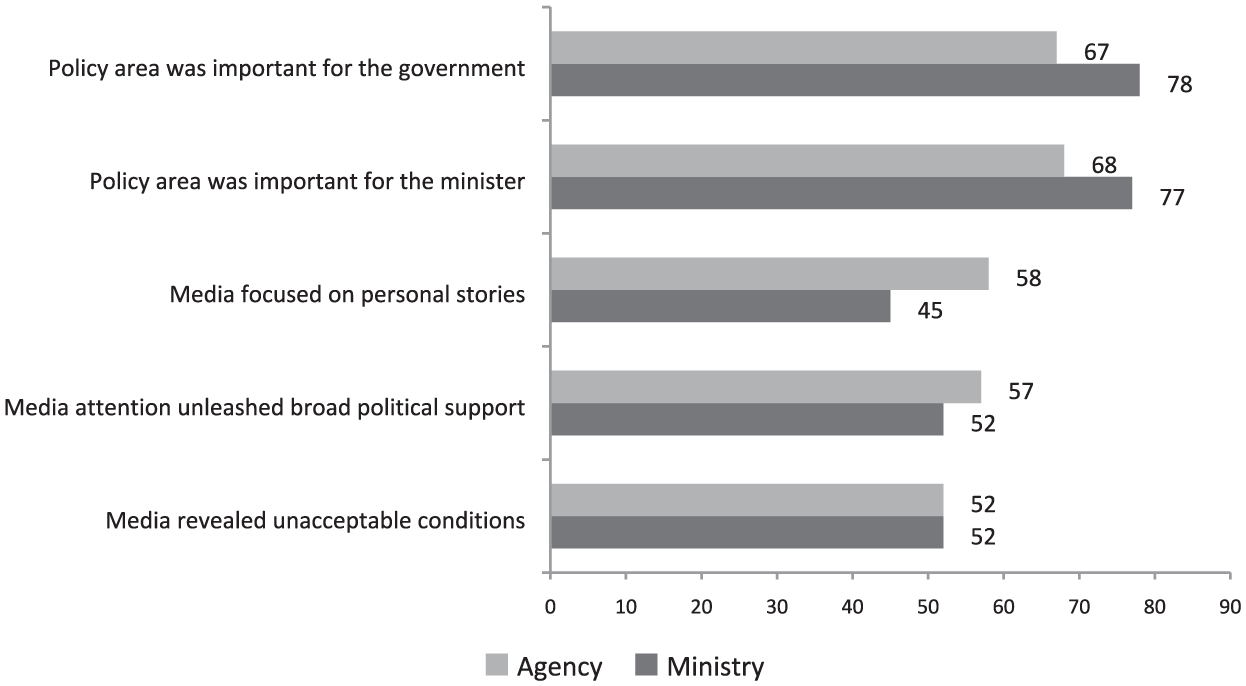
Reasons why media attention influenced a decision-making process. Percentages of respondents who find the explanations important or very important.
All types of explanations receive quite high levels of support. The top two explanations as perceived by most civil servants are the policy area’s importance for the minister and the government. This finding suggests that politicians act on issues they find particularly important because their party has issue ownership, and/or they perceive media attention as an opportunity to change policies. These types of decisions enable politicians to demonstrate political effectiveness and agency, and to build an image and public position (see also Sevenans, 2017).
In the ministries, 75% of the respondents find at least three reasons important, suggesting that several factors are necessary to influence decisions, as emphasised in the in-depth interviews. When asked directly about media-induced changes in decision-making, all interviewees list concrete examples of decisions where they perceive media pressure as decisive. The examples provided by interviewees range from budget reallocations and reprioritisations (i.e. prioritising the treatment of one patient group over another, implementing public funding of new drugs and treatments), to changes in new policy proposals (i.e. recalling proposed new laws and procedures, proposing ad hoc changes in the legislature) and the quality assurance, evaluation or postponement of new policy (i.e. the initiation of official report and commissions to expound consequences of new policy or the scope of insufficient public services or programmes; interviewees, 2015–2016). Moreover, many interviewees argue that most media-driven changes are made hastily on an ad hoc basis.
The in-depth interviews enable us to broaden our understanding of the scope conditions for media-induced change of individual government decisions. First, most interviewees point out that media pressure alone is insufficient unless the media uncover severe malpractices, failures or scandals. Moreover, several interviewees emphasise the need for compelling examples for news stories to evoke empathy and mobilise for action. One interviewee explains, ‘it is the sum of such individual cases that together documents the scope and scale of the problem’ (Communication 1). For media revelations to mobilise popular and/or political support, ‘many must identify with those affected or know someone who are directly afflicted’ (Communication 10) and some victims are deemed more ‘worthy’ of sympathy and support in the media than others (Politician 4). Expressed differently, according to the ministry interviewees, media investigations are often necessary, but insufficient if the critical exposures do not provoke reactions from other stakeholders and/or the public.
The second scope condition is thus mobilisation of the broader public or of political stakeholders. In some cases, broad public support and mobilisation trigger a change in policy, as in one example given by several interviewees, where the government had to retract a proposition to expand doctors’ right to reserve against facilitating abortions, after massive popular protest. As explained by a communication expert – ‘it was a massive media pressure … but it was also a popular demand (…) it was a crazy six months, and the pressure mounted so that eventually (the politicians) had to find another solution’ (Communication 4). The majority of the interviewees argue that broad political pressure exerted by multiple interest groups and alliances of organised interests, is what push the government ministers to demonstrate agency and control. According to a senior expert bureaucrat, ‘a combination of massive media pressure and active lobbying towards members of parliament’ repeatedly changed decisions (i.e. redistribution of resources to post-surgery breast reconstruction, approval of new experimental drugs and treatment; Expert 5). How to build efficient alliances is perceived as crucial to influence decision-making processes through the media and a key competency of contemporary communication and media consultants. As explained by one communication expert, The lobbyists know, and they are very good at building alliances, how to promote their aims through the system. It is not enough to mobilise the media; you also need connections in parliament, interest groups, affected individuals, all relevant stakeholders and all pressure groups in the policy sector. If you aim to change policy, you need to identify who has enough legitimacy and influence and how to build your case. (Communication 10)
Several interviewees are openly critical to the impact of such alliances, and how they can spur hasty ad hoc decisions. As emphasised by an outspoken communication expert: ‘There is always a dark side of the picture after (media induced) change of priorities. When someone scream very loud and mobilise to get what they want, someone else will pay the consequences’ (Communication 2).
A third factor is how central government agencies do not necessarily change policy decisions unless this is in the interest of the incumbents. As demonstrated in the survey, it is considered vital that the issue is important to the minister or the government for them to act. For politicians, media attention offers an opportunity to demonstrate agency, implement policy and send a signal to political opponents and/or the citizens. A senior civil servant explains how politicians seek to exploit the media agenda to promote their own initiatives and policies, ‘When critical media coverage dovetails with the minister’s political agenda, the media boosts attention to an issue and gives him the necessary momentum’ (Expert 4). According to a senior communication expert, timing is essential, as politicians will seek to strengthen their position ahead of the annual state budgetary process (Communication 9). It is, therefore, vital that the minister and/or other senior politicians in government are personally engaged in the issue or held accountable by other stakeholders, for them to react and change decisions.
Overall though, interviewees stress that even when all conditions are present (the media exert strong pressure, the public and/or interest groups are mobilised, compelling mediated case stories demonstrate the failure of public policy, and the issue is important for the government), the consequences of such pressure remain unpredictable. A senior communication expert argues that it is imperative to have ‘a certain mix of events or more ingredients in the casserole to compel decision-makers to change their minds’ (Communication 3).
Concluding discussion
How far media influence permeates internal processes and priorities in government ministries and agencies is of growing interest to political scientists and political communication scholars. While earlier studies have found evidence for media influence on the strategic communication, organisational structure and everyday tasks in public bureaucracies, this article has shown how agendas, resource allocation and decision-making in public bureaucracies are also influenced. Drawing on comprehensive surveys among civil servants in ministries and agencies, as well as in-depth interviews with civil servants and politicians in ministries, we find strong support for the notion that the media influence these three types of decisions in public bureaucracies. While media influence may be a direct effect of media agendas and strategies of journalists, we also find empirical support for how the political environment channel its influence via the media.
We used three empirical approaches. The first (direct approach) indicates that media attention leads to various changes in public bureaucracies. Specifically, allocation of time and attention within bureaucracies is perceived as the most common type of media influence. The indirect approach finds a clear relationship between perceived media attention and resource allocation within ministries, particularly involving internal attention and larger budgets. A strong relationship also exists between perceived media attention and reported changes within agencies, particularly regarding increased resources and attention from the ministry. Such internal media-induced prioritisations represent a substantial media impact that is difficult measure and thus largely ignored in the literature.
The in-depth approach focusses on decisions to investigate what push and pull forces drive media impact on decisions. Asked directly, as high as 60% of the ministry respondents and 40% of the agency respondents report that the media influenced decisions in their organisations during the last year. The survey indicate that a combination of political initiatives and media pressure is at play when media coverage influence decisions in government ministries and agencies. This finding is further substantiated by the interviews. According to ministry interviewees although reports of misconduct, scandals or crises might make the media put an issue on the political agenda, broad public support and major stakeholders’ mobilisation and lobbying often need to build up for change to occur. Political actors at the apex of government agencies act strategically only when they deem the issues at stake important to them, and the media then provide the necessary momentum to change or implement policy.
The analysis illustrates that media impact cannot be explained by media- or actor-centric approaches alone, demonstrating the need for a dual approach to mediatisation of politics and public bureaucracies. The results indicate that changes in government ministries and agencies are primarily driven by strategic political actors, both outside and inside the government, who seek to use the media momentum. Supported by their communication departments and expert civil servants, ministers react when issues arise that are important to them and their ministries. In this sense, media attention (even when critical and massive) represent a welcome gift for some ministers, enabling them to take special action on crucial cases (Figenschou et al., 2017).
There is little evidence of simple, direct media impact. Consequently, the results do not support the most pessimistic views on media influence; the media do not dictate decision-making in government ministries and agencies. To some extent, the results support a responsive government perspective on decision-making in public bureaucracies; the media perform their watchdog role on behalf of citizens, and the government reacts to the mounting media pressure. At the same time, the results nuance this responsiveness thesis; politicians react primarily to issues they find important for themselves, their parties or the cabinet. This suggests that societal actors with resources to earn media attention and mobilise other channels stand a good chance of using the media to influence public policy – not the least if an issue is important for ministers.
A timely question is therefore what happens to the policy issues that remain in the media shadow. Are some groups, policy areas, ministerial departments and organisations systematically downgraded due to particular media issues being prioritised? These questions should be part of the future research agenda on media influence on decisions in public bureaucracies.
Footnotes
Appendix 1
Acknowledgements
An earlier version of the article was presented at ECREA’s Political communication section interim conference, Zürich 2017. We would like to thank the participants, as well as two anonymous reviewers for valuable comments.
Authors’ note
Rune Karlsen is also affiliated with Institute of Social Research, Oslo, Norway.
Declaration of conflicting interests
The author(s) declared no potential conflicts of interest with respect to the research, authorship, and/or publication of this article.
Funding
The author(s) disclosed receipt of the following financial support for the research, authorship, and/or publication of this article: The article is part of the project Media Impact in the Public Service Sector project funded by the Research Council of Norway – grant number 237014.
