



Abstract
This article examines the European Commission’s information policy during the heavily politicised Transatlantic Trade and Investment Partnership (TTIP) negotiations. Through the methodologically innovative use of Freedom of Information requests, it moves beyond official discourse to reveal how internal deliberation among Commission officials is preoccupied with monitoring and containing civil society mobilisation against the deal. Underpinned by elitist conceptions of democracy, public opinion emerges as a problem to be solved through strategic public relations, despite the Commission’s discursive commitments to greater transparency and political dialogue with citizens. The findings challenge the widely-held notion that a ‘communication deficit’ between European Union institutions and their publics is at the root of the perennially elusive formation of a European public sphere. Instead, approaching TTIP as a key frontline in the struggle over post-democracy, I conclude that antipublic ideas encoded in the Commission’s information policy are reflective of historically engrained institutional ambivalence towards public-political participation.
Introduction
When European Union (EU) and US officials launched negotiations of the Transatlantic Trade and Investment Partnership (TTIP) in February 2013, few had anticipated that it would become the most controversial trade deal in decades. More than 3.2 million people had signed the European Citizens Initiative (ECI) against TTIP and tens of thousands took to the streets to show their disapproval, mobilised by a transnational coalition of civil society organisations (CSOs). The extent of opposition varied markedly between member states but Eurobarometer polls showed that support for TTIP ‘declined EU-wide over the period of the talks from a net approval of 33 percentage points in November 2014 to 19 percentage points two years later’ (Siles-Brügge, 2017: 474). While Donald Trump’s election may have put the final nail in TTIP’s coffin in late 2016, the prospect of an EU-US trade deal continues to animate the political dreams of officials on both sides of the Atlantic. Writing for Politico magazine, the former US ambassador, Anthony Gardner (2017), urged policymakers to learn from their failure and to
treat TTIP like a political campaign . . . we should call on communications professionals and use focus groups to better understand what messages connect with the public . . . [and] to combat active disinformation campaigns organized by NGOs to play up people’s fear for financial gain.
Gardner’s call to arms captures the ‘unprecedented politicisation’ (De Ville and Gheyle, 2019: 20) surrounding TTIP – a case that has attracted interest mainly from political scientists (De Ville and Siles-Brügge, 2016; Eliasson and Garcia-Duran, 2018; Meunier and Czesana, 2019; Siles-Brügge, 2017). A key area of research has been the conflict over transparency (Coremans, 2017; Heldt, 2019). Heralded by EU officials as the most transparent trade negotiations ever, anti-TTIP campaigners consistently claimed that the European Commission’s (EC) secrecy undermined the ability of the public to participate meaningfully in shaping the agreement. As Gheyle and De Ville (2017) demonstrate, the conflict over transparency reflects a more fundamental conflict over competing conceptions of legitimacy which accord very different roles to citizens and CSOs in EU governance – questions that lie at the heart of this article.
The anti-TTIP campaign is but the latest chapter in the genealogy of protest movements to challenge the EU’s role in international trade politics: from the Battle of Seattle in 1999, the 2012 pan-European wave of mobilisation that brought down the Anti-Counterfeiting Trade Agreement (ACTA) (Dür and Mateo, 2014), to issue-specific campaigns focused on EU trade policies regarding access to medicines (Stavinoha, 2016). In the case of TTIP, campaigners’ ‘highly emotive “injustice frame”’ (Siles-Brügge, 2017: 481), which resonated across digital (Von Nordheim et al., 2018) and mainstream news media (Boukes, 2019; Conrad and Oleart, 2020), succeeded in ‘evoking a crisis consciousness at the periphery’ of European public spheres (Habermas, 1996: 382). No longer confined to the insular world of technocratic policy-making, the EC, which negotiates trade agreements on behalf of EU member states subject to approval by the European Parliament (EP) and national governments, was compelled ‘to actively defend trade negotiations . . . in the greater public realm’ (Garcia-Duran and Eliasson, 2017: 492). And it is the Commission’s information policy response to the contestation over TTIP that is the focus of this article.
This article contributes to existing literature by, first, offering novel insights into the communicative dimension of EU trade politicisation and, second, by situating the analysis of the Commission’s information policy within long-standing debates about the ‘elusive’ European Public Sphere (EPS) (Heinderyckx, 2015). For although mass-mediated public spheres have emerged as key sites of contestation over the legitimacy of the global trade regime, TTIP, and EU trade politics more generally, has attracted relatively little attention from media and communication scholars. Defined as ‘a set of political decisions, which determine . . . an organisation’s communication with . . . the general public’ and encompass both ‘active communication (public relations)’ and ‘regulations of access to information (transparency regime)’ (Brüggemann, 2010: 7), the aim is not to evaluate the information policy in narrow instrumental terms of effectiveness. Instead, through the lens of political sociology (Zimmermann and Favell, 2011), I seek to problematize normative assumptions in EPS literature that reduce the EU’s legitimation crisis to a ‘communication deficit’, which, I argue, risks emptying public sphere theory of its critical edge. I do so by exploring the ideas about public opinion that inform the Commission’s communication strategy: How is ‘public opinion’ constructed, invoked, or excluded within institutional discourses? What ‘lay theories’ of democracy and the EPS does this reveal?
I approach these questions by analysing previously unavailable EC documents obtained through Freedom of Information (FOI) requests. A rarely used method of data-gathering, FOIs offer researchers ‘a unique means of studying official management and public relations activities’ (Walby and Larsen, 2012: 31–32) by granting access to confidential areas of elite discourse. Consequently, this allows for empirical analysis to move beyond an exclusive focus on the Commission’s official discourse characteristic of existing research (Garcia-Duran and Eliasson, 2017; Siles-Brügge, 2017). The analysis of internal deliberation reveals a predominant ‘antipublic’ discourse (Kantola, 2001), where civil society mobilisation needs to be carefully monitored and contained; a problem to be solved through strategic public relations (PR). This, I argue, is reflective of the historically engrained institutional ambivalence towards public-political participation in EU affairs – a tension between seeing citizens as both ‘an object of manipulation and an independent source of legitimacy’ (Sternberg, 2016: 47) – as well as the decay of ‘representative structures and processes’ at both national and EU levels that characterises the current ‘post-democratic’ condition (Fenton and Titley, 2015).
The politics of TTIP
The aim here is not to evaluate claims about the deal’s economic costs and benefits (De Ville and Siles-Brügge, 2016), explain its unprecedented public salience (Meunier and Czesana, 2019), nor to chart the emergence of the anti-TTIP coalition and its impact on trade policy (Eliasson and Garcia-Duran, 2018). Crucial for our discussion, however, is Crouch’s (2014) argument that in both substantive and procedural terms, TTIP constitutes a quintessentially post-democratic project. Post-democracy is characterised by the shift of politics away from mass-mediated public spheres to unaccountable arenas colonised by corporate lobby groups, leaving citizens with only the hollow shell of liberal democracy filled by mediatised spectacles (Crouch, 2004). Under post-democratic conditions, Fenton and Titley (2015) contend, public ‘deliberation has little or no impact on the “political administrative complex”’ at national or transnational levels of governance (p. 559). Under the guise of reducing non-tariff trade barriers, critics argued the deal would impose a ‘regulatory chill’ on governments’ abilities to enact consumer, welfare, or environmental measures in the public interest (De Ville and Siles-Brügge, 2016). In this regard, the proposed Investor-State Dispute Settlement (ISDS) clause emerged as the most contentious provision of TTIP, echoing mass public opposition to similar provisions in the Multilateral Agreement on Investment that was being negotiated in secret by the Organisation for Economic Co-operation and Development in the late 1990s. A cornerstone of the global investment regime, ISDS allows foreign investors to sue host states via opaque international arbitration courts if they deem their investment rights are being violated by regulatory or legislative measures. By expanding the rights of transnational corporations (TNCs) while operating outside the bounds of democratic modes of accountability, ISDS constitutes, in Crouch’s (2014) words, ‘post-democracy in its purest form’.
This relates to the second – procedural – critique of TTIP: lack of transparency. Throughout the negotiations, the Commission had been accused of marginalising input from civil society by withholding access to key documents, including the negotiation mandate, under the guise of ‘confidentiality’, while simultaneously granting privileged access to corporate lobbyists (Coremans, 2017). In response, and especially once Cecilia Malmström had taken over as EU Trade Commissioner from Karel de Gucht in November 2014, the Commission implemented several transparency measures, including wider consultations with CSOs and the European Parliament, and disclosing a range of hitherto confidential documents. Transparency thus became integral to the Commission’s legitimation strategy. However, far from appeasing its critics, this only had the ‘paradoxical’ effect of further politicising the negotiations (Heldt, 2019).
Gheyle and De Ville (2017: 24) push the argument further by locating this paradox in the underlying conflict between the EC (and, importantly, corporate lobby groups) and CSOs over ‘the requirements for legitimate trade negotiations’. Distinguishing between a ‘delegation’ and ‘participation’ model of institutional accountability, they conclude that
for the EC, transparency is primarily aimed at fostering citizens’ trust by allowing them to understand what is being negotiated. For CSOs, transparency is just a stepping-stone that should allow citizens (through CSOs) to meaningfully participate in the negotiations, and only this can bring about trust. (p. 23–24)
Consequently, the political contestation over TTIP is much more than a contest over its distributive consequences but a conflict between fundamentally irreconcilable conceptions of legitimation where the ‘public’ is seen either as a passive object of strategic political communication or an active subject of political decision-making. This conflict, I argue, reflects a much more deep-rooted institutional ambivalence towards the role of citizens in EU affairs and the formation of a European Public Sphere to which we now turn.
Losing the critical edge
Among theorists of the EPS, the notion of a ‘communication deficit’ has become central to attempts to explain the apparent disconnect between EU policy elites and public opinion, with a dual preoccupation, as Perez (2013: 7) explains, ‘with the design of institutional public relations’ and ‘the role of the news media in reporting EU policies’. Concerning the former, research has evaluated whether the Commission’s information policies have contributed to an EPS ‘through enhancing the transparency of European governance’ and fostering political ‘dialogue with the citizens’ (Brüggemann, 2010; Thiel, 2008; Van Brussel, 2014). Regarding the latter, communication scholars have assessed in how far EU-related national, transnational or digital media discourses contribute to the ‘Europeanization’ of political communication, creating a shared space for pan-European public-political debate (Bärenreuter et al., 2009; Desmet et al., 2015; Hänska and Bauchowitz, 2019; Heinderyckx, 2015) – a voluminous body literature that has done much to advance our understanding of ‘how the EU is publicly discussed, contested and discursively constructed in the media’ (Zimmermann and Favell, 2011: 505). The aim here is not to offer another comprehensive review but rather to highlight a series of normative assumptions that inhibit a more radical critique of the Commission’s information policy.
The first point to emphasise, following Baisnée’s (2007) perceptive reading of the debate, is that ‘most of the research designs have been the “victims” of a definition of the European public sphere that is directly inspired by the EU’ (p. 495). Indeed, the view that the EU’s legitimation crisis is driven by the ‘insufficient and ineffective provision of information, as well as a lack of transparent policy-making processes’ (Thiel, 2008: 343) chimes neatly with long-running institutional efforts to manufacture consent for the European project (Sternberg, 2016). For example, the European Commission (EC, 2018) continually affirms its commitment ‘to ensuring trade policy is transparent and inclusive in order to enhance legitimacy and public trust’. Yet, as Pérez (2013: 6–8) argues, conceptualising the EU’s proverbial ‘democratic deficit’ as fundamentally a problem of communication masks its root causes which may not lie ‘in communication but mainly the sort of political regime the EU is’ – namely one governed by the technocratic and corporatist logics that ‘are biased against the development of a European public sphere’.
Second, conspicuously absent from investigation are what Habermas calls the ‘pathologies of political communication’ (2006: 420) that widen the gap between the ideal-typical function of public spheres and their factual deformation. This follows from the prevalence of a positivist media-centric operationalisation rooted in a ‘weak’ (Splichal, 2006) concept of the public sphere. In De Vreese’s ‘realistic’ approach, for example, ‘Europeanised national public spheres’ are reduced to ‘observations of parallelization and synchrony in topics and an increase in salience of European issues and actors’ across national public spheres (2007: 11). In another widely cited review, the public sphere is defined in rather nebulous terms as ‘an intersubjectively shared, communicatively constructed system of mutual observance’ (Bärenreuter et al., 2009: 9). While clearly not exhaustive of the definitional debate, these examples are emblematic of the tendency to present public spheres as free-floating communicative spaces, abstracted from the colonisation of public-political deliberation by state and corporate actors under conditions of neoliberal hegemony (Fenton and Titley, 2015; Kantola, 2001).
Consequently, commitment to the emancipatory claims of critical theory ‘has been sacrificed for the sake of empirical clarity and engagement with mainstream questions’ (Zimmermann and Favell, 2011: 506). Rather than a yardstick for interrogating how existing modes of political communication undermine the realisation of ‘the radical content of democratic ideals’ (Flynn, 2004: 451), the ‘public sphere’ is deployed as part of scholarship that is normatively oriented towards maintaining the existing political order. Hence, the concern is with how ‘the EU’s institutions . . . [can] supply more effective, that is, accessible, and politically legitimizing information’ (Thiel, 2008: 343) for, as Anderson and Price (2008) suggest, the ‘Commission’s task . . . is to help construct future social “realities” in its favour’ (p. 43–44).
In a recent intervention, Heinderyckx (2015: 3162) begins his review of the role of cross-border news media in the construction of an EPS with the claim that ‘the leadership of the European construction has clearly identified the need to create . . . a space where citizens of the Union can exchange, debate, engage, agree, disagree, and mobilize’. Such a reading, however, glosses over how EU institutions have historically played an active role in minimising publicity – the central principle of public sphere theory (Splichal, 2006). Stenberg’s (2016) insightful survey of the EU’s shifting discourses of legitimacy traces this ambivalence to the very origins of the integration project. Her work shows that the EU’s political leadership has since the 1950s framed ‘public opinion as a “problem” . . . in need of being “won over” but also, importantly, of being guided and contained’ (p. 32). Morphing into an expanding institutional apparatus such as the Eurobarometer poll, EU institutions have over time given ‘increasing space and recognition to sceptical and increasingly polarised public opinion . . . Yet, it also saw them trying essentially to limit the impact, or obstructive potential, on the actual course of EU policies’ (p. 47–48).
Sternberg’s argument is supported by European integration scholars who have examined the Commission’s governance reforms in response to demands for more active citizen participation since the turn of the millennium. The implementation of civil society ‘dialogues’ and other deliberative and transparency measures, Tsakatika claims (2005: 210), did not however mark a significant shift from the prevailing technocratic, output-oriented conception of legitimation:
The possibility that once citizens ‘understand’ they might still not be willing to grant legitimacy to the Union, is not even contemplated . . . In other words, the fact that citizens are mentioned does not mean that citizens are meant to be empowered.
To be sure, EU institutions have more recently created novel mechanisms to facilitate citizens’ political participation, most ambitiously through the ECI (Conrad and Oleart, 2020), while the Commission’s information policy has moved beyond traditional ‘one-way process of informing and justifying EU policy output’ (Van Brussel, 2014: 93). Confined to areas of ‘non-decision’ (Magnette, 2003), such efforts nonetheless maintain an ‘artificial top-down model of the public sphere’ whose ultimate aim is to depoliticise EU governance (Bee, 2014: 1021).
In sum, institutional ambivalence towards democratic participation at the EU level reflects the contradictions of a political regime that places a discursive emphasis on dialogic engagement with citizens but is governed by ‘elitist’ (Magnette, 2003) conceptions of democracy designed to insulate political power from public involvement. A key aim of this article is to reveal how this ambivalence is encoded in the Commission’s TTIP information policy.
Returning to the concept of post-democracy, Fenton and Titley (2015) argue that we need to situate the intensification of these contradictions against the material forces unleashed by neoliberal governmentality in recent decades. The hollowing out of democratic processes at the EU level is thus closely bound up with the pathologies of inequality and concentrations of power that afflict contemporary liberal democracies, resulting in the ‘reduced political influence and democratic agency’ of citizens in relation to national and transnational sites of political decision-making (Fenton and Titley, 2015: 559). Whether the advance of post-democracy has rendered void textbook assumptions about liberal democracy and fatally weakened the critical-normative potency of public sphere theory, as Fenton and Titley (2015) contend, is a point to which I return below. But their critique foregrounds the question, often bracketed out from the EPS debate, of what Fraser (2007) calls the ‘political efficacy of public opinion’ – whether communicative power generated in public spheres actually translates into political power. For instance, while Brüggemann finds that the Commission’s institutionalised ‘dialogues’ with citizens are decoupled from political decision-making, the question whether ‘EU politics can be expected to be responsive to public opinions’ is placed on the margins of theorisation (2010: 8). This elision sustains the view that ineffective information policy rather than the neoliberal capture of democracy lie at the root of the EU’s legitimation crisis.
The notion of post-democracy also carries important methodological implications. It implies moving empirical analysis beyond the level of public-facing discourse, which leaves us with unsatisfactory claims that the Commission continually fails to meet its own ‘democratically acceptable aims’ of fostering political dialogue with citizens due to bureaucratic obstinacy, insufficient resources, and ‘a lack of effective implementation’ (Brüggemann, 2010: 18–19). Instead, once we open up the black box of internal deliberation, we can begin to trace the deep-seated distrust among political and bureaucratic elites towards the public sphere, as in Kantola’s (2001: 67) investigation of the ‘discursive world’ of Finnish elites, which documents the proliferation of ‘antipublic ideologies’ that ‘aim at . . . eliminating public political discussion’ from decision-making at both national and EU levels on the grounds that ‘it is irrelevant, irrational or ignorant’.
Rather than elite interviewing, however, I draw on internal Commission documents obtained through FOI requests, as detailed next.
Methods
FOIs offer researchers an opportunity to ‘go beyond the study of cautiously prepared public relations texts and official discourse’ (Walby and Larsen, 2012: 39) by gaining access to a range of ‘texts produced as parts of governing’ (Walby and Larsen, 2012: 33) – internal emails, memos, working documents, and so on. For communication scholars, targeting an institution’s PR strategies through FOIs can be particularly insightful for probing ‘how organizations manage information and their public image’ (Walby and Larsen, 2012: 38). However, FOIs have their own limitations. Besides legal exemptions, bureaucracies often interpret requests in narrow terms to exclude certain documents from their scope. 1 Furthermore, Lee (2005: 9) cautions, ‘what is most secret is not necessarily what is most significant’, in part because disclosed documents may contain ‘a fairly high level of dross’ (p. 6). Yet, careful sifting, as I hope to demonstrate below, can provide important insights into institutional deliberation that is meant to be kept from the public eye.
Two sets of FOI requests were filed targeting all documents pertaining to the TTIP communications strategy held by the Commission’s Directorate-General (DG) Trade for the period January 2013–December 2014 and January 2015–May 2016. Following the Commission’s initial response, several appeals (‘confirmatory applications’) were submitted in a (partially successful) attempt to gain wider access. All in all, 112 documents were disclosed. After manually eliminating mundane documents (e.g. emails concerning organisational aspects of meetings), the remaining documents were thematically sorted into three main categories: (1) minutes of TTIP Communication Strategy Coordination Meetings; (2) strategic memos and internal analyses; (3) internal media monitoring reports. The analysis of these documents was guided by Herbst’s (1998) social-constructivist approach to studying public opinion to explore policymakers’ ‘lay theories’ of democracy and models of the public sphere. Rather than reconstructing the ensemble of practices that make up the Commission’s TTIP information policy or analysing official discourse, this approach directs concerns towards identifying what conceptions and ideas about public opinion are embedded in everyday institutional talk.
Selling TTIP
Since the early stages of negotiations, Commission officials were fully aware of the unprecedented politicisation of TTIP. In a leaked strategic memo, the Commission cautioned member states that ‘strong political communication will be essential to the success of [TTIP]’ given that ‘[n]o other negotiation has been subject to a similar level of public scrutiny’. 2 An August 2013 ‘Communication & Outreach Strategy Contribution’ prepared for the College of Commissioners warned, ‘With so much interest . . . from the European Parliament, civil society and the media, the political dynamics are unpredictable. The biggest risk is of a repeat of the scenario that led to the rejection of [ACTA]’ just months earlier following mass civil society mobilisation. Thus, from the onset, the politicisation of TTIP was framed as a threat to be closely monitored.
To pre-empt the ACTA scenario from materialising, the Commission informed member states’ representatives that it had developed a ‘holistic’ strategy ‘uniting media relations, outreach and management of stakeholders, social media and transparency’. The strategy was based on three pillars: (1) ‘pedagogical’ aim to ‘shape perceptions’ and raise public awareness of the ‘benefits’ of TTIP; (2) ‘localising’ communication through coordination with member states to ‘influence . . . national debates . . . as opposed to . . . engaging inside the Brussels bubble’; (3) ‘de-institutionalising’ messaging through ‘third-party endorsement’ as these ‘have a greater impact on public opinion than messages directly from the Commission’ which faces a problem of ‘trust’ and ‘credibility’.
Other documents reveal the extent of the Commission’s ‘operation . . . led by a Head of Communications in DG Trade with the strong support of DG Communications and the [Spokespersons Service]’: disseminating positions papers, factsheets, explanatory documents, press material, organising media briefings, a revamped website, as well as a ‘dedicated TTIP Twitter account’. The aim was to produce ‘targeted communications material and deploying that material through all channels including online and social media’. Departing from the ‘long-standing tradition of not communicating with the broader public’ (Brüggemann, 2010: 6), the Commission emphasised the importance of ‘communicating directly with members of the public’ and intervening in ‘key markets’ – identified variously as Germany, France, Poland, and the United Kingdom. For this purpose, it deployed its ‘monitoring capacity’ and ‘tools for traditional and social media, as well as public opinion’ analysis. A ‘special brief on TTIP’ delivered every 3–4 months by DG COMM provided officials with a comprehensive overview of political contestation over TTIP in individual MS. Importantly, transparency and engagement with CSOs were also incorporated as integral elements of the PR campaign. The Civil Society Dialogue (CSD) – the Commission’s main platform for exchanging views with CSOs – was listed, alongside photo-ops and press conferences, as part of the ‘communication logistics around the second round’ of negotiations.
However, the Commission’s efforts to set the terms of public debate and frame TTIP as ‘a means of preserving EU values and democracy’ (Garcia-Duran and Eliasson, 2017: 503) largely failed, as anti-TTIP opponents gained control of media frames online and offline (Conrad and Oleart, 2020). 3 Indeed, Commission officials were acutely aware of growing negative publicity surrounding TTIP. In early 2014, monitoring reports of French press coverage, for example, identified ‘negative reporting [which] criticized [TTIP’s] excessive neoliberal stance’ and cited trade union and NGO critiques ‘regarding the potential threat to democracy’. In May, the report noted that ‘social media discussions on TTIP are almost entirely dominated by opponents . . . both in terms of reach and output’. A September 2014 ‘Note to the Commissioner-Designate’ Malmström began by highlighting that ‘The domestic political challenge on TTIP is the most serious faced by any EU trade negotiation since the 1990s’ with ‘large-scale mobilisation by campaigners against the agreement’ in several countries. Three months later, the Commission ‘presented the state of public debate’ in a meeting with the Trade Policy Committee of the Council: ‘more than 5000 [news] articles . . . as well as 60000 mentions of TTIP in social media . . . one of the top 20 mentioned terms on same days’, with concerns about ‘maintenance of public services’, ISDS, and obstacles to ‘the involvement of citizens’ as cross-cutting themes.
Such intense levels of mass-mediated debate and the infiltration of citizens’ communicative power into sites of institutional decision-making could be read, in line with normative theories of deliberative democracy, as signs of a vibrant Europeanised public sphere (Flynn, 2004). Yet, the fact that public-political engagement with ‘TTIP goes far beyond social media and NGO circles: not an “elite” discussion, but a “Sunday family dinner issue”’ is instead framed as a problem to be managed through more effective PR. An internal ‘note’ circulated in February 2015 cited the threat of anti-TTIP sentiments feeding into electoral processes in ‘a handful of EU countries’ as additional rationale for ‘a TTIP advocacy campaign on benefits for SMEs and “trade and jobs”’ targeting ‘the widest possible audience’. It cautioned that ‘if being “anti-TTIP” becomes politically fashionable it will be more difficult to reverse the trend and the general attitude towards trade policy may also become more negative’.
Further evidence of such ‘antipublic’ and ‘antipolitical’ (Kantola, 2001) attitudes emerges from the dominant explanatory framework regarding public opposition to TTIP. For example, a heavily redacted ‘note’ prepared for de Gucht’s Head of Cabinet in February 2014 made the following assessment:
We have moved from a situation with no awareness and, hence no prejudice, to a situation with significant awareness of the existence of the TTIP project and increasing negative prejudice against it.
Elsewhere, officials lamented the ‘emotional character of the debate’ and identified ‘the anti-globalisation feeling, latent animosity towards the US and an increasing EU scepticism’ as ‘underlying issues’. From the onset, ‘[a]nxiety around the potential impact on the European social model’ was defined as ‘the primary . . . communications challenge’ – particularly the ‘risk that this view becomes mainstream either in the [EP] or among national electorates. This is the process that happened with ACTA and what must be avoided at all costs’. In response, the Commission suggested that ‘the process’ of negotiating TTIP ‘needs to be transparent enough to reduce fears and avoid a mushrooming of doubt’ among European citizens.
A clear pattern emerges from these internal exchanges: a pervasive belief in the irrationality and ignorance of mass publics. There is, as one email noted, ‘huge interest, but little understanding’. Manipulated by activists who use ‘emotional arguments’, attitudes are based largely on ‘perceptions [and] myths’. Whether there is an element of truth to this assessment, given some of the hyperbolic claims by anti-TTIP activists, is a moot point. The key argument here is that the Commission was able to justify its ‘strategic interventions in the public sphere’ (Brüggemann, 2010: 9) by positioning itself as the technocratic repository of reason on one hand and citizens as a misguided ‘audience that needs to be convinced’ with ‘killer examples and figures’ and ‘myth-busting documents’ on the other.
The spectre of public opinion
It is in this discursive context that the spectre of public opinion in the form of polls, protests, and petitions was invoked in internal deliberation. While publicly Malmström had pledged in mid-2015 ‘to put transparency and public discussion about all issues and citizens’ concerns at the centre of trade policy’ (in Garcia-Duran and Eliasson, 2017: 501), signs of mobilisation outside the confines of official deliberative platforms like the CSD were seen as a threat to the ‘successful’ outcome of negotiations. The language used in the disclosed documents is instructive. Consider this reference in the minutes of a July 2013 meeting to a leading digital advocacy NGO: ‘Avaaz: need to monitor to avoid even a ripple, let alone a wave of anti-TTIP (they had 2 million signatures against ACTA)’. A year later, the CSOs that sponsored the ‘Stop TTIP’ ECI – the EU’s flagship ‘instrument of transnational deliberative democracy’ (Conrad and Oleart, 2020: 531) – signed by more than three million citizens were labelled as ‘opponents’. 4
Although explicit references to polling data were rare in internal exchanges, DG COMM did incorporate a question on TTIP into its regular Eurobarometer survey. Prior to the second negotiating round in September 2013, DG COMM notified trade officials about ‘Eurobarometer data which may be judged useful to release’ as the results indicated that 58% of Europeans support an EU–US ‘free trade’ agreement. Importantly, public opinion in this context appears not as a communicatively generated ‘political force’ that should ‘hold officials accountable’ and ensure that decision-making processes ‘express the will of the citizenry’ (Fraser, 2007: 7). Instead, according to an internal document, the c hallenge facing the Commission is ‘understanding and adapting messages to opinion (polls, surveys, data)’. Public opinion thus constitutes an instrument for calibrating the Commission’s information policy and, if favourable, to be selectively invoked, as in Habermas’ (1991) refeudalised public spheres, as a source of ‘acclamation’ for a pre-determined policy agenda.
Between transparency and technocracy
What emerges from this close reading of ‘backstage texts’ (Walby and Larsen, 2012: 34) is an information policy underpinned by a Schumpeterian, elitist conception of democracy, which accords only a minimal role to citizens and civil society in setting the EU’s trade agenda. The analysis is inevitably partial, based on an incomplete record, as many documents were redacted or withheld entirely. In the context of allegedly the most transparent trade negotiations, this includes, in a particular grotesque irony, withholding access to internal discussions about transparency (see Figure 1).
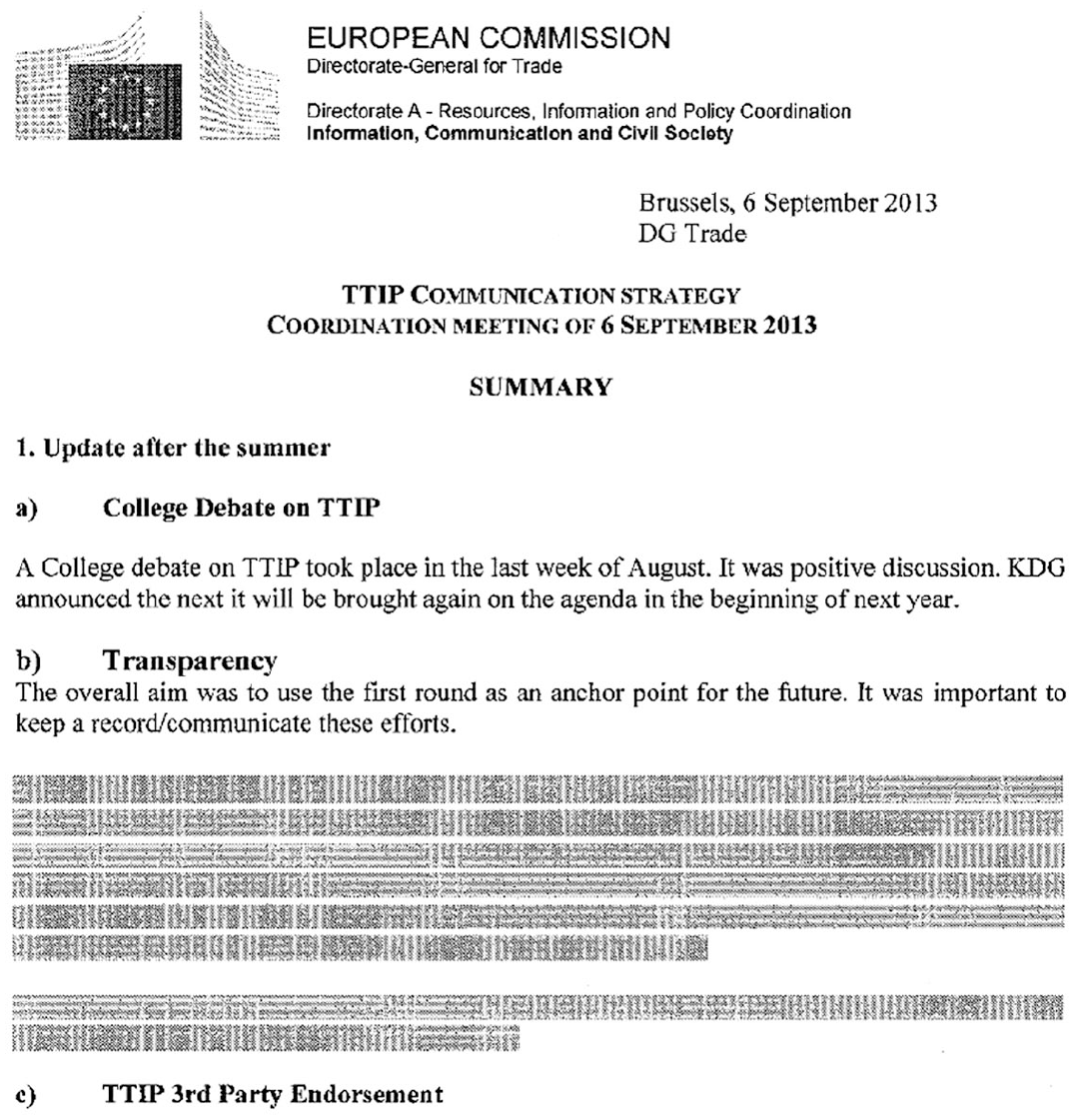
European Commission document partially disclosed through FOI request.
The justifications for non-disclosure offer additional insights into the transparency regime. The Commission claims that ‘public release of this information’ may not only limit the ‘margins of manoeuvre’ of negotiators but may have ‘negative repercussions on . . . public opinion’. In line with the delegation model of institutional transparency (Gheyle and Ville, 2017), documents pertaining to ‘controversial communication issues’ that could ‘endanger the TTIP negotiations’ thus need to be withheld, as it is ‘necessary to protect the “space to think” of officials’. In another ironic twist, the ‘public interest’, the Commission concludes, is ‘better served’ when officials are able ‘to complete the decision-making in question without any external pressure’ – that is, without the obstructive involvement of the public. The institutional imperative is clear: ‘technocratic efficiency retains primacy over democracy’ (Tsakatika, 2005: 214). Whether these justifications are in accordance with established EU case law (as the Commissions claims) matters less here than the underlying ideas about the democratic function of the public sphere that such imposed limits on the transparency regime reveal.
Conclusion
Through the case study of TTIP, this article has made a three-fold intervention in existing debates about the EC’s information policy. First, by analysing internal deliberation rather than official discourse, it offers novel insights into policymakers’ operative models of the public sphere, where the public is viewed as something to be managed and cajoled through persuasive communication. Second, in doing so it has demonstrated the potential of FOI requests as a data-gathering method for probing areas of elite discourse. The argument here is not that this is a means to accessing some putatively deeper layer of institutional ‘truths’. Nor is it about intentionality – whether the Commission’s information policy is designed to undermine the formation of an EPS. Rather, the point is that by confining analysis to official proclamations we are unable to account for the antipublic and antipolitical ideas that are encoded in the Commission’s information policy. Third, these findings challenge the (crypto)normative assumptions underpinning much contemporary theorisation of the EPS where a more ‘proactive media policy and public relations strategy’ (Desmet et al., 2015: 3192) is seen as key to solving the Commission’s alleged communication deficit. Instead, as I conclude below, the historically engrained ambivalence towards a European public sphere needs to be located in the struggle over the expansion of post-democracy, in which the contestation over TTIP became a key frontline.
Indeed, as De Ville and Siles-Brügge (2016: 122) argue, the Commission’s instrumentalisation of information policy ‘as a weapon to counter NGO “myths” and “horror stories” fundamentally misdiagnoses the problem at hand as one of “misinformation” rather than of value-based opposition’ to the EU’s neoliberal trade agenda – a misdiagnosis that chimes rather uncomfortably with much contemporary theorisation of the EPS. However, as the evidence presented earlier suggests, appeals to alternative normative principles on which different visions of trade policy could be based do not register in any meaningful sense in policymakers’ internal deliberation. This becomes apparent when set against the Commission’s efforts to ‘coordinate’ its communication strategy with ‘third-party endorsers’, which include major corporate lobby groups such as BUSINESSEUROPE and singles out the influential Transatlantic Business Dialogue as a partner for ‘joint messages’ during the 2014 World Economic Forum. What follows is that the Commission cannot implement its discursive commitment to deliberative democracy without endangering the ideological principles underpinning the EU’s trade agenda. The depoliticising logic of technocracy finds its counterpart in the neoliberal colonisation of democracy, whereby the scope of what is politically contestable is circumscribed by the overriding imperative to guarantee the functioning of ‘free’ markets and ‘free’ trade.
A key implication for theorising the EPS is thus the need to take seriously the extent to which post-democracy has diminished the function of public spheres as communicative spaces that tie the exercise of political power to public opinion formation. But, contrary to Fenton and Titley (2015), I suggest that it may be too early to abandon the public sphere from the conceptual arsenal of critical theory. Post-democratisation is a contested and unevenly distributed process (Crouch, 2016), as mobilisation against TTIP has shown, and political power ‘by definition requires legitimation’ (Habermas, 2006: 418), even in the quintessentially technocratic arena of trade policy. Indeed, as Chomsky (1991) observed some three decades ago,
State capitalist democracy has a certain tension with regard to the locus of power: in principle, the people rule, but effective power resides largely in private hands . . . One way to reduce the tension is to remove the public from the scene, except in form. (p. 375)
The Commission’s information policy is precisely an articulation of this tension: torn between the depoliticising logic of technocratic and neoliberal rationality on one hand and the legitimating demands of liberal and deliberative democracy on the other, such that public opinion becomes simultaneously invoked and excluded. This article has shown that the spectre of the public is very real in the everyday deliberations of Commission officials. Yet, as long as their primary role is to sustain the existing global trade architecture and the private interests it serves, citizens’ demands for alternative, more democratic imaginaries of public-political participation cannot be satisfied through information policy reforms alone.
