



Abstract
This article will discuss the question of whether and to what extent private ownership of media is the appropriate form for organising the infrastructures of social communication, or whether media oriented towards the common good and not profit-driven are better suited to the requirements of democratic communication in a pluralistic society. Starting from the dual character of media as merit goods and commodities, the connection between media concentration and democracy will be discussed based on concentration theories. In view of the fears that this connection might lead to negative excesses, media policy has long been attempting to curb media concentration. These efforts are shortly presented and discussed. Possibilities of balancing the dual character of the media within the framework of different ownership structures lead to the idea that public service media can form a counterweight to media concentration. This is as well an option for an internet oriented towards the common good. The suggestion of a Public Service Media and Public Service Manifesto that was published in 2021 and supported by more than 1000 subscribers from the academic and media community worldwide illustrates this possibility.
Introduction
In the recent years, attacks on Public Service Media (PSM) have increased. ‘The sustained political and economic assault on public broadcasting from the Right has coincided with the emergence of the Internet as a pervasive presence in everyday life’ (Murdock, 2021: 70). This has different causes and takes different forms in the European countries. The arguments, however, are similar: market distortion is the accusation that is varied in various forms by economic liberals; the lack of fulfilment of educational requirements and/or the forum function for public communication are postulated from a position based on democratic theory.
These attacks are no coincidence. Since the end of the public media monopoly, media offerings of all kinds have become a profitable business and regional and global media groups have increasingly dominated social communication. PSM, especially in Europe, have tried to counter the changes brought about by a commercialised media market and have been quite successful in setting different standards for media services. The question arises whether these massive attacks on PSM are intended to fundamentally discredit the possibility of public interest-oriented media that are not privately owned, so that no alternatives of business models are discussed at all for the future of the media, including AI.
This article will discuss the question of whether and to what extent private ownership of media is the appropriate form for organising the infrastructures of social communication, or whether media oriented towards the common good and not profit-driven are better suited to the requirements of democratic communication in a pluralistic society.
Starting from the dual character of media as merit goods and commodities, the connection between media concentration and democracy will be discussed based on concentration theories. In view of the fears that this connection might lead to negative excesses, media policy has long been attempting to curb media concentration. These efforts are shortly presented and discussed. Possibilities of balancing the dual character of the media within the framework of different ownership structures lead to the idea that PSM can form a counterweight to media concentration. This is as well an option for an internet oriented towards the common good. The suggestion of a Public Service Media and Public Service Internet Manifesto that was published in 2021 and supported by more than 1000 subscribers from the academic and media community worldwide illustrates this possibility.
Media as good with dual character
The concept of merit goods serves as the starting point for our argumentation. The concept states that there are goods, so called merit goods, for which private demand falls short of the socially desired level (Musgrave, 1987). For the media, this means that, on the one hand, they are merit goods from which certain services are expected that serve social goals. On the other hand, media products are (predominantly immaterial) goods, like other goods, which serve the owners to make profits, as with any other goods. The fact that media capital now often comes from financial sources other than media companies, or that non-media capital is entering the media sector (Sjurts, 2005), points to this connection. Research shows that many media companies have financial institutions among their top shareholders. These institutions include banks, securities firms, trusts, and insurance companies (DeWaard, 2017). Some venture capital firms actively invest in media and entertainment start-ups. Large institutional financial firms own a third of the media properties in the world (Noam, 2016: 1180).
The commercial media business models are in principle geared towards profit maximisation and mainly consider the interests of recipients as an instrument for financial success: ‘Commercial media institutions are driven by core economic interests to secure future profitability and expand market share’ (Hardy, 2014: 53). Societal interests do not play a relevant role in this logic. Rationalisation measures that affect the performance level and the freedom of decisions of the editorial offices are the result, which have serious consequences for societal communication. If it has long been true for analogue audiovisual media that they do no longer fulfil function of satisfying the demand for information and education in a sufficiently profitable way, this has also become a problem for the quality press. The digital communication media are no longer even measured against this claim. Still, media regulation as the attempt to apply social norms to the performance of the media market contributes more or less to reconciling standards of social communication with the market.
This dual character has led political actors to try to regulate media since time immemorial, to pursue overriding societal interests and norms. For pluralistic societies, a central norm is the pluralism requirement. This norm of plurality is a functional requirement for democratic societies because it guarantees the diversity of media content and services that is considered necessary for opinion-forming, participation, representation of interests and the depiction of social reality. The norm of diversity refers not only to the political spectrum of opinion, but also to the social, democratic, and cultural reality as a whole, including the topics, forms of presentation, and target groups represented by the media. In most countries, the diversity norm is written into media laws as a mandate for the public media.
Media concentration and democracy
This normative claim that the media should fulfil a democratic function is challenged by the fact that capitalist media markets tend towards concentration processes. From the perspective of democracy, the predominant view is that a lack of journalistic diversity, which goes hand in hand with concentration processes, is detrimental to diversity of opinion and thus to a broad discourse in a pluralistic society. Political information is seen as a good that is necessary for a democratic community and is not sufficiently provided by the mechanics of a market left to its own devices. Claims concerning the threats of ownership concentration for the fulfilment of media's democratic role have been discussed widely among scholars from liberal and critical perspectives. For example, Doyle (2002) affirms that media concentration narrows the range of voices and can lead to over-representation of certain political opinions. The same author argues that media pluralism – as opposed to media concentration – still matters in a multi-platform world (Doyle, 2015). Along similar lines, Baker argued that ownership concentration must be seen as contrary to the fundamental ideas of democracy: ‘Concentrated media ownership creates the possibility of an individual decision maker exercising enormous, unequal and hence undemocratic, largely unchecked, potentially irresponsive power’ (Baker, 2007: 16). Critical Political Economy of Media and Communications (e.g., Fuchs, 2009; Herman and Chomsky, 1988; Holzer, 1994; McChesney, 2008) point in general to the problematic role of profit-driven media business models and their influence on journalism, which in combination with media concentration can be accentuated.
Drawing on this theoretical framework, the Media for Democracy Monitor, established by the Euromedia Research Group (Trappel and Tomaz, 2021), assumes that ownership concentration in the media may compromise the plurality of the media landscape and undermine their democratic performance.
If one considers the functional requirements placed on media with respect to democracy but also to markets, media concentration poses enormous problems. Dependent on the forms and intensity of media concentration the consequences are manifold. They impact on the meso-level on corporate structure and corporate culture, on media production and distribution, on media professions and labour market, on media products and content, and as well on media research, on the micro level on media consumption, and on the macro level on media systems, media policy, and the public sphere, politics, and culture.
Despite some belief that the abundance provided by the Internet would make pluralism concerns outdated, more careful analysis indicates that online communication is characterised by even more concentrated market shares, overwhelmingly favouring large conglomerates (Hardy, 2014; Hindman, 2018). ‘Technological development is raising fixed costs and lowering marginal costs of cultural production, turning economies of scale even more profitable, a classic predictor of market concentration (Noam, 2016; Picard, 2010)’ (Trappel and Tomaz, 2021: 31).
Ownership concentration has even grown more in the last 20 years as news media have been penetrated by digital technologies. Now, increasing consolidation of news media all over the world take place, and their dominance is fuelled highly commercialised media systems and sectors (Abernathy, 2018; Saffer et al., 2020).
Within the Media for Democracy Monitor (Trappel and Tomaz, 2021) the degree of media concentration in 18 countries with mature democracies were measured with the concentration ratio. 1 A low concentration ratio (3) (CR3 lower than 0.40) with more than two competitors for all news media sectors (television, radio, newspaper, generic online media) was found for only for two countries. Thirteen countries had a moderate concentration ratio (2), with some market dominance by large companies; CR3 is between 0.40 and 0.70, and in five countries the concentration ratio was found high (1) with a weak competition, and most media sectors controlled by one company; CR3 here is higher than 0.70. A private monopoly at the national level with no competition at all was found in none of the countries. Thus, most countries of the sample of the Media for Democracy Monitor have a high or moderate concentration, with only Canada and Portugal with low concentration and more than two competitors for all news media sectors.
Causes of media concentration
In view of the extent of media concentration described above and the problematic consequences it has for pluralistic democracies, the question of the causes of media concentration arises with regard to countermeasures. Since the period of deregulation in the media sector, the economic processes in capitalist societies have been at work in the so-called dual media system of coexistence of public and commercial media, and concentration processes can be observed everywhere. They are even an inevitable component or result of the competitive process on the media market, because the private-sector organisational form of media companies forces them to minimise costs and maximise revenues. This is in general achieved by supplying the largest possible number of people with largely identical media products (Knoche, 2013: 141). Kiefer identifies ‘quasi in-built mechanics of concentration’ (Kiefer, 1995: 59).
In Marxist argumentation, the processes of accumulation and centralisation which are inherent to capitalism, lead to concentration of capital. Concentration analyses carried out on the basis of these theoretical-methodological foundations have scientific explanatory power (e.g., Baran and Sweezy, 1967; Bischoff et al., 2000; Huffschmid, 1969, 2000; Kisker, 1999, 2000; Mandel, 1972; Sweezy, 1970; all quoted in Knoche, 2013). Other media economic approaches, such as goods theory, also recognise this trend towards media concentration and explain it from the special characteristics of the media as goods with network character (Bauer and Latzer, 2016).
The economic causes of media concentration, which Knoche (2013) fundamentally locates in the private ownership of media and the associated profit-orientation, but which are fuelled by economies of scale, therefore sooner or later lead to phenomena of concentration in all media markets, even to degrees of concentration that are diametrically opposed to the ideal of a pluralistic media order. This can be observed in press markets, in the broadcasting market, in the film industry, and currently in the offerings of digital communication platforms. It can be assumed that it will also be the case for all communication-relevant applications of artificial intelligence.
However, there are also political reasons for media concentration: privatisation in the media sector, deregulation and the promotion of concentration has promoted concentration processes in recent decades. Forms of media concentration are manifold: shares, assets and investments, merger, acquisition/purchase, joint venture, strategic alliance, cooperation – to name just the most important ones. This way, media systems display horizontal integration (few companies dominate products within the same type of business), vertical integration (the whole supply chain is operated by the same or few companies), and diagonal growth (few media firms operate across several media sectors and even beyond media and communication industries) (Mastrini and Becerra, 2008).
Attempts to curb media concentration
Given the negative effects of media concentration on the democratic diversity of social discourse and the democratic role of media almost all media policies have been directed at attempts to curb media concentration and its consequences – whether ostensibly or seriously – and have ultimately failed time and again. This is true on the local, the national and on the European level (Hoffmann-Riehm, 1996), and it had no chance until now on the global level.
This is where a European perspective comes into consideration. A relevant part of media regulation beyond the respective national laws is initiated by the European Commission (Grassmuck and Thomass, 2021). Media regulation at European level pursues several objectives that are derived from the fundamental values and interests of the EU. At the centre of this is the creation of a digital single market for audiovisual media services, which is intended to guarantee the free movement of media content and services within the EU. This is to be achieved by harmonising the legal framework for media providers, promoting cross-border cooperation, and ensuring fair competition.
The promotion of media diversity and freedom of expression as essential components of European democracy and culture serves to implement the aforementioned diversity standard. This is to be achieved by supporting independent and non-state media, protecting journalists and journalistic standards, and combating disinformation and hate speech. Since the beginning of European media regulation, media concentration and its negative consequences have also been discussed more or less continuously, but no results have been achieved to date (ibid.). The protection of fundamental rights and the privacy of media users and producers, particularly with regard to the processing of personal data, are in conflict with the data-driven business models of Big Tech. This protection is to be achieved through the application of the General Data Protection Regulation and other specific regulations for the media sector.
In order to pursue the aforementioned objectives, the EU has adopted or announced various legal acts and initiatives that shape media regulation at European level. These include, among others, the Digital Services Act, which aims to regulate the liability and responsibility of online platforms for the content they host; the Digital Markets Act, which is intended to improve the competitive conditions for digital markets by creating fair and open access conditions for digital gatekeepers; the ePrivacy Directive, which regulates the protection of privacy and confidentiality of communications in the EU; and the European Media Freedom Act (EMFA), which aims to strengthen the freedom and independence of the media in the EU by supporting and coordinating the role of national media supervisory authorities. The EMFA is also intended to promote the funding and protection of investigative journalism and media pluralism.
One element of the EMFA that is of particular interest here are the references to creating transparency about media ownership (EU, 2024, Art. 6 and Art. 23). These are based on the assumption that possible restrictions on media diversity due to media concentration should at least be publicised and thus have a diversity-promoting effect. However, the EMFA still fails to control ownership concentration, democratic backsliding is not sufficiently addressed. Consequences of ownership concentration on editorial freedom, content quality, combat corruption still needs to be addressed. We can therefore conclude that transparency is an auxiliary construct to curb the consequences of media concentration: at least, the audience (can) know who owns the media and dominates the discourse.
We have to realise that anti-concentration laws ran for decades behind the real progress of media concentration (Grassmuck and Thomass, 2021). The reason for this failure of media policy is due to the fact that it generally tried to combat the consequences of media concentration, not its causes.
Diversity of ownership structures against effects of media concentration
If one wants to tackle the causes of media concentration, it becomes relevant to consider the various existing forms of media ownership; because the possibilities of balancing the dual character of media within the different forms of ownership vary considerably. The forms of regulation – self-regulation, regulated co-regulation and media governance – describe how media ownership should be put at the service of societal goals (Donges, 2007); they all ultimately aim at the excesses of media performance because of profit orientation in order to find that balance. Another – financially orientated – group of measures such as excess profits tax, digital tax aim at redistribution of profits for societal goals. However, both regulatory and financial measures do not touch on ownership and concentration.
When we focus on private ownership of the media as a cause of the problem, it follows that it should be analysed, which possibilities to fulfil the democratic requirements are given in different ownership structures, and which regulatory possibilities are effective in view of which ownership structures to contribute to this fulfilment.
With Theine et al. (forthcoming) we can approach these possibilities to fulfil the democratic requirements via the question whether ownership matters with respect to content. In their study they documented ‘the degree of influence accounted for in the individual studies—that is, whether they showed ownership influence on journalistic content and how strong this influence is’ (ibid. 5). They undertook a systematic scoping review of 56 studies focusing on the economic and political impacts on journalistic media content, whereas public interest orientation and audience alignment did not play a relevant role. Their result is clearly stated: ‘Regardless of the differences in focus and research design, our (study) shows that media ownership matters’ (ibid. 1). This finding applies irrespective of the geographic areas where the research stemmed from. In addition, Theine et al. analysed the effects of different types of media ownership media ownership on journalistic content and hereby follow the categorisation of Benson (2016, 2019) who differentiates between media owned by families or individuals and corporately owned media – traded on the stock market – public ownership and civil society ownership.
In the following, an attempt is made to consider different forms of ownership in terms of their potential to balance the two sides of media – being a merit good on the one hand and a commodity on the other: private ownership with either a low level of regulation or a high level of regulation, media moguls as a special form of ownership, foundation ownership – an equivalent to civil society ownership in Bensons's model – employee ownership, state ownership, public ownership. While media as merit goods serve the social, democratic, and cultural purposes of a society, media as commercial goods primarily serve the profit motive of their owners.
We consider here a differentiation between a low and a high level of regulation on private ownership as it can be derived from the differences of commercialised and a corporatist media system, following the model of Hallin and Mancini (2004), as it is given for example in the United States (low level of regulation) and the Nordic states (high level) (see as well Sousa et al., 2013).
In the case of low regulated private ownership, the profit motive reigns supreme – as it does in the case of media in the hands of media moguls. Tunstall and Palmer (1991) define a media mogul ‘as a person who owns and operates major media companies, who takes entrepreneurial risks, and who conducts these media business in a personal or eccentric style’ (ibid. 105). This is in line with the power mode of political instrumentalism which Benson connects to private ownership and that according to Theine et al. is found in those studies providing evidence of owners’ influence to promote their political interests (ibid. 10).
In both cases, a low and a high level of media regulation, power motives to influence social discourse play a role. In the case of highly regulated private ownership of media, media policy actors try to contain the socially negative excesses of the profit motive. In the case of foundation ownership, the motives are strongly dependent on the purpose of the foundation and the ethos of the founders. The same applies to media ownership in the hands of employees, although the more broadly diversified ownership alone can provide more balance here. State ownership of media restricts social purposes to state interests, in the worst case to those of the current government. With public ownership of media, the social, democratic, and cultural purposes are at the core of the mission, which is socially controlled and therefore provides for public funding. This is the nature of public media, which can of course vary greatly depending on social, political, and cultural circumstances (Thomaß, 2013) (Table 1).
Balancing the merit good versus the commercial commodity.
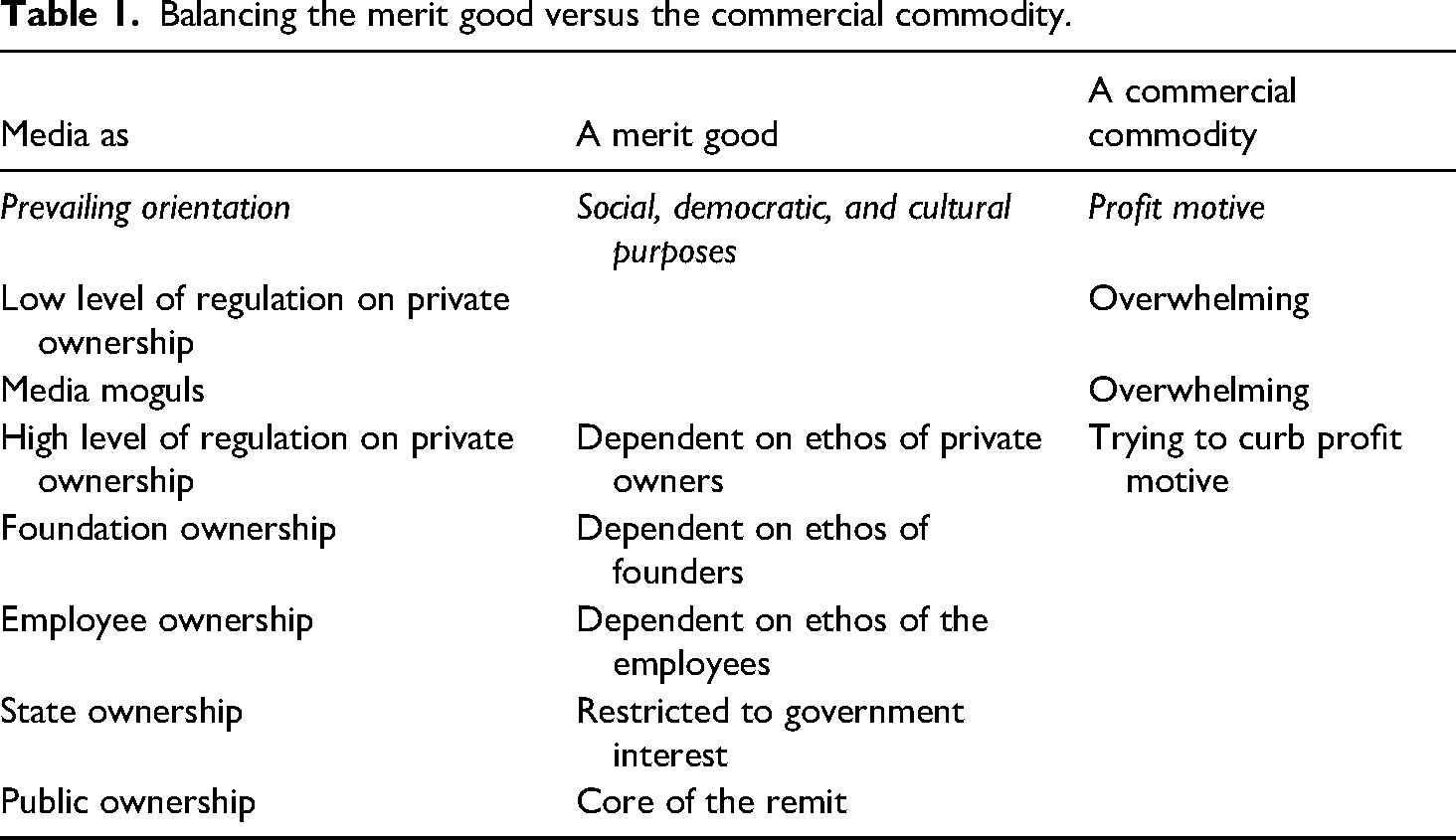
As we argued here and as Theine et al. (forthcoming) showed, ownership structures play a relevant role in the performance of media. It permeates the way a medium works, has an impact on the culture that prevails in the respective company, affects the content via company principles and codes, and these mechanisms of action can be observed more or less openly. In this respect, it can be stated that the plurality not only of media products and content but also of providers is an important element in ensuring diversity. However, it can be argued that it is not only the diversity of media providers that is relevant to diversity, but also that of ownership structures. This is because, since the relationship between media as merit and media as commercial goods is balanced differently within the framework of the different ownership structures, the diversity of ownership structures is also relevant to diversity.
Basically, it can be said that showing the diversity of society needs diversity of media makers, and pluralism of opinions, etc. needs pluralism of structures of ownership. Thus, structural diversity in the sense of balancing forms of ownership is regarded as policy against media concentration.
PSM as strong factor in diversified media ownership structures
Here we argue, as PSM are the most likely to follow the goals of media as a merit good, they act as a counterweight to the effects of media concentration. Media concentration accentuates the ability of private sector media to exploit economies of scale and target audiences as consumers on the basis of advertising, subscription funding or funding through the use of data collected online. PSM based on public funding, public control and a public service mandate are to some extent protected from market forces and can potentially better fulfil their mission to serve social, cultural, and democratic goals. Furthermore, as Thomass et al. (2022) argue, they have a corresponding effect on the entire media system within the framework of media ecology. In comparing the results of the Media for Democracy Monitor with respect to effects of strong PSM on the media system, they come to the conclusion, that strong PSM influence the performance of other media: countries with high PSM audience shares as opposed to countries with less influential PSM better serve democracy (according to the MDM indicators). The countries with strong PSM sector rank in the upper regions of the relevant democracy indicators as Freedom in the World 2021, Liberal Democracy Index 2020, Freedom of Expression Index 2018 or 2020 World Press Freedom Index.
These findings are backed by the studies that Theine et al. (forthcoming) cited in their analysis of the effects of ownership on concentration. Humprecht and Esser (2018) found national patterns in the United Kingdom, Germany, and France which suggest ‘that media systems that financially support strong public service-oriented news outlets are most likely to create media discourses that meet the normative goal of diversity in voices, backgrounds, and perspectives’ (p. 1841). Harlow et al. (2022) are mentioned with their finding that ‘public broadcasters were more likely to cover protests thematically, while private media focused more on protesters’ behaviors and appearances’ (Theine et al., forthcoming: 8). And a study of Curran et al. (2009) how European public service television channels tended to be more news-oriented compared with contemporary channels in the United States.
The EBU report ‘Democracy and Public Service Media’ (2021) presents numerous correlations between the strength of public service broadcasting and democratic quality (by key figures: correlation analyses compare key figures on public service broadcasting at country level with democracy-related indicators). Sufficiently funded public media that are valued by citizens as credible and independent are better able to fulfil their mandate. The input and impact of public service broadcasting are positively related to the attitudes and behaviour of the population. Strong public broadcasters have a positive effect on trust in news, the perception of diversity of opinion and concerns about ‘fake news’.
Empirical studies have demonstrated positive correlations at the individual or country-specific level between a strong use of PSM and factors such as interpersonal trust, approval of democratic values, knowledge of political contexts or resilience to misinformation (Speck, 2022: 266). In media systems with strong public broadcasting, spill-over effects on the quality of reporting by privately organised media and thus in turn feedback on, for example, the political interest of the population have also been observed (ibid.).
Neff and Pickard (2021) presented a study analysing the connection between strong public broadcasters and the well-being of democracy in 33 countries worldwide. They conclude, among other things, that in addition to sufficient funding, it is above all funding that is secured for several years, a clear separation of supervision and management and a pluralistic composition of supervisory bodies that ensure that PSM can make a contribution to the democratic well-being of their societies.
Therefore, we conclude here, PSM are strong counterweight to the effects media concentration. However, even if these findings give strong evidence of the fact that PSM influence a mediascape with positive effects on democratic performance of media, the growing problems of media capture in the so-called illiberal democracies show a countervailing tendency (Schiffrin, 2017). Thomass (2021) in view of a comparative study of PSM in seven countries of the Western Balkans, concludes, that ‘the eagerness of the international community and its tendency to impose models, that might have been considered positive in different historical and cultural contexts, brought no sustainable results’ (p. 280). The examples from the seven countries show how harmful the strong influence of political actors on the management and content of PSM is, damaging the independence of media institutions and compromising their democratic performance. As well in an earlier study of the same author it was mentioned ‘that the more the media are misused as instruments of political or economic actors, the less they can fulfil their function of criticism and control, the more the democratic transformation process was (and is) slowed down’ (Thomass and Tzankoff, 2001: 246, transl BT). The problem of political actors who want to usurp access to media content through their control over supervisory bodies and management functions is therefore an old one, and the question arises as to whether this type of government-controlled media should still be referred to as PSM or rather as state media (Milosavljević and Poler, 2024).
Carrying the idea of PSM to the internet
Looking at media from the perspective of their services for social communication, that is, their quality as merit goods, is also relevant for digital media. This is the basic idea behind the Public Service Media and Public Service Internet Manifesto – a joint declaration by media scholars that outlines the role and objectives of PSM and a public service-oriented Internet in the digital society, launched in 2021.
The argumentation for the manifesto considers, that public service broadcasting had been under pressure since times of commercialisation of media systems in the 80s, often framed by the narrative, that the abundance of channels, which was made possible by the distribution technologies of cable and satellite. Now, as the internet provides for a plethora of channels, the argument is revived, but from a democratic theory perspective it is more questionable than ever, as in view of the rapidly media landscape and the even higher rates on concentration on the digital media markets, PSM are becoming even more important, which must also be realised on the Internet. Murdock demands to ‘reimagine the pivotal role of public service in supporting the cultural resources, social relations and personal capacities that sustain a social order based on equity, justice, recognition and care’ (Murdock, 2021: 70).
The idea of a public service-oriented internet had its forerunners in several initiatives. The Free Software Foundation 2 has been campaigning for many years for more open standards and interfaces in technology development. The Beyond Platforms Initiative 3 is an alliance of media actors that is working to develop innovative solutions to a public service oriented digital public sphere. The European Broadcasting Union is developing infrastructure components aimed, for example, at making recommendation algorithms more transparent and diverse. 4 Public stack 5 works in particular on the local level in Amsterdam to create open, democratic and sustainable digital public spaces, although it sees the realisation of the digital public domain as well as mission in Europe. Forrester put together a visual overview of public entities which are fighting for a better internet, which shows, that a rich eco system in this perspective is evolving. 6 The body of literature in this respect is as well growing (Baratsis, 2021; Bego and Droemann, 2020; Bloemen and Hammerstein, 2017; Masnick, 2019).
The Public Service Media and Public Service Internet Manifesto was launched in search of an Internet for the common good that serves not just the commercial interests of a few companies, but the good of society as a whole. It sets out the following demands (Fuchs and Unterberger, 2021: 7ff):
Securing the existence and funding of PSM as an indispensable component of European democracy and culture, Creation of the legal, economic, and organisational foundations of PSM becoming Public Service Internet platforms that help to advance opportunities and equality in society, Distinction of PSM content from commercial media and data companies that addresses citizens, not consumers, Implementation of fairness, democracy, participation, civic dialogue, and engagement on the Internet Promotion of new formats, new content, and vivid co-operation with the creative sectors of our societies. Sustainable funding for public internet services for development of their remit, based on mechanisms such as the licence fee, the Nordic model of a public service tax, and transnational funding mechanisms, Promotion of equality and diversity, Promotion of social cohesion with opportunities for public debate and participation Promotion of change for the creation of new content and services and a sustainable ecosystem for media innovations, Contribution to a democratic, sustainable, fair, just, and resilient society.
With these ideas of an internet orientated towards the common good, the principles of PSM – public funding, public remit, public control – are transferred to the internet, without there already being a precise design and regulation in place. They could and should be guidelines for further European medai regulation. However, the basic idea advocated here, that publicly funded media orientated towards the common good can represent a counterweight to media concentration, applies all the more to the internet, which has experienced an unprecedented development of concentration over the past 20 years.
Conclusion
Media concentration has been presented in this article as a serious threat to a functioning democracy. The question arises as to how democratic rights can be guaranteed in a concentrated media market, as trust in the market is a fundamental flaw. In contrast, based on the concept of merit goods, it has been developed how structural diversity of ownership can act as a remedy against the consequences of media concentration. Media regulation and economic redistribution (multi-profit tax, digital tax) are the necessities if ownership as such is not touched. However, ownership itself remains the challenge. As the concentration processes in the digital world are accelerating, alternatives to the current organisation of the Internet are being discussed in civil society. The idea of a public service Internet provides a vision of how fundamental principles of a democratic media landscape can be transferred to digital media.
