



Abstract
Amidst a global media landscape dominated by transnational conglomerates and tech giants, proximity media face the imperative to reassess their mission and relevance. As market dynamics may lead to news deserts, proximity public service media (PSM) are crucial in catering to underserved audiences with news and entertainment tailored to their nearby environment. This paper draws on insights from seven focus groups involving stakeholders of Radiotelevisión del Principado de Asturias (RTPA), a proximity PSM outlet in northern Spain, to delve into the perspectives of audiences, production companies and advertisers on RTPA's proximity focus and informational role. The findings reveal widespread appreciation for proximity among RTPA's stakeholders, delineated into three dimensions: physical, emotional and economic. Moreover, the expectations on and assessments of RTPA's informational role are rooted in general PSM values such as impartiality, quality and participation. It is concluded that there is a need to explore the values of PSM beyond normative approaches and including the insights of stakeholders, and that proximity PSM outlets must dynamically adapt their values to meet the unique needs of proximity communities.
Introduction: Proximity media at a crossroads
Digitisation and its impact on the growing spatialisation of communication, together with the trend towards media concentration and the dominance of transnational digital platforms in global communication spaces (Martin, 2021), have put into question the survival of proximity media 1 . The struggle for sustainability in the digital environment has become one of the biggest challenges faced by both legacy media and digital natives, and it stands as a common challenge for both public and private media. The fragmentation of audiences in the face of an ever-increasing offer (Fletcher and Nielsen, 2017), the competition for their attention, increasingly concentrated in social media (Myllylahti, 2018), and the imperative need to innovate in their business model (Carvajal et al., 2022), their distribution strategies (D’Arma et al., 2021) and their relationship with the audiences (Carpes da Silva and Sanseverino, 2020) place the media at a crossroads.
For proximity media, defined as those media outlets that assume the key functions of information and representation within their territory (Martori, 2019), financial problems are even more pressing, as their traditional role as ‘keystone media’ (Nielsen, 2015) within their communities is challenged by the digital, platform-dominated media environment. As stated in the latest report on local news produced by the Hussman School of Journalism and Media, ‘massive consolidation in the newspaper industry has shifted editorial and business decisions to a few large corporations without strong ties to the communities where their papers are located’ (Abernathy, 2020: 10). This new competition environment has led to the closure of local newspapers (Abernathy, 2020), while those that still resist and are able to retain their central role in their communities must deal with the reduction of audiences, advertising revenues and newsroom staff (Jenkins and Nielsen, 2020). Moreover, some municipalities and regions are facing crucial depopulation trends, as citizens move from rural to urban areas, a phenomenon that aggravates the crisis of proximity media in these territories, often leading to news deserts (Negreira-Rey et al., 2023).
However, for a democratic society to function properly, it is essential for citizens to have access to quality information about what is happening in their immediate environment and to a socio-cultural representation that connects with their closest reality. Proximity media widely contribute to sustaining a local public sphere that serves the communication needs of nearby audiences. This might include holding local and regional representatives to account, building community by informing on social events and providing service information, such as weather forecasts (Schulz, 2021).
Previous research on audience expectations on proximity media has pointed to their demand of diverse, independent and trustworthy background information, their promotion of social integration and social cohesion, providing representation and inspiration, and their contribution to civic memory (Costera Meijer, 2010). Similarly, Hess et al. (2023) identify that the main role Australian audiences expect from proximity media involve serving as a community hub, acting as watchdog for powerful people and organisations, as a close advocate, and contributing to sustaining a historical record.
Against this backdrop, public service media (PSM) organisations 2 with a proximity approach become even more indispensable, at least from a normative perspective. While commercial proximity media, namely newspapers and digital media, are still trying to find a sustainable business model that could safeguard the provision of information and representation for local and regional communities, PSM are in a better position to reclaim their central role in their territories – specially in, but not limited to news deserts– contributing to its social and territorial cohesion (CIRCOM, 2014).
Proximity PSM in Spain: The case of Radiotelevisión del Principado de Asturias
Spanish PSM system is structured in two levels. First, the national public service broadcaster, RTVE, provides a nation-wide service. This is complemented with the territorial delegations that RTVE has in each Autonomous Community or region. Later on, most regions have established their own public service broadcasters, serving their territories from a proximity approach. The creation of these proximity public service broadcasters started in the 1980s, when the so-called historic nationalities (Catalonia, the Basque Country and Galicia) established the first three regional public broadcasters, in line with the normalisation of European PSM regionalisation process (Garitaonandía, 1993). Nowadays, there are 15 proximity PSM organisations in Spain 3 . In terms of audience, two proximity PSM channels – TV3 in Catalonia (13.9%) and Aragón TV in Aragón (11.6%) – have better figures than the nationwide generalist PSM channel La1 (10.0%) (Barlovento Comunicación, 2024). Moreover, the newscasts of TV3 in Catalonia, Aragón TV in Aragón and ETB2 in the Basque Country are the most watched in their regions (Barlovento Comunicación, 2024).
One of the proximity PSM organisations of latest creation is Radiotelevisión del Principado de Asturias (RTPA), which was established in 2003 and started broadcasting in 2005 for a region of roughly 1 million inhabitants (25% of which speak Asturian) in Northern Spain. Its selection as a case study is based on several differentiating factors. In terms of identity, Asturias is considered a region with a historical entity, whose identity is emphasised by the existence of its own, non-official language, that co-exists with Spanish in a status of minoritised language (Álvarez Sancho et al., 2023), although it plays an important role in RTPA's programming (Cañedo, 2018). Structurally, RTPA is the proximity Spanish PSM operating with the lowest budget, which has an impact on the fulfilment of its remit, without compromising citizen support, as it is the most watched broadcaster in the region (RTPA, 2024). Moreover, its business model is based on the outsourcing of its activity to local companies, which is directly linked to its public value mandate. Thus, while the Asturian communicative space is characterised by a high presence of state-level, private operators, both in the daily press and in radio, RTPA is the main proximity media in the community (Cañedo, 2018), providing services on both television (TPA) and radio (RPA). In this sense, despite the late development of proximity PSM in Asturias, there is no doubt of its importance in the Asturian media ecosystem, mainly because of its contribution to the region's audiovisual diversity (Cañedo, 2019a, 2019b).
From the outset, RTPA was conceived as a means of ‘promoting and strengthening the peculiarities of the Asturian identity, through the dissemination, understanding and development of historical and cultural values in all their variety and richness’ (Asturias, 2003). The three main pillars that RTPA is built on are public service, linguistic diversity and the revitalisation of the Asturian audiovisual sector. In this regards, previous research has confirmed that, at an economical level, RTPA has been a key agent driving the Asturian audiovisual sector, despite the budgetary constraints of the public service broadcaster and the structural weaknesses of the media sector in the region, while in terms of content, RTPA is defined as an Asturian and informative proximity television broadcaster (Cañedo, 2019a). However, RTPA falls short when it comes to meeting the needs of the Asturian-speaking community, which demands the protection of linguistic diversity in the public service broadcaster (Cañedo, 2019b).
The current situation of RTPA is defined by the lack of a management contract and by a very reduced budget of around 20 million euros per year (of which 40% is allocated to personnel expenses, as RTPA has a staff of roughly 150 people), a consequence of the austerity measures and budget cutbacks that were imposed during the government of Álvarez-Cascos between 2011 and 2012, when the threat of closure flew over the RTPA (Cañedo, 2019a). Both problems, the economic weakness and the lack of a management contract that regulates the composition of the programming grid (in terms of formats and target audiences), have resulted in difficulties in fulfilling the entrusted public proximity service remit, the main consequence of which are low audience figures − 4.7% audience share during the 2023–24 season, according to Barlovento Comunicación (2024).
Based on the above, we propose the following RQs:
How do RTPA's external stakeholders (audiences, production companies and advertisers) assess their PSM organisation's value in terms of proximity?
How do RTPA's external stakeholders value the informational role of the public service broadcaster?
Method
To answer our RQs, we developed a case study on RTPA based on the Focus Group (FG) technique, that revolves around the interaction of a group and seeks to reach an intergroup agreement or consensus (Barbour and Morgan, 2017; Hennink, 2014). The aim was to identify the perceptions and expectations of the different external stakeholders of RTPA. Compared to other common techniques for measuring audience perceptions such as surveys (see e.g. Campos-Rueda and Goyanes, 2022; Sehl and Eder, 2023), the advantage of the FG lies in its potential to identify points of intra-group consensus or dissent as well as to delve into the specific opinions and attitudes of the participants (Barbour and Morgan, 2017).
Considering the above, seven FGs were designed and developed with different audience segments, content production companies and the advertising sector (n = 59). This allowed not only to cover the whole spectrum of RTPA's audience but also to include in the study representatives of the Asturian companies that are part of the daily activity of the broadcaster. This decision was made considering an integral approach to public value assessment, so that insights into the individual, social and industrial value of PSM could be explored. Table 1 summarises the characteristics of each FG.
Characteristics of the focus groups.
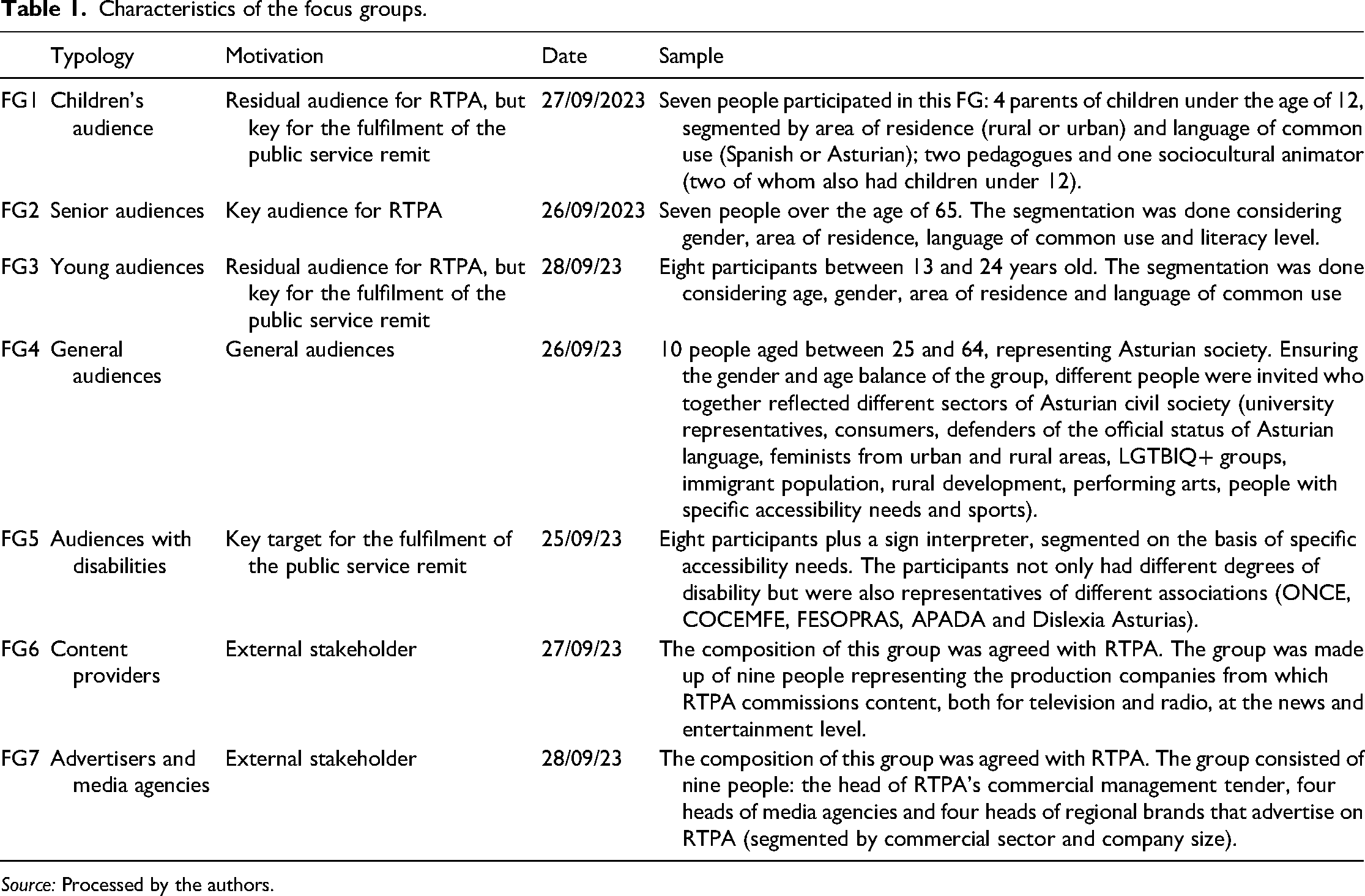
Source: Processed by the authors.
All participants in the research were contacted individually by the research team, which asked about their consumption of RTPA content. This way, even though the consumption levels could vary, all participants were familiar to some extent with the offer of RTPA. The participants were informed of the nature of the study, the importance of their presence and the dynamics of the sessions. This prior contact was key to generating a climate of trust that fostered cooperation and favoured productivity.
The fieldwork was conducted between 25 and 28 September 2023 at RTPA's headquarters (Gijón), in a space provided by the public service broadcaster, with the presence of three members of the research team. Their duration varied between 90 and 150 min. Even though from a methodological point of view conducting the FGs in the offices of the corporation entailed the risk of introducing reactivity biases, such bias turned out to be, in fact, positive, since it allowed the participants to quickly introduce themselves into the subject of the conversation. Moreover, as participants from all groups acknowledged, the experience made them feel more connected to RTPA because they felt that their opinion was important.
Results
Proximity as a transversal element of RTPA's public value
In terms of the physical dimension, audiences link this proximity to the media offer of the public service broadcaster and agree that, in order to receive quality information about Asturias, it is imperative to turn to Asturian media. Thus, all the groups recognise the value of RTPA's competence to represent Asturias and perceive that it has an impact on Asturian society due to its ability to show in a close way what is happening around them. The participants emphasise the bond that is created with the public service broadcaster, as they feel like RTPA is ‘part of their home’, not only because it allows them to keep informed on the news happening in their immediate physical environment but also because the programmes are developed from a shared social imaginary.
The physical proximity of the content is directly proportional to the interest it raises among the audiences. There is a consensus across all groups – regardless of their age – on the fact that what they like most about TPA's content is recognising on the screen the places they live in and the people they interact with in their daily lives. This feeling of attachment is even more accentuated in the audiences from rural areas, who indicate that the more isolated they are, the more their localism is enhanced, and so does their preference towards the consumption of content that reflects their nearby reality. Nonetheless, this perception only applies to the television services of TPA. As for the radio broadcasts, the vast majority of the participants state they don’t listen to RPA.
Regarding the emotional dimension of proximity, it is the older audiences who value it the most. This audience group stresses that they connect to television already at dawn, ‘especially in winter’, which exemplifies the importance of the accompaniment provided by the public service broadcaster. Once again, radio is relegated to anecdotal consumption, and only one person in this age group acknowledges tuning it in because it keeps her company when she wakes up: ‘I'm happy just to have the background noise’. In a region like Asturias, with almost a third of the population over 65, this emotional support is a crucial dimension of public value.
In the same vein, older audiences specify that they like to see other older people on screen, telling their life stories and traditions, thus highlighting the capacity of RTPA to generate and sustain a media archive that protects the rich heritage of the region. This contribution is confirmed by the audiences as well as by the representatives of the production companies, who positively underscore the presence of Asturian identity and culture – including its language – in the programming schedule of the public broadcaster. In this regards, one participant born in Romania and living in Asturias notes that what she likes most about TPA's media offer is its focus on cultural tradition, as this allows her and her family to learn new things about Asturias and feel part of the region they live in.
The sense of belonging that is linked to the emotional proximity of RTPA is also present among young audiences. Despite their disconnection with traditional media and their low television consumption, the participants under 25 state that if they turn on the television, it is because they want to watch TPA. They point that they are fond of a media offer that approaches Asturias beyond news content, mainly because they hardly feel represented on national television and, by contrast, TPA makes them feel important. The linguistic issue is also important for them, as young audiences express that they value not only the broadcasting of content in Asturian but also the possibility to hear their accent on television in a normalised way.
One last aspect of the emotional dimension of proximity is linked to the role deployed by PSM in times of crises, such as the COVID-19 pandemic. The participants in this study ascertain that, in times of exceptional news, the importance of TPA is indisputable. During lockdown, not only did TPA report on the coronavirus crisis from a proximity perspective but it also accompanied its audiences during an extraordinary historical moment when they were unable to leave their homes. The same value is underlined when referring to another difficult moment for Asturias, the wave of forest fires that devastated the region in March 2023. In this aspect, there is an inter-group consensus in recognising that ‘when these news milestones occur, TPA is always up to the task’.
Finally, regarding the economic dimension of proximity, RTPA's external stakeholders perceive the public broadcaster's economic impact both internally and externally, shaping perceptions and driving the regional economy. Audiences recognise RTPA's role in uncovering new destinations within Asturias, spurring local tourism and economic growth. However, some express concerns about the portrayal of rural life, which they feel doesn't align with reality, potentially leading to misguided tourist expectations.
Economic proximity also entails fostering the regional media industry. Production companies regret insufficient support, attributing it to budget cuts since 2012. This has normalised precarious conditions within the sector, leading to calls for increased funding to ensure fair wages and sustainable operations. Despite acknowledging past challenges, stakeholders urge corrective action to address underfunding, emphasising the broadcaster's failure to communicate its economic value effectively.
In this regards, advertisers also recognise RTPA's role in promoting regional products and services, contributing to economic development and considering that the proximity approach of the public broadcaster aligns with their branding objectives. However, advertisers express frustration over perceived neglect by RTPA's news division, which prioritises separation between news and commercial interests. They argue for a more collaborative approach, where advertisers can contribute insights to news stories relevant to their sectors without compromising journalistic integrity. Feeling marginalised, advertisers believe their relationship with the broadcaster requires greater attention and co-operation.
Public service information's value for proximity audiences
The informational value of the Asturian public service broadcaster was highlighted by all the audience groups that participated in this research. In fact, audiences define TPA as a pre-eminently informative broadcaster and, in line with audience data 4 , the newscasts ‘TPA Noticias’ are the most watched programmes among the participants. The assessment made by the audiences on the informational role of the RTPA is positive and, as already mentioned above, they appreciate the role played by the public broadcaster in exceptional times such as the COVID-19 pandemic. The participants, across all age groups and regardless of their background – rural or urban –, particularly value the quality of the news, the depth with which nearby issues are dealt with – ‘because they go into detail about what is happening in Asturias’ – and the independence they perceived in news production, although such perception has a negative counterpoint which will be dealt with later.
In terms of quality, the audiences that were part of the FGs agree that informative content, namely the television newscasts, represents the flagship of the public service broadcaster. Contrary to the general decreasing levels of trust on news media (Newman et al., 2023), the participants consider RTPA's news trustworthy and professional. Indeed, one of the participants points to the journalists and media professionals working at the public broadcaster as ‘the main asset of TPA as a public service’ although he feels that RTPA's personnel is ‘under-exploited and under-performing’, mainly due to the lack of innovation in developing news content that go beyond the newscast, such as political and industrial debates. This is in line with the difficulties that other European PSM also experience in terms of innovation in the news, as their public service mission might conflict with following the trends established by commercial media (Sehl and Cornia, 2021).
Likewise, the groups of general audiences and young audiences also agree on the need to improve political debates on the public broadcaster. The participants point to the lack of diversity on the political roundtable that followed the political debate during the campaign of the local elections in May 2023. General audiences defined such roundtable as ‘gloomy, sad, stale’, a picture that is also shared among young audiences, who feel left out of the political conversation, and call for better representation of the diversity of Asturian society, considering rural population, feminism, the cultural industry and the Asturian language.
One major problem in the provision of public service news is identified in the group of audiences with disabilities, who feel that RTPA is not serving them properly and that there is room for improvement in terms of accessibility. Audiences with hearing impairments feel that their right to information was violated during the COVID-19 lockdown due to the deficiencies of the automatic subtitling accompanying the regional president's press conferences, which was riddled with errors. Moreover, they also point out that the lack of sign-language interpreters during such press conferences represented a serious communication gap for those citizens for whom sign-language constitutes their main communication system. Representatives of this FG considered that at a historic moment of special social relevance, the RTPA neglected the principle of universality, a cornerstone for PSM.
The second value perceived by the audiences in the informative content of RTPA is the depth with which proximity issues are approached. They appreciate not only being able to access in-depth information on what is happening around them but also the extensive territorial coverage, which allows the public broadcaster to report on the current affairs developing throughout Asturias. Again, the coverage of electoral processes with a proximity approach is positively highlighted by the participants.
In relation to this proximity perspective, the audiences also value the platform for participation that has been opened by the broadcaster. The mere fact of appearing occasionally on a TPA programme, for example, with a statement on the news, is valued and appreciated by all audience groups, as well as by advertisers and production companies. There is total consensus that ‘society is very grateful when a TPA camera appears’. This links with both the physical and the emotional proximity of the public broadcaster, that enhances a sense of belonging between audiences and the RTPA.
Finally, there was also a clear intergroup consensus in stating that the news services of RTPA are impartial and non-aggressive, which distinguishes them from the sensationalist bias present in other news programmes on Spanish free-to-air television. The participants agree that the staff of the public broadcaster demonstrates high levels of professionalism and there is a consensus on the objectivity that surrounds news production at RTPA. In the words of a participant representing young audiences, ‘the reason why I turn to TPA when I watch the news on television is because I am a bit tired of the way they are in other media, positioning themselves a lot, to the point where I don't know if they are reporting the news objectively or not’. In this sense, RTPA's lack of positioning is perceived here as something positive, connected to a more objective news coverage, far removed from sensationalism and partisanship: ‘In TPA, as they don't position themselves so much, [the news are] at least a little more objective’.
However, this neutrality is also perceived as something negative among the participants. The general feeling is that RTPA is a ‘very white broadcaster’, in the sense that it does not take an ideological stance on social issues and human rights. General audiences refer here to the rise of the far-right and hate speech, while young audiences call for the explicit condemnation of male violence, the normalisation of a feminist discourse and the protection of the rights of the LGTBIQ+ community. In this regards, young audiences consider that, when addressing such pressing issues, ‘to adopt a neutral position is adopting a position’, and demand RTPA to embrace these values as its own, as part of its public service remit.
Overall, the participants attribute RTPA's neutral stance to fear of both commercial and political consequences. Younger representatives suggest RTPA avoids advocating for women's and LGTBIQ+ rights to retain older, less socially engaged audiences. Politically, budget cuts in 2011–2012 led to a subdued approach to avoid closure. This fear of closure undermines thorough news coverage and societal impact and hampers the public service broadcaster's ability to act as watchdog and monitor the nearby environment.
Conclusions
This paper delved into the case of RTPA, a small proximity PSM organisation in Spain. Despite catering to the communicative needs of roughly one million people, this case illustrates the expectations and assessments of audiences regarding proximity media overall, with a particular focus on proximity PSM. As argued before, amidst the growing influence of globalised media and digital platforms, maintaining a vibrant proximity public sphere presents a significant challenge, underscoring the role that PSM organisations like RTPA can play in preserving local voices and fostering community engagement.
The results of this research showed that Asturian audiences widely value the proximity deployed by the regional PSM. The distinctiveness of TPA's programming (as opposed to the radio offer of the broadcaster) lies in its physical, emotional and economic proximity, as perceived by RTPA's external stakeholders. Audiences regard RTPA as an essential source of high-quality information about Asturias and their nearby realities, forging a profound connection that extends beyond mere consumption to a sense of shared identity and belonging. This might be mainly due to TPA being the only television offer in the Asturian public sphere, as opposed to radio, where competition from the regional services of nationwide media outlets dilutes the perceived value of RPA. Furthermore, RTPA's external stakeholders acknowledge the broadcaster's role as a public service entity and correlate their appreciation of its informational function with PSM's public value dimensions, including impartiality, participation, quality and professionalism.
However, the results also point to some sources of concern. RTPA's public service remit is at risk, as the broadcaster falls behind in meeting some core values with its performance. Universality is questioned as audiences with disabilities express their problems in accessing RTPA's media services, and, also in relation to diversity, young audiences feeling ‘left out’ can discredit the Asturian PSM organisation. On a different note, the results also show that different PSM values can collide. The way external stakeholders decode the value of independence and neutrality is of particular interest. While traditionally viewed as positive attributes, there is contention among stakeholders who advocate for a more defined stance from RTPA on social and political issues. This underscores the need to explore the values of PSM beyond normative approaches, contrasting previous understandings with the perceptions and expectations of audiences and other PSM stakeholders.
This research is not without its limitations. The focus is placed on the stakeholders’ perceptions, rather than in the actual media practices of the audiences. While the participants were familiar with RTPA's services, it is not possible to derive whether more intense media consumption leads to differences in the assessment, and this could be object of study of further research. The findings of this case study, however, hold valuable insights that can aid in refining the strategies of proximity PSM organisations, akin to RTPA. These organisations navigate the balance between their dual identities: that of a public service entity and a provider of proximity content. While rooted in the principles of public service, these media outlets must dynamically adapt their values to meet the unique needs of proximate communities in terms of universality, innovation, diversity and excellence. This requires a nuanced understanding of how to uphold the core tenets of public service while effectively catering to the specific demands and expectations of local audiences.
Footnotes
Funding
The author(s) disclosed receipt of the following financial support for the research, authorship and/or publication of this article: This paper is part of the activities of the followings research projects: ‘Public Service Media in the face of the platform ecosystem: public value management and evaluation models relevant for Spain’ (PID2021-122386OB-I00), funded by the Spanish Ministery of Science and Innovation, the State Research Agency and the European Regional Development Fund; ‘Study on the Public Value of Radiotelevisión del Principado de Asturias’ (230329UCTR); and ‘Audiovisual platformization: A propositional diagnosis of the platformization processes in the current Spanish media landscape’ (2022-GRIN-34309), funded by the UCLM Research Grants Plan and the ERDF.
