



Abstract
Accusations of fake news have become a prominent feature of contemporary political conflict, yet most research continues to treat fake news primarily as a problem of misinformation rather than as a strategic communicative practice. This article advances a novel theoretical framework—the Strategic Delegitimization and Selective Amplification (SDSA) model—to conceptualise fake news accusations as rhetorical weapons in negative campaigning. The model explains how political actors employ this strategic label to delegitimize opponents and how news media selectively amplify these accusations in line with editorial tendencies. This article tests the implications of the SDSA model using a novel dataset of 2778 newspaper articles containing fake news accusations between Italian political parties from 2020 to 2024. The analysis maps patterns of accusations, examines the dual role of populist actors as both accusers and targets, and demonstrates how media partisanship conditions coverage. The findings show how fake news accusations politicize epistemic legitimacy, and contribute to research on misinformation, populism, and media–politics relations.
Introduction
In recent years, the term fake news has become a central and contentious topic in the public discourse. While initially associated with fabricated stories circulating online, the label has increasingly been deployed by political actors as a rhetorical device to undermine opponents’ credibility. As noted by Egelhofer and Lecheler (2019), “fake news” has become a strategic label—less about accuracy than about delegitimization. This shift reflects a broader transformation in political communication, where the battle for epistemic legitimacy often supersedes debates over policy substance.
This transformation raises important questions about the role of the media in contemporary political conflict. The extent to which fake news claims gain traction depends crucially on media coverage. In media systems characterized by enduring ideological divisions, news organizations may actively shape epistemic conflict by selectively reporting and amplifying accusations made by some political actors rather than others. Understanding how fake news accusations circulate, therefore, requires renewed attention to the relationship between political actors and news organizations and to editorial tendencies.
The Italian case offers a particularly illuminating test for examining a theoretical puzzle: how political parallelism persists and operates in media systems where its classic foundations have eroded, yet media continue to play a decisive role in structuring epistemic conflict. Historically, Italy has exhibited strong political parallelism, with newspapers long associated with specific parties and ideological traditions (Hallin and Mancini, 2004; van der Pas et al., 2017). However, recent decades have seen both the disappearance of the party press and a deep crisis of public trust in political and journalistic institutions (D’Arma, 2015; Mancini, 2013). These trends raise key questions about whether ideological affinity between newspapers and parties continues to shape coverage even in the absence of formal ties. The persistence—or transformation—of political parallelism under these conditions can shed light on how media-politics relationships evolve in post-ideological contexts.
The rise of populist parties further sharpens this puzzle, providing fertile ground for studying how fake news accusations circulate between political actors and through media outlets. Populist actors present themselves as the authentic voice of “the people” against a corrupt elite and an untrustworthy media system, framing journalists as part of the establishment they seek to challenge (Hameleers et al., 2016; Waisbord, 2018). This antagonistic stance predisposes them to use accusations of fake news as a rhetorical weapon: by labeling critical narratives as “false,” they reinforce their anti-elite message and delegitimize mainstream media. At the same time, their frequent use of emotionally charged and unverified statements makes them prominent targets of such accusations. Investigating how populist parties feature in fake news disputes can thus illuminate broader dynamics of epistemic conflict in polarized political environments.
Against this backdrop, this study investigates the drivers and dynamics of fake news accusations in the Italian press between 2020 and 2024. We ask who accuses whom of disseminating fake news and how newspapers mediate these rhetorical struggles. To do so, we propose the Strategic Delegitimization and Selective Amplification (SDSA) model, which conceptualizes fake news accusations as instruments of negative campaigning deployed by political actors and selectively amplified by ideologically aligned media.
Our study contributes to political communication research in three ways. First, it advances the study of negative campaigning by incorporating media selectivity into the analysis of epistemic delegitimization (Egelhofer and Lecheler, 2019). Second, drawing on a novel dataset, it provides systematic evidence on how fake news discourse functions in a multiparty, high-parallelism system such as Italy. Third, it clarifies the dual role of populist parties as both prolific accusers and frequent targets in the politics of fake news (Hameleers, 2020), while showing how editorial tendencies shape media coverage, enriching our understanding of how political parallelism continues to structure the mediatized public sphere (van der Pas et al., 2017).
Conceptualizing fake news accusations in political communication
Scholarship on fake news and disinformation has increasingly moved beyond a narrow focus on false or misleading content to examine the political uses of the “fake news” label itself. While early work emphasized the diffusion of fabricated or misleading information, particularly in online environments (Allcott and Gentzkow, 2017; Sunstein, 2017), more recent scholarship conceptualizes “fake news” as a discursive and strategic label deployed in political conflict (Egelhofer and Lecheler, 2019). From this perspective, accusations of fake news do not simply contest the accuracy of specific claims but function as tools of epistemic delegitimization, undermining the credibility of opponents as legitimate participants in public debate (Daur, 2025).
Recent scholarship further complicates the definition of “fake news,” placing it within a broader continuum of “information disorder” that ranges from “misinformation” (false information disseminated without intent to harm) to “disinformation” (false information deliberately produced to cause harm) (Wardle and Derakhshan, 2017). In political communication, however, many statements fall into a gray area, involving exaggerations, selective use of facts, or misleading framing rather than outright falsehoods. As research on fact-checking demonstrates, even professional fact-checkers encounter difficulties in classifying political claims as strictly true or false, given their interpretive and contextual nature (Serafini and Zagni, 2024).
In this context, the present study does not aim to assess the factual accuracy of statements but focuses on the strategic use of the label “fake news” itself. Accordingly, we treat fake news as a discursive resource whose meaning is produced through patterns of attribution and media circulation. This perspective shifts attention from informational content to the relational dynamics through which credibility is constructed and contested.
This approach aligns with research on negative campaigning, which examines how political actors seek advantage by attacking opponents rather than promoting their own policy positions (Lau and Rovner, 2009; Nai, 2020). Fake news accusations constitute a distinctive form of such attack: unlike conventional critiques that question competence or issue positions, they challenge an opponent's epistemic legitimacy, transforming political disagreement (“you are wrong”) into moralized accusations of deception (“you lie”).
This perspective also intersects with the literature on incivility in political communication, which conceptualizes norm-violating language and personal attacks as strategic tools for delegitimizing opponents (Bentivegna and Rega, 2024). However, while incivility research focuses on tone and norm violations, the present framework emphasizes the epistemic dimension of conflict, in which actors challenge the credibility and truthfulness of their opponents.
Political conflict involving populist actors offers a particularly salient context for these dynamics. Populist communication is often characterized by anti-elite rhetoric, appeals to authenticity, and the use of emotionally charged or weakly substantiated claims, including conspiracy theories, which both invite counter-accusations and legitimize epistemic attacks (Galanopoulos and Stavrakakis, 2022; Hameleers, 2020). As a result, populists are likely to occupy a dual position in fake news disputes, acting both as prominent accusers and frequent targets of epistemic delegitimization.
Media retains a pivotal role in circulating such accusations. While much research has focused on social media (Broda and Strömbäck, 2024), highlighting algorithmic personalization and echo chambers (Aïmeur et al., 2023), less attention has been devoted to traditional media, despite its continued influence (Langer and Gruber, 2021). In particular, fewer studies examine how legacy media frame accusers and accused in fake news disputes, and whether they amplify such rhetoric in line with ideological stances. Addressing this gap is essential for understanding how accusations circulate beyond digital environments and are filtered through partisan media logics.
Theories of political parallelism suggest that media coverage of fake news accusations is unlikely to be neutral, instead reflecting the ideological orientations of media outlets (Blumler and Gurevitch, 1995). Understood classically as the alignment between media organizations and political actors (Hallin and Mancini, 2004), political parallelism persists despite the erosion of mass parties, adapting to new logics of polarization, affective partisanship, and audience segmentation (de Albuquerque, 2018; Strömbäck and Kiousis, 2014). From this perspective, contemporary political parallelism no longer relies primarily on overt partisan defense but on epistemic differentiation, whereby media outlets define which actors and claims are credible, contestable, or illegitimate. This selective reporting reflects both strategic partisanship and the journalistic logic of conflict amplification (Waisbord, 2018), contributing to the stabilization of asymmetrical reputational hierarchies and enduring patterns of ideological alignment.
The SDSA model
Building on these strands of research, we propose the “Strategic Delegitimization and Selective Amplification” (SDSA) model as an integrated framework capturing both the strategic behavior of political actors and the mediating role of news organizations. The SDSA model is not intended as a formal predictive model, but as a synthetic analytical framework combining three strands of research: (1) “fake news” as a strategic label in political conflict (Egelhofer and Lecheler, 2019); (2) negative campaigning (Lau and Rovner, 2009; Nai, 2020); and (3) political parallelism (Hallin and Mancini, 2004; van der Pas et al., 2017). By integrating these perspectives, the model provides a relational account of how fake news accusations are produced, circulated, and amplified.
At its core, the model conceptualizes fake news accusations as a triadic interaction between an Accuser (party/leader A), a Target (party/leader B), and a Media Outlet (X). The accuser launches an accusation, the target is accused of spreading fake news, and a newspaper may report it according to its political alignment with the accuser or the target (see Figure 1).
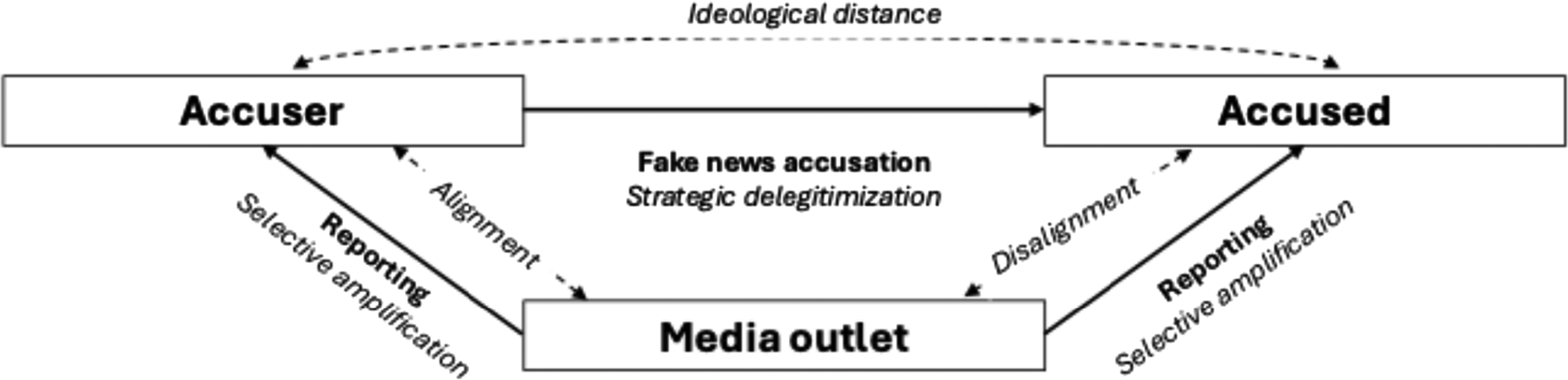
The Strategic Delegitimization and Selective Amplification (SDSA) model triadic relationship.
We address two sets of research questions corresponding to the model's components. First, concerning strategic delegitimization: who accuses whom of fake news in Italian political discourse, and are populist parties more frequently involved as accusers or targets? Second, concerning selective amplification: how does media coverage of fake news accusations vary across newspapers, and do newspapers amplify accusations from like-minded parties while targeting distant ones?
The first component of the model, strategic delegitimization, concerns the incentives of political actors to deploy fake news accusations as epistemic attacks. Rather than contesting specific claims, such accusations challenge the credibility of opponents, shifting conflict from factual disagreement to disputes over truth and legitimacy. This dynamic is particularly evident in polarized contexts, where the parties seek to portray opponents as untrustworthy.
The SDSA model predicts that such accusations are not randomly distributed. Populist parties are expected to play a prominent role: they frequently deploy fake news accusations as part of a broader anti-elite discourse, while their communication styles—often emotionally charged and weakly substantiated—also make them vulnerable to counter-accusations. As a result, populists are likely to occupy a dual position in epistemic conflict, as both accusers and targets. More generally, fake news accusations are expected to occur more frequently between ideologically distant actors. From this logic, we derive the following hypotheses:
H1: Populist parties are more likely to make fake news accusations. H2: Populist parties are more likely to be accused of spreading fake news. H3: Fake news accusations are more frequent between ideologically distant parties.
The second component of the model, selective amplification, concerns how media organizations mediate fake news accusations. The SDSA model predicts that coverage depends on editorial positioning: newspapers are more likely to report accusations made by ideologically proximate actors and targeting more distant ones (van der Pas et al., 2017). This selective amplification enhances the delegitimizing impact of accusations and embeds them within broader patterns of political parallelism, contributing to the construction of reputational hierarchies in which some actors are recurrently framed as unreliable. From this logic, we derive two further hypotheses:
H4: Newspapers are more likely to report fake news accusations made by ideologically proximate parties. H5: Newspapers are more likely to report fake news accusations targeting ideologically distant parties.
These dynamics do not manifest uniformly across all contexts. Their intensity depends on factors such as political polarization, the presence of populist actors, and periods of heightened issue salience or crisis (e.g. pandemics, migration, and geopolitical conflicts), which tend to exacerbate epistemic controversies.
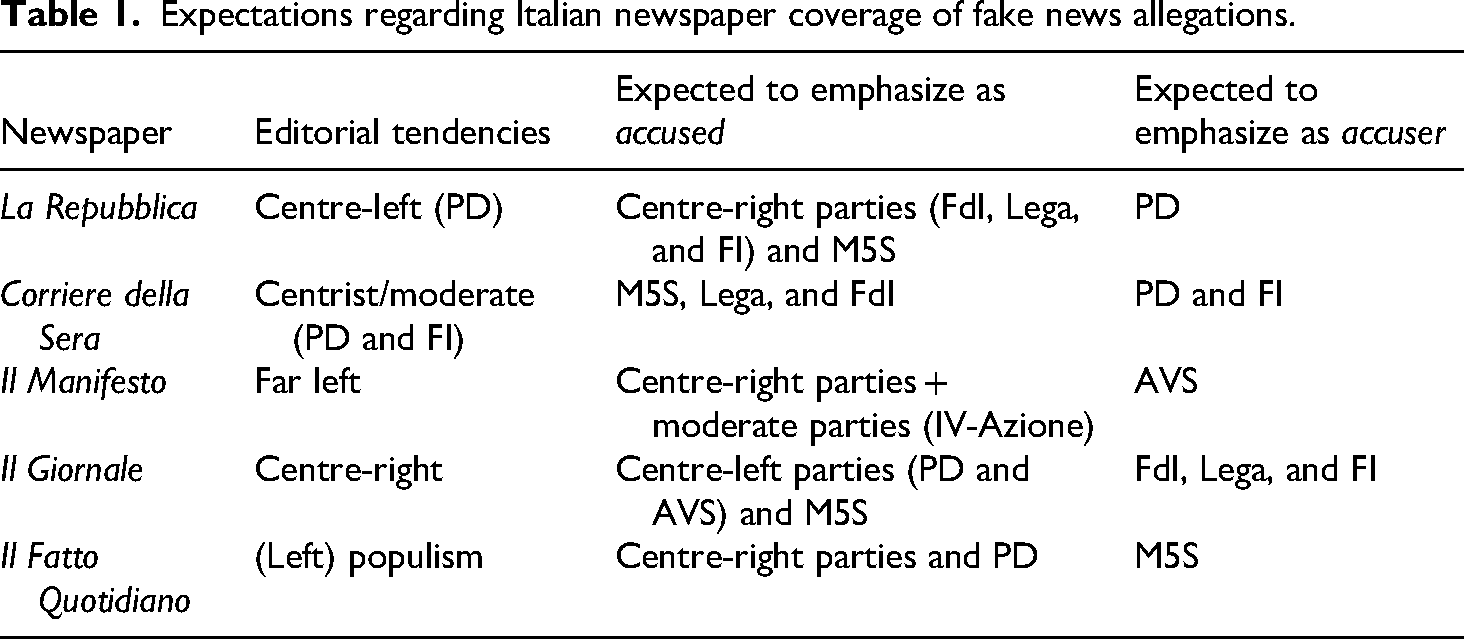
In the empirical analysis that follows, we test the hypotheses derived from the SDSA model using a novel dataset of fake news accusations between eight major Italian parties or leaders 1 in the national press between 2020 and 2024. Five daily newspapers were selected to reflect the ideological breadth of the Italian press: La Repubblica, Corriere della Sera, il Giornale, il Fatto Quotidiano, and il Manifesto. Table 1 shows specific expectations regarding newspaper-party relations in the Italian context summarizing the expected coverage patterns based on the literature on political parallelism and the Italian media system. These expectations should be understood as ideal-typical trends rather than as fixed and rigid classifications of the relationships between newspapers and political parties. In contemporary Italy, in fact, editorial positioning is often indirect, fluid, and contingent on specific issues or contexts (Mancini, 2013). Consequently, the table identifies plausible directional patterns in the way newspapers may differentially emphasize actors as accusers or targets of accusations of fake news.
Expectations regarding Italian newspaper coverage of fake news allegations.
Research design and methodology
Italy provides an ideal case study for examining fake news accusations due to its polarized political environment, strong presence of populist parties, and pronounced political parallelism. We analyze articles from five Italian newspapers between January 2020 and December 2024, covering major crises, including the COVID-19 pandemic, the Russian invasion of Ukraine, and renewed contestation over migration. These periods increase uncertainty and political conflicts, amplifying the production and circulation of controversial claims. Although SDSA mechanisms are not limited to crisis contexts, their empirical manifestation can be particularly pronounced during phases of intense media attention and high-stakes issues.
The dataset was constructed using the Factiva database, retrieving articles containing the English expression “fake news” and its Italian equivalent “notizia falsa” alongside references to at least one major Italian political party or leader. This strategy focuses on explicit uses of the label, consistent with our theoretical framework.
While other terms (e.g. “disinformazione”—misinformation—or “bufala”—hoax—) capture related phenomena, our aim is to analyze the strategic deployment of the label itself, prioritizing conceptual precision over exhaustiveness.
After filtering and de-duplication, the corpus comprises 2778 articles. From each, a text window surrounding the occurrence of the term “fake news” was extracted to capture the immediate discursive context.
The core analytical task is to identify whether actors appear as accusers (i.e. alleging the existence or spread of fake news) or targets (i.e. being accused as responsible for spreading fake news). We employ GPT-4, to automate classification, and thereby avoid the prohibitively time-consuming and potentially inconsistent manual annotation. We adopt a zero-shot prompting approach, ensuring consistent coding without pre-labeled training data. Prior research demonstrates that, for complex classification and relational coding tasks, zero-shot LLMs can match or even exceed the performance of human coders and crowd-sourced annotators (Chae and Davidson, 2025; Di Leo et al., 2025; Gilardi et al., 2023; Törnberg, 2023). For each extracted text window, the LLM was prompted using a consistent, structured template, which instructed it to: identify the political actors directly linked to the fake news mention (if any); classify each identified actor as either an accuser or an accused, or to exclude them if no clear attribution was present; return outputs in a structured JSON format suitable for automated parsing and aggregation.
As with any LLM-based coding, systematic validation is essential. We therefore implemented a multi-step validation strategy. A stratified 5% random sample of the corpus was manually annotated by the authors, with stratification by newspaper to ensure coverage across outlets, and compared with LLM outputs. Agreement reached 75%, consistent with established benchmarks (Cicchetti and Sparrow, 1981; Gilardi et al., 2023; Landis and Koch, 1977). 2 While the model performed particularly well in identifying actors and assigning rhetorical roles, party affiliations were assigned manually to ensure accuracy.
The final dataset consists of 1082 coded observations linking fake news references to actors, roles, and party affiliation.
To examine patterns of fake news accusations among political actors, we first conduct descriptive analyses comparing the frequency with which different parties appear as accusers and as accused actors. Following The PopuList (Rooduijn et al., 2023), 3 the M5S, FdI, Lega, and Forza Italia are classified as populist, while the rest are considered non-populist. Statistical significance in role distributions is assessed using chi-square and proportion tests. To then assess whether fake news accusations are more likely between ideologically distant parties, we merge the data with left–right ideological placements from the Chapel Hill Expert Survey (from now on, CHES). Ideological distance is operationalized as the absolute difference between the accuser and accused party's left–right scores. We first compare the distribution of accusations within and across ideological blocs, classifying parties into left and right camps based on their CHES scores. We then model the frequency of accusations between party pairs using negative binomial regression, with ideological distance as the key independent variable. This approach accounts for overdispersion in pairs counts and allows us to estimate how ideological distance relates to the intensity of fake news accusations.
Finally, to examine selective amplification, we analyze the distribution of accusers and targets across newspapers. For each newspaper × role combination, we calculate party-level shares to compare frequencies, as well as to compare them to pooled baseline distributions across all newspapers. These analyses allow us to assess whether particular outlets systematically over- or under-represent certain actors.
Empirical analysis
The analysis proceeds in two parts: (a) patterns of accusations among political actors (H1–H3), and (b) newspaper reporting patterns (H4 and H5).
A full descriptive overview of the dataset is provided in the Supplemental Appendix. In total, 1082 accusations of fake news were identified in the corpus of Italian newspaper articles between 2020 and 2024. 4 Supplemental Table A1 provides the descriptive statistics of the coded dataset, while Supplemental Figure A1 shows the distribution of accusations by newspaper over time.
Strategic delegitimization: Fake news accusations among political actors
We first examine whether populist parties are more involved as accusers or targets. Results provide mixed support for the populism hypotheses. Populist parties account for 50.9% of fake news allegations, indicating no significant difference from non-populists (H1 not supported). However, they constitute nearly 70% of accused actors, strongly supporting H2. As shown in Figure 2, the FdI and, above all, the Lega are the parties who are more likely to be “accused” rather than “accuser.” An example of such an accusation comes from La Repubblica in June 2023, when Angelo Bonelli, leader of the left-green alliance (AVS), is reported as accusing the leaders of both populist parties, Giorgia Meloni and Matteo Salvini, of using “fake news” to create disinformation about the ecological transition. 5 It is notable that this pattern is not evident for the other populist parties—the Five Star Movement and Forza Italia—which do not display the same asymmetry between accusations made and accusations received.
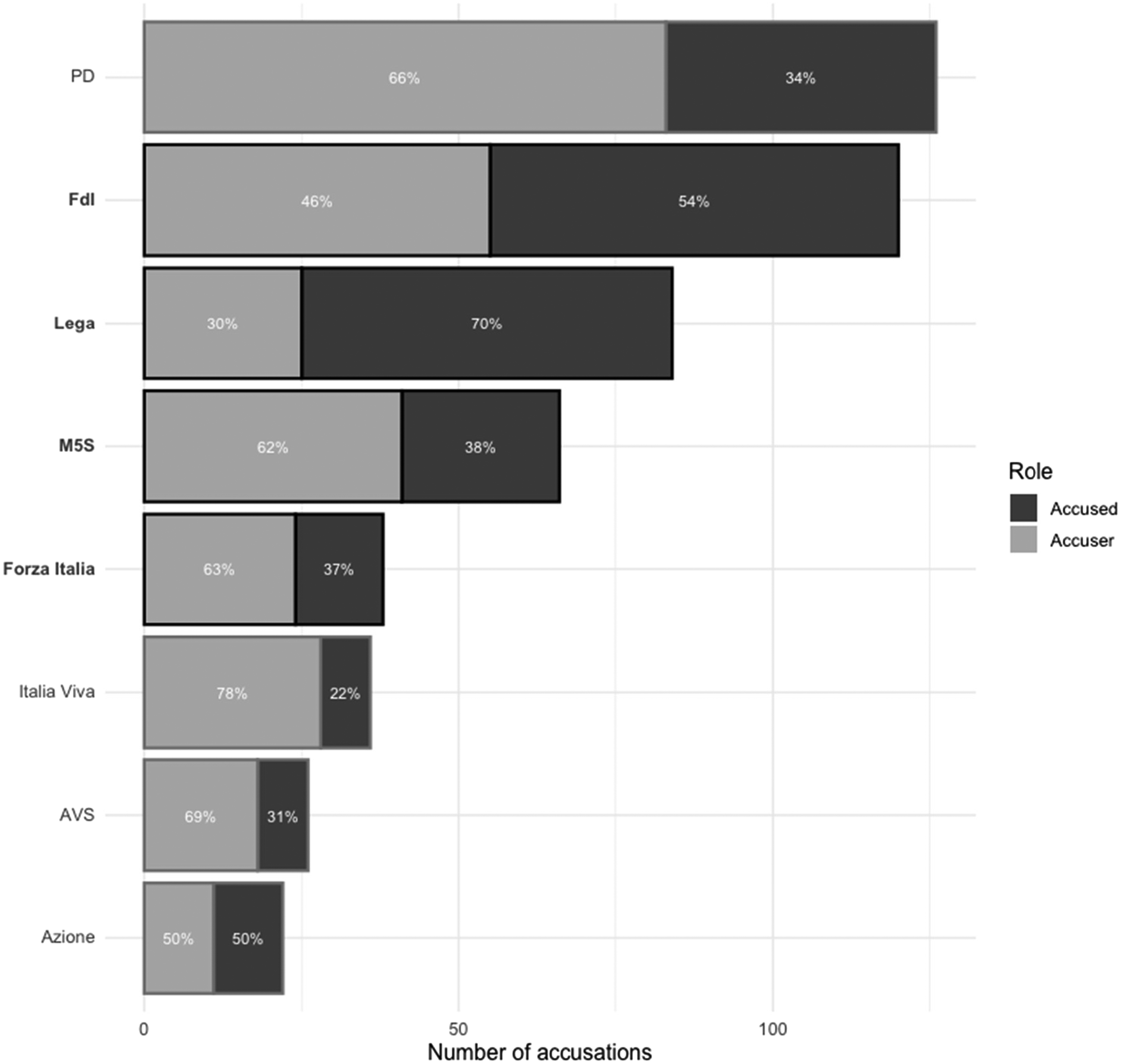
Fake news accusations among Italian political parties in national newspapers, 2020–24. Note: Populist parties are highlighted with bold labels and outlined bars. Party classification follows The PopuList (Rooduijn et al., 2023).
To formally assess whether populist parties occupy a distinct position within fake news discourse, a chi-square test was conducted comparing party type (populist vs. non-populist) and rhetorical role (accuser vs. accused). The results indicate a statistically significant association between party type and role (χ2(1) = 18.58, p < .001). This relationship is driven primarily by the accused role: populist parties are accused of spreading fake news far more frequently than non-populist parties, whereas the distribution of accusations made is nearly even across party types. This interpretation is further corroborated by directional proportion tests. While populist actors account for a slim majority of accusations made (50.9%), this share does not significantly exceed parity (p = .41), providing no statistical support for H1. By contrast, populist parties constitute a large and statistically significant majority of accused actors (69.9%; p < .001), offering strong support for H2. This pattern is highly consistent across newspaper outlets, as shown in Figure A2 in the Supplemental Appendix. Populist actors constitute a majority of those accused of spreading fake news in every newspaper considered, whereas no comparable pattern emerges for accusations made.
Taken together, these results indicate that populism is not associated with a greater propensity to be reported as deploying fake news accusations, but rather with a heightened likelihood of being framed by others as a source of disinformation. The association between populism and fake news rhetoric in Italian newspapers seems to be characterized by a structurally asymmetrical pattern of attribution. In other words, fake news rhetoric appears to function less often as a populist offensive strategy than as a discursive tool through which populist actors are targeted by political opponents and the media.
We should also note that a large proportion of fake news accusations captured in the dataset refer to other actors, besides Italian party politicians. There are many references to accusations circulating among Italian media figures, including journalists and those in large media institutions. One example is reporting on the so-called “Scurati case” (Caso Scurati), in which antifascist intellectual Antonio Scurati's cancelled appearance on the public broadcaster RAI was framed by opposition parties and journalists as political censorship, while RAI management and government-aligned actors countered by accusing critics of spreading “fake news” about the broadcaster and misrepresenting an editorial dispute. In addition, a large segment of the dataset refers to accusations between foreign actors—especially concerning government figures from Russia and the USA. These are excluded from the analysis, which concentrates on accusations involving Italian political parties.
We then assess whether fake news accusations are more frequent between ideologically distant parties (H3). To do so, we construct directional accuser–target pairs from each article in which at least one political actor is accused of spreading fake news.
We begin with a descriptive comparison of accusations occurring across versus within left–right ideological blocs. Parties are classified into left and right camps based on their CHES left–right scores, and the pairs are coded according to whether the accuser and target belong to different ideological camps. We first find that the vast majority of fake news accusations occur across ideological blocs rather than within them. More than 80% of observed accusation dyads involve parties located on opposing sides of the ideological spectrum, whereas fewer than 20% take place within the same ideological camp (see Figure A3 in the Supplemental Appendix). This pattern provides initial descriptive support for H3, suggesting that fake news rhetoric is predominantly deployed across camps and thus indicative of ideological conflict.
To assess this relationship more formally, we model the frequency of accusations exchanged between individual party pairs as a function of their ideological distance using a negative binomial regression. The dependent variable is the number of times a given accuser–target pair appears in the corpus, and the key predictor is the absolute left–right distance between the two parties. The results indicate a positive association between ideological distance and the number of accusations exchanged. Substantively, each one-point increase in left–right distance is associated with an approximate 10% increase in the expected number of fake news accusations between two parties. Although this effect does not reach conventional levels of statistical significance (p = .11), its direction and magnitude are consistent with the theoretical expectation underlying H3. Figure 3 illustrates this relationship by plotting predicted accusation counts across the observed range of ideological distance. The upward-sloping trend suggests that accusations tend to cluster between parties occupying distant ideological positions, even if the limited number of distinct party pairs (41) constrains statistical power.
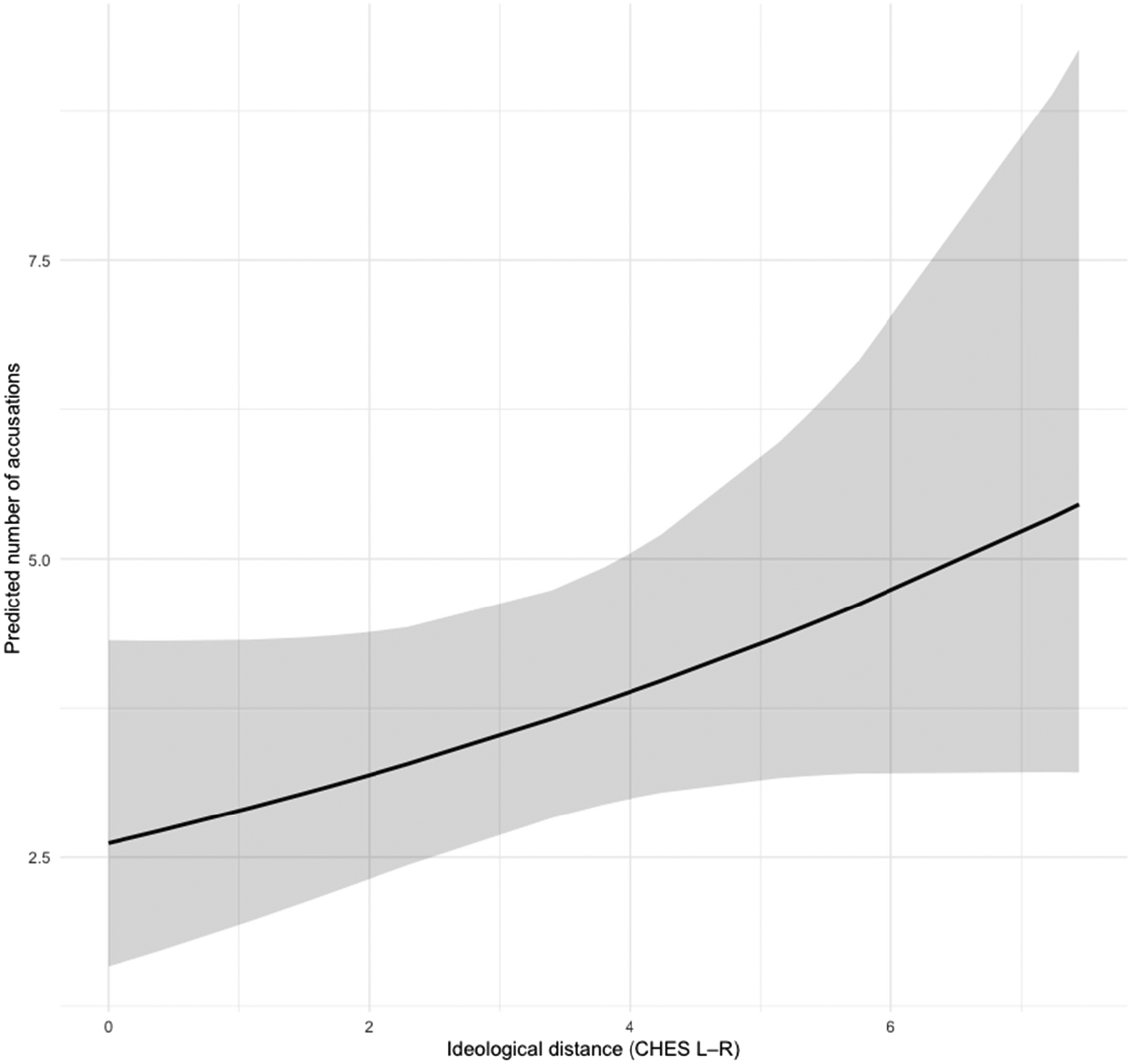
Predicted frequency of fake news accusations by ideological distance.
Overall, these findings provide suggestive, albeit not conclusive, evidence that ideological polarization structures the relational dynamics of fake news rhetoric. Such accusations are overwhelmingly concentrated across ideological camps, and the party pair-level regression indicates that increasing ideological distance is associated with a suggestion of higher accusation frequency (although lacking statistical significance). This pattern is consistent with the interpretation of fake news accusations as a tool of political contestation, deployed primarily to delegitimize ideologically distant opponents.
Selective amplification: Media coverage of fake news accusations
We now examine how newspapers report on accusations selectively depending on their editorial alignment with the accuser and the target. Two general hypotheses guide the analysis. H4 expects newspapers to report more frequently on fake news accusations made by ideologically proximate parties, while H5 anticipates that they are more likely to report accusations targeting ideologically distant opponents. These general expectations are then specified for each newspaper on the basis of their established editorial orientations. Table 1 provides an overview of expected emphases by newspaper and party alignment, based on a mapping of political affinities.
The results show that, across newspapers, the evidence points to an asymmetry between the reporting of fake news accusers and accused. Newspapers show limited selectivity in reporting of accusations made by ideologically close actors, offering only weak support for H4. In most outlets, those parties expected to feature more often as accusers, due to ideological proximity with the newspaper, account for less than half of all accusations reported. This suggests that, as a general rule, newspapers do not systematically privilege ideologically proximate parties as sources of fake news allegations. By contrast, H5 receives considerably stronger support. In four out of five newspapers—La Repubblica, Corriere della Sera, il Manifesto, and il Fatto Quotidiano—accusations disproportionately target ideologically distant parties. It is noteworthy that this pattern extends across the ideological spectrum, true for the moderates Corriere della Sera and La Repubblica, as well as the anti-establishment il Fatto Quotidiano and radical left il Manifesto. Fake news rhetoric thus appears to be filtered more strongly on the target dimension (accused) than on the source dimension (accuser). Table 2 provides a summary of newspaper-specific patterns, reporting the share of accusations involving theoretically expected parties among both accusers and accused actors.
Newspaper-specific emphasis of fake news accusations.
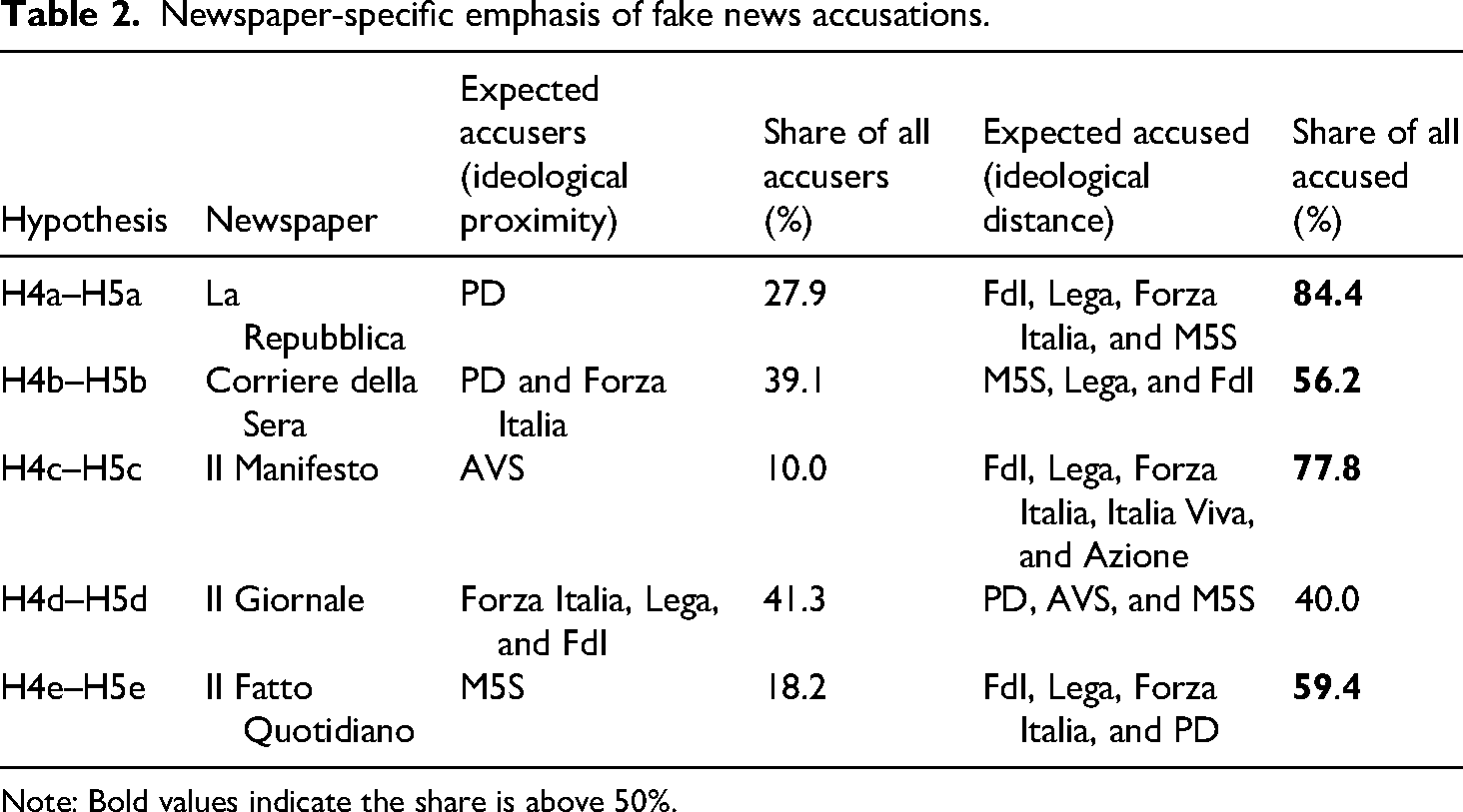
Note: Bold values indicate the share is above 50%.
We now turn to the newspaper-level hypotheses, which refine these general expectations. The newspaper coverage of accused and accusers is visualized in Figure 4. La Repubblica shows a clear pattern of selectivity consistent with ideological distance. While accusations made by the ideologically proximate party PD account for a modest 27.9% of all accusers reported, accusations targeting right-wing and populist parties (FdI, Lega, Forza Italia, and M5S) dominate coverage, representing 84.4% of all accused actors. This indicates strong support for H5a but only limited support for H4a.
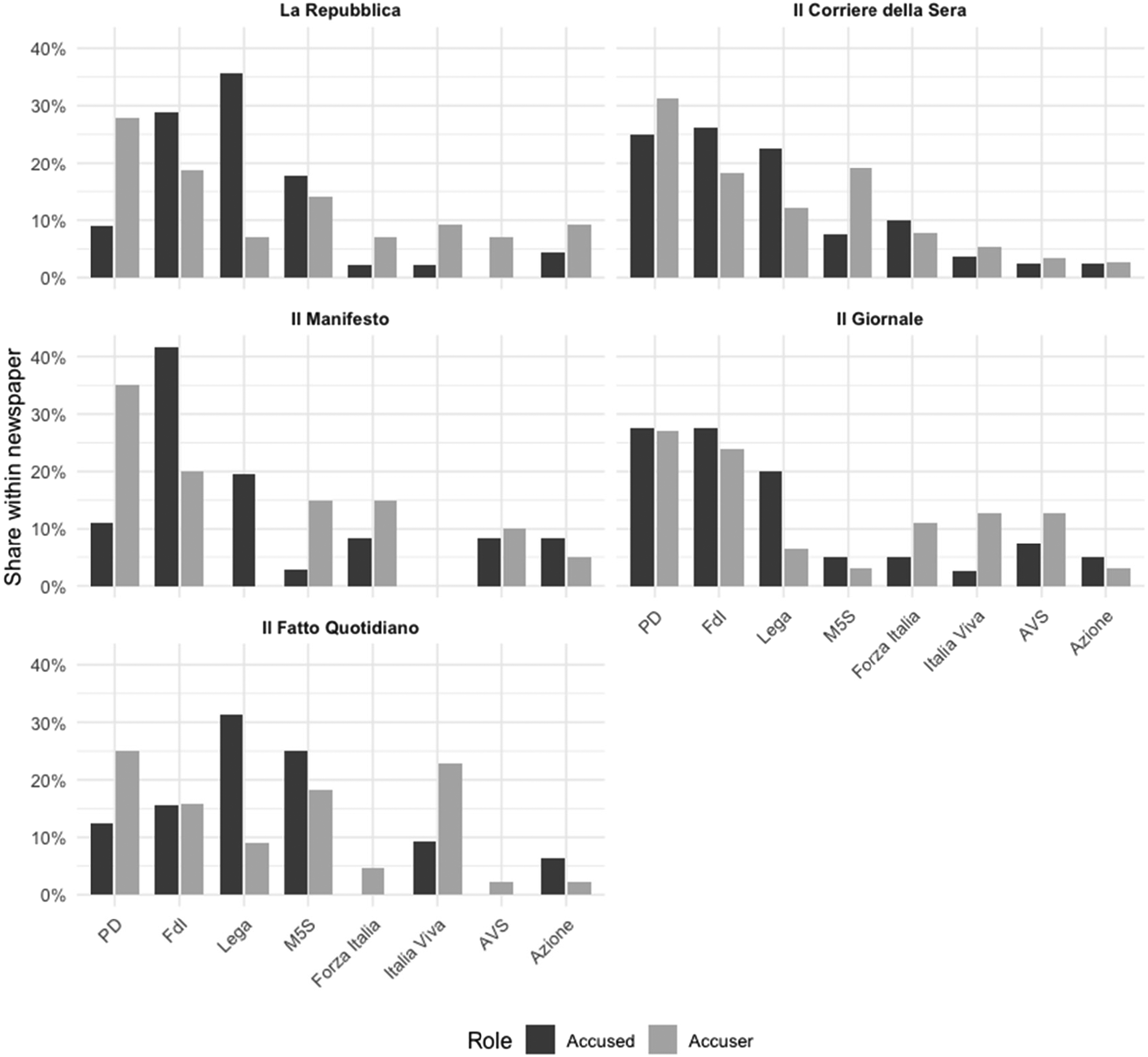
Fake news accusations in newspapers.
Corriere della Sera exhibits a more balanced profile, in line with its centrist editorial stance. Accusations made by the moderate parties PD and Forza Italia account for 39.1% of accusers, suggesting no clear privileging of politically aligned sources (H4b not supported). However, accusations against populist and radical parties still represent a majority of targets (56.2%), offering partial support for H5b while confirming the more selective, but not as severely polarized, nature of Corriere's coverage.
Il Manifesto displays the strongest asymmetry in the dataset. Accusations made by the ideologically aligned party (AVS) account for only 10.0% of accusers, offering no support for H4c. In contrast, accusations against politically distant parties (FdI, Lega, Forza Italia, Italia Viva, and Azione) constitute 77.8% of all accused actors, strongly supporting H5c. This pattern suggests that il Manifesto's selectivity operates overwhelmingly through targeting the ideologically distant rather than amplification of the ideologically proximate.
Il Giornale deviates from the dominant pattern. Accusations made by right-wing parties account for 41.3% of accusers, while accusations targeting left-wing and populist actors represent 40.0% of accused parties. Neither dimension shows strong selectivity, indicating weak support for both H4d and H5d. This comparatively symmetrical pattern suggests a broader or more heterogeneous use of fake news rhetoric within the paper's coverage.
Finally, il Fatto Quotidiano aligns with expectations derived from its left-populist and anti-establishment orientation. While accusations made by the M5S account for only 18.2% of accusers, accusations targeting mainstream parties on both the right and center-left represent 59.4% of accused actors. This again points to selective amplification on the target/accused side, consistent with H5e, but not on the source/accuser side (H4e).
A full breakdown of party-level fake news coverage by newspaper is reported in Table A2 in the Supplemental Appendix. Supplemental Figure A4 further illustrates newspaper-specific deviations from the pooled baseline, showing the relative over- and under-representation of each party across outlets.
Discussion
This study conceptualizes accusations of fake news not simply as indicators of misinformation, but as rhetorical tools of epistemic delegitimization. Analyzing newspaper coverage of fake news accusations in Italy between 2020 and 2024, the results reveal a structured and asymmetrical configuration of who accuses whom, and how the press mediates these exchanges. Three main implications emerge.
First, the results challenge a widespread assumption regarding populism and disinformation: that populist actors are the main promoters of fake news rhetoric. Our analysis shows that populist parties are not significantly more likely than non-populist parties to be covered as accusing others of spreading fake news, but are instead disproportionately positioned as the targets of such accusations. This asymmetry suggests that the strong association between populism and fake news in public discourse may be driven less by populist rhetorical aggression on this point than by their discursive construction as epistemically deviant actors. Future analysis could consider the specific context of the accusations of fake news to determine the extent to which they operate as a delimiting mechanism that marks certain actors as lacking credibility and/or simply as a neutral response to demonstrably false claims.
Second, the distribution of accusations across the ideological spectrum highlights the role of polarization in structuring epistemic conflict. Fake news accusations are more frequent between ideologically distant parties, although differences do not reach conventional thresholds of statistical significance, suggesting that such rhetoric is embedded in broader dynamics of negative campaigning. Rather than contesting political positions or factual claims, parties increasingly question the epistemic legitimacy of their opponents, transforming political disagreement into accusations of dishonesty. This shift is consistent with descriptions of affective polarization (Iyengar et al., 2019), in which political conflict becomes moralized and personalized, and delegitimization replaces substantive debate.
Third, the results highlight the active role of newspapers in mediating epistemic conflict. Our findings show that media selectivity operates primarily on the target dimension, rather than the source dimension: newspapers show limited evidence of systematically amplifying accusations made by ideologically close parties, but consistently emphasize accusations against ideologically distant actors. This pattern holds across outlets with different editorial orientations. Contemporary political parallelism therefore appears to function less through the affirmative promotion of allied voices and more through negative epistemic gatekeeping: problematizing selected political actors as unreliable or illegitimate. By repeatedly associating certain actors, particularly populist parties, with accusations of fake news, newspapers contribute to the stabilization of reputational hierarchies in which credibility is unevenly distributed across the political field.
Taken together, these findings support, and help to refine, the SDSA model. Selective amplification is asymmetrical: it is the accused, rather than the accuser, that primarily drives media visibility. This asymmetry reveals how epistemic power works in mediatized democracies: through the recurrent public labelling of certain actors as untrustworthy, rather than through the systematic elevation of others. Accusations of fake news thus emerge as a key currency in contemporary struggles over truth, legitimacy, and authority.
At the same time, our findings must also be interpreted in light of journalistic practices that influence how political conflict is reported. The Italian concept of “dichiarazia” (Portanova, 2009), understood here as a form of statement-driven journalism, highlights how the media often reproduce political actors’ statements with minimal filtering. Within the SDSA framework, such practices can contribute to the spread of fake news accusations even in the absence of explicit editorial endorsement. In this sense, selective amplification does not necessarily require active partisan support, but can stem from the media's structural tendency to prioritize conflicting and quotable statements. This mechanism helps explain how epistemic delegitimization can be reproduced through seemingly neutral journalistic practices.
The counterintuitive pattern observed for il Giornale represents a revealing contrast case. Despite its strong right-wing ideological positioning, the newspaper displays a relatively symmetrical distribution of fake news accusations. While its ownership structure reflects clear ideological leanings—having moved from Berlusconi family ownership in 2023 to the Angelucci Group, which owns other conservative newspapers such as Libero and Il Tempo and whose owner has longstanding ties to right-wing parties—il Giornale appears to normalize fake news rhetoric as a routine element of political conflict, rather than using it as a selective tool of epistemic delegitimization. One plausible explanation concerns strategic moderation: as a news outlet whose credibility is often contested, il Giornale may have little incentive to highlight accusations that elevate epistemic authority as the central axis of conflict. Within the SDSA framework, this case suggests that selective amplification depends not only on political parallelism, but also on whether a media outlet actively adopts an epistemic gatekeeping role.
Conclusion
This study examined accusations of fake news in Italian newspapers as a form of strategic epistemic delegitimization, rather than as mere indicators of misinformation, and introduced the SDSA model. By shifting the focus from the veracity of content to the relational dynamics of the accusation, the analysis contributes to emerging scholarship that treats “fake news” as a political label whose meaning is produced through patterns of attribution and media visibility.
Applying the SDSA model to the Italian case serves as an important test for understanding how partisanship adapts to post-ideological environments, illustrating how such rhetorical dynamics unfold in a context of high political parallelism and declining institutional trust (Hallin and Mancini, 2004; Mancini, 2013). Despite the decline of party-owned newspapers and the erosion of traditional ideological cleavages, patterns of alignment between parties and media outlets continue to structure coverage. Crucially, this alignment does not operate primarily through the affirmative amplification of ideologically proximate voices. Instead, it manifests through epistemic delegitimization: the recurrent public marking of certain actors as unreliable or illegitimate. In this sense, contemporary media partisanship appears less concerned with overtly defending allies than with defining the boundaries of credibility.
More broadly, this research contributes to the growing literature on strategic communication and the politics of epistemic legitimacy (Egelhofer and Lecheler, 2019) by integrating political strategy and media selectivity within a single explanatory framework. As democratic societies face crises of trust in expertise, journalism, and political institutions, accusations of fake news have become a key currency in struggles over who is entitled to define truth (Hameleers, 2020; Waisbord, 2018). The SDSA framework developed here provides a replicable analytical lens for investigating similar dynamics across different media systems.
Future research could build on this work and extend the SDSA framework by exploring longitudinal changes in fake news rhetoric, assessing its role during electoral campaigns, and examining cross-national variation in media systems with differing levels of media parallelism (Hallin and Mancini, 2004). In contexts characterized by lower levels of political parallelism, we would expect media coverage of fake news allegations to be less structured by ideological distance and more evenly distributed among political actors, thereby reducing the asymmetry between accuser and accused. Another factor that may shape these dynamics concerns the distinction between governing and opposition parties. Although this dimension falls outside the scope of the present analysis, it is likely to interact with both strategic delegitimization and media amplification, and thus represents a promising avenue for future research. Studying these dynamics of epistemic delegitimization can further illuminate the changing foundations of authority, legitimacy, and truth in contemporary democracies (Iyengar et al., 2019; Waisbord, 2018).
Supplemental Material
sj-pdf-1-ejc-10.1177_02673231261458935 - Supplemental material for Fake news as a rhetorical weapon: Strategic delegitimization and selective amplification in Italian newspapers
Supplemental material, sj-pdf-1-ejc-10.1177_02673231261458935 for Fake news as a rhetorical weapon: Strategic delegitimization and selective amplification in Italian newspapers by Lorenzo Mosca and Fred Paxton in European Journal of Communication
Footnotes

Funding
The authors disclosed receipt of the following financial support for the research, authorship, and/or publication of this article: Fred Paxton completed this article while in receipt of funding from the Leverhulme Trust Early Career Fellowship (ECF-2024-354); Lorenzo Mosca and Fred Paxton wrote this article while in receipt of funding for the Project of National Interest (PRIN) “Mimesys” (MIsperceptions, information disorder, and polarization between MEdia and political SYStems) by the Italian Ministry of Education, University, and Research (MUR)—Project code 2022WYEW47.
Declaration of conflicting interests
The authors declared no potential conflicts of interest with respect to the research, authorship, and/or publication of this article.
Data availability statement
The data that support the findings of this study are available from the corresponding author upon reasonable request.
Supplemental material
Supplemental material for this article is available online.
Notes
References
Supplementary Material
Please find the following supplemental material available below.
For Open Access articles published under a Creative Commons License, all supplemental material carries the same license as the article it is associated with.
For non-Open Access articles published, all supplemental material carries a non-exclusive license, and permission requests for re-use of supplemental material or any part of supplemental material shall be sent directly to the copyright owner as specified in the copyright notice associated with the article.
