




Abstract
This article presents two experiments employing two structural priming paradigms that investigated whether cross-linguistic syntactic priming occurred in Chinese and English passive sentences that differ in word order (production-to-production priming in Experiment 1 and comprehension-to-production priming in Experiment 2). Results revealed that cross-linguistic syntactic priming occurred in Chinese and English passive sentences, regardless of production of primes or comprehension of primes and language direction (L1–L2 or L2–L1). Our findings indicate that word-order similarity between languages is not necessary for cross-linguistic structural priming, supporting the view of a two-stage model of language production.
Keywords
I Introduction
Recent studies on bilingual sentence production have demonstrated shared bilingual processing during sentence production in both languages: the first (L1) and second (L2) languages (Dutch–English, German–English, Greek–English, Korean–English, Spanish–English, etc.) and across different syntactic structures (dative, passive/active, noun phrase, relative clauses with high/low attachment, etc.) (Bernolet et al., 2007; Desmet and Declercq, 2006; Hartsuiker et al., 2004; Salamoura and Williams, 2006, 2007; Shin and Christianson, 2009). These combined findings suggest that similar syntactic structures across languages share an integrated representation.
However, controversy still exists as to whether shared bilingual processing can be accounted for within a one-stage or two-stage production model. The two-stage model of sentence production assumes that two levels of processing exist in sentence production: a functional level and a positional level (e.g. Bock and Levelt, 1994; Garrett, 1975). At the functional level, functional syntactic roles (e.g. subject, predicate, and object) and structural relations (e.g. dominance or hierarchical structure) are assigned. At the positional level, the linear order relation (i.e. word order) is determined. On the other hand, the one-stage model suggests that both structural dominance and linear order relations simultaneously occur without any distinction at the positional level of processing during syntactic (or grammatical) encoding.
In order to address this issue, most studies have used cross-linguistic structural (or syntactic) priming paradigms based upon the phenomenon of structural (or syntactic) priming, 1 which refers to people’s tendency to reuse the same structural pattern as one that was previous comprehended or produced (Bock, 1986; Bock et al., 2007). In experimental settings, cross-linguistic structural priming – structural priming across languages – can be elicited by asking bilingual participants to use two languages: primes presented in one language and targets elicited in another language. If the prime sentences are presented in participants’ first language (L1) and the target sentences are elicited in their second language (L2), then it is called L1–L2 priming; L2–L1 priming involves the opposite direction of languages.
Cross-linguistic structural priming has been tested using several paradigms developed in the monolingual literature, including picture-description tasks (Bock, 1986), immediate recall tasks with rapid serial visual presentation (RSVP; Potter and Lombardi, 1998), sentence fragment completion tasks (Pickering and Branigan, 1998), sentence recall tasks (Fox Tree and Meijer, 1999), and confederate-scripting tasks (Branigan et al., 2000).
The picture description paradigm was first devised to investigate whether structural priming occurs across two utterances independently of meaning (Bock, 1986). In this paradigm, participants are asked to hear and repeat a sentence and to describe a picture on each trial. The picture, which is semantically unrelated to the previously repeated sentence, could be described with either one of two alternative constructions, e.g. active vs. passive voice, or prepositional object vs. dative object. In between the repetition and picture description, participants are also asked a question such as ‘Have you heard this sentence before?’ to minimize the participants’ attention to their speech and structural features, because participants are instructed that this experiment is a kind of memory test. Several filler trials between the two targets are not related to the target sentences syntactically or semantically.
In Potter and Lombardi’s (1998) immediate recall tasks, participants read a sentence presented on a computer screen using RSVP. In RSVP, each word is automatically presented in the center of the screen for 100 ms. Trials consist of prime and target trials. On each trial, RSVP of words is followed by an intervening numerical distracting task, and then participants are instructed to recall the sentence they had previously read. In this paradigm, sentences are to be reconstructed from memory, and the reconstructed structure of target sentences is influenced by the syntax of prime sentences.
Fox Tree and Meijer (1999) employed a sentence recall paradigm, in which participants are asked to memorize a given sentence and then recall the sentence, assuming that the surface form does not persist over time (Sachs, 1967). Between the memorization and recall stages, a semantically unrelated prime sentence is presented. Thus, when the sentence is recalled, it must be reconstructed from memory. Like Potter and Lombardi’s (1998) paradigm, the reconstructed syntax of target sentences can be influenced by the structure of prime sentences.
Pickering and Branigan’s (1998) sentence fragment completion paradigm involves written completion tasks. In this paradigm, participants are instructed to fill in all the fragments in the booklet in order, and to complete each fragment in any way they want as quickly as possible. One set of items consists of prime and target fragments. Prime fragments elicited one of the alternative constructions, for example, either the prepositional-object or the double-object dative construction, and presented sentences like The racing driver gave the torn overall … to elicit a prepositional-object dative or The racing driver gave the helpful mechanic … to elicit a double-object dative construction. Preceded by one of the prime fragments, target fragments consist of open fragments like The patient showed …. In this case half of the sets of target fragments have the same verbs as the prime fragments, and the other half have different verbs between prime and target fragments.
Branigan et al.’s (2000) confederate-scripting paradigm was used to investigate priming from comprehension to production in dialogue. This paradigm is a sort of card game, in which pairs of speakers describe pictures to each other in turns and select a picture that the partner described. One speaker is a confederate of the experimenter who systematically produces a variety of scripted syntactically structured descriptions, and the other speaker is a participant who has no scripted descriptions. The participant’s production can be influenced by the structure that the confederate provided.
These paradigms have been adapted to the cross-linguistic structural priming experiments by presenting prime sentences in one language and eliciting target production in another language. Participants use two languages in one experiment and are asked to use one language in prime trials and another language in target trials (either L1 to L2, or L2 to L1). These paradigms have thus been widely utilized to examine cross-linguistic structural priming as evidence of bilingual language processing and representations in production as well as comprehension.
In addition, structural priming has been tested in connectionist models (Chang et al., 2000, 2006). Connectionism is a computational architecture inspired by neural architecture, implementing networks of processing units with input and output (MacDonald and Christiansen, 2002). These models assume the occurrence of structural priming during both comprehension and production on the basis of errors (i.e. when the prediction of words differs from a target word). The models have been argued to successfully capture the empirical data from structural priming studies and language acquisition studies with one identical system, attributing structural priming to implicit adjustment to or learning of the previously used structure, rather than reactivation from residual activation in memory.
II Word order and structural priming
Research on monolingual structural priming has already shown that word order can strongly affect structural priming (e.g. Hartsuiker et al., 1999; Hartsuiker and Westenberg, 2000). In particular, the results of word order priming can demonstrate whether production processing goes through one stage or two stages. Because priming is sensitive to representations used at stages in the grammatical encoding process (Bock et al., 1992), the occurrence of priming can give evidence for the one- or two-stage model by distinguishing the hierarchical structure from word order. In other words, the two-stage model predicts that two structures that have a hierarchical structure in common, but not a common word order, should still prime each other because they share the representations pertaining to the hierarchical structure and functions assigned at the functional stage. In contrast, the one-stage model does not predict any priming effects between these two structures because the representations related to word order are simultaneously used. That is to say, the one-stage model predicts structural priming only if two structures share both the hierarchical structure and word order.
In order to distinguish the two models in the monolingual literature, for instance, Pickering et al. (2002) examined word order priming between English shifted datives and non-shifted datives (e.g. The racing driver showed to the helpful mechanic the problem with the car vs. The racing driver showed the problem with the car to the helpful mechanic), which share hierarchical structure but not word order. They found that the shifted datives did not prime non-shifted datives and argued in favor of the one-stage model.
As for cross-linguistic studies, however, mixed findings have been reported, depending on languages and paradigms. Some research has suggested that cross-linguistic structural priming cannot occur for sentences with different word orders (Bernolet et al., 2007), while other studies have found that priming can occur regardless of word order (Desmet and Declercq, 2006; Shin and Christianson, 2009). For example, Loebell and Bock (2003) found no cross-linguistic structural priming in passives in German and English, which have different word order. In this case, however, the authors argued that the phrase structures (i.e. hierarchical relations) in the two languages’ passives are different.
Bernolet et al. (2007) directly investigated the role of word-order similarity in cross-linguistic syntactic priming using the confederate-scripting paradigm. They studied priming for noun phrases with two ways of expression (cf. Cleland and Pickering, 2003) in Dutch–English and Dutch–German bilinguals using picture-description tasks. For instance, in the phrase the red flower, the adjective is placed before the noun (henceforth AN-structure). In the phrase the flower that is red, the noun is followed by a relative clause containing the adjective (henceforth RC-structure). Noun phrases with AN-structure share the same word order in Dutch, English, and German. Noun phrases with RC-structure have identical word order in Dutch and German (the linking verb is placed at the end of sentence), but differ in English (the adjective is placed at the end of sentence). Adopting the picture-description task, they showed that cross-linguistic syntactic priming could occur for noun phrases with RC-structure between Dutch and German, but not between Dutch and English. The authors concluded that word-order similarity is an important factor of cross-linguistic syntactic priming. Only if two languages have identical word order can integrated syntactic representations be constructed.
Other studies, however, observed cross-linguistic structural priming despite different word orders in the two languages. Desmet and Declercq (2006) found cross-linguistic structural priming in Dutch–English bilingual production for relative clauses with different word orders in Dutch and English using the sentence fragment completion paradigm. Participants were more likely to produce high-attachment relative clauses in English sentences (e.g. The farmer fed the calves of the cow that
Likewise, Shin and Christianson (2009) found that cross-linguistic structural priming can occur regardless of word order by examining Korean–English bilingual production using the sentence recall paradigm. Word order for PO-structure (prepositional or postpositional dative) sentences is different in Korean and English, whereas the hierarchical relations are the same in the two languages. In the canonical Korean PO-structure, the recipient that the predicate verb describes is placed in the beginning of the sentence, whereas in English it comes at the end of the sentence. Their results revealed that participants were more likely to recall English DO-structure sentences in English PO-structure forms after recalling Korean PO-structures. The researchers argued that even though PO-structure sentences in Korean and English differ in word order, cross-linguistic structural priming can occur, providing evidence for the two-stage model of bilingual production.
In sum, the results of studies on word-order effects in cross-linguistic structural priming are still controversial. The discrepancy between earlier results might be due to different research paradigms, as Shin and Christianson (2009) suggested. In other words, Bernolet et al.’s (2007) conclusion about the importance of word order was based on a picture-description task in the confederate-scripting paradigm, which involves comprehension-to-production priming. On the other hand, two studies that found cross-linguistic structural priming regardless of word order (i.e. Desmet and Declercq, 2006; Shin and Christianson, 2009) employed non picture-description tasks involving production-to-production priming: the sentence fragment completion and the sentence recall paradigms, respectively. Therefore, a closer examination of the effects of task and of the mode of the primes (production or comprehension) is needed in the cross-linguistic priming literature.
The present study thus aims to explore the influence of word order on cross-linguistic structural priming using two modes of primes (comprehension and production) in picture-description tasks. Moreover, it examines Chinese–English bilingual production, which no studies have to our knowledge yet investigated in the literature on cross-linguistic structural priming. In terms of word order, active sentences between English and Chinese share the same hierarchical structure and word order (e.g. 小猫打破了杯子 ‘the cat break-perfective the cup’ and ‘The cat broke the cup’), but passive sentences only share the same hierarchical structure not word order (Koopman, 1984; Li, 1985, 1990; Travis, 1984; Wang, 1970). In English passive sentences, the agent is placed at the end of the sentence and the by-phrase follows the verb (e.g. the cup was broken by the cat). In Chinese passive sentences, the agent precedes the verb (e.g. 杯子被小猫打破了 ‘the cup bei the cat break-perfective’). Bei is a passive marker in Chinese and the phrase [bei the cat] is dominated by the verb phrase as the prepositional phrase in English [by the cat] is dominated by the verb phrase. 2 Therefore, in the present study, we will investigate whether cross-linguistic structural priming occurs in English and Chinese passive sentences, with their different word orders.
In addition, we will examine cross-linguistic structural priming in both the L1–L2 direction and L2–L1 direction because some studies (e.g. Shin, 2008, 2010) have shown a discrepancy between the two language directions, which might play a role in leading to structural priming in addition to word order and/or hierarchical structures. Therefore, we will examine the effect of word order on structural priming in both directions.
The study consisted of two experiments involving picture-description tasks. In Experiment 1, we investigated the influence of word order on cross-linguistic structural priming between English and Chinese using the picture-description task, involving production-to-production priming. Participants in Experiment 1 were asked to read a prime sentence first, and then describe a target picture. In Experiment 2, we examined the influence of word order on cross-linguistic structural priming in Chinese–English bilingual production using the confederate-scripting picture description paradigm, involving comprehension-to-production priming. In short, by exploiting these two paradigms, we investigated the role of word-order in cross-linguistic structural priming in Chinese–English bilingual production.
III Experiment 1
1 Method
a Participants
Participants were 31 Chinese–English bilingual students (21–24 years old, M = 22) recruited from Beijing Normal University. All participants learned English after age 12 and lived in a Chinese-dominant environment, speaking Chinese at home and at school. All of them had passed the CET6, which is the grade examination for the students of non-English majors held by the Chinese Ministry of Education. This test examines English listening, speaking, reading, and writing ability of the undergraduate students who have finished the courses required by Chinese national education guidelines. The participants also rated their own proficiency in English according to a 6-point scale, with 1 representing non-proficient and 6 representing quite proficient. Their self-assessment results were as follows: listening (M = 4.06, SD = 1.00), speaking (M = 3.73, SD = 0.63), reading (M = 3.21, SD = 1.02), and writing (M = 3.79, SD = 0.82). According to self-reported measure, the participants were at intermediate levels of proficiency.
b Materials
One hundred and fifty-six pictures were selected from Schoonbaert et al. (2007). Stimuli consisted of 52 experimental items (26 in each language direction) and 104 filler items. Each experimental picture contained two objects: an agent and a patient. Chinese or English nouns for the objects were provided on each picture to ensure that lexical selection would not affect production. Below each picture was a transitive verb depicting what happened in the scene (see Figure 1).

Examples of stimuli with Chinese or English labels.
Half of the items were marked in English, and the other half in Chinese. Verbs between priming sentences and target pictures were different, and semantically unrelated to each other. Filler pictures contained a person or an object, which could be described by using an intransitive verb. One set of 13 pictures was used in the active priming condition, and a different set of 13 pictures was used in the passive priming condition.
In order to judge whether the participants read the priming sentences carefully, we added 30 probe sentences after the picture description. Participants were asked to judge whether these sentences had appeared previously in the experiment.
c Procedure
The experiment was carried out individually in a computer lab, and pictures were presented using E-Prime software. Participants were instructed to read the sentences aloud. Each sentence was followed by a picture prompt; participants were instructed to describe the picture using the verb marked in that picture. There were two filler sentences and two filler pictures between each experimental sentence–picture trial. One probe sentence appeared after the picture description during thirty filler trials but not during experimental trials.
Participants’ verbal responses were recorded for further data analysis. Prior to the formal experiment, there was a practice session to ensure participants understood the experimental procedure. The experiment lasted about 30 minutes, including one short break.
d Design and analyses
We used a 2 (types of priming: active vs. passive) × 2 (direction of language: L1–L2 vs. L2–L1) within-subjects design. In other words, each participant received two types of priming pseudo-randomly and two kinds of language direction one after another. The prime was always in one language, and the target in the other language. The order of language direction (L1 block and then L2 block vs. L2 block and then L1 block) was counterbalanced across participants; half of the participants started with 26 items in the L1–L2 direction and then the other 26 items in the L2–L1 direction, and vice versa for the other half of the participants.
Participants’ descriptions of the target pictures were coded as either active sentences or passive sentences. A sentence was coded as active when the agent came at the beginning of the sentence and the recipient was placed after the verb. A sentence was coded as passive when the recipient occurred at the beginning and the agent was followed by the preposition ‘被-bei’ (in Chinese) or ‘by’ (in English). All other utterances were coded as ‘other’. Previous studies focused analyses on less frequent structures (Bernolet et al., 2007; Hartsuiker et al., 2004). Likewise, we calculated the proportion of passive sentences out of the total number of passive and active sentences produced. Analyses of variance (ANOVAs) were conducted by subjects (F1) and by items (F2). In order to correct for violation of normality, the proportional data were arcsine-transformed.
2 Results
Overall mean accuracy on the 30 probe sentences was 93.4%. This indicates that participants did the task as instructed and read priming sentences carefully.
Of the 1,612 target sentences produced by our participants, 25 were coded as ‘other’ (1.56%). The remaining 1,587 sentences were coded as either active (61%) or passive (39%). The percentage of passive sentences produced after passive primes, 22.21% (SD= 9.86), was higher than the proportion of passive sentences produced after active primes, 16.60% (SD = 7.59). The data for each language direction are shown in Table 1.
The proportion of passives out of all targets produced in Experiment 1.
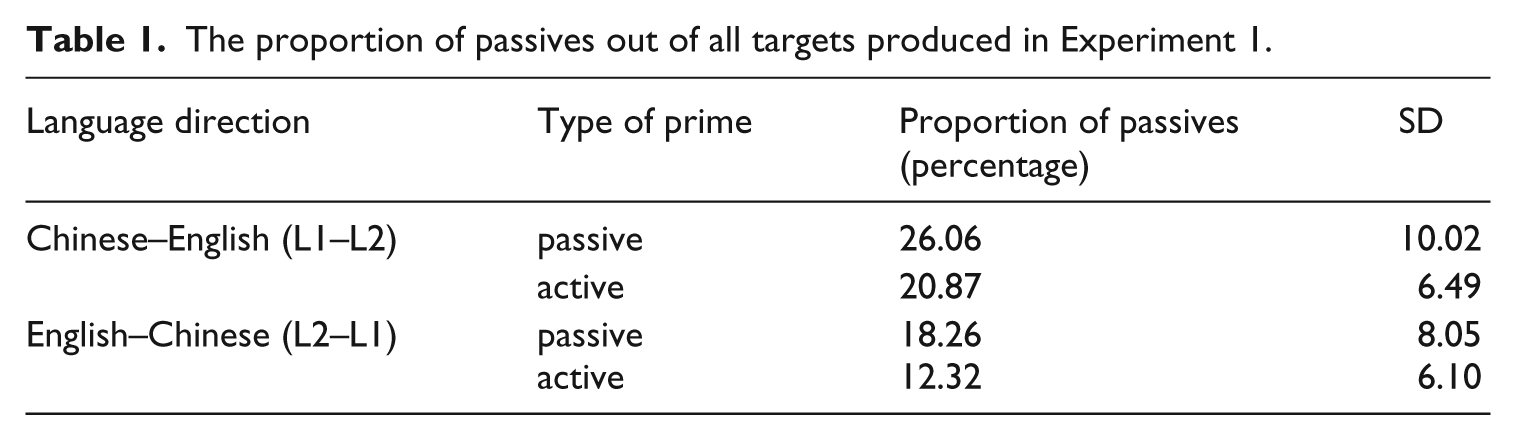
There was a significant main effect of priming type (F1 (1, 30) = 22.16, p < 0.001; F2 (1, 51) = 4.08, p < 0.05). The proportion of passive sentences produced after passive primes was significantly higher than that of passives produced after active primes. The main effect of language direction was also significant (F1 (1, 30) = 40.81, p < 0.001; F2 (1, 51) = 7.13, p < 0.05), showing that the Chinese to English (L1–L2) direction led to more passives after passive primes than the English to Chinese (L2–L1) direction. However, there was no interaction between prime type and language direction (F1 (1, 30) < 1; F2 (1, 51) < 1).
3 Discussion
Experiment 1 examined cross-linguistic structural priming in Chinese–English bilingual production using the picture-description task after reading the prime sentences aloud (involving production to production priming). The results demonstrated that cross-linguistic structural priming can occur in passive sentences in Chinese and English regardless of the cross-linguistic difference in word order in passive constructions.
Our results were obtained using the picture-description task (involving production to production priming), adding evidence for the occurrence of cross-linguistic structural priming regardless of word order, consistent with Desmet and Declercq (2006) and Shin and Christianson (2009), which both used non-picture-description tasks. We therefore feel confident that, in production to production priming, word order is not crucial for the occurrence of cross-linguistic structural priming. Furthermore, we found that the type of task, whether it involved picture description or not, was not the driving factor behind previous production to production priming results.
In order to see whether the occurrence of cross-linguistic structural priming can be affected by a comprehension to production experimental setting as found in Bernolet et al. (2007), Experiment 2 examined cross-linguistic structural priming in Chinese and English passives by using the confederate-scripting structural priming paradigm, involving comprehension to production priming.
IV Experiment 2
1 Method
a Participants
Participants were 31 Chinese–English bilingual students (21–25 years old, M = 22.5) recruited from Beijing Normal University. None of them had participated in Experiment 1. All participants learned English after age 12 and lived in a Chinese-dominant environment, speaking Chinese at home and at school. All of the participants passed the CET6. According to the same self-reported measure of English proficiency as used in Experiment 1, the participants were at intermediate levels of proficiency: listening (M = 4.50, SD = 0.82), speaking (M = 4.20, SD = 0.48), reading (M = 4.23, SD = 0.97), and writing (M = 4.03, SD = 0.61).
b Materials
Experiment 2 used the same pictures as those in Experiment 1, and one additional set of 156 pictures was used for a confederate (a lab assistant who pretended to be a participant). The lab assistant was a Chinese–English bilingual with a proficiency level similar to that of the participants. The priming sentences in Experiment 2 were the same as the primes that the participants read in Experiment 1.
c Procedure
Each participant was seated across from a confederate, and both viewed their own computer monitor, where the stimuli were presented using E-Prime software. The participants were instructed to take turns describing and verifying pictures with each other, using the words presented on the picture either in Chinese or in English. The primes were in one language and the descriptions in the other. When verifying, they had to determine if what was being described matched the picture they saw and to respond by pressing a Yes (match, F key) or No (mismatch, J key) button. Half of the experimental trials were matches, and half were mismatches. The confederate read scripted prime sentences designed to elicit either active or passive voice descriptions by the participant on the following trial. The order of items was pseudo-randomized for each participant.
Participants’ verbal responses were recorded for further data analysis. Prior to the formal experiment, there was a practice session to ensure participants understood the experimental procedure. The experiment lasted about 30 minutes, including one short break.
d Design and analyses
We used the same design and analyses as in Experiment 1.
2 Results
Of the 1,612 sentences produced by our participants, 29 were coded as ‘other’ (1.80%). The remaining 1,583 sentences were coded as either active (68%) or passive (32%). On the basis of subject analysis, the percentage of passive sentences produced after passive primes, 19.62% (SD =10.37), was greater than the percentage of passive sentences produced after active primes, 12.47% (SD = 8.37). The data for each language direction are shown in Table 2.
The proportion of passives out of all targets produced in Experiment 2.

The main effect of priming type was significant (F1 (1, 30) = 101.67, p < 0.001; F2 (1, 51) = 4.15, p < 0.05). The proportion of passives produced after passive primes was significantly higher than the proportion of passives produced after active primes. There was no main effect of language direction, (F1 (1, 30) < 1; F2 (1, 51) < 1), and no interaction between prime type and language direction, (F1 (1, 30) = 3.11, p = 0.088; F2 (1, 51) < 1).
3 Discussion
The results of Experiment 2 suggest that cross-linguistic structural priming can occur in either language direction between Chinese (L1) and English (L2) passive sentences regardless of word order, even though the experiment setting involves comprehension to production priming. We ensured that word-order similarity is not essential for cross-linguistic structural priming, and unlike the finding of Bernolet et al. (2007), we found that cross-linguistic structural priming can occur regardless of different word orders between Chinese and English in comprehension to production.
V General discussion
In the present study, we conducted two experiments to investigate the role of word-order similarity across languages in cross-linguistic structural priming between Chinese and English. We used picture-description tasks to examine both production to production priming and comprehension to production priming. In Experiment 1, participants were instructed to read sentences aloud and then describe pictures (involving production to production priming). The participants described target pictures more frequently with passive sentences after they read passive prime sentences. This priming effect was found in both language directions, from Chinese to English (L1–L2) and from English to Chinese (L2–L1), with no significant interaction between priming type and language direction, although Chinese to English (L1–L2) priming occurred more frequently than English to Chinese (L2–L1) priming.
Experiment 2 used the confederate-scripting picture description paradigm, involving comprehension to production priming. The results showed that participants were more likely to describe target pictures using passives when the confederate used passives to describe prime pictures. This priming effect was found in both language directions, from Chinese to English and from English to Chinese, with no significant difference between priming effects in the two directions. Therefore, cross-linguistic syntactic priming effects appeared in both of the experiments despite the fact that Chinese and English passive sentences have different word orders.
The results are consistent with the results of Desmet and Declercq (2006) and Shin and Christianson (2009), but not with the results of Bernolet et al. (2007). Shin and Christianson (2009) previously speculated that the discrepancy might have been due to different research paradigms (i.e. picture-description tasks or not) because Desmet and Declercq (2006) and Shin and Christianson (2009) used non-picture-description tasks (the sentence completion task in Dutch–English bilingual production and the sentence recall task in Korean–English bilingual production, respectively), whereas Bernolet et al. (2007) used the confederate-scripting picture-description task. The results in our first experiment further demonstrated that word-order similarity is not necessary for cross-linguistic structural priming in Chinese–English bilingual production even in picture-description tasks. In other words, our finding demonstrated that the discrepancy in previous studies cannot be attributed to different tasks.
In addition, our findings further demonstrated that the discrepancy in previous studies cannot be ascribed to the modes of the primes. In Experiment 2 using the confederate-scripting picture-description task eliciting comprehension to production priming, we observed cross-linguistic structural priming in Chinese and English passives. This result shows that the discrepancy in previous studies cannot be attributed to different mechanisms between sentence comprehension and production
Rather, cross-linguistic structural priming may be affected by usage frequency of various sentence types, as Shin and Christianson (2009) suggested. For instance, Bernolet et al.’s (2007) results (Experiment 3a) showed that the participants only produced 0.4% Dutch RC-structures, which suggests that this structure is quite infrequent. Thus, we could argue that lack of cross-linguistic syntactic priming for noun phrases with RC-structure in Dutch–English bilinguals is due to the low frequency of noun phrases with RC-structure in Dutch.
Moreover, cross-linguistic structural priming may be affected by language proficiency (especially, L2 proficiency). Bernolet et al.’s (2007) participants were reported to have had ‘at least 5 years of experience with English as a second language (M = 10 years)’ (p. 939), and their self-ratings on their L2 speaking and general proficiency were 4.69 and 4.94 out of 7, respectively (and no ratings reported on L2 listening). This demonstrated that the authors did not use any proficiency test as a part of the experiment, so we cannot know the participants’ standardized L2 proficiency. According to Shin (2008, 2010), cross-linguistic structural priming cannot be observed in low L2 proficient learners’ production. In other words, the absence of cross-linguistic structural priming in Bernolet et al. (2007) might be due to their participants’ low L2 proficiency and/or an interaction between L2 proficiency and low frequency of the structure in L1, compared to those in other studies (i.e. Desmet and Declercq, 2006; Shin and Christianson, 2009) and our study, not different word orders between two languages.
Regarding the language direction effects, our results revealed that cross-linguistic structural priming could occur both from Chinese (L1) to English (L2) and from English (L2) to Chinese (L1). Moreover, priming effects were equivalent in both language directions. This demonstrates that priming across languages is independent of language direction.
In regards to the issue of one-stage versus two-stage production models, our results provide evidence in favor of a two-stage model. In the two-stage model, syntactic representation is initially constructed at the functional level, which is not related to word order at the first stage. The linearization of the word order takes place at the second stage. As similar hierarchical structures that merely differ in word order across languages have a shared representation, cross-linguistic structural priming can still occur between two languages that have different word order. The current study found that cross-linguistic structural priming can be produced for Chinese and English passives; thus, the results support the two-stage model of syntactic production.
However, single-stage models may also be able to explain the present results. For example, Chang et al.’s (2006) connectionist grammatical encoding model can predict priming across two languages that have similar structures with the emphasis on incremental production and choice points between two alternative structures. Although the present results could in principle be accounted for under such a model, the cross-linguistic nature of the present experiments (see also Shin and Christianson, 2009) would seem to require a slight modification in Chang et al.’s model. Specifically, the point here is that structures can map across languages even when linear orders of lexical items do not. As such, a single-stage model would, in our understanding, need to include a sort of production buffer, which would allow lexical production to occur directly at the choice point in one language but to lag behind the choice point one or more words in the other language. Further research is thus required to determine if Chang et al.’s single-stage model can account in this way for these and similar cross-linguistic data.
The current study also reveals that cross-linguistic structural priming can indeed occur between two distinct languages – Chinese and English, here (see also Shin and Christianson, 2009) – although De Bot (1992) claimed that it was impossible for syntax between two greatly different languages to be connected with each other. Because Chinese and English belong to different language families, the present study extends the range of language families across which cross-linguistic priming effects have been observed and demonstrates that cross-linguistic structural priming effects may be universal (at least in the languages studied so far).
In conclusion, cross-linguistic syntactic priming can occur between Chinese and English passive sentences, which share the same functional and hierarchical structures but have different linear orders. Cross-linguistic structural priming occurs at the level of hierarchical structure, and word-order similarity is not necessary for the occurrence of cross-linguistic structural priming. The occurrence of cross-linguistic structural priming cannot be ascribed to specific priming task paradigms or the modes of primes (production to production or comprehension to production priming) in bilingual production.
Footnotes
Acknowledgements
We thank Kiel Christianson and three anonymous reviewers for helpful suggestions and comments on earlier versions of the manuscript. This research was supported by the National Social Science Fund (11BYY039), the Fundamental Research Funds for the Central Universities, and the Program for New Century Excellent Talents of the Ministry of Education in China (NECT-11-0028) to Baoguo Chen; and by a Research Grant of Kwangwoon University in 2013 to Jeong-Ah Shin.
Declaration of conflicting interests
The author declares that there is no conflict of interest.
Funding
This research was supported by the National Social Science Fund (11BYY039) and the Fundamental Research Funds for the Central Universities and the Program for New Century Excellent Talents of Ministry of Education in China (NECT-11-0028) to Baoguo Chen; and by the Research Grant of Kwangwoon University in 2013 to Jeong-Ah Shin.