



Abstract
The current study tests the Interface Hypothesis through forward and backward anaphora in complex sentences with temporal subordinate clauses in highly proficient English-speaking learners’ second-language (L2) Chinese. Forward anaphora is involved when the overt pronoun ta ‘he/she’ or a null element appears in the subject position of the main clause, whereas backward anaphora is involved when it is in the subject position of the temporal clause, because the main clause always follows the temporal clause in Chinese. Specifically, the article tests the syntactic and discourse constraints in the interpretation and representation of ta and the null element in complex sentences. Ta is constrained by the syntactic cyclic-c-command condition. Thus it is possible for ta to refer to the other sentential subject in forward anaphora, but not in backward anaphora in Chinese. Unlike English, Chinese allows a null element in subject positions of finite subordinate and main clauses. It is proposed in the article that the null element in these positions is a Øtopic, a syntax–discourse interface category. Results from an acceptability judgement task and a picture judgment task indicate that Øtopic at the external interface has been acquired, whereas the cyclic-c-command condition within narrow syntax is fossilized in L2 Chinese.
I Introduction
The Interface Hypothesis (IH) has generated much research in language acquisition in recent years (Sorace, 2005; Sorace and Filiaci, 2006). The original hypothesis distinguishes narrow syntax from interfaces between syntax and cognitive domains in general in language acquisition (Sorace, 2005). It proposes that language structures involving interfaces are less likely to be acquired completely. By contrast, the structures that only involve syntactic computations are predicted to be fully acquirable in second language (L2) acquisition and also retainable in first language (L1) attrition. They are also predicted to be acquired early in bilingual L1 acquisition. Keeping its original hypothesis about purely syntactic properties, the IH later divides interfaces into internal interfaces (i.e. between components of the language system such as the syntax–semantics interface) and external interfaces (i.e. between syntax and a cognitive system not specific to language, such as the syntax–discourse interface) (Serratrice et al., 2004; Sorace, 2011; Sorace et al., 2009; Tsimpli and Sorace, 2006). The internal interfaces are assumed to be unproblematic, whereas the external interfaces are the locus of ultimate fossilization in L2 acquisition and also of protracted delays in bilingual first language acquisition. They are also easily affected under reduced input conditions in L1 attrition.
Earlier work on IH has accounted for the interface vulnerability with underspecification of interpretable features (e.g. Tsimpli et al., 2004). Sorace (2011) points out that attributing the vulnerability only to representational differences between the two languages in question makes it difficult to explain why speakers of different language combinations show similar patterns. Sorace maintains that bilinguals’ problems with the external interfaces result from ‘their less-than optimal ability to consistently and efficiently integrate different types of knowledge’ (p. 20; see also Sorace and Filiaci, 2006).
A large amount of evidence supporting IH comes from studies on the distribution of overt and covert pronominal forms in null-subject languages. These studies found that the discourse–pragmatic constraints of the distribution of pronominal forms posed problems but not the syntactic licensing of pro in simultaneous bilingual first language acquisition (e.g. Serratrice et al., 2004; Sorace et al., 2009), L1 attrition (e.g. Tsimpli et al., 2004), heritage speakers (Montrul, 2004) and L2 ultimate attainment (e.g. Sorace and Filiaci, 2006). Empirical evidence supporting the successful L2 acquisition of internal interfaces have been reported for the lexicon–syntax interface in Montrul (2005) and for the lexicon–semantics interface in Montrul and Slabakova (2003) and Tsimpli and Sorace (2006), among others.
In contrast to the studies above, external interfaces have been reported acquirable in L2 acquisition in the following studies:
Ivanov (2012) shows that advanced English-speaking learners have acquired the pragmatic meaning of clitic doubling in Bulgarian.
Iverson et al. (2008) report that advanced L2 learners of Spanish have acquired the discourse-dependent distinction between the indicative and subjunctive complements with epistemic predicates.
Kraš (2008) finds that near-native Croatian-speaking learners have acquired the discourse–pragmatic constraints on the interpretation of overt and covert pronouns in sentences with temporal clauses.
Rothman (2009) finds that some highly advanced L2 Spanish learners displayed correct distribution of overt and null subject pronouns that are subject to both syntactic and pragmatic constraints in different contexts in several tasks.
Slabakova and Ivanov (2011) find no residue optionality in near-native speakers’ L2 Bulgarian and L2 Spanish regarding the syntax–discourse knowledge of clitic dislocation.
Slabakova et al. (2012) report that L2 learners of Spanish acquired the discourse-sensitive properties of clitic left-dislocation and focus fronting.
Zhao (2012a) finds that Øtopic at the syntax–discourse external interface has been acquired by L2 learners of Chinese. Furthermore, it was acquired in different sentence positions at different proficiency levels.
It is difficult to determine whether these studies confirm or challenge IH. To quote Sorace and Filiaci (2006: 340), ‘the interface properties involving syntax and another cognitive domain may not be fully acquirable.’ The use of ‘may not’ and ‘fully’ covers every possible situation in the acquisition of external interfaces, making IH unfalsifiable in this respect. Despite this, the studies above challenge IH in that they provide evidence opposite to the studies that are interpreted as supporting the IH. As Slabakova et al. (2012: 329) point out, ‘the usefulness of a model that predicts that certain properties may or may not be acquired is questionable.’
White (2011), after examining a wide range of studies, showed that external interface properties were either acquired or fossilized, just like those at internal interfaces. White proposes that not all phenomena at a particular interface are necessarily problematic or acquirable. This view is shared by Yuan (2010). Yuan finds that the acquirability of the syntax–semantics internal interface was not domain-wide in L2 grammars with respect to the licensing of existential polarity words (EPWs) in Chinese. While lexical-word licensers of EPWs such as negators have been ultimately acquired by both English-speaking and Japanese-speaking learners, none of the functional-morpheme licensers such as the yes–no particle ma have been acquired by English-speaking learners even at the end-state. Japanese-speaking learners also failed to acquire functional-morpheme licensers, except for ma, which had a moderate licensing power in their L2 end-state grammars. Yuan proposes that the acquirability/vulnerability of interface categories is affected by variables such as the categorical nature of the elements involved in the interface relation (e.g. lexical-word licensers versus functional-morpheme licensers), their status in the target grammar (e.g. the licensing power of different licensers in Chinese), and the possible input and the cross-linguistic influence.
There has also been evidence to show that not all purely syntactic structures are fully acquirable. Coppieters (1987) reports differences between native and near-native L2 learners of French with respect to some purely syntactic distinctions on causative constructions and clitic pronouns. Sorace (1993) discovers that the L2 Italian grammars of neither English speakers nor French speakers have fully converged on the target grammar regarding the syntactic constraints on auxiliary change under reconstructing. Neither have the highly proficient Croatian speakers in Kraš (2011).
The current study mainly intends to contribute to the ongoing debate on the acquirability of purely syntactic properties through the acquisition of the cyclic-c-command condition on the overt pronoun ta ‘he/she’ in L2 Chinese of highly proficient adult English-speaking learners. It also hopes to make some contribution to the debate on the acquirability of the syntax–discourse interface through the acquisition of null subjects in complex sentences with temporal clauses that are proposed to be Øtopic, a syntax–discourse interface category.
The article is organized as follows. Section II contains syntactic analyses of ta and the null element in the above positions. Previous relevant L2 literature is reviewed in Section III. Section IV introduces the present study and presents the results. The findings of the study are discussed in Section V, and Section VI contains the conclusions.
II Theoretical background
Chinese allows null elements and overt pronouns in the subject position of finite clauses. For instance, they can both appear in the subject position of the main clause in (1) and that of the subordinate clause in (2). By contrast, English only allows the overt pronoun to appear in such positions as in (3) and (4). 1
(1) Zhangsani chi wanfan de shihou, tai/ei dai zhe yi ding maozi. Zhangsan eat dinner DE when he wear PRG one CL hat ‘When Zhangsani was having dinner, hei/ei was wearing a hat.’ (2) * tai/ei chi wanfan de shihou, Zhangsani dai zhe yi ding maozi. he eat dinner DE when Zhangsan wear PRG one CL hat ‘When *hei/ei was having dinner, Zhangsani was wearing a hat.’ (3) When Johni came in, hei/*e was wearing a raincoat. (4) When hei/*e came in, Johni was wearing a raincoat.
The null element can refer to Zhangsan in both (1) and (2); ta ‘he’ can refer to Zhangsan in (1) (i.e. coreferential reading), but not in (2). The English he can refer to John in both (3) and (4).
Huang (1982) notes that while the English overt pronoun may not refer to a potential antecedent that it c-commands (derived from the Binding Principle C), the Chinese ta abides by a stricter structural condition below. The compulsory disjoint reading of ta in (2) (i.e. ta refers to someone other than Zhangsan in the sentence) is due to this condition.
(5) A pronoun may not cyclic c-command its antecedent Cyclic c-command: A cyclic c-commands B if and only if: a. A c-commands B; or b. C is the minimal cyclic node (NP or CP) that dominates A but is not immediately dominated by another cyclic node, then C c-commands B.
In (6) and (7) I present the tree structures of (1) and (2), with irrelevant details omitted.
(6) (7) 

As shown in (6), ta does not c-command Zhangsan. However, its minimal cyclic node, the subordinate clause CP2, c-commands it. Ta cyclic c-commands Zhangsan and thus cannot refer to the latter due to the cyclic-c-command condition in (5). By contrast, neither ta nor its minimal cyclic node, the matrix CP1, c-commands Zhangsan in (7). Therefore, the condition in (5) does not prevent ta in (1) from referring to Zhangsan. The cyclic-c-command condition is about the grammatical impossibility of coreference between a pronoun and its potential sentential antecedent based on a syntactic relation, hence a syntactic condition like the Binding Principles. Ta in (1) and (2) can also refer to someone other than Zhangsan due to its pronominal nature.
Although Huang’s account has no problem accounting for the difference between (1) and (2) regarding the coreferential reading of ta, it is slightly stipulative as to why the null subject in (2) can refer to Zhangsan. He simply suggests that the condition in (5) is a special requirement on overt pronouns, and does not apply to null pronouns.
Below I argue that the null elements are not subject to the same condition as the overt pronoun in (1) and (2) because they are not null pronouns. This hopefully removes the need to stipulate that the cyclic-c-command condition simply does not apply to null pronouns.
The Government and Binding (GB) analysis of pro has been argued to be incompatible with the current development of MP (Holmberg, 2005; Roberts, 2010). Roberts (2010) proposes within MP that null pronouns result from PF deletion. A pronoun deletes from the subject position of Romance null-subject languages such as Spanish when it is the defective goal of T, i.e. when its formal features are properly included in those of its probe T. Spanish differs from English, a non-null-subject language, in that the Spanish T has a D(efiniteness) feature, whereas the English T does not. Without the D feature on T, it is impossible for the subject pronoun to be T’s defective goal, as the pronoun intrinsically has a D feature. Roberts suggests that T’s D-feature is related to rich agreement.
Following this line of argument, Zhao (2008, 2012a, 2012b) argues that null pronouns are not allowed in Chinese. Chinese does not have agreement morphology at all, let alone rich agreement morphology. This means that the Chinese T does not have a D feature, and therefore the subject pronoun can never be the defective goal of T. Additionally, if the null element is a null pronoun, we cannot account for its interpretive asymmetry in (8a) and (8b). If we replace the null element with the overt pronoun ta, the subject-object asymmetry disappears (for detailed analysis, see Zhao, 2008).
(8) a. Zhangsani shuo ei/j/tai/j renshi Lisi. Zhangsan say he know Lisi ‘Zhangsani says that ei/j/hei/j knows Lisi.’ b. Zhangsani shuo Lisi renshi e *i/j/tai/j. Zhangsan say Lisi know him ‘Zhangsani says that Lisi knows e*i/j/himi/j.’
It has been proposed within GB theory that Chinese allows a variable type of null element as in (9) (Huang, 1984).
(9) Q: Zhangsan kanjian Lisij le ma? Zhangsani see Lisi PFV Q ‘Did Zhangsan see Lisi?’ A: Ta kanjian ej le. he see PFV ‘He saw ej.’
The null element in (9A) is derived by topicalization, through which the object is moved to the topic position and a trace is left at Complement-V. What is really missing is the topic rather than the embedded object of the sentence. This type of null element is possible because Chinese allows a Topic NP Deletion Rule, which operates across discourse to delete the topic of a sentence under identity with a topic in a preceding sentence, forming a topic chain, as in (10) (e.g. Huang, 1982, 1984).
(10) Xiaomingi hen ai xuexi, [Top ti], ti tiantian kan shu, Xiaoming very love study everyday read book [Top ti], laoshimen hen xihuan [ti]. teachers very like ‘Xiaoming loves studying very much, and (he) reads everyday, and the teachers like (him) very much.’
Traces such as the null element in (9A) have been noted to be incompatible with the MP (e.g. Holmberg, 2005). Since the copy theory of movement has been re-introduced into MP (Chomsky, 1993), traces have generally been thought to be copies deleted at PF in a process of chain-reduction, i.e. the deletion of all identical copies in a dependency except the highest one or the head of the chain (Nunes, 2004).
Zhao (2012a, 2012b) proposes a topic deletion type of null element (Øtopic) in Chinese. The derivation of Øtopic draws on Huang’s idea of the variable type of null element, but Huang’s idea is implemented in a different way. The answer sentence in (9) is analysed in (11).
(11) [TopicP he see PFVLisi[Ta [vP Lisi [VP kanjian Lisi le]]]].
Lisi in (11) is base-generated as complement-V. Triggered by the Edge feature of v and Topic respectively, it then moves to Spec vP and finally to Spec TopicP, leaving a copy at every extraction site. All the lower copies are suppressed except for the one at Spec TopicP. Whether the topicalized object at Spec TopicP is spelled out or not is a discourse issue. It is dropped when the topic is given and salient. When it is dropped, the sentence in (9A) is derived. The derivation of Øtopic involves the syntax–discourse interface in the sense that its derivation not only calls for syntactic derivation of topicalization, but also discourse information that determines whether the topicalized element can delete. Specifically, Lisi in (9A) cyclically moves to Spec TopicP at syntax, but its final deletion at Spec TopicP is due to discourse saliency.
Zhao (2012a, 2012b) also identifies another type of null element, Øziji in Chinese. Øziji is derived from deletion of the bare reflexive ziji as a defective goal of its antecedent. I argue that Øziji is not allowed in the two sentence positions under investigation here as it is impossible for the null element to form an Agree relation with the other sentential subject, its potential antecedent, as in (6) and (7) above. 2 I argue that the null subjects in (1) and (2) above are Øtopics, like the null element in (9A). Their derivation involves the syntactic derivation of topicalization of the subject and its subsequent deletion as a piece of old information in the discourse. Chomsky (2008) suggests that only phase heads (i.e. C and v) have phi-features. In some languages such as English, the phi-features of C are transmitted to T. Chomsky further suggests that phi-feature inheritance by T from C is parameterized across languages. Accordingly, Zhao (2012a, 2012b) proposed that the Chinese C rather than T probes the subject in its base generation position at Spec vP. One of the implications of this proposal is that Chinese subjects can be topicalized while English ones are stuck at Spec TP and cannot be topicalized (Rizzi and Shlonsky, 2007) 3 . The EPP (Extended Projection Principle) feature of C moves Zhangsan from Spec vP to Spec CP of either the main or subordinate clause as in (12). The Edge feature of TopicP then moves Zhangsan to the topic position of either clause. Zhangsan is deleted when it is already given and salient in the discourse. As the other sentential subject in complex sentences like (1) and (2) is normally the salient topic in the discourse in which the sentence appears, the null subject is generally coreferential with it. 4
(12) … [TopPZhangsan … [CPZhangsan [vPZhangsan …]]]
In this sense, the coreference between the null subject and the other sentential subject is accidental rather than syntactic. There are cases in which the null subject refers to an entity other than the other sentential subject, as shown in (13) below. This provides us with additional evidence that the null subject of the temporal clause is Øtopic, whose derivation and interpretation is conditioned by the discourse.
(13) Situation: Xiao Zhangi went to visit Lao Wang … Sentence: ei dao de shihou, Lao Wangj zheng zai chi wanfan. enter DE when Lao Wang right at have dinner ‘When ei arrived, Lao Wangj was having dinner.’
As pointed out above, the other sentential subject is normally the topic of the discourse where sentences like (1) and (2) appear. Due to this, a null element takes a disjoint reading only when the sentence is unambiguously excludes the coreferential reading as in (13). In sentences like (1) and (2), which supports the coreferential reading, the disjoint reading is not acceptable for the null element. As the main focus of the current study is to test if L2 learners will be able to reject the coreferential reading of the overt pronoun in backward anaphora, only the sentences that support the coreference between the two subjects are of interest here. This means that the disjoint reading of the null element is not acceptable in sentences included in the current study. The interpretive properties of ta and the null element in the sentences under investigation in the current study are summarized in Table 1.
The interpretative properties of the null element and ta in the sentences under investigation.

In the next section, I review relevant literature of anaphora resolution in L1 and L2 acquisition.
III Previous L1 and L2 studies
Sorace and Filiaci (2006) and Kraš (2008) will be reviewed in this section because they are also concerned with ultimate attainment of anaphora resolution in complex sentences with temporal clauses in the L2 grammars of a null-subject language. To the best of my knowledge, there is no such study in L2 Chinese. I will review two relevant Chinese acquisition studies: Lust et al. (1996) on L1 acquisition of anaphora resolution in complex sentences and Zhao (2011, 2012a) on L2 acquisition of the interpretation of the overt pronoun and the representation of Øtopic in embedded object clauses.
Sorace and Filiaci (2006) investigate anaphora resolution in (14) in English-speaking learners’ L2 Italian.
(14) a. Mentre leik/l/proi si mette il cappotto, la mammai dà un bacio alla figliak. while she wears the coat, the mother gives a kiss to the daughter ‘While she/pro is wearing her coat, the mother kisses her daughter.’ b. La mammai dà un bacio alla figliak mentre leik/l/proi si mette il cappotto. the mother gives a kiss to the daughter, while she wears the coat ‘The mother kisses her daughter, while she/pro is wearing her coat.’
According to the Position of Antecedent Strategy (PAS; Carminati, 2005), a null pronoun has a strong bias towards an antecedent in Spec IP (normally, the subject), whereas an overt pronoun prefers an antecedent lower in the structure (e.g. the object). Sorace and Filiaci emphasize that PAS belongs to the syntax–discourse interface rather than the syntax proper, as the violation of the PAS results in pragmatically inappropriate sentences instead of grammatically illicit ones.
Results from a Picture Verification Test showed that the near-native speakers behaved like native speakers in interpreting pro in both forward and backward anaphora contexts. This suggests that near-native speakers have a null-subject grammar and respect PAS. Although L2 learners correctly interpreted the overt pronoun in forward anaphora, they differed from native speakers in interpreting it in backward anaphora. The native speakers strongly preferred an extralinguistic referent for the overt pronoun in backward anaphora 5 . English-speaking learners chose the subject of the main clause as the referent for the overt pronoun significantly more often than the native speakers.
The learners’ non-target behaviour with respect to the overt pronoun in backward anaphora may be a result of their inadequate processing resources. This type of anaphora is particularly costly in terms of processing: the parser is biased to choose the subject of the main clause as the antecedent in an attempt to find an antecedent for the overt pronoun as soon as possible; however, PAS is biased against the overt pronoun referring to the subject. Sorace and Filiaci claim that near-native speakers do not have sufficient processing resources to choose an extrasentential entity from the discourse as the referent of the overt pronoun.
Sorace and Filiaci’s analysis above is slightly confusing as I discuss below. They argue that PAS is at the syntax–discourse interface (p. 347–48). If the syntax–discourse interface generally involves the higher processing cost of accessing and integrating syntactic and discourse representations and thus may result in residue optionality (e.g. Sorace, 2011), it should be true of PAS for both null and overt pronouns. However, near-native speakers have acquired PAS for pro at the syntax–discourse interface. As above, the residue optionality regarding the overt pronoun is actually due to the conflict between PAS and learners’ strategy to find a referent for the overt pronoun as soon as possible. Hence, PAS at the syntax–discourse interface is only part of the reason for the high processing demand involved in the interpretation of the overt pronoun. In a way, the results here seem to indicate some syntax–discourse interface properties (e.g. PAS for pro) are acquirable whereas others (e.g. PAS for the overt pronoun) are not. This interpretation of the results is also consistent with the IH as argued in Section I.
Unlike Sorace and Filiaci (2006), Kraš (2008) found that anaphora resolution of both null and overt pronouns in sentences like (14) was target-like in L2 Italian grammars of Croatian learners in a picture selection task. Kraš argues that positive L1 transfer may have contributed to the successful acquisition here. As in Italian, pro is allowed in Croatian. Additionally, pro tends to take a subject antecedent in intra-sentential anaphora, whereas the overt pronoun tends to take a non-subject antecedent.
Lust et al. (1996) conducted a study on the L1 acquisition of the overt pronoun and the null element in Chinese complex sentences like (1) and (2) above by using a Truth Value Judgement task with pictures. What is particularly interesting for the current study is that Chinese children of all five age groups (3;0–7;6) consistently allowed the coreferential reading of ta in backward anaphora whereas the Chinese adults did not. Both the adults and children allowed the disjoint reading of ta in backward anaphora. Although the disjoint reading is grammatically possible for ta in forward anaphora, both the adults and children seemed to be indeterminate about it. The adults and children alike allowed the coreferential reading for the null element in both forward and backward anaphora. The adults did not allow the disjoint reading for the null element in either case, whereas the children allowed it more frequently than the adults. Lust et al. proposed their own account to explain the interpretations of the null element and the overt pronoun in the sentences under investigation. 6 I will not go into details of their account of the data, as they do not inform the current study directly.
Zhao (2011, 2012a) investigates the representation and interpretation of ta and the null element in the argument positions of embedded object clauses in Chinese in (8). Results from a picture judgement task indicate that L2 learners have interpreted ta correctly in the embedded argument positions by the high-intermediate state. Øtopic has been acquired earlier in the embedded object position than in the embedded subject position, but L2 learners have acquired the representation and interpretation of Øtopic in both positions by the advanced state.
To summarize, studies on anaphora resolution in L2 Italian have produced contradictory results on the overt pronoun, indicating that the syntax–discourse interface may or may not be acquirable. Monolingual Chinese children incorrectly allowed the coreferential reading of ta in backward anaphora. Adult English-speaking learners of Chinese have interpreted ta in the argument positions of an embedded object clause correctly by the high-intermediate state. They have acquired Øtopic in the embedded argument positions by the advanced state. The current study intends to go some way in filling the gap in L2 acquisition of anaphora resolution in Chinese complex sentences with temporal subordinate clauses.
IV The study
1 Research questions and hypotheses
I note that PAS cannot account for the interpretation of the Chinese ta. First, the other sentential subject is not the preferred antecedent for the Italian overt pronoun in either forward or backward anaphora. By contrast, the coreference between the Chinese ta and the other sentential subject is only prohibited in backward anaphora. It is allowed in forward anaphora. 7 Second, the coreference between ta and the subject of the main clause in (2) leads to a grammatically unacceptable sentence rather than a pragmatically inappropriate one as is the case with Italian. This suggests that a syntactic violation occurs in line with Sorace and Filiaci (2006).
As given in Section II, the overt pronoun is constrained by the syntactic cyclic-c-command condition, and the null subject in the sentences under investigation is a Øtopic, a syntax–discourse interface category. The IH predicts that properties at narrow syntax and internal interfaces are acquirable whereas those at external interfaces may not be. It will be interesting to see if these predictions are borne out. Specifically, this article intends to answer the following questions:
Will English-speaking learners acquire the native-like competence in interpreting the overt pronoun ta? In particular, will they be aware of the cyclic-c-command condition so that they reject the coreferential reading of ta in backward anaphora and accept it in forward anaphora?
Will English-speaking learners acquire Øtopic in these positions?
As argued above, ta is subject to the cyclic-c-command condition. As the cyclic-c-command condition is part of syntax, it is hypothesized to be acquirable in line with the IH. Highly proficient learners are predicted to disallow the coreferential reading of ta in backward anaphora, although they will allow it in forward anaphora. 8 The disjoint reading of ta is due to the pronominal nature of ta, and thus involves the lexicon–syntax and syntax–semantics internal interfaces at the most. 9 According to the IH, it is predicted to be acquirable.
I postulate in Section II that the null element is a Øtopic, a syntax–discourse interface category. As stated in Section I, the IH does not have a clear prediction about the acquirability of the syntax–discourse interface properties. An impressive number of recent studies have reported convincing evidence that the syntax–discourse interface categories can be acquired (Ivanov, 2012; Iverson et al., 2008; Kraš, 2008; Rothman, 2007, 2009; Slabakova et al., 2012; Slabakova and Ivanov, 2011; Zhao, 2012a). In particular, Zhao (2012a) found that Øtopic in Chinese has been acquired by adult English-speaking learners in embedded argument positions by the advanced state. Thus I predict that the highly proficient speakers will allow Øtopic in the subject positions of complex sentences under investigation. This is also consistent with the IH. As argued by Slabakova et al. (2012: 339), ‘something that “may not” happen is equally likely with the same thing happening.’
2 Participants
Participants of this experimental study included 15 English-speaking learners of Chinese, and 14 native speakers of Chinese who served as controls. Some of the English-speaking learners included in the study were based in China, some were Chinese major graduates who worked in the UK but whose working environment or lifestyle required them to use Chinese on a daily basis, while others were lecturers and professors of Chinese from universities of the UK who taught Chinese or China-related subjects. All L2 learners were highly proficient in Chinese. They scored above 87.5% in a proficiency cloze test. There was no significant difference between the native speakers and the L2 learners according to an independent-samples t-test (t(27) = 1.920, p = 0.065). Following Kraš (2011), the experimenter also informally tested the learners’ proficiency in her conversation with them to complement the results of the proficiency test, paying attention to their accuracy, fluency, and appropriateness of lexical choices. The L2 learners included here could possibly pass as near-native speakers, although even stricter and more formal criteria were not applied due to practical reasons. The detailed information on each group is given in Table 2.
Information about participants in each group.

3 Materials and procedures
The participants were required to complete three tasks: a proficiency cloze test (Yuan, 1993), an acceptability judgement task (AJT) and a picture judgment task (PJT). The purpose of the AJT was to ensure that participants selected for this study allow the null element to appear in the subject position of the subordinate clause and that of the main clause. If they do not even accept null elements in the above positions, the interpretation is out of the question. Huang (1989) argues that the finiteness of a Chinese sentence is determined by the potential occurrence of any element of the Aux/T category, such as an aspect marker such as le as in (15b) and (15d) or a modal such as yao as in (15c). The subordinate clause in (15a) is also a finite clause because it can take the modal yao ‘be about to’ as in (16), even though it does not need to contain an Aux/T all the time. The AJT consisted of 24 sentences, of which 12 were test sentences. The test sentences belonged to four sentence types given in (15). In addition to the test sentences, 12 distractors were also included. All the test sentences were grammatical. Thus, only ungrammatical distractors were included so that the grammatical and ungrammatical sentences were balanced in number. All the test items were randomized.
The participants were instructed to judge if a sentences is acceptable or not by selecting a number on a five-point rating scale ranging from ‘–2’ to ‘+2’. ‘–2’ stands for ‘completely unacceptable’, ‘–1’ for ‘possibly unacceptable’, ‘+1’ for ‘possibly acceptable’, and ‘+2’ for ‘completely acceptable’; ‘0’ is taken as a sign of indeterminacy. The participants were clearly instructed to choose ‘0’ if they understood the sentence but they found that the sentence was borderline between acceptable and unacceptable.
(15) a. Sub(ordinate)-Null: e changge de shihou, Li Hong chuan zhe yi tiao baise de qunzi sing DE when Li Hong wear PRG one CL white DE dress ‘When e is singing, Li Hong is wearing a white dress.’ b. Sub-Null-le: e ting le zhexie hua yihou, Li Gang ku le. hear Perf these words after Li Gang cry PFV ‘After hearing these words, Li Gang burst into tears.’ c. Sub-yao-Null: e yao chu men de shihou, Xiao Li xiangqilai be-about-to go-out door DE when Xiao Li remember meiyou dai qianbao. not bring wallet ‘When e was about to go out, Xiao Li remembered that he did not bring his wallet.’ d. Main-Null: Xiao Zhang chi fan de shihou, e dai zhe yi tiao haokan de xianglian. Xiao Zhang eat food DE when wear PRG one CL pretty DE necklace ‘When Xiao Zhang is eating, e is wearing a pretty necklace.’ (16) e yao changge de shihou, Li Hong chuan zhe yi tiao baise de qunzi be-about-to sing DE when Li Hong wear PRG one CL white DE dress ‘When e is about to sing, Li Hong is wearing a white dress.’
The PJT consisted of 44 context-providing pictures, each accompanied by one sentence to be marked on a five-point rating scale ranging from −2 to 2 (from ‘completely untrue to the picture’ to ‘completely true to the picture’). As in the AJT, L2 learners were instructed to choose ‘0’ when they understood the sentence but found it borderline between untrue and true to the picture.
Two types of pictures were designed. In one type of picture (Figure 1), one character performed both actions described in the sentence, while the other character was simply present, without being engaged in any activity. This type of picture is termed ‘coreferential pictures’. In the other type as in Figure 2, one character carried out one of the actions mentioned in the sentence, while the other character was engaged in the other. This type is termed ‘disjoint pictures’.

A coreferential picture.

A disjoint picture.
Among the 44 pictures, 24 were experimental items. Therefore there were 24 experimental sentences in the test. These sentences belonged to eight sentence types (as in Table 3) with three tokens each. These eight sentence types were formed through the interaction of the following variables: direction of the anaphora (forward versus backward); NP type (ta versus the null element); and reading (i.e. the type of picture: coreferential versus disjoint). All the sentences were composed of simple vocabulary about everyday life. The same set of lexicalization was used for the reading and NP type variables. 10
Types of sentences in the picture judgment task (PJT).

Notes. BW = backward anaphora situation; Coref = coreferential; Disj = disjoint; FW = forward anaphora situation.
There were also 20 filler items that were random sentences and had nothing to do with the current study. They were only meant to work as distracters. The task had a balanced number of coreferential pictures and disjoint pictures. The number of appropriate and inappropriate sentences was also balanced in the task. All the test items were randomized.
4 Results
For both the AJT and the PJT, the score ‘+1’ and above are taken as acceptance, and ‘–1’ and below as rejection. As mentioned in Section IV.3, the AJT is to ensure that all L2 learners allow null subjects in subordinate clauses and main clauses. As shown in Table 4, both native speakers and L2 learners accept null subjects in subordinate and main clauses. Independent samples t-tests produce no significant difference between the native-speaker group and the L2 group in any of the four sentence types. This indicates that L2 learners allow null elements in the subject position of the subordinate clause and that of the main clause in a native-like way.
Mean scores for the acceptability judgement task (AJT).

Table 5 presents the mean scores of each group by sentence type in the PJT. Let us begin with the data on the null element. A factorial ANOVA with repeated-measures comparing direction of the anaphora and reading by group shows a significant effect for reading (F(1, 27) = 1474.182, p < .001). A significant effect was also found in the interaction between direction and reading (F(1, 27) = 5.121, p = .032). As shown in Table 5, the coreferential reading is higher than the disjoint reading for the null element in both forward and backward anaphora. The L2 learners and native speakers alike accept the coreferential reading but reject the disjoint reading of the null element in both forward and backward anaphora. There is no significant effect for direction, the interaction between reading and group, between direction and groups, or between direction, reading or group. Independent samples t-test produces no significant difference between the L2 group and the native speakers group with regard to Null+Coref+FW, Null+Disj+FW, Null+Coref+BW or Null+Disj+BW. The results indicated that the L2 learners have acquired native-like competence in accepting the coreferential reading and rejecting the disjoint reading of the null element in both forward and backward anaphora.
Mean scores for the picture judgment task (PJT).

Notes. BW = backward anaphora situation; Coref = coreferential; Disj = disjoint; FW = forward anaphora situation.
As for ta, the factorial ANOVA with repeated-measures reveals a significant effect for direction (F(1, 27) = 7.380, p = 0.11), with higher scores for forward anaphora than backward anaphora regarding the coreferential reading and lower scores for forward anaphora than backward anaphora regarding the disjoint reading. There are also significant differences between direction and group (F(1, 27) = 18.025, p <.001), between direction and reading (F(1, 27) = 36.082, p < .001) and also between direction, reading and group (F(1, 27) = 9.261, p = .005). No significant effect is found for reading or the interaction between reading and group. Independent samples t-tests produce a significant difference between the L2 group and the native-speaker group on ta+Coref+BW (t = 4.473, p < .001), but no significant difference on ta+Coref+FW, ta+Disj+FW or ta+Disj+BW. As shown in Table 5, both native and L2 speakers show a strong tendency to allow or allow the coreferential reading of ta in forward anaphora and its disjoint reading in backward anaphora. Both native speakers and L2 learners seem to be indeterminate about the disjoint reading of ta in forward anaphora, although this reading is grammatically possible (see, among others, Lust et al, 1996). Similar findings have also been reported in Lust et al. (1996), as given in Section III.
However, indeterminate group results may conceal different judgement patterns between individuals. Thus individual analysis was conducted. Following Akiyama (2002), I assume consistency when there are at least two rejections out of three. I classify the answers in the following way. A participant is considered to exhibit ‘full acceptance’ if he or she accepts all three test sentences, or ‘partial acceptance’ if he or she accepts two. The other patterns are classified as ‘no acceptance’ (see also Lin, 2009; Thomas, 1989; Zhao, 2012a). Table 6 shows that 78.6% of the native speakers and a comparable 73.3% of the L2 learners consistently accept ta+Disj+FW. This indicates that the majority of both native and L2 speakers consistently accept ta+Disj+FW. Unlike the native speakers who reject the coreferential reading of ta in backward anaphora, L2 speakers seem to be indeterminate about it. Individual analysis was conducted to further examine the L2 data.
Individual results for ta+Disj+FW (percentages given in parentheses).

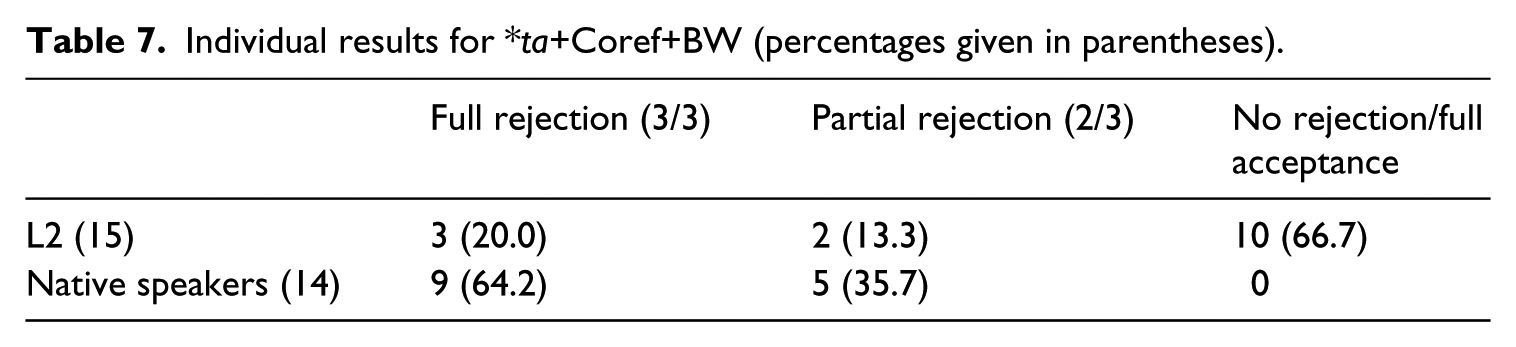
As shown in Table 7, all native speakers consistently reject ta+Coref+BW. Only five of the L2 learners consistently reject this type of sentence whereas 10 showed no rejection. As a matter of fact, these 10 highly proficient speakers accept all the three tokens of ta+Coref+BW, i.e. they show a pattern of ‘full acceptance’. A careful examination of the individual data shows that four out of the five L2 learners who consistently reject ta+Coref+BW are also consistent in incorrectly rejecting ta+Coref+FW. The results indicate that the L2 learners have not acquired the cyclic-c-command condition of ta.
Individual results for *ta+Coref+BW (percentages given in parentheses).
V Discussion
As shown in Table 8, ta and the null element never have the same interpretations in the sentence positions under investigation in either native Chinese grammars or L2 grammars. Native Chinese speakers allow the disjoint reading, but reject the coreferential reading of ta in backward anaphora. L2 learners allow the disjoint reading, but they are indeterminate about the coreferential reading of ta in this type of context. Both native speakers and L2 learners allow the coreferential reading but reject the disjoint reading of the null element in backward anaphora. The native speakers and L2 learners behave alike with respect to the interpretation of ta and the null element in forward anaphora. They both interpret the null element as referring to the subordinate subject but not to someone else. Both of them accept the coreferential reading of ta and predominantly accept the disjoint reading, although there is a hint of indetermination with the latter. I discuss the data in line with the theoretical proposals in Section II below.
A brief summary of the findings.

As given in Section IV.4, the highly proficient learners correctly allow the null element to appear in the subject position of the subordinate clause. In particular, they allow null subjects to appear in the subordinate clauses with the aspect marker le and modal yao as well as in those with neither. As argued in Section IV.3, (15a–c) are finite clauses according to Huang (1989). Therefore, the fact that highly proficient learners accept them may indicate that they accept null subjects in finite subordinate clauses in their L2 Chinese. Due to the lack of inflectional changes in Chinese, we cannot rule out the possibility that highly proficient learners accept these sentences based on the sentences in (17) in their L1. Nonetheless, the results in Section IV.4 show that the highly proficient learners also correctly accept null subjects in main clauses in (15d), which is not allowed in their L1 as in (18). This unequivocally indicates that they accept null subjects in finite clauses. This result is consistent with the findings of Yuan (1993) and Zhao (2011, 2012a) that null subjects are allowed in finite clauses in L2 grammars of English-speaking learners by the advanced state. If highly proficient learners have acquired that null subjects are allowed in finite clauses in Chinese, it is highly possible that they do not need to rely on their L1 grammar to judge (15a–c).
(17) a. When singing, Li Hong is wearing a white dress. b. After having heard these words, Li Gang burst into tears. c. When (being) about to go out, Xiao Li remembered that he did not bring his wallet. (18) * ‘When Xiao Zhang is eating, e is wearing a pretty necklace.’
The results from the PJT show that highly proficient learners behave like native speakers and interpret the null element as referring to the other sentential subject in both forward and backward anaphora. I argued in Section II that these null elements are Øtopics, derived from deletion of the topicalized subjects as a piece of old information in the discourse. Their derivation inevitably involves the syntactic computation of topicalization as well as discourse information, and thus a syntax–discourse interface category. Given the assumption, the results may indicate that the highly proficient learners have acquired Øtopic at the syntax–discourse interface. It is not possible that the null elements are treated as null Chinese equivalents of the English pronouns. First, the highly proficient learners do not allow the same readings for the null element as they do for ta as shown in Table 8. Second, it has been found that English-speaking learners have become aware that null pronouns are not allowed in Chinese by the advanced state (Zhao, 2012a). The result that Øtopic seems to have been acquired by the highly proficient speakers here is consistent with Zhao (2011, 2012a) who found that Øtopic had been acquired in other sentence positions by English-speaking learners by the advanced state.
It is not surprising that Øtopic can be acquired in L2 Chinese. There is plenty of evidence in the input data to show that null elements can be used to refer to a discourse entity in Chinese. In terms of representation, the acquisition of Øtopic in the subject position takes subject topicalization and the Topic NP Deletion Rule as preconditions. Independent evidence in the literature indicates that these preconditions have been acquired by English-speaking learners by the advanced state (for details, see Yao, 2007; Zhao 2008, 2012a).
The acquisition of Øtopic provides further evidence to the claim that some aspects at the syntax–discourse external interface are acquirable (Ivanov, 2012; Iverson et al., 2008; Kraš, 2008; Rothman, 2007, 2009; Slabakova et al., 2012; Slabakova and Ivanov, 2011; Zhao, 2008, 2012a). The current study supports the proposals of White (2011) and Yuan (2010) that interface vulnerability may not be domain-wide in that Øtopic at the syntax–discourse interface is acquired in comparison with some syntax–discourse properties that have proved to be vulnerable to ultimate fossilization as discussed in Sorace and Filiaci (2006), among others. This result can also be considered as consistent with the IH. As discussed in Section I, the IH does not rule out the possibility that properties at the syntax–discourse interface may be acquirable.
As shown in Table 8, highly proficient learners behave like native speakers regarding the disjoint reading of ta in backward anaphora. As noted above, the disjoint reading of ta in forward anaphora is grammatically acceptable (Lust et al., 1996). I report in Section IV.4 that individual analysis show that over 70% of native speakers and L2 learners consistently accept this type of reading, despite the mean scores for both groups being around ‘0’. This indicates that the majority of native speakers and L2 learners accept the disjoint reading of ta, although there is some degree of indetermination. Lust et al. (1996) also found that the grammatical disjoint reading of the Chinese ta was not readily accepted by their adult native speakers.
Then what causes the indetermination in both native grammars and end-state L2 grammars? Lust et al. has not given any detailed explanation but simply claim that this might be due to a pragmatic principle or strategy. I argue below that the indetermination may be related to the fact the subject of the temporal clause is readily accessible as the referent. Syntactically, the subject of the temporal clause is not in the governing domain of ta and thus qualifies as a possible referent of ta. Semantically, the test sentences adopt activity verbs in the temporal sentence and verbs with continuous aspect in the main clause as in (1), thus supporting the coreferential reading of ta. In addition, coreferential reading of ta may be less costly than the disjoint reading as below.
It has been proposed in the literature that processing is subject to the economy principle (see, amongst others, Weinberg, 1999). If both intrasentential and extrasentential dependencies are available, the processor initially establishes an intrasentential dependency (see Burkhardt, 2005). Processing of the disjoint reading involves an extra processing load of accessing a discourse representation of the previous sentence, where the antecedent may be found. Thus the coreferential reading is less costly than the disjoint reading in terms of processing. It has been noted that recency plays an important role in anaphor resolution (e.g. Lappin and Leass, 1994). Sorace and Filiaci also note that it is a ‘well-known preference for finding pronoun antecedents within the clause’, rather than ‘going outside the sentence’ (2006: 359). Mitkov (2002) points out that a noun phrase in the previous clause of a complex sentence is the best antecedent candidate for an anaphor in the subsequent clause. This is precisely the case here. With the subject of the temporal sentence being instantly available as the possible referent of ta, some participants may not be motivated to search for another referent for ta in the discourse. What is of greater interest about the findings of the disjoint reading of the overt pronoun is that English-speaking learners of Chinese do not diverge from native speakers in this respect in either forward or backward anaphora.
Sorace and Filiaci (2006) argue that near-native English-speaking learners of Italian may have insufficient processing resources to take a referent from the discourse as an antecedent for the overt pronoun in backward anaphora in their L2 Italian grammars. Unlike the Italian data in Sorace and Filiaci, the disjoint reading of the Chinese ta is fully acceptable in the highly proficient English-speaking learners’ L2 Chinese. The lack of sufficient processing resources may not be the reason for the non-acquisition of the disjoint reading of the overt pronoun in Italian. Otherwise, this should also be true of the disjoint reading of ta. Highly proficient learners of Chinese would have been unable to relate ta to a discourse entity, contrary to the fact. I will leave the discussion as to why near-native speakers of Italian fail to allow the disjoint reading of the overt pronoun to future research, as it is beyond the scope of the current study.
The highly proficient learners behave like native speakers in accepting the coreferential reading for ta in forward anaphora, but they fail to correctly reject it in backward anaphora. This indicates that they have not acquired the cyclic-c-command condition, contra the predication made in line with the IH. As argued above, the Chinese overt pronoun abides by a stricter syntactic condition than the English one: the cyclic-c-command condition. In backward anaphora, ta cyclic c-commands the subject of the main clause, and hence it cannot refer to the latter. This cyclic-c-command condition is internal to the syntax proper.
As shown in Table 5, 66.7% of the highly proficient learners fully allow the coreferential reading of ta in backward anaphora. This seems to reflect influence from their L1 English. In the L2 grammars of these highly proficient learners, ta is only restricted by the constraint on the overt pronoun in their L1. As long as ta does not c-command an NP, it can take the latter as its antecedent. In either forward or backward anaphora, the other sentential subject is not in the c-commanding domain of ta. These highly proficient learners allow ta to refer to the other sentential subject, although ta cyclically c-commands the latter in backward anaphora.
Five of the L2 learners consistently reject the coreferential reading of ta in backward anaphora. Does this mean they have acquired the cyclic-c-command condition? The answer is negative. As given in Section IV.4, unlike the native speakers, four of these five L2 learners also reject the coreferential reading of ta in forward anaphora. Interestingly, the disallowance of the coreferential reading in both forward and backward anaphora seems to resemble the Italian overt pronoun, which tends not to take the other sentential subject as its referent in either backward or forward anaphora as in (19) (Cardinaletti and Starke, 1994; Fernández-Soriano, 1989). As in Italian, L2 learners seem to have avoided the use of the overt pronoun in ‘unmarked situations, i.e. where the referent is prominent in the discourse’ (Cardinaletti and Starke, 1994: 49). As argued before, the other sentential subject in the complex sentences is normally the topic of the discourse, hence its prominence in the discourse.
(19) a. ??? Quando luii è arrivato a casa, Giannii ha telefonato. when he is arrived at home Gianni has called. b. ??? Giannii ha telefonato quando luii è arrivato a casa. Gianni has called when he is arrived at home. (Adapted from Cardinaletti and Starke, 1994: 68)
This ultimate lack of convergence with the native Chinese grammar could be explained by the absence of triggering positive evidence in the L2 Chinese input data in terms of the interpretational constraint of the pronoun ta. The English overt pronoun obeys a more relaxed condition in taking possible referents. It can refer to an antecedent as long as it does not c-command the latter. The Chinese ta cannot take a referent if it cyclic c-commands the latter. The cyclic-c-command relation properly includes the c-command relation. As a result, there is no positive evidence in the L2 Chinese input data to inform English-speaking learners that the Chinese ta cannot refer to an NP that it cyclic c-commands. This lack of positive evidence might have resulted in highly proficient speakers’ failure to reject the coreferential reading of ta in backward anaphora.
However, the account runs into difficulties when we take the L1 data into consideration. As given in Section III, Lust et al. (1996) find that the monolingual L1 Chinese children also accept the coreferential reading of ta in both forward and backward anaphora. The absence of positive evidence also exists in L1 acquisition of this aspect. L1 learners can ultimately arrive at the native Chinese grammar, which diverges from the fossilization of highly proficient L2 learners in this respect. If the absence of positive evidence is the only reason that underlies the non-convergence of L2 Chinese grammars, why L1 Chinese learners ultimately acquire the cyclic-c-command condition remains unexplainable.
Then what makes the cyclic-c-command condition acquirable to the L1 learner but not to the L2 learners in the absence of positive evidence? Chomsky (1995) argues that parametric differences across languages are limited to the lexicon, i.e. to the functional categories in the lexicon. Accordingly, it may be possible to conceptualize the cyclic-c-command condition that leads to the parametric difference between Chinese and English as a [+cyclic-c-command] feature on the pronominal D. The [+cyclic-c-command] feature is an uninterpretable functional feature because it does not affect the lexical composition of ta. The existence of such a feature does not change the lexical form of ta as a third person singular pronoun. It is not a feature relevant to the lexicosemantic constitution of an element (Spyropoulos, 2005), or ‘required for the assembly of lexical items’ (Hawkins and Hattori, 2006: 271).
When the pronominal D head has a [+cyclic-c-command] feature, it cannot refer to an NP it cyclic c-commands. The English he/she does not have such a feature, whereas the Chinese ta has such a feature. Thus ta cannot refer to the subject of the main clause in backward anaphora, as it cyclically c-commands the latter. He/she can still refer to the subject of the main clause in backward anaphora, as it does not have such a feature.
If the conceptualization of a [+cyclic-c-command] feature is feasible, the different outcomes of L1 Chinese acquisition and L2 Chinese acquisition described above seem to support different versions of the claim that there is representational deficit within narrow syntax in L2 acquisition. (Hawkins, 2003; Hawkins and Chan, 1997; Hawkins and Hattori, 2006; Tsimpli and Dimitrakopoulou, 2007). Adult L2 grammars fossilize when functional uninterpretable features that are not instantiated in learners’ L1 are required.
As argued above, the English pronominal D does not have the [+cyclic-c-command] feature. This feature is not instantiated in English-speaking learners’ L1. As a result, it is no longer accessible to adult English-speaking learners of Chinese. Even highly proficient learners are unaware that ta cannot refer to an NP when its minimal cyclic node c-commands the NP.
As mentioned in Section I, the ultimate fossilization of purely syntactic categories in L2 acquisition has also been reported in Coppieters (1987), Sorace (1993) and Kraš (2011). The ultimate fossilization of narrow syntactic properties reported in previous studies and the current study may suggest that the ultimate success of the purely syntactic categories cannot be generalized across the board in L2 acquisition, just as interface vulnerability may not be domain-wide (White, 2011; Yuan, 2010). The learnability of the purely syntactic categories is also influenced by variables such as the nature of the category, crosslinguistic difference and input.
VI Conclusions
The current study finds that ta and the covert element do not share the same meaning in the subject positions of the complex sentences in either the native Chinese grammar or the highly proficient learners’ L2 grammars. It has shown that the cyclic-c-command condition within narrow syntax is not acquirable, whereas Øtopic at the syntax–discourse external interface properties is acquirable. These findings are not fully consistent with the predictions of the IH, but this study is not the only one that has produced findings inconsistent with the IH. The non-acquisition of narrow syntactic properties is also found in Coppieters (1987), Sorace (1993) and Kraš (2011), while the acquirability of the syntax–discourse interface categories are consistent with Ivanov (2012), Iverson et al. (2008), Kraš (2008), Rothman (2007, 2009), Slabakova et al. (2012), Slabakova and Ivanov (2011) and Zhao (2008, 2012a). This study provides supporting evidence to the claim that the (non-)acquirability of a particular interface cannot be generalized (White, 2011; Yuan, 2010). Furthermore, it shows that L2 learners’ success in the acquisition of the syntactic categories cannot be assumed in a domain-wide fashion. Variables such as the nature of the category, crosslinguistic difference and input may influence the success in the acquisition of narrow syntactic categories, similar to the way they affect the vulnerability of interface categories (Yuan, 2010).
Although the current study provides some useful data on the L2 acquisition of forward and backward anaphora, it only includes highly proficient learners whose native language is English. English does not allow null elements to appear in the subject position of finite clauses. It allows the coreferential reading of the overt pronoun in both forward and backward anaphora. Future research may include L2 learners whose first language allows null subjects in finite clauses but rejects the coreferential reading of the overt pronoun in either forward or backward anaphora to gain a deeper understanding of the roles of input and crosslinguistic influence.
Footnotes
Declaration of conflicting interest
The author declares that there is no conflict of interest.
Funding
This research received no specific grant from any funding agency in the public, commercial, or not-for-profit sectors.