




Abstract
This study takes a new look at the topic of developmental stages in the second language (L2) acquisition of morphosyntax by analysing receptive learner data, a language mode that has hitherto received very little attention within this strand of research (for a recent and rare study, see Spinner, 2013). Looking at both the receptive and productive side of grammar acquisition, however, is necessary for a better understanding of developmental systematicity and of the relationship between receptive and productive grammar acquisition more widely, as well as for the construction of a comprehensive theory of second language acquisition (SLA). In the present exploratory study, the receptive acquisition of L2 English grammar knowledge is studied cross-sectionally within a Processability Theory (PT) framework (Pienemann, 1998, 2005b), a theory of L2 grammar acquisition which makes explicit predictions about the order in which L2 learners learn to productively process different morphosyntactic phenomena. Participants are 72 francophone beginning child L2 learners (age 6–9) acquiring English in an immersion program. The learners’ ability to process six morphosyntactic phenomena situated at extreme ends of the developmental hierarchy proposed by PT was tested by means of the ELIAS Grammar Test, a picture selection task. Overall, the developmental orders obtained through implicational scaling for the six target phenomena agreed with PT’s predictions, suggesting that similar mechanisms underlie the acquisition of receptive and productive L2 grammar processing skills.
Keywords
I Introduction
Research conducted since the 1960s suggests that second language (L2) learners acquire certain morphosyntactic phenomena of the target language in a relatively fixed order and that learners also go through similar stages within their interlanguage development of specific grammatical structures (e.g. negation). The umbrella terms used to denote these two phenomena are ‘orders’ and ‘sequences’ of acquisition, respectively (Ellis, 2008; Ortega, 2009). Within the line of research that deals with these developmental phenomena, considerable effort has been invested in testing the imperviousness of the various stages of acquisition to factors such as age of acquisition, first language (L1) background and learning context as well as in exploring the cross-linguistic validity of and possible driving forces behind any observed developmental consistencies. Major (and ongoing) debates have also revolved around methodological issues such as the appropriate methodology for establishing staged development (e.g. group scores versus implicational scaling) and the operationalization of the concept of ‘acquisition’ (e.g. in terms of native-like performance versus emergence).
A rarely made observation concerning the otherwise very diverse body of research on L2 developmental stages is that the vast majority of studies have looked only at productive learner data, leaving receptive learner data out of the equation. By receptive learner data, we here refer to data that have been obtained through a ‘receptive grammar task’, e.g. grammaticality judgement tasks, comprehension tasks such as picture selection tasks, or psycholinguistic online processing tasks such as self-paced reading tasks or tasks involving eye-tracking. The assumption is that these tasks can inform us about learners’ ability to process L2 morphosyntax during input processing. This is opposed to productive learner data, which tells us something about their ability to process grammar for language production. (See also the discussion below about the relationship between grammar processing in these two language modes.)
To our knowledge, only three studies to date (Keatinge and Keßler, 2009; Larsen-Freeman, 2002; Spinner, 2013) have been explicitly devoted to the receptive side of L2 grammar acquisition. Yet looking at receptive language data is useful, and even necessary, for two reasons. First, it may benefit our understanding of developmental stages in general by providing additional evidence for developmental systematicity from a richer pool of language data and by allowing us to look at the various prevailing conceptualizations of and explanations for developmental stages in a new and more informed light. Indeed, it can be reasonably argued that receptive learner data are crucial for a truly comprehensive understanding of developmental stages in SLA.
A second reason for looking at receptive learner data is the potential relevance of the findings for the field of SLA more widely. One of the ultimate aims of SLA is to arrive at a comprehensive theory of L2 grammar acquisition. Such a theory must also include an explicit view on concepts such as grammar knowledge (as a ‘mental system’), receptive grammar processing and productive grammar processing, and on the relationship between them. Current opinions on these issues still vary in different respects. For example, L1 researchers currently debate whether receptive and productive grammar processing are, as per the traditional view, ‘subserved by distinct, dedicated processing resources, which presumably do not have much more in common than access to the same declarative resources: the lexicon and the grammar’ (Kempen et al., 2011: 347) or whether, despite the different direction of processing (from meaning to message and vice versa), receptive and productive grammar processing involve ‘shared processing resources’ (as argued by Kempen et al., 2011: 348) and common ‘neurobiological systems’ (as argued by Segaert et al. 2012: 1). These, and other, related issues, also still stand open to debate in SLA research. A comparative investigation of developmental systematicity in receptive versus productive L2 grammar acquisition can contribute to this debate by shedding light on the relationship between receptive and productive grammar acquisition.
It should be emphasized that the two rationales for studying receptive learner data just outlined serve merely as the underlying impetus and overarching research questions of the present study. Given the novelty of this research, the aim of the present article is to address these questions in an exploratory manner by identifying methodological issues and exploring possible directions for future research. Concretely, the present study will look at developmental stages in receptive grammar acquisition within the framework of Processability Theory (PT; Pienemann, 1998, 2005b), a psycholinguistic theory of L2 grammar acquisition that offers an account of the stages learners go through in learning to process L2 morphosyntactic structures. PT assumes that grammar knowledge consists of mental representations (i.e. a mental grammar) and of processing skills which operate on, and hence are separate from, the mental grammar. PT argues that it is the order in which productive processing skills are acquired which causes the developmental stages observed in learner production data. Examining whether the mechanisms posited by PT to govern the development of productive grammar processing skills also apply to the development of receptive grammar processing skills not only enhances our insight into developmental stages but also informs us whether receptive and productive processing are governed by similar mechanisms.
In the remainder of this article we will outline the mechanisms of PT and present previous research on receptive and productive grammar acquisition, followed by an empirical study on the development of receptive grammar knowledge by francophone child learners of English as an L2.
II Theoretical framework: Processability Theory
1 Basic mechanisms
Processability Theory (Pienemann, 2005b; Pienemann and Keßler, 2011) aims to offer a cross-linguistically applicable and psycholinguistically plausible explanation for the stages and sequences learners go through in learning to produce morphosyntactic structures of the target L2. The fundamental tenet underlying PT is that language acquisition is constrained by the architecture of human language processing: ‘learners can acquire only those linguistic forms and functions which he or she can process’ (Pienemann, 2011b: 27). PT derives its psycholinguistic plausibility from the fact that its predictions are grounded in the processing mechanisms – called ‘processing procedures’ (see below) – of Levelt’s (1989) and Kempen and Hoenkamp’s (1987) psycholinguistic models of speech production. In addition, PT formally represents grammar within the specific formalism of Lexical-Functional Grammar (LFG; Bresnan, 1982; Kaplan and Bresnan, 1982), a cross-linguistically applicable theory of grammar. LFG also provides PT with its central mechanism of ‘feature unification’ (i.e. the unification of grammatical information between different sentence constituents, as in subject–verb agreement), a mechanism that LFG also shares with Levelt’s and Kempen and Hoenkamp’s speech production models.
Based on the above models, PT defines productive grammar processing along the following tenets. First, in order to ensure ‘feature unification’, grammatical information has to be stored in a grammatical memory store and called up at later points in the language generation process. Depending on the type of feature unification, this process is executed by one of five processing procedures:
The lemma procedure activates the lexical items.
The category procedure accesses the categorical information associated with the activated lemmas.
The phrasal procedure builds phrases by unifying information between constituents of the same phrase.
The S-procedure exchanges information between phrases in a sentence and accesses the target word order rules.
The subordinate clause procedure or S’-clause procedure operates on subordinate clauses, allowing learners to produce target-like word orders which are specific to such clauses.
These five procedures are executed in an implicational order, because every procedure builds on the output of the previous one.
Second, to account for developmental stages, PT holds that the above five processing procedures are acquired by L2 learners in the same implicational order as that in which they are executed in the course of the speech production process. In other words, PT predicts a basic developmental chronology – or ‘Processability Hierarchy’ – that consists of five hierarchically ranked developmental stages, each of which is characterized by the acquisition of one of the five processing procedures outlined above. Hence, the grammatical phenomena that require one of these processing procedures become available to all L2 learners in the same order. While the processing mechanisms in the Processability Hierarchy are claimed to be universal, the resulting developmental schedules (i.e. which grammatical structures arise at each stage) are language-specific.
Third, an important note for this study is that PT defines acquisition not in terms of native-like performance, as is often the case in SLA, but in terms of ‘emergence’. Pienemann (1998) defines emergence as the ‘first systematic use’ (p. 138) of a structure and explains that ‘from a speech processing point of view, emergence can be understood as the point in time at which certain skills have, in principle, been attained or at which certain operations can, in principle, be carried out’ (p. 138). This means that learners’ production is clearly distinct from formulaic sequences and memorized chunks, but may not yet have reached the accuracy-based criteria commonly set in many SLA studies to qualify for ‘native-like acquisition’, i.e. anywhere between 60% (e.g. Vainikka and Young-Scholten, 1994) and 90% (Dulay and Burt, 1974) correct use in obligatory contexts. The operationalization of emergence for the receptive side of grammar acquisition is one of the main methodological challenges in the study of developmental stages in receptive grammar acquisition, and one which will be explored in the present study.
As a theory of L2 grammar acquisition, PT is noteworthy for making explicit and falsifiable predictions (Jordan, 2004), which (a) concern both morphology and syntax, (b) involve both orders and sequences of acquisition, and (c) which are cross-linguistically valid. This makes PT more comprehensive in scope than many other accounts of developmental stages. Early morpheme order studies (e.g. Dulay and Burt, 1974; Larsen-Freeman, 1975), for example, were mainly restricted to a limited set of English morphemes and lacked a clear theoretical framework, while later, more theoretically-driven approaches were often limited in their cross-linguistic applicability and/or morphosyntactic scope (e.g. Bardovi-Harlig, 2000; Hyltenstam, 1984; Nicholas, 1984).
Empirical support for PT, finally, has come from both child and adult learners of different L2s (e.g. Arabic, German, Italian, Japanese, Swedish) and from different L1 backgrounds (e.g. Al Shatter, 2008; Baten, 2011; Di Biase and Kawaguchi, 2002; Håkansson, 2001; Håkansson et al., 2002; Rahkonen and Håkansson, 2008). The present study focuses on the acquisition of L2 English by French-speaking children.
2 Developmental stages in L2 English
Recent versions of PT (Pienemann, 2005b, 2011a) distinguish six stages for the development of grammar in English (Table 1). Stages 1–3 and 5–6 in English correspond to the five processing procedures outlined in the previous section. Stage 4 is a more recent addition to the Processability Hierarchy, which has been added in response to empirical findings. These stages account for the acquisition of a large number of English grammatical structures, including the following:
morpheme markings such as past tense -ed, plural -s marking and possessive -’s, which do not involve any feature unification (category procedure; Stage 2);
number agreement between modifiers and nouns, which involves within-phrasal feature unification (phrasal procedure; Stage 3);
‘tense agreement’, as in agreement between auxiliary have + past participle; (Pienemann, 2005a) (VP procedure; Stage 4);
structures such as subject–verb agreement, which involves between-phrasal unification of person and number (S-procedure; Stage 5); and
sub-clausal word order phenomena such as the cancellation of inversion in indirect questions (termed ‘Cancel Inversion’) (subclause procedure; Stage 6).
The developmental hierarchy for English has been supported by empirical evidence from English L2 learners with L1 backgrounds as typologically diverse as, for example, Japanese (Sakai, 2008) and German (Pienemann, 2005b).
Developmental stages in English.
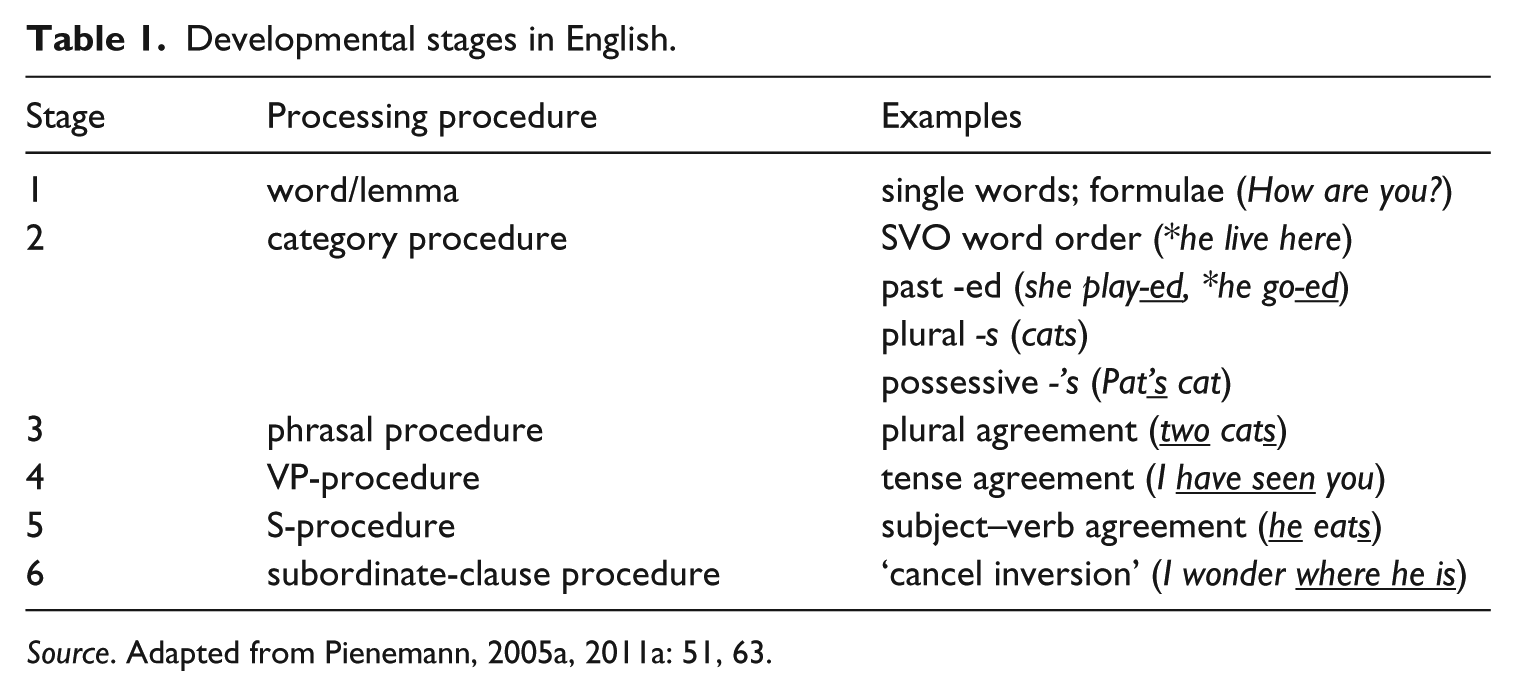
Source. Adapted from Pienemann, 2005a, 2011a: 51, 63.
3 ‘Feature unification’, ‘processing procedures’ and receptive grammar acquisition
As mentioned earlier, the basic principles of PT are grounded in Levelt’s Model of Speech Production and in Kempen and Hoenkamp’s Incremental Procedural Grammar. This makes PT ‘in actuality a theory of language production’ (Ellis, 2008: 461; emphasis ours). Pienemann (1998) himself writes that ‘it is clear that comprehension and production are not mirror images of each other’ (p. 52), 1 and limits the scope of PT to productive grammar acquisition. The question addressed in this article, then, is whether the implicationally ordered processing procedures also account for the development of receptive grammar acquisition.
Relevant research to consider in this context is psycholinguistic research on the processing of grammatical agreement in L1 speakers and L2 learners. First, studies on L1 processing have suggested that agreement processing is a psychologically real process in receptive grammar processing. Even though listeners, unlike speakers, can circumvent grammatical parsing by relying on non-grammatical ((i.e. on lexical and semantic, e.g. probabilistic, information) information Fernández and Cairns, 2011; Garman, 1990; Van Gompel and Pickering, 2007), native speakers will still access and process grammatical information in linguistic input. Second, research that explicitly compares the effect of L2 proficiency on the processing of different types of agreement is still rare, but the few available studies suggest that, while highly advanced L2 learners may show native-like processing patterns, beginning and intermediate learners show varying levels of processing skills, depending not only on their proficiency level but also on the grammatical feature that is being investigated (Chondrogianni and Marinis, 2012; Hopp, 2010; Sagarra and Herschensohn, 2010). A relevant question, then, is what causes certain features to be more difficult to process than others.
Although the notion of agreement in these studies is somewhat more narrow than the feature unification that takes place at the various stages of PT, there are enough similarities to argue that this psycholinguistic evidence, especially the fact that certain features are more difficult to process than others, warrants an investigation of the staged development of processing skills within a PT framework.
III Previous research on developmental stages in receptive grammar acquisition
Only a limited number of studies to date have looked at developmental stages in receptive L2 grammar acquisition. In an early morpheme acquisition study, Larsen-Freeman (1975) examined adult L2 learners’ productive and receptive knowledge of 10 English morphemes that were typically investigated in morpheme acquisition research of the time. The test battery consisted of three L2 production tasks (a blank-filling exercise, the Bilingual Syntax Measure and a sentence repetition task) and two receptive tasks (aural and written picture matching tasks). Results showed that only the rank orders of the reading and writing tasks, on the one hand, and of the speaking and listening tasks, on the other hand, correlated. These results later led Larsen-Freeman to emphasize that one should not ‘assume an isomorphism between comprehension and production’ (Larsen-Freeman, 2002: 283) in L2 development. Although Larsen-Freeman’s study is noteworthy for being the first to examine the developmental patterns in receptive L2 grammar acquisition, it shared a number of problems with other morpheme studies of the time (see Ellis, 2008), including its use of accuracy rank orders based on group data, a method that masks individual variation, and which is thus ill suited for investigating developmental stages.
In more recent years, only two empirical studies that we know of have explicitly investigated developmental stages in receptive L2 grammar acquisition. Keatinge and Keßler (2009) examined 10 German-speaking adolescents’ receptive and productive knowledge of the passive voice in L2 English within a PT framework. They write that, according to PT, ‘perception of the passive voice is constrained by processing procedures’, but they assume that ‘perception does not require productive processing skills of this structure’ (p. 73). Despite the importance of the relationship between receptive and productive processing, a more detailed discussion of these assumptions is not provided. On this basis, then, these authors hypothesized that learners will start to comprehend the passive voice before or at the same time as they begin to produce interlanguage variants of the passive (e.g. *Banana eat by monkey). L2 learners’ productive knowledge of the passive voice was tested using a number of elicitation tasks, namely Tomlin’s (1995) Fish Film, two sentence completion tasks, and a story telling task. Learners’ receptive knowledge of the passive was assessed by a semantic decision task based on the Fish Film, whereby learners had to match passive and active sentences to one of two pictures. Data analysis revealed that the learners who were not yet able to produce (pseudo-)passives had a score of either 0% or 10% on the comprehension task, while all learners (except one) that were able to produce (pseudo-)passives had scores of 70% or higher on the comprehension task. Keatinge and Keßler (2009) claim that their data support the applicability of PT to receptive grammar acquisition, but this conclusion seems premature given that the authors looked at one structure only.
The most recent venture into receptive developmental stages was undertaken by Spinner (2013). In this study, receptive language data were collected using two aural grammaticality judgement tests (GJTs) - one being a revised version of the other. The two GJTs tested 15 English structures representing Stages 2 through 6 in the PT Processability Hierarchy for L2 English. The tests included both morphological and syntactic structures. Participants included 51 learners of English, ranging from beginner to advanced and with various L1 backgrounds. While results from a production task confirmed PT, the GJT data did not reveal any developmental systematicity, suggesting either that receptive grammar acquisition is not governed by PT, or that other factors (e.g. the nature of the task) had prevented any developmental systematicity from becoming visible in the data. The study by Spinner (2013), then, is the only study that has looked at the acquisition of various morphosyntactic structures within a PT framework. This study differs from our own in many respects, including in learner characteristics (e.g. the age of the participants), the learning context and the L1 background, but also in the type of test instrument used. In the discussion section of this article, we will compare our results to those of Spinner, consider how the methodological aspects of both studies may have affected any differences in results, and draw conclusions for future research.
IV Receptive and productive grammar acquisition in (second) language acquisition research
In research on developmental stages as well as in L1 and L2 acquisition research more generally, relatively little effort has been made to integrate productive and receptive grammar acquisition into a comprehensive theory of language acquisition. This is not to say, however, that no attention whatsoever has been given to the relationship between receptive and productive grammar acquisition.
One relevant subfield of SLA that has addressed the question of whether production and comprehension share a common knowledge base and/or processing skills is research on developmental asymmetries in L1 and L2 acquisition; that is, cases where comprehension appears to precede production in development or, more counter-intuitively, where the opposite appears to be the case. For example, Unsworth (2007) found that among child L2 learners of Dutch, ‘direct-object scrambling’ is more target-like in production than in comprehension. Some researchers have attributed such findings to extra-grammatical factors that come into play in the comprehension process but which do not play a role in production. In particular a lack of pragmatic knowledge needed to interpret certain constructions is often cited (Van Hout et al., 2010). Others dismiss the observed asymmetries as experimental artefacts, e.g. as resulting from comprehension tasks that are unnaturally difficult, or experimental tasks that do not adequately capture receptive knowledge (Hendriks and Koster, 2010). Still others have sought explanations in the organization and composition of the grammatical system. One explanation holds that comprehension and production rely on different grammars, an explanation generally considered non-parsimonious and, hence, unattractive because ‘such a linguistic model would never account for the general adult pattern that we are able to understand whatever we can produce and vice versa. Symmetry would then be the exception instead of the rule’ (Hendriks and Koster, 2010: 1889). A more popular account for these asymmetries is that production and comprehension share a common grammar knowledge base but with potentially different, specialized processes. Opinions vary as to whether comprehension and production processes are entirely distinct (L White, 1991) or essentially the same processes that operate in a different mapping direction (Keenan and MacWhinney, 1987; Smolensky, 1996).
Other research that bears on the relationship between receptive and productive grammar acquisition is research on ‘receptive bilinguals’ (RBs), speakers who are capable of comprehension in two languages but who can produce little or no speech in one of their languages. Sherkina-Lieber et al. (2011) looked at morphological knowledge of Labrador Inuttitut by Inuit receptive bilinguals to investigate whether this asymmetric knowledge is caused by the fact that ‘speech production and speech comprehension rely on the same linguistic knowledge but are different processes’ (p. 303) or whether ‘their comprehension [is] based on vocabulary knowledge coupled with extensive use of context in familiar situations, in the absence of actual grammar’ (p. 302). Results from a grammaticality judgement task suggested that even receptive bilinguals with the lowest degree of receptive skills ‘possess intuitions about the grammar of their receptively known language’ (p. 314). The authors speculate that receptive bilinguals’ grammar knowledge is insecure and inconsistent, enabling them, for example, to know that a particular case morpheme is needed in a certain morphosyntactic position, but not to select the correct case morpheme in language production. Depending on the degree of syntactic knowledge at the learner’s disposal, production problems may be more or less severe (resulting in hesitations, errors, or a failure to produce certain constituents altogether).
A focus on receptive versus productive grammar skills and knowledge can also be found in a strand of research that studies L2 learners’ receptive grammar knowledge to determine whether certain persistent problems with L2 morphosyntax in production constitute evidence of the absence of underlying grammar knowledge or of processing difficulties in production. Some of these studies found that receptive processing did not pose a problem for L2 learners, and hence attributed the problems in production to productive processing skills. For example, problems with gender have been attributed to ‘difficulties in identifying the appropriate morphological realization of functional categories; that is, the problem lies in mapping from abstract features to their surface morphological manifestation’ (Prévost and L White, 2000: 108). Conversely, however, a study by McCarthy (2008) found (qualitatively similar) difficulties with grammatical gender in both productive and (offline) receptive tasks, leading the author to argue that similar processing problems occur in receptive and productive grammar processing.
In short, the diverse research available to date on the relationship between receptive and productive grammar knowledge and processing skills yields mixed and inconclusive findings. Overall, there appear to be both similarities and disparities between the receptive and productive grammar systems, but clearly more research is needed to pinpoint the shared and distinct properties of each type of grammar system and to integrate the diverse findings into a comprehensive theory of SLA. The study of developmental stages in receptive grammar acquisition within a PT framework is relevant in so far that it can help shed light on the intricate relationship between production and reception in the L2 acquisition process by showing whether similar processing procedures underlie the acquisition of receptive and productive grammar processing skills.
V Present study
The general research question addressed in the present study is to what extent the processing procedures postulated by PT for productive L2 grammar acquisition also govern the acquisition of learners’ receptive grammar processing skills. In order to answer this question, we present a study on the order in which francophone children acquire English morphosyntactic phenomena. The instrument for the study was developed within the framework of the Early Language and Intercultural Acquisition Project (ELIAS; Kersten et al., 2010; Steinlen et al., 2010), a project on immersion education in Europe. 2
1 Participants
Seventy-two francophone children between 6;11 and 8;8 years old (mean age: 7.8 years) learning English as an L2 in an English primary school immersion program in the French-speaking part of Belgium participated in the study. About a quarter of the children were bilingual in French and an additional home language (e.g. Arabic, Italian or Turkish). School contact with English amounted to approximately 10 hours per week. The duration of L2 contact (i.e. time spent in the immersion programme) ranged from 18 to 41 months. None of the participants had any knowledge of English prior to entering the immersion programme. They furthermore had little or no contact with English outside the school (Buyl and Housen, 2014).
2 Instrument and procedure
The learners’ receptive grammar knowledge was tested by means of the ELIAS Grammar Test (henceforth EGT), a picture selection task based on the Reception of Syntax Test (P Howell et al., 2003) and the Kiel Picture Pointing Test (Steinlen and Wetlaufer, 2005). The EGT measures knowledge of nine grammatical phenomena by assessing learners’ ability to match an orally presented ‘prompt’ (containing a target grammatical phenomenon) with the picture representing the propositional content of this prompt. For each prompt three drawings (‘response pictures’) were shown to the child (for examples, see Appendix 1): one represents the prompt; a second, the ‘error’, differs from the prompt in the grammatical dimension, i.e. it represents the same propositional content but the grammatically contrasting value of the prompt (e.g. singular instead of plural); the third picture, the distractor, depicts a different propositional content than the prompt. For example, when presented with the prompt cats, learners must choose between drawings of one cat (‘error’), of two cats (‘correct’), or of a dog (‘distractor’).
The EGT, like other picture selection tasks, relies on morphosyntactic contrasts. For each targeted grammatical phenomenon (e.g. plural -s), the instrument contains not only prompts representing this phenomenon but also an equal number of prompts representing the contrasting grammatical value (e.g. singular nouns in the case of PLU, i.e. plural). Each of the prompts representing one value is ‘paired’ with one of the contrastive prompts, meaning that they differ in the value of the morphological contrast but not in the lexico-semantic content (e.g. cats versus cat). Moreover, the same set of three response pictures is used for the paired prompts. Thus, what serves as the ‘correct’ picture for one prompt serves as the ‘error’ for the paired prompt, and vice versa. Each grammatical phenomenon is tested through six prompts, three of which represent one value of the grammatical phenomena and three the contrasting value. Learners respond by pointing to one of the three response pictures.
To avoid fatigue and diminishing concentration, the 54 test items of the EGT were divided over two parts that were administered on separate occasions. The time lapse between the administration of the two test parts varied due to the school’s schedule but never exceeded seven days. The learners were tested individually in a quiet room in the school during regular school times. Administration of each test part took approximately 10 minutes per child.
3 Grammatical phenomena and PT
Table 2 gives an overview of the six target grammatical phenomena that were investigated in the present study, along with examples of paired prompts and the abbreviations used in the remainder of this article. Table 3 shows at which PT stage we predict each target phenomenon to become available. These predictions are based on the targeted grammatical phenomena only, and not on any other grammatical phenomena that may be present in the prompt. Thus, for the prompts targeting the phenomena GEN (e.g. The girl is feeding the boy’s dog), NEG (e.g. The dog is not eating) and SVO (e.g. The boy is kissing the girl) we assume that learners have to process the verbs forms only to the extent that they recognize the verb lemma that expresses the action depicted in the response pictures. Grammatical information such as progressive aspect or subject–verb agreement is not necessary for the purpose of identifying the correct picture. This assumption is based on psycholinguistic evidence that receptive parsing has access to a wide range of non-grammatical cues for comprehension. Hence, given the availability of sufficient semantic or contextual cues, listeners do not necessarily have to perform an in-depth analysis of all the grammatical information encoded in the input in order to arrive at the meaning of the sentence (Garman, 1990; Van Gompel and Pickering, 2007). The EGT has been designed with this psycholinguistic information in mind. By presenting learners with pictures that contain the lexical and semantic information given in the prompts, it is ensured that learners have enough contextual information for a ‘superficial’ analysis of the prompt. An in-depth analysis is required, however, to distinguish between the (propositionally related but grammatically contrastive) error and correct picture (Steinlen et al., 2010).
Grammatical phenomena in the ELIAS Grammar Test (EGT).

Source. Adapted from Steinlen et al., 2010.
Classification of AGRc, AGRv, GEN, NEG, PLU and SVO into the Processability Hierarchy for L2 English.

We predict that GEN and PLU are Stage 2 phenomena because they require learners to access the lemma’s category information but do not involve any feature unification (Pienemann, 2005b). SVO, the canonical word order in English, is also predicted to emerge at this stage. For NEG, we predict that, within the context of the EGT, receptive parsing of the prompts – which all took the form of ‘subject + is + not + -ing-form’, as in The duck is not eating – becomes possible at Stage 2, i.e. the stage at which PT predicts the most basic interlanguage negation form ‘Neg+SVO’ (e.g. *No me live here) to become processable (Pienemann, 2011b). The prompts in the ELIAS GT obviously do not take this interlanguage form. However, our classification is again based on the assumption that, when presented with the three response pictures for NEG (see Appendix 1), the only information that needs to be parsed in order to select the correct picture in the EGT is the subject, the negator and the verb. Given the contextual clues provided by the response pictures, all additional grammatical aspects in the prompts (such as word order, or progressive tense) is irrelevant for the purpose of selecting the correct picture.
Finally, subject–verb agreement in AGRc and AGRv requires the S-procedure (Stage 5) (Pienemann, 2005b). It should be noted here that PT is not entirely clear about the status of copula verbs, i.e. whether this grammatical feature merely involves learning ‘is’ and ‘are’ as lexical items, or whether this also involves the S-procedure. However, since copula verbs have in other studies been treated within the context of the S-procedure (Dyson, 2009; Pienemann, 1998), we decided to also include copula be here at Stage 5.
In sum, the six ELIAS GT phenomena included in this study are predicted to emerge at the two non-adjacent Stages 2 and 5 (Table 3). We believe that for the exploratory purpose of this study it is sufficient to contrast two stages at the extremes of the developmental continuum. If our receptive data confirm that Stage 2 phenomena are acquired earlier than Stage 5 phenomena, further research can explore whether the application of PT is still upheld for other grammatical phenomena and other stages in the developmental hierarchy.
4 Analytic procedures
a Emergence criterion
Crucially, PT makes predictions about the order in which certain morphosyntactic phenomena emerge in L2 learners’ interlanguage, rather than the order in which (accurate) native-like performance is reached. This distinction between emergence and native-like acquisition is important because applying different definitions and operational criteria of acquisition to the same data may yield different developmental patterns (Hatch and Lazaraton, 1991; Pallotti, 2007; Pienemann, 1998).
Applying the emergence criterion to a productive language data set involves a distributional analysis in which it is (1) established whether the target grammatical phenomenon is used with a specific, selective function (as indicated, for example, by its absence in inappropriate contexts), and (2) checked whether the feature is used productively, i.e. whether it is rule-generated rather than accessed as a part of a memorized chunk or formula (as, for example, indicated by the use of a morphosyntactic feature on different lemmata; Pienemann, 1998; for an extensive discussion of the operationalization of the emergence criterion, see also Pallotti, 2007). Importantly, this operationalization of emergence is not applicable to datasets involving elicited production tasks such as fill-the-gap exercises, nor to receptive language data.
Previous PT studies which used problematic types of elicited production have dealt with the problem in ad hoc manners. For example, Baten (2011) used a fill-the-gap exercise to elicit German case endings. Rather than setting acquisition criteria, Baten compared the relative suppliance ratios of the different case endings in different contexts. Glahn et al. (2001), in a language production study on adjective–noun agreement with predicative and attributive adjectives in L2 Swedish, elicited the production of adjectives by asking participants a number of questions concerning the properties of illustrated items (e.g. ‘What colour are the small cups?’, to which participants were expected to respond with a phrase like ‘They are brown.’). As an ad hoc solution to the problem that ‘it would of course be very difficult to find a criterion corresponding to “the first systematic use” ’ (Glahn et al., 2001: 398) for this type of task, emergence was defined as one instance of correct agreement use out of 15 elicited responses. However, the emergence criterion was further supplemented with a 50% and 80% acquisition criterion, so as to see ‘to what extent the various criteria actually yield different pictures of the developmental pattern’ (Glahn et al., 2001: 398).
In one of the two currently available PT studies on receptive grammar processing, Keatinge and Keßler (2009) use a picture selection task. Problematically, Keatinge and Keßler do not specify the cut-off point for emergence/acquisition used in their analysis. The results showed that participants obtained only scores below 30% (which were interpreted as lack of acquisition) or above 70%. Their cut-off point for emergence/acquisition could thus lie anywhere between 30% and 70%. In the second PT study, Spinner (2013) used an acquisition criterion which was set at a score of 80% on the GJT (though she also reports that other acquisition criteria were applied during the analyses which were not reported because they corroborated the results of the 80% acquisition criterion).
In the EGT used in this study, six possible emergence/acquisition criteria (from 1 to 6 out of 6 correct) can be set (see Table 4). One might be tempted to interpret lower scores as indicating ‘emergence’ and higher scores as indicating ‘full acquisition’. Doing so, however, would ignore an important statistical factor, namely chance performance. In a three-choice task, participants have one chance out of three to arrive at a correct reply merely by guessing, and this for every of the six test items for a given grammatical phenomenon. When setting a criterion, we must therefore establish whether the probability that a participant meets this criterion is above chance performance, i.e. whether the probability of obtaining this score is below .05 (D C Howell, 2010). In the EGT we can be certain that a participant was not guessing only when he or she obtained a score of 5 or 6 out of 6 (Table 5).
Emergence/acquisition criteria (percentages in parentheses).
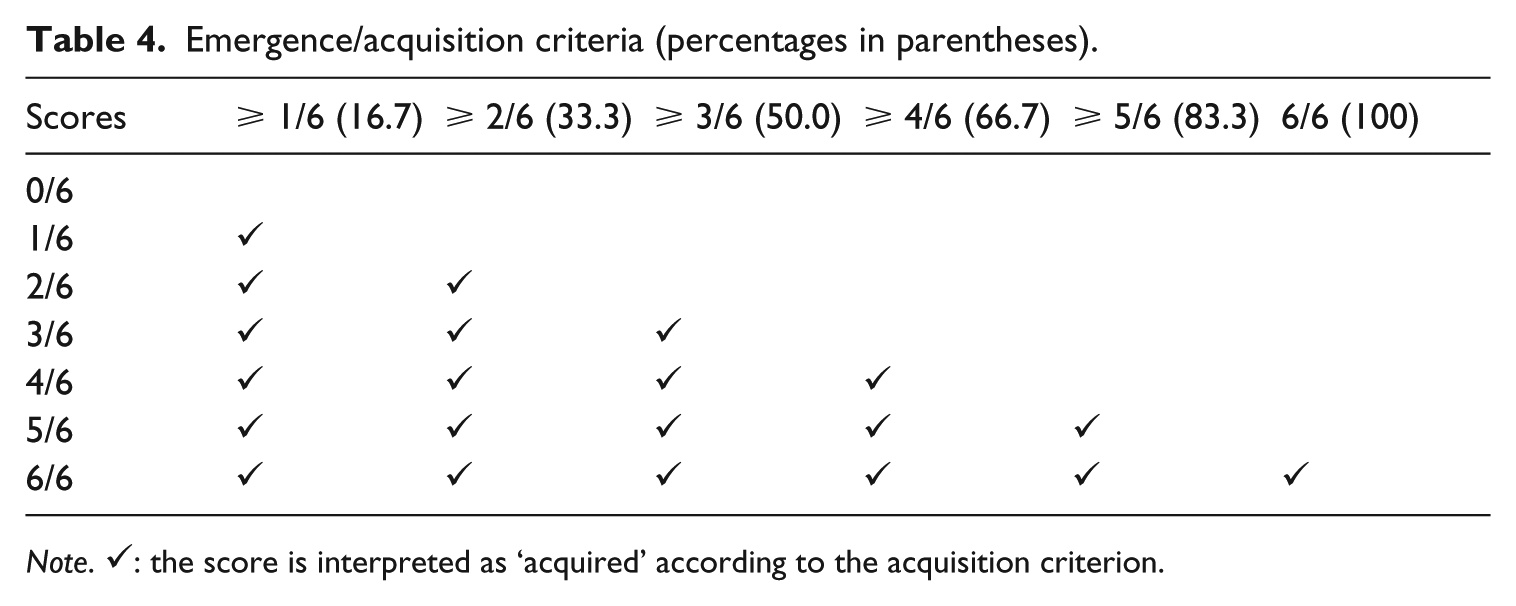
Note. ✓: the score is interpreted as ‘acquired’ according to the acquisition criterion.
Emergence/acquisition criteria.

Notes. n = number of prompts; π = chance level; k = number of correct responses; p ⩾ k = probability of obtaining score k or higher by chance; * = score is above chance performance (p >.05).
We will present the implicational scales based on the statistically reliable ⩾ 5/6 and 6/6 criteria as well as the scales based on the other criteria. Although we cannot rule out guessing behaviour in the case of the latter, a comparison of all six scales may still yield relevant information at the exploratory stage represented by this research. In particular, the overall rank order of the scales may reveal, if not universal developmental systematicity, at least some developmental tendencies.
b Implicational scaling
In accordance with standard practice in PT research, the data are analysed by means of implicational scaling, a technique which measures the consistency across individual learners’ rank orders (Hatch and Lazaraton, 1991; Rickford, 2002). The use of individual learners’ data (rather than group data) makes implicational scaling the most appropriate currently available device for ‘revealing structure [i.e. developmental systematicity] in variability, and for demonstrating that what some linguists might dismiss as random or free variation is significantly constrained’ (Rickford, 2002: 142).
An implicational scale consists of a matrix in which individual learners’ results for different grammatical phenomena, recorded in the form of an ‘acquired’ (+) or ‘not acquired’ (–) mark, are ordered following a scaling procedure. On one axis of the scale, the phenomena are ordered from the one acquired by the largest number of learners to the one acquired by the smallest number of learners, resulting in what will henceforth be called the ‘overall rank order’. On the other axis, the individual learners are ordered from the most advanced (i.e. having acquired the largest number of phenomena) to the least advanced. In order to support developmental systematicity, the individual learners’ rank orders should be consistent with the overall rank order, i.e. when he or she has acquired a given grammatical phenomenon, all phenomena that are ranked lower in the overall rank order should also have been acquired.
Most implicational scaling studies allow for a limited number of deviations from the ‘perfect’ pattern. For example, a coefficient or index of reproducibility (IR) can be calculated, which expresses the percentage of entries in the matrix that do not deviate from this pattern. The matrix can be considered scalable when the IR is .93 or higher (Rickford, 2002). To give the reader an idea of the overall scalability of the implicational scales, we will report the coefficient of reproducibility. However, it should be kept in mind that a low IR cannot provide counterevidence to PT, because individual variation within the rank order of the Stage 2 phenomena or within the rank order of the Stage 5 phenomena is allowed (Pienemann and Keßler, 2011). Thus, a low IR is acceptable, as long as it does not concern the between-stage level.
A final note on implicational scaling is that some PT studies pre-arrange the grammatical features under investigation in the order predicted by PT instead of arranging them based on the number of participants that have acquired each feature. In this case several grammatical features belonging to the same stage are furthermore combined into one stage by marking a stage as acquired when at least one (or a few) of the features is acquired, which is in line with the crucial claim (or disclaimer) that PT ‘does not predict that whatever can be processed will indeed be acquired. Instead the theory predicts that what cannot be processed will not be acquired’ (Pienemann, 2005b: 40), meaning that not all features of a given stage need to have emerged in the learners’ interlanguage before he or she can move on to the next stages. Coefficients of scalability are then calculated for this ‘PT-scale’. Spinner (2013), for example, presents such ‘PT scales’ alongside the conventional scales. In the current study, however, we opted against this procedure, in favour of the conventional scalability procedure (at least for the purpose of presenting the data), for the following reasons: First, showing the entire scale allows us to illustrate how the different emergence/acquisition criteria affect the results, an interesting aspect of implicational scaling at the current exploratory stage of research. Second, given that there are only two PT-stages represented in the ELIAS GT, a brief look at the conventional scale can quickly inform us about whether individual variation affects only the inter-stage level, and/or also intra-stage level, thus giving us the same information as the ‘PT-scales’.
VI Results
Tables 6 to 11 present the implicational scales using the criteria ⩾ 1/6, ⩾ 2/6 ⩾ 3/6, ⩾ 4/6, ⩾ 5/6 and 6/6 respectively. In these scales, a ‘+’ in a column headed by one of the grammatical phenomena indicates that the participant(s) in the corresponding row passed the acquisition criterion for the grammatical phenomenon, while a ‘–’ signals that this was not the case. For the sake of surveyability, the scales are contracted; that is, learners with the same pattern of acquired and non-acquired items are combined into one row. On each line, the number of participants who showed this pattern is indicated in the left-most column. For instance, in the ⩾ 1/6 scale (Table 6), 69 learners had a score equal to or higher than 1/6 on all six target structures. The interpretation of results and the calculation of the coefficients of scalability are based on the full scales, in line with what is considered the appropriate method for interpreting scales.
Implicational scale: Acquisition criterion: ⩾ 1/6 correct.
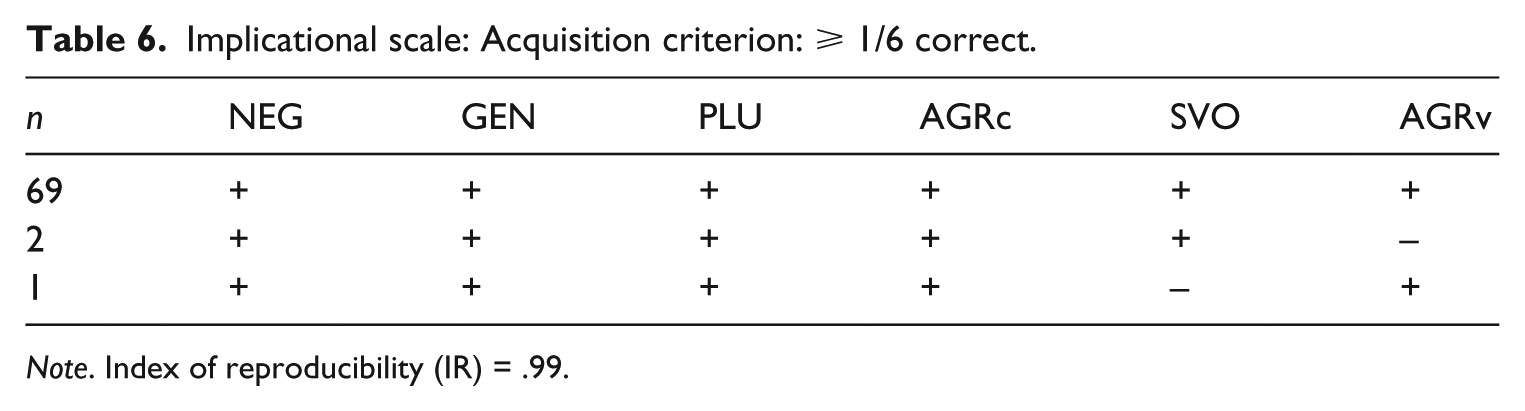
Note. Index of reproducibility (IR) = .99.
Implicational scale: Acquisition criterion: ⩾ 2/6 correct.
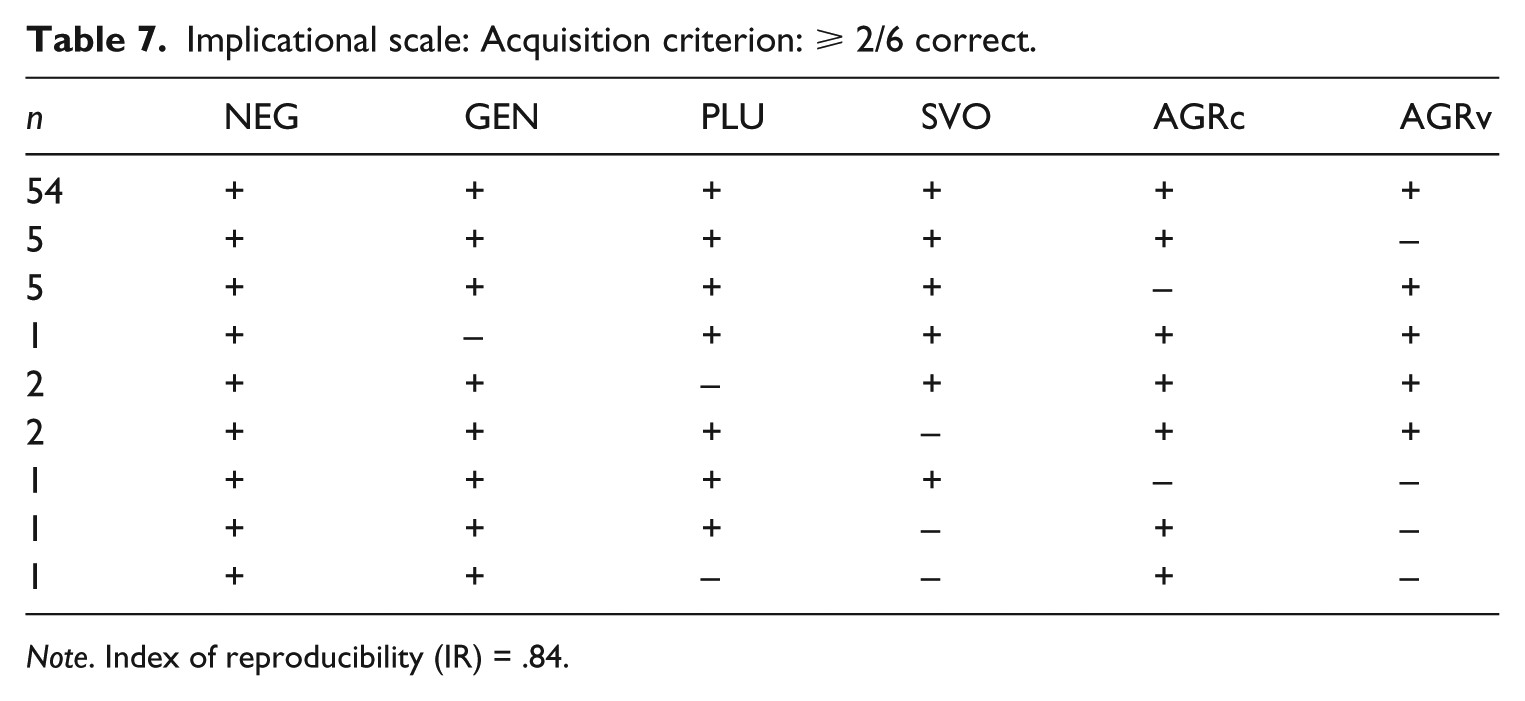
Note. Index of reproducibility (IR) = .84.
Implicational scale: Acquisition criterion: ⩾ 3/6 correct.
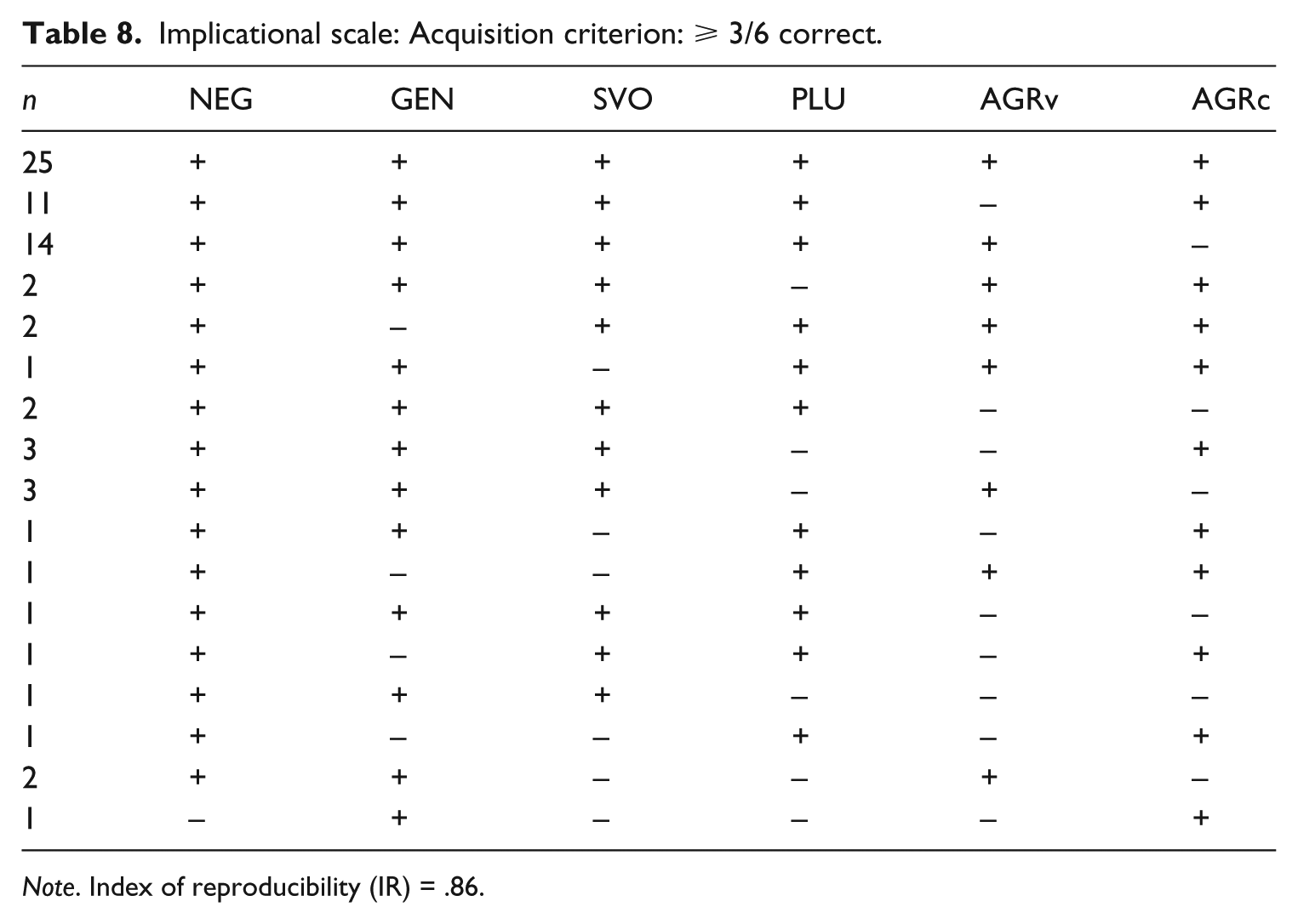
Note. Index of reproducibility (IR) = .86.
Implicational scale: Acquisition criterion: ⩾ 4/6 correct.
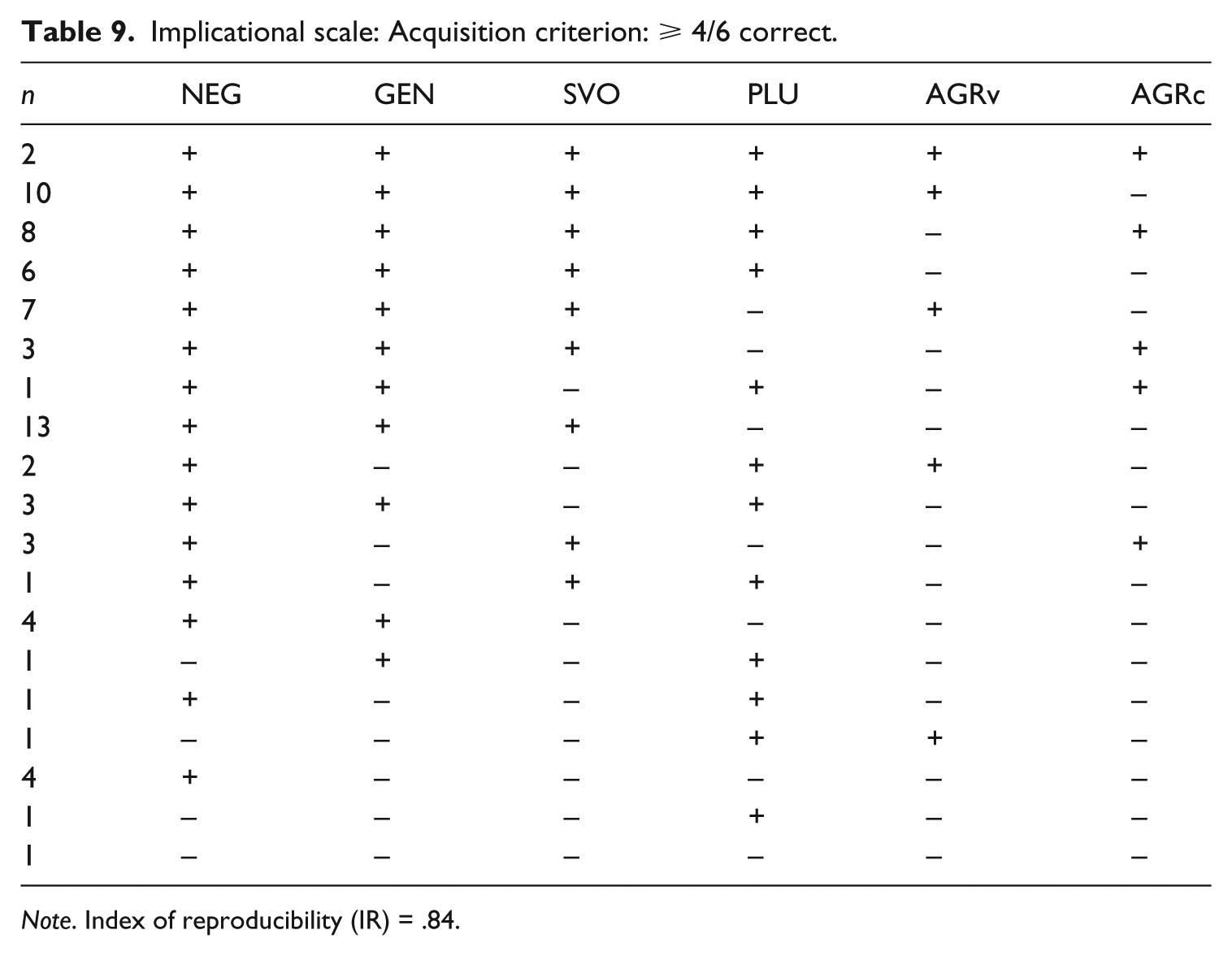
Note. Index of reproducibility (IR) = .84.
Implicational scale: Acquisition criterion: ⩾ 5/6 correct.
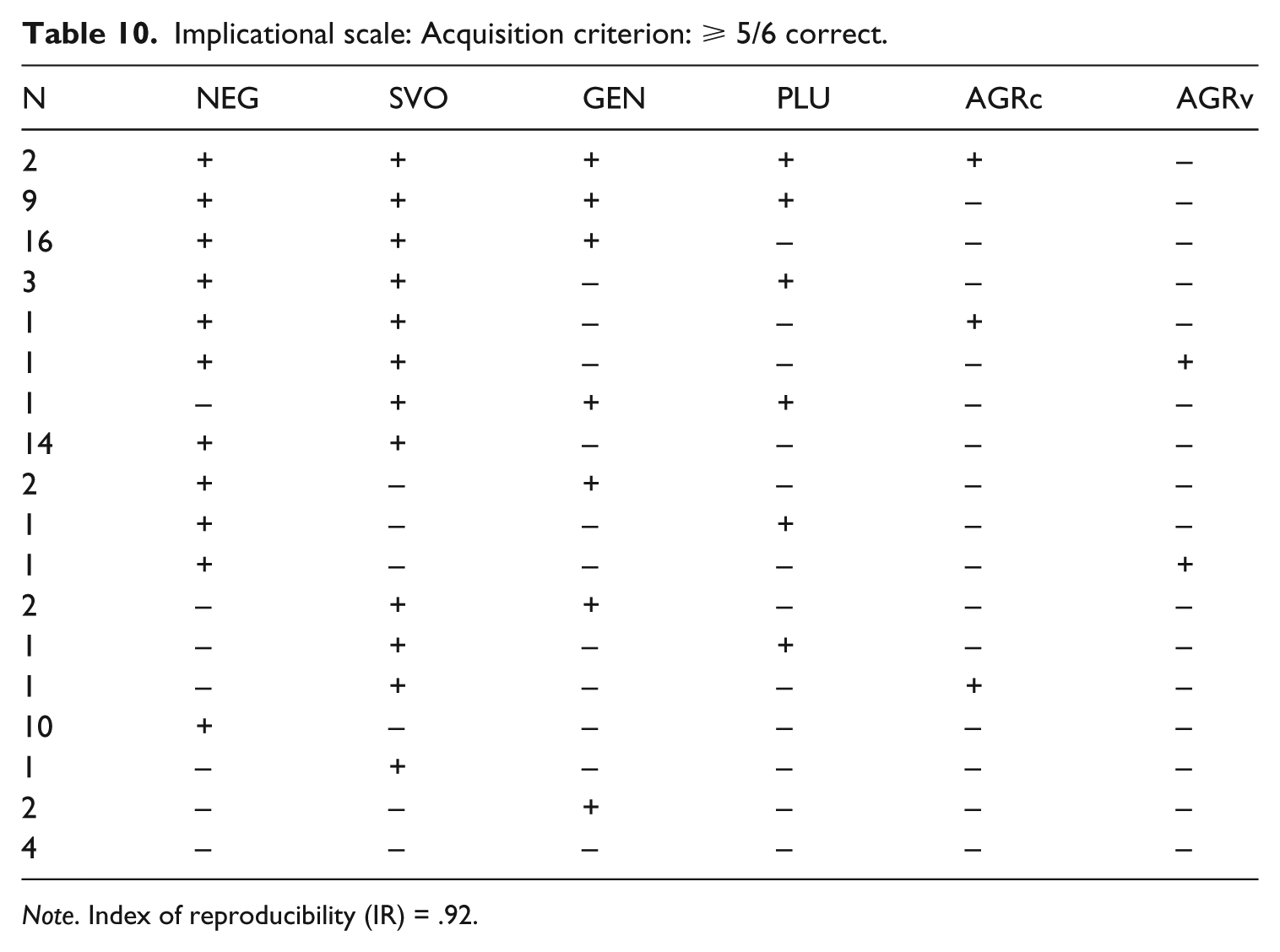
Note. Index of reproducibility (IR) = .92.
Implicational scale: Acquisition criterion: 6/6 correct.
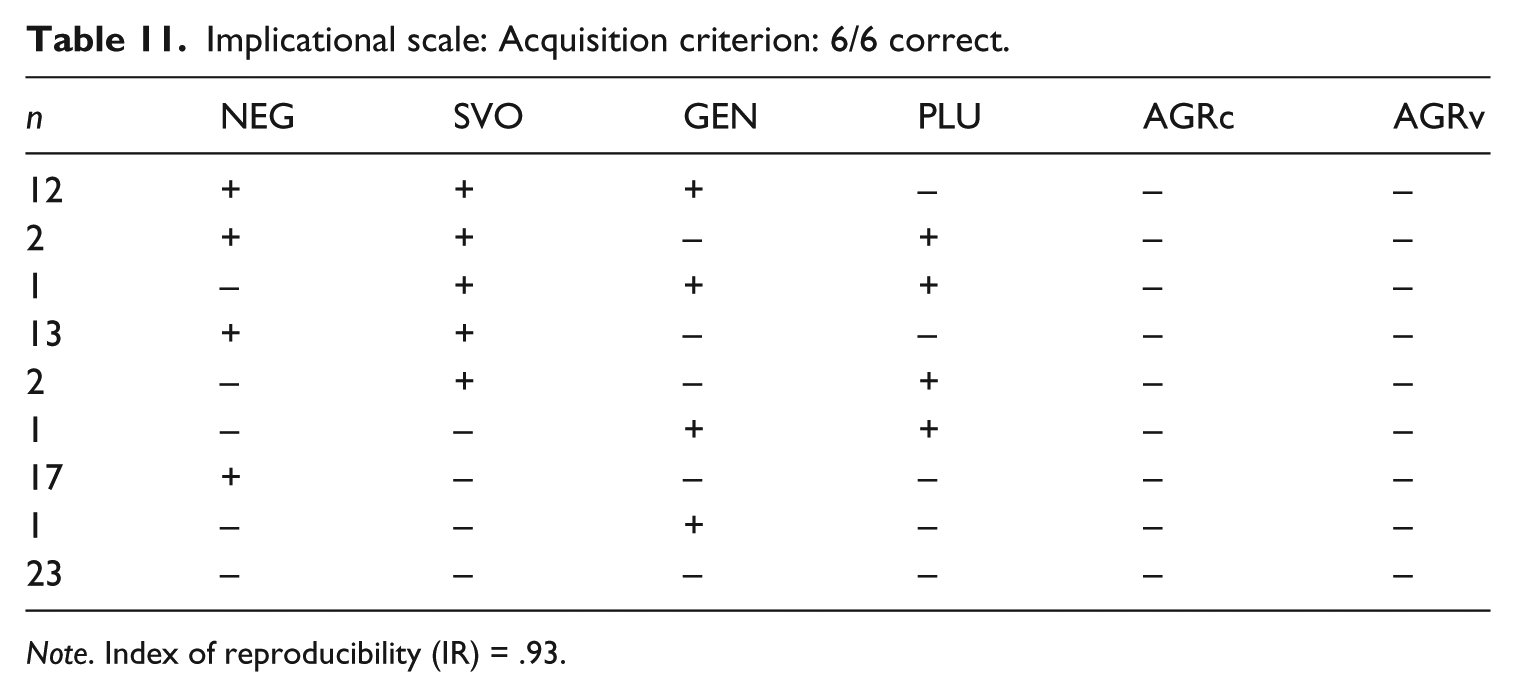
Note. Index of reproducibility (IR) = .93.
We will first look in more detail at the scales for the acquisition criteria ⩾ 1/6, ⩾ 2/6, ⩾ 3/6 and ⩾ 4/6 - the four criteria which, though more likely to reflect ‘emergent’ rather than consolidated knowledge, must be interpreted with caution due to the possibility of chance performance.
In the ⩾ 1/6 scale, 69 participants passed the criterion for all six grammatical phenomena, thereby giving us little information about the order in which they had done so. Of the remaining three participants, two participants have a score of 1/6 or better for all phenomena except AGRv (an order that is in line with PT), while one has acquired all phenomena except SVO. Important for the present study is that the reversed order of AGRc and SVO does not constitute counterevidence for PT, since the learner has acquired NEG, GEN and PLU. Thus, despite the fact that the learner did not give any correct replies on the SVO test items, the category procedure has clearly emerged. Note that if the scale were to be rearranged according to what PT predicts and each stage was considered acquired if a learner had acquired at least one of the structures of each stage, all participants would have acquired both stages.
Next, the ⩾ 2/6, ⩾ 3/6 and ⩾ 4/6 scales all show an overall rank order that is in accordance with PT: AGRc and AGRv are ranked last. The IR coefficients are below .93, which means that the scales in their entirety are not scalable. Recall, however, that this coefficient includes scalability violations that occur within Stage 2 and/or Stage 5, violations that are irrelevant for the applicability to PT. More important, then, are the individual learners’ rank orders. In all three scales, a number of learners show a rank order whereby AGRc and/or AGRv are acquired while one or more of the lower-ranked is not: both in the ⩾ 3/6 scale and in the ⩾ 4/6 scale, 17 of the 72 learners show such a pattern of pluses and minuses, as opposed to seven of the 72 learners in the ⩾ 2/6 scale and only one learner in the ⩾ 1/6 scale. Again, however, in all these instances, the learners have acquired at least two of the four Stage 2 phenomena, thereby confirming that the category procedure has emerged. Conversely, and providing the clearest and most convincing support for PT, all three scales contain learners who have acquired some of the Stage 2 procedures but none of the Stage 5 procedures. This is the case for one participant in the ⩾ 2/6 scale, four participants in the ⩾ 3/6 scale and 34 participants in the ⩾ 4/6 scale. These situations clearly show that the S-procedure (Stage 5) emerges after the category procedure (Stage 2).
It is clear that, at first sight, the total number of ‘acquired’ grammatical phenomena in the above four scales decreases as the emergence/acquisition criterion is raised to a higher score. In the ⩾ 1/6 scale (Table 6), 69 of the 72 learners have passed the acquisition criterion for all grammatical phenomena. This number drops to as few as 2 learners in the ⩾ 4/6 scale. At the same time, the number of learners who have acquired only a few of the grammatical phenomena increases as the acquisition criterion is raised. This result is noteworthy because it indicates that the statistical effect of chance performance is not so strong so as to distort the general picture emerging from these scales, and the scales may thus be considered informative in terms of their general outcome, i.e. the support for PT offered by the overall rank order.
Finally, these four scales also clearly illustrate how the choice of an acquisition criterion can affect the outcome of an implicational scale, a point already raised by Hatch and Lazaraton (1991). Some stage-internal variation can be found, first, in the order of PLU versus SVO (the ⩾ 3/6 and ⩾ 4/6 scales show an SVO–PLU order, the ⩾ 2/6 scale a PLU–SVO order) and, second, in the order of AGRc and AGRv (AGRc–AGRv order in the ⩾ 3/6 and ⩾ 4/6 scales, AGRv–AGRc order in the ⩾ 2/6 scale). It warrants repeating, however, that the correspondence with the PT hierarchy is not affected.
In contrast to the ⩾ 1/6, ⩾ 2/6, ⩾ 3/6 and ⩾ 4/6 scales, the results from the ⩾ 5/6 scale (Table 10) and 6/6 scale (Table 11) can be confidently discussed not only in terms of the overall rank order of the grammatical phenomena but also in terms of the individual variation that is found in the scale, since the results in this scale are statistically reliable in terms of chance performance.
The order from first to last acquired for both the ⩾ 5/6 and 6/6 criteria is: NEG–SVO–GEN–PLU–AGRc–AGRv. The rank orders in both scales are thus again in line with the ones predicted by PT, with AGRc and AGRv ranked last. The IR coefficients furthermore confirm that the 6/6 scale is scalable (with the ⩾ 5/6 yielding a borderline coefficient of .92), and that the rank order in these scales applies also at the intra-stage level (i.e. NEG is, according to this scale, acquired before SVO, followed by GEN, and so forth). 3
If we look at the ⩾ 5/6 scale in more detail, it can be observed that two learners in this scale have acquired all Stage 2 phenomena as well as AGRc. Nine learners in this scale have acquired neither AGRc nor AGRv but have acquired all of the Stage 2 phenomena (NEG, SVO, GEN, PLU). Fifty-seven learners have not yet acquired AGRc and AGRv, nor have they acquired all of the Stage 2 phenomena, e.g. 16 learners have acquired only NEG, SVO and GEN; three learners have acquired only NEG, SVO and PLU; and so forth. All three situations provide strong support for PT.
Further observations concerning the ⩾ 5/6 scale are that one learner has passed the 5/6 threshold for AGRc without yet having done so for GEN and PLU; one learner has acquired AGRv while not yet having acquired GEN and PLU; one learner has acquired AGRv while not yet having acquired SVO, GEN and PLU; and, finally, one learner has acquired AGRc while not yet having acquired NEG, GEN and PLU. For reasons explained above, these cases nevertheless also support PT.
Finally, in the 6/6 scale, no deviations from the predicted PT rank order are observed. Forty-nine participants had acquired at least one of the Stage 2 phenomena, but none of the Stage 5 phenomena. Twenty-three of the learners had acquired none of the phenomena.
VII General discussion
The present study set out to investigate to what extent the PT procedures that have been established for productive L2 grammar acquisition also govern the acquisition of learners’ receptive grammar knowledge. To address this question, we investigated whether L2 learners of English systematically acquire the English grammatical phenomena negation, genitive -’s, canonical word order and plural -s, none of which require any exchange of grammatical information (and hence are predicted to be processable from Stage 2 of the Processability Hierarchy onwards), before cases of agreement between the subject and verb (copula verb be or a main verb), which are hypothesized to involve the exchange of grammatical information between phrases and hence are predicted to emerge later in the L2 grammar acquisition process (at Stage 5 of the Processability Hierarchy).
Cross-sectional data from a picture selection task (the ELIAS Grammar Test) administered to 72 francophone child learners of L2 English suggests that the targeted grammatical phenomena are acquired in an order that is compatible with PT. Applying different criteria of what counts as ‘acquired’ to the data and analysing the data using implicational scaling yielded acquisition orders in which the Stage 2 features are acquired before the Stage 5 features. Looking at the scales at the level of the individual learners confirms the applicability of PT. Regardless of the acquisition criterion used, all learners who have acquired one or both Stage 5 phenomena had also acquired at least some of the Stage 2 phenomena. Missing knowledge of some of the Stage 2 phenomena can be accounted for by PT’s assumption that the acquisition of a particular processing procedure will not necessarily lead to the immediate and simultaneous emergence of all grammatical phenomena, which are governed by this processing procedure (Pienemann, 1998, 2005a).
Studying developmental stages in receptive grammar acquisition was argued to be relevant for two reasons. First, it gives us a more complete picture of staged development and its driving forces by looking at both modes of grammar acquisition. The results of the present study, then, would suggest, albeit tentatively, that receptive and productive grammar acquisition involve the same developmental stages and are governed by the same processing-related factors, i.e. those outlined by PT. Second, the proposed research was argued to be relevant for SLA and psycholinguistics research more generally because it increases our understanding of the relationship between receptive and productive L2 grammar processing, and thus contributes to the ultimate goal of SLA research to construct a comprehensive theory of SLA, which includes principled accounts of both receptive and productive grammar processing skills and the underlying mental grammar system. The finding from the present study that PT’s processing procedures may govern the development of receptive grammar processing skills entails that receptive and productive language processing share important mechanisms, and that these mechanisms govern the receptive and productive L2 acquisition process in similar ways.
The results from the present study sharply contrast with those found by Spinner (2013). The data from the GJT used by Spinner showed no inter-learner systematicity. Apart from the different test instruments and the differences in learner characteristics (e.g. adults versus children), the following differences between the two studies are worth pointing out. First, the present study looked only at Stage 2 and Stage 5 structures, while Spinner’s GJT included three structures each for the Stages 2, 3, 4 and 5 and two structures for Stage 6. We cannot exclude the possibility that the present study gives a premature impression of systematicity because there are no Stage 3 and Stage 4 structures. Focusing on Stage 2 and 5 in Spinner’s studies indeed shows only few instances where Stage 5 was acquired while Stage 2 was not. Another noteworthy difference is that Spinner, when collapsing the three structures of a stage together in order to avoid inter-stage variation to affect the scalability coefficient, marked a stage as acquired only when at least 2 of the 3 structures of that stage were acquired. When a participant had acquired only 1 of the 3 structures of a given stage, the stages was not marked as acquired. It is possible that results would have been different if stages had also been considered acquired in the latter case.
Finally, it should be acknowledged that the present study, which sought to study receptive grammar acquisition by means of a comprehension-based task, is not free of methodological limitations, some of which may also explain the discrepancy between the present study and Spinner’s findings derived from a GJT. The following section will outline the methodological limitations and discuss ways in which they may be overcome in future research.
VIII Methodological limitations and future research
Two methodological limitations that were already pointed out are the absence of any structures belonging to Stages 3 and 4, and the problem of chance performance in setting an emergence criterion. Future research will have to see whether the applicability of PT to receptive grammar development is confirmed when additional, intermediate stages are included. Another challenge for further research is to formulate definitions of emergence versus acquisition in the context of receptive grammar acquisition, and devise valid and reliable ways for operationalizing these definitions in a widely applicable manner.
Other methodological limitations should be pointed out. First, doubts could be raised concerning the extent to which the AGRc and AGRv prompts in the ELIAS GT target the intended grammatical knowledge, i.e. subject–verb agreement. As is commonly done in picture-selection tasks, the prompts in these categories all contain nouns with a zero plural (e.g. sheep, fish, deer) as the subject (Blom and Unsworth, 2010; P Howell et al., 2003; Johnson et al., 2005); this is to avoid that learners can interpret the sentence on the basis of the plural -s on the nouns alone (i.e. without processing the verbal morphemes). The result of the stimulus design, however, is that, although learners now must process the 3SG-s (AGrv) and the copula verb (AGRc), it cannot be said with absolute certitude that subject–verb agreement takes place, since zero plural nouns do not contain overt number information. Although this type of design is commonly used for assessing young learners’ knowledge (or processing skills) of subject–verb agreement, it may be expedient for future research to explore alternative methods for testing subject–verb agreement processing.
The former limitation is related to the more general issue that comprehension involves not just grammatical parsing but also lexical and semantic inferential processes. The ELIAS GT, like other comprehension tasks and particularly picture selection tasks, has been carefully designed to ensure that learners have to process the targeted grammatical structure. Even so, it remains true that one can never be entirely certain of what goes on in the learners’ mind when processing input. One reviewer wondered whether GEN really requires learners to process the genitive -’s and whether there might not be sufficient clues in the pictures to correctly respond without actual processing of the genitive -’s. This issue indeed illustrates that, although picture selection tasks (many of which contain similar prompts for testing genitive -’s and subject–verb agreement) are widely used and considered a valid and reliable procedure (especially in research on child acquisition, where methodological options are more limited than with adult learners; see, for example, Blom and Unsworth, 2010; Gerken and Shady, 1996), it should not be taken for granted that tasks test what we think or want them to test.
To address the limitations of the present study, then, it may be fruitful for future research to look beyond the tasks used in both this study and in the previous studies by Spinner (2013) and Keatinge and Keßler (2009). In particular, tasks that tap into online processing, such as self-paced reading or listening or eye-tracking may have some potential for investigating receptive grammar development, including within a PT framework. First, although research will still have to think about how emergence versus acquisition is operationalized, these tasks have the advantage that they do not involve multiple-choice replies. Thus, guessing behaviour or chance performance does not come into play. Second, online processing tasks such as self-paced reading/listening and eye-tracking are seen as adequate instruments for gaining insight into learners’ ability to implicitly process grammatical agreement, such as subject–verb agreement or agreement between adjective and nouns (Marinis, 2003; Roberts, 2012) m more so, perhaps, than grammaticality judgement tasks or picture selection tasks. Given that PT deals with productive online processing skills and with learners’ ability to unify and exchange grammatical information, and given the aim of the present research venture to apply PT to the receptive counterpart of this language skill, tasks which target receptive online processing seem particularly appropriate for future research.
Finally, two more considerations for future research are in order. A first concerns the cross-sectional nature of the data in the present study. Although it has been claimed that the use of different acquisition criteria with cross-sectional data ‘will to some extent reveal the dimension of gradual acquisition’ (Glahn et al., 2001: 398), longitudinal data ultimately provide the best basis for identifying developmental patterns in language acquisition (Ellis, 2008). Second, the present study did not look at production data because the explicit nature of the predictions made by PT in principle allows testing the applicability of the theory to receptive grammar acquisition, without a comparison with production data. Nevertheless, a comparison with production data from the same learners is worthwhile. Although PT has received empirical support from a considerable body of research based on production data, others scholars have disputed the theory by adducing production-based counterevidence (Charters et al., 2011; Dyson, 2009). Second, looking at the emergence of grammatical structures in comprehension relative to their emergence in production is useful for obtaining an even better understanding of the developmental relationship between receptive and productive processing skills. A first attempt in this direction was undertaken by Keatinge and Keßler (2009). However, as mentioned earlier, this study looked at one structure only (the passive voice). Clearly, research on a wider range of features is necessary.
Footnotes
Appendix 1
Acknowledgements
All data in this article were collected by the present authors within the framework of the Early Language and Intercultural Acquisition Studies (ELIAS) project (Kersten et al., 2010), of which the present authors were team members. The data were reanalysed for the purpose of this article, and results are reported with permission of the fellow ELIAS team members - for which we thank them. We would also like to thank Gabriele Pallotti for his feedback on an earlier version of this article, as well as the anonymous reviewers for their insightful comments. Any errors that remain are of course ours.
Declaration of conflicting interest
The authors declare that there is no conflict of interest.
Funding
This work was made possible by the Research Foundation - Flanders (FWO), where the first author is a PhD Fellow.