




Abstract
This article presents the results of experimental data on language production and comprehension. These show that adult learners of Dutch as an additional language, with different language backgrounds, and a L2 proficiency below level A2 (Waystage) of the Common European Framework of Reference for Languages (CEFR; Council of Europe, 2001), use dummy auxiliaries as a structural device and interpret them as semantically vacuous. Proficiency level in the target language, more than language background, seems to determine the occurrence of dummy auxiliaries, and also which dummy auxiliary is used. Participants at a lower level of language acquisition use both dummy auxiliaries zijn (‘be’) and gaan (‘go’), whereas more advanced learners continue using predominantly dummy auxiliary gaan. These findings suggest that both dummy auxiliaries have a trigger function in setting the step from nonfinite utterances, to utterances with dummy auxiliaries carrying morphological information, and finally to utterances in which the morphological information is carried by the finite verb.
Keywords
I Introduction
1 General introduction
Dummy auxiliaries are non-grammatical forms often attested not only in the learner varieties of adult learners of Dutch as an additional language (DAL) (Blom and De Korte, 2008 and 2011; Starren, 2001; Van de Craats, 2009; Van de Craats and Van Hout, 2010; Verhagen, 2009, 2011, 2013), but also in learner varieties of other target languages such as French and German (Schimke, 2013), and English (Fleta, 2003; Huebner, 1989; Huebner, Carroll, and Perdue, 1992; Zobl, 2002). They have also been observed in child first language (L1) and second language (L2) acquisition of Dutch, English and German (Cornips, 2013; García et al., 2005; Haberzettl, 2003; Hollebrandse et al., 2013; Hulk and Cornips, 2005; Jordens and Dimroth, 2006; Julien et al., 2013; Lalleman, 1986; Tracy, 2002; Zuckerman, 2001), suggesting that the occurrence of dummy auxiliaries may be a more general, rather than a language-specific step in language acquisition.
Use of dummies is often related to verb movement; compare Chomsky’s (1995) Economy Principle. Dummy auxiliaries are assumed to be easier to access than lexical verbs because, due to their high frequency, they are stored in their inflected form in the mental lexicon, from where they can be directly retrieved and inserted in the position of a functional head. Production of lexical verbs in the same position, on the other hand, requires movement, which is considered a more costly operation. Van Kampen (1997) and Zuckerman (2001, 2013) observed that monolingual Dutch children use dummies in main sentences – which require verb movement – and that dummies in subordinate clauses – where verb movement is not required – are very rare. Blom and De Korte (2011), Van de Craats (2009) and Van de Craats and Van Hout (2010) studied, respectively, the learner varieties of Dutch L2 Turkish-speaking children, and adult Turkish- and Moroccan Arabic-speaking DAL learners, and concluded that dummy auxiliaries, more in particular gaan (‘go’) and zijn (‘be’), precede movement of the lexical verb and constitute a structural device that does not require movement and that helps the learner to open a position in the sentence for verbs to move to.
Other researchers, such as Dimroth et al. (2003), Jordens and Dimroth (2006), Starren (2001), and Verhagen (2009) offer a primarily semantic account for the use of zijn +
Zuckerman (2001, 2013) and Verhagen (2013) investigated respectively the comprehension of dummy auxiliary gaan by monolingual children acquiring Dutch and dummy zijn by Moroccan DAL learners. They came to the conclusion that learners, in early stages of their acquisition of Dutch, ascribe imperfective meaning to those two dummy auxiliaries, rather than prospective (gaan) or perfect (zijn).
From the above, it is clear that there is no consensus as to the function and meaning of dummy auxiliaries. The overarching research question that we want to answer in the present study is whether dummy auxiliaries are devoid of meaning and are used by adult DAL learners as a structural device that helps them acquire the proper morphological marking of agreement, as claimed by Van de Craats (2009) and Van de Craats and Van Hout (2010).
This study contributes in three ways to what we know from previous research on this topic. One is that not only Turkish and Moroccan Arabic speakers were the objects of study, but also speakers of Berber Tarifiyt were included. This group of learners has not been systematically distinguished from the Moroccan–Arabic speakers in previous studies. Tarifiyt speakers constitute approximately 60% of the Moroccan population in the Netherlands (El Aissati et al., 2005). The second contribution is that not only the production but also the comprehension of (dummy) auxiliaries in Dutch was studied. The aim of studying both production and comprehension was to provide a deeper insight of the question whether learners assign meaning to dummy auxiliaries or not. To our knowledge only Zuckerman (2001) and Verhagen (2013) have addressed the comprehension of dummy auxiliaries. The third contribution is the diversity in elicitation tasks to trigger the use of dummy auxiliaries in different contexts and to test factors that may inhibit or enhance the occurrence of dummy auxiliaries. In addition, we have drawn a larger sample of learners than other studies on adult DAL learning did so far, with the exception of Verhagen (2009, 2013).
The outline of the article is as follows. We start by describing the relevant markers of temporality in the four languages involved in this study and by presenting the research questions. Section II explains the experimental framework and the methods for data collection and analysis. This is followed by the Section III, in which the results are presented. Section IV discusses the main findings and presents the conclusions.
2 Markers of temporality and the concept of dummy auxiliaries
Investigation of the source of deviant forms in the learner varieties cannot be carried out without considering the possibility that those errors are produced under influence of the languages involved. Van de Craats and Van Hout (2010) have put forward the hypothesis that dummy gaan could be the result of interference from L1 Moroccan Arabic, since that language has a real auxiliary which is, qua form and meaning, very similar to the auxiliary gaan in Dutch. Dummy zijn is assumed by them, by Julien et al. (2013) and by Verhagen (2013) to originate from the Dutch language itself, under the influence of the extensively used copula zijn.
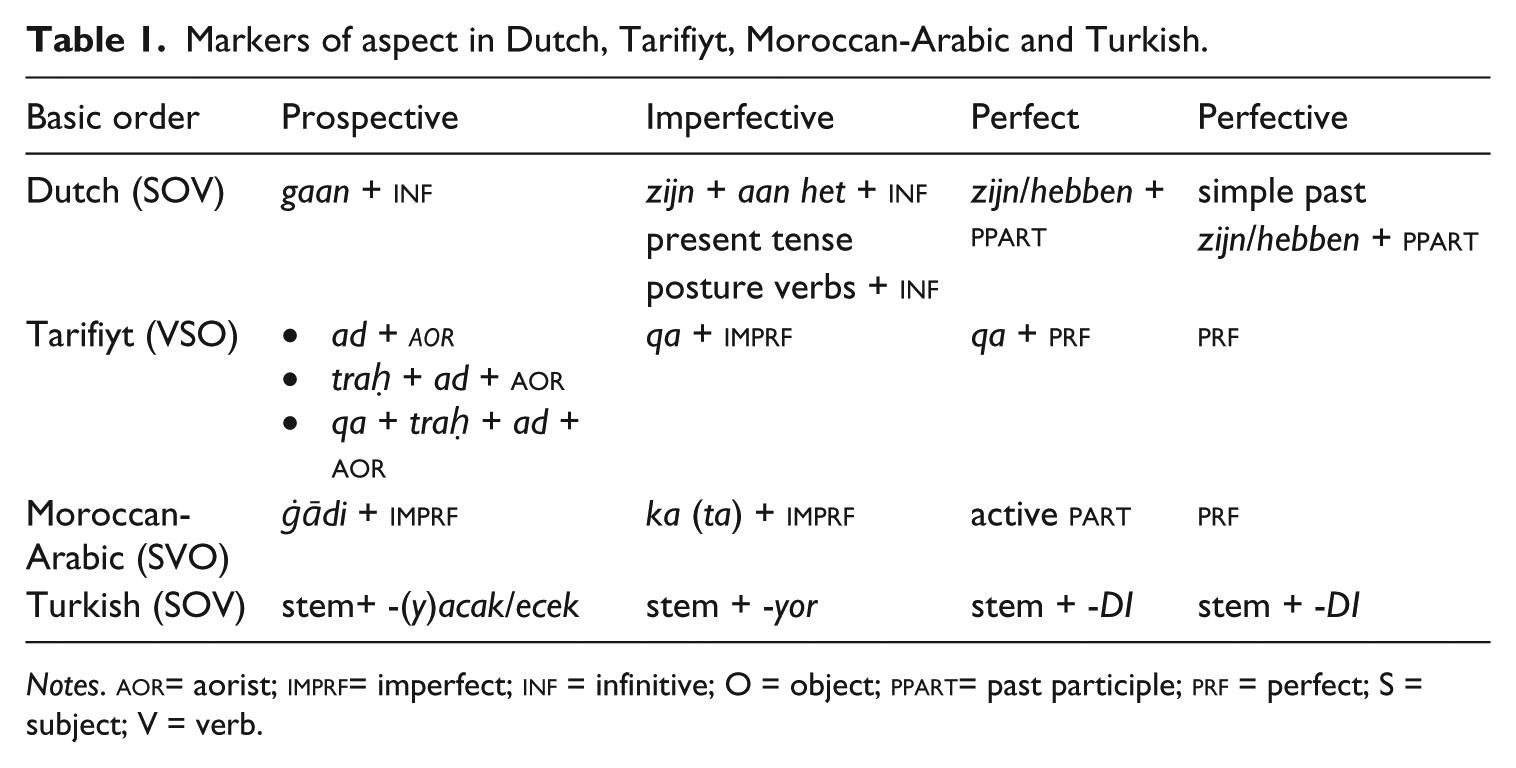
A description of relevant linguistic means for the expression of temporality in the languages involved in the present study is presented in Table 1. The temporal framework of Klein (1994) was adopted to distinguish the aspectual categories of prospective, imperfective, perfect and perfective. Table 1 shows how different the four languages involved are in expressing aspectual distinctions. Turkish uses mainly synthetic forms (Göksel and Kerslake, 2005), whereas the other three languages often make use of analytic forms. In Tarifiyt (E-Rramdani, 2003; El Aissati, 1994, 2001) and Moroccan Arabic (Harrell, 1962; Hoogland, 1996), perfect and perfective aspects are expressed each with a different form, whereas Turkish has only one form for both aspects. Dutch is peculiar in that it has two forms to express perfective aspect, one of them being the same as the form used to express perfect aspect (Klein, 1994). Further, Tarifiyt has different forms to express prospective aspect, and Dutch has multiple ways of expressing imperfective aspect.
Markers of aspect in Dutch, Tarifiyt, Moroccan-Arabic and Turkish.
Notes.
Since the present study concerns the acquisition of agreement marking on the finite verb in Dutch, a more detailed description is given below. Dutch main clauses have the special property that the finite verb occupies the second position, irrespective of which constituent occupies the first position. This property is known as Verb Second (
An example of the stages various types of learners go through, with dummy auxiliary (Stage 2) and without dummy auxiliary insertion (skipping Stage 2), is provided in (1).
(1) Stage 1: * Jan [VP naar de kerk lopen] Jan to the church walk. ‘Jan walk to the church.’ Stage 2: [CP Jan [C gaat [VP naar de kerk lopen]]] Jan go.3 ‘Jan is going to walk to the church.’ Stage 3: [CP Jan [C loopti [IP[VP naar de kerk ti ]ti]]] (according to ten Besten/Koster) Jan walk.3 ‘Jan walks to the church.’ or [IP Jan [I loopti [VP naar de kerk ti ]]] (according to Zwart) Jan walk.3 ‘Jan walks to the church.’ Stage 4: [CP Hier [C loopti [IPJan ti [VP naar de kerk ti ]]]] Here walk.3 ‘Here Jan walks to the church.’
Dutch has a two-way system – past and non-past – to grammaticalize tense. Aspect is often expressed through auxiliaries and constructions with a posture verb or with the prepositional phrase aan het V (‘on the V’), where V stands for a verb in infinitival form. The aspectual auxiliary occupies the second position and the lexical verb, in the infinitive, a sentence-final position. Prospective aspect is commonly expressed with the auxiliary gaan in combination with the lexical verb in the infinitive as illustrated in (2).
(2) Jan gaa-t zijn vriend roepen Jan go- ‘Jan is going to call his friend.’
The simple present tense, as well as posture verb constructions and constructions with an adjective or preposition can be used to convey imperfective aspect. In (3a–c), examples are given of each of these constructions.
(3) a. Simple present Moeder bouw-t een toren Mother build- ‘Mother builds / is building a tower.’ b. Zijn + aan het + INF Zij is een toren aan het bouw-en She be. ‘She is (in the process of) building a tower.’ c. Zijn + INF Moeder is werk-en Mother be. ‘Mother is (not here) working.’
Flecken’s study (Flecken, 2011) reveals that the aan het
Perfect aspect is expressed with the construction zijn (‘be’) / hebben (‘have’) + past participle. 1 Example (4) illustrates this.
(4) a. Peter is aangekomen Peter be. ‘Peter has arrived.’ b. Moeder heeft een toren gebouwd Mother has. ‘Mother has built a tower.’
Perfective aspect is expressed by using the simple past, as in example (5), or the construction zijn (‘be’) / hebben (‘have’) + Past Participle as examples (6a) and (6b) illustrate.
(5) De poes at de vis The cat eat. ‘The cat ate the fish.’ (6) a. Ik heb in het park gelopen I have. ‘I walked in the park.’ b. Ik ben naar het park gelopen I be.pres. ‘I walked to the park.’
3 Research questions
As stated in the introduction, the main inquiry in this study is whether dummy auxiliaries are indeed devoid of meaning and used by adult DAL learners as a structural step in the acquisition of finiteness, as claimed by Van de Craats (2009) and Van de Craats and Van Hout (2010). In order to answer that overall question, we address the following specific research questions:
1. Do low-proficient adult DAL learners use dummy auxiliaries?
The prediction is that dummy auxiliaries will be found in the present study since they have often been attested in (early) learner varieties of adult DAL learners.
2. Does level of language proficiency in Dutch influence the choice and frequency of dummy auxiliaries?
Previous research has shown that L2 children and adult learners of Germanic languages use very few dummy auxiliaries at the initial stage of language acquisition, and that dummy use increases as learners’ exposure to the target language increases, decreasing again later, while finiteness is being acquired. Huebner (1989), Haberzettl (2003), Van de Craats (2009) and Van de Craats and Van Hout (2010) showed in their studies the emergence, increase and decline of the is/ist- and ga/gaat-patterns in relation to increasing proficiency in the target language. That pattern appeared between a stage in which the lexical verbs were uninflected (in German and Dutch the word order at that stage was mainly SOV) and a stage with inflected verbs (in German and Dutch the word order was SVO). In Van de Craats’ study (2009), participants began to produce is-constructions about nine months after having started receiving formal L2 input, increased their use in the next nine months and, in the case of some participants, decreased in the third period of nine months that followed.
In the light of these findings, the same pattern can be expected in the present study. It is predicted that the number of dummy auxiliaries produced by participants who have a lower level of proficiency will be lower than the number produced by the participants with a higher proficiency level.
3. Does language background determine the choice of dummy auxiliary?
Previous research (Van de Craats, 2009) has shown that Turkish learners of Dutch mainly used the dummy auxiliary zijn, and Moroccan Arabic learners had a preference for the dummy auxiliary gaan (Van de Craats and Van Hout, 2010). On the basis of these findings, it is predicted that the choice of dummy auxiliaries will differ among the three language groups participating in this study. It is further hypothesized that correct aspectual use of the construction gaan +
4. Do adult DAL learners, in the initial stages of language acquisition, assign meaning to the constructions zijn +
Given the results of Zuckerman’s (2001) and Verhagen’s (2013) studies, in which it was found that L1 children and Moroccan learners of Dutch ascribe present tense reading to respectively gaan +
II Method
1 Participants
The participants were 40 adult learners of Dutch, five male and 35 female, who came to the Netherlands after their sixteenth year of life. They spoke Moroccan-Arabic, Berber-Tarifiyt, or Turkish as their L1, and were acquiring Dutch at various training centers in cities of the Randstad (the metropolitan region in the western part of the Netherlands), and in cities in the eastern part of the Netherlands.
All participants had a low level of proficiency in Dutch and were attending Dutch classes aimed at attaining levels A1 (Breakthrough) and A2 (Waystage) of the CEFR. Their L2 oral proficiency was rated by experienced language teachers, who assigned them to one of the two groups mentioned above. Assessments based on CEFR are aimed at evaluating communicative rather than grammatical skills. All participants were reported by the teachers as not yet having fully acquired verb inflection and placement in Dutch.
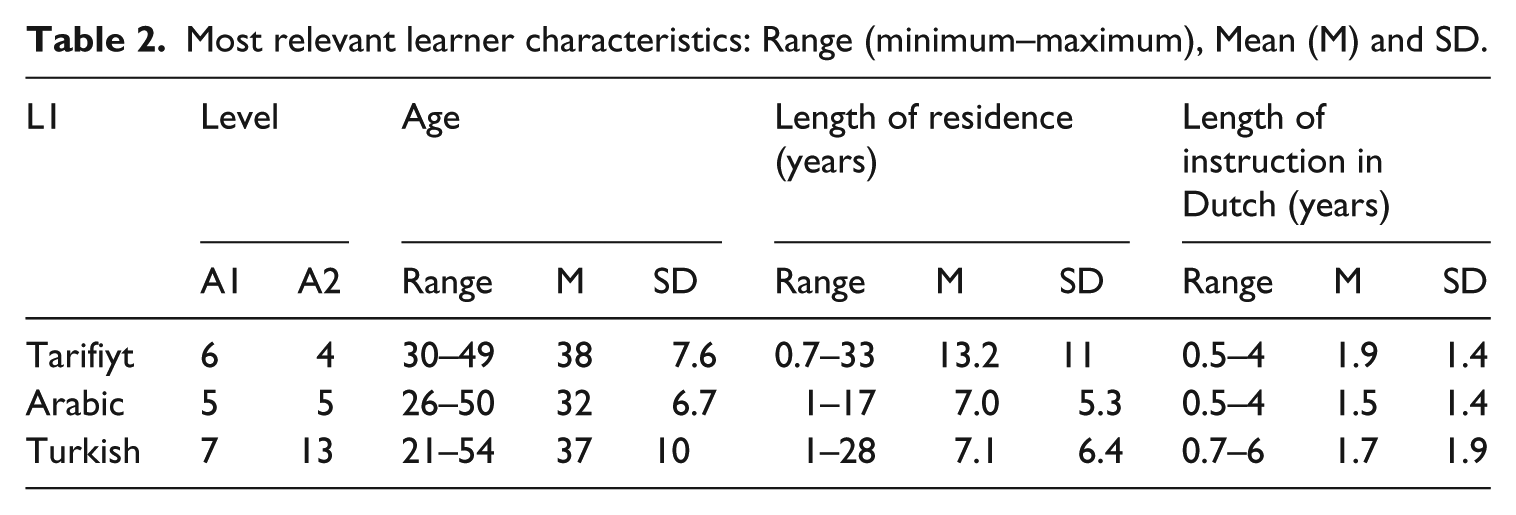
All three participant groups had a low educational level. None of them had attended university and six of them had never attended school. Most of the participants had some knowledge of one or more other languages than their L1 when they started learning Dutch. The languages that they understood and/or spoke to various degrees of proficiency were English, French, Kurdish or Spanish. Seven of the Tarifiyt speakers had also command of spoken or written Arabic. Their command varied from only understanding it (four participants) to speaking it with varied degrees of fluency (five participants). One participant could only read and write it. The social status (low), in the Netherlands, of these three groups of immigrants, as well as their history of migration, are comparable (Crul and Doomernik, 2003; Roes, T, 2008; Scheele et al., 2010). Table 2 gives an overview of the characteristics of the 40 participants divided into language background and proficiency level in Dutch.
Most relevant learner characteristics: Range (minimum–maximum), Mean (M) and SD.
2 Elicitation tasks
Table 3 shows the three production experiments and the comprehension experiment that were administered to the participants. This set of experiments, all of them eliciting the third person singular, was designed not only for adult DAL learners, but also for monolingual and bilingual children acquiring Dutch, who took part in a bigger study on this subject.
The experiments in this study.
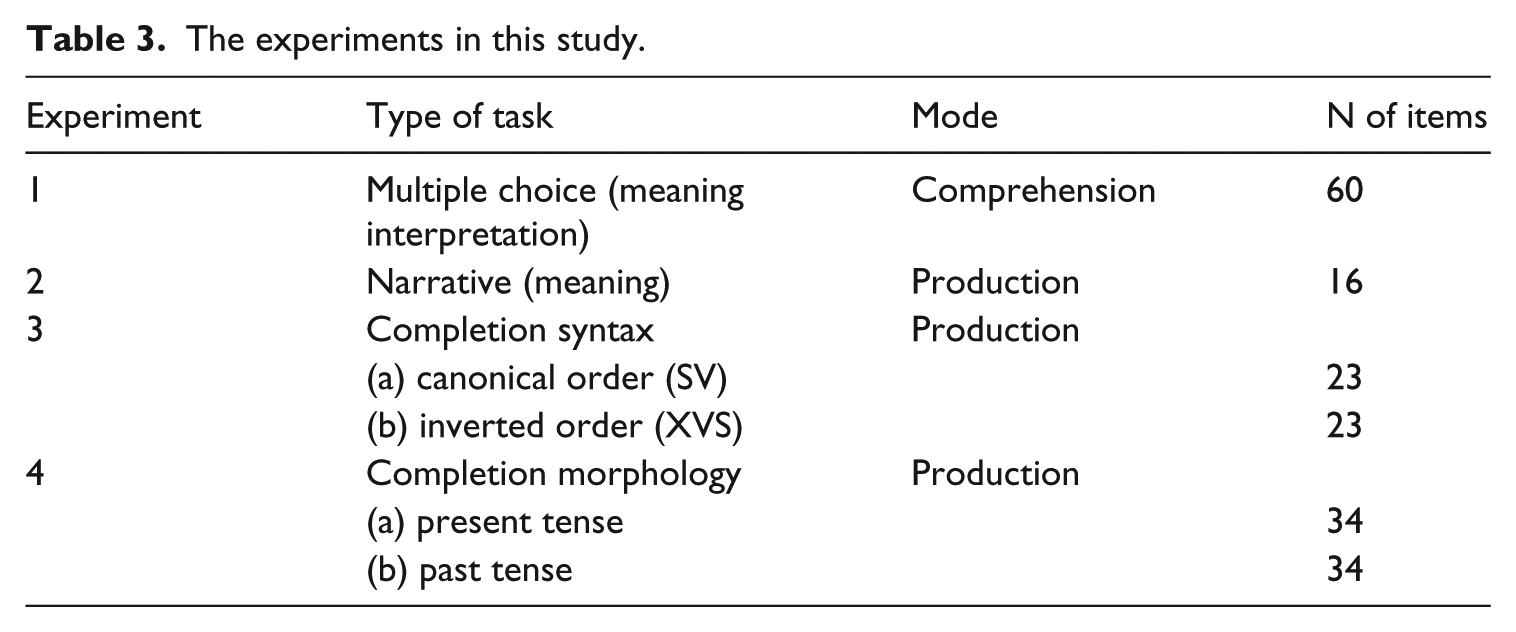
Both the comprehension task and the narrative task were designed to test whether aspectual meaning is involved in the constructions zijn +
The completion syntax task was developed to answer the question whether the number of dummy auxiliaries produced increases as the number of syntactic steps required to get an inverted (XVS) order increases. This was the case in Blom and De Korte’s study (2011), but only with respect to children. They produced more dummy auxiliaries in sentences with than without inversion. Adult DAL learners who took part in that same study did not produce sentences with inversion, presumably due to their low level of proficiency in Dutch. In view of those results, the participants in the present study were not expected to realize inversion consistently, since their level of proficiency in Dutch is below A2. Nevertheless, the task was administered to observe their use of dummy auxiliaries in that context. The sentence completion tasks ‘present tense’ and ‘past tense’ were developed to investigate the relationship between morphological skills (inflection) and the use of dummy auxiliaries.
3 Materials
The verbs used in the experiments were divided into four classes based on lexical aspect (Aktionsart), that is, their durative nature, argument structure and the possible presence of an adverbial or an object in the sentence signaling an endpoint to the action or state. Vendler’s (1957) four-way classification was the basis for the categorization of the verbs used in this study. These verbs were also grouped on the basis of morphological regularity and presence of a verbal particle.
Short clips and pictures taken from the television series Pingu were used. 2 The program DVDx 4.0 was used to rip the DVD Pingu voor altijd (‘Pingu forever’) (Pygos Group & Hit Entertainment Limited, 2010). Afterwards clips were made from the converted DVD using the program Virtual Dub 1.9.
4 Procedures
Participants were tested individually in a quiet room, in the center in which they were studying. The tasks were presented to them in a laptop using the software program E-prime 2.0 (Schneider et al., 2001). Depending on the task, each participant was instructed to match a picture with a stimulus utterance, which they heard via the laptop’s loudspeaker, or to describe an event on a film clip and/or an action depicted in a picture, or a picture sequence, presented to them in the laptop. The E-prime program allowed not only a randomization of the test items in the experiments, but also the recording of the participant’s responses. In the language comprehension task the E-prime’s function to record accuracy of response was used.
We analysed the data using the software programs Microsoft Excel 2007 and IBM SPSS 21. All the utterances produced by the participants were orthographically transcribed. Transcription conventions used were taken from the transcription system of CHAT (Codes for the Human Analysis of Transcripts) (MacWhinney, 2000).
A coding system in which all types of verbal constructions produced by the participants were included was designed for all four experiments. The coding system consists of 10 categories, each representing a certain type of construction and its variants.
III Results
This section provides the results of the four experiments used in this study. They will be presented as follows: first, the analysis of target responses in the comprehension experiment will be reported. This will be followed by the results of the four production tasks. For each experiment the analysis of target responses will be presented first, followed by the analysis of the occurrence of dummy auxiliaries. Although the effects of lexical aspect and morphological characteristics of the verbs on the use of dummy auxiliaries was analysed, the results of those analyses will not be presented, because there were no significant outcomes.
1 Comprehension experiment: Target responses
Reliability tests were carried out to measure the internal consistency of the 60 items that this experiment comprises. In the gaan +

Mean proportions and error bars (+/– 2SE) of target responses in the comprehension experiment per language group and proficiency level for the conditions gaan+
An ANOVA was carried out on the data to test whether there was an effect of proficiency level and first language on the responses obtained in each of the three conditions (gaan +
In Figure 1 it can be seen that all three groups of participants produced more target responses in the present tense and the zijn +
The ANOVA shows an effect of proficiency level for the gaan +
In the ‘present tense’ condition the ANOVA yields a non-significant main effect of group, F(2, 34) = 2.330, p = .116. There is no effect for level either, F(1, 34) = 2.969, p = .094. No interaction effect was found, F(2, 34) = 2.001, p = .151.
Similar findings were obtained for the zijn +
The accuracy of target response for the conditions ‘present tense’ and ‘zijn +
2 Narrative experiment
a Target responses
Figure 2 gives the mean proportions of target responses 4 and their standard error bars split out for the three experimental conditions, the three learner groups, and the two proficiency levels. A reliability analysis gives high Cronbach’s alphas for the items in all three conditions; α = .900 for the prospective condition, α = .934 for the imperfective condition, and α = .926 for the perfect condition. These high values reveal that the tests are internally consistent with respect to target responses and that we may use the sum of target responses as an indicator for the test performance of the participants.
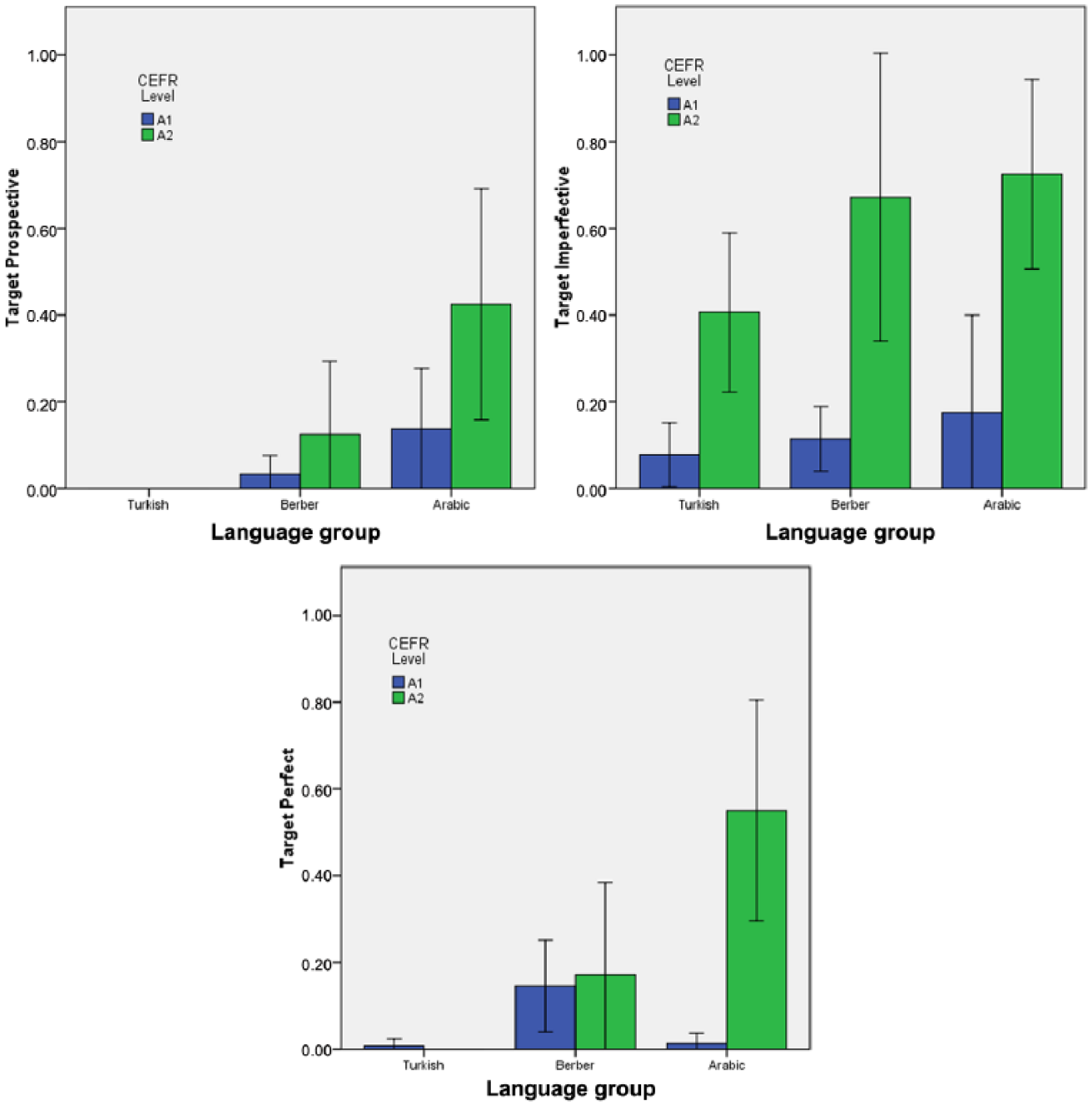
Mean proportions and error bars (+/– 2SE) of target responses for the three conditions prospective, imperfective and perfect of the narrative task, split out for the three language groups and two proficiency levels.
As Figure 2 shows, the proportion of target responses in the prospective condition is fairly low, the A2 Arabic learners having the highest mean, which is just above 40%. An ANOVA analysis shows that the responses in the prospective condition show a significant difference among the three language groups, F(2, 34) = 16.092, p < .000,
The ANOVA for the imperfective condition yields a no significant main effect of group, F(2, 34) = 2.741, p = .079,
In the perfect condition there are significant main effects of both language group (L1), F(2, 34) = 16,464, p < .000,
b The use of dummy auxiliaries
Although in standard Dutch the constructions gaan +
In order to estimate the extent of the use of dummy auxiliaries and to formulate hypotheses as to their function in the acquisition of finiteness, the question we will now try to answer is ‘How many and which dummy auxiliaries occurred in our data?’ We will start by looking at the narrative task. Table 4 presents an overview of the dummy auxiliaries used in that task and their frequencies of occurrence.
Narrative experiment: Dummy auxiliaries and their frequencies of occurrence in the three experimental conditions.
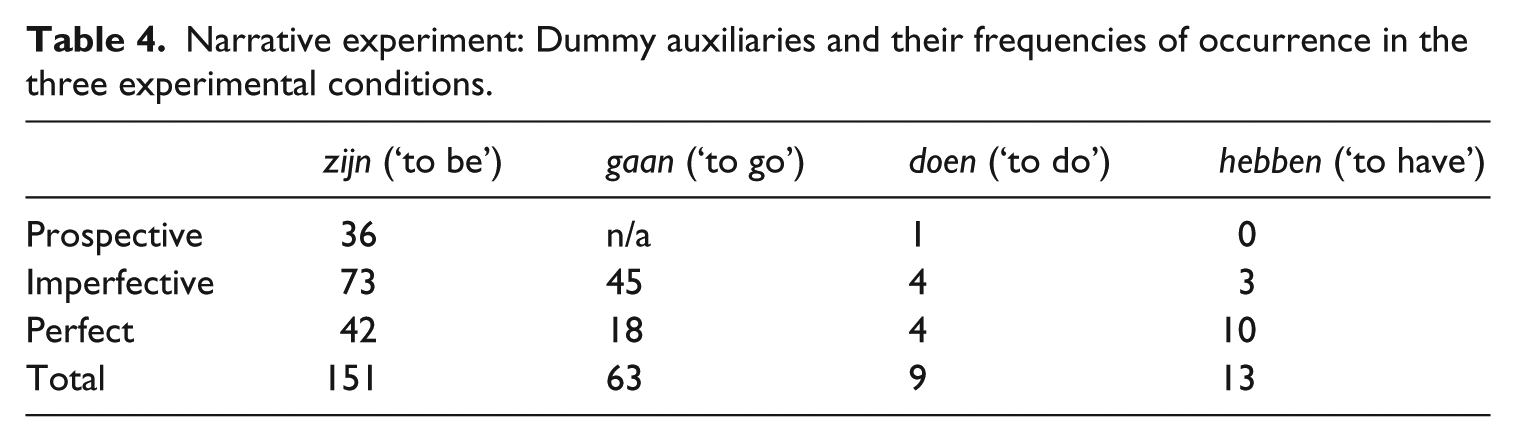
As can be seen in Table 4, four different dummy auxiliaries were found in this experiment: zijn, gaan, doen and hebben. What strikes the eye in Table 4 is that, in all conditions, the frequencies of dummy zijn and dummy gaan are much higher than the number of dummy doen and dummy hebben. The difference between the quantity of dummy zijn and the dummy gaan is also noticeable, dummy zijn being used more frequently. The frequency of both dummy auxiliaries is the highest in the imperfective condition, providing evidence that part of the participants do not ascribe prospective nor perfect meaning to them.
The dummy auxiliaries doen and hebben were hardly used by the participants. This corroborates previous findings based on data of monolingual children (Julien et al., 2013) in which these two dummy auxiliaries were only marginally used. For this reason, the results presented henceforth concern only the dummy auxiliaries zijn and gaan, which are extensively used. So, this answers our first research question and confirms the prediction that dummy auxiliaries are used by adult DAL learners.
Two other research questions were whether proficiency level in Dutch and language background affect the use of those dummy auxiliaries. Two repeated measures ANOVA’s were conducted to compare the effect of proficiency level and language background on the frequency of use of the dummy auxiliaries zijn and gaan in the prospective, imperfective and perfect conditions.
The ANOVA for dummy zijn returned a significant effect of condition, F(2, 68) = 3,618, p = .032,
So, in the narrative task, the prediction that language proficiency in Dutch influences the use of dummy auxiliaries is confirmed for dummy auxiliary zijn, but not for dummy gaan. The prediction that language background would influence dummy use was not confirmed for none of the dummy auxiliaries.
In the following section an analysis of the target responses in each completion experiment will be presented, followed by an analysis of dummy auxiliary use in these experiments.
3 Completion experiments
For various reasons such as absence on the test day – having to leave earlier, and tiredness – five of the participants did not perform one or more of the completion experiments. We therefore omit data of one Turkish-speaking participant in the ‘completion syntax’, the ‘present tense’ and the ‘past tense’ experiments, and of four participants (two Turkish-speaking, one Arabic-speaking and one Tarifiyt-speaking) in the ‘past tense’ experiment.
4 Target responses
a Completion experiment ‘present tense’
An analysis of items reliability was carried out for the completion task ‘present tense’, which revealed that the items have a high reliability α = .970, and that there are no deviant items. This was followed by an ANOVA to test the overall accuracy of the responses in this task. 5 The results are illustrated in Figure 3, giving the mean proportions of target responses and their standard error bars split out for the three learner groups, and the two proficiency levels.

Mean proportions and error bars (+/– 2SE) of target responses per language group and proficiency level in the completion experiment ‘present tense’.
In the completion task ‘present tense’ there are no significant main effects of language group, F(2, 28) = 1.930, p = .161. There was an effect of proficiency level, F(1, 28) = 36.662, p = .000,
b Completion experiment ‘past tense’
No statistical analysis was performed on the target data of this task, because participants produced only eight target utterances (out of 1,019) with this structure, indicating that this grammatical construction is not yet acquired by the majority of the participants.
c Completion experiment ‘syntax’
An analysis of items reliability was carried out for this task. The items have a high reliability α = .927, and there are no deviant items. Figure 4 shows the results of an ANOVA for the ‘canonical order’ condition. The results give the mean proportions of target responses and their standard error bars split out for the three learner groups, and the two proficiency levels.
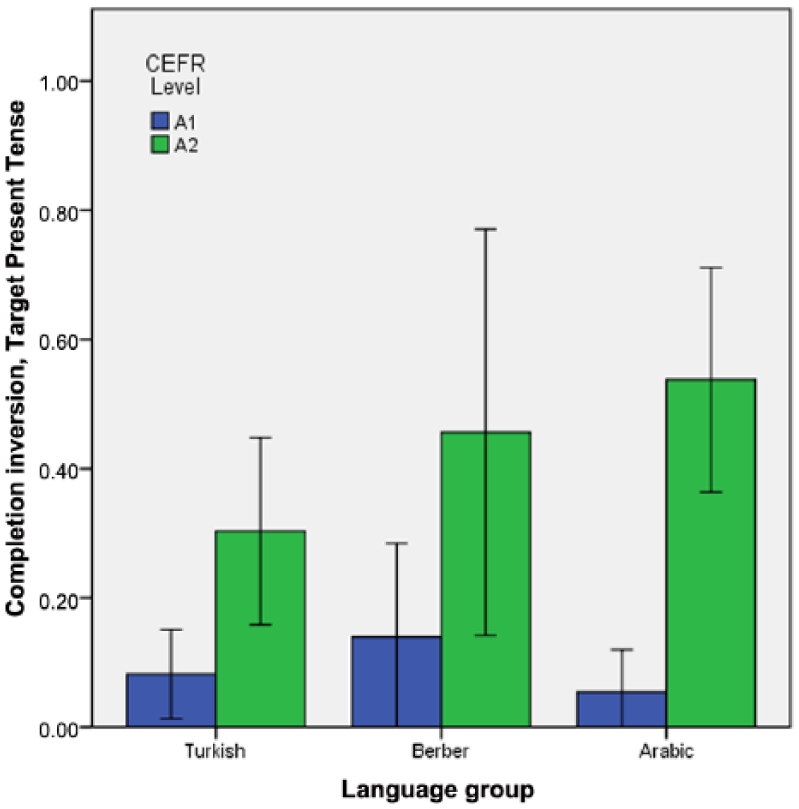
Mean proportions and error bars (+/– 2SE) of target responses in the experiment ‘completion syntax’ per language group and proficiency level for the condition ‘canonical order’.
In the ‘canonical order’ condition there was no significant effect of language group, F(2, 33) = 1.275, p = .293, but there was an effect of proficiency level, F(1, 22) = 24.596, p = .000,
No statistical analysis was carried out for the ‘inverted order’ condition, because of the 866 utterances produced in this condition, only 41 (4,4%) were correct. 6 Analysis of the individual performances shows that those utterances with correct inversion were produced by nine participants, equally spread through the language groups (three Turkish speakers, three Tarifiyt speakers and two Arabic speakers). All, except one, were A2 participants and only one participant produced a relatively high number (16 out of 23) of correct sentences with inversion. The other eight participants produced that type of sentences sporadically, indicating that inversion was not easy to realize for both A1 and A2 participants.
5 The use of dummy auxiliaries
Table 5 presents an overview of the dummy auxiliaries used in the completion tasks. As can be seen in the table, the pattern is the same as that already observed for the narrative task: dummy zijn and dummy gaan are used much more often than dummies doen and hebben.
Completion experiments: Total number of dummy auxiliaries.
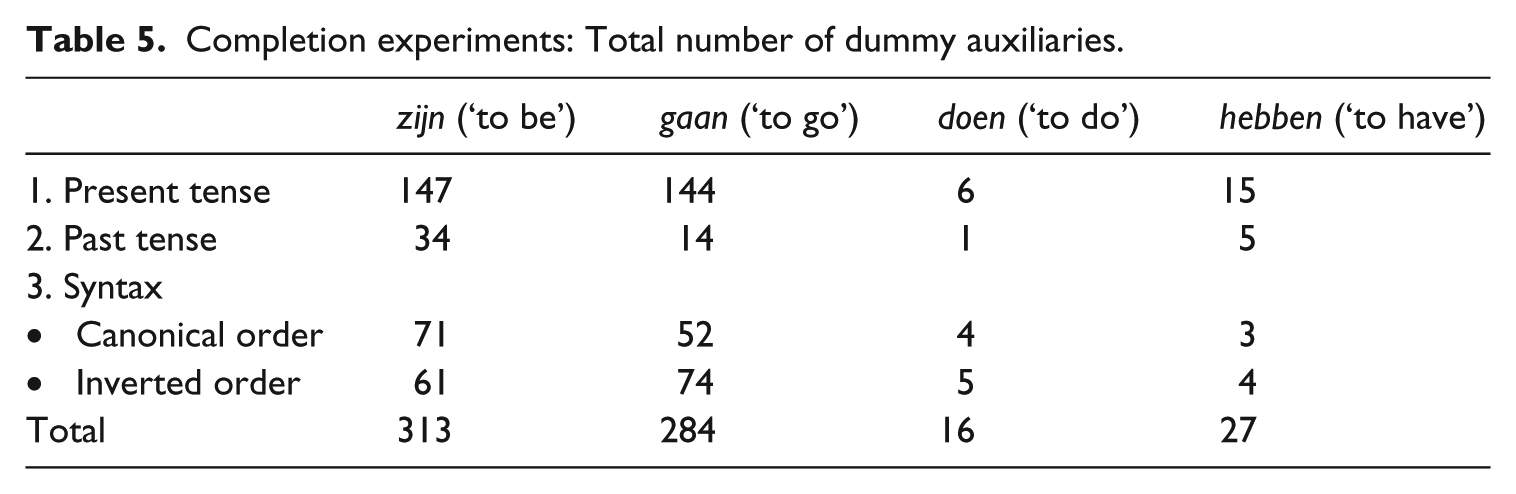
The sum of dummy auxiliaries used in the completion tasks and in the narrative task (see Table 4) gives the following results: a total of 464 occurrences of dummy zijn, 347 of dummy gaan, 25 of dummy doen and 40 of dummy hebben. Because the last two dummy auxiliaries are only sporadically used, they will be excluded from the analyses presented henceforth, which will focus on the extensively used dummy auxiliaries zijn and gaan.
It is striking that the number of dummy auxiliaries in the ‘past tense’ experiment is considerably lower than in the similar task eliciting the ‘present tense’. The construction ging +
Table 5 shows further that the numbers of dummy auxiliaries in both conditions of the ‘syntax’ experiment do not differ much. What is interesting here, is that the 135 utterances (out of a total of 866) produced with a dummy auxiliary had three different surface forms. There were eight utterances with a dummy auxiliary verb in second position, that is, with the structure XVdummySVlexical
Two ANOVA repeated measures were carried out to compare the effect of proficiency level and language background on the use of dummy zijn and dummy gaan across the four tasks. The analysis regarding dummy auxiliary zijn shows a near significant effect of proficiency level, F(1, 27) = 3.691, p = .074 (HF corrected),
Regarding dummy auxiliary gaan, the results show only a main effect of task, F(3, 81) = .855, p = .010 (Huynh–Feldt corrected),
6 Individual patterns of variation in dummy use
In order to account for individual variation, but still be able to see general patterns, participants were divided into five groups on the basis of their production of dummy auxiliaries:
extreme dummy users, those who use dummy auxiliaries 10 times or more often across all tasks;
occasional dummy users, who use a dummy auxiliary, up to nine times, spread throughout all tasks;
selective dummy users, who use dummy auxiliaries to various degrees, but only in one, two or three tasks;
infrequent dummy users, who use a dummy auxiliary only once across all tasks and;
no dummy users.
Table 6 displays the four types of dummy users and the no dummy users distributed over the two levels of language proficiency.
Use of dummy auxiliaries by five types of dummy users.
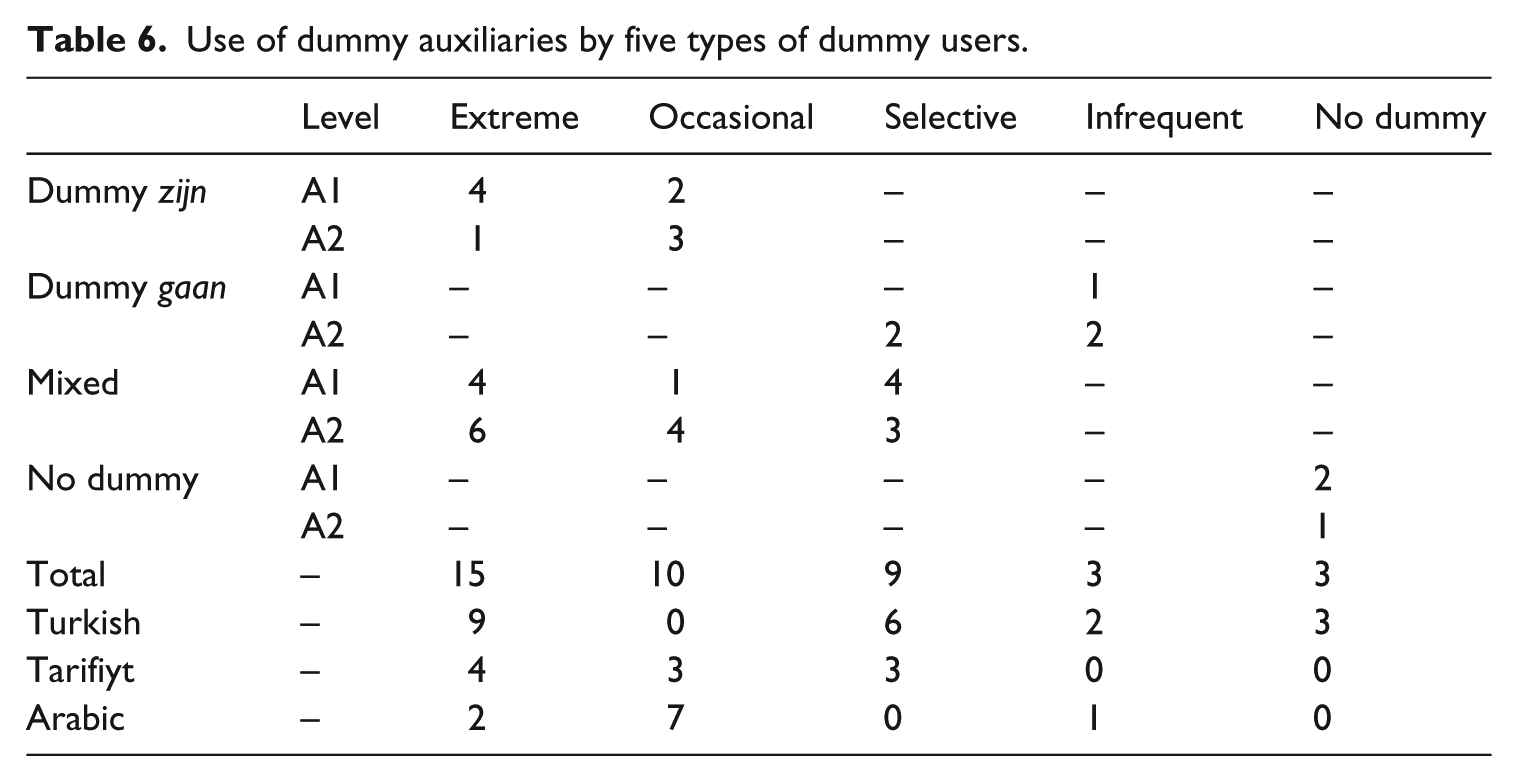
Table 6 shows that there were 15 extreme dummy users: five of them use dummy auxiliaries as often as 49 to105 times across the five tasks; 10 occasional dummy users; nine selective dummy users; three infrequent dummy users, and three no dummy users. Although five participants have not performed all tasks, their performance on the remaining tasks showed such clear tendencies for a particular type that it was possible to place them in one of the above categories.
Table 6 also shows that there are participants who use only dummy zijn, there are others who use only dummy gaan, and there is also a group that uses both dummy auxiliaries. Participants who use only dummy zijn are the extreme and the occasional dummy users, and most of them are A1 participants. Dummy gaan, when used as the only dummy auxiliary, is used by selective and infrequent dummy users, most of them being A2 participants. Two of the no dummy users are A1 participants, and one is an A2 participant. It is remarkable that two of those three participants are in the very beginning of their language acquisition process (evidenced by the almost exclusive use of nonfinite verbs), and one of them is in a more advanced stage (evidenced by the high level of accuracy in the use of finite verbs and only a few nonfinite verbs). This suggests that participants who use dummies extensively have already discovered that there must be a finite verb in the frontal part of the sentence. The dummy auxiliaries fulfill that function. Participants who do not use dummy auxiliaries can be divided into two groups: those who are not yet trying to figure out how the Dutch verbal system works, and those who have already discovered how it works. Table 7 clarifies these distinctions in stages of development. The 40 participants are classified according to their use of nonfinite verbs, dummy auxiliaries and finite verbs in the 130 items comprised in all three production tasks. In the nonfinite stage, fewer than 10 dummy auxiliaries are used, nonfinite lexical verbs are used more than 40 times, and finite lexical finite verbs are produced fewer than 15 times. In the dummy auxiliary stage, dummy auxiliaries are used more than 10 times across all experiments. At this stage, the number of nonfinite and finite verbs varies considerably, but the tendency is that nonfinite verbs are produced more often than finite verbs. In the finite stage, the dummy auxiliaries decrease – they are used fewer than 10 times across all experiments – and simultaneously the number of finite verbs in initial position is higher.
Three stages in the language development of Turkish, Berber Tarifiyt and Moroccan Arabic adult DAL learners.

Notes. The figures given in parentheses are: the number of nonfinite verbs, followed by the number of dummy auxiliaries, followed by the number of finite verbs across all experiments. * Data for this participant is missing for three of the five tasks; because he produced almost exclusively nonfinite verbs in the narrative task, we assume that, had he performed all the tasks, he would have produced nonfinite verbs much more often than 40 times. For this reason, this participant was placed in the ‘nonfinite stage’.
Table 7 shows that the nonfinite stage consists solely of A1 participants (8), and that the finite stage consists mainly of A2 participants (13), with the exception of one Arabic-speaking participant. The dummy stage, on the other hand, is composed of both A1 (9) and A2 participants (9). A considerable number of participants had passed the nonfinite stage and were in the dummy stage. Several A2 participants had mastered that stage, even though they still, sporadically, used dummy auxiliaries.
IV Discussion and conclusions
The aim of this study was to address the question as to whether dummy auxiliaries are used by adult DAL learners as a structural syntactic step towards the acquisition of finiteness. Four specific research questions were posed which will be discussed below.
Even though dummy auxiliaries have been attested in different earlier types of language acquisition (see introduction), it was necessary to find out whether the data collected for the present study corroborated this finding. We review each of the research questions:
1. Do low-proficient adult DAL learners use dummy auxiliaries?
The results reveal that all three groups of participants used dummy auxiliaries abundantly, in particular zijn and gaan (see Tables 5 and 6).
2. Does level of language proficiency in Dutch influence the choice and frequency of dummy auxiliaries?
It was predicted that the number of dummy auxiliaries produced by A2 participants would be higher than that produced by A1 participants. This prediction is not confirmed. There is indeed a level effect, for dummy auxiliary zijn. However, instead of an increase, the A2 participants show a decrease of dummy zijn across all tasks. As for dummy auxiliary gaan, no level effect was found. It seems that the majority of participants in the present study is at a more advanced stage than predicted on the basis of their CEFR level and the results of earlier studies. The starting point in other studies (most of them being longitudinal), such as that of Van de Craats (2009), was the very beginning of being exposed to target language instruction. Van de Craats reported that her participants started using dummy auxiliaries after nine months of instruction. In the present study, at the moment of testing, the majority of the participants (31) had been attending Dutch lessons for a longer period of time than those in Van de Craats’ study. It is, therefore, conceivable that they had already gone through the first phases reported in Van de Craats’ study.
There are strong indications that the developmental path these learners follow is the same as that reported in the studies mentioned above. Moreover, the present study introduces a new finding. It seems that there are two phases within the dummy stage: an initial phase in which both dummy zijn and gaan are used, and a subsequent phase in which the occurrence of dummy zijn diminishes while dummy gaan keeps being used. The conclusion is that level of language proficiency in Dutch influences the use and choice of dummy auxiliaries.
Utterances like Pingu is gaat schoppen (‘Pingu be.3
3. Does language background determine the choice of dummy auxiliary?
Although the results of the target responses show significant differences among the three language groups in the prospective and perfect conditions of the narrative task, the prediction that language background influences the choice of dummy auxiliary was not confirmed.
All three groups behave similarly, and they all use the same dummy auxiliaries. This indicates that the choice of dummy auxiliaries is influenced by target language input rather than by language background. On the other hand, the prediction that Arabic-speaking learners would perform better than the other two groups on the prospective condition of the narrative experiment was confirmed. It seems that positive transfer helps the Arabic-speaking group to acquire more easily the prospective use of gaan +
4. Do adult DAL learners, in the initial stages of language acquisition, assign meaning to the constructions zijn +
The results from the comprehension experiment show that all participants match the picture portraying the ongoing action to the construction zijn +
Additional evidence that no meaning is attached to dummy auxiliaries is provided by the lack of any significant effect of lexical aspect of the verbs tested in the experiments. Dummy auxiliaries are used indiscriminately with all verb classes, regardless of their semantic constraints. The learners in the present study do not comply with the constraints that statives in Dutch do not allow the continuous constructions zijn + aan het +
Our conclusion is that dummy auxiliaries are semantically vacuous. They have a purely structural function, in line with Chomsky’s (1995) Economy Principle. They come from the Dutch input learners get, in which the copula zijn and the construction gaan +
Footnotes
Acknowledgements
We are indebted to the makers and the copyright holders of the DVD Pingu voor altijd (Pygos Group & Hit Entertainment Limited, 2010), from which we extracted the clips we used in eliciting the data for this study.
Declaration of Conflicting Interest
The authors declare that there is no conflict of interest.
Funding
This research received no specific grant from any funding agency in the public, commercial, or not-for-profit sectors.