




Abstract
Non-native speakers’ sensitivity to discourse-level cues in pronoun interpretation has not been widely researched. We carried out three antecedent-choice questionnaire experiments which investigate the impact of focus on within-sentence pronoun resolution in native and non-native speakers of German and native speakers of Russian. Focus was realized via cleft structures and focus-sensitive particles (FSPs). Findings show a clear difference between native and non-native speakers that is not attributable to first language (L1) influence. Native speakers of German and Russian were less likely to resolve the pronoun to an antecedent in focus via a cleft compared to a non-focused antecedent in the same position (the ‘anti-focus effect’). Unlike the native speakers, non-native speakers did not show an anti-focus effect with clefts but showed a tendency to resolve a pronoun to an antecedent appearing with an FSP. We argue that non-native speakers do not always complete a detailed analysis of the information structural cues when seeking an antecedent and may instead be influenced by surface-level cues that highlight certain antecedents.
Keywords
I Introduction
Pronoun resolution is a crucial part of language comprehension for both native (L1) speakers and non-native (L2) speakers. It is sensitive to a wide variety of information sources which have to be integrated in order to arrive at an interpretation. However, previous research has shown that L2 speakers do not always arrive at the same interpretation for pronouns as L1 speakers do (e.g. Belletti et al., 2007; Sorace and Filiaci, 2006). General hypotheses about non-native comprehension above the word-level have tended to emerge from studying possible differences between L1 and L2 speakers in building structural representations (e.g. Clahsen and Felser, 2006; Hopp, 2014; Jiang, 2007). However, while pronoun resolution may be sensitive to grammatical cues, discourse-level information often plays a crucial role in determining the appropriate antecedent. As observed by several researchers (e.g. Cheng and Almor, 2017; Grüter et al., 2016), L2 speakers’ sensitivity to discourse-level cues in pronoun interpretation has thus far not been widely researched. And where this has been studied, it has often been difficult to rule out the influence of a speaker’s native language on their pronoun interpretation in the non-native language (henceforth ‘L1 influence’). It is therefore unclear whether there are differences in sensitivity to discourse-level cues between native and non-native speakers that go beyond L1 influence.
Here we investigate the role of focus in native and non-native pronoun resolution. Focus is part of information structure, which is the pragmatic-level information conveyed by the form of a sentence. L2 speakers have already been shown to be sensitive to focus information per se (Reichle and Birdsong, 2014) and to use it during language production (Callies, 2009). However, allowing information structure to inform pronoun resolution as described below requires quite sophisticated discourse comprehension, which has not been extensively tested in L2 speakers. The influence of focus on pronoun resolution is also an area where L1 influence could play a role, since it is a complex phenomenon that learners are unlikely to have acquired explicitly. To address the question of whether there are L1–L2 differences in the area of discourse comprehension that go beyond L1 transfer, we chose to test the influence of focus on pronoun resolution in German in highly proficient learners of German with Russian as an L1. Not only do Russian and German have a similar pronoun system, with third-person personal pronouns in both languages marked for number, gender (in singular) and case that must agree with their antecedents in these features, but both languages also have similar ways of expressing focus (see below). If differences are found between L1 German speakers and L2 German speakers with Russian L1, this will be evidence of a more general difference between native and non-native comprehension of discourse information that is not attributable to L1 influence.
II The realization of focus
Focus is a broad term that has been the subject of much debate in the fields of semantics and pragmatics and the field of information structure. The function of focus was traditionally understood as presenting information that is new or important, an assertion made about the topic (e.g. Halliday, 1967). More recent work has emphasized the more precise characterization that focus ‘indicates the presence of alternatives that are relevant for the interpretation of linguistic expressions’ (Krifka, 2008: 247). Phonologically, focus is normally associated with pitch accent in English; for example, in answer to the question in (1a), an appropriate response is (1b).
(1) a. Who presented the results? b. [JOHN]F presented the results. c. It was John who presented the results.
In some languages, including German, focus can be realized syntactically via an it-cleft as shown in (1c). An it-cleft in English or German comprises an expletive pronoun and a copula verb followed by the cleft focus, which is modified by a relative clause. 1 The name John is the cleft focus in (1c). Within generative-transformational grammar, it has been assumed that clefting involves moving an element leftwards into a focus position (as summarized by Reeve, 2011). From the point of view of information structure, clefting appears to divide the sentence into several parts: a presupposition (also called background), a focus and an assertion (Lambrecht, 2001). In (1c), the presupposition is that X (someone) presented the results; John is the focus; and the assertion is that X is John. At the pragmatic level the function of the pitch accent in (1b) and the cleft structure in (1c) is the same, that is, to indicate that out of the range of alternatives for presenting the results, it was John who did so.
Focus can also be realized via focus-sensitive particles (e.g. only, even) as shown in (2).
(2) Only John presented the results.
The particle is said to act as an operator that associates with a focused element in its scope, such as John in (2). Focus realized via particles gives rise to a presupposition, that someone presented the results, and an assertion, that nobody other than John presented the results; the assertion is tied to the semantics of the individual particle (although the existence of a presupposition is a matter of debate; for a discussion, see Guerts and van der Sandt, 2004). Particles can semantically express exclusion, inclusion or ranking of the focus alternatives with respect to the focused element; for example an exclusive such as only excludes the alternatives. The position of focus particles in German is flexible as they can associate with different elements in a sentence; however, in initial position as shown in (2) the particle unambiguously associates with John.
Turning to focus realization in German and Russian, focus can be realized in German in a variety of ways. In written German, focus particles are often used, as well as syntactic re-ordering and clefting. It has been noted (Dufter, 2009) that clefting is less common in German than in English. This is attributed to the greater flexibility in German word order, which allows focused elements to be placed on the right in the German middle field, or via movement to the syntactic prefield. In Russian, like German, word order is flexible and focused constituents are often placed on the right, although fronting (movement to the left) is also possible in some cases (Bailyn, 2012). Russian has a range of focus particles that are flexible in their positioning, but, like German, in initial position the association is clearly with the following noun. Russian also has the equivalent of a cleft construction, called the èto-cleft, which can have a similar function to clefts in German or English (Bailyn, 2012). In many ways, then, focus realization is highly similar in German and Russian. It should be noted, however, that there are some differences with respect to the structure of the èto-cleft. This has led to the claim that Russian – similarly to some other Slavic languages – does not have a true cleft construction (Junghanns, 1997; Kimmelman, 2009). There does not seem to be an agreement on whether to consider èto the same or a different lexical item when comparing, for instance, the demonstrative èto (literally, this) and a homophonous particle used in equative constructions in Russian (Geist, 2007; Geist and Błaszczak, 2000; Paducheva, 2012; Partee, 2010). Second, èto-clefts may also be analysed differently depending on the interpretation they are given. Thus, Kimmelman (2009) distinguishes between two types of èto-clefts – a focus èto-cleft and a thetic èto-cleft – arguing that èto may be read as a contrast marker in one case and as a topic in another. The linguistic uncertainty about the èto cleft in Russian was an important motivation for Experiment 3 (we return to this issue below).
III The effect of focus realization on L1 pronoun interpretation
One consequence of focus realization is that focused material becomes cognitively prominent; for example, it will be remembered better and named faster and more accurately than non-focused material (Birch and Garnsey, 1995; Singer, 1976; for an overview, see Drenhaus et al., 2011). Relatedly, a number of studies have demonstrated that, for pronoun resolution between sentences, focus realization (usually via clefts) makes an antecedent more accessible. For example, Foraker and McElree (2007) investigated two competing approaches of how prominent antecedents are represented in memory using a speed–accuracy trade-off paradigm and eyetracking during reading. They found higher asymptotic accuracy for the conditions in which the pronoun matched the clefted NP (compared to the non-clefted NP), and an advantage for the cleft match was also seen in several eyetracking measures.
The advantage for focused antecedents is perhaps surprising given that pronouns are also known to favour topics as antecedents. In information-structural terms, the notions of topic and focus are usually distinct and complementary, with topichood being associated with discourse-old, given or presupposed information and focus being associated with new, unpredictable information (Gundel and Fretheim, 2004). Studies aiming to compare the cognitive consequences of focus and topichood for pronoun resolution, however, have mainly found that both factors make a contribution to antecedent prominence despite their different functions (Arnold, 1999; Cowles et al., 2007; Kaiser, 2011).
A recent set of studies by Colonna and colleagues (Colonna et al., 2012, 2015; de la Fuente, 2015) have challenged the view that focus necessarily increases antecedent accessibility. In contrast to previous studies, they examined the consequences of focusing when a pronoun appears within the same sentence as the antecedent. In a series of questionnaire studies, Colonna et al. (2012) tested pronoun resolution preferences in sentences such as (3). 2
(3) a. Baseline Peter hat Hans geohrfeigt, als er jung war. ‘Peter slapped Hans when he was young.’ b. Focused subject Es ist Peter, der Hans geohrfeigt hat, als er jung war. ‘It is Peter who slapped Hans when he was young.’ c. Focused object Es ist Peter, den Hans geohrfeigt hat, als er jung war. ‘It is Peter who Hans slapped when he was young.’
Participants were asked to choose an antecedent for the pronoun in the adjunct clause by completing the sentence __ war jung (‘__ was young’). They found that Peter was chosen as an antecedent numerically less often when it appeared as a clefted subject (3b) than in the baseline condition (3a). (This comparison was however not statistically significant.) 3 When compared with antecedent choices for topicalized nouns from a different experiment, there were significantly fewer choices for the focused antecedents (subject or object) than for the topicalized antecedents in both French and German. 4 They dubbed the apparent dispreference for focused antecedents within the same sentence the ‘anti-focus effect’. The anti-focus effect has also been detected (marginally) during online processing in German (Colonna et al., 2015) and, more robustly, in Spanish where de la Fuente (2015) found significant anti-focus effects with both subject and object clefts. He also found a similar pattern when focus-sensitive particles (FSPs) such as only were used rather than it-clefts in both Spanish and English.
The authors’ explanation for the anti-focus effect involves a careful consideration of the information structure, in particular noting that topichood is an important cue in pronoun resolution. Considering again Lambrecht’s (2001) division of a cleft sentence into presupposition, focus and assertion, the presupposed part of (3b) is X (someone) slapped Hans, i.e. the sentence is about Hans being slapped. As such, Hans belongs to the presupposed part of the sentence. Since topichood is associated with the notion of aboutness or givenness, Hans is the (part of) the topic, making Hans a good referent for the pronoun when Peter appears in a cleft. Relatedly, focus has been associated with signalling a topic shift (for a discussion, see Colonna et al., 2015). If focus signals an upcoming shift, then referring to the focused antecedent when the pronoun is in the subsequent sentence is indeed felicitous. It is this difference that gives rise to the distinct impact that focus has on pronoun resolution within and between sentences. Note that in order for the anti-focus effect to take place, detailed consideration of the information structure is needed.
There is thus an emerging body of cross-linguistic evidence that, for sentence-internal pronoun resolution, an antecedent that is focus marked becomes less accessible as an antecedent. The findings stand in stark contrast to the clear increase in accessibility gained from focus marking when the pronoun appears in a new sentence, and show that not only are pronoun resolution preferences sensitive to a range of discourse-level cues, but also that these cues cannot be mapped onto cognitive prominence in a simplistic way; instead, a more fine-grained analysis of the information structure is necessary to arrive at this pattern of pronoun resolution preferences.
IV L2 sensitivity to discourse-level information during pronoun resolution
L1 pronoun resolution is sensitive to focus, but can the same be said for L2? There is only one study (as far as we are aware) that has directly tested this. Ellert (2010) tested German learners of Dutch (in Dutch) and Dutch learners of German (in German) on pronoun resolution between sentences, using comparative structures with both canonical (4a) and non-canonical (4b) word order. The non-canonical word order in (4b) puts the subject NP der Schrank (‘the cupboard’) in focus. The structures are highly similar in German and Dutch.
(4) a. Der Schrank ist schwerer als der Tisch. Er stammt aus einem Möbelgeschäft in Belgien. ‘The cupboard is heavier than the table. It comes from a furniture store in Belgium.’ b. Schwerer als der Tisch ist der Schrank. Er stammt aus einem Möbelgeschäft in Belgien. ‘Heavier than the table is the cupboard. It comes from a furniture store in Belgium.’
In an offline antecedent choice task and a visual-world eyetracking task, the two learner groups, as well as native speakers of German and Dutch, patterned together. All groups strongly preferred (> 90%) to resolve the pronoun in the second sentence to the subject NP (der Schrank), in both canonical and non-canonical word orders. Ellert argued that this finding aligns with previous L1 findings (discussed above) that focus enhances the accessibility of an antecedent in between-sentence contexts, and that this enhancement is also apparent for L2 speakers. But the study and interpretation raise some questions. Given that der Schrank was the preferred antecedent in the canonical order conditions as well as the non-canonical ones, can the results be attributed to focus at all? It could equally be due to a strong preference for resolving the pronoun to the subject NP in comparative structures. Indeed, given the strength of the preference, against previous studies showing focus effects on pronoun resolution, this is a very plausible alternative. If the finding were attributable to focus, it is unclear to which extent this is determined by L1 preferences, since both German and Dutch have the same preference. And it is unclear how L2 speakers would perform if the phenomenon were more subtle, as per the anti-focus effect discussed above.
More broadly, it has been difficult to determine whether or not L1 preferences play a significant role in L2 speakers’ sensitivity to discourse-level information during pronoun resolution. For example, one problematic area of pronoun resolution for L2 speakers is in relating the choice of a particular pronominal form to aspects of the discourse structure. In a language with both null and overt pronouns such as Italian, native speakers normally interpret a null pronoun as referring to a prominent entity (such as the local subject), whereas an overt pronoun normally refers to a non-prominent entity (Carminati, 2002). L2 speakers, however, tend to interpret both null and overt pronouns as referring to prominent entities (Belletti et al., 2007; Sorace and Filiaci, 2006) and overuse overt third-person pronouns where L1 speakers would use a null pronoun (Tsimpli and Sorace, 2006). L2 speakers’ reduced sensitivity to form–function mappings has also been found for the distinction between personal and demonstrative pronouns in German (Ellert, 2013; Wilson, 2009). But in the majority of studies on the overt/null distinction, the non-native speakers’ L1 either did not have the relevant overt/null distinction or had null and overt pronouns but different discourse constraints on their use; it is therefore unclear whether L2 speakers’ difficulty in this area can be attributed to L1 influence or to a more general problem with this type of form–function mapping.
Current hypotheses about L2 comprehension, such as the Interface Hypothesis (IH), attribute non-native-like behaviour in this area to difficulty integrating information from the syntactic domain with discourse-level information (Sorace, 2011; Sorace and Filiaci, 2006; Sorace and Serratrice, 2009); see also the Shallow Structure Hypothesis (Clahsen and Felser, 2006). But the IH remains ambivalent on the issue of native-language influence: earlier formulations directly attribute difficulties to differences between the native and the non-native language, whereas later discussions (e.g. Sorace, 2011) also consider a general L2 processing problem as the underlying cause.
The possibility of L1 influence also affects several studies that have manipulated other discourse-level cues to pronoun resolution. For example, Jegerski et al. (2011) found that Spanish pronoun resolution in L1 English learners of Spanish was affected by discourse structure manipulations (coordination or subordination), which had been shown to affect pronoun resolution in English. Native Spanish speakers, in contrast, were not sensitive to the manipulation of discourse structure but were affected by the form of the pronoun (null versus overt). Okuma (2011) manipulated explicit topic and subject marking in Japanese sentences and found that the pronoun resolution choices of L1 English-speaking learners of Japanese were influenced more by topic marking than the native speakers’ choices; note that topichood is an important factor in English pronoun resolution.
While much evidence points to, or at least cannot rule out, the influence of the native language in L2 speakers’ sensitivity to discourse information during pronoun resolution, there is emerging evidence that this is not the only contributing factor. For instance, Cheng and Almor (2017) showed that L2 speakers were less sensitive to discourse-level information than L1 speakers when testing causality biases in pronoun resolution. Moreover, while their results are partly attributable to native-language influence, in other aspects the learners’ behaviour was different from both the native speakers in their study and from patterns previously found in the learners’ native language. Similarly, Roberts et al. (2008) tested Turkish and German learners of Dutch and found that offline, pronoun resolution choices aligned with learners’ native languages, but online the two learner groups patterned together. More robust evidence comes from Schimke and Colonna (2016), who tested Turkish learners of French alongside French native speakers (in French) and Turkish native speakers (in Turkish). They showed that the Turkish learners of French were sensitive to manipulations of the discourse structure when resolving null pronouns, whereas native French speakers and native Turkish speakers were not, pointing to an increased sensitivity to discourse-level information in the learners that is not evident in their native language.
In summary, non-native-like performance in pronoun resolution tasks has often been attributed, at least in part, to the influence of native language preferences, but direct evidence for such an influence is lacking because many studies did not include a second L2 group on which this could be tested directly. Studies which have directly tested the influence of the native language have produced mixed results, with Roberts et al. (2008) finding native-language influence in offline choices but not online processing, and Schimke and Colonna (2016) finding that L2 pronoun resolution patterns were not consistent with either the L1 or the target language and showed an increase in sensitivity to discourse-level factors.
V The current study
In order to explore the role of focus marking in L2 pronoun resolution, three antecedent-choice questionnaires were carried out. Given the mixed evidence on L2 speakers’ sensitivity to discourse-level information in pronoun resolution, there is a need for a broader evidence base in order to arrive at a more precise characterization of L2 behaviour. In particular, we examine whether L2 speakers are sensitive to the subtle effect of focus information on within-sentence pronoun resolution, which requires detailed discourse-level comprehension, when focus is realized via clefts and via FSPs. Clefts signal focus by means of changes to the canonical sentence structure. That is, computing the appropriate information structure representation for cleft sentences presupposes the computation of a sufficiently detailed global syntactic representation. Experiment 1 investigates the effect of clefting on pronoun resolution within sentences in native German speakers and Russian learners of German. Second, we test whether other ways of realizing focus, namely through FSPs, would produce an anti-focus effect in L2 speakers, as has been shown for L1 speakers of English and Spanish (de la Fuente, 2015). Note that unlike clefting, adding an FSP does not result in any changes to global sentence structure. This question is addressed in Experiment 2 which also tests native German speakers and Russian learners of German. We also explore L1 influence by choosing a phenomenon of which L2 speakers are unlikely to have explicit knowledge and testing L2 speakers whose L1 contains the relevant focus structures, namely, Russian. If the L2 speakers behave differently from the L1 control group, the differences will not be attributable to L1 influence since focus is realized similarly in German and Russian, and instead point to a more general limitation in non-native comprehension of discourse. A final experiment conducted in Russian investigates the effect of both clefts and FSPs on pronoun resolution in Russian native speakers, to explicitly test whether the learners’ behaviour in the first two experiments can be attributed to preferences in their L1.
VI Experiment 1
1 Materials
Twenty-one experimental items, consisting of a lead-in sentence and a critical sentence, were constructed in three conditions, as shown in (5).
(5) Die Fahrprüfung war für den Nachmittag geplant. ‘The driving exam was planned for the afternoon.’ Baseline: a. Der Fahrlehrer teilte dem Prüfer am Telefon mit, dass er ausgetauscht werde. The driving-instructor told the-(dat.) examiner on the-telephone (Part.), that he replaced will-be ‘The driving instructor told the examiner on the telephone that he will be replaced.’ NP1 cleft: b. Es war der Fahrlehrer, der dem Prüfer am Telefon mitteilte, dass er ausgetauscht werde. It was the driving-instructor, who the-(dat.) examiner on the-telephone told, that he replaced will-be ‘It was the driving instructor who told the examiner on the telephone that he will be replaced.’ PP cleft: c. Es war am Telefon, als der Fahrlehrer dem Prüfer mitteilte, dass er ausgetauscht werde. It was on the-telephone, when the driving-instructor the-(dat.) examiner told, that he replaced will-be ‘It was on the telephone that the driving instructor told the examiner that he will be replaced.’
In the first part of the critical sentence, two [+human] NPs are introduced, with the first mentioned (= NP1) the main clause subject and the second mentioned (= NP2) a direct or indirect object. The appearance of the it-cleft was manipulated as follows: (5a) is a baseline in which there is no cleft. In (5b) NP1 appears in an it-cleft; in (5c) an adjunct PP appears in an it-cleft. The PP cleft condition was included to test whether simply the presence of a cleft affects pronoun resolution choices. The second clause of the critical sentence was a finite complement clause introduced by dass ‘that’ and which contained a pronominal subject. Fifteen items contained masculine pronouns (er) and six feminine (sie). 5 These items were mixed with 16 fillers and 15 items from an unrelated experiment and distributed over three presentation lists in a Latin-square design, such that participants saw seven items in each condition and each item in one condition only. Thirteen of the filler items were unambiguous so that participants’ general attention to the task could be checked.
2 Procedure
The questionnaire was administered using the software Surveygizmo (https://www.surveygizmo.com). Each item was followed with the question ‘Er/sie bezieht sich auf:’ (‘he/she refers to:’), and then the two potential antecedents were provided. Participants had to choose one of the two antecedents. Because the focus items are ambiguous with respect to pronominal reference (both antecedents are grammatically possible), participants were instructed at the beginning of the questionnaire to choose the referent they felt was the most likely one.
The L1 group was recruited via university message boards and sent the link via email. Participants completed the task remotely and were paid a small fee or given course credit for their participation. The L2 group was given the questionnaire as part of an unrelated experimental session under laboratory conditions. All participants gave informed consent before completing the questionnaire.
3 Participants
The L1 group consisted of 23 native speakers of German (4 male). Participants were aged 18–34 years (mean 23 years). One additional participant was tested but dropped from the analysis because of low accuracy (< 70%) on the unambiguous filler items. Filler accuracy for the 23 participants included in the analysis was 98.0% (range 84.6–100%). All participants reported that they were native speakers of German, not early bilingual and did not have any diagnosed language disorders.
The L2 group consisted of 25 native speakers of Russian (5 male) who were all upper intermediate or advanced learners of German. Participants were aged 20–36 years (mean 28 years). They all completed the Goethe placement test (Goethe Institute, 2011), obtaining a score of 21/30 or above (range 21–30, mean 26). A score of 21 is equivalent to level B2 (upper intermediate) in the Common European Framework of Reference for Languages (CEFR), and a score between 22 and 26 is equivalent to level C1 (advanced). All participants were resident in Germany at the time of testing, and started learning German on average at 14 years (range 7–25 years). They had been learning German for an average of 13 years (range 5–24 years). All participants had high accuracy (> 90%) on the unambiguous filler items (mean 99.1%, range 92.3–100%).
4 Predictions
If a sentence-internal potential antecedent becomes less accessible when it is in focus (the anti-focus effect), participants should choose the NP1 significantly less often in the NP1 cleft condition (1b) compared to the baseline (1a). The PP cleft condition (1c) was included to check whether the anti-focus effect is driven merely by the presence of a cleft. If so, there will also be significantly fewer NP1 choices in the PP cleft condition (1c) compared to the baseline (1a). If L2 speakers are sensitive to changes in the discourse structure brought about by focus via clefting, they should show similar pronoun resolution patterns as the L1 speakers.
5 Results
Table 1 shows the proportion of NP1 choices in each condition for the L1 and L2 groups. Numerically, there are fewer NP1 responses in the NP1 cleft condition compared to the baseline (.43 versus .51), and a higher proportion of NP1 choices in the PP cleft condition in the L1 group. In the L2 group NP1 choices are lowest in the baseline condition (.50) and similar across the two cleft conditions (.54 and .53). For the data analysis, NP1 responses were coded as 1 and NP2 responses coded as 0; the raw data was submitted to a mixed-effects logistic regression model using lme4 (Bates et al., 2015) in the R statistical program (R Core Team, 2015). The factor Condition (three levels with the baseline as reference level) was included in the model, as well as random intercepts for participants and items. 6
Mean proportion of NP1 responses (SD in brackets) over participants in each condition for the first language (L1) and second language (L2) groups in Experiment 1.
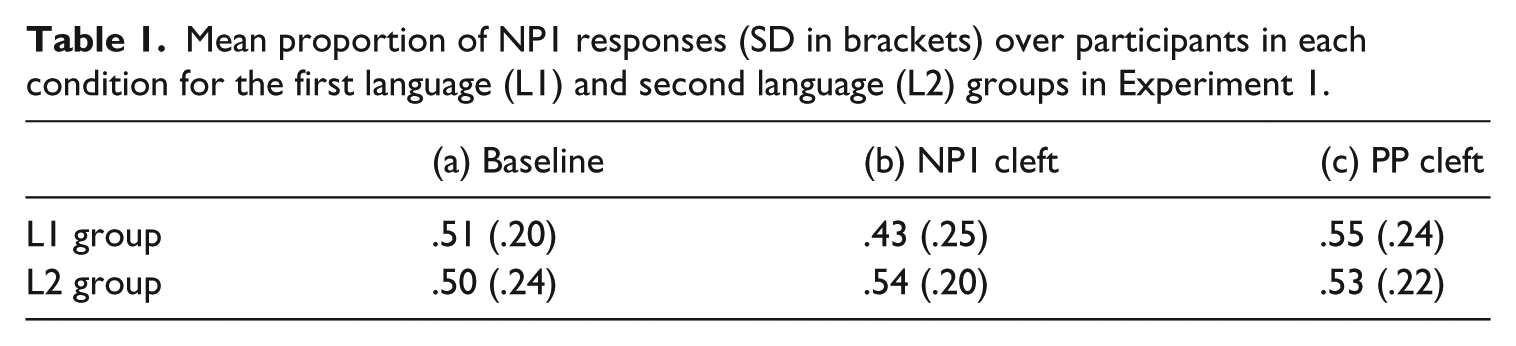
To determine whether the data should be analysed separately for the two groups, we first ran two models containing data for both groups together to look for an interaction of Condition by Group (two levels, L1 and L2). The two models were identical except that one contained the interaction (Condition * Group) and the other did not (Condition + Group). In the Condition * Group model, the factor Group interacted significantly with one level of Condition (β = .78, SE = .38, z = 2.05, p = .040), and this model was a significantly better fit than the model without in a likelihood ratio test (χ2 = 6.38, df = 2, p = .041). We concluded that there was a significant interaction between Condition and Group which justified conducting separate analyses on each group.
In the L1 group the difference in NP1 choices between the baseline and the NP1 cleft condition was significant. There was no difference between the baseline and the PP cleft condition. In the L2 group there were no significant differences between conditions. The full model outputs are given in Table 2.
Model outputs for Experiment 1, L1 and L2 groups.
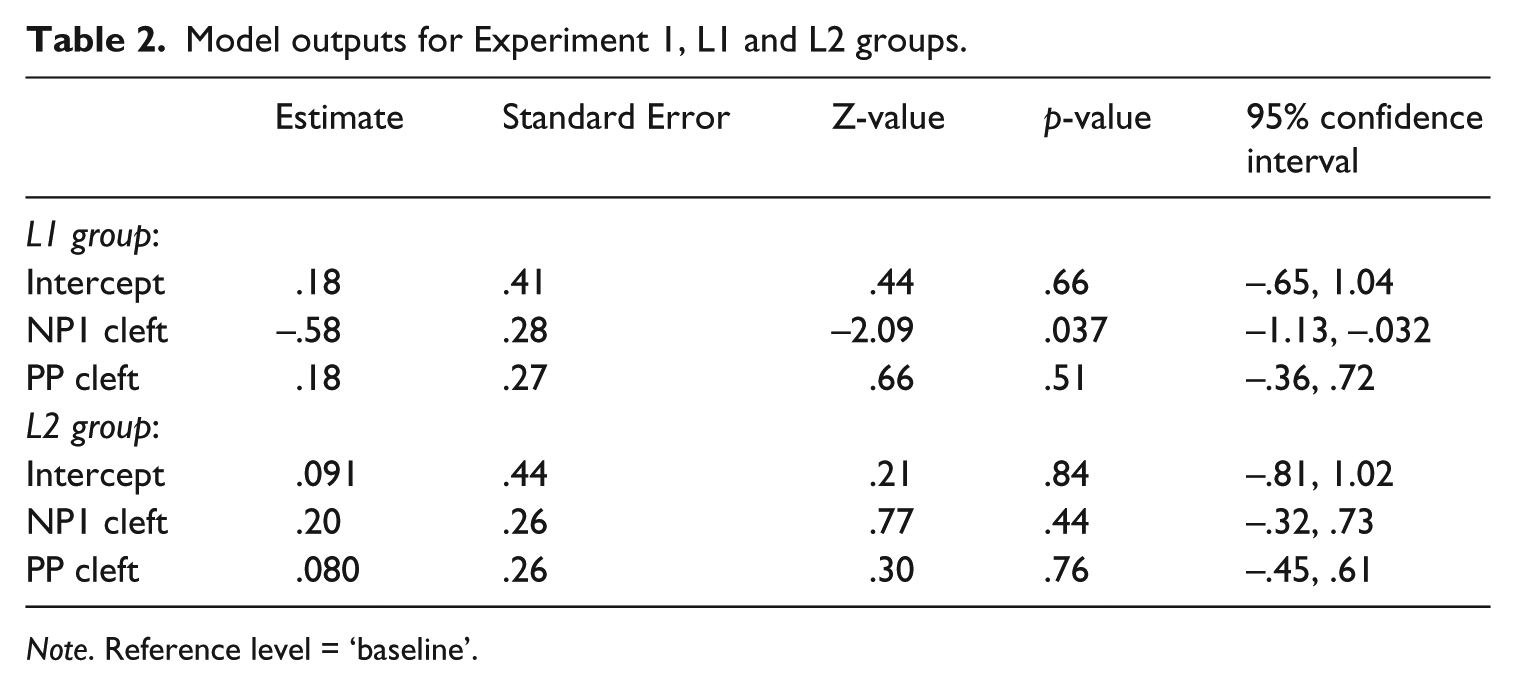
Note. Reference level = ‘baseline’.
6 Discussion
The L1 group was less likely to choose a clefted NP as an antecedent than a non-clefted NP, which aligns with the anti-focus effect reported by Colonna et al. (2012, 2015). The anti-focus effect here is unlikely to be due merely to the presence of a cleft, because the PP cleft condition did not have the same effect on NP1 choices. It is more likely that placing an NP in a cleft changes the information structure of the sentence such that the NP2 is now considered more topic-like (Colonna et al., 2012). The L2 group differed from the L1 group in that their NP1 choices were not affected by the cleft manipulation. This could be due either to a general insensitivity to focus information in non-native comprehension, or to the fact that recognizing the information-structural change brought about by clefting NP1 (and relating this to pronoun resolution) required participants to first compute a structural analysis of our cleft sentences. That is, mapping cleft structures onto corresponding pragmatic representations might have been problematic for this group.
The aim of Experiment 2 was twofold: (i) to see if a larger group size would increase the chance of detecting effects of focusing in L2 speakers, and (ii) to test whether other focus markers, namely FSPs, would also influence pronoun resolution in either group. A range of particles was chosen, to avoid repetition in the materials. These particles belonged to four semantic classes, as shown in Table 3. All the particles have the same distributional properties and, pragmatically, indicate the presence of alternatives, while the different semantic classes express a different relationship between the focus and the alternatives. Given their high proficiency level in German, participants were expected to be familiar with particles used in experimental materials, since some (auch, vor allem, nur) already appear in textbooks of German as a foreign language designed for A1/A2 levels (e.g. Forßmann, 2009; Funk et al., 2006), and the others are present in textbooks and dictionaries targeting B1 level (Hilpert et al., 2010; Kunkel-Razum and Worsch, 2014).
The particles used in Experiment 2.
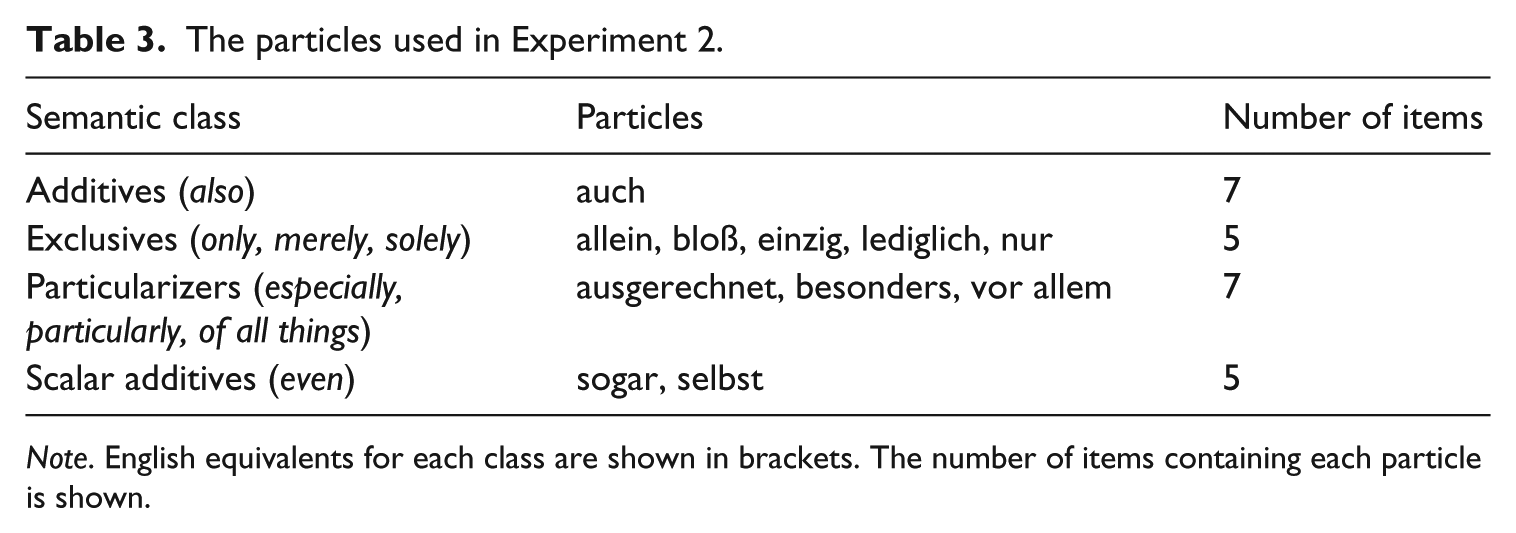
Note. English equivalents for each class are shown in brackets. The number of items containing each particle is shown.
VII Experiment 2
1 Materials
The 21 experimental items from Experiment 1 were adapted to create four conditions as shown in (6), and three items were added to make a total of 24 items. The baseline and NP1 cleft conditions were retained from Experiment 1, and two particle conditions were added, associating with either NP1 or NP2.
(6) Die Fahrprüfung war für den Nachmittag geplant. ‘The driving exam was planned for the afternoon.’ Baseline: a. Der Fahrlehrer teilte dem Prüfer am Telefon mit, dass er ausgetauscht werde. The driving-instructor told the-(dat.) examiner on the-telephone (Part.), that he replaced will-be ‘The driving instructor told the examiner on the telephone that he will be replaced.’ NP1 cleft: b. Es war der Fahrlehrer, der dem Prüfer am Telefon mitteilte, dass er ausgetauscht werde. It was the driving-instructor, who the-(dat.) examiner on the-telephone told, that he replaced will-be ‘It was the driving instructor who told the examiner on the telephone that he will be replaced.’ NP1 particle: c. Ausgerechnet der Fahrlehrer teilte dem Prüfer am Telefon mit, dass er ausgetauscht werde. particularly the driving-instructor told the-(dat.) examiner on the-telephone (Part.), that he replaced will-be ‘The driving instructor of all people told the examiner on the telephone that he will be replaced.’ NP2 particle: d. Der Fahrlehrer teilte ausgerechnet dem Prüfer am Telefon mit, dass er ausgetauscht werde. the driving-instructor told particularly the-(dat.) examiner on the-telephone (Part.), that he replaced will-be ‘The driving instructor told the examiner of all people on the telephone that he will be replaced.’
The items were mixed with 16 fillers and 14 experimental items from an unrelated experiment and distributed across four lists. Thirteen of the filler items were unambiguous so that participants’ attention to the task could be checked.
2 Procedure
The experiment was administered using Limesurvey (Schmitz, 2015). The task and instructions were the same as in Experiment 1. Participants in both groups were recruited remotely via message boards and mailing lists, and were paid a small fee or given course credit for participation. All participants completed the task remotely, with the L2 speakers additionally completing an online version of the Goethe placement test (Goethe Institute, 2011).
3 Participants
The L1 group consisted of 33 native speakers of German (10 male), aged 19–35 years (mean 25 years). One additional participant was tested but dropped from the analysis because of low accuracy (< 70%) on the unambiguous filler items. Filler accuracy for the 33 participants included in the analysis was 98.8% (range 92.3–100%). All reported that they were native speakers of German, were not early bilinguals and did not have any diagnosed language disorders.
The L2 group consisted of 35 native speakers of Russian (8 male). One additional participant was tested but dropped from the analysis because of low accuracy (< 70%) on the unambiguous filler items. Filler accuracy for the 35 participants included in the analysis was 97.8% (range 84.6–100%). All reported a Goethe placement test score of 21/30 or above (range 21–30, mean 26), indicating that they were upper intermediate or advanced learners of German. Participants were aged 21–60 years (mean 35 years). All participants were resident in Germany at the time of testing, and started learning German on average at 19 years (range 7–46 years). They had been learning German for an average of 16 years (range 3–43 years). No participant for Experiment 2 had taken part in Experiment 1.
4 Predictions
For the L1 group we expected to replicate the anti-focus effect for clefts from Experiment 1. If FSPs have a similar effect on pronoun resolution as the clefts, we should also see an anti-focus effect for the conditions containing FSPs, with NP1 choices being less likely in the NP1 particle condition compared to the baseline, and NP2 choices being less likely in the NP2 particle condition compared to the baseline.
For the L2 group, the previous null result was inconclusive, so in Experiment 2 we tested a larger L2 group to see whether their apparent insensitivity to clefting would prove robust. If L2 speakers are able to compute and utilize focus information, they should pattern with the native speakers in showing anti-focus effects. If they are selectively insensitive to focus information signalled by means of clefting (e.g. because of difficulties with the structure), effects of focusing may be restricted to the particle conditions vs. baseline.
5 Results
Table 4 shows the proportion of NP1 choices in each condition for the L1 and L2 groups. For the L1 group, the pattern for the cleft condition is similar to Experiment 1, with fewer NP1 choices in the cleft condition compared to the baseline. There are also fewer NP1 choices in the NP1 particle condition compared to baseline. The NP2 particle appears similar to the baseline condition. In the L2 group, while the cleft condition appears not to have a dramatic effect on NP1 choices, the NP1 particle condition shows a higher rate of NP1 choices than the baseline.
Mean proportion of NP1 responses (SD in brackets) over participants in each condition for the L1 and L2 groups in Experiment 2.

Data were analysed in the same way as for Experiment 1, except that Condition had four levels. As in Experiment 1, combined group models were first calculated to determine whether Condition interacted with the factor Group. Given that, in the Condition * Group model, the factor Group interacted significantly with one level of Condition (β = .75, SE = .29, z = 2.62, p = .009), and that this model was a marginally better fit than the model without the interaction in a likelihood ratio test (χ2 = 7.40, df = 3, p = .060), we concluded that separate analyses on each group were justified.
For the L1 group, NP1 choices were again significantly less likely in the NP1 cleft condition compared to the baseline. There was no significant difference between the NP1 particle and the baseline, or the NP2 particle and the baseline condition. In the L2 group there was again no significant difference between the NP1 cleft and the baseline conditions, but NP1 choices were significantly more likely in the NP1 particle condition than the baseline. 7 There was no difference between the NP2 particle condition and the baseline. Full model outputs are given in Tables 5 and 6.
Model output for Experiment 2, L1 group.
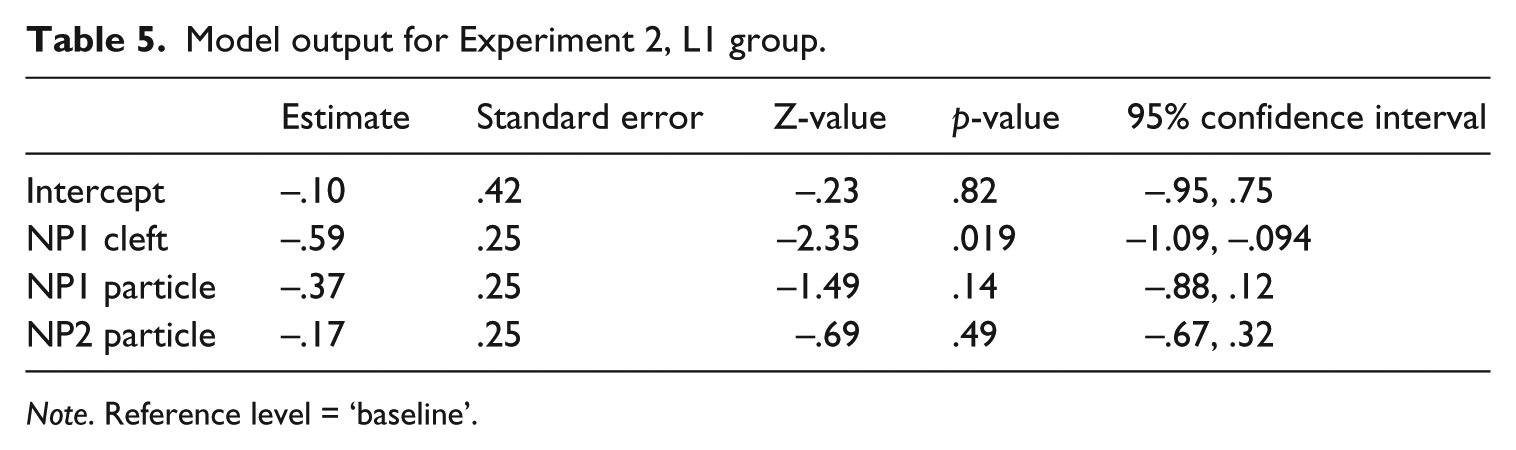
Note. Reference level = ‘baseline’.
Model output for Experiment 2, L2 group.
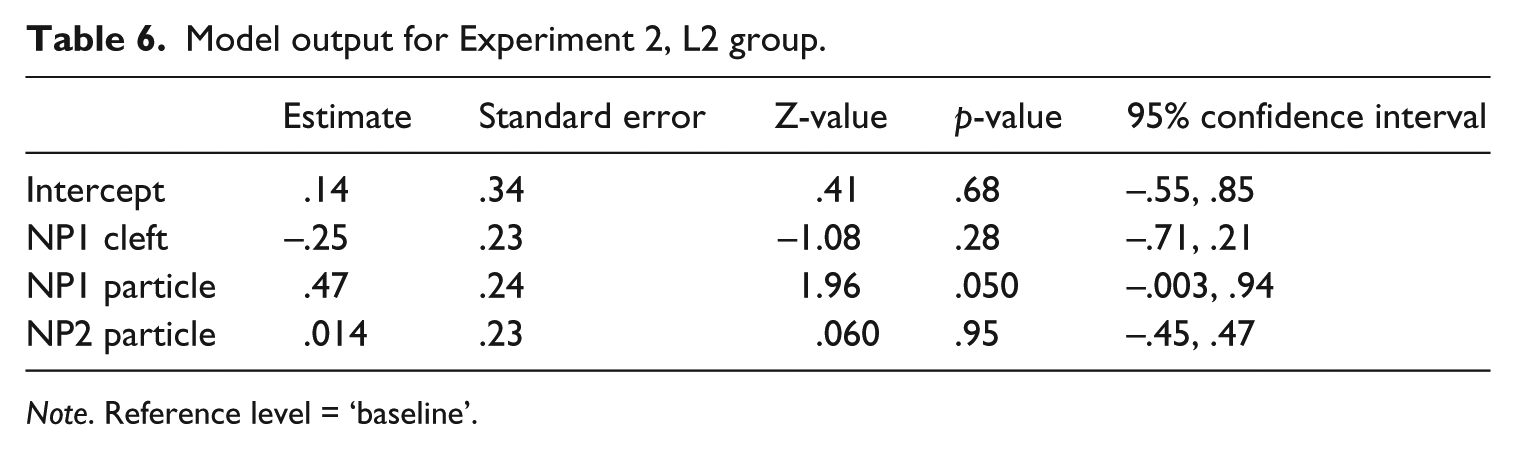
Note. Reference level = ‘baseline’.
The original motivation for including FSPs in Experiment 2 was to test whether pronoun resolution in L2 speakers would be sensitive to different ways of realizing focus. Our study was not designed to test the effects of different particles, however; they were not included as an experimental manipulation or distributed in equal numbers. It is of course possible that the different semantic classes of FSPs may affect pronoun resolution to different extents. There is some indication of this for L1 speakers from de la Fuente (2015), who showed that in English and Spanish the FSP only had a stronger anti-focus effect than the particle even (and also in Spanish). We therefore present here the results of the relevant conditions of Experiment 2 split by semantic class (Table 7).
Proportion of N1 responses for each semantic class in the NP1 particle, NP2 particle and baseline conditions, for the native and non-native groups in Experiment 2.
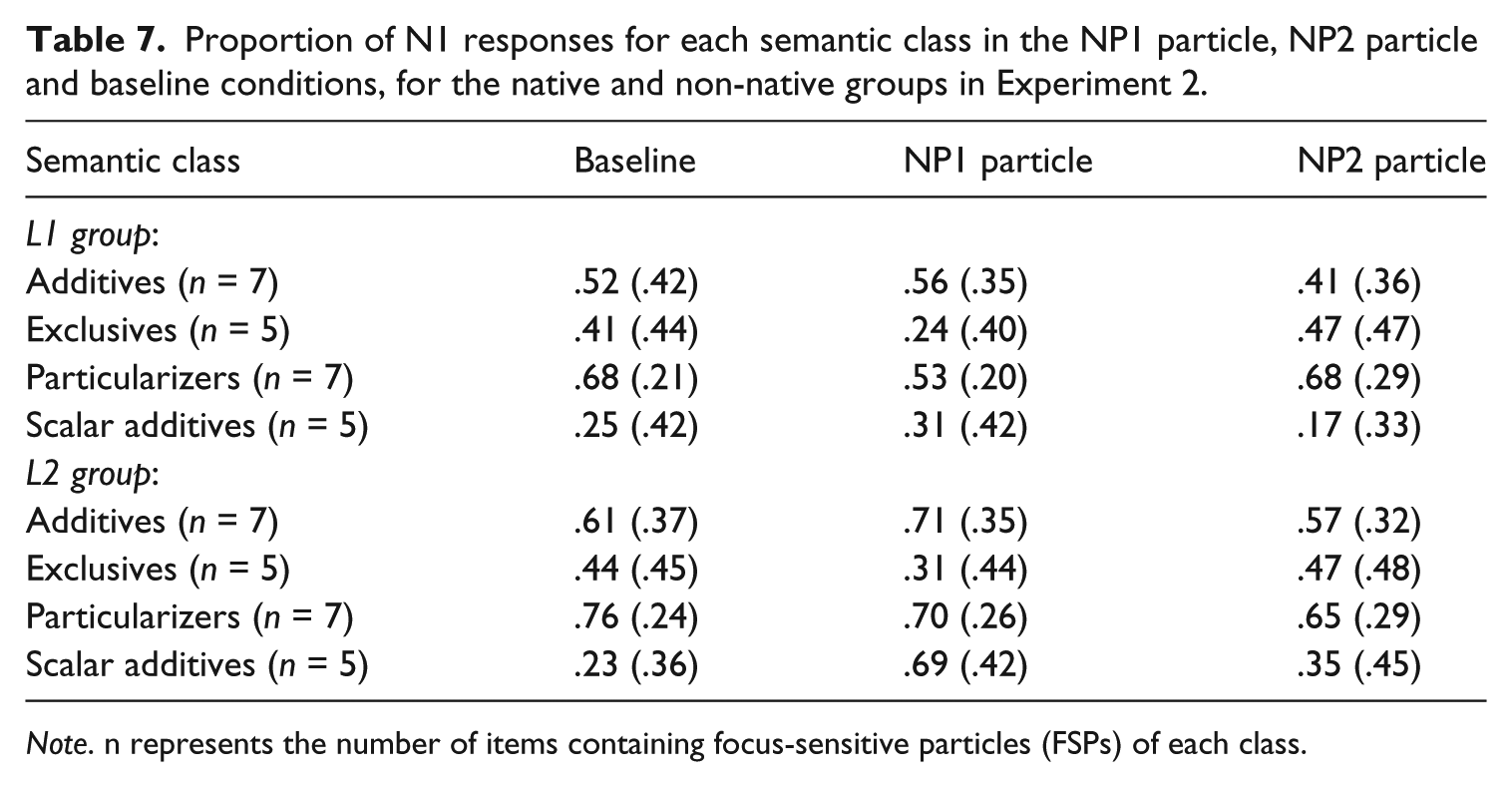
Note. n represents the number of items containing focus-sensitive particles (FSPs) of each class.
A separate mixed-effects logistic regression model for each level of the factor Particle Group (Additives, Exclusives, Particularizers, Scalar Additives) was run, separately for native and non-native participants, with Condition (Baseline, NP1 Particle, NP2 Particle) as a fixed effect. 8 Random intercepts for participants and items were included. For the native group, the drop in N1 choices from the baseline to the NP1 particle condition was marginally significant for both Exclusives (β = −1.09, SE = 0.61, z = −1.78, p = .075) and Particularizers (β = −0.89, SE = 0.48, z = −1.83, p = .067). For the L2 group, only the Scalar Additives showed effects, with a significant increase in N1 choices from baseline to the NP1 particle condition (β = 2.06, SE = 0.51, z = −4.05, p = .00005) and a marginal increase in the NP2 particle condition (β = 0.96, SE = 0.50, z = 1.93, p = .054).
6 Discussion
In the native group the anti-focus effect was replicated for clefts. While numerically the NP1 particle choices also follow the same pattern, the difference to the baseline was not significant, so we cannot claim that focus particles have an effect on L1 pronoun resolution choices in the same way as the cleft construction. The exploratory analysis, however, showed that Exclusives and Particularizers showed marginal effects in the direction of the anti-focus effect. We return to this in the general discussion. In the L2 group, while there was again no effect of clefting, an unexpected effect was observed in the NP1 particle condition, with NP1 choices being significantly more likely than in the baseline condition. This suggests that focusing via FSPs affects pronoun resolution differently in native and non-native comprehension. Additionally, our exploratory analysis indicates that this might be restricted to certain types of FSPs.
One obvious possibility is that the information structural cues under investigation affect pronoun resolution in a different way in German and Russian, the native language of our L2 speakers, and that the L2 pattern can be explained by L1 influence. While we chose an L2 group whose L1 is similar to German in the expression of focus, we noted in the introduction that there are some differences between German and Russian with respect to clefts. It is therefore possible that, at least in the cleft conditions, German and Russian may pattern differently and that the L2 group was influenced by Russian preferences. To test this possibility directly, we carried out Experiment 3, which was a Russian language version of Experiment 2, with native speakers of Russian.
VIII Experiment 3
We designed Experiment 3 to test whether the L2 response patterns could have been driven by Russian-specific preferences. Experiment 3 materials used constructions with èto that are the closest equivalents of it-clefts according to the existing literature (e.g., Junghanns, 1997; Kimmelman, 2009), and correspond thus to their German counterparts from Experiment 2 in their focus meaning. The Russian materials were checked by two specialists in Russian language and literature studies: a school teacher holding a master’s degree and a professor. Both experts were also native Russian speakers and reported that all conditions (baseline, cleft, NP1 particle, NP2 particle) were grammatically correct and sounded natural in Russian.
1 Materials
Materials for Experiment 3 were Russian equivalents of the German materials from Experiment 2; see (7). Minor changes such as appropriate terms of address were changed to make the sentences natural in Russian, but nothing that changed the substantial content of the items or the fillers. Some feminine role nouns had to be changed to masculine forms to avoid an alternative (often pejorative) meaning; pronouns were changed accordingly. German names with forms of address were replaced by Russian proper names. In four items PPs following NP2 were omitted because they were unnatural and would have required a different word order. The particles used in Experiment 3 were, as far as possible, translations of the Experiment 2 materials, but in some cases they were substituted for others to ensure that the sentences sounded natural in Russian. As in Experiment 2, the particles belonged to four semantic classes, as shown in Table 8.
The particles used in Experiment 3.
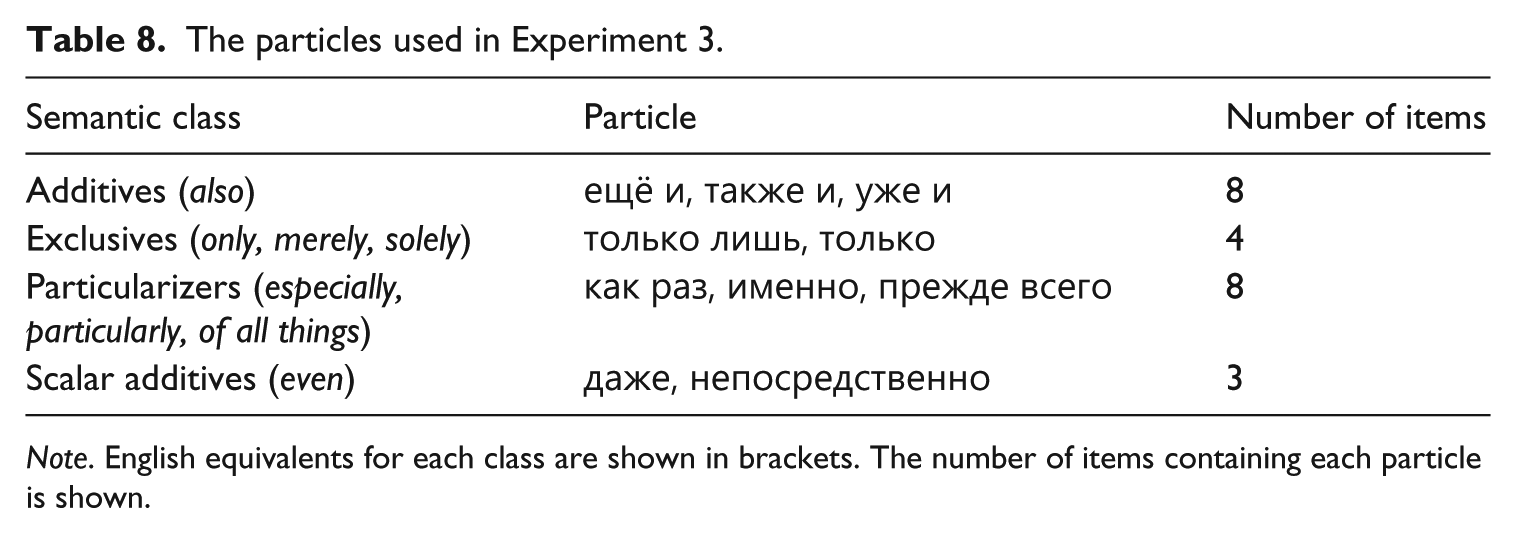
Note. English equivalents for each class are shown in brackets. The number of items containing each particle is shown.
(7) Экзамен по вождению был назначен на послеобеденное время. exam on driving was set for afternoon time ‘The driving exam was planned for the afternoon.’ Baseline: a. Инструктор сообщил экзаменатору по телефону, что он будет заменён. Instructor(nom.) informed examiner(dat.) on phone, that he will-be replaced ‘The instructor informed the examiner on the phone that he will be replaced.’ NP1 cleft: b. Это инструктор сообщил экзаменатору по телефону, что он будет заменён. This instructor(nom.) informed examiner(dat.) on phone, that he will-be replaced ‘It was the instructor who told the examiner on the phone that he will be replaced.’ NP1 particle: c. Как раз инструктор сообщил экзаменатору по телефону, что он будет заменён. precisely instructor(nom.) informed examiner(dat.) on phone, that he will-be replaced ‘The instructor of all people told the examiner on the phone that he will be replaced.’ NP2 particle: d. Инструктор сообщил как раз экзаменатору по телефону, что он будет заменён. instructor(nom.) informed precisely examiner(dat.) on phone, that he will-be replaced ‘The instructor told the examiner of all people on the phone that he will be replaced.’
2 Procedure
The procedure was the same as in Experiment 2. Participants were recruited remotely via social media, specifying that the Russian speakers should have no knowledge of German. 9
3 Participants
Participants were 50 native speakers of Russian (18 male), aged 24–62 years (mean 33 years) who were not early bilinguals. None reported any language disorders. Two participants were dropped because of poor performance on the filler items (< 70%) leaving 48 participants in the analysis. Filler accuracy for the 48 participants included in the analysis was 97.6% (range 75–100%).
4 Predictions
If findings for the non-native group in Experiments 1 and 2 are based on an L1 influence, then Russian participants should display similar pronoun resolution preferences in Russian: no sensitivity to clefting (èto-construction), but a focus effect with particles, such that NP1 is chosen more often in the NP1 particle condition compared to the baseline.
Note that this finding would be at odds with the anti-focus effect in intra-sentential pronoun resolution found previously in L1 speakers of French, German and Spanish. If clefting has a similar effect on pronoun resolution cross-linguistically, then the NP1 will be chosen less often in the NP1 cleft condition (èto-construction) compared to the baseline.
5 Results
Table 9 shows the proportion of NP1 choices in each condition for the native Russian speakers. The data were analysed in the same way as for Experiment 2. NP1 choices were significantly less likely in the NP1 cleft condition compared to the baseline. There was no significant difference between the NP1 particle and the baseline, or the NP2 particle and the baseline. The full model output is given in Table 10.
Mean proportion of NP1 responses (SD in brackets) over participants in each condition for the native Russian speakers in Experiment 3.

Model output for Experiment 3 (native Russian speakers).
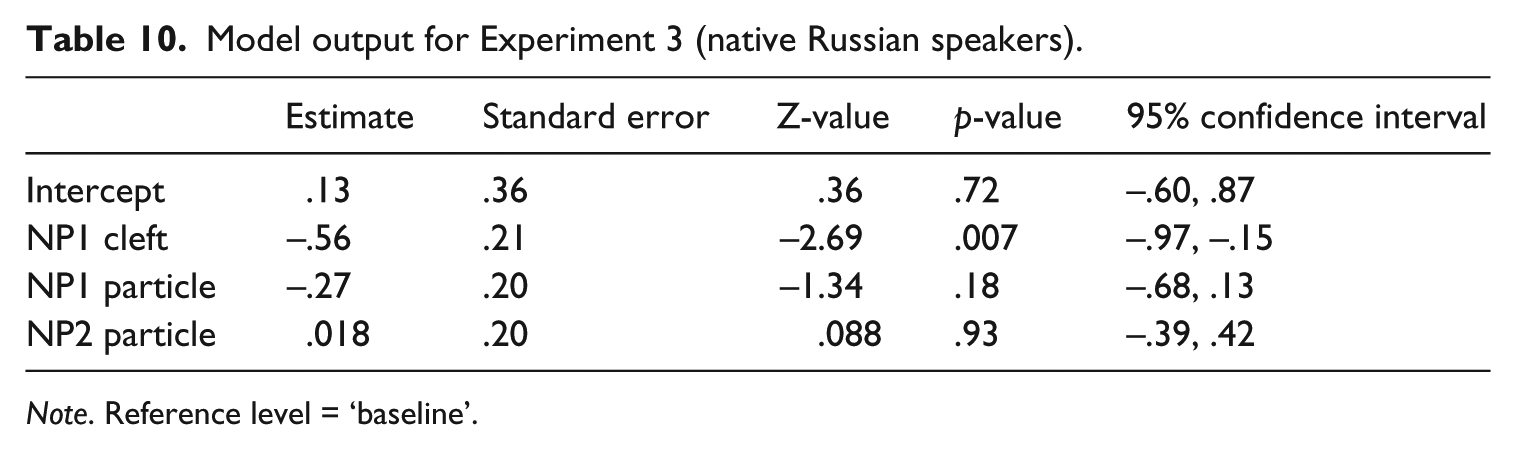
Note. Reference level = ‘baseline’.
In summary, the results of Experiment 3 patterned with the native German speakers’ results for Experiments 1 and 2. It therefore seems unlikely that the behaviour of the non-native speakers in Experiments 1 and 2 was driven by native language preferences, and at the same time we provide further cross-linguistic evidence for the anti-focus effect.
Exploratory analysis, FSPs
As per Experiment 2, an exploratory analysis of the particle conditions split by semantic class was carried out (Table 11). A separate mixed-effects logistic regression model for each level of the factor Particle Group (Additives, Exclusives, Particularizers, Scalar Additives) was run, with Condition (Baseline, NP1 Particle, NP2 Particle) as a fixed effect. 10 Random intercepts for participants and items were included. The drop in N1 choices from the baseline to the NP1 particle condition was significant only for Particularizers (β = −0.89, SE = 0.35, z = −2.56, p = .010). The increase in N1 choices for Exclusives was marginally significant in the NP1 particle condition (β = 0.88, SE = 0.51, z = 1.71, p = .087), and the increase for Scalar Additives in the NP2 particle condition was significant (β = 2.32, SE = 0.98, z = 2.37, p = .018).
Proportion of N1 responses for each semantic class in the NP1 particle, NP2 particle and baseline conditions in Experiment 3.
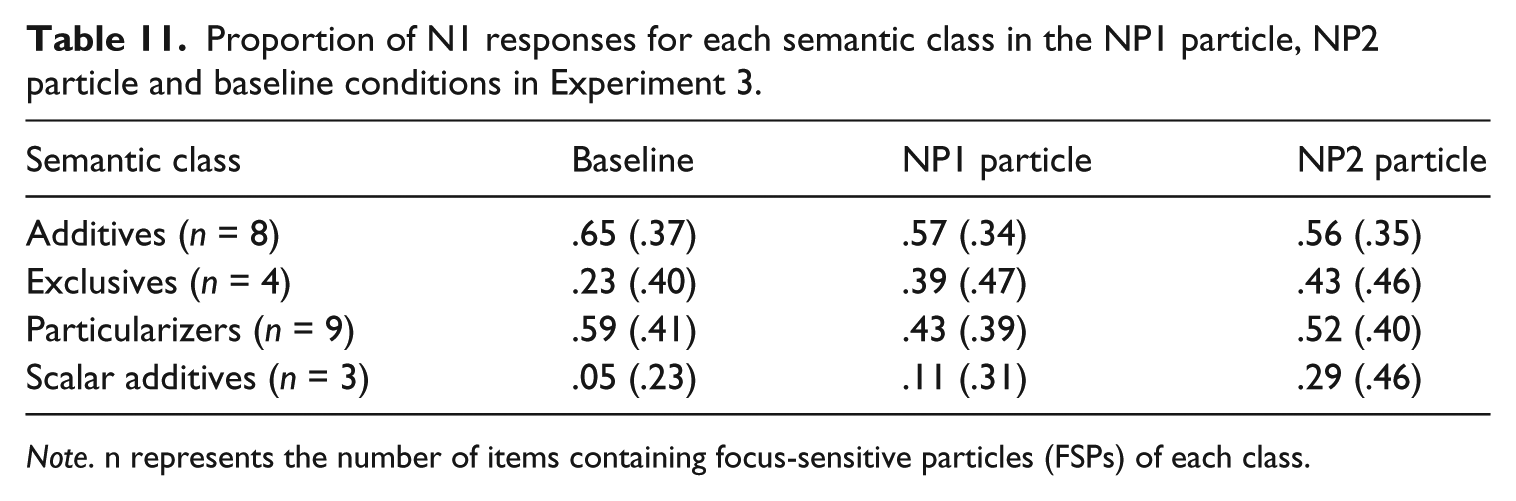
Note. n represents the number of items containing focus-sensitive particles (FSPs) of each class.
IX General discussion
We examined sensitivity to focus by testing whether non-native speakers show similar interpretation preferences for within-sentence pronoun resolution as native speakers. Across three questionnaire experiments, we found that clefts generated a clear anti-focus effect in both German and Russian for native speakers (that is, native speakers chose NP1 as an antecedent for a sentence-internal pronoun significantly less often when the NP1 was a cleft focus, compared to a baseline condition with no cleft). The L2 speakers appeared to be insensitive to the cleft manipulation. They were, however, sensitive to the presence of FSPs. In contrast to the native speakers, Russian learners of German chose NP1 as an antecedent for a sentence-internal pronoun significantly more often when the NP1 appeared with an FSP, compared to a baseline condition with no focus realization: a pro-focus effect. We discuss these results below.
1 L1 influence
When discourse-sensitivity in L2 pronoun resolution tasks has been tested, non-native-like performance has often been attributed, at least in part, to L1 influence. Direct evidence for such an influence in the pronoun resolution literature is limited because many studies did not include a second non-native group on which this could be tested. In the current study, we tested L2 speakers of German with Russian as an L1. Russian and German have very similar ways of expressing focus, and a similar pronoun system. Despite these similarities, we found L1/L2 differences in the influence of focus on within-sentence pronoun resolution. We confirmed that the non-native pattern of results was not attributable to L1 preferences, in view of differences between cleft structures in German and Russian, by testing a group of native Russian speakers on comparable materials. The L1 Russian speakers patterned with the L1 German speakers, not with the L2 speakers of German. We are therefore confident that the non-native pattern of results in German is not a result of L1 influence from Russian. We consider the specific results with respect to clefts and FSPs below.
2 The anti-focus effect
We first needed to establish that the anti-focus effect was present in L1 speakers of German, since it has previously been shown as a numerical trend and was significant only in comparison to between-sentence resolution, not a baseline condition. The results here show a very consistent picture: NP1 is chosen as an antecedent significantly less often by native speakers of German and Russian when it appears as a cleft focus compared to the baseline condition. The anti-focus effect found here confirms the findings of Colonna et al. (2012, 2015) and extend the set of languages in which an anti-focus effect has been attested. Additionally, the anti-focus effect was shown previously only with sentences containing adjunct clauses introduced by als/quand (‘when’) that contained a pronoun. The materials in the present study contained complement clauses introduced by dass (‘that’) instead. This is important because clausal connectors are known to interact with pronoun resolution preferences (Kehler, 2001; Kehler et al., 2008). Colonna and colleagues predicted that the anti-focus effect should generalize beyond one single connector and should be applicable to all clausal connectors as long as the clauses formed part of the same discourse unit. 11 The present results for the L1 speakers therefore confirm this prediction.
The anti-focus effect was not apparent for the FSPs in the native speakers. It is possible that no effect for FSPs was detected because of the range of different particles included in the current materials. Different particles, while all being associated with focus, do have different semantics which could affect antecedent choices to varying degrees, as shown by de la Fuente (2015). It has been argued that clefts have an exhaustive interpretation, similar to that expressed by the FSP ‘only’. Indeed, our exploratory analysis on the different semantic classes of FSPs showed that Exclusives and Particularizers showed the anti-focus effect marginally for the German native speakers, and significantly for Particularizers in the Russian native speakers. The result for Exclusives aligns with the anti-focus effect for clefts and is in line with de la Fuente’s (2015) results for ‘only’ in English and Spanish. 12 The mixed results for the FSPs also indicate that the anti-focus effect may partly be due to semantics and is not driven entirely by focus alone; focus alone predicts that all the FSPs would have a similar effect, since all associate with a focused NP. The semantic aspects of the anti-focus effect should be explored further in future research.
The non-native speakers, in contrast to the native speakers, did not display an anti-focus effect, even for clefts. One question that arises here is why L2 pronoun resolution choices should be insensitive to the changes brought about by clefts, especially in view of the evidence that this is unlikely to be caused by L1 influence. It seems unlikely that L2 speakers’ insensitivity to clefts is due to them simply not noticing the cleft construction, given its somewhat dramatic effect on the global sentence structure. More importantly, highly proficient non-native speakers have previously been shown to demonstrate understanding of cleft structures (Reichle and Birdsong, 2014), and even to use more cleft structures than native speakers when producing written and spoken discourse (Callies, 2009). There is therefore no reason to assume that the highly proficient non-native speakers in our study were generally unaware of such structures or could not interpret them per se, although we acknowledge that cleft structures in German are not very common in written corpora (Dufter, 2009). It is more likely that the problem arises in mapping the syntactic structure to the information structure and subsequently allowing the information structure properties affect pronoun resolution preferences. This is a complex procedure, and if any single part of it breaks down, the anti-focus effect will not be apparent. Not only does the focus information itself need to be understood, but also the changes in information structure brought about by the focus need to be accommodated, and the information structure in turn needs to influence pronoun resolution. We propose that L2 speakers are not completing all stages of this process, which is why they do not show anti-focus effects in their pronoun resolution preferences. Additionally, cleft structures differ from FSPs in that they alter the global sentence structure. Clefting, as a syntactic device for changing a sentence’s information structure, might make the topic harder to identify. Indeed, it is unlikely that non-native speakers are insensitive to all syntactically signalled discourse information. For example, it has been shown that non-native speakers are sensitive to dislocation as a means of topicalization (Schimke and Colonna, 2016). The crucial difference between this study and the cleft structures examined here lies in the relationship between the ‘moved’ element and its accessibility for pronoun resolution. In Schimke and Colonna (2016), the pronoun refers preferentially to the element that undergoes movement. But in the current study, clefting changes the information structure which in turn promotes the alternative antecedent (NP2 in the current experiment). This more subtle translation from syntax to information structure may pose particular difficulty for the non-native speakers.
3 A pro-focus effect for non-native speakers?
Non-native speakers’ pronoun resolution also differed from the native group with respect to FSPs. The L2 speakers were measurably influenced by the FSPs. In fact, they showed a pro-focus effect, that is, they were more likely to choose NP1 as an antecedent if it appeared with a focus particle. It may seem surprising that the non-native speakers were sensitive to FSPs, which are, from a learner perspective, somewhat complex and opaque, given that they are not obligatory and variably affect other sentence constituents (Perdue et al., 2002). However, there is evidence that language learners, both children and non-native speakers, begin to successfully employ focus particles surprisingly early (Dimroth, 2002; Nederstigt, 2011; Perdue et al., 2002). We suggest above that the non-native speakers did not to compute a detailed analysis of the information structural cues when seeking an antecedent. How, then did they arrive at the pro-focus effect? One possibility is that they sought lexical cues that highlight certain antecedents, and that they perceived the focus-marking via FSPs as a means of highlighting. If the FSP was seen as a highlighting device, then the NP associated with the FSP would have had a higher cognitive prominence and would thus have been more likely to be chosen as an antecedent than an NP without any focus, giving rise to the pro-focus effect found for non-native speakers here. 13 However, given that the pro-focus effect may be limited to certain semantic classes, as indicated by the exploratory analysis, the non-native speakers appear to be considering semantic information during this process.
Our proposal that the L2 speakers are searching for cues to antecedent prominence fits with the finding that the FSP did not have the effect of making the NP2 more accessible for the non-native speakers, only the NP1. First position in a sentence has long been associated with accessibility in pronoun resolution (Arnold et al., 2000, 2007). Thus, if FSPs are taken as cues to prominence, when the FSP associates with NP1 the combined cues of first position and FSP serve to promote NP1. When the FSP associates with NP2, the first position cue (promoting NP1) conflicts with the FSP cue (promoting NP2), which may cancel or lessen the effect that the FSP has. This would additionally imply that the focus marking is not acting alone in contributing to prominence for the non-native speakers but combines with other prominence cues.
While our study addressed quite a narrow issue of how focus information affects pronoun resolution preferences, the findings have wider implications about sensitivity to discourse-level information in non-native language comprehension. First, our study provides evidence that the native language does not always influence the comprehension preferences of non-native speakers. Second, we found sensitivity to the focus information to be selective. The L2 speakers appeared to have particular difficulty with syntactically (i.e. via clefting) signalled discourse information, at least when this does not directly map onto the prominence of a particular antecedent. These two findings fit with results from studies on language production, where L2 speakers find it challenging to make links between grammatical forms and the implications they have for discourse structure. In production studies looking at conceptual packaging, for example, non-native like usage patterns have been found (Brown and Gullberg, 2011, 2013), even when the conceptual packaging is similar in the L1 (van Ierland, 2010). Third, sensitivity to a discourse cue does not always lead to native-like behaviour. This has been attested in several studies of pronoun resolution in which discourse-level information was manipulated experimentally (Jegerski et al., 2011; Schimke and Colonna, 2016). This relates to current hypotheses about non-native comprehension which tend to make broad generalizations about the recruitment of discourse information, with the Interface Hypothesis stating that L2 speakers have difficulties at the interface of discourse and syntax, and the Shallow Structure Hypothesis proposing, if anything, an over-reliance on discourse-level information. The current study shows that these broad categorizations are not precise enough to capture the behaviour of L2 speakers, and reflects the need for a more fine-grained characterization of L2 comprehension in the area of reference, discourse and information structure.
Footnotes
Acknowledgements
The authors would like to thank Franziska Hauer, Judith Schlenter, Thea Villinger and Özlem Yetim for assistance with materials creation, programming, participant recruitment and testing. We would also like to thank audiences at Linguistic Evidence 2016 and ISBPAC 2016 and the anonymous reviewers for their insightful comments.
Declaration of conflicting interest
The author(s) declared no potential conflicts of interest with respect to the research, authorship, and/or publication of this article.
Funding
The author(s) disclosed receipt of the following financial support for the research, authorship, and/or publication of this article: This research has been supported by an Alexander-von-Humboldt Professorship to Harald Clahsen and by the German Science Foundation (DFG) through grant no. FE 1138/1-1 awarded to Claudia Felser.