



Abstract
In this study, verb placement with respect to negation is investigated in elicited production and elicited sentence imitation data collected with child second language (L2) learners of German. These data are compared to published data from adult L2 learners, which were collected with the same elicitation materials and were re-analysed for the current study. Results show that similar developmental stages can be observed in child and adult learners. In particular, contrary to previous findings, child L2 learners who had not yet fully acquired finiteness (subject–verb agreement) showed a preference for placing lexical verbs to the right of negation, rather than in a raised position to the left of negation. This pattern was observed for nonfinite and finite lexical verbs, but not for finite auxiliaries, suggesting that children, like adults, may pass through a phase where lightness influences verb placement preferences more strongly than does finiteness.
I Introduction
Children acquiring a second language have often been observed to be particularly successful language learners. In studies looking at the end state of acquisition, second language learners with an age of onset before puberty have frequently been found to perform similarly to native speakers for a large range of linguistic phenomena, while such learning outcomes seem to occur less frequently in adult second language learners (see, for example, Birdsong and Molis, 2001; DeKeyser, 2000; Johnson and Newport, 1989; Long, 1990; Munro et al., 1996). Given these results from end state studies, one might expect studies looking at the course of acquisition to come to similarly uniform conclusions, and, plausibly, to observe developmental trajectories in second language (L2) children that are more similar to those observed in first language (L1) acquisition than in adult L2 acquisition. Existing findings concerning the process of child L2 acquisition are surprisingly heterogeneous, however.
L2 children have been found to proceed through similar developmental stages, often at a comparable or even faster rate, when compared to L1 children in some studies (Blom and Polisenská, 2006; Dimroth und Haberzettl, 2012; Prévost, 2003; Rothweiler, 2006; Tracy and Lemke, 2012; Tracy and Thoma, 2009; Weerman et al., 2006), while other studies have found that L2 children are more similar to adult L2 learners and distinct from L1 learners (Kroffke and Rothweiler, 2006; Meisel, 2009; Song and Schwartz, 2009; Sopata, 2010; Unsworth, 2005). Part of these divergent findings can be explained by the fact that L2-learning children at different ages were investigated. In particular, some of the studies reporting very similar developments in L1 and L2 children have looked at children with an age of onset of less than 6 years (Prévost, 2003; Rothweiler, 2006; Tracy and Lemke, 2012; Tracy and Thoma, 2009). But even children with a higher age of onset seem to perform very similarly to L1-learning children, for example, in the acquisition of subject–verb agreement in L2 German and Dutch (Blom and Polisenská, 2006; Dimroth and Haberzettl, 2012), and even children with a relatively low age of onset between 3 and 6 years have been found to deviate from L1 children and to show developmental patterns more similar to adult L2 learners (Haznedar, 1997; Meisel, 2009; Song and Schwartz, 2009; Sopata, 2010; Tran, 2005; Unsworth, 2005). Moreover, studies differ in the domains in which similarities between child and adult L2 learners have been observed. Specifically, in studies concentrating on morphosyntactic phenomena, Haznedar (1997), Schwartz (2004) and Unsworth (2005) propose that child and adult L2 learners are similar to each other as far as their development of syntax is concerned, positing in particular an influence of the L1 on L2 syntactic development. Schwartz (2004) further proposes that L2 children are more similar to L1 children in the domain of inflectional morphology (but see Schwartz, 2009, for more recent evidence conflicting with this claim). Meisel (2009), however, comes to the opposite conclusion, proposing that child L2 learners are relatively more similar to L2 adults in the domain of inflectional morphology.
Given these divergent findings and conclusions, it seems likely that there is no one answer to the question of whether L2 children develop in ways similar to L1 children, to L2 adults, or distinct from both other learner populations. Rather, most likely, more variables need to be taken into account to understand what causes differences and similarities in developmental trajectories. To do so, empirical studies are needed in which different learner populations are compared, and properties of the learners, the learning situation, the type of data and of the specific linguistic phenomenon under consideration are either systematically kept constant or systematically varied. The current study aims at contributing to this research agenda by comparing untutored L2 learners of German that differ in age (adult compared to child learners) and length of residence (the adults having, on average, a longer length of residence than the children). With these different populations, we have collected highly comparable data, using the same elicited production and elicited imitation task. The data of the adult group have been published in Schimke (2011), and will be re-analysed and compared to the child data in the current study. The phenomenon under consideration is verb placement with respect to negation. This phenomenon is of interest because, as shown below, previous studies suggest strong differences between child and adult L2 learners of German in this domain. By looking at a larger group of learners and by using more comparable data collection methods, we aimed to either confirm this difference, or detect similarities that might have gone unnoticed in earlier studies. Our results suggest that indeed, when sufficiently early phases are captured and sufficiently controlled and similar tasks are used, child L2 learners turn out to be more similar to adult L2 learners than previously assumed for the acquisition of verb placement. In the remainder of this introduction, verb placement with respect to negation in German is briefly introduced, and previous evidence concerning its acquisition by adult and child L2 learners is summarized.
1 Verb placement with respect to negation in German
In German, verb placement in main clauses is related to finiteness of the verb. Nonfinite verbs, such as infinitives and past participles, appear in the base position of the verb, which is sentence-final. This placement is illustrated in (1), for the infinitival form ar-bei-ten (‘to work’).
(1) Peter soll viel arbeiten. Peter shouldFIN a-lot workINF ‘Peter should work a lot.’
Finite lexical and auxiliary verbs, such as soll (‘should’) in (1), appear in the second position of the sentence, the so-called V2 (verb second)-position. It is assumed that for lexical verbs, this is due to raising of the verb out of its base position into a higher functional category (e.g. von Stechow and Sternefeld, 1988). In negated sentences, finite verbs thus always appear to the left of negation, as illustrated for a finite lexical verb in (2) and a finite auxiliary in (3). Nonfinite verbs, such as the past participle in (3), appear to the right of negation.
(2) Peter arbeitet nicht. Peter workFIN not ‘Peter does not work.’ (3) Peter hat nicht gearbeitet. Peter haveFIN not workPP ‘Peter has not worked.’
Note that on the surface, finite and nonfinite forms cannot always be distinguished from each other. First and third person plural forms (ending in -en, as in arbeiten) are ho-mo-phonous with the infinitive, and first person singular forms (ending in a schwa, as in ar-bei-te) as well as the bare stem (arbeit) have been claimed to be default forms in learner language (Prévost and White, 2000), so that their status as finite forms is also not unambiguous. The stimulus sentences in the present study therefore contain exclusively third person singular contexts, where the finite form (ending in -t, e.g. arbeitet) can be unambiguously distinguished from nonfinite forms.
2 Previous evidence from adult learners of German
In negated utterances of beginning untutored adult second language learners of German, the verb often appears in a nonfinite form and to the right of negation, as in (4), taken from Becker (2005).
(4) * mein Vater nicht schlafen
1
my father not sleepINF (Becker, 2005: 287)
Learners thus have two tasks to fulfill to come to the target-like structure. They have to inflect the main verb, and they have to place it to the left of negation. It has been suggested that light verbs, such as auxiliaries and modal verbs, play a precursory role in this process (Becker, 2005; Parodi, 2000). Contrary to lexical verbs, light verbs predominantly appear in a finite form from their first occurrences on, and they have been found to systematically appear to the left of negation, even at stages at which lexical verbs are most often used in nonfinite forms and positions (Chilla et al., 2013; Parodi, 2000; Vainikka and Young-Scholten, 1996; for similar evidence from Dutch, see also Verhagen, 2011). Based on this observation, it has been claimed that verb placement would be determined by lightness, rather than by finiteness, at early stages of acquisition (Becker, 2005; Parodi, 2000). This idea is consistent with claims according to which the functional categories governing finiteness and its relation to verb placement are not native-like in beginning L2 learners. In particular, Dimroth et al. (2003) as well as Vainikka and Young-Scholten (1996) assume that learners start out with a lexical system of utterance organization. The functional categories that govern both subject–verb agreement and verb raising would thus only be available at a later stage of development. According to this proposal, finiteness should not determine verb placement at least as long as subject–verb agreement has not been fully acquired. 2
Others have claimed, however, that finiteness influences verb placement from early on. In data from two untutored adult learners of German, Prévost and White (2000) observed that learners sometimes replaced lexical verb forms by nonfinite default forms. Importantly, however, when finite verbs were used, they were consistently raised. According to the ‘missing surface inflection hypothesis’ (Prévost and White, 2000), this shows that learners do not need a stepwise process to build up knowledge about the target grammar, but that knowledge about finiteness and verb raising is present from early on. 3
In order to arbitrate between accounts assuming lightness and accounts assuming finiteness to be the determining factor for verb placement at early stages, finite light verbs and nonfinite lexical verbs are not informative, as both accounts make the same predictions regarding the placement of these forms. The crucial finite lexical verb forms are (by definition) rare in spontaneous production data at this stage, however. In order to obtain more evidence of the preferences concerning these forms, Schimke (2011) conducted an elicited imitation task. Beginning adult learners of German were instructed to repeat sentences containing a negator and either a finite light verb, a finite lexical verb or a nonfinite lexical verb. The stimulus sentences were too long to be held in working memory as a single chunk. Several studies have shown that under such conditions, both child and adult learners make spontaneous and unconscious changes in their responses that reflect their grammatical preferences (Hamayan et al., 1977; Höhle et al., 2014; Klem et al., 2015; Munnich et al., 1994; Naiman, 1974; Verhagen, 2009). Schimke (2011) divided learners in two groups according to the range of correct subject–verb agreement as measured in a production task. Results showed that learners with a low rate of correct agreement preferred light verbs to be placed to the left of negation, while they showed no clear preferences for lexical verbs. In particular, they had identical placement preferences for finite and nonfinite lexical verbs. This study thus supports the suggestion that knowledge about finiteness and verb placement has to be built up gradually in adult second language acquisition (Dimroth et al., 2003; Vainikka and Young-Scholten, 1996), and that light verbs play a precursory role (Becker, 2005; Parodi, 2000).
3 Previous evidence from child learners of German
Studies on child L2 learners of German have come to different conclusions from most studies on adult learners. There are two studies that have looked at learners with a low age of onset. Prévost (2003) analysed data from an English-speaking girl with an age of onset of 3;2 and Rothweiler (2006) analysed data from three Turkish-speaking learners with an age of onset of between 2;10 and 4;5 (Rothweiler, 2006). In these studies, two dominant utterance patterns were observed: nonfinite lexical verbs to the right of negation, and finite verbs (both light and lexical) to the left of negation. This points to an influence of finiteness on verb placement from early on. Moreover, the authors do not report any evidence for a precursory role of light verbs. Two studies looking at learners with a higher age of onset report patterns that are even more different from what has been observed for adults. Dimroth (2008) studied a Russian-speaking child learner of German (age of onset: 8;7). Data collection started almost immediately after the onset of exposure to German. Nevertheless, out of a total of 158 negated lexical verb utterances, there were only 4 utterances where the verb was placed to the right of negation. Moreover, inflected verb forms appeared from the first utterances on, with few subject–verb agreement errors and no use of nonfinite forms as main verbs. This learner thus differed from adult L2 learners (as well as from L1-learning children) by preferring both a finite form and a finite position from the earliest utterances on. A second study by Kroffke and Rothweiler (2006) looked at two Turkish learners of German (age of onset: 6). Similarly to the results in Dimroth (2008), there was a predominance of finite compared to nonfinite verb forms. Moreover, there was also a preference for the position to the left compared to the one to the right of negation. Deviations from this pattern (nonfinite and finite verbs appearing to the right of negation) constituted a minority of the total number of utterances. This pattern is confirmed in a summary of child L1, child L2 and adult L2 studies concerning the acquisition of verb placement with respect to negation in the three verb raising target languages French, Dutch and German (Verhagen and Schimke, 2009). From this overview of available studies, it seems that child L2 learners prefer the position to the left compared to the position to the right of negation to a stronger degree than adult L2 learners, and to a similar or in some cases stronger degree than child L1 learners. If this pattern can be confirmed, this would suggest that child L2 learners might not rely on a stepwise process in the acquisition of verb placement, and that light verbs might not play the same precursory role that they have been found to play in adult learners. Rather, child L2 learners might acquire placement preferences for finite lexical and finite light verbs simultaneously. This could in turn be due to a greater sensitivity to morphology that has often been suspected to exist in this learner group (Schwartz, 2004). Before we can conclude this with certainty, however, one has to take into account that so far, the production of few child L2 learners has been investigated with respect to this question. Moreover, children might go through developmental stages so fast that evidence for them can easily be missed. Finally, they might also avoid the production of certain structures as long as they have no stable grammatical knowledge about them (see in particular Dimroth, 2008, for a discussion of avoidance strategies).
The current study therefore examines new data from a larger group of children that have been collected with tasks that make it difficult for the participants to avoid certain structures completely. We ask whether there is evidence that these children pass through the same two stages that have been observed in adults (e.g., a stage where lightness determines placement preferences, and a subsequent stage where finiteness is fully acquired and determines placement preferences). Alternatively, they could acquire the target-like form and placement of light verbs and lexical verbs simultaneously. This would indicate that there is no phase in which verb placement depends on lightness, and that development is instead driven by finiteness alone.
II The present study
In order to answer the above research question, the current study investigates placement preferences for finite light verbs and finite and nonfinite lexical verbs with respect to negation in child L2 learners of German. The participating children completed the same elicited production and elicited imitation tasks that had been run with the adults in Schimke (2011).
1 Participants
The adult participants in Schimke (2011) were 48 adult Turkish learners of German. All participants had immigrated to Germany and were acquiring the target language in an immersion setting. Participants had a relatively long length of residence on average with at the same time comparatively little access to the target language. All participants continued to use Turkish as their predominant language, and proficiency in German was low in general. For the current study, we tested an additional 37 child L2 participants with a length of residence in Germany of between 1.5 and 24 months. Twenty of the children had a first language in which the basic word order was SOV (most frequently Turkish), as was the case in the adult participants. The remaining 17 child participants had a first language with SVO basic word order (mainly Polish). All children had come to Germany with their families and continued to use their L1 on a daily basis. They all attended primary school for about half a day every working day. In Schimke (2011), two groups were created among the adult participants using a median split based on correctness of subject–verb agreement (see also Beck, 1998; Kroffke and Rothweiler, 2006; Parodi, 2000, for similarly relating subject–verb agreement and verb placement). This was done to be able to test the claim that the relation between finiteness and verb placement is absent in particular at a stage at which subject–verb agreement is not yet fully acquired (Becker, 2005; Dimroth and Haberzettl, 2003; Parodi, 2000; Vainikka and Young-Scholten, 1996). In the current study, we kept the median split for the adult group and performed a similar one for the child group. For determining the rate of correct agreement for each participant, we coded in the production data (described in more detail below) for all 3rd person singular main clauses that contained a lexical main verb whether agreement was marked on the verb or not. The presence of the -t suffix was considered a sufficient agreement marker, and changes of the stem were not taken into account, as these can be considered to reflect not only grammatical, but also lexical knowledge. On average, 38 clauses could be analysed for adult participants (range 11–65) and 31 clauses for child participants (range 9–65). By coincidence, the median rate of correct agreement was 32% in both the adult and the child group. Participants with a rate of up to 32% correct agreement were collapsed in a low-agreement (low-agr) group, and participants with a rate of more than 32% correct agreement in a high-agreement (high-agr) group. Information about the four resulting participant groups is summarized in Table 1.
Information about the four participant groups in the current study.
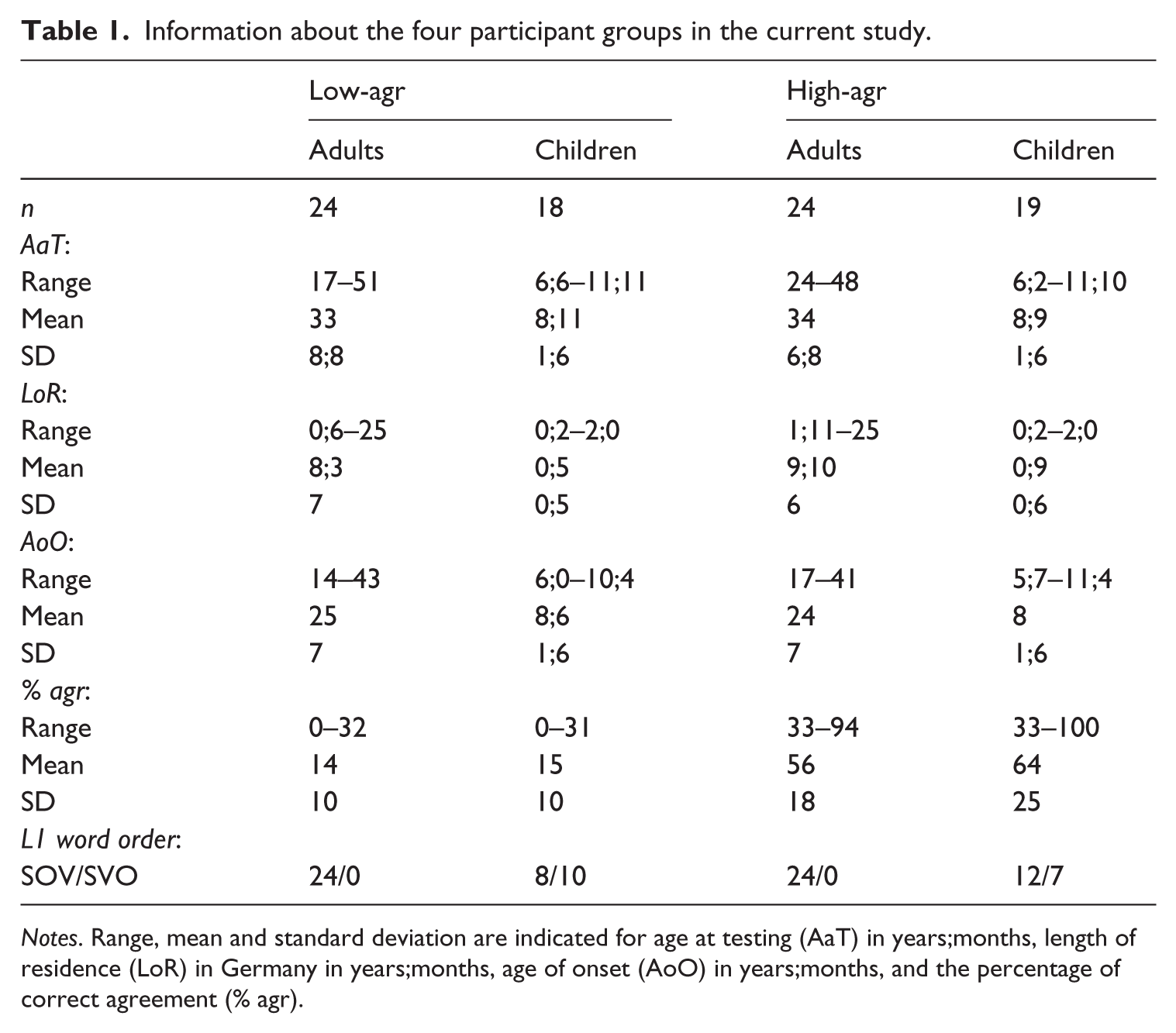
Notes. Range, mean and standard deviation are indicated for age at testing (AaT) in years;months, length of residence (LoR) in Germany in years;months, age of onset (AoO) in years;months, and the percentage of correct agreement (% agr).
We performed a series of t-tests to compare the child and adult low-agr groups and the child and adult high-agr groups to each other. In both cases, we found highly significant differences in age at time of testing, length of residence and age of onset, and no significant differences for the percentage of correct agreement (low-agr groups: AaT: t(40) = 11.62, p < .0001; LoR: t(40) = 4.72, p < .0001; AoO: t(40) = 9.28, p < .0001; % agr: t(40) = 0.51, ns; high-agr groups: AaT: t(41) = 15.74, p < .0001; LoR: t(41) = 6.54, p < .0001; AoO: t(41) = 9.89, p < .0001; % agr: t(41) = 1.22, ns). This means that we can compare verb placement preferences for groups that are similar with respect to agreement, but in which the adult group has a higher age at time of testing and onset of exposure to the target language (which is inherent to the distinction between adult and child learners) and a longer residence on average (which is not inherent to the distinction between adult and child learners, even though potentially telling with respect to differences in rate of acquisition). In the following, we will compare elicited production and elicited imitation data from the two age groups to each other, separately for the low-agr and the high-agr groups. Recall that in the child, but not in the adult groups, there was variation with respect to the word order of the L1. The L1 has been shown to influence verb placement preferences in the L2 in previous studies (Haberzettl, 2005; Verhagen, 2009). Adding word order as a predictor to the statistical models reported below frequently led to nonconvergence, indicating that the current sample is not big enough to systematically asses its effects. The descriptive results split up for L1 word order can be seen in Appendix 1 and will be briefly discussed below. Moreover, we will come back to individual patterns in the low-agr groups in a post-hoc analysis.
2 Elicited production
a Methods
As in Schimke (2011), the elicitation materials consisted of three picture stories developed by Verhagen (2009) and a short silent movie developed by Dimroth (Dimroth, 2006 4 ). The elicitation tools prompted the use of utterances in third person singular contexts and the use of negation. The picture stories consisted of between 9 and 11 pictures, and the silent movie of 31 individual scenes. Participants retold the content of each picture and of each scene of the movie immediately after having seen it, and before proceeding to the next picture or scene. The sentence imitation task reported below was administered after the production task.
b Results
We extracted all 3rd person singular context utterances that contained both the sentential negator nicht (‘not’) and a verb form from the retellings. Verb forms were then classified in a two-step-process. First, we classified all verbs as either light verbs or lexical verbs. Following Parodi (2000), modal verbs, auxiliaries, possessive ‘have’ (haben) and the copulae ‘to be’ (sein) and ‘to become’ (werden) were coded as light verbs. In a second step, we classified verb forms according to their morphological form. Lexical verbs were coded as finite when they were correctly agreeing (presence of the -t suffix), as nonfinite for infinitives (presence of the -en suffix) and past participles, and as ‘other’ in all other cases (this concerned in particular the bare stem or forms ending in -e). There were no nonfinite light verbs in our data. All light verbs occurring in the production data were classified as finite forms, except for one exceptional case classified as ‘other’. 5 Figure 1 displays the absolute number of placements to the left and to the right of negation for each of the occurring verb types in the adult and child low-agr groups. Recall that if finiteness determines placement preferences, both finite light verbs and finite lexical verbs should appear to the left rather than to the right of negation. If lightness determines placement preferences, light verbs should appear to the left, and lexical verbs to the right of negation.
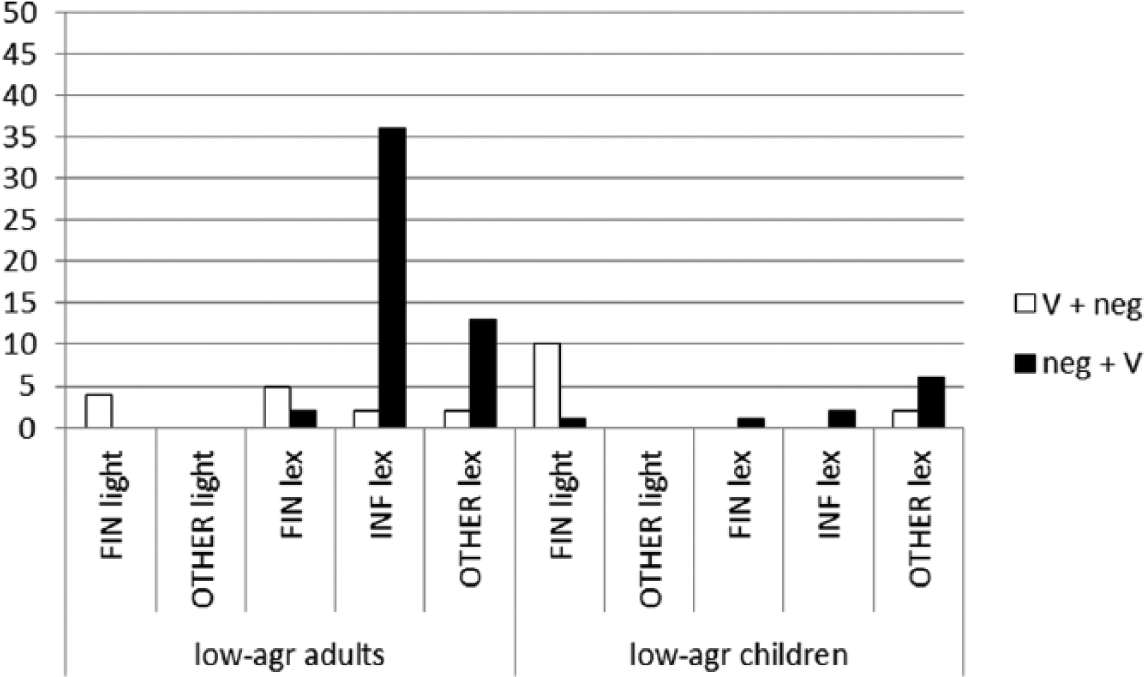
Absolute number of finite and other light verbs and finite, nonfinite and other lexical verbs that appear to the left (V+neg) and right (neg+V) of negation in the adult and child low-agr groups.
As expected, light verbs appear predominantly to the left, and nonfinite lexical verbs mainly to the right of negation in both groups. Clearly nonfinite verbs appear, however, much more frequently in the adult than in the child group. The majority of lexical verbs used by the children were bare stems or forms ending in a schwa. As for finite lexical verbs, these are of particular interest, because they can potentially allow for teasing apart the influences of lightness and finiteness: If lightness matters more than finiteness, finite lexical verbs should appear to the right of negation; if finiteness determines placement preferences, they should appear to the left of negation. In the adult low-agr group, 5 of the 7 finite lexical verbs appeared to the left of the negator, while the single finite lexical verb produced by a child from the low-agr group appeared to the right of the negator. Based on these small numbers of occurrences, no conclusions regarding placement preferences seem warranted. This means that based on elicited production alone, it is unclear for both low-agr children and low-agr adults whether lightness or finiteness determines verb placement preferences.
The results for the high-agr groups are presented in Figure 2. Similarly to the low-agr groups, preferences are clearest for light verbs in the high-agr groups: this type of verb appears to the left of negation exclusively. It is plausible that finiteness plays a role as well, however: of the 15 finite lexical verbs in the high-agr adult group, 10 appear to the left of negation, and of the 16 finite lexical verbs in the high-agr child group, 12 appear to the left of negation. The main difference between the adult and the child group seems to be that the adults use nonfinite verbs in negated contexts (23 occurrences), while this happens very rarely in the children (2 occurrences).

Absolute number of finite and other light verbs and finite, nonfinite and other lexical verbs that appear to the left (V+neg) and right (neg+V) of negation in the adult and child high-agr groups.
To sum up, the data so far suggest that finiteness and lightness might play a role for verb placement in the child and adult high-agr groups. In the low-agr groups, conclusions about finiteness are difficult due to the low number of finite verb forms. In the elicited imitation task that we present next, we aimed at getting a more complete picture by using a controlled task in which every participant was presented with every type of verb.
3 Elicited imitation
The elicited imitation task allows us to test the placement preferences for different types of verbs in the different groups in a systematic way. The same types of verbs are presented to the left and the right of negation in this task. We assume that the relative number of responses in which a given verb type is maintained in the presented position as opposed to responses in which the position is changed can reveal grammatical preferences of the participants. The materials and the procedure that are summarized in the following are identical to those used in Schimke (2011).
a Materials
All items in the experiment were simple third person singular present tense declarative sentences composed of frequent lexical items. Different items were used for light and lexical verbs. For light verbs, eight sentences containing the auxiliary haben (‘have’) were created. Each sentence had between 10 and 13 syllables (average 12.5) and 9 words. Light verbs appeared in two different conditions: a grammatical condition in which the light verb was placed to the left of negation, and an ungrammatical condition in which it was placed to the right of negation. We did not include a condition with nonfinite light verbs, as these are exceedingly rare in learners’ production. For lexical verbs, 16 sentences containing regular lexical main verbs were created. They had either 12 or 13 syllables (12.5 on average) and 8 words. Lexical verbs appeared in four different conditions: 3rd person singular finite verbs (-t) to the left and to the right of negation and infinitives (-en) to the left and to the right of negation. Examples for all conditions are given in Table 2.
Materials imitation task.
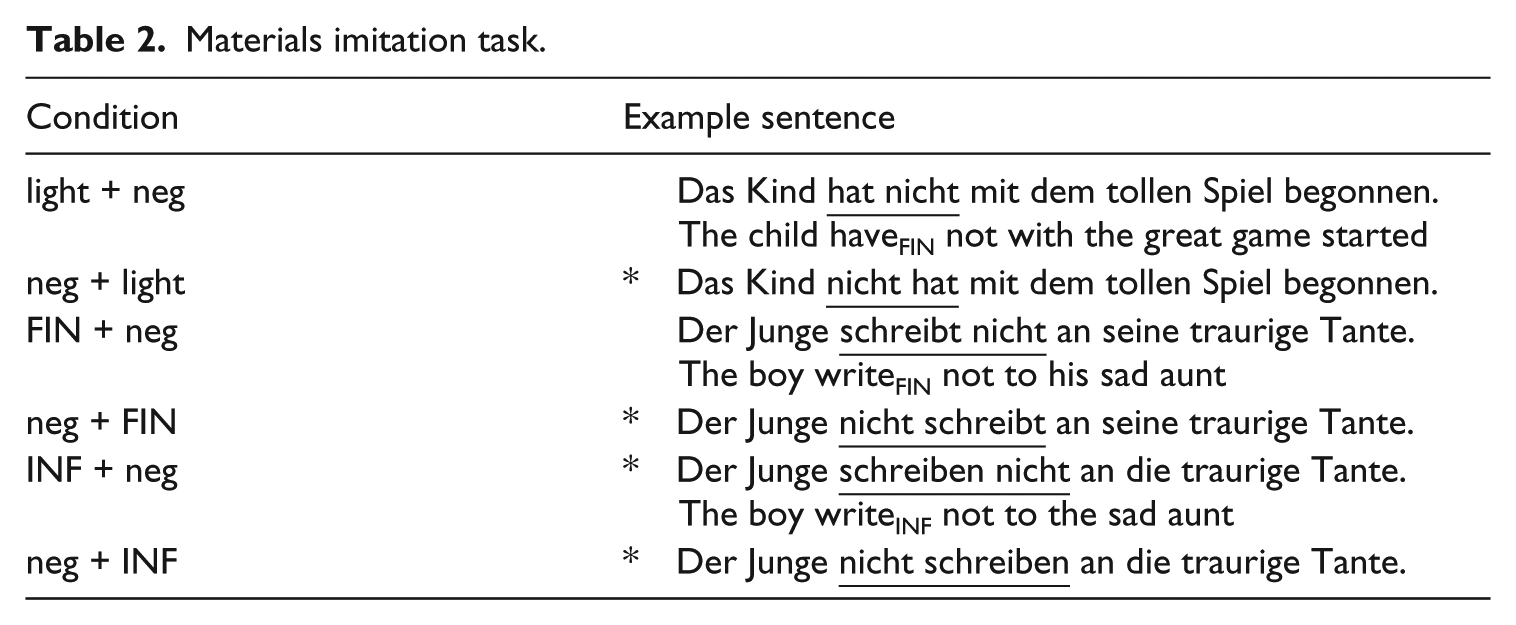
In order to maintain the same number of syllables per item across conditions, changes were made to determiners or adjectives for those cases where nonfinite lexical verb forms had one syllable more than finite lexical verb forms. Finally, 24 simple declarative present tense filler sentences were created. Two thirds of the filler sentences were grammatical and one third contained word order and agreement errors such that overall the experiment contained as many grammatical as ungrammatical stimulus sentences. The filler sentences contained no negation. Items were recorded with a female native speaker of German. Care was taken that all verb endings were clearly audible.
b Procedure
Four experimental lists were created in which every auxiliary item appeared in one of the two possible conditions in two lists respectively, and the lexical verb items appeared in a different one of the four possible conditions in each list. A given participant was always presented with all the items from one single list, so that each participant heard one version of each item only. The same randomized order was used in each list. The experiment was split into two halves of 24 sentences each. To control for effects of order, the order of the two halves was varied between participants. Each half started with two warm-up sentences. Participants heard the sentences via headphones and were instructed to repeat each sentence. If they were unable to repeat a sentence, they could listen to it again until they produced a response or decided to go over to the next sentence. All responses were recorded and transcribed.
c Coding
We first coded whether participants’ responses contained both the verb and the negator. If this was the case, verb forms were coded following the same procedure as for the production data. While lexical verbs occurred in finite, nonfinite and ‘other’ forms, there were again no clearly nonfinite forms in the responses containing light verbs. There were light verb forms classified as ‘other’, mainly due to two children who produced the form hat as ha, thus without an audible -t. Finally, the placement of the verb with respect to negation was determined.
d Results
Results of the imitation task will be presented in four steps. We are first going to present a brief analysis of the number of analysable responses per condition, in order to make sure that subsequent statistical tests compare conditions that are similar to each other in terms of analysable responses. Then, we will present the main analyses, where we analyse verb placement preferences for the six different experimental conditions, asking whether participants maintained or changed the position of the verb in their response, depending on the type and form of verbs presented to them. Subsequently, we will present two post-hoc analyses focusing on questions raised by the results of the main analysis.
Number of analysable responses
Participants made a high number of changes in their responses, indicating that it was impossible for them to hold the presented sentences in working memory as a single chunk. This might be taken as a confirmation that responses in this task reflect an active process of reconstruction based on the grammar of the respective participant (see also Klem et al., 2015, for the same assumption). But the challenging nature of the task also comes at the cost of many unanalysable responses. In particular, responses could not be analysed when either the verb, the negator, or both elements were left out or the order of the verb and negation could not be clearly determined, for example due to multiple re-starts. We could analyse between 39% (low-agr child group) and 79% (high-agr adult group) of the responses per group (high-agr child group: 61%, low-agr adult group: 58%). To establish whether there was a different number of analysable responses in conditions that are compared to each other in the following, we analysed the outcome variable ‘analysability’ (analysable response, no or not analysable response) using binomial mixed effect models, and verb type (auxiliary, finite lexical verb, infinite lexical verb) and position (verb to the left or right of negation) as well as their interaction as predictor variables for all four participant groups separately. 6 We also included random intercepts for participants and items. In all four groups, the infinite lexical verb conditions yielded significantly more analysable responses than the light verb conditions (low-agr adults: 64% vs. 49%, estimate = 1.28, SE = .40, z = 3.17, p < .001; low-agr children: 49% vs. 29%, estimate = 1.11, SE = .49, z = 2.23, p < .05, high-agr adults: 86% vs. 68%, estimate = 2.00, SE = .47, z = 4.24, p < .001; high-agr children: 72% vs. 49%, estimate = 1.65, SE = .49, z = 3.39, p < .001). In the adults, but not the children, there were more analysable responses in the finite lexical verb conditions than in the light verb conditions (high-agr adults: 82% vs. 68%, estimate = 1.50, SE = .43, z = 3.48, p < .001; low-agr adults: 61% vs. 49% estimate = .83, SE = .40, z = 2.09, p < .05). 7 Crucially, there were no main effects of verb position and no interaction between verb position and verb type in any of the groups (all z < 2). 8 To sum up, unsurprisingly, high-agr learners and adult learners tend to be more successful in repeating than low-agr and child learners. Moreover, there are clear differences in the number of analysable responses for the different verb types, with infinite lexical verbs, and, in the adults, finite lexical verbs, yielding more analysable responses than light verbs. The fact that light verbs do not add any lexical meaning to the sentence might contribute to this tendency. Finally, there are no robust effects of verb position or interactions with this factor, indicating that overall, the number of analysable responses per verb type was comparable whether the verb appeared to the left or to the right of negation. This makes it easier to compare the rates of changes from one position into the other, as done in the following.
Verb placement preferences in the different experimental conditions
We next wanted to know whether participants made changes to verb placement in their responses and whether this was different in different experimental conditions. Similarly to Schimke (2011), we argue that if a particular type of verb form is changed more often from one position to the other position than the other way around, this might be taken as evidence that the latter position is preferred for this type of form. 9 Figure 3 displays the rate of word order changes (percentage of changed orders out of all analysable responses) in the low-agr adult and child groups separately for the three different types of verbs as presented in the stimuli.
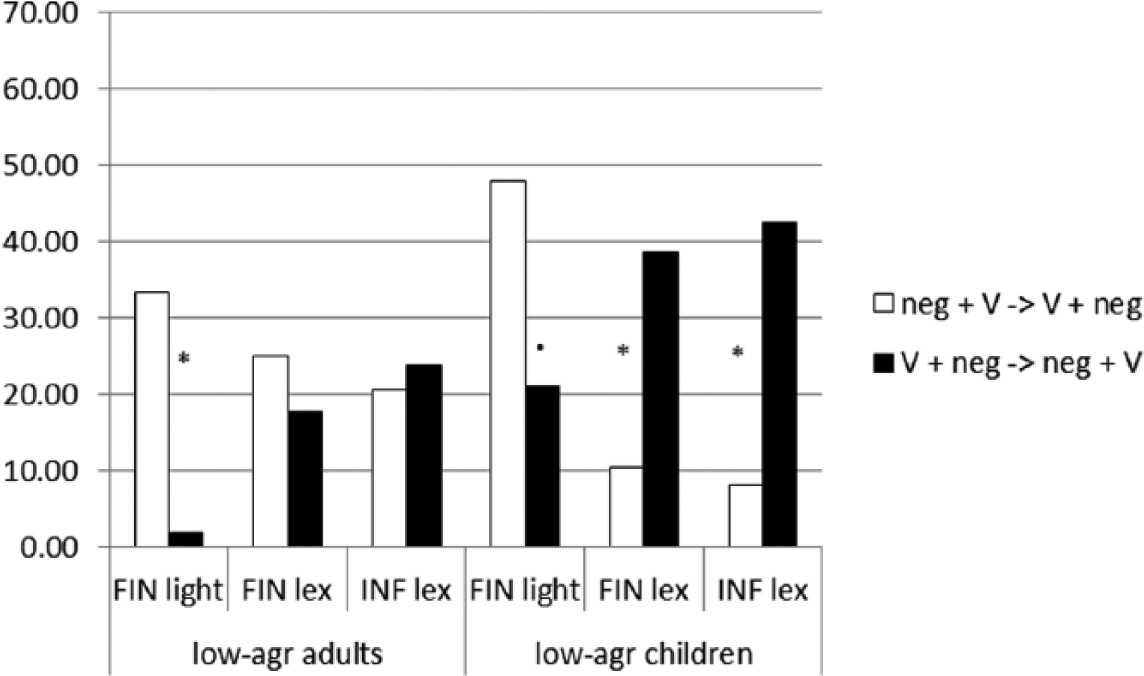
Percentage of cases in which the word order was changed out of all analysable responses in the different conditions in the low-agr groups.
Let us use the first two columns to the left (low-agr adult results for finite light verbs) to show how to read the results. The white column indicates that out of all analysable responses to light verbs presented in an ungrammatical position to the right of negation in the stimulus (i.e. x nicht hat …), 67% were verbatim repetitions, and 33% were changes, i.e. the participant placed the light verb in the grammatical position to the left of negation. The black column means that out of all analysable responses to light verbs presented in a grammatical position to the left of negation in the stimulus (i.e. x hat nicht …), 98% were verbatim repetitions and 2% were changes, i.e. the participant placed the light verb in the ungrammatical position to the right of negation.
As reported in the preceding paragraph, the number of analysable responses for the two conditions (verb position to the left or right of negation) were comparable for each verb type separately, but the overall number of responses between verb types was not. As a consequence, we analysed separately for every verb type whether changes to verb placement were made to a different degree in the two conditions. We used logistic mixed effect models with condition (verb presented to the left or right of negation) as a predictor, verb placement (verb position maintained vs. changed) as an outcome variable, and random intercepts for participants and items. Both in low-agr adults and in low-agr children, light verbs were changed more frequently from the position to the right of negation to the left than the other way round, leading to a significant effect of condition in the adults (estimate = 4.26, SE = 1.47, z = 2.90, p < .005), and a marginally significant effect in the children (estimate = 1.25, SE = .72, z = 1.73, p = .08). An example of such a change produced by a child participant is given in (5).
(5) stimulus: * Der Koch nicht hat in dem neuen Haus gearbeitet. the chef not haveFIN in the new house workPP response: de Koch hat nich Hause arbeit. the chef haveFIN not house workOTHER
The pattern looks very different for finite and nonfinite lexical verbs, with no significant preferences in the low-agr adult group (both z < 1.1), and higher rates of changes into a position to the right of negation in the low-agr children, which was significant in the finite lexical verb condition (estimate = −1.77, SE = .78, z = −2.28, p < .05) as well as in the nonfinite lexical verb condition (estimate = −2.14, SE = .73, p < .005). An example of such a change is given in (6).
(6) stimulus: Der Kranke bleibt nicht in einem großen Krankenhaus. the sick person stayFIN not in a big hospital response: * Der Kranke nicht bleib große Krankenhaus. the sick person not stayOTHER big hospital.
These results suggest first, that, contrary to what is suggested by the previous evidence in particular for child L2 learners, learners prefer the position to the right of negation for lexical verbs. Second, this preference is clearly dependent on lightness, as it does not hold for light verbs. Before we turn to the question of whether it is also influenced by finiteness, we present the changes occurring in the high-agr groups in Figure 4.
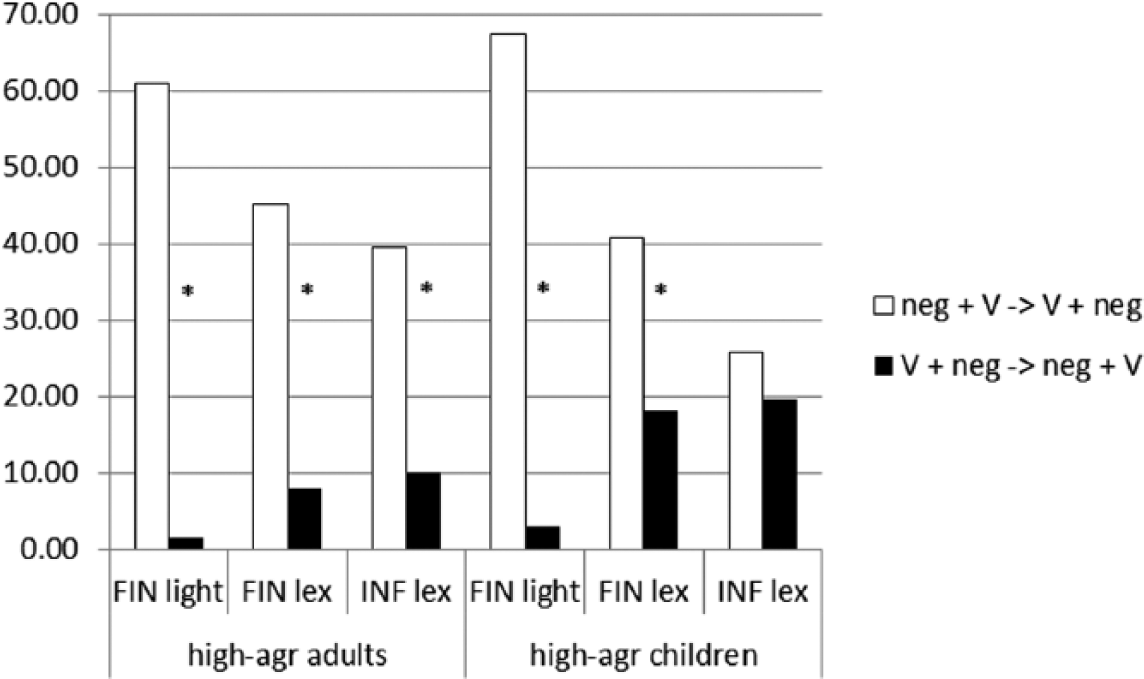
Percentage of cases in which the word order was changed out of all analysable responses in the different conditions in the high-agr groups.
The pattern in the high-agr groups is very consistent and different from the preferences in the low-agr groups. All verb types are changed more frequently from a position to the right to a position to the left of negation than the other way round. This effect is significant for all subgroups except for the changes to nonfinite verbs made by the high-agr child group (adult light verbs: estimate = 5.90, SE = 1.30, z = 4.53, p < .0001; adult finite lexical verbs: estimate = 2.32, SE = .50, z = 4.63, p < .0001; adult nonfinite lexical verbs: estimate = 2.01, SE = .49, z = 4.10, p < .0001; child light verbs: estimate = 6.30, SE = 2.02, z = 3.13, p < .001; child finite lexical verbs: estimate = 1.35, SE = .60, z = 2.24, p < .05, child nonfinite lexical verbs: z < 1). This result suggests that the high-agr child and adult learners have developed a preference for the position to the left of negation, both for light and lexical verbs.
Interim Discussion
The analysis of placement preferences for light verbs reveals similar patterns in all groups, with a general preference for the target-like position to the left of negation. In contrast, for lexical verbs, there is a clear difference between the low- and the high-agr groups respectively. The adult low-agr group shows no clear preferences for lexical verbs, which is deviant from the target system where a preference for the position to the left of negation is expected at least for finite lexical verbs. The low-agr children deviate even more clearly from target-like preferences. They made significantly more changes towards verbs to the right than towards verbs to the left of negation. This finding is remarkable because it means that the low-agr child participants actively changed the sentence to a form that does not correspond to the target pattern as present in the input. This suggests that like adults, child learners pass through a stage where their grammatical preferences differ from the target system in that lexical verbs are preferred to appear to the right of negation. This stage seems to be overcome in the high-agr groups, where preferences are closer to the target pattern.
Before we discuss this finding further, it seems necessary to take a closer look at the data of the low-agr groups, where the target-deviant preferences that are crucial for our conclusions were observed. These findings raise at least two questions for further investigations. 10 First, up to now, we only analysed the position of the verbs occurring in participants’ responses, and did not take into account their morphological form. We thus know that low-agr learners placed a relatively high proportion of the verbs presented in the target V2-position into a position to the right of the negator. We do not know, however, whether they also changed the verb forms in their responses. Second, given in particular the high degree of unanalysable responses in the low-agr child group, one might wonder whether the preferences in this group are representative for the group as a whole. These two questions will be addressed in the following two post-hoc analyses.
Placement preferences for the different lexical verb types produced in the low-agr groups
The data presented in the preceding paragraph suggest that child and adult participants from the low-agr groups prefer a position to the right rather than to the left of negation for lexical verbs. As we have analysed all responses dependent on the form of the verb as presented to the participants, not as (re-)produced by them, however, it remains unclear from this analysis whether this preference is independent of finiteness marking or not. It is necessary to investigate this in order to test the assumption that lightness matters more than finiteness at this stage. In the following, we are therefore going to focus on placement preferences for the specific morphological forms that low-agr learners produced in their responses. A particular utterance pattern can thereby occur due to different processes. A finite lexical verb appearing to the left of negation (of the type bleibt nicht), for instance, can result from a faithful repetition of a ‘FIN lex + neg’ stimulus (bleibt nicht → bleibt nicht), from a morphological change in response to an ‘INF lex + neg’ stimulus (bleiben nicht → bleibt nicht), from a syntactic change in response to a ‘neg + FIN lex’ stimulus (nicht bleibt → bleibt nicht) or from both a morphological and syntactic change in response to a ‘neg + INF lex’ stimulus (nicht bleiben → bleibt nicht). In the following, we will focus on the absolute number of occurrences of response patterns, independent of the process from which the patterns resulted. Contrary to the preceding analyses, we do thus not present the relative frequency of differences between stimulus and response (‘changes’), but look at the verb forms and positions occurring in the responses without taking the stimulus into account. Note that Appendix 2 displays how the different responses were distributed on the different types of stimuli for both the low-agr and the high-agr groups. Note further that we no longer consider light verb forms for this analysis, as there were no nonfinite light verb forms that could inform us about the relative weight of lightness and finiteness. Figure 5 displays the occurrences of the three different types of possible lexical verb forms in all low-agr participants’ responses to the left and to the right of negation.
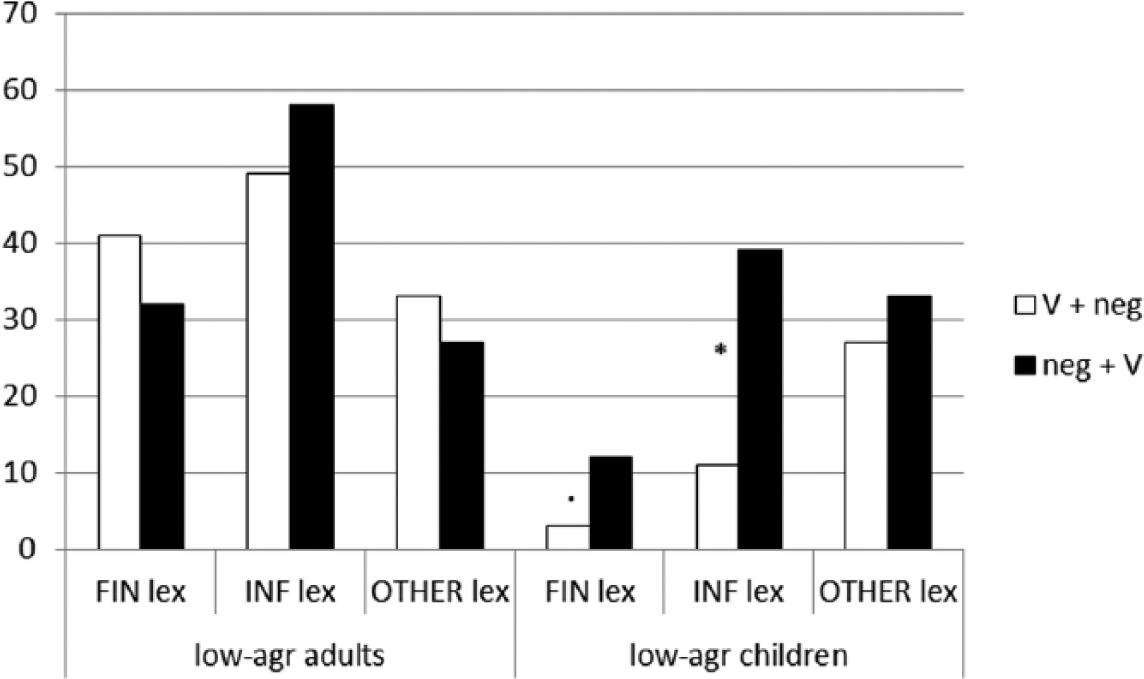
Absolute number of finite, nonfinite and other lexical verbs that appear to the left (V+neg) and right (neg+V) of negation in the responses of the low-agr groups.
To test whether one of the positions was significantly more frequent than the other, we computed a logistic mixed effect model with random intercepts for subjects and items, and placement of the verb (left, right) as the outcome variable. As before, we conducted separate analyses per verb type due to the different frequencies of analysable responses for the different verb types. When the intercept of the resulting model was significant, we concluded that one position was chosen significantly more often for this verb type than the other position. In the low-agr adult group, the models revealed no significant placement preferences for any type of lexical verb (all z < 1), confirming the pattern established in the analysis presented in the preceding section. In the low-agr children, there was a marginally significant preference for finite lexical verbs to occur to the right rather than to the left of negation (estimate = 7.8, SE = 4.38, z = 1.79, p = 0.07, note that these analyses are based on data from the 10 children that produced at least one finite verb form), as well as a significant preference for the same position for nonfinite verbs (estimate = 1.33, SE = 0.45, z = 2.95, p < .01) and no preference for ‘other’ verbs (z < 1.1). This shows first, that there is no preference for a placement to the left of negation for any type of lexical verb form. Second, however, it indicates sensitivity to morphology that we could not detect in the previous analysis. Specifically, preferences are clearest for nonfinite verb forms. For finite verb forms, the preference is equally strong (around 20% placements to the left of negation for both types of verb forms), but only marginally significant due to the overall lower frequency of these forms. If the child participants produced verb forms to the left of negation, these were mostly ‘other forms’. This tendency might in part be due to a purely phonetic constraint that might lead to the deletion of the final -t being more likely when the verb precedes the negator than in other contexts.
We conclude that the low-agr adult group has no preference for one position over the other for all types of lexical verbs, while the low-agr child group has either no significant preference or, for nonfinite verbs, a preference for the position to the right of negation. The fact that even morphologically finite forms are not placed preferentially to the left of negation in the low-agr child group suggests that finiteness does not play the determining role for verb placement that it has in the target system. In the final part of the result section, we will turn to the question whether the preference for a placement of lexical verbs to the right of negation can be traced back to a particular subgroup in the children.
Individual data in the low-agr child group
The preference to place lexical verbs to the right of negation that we observed in the child low-agr group is surprising, as previous studies have predominantly reported no or very few verbs appearing to the right of negation in spontaneous production data of L2 children with an age of onset comparable to the ones tested here. This raises the question whether this preference is mainly carried by any specific subgroup in the low-agr child group. The sample is not big enough to conduct systematic analyses of all potential variables of interest. It is possible, however, to get an impression of whether the crucial data points are all due to a subgroup of children, by looking at individual data patterns. Table 3 thus presents responses of the type ‘lexical verb + negation’ or ‘negation + lexical verb’ depending on the word order in the stimulus. This analysis thus collapses data from all lexical verb conditions, independent of the morphological form of the stimulus or the response. Data are sorted according to L1 basic word order, and then (within word order groups), according to the age of onset.
Absolute number of maintained and changed word orders for lexical verbs in the low-agr child group. Data are sorted according to L1 basic word order, and then (within L1 word order groups), according to age of onset. Grey cells indicate the crucial neg+V pattern.

Notes. AoO = age of onset; LoR = length of residence; SOV = subject–object–verb; SVO = subject–verb–object.
These data suggest that the preference for the position of lexical verbs to the right of negation is not carried by any specific subgroup within the low-agr child group. Specifically, all of the children maintained the word order in their response when presented with a structure with a lexical verb to the right of negation at least once, and 12 out of the 18 children made at least one active change from a position to the left to a position to the right of negation. By contrast, while 14 of the children reproduced a pattern with the verb to the left of negation at least once, active changes from a position to the right to a position to the left of negation occurred in only 2 out of the 18 children.
III General discussion
The results from all analyses together form a consistent picture. They suggest that at a beginning stage characterized by a low rate of correct subject–verb agreement, child and adult L2 learners produce light verbs more often to the left than to the right of negation, and lexical verbs more often to the right than to the left of negation. Concerning a potential influence of finiteness marking on lexical verbs, there is no evidence that finiteness marking on lexical verbs would lead to a preference for a raised position to the left of negation at this stage. Specifically, the low-agr adults’ results in the imitation task suggest no clear placement preferences for any type of lexical verb form, even though numerically, there is a slight preference for the position to the right of negation for nonfinite verbs, and to the left of negation for finite and ‘other’ verbs. In the children, the form made a clearer difference than in the adults, as their preference for a placement to the right of negation was strongest (and significant) for nonfinite verbs, and weakest (and not significant) for ‘other’ verbs. As far as finite lexical verbs ending in -t are concerned, children showed a preference for a placement to the right of negation that was equally strong as for nonfinite verbs, but marginally significant due to the low number of finite lexical verbs. A good characterization of the data of the low-agr groups might be the following: At the early stage under consideration here, learners have not yet developed a target-like sensitivity to finiteness markings on lexical verbs. The fact that the preference for the position to the right of negation is clearest for nonfinite (compared to ‘other’) verbs might indicate the emergence of such sensitivity, but this does not (yet) lead to a preference for finite lexical verbs to be placed to the left of negation. We interpret this to indicate that the distinction between light and lexical verbs has a greater weight at this stage than that between finite and nonfinite verbs. In learners that have more knowledge about subject–verb agreement, lightness no longer seems to be exclusively responsible for verb placement, as the preference for the position to the left of negation extends to both finite light and finite lexical verbs at this stage.
These observations suggest that the acquisition of verb placement proceeds much more similarly in child and adult L2 acquisition than previously assumed. Apparently, child learners need to gradually build up knowledge about verb placement, just like adult learners do. This is in line with models of L2 acquisition that assume that the access to functional categories is not immediate (Dimroth et al., 2003; Vainikka and Young-Scholten, 1996). Moreover, at least during a short phase, the distinction between light and lexical verbs seems to play a crucial role in child as well as in adult learners. This raises the question of what causes the precursory role of light verbs. Becker (2005) suggests that it is related to the semantic transparency of structures with light verbs to the left of negation. Typically, negation has semantic scope over the predicate of the sentence, which is expressed by the lexical verb (and its complements). In light verb structures, semantic scope is transparently marked, because the operator (the negator) precedes its domain of application (the lexical verb). This is not the case for sentences with finite lexical verbs, where finite verb raising imposes a structure that is not semantically transparent in terms of scope marking (see also Verhagen, 2011, for a similar argument). Parodi (2000) and Dimroth (2008) suggest that light verb structures are particularly transparent even in non-negated utterances, because light verbs are specialized carriers of agreement features (Parodi 2000) or salient expressions of semantic finiteness (assertion) (Dimroth, 2008). Whatever the underlying reason for the precursory role of light verbs, it seems to play out both in child and adult learners. Finally, as can be seen in more detail in Appendix 1 as well as in Table 3, the overall pattern of results seems to be similar in children from SVO and SOV languages, in particular in the low-agr group. We thus have no evidence in the current study that the gradual acquisition of verb raising would be restricted to learners from SOV languages. 11
Despite these overall similarities in all investigated groups, we also observed considerable differences between children and adults. First, in production, the preference for a verbal position to the right of negation was much clearer in the adult than in the child group, and in particular, could be observed even in the high-agr group. It seems that this target-deviant pattern is more entrenched in the adults than in the children, and that adults are less reluctant to overtly depart from target-language patterns. Second, there are also differences in the types of verb forms used, even though the overall range of correct agreement was comparable between children and adults at the low- and high-agreement level. Adults often use the infinitival form, ending in -en, as a default form, whereas children use the bare stem to a similar degree. 12 Third, adults and children apparently differ in the effects that the different demands of the two tasks have on them. While children showed clearer evidence for target-deviant preferences in imitation than in production, the reverse holds for the adults. Adult learners might be able to show more target-like knowledge in imitation than in spontaneous production, because in imitation, they do not need to independently plan their utterances. Lexical access should be facilitated due to the presentation of the target sentence. In the children, the imitation task might reveal more target-deviant knowledge than the elicited production task, because children might have a tendency to avoid structures they are not sure of (as has been suggested by Dimroth, 2008), and this might be easier in production than in imitation. This suggests that relying on production data alone can be deceiving when comparing different groups, as both target-deviant and target-like knowledge might be hard to detect in one type of data alone.
Lastly, a striking difference between children and adults in the current sample is the different average length of residence. The low-agr adult group demonstrates that adults can remain at a very low level of proficiency (in terms of morphosyntactic development) for several years, at least when their learning conditions are not advantageous. However, the learning conditions for the children in the current study were not perfect either. While they received input in German from their teachers at school, they often did not attend the regular classes together with German-speaking children, but generally attended a preparatory class for non-German-speaking children, meaning that they received little or no German input from peers. The fact that the average length of residence in the high-agr child group nevertheless consisted of only a few months makes one wonder whether children in an immersion setting ever learn as slowly as adults sometimes do in this setting. The question of how variable second language acquisition in children can be needs further investigation.
Despite these differences between children and adults, it is striking that the basic pattern of acquisition is similar in both groups. Similar to what has been previously established for adults, child L2 learners have an early preference for lexical verbs to appear to the right of negation. During this – albeit apparently very short – phase, the position of the verb is determined by lightness rather than finiteness. This phase can be observed in children from different source languages.
Footnotes
Appendix 1
Absolute number of finite light verbs and finite, nonfinite and other lexical verbs that appear to the left (V+neg) and right (neg+V) of negation in the child low-agr group split up for L1 word order (compare to Figure 1 for the collapsed results):
Absolute number of finite light verbs and finite, nonfinite and other lexical verbs that appear to the left (V+neg) and right (neg+V) of negation in the child high-agr group split up for L1 word order (compare Figure 2 for the collapsed results):
Percentage of cases in which the word order was changed out of all analysable responses in the different conditions in the child low-agr group split up for L1 word order (compare Figure 3 for the collapsed results):
Percentage of cases in which the word order was changed out of all analysable responses in the different conditions in the child high-agr group split up for L1 word order (compare Figure 4 for the collapsed results).
Absolute number of finite, nonfinite and other lexical verbs that appear to the left (V+neg) and right (neg+V) of negation in the responses of the child low-agr group, split up for L1 word order (compare Figure 5 for the collapsed results)
Appendix 2
Absolute number of responses in the different experimental conditions for lexical verbs in the four investigated groups.
Declaration of Conflicting Interest
The author(s) declared no potential conflicts of interest with respect to the research, authorship, and/or publication of this article.
Funding
The author(s) received no financial support for the research, authorship, and/or publication of this article.