




Abstract
This study examines whether the second language acquisition (L2A) of syntactic properties at the interfaces is problematic for L2 learners. English verb phrase ellipsis (VPE) was tested as an interface property which involves feature interpretability. Two subtle contrasts of VPE at different grammar-internal interfaces were examined: (a) copula be and lexical verb ellipsis at the syntax–lexicon interface (*John is here, and Mary will too vs. John slept, and Mary will too), and (b) progressive be and perfective have stranding at the syntax–semantics interface (*John slept, and Mary was too vs. Peter saw your parents last week, but he hasn’t since). Unlike (a), the contrast in (b) requires identifying (un)interpretable features on -ing and -en to recover the semantics of the elided material. Since Saudi Arabic does not license VPE, (very-)advanced English L2 speakers whose first language (L1) is Saudi Arabic were tested. The results from a bimodal timed acceptability judgment task showed they were more target-like on the contrast at the syntax–lexicon interface than they were on the syntax–semantics interface. They particularly deviated from target-like judgments on have stranding which requires recognizing the perfective uninterpretable feature on -en. These results suggest selective vulnerability at grammar-internal interfaces whenever uninterpretable features are involved.
Keywords
I Selective vulnerability
Understanding the phenomenon of selective vulnerability in second language acquisition (L2A) is still an unresolved puzzle. Selective vulnerability here is understood as failure to develop target-like L2 grammars in certain domains but not others. In the current version of the Interface Hypothesis 1 (Sorace, 2011; Sorace and Filiaci, 2006; Tsimpli and Sorace, 2006), the locus of L2 vulnerability is at the interface between the syntax and grammar-external cognitive domains, such as discourse and pragmatics. This version developed from comparing the acquisition of formal properties at grammar-internal interfaces and the task of integrating these formal properties with other cognitive domains at the grammar-external interface. According to Tsimpli and Sorace (2006), properties relating to pronominal subjects at the syntax–discourse interface are more subject to vulnerability than properties such as object-fronting at the syntax–semantics interface. They argued that ‘the distinction between the two interfaces is based on the assumption that the syntax–discourse interface is a “higher” level of language use, integrating properties of language and pragmatic processing, whereas syntax–semantics involve formal properties of the language system alone’ (Tsimpli and Sorace, 2006: 653). One problem with this account is that the status of the L2A of grammar-internal interfaces is not addressed in any detail. It is not made explicit what role formal properties play in rendering internal interfaces less vulnerable. Also, it is presumably expected that linguistic properties at the same internal interface are equally vulnerable, which is not necessarily the case.
The aim of this article is to supplement the study of interface phenomena with predictions of the Interpretability Hypothesis (Tsimpli and Dimitrakopoulou, 2007) about feature interpretability in the syntax. According to the Interpretability Hypothesis, properties bearing uninterpretable features not activated in L1 are vulnerable, whereas those bearing interpretable features are not, even when they are not activated in L1. Two subtle cases for English verb phrase ellipsis (VPE) are examined in partial morphological identity with the antecedent verb: (a) ellipsis of copula be and lexical verbs following a stranded modal (e.g. *John was here, and Mary will be here too vs. John slept, and Mary will sleep too), and (b) progressive be and perfective have stranding (e.g. *John slept, and Mary was ing sleep too vs. Peter saw your parents last week, but he hasn’t en see since) (examples from Lasnik, 1999; italics and strikethrough by author). To acquire the contrast in (a), L2 speakers need to distinguish between lexical verbs and copula be in terms of their representation in the lexicon (non-inflected vs. inflected, respectively) (Lasnik, 1999).
2
To acquire the contrast in (b), L2 speakers need to distinguish the formal features encoded on the stranded affixes -ing and -en in the elliptical site (interpretable progressive features vs. uninterpretable perfective features, respectively) (Rouveret, 2012). Whilst the contrast in (a) is captured at the syntax–lexicon interface, the contrast in (b) is implicated at the syntax–semantics interface and requires identifying (un)interpretable features to recover the semantics of the elliptical material. The aim of comparing the contrasts (a) and (b) is to uncover whether structures at different grammar-internal interfaces (i.e. syntax–lexicon vs. syntax–semantics) are equally problematic. This study proposes that feature interpretability could help us understand diverging performance at grammar-internal interfaces. The contrast between -ing and -en at the syntax–semantics interface is a test of whether structures at the same interface could also be equally problematic. Overall, these subtle contrasts illustrate a poverty of the stimuli phenomenon because they are under-determined by the input and not taught to L2 speakers. Since Saudi Arabic does not license VPE, L1 Saudi Arabic speakers were targeted in this study in order to examine the extent to which they can acquire such subtle distinctions.
The remainder of this article is organized as follows: first, a parametric description of the licensing of VPE is given, followed by a syntactic explanation of the core VPE contrasts. Then, existing studies on these contrasts are briefly reviewed. After that, the research questions and the methodology chosen for this empirical study are presented. Finally, the results are reported and discussed with suggestions for future research.
II The licensing of VPE
VPE is a PF-deletion process of a complete syntactic structure (Lasnik, 1999; Rouveret, 2012). In English, the licensors must be hosted by Tense through movement or base-generation (Aelbrecht, 2010; Rouveret, 2012).
3
Thus, the licensing condition involves realizing the contrast in verb-movement constraints between English auxiliaries and lexical verbs, as in (1–3), taken from Aelbrecht (2010: 166–167). The licensors are marked in strikethrough throughout the examples.
(1) Uriel was drinking coffee and Aviad (2) *Ed doesn’t like cats and dogs, but Chris (3) Ed doesn’t like cats and dogs, but Chris drinking coffee] too.cats and dogs].like cats and dogs].
The ungrammaticality of (2) has been explained in terms of verb-movement constraints on English main verbs. Rouveret (2012: 948) proposed that main verbs move to little v so they can c-command the VP and in principle could license ellipsis of the material in the verb’s complement. However, English main verbs (unlike auxiliaries) cannot move further to Tense, which must be lexically filled to license VPE. 4 If Tense is lexically empty, do support is obligatory for lexicalizing the tense feature, and thus, licensing ellipsis of the material in VP (3). Among the licensors for English VPE are modals (4) and infinitival to (5), which are lexically hosted by Tense. The examples are taken from Aelbrecht (2010: 166).
(4) Jasmin can draw an elephant, but Ryan (5) Bettina couldn’t make it, but she really wanted draw an elephant].make it].
Different from English, Arabic does not license VPE regardless of it being a verb-movement language. Unlike English auxiliary verbs and modals, Saudi Arabic verbs are not VPE licensors and thus cannot be stranded, as in (6–7). Instead, the whole TP, including the moved verb, needs to be elided (i.e. TP-ellipsis), as in (8). The examples in (6–8) are from a Hejazi variety. The lack of VPE in Saudi Arabic has also been reported with a Najdi variety (Abdulkarim and Roeper, 1997).
(6) * Nizaar kaan yi-gra bass Omar maa Nizar was reading but Omar not was reading ‘Nizar was reading, but Omar wasn’t.’ (7) * Nizaar gaaʕid yi-gra bass Omar mu Nizar Prog reading but Omar not Prog reading ‘Nizar is reading, but Omar isn’t.’ (8) Nizaar yi-Hubb Ɂs-safar wu Nizar loves traveling and Omar loves traveling too ‘Nizar loves traveling, and Omar too.’yi-gra].yi-gra].yi-Hubb Ɂs-safar] kamaan.
The correlation between VPE and verb-movement is not attested cross-linguistically (Cyrino and Matos, 2005; Rouveret, 2012). Instead, Cyrino and Matos (2005) proposed that the licensing of VPE correlates with the degree of aspect grammaticalization in a given language, and therefore the projection of an independent aspectual functional category (AspP) below Tense. For English, they proposed that AspP is an extension of the vP (labeled as Asp/vP), and thus Tense holds a local c-command relation over vP, where Asp is part of the elliptical site, as in (9b). On the other hand, in verb-movement languages without VPE (e.g. French, Spanish, Italian and German), they proposed that AspP is an independent projection intervening between Tense and vP because Asp is highly grammaticalized. To illustrate with French, in (10b), the verb which has moved to Tense does not locally c-command the elliptical site because of the intervening AspP, and thus VPE is not possible. The examples (9a–10a) are from Cyrino and Matos (2005: 106).
(9) a. John has seen his friends lately and Peter has ___too. b. … and
(10) a. * Tu vas au cinéma ce soir et Paul va ___ aussi. you go to the cinema this evening and Paul goes too b. * … et


Like other verb-movement languages without VPE, the verbal system of Saudi Arabic shows aspect grammaticalization, 5 which suggests the projection of AspP intervenes between Tense and vP. It is assumed that because AspP violates the locality of the c-command relation between Tense and the elliptical site, VPE is not allowed in Saudi Arabic.
III The identity and recoverability conditions in VPE
Two subtle contrasts of VPE from Lasnik (1999) are discussed as properties at grammar-internal interfaces. The first contrast (11–12) is between lexical verb and copula be ellipsis when the antecedent and the elided verbs are morphologically non-identical: the antecedent verb is marked in italics throughout the examples.
(11) John slept, and Mary will (12) *John was here, and Mary will sleep too. (Lasnik, 1999: 108)be here too. (Lasnik, 1999: 109)
The contrast in acceptability here is assumed to be captured at the syntax–lexicon interface, where copula be (unlike lexical verbs) is inflected in the lexicon. Under Lasnik’s (1999) account, lexical verbs are inflected in the syntax through morphological merge, whereas auxiliaries are inflected in the lexicon. The identity condition, which assures that the antecedent and the elided verbs are identical, is thus computed at the root level before morphological merging with affixation (Lasnik, 1999). In (11), verb ellipsis applies at the root level [sleep] before affix hopping [T -ed] + [v sleep]. VPE here is possible because the antecedent and the elided verb, sleep, shared identical roots when they entered the derivation. Conversely, ellipsis of copula be in (12) is disallowed because the antecedent was and the target form be in the ellipsis site were non-identical forms when they entered the derivation. Unlike copula be, lexical verbs can ignore morphological parallelism because they are inflected in the syntax not in the lexicon. Although Lasnik (1999) captured this contrast in terms of violating morphological identity, Rouveret (2012) proposed a lexical identity account. Whilst both forms of sleep in (11) have the same lexical entry, the forms was and be in (12) belong to distinct lexical entries, which violate the condition in (13): (13) Lexical Identity Condition: ‘Every lexical item in the numeration of the elided VP must be identical to an item in the numeration of the antecedent VP’ (Rouveret, 2012: 930).
Turning now to the second contrast (14–15), which is between progressive be and perfective have stranding when preceded by a finite antecedent: (14) *John slept, and Mary was (15) Peter saw your parents last week, but he hasn’t sleeping too. (Lasnik, 1999: 111)seen them since. (Lasnik, 1999: 113)
Although VPE is possible with a non-identical finite antecedent, it is disallowed with a stranded auxiliary be [-ing]+[sleep] (14), but allowed with a stranded have [-en]+[see] (15). The contrast in acceptability between be and have stranding is captured at the syntax–semantics interface. Rouveret (2012) explained this contrast by considering feature interpretability on the stranded affixes, proposing the recoverability principle in (16).
(16) Principle of Recoverability: ‘A VP-elided constituent cannot contain any non-recoverable interpretable feature’ (Rouveret, 2012: 911).
Rouveret (2012) argued that the two aspectual affixes differ in feature interpretability: whereas -ing encodes a progressive interpretable feature, -en encodes a perfective uninterpretable feature. His argument was based on the meaning contribution of these aspectual affixes. If the grammatical morpheme can distinguish meanings, then it is assumed to encode an interpretable feature specified for that meaning. In English, the -en affix occurs in perfective verb forms (e.g. have eaten) and passive forms (e.g. be eaten). The contrast in meanings between (have eaten vs. be eaten) is resolved by the auxiliary rather than -en. Therefore, it is assumed that -en does not convey the perfect meaning and thus bears an uninterpretable feature. In contrast, the -ing morpheme only occurs in progressive verb forms (e.g. be eating). Therefore, it is assumed that -ing rather than be must carry the progressive interpretation. Whilst the perfect meaning is encoded in auxiliary have, the progressive meaning is not encoded in auxiliary be. Instead, be encodes a kind of ‘stative meaning’ with passive (e.g. be eaten), progressive (e.g. be eating) and copular (e.g. be happy) constructions.
Given the above reasoning, the contrast in (14–15) is explained as follows: according to the principle of recoverability (16), any affixes with interpretable features, such as -ing, cannot be deleted unless they are recoverable from the antecedent clause. Interpretable features function at the syntax–semantics interface because they are required at LF for semantic interpretation. When the -ing is deleted from the ellipsis site, the progressive meaning is non-recoverable from either the stranded auxiliary was or the antecedent (14). Conversely, when the -en is deleted from the ellipsis site, the perfective meaning is still recoverable from the stranded auxiliary, have (15).
A subtle contrasting behavior of -ing and -en also arises in the antecedent clause, as in (17–18), taken from Lasnik (1999: 109). The (?) mark is understood to show that the status of (17) is marginally unacceptable.
(17) ?John was sleeping, and Mary will (18) John has slept, and Mary will sleep too.
6
sleep too.
According to the lexical identity condition, the contrast in the degree of acceptability of the lexical verb ellipsis between (17) and (18) should be surprising. If identity is assessed before morphological merger and the verb forms sleep are lexically identical, why should verb ellipsis be less acceptable when the antecedent contains a progressive participle [was]+[ing]+[sleep] compared with a perfective participle [has]+[en]+[sleep]? Hagstrom (1994: 4), wrote that the reason why the status of (17) is questionable is probably because it can also be interpreted as ‘John was sleeping, and Mary will be sleeping too’ (footnote 5). However, in this interpretation, was and be are non-identical forms, and thus (17) should be completely ruled out if both forms entered the derivation fully inflected (compare with 12). It is plausible to assume that the relative unacceptability of (17) is due to a semantics mismatch in the computation of identity. Because of its meaningful content, -ing (as opposed to -en) requires strict morphological identity to generate parallel semantic/aspectual interpretations between the antecedent and the elliptical material. For -ing, violation of the identity requirement, as in (17) seems less severe than the recoverability requirement, as in (14). Hence, (17) is marginally unacceptable, whereas (14) is completely ungrammatical.
To summarize, the identity and recoverability conditions in English VPE are quite complex. The identity condition is assessed at the syntax–lexicon interface, whereas the recoverability condition is assessed at the syntax–semantics interface where feature interpretability needs to be identified on the stranded auxiliaries. Unlike interpretable features, uninterpretable features are syntax-internal and do not contribute to meaning, and are thus deleted before the derivation is transferred to the semantics (Rouveret, 2012).
IV Existing L2A studies
There has been considerable psycholinguistic research investigating parallelism effects on VPE compared with VP anaphora, from a semantics-processing approach (e.g. Duffield and Matsuo, 2009; Duffield et al., 2009), or a syntax-processing approach (e.g. Arregui et al., 2006). None of the cited studies have investigated morpho-syntactic parallelism of the type tested in this current study. Nonetheless, Hawkins (2012) did examine the same contrasts (among other cases) in L2 English by L1 Arabic and Chinese speakers. The L2 speakers were of advanced, intermediate and low-intermediate English proficiency. Adopting a syntactic-processing approach, Hawkins assumed that although these VPE contrasts are syntactically-determined, the gradience effect in the acceptability of non-parallel structures is a performance rather than a grammar phenomenon. In a sentence completion judgment task, the VPE stimuli appeared following a two to three sentence-long context to challenge the participants to identify the elided material from the given context. The participants had to judge the VPE stimuli by choosing one of three options (perfect, possible or impossible). The task was untimed and had 60 items presented in written form. In target-like judgments, the L2 speakers rejected copula be ellipsis (e.g. Jill is very successful … #Sue will too), but accepted lexical verb ellipsis (e.g. Jack sent Jill a letter … Mary will too), where both structures had finite antecedents. However, the L2 speakers gave non-target-like judgments by equally rejecting perfective have stranding (e.g. Jack wrote Jill a letter … Mary has too), and progressive be stranding (e.g. Jack sent Jill a letter … #Mary was too), where both structures had finite antecedents. Hawkins’ (2012) explanation was that the L2 speakers treated the participle affixes -en and -ing as bearing interpretable features which are non-recoverable. Since neither Arabic nor Chinese have an uninterpretable perfective feature, they potentially did not recognize it in -en. Hawkins (2012: 434) called for L2 data from near-native L2 English speakers to verify whether ‘the same insensitivity to the uninterpretable status of -en’ would eventually disappear and thus challenge the Interpretability Hypothesis.
An earlier study by Al-Thubaiti (2009, 2010) examined these specific contrasts with L1 Saudi Arabic instructed English L2 learners. They were college students of various proficiency levels: beginners, low-intermediate, high-intermediate and advanced. Their accuracy results from a timed acceptability judgment task showed that perfective have and progressive be stranding with a finite antecedent were equally rejected (e.g. John plays football, but Tom hasn’t recently vs. *Heather visits her mother, but Mary isn’t yet). This finding was taken to indicate a potential lack of uninterpretable features on -en which is not available in L1 Saudi Arabic. Nonetheless, L2 data from highly-proficient speakers is required to verify the current findings, which the present study is designed to test.
V Research questions and predictions
Since Saudi Arabic does not license VPE, the following research questions were examined with (very-)advanced English L2 speakers whose L1 was Saudi Arabic:
Can L2 speakers recognize aspectual auxiliary verbs and modals as opposed to simple lexical verbs as possible syntactic licensors for VPE? (a) John is sleeping, and Mary (b) John will sleep, and Mary (c) *John doesn’t like cats, but Mary
sleeping too.sleep
too.cats.
Can L2 speakers distinguish (un)grammatical conditions of VPE, where the antecedent and the elided verbs are non-identical? (d) *John was here, and Mary (e) John slept, and Mary (f) *John slept, and Mary (g) Peter saw your parents last week, but he
be too.sleep too.sleeping too.seen them since.
The first question tests whether L2 speakers could distinguish modal-stranding and auxiliary-stranding as possible VPE constructions as opposed to *verb-stranding. Unlike English, Tense in Saudi Arabic is instantiated with a strong verbal uninterpretable feature which requires verb-movement. If resetting feature strength is possible, the L2 speakers should be able to restrict verb-movement to auxiliaries, and thus distinguish between non-raising lexical verbs and raising aspectual auxiliaries. Since VPE licensors must be in Tense, they should be able to realize aspectual auxiliaries as well as modals as legitimate syntactic licensors, unlike lexical verbs. The Interpretability Hypothesis (Tsimpli and Dimitrakopoulou, 2007) does not make explicit predictions about resetting the feature strength of uninterpretable features. Instead, the claim is that acquiring uninterpretable features not activated in L1 is predicted to be problematic. Hence, this question examines whether resetting the strength of uninterpretable features is as problematic as acquiring uninterpretable features from scratch.
The second question examines L2 performance on two grammar-internal interfaces, which is the focus of the study. The first contrast between copula be and lexical verbs in (d–e) is constrained by the lexical identity condition at the syntax–lexicon interface. The second contrast between be and have stranding in (f–g) is constrained by the recoverability principle at the syntax–semantics interface and involves distinguishing (un)interpretable features on -ing and -en. As discussed earlier, the Interface Hypothesis (Sorace, 2011) does not offer testable predictions about either interface but instead makes broad claims about interface properties. The present study was designed to understand whether grammar-internal interfaces are equally problematic. According to the Interpretability Hypothesis, the tested conditions should not be equally problematic. Non-target-like performance is predicted on the syntax–semantics interface because it involves uninterpretable features not activated in L1 (as with -en), but target-like performance is predicted on the syntax–lexicon interface contrast because it does not involve distinguishing feature interpretability on copula be or lexical verbs.
VI Method
1 Participants
Forty-nine participants took part in this study, comprising 34 highly-proficient Saudi Arabic L2 speakers of English and 15 English native speakers (NSs) as controls. The average age at testing was 26.80 years (19–56) for the controls, and 27.18 years (20–37) for the L2 speakers. The English controls were graduate students at UK universities at the time of testing. The L2 speakers were English professionals recruited from the population of university instructors in Saudi Arabia. They each had a minimum of eight years of continuous experience of using English in their profession (M = 20.06, SD = 6.88).
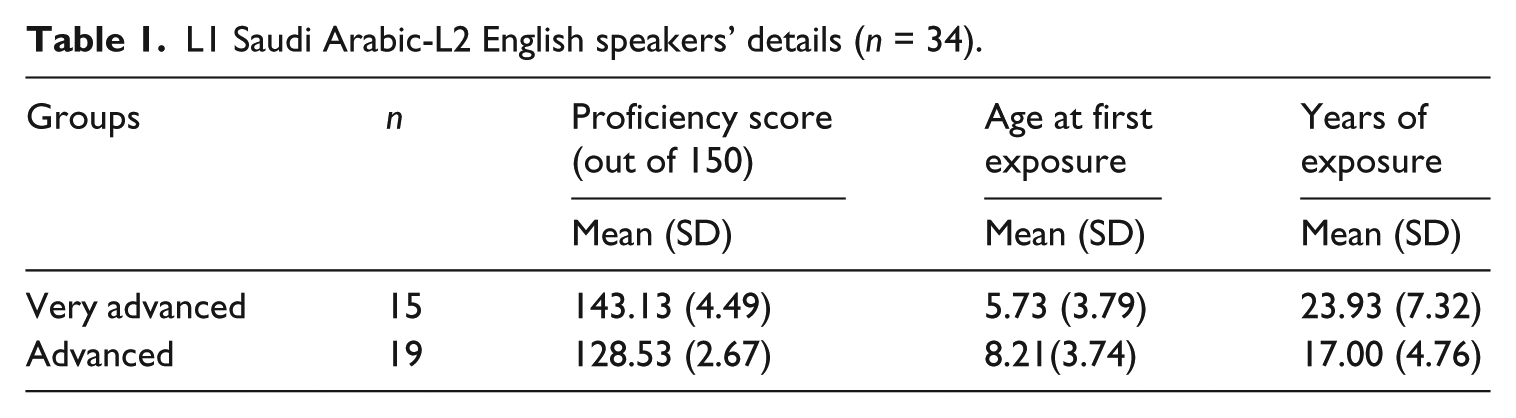
The English proficiency of the L2 speakers was evaluated by the Quick Oxford Placement Test (QOPT; Max = 60) and Nation’s (2001) Vocabulary Levels Test (VLT; Max = 90). Each participant was assigned a proficiency score out of 150, which was the total of their scores on both tests. All 34 participants had scored in the (very-)advanced levels of the Association of Language Testers in Europe (ALTE). To form two proficiency groups based on their combined score, a hierarchical cluster analysis was run on the 34 eligible cases. Applying Ward’s method, two groups were produced and labelled as advanced and very advanced. In an independent samples t-test, the two groups differed significantly with a large effect size, t (32) = 11.81, p < .001, d = 4.08. Their details are summarized in Table 1.
L1 Saudi Arabic-L2 English speakers’ details (n = 34).
2 Material
An Acceptability Judgment Task (AJT) of 164 stimuli (half of them grammatical and half ungrammatical) was constructed to test a variety of morpho-syntactic structures (resumption, verb-raising effects and VPE) which differ between Saudi Arabic and English. For VPE, there were 48 stimuli and eight ungrammatical distracters to balance the distribution of (un)grammatical conditions (28 grammatical and 28 ungrammatical) (see Table 2). The full list of VPE material is given in Appendix 1.
Summary of VPE constructions by elided and antecedent verb forms (identical vs. non-identical) with examples and numbers of tokens.

Note. For illustration, the antecedent appears in italics, licensors in strikethrough. ug = ungrammatical, ua = marginally unacceptable, g = grammatical.
As shown in Table 2, three types of VPE were tested in conjunct sentences with morphologically (non)identical verb antecedents. The elided verb was assessed in the context of the antecedent conjunct. To examine the condition of lexical identity, there were two sets of modal-stranding constructions involving ellipsis of non-finite copula be and lexical verbs, each under conditions of identical and non-identical verb antecedents to the elided verb (non-finite vs. simple finite). To further test the assumption that lexical verb ellipsis takes place before morphological merger, two other sets were constructed with two types of participle antecedents non-identical to the elided lexical verb: progressive and perfective participles. For the recoverability principle, there were two sets involving progressive be and perfective have stranding tested under (non)identical conditions (progressive/perfective participle vs. simple finite). To test the licensors, eight items on lexical verb-stranding were constructed to be compared with modals and aspectual auxiliary stranding with identical antecedents. All stimuli were counter-balanced in terms of coordinator type (and, but) so that half of the stranded modals and auxiliaries were followed by negation.
3 Procedure and analysis
Two pseudo-randomized versions of the AJT were administered individually. Using a power-point slide show, the stimuli were presented aurally and in writing. The transition time between the slides was fixed and the participants were not allowed to move forward from one slide to another. This dual modality of presentation was chosen to control for response time. It was crucial that the task was timed in order to reduce the chances of participants relying on explicit knowledge in a judgment task (Ionin, 2012; Sorace, 1996). Research has also shown that L2 speakers perform better on ungrammatical structures when they are presented using a dual modality (Murphy, 1997). Each stimulus was read twice by a female English NS and displayed for eight seconds on the computer screen. During the display time, the participants had to circle their judgments on a prepared paper. They were asked to rate the stimuli on a five-point scale ranging from 1 (definitely impossible) to 5 (definitely possible). The mid-point 3 was interpreted as an intermediate judgment which lay between both extremes on the scale (Cowart, 1997). To ensure eliciting ‘sentence intuitions’, the participants had a thorough instruction and practice session. Using the set of instructions compiled by Bley-Vroman et al. (1988), they practiced how to rate sentences with examples from Saudi Arabic followed by English. Two issues were stressed in the practice session: (a) what they felt about the sentence; and (b) their ‘true’ judgment regardless of what they were taught. The practice items were unrelated to the tested conditions. To control for fatigue and order effects, the 164 stimuli were presented in four blocks (with 41 items per block), and each block had one item of each condition (see Ionin, 2012). For all participants, the actual judgment task was completed in almost 21 minutes, excluding the practice session and interval breaks between blocks. In a different session, they were given a proficiency test and a background questionnaire.
All statistical analyses (with alpha set at p < .05) were conducted on the mean acceptance and rejection ratings per condition. Within-group analyses were chiefly performed to test whether the L2 speakers could distinguish the different contrasting conditions. Therefore, the L2 speakers’ judgments were not directly compared with those of the NSs, but with their pattern of performance on the paired conditions.
VII Results
1 The licensing of VPE
Before examining any effects for morphological parallelism, the L2 speakers were examined on whether they could distinguish (un)grammatical stranding structures. In target-like grammar, lexical verb-stranding is ungrammatical (e.g. … *and his wife
Mean ratings (SD) of three types of stranding structures with morphologically identical verb antecedents.

Note. * indicates ungrammatical VPE.
For all the groups, repeated-measures ANOVAs were conducted with stranding type (modal-stranding, auxiliary-stranding and *verb-stranding) as the within-participant factor. The results showed a significant effect of stranding type with a very strong effect size on the mean ratings achieved by the NSs group, F (1.08,15.11) = 54.71, p < .001,
Although all groups gave significantly lower ratings to *verb-stranding, the ratings seem higher than expected for an ungrammatical structure (see Table 3). Hawkins (2012: 206) raised a situation in which these structures could be felicitous if the deleted material were interpreted as arbitrary null objects rather than VPE. In English, some transitive verbs (e.g. read, write) optionally allow arbitrary null objects. For example, the deleted material in the second clause of Jack wrote Jill a letter. Mary wrote ___too, can be interpreted as (Mary wrote something else) and not as (Mary wrote #Jill a letter too). The possibility of such an alternative interpretation could explain why the ratings were higher than expected. Nonetheless, what matters most here is that all groups distinguished between *verb-stranding on the one hand, and modal-stranding and auxiliary-stranding on the other. They also gave significantly comparable high acceptance ratings to both modal-stranding and auxiliary-stranding as grammatical manifestations of VPE.
Having shown through within-group analyses that the L2 speakers could distinguish (un)grammatical VPE constructions, the following analyses were conducted to examine the lexical identity condition and recoverability principle.
2 The lexical identity condition: Modal-stranding
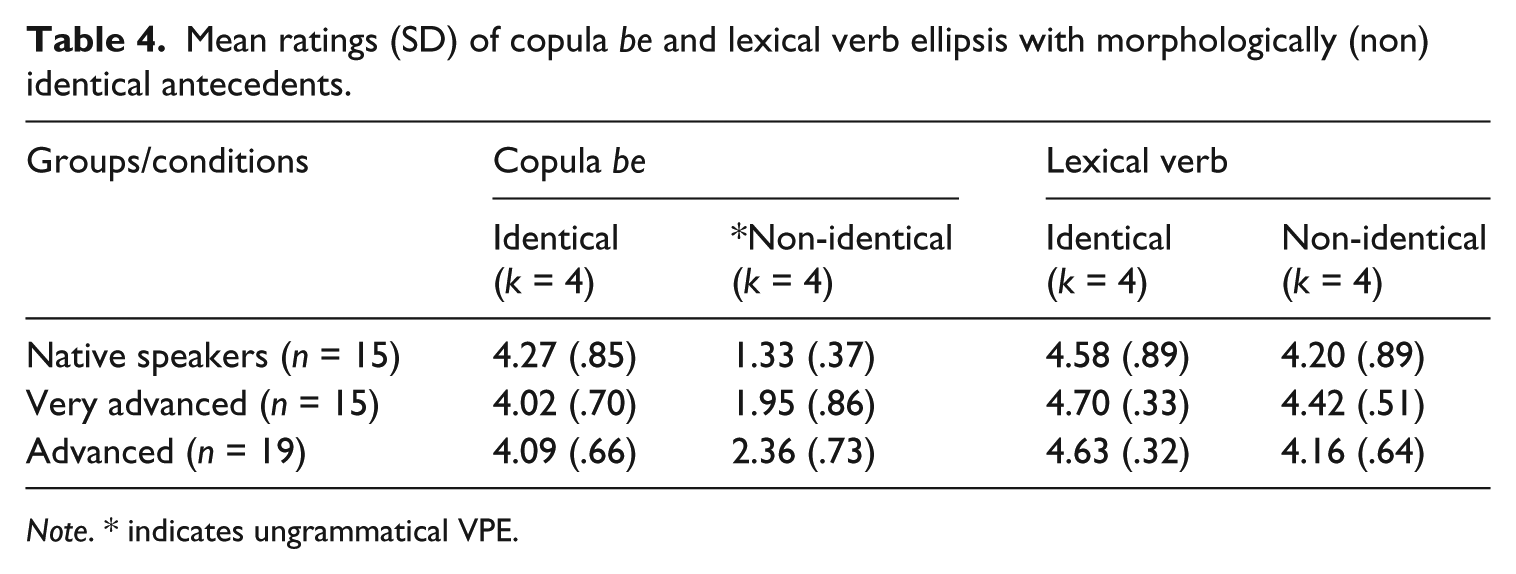
The first analysis examined the contrast between non-finite copula be and lexical verb ellipsis following a modal in (non)identical conditions (see Table 4). Whilst ellipsis of copula be is only licensed with an identical verb antecedent, lexical verb ellipsis is possible with a non-identical antecedent.
Mean ratings (SD) of copula be and lexical verb ellipsis with morphologically (non)identical antecedents.
Note. * indicates ungrammatical VPE.
For each group, repeated-measures ANOVAs were conducted with verb type (copula be and lexical verb) and morphological parallelism with the verb antecedent (identical and non-identical) as within-participant factors. The results showed a significant main effect for verb type with higher acceptance ratings of lexical verb ellipsis by the NSs group, F (1,14) = 106.76, p < .001,
Looking first at copula be, all groups gave acceptance ratings to copula be ellipsis with identical antecedents, but rejection ratings to non-identical antecedents (see Table 4). In the Bonferroni comparisons, there were significant differences between the acceptance and rejection ratings of the NSs group (p < .001, d = 3.10), the very advanced group (p < .001, d = 2.71) and the advanced group (p < .001, d = 1.68). The magnitude of the mean difference in the ratings of the L2 groups showed improvement with increased proficiency.
Turning to lexical verbs, all groups gave acceptance ratings to lexical verb ellipsis with both (non)identical antecedents, but they gave slightly lower acceptance ratings to non-identical ones (see Table 4). In the Bonferroni comparisons, there were significant differences between the acceptance ratings of the NSs in favor of identical antecedents (p = .003, d = .93). The L2 groups’ ratings varied statistically by proficiency. Whilst the very advanced showed marginally non-significant differences between (non)identical antecedents (p = .059, d = .55), the advanced gave significantly higher acceptance to identical than to non-identical antecedents (p = .006, d = .76). Nonetheless, the effect size across all three groups was comparably small, suggesting no substantial differences.
In the third paired condition, the acceptance ratings of lexical verb ellipsis and rejection ratings of copula be ellipsis with non-identical antecedent were compared (see Table 4). As expected, there was a significant difference reflecting higher acceptance of lexical verb ellipsis by the NSs group (p < .001, d = 3.24), the very advanced group (p < .001, d = 2.99) and the advanced group (p < .001, d = 2.82).
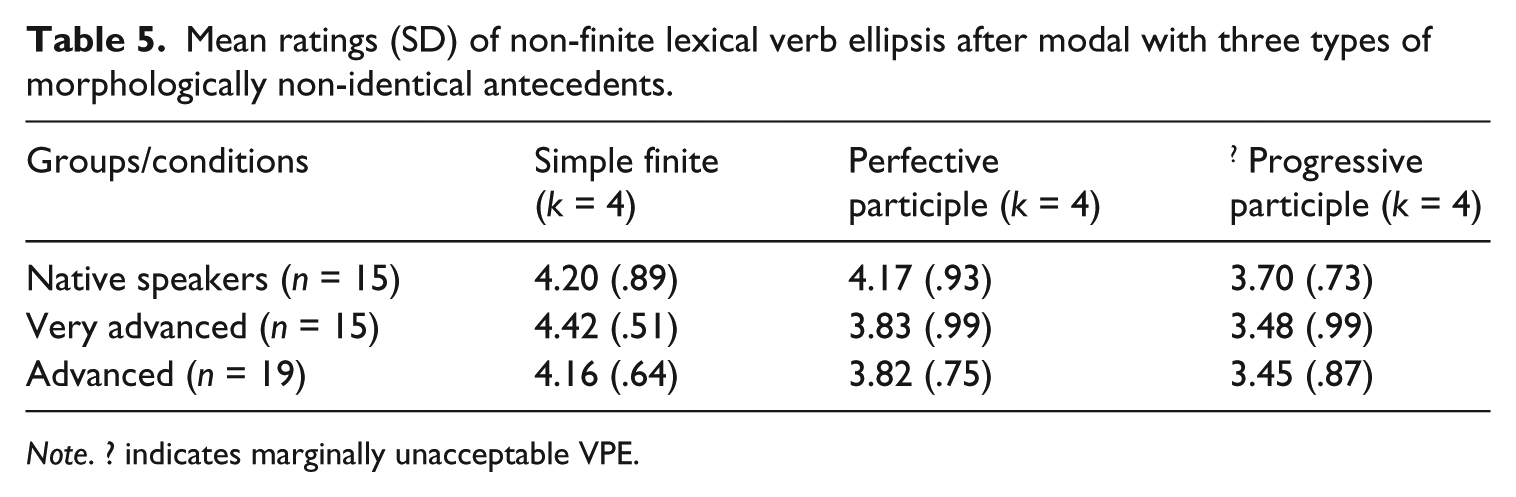
These findings offer some evidence that the parallelism requirement is applied before morphological merger in the case of lexical verbs (unlike auxiliary verbs) and therefore morphological mismatch between the antecedent and the elided verbs is acceptable. Following up on this assumption, a series of repeated-measures ANOVAs was conducted for each group on their acceptability ratings of ellipsis of non-finite lexical verbs with three types of verb antecedents (simple finite, perfective participle and progressive participle) as the within-participant factors (see Table 5). The results showed a significant effect for antecedent type with a moderate effect size on the acceptability ratings of the NSs group, F (1.43,19.96) = 7.11, p = .009,
Mean ratings (SD) of non-finite lexical verb ellipsis after modal with three types of morphologically non-identical antecedents.
Note. ? indicates marginally unacceptable VPE.
In pairwise comparisons (LSD), the NSs gave comparable ratings on simple finite and perfective participle antecedents (p = .758, d = .08), but gave significantly lower ratings on progressive participle antecedents compared with the antecedents of simple finite (p = .003, d = .96) and perfective participle (p = .026, d = .67) respectively (see Table 5). Although the NSs’ ratings on the simple finite and perfective participle suggest that lexical identity is computed before morphological merger, their ratings on the participle forms (progressive and perfective) are problematic for this assumption. However, their ratings do conform with the contrasting behavior noted in the literature between the progressive aspect (-ing) and the perfective aspect (-en) in the antecedent conjunct (Lasnik, 1999).
On the other hand, the L2 groups’ ratings showed varied degrees of acceptability across verb antecedent types, with the simple finite antecedent receiving the highest ratings followed by the perfective and progressive participles, respectively (see Table 5). The simple finite was rated significantly higher than the perfective participle by the very advanced (p = .008, d = 1.00) and advanced groups (p = .041, d = .51). Also, the simple finite was rated higher than the progressive participle by the very advanced (p = .001, d = 1.34) and advanced groups (p < .001, d = 1.11). Comparing the progressive and perfective participles, the very advanced group showed comparable ratings on both participle antecedents (p = .073, d = .50) but the advanced group gave significantly lower ratings on the progressive participle compared with the perfective (p = .009, d = .69). Although the pattern of the L2 groups’ ratings was different from that of the NSs’, they showed that lexical verb ellipsis does not require strict morphological parallelism between the antecedent and the elided verb. Unlike the NSs, at advanced levels, they do not distinguish between participle forms. Regardless of the type of aspectual auxiliary, they seem to have a grammar which distinguishes simple forms from participle forms.
To summarize, the (very-)advanced L2 groups recognized modal-stranding as one manifestation of VPE. They also realized the contrast in morphological parallelism constraints between copula be and lexical verb ellipsis. Whilst they accepted ellipsis of copula be with only identical antecedents, they accepted ellipsis of lexical verbs with both identical and non-identical antecedents.
3 The recoverability principle: Auxiliary-stranding
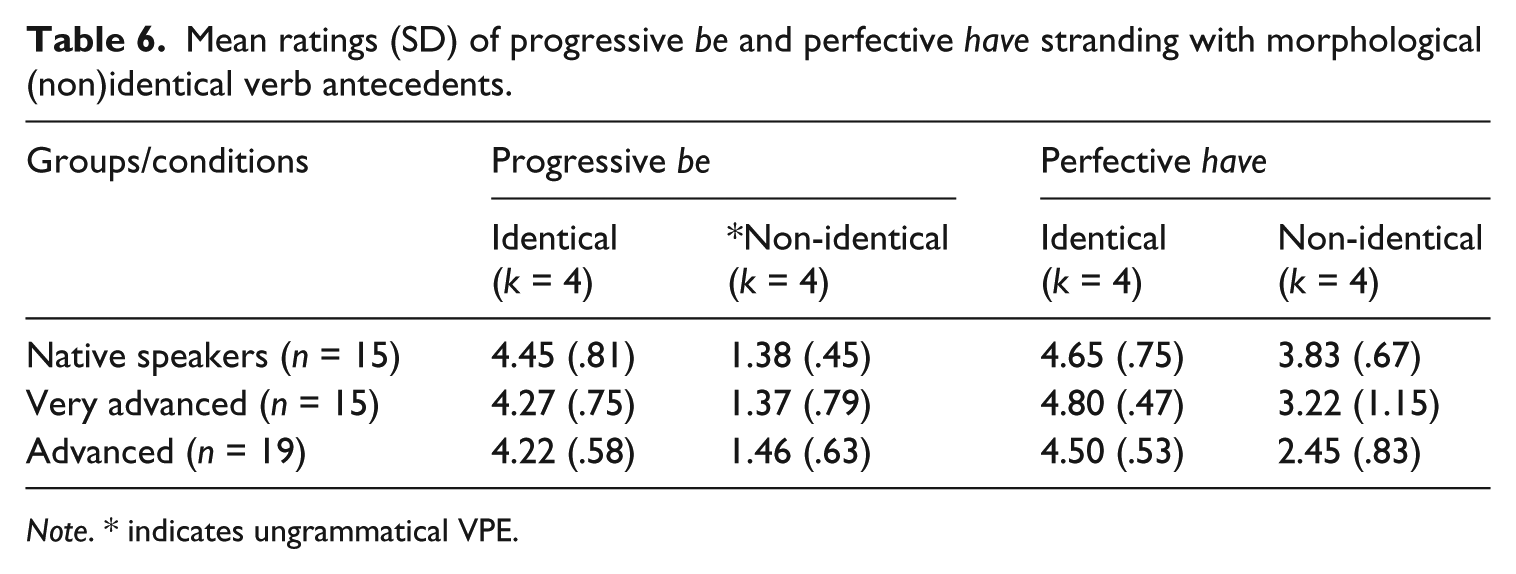
The second analysis tested two types of stranded auxiliary (progressive be and perfective have) with (non)identical antecedents to the elliptical verb (see Table 6). Whilst it is required that the antecedent verb must match the elliptical progressive verb following a stranded be, it is not a requirement with perfective have stranding. Therefore, with non-identical antecedents, progressive be stranding is ungrammatical whereas perfective have stranding is grammatical.
Mean ratings (SD) of progressive be and perfective have stranding with morphological (non)identical verb antecedents.
Note. * indicates ungrammatical VPE.
For each group, repeated-measures ANOVAs were conducted with stranded-auxiliary types (be and have) and morphological parallelism (non-identical and identical) as within-participant factors. The results revealed a significant main effect for type of stranded-auxiliary reflecting higher acceptance of auxiliary have by the NSs group, F (1,14) = 166.64, p < .001,
The results for the progressive be stranding showed a significant difference between the acceptance ratings on identical antecedents and the rejection ratings on non-identical antecedents in the judgments of the NSs group (p < .001, d = 3.69), the very advanced group (p < .001, d = 2.89) and the advanced group (p < .001, d = 2.77). The magnitude of the mean difference was comparably large for all groups. Conversely, the results for the perfective have stranding were not categorical as expected. Although both conditions should be grammatical, the NSs gave significantly lower acceptability ratings on non-identical antecedents than on identical ones (p < .001, d = 1.85). Comparable results were also shown by the very advanced (p < .001, d = 1.82) and advanced groups (p < .001, d = 1.83). Again, the magnitude of the mean difference was comparably large for all groups.
Comparing the judgments on non-identical antecedents by auxiliary type, the results showed that the NSs gave significantly lower ratings on progressive be stranding than on perfective have stranding (p < .001, d = 3.32). Likewise, the very advanced gave significantly lower ratings on progressive be stranding (p < .001, d = 1.92) and the advanced group did too (p < .001, d = 1.31). However, the magnitude of the mean difference for the NSs was larger than those of the (very-)advanced L2 groups. In fact, by displaying the ratings of all groups on boxplots, we noted different patterns of judgements on have vs. be stranding (see Figure 1). Although all the groups gave rejection ratings on be stranding, they produced different patterns of judgments on have stranding. To uncover the nature of their judgments given to have stranding, their mean ratings were compared with mid-point 3 (see Table 6). In one-sample t-tests, the NSs’ ratings were significantly higher than the mid-point rating, t (14) = 4.80, p < .001, suggesting acceptance ratings. Conversely, the ratings of the very advanced group were equal to the mid-point rating, t (14) = .73, p = .48, and the ratings of the advanced group were significantly lower than the mid-point rating, t (18) = 2.91, p = .009. Unlike target-like judgments, the very advanced group seemed uncertain in their judgments, whereas the advanced group gave rejection ratings. In fact, the very advanced group compared with the other two groups showed much individual variation as indicated by their large SD which stretched over both regions of acceptance and rejection (see Figure 1).
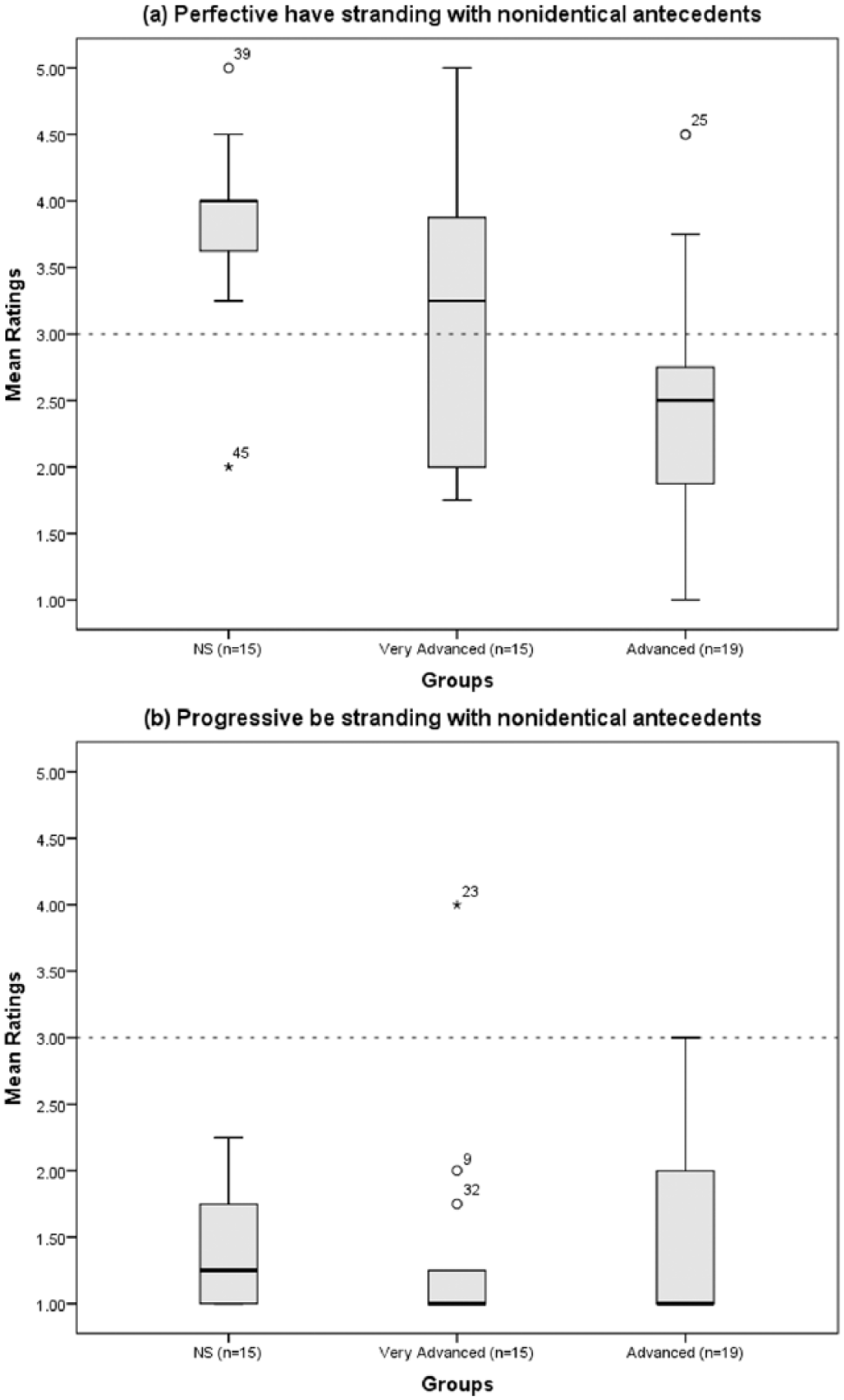
Boxplots for mean ratings on VPE with non-identical antecedents: (a) perfective have stranding, and (b) progressive be stranding.
To further verify that the L2 groups’ judgments truly represent the contrast inherent between be and have stranding, their mean ratings with non-identical antecedents were divided by construction type (negative and positive) to uncover any potential effect of the presence of negation following the stranded auxiliary (see Table 7).
Mean ratings (SD) of progressive be and perfective have stranding with non-identical antecedents by construction type: negative vs. positive.
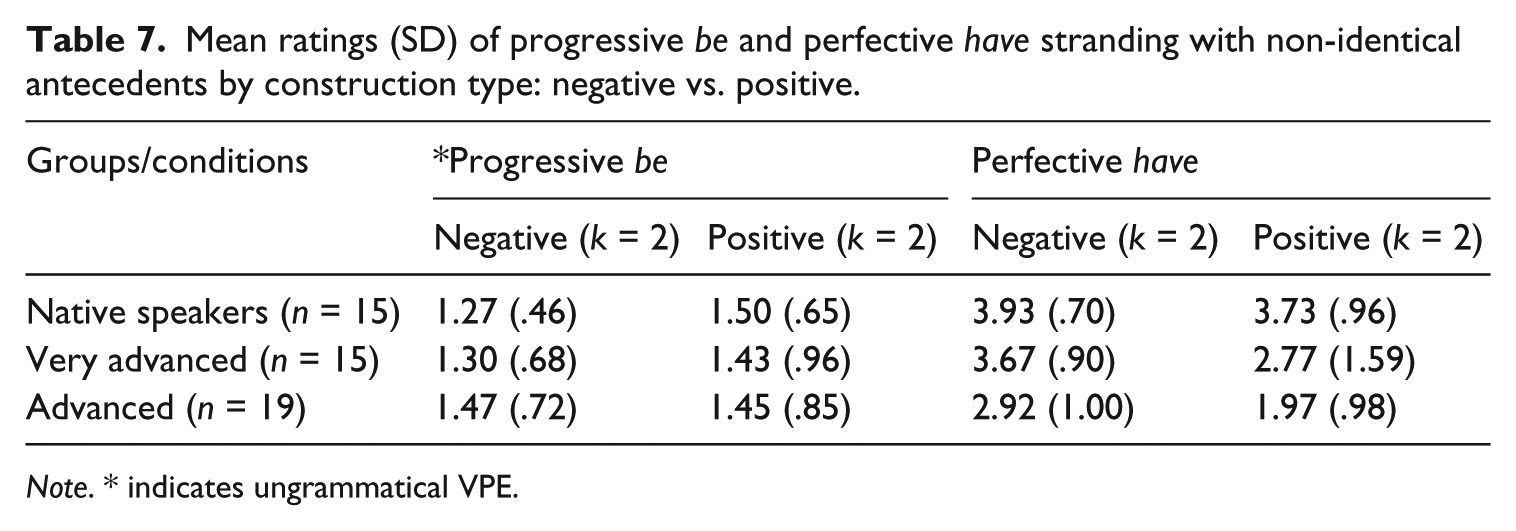
Note. * indicates ungrammatical VPE.
Repeated-measures ANOVAs were run for each group separately with construction type (negative and positive) and auxiliary type (be and have) as within-participant factors. The results confirmed our findings regarding the effect of auxiliary type by the NSs group, F (1,14) = 157.08, p < .001,
To summarize, the results from the different analyses suggested that although the (very-)advanced L2 groups significantly distinguished between identical and non-identical conditions irrespective of auxiliary type, their ratings were non-target-like on perfective have stranding compared with progressive be stranding. The L2 groups of (very-)advanced proficiency seemed to be affected by negation in their ratings of perfective stranding, which made them appear target-like.
VIII Discussion and future research direction
Two subtle contrasts of English VPE were examined at grammar-internal interfaces. The first contrast was between copula be and lexical verb ellipsis (e.g. *John is here, and Mary will too vs. John slept, and Mary will too), which is constrained by the lexical identity condition at the syntax–lexicon interface. The second contrast was between be and have stranding (e.g. *John slept, and Mary was too vs. Peter saw your parents last week, but he hasn’t since), which is constrained by the recoverability principle at the syntax–semantics interface and involves distinguishing (un)interpretable features on -ing and -en. These contrasts were tested with English NSs and L2 speakers of L1 Saudi Arabic whose L1 does not allow VPE. A bimodal timed AJT was used to elicit judgment data under controlled time response to reduce the chances of them accessing explicit knowledge as much as possible. As predicted, performance on the syntax–semantics interface revealed non-target-like judgments compared with the syntax–lexicon interface. The diverging performance at the syntax–semantics interface was associated with uninterpretable features. Of all the tested conditions, the results uncovered non-target-like judgments on perfective have stranding which required recognizing the perfective uninterpretable feature on the stranded affix -en. The results will be first discussed in terms of the licensors to answer RQ1. Then, the L2 judgments will be discussed answering RQ2 in terms of adherence to the lexical identity condition at the syntax–lexicon interface, followed by the recoverability principle as implicated at the syntax–semantics interface.
To start with the licensors, although Saudi Arabic does not license VPE, the results showed that (very-)advanced L2 speakers successfully identified auxiliaries and modals as VPE syntactic licensors (see Table 3). In target-like judgments, they gave lower ratings to lexical *verb-stranding (e.g. *Neal grows vegetables, and his wife
According to the lexical identity condition, ellipsis of copula be, unlike lexical verbs, requires strict parallelism with the verb antecedent. The NSs’ judgments were consistent with this condition (see Table 4). Although they rejected ellipsis of non-finite copula be preceded by a finite non-identical antecedent (e.g. *John is happy, and Mary
The results from copula be and lexical verb ellipsis in identical and non-identical conditions lend converging evidence that very advanced L2 speakers are sensitive to the lexical identity condition assumed to be captured at the syntax–lexicon interface. The results also indicate that they recognized modals as legitimate syntactic licensors for VPE. Had they been applying a simple deletion strategy at the surface, they would not be able to accept lexical verb ellipsis in non-identical conditions. These results are in line with earlier findings reached by Al-Thubaiti (2009, 2010), where L2 English college students of various proficiency levels were tested. Although the college students showed vague knowledge of constraints on VPE at the early stages of development, they gradually started to realize, with some individual variation, that ellipsis of copula be (unlike lexical verbs) requires strict identity with the antecedent verb. In fact, college students of advanced English proficiency still performed less well than the very advanced L2 speakers in the present study. Eventually, the contrast between copula be and lexical verbs seems acquirable, as was also found by Hawkins (2012) when testing L1 Arabic and Chinese English L2 speakers.
The identity condition as it applies to lexical verbs offers some evidence for deletion before morphological merger. This assumption was further tested by comparing judgments on non-finite lexical verb ellipsis with three types of non-identical antecedents (simple finite, progressive participle and perfective participle) (see Table 5). Although the NSs gave comparable acceptance ratings to ellipsis with the antecedents of simple finite and perfective participle (e.g. Mike revises his work, and Jennifer
Moving now to the recoverability principle, perfective have and progressive be stranding illustrate a subtle contrast in ellipsis between the stranded affixes -en and -ing. This contrast bears on feature interpretability and is captured at the syntax–semantics interface. The -ing cannot be elided unless its meaning is recoverable because it carries an interpretable progressive feature, whereas the -en can be elided regardless of recoverability because it carries an uninterpretable perfective feature (Rouveret, 2012). On this contrast, the NSs performed less categorically than expected (see Table 6). Although they gave acceptance ratings to perfective verb ellipsis following a stranded have in both identical and non-identical conditions, their ratings were significantly lower on finite non-identical antecedents (e.g. John plays football, but Tom
Nonetheless, the L2 speakers’ judgments on perfective verb ellipsis with finite non-identical antecedents showed considerable individual variation (see Figure 1). In deeper analysis of their judgments, an effect of negation was uncovered (see Table 7). By breaking down their judgments by construction type (negative vs. positive), the presence of negation clearly improved their preparedness to accept perfective verb ellipsis with non-identical antecedents but had no effect on progressive verb ellipsis in the same condition. This is illustrated by the fact that the L2 speakers gave significantly higher ratings to (e.g. John plays football, but Tom
Taking stock, what do these findings tell us about the domain of vulnerability in L2A? To what extent do predictions of the Interpretability Hypothesis (Tsimpli and Dimitrakopoulou, 2007) help us understand ‘selective vulnerability’ at grammar-internal interfaces? We have seen how L2 performance on the syntax–lexicon and syntax–semantics contrasts were not equally problematic. Whilst the contrast between copula be and lexical verb ellipsis at the syntax–lexicon interface was unproblematic, the contrast between perfective have and progressive be stranding at the syntax–semantics interface turned out to be problematic. A consideration of the role of formal features as in the Interpretability Hypothesis can explain why different grammar-internal interfaces are not equally problematic. As predicted, highly-proficient L2 speakers had problems with the contrast which involved distinguishing (un)interpretable features at the syntax–semantics interface unlike the contrast at the syntax–lexicon interface. They showed problems recognizing uninterpretable features on the perfective form, -en, but no problems in recognizing interpretable features on the progressive form, -ing. Such contrasting performance is taken to indicate a case of ‘selective vulnerability’ at grammar-internal interfaces, where vulnerability arises with uninterpretable features. Nonetheless, L2 speakers of very advanced proficiency can overcome this difficulty in acquiring uninterpretable features with the help of interpretable features. Unlike target-like judgments, they seem to have developed a grammar in which the presence of negation correlates with the acceptance ratings of the perfective form. This effect was subtle when computing the group mean, and thus made the L2 groups appear target-like in the first set of paired comparisons. Only through detailed analyses was this subtle effect revealed in their L2 judgments. If this analysis holds true, it should be replicated in future research. Since this article is the first to test such subtle contrasts, a strict experimental research design is required to follow up on the current findings.
In conclusion, this current study has shown that vulnerability at the interface domain cannot be understood without considering the role of formal features. Much more research is required to validate the findings on VPE especially because it is under researched.
Footnotes
Appendix 1
VPE stimuli and distracters.
Acknowledgements
I would like to thank first and foremost three anonymous Second Language Research reviewers for their valuable and meticulous feedback that helped in improving the article in many ways. I would like also to thank Roger Hawkins for his advice and comments on an earlier draft of the article. I am so grateful to Rex Sprouse for discussing the topic of VPE with me, and to Mahasen Abu-Mansour for her advice on the transliteration of the Saudi Arabic examples. I am so thankful as well to Heather Marsden for encouraging me to submit to Second Language Research.
Declaration of Conflicting Interest
The author(s) declared no potential conflicts of interest with respect to the research, authorship, and/or publication of this article.
Funding
The author(s) received no financial support for the research, authorship, and/or publication of this article.
