



Abstract
Although increasing literature has suggested that emotion-label words (e.g., anger, delight) and emotion-laden words (e.g., thief, bride) were processed differently in native language (L1), there was a lack of neuroimaging evidence showing such differences in second language (L2). The current study compared the cortical responses to emotion-label words and emotion-laden words in L2 using event-related potentials (ERPs) technique. Sixteen Chinese–English bilingual college students were asked to finish a lexical decision task with their brain activations recorded. Overall, emotion-label words and emotion-laden words showed diverse processing characteristics. Specifically, such differences were evidenced by the results that (1) larger N170 was elicited by negative emotion-label words than by negative emotion-laden words while positive emotion-laden words evoked larger N170 than positive emotion-label words at occipito-temporal sites, and (2) emotion-laden words evoked larger Late Positive Complex (LPC) than emotion-label words at parietal sites over the right hemisphere. The implication of the current findings was also discussed.
I Introduction
Recently, emotion word research has emerged as a fruitful field of interdisciplinary investigation (Citron, 2012; Pavlenko, 2012; Warriner et al., 2013). However, the majority of the previous studies in this field unsystematically mixed the emotion-label words and emotion-laden words together (Ayçiçegi-Dinn and Caldwell-Harris, 2009; Chen et al., 2015; Eilola and Havelka, 2011; Kousta et al., 2011; Palazova et al., 2011; Yap and Seow, 2014). Here, emotion-label words (e.g., anger, happiness) directly elucidate affective states. Emotion-laden words (e.g., thief, bride) evoke emotions with the mediation of connotation, without straightforwardly describing affective states (Altarriba, 2006; Pavlenko, 2008; J. Zhang et al., 2017).
Recent behavioral data (Kazanas and Altarriba, 2015, 2016a, 2016b; Knickerbocker and Altarriba, 2013) demonstrated that emotion-label words had an advantage in producing emotion activation over emotion-laden words. Moreover, one event-related potential (ERP) study (J. Zhang et al., 2017) compared the neural correlates of emotion-label words and emotion-laden words by recording a group of Chinese speakers’ cortical responses when they performed a lexical decision task. The ERP data revealed that emotion-label words elicited larger N170 than emotion-laden words on the right hemisphere, suggesting that emotion-label words captured enhanced attention than emotion-laden words. In addition, negative emotion-label words elicited different late positivity complex (LPC) between the right and the left hemisphere, and such a difference of LPC between the two hemispheres was not found for emotion-laden words and positive emotion-label words. These results suggested that emotion-label words and emotion-laden words were recognized differently across processing stages (i.e., N170 and LPC) (J. Zhang et al., 2017).
One characteristic of many previous studies (Kazanas and Altarriba, 2015, 2016b; Knickerbocker and Altarriba, 2013; J. Zhang et al., 2017) was that they only compared emotion-label words and emotion-laden words in native language (L1). There were few studies that compared the two kinds of emotion words in L2, despite that there were indeed increasing behavioral and neurophysiological studies that compared L2 emotion words against neutral words and L1 emotion words (Chen et al., 2015; Colbeck and Bowers, 2012; Conrad et al., 2011; Ferré et al., 2017; Iacozza et al., 2017; Jankowiak and Korpal, 2017; Jończyk et al., 2016; Opitz and Degner, 2012; Sheikh and Titone, 2016; Wu and Thierry, 2012). For example, Sheikh and Titone (2016) asked 34 bilinguals to read sentences in L2 and found that L2 positive emotion words were processed faster than neutral words, suggesting that emotion words were embodied in L2, at least for positive words. However, as mentioned above, most of the prior research on L2 emotion word recognition implicitly mixed emotion-label words and emotion-laden words together or failed to compare the two kinds of words. Only a few studies examined the differences between the two kinds of words in L2. For example, Altarriba and Basnight-Brown (2011) compared the affective Simon effects that were produced by emotion-label words and emotion-laden words among Spanish-English bilinguals and found that both L2 emotion-laden words and L2 emotion-label words produced significant incongruent effects for Spanish-English bilinguals. More recently, another behavioral study (Kazanas and Altarriba, 2016a) further compared L2 emotion-label words and emotion-laden words using a masked priming paradigm among 60 Spanish-English bilinguals. The results showed that the reaction times to L2 emotion-label words were significantly shorter than those to L2 emotion-laden words. Although there was some behavioral evidence (Altarriba and Basnight-Brown, 2011; Kazanas and Altarriba, 2016a) that suggested emotion-label words and emotion-laden words were different, it was unclear about how the two kinds of words differed in early and late processing stages and in related cortical responses. Therefore, the aim of the present study was to compare L2 emotion-label words and emotion-laden words processing in distinct time courses by following one recent study (J. Zhang et al., 2017) that used ERP measurement to contrast L1 emotion-label words with emotion-laden words. Since emotion-label words illustrated emotion state directly while emotion-laden words expressed emotion indirectly through connotation (Altarriba, 2006; Pavlenko, 2008; J. Zhang et al., 2017), it was hypothesized that emotion activation was larger for emotion-label words, such that emotion-label words might elicit larger amplitudes at early (P100/N170) and late (LPC) time windows than emotion-laden words.
II Method
1 Participants
Seventeen university students (8 males; mean age: 23.75 years) were recruited. Their native language was Chinese and they started to learn English as a second language at around 10 years old. All of the participants were right-handed and had normal or corrected-to-normal vision without neurobiological or psychiatric disorders. Their English proficiency was tested with LexTALE (Lemhöfer and Broersma, 2012), a quick and valid instrument to measure one’s English lexical knowledge. The LexTALE performance showed that the participants were roughly at medium level in English proficiency (mean score: 55.7%; 60% indicating medium level proficiency). The study was conducted with the ethical approval from the Institutional Review Board at the University of Macau. Informed and written consents were collected before the experiment. One participant was excluded for further analysis due to the high artifact contamination. In this vein, data from the remaining 16 participants were included for further analysis.
2 Stimuli
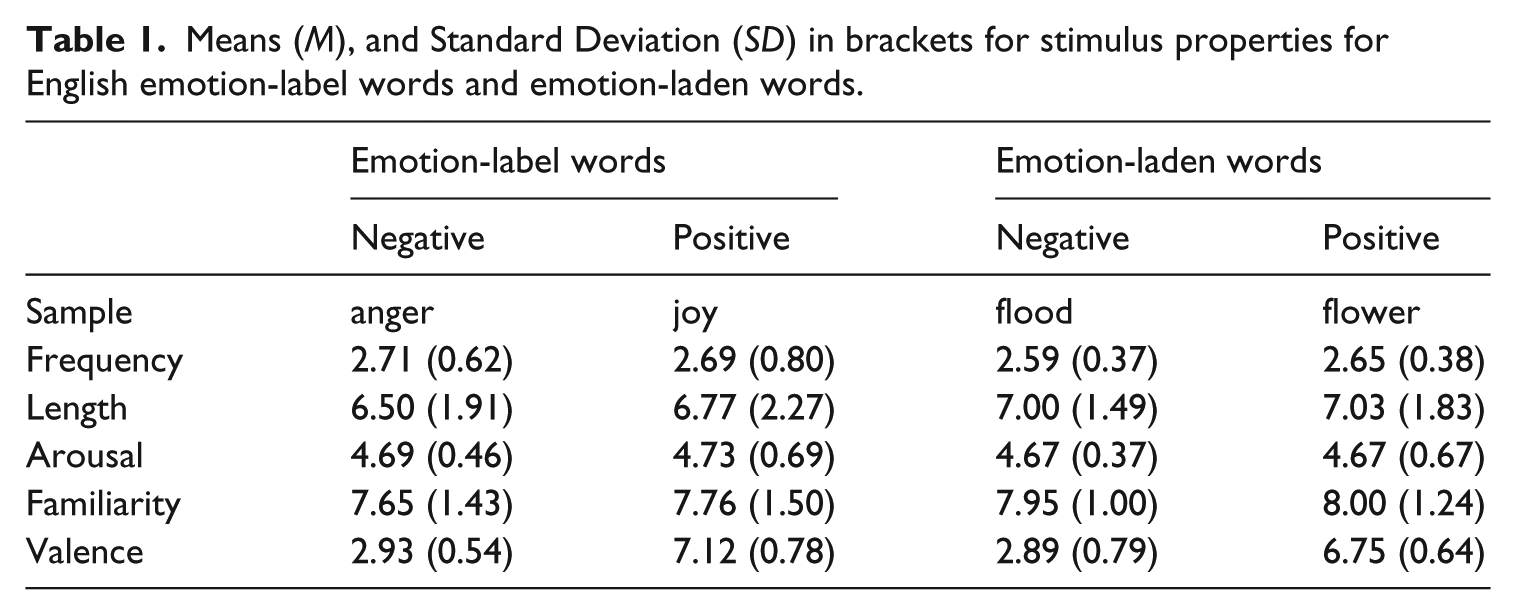
Thirty English negative emotion-label words, 30 English positive emotion-label words, 30 English negative emotion-laden words, and 30 English positive emotion-laden words were selected from a large English affective norm database (Warriner et al., 2013), being matched on word frequency, length, arousal, and familiarity (ps > 0.1; for details, see Table 1). Here, English word frequency [log 10 (FREQcount + 1)] was retrieved from SUBTLEX-US (Brysbaert and New, 2009). Arousal and familiarity were based on the rating of another 20 participants who were not involved in the experiment. In order to confirm the valence of the stimuli, rating data were retrieved from Warriner and colleagues’ emotion word database (Warriner et al., 2013). Positive words were more positive than negative words, F(3, 116) = 338.935, p < 0.001. At the same time, emotion-label words and emotion-laden words showed no difference on valence and familiarity (ps > 0.1). Another 120 English nonwords were derived from English Lexicon Project (Balota et al., 2007) to balance the yes or no responses.
Means (M), and Standard Deviation (SD) in brackets for stimulus properties for English emotion-label words and emotion-laden words.
3 Procedure
Before the experiment, participants were asked to finish the LexTALE (Lemhöfer and Broersma, 2012) to test their English lexical knowledge. After the LexTALE and a short rest, participants started the main experiment in which the stimuli were presented in white (font: New Times Roman, size: 48 points) against a black background.
There were seven blocks in the experiment, containing one practice block and six experimental blocks. The practice block contained 12 English words and 12 English nonwords that were not contained in the experimental blocks. There were 80 trials in one experimental block that included 10 negative emotion-label words, 10 positive emotion-label words, 10 negative emotion-laden words, 10 positive emotion-laden words, and 40 nonwords. Each English word was displayed twice in different blocks. Each trial began with a 500 ms fixation which was replaced by the target stimulus. The presentation of each target lasted for 1,000 ms and participants were not allowed to react until the target disappeared and a question mark was presented. The question mark indicated that participants should decide whether the stimulus was an English word or not by pressing the corresponding keys on the Response Box (E-prime, Psychology Software Tools, Inc., Pittsburgh, PA). Once the participants finished making a decision, a picture of an eye was displayed for 1,000 ms, informing that the participants were permitted to blink if they needed. Trials in each block and six blocks were randomly presented to the participants. A short break was permitted between the blocks.
4 Electroencephalogram (EEG) recording and data analysis
High-density EEG data were recorded by a 128-channel HydroCel Geodesic Sensor Net with a sampling rate of 1 kHz (Electrical Geodesics, Inc. EGI; Eugene, OR). Electrodes all remained below 50 kΩ during the recording. The off-line EEG data were analysed with EGI Net Station Waveform. Specifically, the EEG data were firstly filtered with a 0.1 Hz high pass and with a 30 Hz low pass. The filtered EEG were then segmented into 900 ms epochs, beginning 100 ms prior stimuli onsets. The trials with amplitude changes that were larger than ±70 μV were labeled as blinks and the changes beyond ±27.5 μV were regarded as eye movements. The trials were rejected if they were inspected as blinks or eye movements. In addition, the trials that were detected with more than 10% bad channels (i.e., amplitude changes over 200 μV during recording) were also discarded. We replaced the bad channels by averaging the values from the surrounding channels. In this way, around 28% trials were deleted and on average more than 40 trials in each condition remained for further analysis. The data were re-referenced to the average of all the electrodes. Epochs in the same condition were averaged and were corrected to a 100 ms pre-stimulus baseline.
The focused ERP components were analysed in the time windows of 80–130 ms (P100), 150–210 ms (N170), and 550–800 ms (LPC), based on the visual inspections and also in line with the previous studies (Citron, 2012; J. Zhang et al., 2017). Mean amplitudes of occipital sites (P7/P8, PO7/PO8, and P9/P10) over the hemispheres were computed for P100 and N170. LPC was indexed by the averaged mean amplitude of four electrodes including C4, C6, CP4, and CP6, within the time window of 550–800 ms.
III Results 1
1 Behavioral data
Because of the fixed presentation duration of the target stimuli, the reaction times were not analysed. For accuracy rate, a 2 × 2 repeated measure ANOVA was conducted. The two factors were Word Type (i.e., emotion-label words and emotion-laden words) and Valence (i.e., negative and positive). Emotion-laden words (94.1%) were recognized more accurately than emotion-label words (91.8%), F(1, 15) = 16.589, p < .01, partial η2 = 0.525. Moreover, negative words (94.0%) were identified better than positive words (91.9%), F(1, 15) = 4.748, p < .05, partial η2 = 0.24. The interaction between word type and valence was also significant, F(1, 15) = 5.907, p < .05, partial η2 = 0.283. Specifically, positive emotion-laden words (94.2%) had higher accuracy rate than positive emotion-label words (89.6%), t (15) = 5.367, p < .001. Nevertheless, negative emotion-label words (94.0%) had the same accuracy rate with negative emotion-laden words (94.0%), t (15) = 0.082, p > .94.
2 ERP data
ERP waveforms at focused electrodes and topographical maps in each condition are illustrated in Figure 1 and Figure 2 respectively. The results for each ERP component are shown as follows.
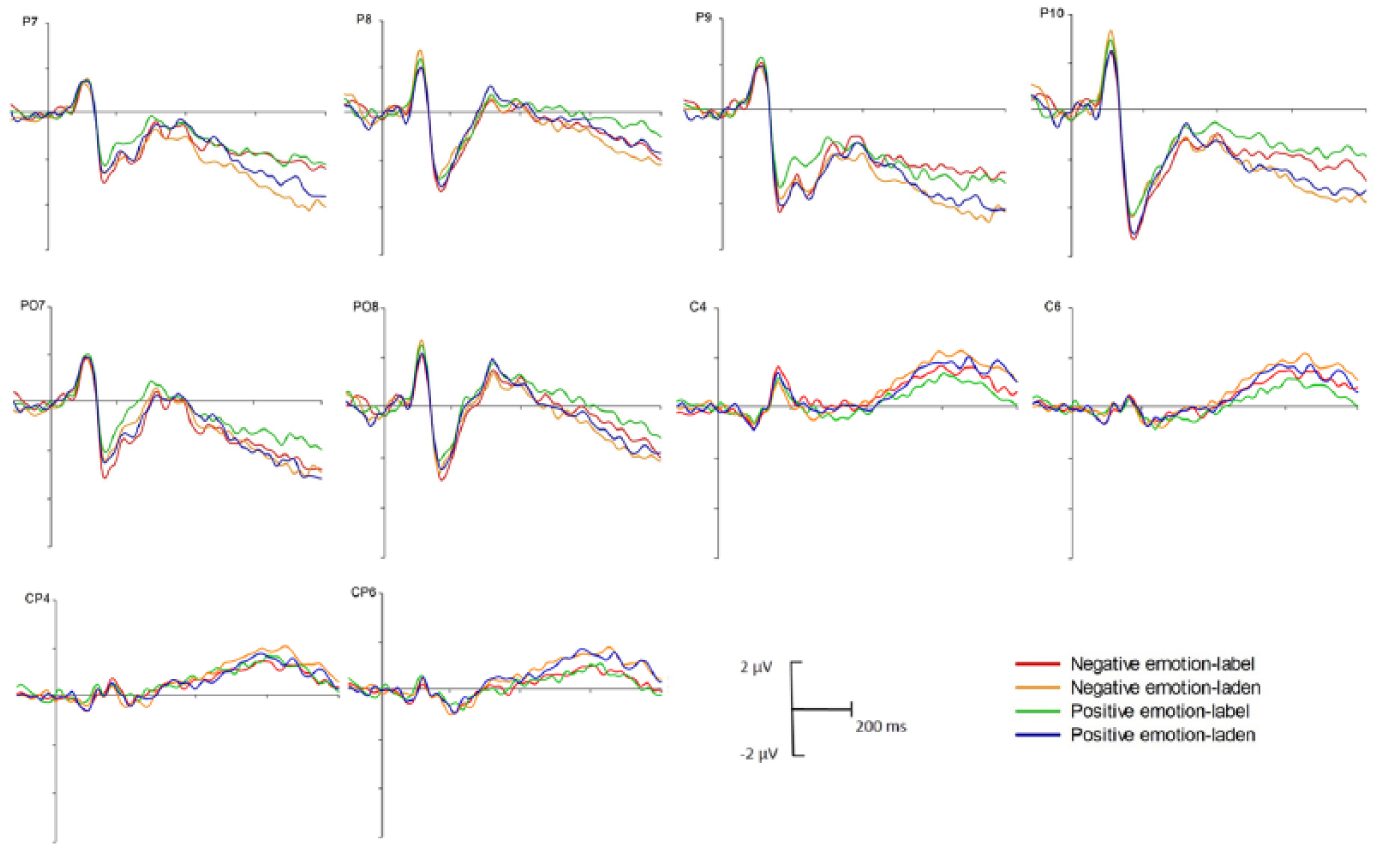
Grand average ERPs of the P100, N170, and LPC components at the indicated electrode sites.
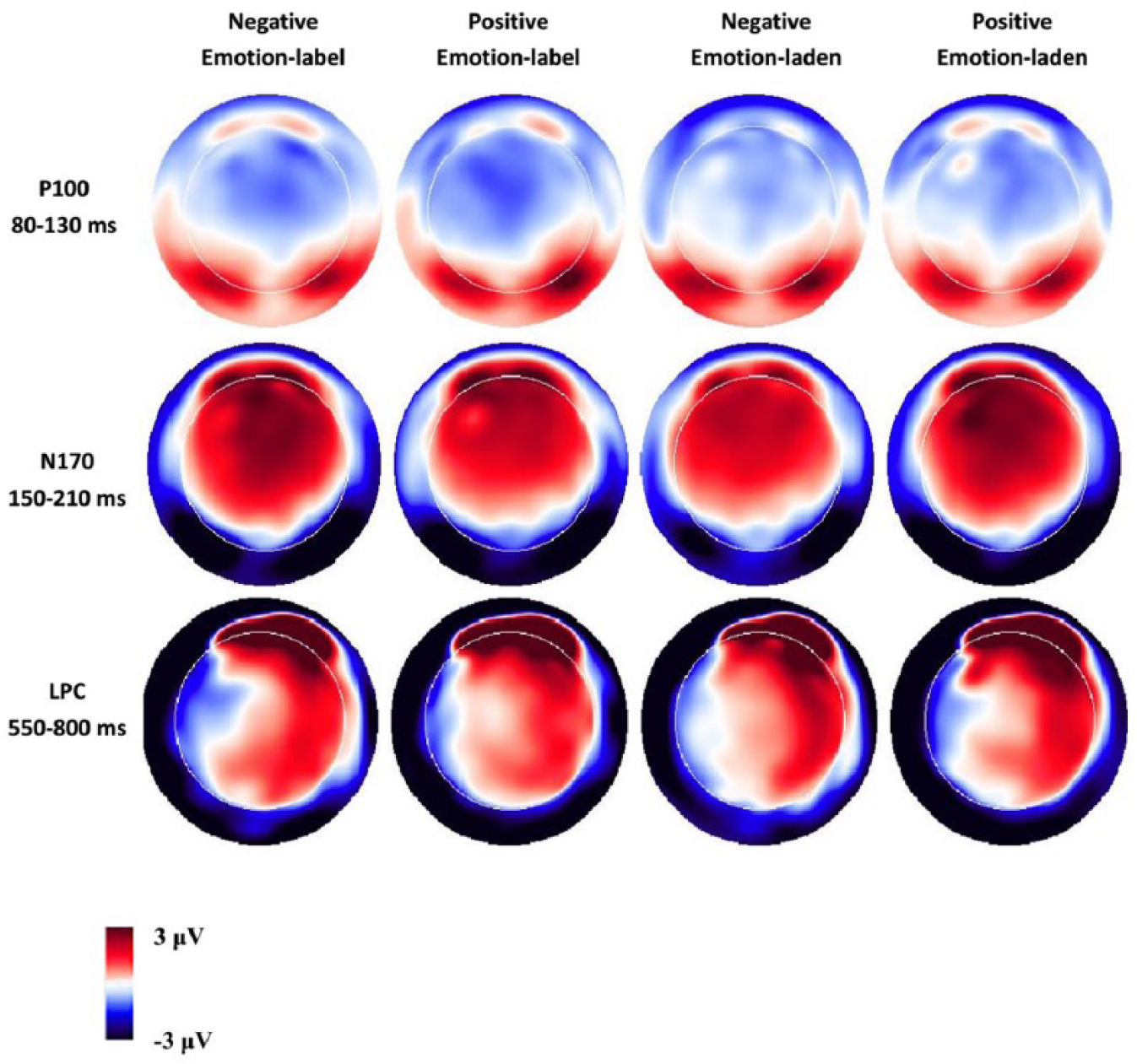
Grand average ERP topographies of the P100, N170, and LPC components across four word types.
P100
A 2 × 2 × 3 × 2 repeated ANOVA was performed. The four independent variables were Word Type (i.e., emotion-label words and emotion-laden words), Valence (i.e., negative and positive), Electrode (i.e., P7/P8, PO7/PO8, and P9/P10), and Hemisphere (i.e., left and right). No main effects or interactions between the factors emerged.
N170
The repeated ANOVA was identical with P100, A main effect of electrode was observed, F(1, 15) = 18.155, p < .001, partial η2 = 0.548. Pairwise comparison using a Bonferroni correction showed that larger N170 was found at P9/P10 than at P7/P8 and PO7/PO8 (ps < 0.01). The interaction between word type and valence was significant, F(1, 15) = 7.812, p < .05, partial η2 = 0.342. We further compared the types of words and found negative emotion-label words generated larger N170 than negative emotion-laden words, t (15) = 2.395, p < .05. On the contrary, identical N170 was found for positive emotion-label words and positive emotion-laden words (p > .2). In addition, A three-way interaction among word type, valence, and electrode was significant, F(2, 30) = 6.193, p < .01, partial η2 = 0.292. Further we compared the emotion-label words and emotion-laden words and found positive emotion-laden words elicited larger N170 than positive emotion-label words at P9/P10 and PO7/PO8, t (15) = 2.890, p < .05, t (15) = 2.298, p < .05. Additionally, enhanced N170 was generated by negative emotion-label words than by negative emotion-laden words at P9/P10 and PO7/PO8, t (15) = 3.240, p < .01, t (15) = 2.973, p < .05. No other comparisons reached significance. There was also a marginally significant three-way interaction among word type, electrode, and hemisphere, F(2, 30) = 3.388, p = .05, partial η2 = 0.184. Further contrasts revealed that only on the left hemisphere (P7 and PO7), larger N170 was evoked by emotion-label words than by emotion-laden words, t (15) = 2.142, p < .05 for P7, t (15) = 2.233, p < .05 for PO7.
LPC
A 2 × 2 × 4 repeated measure ANOVA was conducted. The three factors were Word Type (i.e., emotion-label vs. emotion-laden), Valence (i.e., negative vs. positive), and Electrodes (i.e., C4, C6, CP4, CP6). A main effect of word type was obtained, F(1, 15) = 6.927, p < .05, partial η2 = 0.316, such that emotion-laden words generated larger LPC than emotion-label words. No other main effects or interactions emerged.
IV Discussion
By adopting ERP measurement, the present study compared the neural correlates of identifying L2 emotion-label words and emotion-laden words. Combining behavioral data and ERP data, we added novel electrophysiological evidence that confirmed the differences between emotion-label words and emotion-laden words in L2.
1 Behavioral data
Behavioral results firstly showed that emotion-laden words were recognized more accurately than emotion-label words in general. However, the advantage of emotion-laden words was only restricted to positive words, while negative emotion-label words and negative emotion-laden words had similar accuracy rate. Our results were in line with the previous evidence (Altarriba and Basnight-Brown, 2011) that positive emotion-label words generated little Simon effect. Since emotion-label words could activate enhanced emotion than emotion-laden words (Kazanas and Altarriba, 2015, 2016b), and positive effect broadens our mind and impair cognitive processing (Phillips et al., 2002), positive emotion-label words had lowest accuracy rate among the four types of emotion words.
A main effect of valence demonstrated that negative words had higher accuracy rate than positive words. More specifically, negative word advantage was only found for emotion-label words. The facilitation effect for negative words was also obtained in Eilola and Havelka’s study (2011) in which they compared the skin conductance levels (SCLs) between English native and non-native speakers in an emotion and taboo Stroop task. The results demonstrated that both negative words and taboo words elicited larger SCLs than positive and neutral words, but this difference was only observed for English native speakers (Eilola and Havelka, 2011). However, this difference was evident in the present study for even non-native English speakers. Eilola and Havelka (2011) implicitly mixed emotion-laden words (e.g., warmth, rape) and emotion-label words (e.g., enjoyment, loneliness) together. This mixture might result in the null effect for non-native English speakers, because in the present study, only negative emotion-label words had higher accuracy rate than positive emotion-label words whereas no such difference was obtained for emotion-laden words.
2 ERP data
As for the ERP data, in the current study, three ERP components including P100, N170, and LPC were observed, similar with the previous study in L1 (J. Zhang et al., 2017).
It was found that evoked P100 was not different for emotion-label words and emotion-laden words at occipital sites. This finding was consistent with that of Chen and her colleagues (2015) who examined emotion words recognition in L2 among Chinese–English bilinguals and found that negative words, positive words, and neutral words evoked similar early components (i.e., P100). Almost no evidence indicated that effect of emotion content on word recognition could be found as early as 100 ms after stimulus onset in L2, but the emotion activation that was provoked by emotion words at this very early stage (100 ms) were found in L1 (Bayer et al., 2012; Scott et al., 2009).
Results on N170 were intriguing in two aspects. Firstly, an evident difference between emotion-label words and emotion-laden words was confirmed by the result that N170 was larger for negative emotion-label words than negative emotion-laden words. Negative emotion was believed to dominate in the mental lexicon because negative emotions accompanied with threat whereas positive emotions labeled safety (Schrauf and Sanchez, 2004) and increased attention to negative items permitted one to adapt to dangerous conditions (LeDoux, 1998). This dominance of negative words in mental lexicon was more significant for emotion-label words than for emotion-laden words, corroborating that emotion-label words usually produced larger emotion activation than emotion-laden words (Kazanas and Altarriba, 2016b; Knickerbocker and Altarriba, 2013; J. Zhang et al., 2017). However, positive emotion-laden words evoked larger N170 than positive emotion-label words at both P9/P10 and PO7/PO8 sites. As emotion-label words produced larger emotion activation than emotion-laden words (Knickerbocker and Altarriba, 2013; J. Zhang et al., 2017) and positive affect increased the attention breadth (Rowe et al., 2007) and interfered the performance (Phillips et al., 2002), it was conceivable that positive emotion-label words was accompanied with enhanced positive effect, lowest accuracy rate, and decreased N170 that reflected lower early attention allocation towards stimuli than emotion-laden words.
Secondly, on the left hemisphere, enhanced N170 was found for emotion-label words than for emotion-laden words. A recent study (D. Zhang et al., 2014) revealed that both L1 negative words and positive words elicited larger N170 than neutral words at occipito-temporal sites only on the left hemisphere. D. Zhang et al. (2014) argued that the left hemisphere advantage of N170 might be as a result of increased activity of the visual word-form area (VWFA) that was targeted to visual word recognition and located in the left fusiform gyrus (Dehaene and Cohen, 2011; McCandliss et al., 2003). Our finding extended the study of D. Zhang et al. (2014) by indicating that at least on the left hemisphere, L2 emotion-label words evoked larger electrophysiological activation than emotion-laden words. Moreover, since we examined the L2 emotion-label words and emotion-laden words processing, it was also plausible that the participants were struggling with processing the orthography in L2, which activated the VWFA.
In addition to N170, at the parietal sites over the right hemisphere, emotion-label words generated decreased LPC than emotion-laden words. Recall that N170 was larger for emotion-label words than emotion-laden words in the present study and there was short of automatic activation for emotion-laden words, it could be possible that emotion-laden words required more elaborate processing than emotion-label words at the later stage that was responsive to larger LPC (Chen et al., 2015).
There were several limitations warranting discussion. First, concreteness of the emotion-label words and emotion-laden words was not matched. Some evidence has shown that concreteness interacted with emotion effect. Specifically, larger LPC was found for the concrete negative words than concrete neutral words and positive words, while no difference was found for abstract words (Kanske and Kotz, 2007). However, concreteness difference between emotion-label words and emotion-laden words was inherent in the two types of words (Martin and Altarriba, 2017). Emotion-label words, such as happiness or sadness, are abstract words, whereas emotion-laden words, such as gift or poverty, can be concrete words (e.g., gift) or abstract words (e.g., poverty). Therefore, emotion-laden words are generally more concrete than emotion-label words and concreteness might be one possible explanation for the distinction between the two kinds of words, as reflected in the finding that emotion-laden words elicited larger LPC than emotion-label words. However, concreteness could not fully account for the distinction between the two kinds of words in the present study, because emotion-label words (at least for negative ones) elicited larger N170 than emotion-laden words. The effect of concreteness on ERP was mostly found in late processing and could hardly be found as early as before 200 ms. Nevertheless, future studies could more directly compare the two types of words after concreteness being controlled. Second, only 16 participants were recruited in the present study. Although the effect sizes for the findings were relatively large (i.e., partial η2 > 0.1), the limited number of participants made it difficult to investigate the role of language proficiency in L2 emotion word processing (Ponari et al., 2015). Future studies could compare bilinguals’ processing emotion-label words and emotion-laden words in L2 with different language proficiencies.
Regardless of the limitations, taken together, our results at least confirmed the different neural correlates of recognizing emotion-label words and emotion-laden words in L2. Generally, emotion-label words were recognized differently from emotion-laden words, as reflected by increased attention captured by negative emotion-label words than negative emotion-laden words, decreased attention allocation toward positive emotion-label words than to positive emotion-laden words, and enhanced elaborate processing for emotion-laden words in L2. Therefore, an implication of the current findings is that separating emotion-label words and emotion-laden words is required for L2 emotion words research in the future.
Footnotes
Appendix 2
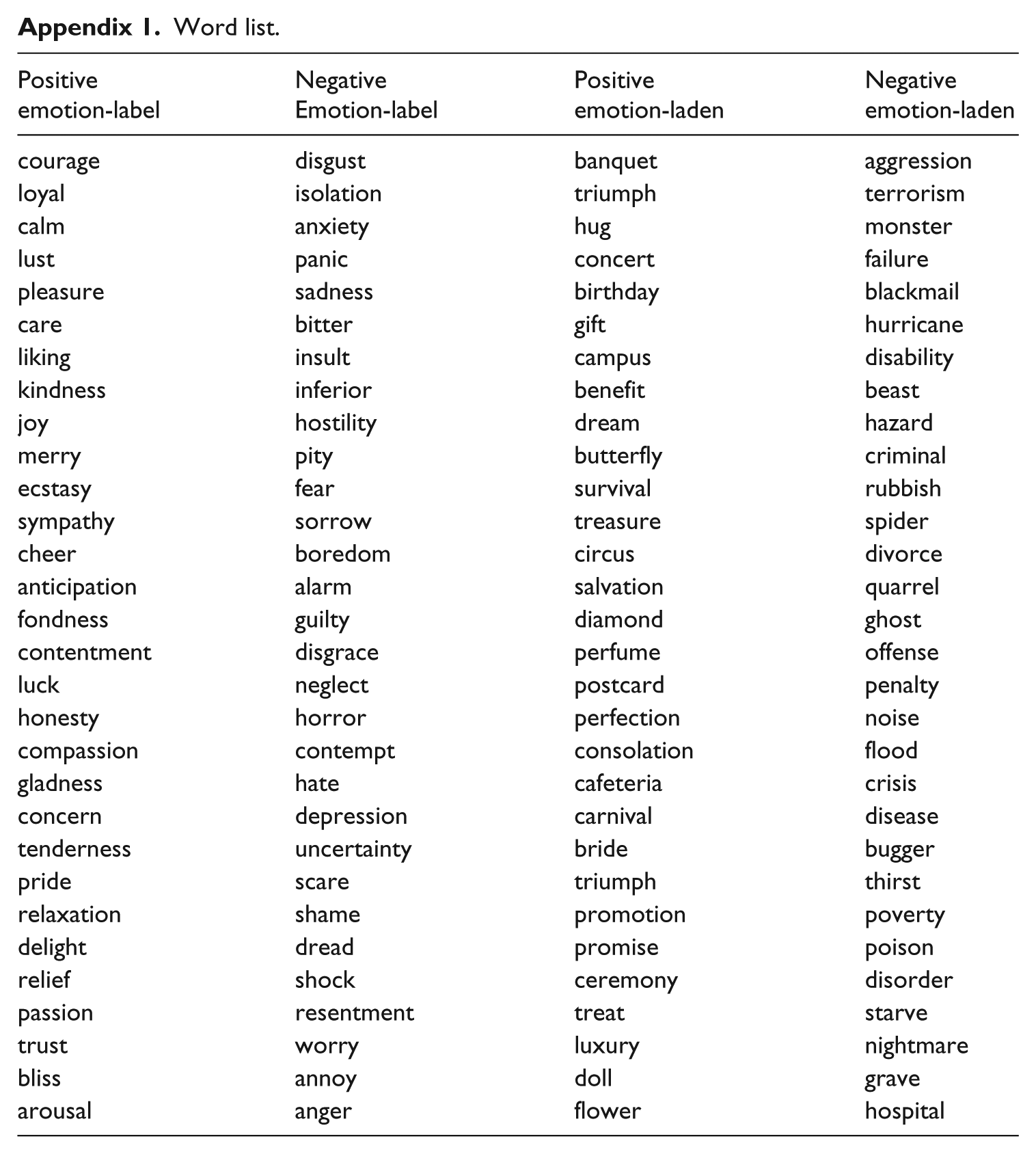
Appendix 1.
Word list.
| Positive emotion-label | Negative |
Positive emotion-laden | Negative emotion-laden |
|---|---|---|---|
| courage | disgust | banquet | aggression |
| loyal | isolation | triumph | terrorism |
| calm | anxiety | hug | monster |
| lust | panic | concert | failure |
| pleasure | sadness | birthday | blackmail |
| care | bitter | gift | hurricane |
| liking | insult | campus | disability |
| kindness | inferior | benefit | beast |
| joy | hostility | dream | hazard |
| merry | pity | butterfly | criminal |
| ecstasy | fear | survival | rubbish |
| sympathy | sorrow | treasure | spider |
| cheer | boredom | circus | divorce |
| anticipation | alarm | salvation | quarrel |
| fondness | guilty | diamond | ghost |
| contentment | disgrace | perfume | offense |
| luck | neglect | postcard | penalty |
| honesty | horror | perfection | noise |
| compassion | contempt | consolation | flood |
| gladness | hate | cafeteria | crisis |
| concern | depression | carnival | disease |
| tenderness | uncertainty | bride | bugger |
| pride | scare | triumph | thirst |
| relaxation | shame | promotion | poverty |
| delight | dread | promise | poison |
| relief | shock | ceremony | disorder |
| passion | resentment | treat | starve |
| trust | worry | luxury | nightmare |
| bliss | annoy | doll | grave |
| arousal | anger | flower | hospital |
Declaration of Conflicting Interest
The author(s) declared no potential conflicts of interest with respect to the research, authorship, and/or publication of this article.
Funding
The author(s) disclosed receipt of the following financial support for the research, authorship, and/ or publication of this article: This study was supported by MYRG2017-00217-FED, MYRG2016-00193-FED, and MYRG2015-00221-FED from the University of Macau in Macau.
