




Abstract
This article proposes a formal model of the human language faculty that accommodates the possibility of ‘attrition’ (modification or loss) of morphosyntactic properties in a first language. Modeling L1 grammatical attrition entails a quite fundamental paradox: if the structure of the language faculty in principle allows for attrition of morphosyntax, why is it apparently so heavily constrained and rarely attested? We demonstrate that the attrition paradox can be resolved with a model that integrates a formally explicit generative grammar (eschewing classical parameters in favor of functional feature assemblies; see Chomsky, 2000, 2001) into a generalized model of language acquisition that decouples linguistic input from acquisitional intake (following Lidz and Gagliardi, 2015). This implementation makes specific predictions about the input and intake conditions that favor and disfavor L1 attrition. We explore these predictions for one of the most widely studied areas of attrition, namely the realization of pronominals.
I A paradox in modeling L1 attrition
This article provides a new theoretical model of first language (L1) grammatical attrition: a potentially enduring modification to morphosyntactic properties of an end-state grammar under linguistic pressure. 1 Language attrition is by no means a unitary phenomenon, and broadly defined, a range of linguistic abilities related to the use, processing and grammatical representation of an L1 may be identified as susceptible to it. 2 This includes attrition on other linguistic levels (e.g. lexical, phonological, semantic, pragmatic, etc.) or differences in first language processing, reading abilities, and oral fluency, for example. A great deal of the existing research on attrition focuses on matters of ‘performance’ in the first language: performance factors are more immediately perceptible both to attriters themselves and to researchers, whereas the properties of speakers’ underlying grammars are typically below the level of consciousness. Moreover, the potential for attrition of morphosyntactic properties beyond childhood appears to be highly restricted and is considerably rarer, as is frequently reported in the literature (see, for example, reviews in Domínguez, 2013; Schmid and Kӧpke, 2017a, 2017b; Tsimpli, 2017).
While stable L1 grammars appear unlikely to be significantly restructured beyond childhood, grammatical attrition – in the sense defined above – is indeed evidenced in the literature, for example in the interpretation of overt pronouns (e.g. Domínguez, 2013; Sorace, 2000; Tsimpli, 2007; Tsimpli et al., 2004) and properties of pronominal binding (e.g. Gürel, 2004, 2007). While not as widely attested as attrition in L1 performance or processing, we contend that from a scientific perspective, the possibility of grammatical attrition is crucial to our understanding of bilingual acquisition and of the organization of the language faculty, broadly speaking. However, to our knowledge there is currently no model of grammatical attrition compatible with formal generative models of the language faculty. 3 More problematically still, any formal approach to modeling grammatical attrition faces an apparent paradox: if the language faculty architecture comprises mechanisms capable of affecting a mature L1 grammar, then why is the phenomenon of grammatical attrition itself so heavily constrained and so apparently rarely attested? Any model seeking to accommodate attested instances of grammatical attrition will then not only need to account for what may be modified within the L1 grammar (and under what conditions), but will also need to resolve this paradox in modeling attrition.
The principal aim of this article is to articulate such a model. Section II first establishes a set of requirements which we argue any model of L1 grammatical attrition must meet. We then articulate our own model of L1 grammatical attrition incorporating three key aspects: first, a distinction between input and intake (as input which has been processed and assigned a representation; e.g. Carroll, 2001); second, an inference component that modifies an existing grammar under appropriate intake conditions, including parsing and extralinguistic factors such as memory and pattern recognition (e.g. Lidz and Gagliardi, 2015); finally, a ‘feature-based’ generative model of the computational component of the grammar prominent in the theoretical literature (e.g. Chomsky, 2000, 2001). The basis of our model is provided by Lidz and Gagliardi’s (2015) L1 acquisition model, as a framework for understanding how input may engender changes to the state of an L1 grammar provided it is perceptually encoded in such a way that leads to acquisitional intake. 4 The second main aim of the article is to establish the empirical viability of our model in accounting for reported contexts of attested grammatical attrition. This is our focus in Section III, where we examine the realization of pronominals (as an example of a core grammatical property subject to structured crosslinguistic variation) by L1 of speakers exposed to another language variety in which equivalent or analogous grammatical items behave differently. Section IV summarizes our conclusions.
II A model for L1 grammatical attrition
1 Three requirements for any model
Before we present our model, we wish to set out some general properties that we believe any model capable of accommodating attrition in L1 grammars must incorporate. Firstly, there must remain an ongoing flexibility within (at least certain aspects of) a mature L1 grammar, that is, the grammar exhibits sensitivity to the linguistic environment beyond the primary years of language acquisition. In the current state of knowledge regarding grammatical attrition, the extent of this flexibility and the conditions under which a mature L1 grammar exhibits sensitivity to input remain open empirical questions. 5 It follows that a model must incorporate a formal account of attrition within the grammar: where grammatical attrition arises, what kinds of mental representations are affected, and in what ways? Since the grammatical properties we discuss below are couched in the theory of the Minimalist programme (e.g. Chomsky, 1995, 2001, 2005), for concreteness we adopt a broadly Minimalist model whereby the computational component of the grammar, narrow syntax, builds structure and establishes syntactic relationships by manipulating the morphosyntactic features bundled onto lexical items. The narrow-syntactic computation yields representations of sentences that are legible to the language-external mental systems responsible for sensorimotor function (the interface with which is known as PF) and conceptual-intentional function (the interface with which is known as LF). 6
A second requirement of a model of attrition is to explain the mechanisms by which mental representations become affected: the grammar must be integrated into a model of the language faculty (broadly construed) which retains a role for input in maintaining an L1 grammar beyond the primary years of language acquisition. To this end, we assume that a distinction must be made between input (consisting of the whole L1/L2 linguistic environment, including the various forms represented in it as well as their distributions, etc.) and intake (the result of a speaker’s processing of the input). While the need to distinguish between input and intake has repeatedly been highlighted by researchers working on second language acquisition, it has not, by and large, been adopted by generative linguistic theory. 7 As Gagliardi (2012: 4) notes, generative research into language acquisition quite generally has overlooked the matter of what mental representations/encoding of the input form the basis of an individual’s choice between hypotheses about the developing grammar. Yet in attrition research, a detailed articulation of the relationship between the external (L1 and L2) input, the speaker’s processing of it, and any resulting changes to the L1 grammar is precisely the matter under investigation. In establishing a role for intake (to be formalized in Section II.2 below), the general approach that we are advocating for L1 attrition draws to a certain extent on Putnam and Sánchez’s (2013) proposal for attrition in heritage language grammars. 8 Also working within a generative framework, Putnam and Sánchez seek to advance understanding of the relationship between input and bilingual acquisition to accommodate non-targetlike structures in the L1 competence grammar of heritage speakers. We extend this approach to the general case of L1 grammatical attrition in late sequential bilingual/bidialectal speakers.
The extension of the heritage grammars model is favored by the fact that in both cases, during the lifespan of an individual speaker quantitative differences arise in the input frequencies of two languages. In the case of heritage grammars, the resulting difference between the acquired heritage grammar and corresponding monolingual grammars (e.g. Benmamoun et al., 2013; Montrul, 2016) derives from the fact that the dominance of the L2 input coincides with the primary years of language learning. L1 attrition is primarily distinguished from heritage language acquisition by the dominance of L2 input arising after any critical period for L1 acquisition, coinciding with modification of a grammar that has already reached maturity. Putnam and Sánchez themselves recognize such similarities and indeed claim that their model also accommodates L1 attrition, envisaging a blurred distinction whereby ‘both are epiphenomenal instances of the same process, albeit at different ends of the spectrum’ (Putnam and Sánchez, 2013: 493). However, as they assume that L1 attrition ‘seems to affect linguistic production skills predominantly’ (Putnam and Sánchez, 2013: 502–03, fn. 2) they do not address grammatical attrition. While we advocate a different kind of approach to the potential instability of grammatical properties and the nature of input and intake processes that would lead them to change, we nevertheless follow the intuition of their approach, inasmuch as it is natural to seek to accommodate both heritage language acquisition and L1 attrition within a generative model of L1 and L2 acquisition. This allows the examination of the role of input (either from L1 or L2, as relevant) in shaping and sustaining both developing and mature grammars and of the broader processes entailed in bilingual acquisition.
A third requirement of any model that seeks to incorporate the possibility of L1 grammatical attrition concerns the resolution of an apparent paradox of the enterprise itself. Namely, if the mechanisms of the language faculty architecture are such that they allow for the possibility of attrition in L1 morphosyntax, then what accounts for the ‘strikingly low levels of attrition in L1 grammar found in most studies of morphosyntax and its interfaces’ (Tsimpli, 2017: 759)? Any successful model must resolve the paradox that while the language faculty provides a pathway to L1 grammatical attrition, that pathway rarely seems to be taken: as discussed below, grammatical attrition is heavily constrained and evidently does not result in an unstructured ‘loss’ of L1 morphosyntactic properties.
It is worth reflecting at this point on the status of the Interface Hypothesis in L1 grammatical attrition, as it represents – at least, to our knowledge – the only generative model of attrition to date. The Interface Hypothesis is extended from its original application in L2 acquisition to L1 attrition by Sorace (2000), Tsimpli et al. (2004); see Gürel (2011) and Iverson (2012) for discussion. It proposes that grammatical properties of the ‘external’ interfaces of the language faculty (e.g. syntax–discourse) should be vulnerable, yet ‘[grammatical] properties not dependent on extralinguistic information, those found at internal interfaces [e.g. syntax–semantics] and in the narrow syntax, should remain unaffected.’ (Iverson, 2012: 78). In other words, the Interface Hypothesis is not a model that can resolve the attrition paradox, as it assumes that there is no paradox, since there is no grammar-internal attrition. However, as demonstrated by the cases reviewed in Section III below (and indeed by Domínguez, 2013; Iverson, 2012), the empirical claim of the Interface Hypothesis is incorrect insofar as there are conditions under which attrition of syntactic and morphosyntactic properties is attested. 9 We take it to be crucial, then, that a viable model must account for the availability of attrition in grammatical representations including the ‘internal’ interfaces, between syntax and morphology or semantics, which is excluded by Tsimpli et al.’s approach. Beyond the empirical argument that the defining prediction of the Interface Hypothesis for L1 attrition is incorrect, we also wish to highlight that the Interface Hypothesis does not meet our other requirements for a model of attrition. It does not entail an account of the representational changes that constitute attrition, nor of the intake mechanisms that lead to such changes under appropriate input conditions.
While the Interface Hypothesis does not meet any of the three general requirements for a model of L1 grammatical attrition that we have proposed in this section, we now show how these requirements can be met by assembling a set of existing assumptions about input processing, language acquisition and the structure of the grammatical component. There are three key aspects of our model, treated in turn in the remainder of this section. They are: the input/intake distinction (Section II.2); the inference engine (Section II.3); and the feature-based model of the grammar (Section II.4).
2 Input and intake
Carroll (2001: 4) emphasizes that the input to the mechanisms of language learning 10 consists not of the objective properties of the stimulus itself, but rather of the mental representation of the stimulus, i.e. the way in which it is encoded by a speaker. By ‘input’, we refer to the set of all linguistic data available to a speaker irrespective of what he/she does with it, or is able to do with it. As Rast’s (2008: 4–5) summary of current usage of the term indicates, there is much less consensus about what exactly is referred to as ‘intake’. 11 While this has been extensively debated and analysed from various perspectives in second language acquisition (see, amongst many others, Chaudron, 1985; Gass and Selinker, 1994) for our purposes here, many of the different theoretical positions regarding intake are not crucial at this point. However, the input/intake distinction itself is crucial, allowing a focus on special sensitivity to specific, relevant aspects of the input which children and/or adults use to construct a grammar. The lack of consensus about what exactly is described by ‘intake’ is in part because of the objective difficulty of examining what from the input is ‘taken in’, and partly because of different approaches to what psycholinguistic processes are entailed in representing/encoding input and with what degree of success (see, for example, Rast, 2008; VanPatten, 2000). Moreover, where L1 rather than L2 acquisition is concerned, a role for intake is rarely acknowledged, perhaps because the distinction is rarely considered to be crucial due to apparent or perceived homogeneity in L1 monolingual acquisition during infancy, where outcome success is not typically at stake.
A notable exception is Lidz and Gagliardi’s (2015) model of child L1 acquisition (see also Gagliardi, 2012; Pearl, to appear; Pearl and Lidz, 2009) which incorporates an intake component, or perhaps more accurately, distributes intake throughout different components. In this L1 acquisition model, schematized in Figure 1, the initial phase of intake – ‘perceptual intake’ – is the result of perceptual encoding of the raw input utterance. Lidz and Gagliardi highlight that the perceptual encoding of input is achieved not only by the child’s grammar in its present state, but also by parsing and extralinguistic systems such as memory, pattern recognition, and ‘statistical-distributional features of the input’ (Lidz and Gagliardi, 2015: 337). As such, they demonstrate that at different stages of L1 acquisition, different information will be extracted from input due to the different state of existing knowledge of the child; differences in the information processing may then ultimately be significant in terms of outcomes for acquisition. We assume, then, that perceptual encoding constructs (at least) a linguistic representation of the input consisting of a range of representational information on a number of grammatical levels (syntactic, semantic, phonological, etc.). Lidz and Gagliardi (2015: 337) explain: ‘A [child] learner’s perceptual intake representation does not contain all of the information that an adult represents for the same sentence. If it did, then there would be nothing to learn’.
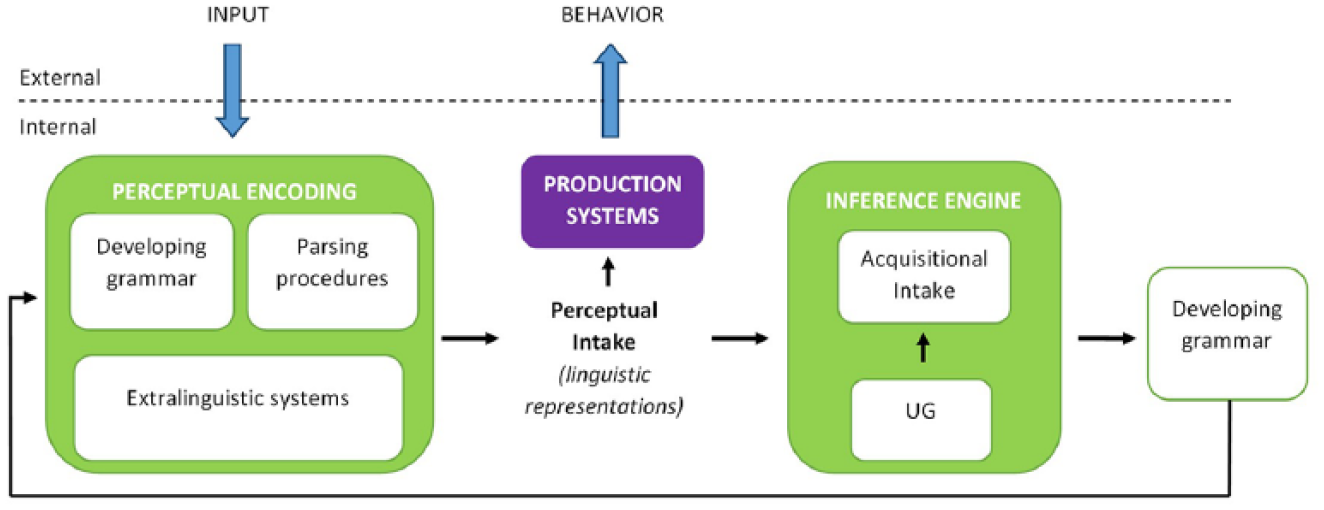
The language acquisition model adapted from Lidz and Gagliardi (2015: 336).
Crucially for our aim of understanding grammatical attrition within a generative model, Lidz and Gagliardi emphasize that while traditionally the input/intake distinction has been used to ‘underwrite’ input-driven approaches to language acquisition that eschew a role for a universal grammar component, once the role of UG within the model is clearly articulated there is no need to choose between knowledge-driven (i.e. UG) and input-driven approaches: different kinds of knowledge are brought to bear upon different psycholinguistic processes in the acquisition model. We continue to articulate the other components of this model below.
3 The inference engine
In her work on the input/intake distinction, Carroll (2001) reports that (second) language acquisition theory must provide a number of different types of theory: a theory of the cognitive property of linguistic knowledge (e.g. Principles and Parameters, etc.) and also of the transition, i.e. the change in the states of that linguistic knowledge over time. Further, acquisition requires a learning theory of how processed input providing new information engenders a restructuring. Aside from just providing a model of L1 acquisition that incorporates a role for the input/intake distinction, Lidz and Gagliardi’s (2015) acquisition model incorporates an approach to the matters of transition of linguistic knowledge, processing, and learning (in Carroll’s terms), which are distributed across different components of the language acquisition device.
In this acquisition model, the ‘learning’ mechanisms constitute a processing component called the inference engine. Within this processing component, ‘acquisitional intake’ – supported by UG in identifying the class of representations that constrain grammars independently of linguistic experience – compares the perceptual intake against the predictions of any UG-sanctioned grammar. This bears out the general Chomskian view of acquisition whereby ‘[l]earners do not need to arrive at abstract representations via a process of generalization, but rather use their input to identify the realization of those abstract representations in the surface form of the exposure language’ (Lidz and Gagliardi, 2015: 334). In essence, then, the inference engine allows the L1 learner to bring to bear his/her UG-based knowledge of the behavior of the computational component (e.g. constraints on movement operations, agreement/checking between functional features, c-command, etc.) to the perceptual intake representation in order to make inferences about the underlying grammar that generated it. 12 In turn, that inference may update the child learner’s developing grammar, which we assume (as outlined below in Section II.3) would consist of reconfiguring the lexical specification of morphosyntactic feature bundles on functional items of the L1 lexicon. Considering what is variously and very broadly construed as ‘intake’, 13 then, we can see that in Lidz and Gagliardi’s model, intake is effectively distributed across different components of the model: input processed within the perceptual encoding component, the encoded perceptual representation itself, the mechanisms of the inference engine that process the perceptual representation, and any changes that are ultimately instructed to the developing grammar.
We propose to extend Lidz and Gagliardi’s model beyond L1 child grammars to include mature grammars. Recall Lidz and Gagliardi’s statement above that if the child L1 learner’s perceptual intake representation for a sentence matches the adult speaker’s, then there is nothing for the child to learn. This is because the perceptual intake matches the expectations of the child’s UG-sanctioned grammar, including the ‘statistical-distributional features of the input’. It follows that some deficit/underspecification in the child L1 learner’s perceptual intake representation (a mismatch between the representation and the anticipated interpretation, for example) leads to that representation being processed by the inferential mechanisms of language acquisition. Accordingly, as the child’s perceptual encoding of sentences becomes more complete/‘adultlike’, there is less to learn since the child’s perceptual intake representations are increasingly consistent with the properties of the L1 input: in other words, what is carried forward from these perceptual intake representations for processing by the inferential mechanisms then decreases. We suggest, then, that when successful child L1 acquisition finishes, it is due to the completeness of perceptual representations (on all levels) and their compatibility with any extralinguistic aspects of perceptual encoding as defined above, including pattern recognition and statistical-distributional properties. This reduces the substantive input to the inferential learning/acquisition mechanisms to essentially zero, and one might suppose that this eventually removes any role for the inferential component from the processing loop illustrated in Figure 1. That is, once further L1 input is processed by a speaker who has developed an adultlike grammar, it is only processed for comprehension and not for acquisition.
Extending this L1 acquisition model of input, intake and inference to L1 grammatical attrition leads us to a new approach regarding the locus of grammatical attrition within the language faculty. The mechanisms of attrition are in fact distributed across a range of components, with the inference engine moreover playing a critical role: as in acquisition, the inference engine updates the speaker’s current grammar (see Section II.2) in response to perceptual observations of input that is to some degree inconsistent or incompatible with that grammar, for example under prolonged exposure to a different language or language variety. The model allows us to approach the question of what happens to acquisitional intake when at some later point in an individual’s life (after the L1 acquisition process has completed) they become exposed to a new kind of input. In the processing terms we have detailed above, this consists of the speaker generating perceptual representations which are deficient or exhibit mismatches between different levels (e.g. syntax and semantics, etc.). During L1 acquisition, this situation leads to acquisitional intake within an inference engine, guided by UG. Beyond L1 acquisition, though, the matter remains open. Given our assumption that mature grammars may change in some respects, the only possibility for such change arising within the adopted model is if perceptual representations of the L1 and/or L2 input can result in acquisitional intake of some kind for the L1 grammar. In other words, where grammatical attrition occurs, this is due to the ‘reactivation’, in some sense, of the inference engine (having been essentially redundant since the end of L1 acquisition). 14 The inference engine would become activated where a speaker fails to generate perceptual representations of the input that are fully compatible with his/her grammar and/or with extralinguistic considerations relevant to the perceptual encoding component. What the relevant perceptual encodings must look like to trigger this, and how the inference engine then deals with those perceptual input representations remain to be established, and of course, it seems unlikely that they will apply in the same manner as in L1 acquisition. These are questions that we begin to address in the rest of this article.
4 Grammatical component and feature (re)assembly
To complete the model, we must incorporate a theory of the grammatical component. To model the grammar we rely on a generative approach in general, specifically adopting a Minimalist account of the mechanisms of its computational component. We consider a generative model to be the only approach to the structure of a speaker’s mental grammar that can be formally articulated in sufficient detail to be able to: (1) make specific claims about the structure of the native L1 grammatical competence; and (2) provide insight into how an ‘attrited’ grammar might differ from this, at a fine-grained level of grammatical detail. In other words, this approach is able to make specific claims about what the mental grammar consists of, and in principle, then, of what may be modified in cases of grammatical attrition.
As highlighted by Domínguez (2013) and Domínguez and Hicks (2016), attrition of underlying grammatical properties of L1 grammars is inherently problematic for traditional generative models based on the classical ‘parametric’ view of language acquisition, where parameters of Universal Grammar (UG) are by assumption set early, and once only: parameter settings are intrinsically categorical and resilient to changes in the linguistic environment, ruling out both L1 parameter resetting during a speaker’s lifespan as well as parameter-based intra-speaker variation. 15 The problem with the parameter-based model is also evident in existing accounts of the selectivity of attrition, with extensive work (e.g. Domínguez and Hicks, 2016; Gürel, 2002, 2004, 2007; Gürel and Yılmaz, 2011; Tsimpli et al., 2004) demonstrating that what appears to be vulnerable is not the parameter setting itself but grammatical properties at a much finer-grained level. Tsimpli et al. (2004: 258), for example, surmise that the parametric value of the weaker language is not ‘unset’ completely, but simply affected in the aspects for which the dominant language assumes different values. Yet this is incompatible with the classical parametric approach as there is no mechanism of the L1 grammar which can be affected in the kind of way envisaged.
More recent theoretical debates in the field of principles and parameters syntax (within Minimalist and Biolinguistic approaches) have steered away from the assumption of a richly specified Universal Grammar supplemented with well-defined parameters of variation, promoting the central thesis of a computational component of the language faculty which is in fact invariant crosslinguistically. Language-specific properties are encoded in the lexicon, as sets of morphosyntactic features borne by functional categories, such as T(ense), or D(eterminer). 16 Languages make different selections of features from within a potentially universal inventory, and moreover corresponding functional categories may be specified with different bundles, or assemblies, of features. This approach has proved particularly successful in theorizing crosslinguistic and cross-dialectal variation at a level of fine-grained detail. Essentially, variation arises where functional categories are specified with different feature combinations in different grammars (e.g. Adger, 2006; Gallego, 2011; Holmberg, 2010; Richards, 2008), extending also to the level of intra-speaker variability (Adger and Smith, 2005; Barbiers, 2005; Henry, 1995). In acquisition, the setting of language-specific morphosyntactic properties is a matter of assigning grammatical representations of the input in a way that specifies lexical items with morphosyntactic features. These feature assemblies interact with those of other lexical items in a way that is consistent with a minimal core of universal syntactic properties plus general mechanisms of efficient computation. Returning to the language acquisition model adopted above, the target of acquisitional intake is now understood to be the assemblies of features specified on items of the functional lexicon.
Whereas traditional parameter-based models of grammatical variation fail to provide a natural mechanism for L1 attrition, the feature-based view suggests that, in principle, during a speaker’s lifespan his/her grammar may undergo finer-grained changes in morphosyntactic properties, via changes or additions to feature specifications of lexical items.
5 Overview of a unified model of grammatical acquisition and attrition
We have outlined the key components of a model of L1 acquisition which we extend to incorporate L1 attrition. The key to the new model concerns how these components integrate, along with some of our own extensions to accommodate acquisition of more than one language variety, and ultimately, as we will see, grammatical attrition. We want to be clear that it is our intention to specify components of this model that are system-agnostic as far as possible, avoiding commitments to particular assumptions and internal mechanisms of the components that are themselves the subject of often intense debate, for example concerning the nature of the inferential mechanisms, processing systems, theories of UG, transfer, and so on. Specific assumptions concerning any of these individual components may influence the overall system outlined here, but the model we propose is based on an integration of viable components, rather than a particular theory of any given one of them.
Consider our unified model of grammatical acquisition and attrition schematized in Figure 2, adapted and extended from Lidz and Gagliardi’s (2015) model of L1 acquisition; see Figure 1. 17 Below we refer to our model as Attrition via Acquisition, for short. The components and their assembly are largely the same, yet we introduce some additional assumptions to account for input from more than one language variety. The Attrition via Acquisition model is then in principle capable of extending to various contexts of bilingual acquisition, though we do not develop this matter further here.

Unified model of grammatical acquisition and attrition (‘Attrition via Acquisition’).
Two minor adjustments to Lidz and Gagliardi’s (2015) model of L1 acquisition are: (1) that external input may be from any particular language rather than just L1; and (2) that rather than identifying the speaker’s existing grammar as the ‘developing grammar’ (i.e. supposing an intermediate stage only), we term this the ‘current grammar state’, which may include initial, intermediate and stable/‘final’ states. It is also worth making explicit here that if a speaker is either being exposed to more than one language or (also) has acquired – or is acquiring – more than one grammar, initial identification of the input language and selection of appropriate encoding resources (a relevant current grammar plus processing mechanisms) must be critical to the perceptual encoding phase. In Lidz and Gagliardi’s model for monolingual L1 acquisition this is not required, but it is inescapable once that model is extended beyond monolingual contexts. We suppose that in the case where a speaker is exposed to input from a language for which he/she cannot select a grammar of any kind (i.e. the speaker does not know the language they are being exposed to), no perceptual representation is generated. In such cases nothing feeds through to the inferential component. 18
A further question arises at this point as to whether – and how – language-specific parsing and extralinguistic systems are selected for L2 input. In other words, does the initial language selection based on recognition of the input language determine a choice between alternative language-specific processing systems? While certainly relevant to the Attrition via Acquisition model, it is not our aim in this paper to directly address how L1 and L2 processing develops within the individual; we spell out our general assumptions in this regard as they become relevant below. To be clear, the perceptual encoding phase entails a selection of a single grammar (to the exclusion of other available grammars), to which a given set of processing mechanisms applies in order to generate the perceptual encoding of the input.
A further significant feature of our Attrition via Acquisition model concerns the introduction of different possible outcomes arising from the speaker’s perceptual intake representation (dashed lines denote points in the model where the output of one component determines the next processing step). If the perceptual intake assigned by the parser and current grammar state is complete on all representational levels and meets the expectations of the extralinguistic systems, then there is nothing to acquire; as a result, we assume that the inferential mechanisms are not invoked. If, on the other hand, the perceptual representation is partial/incomplete in that it mismatches between different grammatical levels or fails to meet the expectations of the extralinguistic systems, then the representation is fed through to the inference engine to determine how the current state of the grammar must be updated. We take this modification to the model to be essentially consistent with Lidz and Gagliardi (2015), implicit in their assertion (see discussion in Section II.2 above) that if a learner’s perceptual intake representation is adultlike then there is nothing to learn.
A more important adjustment to Lidz and Gagliardi’s acquisition model arises in the mechanisms of the inference engine. In order to extend this model for monolingual L1 acquisition to L2 acquisition (including attrition contexts), the current grammar states of all languages that a speaker has acquired (or is acquiring) must be active within the inference engine. This adjustment to the acquisition model is clearly required independently of attrition in order to account for the potential role of both UG and the L1 grammar in L2 acquisition, and equally to account for the potential role of any L2 in L3 acquisition. Yet the required assumption that all current grammar states are activated in the inference engine is also what provides the potential for ‘bidirectionality of crosslinguistic influence’ between languages in L2 acquisition (Sharwood Smith, 1982), critical to the process of language attrition (Schmid and Köpke, 2017b). We explore in Section III below the kinds of input and perceptual intake that may lead to the activated L1 grammar being modified. Note, however, that a key prediction of this analysis of grammatical attrition is that it may not violate principles of UG, since the inference engine has access to UG.
To summarize, we suppose that L1 attrition of morphosyntactic properties consists of supplanting functional feature assemblies specified on a given lexical item in the L1 with those of a separate (though in some sense ‘corresponding’) lexical item of the dominant input language variety. Our Attrition via Acquisition model assumes that reassembly of functional features of a fully acquired L1 requires the corresponding features on those items of the input language (L2) to feed through from perceptual intake to acquisitional intake. In outline, this model now offers a resolution to the paradox of modeling attrition as identified in Section II.1. While modification of a mature L1 grammar is in principle available via feature reassembly, such a reassembly depends not only upon specific conditions in the external input (a substantive change to the L1 input after the point by which an L1 grammar has been fully acquired) but also on the perceptual intake representations of that input that the speaker generates. In practice, the input and intake conditions that would lead to feature reassembly are likely to heavily constrain the appearance of L1 grammatical attrition. We explore these in Section III.
III Accounting for attrition: Case study of pronominals
The advantage of our approach to grammatical attrition is that attrition can be accommodated within existing assumptions about language acquisition and without recourse to attrition-specific mechanisms. The innovation of the Attrition via Acquisition model consists of its assembly of grammatical, processing and acquisitional components that in principle should extend to all language acquisition contexts, while also providing a route to L1 attrition. It remains to a certain extent an open question what range and combination of linguistic and extralinguistic factors favor grammatical attrition. For example, for child L1 acquisition contexts, Lidz and Gagliardi suggest that statistical-distributional evidence supports intake during the perceptual encoding and moreover is informative about grammatical structure (see Yang, 2002, 2018). For heritage language acquisition, Putnam and Sánchez suggest that a qualitative reduction in L1 processing (principally, they suggest, in processing for production) lowers the ‘level of activation’ of the relevant L1 grammatical features and thereby favors intake of L2 properties in supplanting the corresponding L1 forms.
At this stage in the development of the Attrition via Acquisition model, certain details remain to be established. Wherever possible, we have tried not to commit to particular theories of the individual components. We want to be clear that detailed predictions for the conditions under which attrition should be attested necessarily depend on the future articulation of the specific components of the model. However, the Attrition via Acquisition model does establish some fundamental new expectations for the occurrence of L1 grammatical attrition:
grammatical attrition is dependent upon extensive input from a second (or other) language variety;
the speaker must be able to assign perceptual representations to that input;
grammatical attrition will consist of adjustments to features on individual morphemes/lexical items of the L1, rather than to broad-ranging/typological language ‘choices’.
In the remainder of this section we begin to explore the behavior of the L1 grammar under the kind of input conditions which, under our model, are expected to favor attrition. Bearing in mind that our aim is to provide illustrations of the Attrition via Acquisition model at work rather than a more detailed set of predictions, we exemplify with an area of the grammar for which there is an established literature concerning attrition, namely the realization and interpretation of pronominals.
1 L1 attrition in late sequential bidialectal contexts
The first attrition context concerns what we may term late sequential bidialectalism, as in multidialectal communities. Here, an individual is extensively exposed to a morphosyntactically distinct variety (or even set of varieties) of their L1 exhibiting different grammatical options for certain structures. Cabrera-Puche (2008), Otheguy and Zentella (2012), Domínguez (2013), and Domínguez and Hicks (2016) report attrition in the use and grammatical knowledge of Spanish null and postverbal subjects, influenced by prolonged exposure to dialectal variation. Spanish allows null (‘pro’) and overt subjects (1) in finite clauses, as well as preverbal (1) and postverbal (2) subjects.
(1) Juan say-3rd.sing that pro / he be-3rd.sing ill ‘Juan says that he is ill.’ (2) Ya llegó already arrived Juan ‘Juan just arrived.’
The availability of postverbal and finite null subjects in the grammar is formally connected in generative syntax. It has been determined by the classical Null Subject Parameter (Chomsky, 1981; Rizzi, 1982) and in more recent Minimalist theory by the makeup of the morphosyntactic feature set bundled on the functional syntactic head Tense (Holmberg, 2005; Roberts, 2004; Sheehan, 2006). Subject use in Spanish exhibits considerable dialect variation which we accordingly assume, following Domínguez and Hicks (2016), is underpinned by distinct syntactic featural representations for different dialectal grammars. For example, Caribbean speakers of Spanish realize subjects overtly with a higher frequency than mainland Latin American speakers. In different Spanish-speaking communities in New York City subject pronoun use correlates with the origin of the speakers (Otheguy and Zentella, 2012). Otheguy and Zentella show that those speakers in New York City who interact with speakers of a different variety exhibit change in subject pronoun use under the influence of the new dialectal input, whereas those who do not are able to retain the dialect usage of their community.
The case of bidialectal Spanish L1 attrition in Miami studied by Domínguez (2013) and Domínguez and Hicks (2016) involves not only use but crucially also knowledge of null and postverbal subjects. Domínguez and Hicks thus confirm that the phenomenon constitutes grammatical attrition as far as our definition is concerned (see Section I), albeit in a different sense than a general one of ‘erosion or structural loss’ (Schmid and Köpke, 2017b). 19 The data concerns attrition in the fully acquired mature L1 grammars of Caribbean Spanish speakers who have moved to multidialectal Caribbean/mainland Spanish-speaking communities in the US, either in adulthood or after the age of primary linguistic development. Cuban Spanish speakers in Miami – under the influence of the subject properties of the mainland variety – use significantly higher rates of null subjects than their counterparts in Cuba. This correlates not only with significantly higher realization rates of postverbal subjects, but also with significantly higher rates of acceptance in acceptability tests, confirming that the L1 grammar of these late sequential bidialectal speakers is demonstrably influenced during adulthood by prolonged exposure to dialectal variation within the community. Domínguez and Hicks propose an analysis of the grammatical change to the L1 whereby the morphosyntactic feature assembly specified on the inflectional head Tense in the mainland variety is incorporated into the L1 grammar of the Cuban speakers.
While Domínguez and Hicks provide a viable analysis of the grammatical change entailed in this case of bidialectal attrition, it is not clear how this change arises. Within the Attrition via Acquisition model presented in Section II.4 (Figure 2), consider the anticipated route to attrition of this kind. Depending to a certain extent on the comparative differences between the individual’s L1 variety (L1a) and the dialectal variant (L1b) borne out in the input, it is likely that the speaker’s perceptual encoding of the L1b input will be largely successful, yet also mismatching with their own L1a-based expectations: in the example described above, this concerns frequency of subject types in the input as well as the corresponding interpretations. Under prolonged exposure to L1b, this mismatch, as suggested in Section II.4, is expected to invoke the inference engine, just as for child L1 acquisition: specifically, that mismatch provides evidence for the input grammar instantiating a different featural configuration of the functional syntactic head Tense. Such fine-grained grammatical differences affecting L1a/L1b features will be of the type that can be detected by the inference engine, where the perceptual intake integrates with UG. Successful encoding of the rest of the grammatical properties of the L1b input (due to a high degree of similarity with the L1a) then favors acquisitional intake of these specific properties. Attrition of this kind is thus facilitated due to the success of the perceptual encoding of extensive input from a language variety which is grammatically close yet not identical to the speaker’s L1: such perceptual intake can influence existing L1 representations more readily because the new representation bears upon an existing one.
A further prediction of the Attrition via Acquisition model is that the change undergone by the L1 grammar in late sequential bidialectal contexts is less likely to involve the ‘loss’ of existing options since the L1 grammar itself remains active in processing for both production and comprehension. The changes required are likely to supplement – rather than replace – the existing grammar. This expectation is indeed borne out in Domínguez and Hicks’s (2016) analysis of the grammar of the ‘attriting’ Caribbean Spanish speakers, who are argued to retain their existing feature specification for the inflectional head Tense while at the same time adding the corresponding feature specification of the mainland Spanish grammar. If the attriting grammar comprises new grammatical options drawn from the influencing variety, then speakers might also exhibit (intra-speaker) sociolinguistic variation in the options they select in different contexts, a prediction that we do not believe has been investigated to date.
2 L1 attrition in high L2 proficiency late sequential bilinguals
The second case in which grammatical attrition obtains concerns speakers who have attained high proficiency in the L2 that provides the dominant input. Tsimpli et al. (2004) also study attrition with respect to null subject properties, but in bilingual contexts which are distinguished by the availability (Italian, Greek) versus lack of (English) null subject properties. They study the interpretation of subject pronominals by L1 Italian and Greek bilinguals of near-native proficiency in English following extensive exposure to the L2 in Britain over a period of at least six years. Unlike English, the speakers’ L1 is a null subject language where the acceptability of overt subjects is constrained by interpretative properties such as topic and focus. Focusing on the interpretive aspects which correlate with null subject properties, Tsimpli et al. discover an asymmetry between the L1 use of null and overt subjects in their participants in that attrition is attested in the use of overt subjects, but not in that of null subjects.
Much as described in accounting for the behavior of Spanish null subjects adopted in Section III.1 above, Tsimpli et al. assume that knowledge of null subject properties entails only morphosyntactic features that are not semantically interpretable. On the other hand, overt pronominals and postverbal subjects in null subject languages exhibit a number of semantic and pragmatic constraints. For example, topicalization or focus requires an overt rather than null pronoun, which in these languages leads to a contrast in interpretive possibilities between overt pronouns (aftos) and pro as in (3), from Greek: (3) O Janis
j
idhe ton Petro
k
otan the Janis saw the Petro when he him approached ‘Janis
j
saw Petro
k
when he
k/*j
approached him.’ (adapted from Tsimpli et al., 2004)
Their explanation for the asymmetry they find in attrition builds on the Interface Hypothesis account of Sorace (2000, 2005, 2011) and Tsimpli (2007), prominent in generative approaches to L1 attrition (Domínguez, 2013: 172), whereby syntactic properties per se are not vulnerable but those borne out in the mapping between syntax and the external interfaces (such as discourse/pragmatics) may be. By assumption, null subject usage involves only uninterpretable features of syntax, whereas overt subject use integrates syntactic knowledge with semantically interpretable information related to discourse/pragmatics, for example.
In Section II.1 we identified a number of general concerns with the Interface Hypothesis as a generative model of attrition. Note that for the attriting speakers’ grammar (including its interfaces) Tsimpli et al.’s account does not describe what the grammatical change consists of, nor the process by which that change arises. However, our Attrition via Acquisition model provides an alternative account of the route to L1 attrition which can also explain the asymmetry in attrition Tsimpli et al. discovered. For highly proficient speakers (Tsimpli et al.’s participants are near-native), perceptual encoding of L2 input can be assumed to deliver largely successful perceptual representations. It appears that for such speakers, grammatical properties which exist in both the L1 and L2 (but where differences nevertheless obtain) are more likely to be susceptible to attrition (Altenberg, 1991; Gürel, 2002, 2004, 2007; Gürel and Yılmaz, 2011; Köpke, 1999, 2002; Paradis, 2007; Tsimpli, 2007). The L2 English input contains nothing ‘new’ regarding null subject properties, since there are none in English. Thus, in this respect there is no acquisitional intake regarding null subjects generated from the perceptual representations of L2 English input. On the other hand, the English input naturally provides abundant evidence of overt subjects. Provided the perceptual representations of the L2 input are complete enough to generate appropriate interpretations with regard to the information structural properties, acquisitional intake for these speakers should be able to identify that overt subjects bear different featural properties from their L1: for example, overt subject pronominals in English lack the [Topic shift] feature present on the corresponding overt pronominal subjects in Italian. It is expected that the inferential mechanisms of L2 acquisition will lead the learner to posit the correct feature set for overt pronominal subjects in English. Yet the inferential mechanisms that process the perceptual intake activate not only UG but also the L1 and L2 grammars in their current state (see Section II.4): continued processing of L2 input that invokes both UG and the L1 in updating the advanced L2 grammar allows for the possibility that acquired morphosyntactic features of the relevant L2 lexical item ‘update’ the L1 grammar. In this particular case, this process consists of associating the acquired feature specification of the overt subject pronominal in English with the corresponding overt pronominal in the L1 grammar.
Further attrition evidence from high L2 proficiency late sequential bilinguals supports our analysis of Tsimpli et al.’s data (contra the Interface Hypothesis explanation) in that it is the presence of analogous forms in the L1 and L2 that is critical for grammatical attrition. Indeed, attrition is attested where it is unrelated to properties of the external interfaces. The classical ‘binding principles’ that determine the syntactic distribution and interpretive dependencies of different types of nominals (e.g. pronouns, anaphors) are a paradigm case of a core syntactic phenomenon, bearing the syntactic hallmarks of locality and c-command.20, 21 For example, due to Principle B of the classical binding theory, overt pronominals are governed by a requirement to be disjoint in reference from any local c-commanding nominal. Yet, the patterns described by the binding principles are known to exhibit structured variation across languages: in a subordinate clause, the subject pronominal o in Turkish, unlike English (or Dutch), cannot be bound by the subject of the matrix clause: (4) Arzu
j
[ Arzu s/he-Gen charming be-Nom-3SingPos-Acc believe-Prg ‘Arzu believes that s/he is charming.’ (adapted from Gürel and Yılmaz, 2011) (5) Arzu
j
believes [that she
j/k
is charming].
Gürel and Yılmaz (2011: 241) find that for Turkish L1 speakers living in the Netherlands and in North America, ‘extensive L2 [Dutch or English] exposure accompanied by reduced L1 input makes it difficult for these bilinguals to keep binding properties of L1 and L2 overt pronouns separate and stable’. For the pronominal o, the Principle B requirement (for a disjoint interpretation) is demonstrated to be not strictly followed, that is, speakers who are extensively exposed to L2 input in replacement of L1 input show a higher acceptance of the binding pattern based on the L2 than monolingual controls.
The model that we present in this article can in principle accommodate such attrition within binding properties. It is argued by Reuland (2001, 2011), Heinat (2008) and Hicks (2009), for example, that under a Minimalist approach binding constraints (specifically, binding principles A and B) reduce to general properties of syntactic computation that manipulate the features of lexical items. Differences across languages concerning how these features are assembled on lexical items result in different kinds of syntactic manipulation, and in different binding patterns (e.g. the relationship between an anaphor and its antecedent). Thus, under our approach, in the case of ‘attriting’ bilinguals, the feature specification of the L2 pronominal is associated with the phonological form of the corresponding L1 pronominal. 22 Once again, as we proposed in Section III.1, the existing L1 grammar is supplemented by mapping existing lexical items to feature bundles based on the L2 grammar. Hence as Gürel and Yılmaz conclude – and as Domínguez and Hicks (2016) also discovered in the case of the attrition in Spanish subjects reported above in Section III.1 – grammatical attrition in this case appears to consist of fluctuation between L1 and L2-based grammatical options rather than the complete loss of L1 forms.
Under both ‘routes’ to L1 attrition expected by our Attrition via Acquisition model as outlined in this section, the possibility of attrition should arise for grammatical phenomena which are ‘aligned’ in the L1 and L2, yet where slightly different properties obtain regarding how the feature bundles are assembled. This view is strongly supported in a series of work by Ayşe Gürel, among others (e.g. Gürel, 2002, 2004; Gürel and Yılmaz, 2011): ‘It seems that speakers need to perceive some sort of equivalence between L1 and L2 forms at some unconscious level to merge the two linguistic systems in contact’ (Gürel and Yılmaz, 2011: 244). This is taken for granted in the case of bidialectal contexts since all grammatical phenomena of the L1a and L1b are likely to align, with many of them behaving identically, but possibly with a small number of minor divergences, which would constitute candidates for attrition. The requirement for alignment between the speaker’s L1 variety and the input variety is particularly significant, though, for late sequential bilingual contexts, since certain grammatical phenomena may align in L1/L2 whereas others will not. In Tsimpli et al.’s (2004) study, for example, this is borne out in the fact that L1 attrition due to English exposure is not attested for null subject use (English does not have null subjects), but is attested for overt subject use (English has overt subjects with subtly different interpretive properties from the L1).
IV Conclusions
L1 grammatical attrition bears upon central issues for linguistic theory concerning the internal processes of the human language faculty: perhaps most significantly, the organization of the grammatical component and its development within the individual, and the role of processed linguistic input in this development. This article identifies a paradox facing any formal model of L1 grammatical attrition: given that grammatical attrition is attested, then the language faculty architecture must comprise mechanisms capable of modifying a mature (end-state) L1 grammar. Yet if such mechanisms are present, why is the phenomenon of L1 grammatical attrition so heavily constrained and so apparently rarely attested? Under the Attrition via Acquisition model that we propose in this article, grammars reach a stable state when the linguistic input no longer invokes the inference engine. Accordingly, even after language acquisition has reached this stage, a stable L1 grammar ‘for life’ is not guaranteed: sufficient exposure to substantively different input may reinvoke the inference engine. The changes resulting from this, by definition, constitute L1 grammatical attrition. The resolution to the attrition paradox, we claim, lies not in the grammar per se, but in the processes by which L1 and L2 inputs are manipulated by speakers: we propose that changes in L1 grammars require not only input, but also successful ‘intake’, i.e. processing of the input for the purposes of acquisition. The mechanisms of intake are distributed across different subcomponents of our Attrition via Acquisition model, following Lidz and Gagliardi’s (2015) model of how intake mediates input and a changing grammar: for them, a developing child L1 grammar, but for us, any grammar of any state. Where continued perceptual encoding of input generates perceptual intake representations that fail to match the speaker’s expectations, the inference engine may be invoked. This generates an acquisitional intake representation that is capable of modifying the L1 grammar, which we formalize as a rearrangement of feature assemblies in the functional lexicon: features mapped to a lexical item in the L2 grammar are also mapped to a corresponding item of the L1 grammar. We predict this to occur principally for aspects of the L1 grammar which share featural properties to a significant degree but where differences nevertheless obtain.
Our aim in proposing the model above is to work towards formalizing some of the mechanisms of attrition within established, viable theories of the grammar and of language acquisition. Our model unifies the processes involved in attrition with those of acquisition: even in adulthood the computational component permits reconfigurations of formal features on lexical items of the L1, yet the process requires not only the right L1/L2 input conditions but the right intake conditions, too. What we are trying to achieve is a broad model capable of formalizing the relevance of all aspects of attrition: input, intake, UG, the role of L1/Ln, inferential mechanisms – as well as formalizing the kind of representational changes that the grammar undergoes. While there is still a great deal unknown about attrition in general – and grammatical attrition specifically – as far as we can tell, the Attrition via Acquisition model is consistent with the key properties that grammatical attrition has so far been shown to exhibit. On an empirical level, it remains to continue exploring the predictions for attrition where the external inputs are varied (different language and input contexts) and for different grammatical phenomena. At a theoretical level, it remains to establish more detailed predictions under alternative theories of the various internal components of the model, such as UG, perceptual encoding of input, inferential mechanisms, and so on. Evidently, many of the major steps in our understanding of attrition remain to be taken and it is our hope that our model provides a new framework for future research.
Footnotes
Acknowledgements
For detailed comments and advice that improved the quality of this article, we would like to thank three anonymous SLR reviewers, as well as Ayşe Gürel, Mike Putnam, Monika Schmid, Roumyana Slabakova, and the research students in the University of Southampton reading group in formal linguistics. We are also grateful for the opportunity to present work contained in this article at the Selectivity of native language attrition workshop (Edinburgh, 2017), GASLA 14 (Southampton, 2017), the 3rd International Conference on Language Attrition (Essex, 2016) and the Hispanic Linguistic Symposium 2014 (Purdue, 2014).
Declaration of Conflicting Interest
The authors declared no potential conflicts of interest with respect to the research, authorship, and/or publication of this article.
Funding
The authors received no financial support for the research, authorship, and/or publication of this article.
