



Abstract
Existing research on second language (L2) pronoun resolution has not yet looked at immediate and cumulative priming effects. By using a sentence comprehension task, the present study aims at priming dis-preferred interpretations for ambiguous pronouns. We test a group of native speakers and a group of intermediate-proficiency L2 learners of English, whose first language (L1) is Mexican Spanish. The results suggest that the magnitude of the immediate priming effect is comparable in L2 and native speakers. In addition, we found that priming at the discourse level can be persistent for L2 speakers that have successfully acquired pronoun interpretation constraints in the L2. Based on the findings, we hypothesize that priming can be determined by the degree to which the structure is a stable representation in the leaner’s system, regardless of the amount of experience with that structure/preference.
I Introduction
Psycholinguistic research has demonstrated that speakers can quickly adapt to a new communicative context at the phonological, lexical and syntactic level (e.g. Brennan and Clark, 1996; Wells et al., 2009). The present study investigates adaptation in native speakers and second language (L2) learners at the discourse level, focusing on anaphora resolution.
Anaphora resolution consists of resolving what a pronoun or a noun refers to in the discourse. In English, when a pronoun has more than one potential antecedent, as in example (1), individuals have a preference to resolve the ambiguity by referring she to Mary.
(1) Mary met Linda while she was travelling.
This interpretation preference, known as the first-mention/subject bias, consists of choosing the first-mentioned/subject referent as the antecedent for an ambiguous pronoun. The first-mentioned/subject referent is usually topical in the preceding discourse, making this position salient and a likely candidate as a referent for a pronoun (e.g. Ariel, 1990). 1 Notice that the first-mention/subject bias is not a fixed rule, and can be overridden when additional information in the context cues the comprehender to a different interpretation. For example, when prosodic information is present, the pronoun can be interpreted more often as referring to the NP2 antecedent (e.g. Cummins and Rohde, 2015). Semantic gender on the pronoun and semantic biases of the verb preceding the pronoun can also favor a non-subject interpretation in English (e.g. for verb bias, see Garvey and Caramazza, 1974; for semantic gender, see Arnold et al., 2000). Note also that comprehenders may present individual differences on the strength of the use of the first-mention/subject bias (e.g. Arnold, 2015; Arnold et al., 2018). However, in the absence of additional cues, as illustrated in example (1), English speakers have a tendency to select the NP1 more often than the NP2 when interpreting the pronoun.
Recent evidence has shown that individuals can adapt their anaphora resolution biases to the likelihood of occurrence of a specific type of pronoun in the input (e.g. Fernandes et al., 2018). For example, Fernandes et al. tested how speakers of European and Brazilian Portuguese adapt their pronoun interpretations to changes in a statistical environment. In Portuguese, a null pronoun marks topic-continuity and is usually referred to the preceding subject (e.g. ‘The athletei consulted the orthopedist at the hospital when Øi returned from the journey to Italy’). On the other hand, an explicit pronoun typically marks a topic-shift and is more likely to be referred to the object antecedent (e.g. ‘The athlete consulted the orthopedisti at the hospital when hei returned from the journey to Italy’). Brazilian and European Portuguese differ on the frequency of use of overt pronouns, with Brazilian Portuguese showing a higher frequency of use of explicit pronouns and a generally smaller object-bias interpretation than European Portuguese. Fernandes et al. found that speakers were more likely to interpret an overt pronoun as referring to an object antecedent when there were fewer overt pronouns in the task, in comparison to a task in which there was an equal number of null and explicit pronouns. In particular, the effect was stronger for the speakers of Brazilian Portuguese, the variety that uses more explicit pronouns, suggesting that participants integrated existing statistical knowledge with the new statistics acquired during the experiment.
In the present study, we investigate how native and L2 speakers adapt their pronoun interpretations in a biased statistical environment by using a comprehension priming task.
Comprehension priming at the structural level consists of processing a structure that in turns eases the comprehension of a subsequent structure of the same type. Comprehension priming has been investigated in native speakers for a number of syntactic structures, for example active vs. passive sentences (Weber and Indefrey, 2009), direct object vs. prepositional object constructions (e.g. Thothathiri and Snedeker, 2008) and object relative clauses (Nitschke et al., 2010, 2014), using both off-line and online comprehension tasks. The existing research has demonstrated that prior exposure to a certain type of syntactic structure can facilitate offline and online comprehension of that structure during the course of the experimental session.
In the present study, we investigate priming at the discourse level. In particular, we present participants with sentences in which a pronoun unambiguously refers to the second-mentioned/object antecedent, as shown in (2), and observe how exposure to these ‘prime’ sentences changes participants’ interpretations of potentially ambiguous pronouns, as the one presented in sentence (1).
(2) Emily liked Brian because he was a good person
We use the term immediate priming to indicate how participants respond to the ambiguous pronouns immediately after encountering the unambiguous pronoun (i.e. how often participants chose a NP2 interpretation for the pronoun in (1), after encountering a biased sentence like (2), overriding the first-mention bias). We also measure adaptation, which is how comprehension of the ambiguous pronouns is cumulatively affected by experience with the primed structure throughout the task (i.e. if NP2 interpretations for ambiguous pronouns increase throughout the task as a function of the number of prime sentences encountered; e.g. Fine et al., 2013; Jaeger and Snider, 2008; Kaan and Chun, 2018).
1 Structural priming and adaptation in L2 speakers
While it is still unclear if immediate priming and adaptation are determined by the same underlying mechanisms (e.g. Fine and Jaeger, 2013), both phenomena can be explained by models of implicit learning (e.g. Chang et al., 2006; Reitter et al., 2011). For example, according to Chang et al. (2006), priming promotes the development of syntactic representations via error-based learning. In the underlying representational system, a mismatch between a (more frequent) predicted structure and the (less frequent) structure encountered in the input determines the detection of an ‘error’ that creates systematic long-term changes. If the structure encountered is highly infrequent, a large error will be detected that will result in a larger modification of the underlying abstract representation. As a result, with cumulative exposure to a (less frequent) structure, the magnitude of structural priming can strengthen over time, determining cumulative adaptation and learning.
In Chang et al.’s model the weight adjustment in the underlying system is determined by a function of both the speaker’s previous experience with a structure and the individuals’ learning rate, so that existing language experience of an individual has an impact on structural priming and adaptation. For example, it is expected that short and long term priming effects may differ in magnitude in language learners compared to fully proficient speakers. In the case of adult L2 learners, the error perceived may be larger than in native speakers of a language because of the reduced exposure to the language. As a result, L2 speakers may experience larger differences in frequency between a more frequent and a less frequent structure, demonstrated by generally bigger immediate priming effects in a L2 than in a native language (e.g. for results on comprehension: Gámez and Vasilyeva, 2015; Nitschke et al., 2010, 2014).
The evidence on structural adaptation effects in the L2 is mixed, with L2 speakers not always showing cumulative priming for more infrequent structures. While some syntactic priming studies have demonstrated that L2 speakers can change their parsing preferences based on the input received during an experimental session (e.g. Jackson and Ruf, 2017; Kaan and Chun, 2018), other studies have shown no structural adaptation effects in this population (e.g. Hopp, 2015; Kaan et al., 2019).
The mixed evidence for adaptation effects in the L2 suggests that the type of structure under analysis, the proficiency of the L2 speakers and task-related features may affect cumulative adaptation (Kaan et al., 2019). For example, some research has shown significant effects of immediate priming that is not persistent among intermediate proficiency L2 learners (e.g. Jackson and Ruf, 2017). In addition, previous studies have shown that at least some basic knowledge of a (less frequent) structure is required for both immediate and cumulative adaptation to take place in the L2 (e.g. Jackson, 2018 for a review).
Investigating the effects of immediate priming and adaptation in the L2 is necessary to understand how and in which contexts learners can adapt, to shed light on the underlying mechanisms of adaptation and to determine how the L2 linguistic knowledge can converge towards the target language. In the next section, we give an introduction about the background literature on pronoun interpretation in L2 speakers.
2 Interpretation of subject pronouns in L2 speakers
L2 learners have a full set of referential forms and interpretation biases in their first language (L1) and may experience difficulties learning different pronoun resolution biases in the L2.
For example, it has been shown that individuals learning a null subject language (e.g. Italian, Spanish, Greek) may show some differences in subject pronoun interpretation compared to monolingual speakers. The optionality in pronoun interpretation has been shown even when the learners achieve high proficiency in the L2 (e.g. for adult L2 learners, see Belletti et al., 2007; Montrul, 2004; Sorace and Filiaci, 2006; for bilingual children, see Argyri and Sorace 2007; Sorace et al., 2009; for object pronouns in L2 speakers and bilingual children, see Girbau, 2018; Rossi et al., 2014).
On the other hand, research focusing on adult learners of non-null subject languages, such as English, has demonstrated that intermediate proficiency adult L2 speakers can interpret subject pronouns in the L2 like native speakers (Contemori and Dussias, 2019, accepted; Contemori et al., 2019; Cunnings et al., 2017). The study by Contemori et al. (2019) is particularly relevant for the present research because it looks at a similar population of learners as the one tested here.
To illustrate, Contemori et al. (2019) conducted several comprehension experiments testing the pronoun interpretation biases of intermediate proficiency English learners whose L1 is Mexican Spanish. Contemori et al. found that English learners could interpret intra-sentential ambiguous pronouns like native English speakers. For example, in a sentence like (1), intermediate learners chose the NP1 (e.g. Mary) as referent for the ambiguous pronoun she as often as native English speakers. Note that similar sentences with an ambiguous pronoun as the ones that L2 speaker could interpret successfully in Contemori et al. are used in the priming study presented here.
In another experiment, Contemori et al. tested the comprehension of intra-sentential anaphora in sentences with increased discourse complexity (a conjoined NP is followed by a sentence introduced by ‘while’: e.g. ‘Carlos and Martín are at the office. While Carlos is working, he is eating lunch’). For the more complex sentences, the results showed that while native speakers preferred a local-antecedent interpretation for the ambiguous pronoun (e.g. he = ‘Carlos’), L2 speakers did not demonstrate a clear local-antecedent preference. Contemori et al. concluded that while intermediate proficiency L2 participants can achieve accurate performance on simple intra-sentential anaphora (e.g. (1)), the increased complexity of the discourse can affect L2 speakers’ preferences in comparison to native English speakers.
3 Aims and predictions
In the present study, we test the priming of pronominal interpretations in native speakers of English and intermediate-proficiency learners of English whose L1 is Mexican Spanish. By using an offline sentence comprehension experiment that implements the priming technique, the presentation of ambiguous and unambiguous pronouns is manipulated with the aim of decreasing first-mention/subject interpretations in sentences that contain a potentially ambiguous pronoun. Notice that previous comprehension studies have shown that immediate and cumulative priming can be observed using off-line measures with native speakers and L2 learners (e.g. Brandt et al., 2017; Fernandes et al., 2018; Kidd et al., 2015; Nitschke et al., 2010, 2014).
Priming anaphora resolution biases is an aspect of discourse level interpretation that has not yet been analysed in L2 learners (for a study of production priming with proficient bilinguals, see Travis et al., 2017). As we mentioned in the previous section, research focusing on anaphora resolution in adult learners of English has demonstrated no differences between how L2 speakers interpret pronouns in simple contexts like (1) in comparison to native speakers (Contemori and Dussias, accepted; Contemori et al., 2019; Cunnings et al., 2017). Thus, we focus here on a structure that intermediate-level proficiency speakers can master successfully in English.
Our first question is whether the first-mention/subject bias is susceptible to priming in L2 speakers (i.e. immediate priming). Additionally, we aim at exploring how L2 comprehenders adapt to changes in a statistical environment shifting their pronoun interpretation preference throughout the task (i.e. cumulative adaptation). Based on previous studies on syntactic priming in comprehension, we expect to find an effect of immediate priming in intermediate-proficiency L2 speakers (e.g. Gámez and Vasilyeva, 2015; Nitschke et al., 2010, 2014). In this case, the magnitude of the effect may be bigger in the L2 speakers in comparison to native speakers, as various models of priming assume that increased effects should be observed in speakers with substantially lower linguistic experience (Chang et al., 2006; Reitter et al., 2011). However, while this assumption is based on the priming of various infrequent syntactic structures, it is unclear whether priming of dis-preferred interpretations at the referential level may yield similar results.
Concerning the effect of adaptation, we expect that native speakers of English will decrease their first mention/subject interpretations in the priming task as a function of the statistical information presented in the context (e.g. Fernandes et al., 2018). However, given the mixed-evidence in the previous literature, it is an open question whether the L2 speakers will show an effect of adaptation like native speakers. According to Jackson and Ruf (2017), adaptation may depend on the stability of specific semantically constrained constructions that may emerge with higher levels of L2 proficiency. Thus, if the structure under-investigation is stable in the underlying system, we may expect that L2 speakers show similar effects of immediate priming and adaptation as native speakers (Jackson and Ruf, 2018).
II Method
1 Participants
Sixty native English speakers (28 females; overall: mean age = 32.7, SD = 4, range = 24–39; for males: mean age = 32, SD = 4; for females: mean age = 33.7, SD = 3.9) were recruited through Amazon Mechanical Turk and received compensation for their participation. Participants answered two demographic questions 2 before participating in the survey and they were not included in the group if they were older than 39 and or spoke a language other than English fluently. All participants were born in the US and lived in the US at the time of testing.
Fifty-nine L2 English speakers (L1 Spanish) (32 females, one participant did not respond to the gender question; overall: mean age = 19.6, SD = 2.3, range = 18–29; for males: mean age = 19.6, SD = 2.2; for females: mean age = 19.6, SD = 2.5) were recruited in intermediate-level English as a second language (ESOL) classes at a large American University located in a Spanish–English bilingual community on the USA–Mexico border. 3 Eleven L2 speakers were born in the US and 48 were born in Mexico. L2 participants who were born in the US were raised in Mexico and were not exposed to English in early childhood. L2 participants completed a Language History Questionnaire (LHQ; Marian et al., 2007). The LHQ included questions about when participants were first exposed to English and Spanish and how many years they had lived in a country where either language is spoken. Self-ratings on average exposure to the L1 and the L2 were also included. The demographic information collected with the LHQ is reported in Table 1.
Second language (L2) participant information based on the demographic information collected with the language history questionnaire: Mean (SD).

Notes. Participants completed the questionnaire. MELICET = Michigan English Language Institute College English Test.
Additionally, participants completed a subsection of the Michigan English Language Institute College English Test (MELICET) to test their proficiency in English. The subsection of the MELICET consisted of 50 multiple-choice questions organized in two sections: 30 grammar questions and 20 cloze questions from a reading passage. Participants’ scores on the MELICET are reported in Table 1.
2 Materials
A sentence comprehension task was used to prime pronoun interpretations with L2 and native speakers. The experimental sentences consisted of a main clause that introduced two referents with same gender followed by a subordinate clause introduced by ‘while’. The subordinate clause always included an ambiguous pronoun, as shown in (3). A comprehension question tested participants’ interpretation of the ambiguous pronoun, followed by three options, one indicating the first-mentioned/subject antecedent (i.e. the NP1; John in sentence (3)), one indicating the second-mentioned/object (i.e. the NP2; Paul in sentence (3)) and one indicating an external referent (someone else).
(3) John met Paul while he was in high school
Who was in high school?
A norming task was conducted using Amazon Mechanical Turk to ensure that native speakers of English interpreted the ambiguous pronouns as the NP1 in the majority of the cases in the experimental sentences. The norming task contained 36 sentences with ambiguous pronouns and 72 unambiguous filler sentences that did not include a pronoun. In the sentences with ambiguous pronoun, half of the sentences included the pronoun he and half of the sentences included the pronoun she.
Twenty native speakers of English participated in the norming task that was designed as a Question Pro survey. Participants performed at ceiling in the (unambiguous) filler sentences (mean accuracy 90%), indicating that they were paying attention during the norming task.
Thirty sentences with ambiguous pronouns that had a minimum of 75% NP1 interpretations (e.g. John in sentence (3)) were selected for the priming task. The cut-off point was selected based on previous studies on the first-mention/subject bias indicating a similar average of NP1 interpretations with native speakers of English when the pronoun is ambiguous (e.g. for a corpus study, see Arnold 1998; Contemori and Dussias, accepted; Cunnings et al., 2017; for inter-sentential anaphora, see Nappa and Arnold, 2014; for intra-sentential anaphora, Contemori et al., 2019). 4 The results of the norming task confirmed that our experimental sentences biased participants’ interpretations towards NP1 resolution.
Half of the sentences selected included a masculine pronoun and half of the sentences included a feminine pronoun. In addition to the 30 sentences with ambiguous pronouns, 15 baseline sentences and 15 priming sentences were constructed that had similar structure as the experimental sentences.
In the baseline sentences, either two or three referents were presented in the context and no pronoun was included, as shown in example (4). The comprehension question following the baseline sentences tested participants’ interpretation of the sentence, referring in half of the cases to a NP1 or NP2 and in half of the cases to an external referent (e.g. someone else).
(4) Ian ran out of milk, so Judy went out and bought some. Judy saw Alison on the way to the store.
Who did Judy see?
In the priming sentences, an unambiguous pronoun always referred to the preceding NP2. In addition, a NP2-semantically biased verb followed by the connector ‘because’ was included, as shown in (5). The use of the pronoun he/she was counterbalanced across the trials.
(5) Emily liked Brian because he was a good person.
Who was an evil person?
The items in each list were ordered so that an experimental sentence with an ambiguous pronoun (target) was either preceded by a baseline sentence or by a priming sentence. Additionally, 30 filler sentences that had similar structure as the baseline sentences were included. For the fillers, the answer to the comprehension question was in half of the cases counterbalanced between NP1 and NP2 and in half of the cases was an external referent (someone else). Sentence (6) is an example of a filler sentence with a comprehension question resolved towards the NP1.
(6) Anthony and Jack spent Thanksgiving at the beach, but Anthony had to go back to work earlier than planned.
Who had to go back to work?
Two versions of the experiment were created such that a sentence with an ambiguous pronoun was preceded by a baseline sentence in one list, and by a priming sentence in the other list. A filler sentence was included between each pair of baseline-target and prime-target. Each list contained a total of 90 sentences. All sentences were followed by a comprehension question.
3 Procedure and coding
For native speakers, the task was designed as a Question Pro online survey administered through Amazon Mechanical Turk. L2 participants received a pen and paper version of the survey, and completed a hard copy of the MELICET and LHQ during the same session. Participants who did not score at least 85% in total on fillers, baseline and priming sentences were discarded (eight L2 participants and two native speakers, not included in the group described in the participants’ section).
The dependent variable is the number of NP1 interpretations given by participants for the sentences containing ambiguous pronouns. We used Logistic Mixed-effects Regression Modeling (LMER; Jaeger, 2008) to analyse the number of NP1 interpretations (coded as 1 and 0), in the glmer function. The factors included in the model are Group (L2 vs. native speakers), Priming Condition (Baseline vs. NP2 prime) and Order of the Items as a continuous variable. All interactions were allowed. The model included the maximal converging random-effects structure allowed by the design (Barr et al., 2013).
III Results
Table 2 summarizes the proportion of NP1 choices given by the native speaker and L2 group for the sentences with an ambiguous pronoun preceded by the baseline condition sentences and priming condition sentences. The results of the full model are reported in Table 3. The maximal converging random effect structure of the model included by-subject and by-item random intercepts, together with by-subject random slopes for the effects of Priming Condition and by-item random slopes for the effects of Priming Condition and Order of the items, and their interaction. The model showed a main effect of Priming Condition, indicating that both groups of participants chose fewer NP1 interpretations when the ambiguous pronoun sentences were preceded by the NP2 priming condition compared to those preceded by the baseline condition.
Proportion of NP1 choices for the ambiguous sentences by priming type (SD in parenthesis).

Full model statistics.

We also found a main effect of Order of the Items, indicating an adaptation effect, with participants producing fewer NP1 interpretations for ambiguous pronouns throughout the task. The effect of adaptation is shown in Figure 1. We did not find a significant main effect of Group, suggesting that native speakers and L2 participants performed similarly in both conditions. In addition, none of the interactions reached significance.
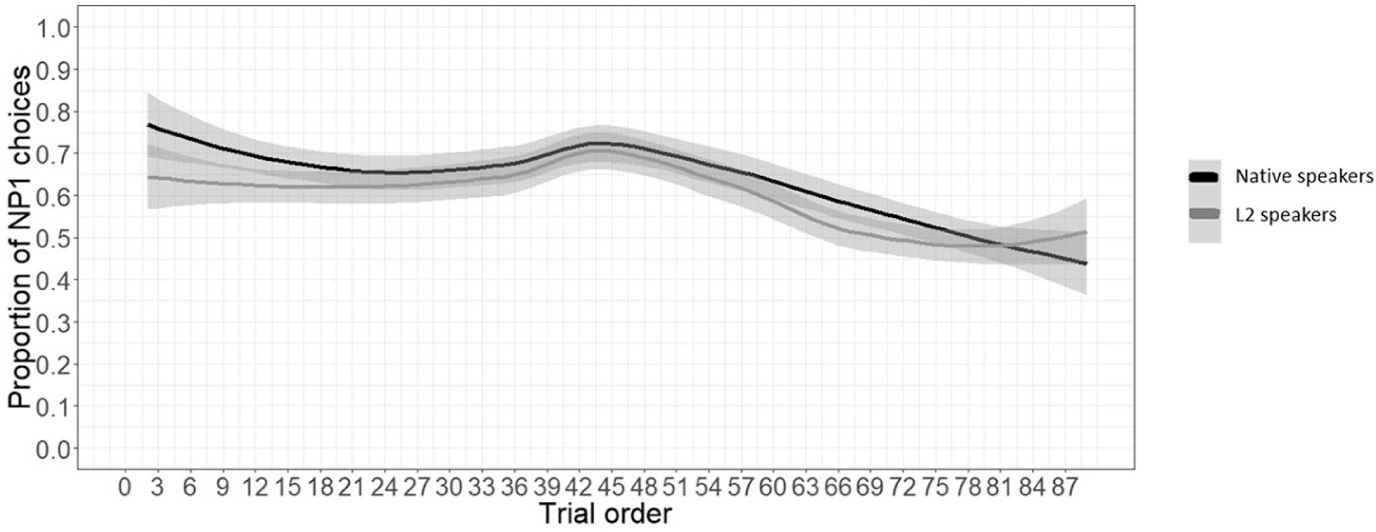
Proportion of NP1 choices over the course of the experiment in native and L2 speakers.
IV Discussion
In the present study, we aimed at priming dis-preferred pronoun interpretations in English by testing a group of native speakers and a group of L2 learners with an off-line sentence comprehension task. The results demonstrated a significant effect of priming in both groups, showing that participants adopted a NP2 interpretation more often when a sentence containing an ambiguous pronoun was preceded by a sentence containing a NP2-biased pronoun in comparison to a baseline condition. Additionally, a main effect of order of trials was found indicating adaptation to the primed interpretations throughout the task.
The results confirm that comprehenders adjust their discourse interpretations in a novel environment where English pronouns are resolved towards the preceding NP2, suggesting that the processor calculates the probability of an anaphoric pronoun to be interpreted in a specific way based on its occurrence in a context (e.g. Kehler et al., 2008).
Notice that in our results no interaction with Group was found. Although L2 and native participants were recruited from different populations (Amazon Mechanical Turk vs. a large university), no difference emerged between the two groups.
This result confirms previous studies demonstrating that intermediate proficiency L2 speakers can interpret pronouns in English like native speakers, when the context is relatively simple (Contemori and Dussias, 2019, accepted; Contemori et al., 2019; Cunnings et al., 2017).
Additionally, the lack of an interaction indicates that the magnitude of immediate and cumulative priming is similar in the native and L2 participants. This finding is not in line with previous results on syntactic priming indicating that L2 learners may present bigger priming effects than native speakers for infrequent structures or dispreferred interpretations at the syntactic level (e.g. Jackson, 2018 for a review). Notice that although most of the previous L2 priming studies have tested production, comprehension priming has also shown bigger structural priming effects in lower proficiency L2 speakers (e.g. Nitschke et al., 2010, 2014).
Our L2 speakers have intermediate proficiency in English and have had less experience with the pronoun resolution preferences in English than native speakers. Despite the reduced exposure, L2 participants showed a similar amount of immediate and cumulative priming than the control group. This result suggests that priming may be determined by the degree to which the structure is a stable representation in the underlying system, regardless of the amount of experience with a structure/preference (e.g. Jackson and Ruf, 2017).
As a result, experience-based differences in priming between native speakers and L2 learners may emerge when the representation for a structure is not completely stable in the learners’ system. In this case, L2 speakers may show bigger effects of priming compared to the native speakers (e.g. Nitschke et al., 2010, 2014). While more research on priming during referential processing is needed to confirm this hypothesis, our study contributes to shed light on the mechanisms underlying structural priming in a population with limited language experience.
Finally, the presence of a robust adaptation effect in L2 speakers supports the hypothesis that structural priming is as a form of implicit learning (e.g. Chang et al., 2006), with the underlying system adjusting its predictions based on each experience and accumulating observations over time. Furthermore, the finding that adult L2-learners adapt their language interpretations based on changes at the discourse level in the linguistic context has implications for L2 learning. Anaphora resolution can be challenging for L2 English speakers when the context increases in complexity (i.e. if two referents are introduced in the discourse via coordination – sharing similar prominence – and the conjunction ‘while’ is used to mark a contrast; Contemori et al., 2019; Roberts et al., 2008). If adaptation is a mechanism that underlies language learning (e.g. Chang et al., 2006), it is crucial to understand how effective and persistent it can be to aid to the successful acquisition of pronoun resolution biases in the L2. In addition, future research should use implicit measures of comprehension (e.g. eye-tracking) to ensure that the immediate and cumulative priming observed in the present study using an off-line comprehension task reflect changes in the processing system as a function of the statistical environment (e.g. Fernandes et al., 2018).
To conclude, our results demonstrated an effect of immediate and cumulative priming in L2 and native speakers, showing that priming can be persistent at the discourse-level for structures that the L2 speakers have acquired successfully. The findings demonstrate that the magnitude of the priming effect can be comparable in L2 and native speakers, suggesting that the learners’ underlying system has stable underlying representations for the pronoun resolution preference tested here.
Footnotes
Declaration of Conflicting Interest
The author(s) declared no potential conflicts of interest with respect to the research, authorship, and/or publication of this article.
Funding
The author(s) received no financial support for the research, authorship, and/or publication of this article.
