



Abstract
This study investigated the influence of phonological word representations from both first language (L1) and second language (L2) on third language (L3) lexical learning in L1-dominant Spanish–English bilinguals. More specifically, we used event-related potentials (ERPs) to determine whether L1 Spanish and L2 English phonology modulates bilinguals’ brain response to newly learned L3 Slovak words, some of which had substantial phonological overlap with either L1 or L2 words (interlingual homophones) in comparison to matched control words with little or no phonological overlap. ERPs were recorded from a group of 20 Spanish–English bilinguals in response to 120 auditory Slovak words, both before and after a three-day-long learning period during which they associated the L3 Slovak novel words with their L1 Spanish translations. Behaviorally, both L1 Spanish and L2 English homophony facilitated the learning of L3 Slovak words in a similar manner. In contrast, the electrophysiological results of the post-training ERPs, but not the pre-training ERPs, showed an N100 effect for L2 English interlingual homophones and opposite N400 effects for L1 Spanish and L2 English interlingual homophones in comparison to control words. These findings suggest different neurocognitive mechanisms in the use of L1 and L2 phonological information when learning novel words in an L3.
Keywords
I Introduction
Bilingualism and multilingualism are rather common in the present-day globalized world; it is estimated that more than a half of the world’s population speaks two or more languages. Although there does not seem to be a special neural mechanism for third language (L3) acquisition that would differ from second language (L2) acquisition, the study of L3 acquisition can provide a specific window to language processing and reveal certain aspects of bilingualism that the study of first language (L1) acquisition and L2 acquisition on their own cannot (De Bot and Jaensch, 2015; Flynn et al., 2004). One such aspect of bilingual language processing is the organization of the mental lexicon and the activation of orthographic, phonological, and semantic information when bilinguals encounter words from their languages (Aitchison, 2012). In particular, the role of phonology seems to be crucial in bilingual word recognition processes, but it is not yet very clear what the precise mechanisms involved in this processing are (Carrasco-Ortiz et al., 2021; Dijkstra et al., 1999, 2010; Mulík et al., 2019). Previous studies have shown evidence for activation of phonological representations of both bilinguals’ languages, even when they read or hear words in only one of them (Carrasco-Ortiz et al., 2012; Grainger and Dijkstra, 1992; Haigh and Jared, 2007; Van Assche et al., 2020). Notably, empirical evidence suggests that previously acquired phonological representations can positively affect L2 lexical learning (Liu and Wiener, 2020) and L3 lexical learning (Mulík et al., 2019). However, what is still unclear is the extent to which this phonological information becomes active in each of the bilingual’s languages in L3 lexical learning and how the nature of this activation affects L3 lexical learning. The present research examined whether phonological representations from both L1 and L2 influence learning of L3 novel words, some of which had substantial phonological overlap with L1 or L2 words. To this end, we used event-related potentials (ERPs) to determine whether L1 and L2 phonology can modulate bilinguals’ brain response to newly learned L3 words.
The ERP technique can provide a continuous measure of brain activity during language comprehension in real time and offers insights into the cognitive mechanisms associated with spoken word recognition. Thus, ERPs can be used to track the temporal dynamics of spoken-word processing as it unfolds (see Dufour et al., 2013; Winsler et al., 2018). Specific ERP components have been linked to different stages of spoken-word processing. One such ERP component is the N400, a negative deflection in the ERP wave with a central scalp distribution peaking about 400 ms after stimulus presentation and spanning anywhere from 200 to 600 ms (Kutas and Federmeier, 2011; Kutas and Hillyard, 1984). Some studies suggest that the N400 can reflect the ease with which phonological and semantic information is retrieved at the lexical level of representation (Carrasco-Ortiz et al., 2012; Desroches et al., 2009; Kutas and Federmeier, 2011; Newman et al., 2012). Another ERP component, the Phonological Mapping (Mismatch) Negativity (PMN), is a negative deflection in the ERP wave with a fronto-central distribution peaking about 300 ms after stimulus presentation (Connolly and Phillips, 1994). The PMN component has been observed only during spoken word recognition tasks, supporting the assertion that it is specifically related to phonological mapping. These two ERP components seem to be functionally distinct; while the PMN appears to be sensitive to sublexical phonological information, the N400 is associated with integration processes of lexical and semantic information (Lewendon et al., 2020). In addition to N400 and PMN, another ERP component associated with spoken word recognition is the N100, a negative deflection in the ERP wave peaking about 100 ms after stimulus presentation, which has been linked to early sensory processing (Näätänen and Picton, 1987).
One way to investigate the effects of phonological similarity between languages is to present bilinguals with interlingual homophones and see whether they process them differently than words that only exist in one of their languages. Generally speaking, interlingual homophones are words that sound similarly but mean something different across languages, e.g. the French word nid ‘nest’ sounds just like the English word knee. Interlingual homophones can be understood as word pairs with substantial degree of phonological overlap, since the acoustic realization of phonemes can vary slightly for different languages. When bilinguals read interlingual homophones, they usually recognize them faster than words that lack phonological overlap (Haigh and Jared, 2007; Lemhöfer and Dijkstra, 2004; but see Dijkstra et al., 1999). Empirical evidence for this facilitation effect comes mainly from visual recognition tasks in priming studies (Brysbaert et al., 1999; Duyck, 2005; Duyck et al., 2004; Van Wijnendaele and Brysbaert, 2002), even across different language scripts (Dimitropoulou et al., 2011; Kim and Davis, 2003), and from single word studies (Haigh and Jared, 2007; Lemhöfer and Dijkstra, 2004). Importantly, there is also electrophysiological evidence for facilitatory effects of interlingual homophones (Carrasco-Ortiz et al., 2012) observed as a reduced amplitude of the N400 component in response to words with a large phonological overlap across bilinguals’ languages compared to control words. Indeed, N400 amplitude is known to be sensitive to how easy it is to access word features in the long-term memory (Federmeier and Kutas, 1999; Kutas and Federmeier, 2000).
In contrast to visual processing of interlingual homophones, empirical evidence for interlingual homophone effects in auditory processing of spoken language is scarce. In behavioral studies on proficient Dutch–English bilinguals, processing inhibition for interlingual homophones compared to control words has been observed in auditory lexical decision tasks both for L1 and L2, probably due to competition between the homophones (Lagrou et al., 2011; Schulpen et al., 2003). Crucially, Altvater-Mackensen and Mani (2011) reported that German–English bilinguals who listened to spoken German sentences with embedded interlingual homophones showed facilitatory effects (reduced N400 amplitudes) to these words in comparison to control words, but only for those participants who learned their L2 English before the age of 6.
Finally, Mulík et al. (2019) observed a behavioral facilitation effect to interlingual homophones in L1-dominant Spanish–English bilinguals who learned novel words in L3 Slovak. They investigated whether such bilinguals would activate words from both their dominant L1 and their less-dominant L2 when learning words in a new L3 and whether the observed L2 activation would depend on their L2 proficiency level. Experimental stimuli used by Mulík et al. (2019) consisted of 120 auditory Slovak words that were homophonous either with English or with Spanish (interlingual homophones) or with neither of these languages (control words). Thirty-five participants, with either high or low L2 English proficiency level, learned as many Slovak words and their written Spanish translations as possible during three days of training, completing various behavioral tasks such as paired-associate learning, correct/incorrect translation recognition and backward translation on Slovak–Spanish translation equivalents. Response times, accuracy scores, and correct translation counts were analyzed and facilitation effects between homophones and control words were studied for both English and Spanish homophones. The phonological similarity of Slovak words with bilinguals’ L2 English words showed similar behavioral facilitation effects as phonological similarity with L1 Spanish words, especially in the high L2 proficiency group. Mulík et al. (2019) interpreted their results as evidence for an involuntary activation of bilinguals’ less-dominant L2, without it being overtly present in the learning task. These results suggest an important contribution of L1 and L2 phonology during the learning of L3 words; however, the precise processing locus of these facilitation effects observed during spoken word recognition is still unclear. The present study used electrophysiological responses to track the time course of the L1 and L2 phonological effects as spoken L3 words unfold over time.
The cross-language effects of phonological similarity can be accounted for by the language non-selective access hypothesis (Dijkstra and van Heuven, 1998, 2002), according to which the visual or auditory presentation of a word can lead to simultaneous activation of word representations in L1 and L2. Shared phonological and orthographic features can increase activation of word candidates within and across languages and this may result in faster word recognition in either of the two languages. Under this assumption, the language non-selective access hypothesis would predict that learning of L3 words with overlapping phonological units with L1 and L2 words would be faster and more efficient than that of L3 words with a lesser degree of phonological similarity with L1 and L2 lexical items.
II The present study
The aim of the present study was to further investigate the role of L1 and L2 phonology during L3 lexical learning. More specifically, we examined whether phonological similarity between words of either one of the bilingual’s languages with those in L3 would lead to activation of L1 and L2 words and thus modulate learning of L3 words. Recent evidence suggests that L1-dominant bilinguals can make use of both of their languages to learn L3 novel words (Bartolotti and Marian, 2017), even when one of them is not explicitly present in the learning situation (Mulík et al., 2019). Of particular relevance for the current study were the neurocognitive mechanisms associated with the use of phonological information from L1 Spanish and L2 English in L3 Slovak lexical learning in L1-dominant Spanish–English bilinguals. The measure of interest in the present study was the ERPs, which can be more informative about the underlying cognitive processes in word processing than behavioral measures, such as reaction times and accuracy measures (Bice and Kroll, 2015). ERPs can give a fine-grained account of distinct processing stages of spoken word recognition that precede behavioral responses. Also, ERPs are useful in distinguishing different ERP components that may reveal specific neurocognitive mechanisms engaged during L1 and L2 processing in L3 lexical learning.
As the language non-selective access hypothesis (Dijkstra and van Heuven, 2002) would assume parallel activation of L1 and L2 lexical representations that are phonologically similar to the unfolding lexical input, we expected to find similar facilitatory effects for both L1 and L2 phonology during L3 lexical learning. However, the influence of L1 and L2 phonology can be observed at different stages of L3 word recognition. In particular, the effect of L1 and L2 phonology could be seen at early moments of spoken word recognition, namely on the N100 and PMN components. The presence of an N100 effect would indicate early sensory processing of L1 Spanish and L2 English homophones in L3 lexical learning, whilst the PMN effect would point to the effects of L1 Spanish and L2 English phonology at a prelexical stage. Some studies have already shown that phonological similarity within and across languages can modulate early ERP components, such as the N100 and PMN, revealing pre-lexical processing mechanisms in spoken word recognition (Dufour et al., 2013; Desroches et al., 2009; Xue et al., 2020).
We also expected to find L1 and L2 phonological effects on a late ERP component reflecting lexical processing, such as the N400, which has been found to be sensitive to the difficulty for the integration of phonological, orthographic, and semantic information for a given word (Holcomb, 1993). Under this assumption, any activation of L1 and L2 phonological representations should modulate the N400 amplitude during L3 lexical processing. More specifically, reduced N400 amplitudes were hypothesized to occur in response to interlingual homophones in comparison to their matched control words. Based on previous studies (Altvater-Mackensen and Mani, 2011; Carrasco-Ortiz et al., 2012; Midgley et al., 2011), we can interpret this reduced negativity as a facilitation due to a greater ease in processing L3 words that enjoy substantial overlap with phonological representations stored in both bilinguals’ languages. However, the fact that the present study comes to observe three languages at play can result in different cross-language effects in the N400 amplitude as compared to previous bilingual studies (De Bot and Jaensch, 2015).
To test these hypotheses, we recorded Spanish-dominant Spanish–English bilinguals’ brain activity while they listened to a list of L3 Slovak words, some of which were homophonous with their L1 Spanish words (e.g. Slovak /kuɾa/ ‘chicken’ is homophonous with the Spanish word cura /kuɾa/ ‘priest’) and others with their L2 English words (e.g. Slovak /ʃip/ ‘arrow’ is homophonous with the English word sheep). The recordings of bilinguals’ brain activity via ERPs were performed both before and after a three-day-long training period during which the participants were taught novel L3 words with their L1 translations and then tested on their learning. With respect to the training sessions, we expected for L3 Slovak interlingual homophones with L1 Spanish and L2 English to be learned with more ease than control words. We also expected the behavioral facilitation effects of L3 Slovak interlingual homophones with L1 Spanish to be similar to those of L3 Slovak interlingual homophones with L2 English, which would replicate the results reported by Mulík et al. (2019).
As for the ERP recordings both before and after the training period, participants were instructed in Spanish to listen carefully to the Slovak words, but they did not perform any overt task during the ERP recording in order to ensure that the processing of the auditory L3 Slovak words was as automatic as possible (see Holcomb et al., 2002). We predicted a modulation in N400 amplitude for interlingual homophones in comparison to control words due to a facilitation effect of the overlapping phonological features of interlingual homophones across languages. Crucially, if there was a difference in underlying neurocognitive mechanisms that L1-dominant bilinguals implement for the use of L1 and L2 phonological information in L3 lexical learning, then the L3 Slovak words with L1 Spanish homophones should exhibit different ERP effects than the L3 Slovak words with L2 English homophones.
III Method
1 Participants
Twenty Spanish–English bilinguals (15 females) participated in the study. Their ages ranged from 19 to 27 years (mean age = 22.7, SD = 2.0). All participants were native speakers of Spanish and had acquired English as an L2; their ages of L2 acquisition ranged from 3 to 17 years (mean age = 9.6, SD = 4.0). Eleven participants also reported having recently started to learn an L3, most commonly French (mean exposure = 1.6 years, SD = 1.1). According to the Edinburgh Handedness Questionnaire (Oldfield, 1971), all participants were right-handed. All of them also had normal or corrected-to-normal vision and reported no hearing problems, brain injury, or neurological damage.
Before taking part in the experiment, all participants signed an informed consent form and completed the Language History Questionnaire – LHQ 2.0 (Li et al., 2014), in which they self-evaluated their Spanish and English skills on a Likert scale (1 = very poor, 7 = excellent). Table 1 shows participants’ ratings of their ability for listening, speaking, reading, and writing in both languages, and the results of a paired t-test which showed that participants overall rated their abilities in L1 Spanish better than in L2 English. In order to assess bilinguals’ language dominance, the Bilingual Language Profile (BLP) questionnaire was used (Birdsong et al., 2012). The BLP uses a self-report to produce a general bilingual profile and a continuous dominance score. The four modules of the BLP (language history, language use, language proficiency, and language attitudes) receive equal weighting and the dominance score is calculated by subtracting the English score from the Spanish score, with positive numbers yielding Spanish-dominance and negative numbers English-dominance (Gertken et al., 2014). The English and Spanish scores are shown in Table 1. According to BLP, all 20 participants were Spanish-dominant, and their average dominance score was 82 (SD = 23).
Participants’ Spanish and English language skills (1 = very poor, 7 = excellent) and dominance scores (max. value = 218) obtained from ratings reported in the Language History Questionnaire (LHQ) and the Bilingual Language Profile (BLP), respectively.

Notes. The p values of a Student’s t-test for paired samples show significantly higher Spanish than English scores for the group of 20 participants.
2 Stimuli
Experimental stimuli used in the present study were the same as those used by Mulík et al. (2019). The stimuli consisted of 120 auditory Slovak words with substantial phonological overlap with either English or Spanish (interlingual homophones) or with neither language (control words), and their 120 written Spanish translations. The Slovak words, recorded by a native speaker of Slovak, were phonotactically legal in English or in Spanish. In terms of experimental manipulation of the auditory stimuli, they were assigned into four experimental conditions (Spanish interlingual homophones, control words for Spanish interlingual homophones, English interlingual homophones, control words for English interlingual homophones) based on two measures of phonological similarity. On the one hand, monolingual native speakers of English and Spanish evaluated the phonological similarity of the Slovak words with the bilinguals’ L1 and L2; on the other hand, the phonological Levenshtein distance (Levenshtein, 1966; Yarkoni et al., 2008) was measured for the Slovak words and their corresponding English and Spanish interlingual homophone transcriptions (Table 2). Importantly, both measures showed that Spanish and English interlingual homophones did not differ in terms of their phonological similarity to existing Spanish and English words, and neither did the Spanish and English control words. Crucially, however, interlingual homophones and control words differed in terms of phonological similarity, both for English and Spanish. The four experimental conditions contained 30 Slovak words each, controlled for their length in the number of phonemes. The 120 Spanish translations were also controlled for length, animacy, concreteness, and lexical frequency among the four experimental conditions (Mulík et al., 2019). Since high-frequency words can reach the threshold for activation more quickly than low-frequency words (Dahan et al., 2001; Grainger, 1990), we controlled for frequency effects by using words of the same lexical frequency in each experimental condition (based on L1 Spanish translations). Similarly, L1 Spanish interlingual homophones and L2 English interlingual homophones did not differ in terms of word frequency either (Marian et al., 2012).
Phonological similarity of the Slovak experimental stimuli for Spanish and English interlingual homophones and respective control words (Mulík et al., 2019): Monolingual native speaker evaluation (MNSE; 1 = not similar; 7 = very similar) and phonological Levenshtein distance (PLD; 0 = identical).

3 Experimental procedure
During three days of training, participants completed various learning and testing tasks so that we could examine the facilitation effect of interlingual homophones with either Spanish or English by means of behavioral and electrophysiological measures (Figure 1).
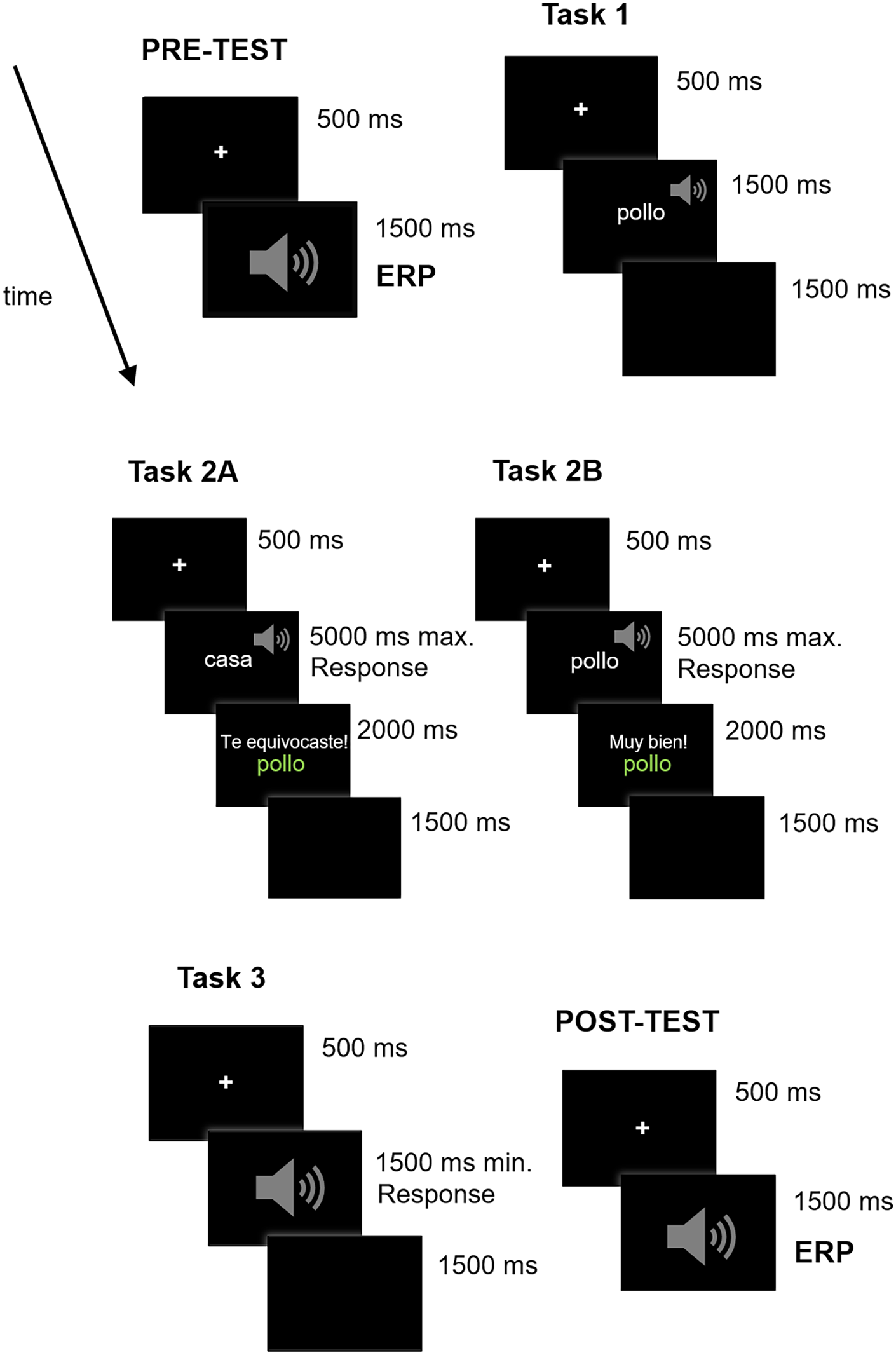
Behavioral and event-related potentials (ERPs) tasks used in the experiment.
On each day, they underwent an individual computerized session with a paired-associate learning task (Task 1), a translation recognition and decision task (Task 2), and a Slovak-to-Spanish backward translation task (Task 3). These three tasks were the same as those used by Mulík et al. (2019). In addition to the behavioral tasks 1, 2, and 3, participants also completed an ERP pre-test and post-test task. The ERP pre-test task was carried out at the beginning of the first day of training, before the participants had started learning the auditory Slovak words. The ERP post-test task, on the other hand, was carried out at the end of the last day of training. All training and testing tasks were carried out in a sound-attenuated room, where the participants were comfortably seated in front of a computer screen. Auditory stimuli were delivered by means of earphone inserts (Compumedics NeuroScan, USA); visual stimuli were presented at the center of the screen in white font on black background. All instructions were given in Spanish.
a Behavioral tasks
In the present experiment, all participants aimed at learning all 120 Slovak words and their corresponding Spanish translations. The three behavioral tasks were run in SuperLab 4.5 (Cedrus Corporation, USA). The 120 randomly ordered trials in Task 1 consisted of a 500 ms fixation cross, followed by a simultaneous presentation of an auditory Slovak word and its correct written Spanish translation which remained on the computer screen for 1,500 ms, and a subsequent 1,500 ms blank inter-trial interval (ITI) window. At the beginning of Task 1, participants were instructed to pay close attention and remember as many Slovak words and their Spanish translations as possible. To provide the participants with more exposure to the word pairs to be learned, Task 1 was always performed twice in a row. Task 2 also consisted of 120 random trials, starting with a 500 ms fixation cross followed by a simultaneous presentation of an auditory Slovak word and a written Spanish translation which was either incorrect (50% of trials, Figure 1: Task 2A) or correct (50% of trials, Figure 1: Task 2B). The written translation remained on the computer screen until the participants identified it as correct or incorrect by pressing a button (or until the maximum time of 5,000 ms had elapsed), followed by visual feedback (2,000 ms) and a subsequent 1,500 ms blank ITI window. Response times and accuracy of the answers from Task 2 were recorded by means of a Cedrus Response Pad RB740. Finally, the 120 trials in Task 3 consisted of a fixation cross (500 ms) after which an auditory Slovak word was presented for the participants who were previously instructed to recall and write down its correct Spanish translation on a provided answer sheet. Task 3 was self-paced, with a 1,500 ms blank ITI window.
b ERP tasks
Both the pre-test and the post-test ERP task were run in Stim2 (Compumedics NeuroScan, USA). In these tasks, each trial consisted of a fixation cross presented for 500 ms at the center of the computer screen, followed by a 1,500 ms interval at the beginning of which the participants heard an auditory Slovak word. In total, the participants listened to the 120 auditory Slovak words in random order while an electroencephalogram (EEG) was continuously recorded from their scalp, using 32 electrodes mounted in an elastic cap according to the International 10–20 System (Klem et al., 1999). The vertical and horizontal electrooculogram (from the right and left eye, respectively) were obtained in order to monitor blinks and eye movements. Impedances were maintained under 10 kΩ for all channels.
After the recording, the EEG data from all electrodes were re-referenced offline to the mean of both mastoids. Then, the EEG data were filtered using a bandpass range of 0.01 Hz to 30 Hz and digitized at a sampling rate of 1,000 Hz. Epochs of 1,000 ms, including 100 ms pre-stimulus baseline, were time-locked to the word onset. For artifact removal, trials with values above 100 µV and below –100 µV were discarded (16.4% and 13.8% of trials for pre-test and post-test, respectively). Both for the pre-test and the post-test, the data from three participants were removed because of noisy data or too many EEG artifacts. For the remaining 17 participants whose EEG data were analyzed, there were at least 24 clean trials out of 30 left in each condition on average after artefact rejection. For each electrode, average ERPs for each participant in each of the four experimental conditions were calculated offline from trials without artifacts. Grand average ERPs were calculated for the whole group from individual average ERPs.
4 Data analysis
Mean response times (RTs) and sensitivity scores (d′) were calculated from participants’ responses in the translation recognition and decision task (Task 2) for each learning session and each experimental condition. RTs of incorrect responses were discarded (43% of all data), along with those that were above 2.5 SD from the mean (1% of all data). Participants’ d′ sensitivity scores were calculated as their ability to discriminate between correct and incorrect Spanish translations of the auditory Slovak words (d′ = z(Hit) − z(False Alarm)), ranging from an at-chance performance (d′ = 0) to a near-perfect performance (d′ = 4.65) (Macmillan and Creelman, 2004). The correct translation count (N) was calculated as the sum of the correct Spanish translations each participant could provide for the auditory Slovak words in the Slovak-to-Spanish backward translation task (Task 3).
5 Statistical analysis
Participants’ RTs (Task 2), d′ sensitivity scores (Task 2), and correct translation counts (Task 3), as well as mean voltage between 50–150 ms, 250–350 ms and 350–550 ms post-stimulus onset (ERP pre-test and post-test tasks), were analyzed by repeated measures analyses of variance (ANOVAs). For behavioral measures, three factors were considered in the ANOVA:
IV Results
The phonological similarity of novel L3 Slovak words with participants’ L1 Spanish words showed similar behavioral facilitation effects in L3 lexical learning as phonological similarity of novel L3 Slovak words with L2 English words. Unlike the behavioral data, however, electrophysiological data showed different effects of phonological similarity of novel L3 Slovak words with participants’ L1 Spanish words and L2 English words. The data and the materials can be accessed at http://osf.io/dxfbv.
1 Behavioral results
The analysis of behavioral data from the three days of training revealed that, regardless of language, interlingual homophones yielded shorter RTs and higher d′ sensitivity scores compared to control words in the translation recognition and decision task, as well as higher correct translation counts in the backward translation task (Figure 2).

Behavioral results.
The results of repeated-measures ANOVAs are reported in Table 3. The facilitation effects of homophony shown in Figure 2 were confirmed by means of a significant main effect of
Results of repeated-measures ANOVAs for response times (RT), sensitivity scores (d′), and correct translation counts (N).

Notes. * Significant effects.
The results of repeated-measures ANOVAs also showed a significant main effect of learning
2 Electrophysiological results
a Pre-test
As for early ERP components, the ANOVA conducted in the 50–150 ms post-stimulus time window (N100) did not reveal any significant main effects of
In the 250–350 ms post-stimulus time window (PMN), the results of the ANOVA revealed a significant main effect of
Concerning the N400 component, ERPs registered before the learning sessions in the 350–550 ms post-stimulus time window did not reveal any significant effects of L1 Spanish (Figure 3) nor L2 English homophony (Figure 4), since there was no significant main effect of the manipulated variables of

Participants’ grand average event-related potentials (ERPs) for Spanish interlingual homophones and Spanish control words in the pre-test.

Participants’ grand average event-related potentials (ERPs) for English interlingual homophones and English control words in the pre-test.
b Post-test
Crucially, ERPs registered after the three learning sessions showed significant effects of both Spanish homophony (Figure 5) and English homophony (Figure 6) in the 350–550 ms post-stimulus time window (N400), and an early effect of English homophony in the 50–150 ms post-stimulus time window (N100). This is in sharp contrast with the results from the pre-test, where no such effects of homophony (

Participants’ grand average event-related potentials (ERPs) for Spanish interlingual homophones and Spanish control words in the post-test.
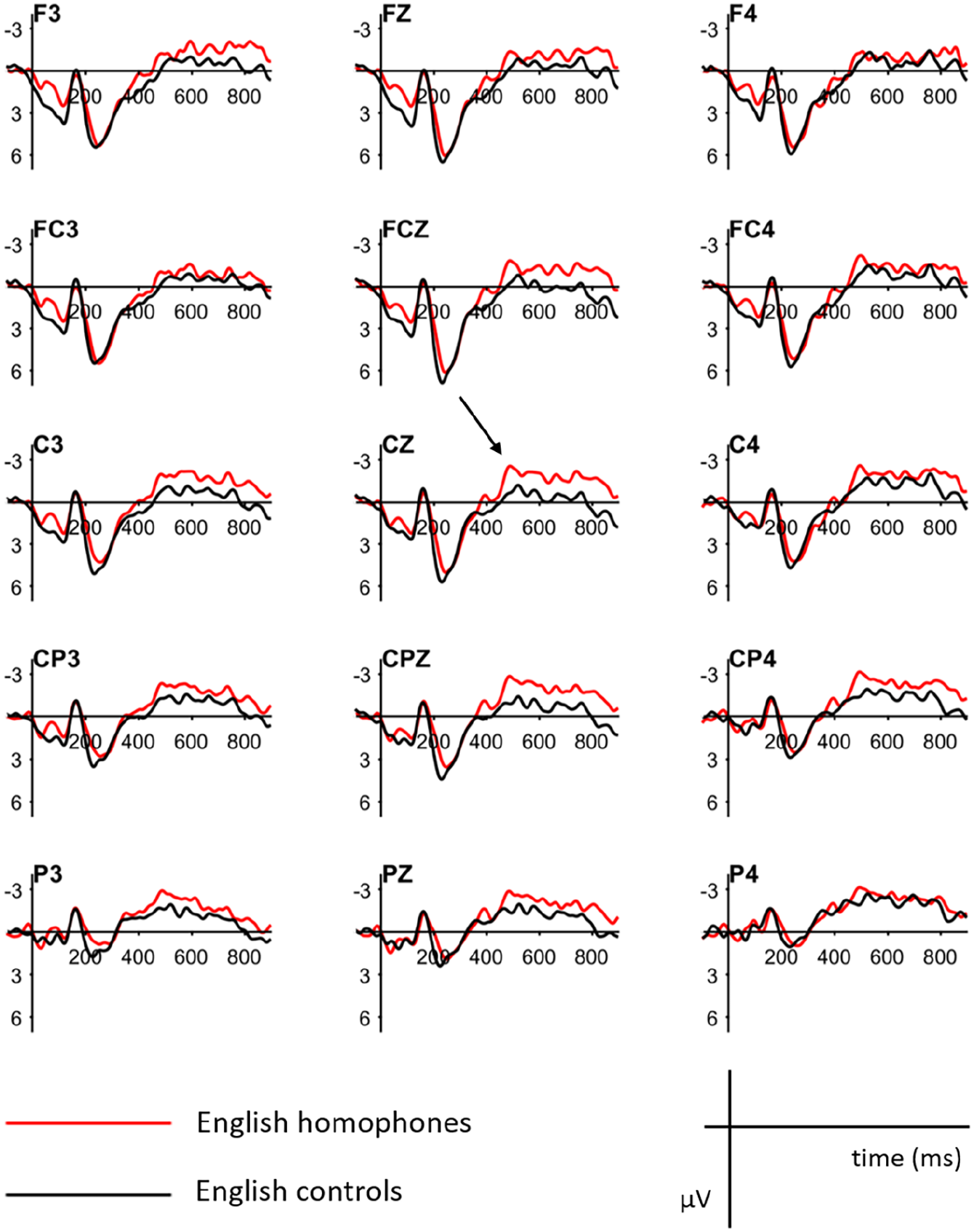
Participants’ grand average event-related potentials (ERPs) for English interlingual homophones and English control words in the post-test.
As for early ERP components, the ANOVA conducted in the 50–150 ms post-stimulus time window (N100) showed a marginally significant
Analyses carried out in the 250–350 ms post-stimulus time window (PMN) did not reveal any significant main effects of
In the 350–550 ms post-stimulus time window (N400), the results of repeated-measures ANOVAs showed a significant
Visual inspection of the topographic maps for the statistically significant effects of Spanish and English homophony in the post-test points to several differences between the L1 Spanish and L2 English homophony effects (Figure 7). In the N100 time window (50–150 ms), there is a prominent negative English homophones-minus-controls difference (in blue) peaking around 100 ms (Figure 7, post-test). In the N400 time window (350–550 ms), the positive Spanish homophones-minus-controls difference wave (in red) contrasts with the negative English homophones-minus-controls difference wave (in blue) (Figure 7, post-test). In the pre-test, similar N400 effects are visually present for both languages, but they are not statistically significant (Figure 7, pre-test). No significant differences were found for the topographical distribution of the N400 effects, neither in the pre-test nor in the post-test.
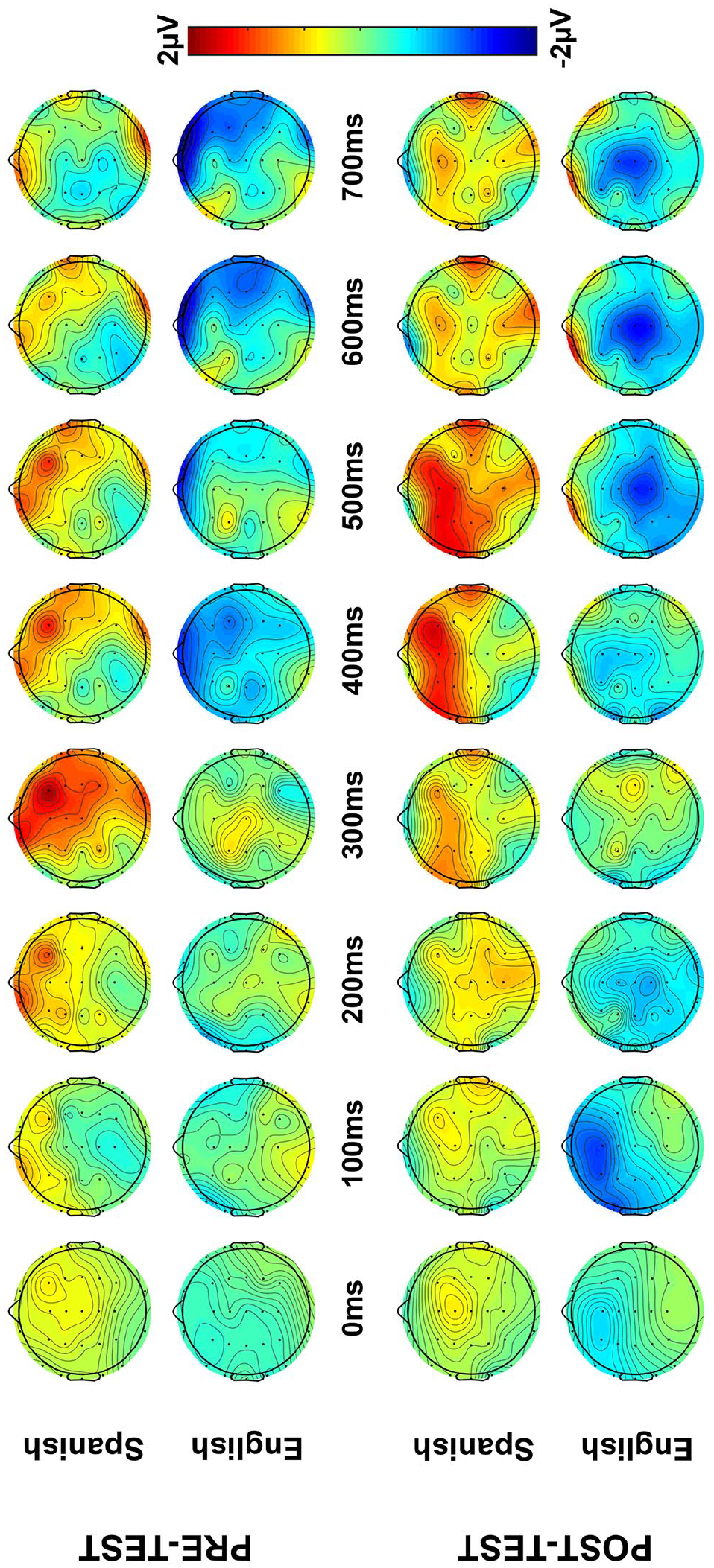
Topographic maps for the homophones-minus-controls difference waves in 100 ms-long post-stimulus windows for both Spanish and English in both pre-test and post-test.
V Discussion and conclusions
The present study examined cross-language phonological activation of L1 Spanish and L2 English words in L1-dominant Spanish–English bilinguals during L3 Slovak lexical learning. To address this question, we recorded the bilinguals’ brain activity while they passively listened to interlingual homophones and matched control words in L3 Slovak, both before and after three days of training. Results from the training sessions showed comparable behavioral facilitation effects of phonologically similar L3 words with participants’ L2 and L1 words, which suggests phonological activation of both bilinguals’ languages, even when their non-dominant L2 was not overtly present in the L3 lexical learning task. Although behavioral results did not reveal any differences as a function of bilinguals’ L1 and L2, electrophysiological results showed some important ERP differences in response to L1 Spanish and L2 English interlingual homophones which were only present after three days of training. While in the pre-test no effects of L1 Spanish or L2 English homophony were observed, in the post-test there was an N100 effect of L2 English homophony found between 50 and 150 ms, as well as opposite effects of L1 and L2 phonological similarity on L3 lexical processing that were found between 350 and 550 ms. A reduced negativity in this N400 time window was observed in response to L3 Slovak words homophonous with L1 Spanish words, whereas an increased negativity in the N400 was observed in response to L3 Slovak words homophonous with L2 English words. No PMN effects of L1 Spanish or L2 English homophony were observed in the 250–350 ms time window, neither in the pre-test nor in the post-test. These results provide further ERP evidence for a strong language non-selective access hypothesis (Dijkstra and van Heuven, 1998, 2002), which predicts the simultaneous activation of word representations in both bilinguals’ languages, even when only one language is required for the task.
The discrepancy observed between N100 and N400 effects of L1 and L2 interlingual homophones could have arisen from the bilinguals’ language mode (Grosjean, 2001) during the learning sessions. Indeed, all instruction during the experiment were given in Spanish and participants were exposed to L3 Slovak words and their L1 Spanish translation equivalents, but not their L2 English translation equivalents. It is possible that our participants were expecting to use only their L1 Spanish and not their L2 English in the L3 lexical learning sessions. This could have yielded a cost for processing L3 Slovak words homophonous with L2 English words as their co-activated L2 English interlingual homophones were not pertinent for the task, resulting in increased N100 and N400 amplitudes. This is in line with previous studies showing that the language mode of the task and even of the whole experiment can affect the processing of bilinguals’ languages (Canseco-Gonzalez et al., 2010; Dunn and Fox Tree, 2014). In order to test this account in future studies, the experiment could be run entirely in English instead of Spanish, including English instructions and English word translations in all tasks. If reduced N400 amplitudes for English homophones and increased N100 and N400 amplitudes for Spanish homophones were to be observed in this inverse language mode setting, the proposed language mode explanation would be confirmed; otherwise, it would be falsified.
Alternatively, the opposite N400 effects for L1 and L2 interlingual homophones can also be accounted for by means of differences in the inhibitory processes for L1 and L2 interlingual homophone competitors. L1-dominant bilinguals could be able to readily inhibit the influence of L1 interlingual homophones but not that of L2 interlingual homophones during the L3 lexical recognition task. In line with this tentative account, previous studies show that inhibiting the L1 is a skill bilinguals can acquire along with learning an L2 (Green, 1998; Levy et al., 2007; Linck et al., 2009). It is thus possible that differences in the N400 amplitude observed in our study can reflect the extent to which L1-dominant bilinguals were able to inhibit L1 interference more easily than L2 interference. Indeed, the N400 effect has been linked not only to activation processes but also to inhibition processes in word recognition (e.g. Barber et al., 2004; Jankowiak and Rataj, 2017; Koyama et al., 1992). Τhis is in line with the inhibition account of N400 generation, which predicts that the stronger the required inhibition is, the greater the N400 amplitude will be (Debruille, 2007). Additional evidence for this account comes from the N100 effect for L2 English homophones but not L1 Spanish homophones we observed in the post-test, which could be interpreted as a sign of different early sensory processing of L2 English homophones and L1 Spanish homophones resulting from the training period (Näätänen and Picton, 1987). In future studies, measures of individual differences in inhibitory control, which can be obtained from behavioral tasks such as Stroop, Flanker, Simon, and others, might help clarify the inhibition account of opposite N400 effects for L1 and L2 interlingual homophones in L3 lexical learning (see, among others, Bice and Kroll, 2015; Blumenfeld and Marian, 2011; Linck et al., 2011).
Finally, the reduction in N400 amplitude observed for L1 Spanish interlingual homophones could be attributed to the phonological overlap of L3 Slovak words with L1 Spanish words, which would confirm our hypothesis that lexical processing was facilitated for these words compared to their matched control words. Indeed, a reduction in N400 amplitude might reflect facilitation in the activation of features that are associated with word representations in long-term memory (Federmeier and Kutas, 1999; Kutas and Federmeier, 2000). These results are in line with those obtained by Altvater-Mackensen and Mani (2011), who also observed a reduced N400 amplitude for interlingual homophones in German–English bilinguals who listened to L1 sentences. Contrary to our hypotheses, an increase in N400 amplitude was observed for L2 English interlingual homophones compared to matched control words. These results suggest that bilinguals may engage different neurocognitive mechanisms to process L3 Slovak words that share phonological overlapping units with their L1 and L2. It is likely that the processing advantage observed behaviorally for the recognition of L1 translation equivalents has increased the N400 amplitude due to a selection process between phonologically similar L2 and L3 word candidates. Indeed, previous studies (Holcomb et al., 2002; Müller et al., 2010) suggest that the activation of semantic information associated with multiple lexical candidates can bring about an increase in the N400 amplitude. In light of this, the increased N100 and N400 amplitudes we observed for L2 English homophones could be interpreted as a parallel activation of L2 during early sensory processing of L3 words (N100) that was later accompanied by a lexical selection process at the phonological level of representation (N400).
According to the Revised Hierarchical Model (RHM), proposed by Kroll and Stewart (1994), each entry in the bilingual’s mental lexicon is represented as an L1 and L2 word form at the lexical level with a shared semantic representation at the conceptual level. Importantly, L1-dominant bilinguals can rely on strong lexical links between the L2 translation and the L1 translation of a word (L2→L1) but not in the opposite direction (L1→L2). Similarly, the conceptual links between the L1 word form and the meaning are stronger than the conceptual links between the L2 word form and the meaning of the word. Under this view, bilinguals are more likely to activate the corresponding translation pair upon hearing an L2 word than upon hearing an L1 word. Thus, when the participants in our experiment heard L3 Slovak words with L1 Spanish interlingual homophones, they probably activated the L1 Spanish interlingual homophone more easily than the L2 English interlingual homophone after hearing the corresponding L3 Slovak word. Also, hearing an L3 Slovak word (e.g. /ʃip/ ‘arrow’) with L2 English interlingual homophone (sheep) might have activated the L1 translation of the L2 English homophone (oveja ‘sheep’) as well as the newly learned L1 Spanish translation of the L3 Slovak word (flecha ‘arrow’), thus generating an increase of lexico-semantic information in the system (flecha ‘arrow’ ←→ oveja ‘sheep’). The resulting competition between the L2 interlingual homophone and its L1 translation, absent in the case of L1 interlingual homophones, could have elicited greater N400 amplitudes in response to L2 English interlingual homophones in comparison to their control words. Therefore, our results could also be explained by difference in the activation of lexical-semantic information generated in the bilingual system during L3 word recognition, arising from the asymmetry between bilinguals’ language dominance for L1 and L2.
In conclusion, behavioral results point to similar facilitation effects of L1 and L2 homophony with novel L3 words, as reported in a previous study (Mulík et al., 2019). However, electrophysiological results suggest that L1-dominant bilinguals can implement different neurocognitive mechanisms in the use of L1 and L2 phonological information when learning novel words in an L3. The present findings are in line with previous studies demonstrating that bilinguals seem to access and activate their unused language during speech comprehension (FitzPatrick and Indefrey, 2014; Shook and Marian, 2019). Our results suggest that L1-dominant bilinguals can make use of both of their languages to learn L3 novel words, even when one of them is not explicitly present in the learning situation. The present study also provides electrophysiological data that confirm the facilitatory interlingual homophone effect of L3 words homophonous with the bilinguals’ dominant L1 words. Moreover, the opposite N400 effect found for L3 interlingual homophones with the bilinguals’ non-dominant L2 could be attributed to competition amongst numerous activated lexical candidates in the bilingual system.
Footnotes
Acknowledgements
The authors would like to thank the editor and the reviewers of this article for their helpful comments and suggestions, as well as to the participants of this study and the members of the Neurolinguistics Research Group (Grupo de Investigación en Neurolingüística) at Universidad Autónoma de Querétaro for their support during data collection and analysis.
Declaration of conflicting interests
The author(s) declared no potential conflicts of interest with respect to the research, authorship, and/or publication of this article.
Funding
The author(s) disclosed receipt of the following financial support for the research, authorship, and/or publication of this article: This work was supported by the CONACYT (Consejo Nacional de Ciencia y Tecnología de México) National Grants 2015 and 2017 awarded to Stanislav Mulík [grant numbers 404688 and 473389].
