



Abstract
As research into online informal language learning (OILL) develops as a field, the impact on such practices for a wide variety of contexts can be considered. In the case of this publication, the study abroad (SA) context is of particular interest. Indeed the study abroad student may interact with a range of online learning resources in formal, non-formal and informal contexts before during and after mobility. This review article looks at both Online Informal Language Learning and non-formal learning activities relevant to SA, with particular focus on the Erasmus + online learning support (OLS) platform and popular commercial non-formal learning apps such as Duolingo and Busuu. Such informal and non-formal learning activities also interact with formal language learning offered to SA students, some of which may also take place online. Formal, non-formal and informal learning can therefore be seen to constitute a personal learning environment (PLE) which is specific to each learner. Complex systems views of language learning, including usage based approaches and cognitive grammar, form a useful theoretical framework for understanding how second language (L2) skills may develop as learners are exposed to frequently occurring prototypes in salient contexts in input. While it is now widely accepted that such exposure has a significant impact on comprehension levels, research continues into individual differences between learners in terms of exposure time and cognitive, affective and linguistic engagement with the target materials. Data will be presented indicating that while formal and non-formal learning activities involve exposure times which are often insufficient for significant language development when taken in isolation, informal learning activities offer exposure times and forms of engagement which support language development for many learners. Issues surrounding the assessment and certification of linguistic skills gained outside the classroom are addressed in conclusion.
I Introduction
Language learners receive input not only from face-to-face encounters with the target language but also from virtual online interaction in what is becoming known as the ‘digital wild’ (Sauro and Zourou, 2019; Wagner, 2015). More is being learned about the virtual component of this input ecology as research into online informal language learning (OILL) develops as a field. The impact of practices such as watching television series or playing online games in the target language may be considered in a wide variety of contexts. In the case of the present publication, the study abroad (SA) context is of particular interest, since mobility candidates may interact with a range of online learning resources in formal, non-formal and informal contexts before, during and after mobility. The existing body of research into the use of online resources in the context of SA focuses mostly on the risks of excessive first language (L1) online activities for English speaking learners of other languages rather than opportunities for online informal learning of English by SA candidates with other native languages. This includes considerations of the interactions between physical and virtual mobility (Coleman and Chafer, 2010), the risks of extensive contact with L1 networks during SA (Hofer et al., 2016; Mikal and Grace, 2012) and the interaction between technology use and motivation during SA (Seibert Hanson and Dracos, 2016). These issues have been referred to by Seibert Hanson and Dracos (2019) as ‘the digital dilemma’. While online activities in the target language can interact positively with SA, frequent L1 interaction via social media may be detrimental to the learning opportunities of SA. Since OILL focuses on target language activities, particularly in English, the impact of online exposure to the target language on the study abroad experience as a whole will be the focus of this review, and may be of interest to researchers in both SA and OILL.
The contents of this article were presented as a plenary communication at the 2019 conference entitled ‘Input in study abroad and views from acquisition: Focus on constructs, operationalizations and measurement issues’ at the University of Barcelona, as the organizers sought to explore interdisciplinary avenues within the field of second language acquisition by questioning both physical mobility (SA) and virtual mobility (Learning in the digital wild). As such, it seeks to open a dialogue between these important fields. The article will first suggest that the personal learning environment (PLE) is a useful metaphor for understanding the learner’s experience of different forms of input. This allows a holistic focus on the activity of the learner rather than on individual academic structures within which the learner operates. This notional environment may be made up of formal, non-formal and informal language-learning activities accessed on platforms as varied as Moodle, Duolingo or Youtube. Second, it will be argued that informal learning, particularly of English, far from being a sideline in the learning process, is central to language learning today, particularly in the Erasmus context. Third, it will be suggested that non-formal tools, such as language learning apps and the Erasmus+ Online Learning Support (OLS) platform, may be a significant component of the personal learning environment of SA students. Finally, the challenge of assessing and certifying language learning outside a formal system will be discussed with reference to both informal and non-formal language learning activities.
II Learning environments
As a first step in considering synergies between OILL and SA, it may be helpful to adopt the perspective of a language learner in an SA context who learns through a range of interacting resources, relationships and experiences. This holistic view has been theorized in computer assisted language learning research as the personal learning environment (PLE). More broadly, in second language acquisition, complex dynamic systems theories have also led researchers to consider learning as emerging from wide ranging and complex interactions. These perspectives are helpful as researchers observe that within their learning ecosystem, alongside face to face exposure to the target language, learners are in contact with a variety of learning materials in formal, non-formal and informal contexts.
1 Personal learning environments
In their study of PLEs, Laakkonen and Taalas (2015: 171) remind us that ‘this concept was used as both a practice-oriented description of the digital environments students use and may use for learning purposes, and as an ideological concept that entails and presumes certain pedagogical choices.’ For the purposes of this review article, we will limit ourselves to the descriptive dimension of this definition. While keeping in mind that practitioners may wish to prescriptively organize learning resources of different types through the use of bespoke tools, the focus here is on the interactions between online and face-to-face language activities. This reminder that the varying resources used by the learner are experienced as a single connected environment is an important one which we will return to in our discussion of learning as a complex dynamic system. It may indeed be the case that the learner’s ability to make links between content experienced in formal, informal and non-formal contexts is a useful indicator of language development.
Within the learner’s PLE, these contexts can be further characterized. Formal learning materials originate from an academic context and as such are prescribed by a teacher and are likely to be the subject of some form of assessment. Formal learning in higher education involves both class time and online activities prescribed by a teacher. It is of course possible for formal learning materials, such as recordings listened to on a University learning management system (LMS), to originate from the mass media and/or to involve the use of informal register. However, they should still be considered as formal learning activities since the learner does not engage in them on their own initiative and the pedagogical activity has been specifically designed around the material with the aim of language learning. Formal learning materials in higher education often consist of a relatively small number of large units, since classes are usually 1–2 hours in duration, over 20–30 weeks of the academic year.
The non-formal context is perhaps the most visible to the layman since it involves commercial products such as Speaky 1 or Duolingo 2 designed for language learning outside any academic context. This implies that non-formal activities are engaged in at the learner’s initiative. Current non-formal apps and websites fall into two major categories: content-focused tools, such as Rosetta Stone and Duolingo and interaction-focused tools such as Italki and Speaky. In this article, we seek to point to the significance of non-formal learning as part of the bigger picture of the personal learning environment of each learner, with particular reference to SA contexts. Non-formal learning materials often consist of very large numbers of micro-learning units, designed to be studied every day for a few minutes, typically on a mobile device while commuting for example. The non-formal learning tool of particular interest in the context of European student mobility is the Erasmus + Online Learning Support platform (OLS) which offers mobility candidates materials for learning all European languages.
A main focus of this review is online informal learning, or learning in the digital wild, which involves learning naturalistically from resources not designed for language learning. Examples of this include binge-watching Netflix in English, multiplayer gaming in another language or social networking another language. The practices of informal online learning, while changing over time, still predominantly focus on listening activities. Music with English language lyrics has been a constant source of language exposure over many decades, and the internet has facilitated access to transcriptions of popular songs. The development of personal listening devices means that the English language music can be listened to for extended periods. Music therefore increasingly offers opportunities for informal language learning.
Since the broadening of access to high speed internet some since the early 2010s, English language television series have become available in their original version to viewers around the world. The historic distinction between smaller European countries in which series were routinely subtitled (Portugal, Holland, Scandinavian countries) and the larger countries where dubbing was economically viable (France, Germany, etc.) was often pointed to as an explanation of some of the disparities between English comprehension levels in Europe (Bonnet, 2004). More recently, these distinctions have become less significant as access to online contents has broadened.
Degrees of intention to learn vary in these activities with learners sometimes engaging in informal activities purely for pleasure and sometimes demonstrating a degree of awareness that the activity may be helpful for language learning (Sockett, 2014). Learning from informal contents typically involves large quantities of listening activities, often attaining hundreds of hours per year, as well as interactive activities such as online gaming in English and social networking. The predominant role of English as a lingua franca in the digital wilds means that in the SA context, informal learning impacts those seeking to learn English and those seeking to learn other languages differently.
The ways in which formal, informal and non-formal learning may contribute to second language acquisition in SA contexts is a key issue for researchers seeking to go beyond a classroom focus in the 21st century. While we will now go on to discuss informal and non-formal learning contexts in more detail, it is important to remember that from the learner’s point of view, formal, non-formal and informal activities are working together in the learner’s PLE as language development occurs.
2 Complex dynamic systems
The notion of the personal learning environment is a helpful reminder that language development is the result of a complex interaction between a wide range of factors including both intra-personal and interpersonal phenomena. In language acquisition research in recent years, this notion has come to the fore in explorations of complexity theory (CT), most notably as presented by Larsen-Freeman and Cameron (2009). While research into classroom practices has a well-established set of methodologies, the question of how exactly to measure informal practices is still at issue in the research community. As in SA studies, approaches such as diary studies have been used, offering emic perspectives on learning and focusing on the individual pathways which emerge for each learner. The very informal nature of such practices means that observing the private practices of learners, many of whom are minors, is extremely problematic. Moreover, the whole issue of attributing acquisition of a given lexical item for example to formal, non-formal or informal uptake is problematic since authentic resources in the target language may be encountered in any of these contexts. A growing number of researchers have suggested that the most relevant theoretical perspective for analysing online informal learning is complexity theory. Godwin-Jones (2018: 8) points out that: the concept of complex systems can be especially useful in exploring informal language learning in digital environments. CT helps illuminate the dynamic processes at play; it can untangle sets of nested systems . . . with language and learners themselves being complex systems within a dynamic framework of L2 [second language] development.
It is indeed necessary to study the dynamics of informal learning rather than to observe informal practices at a given time. The many systems at play in the personal learning environment of the learner include individual differences such as aptitude, learning style, strategies and motivation, interactions with formal and non-formal learning, and interactions with informal learning both online and directly through contacts with target language users. Therefore, as Godwin-Jones reminds us both the learner and the environment in which they learn are evolving in interaction with each other. Such a CT perspective also entails the study of usage-based approaches to language, involving the acquisition of frequently occurring, prototypes from salient contexts in meaningful input (Behrens, 2009). In such a usage-based perspective, acquisition of lexical chunks of language from viewing materials is an area of particular interest, and studies using fan fictions will be presented in Section VI of this article as examples of how such acquisition may be observed.
III Informal learning as immersion
The myth of immersion as a ‘magic bullet’ for language learning is a key theme of much research into SA, (Surtees, 2016: 85) as researchers seek to understand how much time-on-task is actually involved in real-world study abroad. While informal learning activities might seem trivial in the greater scheme of pedagogical efforts to teach languages in formal and non-formal contexts, it is important to point out that from a purely statistical point of view, informal learning may be a highly significant contributor to language development. As we shall see, informal activities predominate among learners today and their focus on English is reflected in the choice of languages studied in the context of Erasmus + mobility.
The context of study abroad most often begins in universities, and most study abroad candidates are non-specialist language learners travelling to other countries to further their major field of study in a language of instruction other than that of their home institution. Most universities offer around 30–40 hours of language classes per year to non-specialists, and while it may be imagined that this is accompanied by anything up to three hours of private study per hour of class time, experience suggests that this is not always the case. Language development, at least in the European context, is often understood with reference to the six levels of the Common European Framework of Reference for Languages (Council of Europe, 2000). In the French secondary system, level B2 is the target for a first foreign language at the end of high school and is also generally the required level for study abroad during an undergraduate degree programme.
The reality of language attainment is however sometimes at odds with targets. Results from language testing at Université Paris Cité (Figure 1) suggest that of some 1,300 students tested at the end of a range of three-year undergraduate programmes, fewer than 500 were actually at B2 level or above. Since it is widely claimed 3 that some 200 hours of language learning are necessary to move, for example from level B1 to B2, universities in countries such as France face difficulties in providing a sufficient number of hours of language classes to facilitate a level of language development perceptible on a six point scale. With increasing financial pressures on universities, it is unlikely that non-specialist language provision will be able to offer such levels of classroom time.
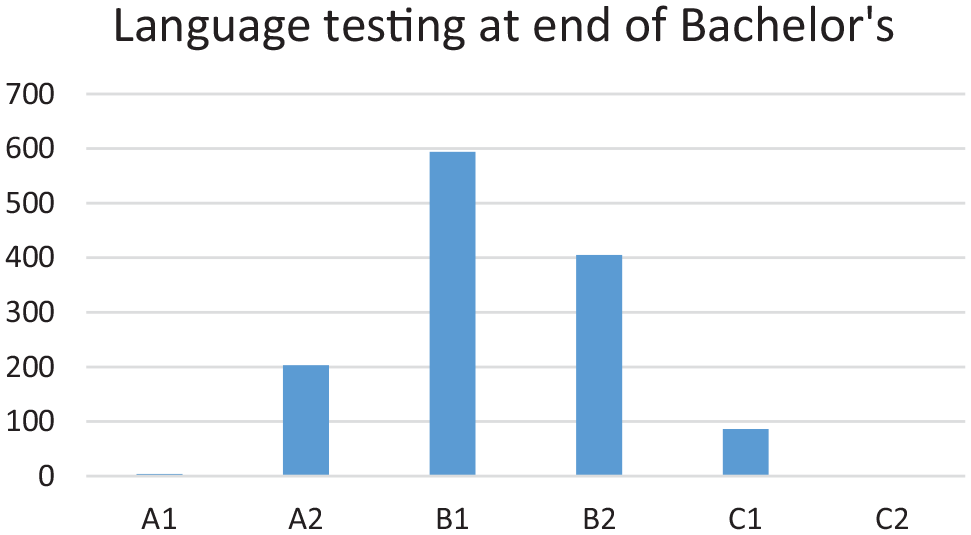
Université Paris Cité: Non-specialist students 2016–2017.
When studying numbers of hours of English activities in informal contexts, a different picture emerges. Research into online informal learning suggests that most students watch several hundred hours per year of TV series, vlogs and other video contents in English. A recent doctoral thesis by Arndt (2019) indicates that while German teenagers aged 15–16 usually have 2.5 hours of English classes per week over 38 weeks of the year, they engage in an average of 12.6 hours per week of informal activities over the whole year. There may therefore be as many as six hours of informal practice for every hour of class time for most learners. These activities include listening to music in English, but also involve significant amounts of multiplayer gaming in English and viewing of TV series and vlogs. The impact of these large numbers of hours is of interest to researchers, particularly since they offer the large numbers of hours thought to be necessary for significant language development. Indeed the 30 million heard words which research indicated were necessary for language fluency 4 can be achieved by the average German viewer in around 10 years of informal activities. Similar figures have been obtained from research in France, Sweden and many other countries (Lee, 2019; Sockett, 2014; Sundqvist and Sylvén, 2016). In the field of online multiplayer gaming, research by Las Vergnas (2017) suggests that gamers observe significant language learning gains when playing multiplayer online battle arena (MOBA) games, such as ‘League of Legends’, requiring verbal interaction with other players. Of the 2,124 gamers involved in the study, more than half reported playing in excess of 21 hours per week. It is therefore apparent that one of the principle characteristics of online informal learning is a high number of hours of exposure to and use of the target language, reminiscent of the type of immersion experience imagined by SA candidates.
Two further characteristics of informal learning are of particular relevance to SA. First, the universality of informal practices (most studies suggest that more than 90% of students engage in OILL practices) means that in OILL studies, modern language majors are far outnumbered by students whose major field of study is something other than a language. Indeed Lee (2019) points to significant differences in OILL practices between English majors and other students. In particular, English majors tend to be far more intentional in their informal practices, while non-specialists mostly engage in informal activities to give them a break from their major areas of study. Similarly in SA, while a minority of language majors will always be encountered and may be a focus of SA research, a majority of students engage in mobility to study subjects other than the local, national or instructional language and a renewed focus on this under-researched majority may yield new insights into learning in SA contexts. Second, informal activities, such as viewing television series and vlogs, overwhelmingly involve the use of English rather than other languages. Data from the Erasmus+ OLS programme 5 suggests that although the OLS (online learning support) platform 6 offers contents in 24 European languages, 45% of the contents accessed by Erasmus students are for the learning of English. Many studies on the ‘digital dilemma’ focus on English speakers being hampered in learning other languages by their ubiquitous access to English. In the Erasmus context however, such constant online access is likely to support learning in situations where English is being used as a lingua franca amongst students and as a language of instruction in European Universities. Therefore OILL is most often a practice of non-specialist students involving English, and the same can be said for the profile of mobility candidates in Europe.
IV Individual differences in OILL
The question ‘Why does this work for some people and not for others?’ is perhaps as commonplace in SA research as it is in OILL studies. As Kinginger (2011: 60) remarks, ‘It would appear that a purely quantitative approach to understanding students’ use of time may not suffice if the goal is to understand how and why language learning does or does not take place in study abroad.’ CT views of learning suggest that involvement in OILL activities will lead to a wide range of outcomes. These emergent individual pathways may result from preferences such as choosing passive rather than active informal activities and a wide range of other individual differences (IDs). A view of OILL practices without a focus on IDs might lead to one of two oversimplifications. First, concerns about an absence of focus on form might lead to the conclusion that informal contexts have little to offer. Second, a blanket assumption that input is proportional to uptake might lead to a mistaken belief that all learners will make great progress by watching their favourite television series in English. In reality neither of these assertions is true and much current research on OILL focuses on the individual differences between learners and their impact on language development.
Individual differences of interest in informal learning research may include age and gender differences, motivation, introversion/extroversion and types of engagement. From a CT perspective, an activity such as social networking, which may offer significant opportunities for L2 development, may be associated with a range of characteristics, including female gender, intrinsic motivation, a clear L2 identity, extraversion, and social engagement.
Muñoz (2020) provides a helpful overview of age and gender issues, suggesting both that male learners generally prefer gaming while female learners prefer watching movies, and also that there may be a shift from game playing among younger learners to movie watching among older learners. This is a helpful reminder that informal learning takes place in a complex landscape in which many different factors are interacting. Brevik (2019) suggests three profiles in informal activity amongst Norwegian learners: the gamer, the surfer and the social media user. Her analysis also identifies gaming and extensive web surfing as predominantly male activities while suggesting that social media use may be more frequent amongst female learners. While both gaming and social media use provide opportunities for language production rather than only comprehension, the number of hours associated with gaming (often in excess of 35 hours per week) means that gaming interacts strongly with frequency of exposure to language.
Hannibal Jensen (2019) contrasts differing levels of cognitive motivation amongst young informal language users in Denmark. While many respondents in her study chose English for their informal activities because of ‘the wish to be part of a larger community of expertise’ (p. 79), she also identifies those who ‘felt no positive identification with L2 speakers, but, rather, tolerated the English language as it was vital for engagement in the activities’. These differing types of motivation are seen to have an impact on informal acquisition. In the latter group, learners would only try to understand unknown vocabulary ‘when it was necessary for engagement in the activity’ and would ‘ignore the meaning of the vocabulary rather than try to infer it’ (p. 82).
Many researchers (Lee, 2019; Sundqvist and Sylvén, 2016) distinguish between informal activities which are largely passive, such as television viewing or listening to music, and activities requiring some language production, such as social networking and multiplayer online gaming. Such studies suggest that merely viewing television series, particularly with subtitles in the learner’s native language generally has little impact on language development, whereas moving towards viewing without subtitles, involvement in multiplayer gaming, reading and social networking tend to be the practices associated with greater language development. CT would suggest that many cognitive, affective and behavioural differences between learners would lead to a great disparity in outcomes of informal learning. Researchers in SA also consider that characterizing learner engagement is a key to understanding language development. ‘When students do not make dramatic gains in language ability or intercultural awareness despite a professed desire to do so, it is because they do not become sufficiently or meaningfully engaged in the practices of their local host communities’ (Kinginger, 2011: 67). With this in mind, recent research into individual differences in OILL has sought to evaluate the different dimensions of engagement of students in informal activities. In Arndt’s (2019) doctoral thesis, four parameters of engagement are identified from a study of 260 German high school students. These are behavioural engagement (the number of hours spent in informal activities), affective engagement (the extent to which emotions are engaged in the activities), cognitive engagement (the extent to which learners think about the activities) and linguistic engagement (a subset of cognitive engagement focusing on the language in the activities). The findings indicate that most students fall into categories of either average viewing times (12 hours per week) and low cognitive, affective and linguistic engagement, or higher levels of cognitive, affective and linguistic engagement with fewer hours of viewing. For some students, exposure to online activities can therefore be seen as a background activity. Many of these students have already attained a good level of English and can understand authentic online contents with little effort. Those students for whom lower quantities and higher levels of the other categories of engagement are observed are often those with a lower language level who express difficulty in understanding online contents. While these results might be misunderstood as indicating that those who make less effort learn more, from a CT perspective, it is possible to observe that more advanced learners have been through a process of development of the listening skills necessary to view large quantities of material with little cognitive effort while less advanced learners are still actively decoding language in a process which places a significant burden on working memory. These processes may be compared to Sinclair’s (1995) automatic and controlled processing and other descriptions of proceduralization.
Much work remains to be done in understanding the varying impacts of OILL on learners. Few binge-watchers of television series achieve fluency without also engaging in production activities. However, continuing to focus on the nature of learner engagement in both virtual and physical mobility is likely to yield significant results in both fields.
V Non-formal language learning
As we have seen, the learner’s PLE is made up of a wide range of inputs and interactions. While online informal language learning describes a range of activities which are difficult to study because they take place in private, non-formal learning offers the contrasting challenge that the activities take place on proprietary platforms, the owners of which have little to gain from revealing their results to researchers. Informal and non-formal contents do however fill complementary roles in the personal learning environments of language learners today.
The non-formal learning context relates to tools designed for language learning outside any academic context and today generally take the form of smartphone apps. The general public are often made aware of such tools via advertising, since the economic model for most non-formal products is a commercial one. Products such as Rosetta Stone or Pimsleur were originally sold as CDROM or DVD-based courses. With the development of smartphones, non-formal learning apps have become widespread and a range of economic models taken from the world of gaming can now be seen in the market. The main economic model is the freemium model, where platforms offer limited contents for free and premium contents for a monthly fee which may be on the order of 12–15€. Another prominent model involves payment in advance. Platforms such as Rosetta Stone offer little or no free contents and rely on their reputation to persuade clients to purchase several months of course material in advance. From a research point of view, data on non-formal learning contents is difficult to obtain because businesses are not always willing to divulge the strengths and weaknesses of their products in a competitive market. As well as commercial products and a limited number of philanthropic ventures such as Duolingo, governments are now also starting to offer non-formal contents to citizens as a way of demonstrating an interest in intercultural understanding. The most relevant manifestation of this phenomenon for SA candidates is the Erasmus+ Online learning support platform. 7
1 Online learning support
Over a five-year period, the European Commission has offered online language learning resources to Erasmus mobility students in place of the language learning grant which was previously given to allow students to purchase language courses of their choice prior to mobility. The OLS also includes pre and post testing, giving an assessment of language level based on the six levels of the CEFR in grammar, vocabulary, listening comprehension and reading comprehension. Only the latter two items are actually CEFR skills, but the test is based on automatic correction of closed questions, so it is not deemed economically viable to measure written expression, oral expression or interaction. Since payment of the final part of the Erasmus grant is linked to taking the pre and post-tests, this part of the OLS has been used by in excess of 1 million students in the first four years.
One of the challenges facing the non-formal learning sector is attrition rates. Since non-formal learning is generally not externally assessed, motivation to start or continue with a course is not always high. While most non-formal content providers are careful not to publish data on this issue, research by Nielson (2011) indicated that only 20% of volunteers given free access to Rosetta Stone software spent more than 10 hours on the platform, while data on the free platform Duolingo indicates that only 12% of its accounts are active. The Erasmus+ annual report for 2017 8 states that in the first four years of the OLS, only 380,000 of the 1 million students using the system actually accessed courses, and gives no details about the amount of time spent on the platform by these students. While relatively low uptake of the OLS platform may be a concern, it is very much in line with general levels of use of other non-formal language learning tools, and of online learning platforms in general. Indeed, according to a study by Jordan (2015) 9 of over 200 MOOCs, completion rates are generally around 15%.
2 The non-formal marketplace
Pedagogically, non-formal tools tend to fall into two main categories, content-focused and interaction-focused, while a third group focusing on videos is beginning to emerge. Content-focused tools are platforms offering language exercises such as gap fill, multiple choice and flashcards, organized by theme or level and mimicking some of the features of online games, such as passing levels, scoring points and winning awards. There are many indications that such platforms are seeking to reach into the formal learning sector. For example, platforms such as Duolingo are beginning to offer products aimed at schools, and to set up partnerships with testing organizations to offer online language certification. School-focused products give teachers access to learner data from online activities and are presented as a simple blended learning solution. Online certification is available in Duolingo for example at a cost of $49, while in Busuu, the certification is provided in partnership with the Pearson group at a similar cost.
Interaction-focused tools are platforms offering to connect language learners with language teachers and other learners. Examples of such platforms are Speaky 10 and iTalki. 11 Learners may set up reciprocal partnerships with others offering complementary language skills, or may purchase one-to-one language classes from an online tutor. Mimicking other online services in the gig economy, such platforms offer rating systems whereby tutors with a better reputation can begin to charge higher fees. The economic model of such platforms is to take a percentage of the amount charged by the tutors. Some platforms, such as Busuu 12 and the recently re-opened LiveMocha, 13 offer a combination of content-focused activities and interaction focused language exchanges. It is interesting to point out that the original LiveMocha.com platform which operated from 2007 to 2014 was purchased and closed down by Rosetta Stone: an indication that interaction-focused platforms are perceived as a threat to more traditional content-based offers.
Within the field of computer assisted language learning (CALL), studies have sought to assess a number of non-formal tools (Loewen et al., 2019), while a limited number of studies aim to compare the performance of different non-formal platforms. Research by Vesselinov and Grego (2016) 14 indicates that platforms offering an interaction focus tend to perform better for learners beyond the novice level. These studies may be treated with some caution since in many cases they are produced at the request of the non-formal provider, rather than being peer-reviewed publications. They do however seek to apply an identical methodology to each product for either ‘oral proficiency’, ‘written proficiency’ or sometimes both. Their recent (2019) study of Rosetta Stone, a content-focused product, indicates that novice learners tend to spend around six hours on the platform over a two-month period. ‘The efficacy is the highest for participants with no or very little knowledge of Spanish and it decreases for more advanced learners’ (2019: 38). It is interesting to observe that the quantity of exposure reported (around six minutes per day) corresponds to the type of micro-learning structure targeted by most non-formal products. Regarding the notion of novice and advanced learners, within the context of study abroad, learners are rarely novices in the language of instruction and indeed are generally required to demonstrate a B2 level in the language of instruction order to participate in mobility. They may however have had little instruction in the local language, so while for mobility candidates interaction-focused tools are clearly preferable in that they allow for one-on-one online conversations, there may still be scope for content-based tools which are most effective at beginner levels.
With the growth in informal practices, a third type of non-formal platform is beginning to emerge which seeks to emulate informal activities by focusing on understanding YouTube videos via subtitling and multiple-choice questions. This is the case of FluentU 15 and of Qioz. 16 Such platforms face the particular difficulty that while they can manufacture tailored contents to put on YouTube for novice learners, they are not in a position to buy the rights to actual films and television series which are frequently viewed informally, depending instead on film trailers and other short extracts placed online by the rights holders. A fully fledged partnership between a content provider such as Netflix or Amazon and a language learning platform has yet to emerge to bridge the gap between informal and non-formal online practices.
The market for non-formal tools can be seen as of particular relevance for SA since sojourners are likely to use such tools either as part of a learning agreement, in the case of Erasmus and the OLS, or as an individual initiative in preparation for and/or in support of mobility. Non-formal tools also interact with informal activities in a number of ways. Indeed the three main categories of non-formal apps correspond to three frequent activities of informal learners (Sockett, 2014; Sundqvist and Sylvén, 2016): viewing videos, social networking and gaming. Interactions between formal, non-formal and informal online learning in the context of SA are therefore of interest for future study.
VI Measuring language acquisition from informal practice
There is little doubt that informal input such as extensive viewing of television series and multiplayer gaming has an impact on acquisition of the target language. Sockett (2014) found that language teachers in France overwhelmingly believe that such practices have led to improvements in listening comprehension levels in the past decade. This impression is backed up by empirical studies such as that carried out by Beuzon and Dalibard (2017), which found that between 2010 and 2016 listening comprehension scores amongst French 14-year-olds, measured by a standardized test, had improved from 50.9 % to: 58.5 %.
The task of measuring acquisition from informal sources separately from other sources presents a number of challenges to the researcher. In SA research, a range of different approaches have been used (Kinginger, 2009; Lapkin et al., 1995) including diary studies, ethnographies and attempts to link individual differences to learning outcomes such as target language fluency. Two approaches which have yielded results in our own research are the use of vocabulary knowledge scales (VKS) and analysis of fan fictions. As detailed in Sockett and Kusyk, 2015, knowledge of frequently occurring lexical items from television series can be measured by extracting frequently occurring chunks from a corpus of popular television scripts and then using a VKS to determine the extent to which these terms are familiar to groups of frequent and infrequent viewers. Such analysis indicated that frequent original version viewers had a significantly better knowledge of frequently occurring three and four-grams than viewers who usually watched versions of the series dubbed into French. This is a helpful finding since it indicates that incidental acquisition is taking place in the context of leisure activities where attention is being paid to meaning but not explicitly to form. Similarly analysing fan fictions written by learners offers the opportunity for researchers to focus on the use of lexical chunks which appear frequently in the corresponding series.
When considering the methodologies used in the past 10 years of OILL studies, it is interesting to note that initial diary studies and questionnaires investigating informal learning activities as a quantitative phenomenon have now given way to studies of different dimensions of learner engagement and analysis of learner productions, in much the same way that SA research has moved on from seeking to equate time on task with learning outcomes. A key difference between OILL and SA studies is that while OILL studies seek to contrast in-class and out-of-class learning, SA studies seek to assess learning from the whole ecology of the sojourner’s experience including formal, informal and non-formal elements.
VII Assessment and certification
Since so much learning takes place outside the classroom, ways in which this learning may be assessed and certified continue to be a major preoccupation. Assessment and certification of informal skills have long been key objectives, particularly in the European Union, whose definition of informal learning points to the fact that the very lack of awareness that learning is taking place can make attaching value to the practices a difficult exercise. A European Union report characterizes informal learning as: learning resulting from daily activities related to work, family or leisure . . . it is not organized or structured in terms of objectives, time or learning support. It may be unintentional from the learner’s perspective. Official Journal of the European Union (2012)
Since there are neither objectives nor a timetable, nor interaction with a facilitator, few of the traditional measures of learning (objectives attained, time spent, analysis by an expert) can readily be applied to such learning, and yet the existence of the acquired skills is not in doubt. The further statement that learning may not be intentional suggests that learners may even need to be prompted to indicate that the skills have been acquired and raises issues of learner awareness of informally learned skills. Much of the EU’s portfolio based approaches to the presentation of skills can be seen as an attempt to situate informally learned skills within the broader personal learning environment of formal and non-formal learning.
Current research methods in informal learning may offer pointers towards opportunities to assess informally learned language skills. While attempts may be made to engage in micro-level analysis of informal practices by observing eye movements on a screen during television series viewing for example, the very private nature of informal practices means that learners are likely to provide a sanitized version of their informal behaviours when being studied by researchers in an etic stance. However, emic approaches are more in keeping with the nature of informal learning. Many researchers, including Wagner (2015), Sockett (2014), Sundqvist and Sylvén (2016) adopt emic approaches including blogging to learn about informal practices, and such approaches also tend to increase learner levels of awareness of their practices (Sockett, 2014). Emic approaches also have the advantage of indicating to learners that their practices are valid and valuable, rather than just guilty pleasures engaged in when they should really be doing their homework. Such approaches also respect the privacy of the learner who is able to curate his own presentation of learning activities rather leaving the interpretation of activities to the researcher. Stressing the value of a detailed knowledge of a particular television series or informally learned skill, however trivial it may appear, also encourages learners to consider themselves as fledgling language users and opens opportunities for more active roles in classroom learning, such as suggesting course contents and procedures for assessment.
The logical extension of the informal learning phenomenon is that formal assessment and even certifications should focus on activities the learner is actually likely to engage in. Examples of skills frequently developed through viewing and commenting on vlogs include practical skills such as learning to apply various types of makeup from lifestyle vlogs (Nikkie tutorials 17 , Zoella 18 ) or discursive skills such as narrating a walkthrough of a video game from ‘let’s play’ vlogs (Pewdiepie 19 , DanTDM 20 ).
Since vloggers’ descriptions of these activities are almost exclusively in the first person, it would be reasonable to suppose that frequent viewers are developing the linguistic skills necessary to describe their own state of mind on a number of topics. The essential difference between vlogs and television series is that the vloggers present themselves as peers of the viewer and often use low production values such as fixed cameras and poor sound and lighting. As such it is likely that frequent viewers would feel able to create their own vlog posts on similar topics and the design and evaluation of such tasks would be a simple way to measure learning from such informal sources. Even binge-watching of series necessitates the various cognitive skills used to process listening comprehension such as making mental summaries of characters and situations and developing hypotheses about what is going to happen. Viewers begin each episode with knowledge of the characters and situations gained from previous viewing and use this top-down information to interpret the meaning of events and dialogues as they occur. It would therefore be reasonable to suppose that designing evaluations around such skills would give an indication of the extent to which such cognitive skills have been developed in this context. Fan fiction writing (Sauro and Sundmark, 2019) is already widely used as a classroom tool to bridge the gap between formal and informal practices. By extension writing this type of text as part of a language evaluation would draw on knowledge specific to each learner.
As such skills increasingly become part of the assessment landscape, teachers will increasingly need to orientate classroom activities towards such skills, making truly learner-centred classroom activities the norm rather than the exception. This is true not only in general English classes but also in contexts of English for specific purposes (ESP), of particular relevance to the large number of non-specialist SA candidates whose language of instruction is English. A whole range of academic subjects are particularly suited to the integration of informal contents. Many television series have a professional context as the background to their plot development and money is increasingly invested in advisors able to make these contexts as realistic as possible. Examples of this are series such as Mr Robot, the technical scenes of which were written by computer scientists tired of unrealistic use of computer technologies in fiction, Breaking Bad, which had an advisor on chemistry supervising the technical contents, and a whole range of humanities subjects such as history, politics, economics being presented in series such as the West Wing, Suits and the Crown.
The increasing involvement of non-formal providers in language assessment and certification is an indication that a move towards a more learner-centred approach to these issues is likely to be seen in the coming years. Indeed, as fledgling users of the target language become more involved in the creation of artefacts such as Youtube channels and social media texts which themselves offer evidence of engagement in the target language, the aims of portfolio approaches which may have seemed far-fetched in the past, may soon offer a starting point for assessment in the middle decades of the 21st century.
VIII Conclusions
The preceding paragraphs have sought to point to certain synergies between the fields of research into SA and OILL. While informal and non-formal activities may seem far removed from the formal pursuit of language learning in an SA context, the ‘digital dilemma’ facing SA research and practice is an indication that critical enquiry in the latter field will increasingly take into account the many different tools and experiences in each learner’s PLE, interacting in a complex system as language development takes place. While informal practices continue to expand and diversify, non-formal tools which were once confined to books and DVDs are now a regular part of the learner’s daily experience in much the same way that other smartphone gaming applications might be. At the same time, the increasingly formalized role of tools such as the OLS and non-formal tools offering certification suggests that the boundaries between these contexts may become less clear. Understanding, measuring and certifying such development is certainly more difficult than it might have been at a time when language learning mostly took place in a classroom environment. There is however some cause for optimism that the quantity and diversity of activities outlined in this article are leading to the development of language skills amongst populations who traditionally had little exposure to other languages and cultures. There is little doubt that this holistic learner-focused perspective can become a significant area of study for researchers in the fields of SA and OILL in the years to come.
Footnotes
Declaration of Conflicting Interests
The author declared no potential conflicts of interest with respect to the research, authorship, and/or publication of this article.
Funding
The author received no financial support for the research, authorship, and/or publication of this article.
