




Abstract
Background
Compression bandage consists of fibrous materials which are viscoelastic in nature due to which the internal stress developed in the compression bandage under wrapped position may decay over time. The viscoelastic behaviour of a textile material depends on the fibre type as well as on its structure, and hence these factors could play a prominent role in interface pressure variation over time.
Objective
To explore the influence of different materials and varying structures on the interface pressure profile generated by the bandages over time during static state of the limb.
Method
The material and construction of several compression bandages were engineered first and based on that different knitted bandages were prepared using several yarns (cotton, viscose, polyethylene terephthalate [PET], cotton-Lycra and PET-Lycra) and varying thread density in the structure. Three important factors, namely the material type, the applied tension and the tightness of the structure, were selected to examine their influence on interface pressure variation over time. The interface pressure measurement over time was done using a leg-segment prototype, which allows continuous online measurement of interface pressure over a static mannequin leg.
Results
More than 40% reduction of interface pressure was obtained for bandages made of spun yarns (cotton or viscose) in eight hours. Reduction of interface pressure for these bandages was higher when wrapped at a higher tension level. Lower reduction of interface pressure was obtained for the sample having higher thread density as compared with lower thread density in the structure, for the same applied tension level during wrapping. Bandages containing elastomeric yarn in the structure showed good sustenance of pressure for longer period.
Conclusion
Bandages made up of elastic core spun yarns are effective for maintaining uniform interface pressure for longer period due to sustained compression developed by the elastic filament and tight structure of these bandages.
Introduction
Compression therapy is the most assuring treatment given to heal venous ulcers and other chronic venous diseases.1,2 The efficacy of the compression treatment is undoubtedly dependent on the interface pressure developed in the interface between the bandage and skin and also on the holding capacity of the bandage to sustain a uniform interface pressure gradient over the limb for faster recovery. The knowledge of interface pressure profile generated by a compression bandage over time is of prime importance as it would help to know after how much time the bandage loses its efficacy and needs re-wrapping or replacement for further compression treatment. Several investigators have studied the interface pressure variation over time for several bandages.3–8 More than 50% reduction of the initial interface pressure has been observed for elastic short stretch bandages in 12 hours. Multilayer bandaging system has shown good sustenance of pressure for longer time.
The efficiency of different bandages to provide sustained pressure varies because of differences in their structure and constituent material type. The bandage applies pressure over the limb because of the internal stress developed in the structure during its application over limb by applying external tension. 9 The capacity of a bandage to sustain pressure is greatly dependent on its ability to maintain this internal stress developed in the bandage under wrapped position. Bandages consist of fibrous materials which are viscoelastic in nature. Because of viscoelastic behaviour of fibre or yarn, the stress developed in the textile structure under constant extension decreases over time.10–13 This phenomenon is called stress relaxation which refers to the behaviour of stress reaching a peak and then relaxing over time under a fixed level of strain in the material. The reduction of the internal stress in the bandage over time is an important factor for the pressure drop during course of compression treatment. 8 Decrease in the pressure over time may also occur due to reduction of the venous volume which decreases the circumference of the limb.6,7 Ability of a bandage to hold the stress depends on the fibre type, yarn structure and the woven or knitted structure of the bandage. It has been found that different fibres behave differently under stress condition.10,13 Cotton and viscose fibres have been found to have higher stress relaxation as compared with synthetic fibres like nylon, PET, etc. 14 Understanding relaxation behaviours of different fibrous materials could help to design and evaluate long-term bandage performance.
Bandages could be applied with different tension levels during wrapping depending on the recommended pressure requirement. Varying applied tension in the bandage structure leads to varying stress developed in the structure due to which same fibre or yarn present in the structure may go to lower or higher amount of stress relaxation depending on the developed initial stress in it. Different yarns behave in complex viscoelastic fashion and try to relax more under high-stress conditions. 11 Varying number of yarns per unit area in the bandage structure may also influence its relaxation behaviour. Since, the total resistance developed in the bandage upon application of external tension gets distributed to individual yarns and therefore under same applied tension during wrapping, a low-stress state on each individual yarn in the structure could be obtained if more number of yarns are present in the bandage structure. The above facts indicate that the material type, the yarn or thread density and the applied tension could influence relaxation behaviour of a bandage and hence, could determine interface pressure variation over time.
To demonstrate the above concept, a series of different compression bandages was examined over time using a leg-segment prototype which measures the interface pressure applied by the bandage over a mannequin surface. Different knitted bandage samples with varying thread density were also prepared with different yarns like cotton, viscose, PET, elastic core spun, etc. that are frequently used in making compression bandages, to study the influence of material type, applied tension and thread density on interface pressure profile generated over time.
Methods
Interface pressure measurement using leg-segment prototype
Interface pressure measurement was done using a leg-segment prototype which provides a simple and efficient method of measurement of interface pressure exerted by the bandage over a mannequin surface. The leg-segment prototype consists of a wooden mannequin leg. Air bladders were fixed over the surface profile created at different sections of the mannequin leg as shown in Figure 1. This prototype was based on the pneumatic principle which relates the air pressure change inside the inflated air bladder on application of an external pressure applied by the bandage to the interface pressure developed.15,16 At a time only one of the columns can be engaged with the air inlet valve. From the bladder wrapped on each individual column of the mannequin, a separate air inlet tube is provided. To use an air bladder placed on a particular column, the inlet of air valve and the inlet of that bladder are only connected with a connecting tube. In the present case, only one column (21.2 cm, lowest circumference) of the mannequin was engaged with the air valve. To obtain the interface pressure applied by a bandage, the air bladder was first inflated with air using a hand pump to a particular air pressure (Pi), and then the bandage was wrapped over the bladder surface. This wrapping exerted additional pressure on the surface of the bladder and hence the air pressure inside the bladder was changed and the total pressure (Pt) was obtained. The air pressure inside the bladder was marked using a differential pressure transmitter. The interface pressure applied by the bandage at any time was obtained by deducting the initial air pressure reading (Pi) from the final air pressure reading (Pt) inside the bladder. Measurement of the final air pressure (Pt) was done continuously and interface pressure readings at subsequent intervals were collected to obtain the pressure profile generated by the bandage over time.
Schematic diagram of the leg-segment prototype used for interface pressure measurement.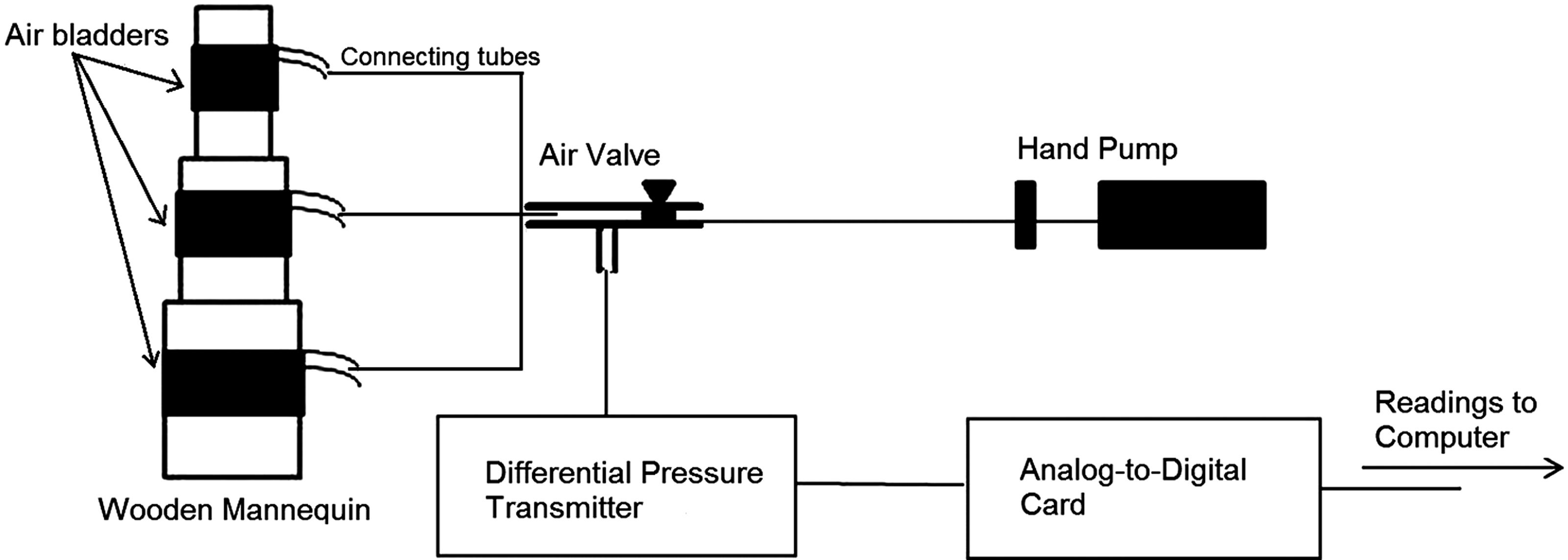
Bandages
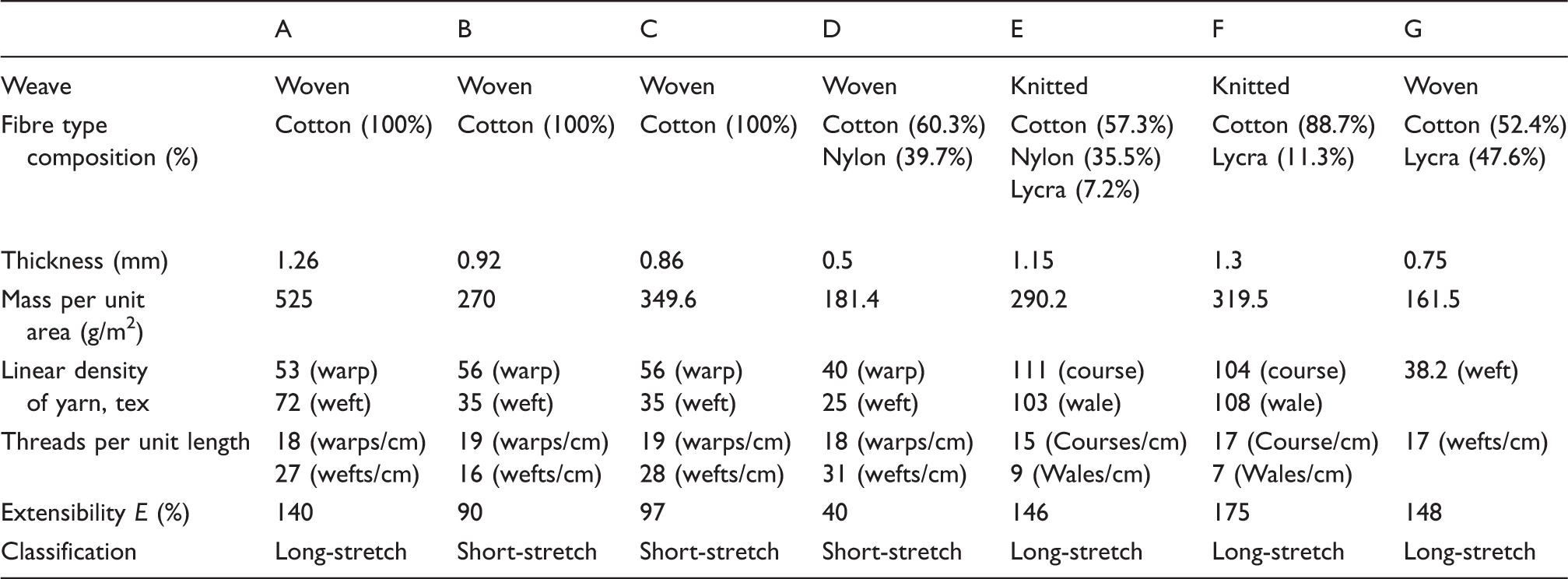
Details of standard compression bandages.
Preparation of fabric samples
Details of laboratory manufactured knitted bandages.

Application technique
All the bandage samples were wrapped over the inflated air bladder under constant tension to achieve nearly same interface pressure. To obtain a particular interface pressure by different samples, the technique given by Yildiz
18
was followed. The tensile load versus extension curve for each bandage was obtained first and then different extension values were chosen for different bandages in such a way that each of them were given nearly same applied tension to obtain equal pressure. Figure 2 shows the tensile behaviour of two bandages (A and B) to select different extension levels for bandages under same tension. To wrap the bandage at a particular extension, a predetermined length of the bandage sample was taken and then it was marked with uniform rectangular shapes at regular spaces throughout the sample length. The size of rectangles marked was chosen in such a way that each rectangle changed to square shape during wrapping when a uniform and desired extension was given. The above procedure helped achieve nearly same applied tension for each bandage during wrapping.
Tensile characteristic of different bandages.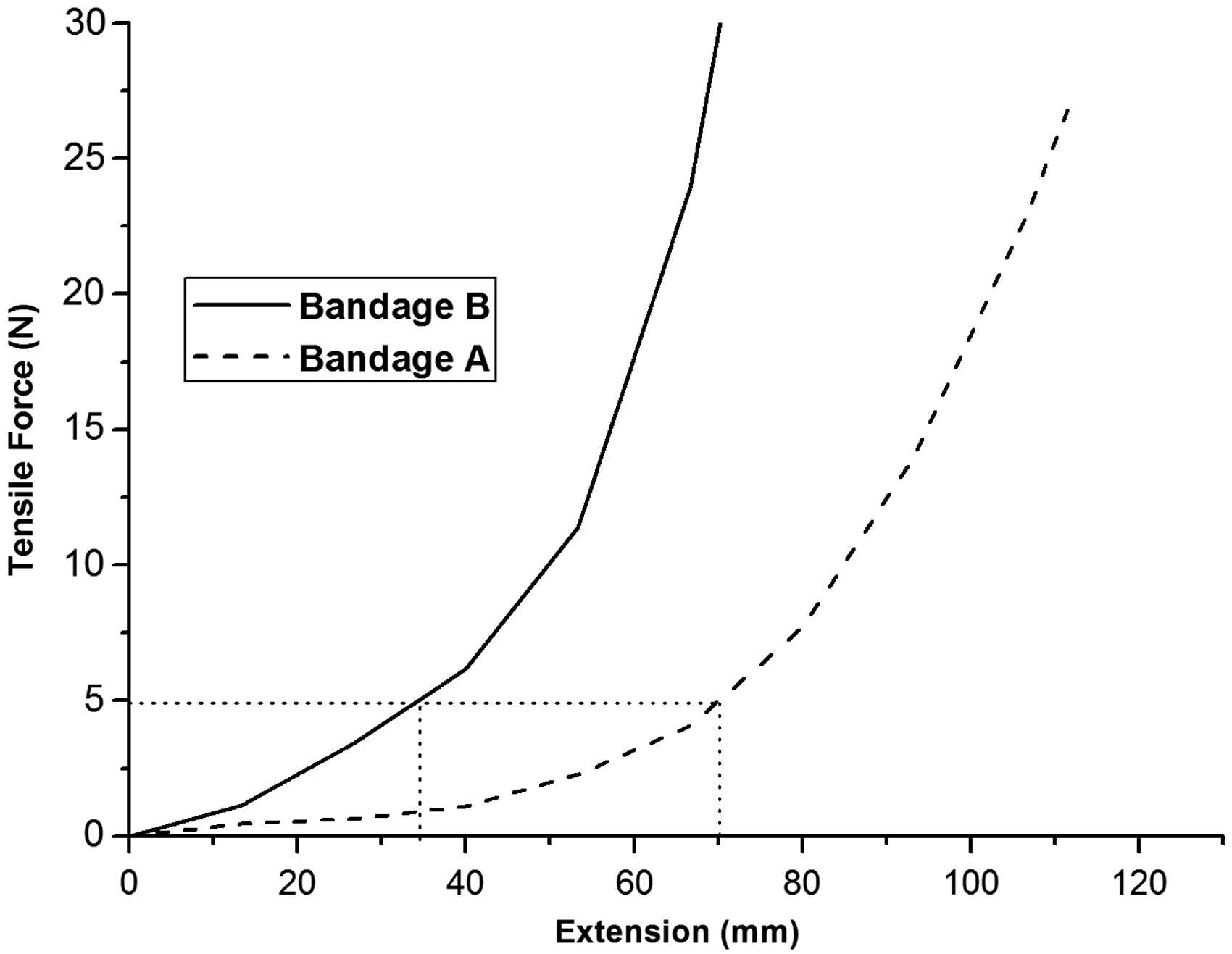
Design of experiment
Three important parameters namely material type, applied tension, and TF were chosen to study their influence on the interface pressure profile generated by different samples over time. Interface pressure profile generated by each bandage sample as well as for each bandage was measured for eight hours. For the analysis, the decrease of interface pressure was obtained after 0.25, 2 and 8 hours. The pressure profiles of the individual bandages were obtained five times using different samples of same bandage material and the mean values were calculated and used for subsequent analysis. All individual pressure measurements were done on a single column of the mannequin leg having lowest circumference of 21.2 cm. The same column (i.e fixed circumference) was chosen to obtain similar value of initial interface pressure for all the bandages at same level of applied tension. The width of each specimen was taken as 5 cm and two layers were wrapped over the mannequin surface for each individual test. The method of wrapping over the mannequin is already explained above; and this procedure was ascertained after performing many trials prior to actual test. The accuracy for air pressure measurement by the prototype was checked several times before final test. The least count for pressure measurement of the differential pressure transmitter was ±1 mmHg.
Stress relaxation test
Stress relaxation test at a particular extension level was performed using an INSTRON (High Wycombe, Bucks, UK) tensile tester (model-4301) and reduction of peak stress over two hours relaxation period was obtained for each bandage separately. Each bandage sample was extended at a constant rate of force up to a peak tension of 3 N or 5 N and then left for two hours of relaxation period. The gauge length for each testing specimen was 10 cm and the width taken was 5 cm. The decrease of the peak tension or stress was obtained after 15, 60 and 120 minutes and used for analysis.
Statistics
The mean interface pressure drop (%) in eight hours was obtained for experimentally prepared knitted bandages at all possible levels of chosen factors. An N-way analysis of variance (ANOVA) for a fixed effect model was performed to determine whether there were any significant differences in the mean pressure drop (%) in eight hours at different levels of various factors. A P value less than 0.01 was considered as statistically significant.
Results
Stress relaxation of prepared knitted bandages over time.
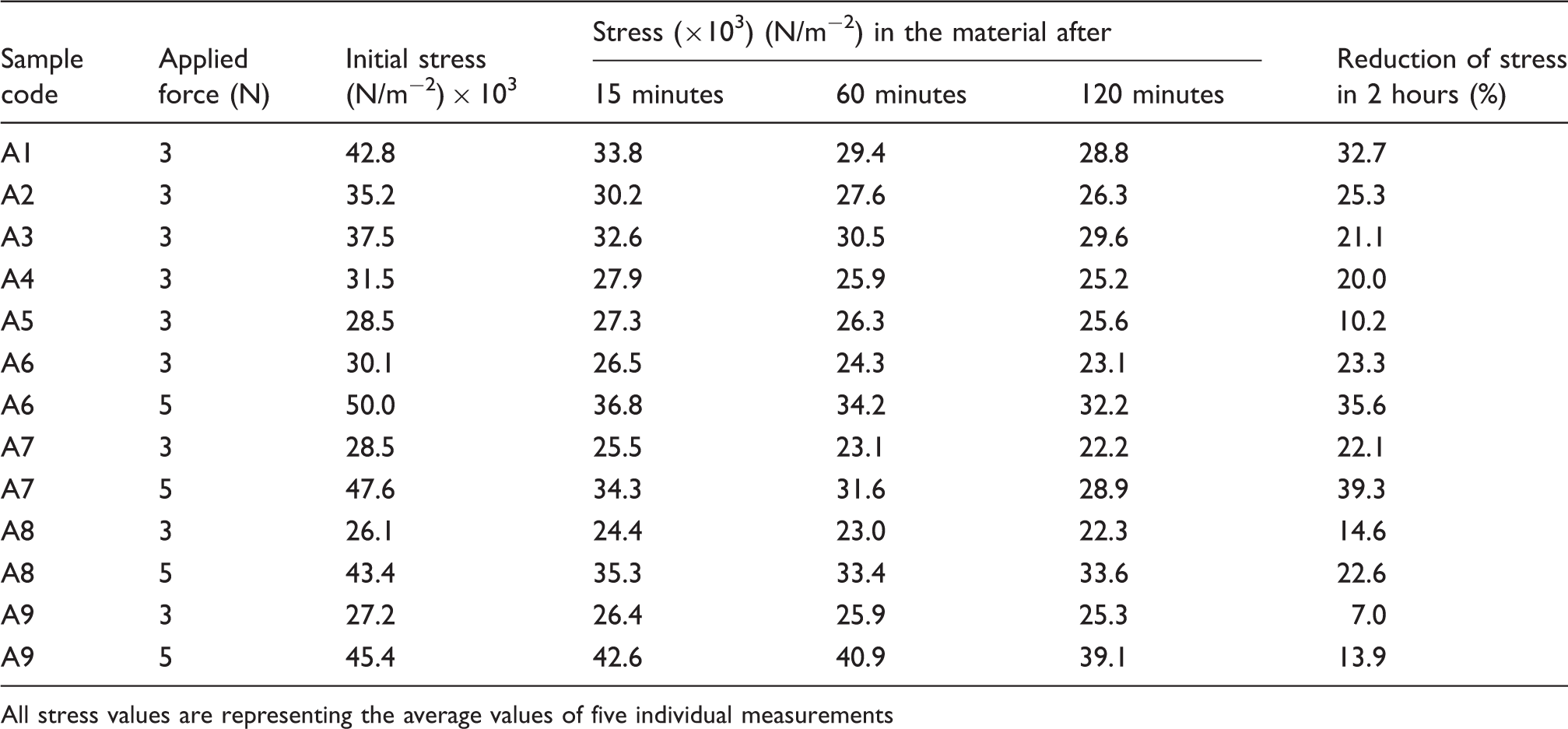
All stress values are representing the average values of five individual measurements
The results of interface pressure variation over time of different bandages are presented below.
Effect of material
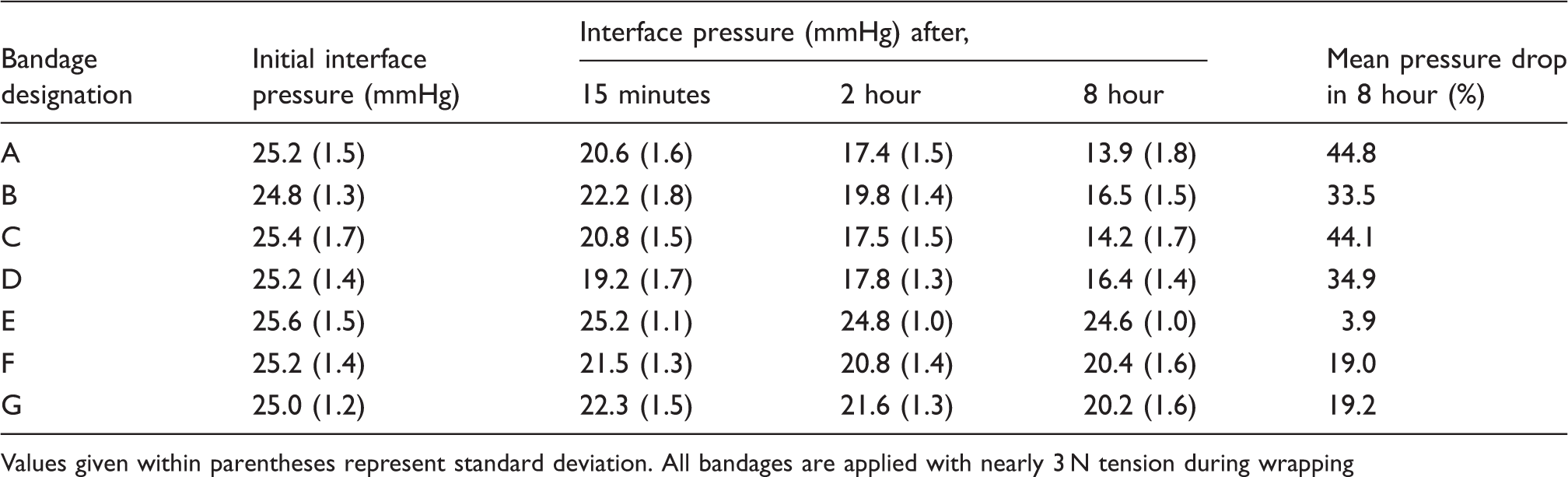
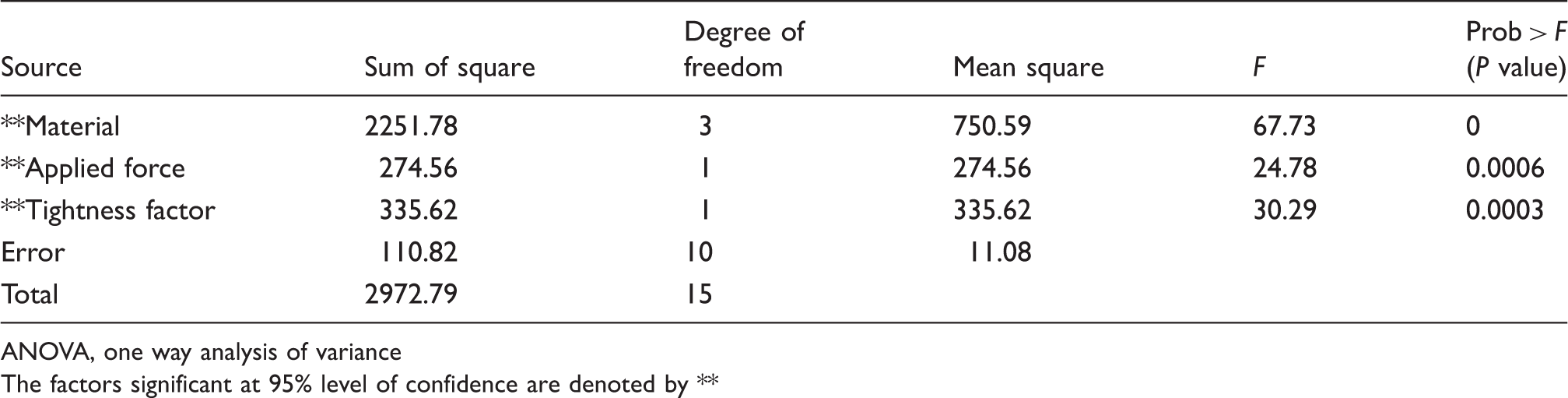
Different interface pressure profiles were obtained over time for different bandages. Table 4 shows the variations of interface pressure over a period of eight hours for different bandages when applied under same tension. It was observed that 100% cotton compression bandages did not sustain pressure for longer period. More than 30% reduction of interface pressure was obtained for purely cotton compression bandages in eight hours. Decrease in the interface pressure was lower (less than 20%) for bandages (E, F and G) having elastomeric material in them. Similar results were obtained for the prepared knitted bandages (Figure 3). For the same applied tension, samples made up of 100% cotton or viscose spun yarns (A1 or A2) showed higher pressure reduction (more than 40%) in eight hours while sample made up of elastic core spun yarn (A5) showed lesser pressure drop (nearly 20%). It is clearly seen from Table 5 that different fibres present in bandage structure significantly affects pressure drop (P < 0.05).
Effect of material type on interface pressure profile generated over time for different bandages (A1 to A5). Interface pressure profiles generated over time for different bandages. Values given within parentheses represent standard deviation. All bandages are applied with nearly 3 N tension during wrapping ANOVA results to check significant difference in the mean values of pressure drop (%) in eight hours for the laboratory manufactured knitted bandages at various levels of factors. ANOVA, one way analysis of variance The factors significant at 95% level of confidence are denoted by **
Effect of tightness factor
Increasing number of threads by feeding more yarns simultaneously leads to increase in tightness of the structure. Two different bandages were made for each yarn type with varying thread density and their TF was calculated as listed in Table 2. Low value of tightness factor (TF ∼ 11) represents the slack or loose structure while high value (TF ∼ 19) shows very tight structure of the knitted fabric.
17
Figure 4 shows the interface pressure variation over eight hours at two levels of TF (low and high) for each material type. It can be observed that for the same applied tension during wrapping, the pressure reduction was lesser for a tight structure as compared with a loose structure of the same material type. For the same applied tension, pressure drop within eight hours was nearly 50% for loose structure of cotton sample (A1, TF = 11.57) while lesser reduction of pressure (nearly 35%) was obtained for tight structure (A6, TF = 16.05). Similar results were obtained for each material type and lesser pressure drops were obtained for structure having high value of TF (P < 0.05).
Effect of tightness factor of the knitted structure on interface pressure profile generated over time for different bandages.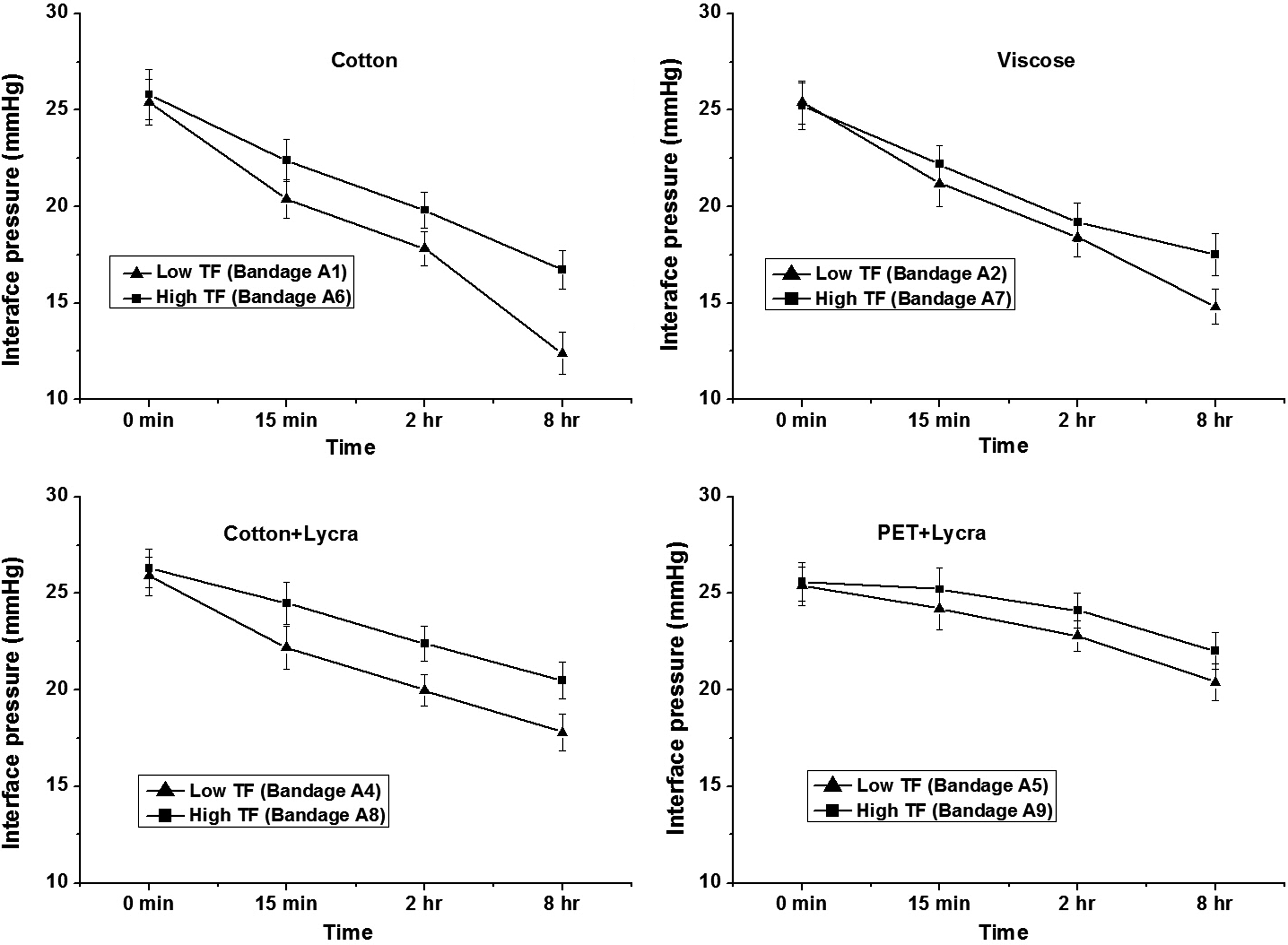
Effect of applied tension
Two levels (low and high) of tension were chosen for the application of different bandages over the mannequin. Owing to changes in the applied tension during wrapping different values of the initial interface pressure were obtained. Figure 5 shows the effect of applied tension on the interface pressure variations for different materials. It was observed that the percentage reduction of the interface pressure was higher at high tension as compared with low tension for the same material type. For viscose sample (A7), pressure drop within eight hours was nearly 43% at high tension level while it was lesser (nearly 30%) at low tension level. Other bandage samples made of different yarns were also showing similar results (P < 0.05).
Effect of applied tension on interface pressure profile generated over time for different bandages (A6 to A9). Low and high tension given during wrapping were 3 N and 5 N respectively.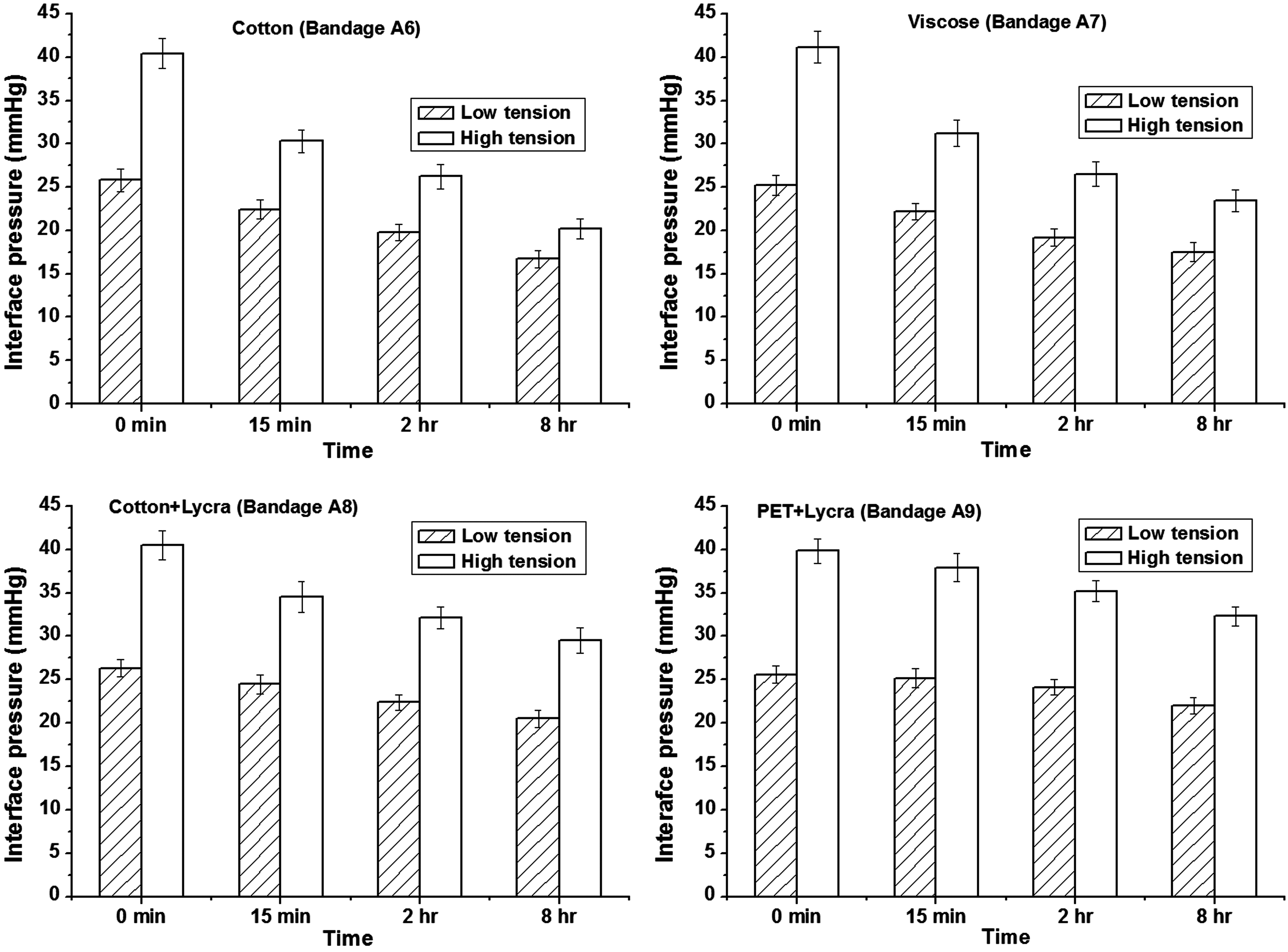
Discussions
A bandage applies compression over the limb surface and this interface pressure beneath the bandage is significantly dependent on the applied tension during its application. Several researchers have reported that the pressure beneath a bandage drops over time.3–8 The ability of the bandages to provide sustained pressure varies significantly due to their dissimilar structure and varying material type. The aim of the present work is to elucidate the influence of material type, structure and applied tension on pressure variation during the course of compression treatment.
Internal stress is developed in the bandage structure because of applied tension during wrapping. The pressure sustenance by a bandage depends on its ability to maintain internal stress in the structure. This ability of the bandage depends significantly on the stress relaxation behaviour of the fibres or yarns that are present in the structure. Reduction of stress in different bandages was observed under extended state (Table 3). It can be inferred from Table 3 that the pressure drop in different bandages is primarily due to the relaxation of stress in their structure over time.
Relaxation behaviour of a fabric structure depends significantly on the relaxation behaviour of fibres or yarns used in it.12,14 Relaxation time is commonly used to describe stress relaxation behaviour of a viscoelastic material, which indicates the time required to reach from unrelaxed state to new relaxed state of the material. 19 It has been found that cotton and viscose fibre have the lowest relaxation time due to which stress decays fast under constant extension. 13 Synthetic fibres (nylon, PET and Lycra) have low-stress relaxation as compared with cotton fibre because of their larger relaxation time. This could be the reason for different pressure profiles obtained for different bandages (Table 4). Higher and faster pressure drop for 100% cotton and viscose samples were obtained because of their poor ability to sustain internal stress in the structure (Figure 3).
Under stressed condition, fabric structure tries to reach a minimum deformation energy state, like in any natural phenomenon, by stress relaxation in the fibres or yarns and also by re-arranging fibres or yarns in the structure. 14 Increasing applied extension or tension in the fabric leads to increase in internal stress in the structure due to which it becomes more unstable. This increases the rate and the amount of relaxation phenomenon of the fabric to attain a newly relaxed position having low internal stress. It has been observed that the relaxation of stress in fibre, yarn or fabric gets pronounced at higher stress level. This may be the reason for higher percentage drop of pressure for different bandages at higher tension level as compared with lower tension level (Figure 5). This was further substantiated by the stress relaxation results of different bandages which showed larger drop of stress in the material under higher extension or tension level (Table 3).
It was observed that at same level of applied tension, relatively lower pressure drop was obtained for high value of TF as compared with low value of TF of the bandages made of same yarn (Figure 4). High value of TF of the bandage indicates more number of threads or yarns in the fabric per unit area as compared with low value of TF of the bandage having similar yarns. Owing to the increasing number of yarns, the overall stress in the structure gets distributed to more number of yarns. Therefore, under same applied tension, stress in the individual yarn inside the structure is less for the bandage having higher thread density as compared with lower thread density. Due to lower internal stress in the individual yarn for a tight structure as compared with loose structure, lower stress relaxation was obtained under same applied tension (Table 3). This could be the reason for relatively lower reduction of interface pressure for bandages having higher number of threads as compared with lower number of threads (Figure 4).
Elastic core spun yarns are frequently found in the structure of several compression bandages. There is elastic (Lycra or spandex) filament in the core of these yarns and staple fibres or filament yarns are wrapped around it. Elastic filaments have excellent elastic and rheological properties. They can maintain the internal stress for longer time because of their good elastic properties. It has also been found that fabrics containing elastomeric yarn tend to be tighter and have more number of threads per unit area. 20 Similar results were obtained for the knitted bandages (A4 and A5) prepared with elastic core spun yarns and relatively higher number of course/cm and wale/cm was obtained as compared with normal spun or filament yarns (A1, A2 and A3) (Table 2). Lower pressure drop was obtained within eight hours for these samples (A4 and A5) as compared with 100% cotton or viscose samples for the same applied tension level (Figure 3). This was because of lower stress relaxation of elastic filament that was present in their structure and also due to their relatively tight structure, individual yarns were at lower stress level.
Analysis of pressure variation over time was done using leg-segment prototype in the present study. Direct or in vivo pressure measurement system is not always practicable with wounded patients and this method is also time consuming and uneconomical to assess performances of various bandages under different conditions. The proposed prototype provides a simple, efficient and alternate way to assess compressive behaviour of the bandages under different conditions prior to their application on wounded leg and hence could be used for comparison and evaluation of different compression bandages.
Several other factors like yarn tex, yarn twist, fibre staple length, temperature, humidity, dynamic movement, etc. could also influence the relaxation behaviour of textile structure and hence can influence interface pressure drop over time. Number of layers wrapped over limb could also influence pressure drop over time. In case of multilayer bandaging system, the inside layers are loaded by compression forces because of subsequent upper layers of the bandage. This provides reinforcement to the inner layers by the upper layers and hence do not allow inner layers to undergo stress relaxation freely, so this causes slower stress relaxation. This could be the reason for lower pressure drop for four-layer bandaging system as compared with single or double layer bandaging system observed by several researchers.5,6 In a real scenario, reduction in the circumference of lower extremity is also obtained after prolonged use of the bandage over the limb. A short-stretch bandaging system leads to best volume reduction of the limb. Oedema reduction of the extremity over time could also play an important role in pressure drop for the bandages. The proposed leg-segment model used in our study does not account for these complex changes in the leg over time.
Further studies need to be done in this area and several other factors like number of wraps, yarn twist, temperature, limb circumference, physical movement of leg, etc. should also be analysed in detail to understand in a better manner long-term compression behaviour of different bandages under different conditions.
Conclusions
This paper aims to elucidate the influence of different material types, bandage structure and applied tension on the interface pressure profile generated by the bandage over time. Interface pressure drop by a bandage material is primarily due to relaxation of internal stress in the material under constant extension. It is found that compression bandages made up of 100% cotton or viscose yarns show poor sustenance of pressure because of higher relaxation of stress in the cotton or viscose fibres. Elastic core spun yarn has good elastic property due to the presence of elastic filament and hence incorporating elastomeric yarn in the bandage structure showed improved long-term compression behaviour of the bandage. Increasing the applied tension in the bandage material leads to more unstable state of the bandage structure because of higher internal stress developed in it. This caused higher stress relaxation and therefore larger percentage drop in pressure. Increasing thread density in the bandage structure led to lower reduction of pressure over time because of re-distribution of overall stress to more number of yarns and hence lower stress state on the individual yarn in the structure is obtained which in turn leads to slow stress relaxation.
Footnotes
Funding
The authors acknowledge the financial support provided by the Council of Scientific and Industrial Research, Human Resource Development Group, New Delhi, India.
Conflict of interest
None of the authors has declared any conflict of interest within the period of completion of work.