




Abstract
Frank Bernand Cockett, BSc, MRCS LRCP, MBBS, FRCS, MS, who died on 17 January 2014, 1 aged 97, has made a major contribution to the development of vascular surgery, and later became a noted authority on English marine art and history of Medicine.
1916–1939
Frank Bernard Cockett was born on 22 April 1916 in Queensland, Australia. He spent his early years in Hobart, the capital of Tasmania, and moved to Bedford (UK), when his father was appointed Methodist Minister at the Bunyan Meeting House in the 1920s. He studied at the City of London School for Boys where he won a scholarship to St Thomas’s Hospital Medical School. Here he gained a first class honours BSc in physiology before qualifying in medicine, just when war started.
Cockett and the war
In 1940, Frank Cockett became a house surgeon at St Thomas’ Hospital and belonged to the handful of doctors who kept the hospital open for emergencies. They slept in the basement of the X-ray department and operated day and night in makeshift theatres. On 8 September 1940, the hospital was bombed and Cockett participated to the rescue of five nurses from the rubble: … at about 7 pm bombers came over and lit fires with incendiary bombs. I did my night rounds and watched the bombs dropping for a bit, and then about 2 am went to bed and got to sleep. The next thing I found myself sitting up in bed … St Thomas’ had been hit by a bomb the nurses’ home had been demolished – was just a heap of ruins.
2
After the dramatic experience at St Thomas’ Hospital, Frank Cockett was serving abroad as a Squadron Leader in Malta in the Royal Air Force (1942–1943) and described this experience in ‘The Maltese Penguin’ 3 so-called because medics did not fly. He was so shocked by the privations endured by the Maltese population that when his children were refusing to eat what was on the table, he reminded them that ‘… people of Malta had had to survive on nothing but a glass of water and dry biscuit in the morning – half for drinking, and half for washing and brushing their teeth’.
After Malta, Cockett participated to the Allied invasion of Sicily in July 1943, and following the Eighth Army, he spent three agreeable months up through Italy (Orvieto, Florence, Fiesole) to conclude his military career in Algiers.
Return to London and Cockett’s family
Once returned to London in 1945, Frank Cockett married Felicity Anne Fisher, with whom he had one son and two daughters. She died in a car accident in 1958 near Salisbury during their return from vacancies in Devon. In his memoirs – 10 handwritten volumes dedicated to his life – Cockett reported that, even though it was the middle of the day, there was no doctor on duty at the hospital, and he found himself trying to save his wife’s life with only the help of a young nurse. He diagnosed that his wife had a tension pneumothorax and writes: We started ransacking the place for a needle and rubber tubing, and any bottle which would do as an underwater seal. I sterilized the needle with a match flame and thrust it into the second intercostal space and sure enough there was a hiss of air at high pressure coming out … but to my horror her blood pressure and pulse started to disappear and she stopped breathing … I tried everything … but she slipped away from me …. There was still no doctor to be found … at some point I looked him up in the local telephone directory and phoned his home – but to no avail – there was no one there.
Two years later, Cockett married Dorothea Newman (Figure 1), with whom he had twin sons. She and his five children survive him.
London, 5 September 2003, Frank Cockett, his wife Dorothea and Alberto Caggiati.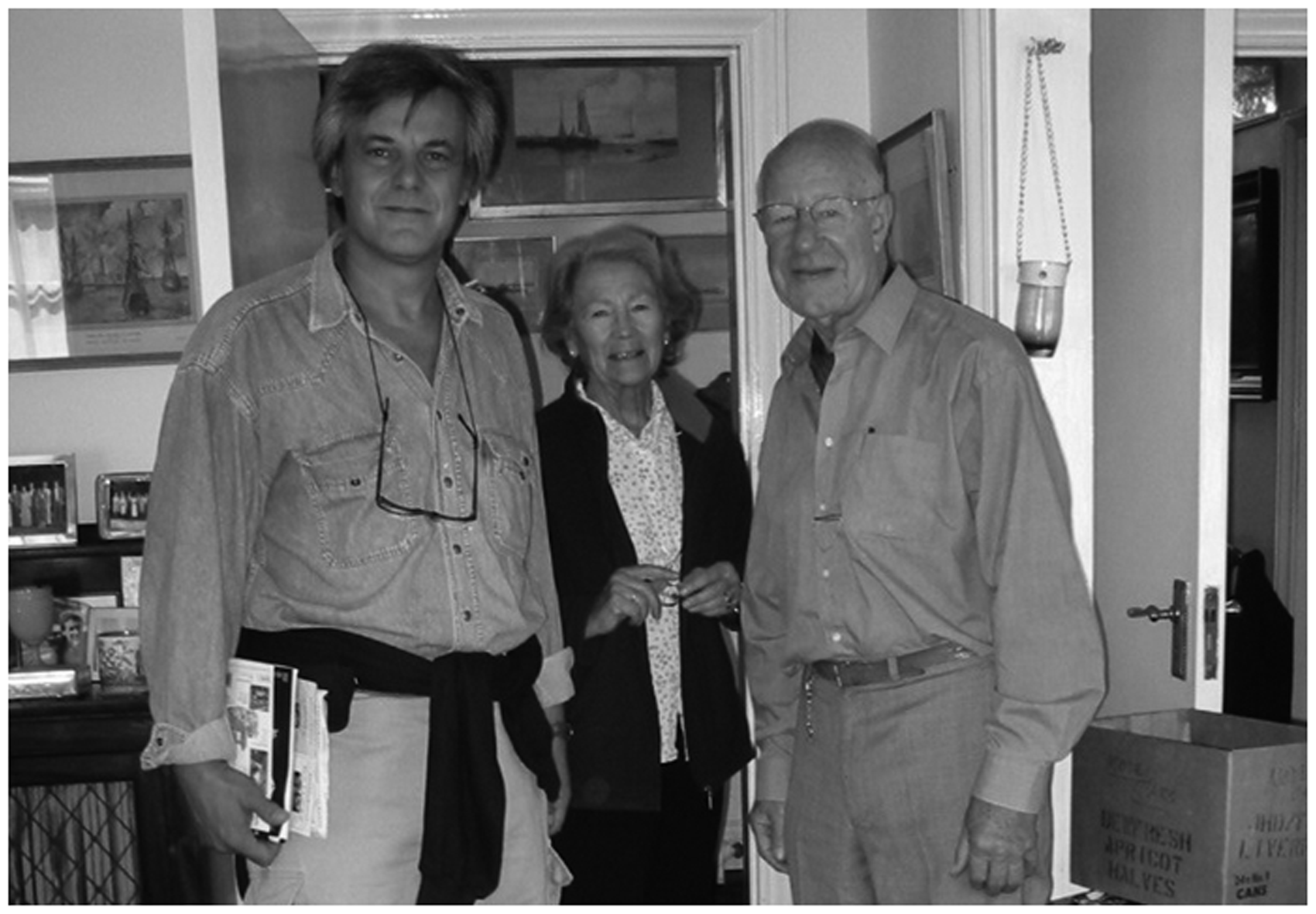
Medical activities and scientific contributions
At the end of the Second World War, Cockett returned to St Thomas’ Hospital where he worked until 1981, when he retired. He became renowned for his work in the fields of (1) the treatment of venous ulcers and varicose veins, (2) aortic surgery, and finally (3) the compression of the left common iliac vein.
In 1949, Frank Cockett was put in charge of the leg ulcer clinic which was ‘thought by senior surgeons to be a non-exciting clinic dealing with a non-exciting condition, the cause of which was poorly understood’. ‘I saw what an enormous unsolved problem there was. Of course all were called varicose ulcers, but most of them had no varicose veins’ (from his autobiography).
During numerous painstaking dissections and vascular casting on cadaver limbs, he noted that ankle perforating veins were enormously enlarged and argued that ‘they’ were the cause of the ulcers in the lower leg and not the saphenous vein. In 1951, he operated on his first case with considerable trepidation that the wound would not heal. By 1953, he had operated on a series of cases and published in Lancet ‘The ankle blow-out syndrome’.
4
The same year he obtained the degree of Master in Surgery, his thesis entitled: ‘The pathology and treatment of venous ulcers of the leg’ (Figure 2).
The frontispiece of Cockett thesis.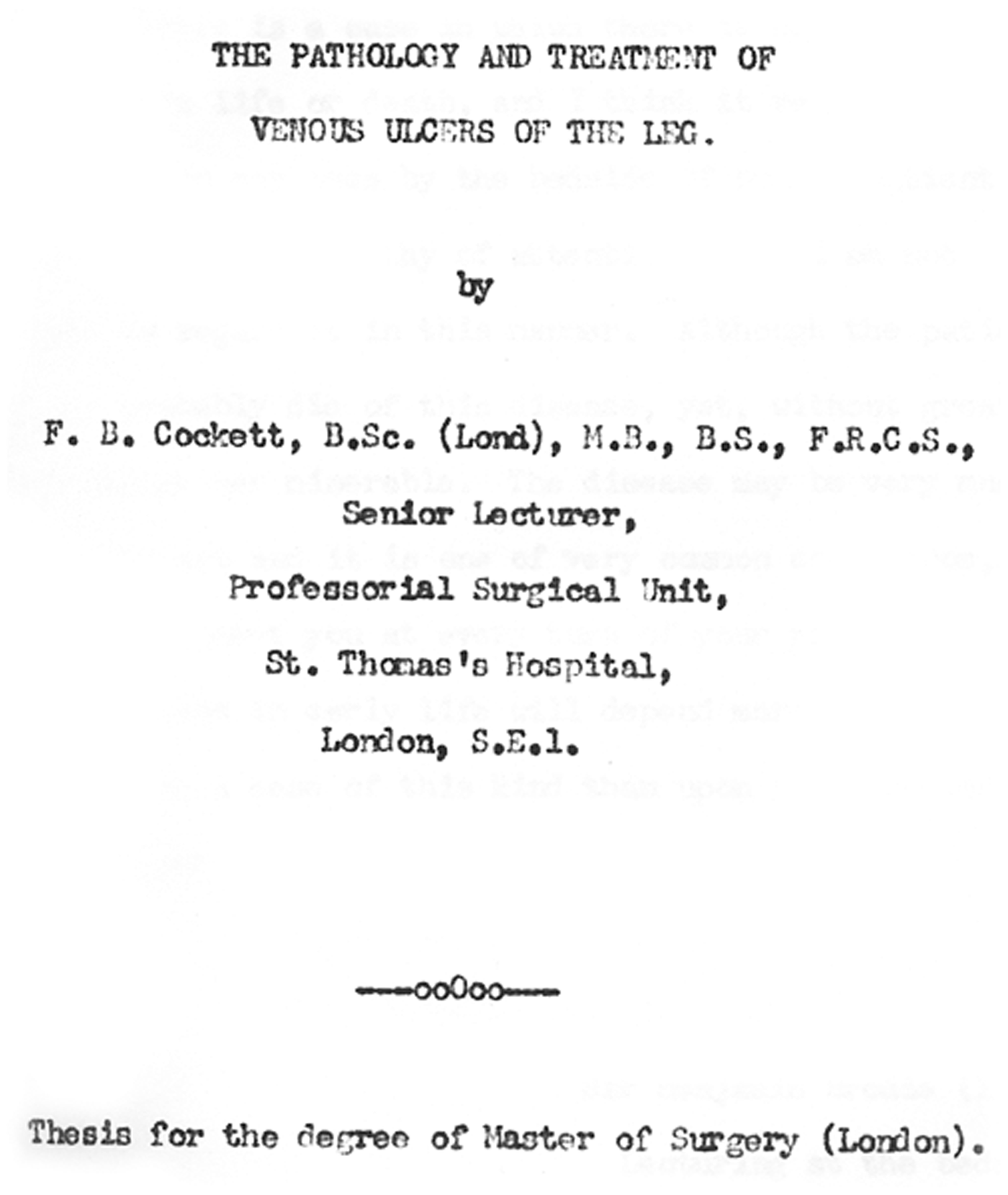
His experiences in the phlebological world are summarized in a book he co-authored with Dodd and Cockett. 5 Ten years later, he published his famous anatomic, radiologic and clinical studies concerning the compression of the left iliac vein. 6
He was the first to describe the perforating veins at the inferior two-thirds of the calf, which are usually three; superior, medium and inferior and are called Cockett’s perforating veins and described his own operation for them.
In 1954, he was appointed as consultant surgeon at the hospital and performed successfully aortic surgery. In 1955, Cockett was the first to insert an aortic bypass graft for treatment of aortic thrombosis without removing the aorta. 7 This operation was another step forward and was less demanding than aortoiliofemoral endarterectomy.
Despite his experience and skillfulness, Cockett offered his patients the reassurance of his kind ‘bedside manner’. As he reported in his autobiography, even on Christmas day, he would visit his patients accompanied by his children who would help serve Christmas dinner while their father carved the turkey.
Cockett was one of the founding members and former president of the Vascular Surgical Society of Great Britain and Ireland and served as chairman of the venous forum at the Royal Society of Medicine. He also was a founding member of the St Thomas’ History and Works of Art Committee, serving as its chairman for 12 years.
Zanzibar
In 1963, Zanzibar was still a British protectorate and the ailing sultan, Sayyid Sir Abdullah bin Khalifa Al-Said, suffered from leg ulcers. There was considerable political unrest in Zanzibar at the time, and the British government believed that the Sultan’s well-being was crucial to stability. Therefore, the government sent Cockett to Zanzibar to treat the sultan. Unfortunately, Cockett arrived too late and he could not but amputate the Sultan’s gangrenous legs. The Sultan died, and six months later, the new Sultan was overthrown, and Zanzibar obtained independence to become a part of Tanzania.
The collector and the expert
In 1981, Cockett retired from the National Health Service (NHS) and dedicated his full time to the field of marine art.
Haunting the auction rooms which he visited equipped with his magnifying glass, he had already amassed an impressive collection of early English marine paintings. He was an adviser to Christie’s, and in 1995, published a monograph, ‘Early Sea Painters’, about the development of English marine art since the reign of Charles II which chronicled the rise of marine art in England. 8 In 2000, he published a biography and assessment of Peter Monamy (1681–1749), the first important English marine artist. 9 The walls of his private study room were filled with hundreds of car models he collected, too.
While hunting for marine paintings, in 1973 Cockett purchased from Bonhams an unrecognized portrait of the English surgeon William Cheselden (1688–1752). The painting had been removed from St Thomas’ Hospital when, in 1860, the hospital moved from London Bridge to its current site near Westminster Bridge. Cockett returned the portrait to its original home.
Cockett, the sportman
Besides swimming, squash and skiing, Cockett enjoyed sailing, above all. His sailboat for solitary sailing was a dinghy named ‘Varix’. While he sailed with his friends (generations of students and colleagues from St. Thomas’ were initiated to sailing by him), Cockett preferred his steel-hulled ocean racing yacht named ‘Saphena’. With this, he participated for several years in the Cowes-Dinard and Cherbourg races (Figure 3). In 1993, he stopped his agonistic activities (after wrecking of the Saphena and a serious motor accident which left him less mobile) but continued to sail for pleasure until he was well into his 80 s.
Frank Cockett ‘Saphena’ during Cowes-Dinard race.