



Abstract
Purpose
Deep venous thrombosis induced by iliac vein compression syndrome often interferes with patients’ work or daily living. This study aims to investigate the long-term outcome and quality of life in patients with iliac vein compression syndrome after endovascular treatment.
Methods
From October 2011 until June 2016, 28 patients with acute deep venous thrombosis diagnosed as iliac vein compression syndrome by ultrasonography were enrolled in this perspective study. Fifteen patients underwent balloon dilation and stent insertion (group A); 13 patients received anticoagulation treatment, thrombolysis, or balloon dilation without stenting (group B). The Medical Outcomes Study-Short Form-36 was used to assess the quality of life preoperatively and after endovascular treatment. The follow-up of Short Form-36 questionnaire was obtained within 12.13 ± 12.04 months after repair.
Results
There was no operative mortality in two groups, and technical success was achieved in 14 (93.3%) patients in group A. Thirteen (86.7%) patients were cured in group A, which was significantly higher than that of group B (46.2%, p = 0.042). Only one patient showed occlusion of stent in group A, with a secondary patency rate of 93.3%. Except for ‘Role emotion’, all remaining domains were significantly improved in group A when compared with preoperative score (p < 0.01). The scores of ‘Physical functioning’, ‘Role physical’, and ‘General health’ in group A were significantly higher than those of group B (p < 0.05).
Conclusions
Endovascular stenting to treat iliac vein compression syndrome shows beneficial clinical outcome, cumulative patency rate, and quality of life, with high technical success and low complications.
Keywords
Introduction
The iliac vein compression syndrome (IVCS), also known as Cockett syndrome, or May–Thurner syndrome, is caused by the compression of the common iliac vein by the overlying artery and associated mechanical trauma, which induce endothelial irritation and result in the formation of venous spurs1,2 McMurrich 3 first reported the presence of web-like intraluminal obstruction in 1908, high prevalence of this lesion was then confirmed by autopsy in asymptomatic general population,1,4 The spur formation is a risk factor for developing deep venous thrombosis (DVT) of lower extremities. 1 This clinical syndrome is considered to be a contributor of chronic venous disease. 5
IVCS often presents as sudden pain and limb swelling of lower extremities in young patients after surgery or pregnancy, 6 which often interferes with patients’ work or daily living, and surgical treatment was the only choice in the past.7,8 Nowadays, endovascular treatment, including iliac vein balloon dilation and insertion of stent, has made it possible to correct this obstruction.9–13 Although clinical presentation, stent technique, and results of endovascular treatment were studied,14–16 little attention has been paid to the quality of life (QoL) assessment, and the impact of other factors, including the possible need for second intervention, on patients’ QoL has not been clearly elucidated yet. This study aims to evaluate the long-term outcome and QoL in patients with IVCS after endovascular treatment.
Methods
Patient selection
This study was approved by the Ethics Committee of our University. From October 2011 until June 2016, 28 patients with acute (<15 days) DVT were diagnosed as IVCS by ultrasonography and were enrolled in this perspective study (Figure 1). According to patients’ choice of stenting or not, these case were divided into two groups. In group A, 15 patients underwent balloon dilation and stent insertion; in group B, 13 patients received anticoagulation treatment, thrombolysis, or balloon dilation without stenting. The Medical Outcomes Study-Short Form-36 (MOS SF-36) was used to assess the QoL preoperatively and after treatment. Patients, who were unable to fill in the questionnaires themselves, for example because of dementia, were excluded from this study. All patients were recorded and were asked to answer SF-36 questionnaires during routine follow-up; two were lost to follow-up. Duplex ultrasound was used to assess stent patency during follow-up (Figure 2).
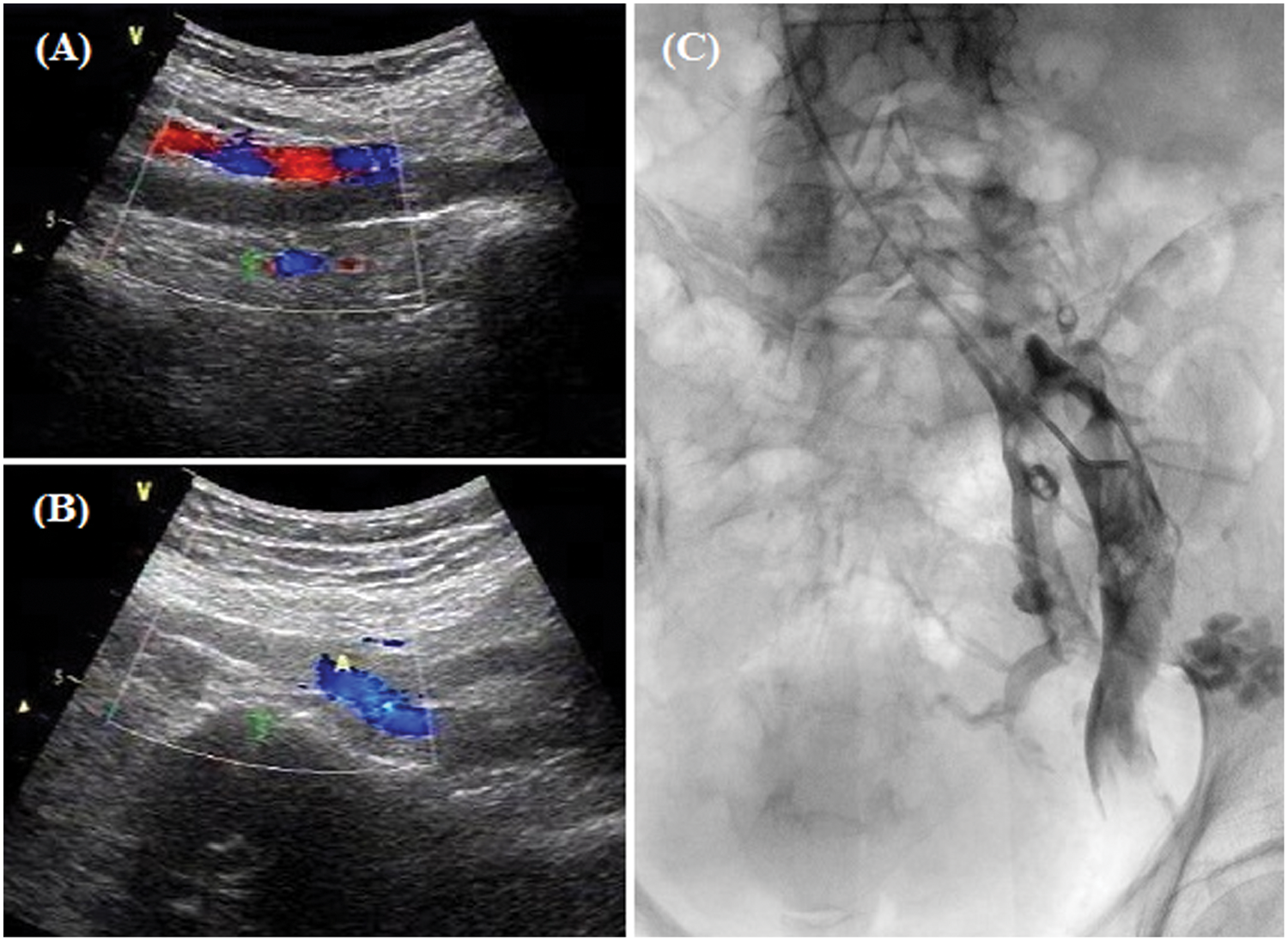
Preoperative diagnosis of IVCS. The left common iliac vein and external iliac vein were filled with uneven echo, and no obvious blood flow signal was observed (A). The diameter of the left common iliac vein into the inferior vena cava was about 2 mm, and no obvious blood flow signal was observed (B). IVCS was confirmed by venography during intervention (C). IVCS, iliac vein compression syndrome.

Ultrasound follow-up after stenting. The stent echo was seen in the left common iliac vein and external iliac vein, with a diameter of 7 mm; the blood flow was patent, and the velocity of the common iliac vein into the inferior vena cava was 21 cm/s.
Technique
The diagnosis of IVCS was obtained by ultrasound and confirmed by venography. After the performance of the diagnostic venogram, a 7F sheath was placed, thrombolysis catheter implantation, angioplasty, or stenting were performed. All patients were heparinized during intervention to maintain an activated clotting time of 200–300 s. In group A, the lesion was pre-dilated with a balloon catheter (8–10 mm) and 1–2 endovascular stents were implanted after an effective thrombolysis. Post-dilation was performed with a balloon catheter if necessary (8–12 mm) and immediate postoperative venography was performed (Figure 3). Technical success was defined as a less than 10% residual stenosis with adequate flow. Clinical efficacy was established as below: patient was cured if resolution of symptoms with a normal QoL; improvement of symptoms with a moderate QoL was considered as improved efficacy; no improvement of symptoms with a low QoL, including death, was considered invalid efficacy. Patients received oral anticoagulation by oral take of warfarin sodium (100 mg/day; international normalized ratio 2–3) for 3–6 months if no contraindications, and dipyridamole (225 mg/day) was used in case of contraindication or resistance to warfarin. Elastic stockings were used if necessary.

Interventional procedure. IVCS in left common iliac vein was shown by venography (A); the lesion was pre-dilated with a balloon catheter (B) and postdilation was performed with a balloon catheter if necessary (C); the left common iliac vein was patent by second venography (D). IVCS, iliac vein compression syndrome.
Questionnaires and data collection
A Chinese version of the standard MOS SF-36 questionnaire has been validated for a Chinese population. 17 Dataset was acquired using SF-36 QoL questionnaire. The SF-36 questionnaire was gathered and ultrasonography was performed during follow-up.
Statistical analysis
The statistical analysis was performed with Prism 5.0 software (GraphPad Software Inc., San Diego, CA). Statistics are summarized as mean value and one-way analysis of variance was used for continuous variables. Mean values are given with standard deviation (SD) in the form mean ± SD. Measures of dispersion are summarized as standard deviation or range. Chi-square test was used to test percentage scoring. For all tests, bilateral significance was tested and accepted as significant with p < 0.05.
Results
Demographics
There was no significant difference of clinical profiles between group A and group B. One in each group showed carcinoma (p > 0.05); 5 (33.3%) patient had history of traumatism or open surgery in group A, 3 (23.1%) in group B (p > 0.05). Furthermore, there was 1 (7.7%) with Budd–Chiari syndrome in group B (Table 1).
Demographics of patients with DVT.

Note: There were no significant differences between groups. DVT: deep venous thrombosis; ns: not significant.
Operative techniques
There was no operative mortality in both groups, and technical success was achieved in 14 (93.3%) patients in group A. A re-thrombosis of stent occurred after one week in group A. Twenty-two self-expanding stents (Luminexx; Bard, Austin, TX, USA) were used, with a mean length of 104.5 mm (60–120 mm) and a mean diameter of 11.6 mm (8–12 mm). Treatment of DVT consisted of catheter direct thrombolysis, peripheral thrombolysis, balloon dilation, and stenting. Inferior vena cava filter was used if the clot extends into the inferior vena cava. Inferior vena cava filters were implanted in three (20%) patients in group A, three (23.1%) in group B. All patients received anticoagulation treatment, four (30.8%) patients in group B received sole anticoagulation treatment, without thrombolysis, balloon dilation, or stenting. Catheter direct thrombolysis was performed in six (40%) patients in group A, eight (61.5%) in group B; one (7.7%) patient received peripheral thrombolysis in group B. All patients received balloon dilation and stenting in group A, two (15.4%) cases in group B underwent balloon dilation.
QoL before operative techniques
The distributions of MOS SF-36 domain scores of patients on admission are shown in Table 2, which showed no significant difference in all domains. The worst-scoring domain was ‘Role physical’ in two groups, and the best-scoring domain were ‘Role emotion’ in group A, ‘Mental health’ in group B before interventional procedure. Except for ‘Role emotion’, all remaining domains were significantly improved in group A when compared with preoperative score (p < 0.01). However, ‘Bodily pain’, ‘Role emotion’ and ‘Mental health’ did not improve during follow-up in group B (Table 3). As shown in Table 4, the scores of ‘Physical functioning’, ‘Role physical’, and ‘General health’ in group A were significantly higher than those of group B (p < 0.05). The condition significantly improved in the majority of patients when compared with the condition one year ago in group A (p < 0.001).
Results of the SF-36 questionnaire on admission.

ns: not significant.
QoL change in all groups when compared with previous score.

ns: not significant.
QoL changes during follow-up.

ns: not significant.
Follow-up
The follow-up of SF-36 questionnaire was obtained within 12.13 ± 12.04 (range 0.8–58.7) months. Thirteen (86.7%) patients were cured in group A, which was significantly higher than that of group B (46.2%, p = 0.042). Also, group A shows a significant low rate of invalid efficacy compared with group B (23.1%, p = 0.049). Little complication occurred in group A, only one patient showed occlusion of stent in group A, with a secondary patency rate of 93.3%. No bleeding was found in both groups. Two (15.4%) patients in group B died of multiple organ failure syndromes due to malignancy tumor (Table 5). These two patients with malignant tumors was probably connected with paraneoplastic hypercoagulation.
Operative techniques of patients with DVT.

DVT: deep venous thrombosis.
Discussion
McMurrich 3 first observed the compression of the left common iliac vein in 1908. May and Thurner 1 had similar finding in 1957. Most of the patients with DVT have more than one risk factor; 18 substantial compression of iliac vein was considered a probable risk factor or a contributing factor. Symptomatic DVT occurs predominantly in young women of 20–40 years, especially during pregnancy. 19 Surgical reconstruction usually requires lengthy postoperative care and presents a risk of postoperative hemorrhage during anticoagulation. Endovascular treatment offers a less invasive alternative.9–13 Catheter-directed thrombolysis with or without stenting has been reported to be an effective treatment of DVT induced by IVCS, with a primary patency rates of 79%–100% within two years.6,13,20–22 The prevalence of IVCS ranged from 18% to 49% in patients with a left-sided lower extremity DVT, 13 with a recurrence rate of 73%, if obstruction was not treated with stenting. 23 Therefore, stent placement in the left common iliac vein is recommended for IVCS to overcome the underlying mechanical obstruction and prevent recurrences.
In this study, possible stent implantation was considered in patients who failed conservative therapy and had severe symptoms interfering with work or daily living. It is reported that iliac vein was balloon dilated and stented with Wallstent of 14–16 mm;14,16 however, Luminexx stents of 10–12 mm were used in our study. The patency rate during follow-up of 12.13 ± 12.04 months was 93.3% in group A, which was similar as previous reports.6,9 After stenting, 13 (86.7%) patients in group A had excellent clinical efficacy with resolution of symptoms of lower extremity swelling and pain. The MOS SF-36 scores showed no significant difference in all domains on admission. However, all domains, except for ‘Role emotion’, were significantly improved in group A when compared with preoperative score. Additionally, ‘Bodily pain’, ‘Role emotion’, and ‘Mental health’ did not improve during follow-up in group B. The scores of ‘Physical functioning’, ‘Role physical’, and ‘General health’ in group A were significantly higher than those of group B; the majority of patients said that their condition significantly improved when compared with the condition one year ago in group A.
This promising result indicates stent implantation can improve the QoL in patients with IVCS. However, our study is limited by several factors. First, it is a small, single-center study, there was a big bias for patient selection. Second, follow-up of stent patency with ultrasound can be inaccurate in evaluating iliac venous obstruction. Third, the long-term patency of iliocaval venous stents was not evaluated in this study. Besides, selection of patients was done by ultrasound, which may be affected by the interference of the intestinal contents and the anatomical conditions of the patient as well as by the experience of the operator. Non-ultrasonographic diagnostic methods will be helpful to evaluate with objectivity the effectiveness of the treatments and the differences in the two groups.
Conclusion
This study demonstrates that endovascular stenting to treat IVCS shows beneficial clinical outcome, cumulative patency rate, and QoL, with high technical success and low complications.
Footnotes
Declaration of Conflicting Interests
The author(s) declared no potential conflicts of interest with respect to the research, authorship, and/or publication of this article.
Funding
The author(s) disclosed receipt of the following financial support for the research, authorship, and/or publication of this article: This research was funded by the National Natural Science Foundation of China (Grant No. 81501569). The funders had no role in study design, data collection and analysis, decision to publish or preparation of the manuscript.
Ethical approval
This study was approved by the Ethics Committee of our University.
Guarantor
XH.
Informed consent
Informed consent was obtained from all individual participants included in the study.
Contributorship
YB and ZY researched the literature and conceived the study. XH was involved in protocol development, gaining ethical approval and data analysis. YB and ZY wrote the first draft of the manuscript. All authors reviewed and edited the manuscript and approved the final version of the manuscript.
Acknowledgement
We would like to thank our colleague for the assistance and guidance in this research.