



Abstract
Objectives
to evaluate direct oral anticoagulants (DOACs) in patients with hereditary thrombophilia and deep venous thrombosis (DVT).
Methods
This is a retrospective observational study.
Results
In total, 45 patients were treated between 01/2012 and 12/2022 (mean follow-up: 1.5 +/− 0.3 years). The most frequent thrombophilias were heterozygous V Leiden (20%), heterozygous MTHFR C677T (37.8%), heterozygous MTHFR A1298C (24.4%), and hyperhomocysteinemia (26.7%). The patients received rivaroxaban (n = 19), apixaban (n = 15), and dabigatran (n = 11). Three cases presented symptoms’ recurrence without evidence of thrombosis’ recurrence (two under rivaroxaban and one under apixaban; p > .05). These patients improved under parenteral anticoagulation and were further treated with dabigatran. No other event or major bleeding occurred during the follow-up. The presence of more than two factors was associated with acute recurrence of symptoms (OR = 25.9; 95% CI [1.454–461.262]; p = .026).
Conclusions
DOACs seem to be safe and efficient for patients with hereditary thrombophilia and DVT. The presence of more than two thrombophilia factors is associated with a higher risk for symptom recurrence. Although statistically non-significant, symptoms’ recurrence was also observed more frequently among patients under anti-Xa inhibitors than antithrombin inhibitors. This should be verified in larger comparative studies.
Introduction
Venous thromboembolism (VTE) affects almost 10 million people worldwide annually, and it is associated with a high mortality and morbidity risk. 1 It can be caused by several acquired factors such as trauma, immobilization, cancer, inflammatory disease, and others, although most events are unprovoked.2,3 In some unprovoked cases, the underlying factor is some type of hereditary thrombophilia (HT), which is a genetic propensity to develop venous or arterial thromboembolism, and it includes gene mutations of different coagulation factors such as protein C or S, V Leiden, antithrombin, and prothrombin G20210A. 4 Although V Leiden and prothrombin mutations are the most commonly detected, antithrombin and protein C/S mutations are associated with the highest risk for VTE and pulmonary embolism.4,5
The most recent guidelines do not recommend in general to screen patients for inherited thrombophilias after one episode of VTE. 6 However, in some cases of unprovoked VTE, a thrombophilia testing is necessary when certain factors are present such as young age (<50 years), more than one VTE events, VTE in an atypical site, or a family history of thrombophilia.6,7 Regarding treatment, direct oral anticoagulants (DOACs) including direct Xa (rivaroxaban and apixaban) and thrombin (dabigatran) inhibitors have proven their efficacy and safety to treat patients with VTE compared to traditional vitamin-K inhibitors, even among patients with thrombophilic conditions such as cancer.6,8 However, their success in the treatment of hereditary thrombophilias has not been fully proven yet due to lack of extended clinical evidence in the literature. 9 This has further led to a lack of strong recommendations within the guidelines regarding their use in such patients. 6
Therefore, this study aims to present the experience of our department in the treatment of patients with VTE due to hereditary thrombophilia to make useful conclusions for everyday clinical practice.
Methods
This is a retrospective observational study including adult patients who were treated for upper or lower extremity deep venous thrombosis (DVT) by our Vascular Surgery unit from January 2012 to December 2022. Eligible patients should have undergone a thrombophilia testing and had at least one hereditary factor of thrombophilia detected. The diagnosis of DVT was established by a positive finding of color duplex ultrasound. The reason to undergo a thrombophilia testing should include the following: (i) unprovoked DVT; (ii) a family history of thrombophilia or VTE; (iii) young age of patient (<40 years); (iv) a history of more than one episode of VTE without evidence of other cause. All patients underwent a thorax CT scan to detect any pulmonary embolism. Thrombophilia testing was conducted in the hematology department of our institution. All patients were evaluated in this study according to the Declaration of Helsinki for patients’ rights. All patients had normal renal function (creatinine levels in normal range) and normal liver function.
Exclusion criteria included patients with other thrombophilic factors such as cancer, inflammatory disease, chronic heart insufficiency, severe trauma or surgery, and severe chronic venous insufficiency. Additionally, patients undergoing any type of intervention for DVT (thrombolysis or thrombosuction) were excluded. Patients with symptomatic pulmonary embolism (PE) were also excluded.
Regarding treatment, eligible patients received one of the DOAC agents that are available in our country including rivaroxaban, apixaban, or dabigatran. The choice of the agent was made by the treating physician in each case. The treating strategy was as the following for each agent: rivaroxaban (15 mg bid or low-molecular-weight heparin [LMWH] for 21 days and 20 mg once per day after), apixaban (10 mg bid or LMWH for 7 days and 5 mg bid after), and dabigatran (LMWH for 5–10 days and 150 mg bid after). 10
Baseline characteristics of all patients were recorded including age, gender, type of thrombophilia, location of thrombosis, comorbidities, and type of anticoagulant treatment. Primary outcomes included improvement of symptoms, acute recurrence of symptoms, recurrent thrombosis, and major bleeding during follow-up. Recurrent thrombosis was defined as acute recurrence of symptoms combined with ultrasonographic proof of thrombus propagation or new thrombus formation. Acute recurrence of symptoms was defined as acute worsening of symptoms including pain and edema, despite wearing stockings and receiving the proper anticoagulant treatment. Major bleeding was defined as bleeding requiring blood transfusion, intervention, or reduction of dosage.
Regarding statistical analysis, all basic parameters were calculated for interval-scale variables (mean value and standard deviation). Nominal variables were expressed as number and percentages. Odds ratios (ORs) were used to determine the effect of certain variables on major outcomes, along with 95% confidence intervals (CIs). A p-value less than 0.05 was considered significant for all analyses. StatsDirect statistical software (Version 2.8.0, Stats Direct Ltd, Cambridge, UK) was used for all statistical analyses.
Results
Characteristics and detected hereditary thrombophilias of all patients (n = 45).
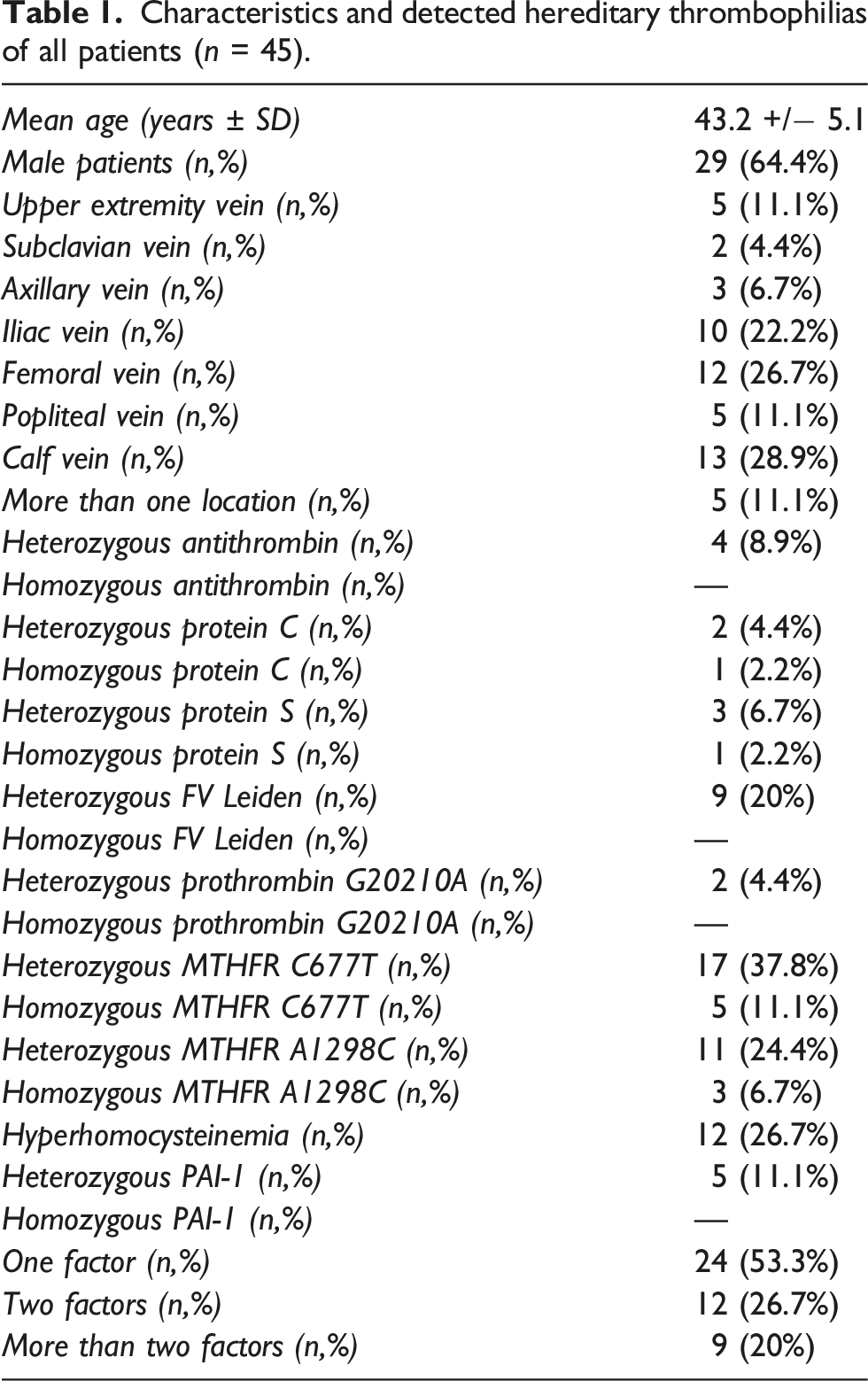
Regarding location, there were 5 cases of upper extremity DVT and 40 cases of lower extremity DVT. The locations of DVT were the following: subclavian vein (n = 2), axillary vein (n = 3), common/external iliac vein (n = 10), femoral vein (n = 12), popliteal vein (n = 5), and calf vein (n = 13). The rate of asymptomatic PE detected with CT scan was 24%. The following DOACs were given to patients: rivaroxaban (n = 19), apixaban (n = 15), and dabigatran (n = 11).
All cases improved initially under anticoagulant treatment. The mean follow-up was 1.5 ± 0.3 years. No recurrent thrombosis or major bleeding was observed within follow-up. There were three cases (all with more than two thrombophilic factors) that presented an acute recurrence of symptoms without signs of new thrombosis after switching to preservation dosage (two cases under rivaroxaban 20 mg once/day and one case under apixaban 5 mg bid) (Figure 1). These patients were switched to LMWH for at least 10 days until their symptoms subsided. Thereafter, it was decided to switch to dabigatran 150 mg bid until the completion of treatment. These three cases were uneventful until the completion of treatment. Kaplan–Meier graph showing the events of acute recurrence of symptoms during the follow-up.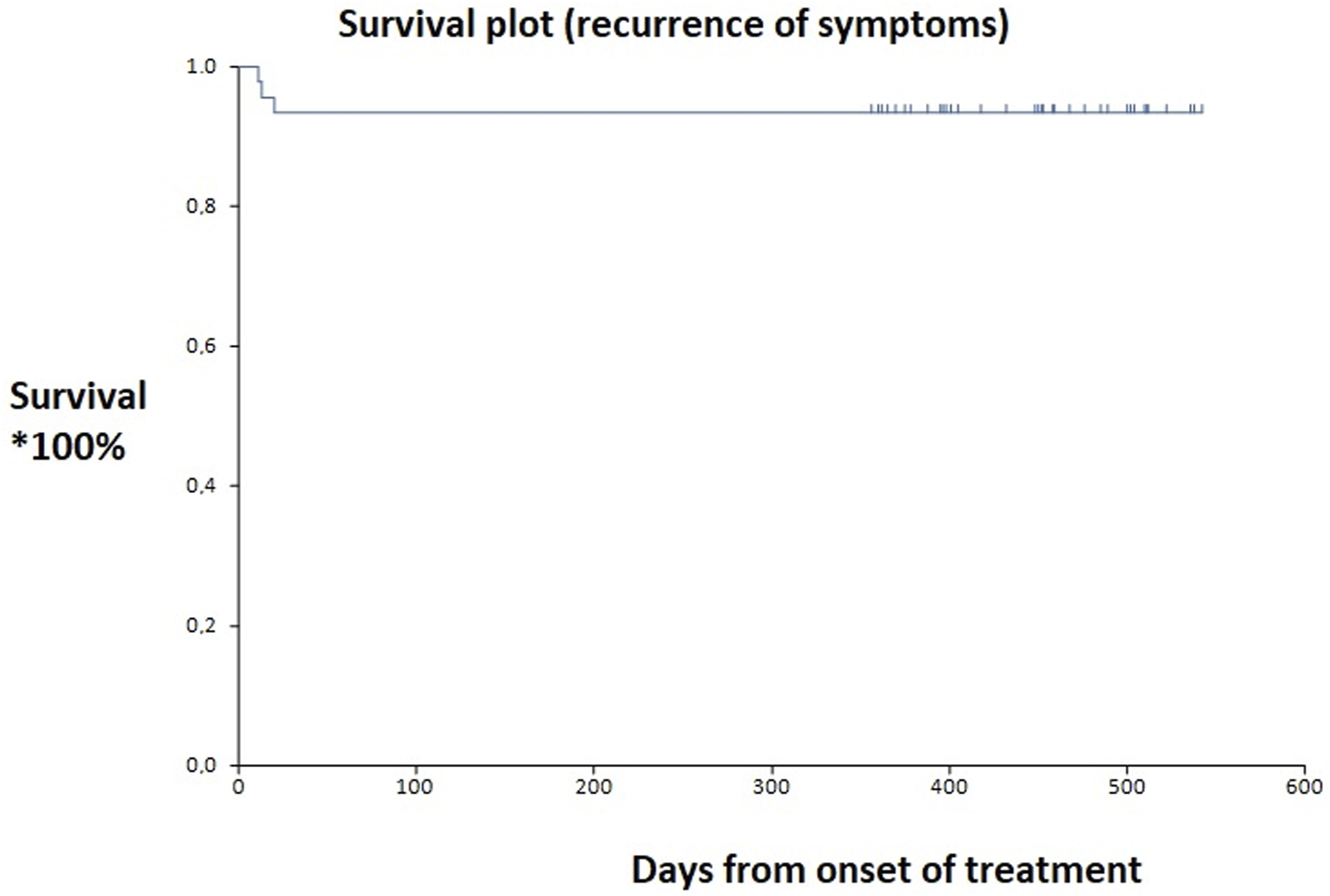
There was no statistical association between the type of anticoagulant and the major outcomes including acute recurrence of symptoms, recurrence of thrombosis, or major bleeding. There was no statistical association between the type of thrombophilia and the location or the outcome of the treatment. However, the presence of more than two factors was associated with acute recurrence of symptoms (OR = 25.9; 95% CI [1.454–461.262]; p = .026)
Discussion
This is one of the few cohort studies in the literature evaluating the performance of DOACs in the treatment of patients with hereditary thrombophilias and DVT of the extremities. We found that the presence of more than two factors may affect the recurrence of symptoms under treatment with DOACs without any effect on the recurrence of thrombosis or major bleeding. We also observed that there was no recurrence of symptoms under thrombin inhibitor during follow-up although this was not statistically significant.
Thrombophilic abnormalities are found in about 30% to 40% of patients after the first episode of unprovoked DVT.5,11 The most frequent mutations are V Leiden and prothrombin G20210A, accounting for almost 50% to 70% of the diagnosed inherited thrombophilia. 11 In our series, however, V Leiden and MTHFR mutations were the most commonly observed. This concurs with the fact that MTHFR mutations in combination with homocysteinemia have a prevalence of about 10% among patients with DVT and are associated with a 2–4 times higher risk for thrombosis. 10 In some studies, the relative risk for DVT has been reported to be increased 10- to 50-fold in patients carrying both homocysteinemia and inherited thrombophilia in comparison with normal controls, suggesting a synergistic interaction, yet other studies failed to confirm such conclusion. 12 Multifactorial genetic thrombophilia has been associated with an increased risk for thrombosis compared to single-genetic defects by several authors.13–16 In an older study, Caprini et al. identified almost 11% of the DVT cases having more than one genetic deficit. 17 Additionally, the combination of V Leiden and prothrombin G20210A mutation has been found to have a 5–6 times higher risk of coronary artery disease and myocardial infarction than double non-carriers. 18
Regarding the risk for thrombosis recurrence, up to one-third of cases with hereditary thrombophilia and DVT will recur within the following 4 years. 19 In 2001, Emmerich et al. conducted a pooled analysis of 8 case–control studies looking at 2310 cases and 3204 controls to estimate the risk of thrombosis in double heterozygotes for factor V Leiden and the prothrombin G20210A mutations. 20 The data showed an odds ratio for VTE in double heterozygotes of 20.0 (11.1–36.1). This was much higher than the odds ratios for thromboembolism of 4.9 (95% CI; 4.1–5.9) for the factor V Leiden and 3.8 (3.0–4.9) for the factor II G20210A mutation as single defects. 20 Other authors have also found that combined mutations are associated with an increased risk for DVT, pulmonary embolization, and recurrence. 21 Aznar et al. have found that 55% of patients with prothrombin mutation G20210A plus another congenital defect had recurrent thrombosis. 22 This concurs with the fact that we found a higher risk for symptom recurrence when more than one factors are present although no association with recurrence of thrombosis was found.
Because these conditions are associated with an increased risk for VTE and arterial thrombosis, anticoagulation therapy is needed for acute treatment and secondary prevention. The mainstay of treatment has traditionally included vitamin-K antagonists (VKA) and heparin-containing products. 6 However, warfarin requires routine therapeutic drug monitoring, has an unpredictable therapeutic effect, and has numerous drug–drug and drug–food interactions, whereas LMWH requires subcutaneous administration and can be expensive. 23 Therefore, the introduction of DOACs into everyday clinical practice has been very promising. However, data on the optimal anticoagulant treatment for patients with thrombophilia are limited. Of the randomized trials (RTs) evaluating DOACs for the treatment and secondary prevention of VTE, only a small minority were identified as having a pre-existing thrombophilia, and screening at the time of enrolment was not performed.24,25 Besides triple-positive antiphospholipid syndrome, there is no official contraindication to use DOACs as a first-line therapy in cases of thrombophilia. 6
Several small observational studies have compared DOACs to warfarin among patients with inherited thrombophilia and VTE. Some have reported a 9% recurrence rate, whereas others reported no thromboembolic or bleeding event during follow-up.26,27 In a large comparative study by Coleman et al., the authors matched 403 patients receiving rivaroxaban and 403 patients on VKAs. 16 There was no statistical difference in recurrent VTE and major bleeding between both groups, with hazard ratios of 0.70 (95% CI 0.33–1.49) and 0.55 (95% CI 0.16–1.86), respectively. 28 In a recent meta-analysis evaluating patients with thrombophilia who were enrolled in Phase 2 and 3 RTs, the authors compared DOAC and VKA therapy for VTE management. 29 In this review, the rate of recurrent VTE was similar between patients receiving DOAC and VKA therapy (RR = 0.7; 95% CI = 0.34–1.44; I2 = 0%). Additionally, the rate of major bleeding did not differ between groups (RR = 0.84; 95% CI = 0.32–2.19; I 2 = 0%). 29 These results concur with our findings verifying the efficacy and safety of DOACs in this group of patients.
Considering the performance of each DOAC, we found that dabigatran was the only agent that was not associated with the recurrence of symptoms although this was not statistically significant. Recurrence of VTE symptoms is not usually reported by other studies as this outcome may be difficult to define. However, acute recurrence of symptoms may be a major concern for the patients that may lead to change of medical regimen even if no recurrence of thrombosis is evident. Rivaroxaban is a selective Xa factor inhibitor while dabigatran is a direct thrombin inhibitor.3,6 This means that dabigatran blocks coagulation at a later stage in the cascade of thrombus formation, probably making it more potent against some thrombophilias. The REMEDY and RECOVER trials have shown that the efficacy and safety of dabigatran were not significantly affected by the presence of thrombophilia. 30 Although pooled data suggest that all DOACs are safe and efficient in patients with thrombophilia considering VTE recurrence and bleeding risk, 29 some authors have also reported recurrent events under DOACs, and specifically rivaroxaban, concurring with our findings. 31
Finally, there are certain limitations in this study. This is a retrospective study including a small number of patients. This could be justified by the rarity of inherited thrombophilias. Therefore, it was not possible to conduct multivariable analysis evaluating more potential risk factors affecting outcomes. Additionally, there may be additional factors increasing the risk for VTE that we have not adjusted the sample. Certain bias considering the choice of treating strategy may be present. Furthermore, this study did not include another group of patients without thrombophilias to compare outcomes. However, the strength of this study is that it provides a real-life experience of how these specific high-risk patients are treated in everyday clinical practice.
In conclusion, we observed that DOACs are both safe and efficient when treating patients with hereditary thrombophilia and DVT of extremities. The presence of more than two thrombophilia factors was associated with a higher risk for symptoms’ recurrence. We also observed a recurrence of symptoms more frequently among patients treated with anti-Xa inhibitors in comparison to thrombin inhibitors although this was not statistically significant. This should be verified in larger comparative studies.
Footnotes
Declaration of conflicting interests
The author(s) declared no potential conflicts of interest with respect to the research, authorship, and/or publication of this article.
Funding
The author(s) received no financial support for the research, authorship, and/or publication of this article.
Ethical statement
Guarantor
KF.
Contributorship
GG and AC conceived the study and were involved in protocol development. GG, AC, and GC were involved in literature research, patient recruitment, and data analysis. GG and AC wrote the first draft of the manuscript. NL and FS conducted a critical review of the draft. KF had the overall responsibillity. All authors reviewed and edited the manuscript and approved the final version of the manuscript.
