



Abstract
A recurrent mantra of the technology industry is that all forms of ‘friction’ should be eliminated from online interactions (especially commercial transactions). In this context, ‘friction’ refers to any unnecessary retardation of a process or activity that delays the user accomplishing a desired action. This broad category can therefore include online adverts that link to the wrong webpages, pop-up windows that block access to content or delays in the physical delivery of an ordered item. Although visions of a frictionless future have been common since at least 1995 (the year Bill Gates popularised the phrase ‘friction-free capitalism’), the basic notion has remained unhelpfully vague. Accordingly, this article focuses specifically on the phenomenon of online friction (i.e. ‘e-friction’) and elaborates a typology of the main subtypes. An analytical framework of this kind makes it much easier to compare and contrast distinct kinds of e-friction, recognising that important differences distinguish those that are ‘elective’, ‘non-elective’, ‘impeding’, ‘distracting’ and so on. Having sketched a preliminary typology, the article reflects upon the ethical implications of the distinct varieties, and concludes by suggesting that there are several reasons why an entirely (e-)frictionless future is a profoundly disturbing one.
Introduction
In August 2019, Facebook launched Threads, a companion app for Instagram that enables users to share text messages, photos and videos automatically with ‘close friends’ (Newton, 2019).
1
Designed to improve Instagram’s chances of competing with Snapchat, the ‘frictionless’ nature of the new app was discussed widely in the mainstream media. In the context of online interactions, ‘friction’ is routinely used to refer to any unnecessary retardation of a process or activity (e.g. a financial transaction, the uploading of a picture and an unsolicited pop-up window), and such things can frustrate and annoy users. If you want to see the list of films available on a streaming service, but you can only access that information after entering personal information (e.g. an email address, your age and your location), then you have encountered friction. In 2005, Luciano Floridi offered the following definition of what he termed ‘ontological friction’: […] the forces that oppose the information flow within (a region of) the infosphere, and hence (as a coefficient) to the amount of work required for a certain kind of agent to obtain information (also, but not only) about other agents in a given environment, e.g. by establishing and maintaining channels of communication and by overcoming obstacles in the flow of information such as distance, noise, lack of resources (especially time and memory), amount and complexity of the data to be processed etc. (Floridi, 2005: 186-7)
2
While this captures the core idea of retardation, Floridi mainly reflects upon the role ontological friction plays in relation to informational privacy. Nonetheless, it follows that ‘frictionless’ interactions are those that are completely free (or, in reality, largely free) from these sorts of interruptions and deferments. Writing about Threads, Alex Hern observed that ‘users will be encouraged to share more information with their close friends on a “frictionless” basis’, while Jamie Condliffe noted that ‘[r]educing friction for users posting content, so apps just do it for them, is useful to the company [i.e. Facebook]’ (Hern, 2019; Condliffe, 2019). In this context, ‘useful’ is, of course, a euphemism for ‘profitable’. Companies that make money by selling users’ data to third parties can make more money more quickly by obtaining easy access to more data. 3
The ‘frictionless’ interactions Threads offers may sound like a cutting-edge innovation (if a somewhat risky one in a post Cambridge Analytica world). But Threads is merely another reworking of an old idea. Ever since the internet was first made available for commerce in 1991, there was an increasing fascination with the possibility of ‘frictionless’ transactions. In 1996, Brian Behlendorf and David Chandler asserted confidently that ‘[t]he frictionless economy is on its way’, while Andreas Gröhn warned that the internet could ‘guide society to a frictionless economy or into anarchy’ (Behlendorf and Chandler, 1996: 469; Gröhn, 1999). The advent of social media in the early 2000s offered new opportunities for rapid IT-mediated commerce, and Facebook (in particular) has been overtly seeking ways of reducing certain kinds of commercial friction since at least 2010. However, the vision of an entirely frictionless online future is a disturbing one, and there are ethical reasons why some forms of friction are highly desirable. For instance, particular users might choose not to allow their credit card number to be automatically stored when they log in to specific websites. They must enter that information manually, every time, which slows down the process, but the resulting friction helps to protect them from cybercrime. Recently, the importance of delaying certain online transactions has started to be acknowledged, even by those most closely involved in developing new technologies. In November 2018, Justin Kosslyn argued that (i) only urgent content should be rapidly accessible, to reduce the impact of phishing, (ii) that automated systems should seek human approval before performing certain actions and (iii) that local content should be prioritised, to slow the spread of disinformation (Kosslyn, 2018). The Forum on Information and Democracy’s working group on infodemics has offered similar arguments. Their policy framework document focuses explicitly on ways in which friction could be usefully introduced by online service providers to inhibit the spread of disinformation (The Forum Information and Democracy 2020). However, so far none of these discussions has made any significant attempt to distinguish between different kinds of friction, preferring instead to assess the phenomenon from a high generic level.
In this context, it is worth noting that there can be significant ethnocultural differences around the deployment of technological friction. In the West, companies may seek to minimise friction, or even eliminate it entirely, yet in countries ruled by authoritarian regimes it is often introduced, covertly, to facilitate political purposes. For instance, as Margaret Roberts has shown, friction is routinely used as a mechanism for contemporary censorship in China (Roberts, 2018, especially chapters 2 and 3). By inconveniencing users of the Chinese internet in subtle friction-based ways, the state can direct the attention of the populous away from webpages deemed unhelpful or harmful (e.g. pro-democracy websites). In this way, the government powerfully controls the spread of information. The burying of particular search results, or the introduction of distracting information, can often be far more effective techniques than more traditional forms of overt censorship: the friction-based methods ensure that most users are never even aware that specific information sources are effectively being suppressed. This foregrounds the extent to which discussions of online friction necessarily involve a consideration of the underlying ethical perspectives.
To clarify the ongoing debates concerning these complex and timely issues, this article will undertake a more detailed analysis of friction in the information age – more specifically, it will focus on online friction (which will be referred to as ‘e-friction’), and it will sketch a preliminary typology of the most important subtypes. In addition, the ethical implications of different varieties will be explored. Crucially, it will be argued that while some types are undoubtedly negative, others have a beneficial impact. Consequently, the analysis developed here supports recent claims that, since not all (e-)friction is inherently undesirable, it would be concerning if our online future were utterly frictionless.
E-friction: Desire and delay
There is an episode of The Simpsons called ‘Bart Sells His Soul’ (S07E04; first broadcast on 8 October 1995) in which Homer is told that a particularly powerful microwave can flash-fry a buffalo in 40 s. He replies, with anguish: ‘40 s? But I want it NOW’! There is nothing new here, of course. Even Sigmund Freud’s influential notion of Lustprinzip (a.k.a. The Pleasure Principle), which guides the Id in his model of the psyche, had its roots in prior theories developed by Gustav Theodor Fechner, Jeremy Bentham and Archibald Alison – which can in turn can be traced back through the centuries to at least the Epicurians and the Cyreniacs (Sulloway, 1992: 66-7). 4 Nonetheless, the phrase ‘instant gratification’ was undoubtedly revitalised, and given a more specific Freudian meaning, from the early 1960s onwards, when it came to connote an extreme impatience to assuage desires and instincts instantaneously, without regard for laws, social customs or the needs of others. In the psychology literature, people with these traits were strongly associated with infantilism, hedonism, addiction and/or primitivism. In Alcoholism and Addiction (1978), Richard P. Swinson and Derek Eaves observed that ‘[t]he self-indulgent are seen as being the product of an over-protective childhood environment that leads to a persistence of childhood traits like the need for instant gratification and an inability to delay rewards’, while in his 1980 monograph Literature and Psychology, Leonard Falk Mannheim referred to ‘the childish expectations of instant gratification of desires’ (Swinson and Eaves, 1978: 119; Mannheim, 1980: 114). These ideas were strongly reinforced by an increased biochemical understanding of the role neurotransmitters such as dopamine and serotonin play in pleasure-related cognition (Previc, 2009).
Over the last decade, similar behaviours have come to prominence in the domain of web-based interactions, especially since it is recognised that certain online platforms have been specifically designed to induce addiction (Moqbel and Kock 2018; Price 2018; Sheldon et al., 2019). Nir Eyal discussed this openly in 2014, and his ‘Hooked Model’ has four components or phases: • trigger: this is the actuator of a behaviour (e.g. an app icon on a phone) • action: the motivating and facilitating of specific behaviours the designer wishes to inspire (e.g. making it easy to follow links on webpages) • variable reward: the providing of the expected reward, but also other unexpected ones (e.g. details about the product sought on a website, but also details about other desirable products too) • investment: the collecting of data so that the service is better targeted next time (e.g. automatically learning a user’s online preferences)
So-called ‘behaviour designers’ craft online interfaces for apps and websites based on this kind of model, and the resulting system development is consciously informed by the psychology of addiction. Scientific forms of quantification, such as the Bergen Facebook Addiction Scale (BFAS), have emerged over the last decade to try to determine the extent of a given individual’s dependency (Andreassen et al. 2012). The BFAS is explicitly based on six behaviour-related characteristics – salience, mood modification, tolerance, withdrawal, conflict and relapse – and it offers a practical methodology for assessing manufactured desire. Numerous recent studies have examined the negative impact the resulting dependencies can have on users, and Trevor Haynes has explored some of the techniques that dominant social media sites deploy (Kircaburun et al. 2018; Jogi et al. 2018): Instagram’s notification algorithms will sometimes withhold “likes” on your photos to deliver them in larger bursts. So when you make your post, you may be disappointed to find less [sic] responses than you expected, only to receive them in a larger bunch later on. Your dopamine centers have been primed by those initial negative outcomes to respond robustly to the sudden influx of social appraisal. This use of a variable reward schedule takes advantage of our dopamine-driven desire for social validation, and it optimizes the balance of negative and positive feedback signals until we’ve become habitual users (Haynes, 2018).
Whether Instagram delays ‘likes’ or not is a controversial topic: Eric Andrew-Gee first made the allegation in January 2018, but Mike Krieger, Instagram’s Chief Technology Officer, denied it in a (subsequently deleted) tweet sent a few days later (Andrew-Gee, 2018). 5 Nonetheless, any purposeful (if automated) withholding of ‘likes’ would be a form of e-friction intentionally introduced to inculcate a dependency. As mentioned already, Facebook (Instagram’s parent company) has for many years strongly advocated a ‘Zero Friction Future’ for technology-based interactions (Facebook IQ, Zero Friction Future (2018). 6 Yet certain types of friction have always been desirable – especially those that potentially increase the company’s profits. As Tim Wu and others have convincingly demonstrated, social networking sites (in particular) are part of a vast lucrative industry that seeks to monetise our attention (Wu, 2016). While the roots of that industry can be traced back to the 19th century, its digital guise is distinctively modern, and any e-friction that prolongs user engagement is desirable from a money-making perspective – which is why so many books offer advice about how to achieve this (e.g. Ford, 2019). Conversely, though, other forms of e-friction can make online experiences less addictive, which is why browser extensions like ‘Friction for Facebook’ introduce e-friction by enabling users to auto-hide and/or delay items appearing in newsfeeds. 7 In order to understand these examples more fully, we need to distinguish more carefully between different kinds of e-friction – and the conceptual trajectory of the central idea provides a useful starting point.
The noun ‘friction’ entered English in the 16th century via a French noun derived ultimately from the Latin verb ‘fricare’ (‘to rub’). It acquired its more specific physics-related connotations fairly rapidly, and by the late 17th century could already refer to the resistance one body meets while moving over another. Isaac Newton deployed it in this sense in the second edition of his Opticks (1718): ‘the electrick Vapour which is excited by the friction of the Glass against the Hand’ (Newton, 1718: 315). As mentioned above, though, its emergence as a technology buzzword occurred when the internet became available for commercial transactions in the mid-1990s
8
. In their best-selling 1995 book The Road Ahead, Bill Gates (the founder of Microsoft), Nathan Myhrvold and Peter Rinearson influentially used the phrase ‘Friction-Free Capitalism’ as the title of one of the chapters, and they clarified the central idea as follows: The information highway will extend the electronic marketplace and make it the ultimate go-between, the universal middleman. Often the only humans involved in a transaction will be the actual buyer and seller. All the goods for sale in the world will be available for you to examine, compare, and, often, customize. […] Information about venders and their products will be available to any computer connected to the highway. Servers distributed worldwide will accept bids, resolve offers into completed transactions, control authentication and security, and handle all other aspects of the marketplace, including the transfer of funds. This will carry us into a new world of low-friction, low-overhead capitalism, in which market information will be plentiful and transaction costs low. It will be a shopper’s heaven (Gates et al. 1995: 158).
This alluring techno-utopian vision prompted numerous discussions about the nature of ‘frictionless commerce’, and companies such as Amazon (founded in 1994) were specifically designed to compete in this kind of transnational digital marketplace. Online traders could take full advantage of the possibilities that arose when a global collection of hyperlinked documents (i.e. the World Wide Web) was implemented in a client/server framework that exploited internet protocols such as TCP/IP and HTTP. From the mid-1990s onwards, there was relatively wide-spread agreement that this kind of commercial environment was free from many of the logistical constraints that had slowed down traditional forms of buying and selling which depended upon human interaction in physical locations. In 2000, Erik Brynjolfsson and Michael D. Smith compared internet-based retail versus traditional retail, recognising that ‘the Internet represents a new nearly “frictionless market”’ (Brynjolfsson and Smith, 2000: 563). For many people at the time, this was an enticing vision, though inherent weaknesses in the model have become apparent in the intervening two decades (e.g. Schröter, 2015).
The advent of social media in the early 2000s was part of the transition to ‘Web 2.0’ (first envisioned by Darcy DiNucci in 1999) that provided even greater opportunities for frictionless interactions to increase profitability (DiNucci, 1999). Social networking arguably went mainstream in 2010 (the year Mark Zuckerberg was Time magazine’s Person of the Year), and ‘frictionless’ online interactions had already become a prominent topic. 9 Facebook’s advocacy of ‘frictionless sharing’, announced at the 2011 F8 developers’ conference, caused controversy and raised fears about data privacy (Jane, 2011). Zukerberg described how users’ activities on a wide range of apps (e.g. Spotify) would be added automatically to their Facebook Timelines via the Open Graph protocol, which would facilitate ‘real-time serendipity in a frictionless experience’ (Karppi, 2018). Depending upon your point of view, this vision of social networking is either weirdly naïve or alarmingly sinister – possibly both. In Robert Payne’s memorable formulation, frictionless sharing is little more than ‘digital promiscuity’ (Payne, 2014). Yet, as Neil M. Richards observed in 2012, the phrase itself is deeply misleading, since the underlying processes are not frictionless and they do not involve sharing, at least in any traditional sense (Richards, 2012). All data generated by a user’s online activities – some of which might be very personal – would be visible automatically to other users and to third parties (e.g. Netflix). The information would appear because the user had accepted that condition as part of a single initial agreement when setting up a Facebook account; but that person would not have the option of explicitly agreeing whether or not a specific piece of data should be made available (Ingram, 2011). It only took Facebook a year to realise that such ‘sharing’ was not deemed desirable by the majority of its users (Greenfield, 2012). Despite the promise of increased profitability, it became apparent that most people would not want close friends and family to know they were currently listening to, say, an erotic audiobook online.
Those were relatively early days in the rise and sprawl of social media, and frictionless sharing never became a central feature of Facebook’s Timeline profile format. Nonetheless, frictionless interactions have remained an attractive technological ideal for many companies, at least in relation to certain kinds of activities. As Kevin Roose put it in a 2018 article for The New York Times: Of all the buzzwords in tech, perhaps none has been deployed with as much philosophical conviction as “frictionless.” Over the past decade or so, eliminating “friction” […] has become an obsession of the tech industry, accepted as gospel by many of the world’s largest companies (Roose, 2018).
Airbnb, Uber and Amazon have all demonstrated convincingly that apps and websites designed to minimise certain kinds of e-friction can hugely increase profitability. Indeed, as mentioned earlier, Facebook IQ’s Zero Friction Future document provides an evidence-based argument for making commerce as frictionless as possible. Having presented a range of pertinent statistics (e.g. 24% of UK shoppers have abandoned an online shopping cart because the website was too slow), the concluding advice to retailers was unambiguous: Now, more than ever before, businesses must take the necessary steps to reduce and eliminate friction. […] Consumers who experience pain points are more likely to abandon the purchase journey at every phase, or switch to a competitor that promises a smoother, hassle-free experience. Simply put, multiple sources of friction will negatively impact your bottom line. Ignoring these pain points can lead to higher marketing costs, loss of customer loyalty and trust and a lower market share (Facebook IQ, 2018).
As the language of this extract indicates, ‘friction’ is here considered exclusively in relation to commerce, both electronic and physical, yet the phenomenon is not confined to retail-related transactions. For reasons of clarity, therefore, this article will distinguish between ‘e-friction’ and ‘p-friction’, As already indicated, the former denotes all forms of friction that are encountered during online interactions (e.g. pop-up windows, needlessly laborious online checkout processes), while the latter denotes forms of friction encountered in the real world (e.g. offline physical delivery delays, damaged items that need to be returned). Revealingly, Facebook IQ does not classify the adverts that appear on their users’ home pages as instances of ‘friction’, even though such things delay the users accessing posts from their friends and family. In general, if a form of friction potentially leads to sales, thereby increasing profits for a company, then it is usually not deemed to be ‘friction’ – but this is mere chicanery. Accordingly, the remaining sections of this article will concentrate primarily on e-friction; and before reflecting upon the ethical implications of its different varieties, it is first necessary to sketch a preliminary ontology which identifies the most important subtypes.
A typology of elective E-friction
Facebook IQ’s Zero Friction Future identifies three types of commerce-related friction, each with two distinct subtypes, that can be encountered during the process of purchasing, either traditionally or online: • o Inspiration – for example, an online ad links to the wrong webpage o Browsing – for example, an online platform requires too much personal information • o Consideration – for example, it is too hard to update shopping cart items o Checkout – for example, too many steps are required to complete the process of purchasing • o Fulfilment – for example, delivery arrangements are slow and inflexible o Post-Delivery – for example, delivery triggers aggressive subsequent upselling / cross-selling
This classificatory framework certainly identifies several key aspects of friction, but there are some curious anomalies. Although it is recognised that (e-) friction can impede ‘Inspiration’ if an online advert links to the wrong webpage, as mentioned earlier there is no acknowledgement that online adverts can themselves impede users’ online activities. Consider the multiple ways in which products and services are currently advertised on YouTube. There are ‘in-stream’ adverts that run before, during and/or after the videos, and these prevent users seeing what they want to see. While some are skippable (usually after 5 seconds), others are not; therefore, they have varying degrees of what can be termed ‘impeding’ e-friction (Belanche et al. 2020). Then there are the ‘overlay’ adverts (which appear at the bottom of videos while the latter are playing), the in-display adverts (which appear in the sidebar) and the in-search adverts (which appear towards the top of search returns). These are all examples of what can be called ‘distracting’ e-friction: they do not completely prevent users doing the things they want to do, but they distract them by briefly drawing their attention away. 10 The impact these different advert types have on potential consumers has been examined carefully (Dehghani et al. 2016; Arantes et al., 2018). Extending the domain beyond YouTube, it is clear that many other sorts of online advertising use impeding e-friction too: pop-under adverts (which open beneath a browser window and are only seen when the latter is closed), modal adverts (which frost over, or grey out, a webpage until the advert is dealt with), as well as prestitial and interstitial webpage-based adverts. Similarly, there are others that use distracting e-friction – for example, multimedia banner adverts designed to draw the users’ attention away from the main website they wish to access (Resnick and Albert, 2016).
Crucially, though, e-friction does not only arise as a result of e-commerce, which is why Facebook IQ’s framework is far too limited to be broadly applicable. It is important to remember this even though most online interactions could be classified as commercial ones, either actually or potentially. A Google search for ‘Ancona’ may provide useful information about that ancient Italian city, and the next day you might see adverts for holiday-lets in the Marche region. Many online activities can be associated with the e-commerce ‘Discovery’ phase, whether discovery was intended or not. However, a helpful initial distinction can be made between those forms that are knowingly chosen by users, and those that are not. Obvious examples of the former would be the parental locks for online streaming services like Netflix and the BBC iplayer. These can be set by one group of users (e.g. parents) to restrict access to age-inappropriate content for other groups of users (e.g. children) (Figure 1):
11
Parental lock on the BBC iplayer.
Anyone who wishes to watch a restricted programme must enter a PIN or password. While this sort of e-friction has been well-known for some time now, other examples are starting to become more familiar. Stefanie Ullmann and Marcus Tomalin have outlined a framework for automatically quarantining online hate speech, and the discussion explored various ways in which the senders and the receivers of offensive messages could be alerted to the harmful nature of those communications (Ullmann and Tomalin, 2020). In such situations, users choose to deploy hate speech detection software; they can set a threshold for offensive material (e.g. 50, on a scale of 1–100), and a warning is triggered if any posts on their social media feeds have automatically generated hate speech confidence scores that exceeded the threshold value (Figure 2): Quarantining hate speech (Ullmann and Tomalin, 2020).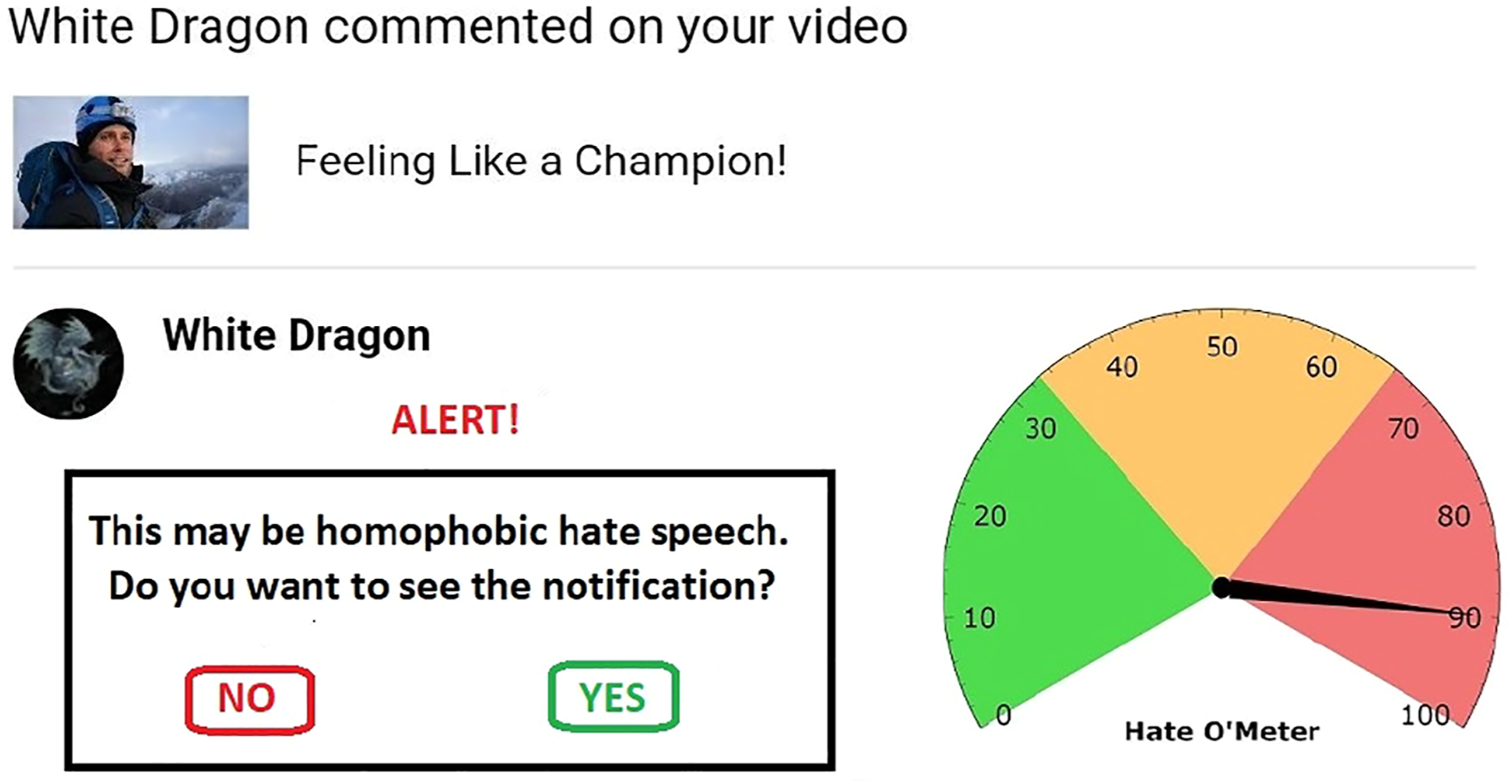
These constraints, which are purposefully chosen by users, protect vulnerable individuals from inappropriate content – and this is one of the advantages of e-friction that Justin Kosslyn correctly identified (Kosslyn, 2018). Adopting the terminology introduced by Ullmann and Tomalin, these forms will all be sub-classified as ‘elective’. Conversely, any e-friction that does not originate from the conscious choice of the user will be classified as ‘non-elective’ (Figure 3)– and this subtype will be discussed at greater length in the next section. Elective and non-elective subtypes of E-friction.
More precisely, though, the parental lock and hate speech examples can both be further subcategorised as ‘impeding’ since they prevent the user accessing content (as opposed to ‘distracting’ forms which draw the user’s attention away from the content rather than preventing access to the content) – and in both cases the elective impeding e-friction serves a ‘protective’ purpose. Their shielding function is what distinguishes them from examples such as web-based alarm clocks that interrupt a user’s activity with alert windows, or a pop-up window that encourages a software upgrade. Since the latter examples involve users being informed, rather than protected from immediate physical or psychological harm, they can be further sub-classified as ‘informative’. In addition, there is a fundamental difference between choosing to add protective e-friction for one’s own personal benefit, and adding it for the benefit of someone else. Consequently, a further distinction is required between e-friction that is elective, protective (whether impeding or distracting) and ‘reflexive’ (e.g. using hate speech quarantining on one’s own social media feeds), and e-friction that is elective, protective and ‘transitive’ (e.g. turning a parental lock on for the benefit of one’s children). 12
Putting all of this together, the elective sub-branch of the e-friction typology is elaborated in greater detail in Figure 4: A typology for elective E-friction.
The typology in Figure 4 is not exhaustive, of course. There are more subtypes of e-friction that are both elective and impeding. Nonetheless, this preliminary sketch already helps to clarify the discussion of e-friction. For instance, if a user configures her working environment so that an automated notification appears in the bottom right-hand corner of the screen whenever a new email arrives, then the resulting e-friction can be sub-classified as follows: • The notification was knowingly set; therefore, the e-friction is ‘elective’ • The notification does not prevent the main activity occurring; therefore, the e-friction is ‘distracting’ • The notification signals the arrival of a new email; therefore, the e-friction is ‘informative’ • The notification was set for the user’s own benefit; therefore, the e-friction is ‘reflexive’
By contrast, assume that a user with tendonitis has configured his working environment so that the screen locks for 15 min after every 2 hours, to enforce regular rest breaks. This time, the resulting e-friction can be sub-classified in the following way: • The lock function was knowingly set; therefore, the e-friction is ‘elective’ • The lock temporarily prevents the main activity from occurring; therefore, the e-friction is ‘impeding’ • The lock reduces the risk of physical harm; therefore, the e-friction is ‘protective’ • The lock was set for the user’s own benefit; therefore, the e-friction is ‘reflexive’
As these examples indicate, the elective sub-branch of the e-friction typology offers a framework for analysing particular instances with much greater specificity – and the same must now be done for the non-elective sub-branch.
A typology of non-elective E-friction
By definition, non-elective e-friction is always unsolicited – but there are borderline cases. If a user explicitly asks to see certain adverts (e.g. for currently available jobs in a specific field), then any resulting e-friction is unambiguously elective. However, a user might encounter an unsolicited interactive online advert that requires the viewer to choose one advert option from several. In this case, the initial advert constitutes non-elective e-friction, while the selected sub-advert constitutes elective e-friction (Rodgers and Thorson, 2000; Belanche et al. 2017). Other varieties of the former often arise from enforced compliance with legislation. In May 2018, the EU introduced its General Data Protection Regulation (GDPR) to enable individuals to have much greater control over their personal data. 13 In order to ensure that they are GDPR compliant, many websites now require users (in an unsolicited manner) to agree to allow data about their online activities to be gathered and shared. By contrast, there are forms of non-elective e-friction that do not result from compliance. These might include pop-up windows requiring the user to sign up for a regular newsletter before being allowed to access a website, or an upgrade hard-sell that appears repeatedly to users who have downloaded the free ‘Home’ version of a software package rather than buying the ‘Professional’ version.
While some of the main subtypes of elective e-friction are also relevant for distinguishing varieties of non-elective friction (e.g. impeding or distracting), the typology for the latter necessarily differs in several important respects. One difference is that the ‘reflexive’/‘transitive’ distinction is no longer needed – and this raises another serious issue. Since all forms of elective e-friction are knowingly selected, their presence is always unconcealed. By contrast, non-elective e-friction does not necessarily signal its presence overtly. The controversial accusation that Instagram withholds ‘likes’ prompted outrage primarily because, in that framework, the non-elective e-friction would be ‘covert’ – that is, the users would be oblivious of its existence – and the same is true when e-friction is used as a form of quasi censorship in China. By contrast, the GDPR example involves e-friction that is fully apparent, so it can be classified as ‘overt’. In addition, the non-elective e-friction typology must also accommodate the phenomenon of error. An advert can link to the wrong website, thereby creating an unwanted delay, and such instances will be classified as ‘unintended’.
14
Putting all of this together, a rough preliminary typology for the non-elective e-friction sub-branch is given in Figure 5: A typology for non-elective E-friction.
Once again, it is important to stress that this typology could easily be developed further. The ‘protective’ and ‘commercial’ subtypes are not the only possible ones on those levels, and additional sub-categories such as ‘suppressive’, ‘malicious’ or ‘ideological’ could usefully be added. Nonetheless, it should already be obvious that the analysis offered here differs considerably from that presented in the Zero Friction Future document. In the latter, the various stages in the e-commerce pipeline were identified (i.e. Discover, Purchase and Post-Purchase), and different kinds of e- and p-friction were associated with each of these. However, that analysis disguises the fact that, at a more abstract level, many forms of e-friction are inherently identical, even if they are encountered during distinct stages of a commercial transaction. For instance, if an online advert links to the wrong webpage during the Discovery phase, then this is an example of non-elective e-friction that is overt but unintended. Similarly, if the checkout stage of the ‘Purchase’ phase requires you to enter a Zip code, even if you live outside the USA in country where Zip codes are not used, then this is also an instance of unintended non-elective e-friction.
A few case-studies should further illuminate the typology in Figure 2. Currently, if you try to access a news story on the online version of the bi-weekly American business magazine Forbes, you see the following two messages (Figure 6): Non-elective E-friction on the Forbes website
The story you wanted to read is grey-shaded behind two pop-up windows: one requires informed consent concerning the use of HTTP cookies; the other requires you to turn off your ad-blocker. To access the desired article, the user must respond to both these unsolicited messages; hence, they are both examples of non-elective e-friction. However, the first ensures that the website is explicit about how user-generated data will be gathered and used, and there are legal reasons why this transparency is required. Clicking the ‘More Information’ button in the window brings up an explanation of the distinction between ‘Required’, ‘Functional’ and ‘Advertising’ cookies, and offers the user control over whether or not the latter two types are included. Therefore, this window as an instance of e-friction that is non-elective, overt, intended, impeding and protective. By contrast, the second window does not appear merely to comply with particular regulatory frameworks. It requires the browser’s ad-blocker to be turned off, because disabling it will boost the website’s revenue (Bloomberg, 2017). Consequently, the second window is an instance of e-friction that is non-elective, overt, intended, impeding and commercial. Ironically, of course, many users choose to block online adverts to reduce the amount of e-friction they encounter when browsing online. To consider one final example: if a user is watching a video on a website and an overlay advert appears, then the screen looks as it does in Figure 7: An overlay advert.
In this case the user is not completely prevented from watching the desired video, but the advert occupies part of the screen and is designed to distract the user’s attention. Therefore, this kind of e-friction can be classified as non-elective, overt, intended, distracting and commercial.
The ethics of E-friction
It should be clear by now that identifying specific subtypes of e-friction enables us to reflect more precisely upon the impact each variety has on users and their online interactions. For instance, it enables us to see that Facebook IQ are only concerned with eradicating those types of non-elective e-friction that are overt and unintended (e.g. broken webpage links). Counterintuitively perhaps, they assume that (all?) commercial forms of e-friction, such as unsolicited adverts, are a desirable part of the ‘frictionless’ future. Indeed, certain varieties of e-friction – e.g. all those that are elective and protective, and which safeguard users from harm such as cybercrime, cyberbullying – offer what Isiah Berlin influentially referred to in the 1960s as ‘positive liberty’: users can choose to remain free from things that could damage them (Berlin, 1969). By contrast, other subtypes are more concerning and harder to justify from an ethical perspective. These include any kind of covert non-elective e-friction (e.g. Instagram’s alleged withholding of ‘likes’, e-friction-based censorship in China).
Given the recent emphasis on transparency in IT systems, any furtive delays knowingly built into online platforms for online interactions (especially those designed to inculcate addiction) are problematical in most ethical frameworks. This holds even if, as Turilli and Floridi have argued, transparency is not an ethical principle in and of itself, but rather a pro-ethical condition for enabling or impairing other ethical practices or principles (Turilli and Floridi, 2009). By definition, covert e-friction lacks transparency entirely; therefore, it necessarily involves deception. Nonetheless, the core distinctions here are subtle ones. It is too simplistic to claim that covert e-friction is tantamount to lying, since, strictly, the latter would involve claiming explicitly that the e-friction was not present. Consequently, it seems to be closer to traditional human-to-human interactions in which one person decides not to share crucial information in its entirety. As James Edwin Mahon has stressed, there is a clear moral asymmetry between lying and keeping secrets. Although the former will be prime facie wrong in most cases, the latter need not be (Mahon, 2018).
The situation is further complicated by the fact that social media sites use algorithms to determine what specific users see and do not see (e.g. which particular adverts appear), and this complicates any discussion of morality, since intentionality is deferred. However, users are less likely to feel resentment towards a service provider if they do not know that the information they desire is being purposefully withheld from them. By contrast, if all covert e-friction were explicitly signalled, thereby becoming overt, then the users would probably feel much greater umbrage. This relates to Margaret Roberts’ exploration of how (e-) friction is used as a form of propaganda in China. The withholding or impeding of certain kinds of online information in China is not explicitly manifest as censorship; therefore, most users are unaware that it is occurring.
Similar issues arise with online adverts, and the distinction between the targeted and non-targeted varieties raises subtle transparency-related issues. As mentioned earlier, although most online adverts are overt, it is not always clear whether or not the user’s personal data has been analysed by the underlying algorithms that determine which adverts are seen. Users are not usually told whether their demographic information (e.g. gender and age) was accessed, or their geo-location information (e.g. GPS coordinates and IP address), or behavioural information derived from a log of their online activities (e.g. websites visited and social network posts) – or a combination of such things. Software like EyeWnder seeks to make all of this more transparent, but targeted adverts themselves could overtly indicate which data motivated their selection. 15 This implies that the brittle binary covert/overt distinction disguises the fact that there are degrees of transparency.
Be that as it may, from a range of (Western) normative ethical perspectives, it is reasonable to suggest that all forms of covert e-friction are problematical and, preferably, should either be eliminated entirely, or else be converted into forms of overt e-friction, so that the users are not duped and misled. In addition, all overt forms of e-friction should be as overt as possible. A growing awareness of the importance of such issues has inspired recent calls for more research into the marketing and consumer ethics of digital technologies, and particularly social media (Moraes and Michaelidou, 2017). It is curious that the ethical implications of (e-)friction have been neglected in recent philosophical explorations of social media sites such as Facebook. It is telling, for instance, that the word ‘friction’ does not appear once in any of the essays in D.E. Wittkower’s Facebook and Philosophy: What’s on your Mind? (2010); and more recent publications such as Roger McNamee’s Zucked: Waking up to the Facebook Catastrophe (2019) have failed to provide further elucidation. This is compounded by the fact that popular texts such as Jess Rosenblum and Jordan Berg’s Friction: Passion Brands in the Age of Disruption (2017) focus only on the task of reducing friction in commercial exchanges.
Conclusion
As this article has demonstrated, visions of a ‘frictionless’ techno-utopian future are nothing new. For at least a quarter of a century now, the urge to reduce e-friction in web-based interactions has led to new business models (e.g. e-commerce), new communication-based platforms (e.g. adverts in social media feeds) and a general shift towards a data-driven economy. Nonetheless, that ever popular buzzword ‘friction’ can refer to many different distinct subtypes that possess very different properties. Responding to this situation, this article has sketched a preliminary typology for e-friction which enables particular instances to be classified more precisely. In turn, this makes it possible to assess the merits and demerits of each variety. Accordingly, while it is certainly true that some forms of e-friction can be usefully eliminated from e-commerce (e.g. broken links to webpages), other forms are highly desirable, especially those that protect users. Consequently, if the infosphere were ever to become entirely ‘frictionless’, then it would most likely be a place in which intimidation and exploitation would flourish even more extensively than they do at present. Thinking via analogy with other forms of friction, this is all extremely familiar. Ever since Galileo introduced the abstraction of a frictionless plane in his Discorsi (1638), theoretical physicists had benefited from imagining how certain bodies would react if specific forces operated on them in an environment entirely devoid of physical friction (e.g. a block resting on an inclined surface) (Galileo, 1638). However, physical friction can be either beneficial or detrimental – it all depends on the activity undertaken. If you want to build a perpetual motion machine, then you would be wise to remove as much friction as possible. However, if you are trying to improve the braking mechanism in a car, then the more friction the better. It is not surprising, therefore, that some forms of e-friction are beneficial, while others are detrimental.
Perceptions about this are gradually starting to alter; and, as mentioned already, Justin Kosslyn provides just one heartening example: The internet is facing real challenges on many fronts. If we truly want to solve them, engineers, designers, and product architects could all benefit from the thoughtful application of friction. The philosophy of the Internet has assumed that friction is always part of the problem, but often friction can be central to the solution (Kosslyn, 2018).
A more detailed awareness of the different subtypes of e-friction should make it easier for the teams of ‘engineers, designers and product architects’ to think much more carefully about (i) the specific kinds of e-friction they incorporate into their systems, (ii) the specific kinds of retardation they eradicate and (iii) the specific ethical implications of the decisions they make. This provides an opportunity for them to realise that e-fiction is not infrequently part of the solution rather than part of the problem. Crucially, a greater awareness of the complexity of the e-friction typology would provide dominant corporations, especially social media companies, with strategies for minimising the kind of negative criticism they routinely receive. To take one recent example, in the summer of 2021 The Wall Street Journal obtained access to a large cache of documents leaked by former Facebook project manager Frances Haugen. 16 Based on the content of the papers, the company has been accused of allowing hate speech to spread on its platforms primarily because misinformation, toxicity and violent content prompt larger numbers of likes, comments and shares, thereby increasing profits (as quantified by the Meaningful Social Interactions (MSI) metric). 17 Consequently, rather than blocking or quarantining all such content so that it is much harder to access and distribute, allegedly Facebook routinely allows large amounts of potentially harmful material to be widely disseminated even though it could act to prevent or delimit its circulation. 18
This is a classic example of a frictionless environment causing damage. By contrast, if Facebook, or any other company, were explicitly to promote certain kinds of e-friction (e.g. the protective subtypes), while overtly striving to eradicate others (e.g. the covert subtypes), then that would signal a much more serious intent to prioritise the safety of users. Microsoft’s recent shift to multifactor authentication for sign-ins is a good example of this countertrend. 19 The new sign-in process purposefully increases the degree of protective e-friction to enhance the security of the users. Another example would be Twitter’s experimental test in June 2020 which involved only allowing links to be shared if the user had first clicked them. 20 This form of protective e-friction was explicitly introduced to minimise the amount of hate speech and misinformation circulating on the platform. As these instances demonstrate, the selective favouring of specific subtypes of e-friction is preferable to the vague championing of an entirely ‘frictionless’ future. The former undoubtedly helps to align more closely the commercial ambitions of dominant corporations with the ethical tendencies of their core users – and that is likely to be in their long-term financial interest.
Analogies can be drawn here with what is known in the philosophical literature as ‘epistemic friction’ (Sher, 2016). In the 1950s, Ludwig Wittgenstein sought to mitigate the damage inflicted by ideal-language philosophy: We have got onto slippery ice where there is no friction and so in a certain sense the conditions are ideal, but also, just because of that, we are unable to walk. We want to walk so we need friction. Back to the rough ground! (Wittgenstein, 1953: §107)
The scenario is similar to that facing e-friction in modern digital technologies. A frictionless future may appear ideal and desirable from certain ideological perspective, yet it is clearly hugely problematical when viewed from other vantage points. Fortunately, we have not yet inched out fully onto the frozen lake of the infosphere, and therefore, we have not yet fallen on our backside. The safety of rougher ground is still within our reach.
Footnotes
Declaration of conflicting interests
The author(s) declared no potential conflicts of interest with respect to the research, authorship, and/or publication of this article.
Funding
The author(s) received no financial support for the research, authorship, and/or publication of this article.

Notes
Author biography
Marcus Tomalin is a member of the Machine Intelligence Laboratory at the University of Cambridge. He has published extensively on language-based Artificial Intelligence. He manages the Giving Voice to Digital Democracies project which focuses on the social and ethical implications of AI technologies.