



Abstract
Autonomous driving systems (ADS) operate in an environment that is inherently complex. As these systems may execute a task without the permission of a human agent, they raise major safety and responsibility issues. To identify the relevant issues for information systems, we conducted a critical and scoping review of the literature from many disciplines. The innovative methodology we used combines bibliometrics techniques, grounded theory and a critical conceptual framework to analyse the structure and research themes of the field. Our findings show that there are certain ironies in the way in which responsibility for apparently safe autonomous systems is apportioned. These ironies are interconnected and reveal that there remains significant uncertainty and ambiguity regarding the distribution of responsibility between stakeholders. The ironies draw attention to the challenges of safety and responsibility with ADS and possibly other cyber-physical systems in our increasingly digital world. We make seven recommendations related to (1) value sensitive design and system theory approaches; (2) stakeholders’ interests and interactions; (3) task allocation; (4) deskilling; (5) controllability; (6) responsibility (moral and legal); (7) trust. We suggest five areas for future IS research on ADS. These areas are related to socio-technical systems, critical research, safety, responsibility and trust.
Keywords
Introduction
Although autonomous driving systems (ADS) are often introduced with the rationale that they are safe, this is not always the case. People can be killed using semi or fully autonomous cars. Following one of the first fatal Tesla crashes in 2016 (Banks, Plant and Stanton, 2018), there have been more than 17 fatalities and 700 crashes involving Tesla’s Autopilot feature since then (Washington Post, 10 June 2023, ‘17 fatalities, 736 crashes: The shocking toll of Tesla’s Autopilot’). The digital world in which ADS and other autonomous cyber-physical systems (ACPS) operate can be viewed as dystopian if the collaboration required with humans is too complex (Jiao et al., 2020).
For years Tesla, Waymo and many traditional automotive manufacturers have been experimenting with autonomous cars. Autonomous cars are presented as one of the next disruptive changes in our lives. However, beyond the remarkable technical achievements needed to operate such cars, human and societal adaptation to them requires solving considerable ethical and legal challenges related to safety and responsibility. As most research on this topic ADS has been published in other disciplines, we want to understand the relevance of this research for IS. As a socio-technical discipline (Sarker et al., 2019), we suggest that IS can contribute to solving some of these challenges, such as those related to trust. For autonomous cars to be accepted, people need to be convinced that autonomous cars will be trustworthy and safe. Hence, in this paper we discuss trustworthiness and the allocation of responsibility for autonomous driving, focusing on the ethical and legal challenges related to safety.
In our study we consider autonomous driving systems (ADS) as systems with specific agentivity (or agentic IS artifacts) such as capabilities of anticipation and prescription (Baird and Maruping, 2021). Naturally, autonomy (Vagia et al., 2016) and automation (Parasuraman et al., 2000) may vary within this category of systems. Operationally, fully ADS would be equipped with artificial intelligence and an Internet of Things (IoT) infrastructure enabling them to interact with the environment without any human intervention.
A recent report by MIT says that ‘few sectors better illustrate the promises and fears of robotics than autonomous cars and trucks. Autonomous vehicles (AVs) are essentially highspeed industrial robots on wheels, powered by cutting-edge technologies of perception, machine learning, decision-making, intelligence ethics, regulation, and user interfaces’ (Autor et al., 2020, p. 39–40). There are many challenges associated with the increasing use of robots and ADS.
First, in the past autonomous systems such as robots were confined to a closed environment such as a factory. Today, however, ADS operate in an environment that is open. This environment is uncertain, unpredictable and inherently complex. This complexity is a feature of the environment, not the system per se. For example, an autonomous car might be safe and reliable on a freeway, but what about on a country road or city centres? There might be animals, pedestrians, bikes, or scooters, and people might not always obey the road rules. People’s driving habits vary depending on the country.
Second, ADS may execute a task without the permission of a human agent. Although a human driver might hope that the ADS will always follow directions, the autonomous nature of the system raises issues of control and delegation. Will an ADS always obey the human driver? Sometimes it might not.
Third, how can we understand responsible design in such a scenario? What does responsibility mean when the environment is so uncertain? Responsible design raises numerous questions related to ethics, such as who is morally responsible or legally liable in the case of an accident.
This suggests that there are many societal challenges associated with the introduction of ADS (Ketter et al., 2022). Hence, the purpose of this paper is (1) to provide a better understanding of the issues of safety and responsibility associated with the introduction of ADS and (2) to propose a research agenda for the information systems field. This paper thus contributes to answering the call for more IS research on ADS (Ketter et al., 2022; Lyytinen et al., 2022). Our two research questions are as follows: (1) How do ironies of automation manifest when levels of automation of ADS increase beyond what we currently experience? And (2) Who is responsible and what does responsibility mean in the context of autonomous driving systems? To answer these questions, we review the literature with a focus on (a) autonomous driving systems, (b) responsibility and (c) safety. This review reveals there are certain ironies in the way in which responsibility for apparently safe autonomous systems is apportioned (Noy et al., 2018). These ironies draw attention to the challenges of safety and responsibility with ADS in our increasingly digital world. Although this paper focuses on autonomous driving only, we believe our findings might be relevant to researchers doing work on robotics and ACPS in general. 1
This paper is organized as follows. After proposing a conceptual framework that will be used as a critical lens to assess the literature, we explain our methodology. The findings section reports on the research related to safety and responsibility for ADS. We then make eight recommendations for future research and identify six specific areas for future IS research.
Conceptual framework
Our conceptual framework considers automation and autonomy as synonymous. At certain levels of automation, endowed with certain capabilities, the system will perform certain tasks autonomously (Hancock, 2019). However, human experience will encounter ironies of automation stemming from the delegation of certain tasks and from the ensuing confusion between who has control and who is morally or legally responsible. Inevitably, these ironies evoke issues of safety, responsibility, predictability and trust. Hence, to address these issues and to answer our research questions, we propose an integrative framework (see Figure 1). The ironies of ADS: a conceptual framework.
ADS levels and ironies of automation
ADS levels
Automation levels in the autonomous driving literature (after McCall et al., 2019; Hancock 2019).
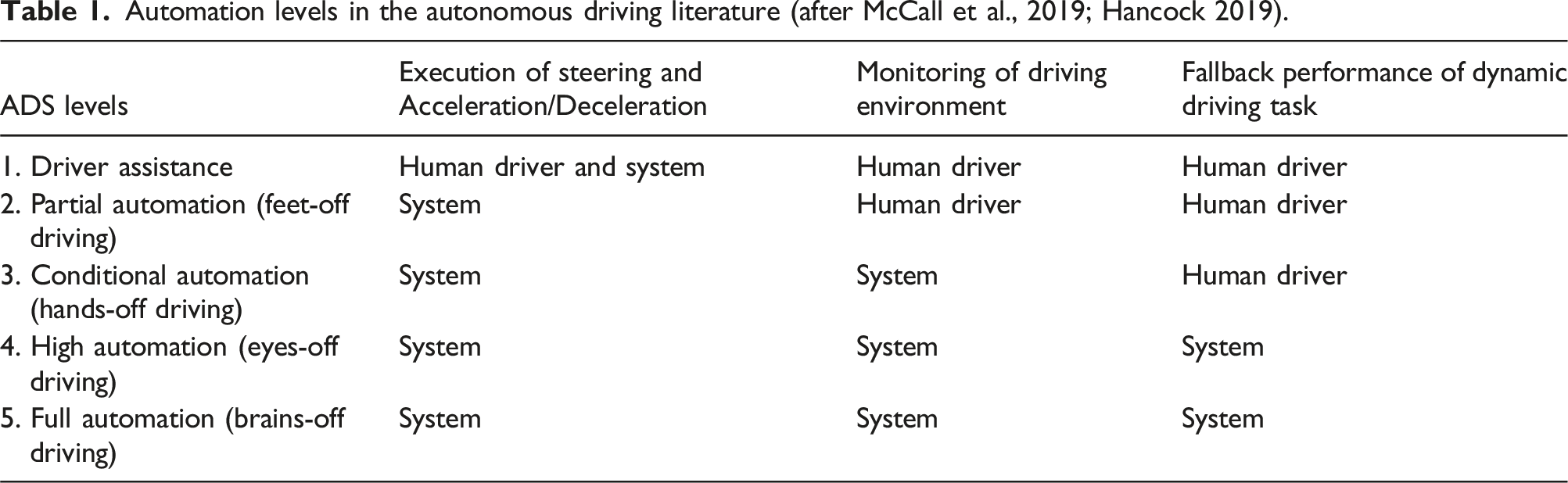
In the human factors literature (e.g. Sheridan, 2011) as in the IS literature (Baird and Maruping, 2021), the allocation of control to a human or to an artificial agent is to accommodate changes in the conditions of either the physical environment or the human. Fully ADS are still at the experimental stage, while partial automation driving systems are already used in mixed traffic conditions (Cabrall et al., 2019). As of July 2023, all commercially available cars have achieved level 2 only. It is important to clarify that in this context, autonomous ‘only makes sense if it refers to the relationship between human driver-passenger and the vehicle –the vehicle is increasingly autonomous from the driver, not to the relationship between the vehicle and the traffic environment’. (Lee and Hess, 2020, p.87). In fact, ADS need to be constantly connected to sensors equipping other vehicles surrounding them. A major difference between level 2 and levels 3 and above is that for latter levels it is the ADS not the driver that monitors the driving environment, except when the system requires the driver to take over (fallback performance) at level 3 (Hancock, 2019). This typology has been criticized like most automation typologies for considering that automation can only be conceptualized as a growing delegation of tasks to the machine from full human control to full machine control. Shneiderman (2020a) argues that, rather than seeing this as a one-dimensional controllability problem, safe and trustworthy systems should highlight both high human control and high technology control, at least for certain complex and life-critical situations. The SAE typology also presents a narrow view of the ‘Dynamic Driving Task’ which only includes operational control and a part of tactical control. It does not include strategic control where drivers determine trip goals, route and levels of automation and corresponding functions they may want to change for the trip (Zhang Y et al., 2021). Recent research proposes that the role for the human in a joint system is to allow both human and machine to work as a team. In this team the human is in charge and delegates responsibility to the system as a crew member while the human retains command and control. The commander is fully responsible at each level: accepting (strategic), taking (tactical) and coping with (operational) risk, but does not operationally control everything.
Ironies of automation
Task allocation strategies (after Cabrall et al., 2019).

Moreover, ‘the more advanced the automation, the more challenging the role of the driver under critical conditions’ (idem). It is ironic that the problem automation intends to solve (e.g. allowing individuals to relax instead of driving) still requires the driver to actively monitor the system (if it is not fully autonomous). To make it fully autonomous would require allowing the system highly developed learning capabilities, which would itself require the driver to fully trust the system.
The ironies of automation we discuss below are rooted in a wider theoretical stream of ironic and paradoxical approaches of technology. ‘Technologies of many kinds perform in ways that are ironic, perverse and paradoxical. That is to say, a certain technology applied in a certain way in a certain context may have consequences or implications of one kind but may be implicated in a contrary set of consequences or implications in another context’. (Arnold, 2003, p. 231). The research literature concurs to say that the only viable response to paradoxes and ironies is to accept them and attempt to ‘cope’ (Mick and Fournier, 1998). Ironies and paradoxes are very close concepts. However, the main difference is that ironies are more rooted in critical approaches reflecting negative and/or problematic outcomes. We summarize some of the ironies of ADS below. Please note that we highlight in italics the terms used in the literature (Bainbridge, 1983; Noy et al., 2018): 1. In terms of task allocation, ADS should offer greater value to the human if they are applied to tasks that are too complex for the human or to do well under certain circumstances. Yet, what is automated are often tasks that human can easily do, not the most difficult ones. 2. Automation leads to deskilling, which in turn, leads to ‘reduced intervention effectiveness when disengagement of automation is requested or necessary’ (Noy et al., 2018, p. 72). Handover from the automated mode to the human operated mode is fraught with difficulties if people have forgotten the required skills (Merat and Lee, 2012). These difficulties are related to potential cognitive overload or lack of understanding due to a learned overreliance on the system. 3. From a cognition viewpoint, the monitoring of a complex ADS requires capabilities and understanding of system operations that might be beyond the requisite diagnostic skills of human operators. Understanding is a necessary condition for moral responsibility or accountability (Van de Poel, 2011), but it is rarely met in semi or fully autonomous systems. Moreover, users may at times stop monitoring the situation when they should and may experience insufficient Level of Situational Awareness (LSA) or make errors induced by biased representation (mental) models. The National Transportation Safety Board in the USA has said that humans are notoriously inefficient at monitoring automated systems (Banks, Eriksson, O’Donoghue and Stanton, 2018). However, some also consider that awareness should be understood as shared rather than the duty of either driver or system (Hoc, 2000; Hoc and Amalberti, 2007). 4. From an action control viewpoint, the dynamics of ADS are different from those of conventional systems. If a person lacks recent ‘in-the-loop experience’ the ADS may not know who is in control at the time. Both the driver’s knowledge about the ADS, and ADS knowledge about the driver (and whether the human driver has sufficient competencies to react) point to uncertain action control in certain situations. 5. Trust depends on several factors including predictability, ability, perceived organizational and institutional support among many others. Trusting ADS when trajectories are unknowable or unpredictable is difficult, notably when systems seem opaque and operate in complex environments (Burton et al., 2020; Zhang Z et al., 2021). There may be unintended consequences of use. 6. The liability gap is also ironic because conventional law currently considers the human operator liable when an accident happens at all automated levels, the only exception being full autonomy (McCall et al., 2019). However, this may be unreasonable given the above ironies. It is a case of responsibility without power, making owning (not necessarily operating) the automated equipment rather unattractive from a liability standpoint (McCall et al., 2019). In the case of the fatal Tesla crash in 2016, the National Transportation Safety Board in the USA initially concluded that human error (inattention) was to blame. Subsequently, however, the board revised its decision and criticized Tesla for allowing the autopilot feature to be activated on roads it had not been designed for and for the way in which it determines whether drivers are engaged (Banks, Plant and Stanton, 2018).
The six ironies of automation listed above may manifest differently at different levels of automation (Parasuraman et al., 2000) and interconnectedness or autonomy (Talebpour and Mahmassani, 2016). One contribution of this paper is to advance how they manifest at different levels of ADS.
Safety and responsibility
Safety concerns associated with the use of dangerous products, or the functioning of complex socio-technical systems, raise issues about the allocation of responsibility. The Safety Science literature as well as professional and institutional standards (e.g. nuclear industry, aviation industry) point to the necessity to identify responsibilities as clearly as possible to prevent accidents, and/or to handle the consequences, and/or learn from them. A tension exists between the responsibility of the human or the operator of a control room and the responsibility of the whole system (including the interactions between its components). Early approaches in the 1960’s and 70’s focused on ‘human errors’ and considered human beings as the ‘weak’ link responsible for accidents. Over the years, however, attention has shifted to the complexity of the system and the responsibility of the designers, with the notion of a ‘normal accident’ (Perrow, 1984) or ‘organizational accident’ (Reason, 1993) becoming accepted. Perrow suggests that the engineers’ knowledge, preferences, practices and professional rules for the design of risky technologies (such as nuclear power plants) induce a high level of interactive complexity between tightly coupled components that retrospectively appear impossible to control by the operators and may end up in a major accident. More recently, integrated approaches of safety show the positive contribution of human factors and analyse the organizational processes that produce or reduce safety in complex and unstable environments (Rasmussen, 1997; Lecoze, 2015). ‘High Reliability Organizations’ (Cantu et al., 2020) safely operate complex and high-risk technologies in extreme contexts (Hällgren et al., 2018). They succeed in keeping major accidents rare despite the enormous potential for accidents in their respective industries. Responsibility is embedded in a strict definition of occupational roles and is at play every time the obligation to act in accordance with formal procedures competes with the obligation to take the initiative when unexpected events threaten safety (Weick and Roberts, 1993). Therefore, the allocation of responsibility for safety is dynamically distributed in time and space among various actors and organizations (especially between the licensee, the regulator and the public). This evolution in thinking paves the way for a stakeholder approach of responsibility allocation, each one considering safety as a common good and influencing the allocation of responsibility.
The variety of risks (moral, legal, social and psychological) associated with autonomous driving makes responsibility a key issue for the development and adoption of this technology. Key questions include: Who is responsible for what and to whom in the case of an accident? What does responsibility mean in the context of ADS? Such apparently simple questions unveil the complex network of actors potentially involved. It appears that if drivers are considered liable in ADS, adoption will be hampered. This problem has been examined from both legal and ethical viewpoints. Philosophers, ethicists and law scholars distinguish several meanings of responsibility. To say that someone is responsible might mean: 1. To attribute causality (i.e. someone is causally responsible for the outcomes of the use of her system); or 2. To attribute fault or blame (i.e. someone is at fault because of neglect or incompetency); or 3. To attribute liability (i.e. someone should be held legally liable for the outcomes of using the system); or 4. To attribute role assignments (i.e. someone failed to do something required by her role, for example, warn clients of some potential limitation of the system) (Johnson and Mulvey, 1995).
Each of these uses of ‘responsibility’ is complex, and they are often interdependent. Moral philosopher Van de Poel (2011) distinguishes nine notions of responsibility. The first four are primarily descriptive (as cause, as task, as authority, as capacity), whereas the last five are normative and imply evaluation or prescription (as virtue, as moral obligation, as accountability, as blameworthiness, as liability). Based on Van de Poel (2011), in this paper we focus on only three types of responsibility to integrate the diversity of meanings: ‘moral responsibility’ (moral obligation and blameworthiness), ‘accountability’ and ‘liability’. Van de Poel (2011) introduces an interesting distinction between ‘forward-looking’ and ‘backward-looking’ to characterize the way responsibility operates. He underlines that the first two normative meanings are primarily forward looking, in the sense that someone feels the obligation ‘to see to it that something is the case’ when it is not yet the case; and that the last three are backward looking ‘in the sense that they usually apply to something that has occurred’ (p. 40). Since Aristotle responsibility as cause and as capacity has been considered a precondition for holding someone accountable or liable. Responsibility as obligation is generally closely related to the task or authority; however, a task is not necessarily moral. Thus, moral responsibility (obligation or blame) can be either forward looking (i.e. related to obligations attached to the role, for example, to inform passengers about risks) or backward looking (e.g. to accept blame, accountability, or financial liability if monitoring of the semi-autonomous system was poor).
From these fundamental considerations of responsibility and from high reliability theory, two cases of forward vs backward responsibility can be distinguished for moral responsibility and for legal liability. Moral or legal responsibility can be attributed either to the role or status of the person or to how tasks were executed. With forward-looking responsibility, strict liability would suggest that whatever the automation level the user is responsible, since driving a semi-autonomous car in itself implies potential risks and damage (Hevelke and Nida-Rümelin, 2015); similarly, product liability implies that there could be a product design defect that relates to the manufacturer (Abbott, 2018). Alternatively, with backward-looking responsibility neglect liability could be invoked by the law if the user or the designer neglected to perform something that would have enabled the avoidance of risk (Abbott, 2018) (e.g. warning consumers about safety risk level or not complying with regulations (Geistfeld, 2017)). Under neglect theory, legal liability is based not just on causality, but also on blameworthiness which is itself related to the examination of intentions, understanding and power. Such additional conditions make it harder to establish liability than with strict liability (Abbott, 2018).
Accountability, defined as to be open to demands for justification and to be answerable for actions, can be addressed in two different ways (Van de Poel, 2011). In ethics we generally distinguish between deontic positions based on general principles and consequentialists positions based on a calculus (Mingers and Walsham, 2010). In the following, we discuss only the consequentialist position of accountability, because with moral and legal responsibility, we already considered the deontic route. According to the consequentialist position, ‘A is accountable if A has the capacity to act responsibly, is causally involved in X and did something wrong’. Understanding accountability in a consequentialist way makes actions by stakeholders’ key. As a result, transparency (visibility and accessibility for those in charge of checking transparency) can be considered as an important dimension if not a good proxy for accountability (Boos et al., 2013).
Trust and predictability
The ‘liminal experience of using [autonomous] tools forces us to confront issues such as technology-based trust and ethics’ (Zhang Z et al., 2021, p. 18). A liminal experience is characterized by a ‘state of emergence marked by ambiguity and multifariousness’ (ibid, p. 15). To be used an ADS must be trusted. The perception of trust is itself related to perceptions of dependability or reliability of operations (Kalra and Paddock, 2016; McKnight et al., 2011) and whether the system will respect privacy. The stronger the relational trust (Tax et al., 1998) towards the manufacturer, the weaker the privacy concerns (Smith et al., 1996) for personal driving data. However, while relational trust qualifies trust in an organization, ADS trustworthiness refers mostly to trust in the technology itself (McKnight et al., 2011). Such trustworthiness has three main components: (1) the belief that the technology has the functional attributes to be able to do certain things, (2) the belief that it can provide adequate and responsive help and (3) that it is reliable (McKnight et al., 2011). Trustworthiness in technology is notably explained by situation normality and by structural assurance, that is, the fact that success is likely because the situation is normal and contract guarantees and regulations are in place (McKnight et al., 2011).
If the system is both reliable and responds predictably to situations, it becomes controllable, which seems a crucial factor for trustworthiness and safety in ADS. However, controllability does not mean control by the user. Control can be remotely exercised by a regulating centre which then has control and reduces the agency of the user. In addition, predictability may not be warranted, in the sense that not all conditions can be known in advance. Compared with the famous trolley problem (Bonnefon et al., 2016), which amounts to deciding who should be killed with certainty, the moral responsibility problems facing autonomous driving are characterized by uncertainty (Nyholm et al., 2016). More generally, as ADS are connected to the external environment, they cannot be tested in every situation since the environment continues to evolve; in this sense they are unpredictable.
Ensuring the safety of ADS means that they respond to certain situations in a predictable manner. That they do so under the same normal conditions without causing an accident is key to their trustworthiness (McKnight et al., 2011). However, accidents sometimes happen because normal conditions are not met. Wildlife, pedestrians, or cyclists may occasionally interact with vehicles, and they may not always respect the rules. Weather conditions and infrastructure maintenance can also introduce hazards. Thus, in some abnormal conditions or infrequent situations, ADS may become unpredictable and dangerous (Goodall, 2020). While at high levels of automation, drivers should be able to anticipate that the car will avoid accidents, they cannot reliably predict the trajectories and actions that will be chosen by ADS (Zhang Z et al. 2021) given their self-learning characteristics. Research projects using reinforcement learning (simulation) or supervised learning based on hundreds of human drivers have found that ADS at level 4 of automation seem unlikely to reach safety requirements (Russell, 2019).
It may be that people’s trust in ADS will vary depending on the predictability of the systems and the ethical decisions that they might make (ideally known in advance) (Karnouskos, 2021). Such decisions could be personalized by the driver or the owner or made mandatory by public authorities (Gogoll and Müller, 2017). The difficulties of providing complete specifications of ADS are related to ‘three root causes: the complexity and unpredictability of the system’s operational domain; the complexity and unpredictability of the system itself; and the increasing transfer of decision-making function from human actors to the system. These three issues also affect the safety assurance of autonomous systems’. (Burton et al. 2020, p. 2). From complexity theory we know that the more complex the system, the more it is unpredictable, and particularly in the domain of high-risk technologies (Perrow, 1984). We can use complexity as a proxy for predictability. Typically, regarding the operational domain, autonomous driving in a short segment with no pedestrians crossing will exhibit more predictable outcomes (i.e. less prone to accidents) and may be considered low complexity compared with autonomous driving on a freeway. However, driving on a freeway is low complexity compared with autonomous driving mixed with human-driven cars in a city (Burton et al., 2020). Regarding the system itself, whether systems are rule based or trained with machine/deep learning would be important. Opaque systems based on self-learning algorithms cannot be predictable (Zhang Z et al., 2021). Regarding handovers from human to machine or vice versa, it both depends on the learning capabilities of the system and on the users (if not fully automated). Interestingly, predictability difficulties also create a moral responsibility gap and a liability gap in the sense that if normal conditions are not met, do manufacturers, operators or users deserve moral blame? And if so, should they be liable to pay compensation for those injured by an autonomous system (Burton et al., 2020)?
Methodology
As the issue we wish to study (responsibility and safety in ADS) is by nature interdisciplinary (Koopman and Wagner, 2017), we formed an interdisciplinary team of two senior IS researchers, one with a background in transportation and the other with publications in digital transformation and ethics, one senior researcher in organizational studies specializing in safety in nuclear power plants, and two PhD students, one specializing in HCI with a strong background in bibliometrics, and one in human resources and IS. We used a variant of a method that the first author and one of the PhD students specializing in bibliometrics have used previously to conduct a literature review. This method named BIBGT interlaces bibliometrics with a grounded theory approach (Walsh and Rowe, 2023). We used (a) a bibliographic technique called Documents Bibliographic Coupling Analysis (DBCA) as proposed by Walsh and Renaud (2017) and (b) a systematic assessment of a subset of documents derived from DBCA that uses our critical analytical framework as a lens. To further classify the literature, we located them on the socio-technical continuum and identified the stakeholders they consider. Our approach thus combines the inductive approach of BIBGT with a final deductive reasoning touch. An interpretive literature review coupled with bibliometrics can be illustrated by the flesh and bones metaphor, whereby researchers’ interpretation of documents (the flesh) is added to the bibliometric analysis (the bones) to reveal the structure of a field. DBCA can help identify current themes/trends of a field 2 (Zupic and Čater, 2015) and thus contribute to scoping reviews (Rowe et al., 2023). A high value in bibliographic coupling strength indicates a similar subject relationship between two documents.
Bibliometric techniques introduce some objectivity into the classification of the publications of a research field and are valuable to investigate a subfield that has been studied from the perspective of different disciplines (Walsh and Renaud, 2017). Since Walsh and Renaud’s (2017) publication, major improvements have been made to automate the use of bibliometrics techniques and facilitate BIBGT. We used ARTIREV software to conduct the entire bibliometric workflow (i.e. to collect bibliometric data, calculate and normalize co-occurrences matrices, cluster documents and generate science mappings). ARTIREV automates the procedure while also enabling researchers to make easy choices about thresholds, normalization methods and clustering algorithms (Walsh et al., 2022).
Details of the BIBGT Iterative Process
First, we explored the ethics of and responsibility in various 3 ACPS to become familiar with the general literature and develop our ‘theoretical sensitivity’ (Glaser, 1978). Second, we narrowed our scope to ADS and designed our critical conceptual framework for understanding the ironies of responsibility in ADS. We used this framework to undertake a review for understanding (Rowe, 2014) what autonomous driving means and how responsibility can be allocated at different automation levels. This review can be considered a hybrid between a scoping review through our use of BIBGT (focused on identifying gaps on the research front with DBCA) and a critical review through our ironies-based framework.
The first step of BIBGT consists of defining the boundaries of the review. Using Scopus as a data source, we extracted 217 documents –and their bibliographic references – focused on autonomous driving systems/vehicles that were published during the period 2016–2022. 4 Our query, shown in Appendix A, includes the most common terms denoting ADS (Gandia et al., 2018).
The second step of BIBGT involves cleaning the bibliographic data, choosing a citation threshold, and using normalization techniques to reduce the dataset. Because scientific data sources such as Scopus contain significant data quality problems (Van Eck and Waltman, 2017), we used fuzzy string similarity algorithms provided by ARTIREV to help merge similar references. Hence, we curated in a semi-automatic way the 10,192 single references included in these documents. We finally obtained 7491 single references that corresponds to 27% of curated references. We also performed a manual verification of the documents selected for our analysis.
Regarding the selection of the second order samples, we iteratively and theoretically sampled the literature to obtain the most suitable thresholds and resulting samples. We used the normalized citation count (NCC) and the citation count (CC) as thresholds. Because the citation count increases over time, the NCC prevents the disadvantaging of recent literature. When the NCC of a document is more than 1, it means that the publication received more attention in terms of citations than others published the same year. Our CC threshold allows us to exclude recent publications cited once (i.e. typically those published in 2022) that are not filtered by the NCC threshold. After several trials, we retained three analyses for comparison: the entire set (n = 217), an intermediate set (subset A, NCC >0.5 and CC > 1, n = 76 after a manual verification), and a restrictive set (subset B, NCC >1 and CC > 1, n = 44 after a manual verification) (see Figure 2). A manual screening was carried out to retain only the most relevant publications for our objective (see BIBGT step 3). Screening and Selection Process. The broader sample (subset A, on the left) has lower citation thresholds. Hence, it includes documents of the more restrictive bibliometric analysis (subset B, on the right). The (*) denotes that the processing has been supported by ARTIREV.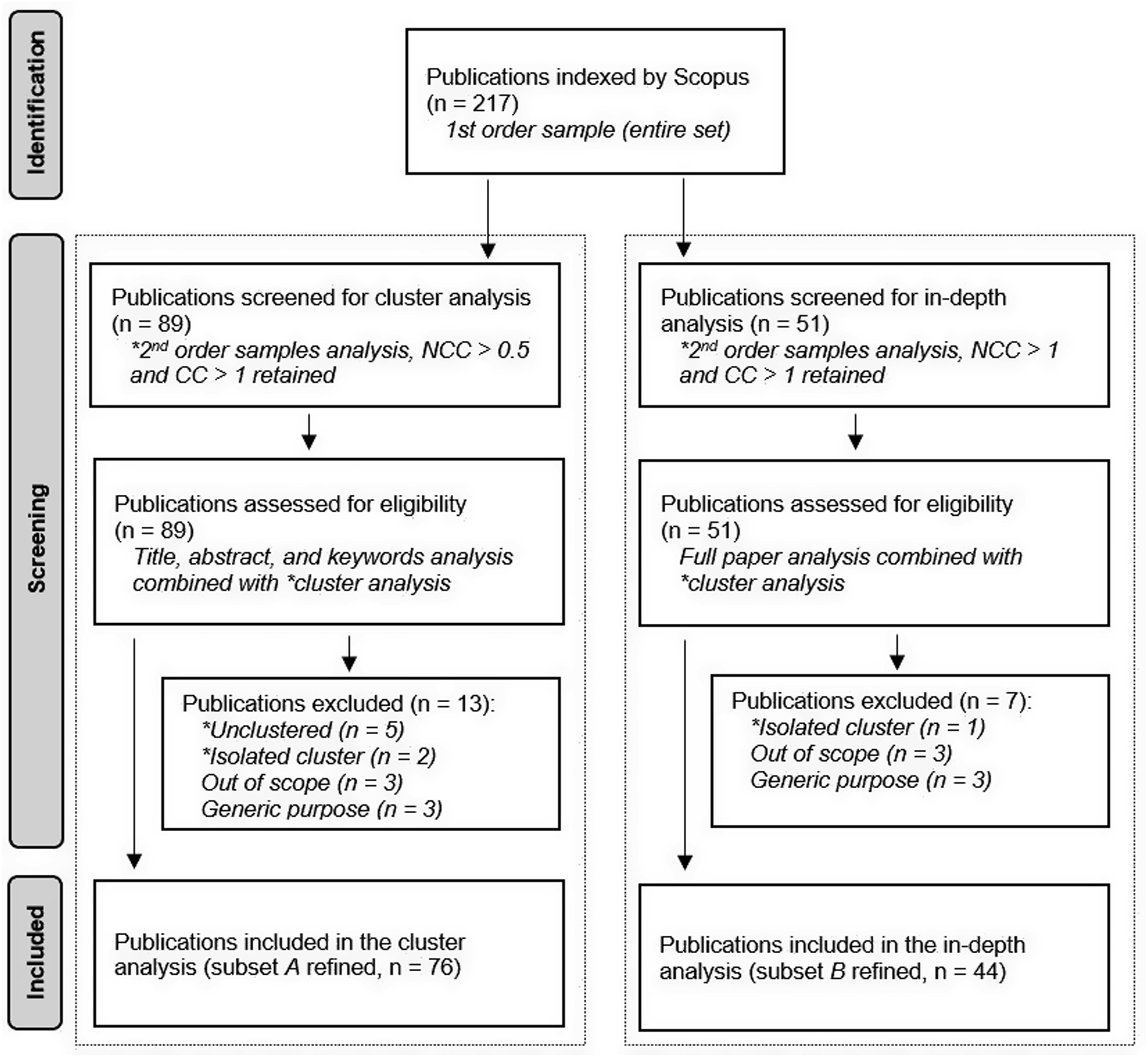
In the third step of BIBGT – Clustering/mapping/interpreting –and for each analysis, we first calculated a co-occurrence matrix in which we applied the association strength normalization method. Then, we applied the Leiden clustering algorithm and the ARTIREV mapping on the three matrices produced. As recommended, we produced science mappings at different citation thresholds and interpreted them (Walsh and Rowe, 2023). We started with the entire literature and coarse grain clusters. We noticed three primary topics (governance, Responsibility Sensitive Safety (RSS) and human factors), but when analysed in detail considerable noise was present. Subsequently, we performed an intermediate analysis (subset A) and pursued a more restrictive set (subset B). This smaller set helped us to clearly delimit the clusters and their relations. Subsets A and B were retained because the documents faithfully represent the subject of this study, and their respective mappings were the most clearly interpretable. We refined both subsets by removing documents not aligned with our study objective, were unclustered, or isolated (list available upon request). Regarding review papers, we assigned them to the closest cluster. If no cluster was affected, we discarded the paper to gain clarity (e.g. Gandia et al., 2018).
We highlight that our interpretation has been performed for the three analyses. However, the findings section is focused on our interpretation of the subsets A and B, while the more limited set was analysed in-depth. Our interpretation was supported by qualitative coding of the title, abstracts and keywords of all documents. This also led to the identification of the core category, that is, responsibility under uncertainty in autonomous driving.
In the fourth and last step of BIBGT, using our conceptual framework and the perspectives taken, we coded the 44 selected papers of the subset B (see Appendix B for methodological details). We synthesized this literature and discovered some research gaps. For the latter, to ensure convergence of the coding, each paper was coded by pairs of coders. We formed duos of one senior researcher and another researcher of the team to code subsets of papers separately. The assignment of papers was performed with regards to domain specificity. Once a subset was coded, the two researchers compared their coding, discussed their differences and calculated the a priori convergence rate. Then, the entire team conferred to discuss divergences in the coding. Out of 616 codes to be compared, the convergence rate grew from 64% before discussion to 100% afterwards. To present the results of the coding, we ranked the papers, first, by cluster (see Appendix C). Subsequently we classified them according to whether they addressed transparency. The articles that refer to it are ranked before those that do not. Indeed, we think that transparency is one of the central ethical values from which responsibility and trust can be discussed.
Perspectives: Types of approaches and stakeholders
Finally, following both Noy et al. (2018) and Sarker et al. (2019, p. 712) we coded the problem of safety and responsibility in autonomous driving as ‘consisting of both social and technical aspects and locating them on a social-technical continuum’. To that end, Sarker et al. (2019) suggest engaging in literature reviews to help identify research gaps with respect to ‘types’ of socio-technical research. They define these types as follows (ibid, p. 712): 1. Type 1 ‘predominantly social in a technological context’, ‘where the investigation focuses […] on the social […] aspects related to the phenomenon of interest, with technological or informational considerations serving as the context’. 2. Type 2 “social imperative “treats technology as the product of human choice and organizational processes. 3. Type 3 ‘the social and technical as additive antecedents to outcomes… Both the social component and the technical component are seen as separate antecedents to certain outcomes; [with….] no evidence of any interaction between the components themselves in producing these outcomes’. 4. Type 4 ‘the social and technical interplay to produce outcomes’ closest to the socio-technical perspective represented by structuration theories, fit or misfit theories, the socio-material perspective and value sensitive designs. 5. Type 5 ‘the technical imperative’, a soft form of technological determinism where the properties [..] of technology influences socio-economic outcomes. 6. Type 6 ‘predominantly technical’ aims at advancing problem solving capabilities of technology, typically through IS design research.
These types of approach are high level abstractions about how social and technical aspects interact. Various stakeholders play an essential role in the acceptance, governance and implementation of ADS.
Findings
Mapping the current research about safety and responsibility in autonomous driving systems
Figure 3 shows a cluster analysis based on the DBCA. Each of the six node documents represents the most central work for that cluster. For each cluster, we present only the most important works, based on their number of citations. We describe them clockwise starting from the top of Figure 3. Map presenting current research themes on safety and responsibility for autonomous driving systems. The subset A (n=76) is presented and corresponds to documents in the cluster analysis. The subset B (n=44), more restrictive (in bold and underlined), has been analysed in-depth. Central nodes denote documents with the most important connectedness in their respective cluster. The node size denotes the NCC of documents. (b) Cluster 1: Adoption of autonomous driving.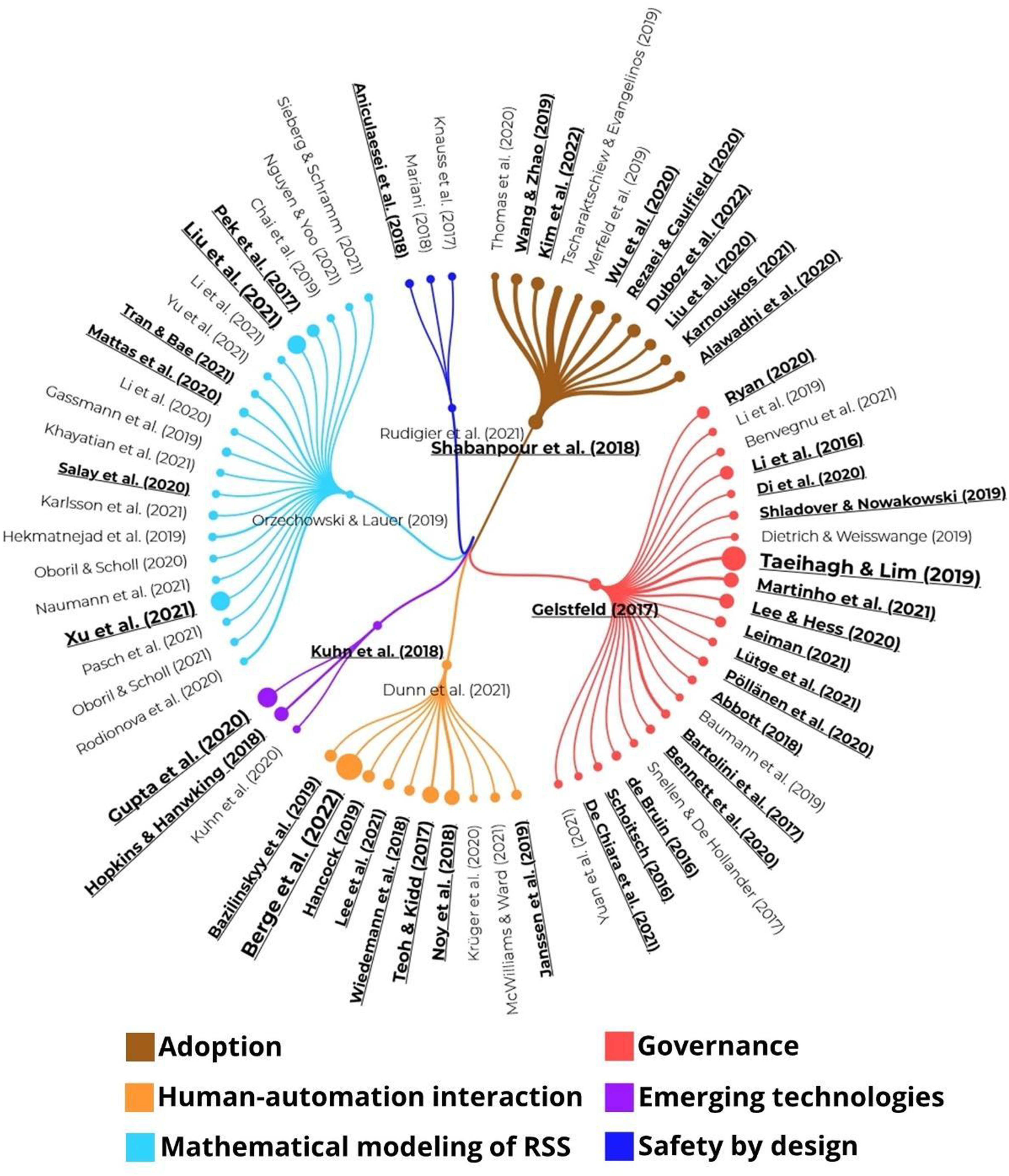
Cluster 1: Adoption of autonomous driving
Cluster 1, coloured brown in Figure 3, contains 12 publications concerned with the adoption of ADS. Factors influencing ADS adoption can be classified into four areas: technology infrastructure (communication, technology of roads and traffic signs and cost of infrastructure), legal (liability, privacy and cybersecurity), ethical principles and regulations, and user behaviour influence factors (marketing and advertising, cost and trust) (Alawadhi et al., 2020). Shabanpour et al. (2018) showed that people are much more sensitive to the purchase price and incentive policies (such as taking liability away from the driver in case of accidents), as well as provision of exclusive lanes for ADS, compared with other factors such as fuel efficiency, safety, or environmental friendliness. Wang and Zhao (2019) analysed the relationship between individualized risk preference (e.g. economic, psychometric) and ADS adoption, and showed that risk preference parameters are significantly associated with socio-economic variables. Finally, Wu et al. (2020) demonstrated that consumers display a positive attitude toward autonomous, connected, electric vehicles. They can bring widespread benefits, including reducing driver fatigue, environmental friendliness and increased accessibility of travel for non-drivers. On the other hand, participants had concerns about vehicle safety and legal liability. Finally, ethical preferences built into systems influence the adoption of ADS (Karnouskos, 2021).
Cluster 2: Governance of autonomous driving
Cluster 2, coloured red in Figure 3, contains 23 publications that are mainly concerned with governance of ADS. The high number of documents and the high number of mean citation counts suggests that governance of ADS is a hot topic (see Table 4). Many scholars have explored the legal challenges related to highly automated driving systems compared with those related to vehicles of lower automation (Leiman, 2020). So far, governments have not constrained ADS developments but have explored ADS implications (De Bruin, 2016; Taeihagh and Lim, 2019). Numerous initiatives have been undertaken to resolve blame attribution. These include changing the paradigm of tort liability (Abbott, 2018); adding new federal safety regulations to established tort doctrines (Geistfeld, 2017); investigating public opinion regarding the attribution of blame in crashes (Bennett et al., 2020; Pollanen et al., 2020); and providing an analytical tool based on a game-theoretic model to assist policymakers (Di et al., 2020).
Citizens tend to assign the obligation of setting moral norms for self-driving cars to ethics researchers and to car manufacturers (Li et al., 2016). Hence, both scholars and practitioners are engaged on the topic. For instance, an initiative joining both industry experts and researchers developed practical guidelines for ethical principles related to ADS (Lütge et al., 2021). Martinho et al. (2021) performed a review of the ethics of autonomous technology in the scientific literature and in industry reports published by companies testing ADS in California. Discussions about ethics related to ADS tend to focus on the trolley problem, while practitioners do not address this problem in industry reports. Both scholars and practitioners prioritize safety and cybersecurity and agree that ADS will not eliminate the risk of accidents.
Cluster 3: Human-automation interaction in a safety context
Cluster 3, coloured orange in Figure 3, comprises 11 publications concerned with human-automation interaction in a safety context. Both sides can interact within the vehicle or in traffic. The safety benefits of ADS are mostly emphasized in this cluster (Noy et al., 2018; Teoh and Kidd, 2017). Highly autonomous driving is safer than human drivers in certain conditions but will continue to be involved in crashes with human-driven vehicles (Teoh and Kidd, 2017). Noy et al. (2018) argue that regardless of the level of automation, a driver will continue to have a role. More critically, Hancock (2019) discusses issues surrounding driverless vehicles with a human factors/ergonomic perspective. Other publications investigate the interactions between humans and various levels of automated vehicles under particular conditions, such as the effect of different alcohol levels on handover performance in conditional ADS (Wiedemann et al. 2018), and interruption and interleaving processes (Janssen et al., 2019). Amongst a variety of external human-machine interfaces, those sending textual egocentric messages from the viewpoint of a pedestrian (rather than that of the ADS) are regarded as the clearest, which poses a dilemma because textual instructions are associated with practical issues of liability, legibility and technical feasibility (Bazilinskyy et al., 2019). More recently, to enhance the safety of cyclists interacting with ADS, Berge et al. (2022) explored on-bike human-machine interfaces. They found that cyclists are hesitant about such interfaces because the utility value is unclear, and the responsibility of safety should not be imposed on the more vulnerable road user.
Cluster 4: Emerging technologies to guaranty traceability and accountability
Cluster 4, coloured violet in Figure 3, contains four publications concerned with emerging technologies helping to guarantee safety, traceability, liability and accountability in manufacturing processes and the resulting products. These publications focus on the cause of the problem and/or responsibility attribution. These articles identify the characteristics that safety assurance should exhibit regarding different stakeholders. Blockchain (Kuhn et al., 2018; Gupta et al., 2020), IoT (Kuhn et al., 2018), and big data (Hopkins and Hawking, 2018), alone or in combination, are presented as promising solutions to address the above-mentioned issues. Blockchain technology is mentioned as a valuable technology to record, share and trace specific data in the supply chain and consequently prevent problems by tracing accountability. Kuhn et al. (2018) investigated the electrical supply industry (producer of electrical components that transmit the vehicle’s energy and communication flow) to derive current challenges as well as future requirements for production processes of safety critical products in the age of ADS.
Cluster 5: Mathematical modelling of Responsibility Sensitive Safety
Cluster 5, coloured light blue, contains 22 publications with the lowest mean citation count. Most of these publications are concerned with RSS. These publications are focused on mathematical modelling of RSS (Salay et al., 2020), formalizing traffic rules to solve liabilities of traffic participants if a collision occurs (Pek et al., 2017), and on simulations that increasingly benefit from naturalistic data (Pek et al., 2017; Xu et al., 2021).
Cluster 6: Safety by design
Cluster 6, coloured blue in Figure 3, contains four publications concerned with safety by design (i.e. requirements, framework, design and resulting infrastructure). These publications introduce a holistic and iterative software engineering approach to develop dependable autonomous systems (Aniculaesei et al., 2018). Mariani et al. (2018) describe the status of the ISO 26,262 functional safety standard with a specific focus on its application to semiconductors. Testing the functionality and safety of automated vehicles are also investigated (Knauss et al., 2017).
Synthesis and gap analysis: Recommendations for interdisciplinary research
The IS Type continuum by cluster. MCC: Mean Citation Count; TDC: Total number of documents within cluster; TDA: Total number of documents analysed in-depth. T1 to T6 denote the six system types according to Sarker et al. (2019).

Types of approaches and types of stakeholders considered
Codes count of the 44 papers for levels of analysis, capabilities and outcomes (see codes in Appendix B).
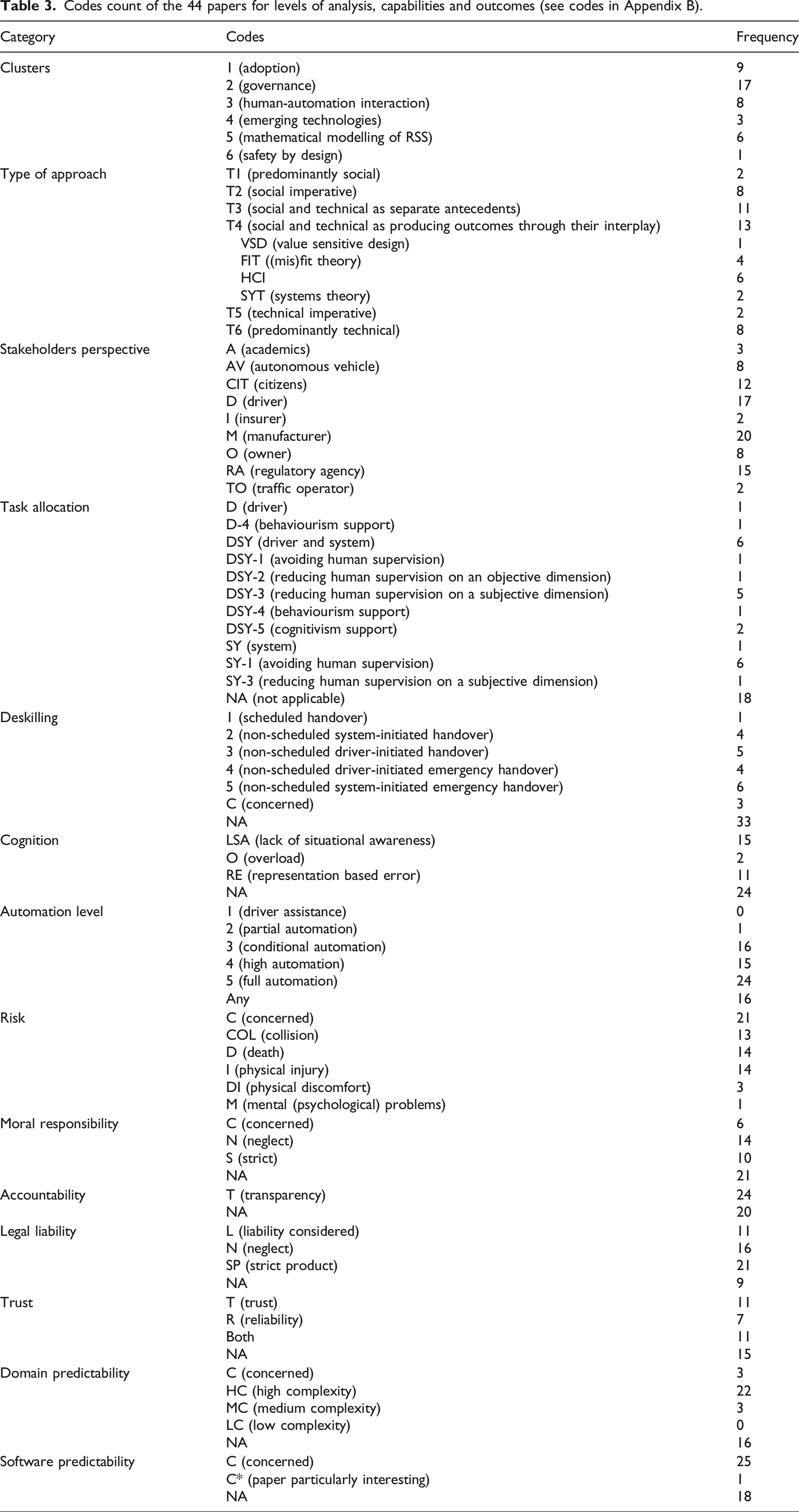
As we found 29% of papers to be Type 4, we refined this type into subtypes where authors position them as follows: 1. HCI: human-computer interaction models in general or specific situations of automated use and respective agencies (6 papers, for example, Janssen et al. (2019) present a 10-step model to explain the control transition between the autonomous car and the human operator. His attention is divided between driving and non-driving tasks (e.g. watching a movie on the mobile phone). 2. FIT: multidimensional adaptation between characteristics of autonomous systems and societal constraints and demands is challenging, yet possible (4 papers; it is typically used by policy perspectives from different countries providing best practices such as driver training programs for safety (Lee and Hess, 2020). 3. SYT: socio-technical systems theory with interaction feedback effects between social and automated components at different hierarchical levels (2 papers: (Noy et al., 2018) propose three levels: (1) the Socio-technical Environment reflecting the domestic and the international legal, political and economic (e.g. trade) milieu that influences the approach to autonomous driving. (2) ‘Transportation System Planning’ articulating mobility objectives, norms, regulations, public health priorities and road culture. (3) Automated driving as a human-centric cyber-physical system where not only drivers’ interactions with the automated vehicle, but interactions between vehicles and other stakeholders influence each other. Taeihagh and Lim (2019) focus on interactions at this third level. 4. VSD: value sensitive design of systems involving respect of ethical principles (Winkler and Spiekermann, 2021). Here, the Lütge et al.’s (2021) paper stresses the importance for both policy and industry to respect certain ethical principles: human agency depending on the level of automation, safety and resilience of the system to attacks (for instance, hijacking), or explicit consent of the driver required for the collection of certain personal data which could be used for marketing purposes or shared with third parties.
Our sample also includes papers with a very technical dimension: type 5 and 6. Type 5 treats the technology as a structural change in an organization, such as Hopkins and Hawking (2018) who explain the role of Big Data and IoT to improve driver safety in a logistics firm. Finally, Type 6 focuses mainly on how to develop or improve the technology (Sarker et al., 2019) (e.g. Salay et al., (2020) propose RSS models).
Recommendation 1 (R1): develop systems theory, value sensitive design and socio-material approaches on ADS
The selected papers show an aggregation of actors, risks and safety issues associated with ADS. Surprisingly, however, few focus on the complex interactions between manufacturers, users and regulatory agencies. The dominant point of view refers mainly to the manufacturers (20 occurrences) of ADS. This is followed by the perspective of the human driver and regulatory agencies (respectively 17 and 15 occurrences). They are clearly identified as key actors in the adoption/rejection of ADS. Each stakeholder is viewed as a risk producer for others as well as a potential victim of the behaviour and decisions of others. Although some articles address more than one stakeholder, most papers focus on the perspective of a single stakeholder.
This leads us to the identification of a second gap in the literature: the non-political treatment of the stakeholders. Almost nothing is said about the lobbying and negotiating activities of various stakeholders. There is no systematic analysis of the political and economic interests of the actors. This is problematic given that some papers can be interpreted as support provided to the interests of a particular stakeholder. This is particularly the case for liability issues faced by the manufacturers (Schoitsch, 2016). The safety lens seems to orient the study of ADS in a technical and legal direction rather than a political one.
Recommendation 2 (R2): Develop a political focus on stakeholders’ interests and interactions.
Capabilities
Task allocation is mentioned in 59% of the articles in our sample. The key questions are about the complexity of handover and the related choices made by the manufacturers and the habits and preferences of the users that pose new safety risks (Baumann et al., 2019). For individuals, giving up control completely and trusting the car is an obstacle that has yet to be overcome (Bruckes et al., 2019). A solution often mentioned in the literature is for the driver to have a button to regain control. The admissibility of such a function depends on the level of automation of the car as well as on the state and behaviour of the driver (Lütge et al., 2021). Thus, controllability can be viewed as increasingly allocated to the machine as automation levels increase. The most frequently mentioned locus of control in our sample is shared between driver and system. Shneiderman’s (2020a) position is that both should have high control with humans having authority and responsibility. Control should be coordinated between humans and systems (Baird and Maruping, 2021), while responsibility should be either that of the driver or of the ADS designer. However, and surprisingly, rather than focusing on the human-machine cooperation suggested by the cognitivist paradigm (strategy 5) and beyond as in the ecological paradigm (strategy 6), the most common strategies mentioned by the authors are strategies 1 (avoiding the role of sustained human supervision of automation) and 3 (reducing human supervision on a subjective dimension). This may be due to the gap between the existing conceptual cognitivist framework in Ergonomics (Hoc, 2000) and IS (Biondi et al. 2019) and the lack of empirical research.
Recommendation 3 (R3): Investigate options for sharing control with digital agents beyond a unidimensional problem.
Deskilling is rarely addressed in the articles, with three articles being concerned and only eight mentioning it precisely (considering equally whether unplanned handover is initiated by the driver or by the system, see Appendix B). If humans are no longer required to steer the vehicle, human drivers are not a good backup in case of an imminent accident, at least when they are busy with other tasks (Baumann et al., 2019). Three clear reasons why the deskilling of humans seems to be inevitable are as follows (Janssen et al., 2019). First, research shows that in early stages of the transfer from the system to the human (i.e. stages 2 to 5 (ibid), drivers might not immediately direct their attention to driving and they might not have sufficient awareness of their environment to act appropriately. Second, studies have shown that earlier tasks might negatively impact later tasks (such as driving) even if those earlier tasks were discontinued. Third, there is no empirical evidence that human drivers completely and systematically disengage from other activities when they take control of the vehicle, whereas there is evidence that they engage in other non-driving tasks under conventional driving conditions.
The literature fails to address the double ironies of task allocation and deskilling (Noy et al., 2018) generated by the opposite tendencies between the extra load of complex activities assigned to the human user (due to the limitations of the ADS when operating under critical circumstances) and the deskilling tendency resulting from the absence of regular practice of driving. Such a combined irony has significant consequences for safety and liability issues. On the one hand, the risk of an accident becomes more likely in critical situations, exposing users’ lives, because by design the deskilled driver is supposed to take control of the situation under certain critical circumstances for which she has no training. This potentially leads to failure. In a sense, this state of affairs mechanically ‘produces’ human errors (that feeds the statistical assumption that 90% of the crashes are caused by the human driver). On the other hand, such an irony could expose the human driver to liability (in most countries humans are still considered as the ones responsible for safety (Bennett et al., 2020; McCall et al., 2019)). Finally, the human appears to be potentially trapped in the manufacturer’s design choices.
The cognitive irony identified by Noy et al. (2018) is mainly addressed in the literature through LSA (Lack of Situation Awareness). However, it is mainly treated from a technical perspective and less from an ironical one: little is said about the LSA created by the ADS design options that reinforces inattentive, sleepy and distracted drivers. We suggest a critical approach should also consider a meta-LSA issue: if the driver is not aware of the ironies identified by Noy et al. (2018), they are more likely to engage in inappropriate behaviours, putting safety at risk. This is related to the stakeholder political approach mentioned above.
Recommendation 4 (R4): Investigate deskilling and the associated ironies to improve driver awareness.
We did not encounter papers analysing the action control irony in our sample, in the sense of either the anticipation of human cognition by ADS or controllability of ADS actions by the human, which is why we did not code this irony. Behaviourism support appears in our sample but not specifically on this aspect. Hence,
Recommendation 5 (R5): Address ADS cognition anticipation and ADS dynamics controllability.
Safety risks and responsibility
The risks considered in the articles focus mainly on collision and on the physical integrity of the user: injuries, road accidents and death. One of the fundamental arguments for the adoption of autonomous driving is that it will cause far fewer accidents. But proving the safety of ADS may take a long time (Kalra and Paddock, 2016; Shladover and Nowakowski, 2019). RSS papers mostly use mathematical models and simulations. Ironically, these papers focus on the prevention of accidents but there is no explicit discussion about the nature of the ‘agent’ who could be responsible for safety (i.e. human drivers, hybrid automata, multi-agent systems, the car itself) and no discussion about the assignment of that responsibility.
Moral responsibility is mentioned in just over half of the sample, whereas legal liability is addressed in nearly 80% of the sample. Both are almost evenly split between ‘neglect’ and ‘strict’ conceptions of moral responsibility and legal liability. It appears that a clearly agreed doctrine for responsibility (moral and legal) is lacking and is still under elaboration. The public tends to attribute responsibility to the human for an accident, regardless of the level of automation of the car, and thus the human can be legally prosecuted (Bennett et al., 2020). However, liability is sometimes attributed to manufacturers based on strict product liability. Merfeld et al., (2019) say that ‘scholars have reached the shared conclusion that elimination of a human driver will shift responsibility onto manufacturers as a matter of products liability law’ (p. 1619). This is clearly the case at level 5. But such a morally justified evolution can also be considered as counterproductive for the development of ADS because it increases the liability risk taken by the manufacturers. At levels 3 and 4 the law is still favourable to them (McCall et al., 2019). However, regarding moral and legal responsibility, designing systems and interfaces for a commander role (Zhang Y et al., 2021) paves the way for allocating responsibility to the human from level 2 to level 4, unless strict product liability applies. In fact, such designs would give the driver the ability and authority to assume controllability and thus proper conditions would exist (notably regarding endowments, preferences and roles) for effective delegation mechanisms (Baird and Maruping 2021). If, on the other hand, the driver is mostly considered as a fallback mechanism and since responsibility without authority leads to stress, responsibility may be allocated to the manufacturer, or at least shared with it. In short, if an algorithm ‘is designed to preclude individuals from taking responsibility within a decision, then the designer [manufacturer] of the algorithm should be held accountable for the ethical implications of the algorithm use’ (Martin, 2019, p. 835). Accountability is regularly addressed in the articles and considered as an ethical issue: transparency is required for autonomous cars. Algorithms should not be designed as non-transparent black boxes (Lütge et al., 2021).
Recommendation 6 (R6): Contribute to the elaboration of a universal doctrine for responsibility at levels 3 and 4
Trust and Predictability
In 41% of the articles, the notion of trust or reliability appears, 61% of which refer to both. Perceptions related to ADS vary between countries depending on the culture, the diversity of backgrounds, technological awareness and the social interactions of people (Cho and Jung, 2018). Whether keeping to limits (e.g. speed), or enjoying comfort (e.g. temperature), customizing system parameters is also important in technology adoption (e.g. Alawadhi et al., 2020). There are strong positive effects of perceived technical protection of trust (Bruckes et al., 2019). Among older individuals, situational normality significantly influences trust towards autonomous cars, while this effect is not significant for younger participants.
Finally, predictability of the (driving) environment is low: it is defined by its inherent complexity (e.g. changing weather conditions, unpredictable behaviour of some road users, etc.). Added to this is the complexity of the system itself. Predictability of the ADS is a concern in 59% of our papers. As ADS use environmental signals captured by sensors, the relationship between inputs (signals) and trajectories (outputs) is unknowable (Zhang Z et al., 2021) for users, meaning that moral and legal responsibility of the driver at level 3 or four cannot be determined. For the moment, it is not certain that future users will fully understand how autonomous cars will work, although this seems an important condition for the adoption of this technology. User perception of safety will play an important role in ADS adoption (Alawadhi et al., 2020). Because the lack of predictability in complex environments threatens trust, a solution will have to be found by manufacturers and system designers to make the introduction of autonomous cars a success.
Recommendation 7 (R7): Investigate how trust in ADS can be gained or lost
A research agenda for information systems
Future research themes in IS
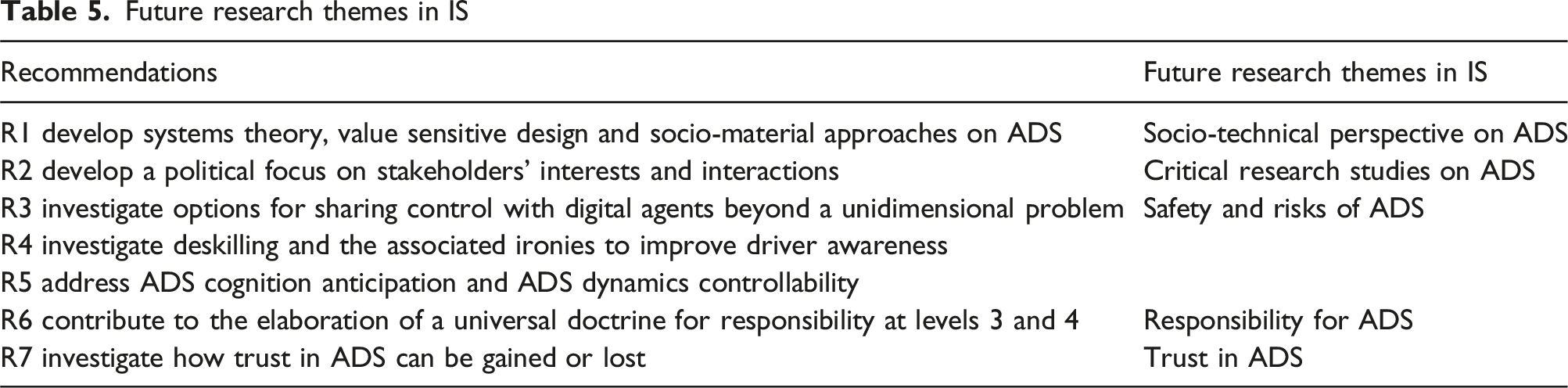
Socio-technical perspective on ADS
In their review of the IS research literature, Sarker et al. (2019) found that IS research has largely neglected the socio-technical perspective over the past 20 years. Most studies (91%) have focused exclusively on instrumental goals, such as efficiency and effectiveness. They suggest that the socio-technical perspective can serve as a distinctive and coherent foundation for the IS discipline. We agree. The ADS literature tends to have an instrumental focus on technology without considering the wider implications. In our review of the literature on ADS, we found that most articles neglect the interaction between the various parts of a system –they only take an HCI or a fit approach in a minority of cases. Since the delegation of tasks is central to several ironies, IS researchers could use the framework of delegation to and from the IS agentic artifact (Abbass, 2019; Baird and Maruping, 2021). Coordination between the latter and other stakeholders can be interpreted as a delegation mechanism problem under uncertainty, that is, where trust in technology depends on limited human knowledgeability of the ADS endowments (ability, preferences, roles) and where the appraisal by the IS agentic artifact (ADS) of the respective human driver endowments is limited. Thus, coordination to and from the ADS inevitably raises the cognitive irony (human knowledgeability of the ADS endowments), the control irony (appraisal by the IS agentic artifact (ADS) of the respective human driver endowments), and the trust irony (unpredictability in certain circumstances leading to low willingness to adopt ADS).
The three delegation mechanisms put forth by Baird and Maruping (2021) –distribution of responsibility, coordination and appraisal – are interdependent in autonomous driving. In fact, coordination depends on appraisal, and responsibility depends on coordination.
Critical research studies on ADS
One antidote to the almost exclusive focus on the instrumental use of technology would be critical research studies on ADS. If we take a critical perspective, issues such as the political interests of actors come to the fore (Myers and Klein, 2011). Considering the tensions, ironies and discourse in which we are enframed (Arnold, 2003), critical studies could focus on wider societal issues such as lobbying of politicians by companies promoting ADS and the cultural changes associated with automation.
Safety and risks of ADS
IS has a long history of studying the adoption and implementation of technology, but few IS scholars have focused on safety. For example, in a recent article by two leading IS scholars that summarized a 6-year research program that identified principles ‘leading to successful intelligent automation programs’, the word ‘safety’ is not mentioned once (Lacity and Willcocks, 2021). Yet in many industries (e.g. airline industry and nuclear industry), safety is the most important aspect. As autonomous systems increasingly take over tasks that used to require substantial human experience (Koester and Salge, 2020), and as our lives start to depend on them, it is obvious that the risks to human safety will increase. If some autonomous systems prove to be unsafe, the business value of such systems will be negligible in any case. How to design interfaces and roles in a joint optimized way (Sarker et al., 2019; Biondi et al., 2019) so that semi-autonomous systems reflect a joint and integrated system is an important issue ‘rather than trying to perfect the machine to meet the human’s safety expectations [through technology]’ (Zhang Y et al., 2021, p. 7). Future IS research could look at whether safety risks come from artificial intelligence (Burton et al., 2020), from connectivity (lack of or too much), or from socio-technical interactions. Notably, there is a need to avoid ‘death by GPS’ related to the unintended effect of the loss of skill of a trip commander because the navigation is not united with ‘other primary driving tasks and controlled by the driver in a commander-like role’ (Zhang Y et al., 2021, p. 5).
Responsibility for ADS
As discussed above, ADS raises major ironies about responsibility because its mixes (1) a high level of risks, calling for a clear and simple (but possibly unfair) identification of ‘who’ is fully in charge and responsible for safety, with (2) a high level of socio-technical complexity. This complexity involves the distribution of responsibilities between several agents, companies and institutions operating in different spaces and times (designers, developers, manufacturers, regulators, users, owners, insurance companies, contractors…). These ambiguities could lead a dilution of responsibility with the potential for long court procedures in the case of accidents along with strategic and political bargaining that may affect the development and adoption of ADS. The rich literature of moral philosophy (Van de Poel, 2011) could be a great help in clarifying the various meanings of the concept of responsibility and perhaps could help to find some innovative solutions. Facing such issues for decades, the nuclear industry has elaborated a doctrine based on the clear identification of ‘who’ is responsible for safety to avoid the risk of dilution of responsibility: ‘The prime responsibility for safety must rest with the person or organization responsible for the facilities and activities that give rise to radiation risks (…) Authorization to operate a facility or conduct an activity may be granted to an operating organization or to an individual, known as the licensee. The licensee retains the prime responsibility for safety throughout the lifetime of facilities and activities, and this responsibility cannot be delegated’ (IAEA, 2006, p.6). This doctrine could inspire the reflection on responsibility for ADS, the problem being to collectively define the equivalent of the ‘licensee’ and to make it acceptable to all parties.
Clarifying the issue of responsibility leads to questions about the attribution of blame and legal liability. As mentioned earlier, scholars in other disciplines have explored the legal and ethical challenges related to highly automated driving systems. But as cyber-physical systems become more autonomous, it is the information system that becomes more important for safety. IS designers thus may bear huge responsibility for the use of such systems. Even with partially autonomous systems, when circumstances lead to unintended consequences (such as death or neuro-psychological harms (Clegg et al., 2020)), should the designer of the fallback mechanism or the commander (Zhang Y et al., 2021), or even government (Pöllanen et al., 2020) be to blame? Encouraged by Stahl and Markus (2021), we suggest IS researchers should not simply leave the resolution of these issues to the courts, but actively engage in the debate regarding responsibility and liability. Governance of automated systems and associated legislation should become an important topic for IS research.
Trust in the wider ADS environment
A perennial topic in the IS research literature is trust in technology (McKnight et al., 2011; Bruckes et al., 2019). Koester and Salge (2020) say that for people to delegate full control to ADS, they need to establish sufficient initial trust in the automation's functionality, reliability and transparency. However, what makes trust a challenging topic with ADS is the complex nature of the environment. For example, if you purchase an automated car, do you trust the manufacturer (Cichy et al., 2021)? Do you trust other drivers to drive safely around you? Do you trust the software to perform correctly after a software update? Do you trust the law to protect your interests in the event of an accident? Will the insurance company cover your loss? These questions and more potentially affect a person’s trust in ADS (Wiefel and Buxmann, 2021). It involves trust, not just in a particular technology, but in the wider social, political and regulatory environment as well (McKnight et al., 2011). We suggest IS researchers are well placed to examine these broader questions related to trust. Shneiderman (2020b) suggests that to obtain trustworthiness at a societal level, technology should be reliable, and a culture of safety developed with organizational controls and regulations.
Conclusion
It seems that we are rushing headlong into automation without properly understanding the consequences. To contribute to the nascent debate within IS about adopting autonomous cyber-physical systems such as autonomous driving systems (Lyytinen et al., 2022), we have sought to answer two research questions: How do ironies of automation manifest when levels of automation of ADS increase beyond what we currently experience? Who is responsible and what does responsibility mean in the context of autonomous driving systems? In answering these questions, we have identified some ironies related to the introduction of ADS and how they manifest at various level of autonomation. We hope we have contributed to a better understanding of moral responsibility (Van de Poel, 2011)) along with the corresponding legal aspects. There remains significant uncertainty and ambiguity regarding the distribution of responsibility between stakeholders and the coordination mechanisms that affect the delegation of control (Baird and Maruping, 2021). In this respect responsibility and controllability should not be confused.
The relentless increase in use of autonomous systems in our daily lives leads us to suggest that a reorientation is needed in IS research. While there is nothing wrong with a focus on the instrumental value of technology, we believe it would be a mistake for the IS discipline to neglect the broader societal issues associated with autonomous systems. Over time, as more tasks that used to rely on human experience and intuition become automated, these broader societal issues will take precedence. Hence, although we have focused on ADS in this paper, we call for IS research to critically examine the social, political and technical aspects of autonomous cyber-physical systems more generally. While a few IS papers have moved in this direction (e.g. Wiefel and Buxmann, 2021; Shneiderman, 2020b), we propose that the IS field needs to actively engage in research that considers the design, management and broader societal implications of all kinds of autonomous systems.
Such research has many practical implications. Facing the complexity of the interrelated outcomes (see Figure 1), and their uncertainty related to what would be a fair distribution of responsibilities, ADS is unlikely to be largely adopted unless their design and implementation is debated with the public. However, the issue of the modalities of participation and framing of such debate is difficult. Our critical approach based on the ironies might be an interesting avenue for such deliberation which might be applicable to other autonomous cyber-physical systems. That very significant uncertainty remains does not mean that some applied configurations operationalizing capabilities in certain environments cannot be successful. However, responsible design calls for more clearly identifying and specifying them. In other words, ‘responsible design’ should be open to some forms of public and/or expert inquiries (Dewey, 1927) that could be based on the ironies developed in this paper. Finally, the issue of whether we can continue using the traditional way software has been implemented –pushed by suppliers with bugs fixed later – becomes highly questionable. Developing software this way raises huge concerns when systems put human lives at risk.
This paper has some limitations. First, it is limited by the broad interdisciplinary scope of our literature review. Second, our choice of bibliographic method meant that we had to ignore some papers that we considered as not central to our topic. Despite these limitations, we believe we have identified the most important ironies associated with ADS, and by extension, autonomous cyber-physical systems in general.
Footnotes
Declaration of conflicting interests
The author(s) declared no potential conflicts of interest with respect to the research, authorship, and/or publication of this article.
Funding
The author(s) received no financial support for the research, authorship, and/or publication of this article.
Notes
Appendix
The table below gives complementary details about the bibliometric workflow in relation to the three first steps of BIBGT: 1) defining boundaries, 2) treating bibliographic data and theoretical sampling, and 3) clustering, mapping, and interpreting.
Bibliometric workflow complementary details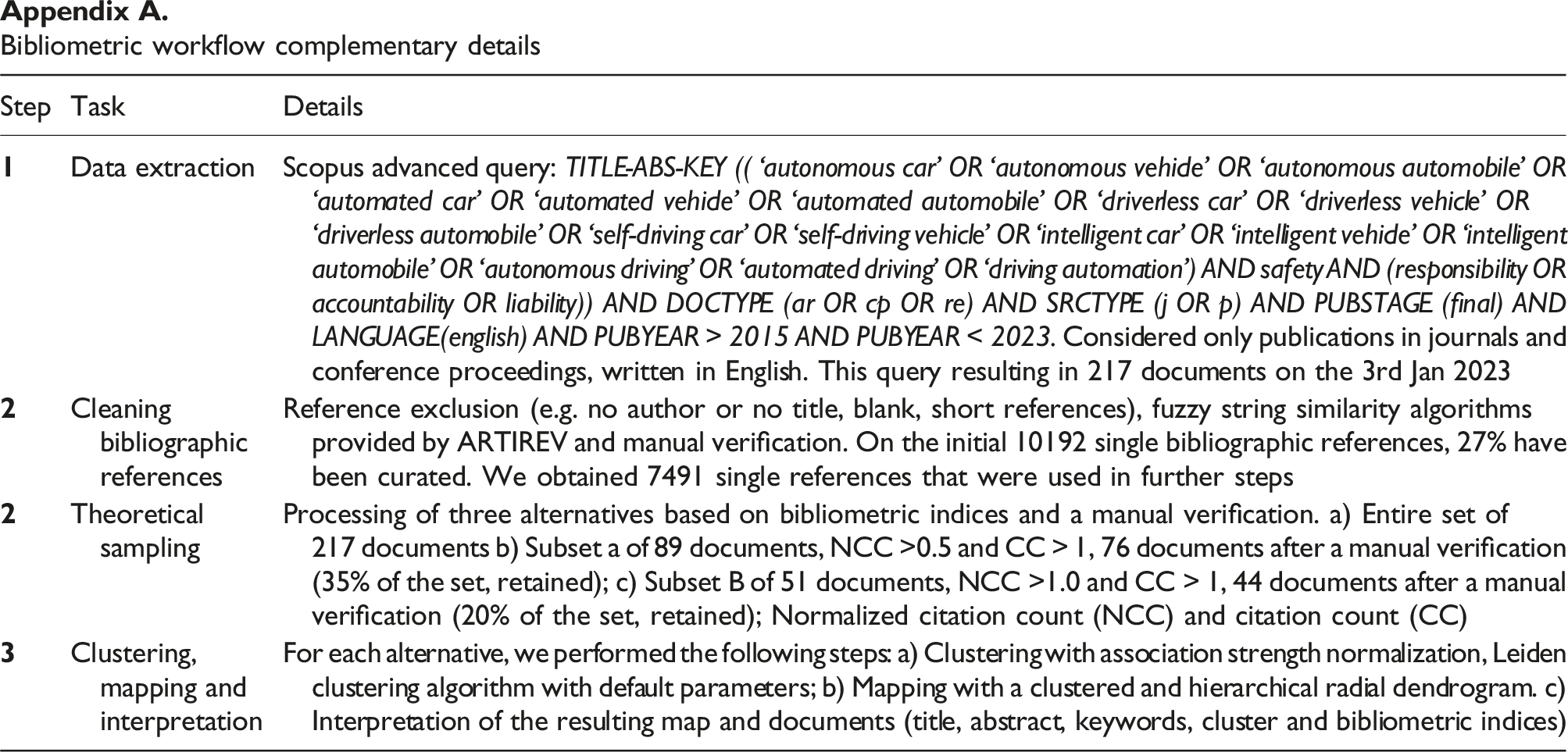
Step
Task
Details
Data extraction
Scopus advanced query: TITLE-ABS-KEY (( ‘autonomous car’ OR ‘autonomous vehicle’ OR ‘autonomous automobile’ OR ‘automated car’ OR ‘automated vehicle’ OR ‘automated automobile’ OR ‘driverless car’ OR ‘driverless vehicle’ OR ‘driverless automobile’ OR ‘self-driving car’ OR ‘self-driving vehicle’ OR ‘intelligent car’ OR ‘intelligent vehicle’ OR ‘intelligent automobile’ OR ‘autonomous driving’ OR ‘automated driving’ OR ‘driving automation’) AND safety AND (responsibility OR accountability OR liability)) AND DOCTYPE (ar OR cp OR re) AND SRCTYPE (j OR p) AND PUBSTAGE (final) AND LANGUAGE(english) AND PUBYEAR > 2015 AND PUBYEAR < 2023. Considered only publications in journals and conference proceedings, written in English. This query resulting in 217 documents on the 3rd Jan 2023
Cleaning bibliographic references
Reference exclusion (e.g. no author or no title, blank, short references), fuzzy string similarity algorithms provided by ARTIREV and manual verification. On the initial 10192 single bibliographic references, 27% have been curated. We obtained 7491 single references that were used in further steps
Theoretical sampling
Processing of three alternatives based on bibliometric indices and a manual verification. a) Entire set of 217 documents b) Subset a of 89 documents, NCC >0.5 and CC > 1, 76 documents after a manual verification (35% of the set, retained); c) Subset B of 51 documents, NCC >1.0 and CC > 1, 44 documents after a manual verification (20% of the set, retained); Normalized citation count (NCC) and citation count (CC)
Clustering, mapping and interpretation
For each alternative, we performed the following steps: a) Clustering with association strength normalization, Leiden clustering algorithm with default parameters; b) Mapping with a clustered and hierarchical radial dendrogram. c) Interpretation of the resulting map and documents (title, abstract, keywords, cluster and bibliometric indices)
Analytical category codes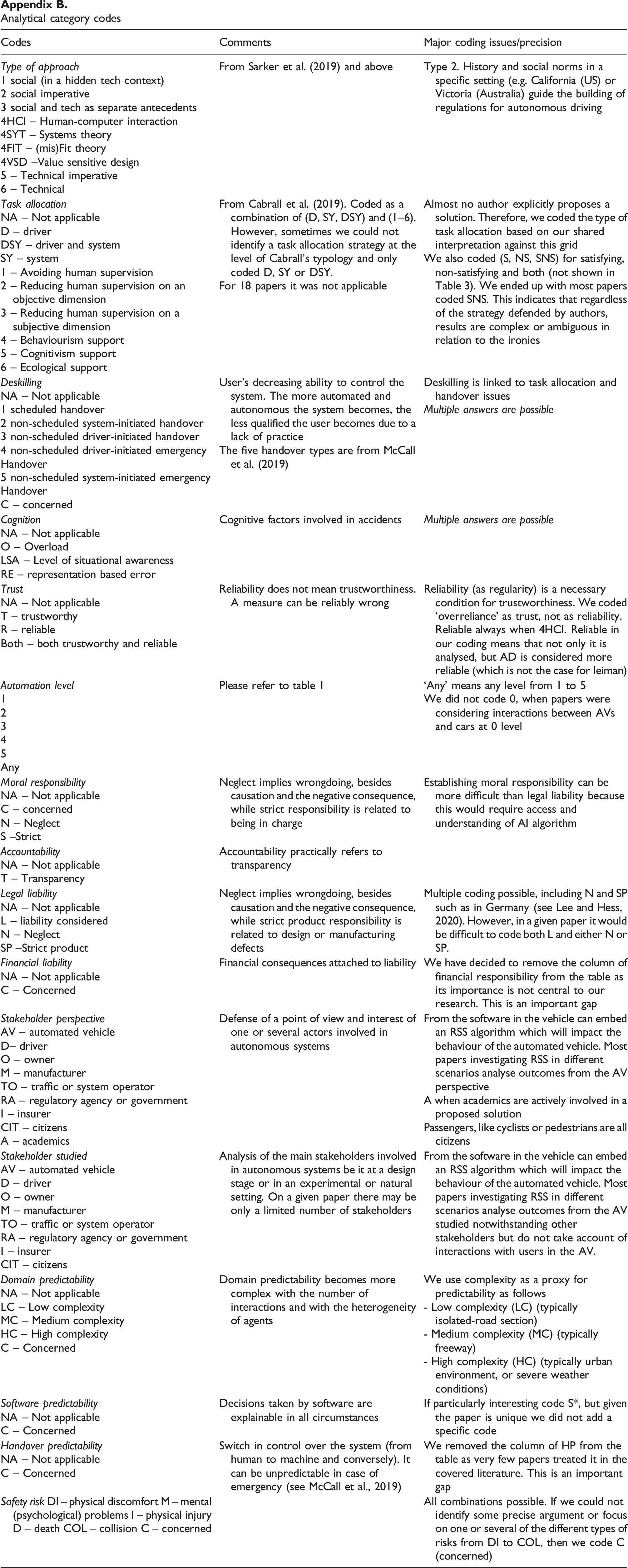
Codes
Comments
Major coding issues/precision
Type of approach
1 social (in a hidden tech context)
2 social imperative
3 social and tech as separate antecedents
4HCI – Human-computer interaction
4SYT – Systems theory
4FIT – (mis)Fit theory
4VSD –Value sensitive design
5 – Technical imperative
6 – TechnicalFrom Sarker et al. (2019) and above
Type 2. History and social norms in a specific setting (e.g. California (US) or Victoria (Australia) guide the building of regulations for autonomous driving
Task allocation
NA – Not applicable
D – driver
DSY – driver and system
SY – system
1 – Avoiding human supervision
2 – Reducing human supervision on an objective dimension
3 – Reducing human supervision on a subjective dimension
4 – Behaviourism support
5 – Cognitivism support
6 – Ecological supportFrom Cabrall et al. (2019). Coded as a combination of (D, SY, DSY) and (1–6). However, sometimes we could not identify a task allocation strategy at the level of Cabrall’s typology and only coded D, SY or DSY.
For 18 papers it was not applicableAlmost no author explicitly proposes a solution. Therefore, we coded the type of task allocation based on our shared interpretation against this grid
We also coded (S, NS, SNS) for satisfying, non-satisfying and both (not shown in Table 3). We ended up with most papers coded SNS. This indicates that regardless of the strategy defended by authors, results are complex or ambiguous in relation to the ironies
Deskilling
NA – Not applicable
1 scheduled handover
2 non-scheduled system-initiated handover
3 non-scheduled driver-initiated handover
4 non-scheduled driver-initiated emergency
Handover
5 non-scheduled system-initiated emergency
Handover
C – concernedUser’s decreasing ability to control the system. The more automated and autonomous the system becomes, the less qualified the user becomes due to a lack of practice
The five handover types are from McCall et al. (2019)Deskilling is linked to task allocation and handover issues
Multiple answers are possible
Cognition
NA – Not applicable
O – Overload
LSA – Level of situational awareness
RE – representation based errorCognitive factors involved in accidents
Multiple answers are possible
Trust
NA – Not applicable
T – trustworthy
R – reliable
Both – both trustworthy and reliableReliability does not mean trustworthiness. A measure can be reliably wrong
Reliability (as regularity) is a necessary condition for trustworthiness. We coded ‘overreliance’ as trust, not as reliability. Reliable always when 4HCI. Reliable in our coding means that not only it is analysed, but AD is considered more reliable (which is not the case for leiman)
Automation level
1
2
3
4
5
AnyPlease refer to table 1
‘Any’ means any level from 1 to 5
We did not code 0, when papers were considering interactions between AVs and cars at 0 level
Moral responsibility
NA – Not applicable
C – concerned
N – Neglect
S –StrictNeglect implies wrongdoing, besides causation and the negative consequence, while strict responsibility is related to being in charge
Establishing moral responsibility can be more difficult than legal liability because this would require access and understanding of AI algorithm
Accountability
NA – Not applicable
T – TransparencyAccountability practically refers to transparency
Legal liability
Neglect implies wrongdoing, besides causation and the negative consequence, while strict product responsibility is related to design or manufacturing defects
Multiple coding possible, including N and SP such as in Germany (see Lee and Hess, 2020). However, in a given paper it would be difficult to code both L and either N or SP.
Financial liability
Financial consequences attached to liability
We have decided to remove the column of financial responsibility from the table as its importance is not central to our research. This is an important gap
Stakeholder perspective
Defense of a point of view and interest of one or several actors involved in autonomous systems
From the software in the vehicle can embed an RSS algorithm which will impact the behaviour of the automated vehicle. Most papers investigating RSS in different scenarios analyse outcomes from the AV perspective
Stakeholder studied
Analysis of the main stakeholders involved in autonomous systems be it at a design stage or in an experimental or natural setting. On a given paper there may be only a limited number of stakeholders
From the software in the vehicle can embed an RSS algorithm which will impact the behaviour of the automated vehicle. Most papers investigating RSS in different scenarios analyse outcomes from the AV studied notwithstanding other stakeholders but do not take account of interactions with users in the AV.
Domain predictability
Domain predictability becomes more complex with the number of interactions and with the heterogeneity of agents
We use complexity as a proxy for predictability as follows
Software predictability
Decisions taken by software are explainable in all circumstances
If particularly interesting code S*, but given the paper is unique we did not add a specific code
Handover predictability
Switch in control over the system (from human to machine and conversely). It can be unpredictable in case of emergency (see McCall et al., 2019)
We removed the column of HP from the table as very few papers treated it in the covered literature. This is an important gap
Safety risk DI – physical discomfort M – mental (psychological) problems I – physical injury D – death COL – collision C – concerned
All combinations possible. If we could not identify some precise argument or focus on one or several of the different types of risks from DI to COL, then we code C (concerned)
Coding of the 44 research front papers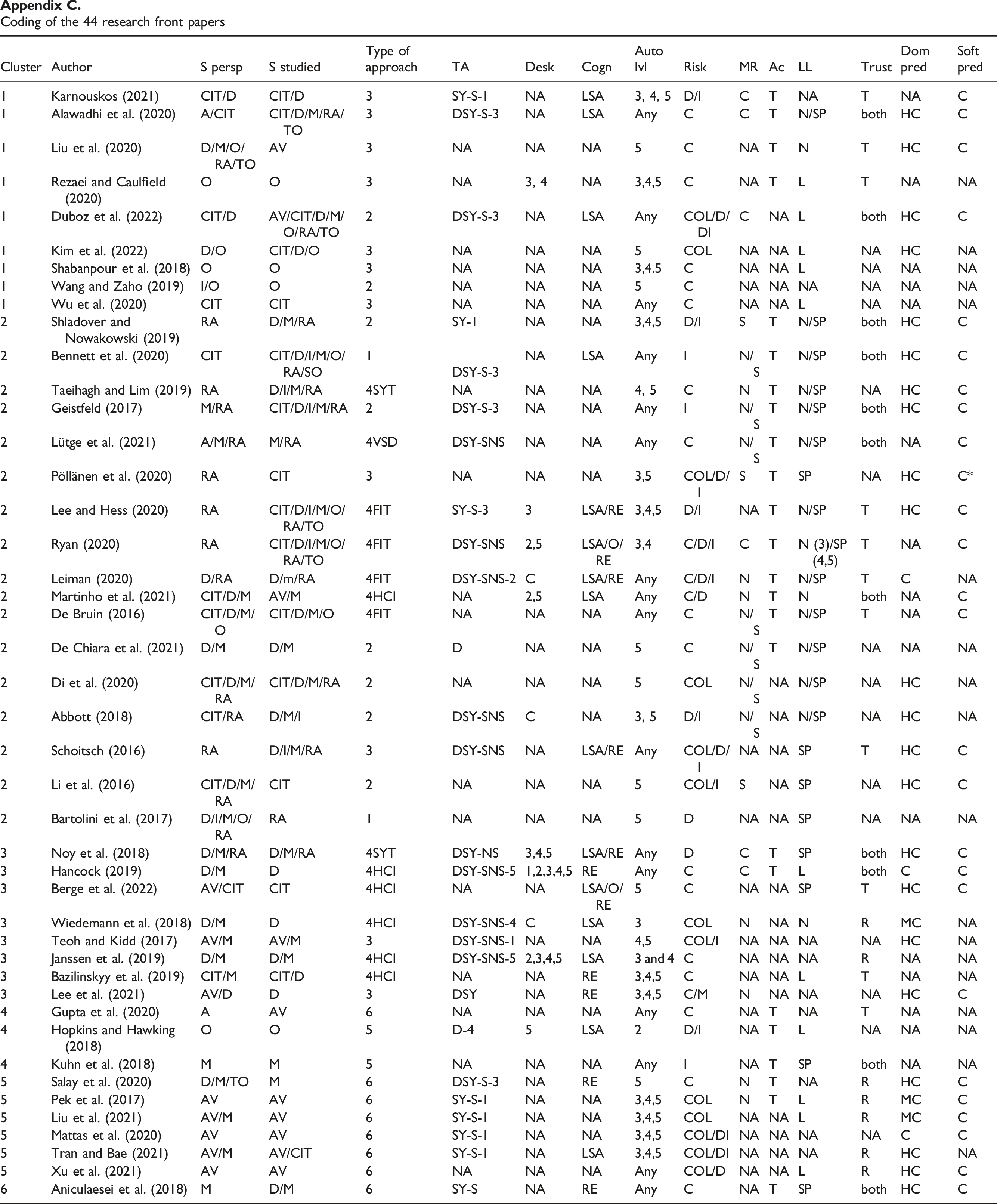
Cluster
Author
S persp
S studied
Type of approach
TA
Desk
Cogn
Auto lvl
Risk
MR
Ac
LL
Trust
Dom pred
Soft pred
1
Karnouskos (2021)
CIT/D
CIT/D
3
SY-S-1
NA
LSA
3, 4, 5
D/I
C
T
NA
T
NA
C
1
Alawadhi et al. (2020)
A/CIT
CIT/D/M/RA/TO
3
DSY-S-3
NA
LSA
Any
C
C
T
N/SP
both
HC
C
1
Liu et al. (2020)
D/M/O/RA/TO
AV
3
NA
NA
NA
5
C
NA
T
N
T
HC
C
1
Rezaei and Caulfield (2020)
O
O
3
NA
3, 4
NA
3,4,5
C
NA
T
L
T
NA
NA
1
Duboz et al. (2022)
CIT/D
AV/CIT/D/M/O/RA/TO
2
DSY-S-3
NA
LSA
Any
COL/D/DI
C
NA
L
both
HC
C
1
Kim et al. (2022)
D/O
CIT/D/O
3
NA
NA
NA
5
COL
NA
NA
L
NA
HC
NA
1
Shabanpour et al. (2018)
O
O
3
NA
NA
NA
3,4.5
C
NA
NA
L
NA
NA
NA
1
Wang and Zaho (2019)
I/O
O
2
NA
NA
NA
5
C
NA
NA
NA
NA
NA
NA
1
Wu et al. (2020)
CIT
CIT
3
NA
NA
NA
Any
C
NA
NA
L
NA
NA
NA
2
Shladover and Nowakowski (2019)
RA
D/M/RA
2
SY-1
NA
NA
3,4,5
D/I
S
T
N/SP
both
HC
C
2
Bennett et al. (2020)
CIT
CIT/D/I/M/O/RA/SO
1
DSY-S-3NA
LSA
Any
I
N/S
T
N/SP
both
HC
C
2
Taeihagh and Lim (2019)
RA
D/I/M/RA
4SYT
NA
NA
NA
4, 5
C
N
T
N/SP
NA
HC
C
2
Geistfeld (2017)
M/RA
CIT/D/I/M/RA
2
DSY-S-3
NA
NA
Any
I
N/S
T
N/SP
both
HC
C
2
Lütge et al. (2021)
A/M/RA
M/RA
4VSD
DSY-SNS
NA
NA
Any
C
N/S
T
N/SP
both
NA
C
2
Pöllänen et al. (2020)
RA
CIT
3
NA
NA
NA
3,5
COL/D/I
S
T
SP
NA
HC
C*
2
Lee and Hess (2020)
RA
CIT/D/I/M/O/RA/TO
4FIT
SY-S-3
3
LSA/RE
3,4,5
D/I
NA
T
N/SP
T
HC
C
2
Ryan (2020)
RA
CIT/D/I/M/O/RA/TO
4FIT
DSY-SNS
2,5
LSA/O/RE
3,4
C/D/I
C
T
N (3)/SP (4,5)
T
NA
C
2
Leiman (2020)
D/RA
D/m/RA
4FIT
DSY-SNS-2
C
LSA/RE
Any
C/D/I
N
T
N/SP
T
C
NA
2
Martinho et al. (2021)
CIT/D/M
AV/M
4HCI
NA
2,5
LSA
Any
C/D
N
T
N
both
NA
C
2
De Bruin (2016)
CIT/D/M/O
CIT/D/M/O
4FIT
NA
NA
NA
Any
C
N/S
T
N/SP
T
NA
C
2
De Chiara et al. (2021)
D/M
D/M
2
D
NA
NA
5
C
N/S
T
N/SP
NA
NA
NA
2
Di et al. (2020)
CIT/D/M/RA
CIT/D/M/RA
2
NA
NA
NA
5
COL
N/S
NA
N/SP
NA
HC
NA
2
Abbott (2018)
CIT/RA
D/M/I
2
DSY-SNS
C
NA
3, 5
D/I
N/S
NA
N/SP
NA
HC
NA
2
Schoitsch (2016)
RA
D/I/M/RA
3
DSY-SNS
NA
LSA/RE
Any
COL/D/I
NA
NA
SP
T
HC
C
2
Li et al. (2016)
CIT/D/M/RA
CIT
2
NA
NA
NA
5
COL/I
S
NA
SP
NA
HC
C
2
Bartolini et al. (2017)
D/I/M/O/RA
RA
1
NA
NA
NA
5
D
NA
NA
SP
NA
NA
NA
3
Noy et al. (2018)
D/M/RA
D/M/RA
4SYT
DSY-NS
3,4,5
LSA/RE
Any
D
C
T
SP
both
HC
C
3
Hancock (2019)
D/M
D
4HCI
DSY-SNS-5
1,2,3,4,5
RE
Any
C
C
T
L
both
C
C
3
Berge et al. (2022)
AV/CIT
CIT
4HCI
NA
NA
LSA/O/RE
5
C
NA
NA
SP
T
HC
C
3
Wiedemann et al. (2018)
D/M
D
4HCI
DSY-SNS-4
C
LSA
3
COL
N
NA
N
R
MC
NA
3
Teoh and Kidd (2017)
AV/M
AV/M
3
DSY-SNS-1
NA
NA
4,5
COL/I
NA
NA
NA
NA
HC
NA
3
Janssen et al. (2019)
D/M
D/M
4HCI
DSY-SNS-5
2,3,4,5
LSA
3 and 4
C
NA
NA
NA
R
NA
NA
3
Bazilinskyy et al. (2019)
CIT/M
CIT/D
4HCI
NA
NA
RE
3,4,5
C
NA
NA
L
T
NA
NA
3
Lee et al. (2021)
AV/D
D
3
DSY
NA
RE
3,4,5
C/M
N
NA
NA
NA
HC
C
4
Gupta et al. (2020)
A
AV
6
NA
NA
NA
Any
C
NA
T
NA
T
NA
NA
4
Hopkins and Hawking (2018)
O
O
5
D-4
5
LSA
2
D/I
NA
T
L
NA
NA
NA
4
Kuhn et al. (2018)
M
M
5
NA
NA
NA
Any
I
NA
T
SP
both
NA
NA
5
Salay et al. (2020)
D/M/TO
M
6
DSY-S-3
NA
RE
5
C
N
T
NA
R
HC
C
5
Pek et al. (2017)
AV
AV
6
SY-S-1
NA
NA
3,4,5
COL
N
T
L
R
MC
C
5
Liu et al. (2021)
AV/M
AV
6
SY-S-1
NA
NA
3,4,5
COL
NA
NA
L
R
MC
C
5
Mattas et al. (2020)
AV
AV
6
SY-S-1
NA
NA
3,4,5
COL/DI
NA
NA
NA
NA
C
C
5
Tran and Bae (2021)
AV/M
AV/CIT
6
SY-S-1
NA
LSA
3,4,5
COL/DI
NA
NA
NA
R
HC
NA
5
Xu et al. (2021)
AV
AV
6
NA
NA
NA
Any
COL/D
NA
NA
L
R
HC
C
6
Aniculaesei et al. (2018)
M
D/M
6
SY-S
NA
RE
Any
C
NA
T
SP
both
HC
C
Author biographies
 .
.
.