



Abstract
This article provides a broad overview of the changing models of Japanese society in postwar years, focusing on how the social science paradigm and popular representations of Japan have shifted with the transformation of the nation’s mega-social structures. The analysis identifies three major periods and concentrates on the dramatic switch of academic orientation from the monocultural to the multicultural model. The discussion also shows how the dominant popular images of Japan around the world have changed from work culture to pop culture, coinciding with the shift in the nation’s socioeconomic structure from industrial to cultural capitalism. Finally, the article demonstrates the ways in which Japan’s social scientists are located on the periphery of the world system of social science knowledge and the dilemmas they face in their attempts to produce multicultural social sciences.
Japanese society has been a quiet playground for comparative sociologists, off the beaten track of mainstream international sociology. For the seven decades since the end of the Second World War, it has attracted attention as the only country that has achieved a highly developed level of capitalism outside the Western cultural tradition, raising a very broad and perhaps oversimplified question: does Japan resemble or differ from other advanced economies in the West? Some analysts observe that Japan is unique, particular and peculiar. For others, Japan shows patterns that are fundamentally common, universal and similar to those of other major economies. Either way, the issue has inevitably stirred some sense of duality and ambivalence among many social scientists in Japan who often reflect outwardly on the Western thought and practice as a major comparative benchmark, either positively or negatively. 1 Meanwhile, many of those overseas social scientists who study Japan from outside have deemed it a productive space for testing – and potentially enriching and modifying – general sociological theories of Western origin.
Against this backdrop, this article briefly sketches the issues, debates and controversies that have inspired social scientists in Japan and abroad during the postwar years, with a central focus upon the frameworks, perspectives and paradigms that have been predominant in the study of Japan. Attempts will be made to conduct a broadly conceived survey within the parameters of sociology, anthropology and associated social sciences as well as Japanese studies, both within and outside Japan. The discussion concentrates upon English-language publications 2 and highlights underlying interactions and tensions in the literature without restricting itself to academic work produced in higher education institutions.
The article is divided into five parts. The first section examines the cultural essentialist ideas that have long dominated the study of Japanese society. The second part concentrates on the paradigm shift in academia that has taken place over the past two decades or so, a transformation from the monocultural model to the multicultural framework that analyzes Japanese society from multiethnic and multiclass perspectives. The third section deals with the drastic change in popular images of Japan, which coincided with the scholarly paradigm shift, focusing on the rise of the country’s popular culture around the world. The fourth part demonstrates that these two sets of changes in academia and in popular domains reflect alterations in the underlying large-scale structures of Japanese society. Finally, the article sketches out the duality and the dilemmas that Japanese sociologists face due to their location in the global community of social scientists.
The so-called convergence debate is perhaps the best place to start to examine the enduring rival perspectives of universalism versus particularism (Langlois, 1994). The convergence thesis holds that all industrialized societies, including Japan, become increasingly analogous to each other in their social structures and value orientations because of the functional imperatives of industrialism. Most studies on Japan over the past half a century have disagreed with this thesis, instead taking an anti-convergence position, pointing out how exceptional Japan is in comparison with Euro-American societies. This trend is attributable in part to the dominance of the cultural essentialist discourse referred to as Nihonjinron (literally, theories on the Japanese), a forceful undercurrent of Japanese studies for decades.
Entrenched essentialism
Although every society is unique, the underlying claim of Nihonjinron is that Japan is ‘uniquely unique’: fundamentally and qualitatively different. The theory addresses the distinctive characteristics of the Japanese personality, culture and society. Involving academics, journalists, novelists and business writers, this field has produced a huge number of books, scholarly and otherwise, including both well-known best sellers and enduring classics. These publications have tended to single out and glorify selected aspects of Japanese society – be they perseverance, loyalty, politeness, hospitality or industriousness – satisfying the appetite of the reading public for symbols of identity and self-confidence. Some Nihonjinron writings have become so influential that their claims are generally taken for granted and are frequently cited as unchallengeable truisms about Japanese society.
The dominant framework of Nihonjinron has claimed that the Japanese are group-oriented in contrast to the individualistic West. At the individual level, the Japanese allegedly fail to develop an independent self, exhibiting strong dependence on others. At the interpersonal level, they supposedly prioritize the groups to which they belong rather than their individual rights and interests. At the societal level, these groups are presumed to be characterized by mutual harmony and consensus, so much so that Japanese society on the whole is considered to be well integrated and egalitarian. Methodologically, the group model draws generalizations about Japanese society from arbitrarily chosen samples, presenting it as a uniform entity with little internal variation. Although criticized variously (Befu, 2001; Mouer and Sugimoto, 1986; Yoshino, 1992), the Nihonjinron approach remains a formidable discourse which attracts a wide readership.
Nihonjinron has a long history. During and after the Second World War, Japan was portrayed as an alien and inscrutable country which had waged an irrational war against the Allied nations. A rational explanation was therefore required by the international community. Benedict’s The Chrysanthemum and the Sword (1946), an anthropological work, attempted to meet this need by using a national character approach and the ‘patterns of culture’ framework. She endeavored to make logical sense of ‘mysterious Japan’ on the assumption that it is internally homogeneous and qualitatively different from Western societies. This study is unrivaled in its lasting influence on social science scholarship on Japan.
When Japan emerged suddenly as a rapidly expanding economy in the 1970s and 1980s, the outside world once again required an intelligible account of how the nation so recently devastated by war could have bounced back to such a degree that it posed a threat to the United States and other advanced economies. The Nihonjinron literature enjoyed a heyday then, as writers competed with each other to present what they considered to be the keys to unlock the cultural secrets of Japan’s amazing economic performance. Some of these publications achieved wide recognition, including Nakane’s (1970) argument that Japan is a ‘vertically structured society’ and Doi’s (1973) claim that the Japanese have particular amae (roughly translated as dependency orientation).
In contrast to the culturalist argument about Japanese uniqueness, some analysts took an institutional approach. Johnson (1982), for instance, endeavored to demonstrate how fundamentally the Japanese capitalist system differs from its Western counterparts. He portrayed a developmental state model in which the state – especially the national bureaucracy – takes a lead in the name of expanding Japan’s national interests by formulating long-term national industrial policies which the private sector is expected to follow.
Japan has also been a focus of debate in civilization studies. In one of the most influential books in the Japanese intellectual community, Umesao (2002) claimed that Japanese civilization has evolved in a way analogous to Western Europe, and quite differently from the middle regions of Asia. This is a strong convergence argument based on spatial ecology. In Huntington’s (2011) classification of world civilizations, however, Japan is the only civilization that is identical to a single nation; all other civilizations in Huntington’s schema are regional units made up of multiple countries. Here, again, Japan is treated as an exceptional entity.
Exceptionalism, particularism and uniqueness continue to dominate interpretations of Japanese society based on two interrelated frameworks: the mono-ethnic model and the mono-class model. The mono-ethnic model maintains that Japan is racially and ethnically uniform. According to the mono-class model, Japan has very little demographic variation and does not have a clear-cut class structure.
Paradigm shift
Since the 1990s, however, a paradigm change has been in progress and the self-glorifying Nihonjinron discourse has shown signs of waning. Once portrayed as uniquely group-oriented and homogeneous, Japanese society is now increasingly characterized by internal variations and class rivalries, comparable to other advanced economies. This perspective tends to be compatible with the convergence hypothesis. The mutation has taken place on two fronts: the multiethnic model and the multiclass model.
Multiethnic model
On the one hand, many studies have revealed that, contrary to popular belief, Japanese society has sizable ethnic and pseudo-ethnic groups that suffer discrimination because of unfounded and ‘invented’ perceptions shared by the majority Japanese. These groups include resident Koreans (Zainichi), the descendants of Koreans who settled in Japan during Japan’s colonization of the Korean Peninsula in the first half of the twentieth century; Burakumin, Japanese who are discriminated against because they are thought to be offspring of the outcaste class in the feudal period; Ainu, the indigenous Japanese living mainly in Hokkaido; Okinawans who reside in the southernmost prefecture of Japan, who had their own kingdom until the late nineteenth century; and those who have immigrated from abroad in recent decades. With a focus on these ‘minority groups’, new research (e.g. Befu, 2001; Lie, 2001; Oguma, 2002; Weiner, 2008) has critically scrutinized the mono-ethnic assumptions about Japanese society and has shaped a multiethnic framework for its analysis.
The transformation has put a spotlight on an old question from a different angle: who are the Japanese? Without defining the population base, one is unable to argue about Japanese culture, Japanese values or Japanese lifestyles, although unstated presumptions underlie most studies.
From the monocultural perspective, it appeared to be self-evident that the Japanese are the people who hold Japanese citizenship, are racially Japanese and share Japanese culture. The Nihonjinron argument was predicated upon a tacit assumption that the Japanese nation (N), ethnicity (E) and culture (C) are equivalent and interchangeable. This amounted to the implicit formulation of an N=E=C equation which the ‘genuine’ Japanese are thought to satisfy. From the multicultural perspective, however, this hidden postulate excludes many categories of people who are Japanese according to one or more criteria: citizenship, pedigree, language, place of residence, place of birth, subjective identification, etc. Cases in point abound, including Zainichi Koreans who were born and raised in Japan but do not have Japanese citizenship; Brazilian born Japanese who have worked in Japan but are not fluent in the Japanese language or customs; and the returnee children of Japanese corporate expatriates, some of whom are not familiar with cultural practices prevailing in Japan. The multicultural paradigm includes all of them as Japanese as opposed to the monocultural paradigm which is inclined to be assimilationist and exclusionist.
Moreover, Japan as we know it today, as a nation of 47 prefectures, is a relatively recent development. Over more than 13 centuries, the geopolitical space of Japan has expanded and waned, with its boundaries fluctuating. It has also recorded competition between eastern and western Japan as well as between the center and the periphery (Amino, 1992). Many studies over the past two decades or so have scrutinized the margins of the Japanese nation-state, establishing their instability and oscillations–including one exhaustive study on the case of Okinawa and Okinawans (Oguma, 2014).
In sum, inclusionist approaches blur the shape of Japan and the contours of the Japanese, regarding them as variables rather than constants and thereby problematizing what one might call the Olympic model of international order, in which the world is seen as divided into self-consistent nation-states, or regions made up of nation-state combinations. Sensitivity to this concern appears to be growing and opening the way for what Morris-Suzuki (2000) calls an ‘anti-area studies’ approach which consciously avoids making Japan a unit of study as a nation-state.
Multiclass model
On the other hand, since the last decade of the twentieth century, an increasing number of studies have undermined the notion of Japanese society as a consensual, integrated and egalitarian entity, presenting instead a view that it is highly diversified in terms of occupation, educational background, firm size, gender, region and other structural variables. Contrary to the predominant images of homogeneity, these investigations have demonstrated that Japanese society is characterized by demographic variance and class stratification. In fact, the level of heterogeneity is strikingly similar to other comparable societies or even higher than those societies (Tachibanaki, 2009). Suddenly, a multiclass model of Japanese society has emerged as an effective framework for inquiry. Studies with this orientation have accumulated, as researchers have become sensitized to, among other things, the emerging reality that nearly 40% of Japan’s labor force comprise underpaid casual employees, the so-called ‘non-regular workers’ with no long-term job security. Abruptly, Japanese society is widely understood to be a kakusa shakai, a disparity society or a society of social division, in stark opposition to the popular view of a harmonious consensual society.
This paradigm shift has major implications for the convergence debate. As a divided class society, Japan appears to significantly resemble similarly stratified nations of the West. In international comparison, Japan is located in the middle of major economies in terms of the distribution of socioeconomic resources, the degree of status inconsistency and the level of intergenerational social mobility and other major class indicators (Ishida, 2010). Furthermore, whatever convergence is occurring is going in the opposite direction to the increased equality that the old convergence advocates had predicted. The forces of neoliberal globalization have increasingly split every industrialized country into more widely separated groups of richer and poorer. Convergence has been towards higher levels of income inequality, social stratification and class competition. In all major economies, one can discern the casualization of labor, the spread of performance-based work practices, the expansion of cultural capitalism, the consolidation of an aging society, the increased breakdown of marriages, the diffusion of online communications, the spread of English as an elite language and so forth, all pointing to new patterns of convergence.
It is unlikely, however, that Japan has suddenly become a multiethnic and multiclass society. Even at the height of the ‘uniquely homogeneous Japan’ paradigm, the opposing perspective, highlighting diversity and stratification, persisted, even if marginally. For one thing, the Marxian tradition was fairly strong in Japanese sociology, particularly in the Cold War years. Moreover, independently of this school of thought, Japanese empirical sociologists have conducted a large-scale national survey of social stratification and mobility (SSM study) every 10 years since 1955. This time-series project spanning more than half a century is internationally unparalleled in its temporal coverage, 3 and presents an indisputable picture of a diverse and stratified society. Based on these and other studies, it is now widely asserted (e.g. Sato and Ito, 2011) that Japan is witnessing the emergence of new inequalities.
Multicultural paradigm
Almost inevitably, the two models – the multiethnic and the multiclass – have gradually intertwined to form a multicultural paradigm of Japanese society, which sees Japan as both ethnically diversified and socioeconomically heterogeneous. The new paradigm now coexists in competition with the conventional monocultural paradigm which regards Japan as mono-ethnic as well as classless.
Beginning from the assumption that Japan has no singular cultural pattern, the multicultural approach attempts to pursue the cultures of women, minorities, the marginalized, the isolated, social movements and so on and show the variety of different value orientations, lifestyles and symbols that exist in Japanese society (Denoon et al., 1996; Schwartz and Pharr, 2003; Sugimoto, 2010; Tanabe, 2013). This perspective is also highly visible in the cultural studies discipline, especially in its analysis of a wide range of subcultural groups and their representations. There are signs, though, that new stereotypes are forming in the mass market of images of Japan, as will be discussed in the next section.
Shift in popular images
The transformation of scholarly paradigms on Japan coincided with the abrupt changes over the past two decades or so in popular images of Japan, with the global spread of manga, anime, computer games, karaoke, sushi, fashion and many other cultural commodities at the mass level. An increasing number of consumers of Japanese popular culture abroad see Japan as a country with lighthearted, hilarious, fluid, urbane and sophisticated attributes. This trend is in sharp contrast to the preceding representations of Japan at the time of the nation’s economic success, which underscored the seriousness, rigidity, loyalty and industriousness of the Japanese primarily based on the nation’s work culture.
McGray (2002) called attention to this new phenomenon, arguing that while Japan may not be an industrial hub anymore, it has become a powerhouse in the production of what he calls the Gross National Cool, the index of the popular cultural goods. Jumping on the bandwagon, the Japanese government, business and the mass media are eager to run a ‘Cool Japan’ project to promote these products in the hope that the nation can increase its ‘soft power’ through the effective use of these symbols and images in international trade and politics. Reminiscent of the defunct ‘Cool Britannia’ campaign championed by Tony Blair’s government in the United Kingdom in the 1990s, the trend has given some Japanese a renewed sense of confidence in Japanese culture in the climate of a prolonged economic downturn. Pulvers (2006) coined the term MASK (an abbreviation of Manga, Anime, Sushi and Karaoke) to capture the spreading phenomenon while at the same time implying that it in fact conceals the realities of Japanese society.
The ‘Cool Japan’ project has been enthusiastically accepted by some overseas educators and researchers involved in the teaching of Japanese and Japanese studies, because many students who choose to take subjects in these areas are avid readers of manga, watchers of anime and players of computer games produced in Japan. They are eager to learn Japanese language and culture in order to engage with these products more directly and closely, a trend that would help ensure better student enrolment numbers and the security and expansion of faculty positions in this area.
In the formation of these new global images of ‘Cool Japan’, exoticism has been every bit as important as it was in the formation of descriptions of Japanese culture in the pre-MASK years. Japan continues to be depicted as a place and culture that outsiders will find mysterious, unfamiliar, alien and inscrutable. In this sense, Japan is depicted as maintaining various elements of its tradition, thereby retaining what the West left behind in the process of its modernization. This tendency was pronounced when Japan’s economy was booming, and the nation’s corporate culture was the center of international attention. The Japanese were presented as both modern and traditional at the same time: efficient but affective, bureaucratic but communal, and competitive but polite, a contrast sustained since the days of The Chrysanthemum and the Sword (peace-loving but cruel), emphasizing Japan’s cultural difference from the West.
With the spread of the ‘Cool Japan’ images, however, postmodern descriptions are increasingly championed in place of the modern descriptors. While keeping the incomprehensible, enigmatic and unfathomable ingredients, a fresh emphasis is now placed on new orientations – fluidity rather than predictability, amorphousness rather than rationality, conviviality rather than seriousness and ecology-consciousness rather than developmentalism – paving the way for what may be called postmodern exoticism.
Here, mainly with manga and anime in mind, a new depiction of Japanese culture has emerged: ‘pictocentrism’ (Inouye, 1996; Napier, 2005). The Japanese are deemed visually oriented in contrast with the ‘logocentric’ and speech-oriented Westerners. Some suggest that kanji characters, originally imported from China, are ideographic rather than phonetic; they represent an image of something, and have thus nurtured a ‘pictocentric’ culture, whereas Western culture is supposed to be predicated upon written alphabetical language. Others point out that Japan has had a long history of visually oriented culture, already evident in the tenth-century scrolls that satirically portrayed members of the aristocracy as romping birds and animals. Japan’s pictorial culture is said to have endured in the feudal period, when illustrated storybooks and the woodblock printing art known as ukiyo-e were popular.
Similar to Nihonjinron-style reasoning, these assertions tend to deduce the characteristics of Japanese national culture from observations of arbitrarily selected examples. Sustaining the Orientalist polarity between Japan and the West, the propagation of MASK, then, tends to mask the reality of Japanese society. It is only a slight leap from here to argue, as many Japan analysts have, that ‘pictocentric’ Japan is postmodern and thus ahead of the ‘logocentric’ West, which is stuck with logical, coherent and rational modernity. In this sense, the new images of Japan can be positioned as postmodern Nihonjinron and thus as a new stereotype formation. One must perhaps view the rising ‘Cool Japan’ phenomenon with a cool head.
A sociology of knowledge perspective
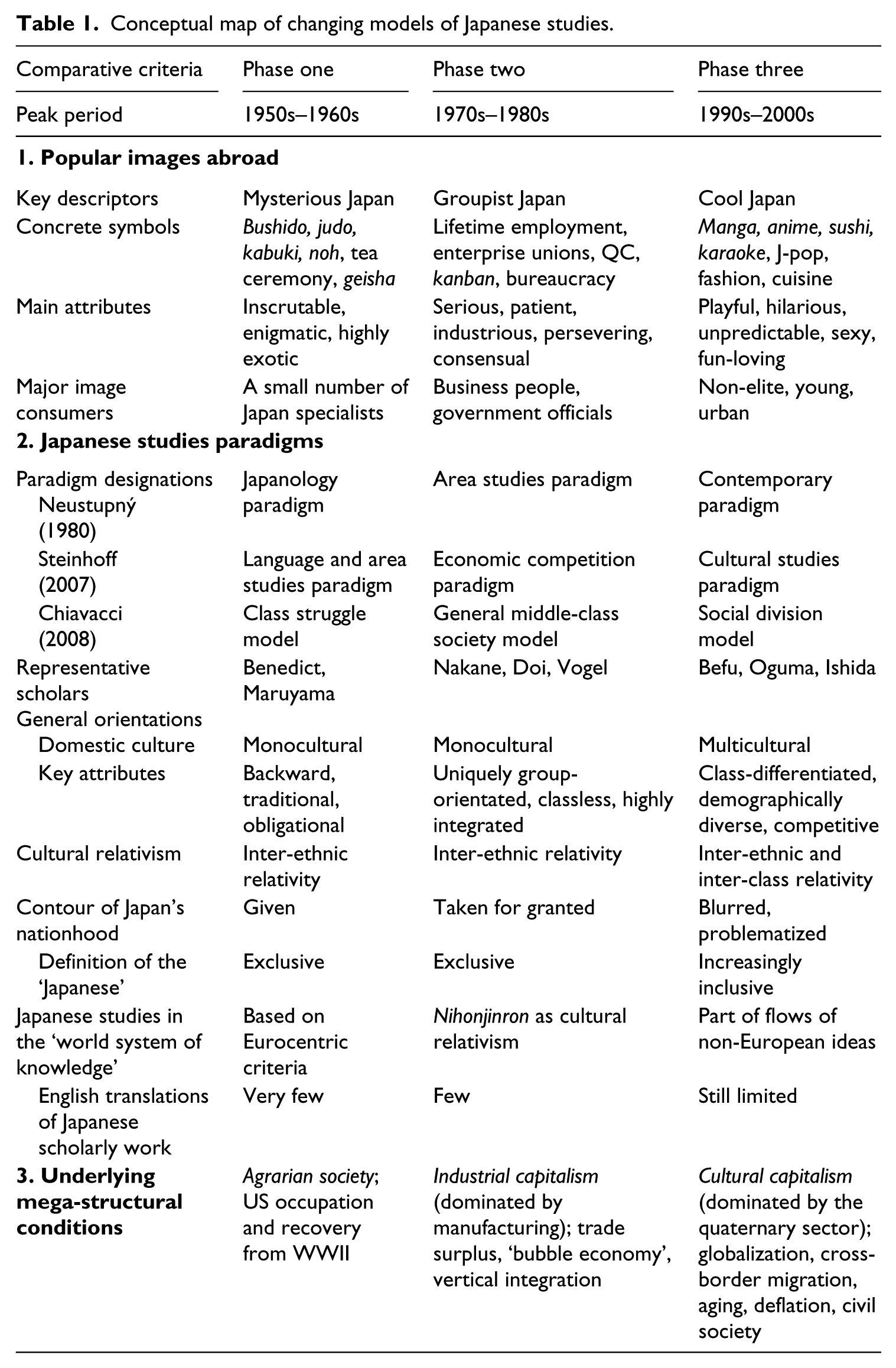
Shifts in scholarly paradigms on Japanese society and the fluctuations of popular images have both reflected and shaped the country’s changing social structures. The three layers – (1) academic scholarship, (2) popular imagery and (3) social structure – interact and correspond with each other, exercising mutual influences and forming an interactive triangle. Table 1 provides a conceptual map of such interdependence and correlation in tabular form. 4
Conceptual map of changing models of Japanese studies.
Paradigm descriptors
Capturing the mutual connections between the three levels, Australia-based Japan specialist, Neustupný (1980) distinguished between three shifting paradigms in the study of Japan by scholars outside of Japan: the Japanology paradigm; the area studies paradigm; and the contemporary paradigm. Japanology, the first paradigm, was comprised of scholars who, from small Japanese departments, combined the study of Japan as an exotic entity in the tradition of philosophy, history, religion and ethnography with language training based on the grammar-translation method. In the area studies paradigm, researchers studied Japan from specialized disciplines such as economics, political science, sociology and modern history, while Japanese departments were comprised mainly of language teachers equipped with the audio-lingual method. The contemporary paradigm saw the emergence of a new generation of Japan specialists who have a high level of communicative competence and are themselves involved in social networks within Japan. These specialists have a good understanding of Japan’s domestic variations and conflicts, focusing upon its internal processes as well as the interdependence of its elements.
Steinhoff (2007), too, presents a three-stage model based on her survey of Japanese studies in the United States. From the 1950s to the 1970s, language and area studies predominated, whereas the economic competition paradigm prevailed from the 1980s to the 1990s. In its place, the cultural studies paradigm has held sway from the 2000s to the present, as Japanese cultural commodities spread around the world.
Focusing on the area of social stratification, Chiavacci (2008) also identifies three phases of class models of Japanese society. Immediately after the end of the Second World War when industrial, agrarian and urban conflicts were rife, the class struggle model was dominant. In the period of Japan’s high-growth era in the 1970s and 1980s, the prevailing discourse claimed that most Japanese belonged to the middle class and that Japan did not have class issues like other societies. Following the stagnation of the Japanese economy from the 1990s, the general middle class framework abruptly collapsed and was replaced by the social disparity model, as discussed above.
These three-phase models of changes in the social scientific study of Japan share a sensitivity that links academic studies with two other dimensions – underlying mega-trends in Japanese social structure and popular global representations of Japan. Although Neustupný, Steinhoff and Chiavacci’s substantive foci differ, all these analysts envisage interaction among the above-mentioned three layers: scholarly discourses, popular representations and social structures.
A sociology of Japanese studies
Of particular import from a sociology of knowledge perspective is the extent to which changes in Japan’s large-scale social structures (level 3 in Table 1) condition both the academic frameworks of Japanese studies (level 2) and the nation’s images at the popular level (level 1).
In the first phase (the 1950s and the 1960s), Japan was a predominantly agrarian society, with the majority of the population engaged in the primary sector of the economy. Japan was recovering from the wartime devastation, and the legacy of the United States’ occupation of the land was widely apparent. It is little surprise that the country was characterized as a backward society that needed to renounce its militaristic, semi-feudalistic and authoritarian configuration and absorb Western democracy and liberalism. For example, Japan’s leading postwar progressive thinker, Maruyama (1963), attempted to demonstrate that the collective leadership of wartime Japan was based on a system in which nobody assumed clearly articulated individual responsibilities. He argued that postwar Japan lacked what he regarded to be mature civil society and individualism à la Western Europe. Such arguments, sometimes called a deficiency thesis, highlights supposedly inadequate characteristics of Japanese society, using the West as a yardstick.
As a devastated, impoverished country, Japan was neither a threat nor of interest to Euro-American societies. It was a distant land for most Westerners and, at the level of popular imagery, it attracted just a small number of Japanophiles who were drawn to its mysterious, enigmatic and exotic aspects of life, including marshal arts, performing arts and other apparently ancient traditions.
In phase two (the 1970s and the 1980s), when Japan’s economy made a comeback and started to dominate on the world stage, the convergence debate was given a new twist with the formulation of the reverse convergence model (Dore, 1973). This model argued that the world is converging on patterns that are prevalent in Japanese society, rather than Western societies, as evidenced by the widespread adoption of various elements of the Japanese management model by multinational corporations of Western origin. Because Japan was a late comer to industrialization, it was argued, it was able to adopt the most advanced ingredients of technology and management practices with a clean slate, giving it a competitive advantage over early comers such as Great Britain and the United States which had to struggle to abandon outdated technology and industrial relations. This perspective is nowhere clearer than in Vogel’s (1979) sociological treatise Japan as Number One, which aimed to demonstrate how the United States could learn from the lessons of Japan in areas such as meritocratic practices, corporate organizations, basic education, welfare and crime control among other things.
At the time, Japan’s economic rise was posing a serious threat to other economies. Business people and government officials in the West took interest in what they regarded as Japan’s management model and sought recipes for quick solutions to their own problems. Japan’s business practices – such as lifetime employment, enterprise unionism and quality control – attracted attention. The predominant popular images of Japan at the time comprised businessmen, clad in grey suits, who were depicted as industrious, loyal and serious.
The third phase (the 1990s and the 2000s) has been more sober on the scholarship front, with the Japanese economy suffering from prolonged economic stagnation. The duration of this situation brought an end to the complacency of the previous period, turning scholarly focus to internal divisions and the class-based competition for a shrinking supply of resources and rewards.
At the same time, the ‘Cool Japan’ imagery has spread at the popular level, replacing the old images of Japan based on work practices. Although the two ostensibly opposing portrayals still coexist, the new images appear to reflect the shifting structure of Japan’s workforce, from industrial capitalism to cultural capitalism. The transformation stemmed from the very affluence that the Japanese economy brought towards the end of the twentieth century. The manufacturing sector, which had been the engine of the nation’s growth, lost its international competitive advantage as a result of a combination of interrelated factors. These factors included the radical appreciation of the Japanese yen, the rise of production and labor costs and the creeping globalization of trade transactions. Once powerful but now too expensive, Japanese manufacturing firms had little choice but to shift their operations offshore to developing areas blessed with ample supplies of cheap labor. As a consequence, the manufacturing sector has endured the so-called domestic ‘hollowing’ and the nation has suffered a substantial decline in its manufacturing labor force, a process which most advanced economies have undergone.
In place of the secondary sector of the economy, the tertiary sector has expanded, hiring more than three-quarters of the workforce and leading to the formation of what may be called a quaternary sector. The new sector, which now exceeds the manufacturing sector in the size of its workforce, comprises the knowledge-intensive industries that engage in the production of information, symbols, images and representations. These so-called knowledge industries cover a wide range of areas, including software technology, media, education, welfare, visual arts, music, entertainment, hospitality, leisure and other ‘cultural’ activities. Fresh images of Japan are engineered and sold overseas in this context, with the ‘Cool Japan’ campaign orchestrated by the government and the business community. If the serious face of Japan in the last century reflected the nation’s industrial capitalism based on manufacturing, the new face of Japan mirrors the country’s cultural capitalism based on the quaternary sector, resonating with Japan’s images overseas, now dominated by Ninja, Hello Kitty and Pokémon. It was almost inevitable that linkages would be formed between the rise of cultural capitalism in Japan on the one hand and the expansion of the cultural studies approach to the study of Japan on the other, with its focus on symbols, representations and their contexts.
Intellectual periphery
In the eyes of Japanese social scientists, Japan’s global status has been inconsistent for more than half a century. It is a world leader in terms of economic and technological achievements but its intellectual achievements have hardly received any international recognition. It is an unavoidable fact that Japan is located in the periphery of the ‘world system of knowledge’ (Kuwayama, 2004) where major Euro-American societies form the center. The books that receive significant attention in the center are quickly translated into Japanese, thoroughly studied and often applied to Japanese situations. New scholarly vogues in the United States, the United Kingdom, France and Germany – such as functionalism, critical theory, cultural studies and postmodernism – find spokespersons in the Japanese social science community, who introduce these new intellectual fashions and propagate them in Japan. The converse does not hold, however. Although Japanese industrial goods and technologies are exported and recognized around the world, Japanese intellectual commodities are little known outside of Japan. Japan’s social science trade balance in particular shows a heavy deficit. To list but a few, the names Parsons, Habermas, Bourdieu and Foucault roll off the tongues of every Japanese sociologist, yet one cannot name an internationally recognized Japanese sociologist of similar stature. To this extent, the Japanese sociological community shares a great deal with its counterparts in other countries in the periphery. This situation is revealing in view of the fact that the Japanese Sociological Association boasts a membership of around 4000, making it one of the largest organizations of sociologists in the world. In this sense, even though Japan has never been colonized, most Japanese sociologists would understand and share the sensitivity of the postcolonial discourse prevalent in other parts of Asia.
The imbalance is attributable in part to the history of sociology in Japan. Sociology as a formal discipline was imported to Japanese academia from Europe and the United States, with most Japanese sociologists digesting Western concepts and theories and applying them to the Japanese situation (Kawamura, 1994: 4–13). Immediately after the Meiji Restoration in 1868, supposedly the starting point of Japan’s modernization, the nation’s intelligentsia were eager to import European social sciences. They had difficulty, however, in comprehending the notion of society as distinguished from the state or nation. Japan’s first-generation sociologists accepted Comte’s theory of social organicism and Spencer’s social Darwinism to the extent that these theories served to justify the hierarchal order of the imperial polity at the time.
During and after the American occupation of Japan (1945–1952), American sociology, notably the structural-functionalism of Parsons and others, was imported to Japan’s mainstream sociology and opposed to Marxist sociology in the Cold War environment. Marxist sociologists, too, followed the Marxist thought developed in Europe and the Soviet Union. As such, Japanese academic sociology has a lengthy history of being subject to the domination of imported Western ideas. There are, however, a number of important exceptions to this trend, most notably the monumental and innovative work of Yasuma Takata (1883–1972), a megastar of Japanese sociology. Takata published more than 100 treatises in his lifetime, including a theory of equilibrium and a theory of power. The scale and depth of his studies have not been surpassed by his contemporaries and followers (Tominaga, 1989).
In this context, it is helpful to pay renewed attention to the old distinction between emic concepts that are particular and comprehensible only to the members of a given culture and etic notions that are universal and understood transculturally (Befu, 1989). Some social scientists maintained that Japan-specific emic ideas are imperative for the analysis of Japanese society and beyond. For instance, they entertained the postulate that Japanese epistemology does not separate the self and his or her environment into a dichotomous pair, but sees them instead as an integrated whole. The Kyoto School of Philosophy, which developed in the prewar years at Kyoto Imperial University (Goto-Jones, 2007), combined Western thought with Eastern philosophy like Zen to systematize a thesis that man and the universe are one and inseparable. Instigating a holistic approach, it rejected the analytical distinction between the two as well as the accompanying idea that one is pitted against the other. Imanishi’s work on primatology and human sociality (Asquith, 2007; Kawai, 2013) and Umesao’s (2002) ‘ecological view of history’ are among the successors of this intellectual tradition.
Recent Nihonjinron propositions continue to propagate theses that downplay the presumably Western assumption of the autonomous, articulate and self-determining individual. Hamaguchi (1985), for example, formulates what he calls the contextual model of the Japanese, arguing that the concept of the individual is irrelevant in the study of the Japanese, who tend to regard the interpersonal relationship itself (kanjin), not the individual involved in it, as the basic unit of action. Ba (translated variously as field, place, physical space or topos) is another conceptual tool with which Japan’s social scientists have frequently engaged. For example, Nakane (1970) tried to show that ba, human relationships or common group memberships that develop in a particular social setting, be it a locality, family or company, explains the organization of Japanese groups better than what she calls attributes, which are seen to be more abstract, less circumstantial and more universalistic criteria that cut across specific group lines. One contribution of these Nihonjinron ideas may be the promotion of cultural relativism and multicultural social sciences.
On a different front, it is worth noting that many original ideas have been advanced outside of the institutional social sciences in Japan. For instance, Yoshimoto’s work on A Theory of Collective Fantasy – published in 1968, well before Anderson’s celebrated title, Imagined Communities (1983) – has been a focus of debate for decades within Japan. It is only recently that this text has been analyzed in lucid English-language studies (e.g. Murakami, 2005).
Japan’s folklore studies, which developed mainly outside academia, have accumulated first-hand data on common people’s everyday life from around the country and documented emic ideas, tales and practices orally transmitted from one generation to another for centuries in rural Japan. The writings of Yanagita, the founder of the field, and his associates can be a productive source of comparative analysis (Koschmann, 1985).
One should also mention the endogenous development of sociological ideas in the sociology of everyday life where the concepts of seikatsu and seikatsusha have formed a significant part of the Japanese sociological vocabulary (Amano, 2011). The closest translation of seikatsu is perhaps everyday life. Seikatsusha means a common person who lives, pursues or embodies it. These ideas are used in Japanese sociological research so extensively that an integrative discipline called seikatsu-gaku (lifology) is firmly established. This approach has had little interaction with the theoretical debate outside Japan, however, even though seikatsu overlaps with such Western sociological concepts as ‘life-world’ (Habermas), the ‘world of everyday life’ (Schütz) and ‘life conditions’ (Dahrendorf).
Finally, one might mention kyōsei, a concept that has also gained momentum in civic practice and academic debate. Kyōsei comprises two ideographic characters: kyō representing the notion of togetherness and sei signifying living. Literally, then, this means ‘living together’. It is often translated into English as coexistence, cohabitation or symbiosis. Broadly, kyōsei is construed as aspirations or practices that promote the coexistence of multiple cultural groups in community life, either globally or domestically, sharing common values and rights while challenging or transcending national, ethnic and social boundaries (Sugimoto, 2012). Kyōsei is arguably the native Japanese idea that most closely resonates with the Western concept of cosmopolitanism and perhaps deserves more comparative analysis.
The brief list above simply describes the tip of the iceberg and could be expanded much further. Ochiai’s contribution to this issue of International Sociology, for example, scrutinizes various achievements of Japan’s feminism to which we should pay heed. Hasegawa’s article, which will appear in the next issue, is also built upon Japanese experiences, ranging from the Minamata mercury disease since the 1950s to the Fukushima nuclear explosion in 2011. 5 It is also worth mentioning that many of the ideas outlined here are not the monopoly of the Japanese social science community, but have close counterparts in the Western social sciences. This situation calls for more critical and comparative assessment. Yet, to the extent that the sociologists of Japanese society live a dual existence between the particular and the universal, they resemble dialect speakers who understand, study and use the standard language spoken in the center. Likewise, they are also akin to the members of an ethnic minority group who have their own distinctively native epistemology and practice, yet are compelled to assimilate themselves to the majority culture.
Most sociological concepts – be they rationality, marginality or deconstruction – are supposedly etic, although they were formulated during the analysis of the specific experiences of Euro-American societies. To that extent, it can be argued that these notions were initially Western-emic and became global-etic because of the cultural hegemony of those societies. If so, for social sciences to be more multicultural, Japan’s homegrown concepts and theories deserve transnational attention. So do their non-European counterparts in Asia and elsewhere.
Here, one inevitably encounters a dilemma of two types of multicultural orientation – intra-societal multiculturalism and inter-societal multiculturalism. In the Japanese studies context, the anti-Eurocentric discourse that espouses the need for globally multicultural social sciences is apt to portray Japanese society, even if strategically and implicitly, as a domestically monolithic and closed unit in an attempt to compete with the allegedly homogeneous ‘West’, thereby tending to fall into the pitfall of intra-societal monoculturalism. In contrast, the framework that accentuates Japanese society as internally multicultural is inclined to underscore its similarity with other societies, thereby tending to dilute the overall cultural hegemony of Euro-American sociology and inter-societal monoculturalism. This means that there are negative correlations between the two levels of multiculturalism.
The community of sociologists engaged in studying Japanese society constantly face the duality of simultaneously shuttling between the outside and the inside of Japan, an ‘entity’ whose boundaries are increasingly blurred. Located at the periphery of global knowledge production, they are delicately poised at the intersections between irreconcilable and competing intellectual forces. Disagreements over the convergence versus anti-convergence perspectives remain unresolved. Japan’s emic concepts have hardly been tested on the global stage vis-a-vis etic notions emanating from the Euro-American milieu. The negative correlations between intra- and inter-societal multiculturalism present social scientists studying Japan with intense dilemmas. Facing these challenges at almost every turn, Japan analysts are perhaps in many respects more privileged and advantaged than those at the global center to develop and maintain the multilingual and multicultural sensitivity to concept construction and theory formation. This schizophrenic existence will hopefully enable them to produce more pioneering, innovative and nuanced work on a global scale.
Footnotes
Funding
This research received no specific grant from any funding agency in the public, commercial, or not-for-profit sectors.