



Abstract
Internet use and digital networking are increasingly an integral part of adolescents’ social lives. This study examines the influences of Internet use in Taiwan on two important adolescent social behaviors: first romantic relationship and sexual debut. Using data from the Taiwan Youth Project (TYP), 2000–2009, the results of event history analyses suggest that adolescents’ Internet use for educational purposes reduces the rates of having a first romantic relationship and a sexual debut in adolescence, whereas using the Internet for social networking, visiting internet cafés, and surfing pornographic websites increase the rates. There are gender differences in the effects of these Internet activities on adolescents’ intimate experiences. Logistic analyses further show that Internet activities also affect the likelihood of whether adolescents have a sexual debut before a first romantic relationship. The implications of these findings are discussed in the conclusion.
Adolescent romantic and sexual behaviors exert important influences on future development and are consistently a central topic in social research (Collins et al., 2009; Dorius et al., 1993; Durham, 1998; Furstenberg, 2000). Scholars suggest that family background, peer affiliations, and academic success are among the most important factors that influence an adolescent’s intimate activities. Since the commercialization of the Internet in 1993, new media technologies have become an increasingly integral part of adolescents’ social, romantic, and sexual lives (Pascoe, 2011). Although many scholars have analyzed the effects of Internet use on adolescent outcomes, such as academic achievements, delinquency behavior, and social relationships (Attewell et al., 2003; Baumgartner et al., 2010; Ferguson, 2011; Ito et al., 2009; Parris et al., 2012; Pascoe, 2011), surprisingly few studies examine how Internet use may affect an adolescent’s first romantic relationship and sexual debut –especially in a non-US context (but see Blais et al., 2008).
Recent US studies on adults’ mate selection highlight the importance of the Internet on romantic and sexual behaviors, and further provide a foundation for research on adolescents’ intimate activities (Rosenfeld and Thomas, 2012; Sautter et al., 2010). Scholars suggest that adults’ use of the Internet, especially web dating sites, as an intermediary to searching for romantic partners has grown exponentially from the late 1990s through the early 2010s, and may eventually surpass friends as the most used avenue for meeting partners (Rosenfeld and Thomas, 2012). Like adults, adolescents may meet people online or offline, develop and/or maintain romantic relationships through online communications, and turn some of these relationships into actual dates or sexual encounters. However, because adolescents’ access to matchmaking websites is limited by age, their connections with potential romantic partners through the Internet may differ from those of adults. Instead of dating websites, adolescents may reach potential romantic partners through social networking applications and online multi-player games. Use of the Internet for educational purposes or visiting pornographic sites may also affect adolescent social and romantic behaviors because of the content they access and the time they spend online (Bradley, 2005).
In this study, we examine whether and how different modes of Internet use and internet café visits affect adolescents’ first romantic relationships and sexual debut in Taiwan. Taiwan presents an ideal case to study the effects of Internet use on adolescents’ intimate behaviors in East Asian societies. As in the US, most adolescents in Taiwan now routinely use the Internet for education, multi-player gaming, and to maintain relationships with friends (Ishii and Wu, 2006; Lin, 2005; Wu and Cheng, 2007). Unlike Western societies, however, the cultural norms for adolescent romantic and sexual activities in East Asia are more restrictive (Chiao and Yi, 2011; Yi and Wu, 2004). In Taiwan, most adolescents must find ways to avoid parental supervision in order to build romantic and sexual relationships, which in the past primarily took place outside of the home, in school or in other social places. Scholars suggest that because of close parental supervision of adolescent dating, Taiwanese teenagers often use the Internet (e.g., Yahoo Messenger in the 2000s) to ask their existing and/or new friends out on a date. This leads many parents to set restrictive rules on their children’s Internet activities at home (Yi and Wu, 2004). In response, many Taiwanese adolescents go to internet cafés (wangka in Taiwan) for various online activities and to interact with peers (Lin, 2005), 1 making these Internet activities and internet café visits critical factors in the study of adolescents’ first romantic and sexual relationships. In the US, scholars have suggested that adolescent females and males may face different challenges in intimate relationship formation (Connell, 1995; Martin, 1996; Pascoe, 2007; Tolman, 2002), and that females are more likely than males to use the Internet to facilitate social ties (DiMaggio et al., 2001). Following this, we also explore the gender differences in the effects of Internet use on adolescents’ first romantic relationships and sexual debuts in Taiwan.
In order to examine the effects of Internet use and internet café visits on adolescents’ intimate behaviors in Taiwan, we analyze data from the Taiwan Youth Project (TYP), 2001–2009, which followed more than 5000 Taiwanese respondents from adolescence to young adulthood, during a period when Internet development and usage increased tremendously. Our results indicate that adolescents’ Internet use for educational purposes reduces the rates of having a first romantic relationship and a sexual debut in adolescence, whereas using the Internet for social networking, visiting internet cafés, and surfing pornographic websites increase the rates. This research contributes to the growing literature on the influence of new media on adolescent intimate behaviors by providing evidence in a non-US context that the Internet – by integrating versatile communication modes and content forms – can affect social interactions beyond the digital world (Castells, 2001; DiMaggio et al., 2001).
Internet use and adolescent romantic and sexual relationships
It is necessary to discuss the importance of romantic relationships and sexual development during adolescence before elaborating how Internet use may affect them. Most adolescents date. Many have sex. However, scholars suggest that these intimate experiences may have different influences on adolescents’ future development. Regarding adolescent dating, scholars suggest that healthy romantic relationships offer adolescents the opportunity to share their personal feelings and thoughts, and to mutually build self-esteem with a non-familial significant other as they mature (Collins et al., 2009; Levesque, 1993; Shulman and Scharf, 2000). Romantic partners serve as companions with whom adolescents may seek support, comfort, and care. They also provide opportunities for cooperation and reciprocal interactions with members of the other gender. These experiences form a foundation for the adolescent’s future romantic relationships. In contrast, although teenage sex has become increasingly prevalent, researchers suggest that earlier sexual encounters increase the risk of contracting an sexually transmitted infection (STI) or experiencing teen pregnancy (CDC, 2010). Teen sex also has a negative effect on educational attainment and psychological well-being – effects that recent studies have shown are contingent upon religion, sexual norms within adolescents’ peer groups, and romantic relationship factors (Frisco, 2008; Meier, 2007).
A related and emerging issue is adolescent sexual intercourse outside of committed relationships. This is referred to as ‘casual sex’ or ‘hooking up’ in recent research literature (Armstrong et al., 2012; Grello et al., 2003; Manning et al., 2006). Although little research has compared the consequences of dating and non-dating sexual activities among adolescents, it is generally believed that casual sex may increase the risk of contracting an STI and/or having an unplanned pregnancy, and may also negatively affect their future sexual relationships and psychological well-being. Most studies on casual sex among teenagers have been conducted using US data (Denizet-Lewis, 2004; Manning et al., 2006), but their conclusions are equally useful for our analysis of Taiwanese adolescents in this study.
The effects of Internet use
Internet use is important for adolescents’ intimate behaviors for several reasons. First, widespread Internet access enables adolescents to interact with potential romantic partners and to seek opportunities for sexual encounters 24 hours a day, well beyond the social limits that are imposed by physical, face-to-face interactions. Second, the Internet provides a ‘private space’ in which to manage self-presentation and maintain social networks (Osgerby, 2004; Pascoe, 2011). This feature of the Internet is especially relevant for adolescents, who are at a life-stage characterized by feelings of awkwardness and vulnerability about their changing bodies and burgeoning social identities (Valkenburg and Peter, 2007). Third, the Internet also allows teens to circumvent parental control over their dating and sexual relationships. In particular, internet cafés provide a social place for adolescents to hang out with peers, both online and offline, with little or no parental supervision.
Earlier research suggests that time spent on the Internet detracts from the maintenance of real-life social bonds (Kraut et al., 1998), whereas more recent studies indicate that the Internet may enhance social interactions and interpersonal ties (Valkenburg and Peter, 2007, 2011). In this study, we argue that whether Internet use reduces or increases adolescents’ development of intimate relationships may depend on how they use the Internet. We consider four Internet activities: Internet use for education, Internet pornography, online social networking, and online video-gaming. Yi and Wu (2004) suggest that Taiwanese parents discourage their teenagers’ participation in social activities to ensure that adolescent students will focus on studying. If school work and socializing with friends are treated as mutually exclusive activities in Taiwan, we may hypothesize that Internet use for education decreases adolescents’ connectedness with potential romantic partners and other friends. On the other hand, Lo and Wei (2005) report that over one-third of adolescents in Taiwan have accessed Internet pornographic materials. This exposure to Internet pornography was associated with an increase in adolescents’ sexually permissive behavior. Following this, we hypothesize that Internet use to access pornographic materials increases the rates of a sexual debut in adolescence.
Regarding online social networking, Yahoo Messenger and Wretch were among the most popular web applications Taiwanese adolescents used in the 2000s (Chang and Tseng, 2009). Many teenagers constantly visited these websites to chat with friends, post photos, and comment on the exchanges or photos posted by other users. Lin (2005) further suggests that, even among girls, online video-gaming has become increasingly common in Asian societies, especially in South Korea and Taiwan. Some online video games involve multiple players and are socially oriented in nature. Playing these online games thus may increase the adolescents’ communication with other players. Because online communication through social networking sites and multi-player games provides adolescents the opportunity to share their emotions and intimate thoughts, which they would be less likely to disclose in face-to-face interactions, we hypothesize that Internet use for social networking and video-gaming increases adolescents’ development of intimate relationships.
Internet cafés add new dimensions to the consideration of Internet effects. Since the late 1990s, internet cafés have been a popular place for Taiwanese adolescents to use the Internet. In 2001, over 50% of high school students visited internet cafés to play online multi-player games and to use online chat rooms (Ishii and Wu, 2006; Kao, 2001). Because adolescents who do not have Internet access at home are more likely to visit internet cafés, internet café visits may simply reflect the disadvantaged sociodemographic backgrounds of the patrons. Liu (2009), however, notes that many Chinese adolescents, despite having Internet access at home, still go to internet cafés in order to escape parental control (also see Yi and Wu, 2004). This suggests that adolescents’ internet café visits are also affected by parental supervision and family bonds. Past studies have shown that a declining parent–child relationship increases the influence of peer groups on adolescents to engage in parentally disapproved behaviors (Brauer and Coster, 2012; Svensson, 2003). Although these studies do not specifically attend to the issues of Internet use and/or adolescents’ sexual or romantic involvements, together they suggest that the youth culture – both online and offline – in internet cafés may further increase the rates of sexual encounters and romantic relationships in adolescence.
Gender effects
The Internet’s different communication modes and content forms open up possibilities for adolescents to explore sexuality and initiate romantic and sexual relationships (Bradley, 2005). The extent to which Internet use may facilitate adolescents’ sexual agency development, however, may differ by gender. Feminist scholars argue that a double standard exists for men’s and women’s sexuality in the United States (Crawford and Popp, 2003). For example, women are often stigmatized for embracing their sexuality, whereas men are rewarded for the same behavior (Jackson and Cram, 2003). Similar gendered constructions of sexuality apply to Taiwanese adolescents. Because the Internet allows adolescents to explore sexual matters relatively free of social conventions (Bradley, 2005; Subrahmanyam et al., 2004, 2006) it may increase teenage girls’ role as agents in the process of seeking romantic relationships and sexual behaviors.
One may argue that adolescents’ intimate behaviors must be considered under the general framework of adolescent social behaviors, which may lead to different hypotheses about the Internet’s gender effects. Research shows that, in general, girls can more easily share personal feelings with their friends and family (Gilligan, 1993). In contrast, disclosing personal feelings in face-to-face interactions is more difficult for adolescent boys, since the gender norms of masculinity often prioritize depersonalization and self-confidence (Connell, 1995; Pascoe, 2007). In the context of digital networking, several scholars have argued that the Internet tends to reinforce rather than displace already-existing social patterns (DiMaggio et al., 2001; Rosenfeld and Thomas, 2012). Schouten et al. (2007), however, report that although online communication stimulates self-disclosure of intimate information and thus improves relationship quality for adolescents in general, boys seem to benefit more than girls do. These different views suggest that the effects of Internet use on adolescent boys’ and girls’ romantic and sexual behaviors remain both a theoretical and an empirical question.
Data, measures, and methods
We analyze data from the Taiwan Youth Project (TYP), 2000–2009. In 2000, TYP used a multi-stratified random sampling procedure to select 2854 students in the 7th grade (‘the J1 sample’) and 2883 students in the 9th grade (‘the J3 sample’) from 40 representative schools across three areas (Taipei City, Taipei County, and Yi-Lan County). These areas include various levels of urbanization and economic structures. From 2000 to 2009, TYP followed the same respondents from adolescence through young adulthood in nine waves of surveys. This longitudinal design allows us to track adolescents’ trajectories of romantic and sexual experiences during a period when Internet development and usage increased tremendously. We restrict analyses to the 2883 respondents from the J3 sample, because questions investigating adolescents’ Internet activities were not administered to most of the J1 sample. 2 Dropping missing cases in our key independent variables – adolescents’ Internet use, internet café visits, and contents of Internet activities – leads to a sample of 2594 respondents. Of these, 2135, 2551, and 2377 cases are available for the multivariate analysis of the three dependent variables discussed below. To preserve cases, we utilize multiple imputations (m = 20) for missing values in the control variables.
Measures
Dependent variables
We analyze three dependent variables measuring adolescents’ intimate experiences. The first is whether or not an adolescent had a first romantic relationship and, if so, how old the adolescent was in years and months when the relationship began. The second is whether or not an adolescent had a sexual debut, and if so, how old the adolescent was in years when this occurred. If an adolescent reported a first romantic relationship or sexual debut in any wave of the TYP surveys, we know exactly the age of the respondent when the event occurred. If no information on an adolescent’s intimate activities is available (perhaps because data collection ended before an event occurred, or an adolescent did not experience a romantic relationship or sexual intercourse), then the time of the event is undefined or unknown. All cases in which the age of a first romantic relationship or first sexual intercourse is undefined or unknown are coded as censored. Because our study focuses on adolescents, we coded subjects whose first romantic relationship and first sexual intercourse occurred after age 20 as censored. Finally, our third dependent variable measures whether adolescents had sexual intercourse before their first romantic relationship. Ninety-three adolescents had their first romantic relationship and sexual debut in the same year. These respondents were excluded from the analysis, because we were unable to determine the temporal order of their sexual debut and first romantic relationship. As shown in Table 1, which reports the wording and coding for all variables used in the analyses, approximately 15% of the adolescent respondents in our sample reported that their sexual debut occurred before their first romantic relationship.
Description of variables in the analyses.

Source: The Taiwan Youth Project (TYP), 2000–2009.
Notes: Analyses are restricted to adolescent respondents in the J3 sample who have no missing values in Internet use, internet café visit, and contents of internet activities. To preserve cases, multiple imputations (m = 20) for missing cases are used for all control variables in multivariate analyses. N for all independent variables = 2594.
N’s for the outcome variables depend on the missing data in the outcome. After excluding missing cases, N’s for the three outcome variables in the order listed in the table = 2135, 2551, and 2377.
Median value = NT$70,000.
Key independent variables
The key independent variables in our analyses are the adolescents’ Internet use, internet café visits, and contents of Internet activities in high school. Internet use is measured using the question, ‘How often do you use the Internet?’ Responses are then coded as number of days in which the adolescents used the Internet per week, ranging from 0 (never use the Internet) to 7 (use the Internet every day). Similarly, internet café visits are measured by the number of days in which the adolescents visited internet cafés. The contents of adolescents’ Internet activities are measured by four dummy variables, recording whether the adolescents have ever played online video games, used the Internet for educational purposes, used the Internet for social networking, and/or visited pornographic websites.
Family attachment
This is measured by two variables. The adolescents’ family bonds are measured by a composite variable based on six TYP questions in the 9th grade (α = .838). These are: (1) When making decisions, I discuss them with my family members; (2) My family enjoys free time together; (3) All of my family members participate in family activities; (4) My family accepts each other’s friends; (5) Whenever frustrated, I can always find comfort from my family; and (6) I depend on my family for advice and suggestions whenever I need this. All of the responses range from 1 = strongly disagree to 4 = strongly agree. 3 Parental supervision is measured by averaging two questions for the 9th grade: (1) Does dad always know where you are? (2) Does mom always know where you are? The responses to these questions range from 1 to 5, with higher values indicating closer parental supervision.
Control variables
We control for the adolescents’ sociodemographic characteristics and academic achievement. Academic achievements are measured by class rank in the 9th grade (lower score = poorer achievement) and a dummy variable indicating whether the adolescent attended an academic senior high school. Highest parental education is measured in years of schooling. Monthly family income is measured in ten-thousand Taiwanese dollars (NT$ 10,000s). Family structure is measured by the number of dependants in the household and a dummy variable indicating whether the adolescents lived in two-parent families. 4 We include two dummy variables indicating whether the adolescents attended schools in Taipei County or Yi-Lan County (reference = Taipei City). Finally, we include the adolescent’s gender and age in the 9th grade.
Statistical models
Cox regression and the discrete-time logit method are used to analyze the data (Allison, 1984; Kalbfleisch and Prentice, 2002). We use Cox regression for first romantic relationship because the adolescents’ ages for this event are measured in years and months. A specific strength of Cox regression over other continuous-time regression models is that the model eliminates the researchers’ burden to decide how the rate of the events depends on time. In Cox regression, the occurrence of an event at time t is listed in two parts: a variable containing the time of the event, and a variable indicating whether the time was a censored time or an event time. By taking the natural logarithm, the Cox equation can be written as,

where
The discrete-time logit method is used to analyze the adolescents’ first sexual intercourse because we only measure the time of this event in years. 5 The discrete-time hazard function Pt is the conditional probability that the adolescents’ first sexual intercourse occurred in age t, given that it had not occurred prior to t. The dependence of Pt on the explanatory variables is assumed to follow a logit model,

Further considerations are necessary to specify the time structure of the events in discrete-time logit. In our analysis, this means the change in the expected probabilities of the first sexual intercourse over time. Preliminary analyses showed that the probability of a sexual debut increased from ages 11 to 18, reaching the first peak when the adolescents completed high school, decreasing slightly after that, and increasing again after age 20. To model this time structure, we use a third-order polynomial in time, or
Finally, we use logistic regression to examine whether adolescents had a sexual debut before a first romantic relationship. For each set of multivariate analyses, we first examine the general Internet effect on the dependent variable. We then add measures of internet café visits and contents of adolescents’ Internet activities to see whether the inclusion of these variables alters the general effect of Internet use. In the third model, we add family bonds and parental supervision to the analyses to see whether the estimated Internet effects are a function of family attachment/detachment. This is followed by the full model including all control variables. Finally, we compare the effects of Internet use on outcomes for the male and female adolescents.
Results
Table 2, Panel A presents the non-parametric life tables for the adolescents’ ages at their first romantic relationship. Only .09% of the adolescents had their first romantic relationship before the age of 14. The rates begin to increase more substantially from ages 15–16 and reach the first peak at ages 16–17, when most adolescents move from middle school to high school in Taiwan. The percentage of adolescents who experienced their first romantic relationship decreases slightly in the next year. This may reflect the fact that many senior students in high school are under the pressure of the university entrance exams. Once students pass this stage, the percentage having first romantic friends increases substantially. By age 20, only 42.55% of the subjects have not yet had their first romantic experience.
Life table for age of first romance/sex, the Taiwan Youth Project (TYP), 2000–2009.

Notes: Analyses are restricted to adolescent respondents in the J3 sample who have no missing values in Internet use, internet café visits, and contents of internet activities.
On average, the age at first sexual intercourse is higher than first romantic experience (Table 2, Panel B). Again, the highest rates of sexual debut occur after high school. That a smaller percentage of youths have first sexual intercourse between ages 19 and 20 compared to between 18 and 19 may suggest the importance of finishing high school as a transition from adolescence to young adulthood. By age 20, one out of every 3.8 young adults has had their sexual debut, while approximately 73.35% maintained their virginity through adolescence.
Effects of Internet use
The top two panels of Figure 1 plot the survival functions of the ages of first romantic relationship and sexual debut by Internet use. Since virtually all adolescents have some experience with the Internet, we divide Internet users and non-users by whether or not they use the Internet more than one day a week. Overall, these plots suggest that the influence of Internet use on adolescents’ intimate behaviors is small. The effects of Internet use, however, may be obscured by the contents of Internet activities. As an illustration, we present two plots showing the influences of online social networking. The results suggest that online social networking increases the rates of first intimate experiences in adolescence. At age 18, approximately 71% of adolescents who use the Internet for social networking have not yet had their first romantic relationships, compared to 80% for those who do not use the Internet for networking purposes. These rates drop to 38% and 56% at age 20, respectively, for those who do and do not use the Internet for social networking. The size of the online social networking effect on sexual debut is smaller but still visible. At age 20, 71% of those who interact with people online have not yet experienced sex, approximately 10% lower than those who do not use the Internet for social purposes.
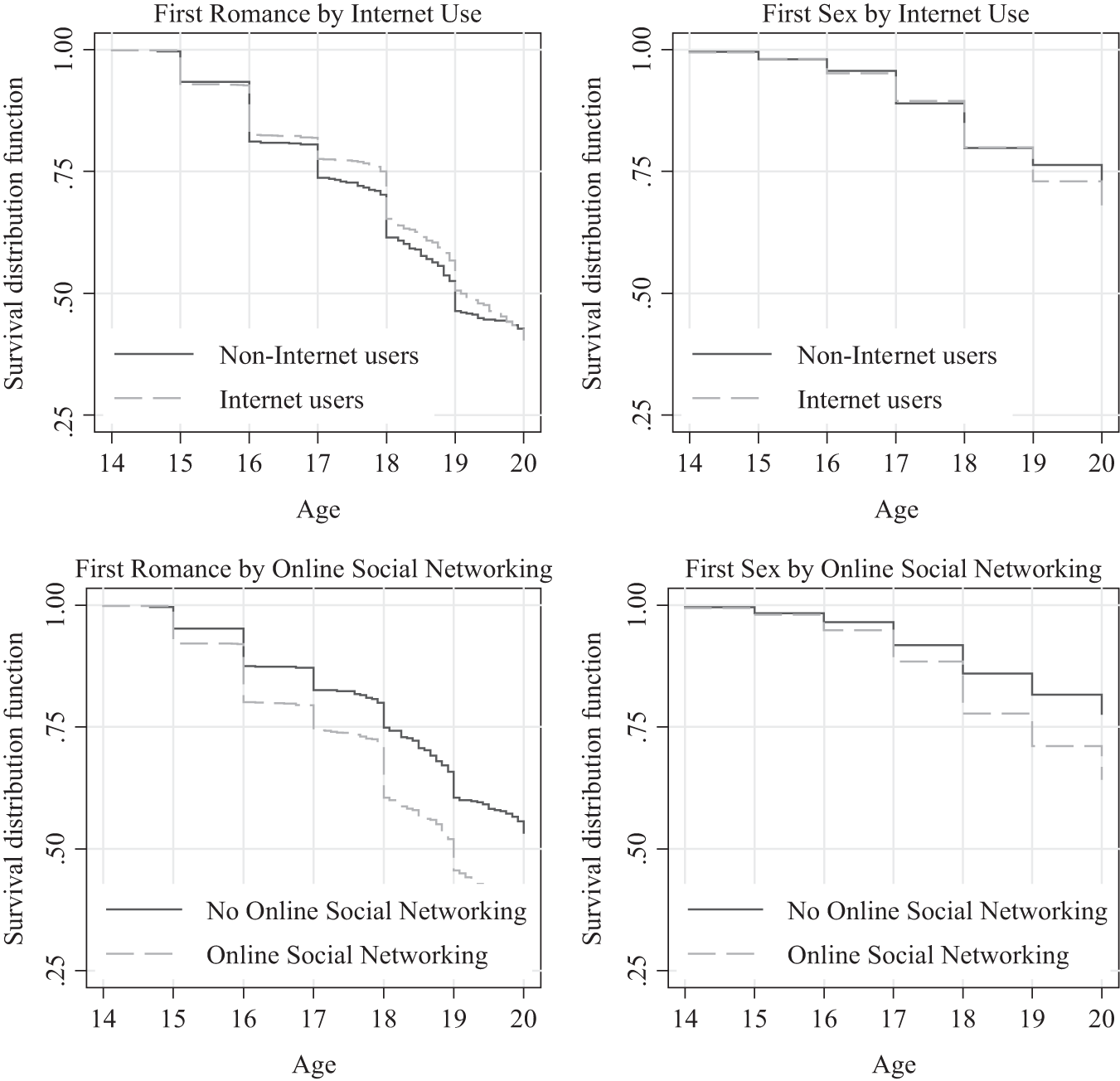
Estimated survival functions for first romance and first sex, by Internet use and online social networking.
Table 3 presents results of multivariate analyses using Cox regression for the adolescents’ first romantic relationship. Models 1 and 2 show that the number of days adolescents use the Internet per week does not have a strong effect on their first romantic relationships. For every additional day of internet café visits per week, however, the rate of first romantic relationship in adolescence increases by a factor of 1.134 (= e.126, p < .01). Online social networking significantly increases the rates of first romantic relationship by 1.657 times (p < .01), whereas using the Internet for educational purposes decreases the rates by a factor of .746 (p < .01). The sizes of these effects decrease only slightly and remain significant after including family bonds and parental supervision in Model 3. 6 Model 4 shows that all else being equal, closer parental supervision, being older, and having better academic achievement in the 9th grade decrease the rates of having a first romantic relationship in adolescence, whereas being female increases the rates (all p’s < .01). The gender-specific effects in Model 5 are discussed later.
Cox regression analysis for adolescents’ first romantic relationship, the Taiwan Youth Project (TYP), 2000–2009.

Notes. N = 2135. Robust standard errors are in parentheses. Multiple imputations (m = 20) are used for missing cases in the control variables.
p < .05, **p < .01 (2-tailed). † p < .05 for gender-differential effect (2-tailed).
Table 4 shows the logit coefficients for sexual debut. Model 1 shows that every additional day of Internet use per week increases the odds of first sexual intercourse by 5% (= [e.049–1] × 100%, p < .01). This effect, however, disappears once we include specific measures of Internet activities in Model 2. At any given age, each additional day of internet café visits per week increases the odds of having a sexual debut by 24.7%. Similarly, using online social networking and surfing pornographic websites respectively increase the odds of a sexual debut in adolescence by 33.8% and 53.3%, whereas using the Internet for educational purposes decreases the odds by 55.1%. These patterns remain after including family bonds and parental supervision in the analysis. As shown in Model 4, both stronger family bonds and closer parental supervision are significantly associated with lower odds of having a sexual debut in adolescence. Model 4 also shows that adolescents’ school performance and family background have more significant influences on their first sexual intercourse than on their first romantic relationship. Being female, being older, having better achievements in the 9th grade, having higher parental education, and living in a two-parent household all decrease the odds of having a first sexual intercourse, whereas having a higher family income increases the odds. Taken together, these analyses suggest that although Internet use alone may or may not show a significant effect on adolescents’ intimate experiences, where and how adolescents use the Internet matters.
Discrete-time survival analysis for adolescents’ sexual debut, the Taiwan Youth Project (TYP), 2000–2009.

Notes. N = 2551. Robust standard errors are in parentheses. Multiple imputations (m = 20) are used for missing cases in the control variables.
p < .05, **p < .01 (2-tailed). † p < .05 for gender-differential effect (2-tailed).
Gender-specific effects
As shown in Tables 3 and 4, being female increases the rates of having a first romantic relationship but decreases the odds of having sexual intercourse. These findings are consistent with the general impression that girls attend more to the psychological dimensions of romance and assign less importance to physical aspects of a relationship than boys do (Thompson, 1995). In the last models of Tables 3 and 4, we further examine whether Internet activities have differential effects on adolescent males and females. The results in Table 3 suggest that online social networking has similar effects on the rates of having a first romantic relationship for teenage boys and girls, but the effects of internet café visits differ across gender. For every additional day of internet café visits per week, the rates of having a first romantic relationship increase by 7.1% for boys and by 32.3% for girls. We also find that using the Internet for educational purposes has a significant effect on adolescent boys but not on girls, although the gender difference between the two coefficients is not statistically significant.
Table 4 similarly shows gender-specific patterns. Again, the effects of internet café visits are significantly greater on girls than on boys. For every additional day of internet café visits per week, the odds of having a sexual debut increase by 52.6% for girls, but only by 13.2% for boys. Although the gender differences in the effects of general Internet use and use of the Internet for educational purposes are not statistically significant, the effects are significant on adolescent boys but insignificant on adolescent girls. Online social networking and visits to pornographic websites both significantly increase the odds of having a sexual debut in adolescence (p’s < .01), but the effect of surfing pornographic websites is greater on girls than on boys.
Sexual debut before a first romantic relationship
Tables 3 and 4 suggest that online social networking and internet café visits increase the rates of having both a first romantic relationship and a sexual debut, but Internet use for education decreases the rates of both. These findings naturally lead to the question of whether these Internet activities also increase or decrease the likelihood of having sex before a first romantic relationship in adolescence. To answer this question, we code adolescents who had their sexual debut before a first romantic relationship as 1, and 0 otherwise. We then examine the outcomes using logistic regression. This analysis does not consider the ages at the time of these intimate experiences, as the event history analyses in Tables 3 and 4 do, but the results provide a foundation for future studies on the effects of Internet activities on adolescents’ likelihood of having casual sex.
Model 1 of Table 5 shows that Internet use increases the odds of having a sexual debut before a first romantic relationship, but the effect disappears once specific measures of Internet activities are included. Model 2 further shows that internet café visits and online social networking both significantly increase the odds of having a sexual debut in adolescence before a first romantic relationship. These effects remain even after adding family bonds and parental supervision in Model 3, and including adolescents’ academic performance and personal characteristics in Model 4. 7 Model 4 also shows that close parental supervision and being older in the 9th grade decrease the odds of having a sexual debut before having a romantic relationship, whereas the number of dependants in the household increases the odds.
Logistic analyses for sexual debut before first romantic relationship, the Taiwan Youth Project (TYP), 2000–2009.

Notes. N = 2377. Robust standard errors are in parentheses. Multiple imputations (m = 20) are used for missing cases in the control variables.
p < .05, **p < .01 (2-tailed). † p < .05 for gender-differential effect (2-tailed).
Finally, Model 5 examines gender differences in the effects of Internet activities on whether adolescents have a sexual debut before a first romantic relationship. Although the size of the coefficient associated with females’ internet café visits is still greater than the coefficient associated with the males, the difference is not statistically significant. Online social networking has large and consistent effects across gender. The effect of surfing pornographic websites on the odds of having a sexual debut in adolescence before a romantic relationship is large and statistically significant for female adolescents, but small and insignificant for adolescent boys. Coupled with the large effect of surfing pornographic websites on females’ sexual debuts in Table 4, this finding suggests that access to pornographic materials has a particularly strong association with female adolescents’ sexual activities. Also note that although the effects of Internet use for educational purposes are not significant on either adolescent females or males, the difference across gender is significant at the .05 level. This is a function of both the negative coefficient for adolescent boys and the positive coefficient for adolescent girls. Beyond this statistical artifact, it is worth noting again that, as shown in Tables 3 and 4, Internet use for educational purposes decreases adolescent boys’ rates of both having a first romantic relationship and a sexual debut, but bears no significant effect on adolescent girls. Taken together, the analyses of Tables 3, 4, and 5 indicate that online social networking increases adolescents’ connectedness with romantic and sexual partners. Internet café visits also increase the rates of adolescents’ intimate activities, but the effects are especially strong for girls. The effects of Internet use for educational purposes and surfing pornographic websites are gender-specific and contingent on the type of adolescent intimate activities.
Discussion
The rapid expansion of the Internet has not gone unnoticed by the sociological community. Scholars suggest that the Internet’s different communication modes and content forms not only create a digital world, but also influence social behaviors in face-to-face interactions (Castells, 2001; DiMaggio et al., 2001; Rosenfeld and Thomas, 2012). This influence is arguably more salient for the new generation of adolescents who grew up in the media-rich environment shaped by the Internet. Internet use allows adolescents to maintain relationships with people they meet online or offline. Some of these relationships may develop into actual dates or sexual encounters outside of the virtual realm. Adolescents also use the Internet to access various types of information. Scholars have shown that the Internet is a more influential socializing agent of sexuality than traditional media (Lo and Wei, 2005).
In this study, we examined whether and how different modes of Internet use and internet café visits affect an adolescent’s first romantic relationship and sexual debut in Taiwan using data from TYP 2001–2009. Although our analysis focuses on a time period when Internet development and usage increased tremendously, the results do not capture the influence of the latest development of mobile devices (e.g., tablets and smartphones since the late 2000s) on adolescent behaviors. Ideally, we would measure adolescents’ Internet activities in greater detail (e.g., number of days in which the adolescents used the Internet for educational purposes), but such information is not available in the data. The generalizability of internet café visits is also limited, because internet cafés are more common in Asia than in American or European society. Despite these limitations, our study provides useful insights into how new media may affect adolescent intimate behaviors, thus shedding light on an understudied topic that has important theoretical and policy implications.
Since the Internet and new media have been integrated into the daily lives of an increasing number of adolescents and young adults, scholars and commentators are debating about the extent to which the Internet may shape youth culture in social relationships and behaviors beyond the digital world. Our study offers evidence that online social networking, access to pornographic websites, and internet café visits significantly increase the rates of having a sexual debut and/or a first romantic relationship in adolescence, whereas using the Internet for educational purposes decreases the rates. These effects are independent of adolescents’ sociodemographic background, academic performance, and family attachment. The consistent and large effects of online networking across adolescents’ gender and type of intimate activities lend support to the argument that the new forms of social networking may facilitate adolescents’ maintenance and development of social bonds, and their interactions with peers. In light of the prevalence of new social networking tools, future research is required to examine the extent to which communication through the Internet and digital devices may affect adolescents’ romantic and social behaviors and their youth subcultures.
Our analyses show that online gaming has no effects on Taiwanese adolescents’ intimate experiences. This finding is puzzling on its face value – if online gaming increases the interactions between youths and other players, it should show a positive effect, otherwise the effect should be negative. One possibility is that adolescents may typically play online video games with same-sex peers. Another possibility is that while some adolescents connect with others through online multi-player gaming, others simply focus on the fun of the games. Thus, the effects of online gaming are positive to some but negative to others. Future research may yield insights into this topic by exploring adolescents’ social behaviors while playing online video games.
We found that Internet use for education has negative effects on adolescents’ rates of first intimate experiences. This finding is consistent with observations that Taiwanese parents, in an attempt to maximize the time their children spend studying, strongly discourage adolescents from dating or engaging in non-educational activities (Yi and Wu, 2004). Further research, however, is required to examine whether Internet use for non-social activities displaces the time that adolescents spend with friends and potential romantic/sexual partners. That the effect of Internet use for education is significant only for boys but not for girls supports the argument by some that Internet use is less likely to corrode females’ social life than that of males (DiMaggio et al., 2001).
Where the adolescents use the Internet also matters. Our analysis shows that internet café visits increase the rates of adolescents’ first intimate experiences, beyond the effects of different Internet activities. These effects are substantially greater on adolescent girls than on adolescent boys. Supplementary analyses further indicate that these patterns remain after controlling for adolescents’ non-Internet social activities and the number of friends teenagers know online and then meet in person. These findings suggest that the youth culture reinforced in internet cafés through both online communication and offline face-to-face associations has a strong impact on adolescents’ intimate behaviors. The effects are even stronger for adolescent females, perhaps because the social context in internet cafés relieves the restrictive gender norms imposed by parents and the society as a whole, or because of different sexuality norms in the youth subculture in internet cafés.
In light of the significant effects of Internet use and internet café visits on adolescents’ first romantic and sexual experiences, one may ask whether new media increase the possibility that adolescents will engage in non-romantic sexual encounters. Our analyses suggest that online social networking and internet café visits both increase the odds of having a sexual debut in adolescence before a first romantic relationship. That this effect is not contingent upon levels of parental supervision and family bonds may imply that parental and family interventions into adolescents’ social activities through the Internet and other digital devices are difficult and often ineffective.
Finally, our study confirms the findings from previous research conducted in Taiwan that surfing pornographic websites increases adolescents’ sexual activities (Lo and Wei, 2005), but further indicates that its effect on adolescents’ having a sexual debut before a romantic relationship is substantially greater for girls than for boys. This gender difference in the effects of surfing pornographic websites is consistent with the hypothesis that the exploration of sexual matters through the Internet may increase adolescent girls’ self-agency in seeking sexual encounters. Feminist scholars argue that while the sexualized images and materials the media market to adolescents may be empowering female sexuality to some extent, the messages may also be confusing and damaging to adolescent girls’ explorations of their bodies and sexuality. To address this issue, comprehensive sexual education must include media literacy training in order to provide better sexual information for adolescents (Lamb and Peterson, 2012: 707–710). A similar conclusion can be extended to our analyses of the effects of Internet use on adolescents’ intimate behaviors in general. As many have noted, the Internet combines different communication modes in a single medium, and the information adolescents may access through the new media is virtually infinite. Fostering adolescents’ abilities to manage this new media tool and potential information overload is essential for a healthy development of adolescent social and intimate relationships. Future research may examine the influences of mobile device use on teenagers’ intimate experiences and sexual activities.
Footnotes
Acknowledgements
We thank Brian Powell, Todd Vachon, and Chyi-In Wu for their comments.
Funding
This research received no specific grant from any funding agency in the public, commercial, or not-for-profit sectors.