



Abstract
Drawing on the case of Rwanda, this article investigates why certain global norms are more likely to be ‘translated’ to national educational policies and the differential influence of inter-governmental organizations (IGOs) and international non-governmental organizations (INGOs) in transmitting global norms. Qualitative analysis of national education policy documents and interviews with international development organizations reveal that global norms linked to development, Education for All (EFA), and gender equality are more amenable to ‘translation’ to the local level, while human rights norms are contested and ‘edited’ for a post-conflict context. The restricted political space for civil society constrains the ability of INGOs to openly advocate for contentious issues; thus, IGOs have more financial and normative influence on national education policies. Findings elucidate mechanisms for the adoption of global models in post-conflict settings.
Introduction
In the era of globalization or ‘glocalization’ (Robertson, 1992, 1995) interactions between the nation-state, international organizations, and civil society create new forms of authority, influencing policy processes at the national and local level. 1 Education policy, previously the exclusive domain of the nation-state, is increasingly responsive to the global environment and to international actors. Research in the world polity tradition has documented the diffusion of global norms and structures in education systems cross-nationally, such as the expansion of mass education (Ramírez and Boli, 1987), similarities across national curricula (Benavot et al., 1991), and the institutionalization of human rights education (Russell and Suárez, 2015; Suárez and Ramírez, 2007). Other comparative research has sought to investigate local factors that determine ‘policy borrowing and lending’ of education policies (Ball, 1998; Dale, 2000; Steiner-Khamsi, 2004) and variation across different contexts (Schriewer, 2009). However, few studies examine how global norms are implemented and interpreted at the local level (for exceptions see Pizmony-Levy, 2011; Suárez, 2007). Through a qualitative analysis of interviews and policy documents from Rwanda, I explore the process of global norm diffusion to the local level. This article seeks to investigate the following questions: To what extent do global norms influence national education policy in post-genocide Rwanda? How do national political circumstances in a post-conflict setting lead to the ‘editing’ and ‘translation’ (Czarniawska and Sevón, 1996; Sahlin and Wedlin, 2008) of broad global norms?
International development organizations and development professionals play a critical role in shaping global policy around education, human rights, and development (Chabbott, 2003; Suárez, 2007). 2 Nation-states emerging from violent conflict or major political changes may be susceptible to the global influence of international development organizations and global civil society, especially if they are dependent on foreign aid (Barnett and Weiss, 2008; Gready, 2010; Nicolai, 2009; Pigozzi, 1999; Reimann, 2006). In post-conflict contexts, the global development community frequently incorporates a focus on conflict resolution and peace-building (Nicolai, 2009; Pigozzi, 1999). However, not all aid-dependent or post-conflict countries are equally influenced by international development organizations. For instance, other post-conflict countries in the region, such as Burundi, have remained relatively isolated from the international community and receive less aid and consequently are less influenced by global norms.
Significant structural change following the Rwandan genocide allowed for new developments in educational policy and for the influence of global actors. However, at the same time, the Rwandan government has a clear policy agenda, particularly in the education sector, and some degree of autonomy from international development organizations (Gready, 2011). Nonetheless, analysis of the education sector provides a clear example of the extent to which the global influences the local and the mechanisms through which certain global norms are displayed prominently in policies and organizational discourse.
In the sections that follow, I first provide an overview of the theoretical framework, focusing on world polity theory and Scandinavian Institutionalism, as well as the influence of global norms and international organizations; second, I describe the case of Rwanda. Third, I discuss my data and methods. Fourth, I present the main findings both in terms of dominant global norms and differences across international organizations. Findings point to the ‘translation’ of broader global norms related to development, quality, and gender, and the ‘editing’ of discussions of human rights and conflict. In conclusion, I discuss the significance of my findings in light of the broader literature and directions for future research.
The influence of global norms and international organizations
World polity perspective
International development organizations diffuse values, discourse, and norms through the control of information and epistemic authority, driving both global and national-level policy processes (Meyer et al., 1997). In the post-Second World War period, there has been a proliferation of inter-governmental organizations (IGOs) and international non-governmental organizations (INGOs) that promote global models of human rights, equality, democracy, and development (Boli and Thomas, 1997). A world polity perspective argues that a stateless ‘world society’ espousing values linked to human rights, justice, and the individual influences nation-states embedded in the broader global system (Meyer et al., 1997; Ramírez, 2012). From a world polity or neo-institutional perspective, international development organizations are viewed as transnational actors that transmit global norms and establish standards linked to a social movement character and ideals of justice and progress (Boli and Thomas, 1997). Global and regional norms are disseminated to the national level through international development organizations, international consultants, conferences, and local ‘receptor sites’ (Frank et al., 2000). 3 While world polity scholars primarily document the diffusion of global norms across different national contexts, other studies have specifically investigated instances of the failure to adopt global norms to the full extent or ‘loose coupling’ (see Cole, 2005; Hafner-Burton and Tsutsui, 2005; Schofer and Hironaka, 2005). ‘Loose coupling’ refers to the gap between the model or global norm and the enactment, either due to lack of resources or lack of intention (Meyer and Rowan, 1977).
Previous research utilizing a neo-institutional perspective has demonstrated that international development organizations and global civil society serve as carriers of global norms linked to human rights, gender equality, and Education for All (EFA), influencing the content and focus of both global and national education policies (Boli and Thomas, 1997; Finnemore and Sikkink, 1998; Meyer et al., 1997; Mundy and Murphy, 2001). 4 Within the education sector IGOs and INGOs promote a discourse linked to the right to education, development, and models of progress and justice (Chabbott, 2003) and have influenced various initiatives in the field of international educational development (Mundy and Murphy, 2001). Several studies have documented the role international multilateral organizations, such as UNESCO, have played in disseminating these policy ideas through international accords such as EFA (Chabbott, 2003; Mundy, 2007).
Other studies have focused on the role of international and domestic NGOs in these networks, especially in terms of advocacy around more contentious issues such as human rights and women’s rights (Keck and Sikkink, 1998). Although previous studies have documented the role of IGOs or INGOs in influencing global and national policy processes, few studies have examined how global norms are interpreted in the national context and the qualitative differences in the organizations in the transmission process. This article aims to elucidate the differences in the influence of IGOs and INGOs in disseminating global norms within the context of post-genocide Rwanda.
Scandinavian Institutionalism
While a world polity perspective provides a framework to understand the degree to which global norms linked to development and human rights have diffused globally, resulting in similarities across structures, the theory is a macro-level sociological approach and is limited in explaining the mechanisms for translation of global norms to the local context beyond the concepts of ‘loose coupling’ and ‘receptor sites.’ The primary focus of Scandinavian Institutionalism is to understand local variations, adaptations, and interpretations of external models at the micro level (Czarniawska and Sevón, 1996; Sahlin and Wedlin, 2008; Sahlin-Andersson, 1996). In particular, studies trace the process of the ‘diffusion of ideas’ and the ‘transfer of innovations’ from one site to another (Czarniawska and Sevón, 1996: 6). Scholars draw on the concepts of ‘translation’ and ‘editing’ to unveil the process of the ‘diffusion’ of external models and ideas within local institutions. The concept of ‘translation’ refers to the physical transference of an idea, formal structure, or practice from one place to another (Czarniawska and Jeorges, 1996; Czarniawska and Sevón, 1996). The related notion of ‘editing’ refers both to the translation but also to the reformulation of ideas and models and recreation of new meanings for a local context (Sahlin and Wedlin, 2008; Sahlin-Andersson, 1996). Thus, Scandinavian Institutionalism extends the world polity perspective to micro-level processes of adaption, translation, and editing of global ideas (Suárez and Bromley, 2015).
To this end, I draw on Scandinavian Institutionalism (Czarniawska and Sevón, 1996) and the concepts of ‘translating’ and ‘editing’ to unpack the micro-level mechanisms of transmission in the case of Rwanda. While Scandinavian Institutionalists have applied their conceptual framework to analyze micro-level processes within the organizational or business sector (Czarniawska and Jeorges, 1996; Sahlin and Wedlin, 2008), I extend insights from this work to examine how global norms are ‘translated’ and ‘edited’ within the Rwandan national education policy context. Hence, I draw both on a world policy perspective to investigate the process of diffusion of global norms to the local level and Scandinavian Institutionalism to understand the micro-level processes of enactment.
Global civil society in Rwanda
Since the 1994 genocide, where more than 800,000 Rwandans were killed during a period of 100 days, the state has made impressive gains in re-building society. 5 In the decades following the genocide, extensive new education policy initiatives have been promoted, including the expansion of access to basic education and achievement of gender parity in the primary and secondary levels (World Bank, 2011). However, the role of international development organizations in shaping new education policies in the education sector has not been explored in the existing literature.
The post-genocide period in Rwanda witnessed an influx of international organizations. In 2010, according to the Yearbook of International Organizations, there were 95 IGOs and 538 INGOs working across all sectors in Rwanda. Before the genocide in 1993, there were 30 IGOs and 242 INGOs working in Rwanda. Consequently, international actors, including multilateral organizations, such as the United Nations and the World Bank, bilateral donors, and INGOs, now command a strong presence at the national policy level.
In the field of education, local organizations such as community-based organizations or parent teacher associations are not highly visible or active in influencing policy. A recent study conducted to identify local NGOs working in the education sector found that, while these local organizations existed formally, they were not particularly active or visible in the policy field (RENCP, 2011). The recently established Rwandan Education NGO Coordination Platform (RENCP), comprised of both local and international NGO members, provides a venue and platform for local and international NGOs to collaborate and coordinate in influencing policy. 6
Although the Rwandan state is highly centralized with a strong focus on development goals, the government is also highly dependent on foreign aid, most of which is channeled through bilateral and multilateral donor organizations. For instance, in 2007, 40% of the education budget came from general budget and sector budget support provided by donors (Uyttersprot, 2008). 7 The main donors pool funds for education in a sector-wide approach (SWAP), coordinating efforts and funding to support the government program. 8 These donors normally include IGOs (bilateral and multilateral), and INGOs to a lesser extent. The INGOs also provide money through the larger donors or to specific projects in the education sector. Hence, international development organizations – namely bilateral and multilateral organizations and INGOs – play a more prominent role in influencing policy, both directly and indirectly, than local civil society due to the institutional structures of the state which restrict space for the development of local civil society organizations (Unsworth and Uvin, 2002). In view of the proliferation of international development organizations working in the education sector in Rwanda, I seek to understand the influence of global norms and international organizations on national education policy.
Methodology
The data for this project derive from a larger mixed-methods, multi-level study carried out from 2010 to 2012 (see Russell, 2013). In order to determine the influence of global norms and international development organizations on government education policy, I conducted qualitative analysis of eight key education sector documents and 28 interviews with personnel from international development organizations (including bilateral donors and multilateral organizations) (see Table 1).
Data sources: Interviews and policy documents.
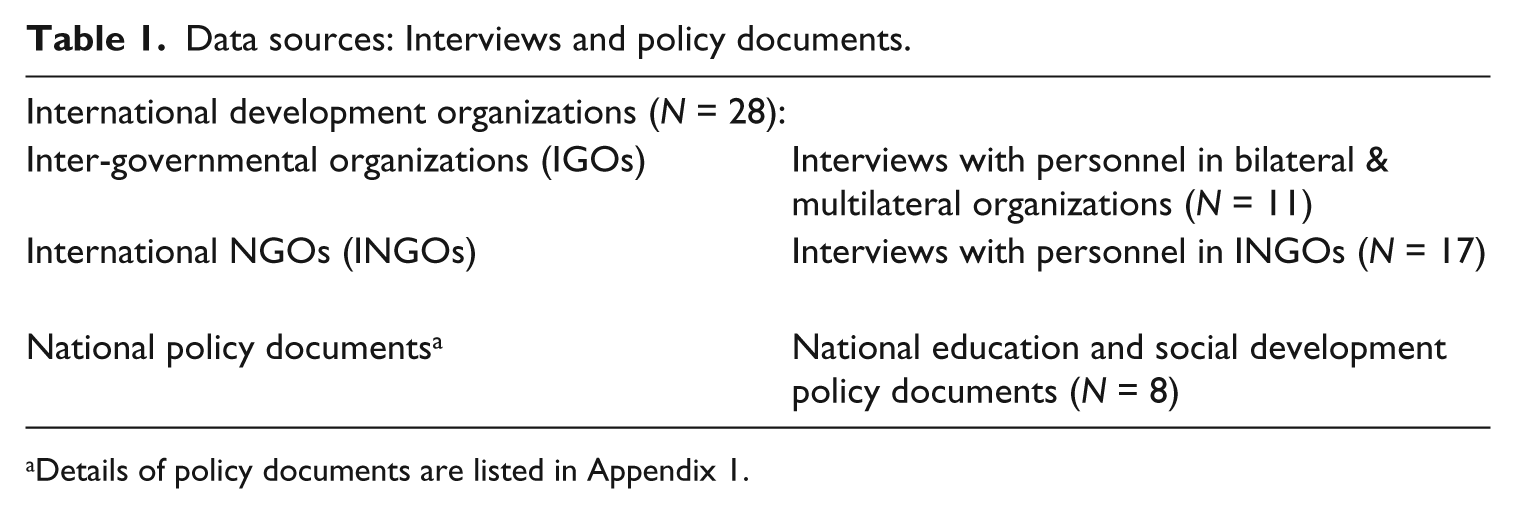
Details of policy documents are listed in Appendix 1.
I utilized purposeful sampling to intentionally select the international development organizations most active in the education sector – in terms of financial contributions and programmatic and technical support – and also to include a range of different types of organizations working on education-related issues. Interviews were semi-structured and approximately one-hour long and were conducted from 2010 to 2012 primarily in English (and occasionally in French). Interviewees were asked questions regarding the work of their organization in the education sector, the role of international organizations in influencing national education policy, and about collaboration with the government. In some instances, I conducted follow-up interviews with an organization or multiple interviews with different personnel within the same organization. Interviewees included Rwandan and international staff (European, American, African), male and female, Anglophone and Francophone.
I also drew on purposeful sampling to select eight key policy documents either from the education sector or social policy documents with substantial sections discussing the education sector. I purposely selected policy documents that represented the most important and easily accessible documents on the education sector for the post-genocide period (see Appendix 1).
In my analysis of international development organizations, I distinguish between IGOs and INGOs. I group multilateral and bilateral organizations together as one group of IGOs, since in the Rwandan educational context they tend to work together as donors in the education sector-wide approach. Through my analysis, I seek to understand the extent to which global norms within the international education policy regime have permeated national level discourse, and the role different international organizations play in this process. Hence, I explore differences in discourse across the policy arena, including IGOs, INGOs, and the national policy documents.
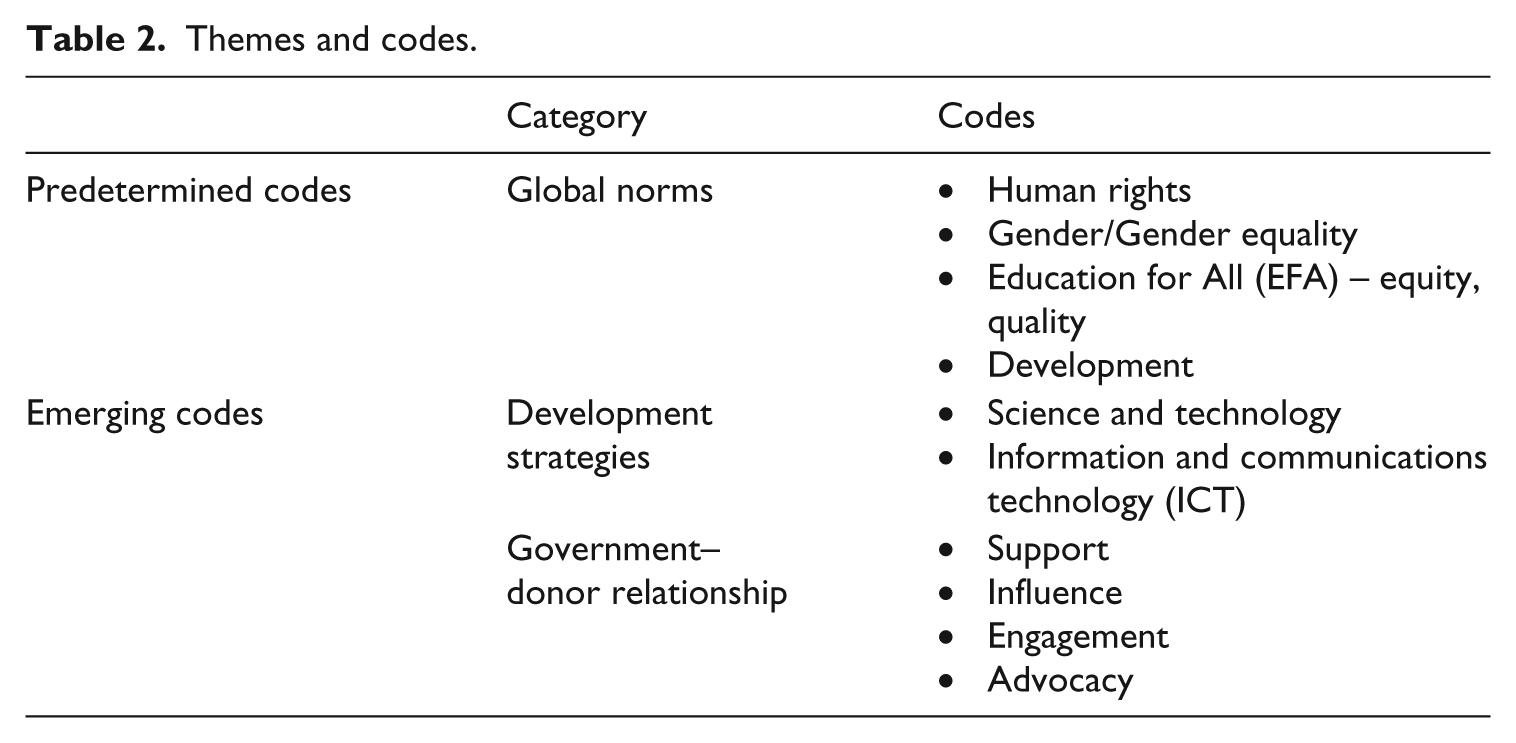
I conducted content analysis of the interviews and policy documents using a qualitative software program (NVivo). Content analysis involves the probing of content and themes of text to uncover both definitions contained in the text and those that emerge through the analysis (Krippendorff, 2012). Thematic categories derived both from theoretical constructs and well as those that emerged from the data. In the first pass, I coded for theoretical themes, namely those global themes that I expected to find within the discourse of international organizations working in the education sector and in the national policy documents. During the second pass of coding, I coded for themes that emerged from the content of the data. Table 2 provides examples of both predetermined codes and codes that emerged from the data.
Themes and codes.
Findings: Global norms
Results from the coding of national policy documents and interviews provide evidence that global norms related to development, EFA, and gender derive from global models, which are ‘translated’ to the local context. In contrast, human rights are a contested norm that is ‘edited’ and reformulated by local actors. Differences also emerge in the influence of IGOs and INGOs, with the latter having stronger normative and financial influence.
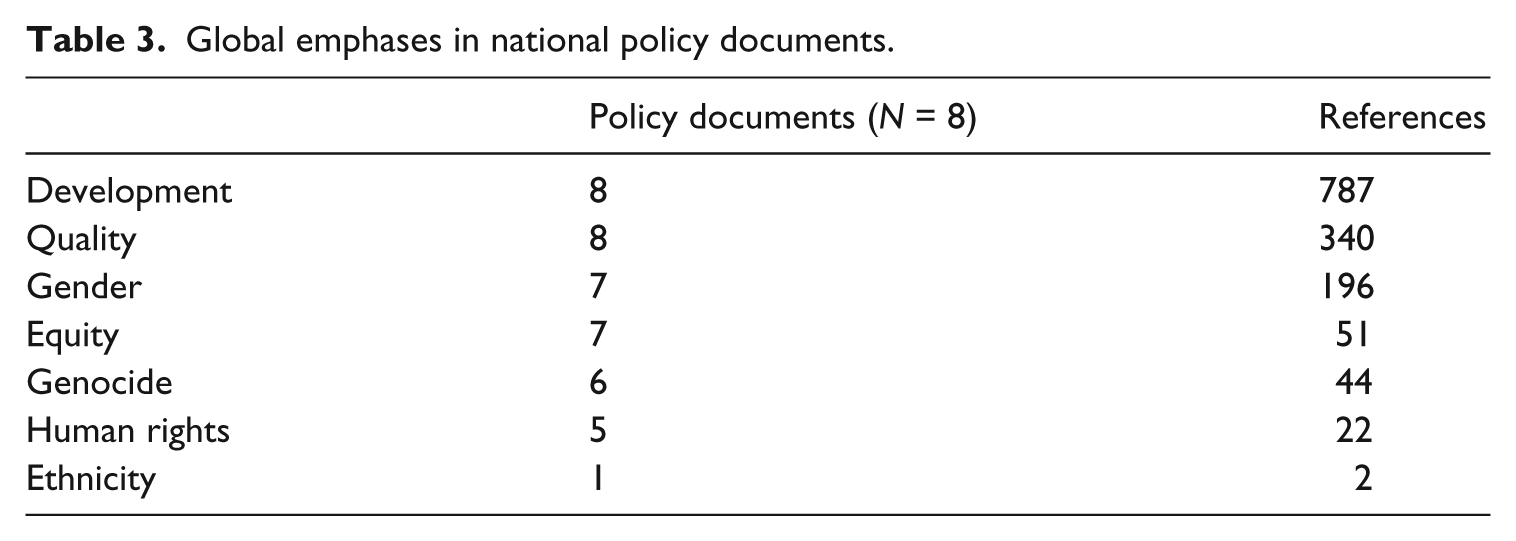
Table 3 illustrates references across the eight policy documents, both in terms of whether the term is mentioned in the document and the total number of references across documents. Mentions of development, quality, gender, and equity are present both in the majority of policy documents and are also mentioned with high levels of frequency. For instance, development is mentioned most frequently across the policy documents (787 times), followed by quality (340), gender (196), and equity (51). In contrast, genocide, human rights, and ethnicity are mentioned in fewer of the documents and to a lesser extent: genocide is mentioned 44 times, while human rights and ethnicity are only mentioned 22 and 2 times, respectively.
Global emphases in national policy documents.
Development
The mentions of development provide an example of a global norm that diffuses or is ‘translated’ directly from the global discourse to the local context without much ‘editing.’
The development discourse in national policy documents and organizational interviews is generally in line with the global discourse espousing the link between development and education (Chabbott and Ramírez, 2000). For instance, many of the local policy documents align with the global discourse where development is equated with economic growth and the advancement of human capital.
The government’s vision of development emerges strongly in its national policy documents: all eight of the selected documents mention ‘development.’ In particular, national policy documents envision education as the key to economic development. For example, the Education Sector Policy (2003) states that:
The development of human resources is one of the principal factors in achieving sustainable economic and social development. Education and training has been considered as a critical lynchpin to achieve development and poverty reduction in Rwanda. (MINEDUC, 2003a: 4)
The Rwandan documents also place a strong emphasis on science, technology, and information and communications technology (ICT). Specifically, in the Rwandan education sector, education is seen as a tool for building a ‘knowledge-based and technology-led economy’ (MINEDUC, 2003a: 5). 9
International development organizations also mentioned the term ‘development’ in their discussions, although to a lesser degree than the policy documents. Five interviewees discussed the ‘development’ of the country in the context of education and their program goals. For instance, one IGO referred to the importance of providing quality education ‘which develops useful skills for employment and the long-term development of the country’ (IGO3, August 2010). Implicit in this quote and the policy examples above is the assumption that the provision of education will lead to the economic development of the country, in line with a human capital theory. 10 Hence, the education sector is viewed as part of a larger development strategy for the government, in which science, technology, and girls’ education are prioritized for the development of human capital and economic growth.
Education for All (EFA): Quality and equity
Discourse linked to the EFA movement in education around ‘quality’ and ‘equity’ is also prevalent within both national policy documents and organizational discourse and is translated directly from the global discourse. All of the documents discuss quality education in the context of improving the quality and relevance of education and teaching. However, reference to ‘quality’ is often made in a nebulous manner, without specific details on how to measure or ensure quality education, similar to global definitions of quality (for instance, see UNESCO, 2004). Equity is referenced in all eight of the policy documents and generally in the context of social equity or equality of opportunity, or specifically in relation to gender equality. However, equity is not discussed in reference to ethnic, social or linguistic groups.
While national policy documents refer to issues of quality, international organizations place particular emphasis on improving the quality of education. This is evident from the interview analysis, in which 12 interviewees explicitly discussed the importance of quality. Several donors mentioned that they are now encouraging the government to shift from a focus on access to quality. One bilateral organization summarized as follows: ‘Donors are focused on quality of education … there has been a shift from a focus on access to a focus on quality; however, this shift was not easy for the government, and resulted in tension’ (IGO2, September 2012). The shift to an emphasis on quality of education and not merely access is in line with broader global trends such as efforts to improve learning outcomes through the Learning Metrics Task Force (UNESCO-UIS/Brookings Institution, 2013). Reference to equity is less prevalent (seven interviewees mention equity or equality), and is generally in the context of ‘equity and inclusion.’
Recent education reforms and policies are aligned with global international education policies (such as EFA) promoted by international development organizations such as UNESCO and the World Bank, which focus on quality and equity (Chabbott and Ramírez, 2000; McNeely, 1995; Mundy, 2007). These new reforms focus on expanding access to basic education, as well as fostering the development of skills viewed as important for promoting human capital and a knowledge-based society. While the reforms are justified in terms of national development and local needs, the influence of global norms within the policy discourse is evident.
Gender discourse
Gender discourse is also a prevalent global norm mentioned in the coded policy documents and interviews: seven of the eight policy documents discuss gender and nearly half (12 of 28) of the interviewees mentioned gender in some context. The gender discourse is translated from the global discourse to emphasize gender equality as a goal for national development and as a human rights issue. Gender is prioritized as a crosscutting topic within all of the education policy documents, as well as in the national development policies. The Education Sector Strategic Plan (2010–2015) states that: ‘The Government is committed to ensuring that women are also well skilled beyond the basic level to contribute positively to economic and social development’ (MINEDUC, 2010: 17). In this example, gender equality is framed explicitly in development terms.
In national policy documents, gender is referred to in the context of gender inequality or gender discrimination, as well as in relation to girls’ education. In the Education Sector Policy, the discussion of education is focused on the problem of gender disparities, both in terms of access and achievement in education, and generally for employment:
Gender is one of the most obvious areas where there is likely to be inequality in education … This tendency is reinforced in education management and administration positions where there are many more men than women in decision-making roles. (MINEDUC, 2003a: 15)
Hence, gender equality is identified as important to ameliorate disparities within the educational system but also within society on a more general level.
While the national policy documents generally refer to gender or gender equality broadly for the benefit of national development or in the language of human rights, organizational discourse revolves around either improving girls’ education or gender-mainstreaming. 11 Personnel from international development organizations also referred to gender frequently: 12 of the interviewees mentioned that they work specifically on supporting girls’ education, gender equality, and female empowerment. Many of these international organizations support government initiatives to reduce gender equality through gender-mainstreaming, empowerment, and gender-sensitive policies and analysis. For instance, one international organization explained that they ‘focus on girls’ education, as well as skills development and post-basic education for girls and disadvantaged groups’ (IGO8, September 2010). Thus, references to gender appear frequently in national policy documents, as well as in international organizational discourse, emphasizing the importance of the topic from both global and national perspectives.
De-emphasizing a human rights discourse
In relation to the themes of development, quality and equity, and gender that are translated in a straightforward manner from the global to the local context, human rights are relatively de-emphasized or ‘edited’ in the policy and organizational discourse. National policy documents strategically reference human rights, albeit sparingly: five out of the eight policy documents mention human rights at least once (22 mentions in total), while international organizational discourse is largely silent on human rights issues. While human rights language is used in policy documents, the content is ‘edited’ to avoid sensitive topics. Thus, it appears that references to human rights are transmitted to the national policy level via other mechanisms, such as through international conferences, treaties, or consultants.
The reference to human rights if often linked to international United Nations treaties and conferences like EFA, wherein education is defined as a human right. 12 For instance, human rights in the policy discourse are mentioned in tandem with international conventions and treaties such as the Convention on the Rights of the Child (CRC), the Millennium Development Goals (MDGs), and EFA. For instance, the Education Sector Policy (2003) rationalizes Rwanda’s national policies in terms of its global commitments to international treaties but focuses specifically on gender disparities rather than other human rights issues.
Human rights language is generally mentioned in reference to gender equality rather than to ethnic groups or civil and political rights. While in some instances the policy documents do reference other types of discrimination, the most prevalent discussion of disparities and discrimination in society is positioned in reference to gender rather than to ethnic groups, language, or socioeconomic status. Given the weak political and legal institutions in a post-conflict context, Rwanda establishes legitimacy for its national policies by invoking international treaties, in line with findings from other empirical research (Hafner-Burton and Tsutsui, 2005).
National education policy documents also refer to human rights within the context of development: ‘The Government of National Unity has decided to rebuild Rwanda as a nation, a nation characterised by key values such as: unity, respect for human rights, patriotism and hard work’ (MINEDUC, 2003a: 5). Additionally, human rights are mentioned in relation to peace-building, promoting unity and reconciliation, preserving the memory of the genocide, upholding the rule of law, and protecting the rights of vulnerable groups (MINECOFIN, 2007).
In contrast to national policy documents, interviewees from international development organizations (IGOs and INGOs) did not explicitly reference human rights as part of their policy agenda. Rather, donors sought to distance themselves from human rights, pointing to their controversial nature. One key donor spoke of the contested nature of human rights, saying that the messaging is more around ‘values education,’ rather than human rights education, due to ‘sensitivities’ (IGO6, October 2012). This may in part be linked to the contested nature of human rights issues, especially related to ethnic identity or to alleged violations of human rights perpetrated by the Rwanda Patriotic Front (RPF) after the genocide. In 2004, several international and local NGOs involved in human rights-related work and capacity-building of local organizations were suspended or expelled due to activities viewed as promoting ‘divisionism’ and ‘genocide ideology’ (Gready, 2011). 13 Hence, donors avoid direct discussion of human rights, except in the less controversial context of children’s rights, due to political sensitivities. Another donor mentioned the government’s deliberate utilization of human rights terms: ‘The focus on human rights, peace, and conflict-resolution and the message of “One Rwanda” is from the president’ (IGO1, August 2010).
Nonetheless, some INGOs draw on the rights-based terminology in reference to ‘children’s rights’ or the ‘right to education.’ For example, one INGO emphasized that it promotes ‘child rights’ and utilizes a ‘human rights-based approach to human development’ (INGO11, August 2011). Another donor discussed the difference between human rights and gender: ‘Gender is well-embedded in the system and has a strong commitment from the government, while “democracy” and “human rights” appear in the discourse but are not as well-established as gender’ (IGO8, September 2010). The example of global human rights discourse illustrates how the government ‘edits’ human rights for policy contexts, while international organizations avoid global terms that are contested in the local context.
Differential influence of international development organizations
Recent policy reforms in Rwanda illustrate the extent to which international organizations influence government policy and discourse. Findings from analysis of interviews indicate that IGOs (bilateral and multilateral) focus on supporting the government and engaging in dialogue and emphasize a more technical discourse linked to human capital and economic development rather than one of human rights and equity. Some interviewees from organizations mentioned that the government is very strict and always spearheads policy changes or interventions, while the role of the donors is to support the government to achieve these policies (IGO3, August 2010). One donor explained: ‘In Rwanda, the government is in control of the development strategy’ (IGO1, August 2010).
Despite the strong vision originating from the government, international development organizations influence policy reforms and discourse indirectly. As one interviewee explained: ‘Ideas must be seen as coming from the government and fit for development needs even if they come from an outside organization’ (IGO10, June 2011). Evidence from interview analysis indicates that donors (including bilateral and multilateral organizations) possess financial and normative leverage over government insofar as certain policies may be tied to funding opportunities. Seven interviewees mentioned the financial leverage that donors have on influencing government policies, either through direct budget support or indirectly through funding studies for key projects and reforms. For instance, several organizations referred to examples of the donors providing funding for studies on equity and inclusion or funding an international consultant to assist the government with the textbook reform in 2010 (IGO4, April 2011; INGO11, August 2011; INGO6, September 2010).
However, with new policy changes and reforms, there is evident tension between the government and international development partners. Two recent education reforms – the switch from French to English as the medium of instruction and the expansion of basic education – illustrate the disparate views between government and donors on certain policy issues. For the change in language policy, when the government issued a directive to change the medium of instruction from a trilingual system to English in 2008, donors were not consulted (IGO4, August 2010). Further, no policy document was developed for this dramatic change; rather, the change was viewed by some as coming from outside of the policy sector (from the office of the President) and imposed on the education sector (INGO12, August 2011). The change of medium of instruction was justified in global terms – English is the global language of science and technology and Rwanda is now part of the East African Community (EAC). Donors disagreed with the abrupt switch from French to English as the medium of instruction, due to the lack of teacher training, teaching and learning materials in English, and general preparation. Further, they were concerned about the adverse effects of learning English in the early grades, which they viewed as detrimental to learning outcomes. The policy change was also viewed as largely political and benefiting those in power – namely Anglophone returnees – rather than providing system-wide educational benefits (IGO4, August 2010; INGO1, September 2010). 14
In the case of the language policy, the donors (IGOs and bilaterals) were able to influence the government policy indirectly through financial and normative leverage, such as by referring to international research on the benefits of mother tongue education (INGO2, September 2010). However, according to one INGO, the influence is often indirect and discreet: ‘Donors advocate on issues that support the government policy such as quality of education or mother tongue’ (INGO1, September 2010). Thus, the sentiment among INGOs is that donors – IGOs and bilaterals – will use their leverage for certain policy issues but will not advocate for more controversial issues around human rights.
Despite the tension surrounding the medium of instruction, personnel in organizations generally spoke of the collaborative manner in which they work with the government in order to affect policy change. In the case of the expansion of basic education, the donors preferred to focus on improving the quality of nine years of basic education, rather than on the government’s priority of expanding access to 12 years. However, despite the donors’ preference for improving quality over access, they supported the government policy. For example, one interviewee from a multilateral organization referred to the diplomatic approach in which donors engage with government, especially over controversial policies:
With the 9 years’ basic education and English language reforms, the donors were concerned and confronted the Ministry of Education with their concerns. Rather than withhold donor money or not endorse the Fast Track Initiative (FTI), the donors raised their concerns with the MOE and engaged in a diplomatic dialogue. Since the donors pool their funds they have leverage over the government both in terms of funding and in terms of reputation. (IGO4, August 2010)
However, there is also a discernible difference between the influence of IGOs (bilateral and multilateral) and NGOs in terms of normative and financial leverage. In terms of relative influence, the perception among INGOs is that IGOs have more direct influence on policy than INGOs due to the weak civil society sector. INGOs can only advance issues by providing examples of best practices and by supporting existing governmental policy. An interviewee from an INGO said:
Civil society in Rwanda is not very strong and tends to be very aligned with the government … there is not much coordination among organizations … The government is happy to work with civil society organizations if the government supports their plan. NGOs provide funding and implement government policies … We advocate for key issues and try to influence donors to earmark funding from the sector budget. (INGO6, September 2010)
In contrast to IGOs, which tend to support government policies, INGOs work on advocating for important issues and influencing policy through the collective RENCP platform, or by influencing donors who have more leverage. However, even a common platform for NGOs is limiting in some respects; according to one INGO:
RENCP is not confident about taking on advocacy issues … this is related to the environment and understanding of advocacy issues. We need to influence policy but advocacy is understood as confrontation with the government … the organizations are not willing to confront the government. (INGO10, July 2011)
Thus, INGOs may have subtle influence over policy but do not openly advocate for contentious policies. Nonetheless, 11 of the INGOs viewed their influence, both direct and indirect, on government policy through the coordinated platform as gradually increasing. One interviewee explained how INGOs can influence policy: ‘Ideas are regularly welcomed by the government. If you can show evidence and document good practices, then you can influence policy’ (INGO13, August 2013). Other INGOs were more skeptical of the influence: ‘There is space to express views but not much influence yet … maybe in the future’ (INGO14, August 2011).
In contrast to IGOs, which tend to focus on supporting and engaging the government, INGOs tend to concentrate their energies on advocacy in key areas such as mother tongue education or girls’ education. Based on interviews, INGOs believe that they have some normative leverage on the government; however, they also perceive the large donors as having more influence, especially financial. In the past, the government has distrusted INGOs, producing tension in the relationship. However, their relationship is evolving with the increasing inclusion of INGOs in policy formulation though the new NGO platform – RENCP. Due to past tensions with government, INGOs tend to refrain from advocating for controversial issues or actions that oppose government policies. In light of the recent violent conflict and authoritarian governance structure, domestic civil society is underdeveloped, and thus INGOs also have less influence; IGOs in contrast work through the authoritarian regime.
Conclusions
Findings from the analysis of interviews and policy documents indicate that the global discourse around education for human capital and national development, gender equality, and EFA discourse is ‘translated’ from the global to the local in national education documents and within organizational discourse. In contrast, human rights discourse is ‘edited’ strategically within government documents and couched in terms of women’s or children’s rights to garner international legitimacy.
Evidence from document analysis illustrates that human rights discourse is invoked sparingly yet strategically within key national policy documents to justify and to legitimize national policies within the global community. The government ‘edits’ global human rights discourse for national policy documents to build external legitimacy. Similarly, prior research on related topics finds that post-conflict societies invoke international treaties in national documents to build legitimacy (Suárez, 2008). Nonetheless, international development organizations, including both IGOs and INGOs, are cautious around issues related to human rights, and prefer to focus on gender equality or children’s rights. This may be linked to the tenuous human rights record of the Rwandan government, which has received much criticism from the United Nations and from international human rights organizations for violations in the Democratic Republic of Congo (DRC), as well as domestically (Amnesty International, 2012; Human Rights Watch, 2012). The government draws on and ‘edits’ human rights language for global legitimacy, but international development organizations avoid the topic for fear of retaliation by the government.
Global norms and ideas linked to global policy documents and international organizations still appear to influence education policy discourse within government reforms at the national level, as evidenced by the alignment with global themes in the discussions. This may be in part due to the influence of external actors, but can also be explained by the government’s desire to seek international and domestic legitimation (Finnemore and Sikkink, 1998; Hafner-Burton and Tsutsui, 2005). Further, government ‘receptor sites,’ or social structures with the capacity to translate global ideas and norms from global to local actors, may foster an openness or tendency to adopt certain global issues that align with domestic policy or interests (Frank et al., 2000). Other norms may be transmitted via international treaties, conferences, or consultants. This suggests that certain global norms are more amenable for ‘translation’ to the national policy agenda than others: gender, development, and quality predominate over human rights norms, which are contested within the post-conflict space and must be ‘edited’ for use in the local context.
There is a tension between government ownership of education policies and reforms and external global influences and norms transmitted through IGOs and INGOs. Despite global influence, the government exhibits strong autonomy over national policy decisions, prioritizing ‘ownership’ over domestic policy decisions. Nonetheless, at the same time that the government asserts ownership over policies, it simultaneously invokes ‘donor-pleasing development terminology’ in order to build credibility among the donor community (Zorbas, 2011: 108). Due to the lack of democratic space for the development of a strong local civil society, there is not much opportunity for international development organizations to partner with local organizations, or for advocacy or influence around controversial issues. Furthermore, donors are less likely to intervene in controversial government policies, in part due to guilt about the genocide and the notion that Rwanda is an ‘exceptional’ case (Zorbas, 2011: 106). As a consequence, international development organizations mainly support policies addressing issues that the government is already engaged in or actively promoting, such as girls’ education or early childhood education. However, in certain cases, international development organizations, especially donors with financial leverage, do advocate for different approaches, as in the case with mother tongue education.
The focus on the future – on economic development, science and technology, and gender equality – is predominant both in the organizational and national policy discourse. International development organizations primarily emphasize issues linked to EFA, related to equity and quality of education. The focus on apolitical, technical issues within the development discourse illustrates the triumph of the technical in international development discourse (Ferguson, 1990), but also may be related, in part, to the sensitive nature of discussing human rights or the past conflict in depth. While policy documents often refer to the genocide, they do not delve into much detail regarding ethnic conflict or present forms of inequality. Rather, they focus on gender as the main form of enduring inequality, instead of ethnic, linguistic, or socioeconomic cleavages. Education sector policies privilege science and technology over addressing the past, by offering few opportunities to discuss history and civics or the social sciences and humanities more broadly. Thus, the education system is portrayed as a functional means to develop human capital, in order to enhance the country’s scientific and technological capabilities rather than as a means to foster critical thinking and open discussion about the violent past.
Findings from this study provide insight into the mechanisms through which global norms of development, gender, and EFA are ‘translated’ to the Rwandan context, while human rights are ‘edited’ for the local context. This study extends world polity research by providing examples of the process of global norm diffusion at the local level. While world polity scholars generally attribute ‘loose coupling’ to lack of resources or lack of intention, this study highlights the importance of local sensitivity and opposition to contested global norms. As the Rwanda case illustrates, certain global norms are more amenable than others due to historical and political conditions. While this research provides evidence for differences in the influence of global norms and in the roles of IGOs and INGOs in translating global norms to the local context of Rwanda, further research is needed on identifying which global norms travel, which get translated to the local level, and the factors and mechanisms that might facilitate or inhibit different levels of influence across different contexts.
Footnotes
Appendix
National policy documents

| Title | Year of publication and state department | |
|---|---|---|
| PD1 | Rwanda Vision 2020 | 2000; Ministry of Finance and Economic Planning (MINECOFIN), Kigali |
| PD2 | Economic Development and Poverty Reduction Strategy (PRSP) 2008–2012 | 2007; Ministry of Finance and Economic Planning (MINECOFIN), Kigali |
| PD3 | Education Sector Policy | 2003a; Ministry of Education (MINEDUC), Kigali |
| PD4 | Education for All (EFA) Plan of Action | 2003b; Ministry of Education (MINEDUC), Kigali |
| PD5 | Education Sector Strategic Plan (ESSP) 2006–2010 | 2006; Ministry of Education (MINEDUC), Kigali |
| PD6 | Education Sector Strategic Plan (ESSP) 2008–2012 | 2008; Ministry of Education (MINEDUC), Kigali |
| PD7 | Nine Years Basic Education Implementation | 2008; Ministry of Education (MINEDUC), Kigali |
| PD8 | Education Sector Strategic Plan (ESSP) 2010–2015 | 2010; Ministry of Education (MINEDUC), Kigali |
Acknowledgements
This article benefited from in-depth feedback from Francisco Ramírez, John Meyer, Oren Pizmony-Levy, David Suárez, Elizabeth Buckner, and Julia Lerch. An earlier version of the article was presented at the African Studies Association (ASA) conference.
Funding
This research was supported by the National Science Foundation (NSF) Sociology Dissertation Grant, the Boren Language Fellowship, the Stanford Center for International Conflict Negotiation (SCICN) Goldsmith Grant, the Stanford Center on Philanthropy and Civil Society (PACS) Grant, the Stanford Vice-Provost for Graduate Education (VPGE) Diversity Dissertation Research Opportunity (DDRO) Grant, and the Stanford Graduate School of Education Dissertation Support Grant (DSG).