



Abstract
This research investigates individual expectations of economic support from different sources: partner, family, friends and formal help. Using data from the International Social Survey Programme (ISSP) the study compares Norway, as representative of the Scandinavian model, and Spain, as representative of the Mediterranean model. The findings confirm that family plays a more important role as a source of economic support in Spain while formal help is far more important in Norway. Moreover, gender and life course have a significant impact on expectations of economic support in both countries, although the differences do not go in the same direction. Women expect more financial support from their partners than men do in Norway, while Spanish women tend to rely more on support from their families. Regarding life course, although expectations of economic support from the family are higher for young and older people in both countries, the life-cycle effect is stronger in Spain.
Introduction
The study of the relationship between solidarity within the family and the welfare state has been gaining attention in sociological research in recent decades, especially in the European context (Boersch-Supan et al., 2011; Brandt and Deindl, 2013; Daatland et al., 2011; Kalmijn and Saraceno, 2008). Following Saraceno (2008: 14), one of the most important debates that is driving contemporary research on intergenerational solidarity is about ‘the relationship between public and private intergenerational contracts and particularly the impact of welfare-state arrangements on intergenerational solidarity within families’. Alongside the prominent role of the family in providing social support to individuals, Freeman and Ruan (1997) pointed out that the processes of industrialization and urbanization in western societies and the rapid development of market economies have led to an increase in opportunities and resources available to individuals (better quality of services, technological advances, increments of productivity). As a consequence, in well-developed countries new sources of social support (such as welfare services or friendship networks) also play an important role and there might be a substitution effect between different forms of social support.
Despite the relationship between intergenerational solidarity and other forms of social support (Daly and Lewis, 2000; Saraceno, 2008), the vast majority of the literature has focused on the intergenerational solidarity within the family (Brandt and Deindl, 2013; Daatland and Lowenstein, 2005), but much less attention has been paid to other sources of social support. In this research we try to further the knowledge about social support, by investigating individual expectations of social support from different sources. More specifically, we analyse what would be the expected source of support for individuals if they need to ask for financial help, considering four different alternatives: partner, family, friends and formal help. Our main goal is to explain the determinants of individual expectations of economic support, drawing on the literature on social support and social care. To that end, we consider four main explanatory factors: gender, life course, filial obligation and household type, plus some other controls.
As patterns of social support vary considerably between countries because of institutional and cultural factors (Attias-Donfut et al., 2005; Brandt et al., 2009), we follow a comparative approach. Following the typology of ‘social care regimes’, proposed by Anttonen and Sipilä (1996) and Sapir (2006), we analyse two different countries in which we expect to find large differences regarding expectations of economic support: Norway, as representative of the Scandinavian model, and Spain, as representative of the Mediterranean model. Moreover, according to the classification of welfare regimes developed by Esping-Andersen (1990), Norway belongs to the Social Democratic model of the welfare state, which is characterized by a high level of decommodification and welfare policies that provide extensive social support from public institutions. Spain belongs to the Southern model (Ferrera, 1996; Moreno, 2000), characterized by an underdeveloped welfare state in which the family is the safety net for individuals in case of need.
We measure expectations of economic support using data from the International Social Survey Programme (ISSP). Following Lin’s (2001) advice on how to measure social capital in social networks, expectations here refer to one’s belief in the readiness of someone else to provide economic support in case of need. It is important to note, however, that in our approach expectations are different from real sources of support, since an individual might expect to find support from one particular person or institution but it does not mean that this would be the case when the time comes. Thus, expectations of economic support refer here to the person (or institution) to whom an individual would turn for help. Our findings confirm that family plays a more important role as a source of economic support in Spain, while formal help is far more important in Norway. More importantly, we have found that gender and life course affect expectations of economic support in different ways in both countries.
Welfare state and social support
The interaction between the family and the welfare state lies at the foundations of the concept of social care. Daly and Lewis (2000: 296) define ‘social care’ as an ‘activity and a set of relations lying at the intersection of the state, the market and the family (and voluntary sector) relations’. The analysis of care has to take into account three main related dimensions: (1) as a form of labour; (2) as a normative framework of obligation and responsibility; and (3) as an activity with costs (both financial and emotional) (Daly and Lewis, 2000: 285). At the same time, the model implies two levels of analysis: macro (policies) and micro (how care is allocated between men and women and between generations within the family). The three actors in the provision of care (states, markets and families) are at work in every European country, but the relative role of each actor varies notably across countries.
Along these lines, Anttonen and Sipilä (1996) introduced a well-known typology of ‘social care regimes’ based on the distribution of informal and formal care provisions. First, there is a family-care model, where the state delegates responsibility for care almost entirely to the family (e.g. Spain, Greece or Italy). In the second model, informal care plays an important role and welfare services are intended exclusively for people in need (e.g. the UK). The third model combines informal care along with formal government arrangements (e.g. Germany or Austria). In the fourth model the state provides a great amount of formal care through extensive universal public services (e.g. Sweden, Norway, Finland, Denmark or Iceland). Later on, Sapir (2006) identifies these models as the ‘Mediterranean model’, the ‘Anglo-Saxon model’, the ‘Continental model’ and the ‘Nordic model’, respectively. Similarly, Daly and Lewis (1998, 2000) consider that all the Scandinavian countries are characterized by strong institutionalized care both for children and older people, as public provision of social care (particularly by local administrations) is more developed than in any other countries (European Commission, 1999). In contrast, in the Mediterranean countries care activities are carried out within the family and public care services and market involvement in the production of care is very limited, since the family plays a more important role in providing resources as a safety net in less developed welfare states (Ferrera, 1996; Moreno, 2000).
In spite of the lack of comparative data, differences between Norway and Spain in the two major branches of care services (childcare and elderly care) are quite substantial (Daly and Lewis, 2000; Hanssen, 1997; Moreno Mínguez, 2010; Rauch, 2007; Roit et al., 2015). First, childcare provision for children under the age of 3 in Norway is far more generous than in Spain (e.g. in 2003 in Norway the average enrolment rate of children under 3 years of age in formal childcare was 29.5% in contrast to 11.3% in Spain) (OECD, 2014). Regarding informal care (help from relatives), differences between Norway and Spain are also relevant. Thus, in 2011 the use of informal childcare arrangements during a typical week for children aged between 0 and 2 years was 19.5% in Spain and 4.3% in Norway (OECD, 2014). Regarding elderly care services, a high percentage of older people in Norway are covered by public services, either by residential care services or by domiciliary help services, whereas Spain has very low levels of elderly care provision (e.g. in 2007 21.1% of people aged 65 and over received formal care either at home or at an institution in Norway, as compared to 9.4% in Spain) (OECD, 2009). As a consequence, elderly care in Spain is provided mainly by the family, especially by women, who act as primary care providers.
Differences in social care models are connected to variations in the social and family contracts (forms of regulating welfare arrangements on intergenerational obligations) (Saraceno, 2008). Kalmijn and Saraceno (2008), among others, highlight that the Southern European countries maintain stronger kinship ties and a more familistic culture than other European countries. Although in most societies there is a norm stating that family members must take care of each other in case of need, norms to support one’s own parents (‘filial obligation’) are expected to be stronger in familistic countries than in individualistic countries 1 (Dykstra, 2010; Kalmijn and Saraceno, 2008; Lowenstein and Daatland, 2006). Thus, in the Mediterranean countries, we find a strong sense of family solidarity and a culture of support as the norm for the majority of the population (Böhnke, 2007; Daly, 1999). These norms are in line with a model of welfare state that strengthens family responsibility (norms of family care and the moral duty to help) and leaves a residual role for the state. As a result, there is a low level of provision of public services in areas that have traditionally been the responsibility of families, such as taking care of dependent individuals at home (Daatland and Lowenstein, 2005; Katz et al., 2010).
In Nordic countries filial obligations are not as strong, while the norm that individuals have to be independent and autonomous is deeply rooted (Kalmijn and Saraceno, 2008; Lowenstein and Daatland, 2006). This has further implications for the relative position of women within the family and the society at large. As Daatland et al. (2011: 1171) point out, particularly in Norway, women (although they were assumed to be more family-oriented than men) ‘were found to be less in support of family obligations than men … and equally so as far as filial and parental norms are concerned’. These authors further conclude that this finding can be related to a female (or maternal) resistance to the duty-driven family: ‘women may be more negative about family norms out of concern for their family, because they have a better understanding of what these actually mean and imply, and because they are reluctant either to assume or to become a family burden if it can be avoided’ (Daatland et al., 2011: 1175). Similar results were also found by Daatland and Herlofson (2003).
In this vein, patterns of intergenerational solidarity are also related to cross-national variations in the gender-gap in the provision of care, as well as to the gender-gap in labour market participation. Roit et al. (2015) show that the largest gender-gap in care provision is found in the Mediterranean countries (Italy, followed by Spain and Greece), whereas the Nordic countries display the lowest gender-gap (Sweden, followed by Denmark 2 ). As Sainsbury (1999: 99) argues, the Scandinavian model undermines ‘gender differences in entitlements and promotes equality between the sexes in social provision’. Women have become entitled in the Scandinavian welfare states as mothers, workers and citizens (Siim, 1987). This is the consequence of different mechanisms but mostly because rights based on citizenship or residence have entitled women to claim non-work-related benefits. In other words, Scandinavian welfare states have entitled women as mothers instead of as wives, since most benefits are directed to mothers rather than to the family unit and they are not means-tested. This is particularly true of Norway, which, according to Sainsbury (1999), corresponds most closely to the separate gender roles regime. 3 In contrast, the Spanish welfare system no longer embraces the ideology of familialism, but certain welfare programmes (especially the social security system) reinforces it in practice (León, 2002). Despite the recent incorporation of Spanish women to the labour market (Moreno, 2004), female labour participation is still low in comparative perspective (Roit et al., 2015; Valiente, 2009) and there is still an important conflict between the new work-related model and the old family model (Valiente, 2002). Women usually bear the burden of extra domestic work and the care of dependent individuals at home, tasks traditionally assigned to them.
Hypotheses
Given the differences between Norway and Spain regarding the social care model, we argue that expectations of economic support from the family will be higher in Spain than in Norway, while expectations of formal help will be higher in Norway than in Spain. Nevertheless, differences in the distribution of public and private sources of care provision are closely connected to the gender-gap in care provision (Roit et al., 2015), as several studies have shown that women have usually been the primary caregivers (Harris and Morgan, 1991; Kalmijn, 2007; Rosenthal, 1985; Van Gaalen and Dykstra, 2006). Therefore, given the differences in the gender-gap in care provision between Norway and Spain, we argue that the effect of gender on expectations of economic support should differ between the two countries. More specifically, Spanish women will rely more on their families than men, given their important role as caregivers within Spanish families (Valiente, 2002), and since women are recipients of support more often than men (Brandt et al., 2009; Meil, 2007; Roberto and Scott, 1986).
H1: Expectations of economic support from the family will be higher in Spain than in Norway, especially for women.
Patterns of support within an individual’s network are expected to vary depending also on life course. We postulate that the relationship between age and expectations of economic support from the family will follow a U shape because of a life-cycle effect in the evolution of earnings. Several studies show that young adults tend to ask for help from their parents, who typically have a better position in the labour market (Hoff, 2007; Meil, 2007; Silverstein and Marenco, 2001). In contrast, individuals of a more mature age are less likely than young and older people to ask their families for help, since both their children and their parents are typically out of the labour market. Finally, we should expect that older people will ask their offspring for help, given that their children are typically at advanced stages of their labour careers. However, Lowenstein et al. (2007) point out that this flow of financial help is only common in Mediterranean countries, where individuals, especially the older generations, continue to rely on the family or traditional solutions (Bazo, 2002). Therefore, we also expect that the life cycle in economic support from the family will be stronger in the case of Spain, where both young and older people face a worse financial situation than their Norwegian counterparts.
H2: Expectations of economic support from the family will be higher for young and older people, especially in Spain.
Another important factor to explain expectations of economic support from the family is filial obligation. Norms of moral obligation toward the family continue to be deeply rooted in many societies but, as we have stated before, this is especially true in more familistic societies. For this reason, in Southern Europe there is a widespread commitment to the norm of supporting family members and relatives (Lee et al., 1994; Lowenstein and Daatland, 2006; Ogg and Renaut, 2006), especially because public provision of care services is limited (Daatland, 2001). Therefore, we argue that those who adhere to the norm of filial obligation will expect support from the family more often in both countries, given that their expectations of support are based on reciprocity.
H3: Norms of filial obligation will have a positive impact on expectations of economic support from the family.
The composition of the household is also an important factor to understand expectations of economic support. Although household composition is quite different in each country (children and parents live together more often and for a longer period of time in Spain than in Norway) (Albertini et al., 2007), co-residence is a source of support in itself. Moreover, those living in an extended household (in which two or more generations live together) are assumed to have greater expectations of receiving support from others in the same household (Bengtson and Roberts, 1991; Böhnke, 2007; Kalmijn and Saraceno, 2008; Kohli, 2004; Lee et al., 1994). Therefore, we predict that living in an extended household should have a positive impact on expectations of social support from the family in both countries.
H4: Living in an extended household will increase expectations of economic support from the family in Norway and Spain.
Data and methods
To measure expectations of economic support in social networks we rely on data from the ISSP ‘Social Networks II’ (2001) (ISSP Research Group, 2003). The survey was carried out in 29 countries and was conducted on a representative sample of the population aged 18 and over living in private homes (1560 interviews in Norway and 1214 interviews in Spain). Respondents were asked: ‘Now suppose you needed to borrow a large sum of money. Who would you turn to first for help?’ Possible responses were: ‘No one’, ‘spouse/partner’, ‘mother’, ‘father’, ‘daughter’, ‘son’, ‘sister’, ‘brother’, ‘other blood relation’, ‘in-law’, ‘close friend’, ‘neighbour’, ‘co-worker’, ‘boss’, ‘social services’, ‘bank’, ‘loan agency’ and ‘other’. Given the range of possible responses, the dependent variable has been coded into a smaller number of categories: (1) partner; (2) family includes all family members listed in the response list (mother, father, daughter, son, sister, brother, other blood relation and in-laws); (3) close friend; and (4) formal support includes banks, loan agencies and social services. The other options (no one, other relatives, neighbour, someone you work with, employer, someone else) are coded as missing because of the low percentage of responses.
The key explanatory variables in the analysis are gender, age, filial obligation and type of household. Age is measured by age groups (1 = ‘18–29 years old’, 2 = ‘30–44 years old’, 3 = ‘45–64 years old’ and 4 = ‘65 years and older’). Following partially 4 Finley et al. (1988), filial obligation is measured by the responses to the item ‘Adult children have a duty to look after their elderly parents’. It takes value 1 for those individuals who agree or strongly agree with this statement and value 0 for those who disagree, strongly disagree or neither agree nor disagree. Household type distinguishes between ‘single household’, ‘single parent’ (an adult living with children under 18), ‘couple without children’, ‘couple with children’, ‘extended household’ (in which two or more family-related adults live together) and ‘other’. In addition, following the literature on intergenerational solidarity, we also include control variables for marital status (Lee et al., 1994) (which distinguishes between individuals who are married or have steady life-partner and those who do not), cohabitation (which distinguishes between married individuals and those who have a steady life-partner but are not married), education (Böhnke, 2007) (measured as years of schooling), being unemployed (Kalmijn and Saraceno, 2008) and habitat (Bott, 1971 [1957]; Scott and Roberto, 1987) (0 = ‘rural’ and 1 = ‘urban’). A descriptive analysis of the variables included in the analysis is reported in Table 1.
Descriptive statistics.

Source: ISSP Research Group (2003).
Since respondents must choose only one answer from more than two unordered available responses of the dependent variable, we estimated two different multinomial logit models: one for Norway and one for Spain. Given that the consistency of the estimates in the multinomial logit models depends crucially on the assumption of independence of irrelevant alternatives (IIA), we performed the test proposed by Hausman and McFadden (1984). The results of the test for the models estimated for Norway and Spain support the hypothesis that IIA holds.
Findings
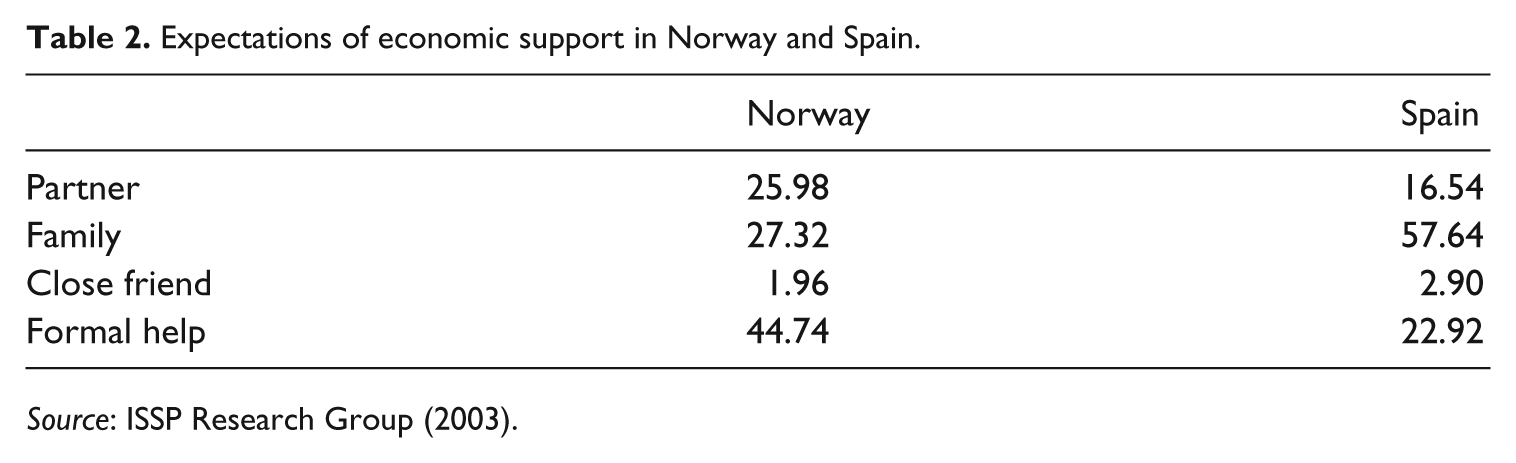
We begin the discussion with the descriptive analysis of the dependent variable in Norway and Spain reported in Table 2. We can see striking differences between the two countries regarding expectations of economic support. A majority of the population in Spain expects to get economic support from the family (57.6%) while formal help is the most common answer in Norway (44.7%). In sharp contrast, only 22.9% of Spaniards would borrow money from a bank or loan agency (formal help) and only 27.3% of Norwegians would ask their families for economic help. There are also important differences regarding economic solidarity within couples. While 26.0% of the Norwegians would ask their partners for economic help, this percentage decreases to 16.5% in Spain. These findings are in line with our expectations (H1) and previous research (Albertini et al., 2007; Brandt et al., 2009; Ogg and Renaut, 2006), as they confirm a more intense intergenerational solidarity in Spain than in Norway.
Expectations of economic support in Norway and Spain.
Source: ISSP Research Group (2003).
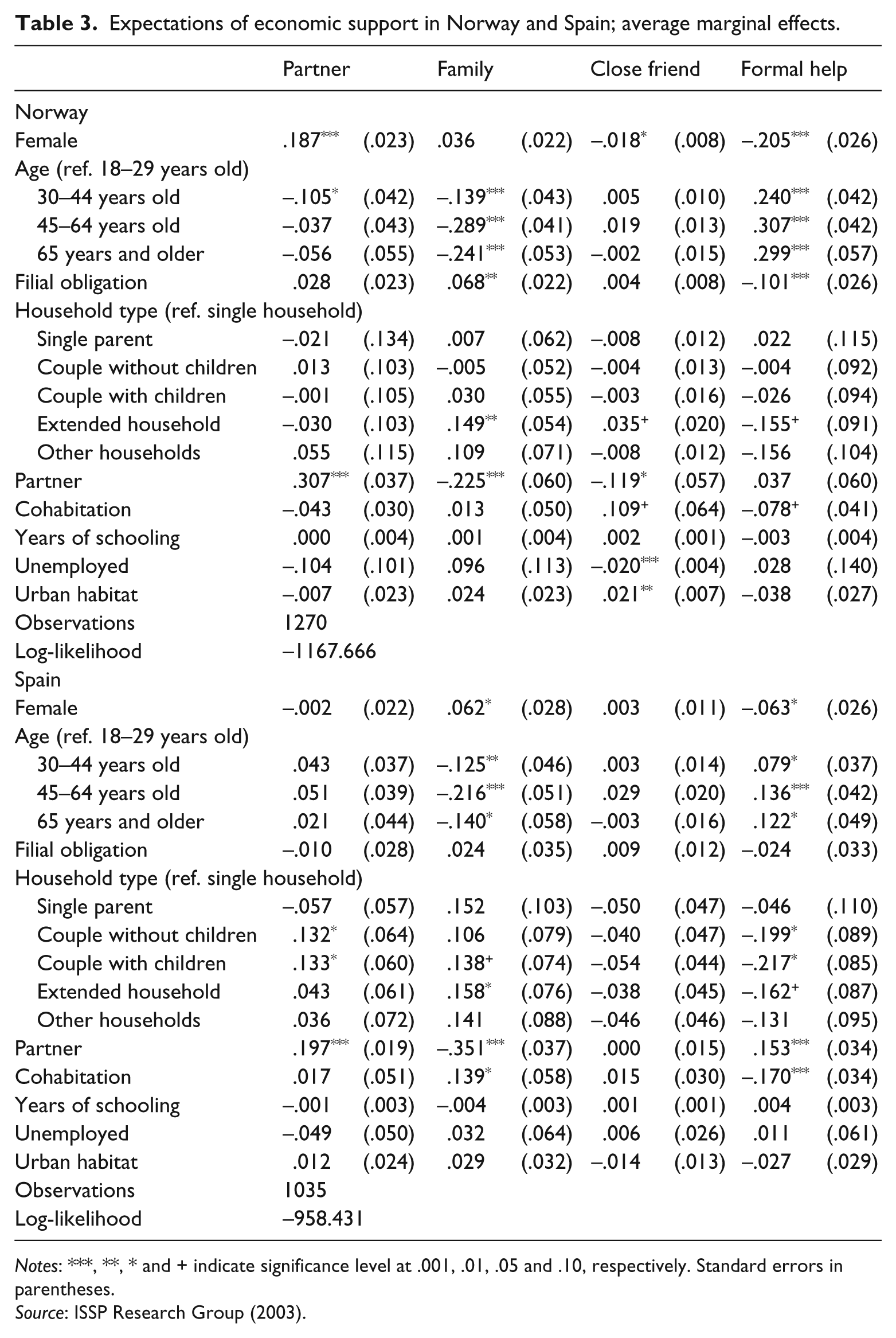
These differences, however, can be influenced by a compositional effect, since the demographic structures of Norway and Spain are quite different. Hence, in a further step we estimate two multinomial logit models (one for each country), which can be used to compute the probability of choosing one particular form of support for a particular individual with a set of personal traits. Furthermore, the estimates from multinomial logits allow us to understand the factors determining expectations of economic support in both countries. The dependent variable in this model is expectation of economic support (coded as stated above). Given that logit coefficients are not comparable between different models (Mood, 2010) and for an easier interpretation of the results, in Table 3 we report the average marginal effects for all the categories of the dependent variable (partner, family, close friend and formal help). For continuous variables, marginal effects can be interpreted as the change in the probability of choosing one category of the dependent variable as the independent variables increase, while marginal effects for dichotomous variables can be interpreted as the discrete change in probabilities from the base level.
Expectations of economic support in Norway and Spain; average marginal effects.
Notes: ***, **, * and + indicate significance level at .001, .01, .05 and .10, respectively. Standard errors in parentheses.
Source: ISSP Research Group (2003).
Marginal effects reported in Table 3 indicate that both the direction and magnitude of the estimates vary substantially between Norway and Spain. The most important difference is related to the effect of the gender variable. Spanish women expect more often than men to get help from their families, while they are less willing to rely on formal help than men. In contrast, there is no difference in expectations of economic support from the family between men and women in Norway. Norwegian women also tend to choose formal help less often than men. However, instead of seeking help from their families Norwegian women would ask their partners for help more often than men would. In addition, we have found significant differences between men and women regarding the option close friend, since men tend to rely more on friends for help in Norway, although the differences are smaller than in the case of partner and formal help.
To have a better understanding of the differences in the probability of choosing any form of economic support by gender, we have used the estimates from logit models reported in Table 3 to compute predicted probabilities for men and women, holding all continuous variables at their average and all the rest of the dichotomous variables at their modal value. These probabilities with their confidence intervals at 95% are depicted in Figure 1. As we have hypothesized (H1), expectations of economic support from the family are higher in Spain than in Norway, after controlling for composition effects, but differences in expectations between sexes are quite substantial. In Norway the probability of relying on the family is 7.7% for women and 6.6% for men, while in Spain the probability of asking for help from the family is 37.5% for women and 31.0% for men. At the same time, in Norway the probability of choosing formal help is 45.8% for women and 73.3% for men, while the probability of choosing help from the partner is 46.5% for women and 20.0% for men. Finally, the probability of relying on formal help is also lower for women (28.0%) than men (35.4%) in Spain, although the difference is smaller in Spain than in Norway.
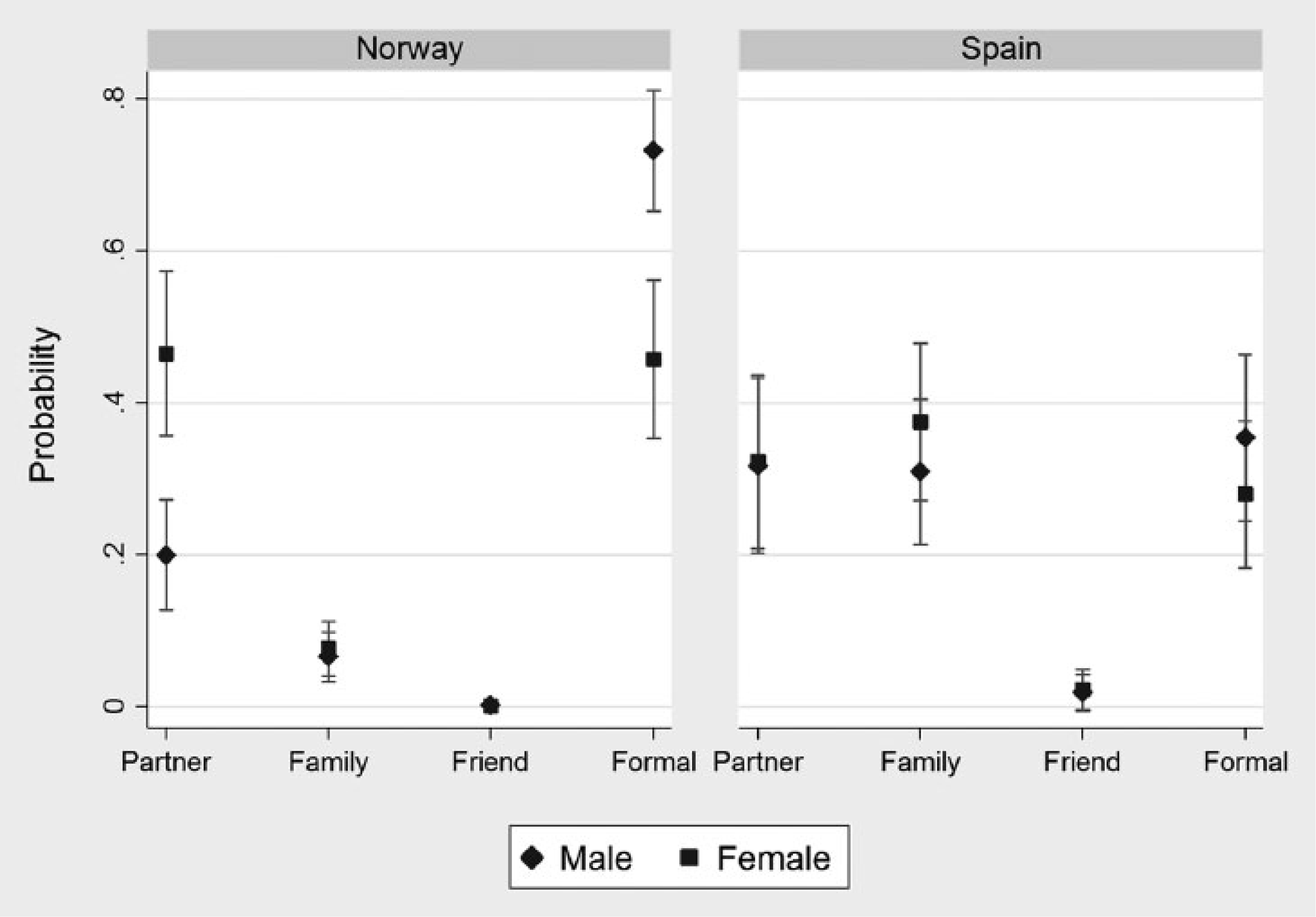
Expectations of social support (predicted probabilities) by gender.
All in all, our findings are consistent with previous research on family solidarity (Daatland et al., 2011) and indicate that Norwegian women are more independent of both their families and partners than Spanish women. The differences in women’s expectations of economic support between the two countries are related to differences in gender norms and the different presence and role of the solidarity networks in both countries. Although attitudes regarding work and family are changing in Spain in a similar way to what happened in Scandinavian countries during the previous decades (Moreno Mínguez, 2010), the masculine work model still continues to have an influence (Leira et al., 2005) and there is a contradiction between egalitarian attitudes and ‘old’ behaviours (Valiente, 1997). Cultural norms for new generations in Spain prescribe equality between men and women (Valiente, 2009) and women have entered the labour market in increasingly higher numbers in the decades after the dictatorship (Valiente, 2002). However, this is in contrast with gender norms prescribing that women should take care of family responsibilities (Tobío, 2001) and ‘the combination of professional and family responsibilities is an acute problem for many Spanish women of working age’ (Valiente, 2002: 770). This reality is related to institutional policies that reinforce family roles (León, 2002) and maintain an unequal division of domestic work (Moreno Mínguez, 2010).
The enduring resilience of the traditional family model in Spain is reflected in the norm that child-rearing is a mother’s responsibility (Tobío, 2001). For this reason, the main strategy developed by Spanish working mothers to cope with their responsibilities is to rely on other women, specially their own mothers. Thus, grandmothers become an important source of support, as they feel responsible for helping their daughters (Leira et al., 2005). This explains the fact that solidarity networks in Spain are maintained mostly by women and within the family, given the limited provision of public services. As pointed out by Leira et al. (2005: 92), ‘even for first-generation Norwegian working mothers, the autonomy of the nuclear family was greater than in the Southern countries’. Moreover, that would explain why Spanish women are expected to be more dependent on their families than men, while no significant differences have been found between Norwegian women and men.
In a familistic context like Spain, in which family ties are maintained mostly by women, they are more able to look for help within their family networks than men. In contrast, Norwegian women are expected to ask their families for help no more than their male counterparts. The differences in solidarity networks between the two countries are reflected in spatial strategies, as many working mothers live close to their mothers in Spain (Tobío, 2001), and in patterns of social contact between generations. For instance, 61% of Spanish women (whose mother is alive and lives in a different household) visit their mothers at least several times a week, while the percentage is 43% for Spanish men (ISSP Research Group, 2003). As stated before, this difference between men and women in the patterns of social contact is mostly due to the prominent role of women as caregivers within the family in Spain (Valiente, 2002). In sharp contrast, Norwegian women who have the same level of maternal contact represent 19%, which is even lower than the 22% of Norwegian men who visit their mothers at least several times a week.
Furthermore, married Norwegian women are also more financially independent than married Spanish women. A greater proportion of Norwegian women would ask their partners for financial help because they are accustomed to having a separate income from their partner’s more often than Spanish women are. For instance, according to the ISSP study on ‘Family and Changing Gender Roles IV’ (2012) (ISSP Research Group, 2014), 42% of couples in Norway pool some of their income and keep the rest separate, or each partner keeps all his/her own income separate. In contrast, only 11% of Spanish couples do the same. Hence, it is unlikely that Spanish women turn to their partners to ask for economic help, since a vast majority of them do not have a separate source of income. In addition, this is consistent with the higher female labour participation in Norway than in Spain. In 2000 it was 76.5% in Norway and 52.9% in Spain (OECD, 2014).
As we have hypothesized (H2), we also observe a life-cycle effect both in Norway and Spain, though this effect is stronger in Spain than in Norway. In both countries, the probability of asking the family for help decreases with age whereas the probability of seeking formal help increases, although the relationship between age and expectations of economic support from the family is not linear, especially in the case of Spain. The youth (between 18 and 29 years old) are those who would turn to the family more frequently and look for formal help less frequently. On the contrary, those of mature age (between 45 and 64 years old) are more inclined to look for formal help and less prone to ask the family for help. Finally, adults between 30 and 44 years old are somewhere in between. This suggests a strong life-cycle effect in choosing the source of economic support in case of need. Young individuals with working parents and weaker financial resources are expected to ask their parents for help, while mature individuals with typically retired parents and children below working age or in low-income jobs have fewer sources of financial support in their family networks.
We find, however, an important difference between Norway and Spain regarding the expectations of older people (65 years and older), which is consistent with H2. In Norway older people have very similar expectations to the group of mature age. However, in Spain the probability of choosing family support increases substantially for older people, while the probability of choosing formal help decreases. The last finding suggests, in line with previous research (Hoff, 2007; Silverstein and Marenco, 2001), that individuals give support to their adult children in both societies. However, in Spain adult children are also expected to provide some financial support to retired people. A cultural explanation might stress the fact that the differences in values and moral obligations between the two countries are substantial, as 80.4% of Spaniards believe that adult children have a duty to look after their old parents as compared to 59.3% of Norwegians. An alternative (or even complementary) explanation can be derived from the differences in welfare policies toward older people between the two countries. For instance, elderly poverty was 12.3% in 2010 in Norway and 22.6% in Spain (Eurostat, 2015). For this reason, older people would expect to receive much less economic support from their families in Norway than in Spain.
To have a better understanding of these differences, in Figure 2 we plot the probabilities of choosing any option of economic support for every age group with confidence intervals at 95%. The probability of an individual under the age of 30 asking for help from his/her family is only 26.7% in Norway and 61.1% in Spain. At the same time, the probability for an individual 65 years and older asking for help from the family is 10.4% in Norway and 45.3% in Spain. Even the group less inclined to ask the family for help (45–64 years old) has a probability of 37.5% in Spain against 7.7% in Norway.
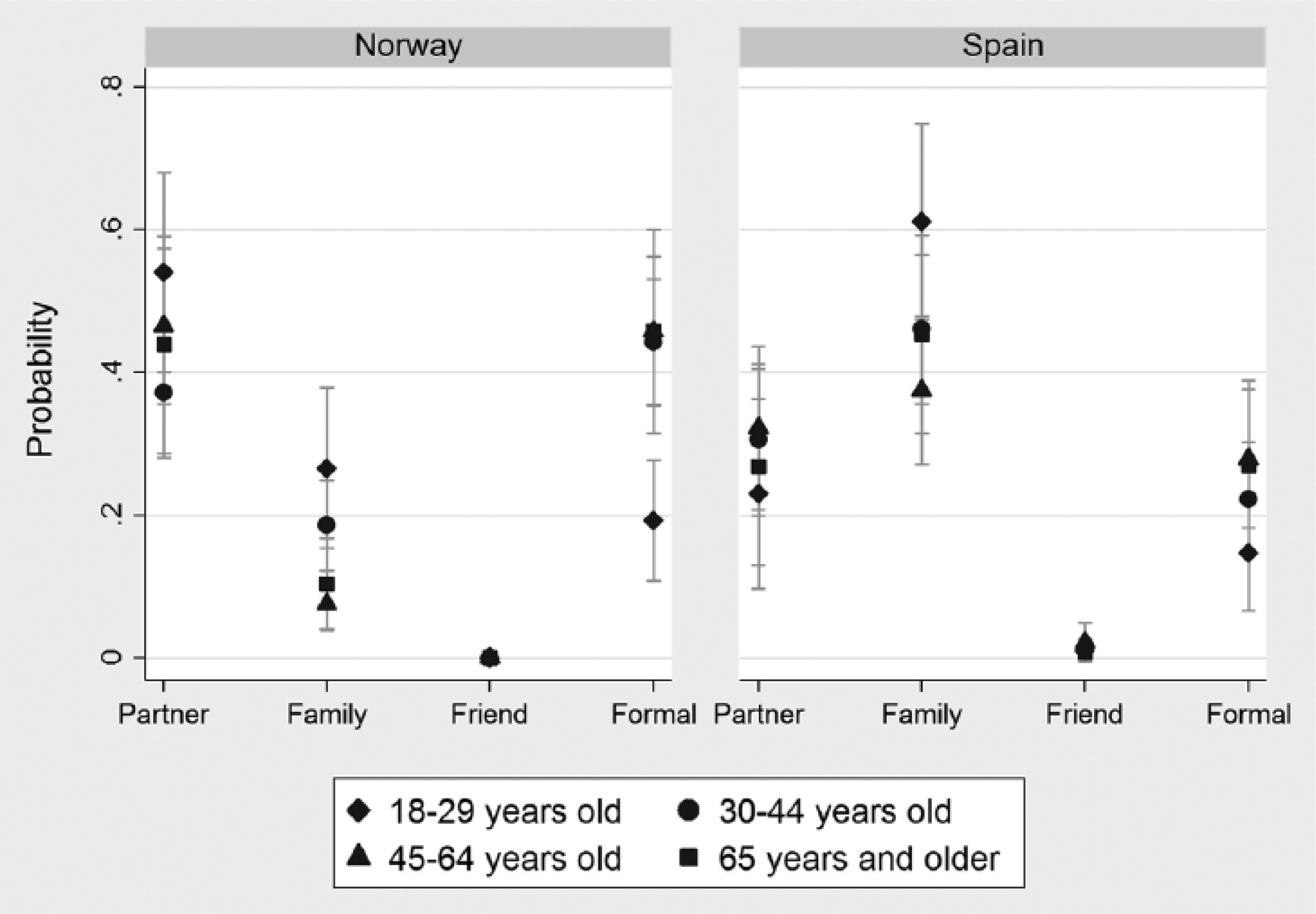
Expectations of social support (predicted probabilities) by age group.
The effect of filial obligation differs between Norway and Spain. While it has a significant and positive effect on the probability of choosing the family and a significant and negative effect on the probability of choosing formal help in Norway, it has no significant effect in the case of Spain. Therefore, our findings support (at least partially) H3. The lack of significance in Spain can be explained by the small variation in this variable in the Spanish sample, as we have hypothesized. As previously stated, the moral obligation of adult children toward their parents is widely shared in Spain (8 out of 10 Spaniards support this moral obligation). Therefore, the widespread commitment to filial obligation produces high expectations of the family but cannot explain differences among individuals’ expectations. Furthermore, this finding would be in line with other studies showing a limited effect of filial obligation on family transfers (Katz et al., 2010).
The type of household has a moderate impact on asking for help from the family, especially in the case of Norway. Individuals living in extended households, in which two or more generations live together, are more willing to ask their families for help in both countries (which is in line with H4), whereas they are less inclined to choose formal help (although this effect is only significant at p < .10 both in Norway and Spain). This finding can be explained by co-residence patterns. Since individuals have more direct access to their family network in extended households, they would rely more often on their families than on other sources of financial support (Daatland and Lowenstein, 2005). On the other hand, co-residence patterns might be connected to the socio-economic status of the household, since there is more co-residence in poor households, and low-income groups are typically more willing to ask their families for help (Kalmijn and Saraceno, 2008; Lee et al., 1994). In addition, in Spain couples with or without children are less willing to ask for formal help, whereas individuals living in couples would ask more often for help from their partners.
Having a partner has a strong effect both in Norway and Spain. Not surprisingly, in both countries, the probability of choosing one’s partner as the source of economic support is much higher for those who are married or have a steady life-partner. More interestingly, having a partner reduces the probability of asking the family for help in Norway and Spain. This suggests that there is a substitution effect between the two forms of help. We can expect that those who have a partner spend less time and fewer resources on their family networks. On the supply-side, it can be argued that members of the family network might be more sensitive to the demands of those who have no partner, since they have fewer sources of help. In that vein, several studies show that widows receive a great deal of support from their adult children (Eggebeen, 1992; Kalmijn and Saraceno, 2008; Silverstein et al., 1995). The effect of having a partner/spouse on the choice of financial support is only weakly affected by legal marital status in Norway, since cohabitation only has a modest and barely significant effect (p < .10) on asking for help from a close friend (positive) and for formal help (negative). However, it increases moderately the probability of choosing family help and reduces the probability of choosing formal help in Spain. The implications of this finding are not straightforward, although it suggests that cohabiting couples are more connected to their families in Spain than in Norway.
The rest of the variables included in the multinomial logit models do not have a clear impact on the probability of choosing one particular form of economic support over another. Several studies point out that less educated individuals are more family oriented (Allan, 1977; Böhnke, 2007; Kalmijn, 2006) because highly educated individuals typically have access to more economic resources (Kalmijn and Saraceno, 2008), are more individualistic and have less contact with their families (Kalmijn, 2006; Lee et al., 1994). However, after controlling for the rest of the variables we do not find a significant effect of years of schooling, either in Norway or Spain. In addition, living in an urban habitat only increases the probability of asking a friend for help in Norway, whereas being unemployed only decreases this probability. While there is no clear explanation for these two findings, it is worth noting that we do not yet know very much about how occupational status and habitat shape networks of social support, although we would expect that the place where people live and their situation in the labour market have, at least, some influence on access to social networks.
Conclusions
The relationship between family solidarity and the welfare state has produced a great deal of research in recent decades. Western societies are increasingly able to offer new sources of support, and this has gone hand in hand with the process of individualization within families and greater variability in family-related behaviours in these societies. In this article we have focused on the expectations of economic support from different sources, including the family, and have compared these expectations between two countries belonging to two different welfare regimes: Norway and Spain. We have found that expectations of economic support rely mostly on the family in Spain while formal help is far more common in Norway. In addition, we have found similarities and differences between Norway and Spain in the factors than explain individual expectations.
Gender and life course have been found to be especially significant in both countries, although the differences do not go in the same direction. Women tend to expect more financial support from their partners in Norway than men, while Spanish women tend to rely more on support from their families than men. Regarding life course, although there is a U shaped relationship between age and expectations of economic support from the family, the life-cycle effect is stronger in Spain, mostly because many older people in this country would expect to receive economic support from their adult children. Finally, norms of filial obligation turn out to be significant in Norway but not in Spain. Regarding similarities between the two countries, we have found the following common patterns: greater probability of seeking support from the family in extended households and lower probability of expecting economic support from their families among those who have a steady life-partner.
Drawing on the literature on gender and the welfare state claiming that the Scandinavian model undermines gender inequality (Sainsbury, 1999), our findings support the idea that women are more independent of both their families and their partners in Norway than they are in Spain. Hence, they will have more resources and abilities to look for help outside the family in case of financial need. This seems to be true also regarding the expectations of economic support of older people. A more generous welfare state provides better standards of living for older people and therefore they are less dependent on their families. All in all, our findings are in line with the literature on crowding out in the sense that welfare policies might enable individuals to be more financially independent from their family network. It does not imply, however, that family solidarity, in a broad sense, tends to vanish in more generous welfare states, since support within families might take different forms.
Footnotes
Acknowledgements
The authors are thankful to three anonymous reviewers and the Editors of International Sociology for valuable comments and suggestions on previous versions of this work. However, the usual disclaimer applies.
Funding
We gratefully acknowledge the financial support of the Spanish Ministry of Economy and Competitiveness (Grants PSI2008-01937 and CSO2011-29346).