



Abstract
Unlike the majority of existing studies that explain the gender earnings gap from a structural perspective, this study aims to understand the unexplained part of gender earnings inequality from a behavioural perspective. By adopting a dataset collected in the Chinese city of Xiamen when China’s market economy was still in formation, this study focuses on how earnings are affected by contact use in job placement. Results based on the quantile regression model show that contact use significantly narrows the average gender earnings gap by enhancing women’s earnings in the lower to middle levels of the earnings hierarchy, but this positive role that women’s contact use plays in their earnings outcome disappears in the upper level of the earnings hierarchy. This study thus calls for scholarly attention to the contextually sensitive consequences of individual behaviour in terms of understanding the part of gender earnings inequality that cannot be explained by the existing literature.
Introduction
The persistence of gender income inequality has been widely acknowledged across labour markets (Bowlus and Grogan, 2008; de la Rica et al., 2008; see also the overview by Ñopo et al., 2011). On the demand side of the labour market, existing explanations are mainly focused on biased evaluation and pay systems, gender segregation in sectors, occupations and job duties, as well as statistical discrimination and taste discrimination practised by employers and managers (Bielby and Baron, 1986; Darity and Mason, 1998; Nicodemo, 2009; Tomaskovic-Devey and Skaggs, 2002). On the supply side of the labour market, a large number of studies have attributed the gender earnings gap to female deficiencies in human capital. Examples include women’s higher propensity to select typically female fields of study and training, which in turn, channel them into female-dominated occupations with lower wages in the long run. Female career interruptions due to their family and reproduction roles have also been shown to result in women’s more limited access to further education and training that is necessary for wage progression at later career stages. In addition to women’s preferences for jobs that are more reconcilable with their family obligations, another commonly accepted argument lies in women’s lack of career aspirations and sufficient salary negotiation skills (Budig and England, 2001; Budig et al., 2012; England et al., 1994).
Despite focusing on the different sides of the labour market, the aforementioned explanations have all taken a structural perspective by explaining gender income inequality through pre-existing gender differences in human capital (as well as soft skills, such as salary negotiation) accumulation and access to different jobs, occupations and sectors. A significant part of gender income differentials consequently remain unexplained, even after all the above factors are taken into account (Hanson and Pratt, 1991; see also the review by Reskin, 1993). An approach that moves beyond a structural perspective is thus necessary to explore the unexplained part of gender income differentials. Among other alternatives, the importance of job placement in the divergence between women’s and men’s earnings has increasingly drawn scholarly attention (Ibarra, 1992; Petersen et al., 2000; Rosenfeld and Spenner, 1992). In their study on the gender earnings gap at career entry among American youth, Marini and Fan (1997) analysed gender differences in earnings by focusing on how the use of social contacts sorted, or placed, women and men into different jobs in a given labour market structure. As the authors argued, this approach situates a micro-level, behaviour-focused job–person sorting mechanism into the macro-level labour market context, and aims to explain the extent to which the gender earnings gap can be explained by individual behaviour in job placement (Marini and Fan, 1997). The most significant theoretical contribution with regard to this behavioural perspective, therefore, lies in its bridging role between individual behaviour and the labour market context.
Unfortunately, almost all existing evidence about the effect of individual contact use in job placement on unequal earnings outcomes between men and women is found in similar contexts, namely, well-developed labour markets in North America and Europe, where gender segregation already existed (de la Rica et al., 2008; Hanson and Pratt, 1991; Huffman and Torres, 2001; Marini and Fan, 1997). By focusing on gender differences in network characteristics, existing studies have generally shown that contact use widens the gender gap in obtaining ‘good’ jobs, earnings and promotion opportunities, by enhancing men’s chances while diminishing women’s in such contexts (Hanson and Pratt, 1991; Huffman and Torres, 2001; Ibarra, 1992, 1997; Kanter, 1977; Straits, 1998). What remains unknown is whether or not the role informal job placement behaviour plays in gender earnings inequality would be consistent with existing findings when the labour market context changes. Addressing this question is of great theoretical significance, because beyond the part of the gender earnings gap that can be universally explained across labour markets from a structural perspective, the remaining unexplained part is likely to be contextually sensitive.
Taking the formational stage of urban China’s market economy as an example, this study is thus interested in testing whether or not individuals’ job placement behaviour in a labour market different from the Western context would result in different outcomes in gender earnings inequality. Based on a unique survey dataset collected in a highly marketized Chinese city, Xiamen, in a crucial historic time during which the form of structuralized gender segregation in urban China was in a transitional process due to marketization, we re-examine the effect of contact use on the gender earnings gap. By doing so, this study differentiates itself from the majority of the existing literature. First, unlike the commonly adopted structural perspective, this study is not aimed at duplicating existing findings by explaining how pre-existing gender differences on the supply and/or demand side of the labour market contribute to gender earnings inequality. Rather, by focusing on contact use in job placement, it raises a theoretical concern: namely, to what extent can gender earnings inequality be constructed by individual behaviour? Second, unlike most of the existing studies that have explained the gender earnings gap at either the individual or the labour market level, this study emphasizes the importance of the labour market context in understanding the consequences of individual behaviour in constructing the gender earnings gap. Indeed, individual behaviour is always confined within a certain context. From a behavioural perspective, this study pays attention to the contextually sensitive consequences of individual behaviour in terms of understanding the part of gender earnings inequality that cannot be explained by the existing literature.
This article is organized as follows. Based on existing studies, we will first show that the commonly assumed disadvantageous outcomes for women using contacts in job placement may not be due to women’s networking preferences per se; rather, it is because labour market outcomes of contact use is not only gender specific, but also contextually sensitive. This makes it necessary to understand the remaining unexplained part of gender earnings inequality from a behavioural perspective and in a particular context. By linking the extent of gender segregation in the labour market context with women’s and men’s relative positions in the earnings hierarchy, we hypothesize that women’s contact use could play a positive role in narrowing the gender earnings gap in the lower to middle levels of the earnings hierarchy, but this positive role disappears in the upper level of the earnings hierarchy. These hypotheses are tested by using data collected in a unique labour market in Xiamen in 1999, the formational stage of urban China’s market economy. In the results section, estimation results from the conventional ordinary least squares (OLS) model and the quantile regression model (QRM) are compared. To conclude, we highlight the contributions of this study. If factors from a conventional, structural perspective fail to completely explain the existence of gender earnings inequality, a behavioural perspective may be a beneficial complement, through which gender earnings inequality is regarded as being constructed by contextually sensitive individual behaviour, such as contact use in job placement.
Contact use in job placement and its gender-specific, contextually sensitive outcomes
It has been widely documented that contact use plays a positive role in a job–person matching process from both the job seeker’s (Fernandez and Fernandez-Mateo, 2006; Fernandez and Weinberg, 1997) and the employer’s (Bian, 1997; Bian and Ang, 1997; De Graaf and Flap, 1988; Kogan, 2011; Kogan et al., 2013) perspectives. On the job seeker’s side, the use of social contacts benefits a job placement process in (1) conveying job information, (2) influencing the employer’s decision-making, (3) providing social credentials to the potential employee and (4) reinforcing the employee’s self-identification as a member of the work organization (Lin, 1999b: 31). On the employer’s side, using pre-existing social ties reduces hiring costs and improves the match between the successful candidate and job position significantly. Studies focusing on the employer’s hiring processes show that external referrals are able to prepare more suitable résumés and time their applications better than non-referrals, and that they are also more likely to reach the employer’s hiring expectations during job interviews due to inside information obtained through referees (Fernandez and Weinberg, 1997; Fernandez et al., 2000).
Nevertheless, the advantageous outcomes of using contacts in job placement, such as higher income or a higher status attached to the job position, seem to have mainly been confirmed among male job seekers, at least in the Western context (Erickson, 2004; Granovetter, 1973; McDonald, 2015; see also the review by Lin, 1999a). Women’s contact use, by contrast, is very likely to lead to lower entry salaries (Fernandez and Fernandez-Mateo, 2006; Marini and Fan, 1997; Petersen et al., 2000; Reskin and McBrier, 2000). Using data drawn from the 1991 General Social Survey and National Organizations Survey, Drentea (1998) showed that American women had a greater chance of getting better-paid jobs through formal job search methods, because their contact use often led them to female-dominated jobs with lower pay, less authority and fewer benefits. Based on the National Longitudinal Survey of Youth between 1979 and 1991, Marini and Fan (1997) further found that at career entry women earned only 84 cents for every dollar men earned. While gender differences in human capital accumulation explained, in total, about 30% of this wage gap, the external influences of employing organizations and network processes on gender differences in occupational and industrial placement accounted for 42% of the gender earnings gap in the United States.
Despite the lack of explicit arguments, existing studies have given a strong indication that contact use outcomes are gender specific and contextually sensitive. Contact use is gender specific mainly due to the nature of human networking behaviour – homophily; namely, one tends to make friends with others similar to oneself (Lin, 1999b, 2001; McPherson and Smith-Lovin, 1987). As a result, women and men form drastically different social networks. Drawing data from the 1985 General Social Survey, both Marsden (1987) and Moore (1990) found that while American women and men might on average have the same number of network ties, their networks differed in nature. Women’s networks were often focused on family, kin and neighbours, whereas men’s were focused on non-kin, especially co-workers (Marsden, 1987; Moore, 1990). Further studies emphasized that a usually larger share of family responsibilities further prevented women from accumulating instrumental network resources. For example, marriage and parenthood have often been found to have opposite effects on women’s and men’s network construction. While they constrain women’s opportunities to form network ties to non-kin outside the neighbourhood, marriage and parenthood tend to create more opportunities for men to form network ties beyond local and kin boundaries (Moore, 1990: 727; see also Campbell, 1988: 191–194; Fischer and Oliker, 1983: 129).
Although gender-specific contact use per se only indicates women’s and men’s different behavioural tendencies, such differences would consequently worsen gender income inequality in a certain labour market context. Empirical studies based on the American labour market, where ‘the sex composition of jobs has become a basis of economic segmentation’ (Marini and Fan, 1997: 589), have demonstrated how women’s and men’s contact use in job placement has reproduced sex segregation and further reinforced the gender earnings gap (Hanson and Pratt, 1991; Huffman and Torres, 2001; Ibarra, 1992, 1997; Kanter, 1977; Straits, 1998). Focusing on the structure of the Western labour market, two explanations in the existing literature are influential.
The argument of social closure posits that male employees have long monopolized privileged positions in workplaces (Reskin, 1988; Tomaskovic-Devey, 1993). As a result, women’s access to high wages, promotions and skill-enhancing jobs is limited. The gender earnings gap can thus be understood as a process of rank segregation in which higher skill levels, opportunities and authority positions are monopolized by and for men (see the review by Reskin, 1993). Another explanation is that homosocial reproduction emphasizes the employer’s hiring preferences. According to Kanter (1977), within upward movement in organizational hierarchies, positions of power become characterized by increasing uncertainty, interdependence, and a need for rapid, accurate communication about matters such as organizational means and planning, and criteria for performance evaluation. Those job characteristics urge the employer to maintain relative social homogeneity among high-ranking employees, in order to impose greater predictability on an otherwise uncertain environment. If men have historically held the reins of power in workplaces, they will benefit most from the universal tendencies for in-group favouritism, creating increasing inequality for out-group members. Both explanations suggest women’s disadvantages in using contacts for enhancing job placement outcomes (such as earnings), when the labour market has already segregated, with women’s greater concentration at the lower end and men’s greater concentration at the upper end of the socioeconomic hierarchy. As stated by Campbell (1985), a positive earnings outcome of a job search often depends on the use of high-status male contacts, which most women unfortunately have limited access to, in the Western labour market. Even when men share job information with women, the information is likely to be selective, leading women towards lower paid jobs (Campbell, 1985: 26).
Figure 1 summarizes why gender-specific contact use would worsen gender earnings inequality in a gender-segregated labour market. Contact use is gender specific, as women’s and men’s different networking preferences result in their access to different types of social contacts, with men’s focusing on non-kin, co-workers and beyond local boundaries whereas women’s preferences focus on family, kin and local boundaries, as argued by the existing studies (Marsden, 1987; Moore, 1990). The fundamental mechanism underlying gender-specific contact use is homophily (Lin, 1999b, 2001; McPherson and Smith-Lovin, 1987), in which gender is one of the most distinctive dimensions. This means that men’s and women’s different types of contacts are also likely to differ in gender, due to men’s and women’s natural advantages in networking with individuals within their own gender groups. In a gender-segregated labour market where men and women are concentrated in different jobs, men’s contact use is likely to lead them to male-concentrated jobs, whereas women’s contact use is likely to lead to female-concentrated jobs. Because male-concentrated and female-concentrated jobs usually differ in earnings, with earnings in the former higher than those in the latter, gender segregation has always directly been associated with the earnings gap, at least in the Western context (Campbell, 1985; Kanter, 1977; Reskin, 1988; Tomaskovic-Devey, 1993). As a result, contact use in job placement contributes to widening the gender earnings gap in a gender-segregated labour market.
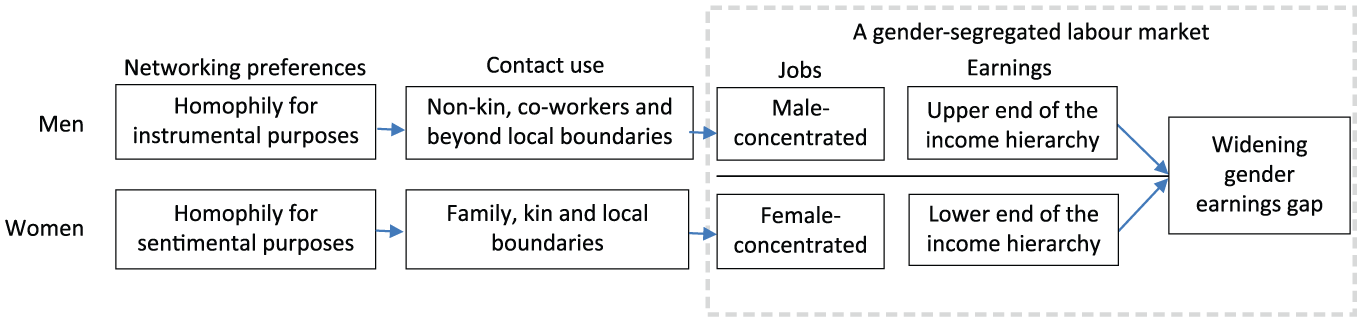
Contact use widens the earnings gap in a gender-segregated labour market.
Figure 1 subsequently leads to the question: Is the worsening gender earnings gap due to contact use per se, or due to contact use in a gender-segregated labour market? Different answers would lead the development of gender-equity policies in completely different directions. If contact use by itself is the key, policies that encourage women to develop different networking behaviour should narrow the gender earnings gap significantly. However, this proposition is not supported by the existing literature. Empirical evidence in the United States and Europe has largely demonstrated the direct association between the extent of gender segregation and that of gender earnings differentials, by showing a relatively narrower gender pay gap at the lower end of income distribution, but a significantly larger gap at the higher end of income distribution in those labour markets (Bowlus and Grogan, 2008; de la Rica et al., 2008; Morris and Western, 1999). Namely, although by relying on male contacts, women’s chance of finding work outside female-concentrated jobs could perhaps be increased, women’s earnings disadvantages relative to their male counterparts in similar positions are likely to be even greater.
If a change in women’s networking behaviour would not fundamentally reverse the gender earnings gap in a gender-segregated labour market, policy makers might consider focusing gender-equity policies on the contextual level, rather than the individual level. Unfortunately, at least as far as we are aware, there has not yet been a study that provides direct evidence supporting the second proposition – that gender segregation of the local labour market is the reason for women’s disadvantaged earrings outcome when using contacts in job placement. In other words, in a labour market where gender segregation is less structuralized, there may be a possibility that women’s contact use plays a positive role in narrowing the gender earnings gap. Therefore, this study aims to fill this gap by re-examining women’s and men’s contact use in job placement in urban China’s transitional context. By doing so, this study has a clear policy implication, which will be discussed at the end of the article.
The effect of contact use on the earnings gap in the formational stage of a labour market
Empirical evidence of this study is based on the formational stage of the market economy in urban China. Studies focusing on guanxi (relationship) manipulation in urban China before and during marketization have shown that contact use is not only positively associated with, but also causes a significant improvement in job placement outcomes, such as wages (Bian, 1997; Bian et al., 2015). Based on anthropological research on Chinese culture (Fei, 1992 [1949]; Yang, 1994), Bian and his collaborators have argued that contact use in the Chinese context is characterized by a heavy reliance on family ties, kin and kin-like relationships, and that a weak tie between the job applicant and the key helper is essentially a chain of strong ties that bridge the job applicant and the key helper together through at least one intermediate helper (Bian, 1997; Bian et al., 2006, 2015). In this respect, women’s networking behaviour in favour of close relationships should not be an obstacle when using contacts in job placement within the Chinese context.
A reasonable concern is that Chinese women’s networking preferences may be significantly different from their counterparts’ in the Western context, so that any observed differences in contact use outcomes cannot be attributed to a contextual effect. Despite the scarcity of a systematic literature on women’s networking behaviour in China, inspiration can be drawn from Huang and Aaltio’s (2014) comparative study about the networks of women managers in China and Finland. By interviewing women managers in the IT industry in China and Finland in 2005, they found that on average, Chinese women managers had smaller networks than their counterparts in Finland. Furthermore, Chinese women managers tended to socialize with their co-workers out of work, resulting in close-knit networks in which ties often bore multiple functions. On the contrary, Finnish women managers tended to keep networks for work and for their social lives separate. By studying a group of high-status professional women in one of the least female-dominated industries in China’s market economy, Huang and Aaltio’s (2014) findings imply that Chinese women have by no means more instrumental networks than their counterparts in the Western context. If anything, their networks tend to be smaller and more close-knit. This tendency should be even stronger before the complete establishment of the market economy in urban China. Therefore, any different pattern observed in contact use outcomes in urban China should be explained with a focus on the job placement context, rather than differences in network characteristics at the individual level.
Unlike the scenario in the well-developed labour market in Western society, structuralized gender income inequality during China’s socialist economy was not based on occupational segregation. During the era of state-controlled economy, an ‘equal pay for equal work’ (tong gong tong chou) policy was enforced to ensure pay equality between women and men in the public sector. Women who did the same work as men received equivalent pay to their male co-workers. However, gender income differentials still existed, mainly because of the concentration of women and men in different types of work organizations. Studies have shown that the concentration of male workers seemed to increase with the extent of state control in a local environment (Qian, 1996; Shen and Deng, 2008; Shu et al., 2007). For example, while women were more likely to be assigned to collective firms, which offered relatively lower wages, fewer employee benefits and less job security, men were more likely to be assigned to state-owned enterprises (SOEs), which offered higher wage rates, comprehensive fringe benefits and better job security (Knight and Song, 2003; Loscocco and Wang, 1992). The official statistics show that in 1978, the average annual wage of SOE employees was 644 yuan, and that of collective-firm employees was only 506 yuan, indicating a 27% wage premium enjoyed by state employees (Qian, 1996).
It is thus reasonable to argue that gender segregation in the socialist economy was along the boundaries of work organizations. The higher the extent of state control in a work organization, the higher the percentage of male workers, and therefore, the more difficult it would be for women to enter such a workplace. That is to say, on average, women were more likely to concentrate in areas with relatively lower levels of state control, as there they were faced with less competition from their male counterparts. This made it possible for a sharp increase in women’s participation in the market sector at the early stage of urban China’s marketization, as state control was reduced to a minimum in this newly emerging sector. During this stage, men were more interested in getting jobs in the state sector, due to the lower prestige and social status attached with jobs in the market sector at this stage (Davis, 1999). In terms of economic returns, however, a market mechanism that rewards productivity with earnings made women’s participation in the private sector a better choice than participation in collective firms, where earnings were consistently lower than those in the mainstream workplaces – the SOEs – of the state sector.
While marketization at the early stage opened a new arena for women to escape workplace-based gender segregation and to catch up with the earnings of men who worked in the state sector, this transition simultaneously created a new form of gender segregation along the boundaries of occupations and jobs, fundamentally based on gender differences in human capital. Using 1991 data collected in 26 cities and 12 provinces in urban China, Maurer-Fazio and Hughes (2002) found that much of the larger gender wage gap in the most marketized sectors could be explained by a reward mechanism that was more sensitive to economic returns to human capital, measured by education and work experience. Their finding is supported by Shu and Bian’s (2003) argument about human capital as the primary explanation for the sharp increase in gender income differentials in the private sector, as well as in the labour force overall. Underlying the human capital explanation, however, scholars have acknowledged that the fundamental reason for such gender difference lies in women’s and men’s different access to job positions that have different requirements for human capital. Using data from the urban section of the 2000 National Survey on Women’s Status in China, Shu et al. (2007) found a 35% gross gap in income between men and women in foreign-direct-investment (FDI hereafter) firms, significantly larger than the countrywide average in the mid-1990s. They argued that women were more likely to be employed in low-skill, export-oriented manufacturing industries that offered low wages, and were less likely to work in knowledge-intensive, high-paying foreign firms and joint ventures (Shu et al., 2007: 1307).
It is thus clear that during marketization at the early stage, the form of gender segregation in urban China was undergoing a transitional process, characterized as the shift from gender differences in access to work organizations with various levels of state control to gender differences in access to jobs with various levels of human capital. While women were paid less because of their lower chances of entering the mainstream state-controlled work organizations during the era of the socialist economy, they were now paid less due to their lower chances of accessing highly-skilled positions in the market economy. Namely, despite the different forms of gender segregation before and after the start of marketization, a shared trait was that women’s earnings were, on average, disadvantaged relative to men’s in urban China. Nevertheless, women’s earnings should be least affected by the contextual effect, during the transitional process of the two forms of gender segregation. In fact, the main driver of earnings inequality in the early stage of China’s market economy was the drastically different reward mechanisms between the state sector and the market sector, rather than gender segregation; so that it was possible for a female worker on the assembly line of an FDI manufacturer to earn as much as, or even higher than, a male employee in an SOE (Davis, 1999). If women, rather than men, were the early entrants in China’s market economy, women’s contact use should be particularly beneficial for their job placement outcomes, as posited by the aforementioned social closure and homosocial reproduction theories (Kanter, 1977; Reskin, 1988; Tomaskovic-Devey, 1993).
Despite that, women would still be at a disadvantage relative to men when it came to high-paying jobs that required high levels of human capital in the market sector, as mentioned above. Existing studies on gender inequality in the Western context have commonly demonstrated the existence of a glass ceiling for women’s career advancement, due to gender segregation that perpetuates men’s dominance in positions of power (Ibarra, 1992, 1997; Kanter, 1977; Reskin, 1993). In the recent development of this literature, QRM has been adopted to examine the gender pay gap at different income levels simultaneously. Findings have generally confirmed the existence of the glass ceiling effect, which increases the gender earnings gap, all measurable characteristics being equal (García et al., 2001; Montenegro, 2001; Nicodemo, 2009). In terms of job placement outcomes of contact use, scholars have come to acknowledge that the role contact use plays is contextualized with the extent of gender segregation (McDonald, 2015). Drawing data from the 1979–2000 National Longitudinal Survey of Youth in the United States, McDonald’s (2015) study shows that because high-wage jobs are dominated by men whereas low-wage jobs are dominated by women, the use of contacts generated wage premiums in middle and high-wage jobs, but not in low-wage jobs, mainly for men.
In terms of the context of the formational stage of China’s labour market, it is thus reasonable to hypothesize that a woman’s job placement behaviour, contact use in particular, has a divergent effect on her earnings outcome, depending on the level of earnings she attempts to achieve. While women’s job placement behaviour may have no positive impact for them to earn the top salaries, it could possibly benefit women’s earnings in other situations. Two hypotheses are therefore developed as follows. Other covariates being equal,
Hypothesis 1: On average, contact use narrows the gender earnings gap by enhancing women’s earnings relative to men’s, in the lower to middle levels of the earnings hierarchy.
And,
Hypothesis 2: Contact use does not play a significantly positive role in enhancing women’s earnings at the upper end of the earnings hierarchy.
Data, measurements and methods
Data
To test the above hypotheses, we chose a survey collected in a coastal Chinese city, Xiamen, in 1999. This dataset is a part of the 1999 Five-City Social Survey in urban China conducted by Yanjie Bian, Department of Sociology at the University of Minnesota (Bian, 2003). The unique data collection location and time have made the dataset rather suitable for this study. As one of the five Chinese cities designated as a ‘Special Economic Zone’ in the early 1980s, Xiamen had enjoyed relative autonomy in developing a market economy, with significantly less state control compared to the rest of the country. As a result, Xiamen had experienced a fast-paced economic development that attracted a large proportion of female employees. Statistics show that the level of GDP in 1999 had increased 21 times that of 1981 in Xiamen. Most of the increases were due to the influx of foreign direct investment. In 1999, Xiamen attracted international investment amounting to US$1.34 billion, which generated 77% of the gross value of industrial output in the city the same year. The large-scale FDI has consequently expanded and diversified the labour force, by creating numerous job opportunities, particularly for women. In Xiamen, the female labour force increased, on average, by 10% per year, from the mid-1990s to the early 2000s. In 1999, the rate of female labour market participation was around 45%, and it reached 49% in 2002 (Xiamen Statistical Bureau, 2001). This extraordinarily high percentage of women’s participation in the labour market was a unique phenomenon in the formational stage of China’s market economy. In fact, since the market economy fully developed in the 2000s, urban Chinese women have been losing ground in the labour market competition against their male counterparts, and the rate of female labour market participation has been continuously declining (NBSC, 2010). For this reason, the survey year of this dataset, 1999, is more pertinent for the research questions posed by this study.
Corresponding to the jurisdictional hierarchy of the city, a four-stage stratified sampling method was adopted to select respondents throughout seven districts, 18 townships (jiedao), 308 neighbourhoods (juweihui), and about 547,000 dwellings within the urban area of the city (Xiamen Statistical Bureau, 2004). Respondents were eventually chosen by using a table of random figures within the selected dwellings. As a result, 1000 respondents, comprising 430 females and 570 males, aged between 18 and 60 and with at least one year’s full-time employment experience, were selected among both permanent (with the local hukou [legal residence] status) and temporary (without the local hukou status) residents in the city. Face-to-face interviews were conducted during data collection. With missing values listwise deleted, 731 cases were used in the regression models. While the survey questionnaire collected retrospective information about the entire job history of each respondent, this study focused only on the respondent’s experience in entering the most recent workplace by the time of the interview.
Measurements
Earnings were measured by log-transformed total monthly salary when the respondent first entered his or her most recent workplace. Because the range of values for ‘the year of job entry’ spans decades before and after the outset of the socioeconomic reforms, original monthly salaries were adjusted based on a computed inflation index with the wage level in 1979 (the starting year of the reforms) used as the baseline. The inflation index was calculated as the ratio of the growth of GDP relative to the growth of RealGDP. The growth of GDP was calculated as the ratio of GDP in the corresponding year relative to GDP in the previous year, and the growth of RealGDP was calculated as the ratio of RealGDP in the corresponding year relative to RealGDP in the previous year. Information on GDP and RealGDP from the pre-communist era to 1999 was retrieved from the 2000 Statistical Yearbook of China (NBSC, 2000).
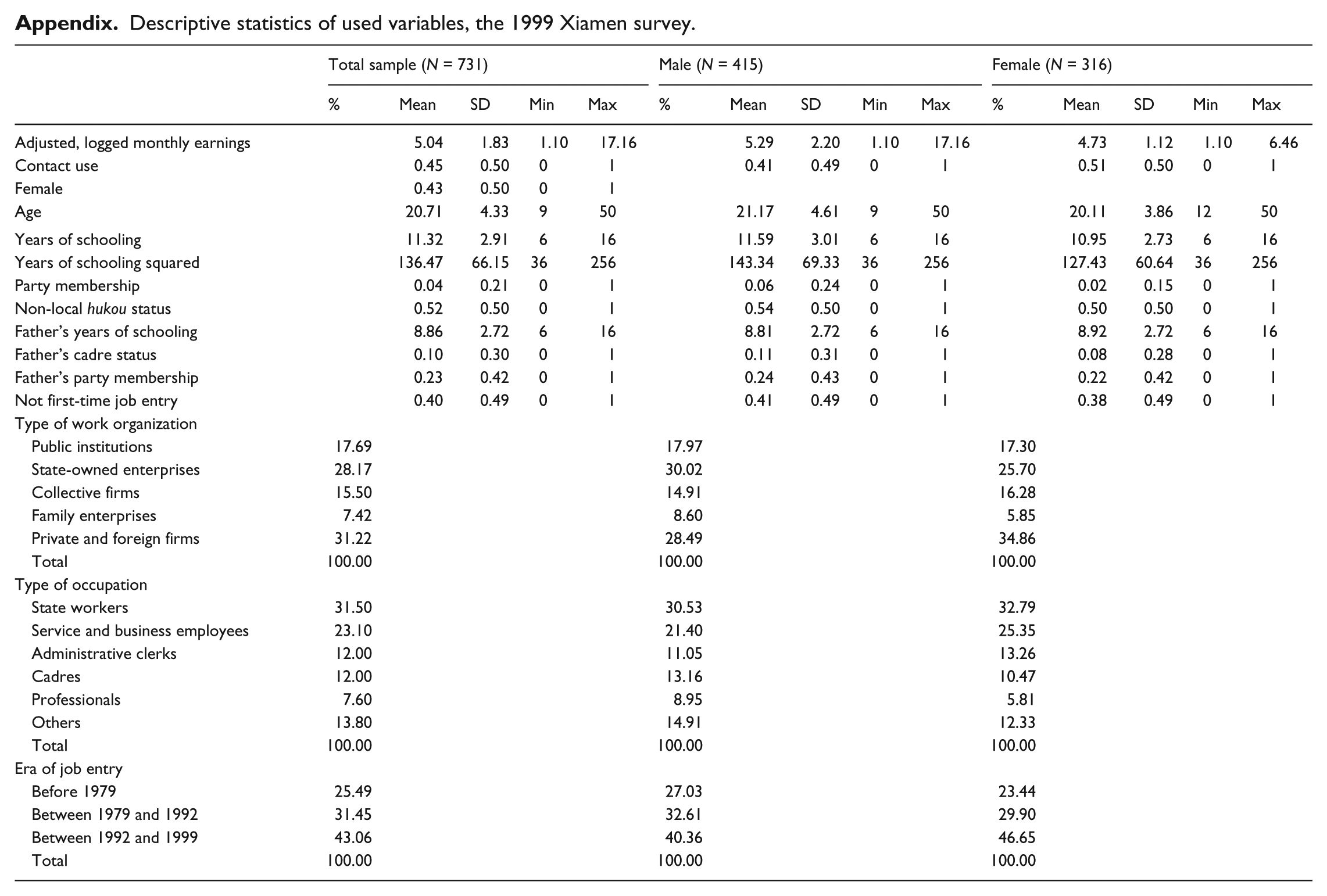
The coding of contact use was based on the question: ‘Have you ever used any type of informal help in order to get into your current workplace?’ This variable was coded 1 if the respondent reported receiving help from any individual(s), and coded 0 if the respondent reported getting no help during job placement. Gender was a binary variable with female coded 1 and male coded 0. Both individual and job placement characteristics were included as control variables. Individual characteristics were age, education (measured by years of schooling), party membership (with party members coded 1 and non-party members coded 0), hukou status (with having a local hukou coded 1, and not having a local hukou coded 0), and family background (measured by father’s years of education, cadre status and party membership). Job placement characteristics included work history, type of work organization, occupational type and era of job entry. Work history distinguished job changers (coded 1) from first-time job entrants (coded 0). It is necessary to emphasize that job changers strictly referred to respondents who switched into a completely different work organization, and a position change or promotion within the same work organization was not included in the analysis. The ‘type of work unit’ was a dummy-coded categorial variable, consisting of SOEs, governmental institutions, collective firms, small family businesses, and private, foreign, or hybrid firms. The variable ‘occupational type’ consisted of six groups, including production workers, service sector employees, administrative clerks, cadres, professionals and others. The ‘era of job entry’ was divided along the timeline of the socioeconomic reforms, including the pre-reform era before 1979, the first stage of the reforms between 1979 and 1991, and the second stage of the reforms between 1992 and 1999. Due to the small sample size, university graduates, migrant workers and laid-off state workers were not further distinguished. However, differences in these three subgroups could be identified by other measurable characteristics, such as age, education and the hukou status. Marital status and presence of children in the household could not be included in the analysis, as available information in the questionnaire only captured the respondent’s status at the time of the interview, rather than when the respondent first entered the most recent work organization. Descriptive statistics of all used variables are presented in the Appendix.
Methods
Along with the traditional OLS model, the QRM approach was adopted to test the hypotheses. General linear regression models (such as the ordinary least squares) are based on a homoscedastic assumption, meaning that the effects of covariates do not vary with the case’s location in the distribution of the dependent variable. Although the transformation of a skewed distribution into a normal one is often adopted when the violation of homoscedasticity occurs, the commonly used method of log-transforming income does not guarantee ‘monotone equivariance’ of such transformation in OLS models (Hao and Naiman, 2007: 39–40). In other words, the assumption of homoscedasticity of OLS models may not be satisfied by simply log-transforming an income distribution. QRM successfully avoids estimation biases due to the violation of homoscedasticity in a linear regression, as the estimation is not based on a univariate quantile (indicated by the mean value in OLS models), but rather, a conditional quantile in any locality throughout the distribution. More specifically, for a cumulative distribution function of logged income,
Results
Following the conventional analytical strategy to estimate the effect of contact use on the average gender earnings gap, Table 1 reports the results of the OLS models. The modelling strategy is as follows. First, the gender earnings gap is estimated with individual and job placement characteristics controlled. This model echoes the structural perspective in the existing literature, by examining the extent to which the gender effect can be explained by pre-existing gender differences. Second, contact use is added into the model to examine whether or not job placement behaviour itself has an impact on individual earnings, with covariates controlled. Last, the interaction term between contact use and gender is included. Comparing Models 1 through 3, the effects of individual and job placement characteristics by and large remain consistent. This means that individual and job placement characteristics cannot substitute for contact use, which has an effect on the gender earnings gap independent of other measurable characteristics. Namely, a behavioural perspective focusing on contact use can indeed contribute to explaining the part of the gender earnings gap that cannot be understood from the conventional, structural perspective. Interaction terms between gender and individual as well as job placement characteristics are not included in the models, also due to the research purpose of this study – namely, explaining the earnings gap from a behavioural rather than structural perspective.
OLS estimations of adjusted logged monthly earnings, the 1999 Xiamen survey.
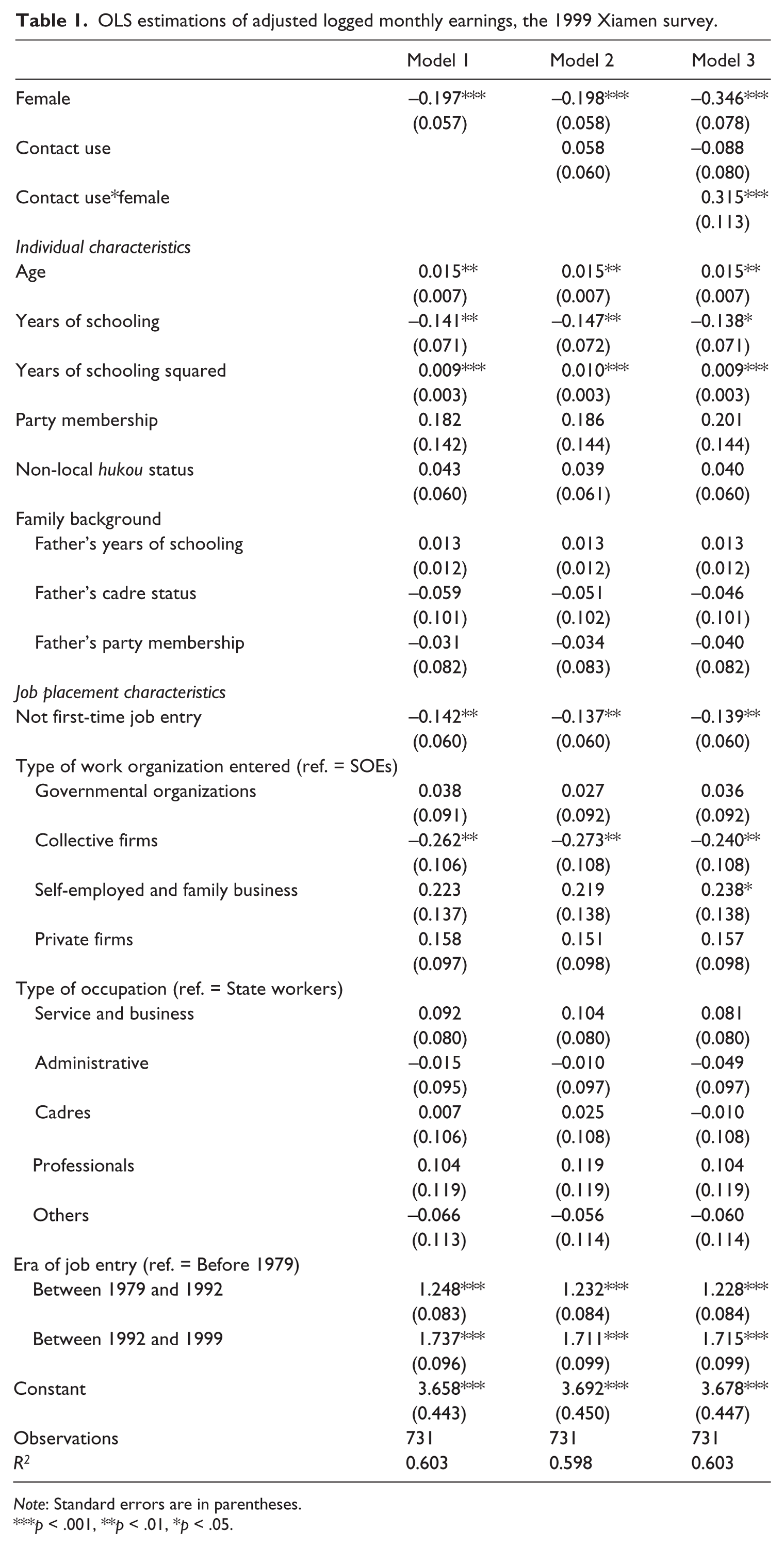
Note: Standard errors are in parentheses.
p < .001, **p < .01, *p < .05.
As the full model (Model 3) shows, without controlling for contact use, logged income is 0.2 points lower for women than for men, which means that women’s earnings are, on average, 18% (= 1–e–0.2) lower than men’s, both individual and job placement characteristics being equal. This finding resonates well with the commonly acknowledged gender pay gap in the formational stage of urban China’s market economy (Gustafsson and Li, 2000; Knight and Song, 2003; Shu and Bian, 2003). The inclusion of contact use per se does not change an average person’s earnings significantly. However, when the interaction between contact use and gender is taken into account, the gender earnings gap differentiates significantly. Other covariates being equal, women contact users earn only 3% (= 1–e0.315–0.346) lower than average men’s earnings, while women non-contact users’ earnings drop to 71% (= e–0.346) of average men’s earnings, widening the gender gap to 29%. These findings show that in Xiamen’s labour market up to 1999, the effect of contact use is gender specific in an opposite way to what has been commonly observed in the Western context: men do not benefit from using contact in job placement, as the main effect of contact use tends to influence earnings negatively, though this tendency is not statistically significant; women’s contact use, by contrast, enhances women’s earnings significantly. As a result, contact use plays a positive role in narrowing the earnings gap between women contact users and men, by enhancing women contact users’ earnings. Women who did not use contacts in job placement are pushed to the bottom of the economic hierarchy, resulting in a much wider earnings gap relative to men.
In terms of individual characteristics, age is positively associated with earnings. Its quadratic term has no significant effect, and is thus excluded from model estimation. Education has a significant, U-shaped effect on one’s earnings. From 8 years (= 0.138/2*0.009) of education onwards, the increase in education increases an average person’s earnings significantly. Other individual characteristics, such as party membership, hukou status and family background do not seem to play any significant role in Xiamen’s labour market up to the year 1999.
In terms of job placement characteristics, other covariates being equal: job changers who switched between work organizations earn significantly less than their counterpart first-time job entrants. This shows that at the formational stage of the market economy in urban China, voluntary job change was not a common phenomenon. Instead, job changes occurred mainly because the majority of state workers were laid off during the marketization process of the state sector throughout the country in the late 1990s. Millions of former state workers, most of whom were poorly educated, middle-aged women, were forced to look for re-employment in the labour market around this period (Gold et al., 2009). Besides their disadvantages in age and education, job changers’ lower earnings relative to first-time job entrants may also be due to characteristics that are not easily measured in the analysis, such as adaptability to a newly emerging market economy. Compared to job placement in SOEs, entering a collective firm significantly decreases one’s earnings, while being self-employed or running a family business significantly increases earnings after the interaction of contact use and gender is controlled, as shown in Model 3. As expected, occupational type has no significant effect on earnings, mainly because an occupational system had not yet been fully developed and the job hierarchy was still mainly based on the type of work organizations at the early stage of urban China’s market economy. Coefficients of job entry stages show that the later the individual enters the workplace, the higher the individual’s pay is. This corresponds well to findings in the previous literature about the changing economic reward mechanism due to marketization (Shu and Bian, 2003).
Results in Table 1 present the effect of women’s contact use on the average gender earnings gap, and fail to reveal the variation in the effect of contact use among individuals at different levels of the earnings hierarchy. To test whether or not the glass ceiling effect exists in women’s contact use premium, two QRM models are used to estimate coefficients at each decile of the income distribution (excluding the 10th decile). Table 2 only presents effects of gender, contact use and their interaction, as control variables, including individual and job placement characteristics, have shown largely consistent patterns across nine deciles, and those patterns are not significantly different from the average ones reported in Table 1 (complete results table is available upon request).
QRM estimations of adjusted logged monthly earnings, the 1999 Xiamen survey.
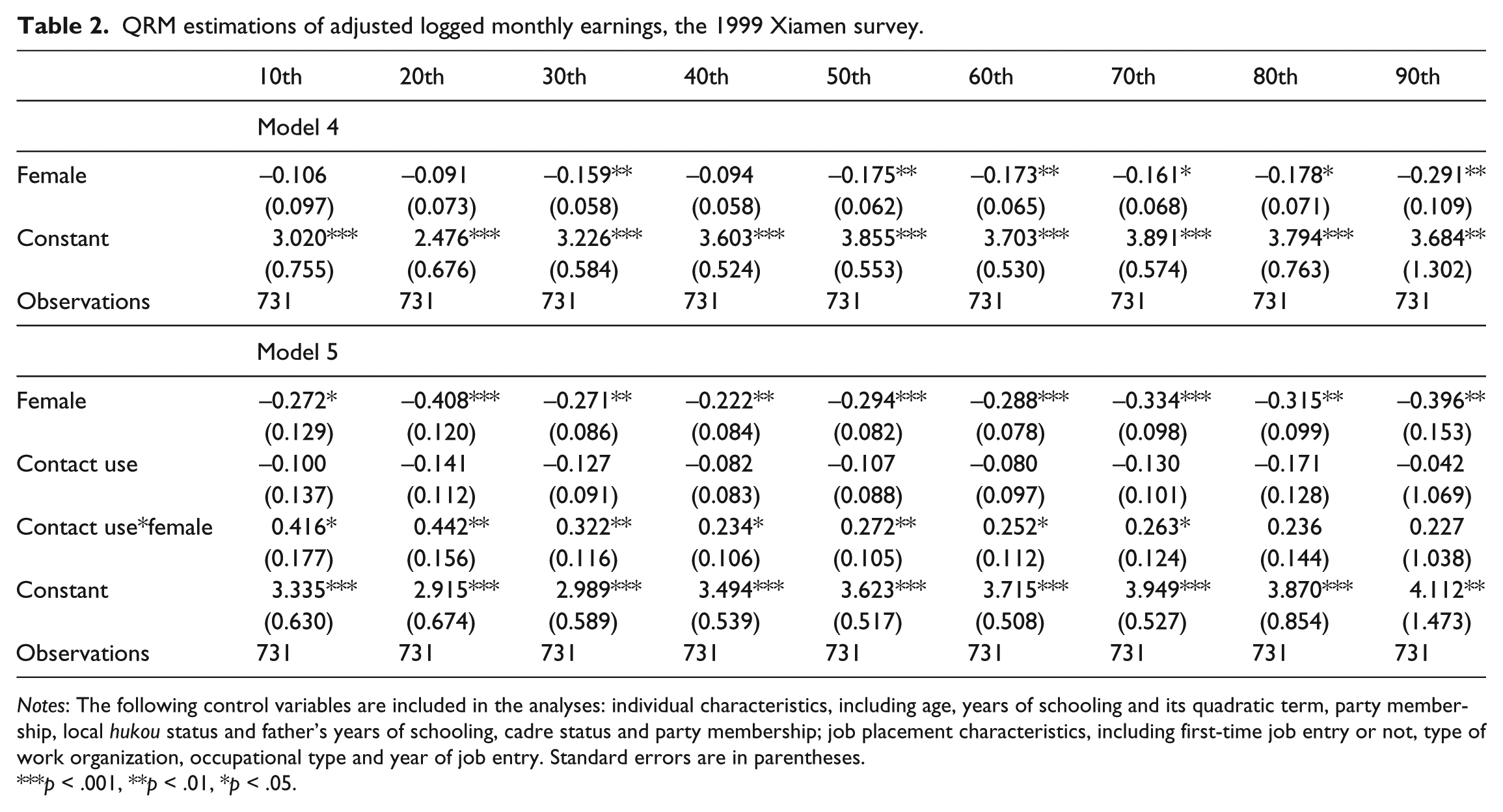
Notes: The following control variables are included in the analyses: individual characteristics, including age, years of schooling and its quadratic term, party membership, local hukou status and father’s years of schooling, cadre status and party membership; job placement characteristics, including first-time job entry or not, type of work organization, occupational type and year of job entry. Standard errors are in parentheses.
p < .001, **p < .01, *p < .05.
Model 4 presents the gender earnings gap without controlling for contact use in job placement. Although negative, the coefficient of being female is not significant in the lowest two deciles. This coefficient fluctuates slightly in the middle of the income distribution, and surges to a significantly higher level in the ninth decile. Therefore, overall speaking, other covariates being equal, the gender earnings differential shows a generally widening tendency in favour of men when the location moves up the economic hierarchy in Xiamen up to 1999.
Model 5 shows a rather different pattern, after contact use and its interaction with gender are included. The coefficient of being female is consistently significant in the negative direction throughout the income distribution, while the coefficient of its interaction with contact use continues to be significantly positive until the seventh quantile. By taking both into account, the gender earnings gap shows a reversed trend for women contact users in the lower end of income distribution, as by using contacts in job placement, those women’s earnings are even higher than the average men’s in the corresponding decile. It is also noticeable that women’s contact use premium declines as the location moves towards the upper end of income distribution. From the fifth decile onwards, women contact users’ earnings begin to fall behind, though they are still much better off as compared to women non-contact users in terms of the earnings disadvantage relative to men. The contact use premium completely disappears in the highest two deciles, where women earn 27% (= 1–e–0.315) and 33% (= 1–e–0.396) less than their male counterparts in the eighth and ninth decile, respectively, regardless of using contacts or not in job placement.
In order to further illustrate the above findings, Figure 2 plots the predicted effects of contact use for men and women across deciles, by fixing other covariates to their mean values and using the linear fit option in Stata. As Figure 2 shows, men non-contact users are always at the top whereas women non-contact users are always at the bottom of the earnings hierarchy throughout the earnings distribution of the local labour market. Women contact users seem to be better off than men contact users until the seventh decile, after which point the earnings of male contact users and non-users show a tendency to converge, as do the earnings of female contact users and non-users. It needs to be pointed out that the line of men contact users is plotted by taking into account non-significant coefficients of contact use across deciles, and that the line of women contact users at the highest two deciles is plotted by including non-significant coefficients of the interaction term between gender and contact use. In other words, the line of men contact users is not statistically different from that of men non-contact users; likewise, the line of women contact users is not statistically different from that of women non-contact users at the eighth and ninth deciles of income distribution.
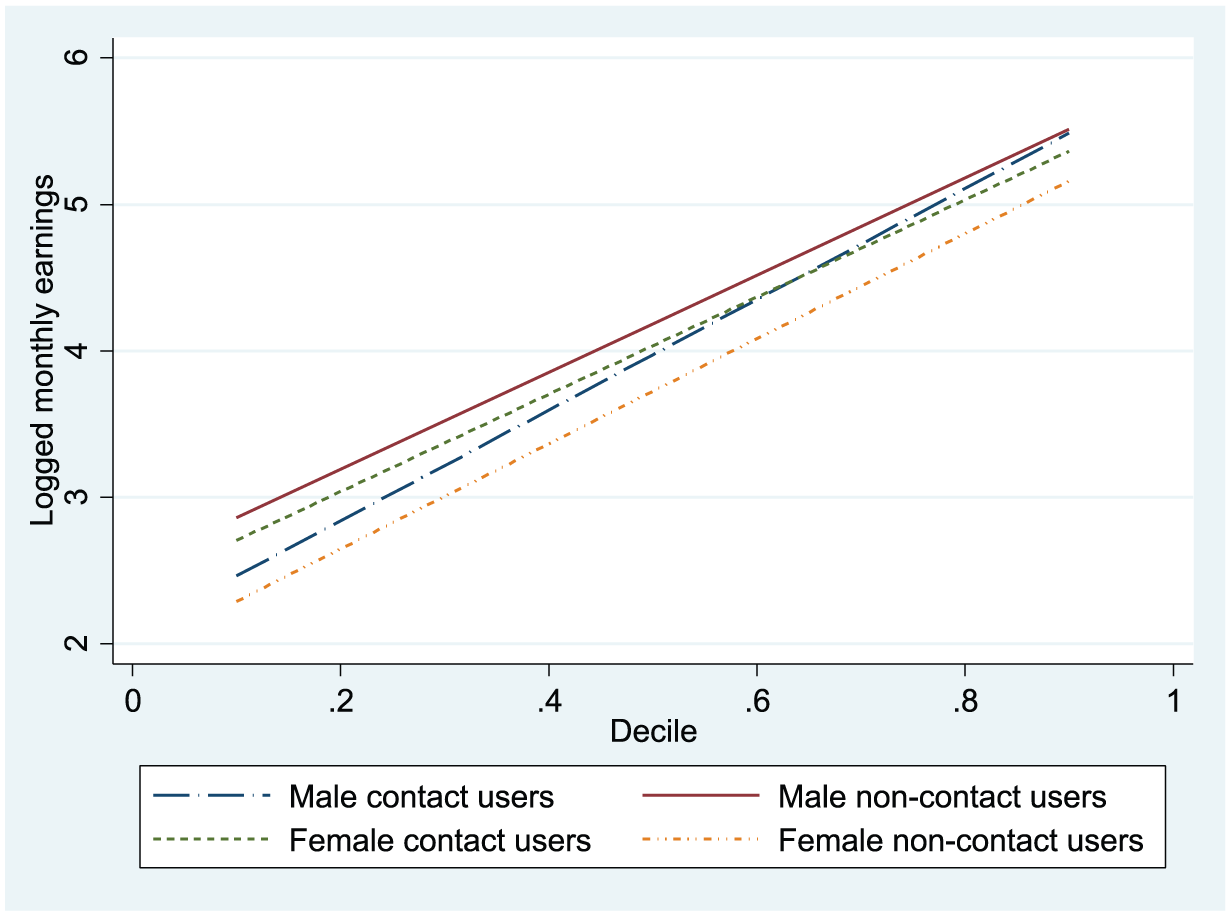
Predicted income differentials by gender and contact use across deciles of income distribution based on Model 5, Xiamen 1999.
Conclusions and discussion
Unlike the majority of existing studies that explain the gender earnings gap from a structural perspective by focusing on gender differences in human capital and access to different jobs, occupations and sectors, this study attempts to understand the unexplained part of gender earnings inequality from a behavioural perspective. The theoretical significance of this perspective is to link individual behaviour – based on individuals’ observable characteristics as well as unobservable values, preferences and motives – to the local labour market context. As individual behaviours are always confined by contextual constraints, the consequences of these behaviours would vary when the surrounding context changes. This study thus contributes to the existing gender inequality literature, by paying attention to the importance of the labour market context in understanding the part of gender inequality that cannot be explained from a structural perspective.
To do so, this study focuses on how earnings are affected by contact use in job placement. Studies conducted in the Western labour market have generally found that women’s contact use in job placement does not significantly benefit their income gains relative to men. This phenomenon is usually attributed to women’s networking preferences, and the contextual effect is seldom taken into account. By adopting a dataset collected in a Chinese city at the formational stage of the market economy, this study re-examines the role women’s contact use plays in job placement in a labour market where the dominant type of gender segregation was in a transitional process from sectoral to occupational segregation.
The OLS estimations show that contact use significantly narrows the average gender earnings gap by enhancing women’s earnings. However, what remains unclear from the OLS approach is whether this positive effect of women’s contact use would vary at different levels of the earnings hierarchy. If the effect of women’s contact use remains consistent throughout the earnings hierarchy, it would be direct evidence to show that women in high-paying jobs do not suffer more than their female counterparts in low-paying jobs from gender segregation. If the positive effect of women’s contact use is indeed stronger in the lower than the upper end of the earnings hierarchy, this would be direct evidence to show that the extent of gender segregation intensifies as a woman moves up the earnings hierarchy. The QRM approach contributes to clarifying this concern. By comparing Models 4 and 5, it is clear that without taking into account contact use, the results in Model 4 have disguised earnings differentials within the group of women. Results in Model 5 show that women who did not use contacts in job placement fare much worse than their male counterparts. By contrast, women who used contacts can significantly narrow their earnings gap relative to their male counterparts, and in fact, women who used contacts in job placement earn more than the average men’s earnings in the lower end of income distribution. Women’s contact use premium declines towards the upper end of income distribution. At the highest two deciles of income distribution, women contact users are not statistically different from women non-contact users, although the coefficients of women’s contact use remain positive.
This is well in line with the contextual characteristics, which show overall significantly increased female participation accompanied with gender segregation in high-paying jobs in Xiamen in 1999. Therefore, the findings in this study offer strong evidence of contextually sensitive outcomes of gender-specific contact use in job placement. While women’s contact use is likely to diminish their earnings relative to men’s in a gender-segregated labour market, as shown in the existing literature, women’s contact use can play a positive role in narrowing the gender earnings gap by enhancing women’s earnings in China’s transitional context. This positive role declines as the extent of gender segregation increases with the earnings level, so that contact use has no significant impact on the gender earnings gap in the two highest deciles of income distribution in the local labour market context.
Admittedly, this study has some limitations, mainly with respect to the available data. Although the 1999 Xiamen survey is suitable for the research purposes of this study, its cross-sectional and small-scale features require caution in understanding and generalizing the above findings. Some control variables, such as marital status and presence of children in the household, cannot be included in the analysis, because the cross-sectional survey does not capture information corresponding to the time when the respondent first entered the most recent work organization. A large-scale longitudinal dataset is needed to enable a more sophisticated and comprehensive analysis in future research.
Despite that, this study has implications for the role contact use plays in the gender earnings gap, with structuralized gender segregation in a local employment environment taken into account. Findings suggest that female contact users are indeed better off than female non-contact users in the low-paid segment, where female representation is significant. As one moves up the income hierarchy, while male representation increases, female representation declines, and as a result, so does the positive effect of women’s contact use on their earnings. As structuralized gender segregation is ubiquitous in human societies, this study is intended to highlight a currently under-studied issue: namely, the linkage between individual behaviour and the surrounding context. Practically speaking, this study shows strong evidence that policies aiming to improve gender equity in the labour market should not focus only on the empowerment of individual women. It is highly likely that women’s disadvantaged economic status relative to men will not change significantly with women’s improved human capital and/or increased number of male contacts in job placement, if the extent of gender segregation in the local labour market remains unchanged. Policies that aim to fundamentally change structuralized gender segregation in the labour market are therefore particularly needed in the present society, which has witnessed a surge in women’s human capital but significantly less improvement in their earnings. For this reason, an approach to understanding the gender earnings gap by taking the contextual factor into account should be of general importance. By conducting this study, we hope to have taken a preliminary step in understanding the previously unexplained part of gender earnings inequality with a focus on contextually sensitive outcomes of individual behaviour in the local labour market.
Footnotes
Appendix
Descriptive statistics of used variables, the 1999 Xiamen survey.
| Total sample (N = 731) |
Male (N = 415) |
Female (N = 316) |
|||||||||||||
|---|---|---|---|---|---|---|---|---|---|---|---|---|---|---|---|
| % | Mean | SD | Min | Max | % | Mean | SD | Min | Max | % | Mean | SD | Min | Max | |
| Adjusted, logged monthly earnings | 5.04 | 1.83 | 1.10 | 17.16 | 5.29 | 2.20 | 1.10 | 17.16 | 4.73 | 1.12 | 1.10 | 6.46 | |||
| Contact use | 0.45 | 0.50 | 0 | 1 | 0.41 | 0.49 | 0 | 1 | 0.51 | 0.50 | 0 | 1 | |||
| Female | 0.43 | 0.50 | 0 | 1 | |||||||||||
| Age | 20.71 | 4.33 | 9 | 50 | 21.17 | 4.61 | 9 | 50 | 20.11 | 3.86 | 12 | 50 | |||
| Years of schooling | 11.32 | 2.91 | 6 | 16 | 11.59 | 3.01 | 6 | 16 | 10.95 | 2.73 | 6 | 16 | |||
| Years of schooling squared | 136.47 | 66.15 | 36 | 256 | 143.34 | 69.33 | 36 | 256 | 127.43 | 60.64 | 36 | 256 | |||
| Party membership | 0.04 | 0.21 | 0 | 1 | 0.06 | 0.24 | 0 | 1 | 0.02 | 0.15 | 0 | 1 | |||
| Non-local hukou status | 0.52 | 0.50 | 0 | 1 | 0.54 | 0.50 | 0 | 1 | 0.50 | 0.50 | 0 | 1 | |||
| Father’s years of schooling | 8.86 | 2.72 | 6 | 16 | 8.81 | 2.72 | 6 | 16 | 8.92 | 2.72 | 6 | 16 | |||
| Father’s cadre status | 0.10 | 0.30 | 0 | 1 | 0.11 | 0.31 | 0 | 1 | 0.08 | 0.28 | 0 | 1 | |||
| Father’s party membership | 0.23 | 0.42 | 0 | 1 | 0.24 | 0.43 | 0 | 1 | 0.22 | 0.42 | 0 | 1 | |||
| Not first-time job entry | 0.40 | 0.49 | 0 | 1 | 0.41 | 0.49 | 0 | 1 | 0.38 | 0.49 | 0 | 1 | |||
| Type of work organization | |||||||||||||||
| Public institutions | 17.69 | 17.97 | 17.30 | ||||||||||||
| State-owned enterprises | 28.17 | 30.02 | 25.70 | ||||||||||||
| Collective firms | 15.50 | 14.91 | 16.28 | ||||||||||||
| Family enterprises | 7.42 | 8.60 | 5.85 | ||||||||||||
| Private and foreign firms | 31.22 | 28.49 | 34.86 | ||||||||||||
| Total | 100.00 | 100.00 | 100.00 | ||||||||||||
| Type of occupation | |||||||||||||||
| State workers | 31.50 | 30.53 | 32.79 | ||||||||||||
| Service and business employees | 23.10 | 21.40 | 25.35 | ||||||||||||
| Administrative clerks | 12.00 | 11.05 | 13.26 | ||||||||||||
| Cadres | 12.00 | 13.16 | 10.47 | ||||||||||||
| Professionals | 7.60 | 8.95 | 5.81 | ||||||||||||
| Others | 13.80 | 14.91 | 12.33 | ||||||||||||
| Total | 100.00 | 100.00 | 100.00 | ||||||||||||
| Era of job entry | |||||||||||||||
| Before 1979 | 25.49 | 27.03 | 23.44 | ||||||||||||
| Between 1979 and 1992 | 31.45 | 32.61 | 29.90 | ||||||||||||
| Between 1992 and 1999 | 43.06 | 40.36 | 46.65 | ||||||||||||
| Total | 100.00 | 100.00 | 100.00 | ||||||||||||
Acknowledgements
This study would have not been possible without Yanjie Bian’s kind support in making the survey dataset available. This article has benefited from constructive comments from Bonnie Erickson, Eric Fong, Alexandra Marin and colleagues at the Mannheim Centre for European Social Research. We are also grateful for all the suggestions received from the audience at the 2014 American Sociological Association Annual Meeting, Economic Sociology, San Francisco.
Declaration of Conflicting Interests
The authors declare that there is no conflict of interest.
Funding
This research received no specific grant from any funding agency in the public, commercial, or not-for-profit sectors.