




Abstract
Sociological research in South Africa presents characteristic features in line with its historical and political phases. This article maps the production of sociological research in South Africa during the apartheid and democratic periods. The data used in the article were drawn from the publication records of South African scholars stored in the database of the Web of Science (WoS). A total of 2342 publications representing the period 1970–2015 was sampled for this scientometric analysis. Employing appropriate statistical tests, the article examines the role of collaboration in the production of sociological knowledge in South Africa, and the relationships that exist among collaboration, international partnerships, subject areas and citations. The analysis shows that South African sociological research has distinctive characteristics that represent the two periods of study. It has benefitted from collaboration, both domestic and international. Collaboration continues to grow in specific subject fields of sociological research in South Africa, and has importance in the visibility of sociological research in the country.
Introduction
Given the historical background, sociological research (used in a broader sense of the term) in South Africa has been an interesting area of study. Scholars (Alexander et al., 2006; Basson and Prozesky, 2015; Buhlungu, 2009; Burawoy, 2009; Crothers, 1997; Hare and Savage, 1979; Hendricks, 2006; Human, 1984; Jubber, 2007; Mapadimeng, 2012; JS Oosthuizen, 1991; K Oosthuizen, 1991; Sooryamoorthy, 2015b, 2016; Uys, 2006; Van Staden and Visser, 1991, 1992; Webster, 2004; Welsh, 1981) have attempted to examine this from different standpoints and have contributed to the understanding of sociological research in South Africa. Although some of these studies were based on empirical data, attempts have yet to be made to map the trajectory of sociological research from the past to the present. This is necessary to understand some of the features of scientific research, namely, collaboration and its effects.
There is an abundance of literature that examines the role of collaboration in scientific research. This article focuses on collaborative dimensions involved in the production of sociological knowledge in South Africa. Given the unique historical background of South Africa, the analysis focuses on two periods: the past (apartheid) and the present (democracy). South Africa was under apartheid rule from 1948 to 1993. In April 1994 it became a democratic country. Employing scientometric data mined from the Web of Science (WoS), the analysis of the first set of data (1970–1990) refers to the apartheid period whereas the second one (1995–2015) relates to the democratic period. The specific questions that are addressed in this article include:
What are the prominent forms of collaboration (domestic and/or international) that are evident in the publications of South African authors during apartheid and democratic periods?
Who are the preferred international research partners of South African authors in terms of partnering countries and their regions?
What are the key subject areas that attracted more national and international collaboration?
Is there any relationship among the subject areas, partnering countries and their regions?
How does collaborative authorship affect the visibility of research publications, measured in terms of citations?
What are the implications for collaboration in sociological research in South Africa?
Data and method
Being a scientometric study, the data were mined from a well-recognized database, the WoS. Although there are issues regarding coverage, this database is widely used for mapping the growth and decline of scientific disciplines. The Social Sciences Citation Index (1945 to present) dataset of the WoS was used for this analysis. In the first stage, all publication records that had at least one author who was affiliated to a South African institution were collected for the entire period of 1945–2015. There were 26,118 publications for this period. In view of the large number of publications, a sampling procedure was adopted. Although the dataset pertained to the period 1945–2015, there were not any publications up until 1966. A sampled year of every five years was therefore selected between 1970 and 2015. This means all publications produced in 1970, 1975, 1980, 1985, 1990, 1995, 2000, 2005, 2010 and 2015 constituted the dataset for this analysis.
The WoS data covered all social science subject areas. In the second stage, sociological subject areas were filtered from the publications for the sampled years. A total of 2342 publications was therefore available for the analysis presented in this article. The sociological subjects included in the dataset were: communication, demography, education, ethnic studies, health care sciences, information studies, public environmental and occupational health, social issues, urban studies, sociology, women’s studies, area studies, criminology, environmental sciences, family studies and cultural studies.
Joint-publication is an index and a proxy of research collaboration; it is the outcome of collaborative efforts. Any publication that involves more than one author is a collaborative research publication. Collaboration can be national (domestic), international or both. When a publication is co-authored by South African scholars who are affiliated to South African institutions, it can be an outcome of domestic collaboration. Domestic collaboration can occur between scholars within the same institution (internal-institutional), in different institutions (external-institutional), or both. When a publication is done with peers in other countries it is a matter of international collaboration. Sometimes a publication can have all forms of collaboration. Imagine a paper written by four authors and two of them were affiliated to the same institution in South Africa, one from a different institution in the country, and the remaining one from overseas. In this case, there is both domestic and international collaboration, and internal-institutional and external collaboration.
Results and analysis
Collaboration
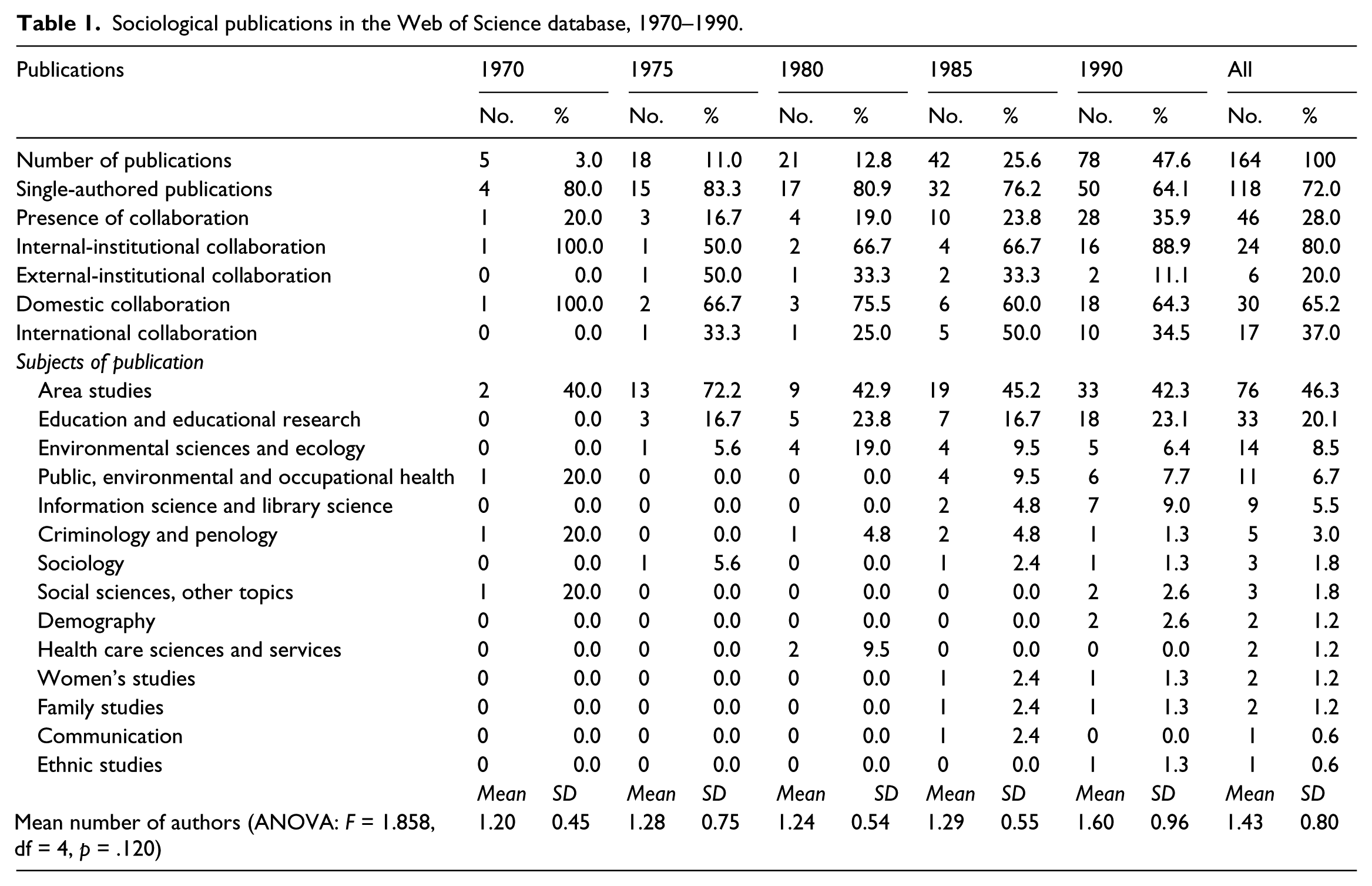
Tables 1 and 2 present the characteristics of publications of South African authors referring to 1970–1990 and 1995–2015, which correspond to apartheid and democratic periods.
Sociological publications in the Web of Science database, 1970–1990.
Sociological publications in the Web of Science database, 1995–2015.
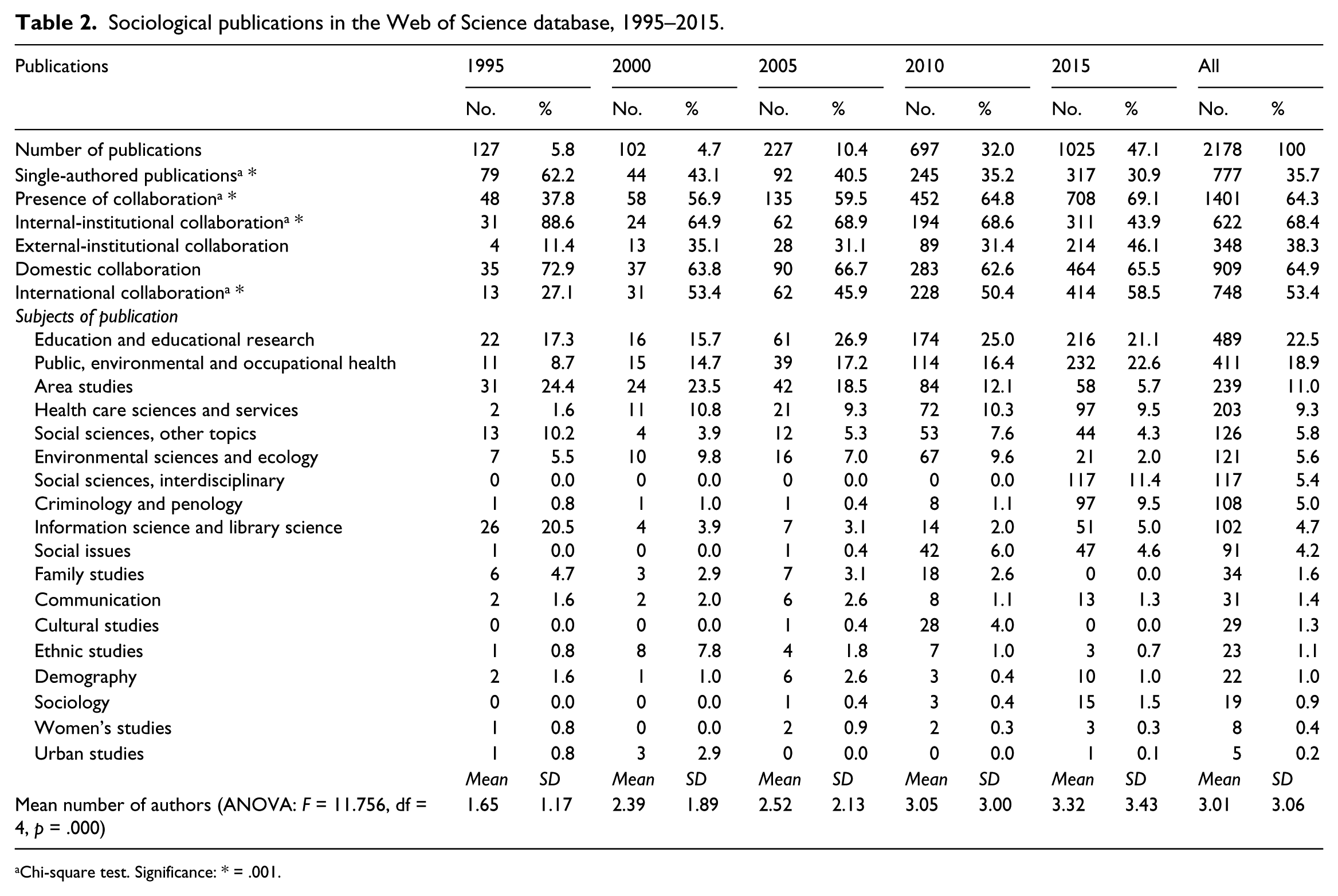
Chi-square test. Significance: * = .001.
In the first period there were 164 publications for the selected years. The number of publications showed a steady increase from 1970 to 1990 (Table 1). Whereas 1970 represented only 3% of the total publications of the entire period, 1990 accounted for 48% of all publications. So, about half of the publications produced during the apartheid period were in 1990. The average number of authors per publication for the period (1970–1990) was 1.43. In 1970 there were 1.2 authors per publication, which increased to 1.6 in 1990. However, the variance across the selected years was not significant in the ANOVA test.
Most of the publications (about three-quarters) for the apartheid period were single-authored (Table 1). The trend showed a decrease in single-authored publications. Eighty percent of the publications in 1970 were single-authored. By 1990, the percentage of single-authored publications had dropped to 64%. Joint-publications were increasing during the period of analysis: from 20% in 1970 to 36% in 1990. Overall, there were 72% single-authored and 28% joint-authored publications for the entire period.
In the second phase (1995–2015) there were 2178 publications (Table 2). The period refers to the new South Africa under the democratic dispensation. A growth in the number of publications was evident since 2000, with that year accounting for 5% of all publications, while 2015 accounted for 47%. The average number of authors per publication for the period was 3.01. The difference across the sampled years was statistically significant in ANOVA. This difference was shown in an ascending pattern. In 1995 the average number of authors per publication was 1.65, which increased to 2.39 in 2000 and 3.32 in 2015.
About 36% of publications during the second period were single-authored. The numbers for single-authored publications decreased from 62% in 1995 to 31% in 2015. The chi-square test showed a significant association between the sampled years and the number of non-single-authored publications. Between 1995 and 2015 the percentage of single-authored publications was halved (from 62% to 31%). Collaboration was present among 64% of all publications referring to the democratic period. Between the years 1995 and 2015, the presence of collaboration increased from 38% to 69%. The most prominent increase in collaborative papers was seen between 1995 and 2000, from 38% to 57%, an increase of 19 percentage points.
With regard to the type of collaboration (domestic and international), 65% of the joint-publications for the apartheid period were produced in domestic collaboration (Table 1). This is only 18% of all the publications (both single and joint) that South Africans produced during the period of analysis. Of those that had domestic collaboration, 80% of them were internal-institutional. Only 20% of the domestic collaboration occurred between two or more different institutions (external-institutional). It was the internal-institutional collaboration and not external-institutional collaboration that was growing in the country in the closing years of apartheid.
During the apartheid period, international collaboration existed in 37% of all the joint-publications. If all publications (both single and joint) for the period are taken into account, the percentage of international collaboration was only 10%. One in every 10 publications had the participation of scholars from other countries. The rate of international collaboration had been increasing since 1985.
Of the joint-publications during the democratic period, 65% (909 out of 1401) had domestic collaboration. In another count, domestic collaboration was present among 42% of all the papers, single- or joint-authored. With regard to type of domestic collaboration, 68% of the publications were internal-institutional and 38% were external-institutional. While internal-institutional collaboration declined (from 89% in 1995 to 44% in 2015), growth was evident in external-institutional collaboration (from 11% in 1995 to 46%).
In the new South Africa (1995–2015) international collaboration was evident in 34% of all publications (both single- and joint-authored). The percentage was 53% when international collaboration was examined among all collaborative publications. International collaboration had been growing, in particular since 2005. Half of the joint-publications in 2010 had international collaboration. This increased to 59% in 2015.
International research partners of South African authors
International collaboration was apparent in a considerable number of publications during the two periods of analysis. However, the percentages varied between the periods. During the apartheid era, 37% of all the joint-publications were the product of South Africans and international scholars. This percentage grew to 53% in the second period.
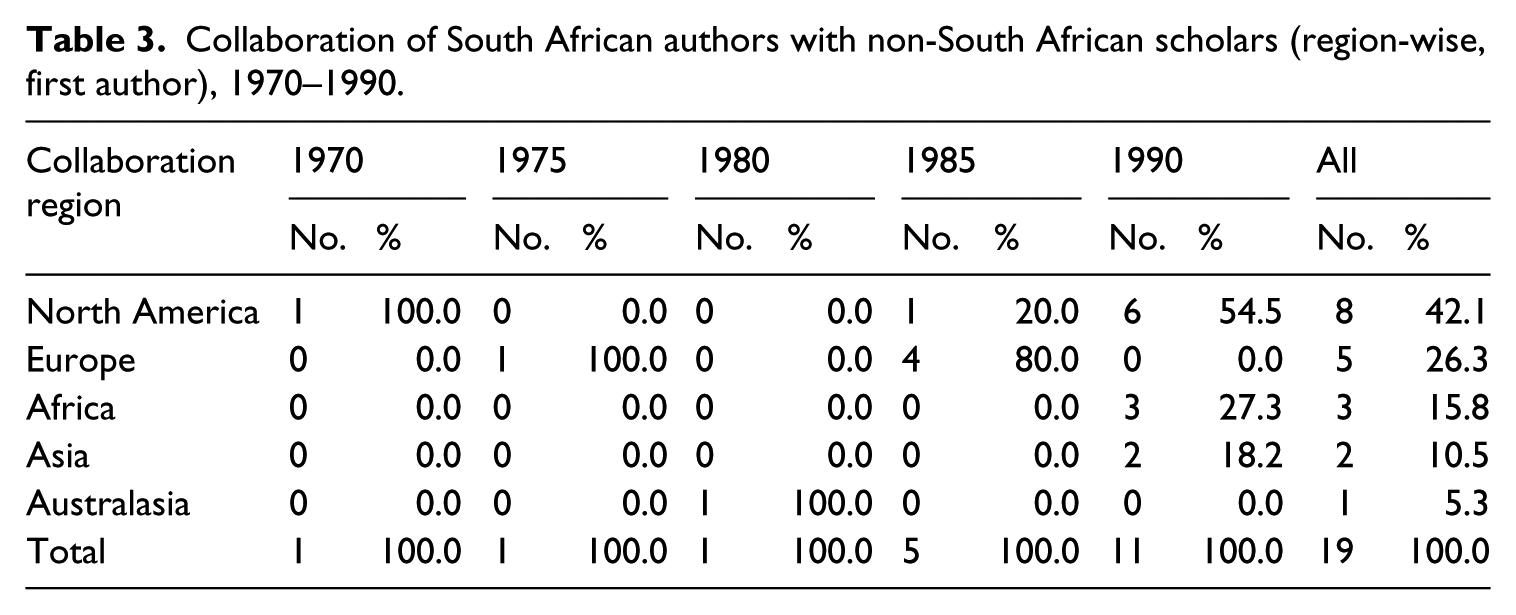
International collaboration of South African authors can be examined at two levels: the continental regions and the individual countries of the partners. As the average number of authors for the periods ranged from 1.43 to 3.01, it is important to examine at least the first two authors of the publications. Table 3 shows the regions of the collaborators who worked with South African authors. During the apartheid period there were not many publications that had international collaboration (referring to the first international author, see Table 3). Most of the internationally collaborated papers had scholars from North America (42%) and Europe (26%). The remaining publications were with African (16%) and Asian (11%) collaborators. For second international authors Europe dominated (75%) and Africa (25%) followed. There were not any authors representing other regions when the second international author was considered.
Collaboration of South African authors with non-South African scholars (region-wise, first author), 1970–1990.
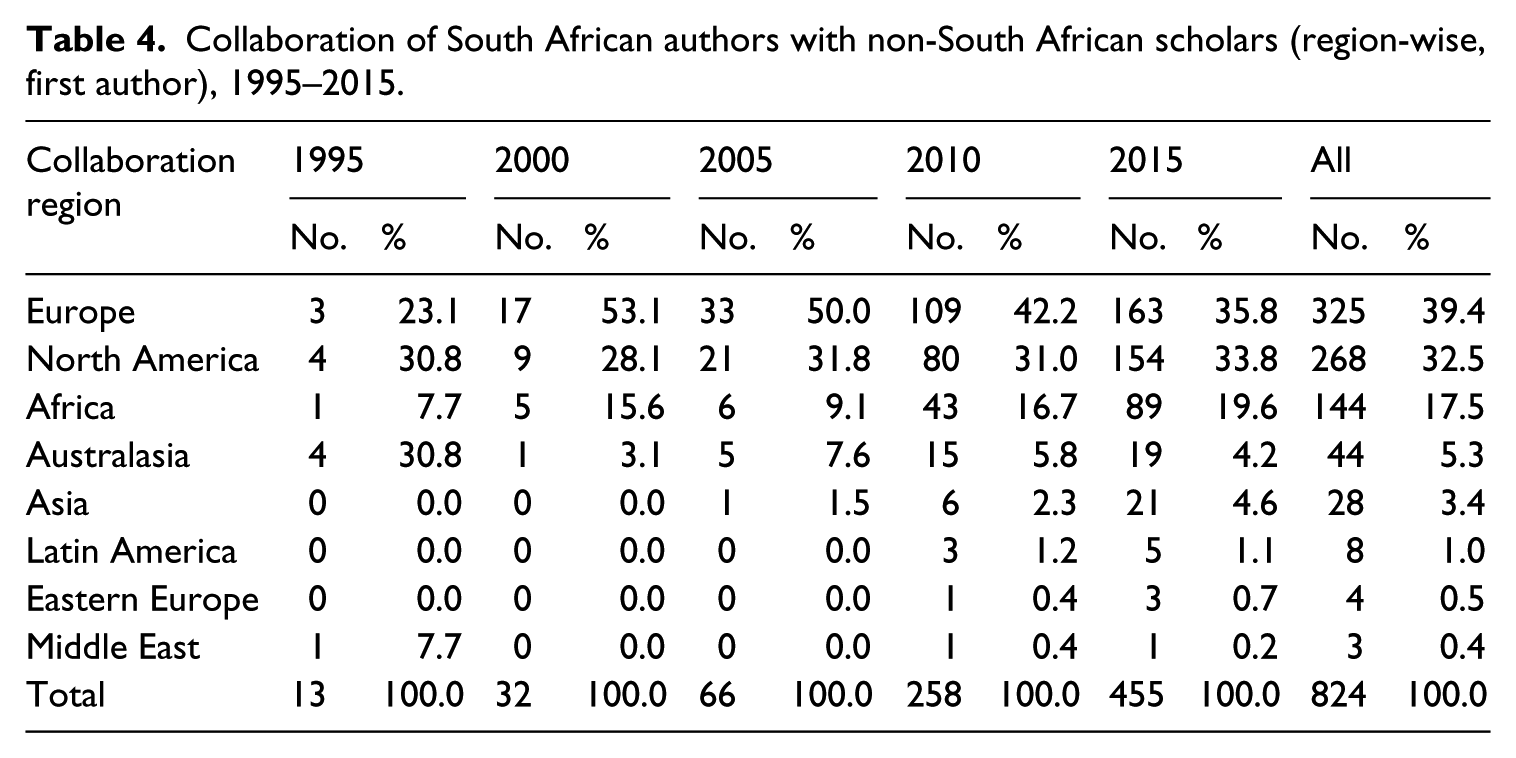
As shown above, since the apartheid period there has been an increased level of international collaboration in sociological research. The first two international partners have been examined. Examining the location by region of international partners showed that for about 40% of the publications the first author was from Europe (Table 4). This was closely followed by North America (33%). African countries participated in the production of 18% of the publications with South African authors. There were a few publications with partners from Australasia and Asia. Across the years some shifts in international participation were evident. In the early years of democracy, three continents were active in collaboration with South Africa. They were Australasia and North America (31% each), and Europe (23%). In both 2000 and 2005 Europe became the predominant partner with more than half of the internationally collaborated publications. The involvement of North America remained more or less at the same level in all the years during this period. For Australasia the participation declined substantially from 31% in 1995 to 4% in 2015. African collaboration, on the other hand, grew from 8% in 1995 to 20% in 2015 whereas the Asian involvement increased from nil to 5% in 2015.
Collaboration of South African authors with non-South African scholars (region-wise, first author), 1995–2015.
A different pattern was found when the second international author was considered. North American and European authors mostly collaborated with South African authors (Table 5). One-fifth of the publications brought in scholars from African countries. Other continental representations were not significant.
Collaboration of South African authors with non-South African scholars (region-wise, second author), 1995–2015.
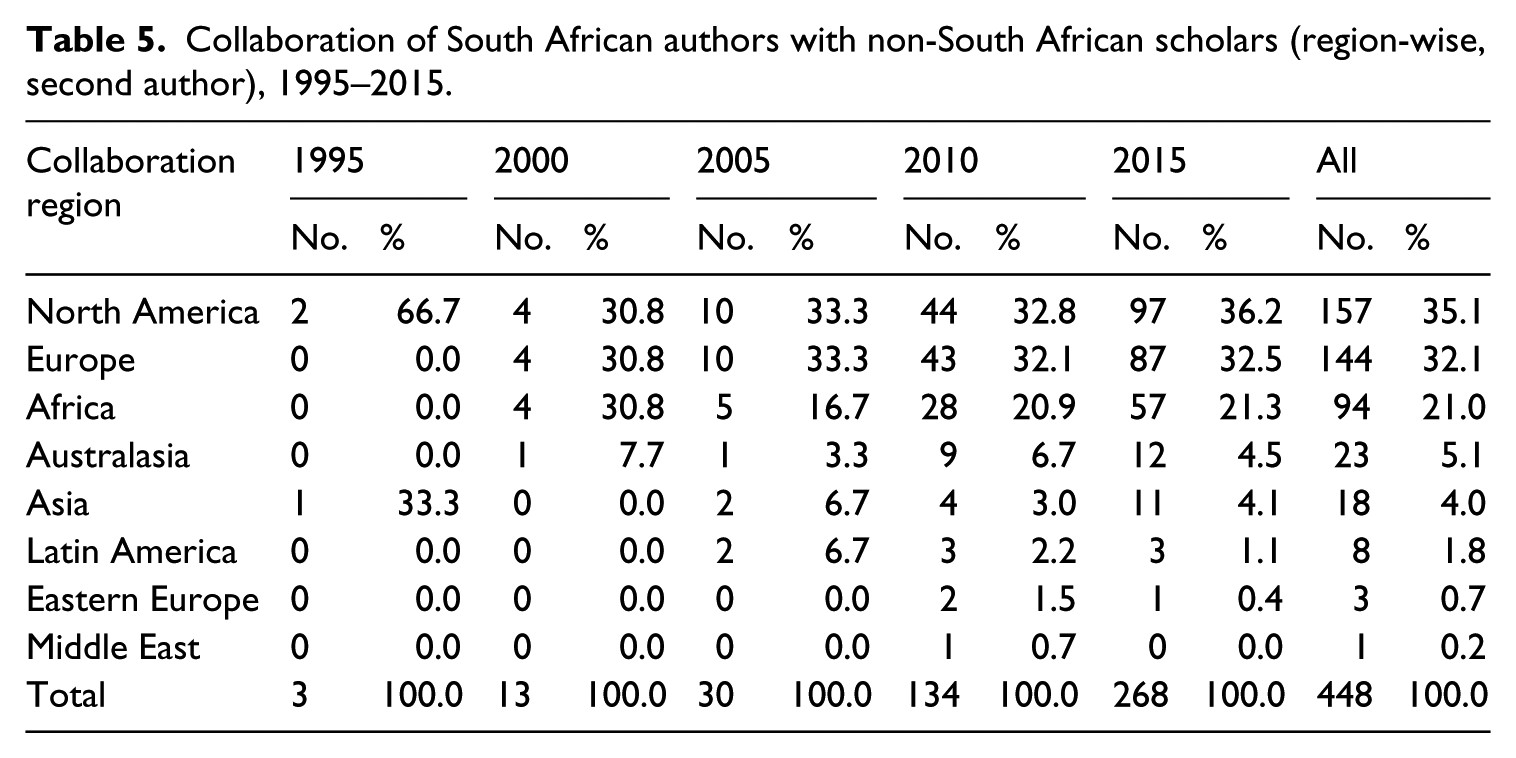
Over the years, continental involvement in publications with South African scholars has been changing. In 1995, for the second international partner, there were only two continents that were involved in collaboration with South Africans (Table 5). These were North America (67%) and Asia (33%). Asian collaboration declined from 1995 to 4% in 2015. North American participation had been almost halved by 2015 (36%). African collaboration was found in 31% of the publications in 2000, which by 2015 had reduced to 21% while increasing the number of publications. Europe continued to maintain the same level of collaboration since 2000.
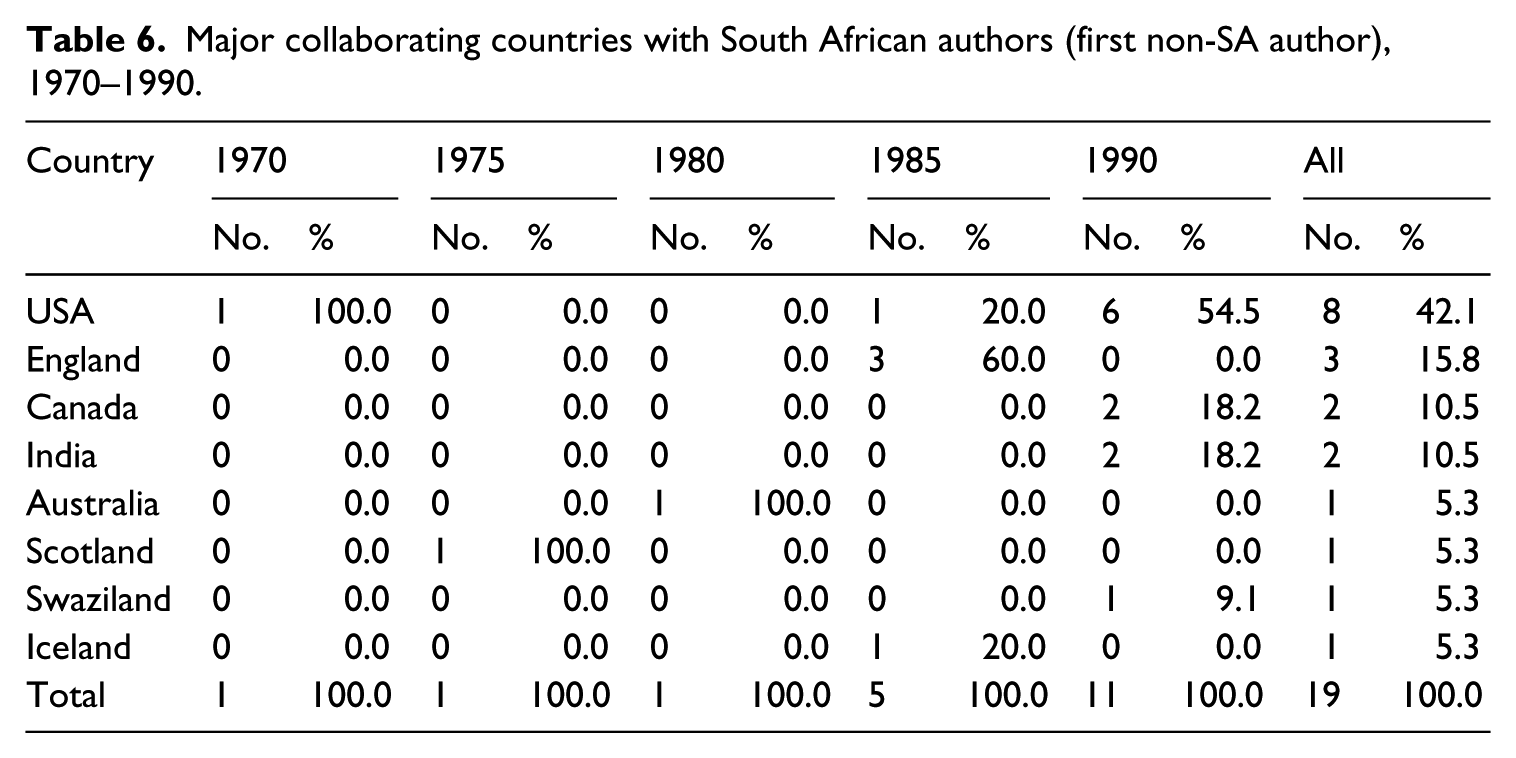
The major partnering countries from where scholars came to join South African scholars for the two periods are shown in Tables 6, 7 and 8. During apartheid times there were four major countries for the first international author: the United States, the UK, Canada and India (Table 6). For the second international author there were only two countries, namely, the United States and Canada.
Major collaborating countries with South African authors (first non-SA author), 1970–1990.
Major collaborating countries with South African authors (first non-SA author), 1995–2015.

Includes all other countries not given in the table.
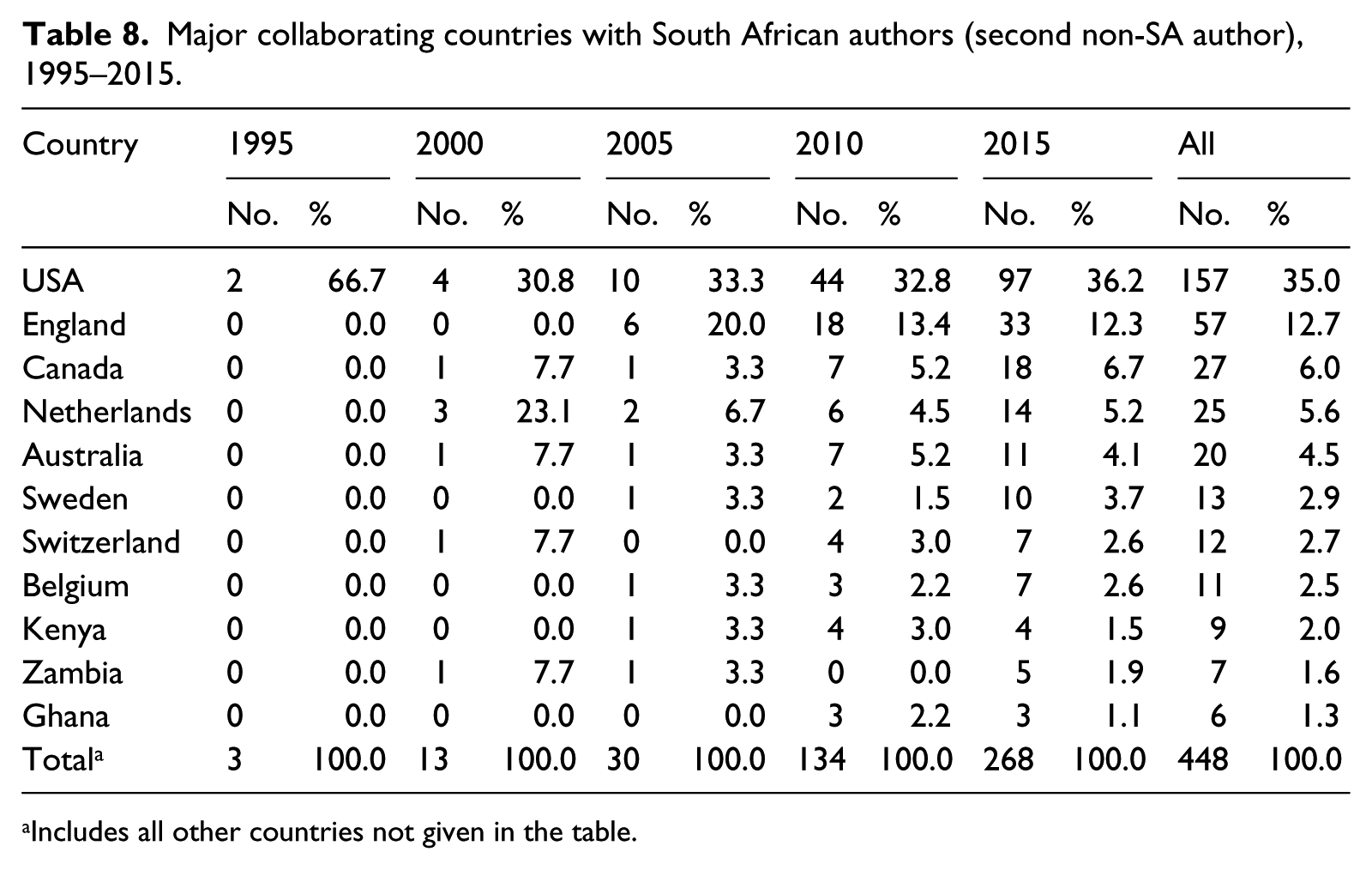
Major collaborating countries with South African authors (second non-SA author), 1995–2015.
Includes all other countries not given in the table.
During the democratic period the major countries engaged in collaboration with South Africans were the United States and England (Table 7, for the first international author). Canada, Australia, the Netherlands and Sweden had publications in the range of 4–5%. Kenya was represented in about 2% of publications. As for the second international author (Table 8) the same countries (as for the first author) were prominent. Some more African countries (Zambia and Ghana, apart from Kenya) have appeared in the list.
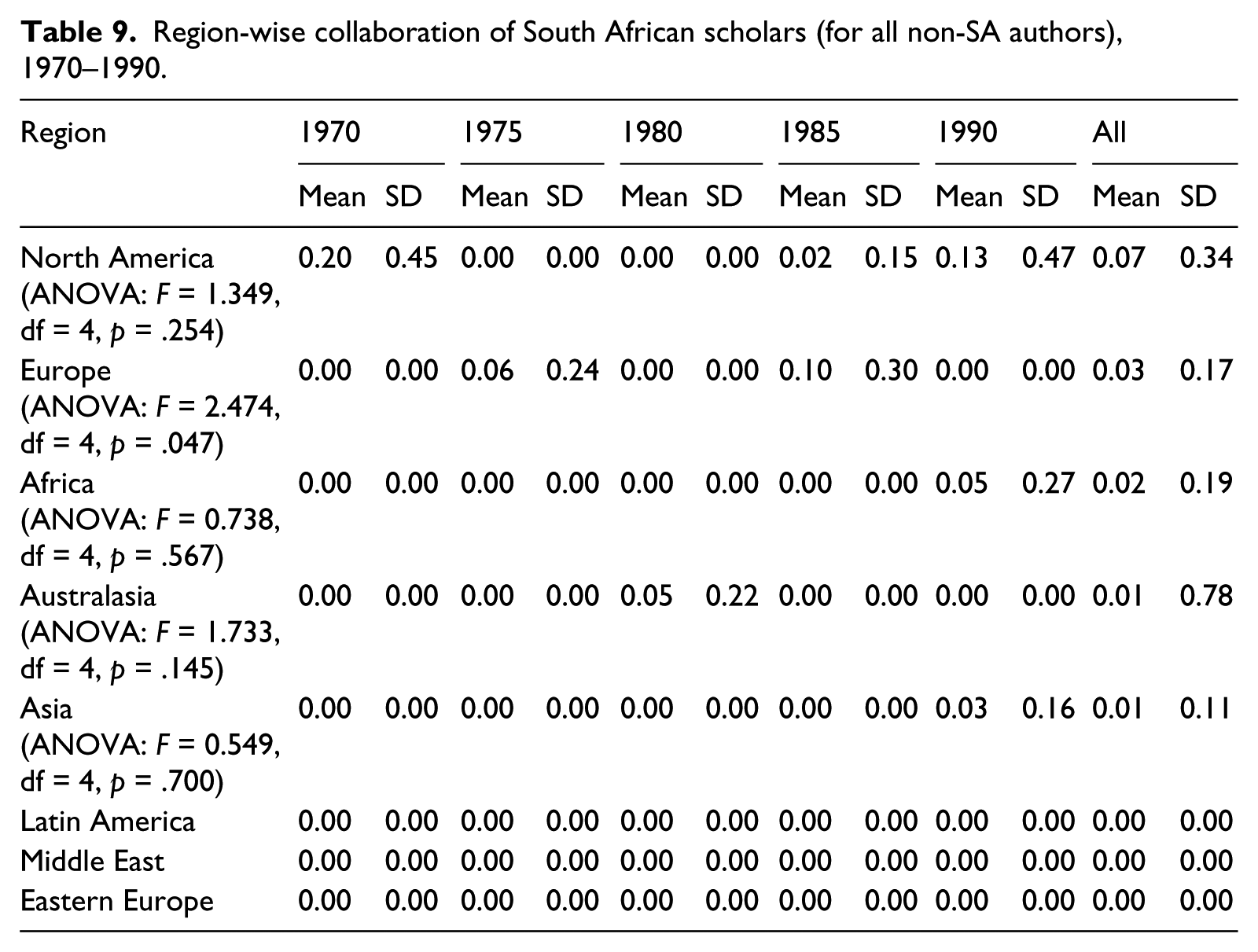
Having examined international collaboration up to two authors separately, an additional measure was created for regional collaboration for all authors. Table 9 presents the data that combines international collaboration for all authors in all publications. International collaboration with South African scholars, ranked according to the mean values, had a higher level for North America, followed by Europe and Africa. Other continents were insignificant. The ANOVA test for Europe indicated that the variance among the sampled years was significant (p = .047). It varied across the years during this period. For other continents the variance was not evident.
Region-wise collaboration of South African scholars (for all non-SA authors), 1970–1990.
For the democratic period three regions have produced a higher mean value of international collaboration (Table 10). These were Europe, North America and Africa. Other regions, except Eastern Europe, have registered a lower mean value on this index. Collaboration with North America, Europe and Africa has been on a growth path during the years of democracy.
Region-wise collaboration of South African scholars (for all non-SA authors), 1995–2015.

Africa has become the third continent in international collaboration after Europe and North America. Australasia, Asia and Latin America have not shown any considerable level of collaboration with South Africans in sociological research.
Subject areas and collaboration
The major sociological subject areas for both the apartheid and democratic periods are shown in Tables 1 and 2. They are arranged in descending order of the number of publications. During the apartheid period there were two key subject areas that had the highest number of publications (Table 1). These were area studies (46%), and education and educational research (20%). Publications in the area of environmental sciences and ecology ranked third with 8.5%. Papers on public, environmental and occupational health had a share of 7%, followed by information science and library science (6%). Other subject areas were not significant in number. Regarding the trends over the years during this period, area studies maintained its dominance over other subject areas. Likewise, education and educational research themes were evident in all the sampled years except for 1970.
Four subject areas were prominent in the number of publications during the democratic period (Table 2): education and educational research (23%); public, environmental and occupational health (19%); area studies (11%); and health care sciences and services (9%). Some other subject areas also became important during this period, producing 4–5% of the total publications. These include the social sciences (other topics and interdisciplinary), environmental sciences and ecology, criminology and penology, information science and library science, and social issues. Some other significant trends are also obvious. The share of the publications in area studies declined from 24% in 1995 to 6% in 2015. Publications in both education and educational research, and public, environmental and occupational health have steadily increased since 1995. One other subject area that showed a recent surge in publication was the social sciences (interdisciplinary), moving from 0% in 1995 to 11% in 2015. Publications in criminology and penology also showed a growth in the production of publications in recent years (2015).
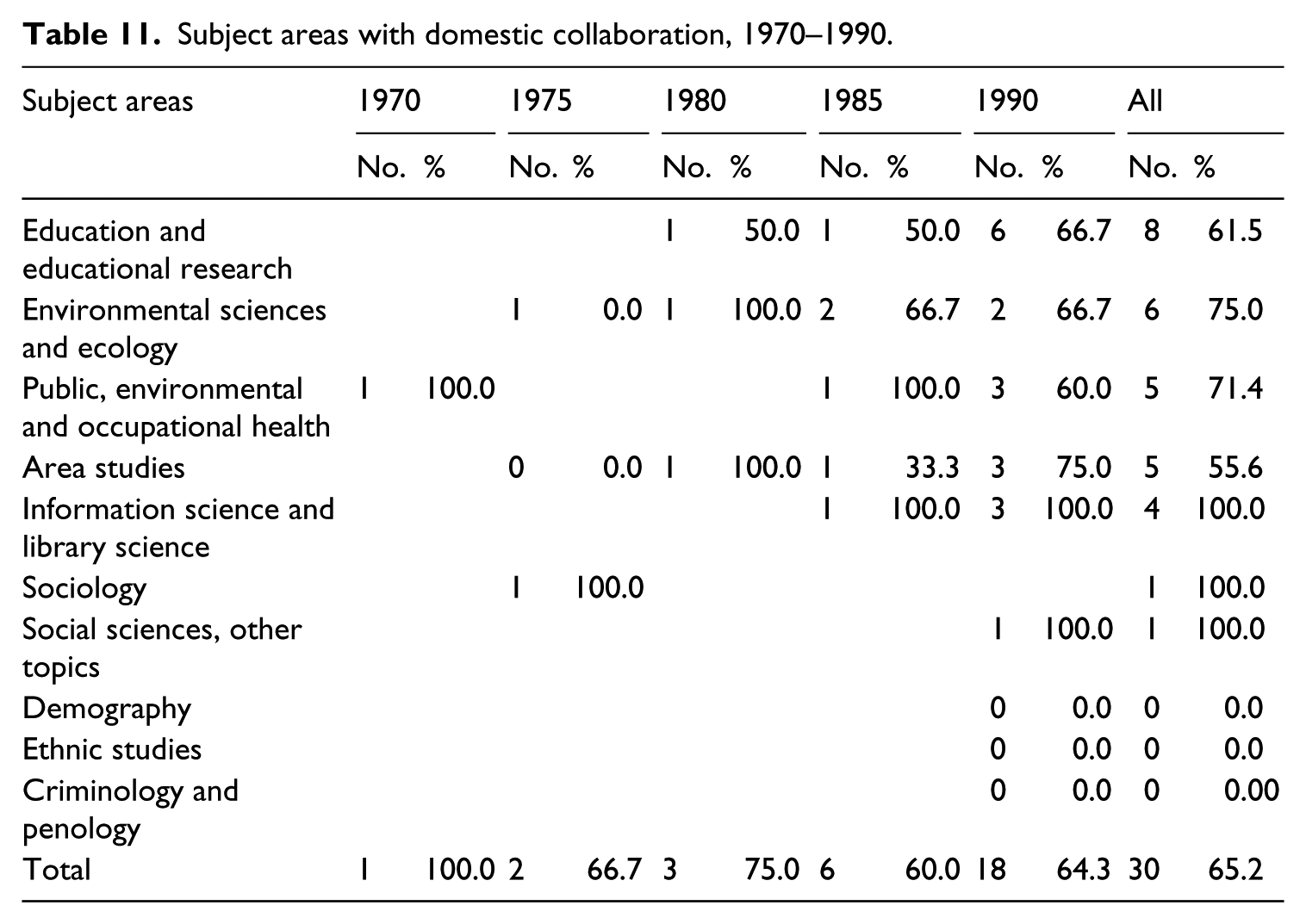
The relationship between subject areas of sociological research and collaboration was examined. First, we looked at the subject areas that had attracted domestic collaboration in the periods of apartheid and democracy (Tables 11 and 12). As indicated earlier, there were only 30 publications produced in domestic collaboration in the apartheid period. In the publication count, education and educational research had the highest number of collaborative publications within the country: about 62% of the total publications in this field (Table 11). In the percentage of publications, all publications in information science and library science, social sciences and area studies were domestically collaborated papers. Public, environmental and occupational health, and environmental sciences and ecology also brought scholars within the country closer. At the same time, demography, ethnic studies or criminology and penology did not have any publication that presented domestic collaboration. The trend across the years during the period shows that most of the publications in domestic collaboration occurred in 1990, close to the end of apartheid. Prior to this, collaboration was not a serious activity among scholars. Domestic collaboration existed in 65% of the publications (of all the collaborated ones) during the apartheid period, which remained at the same percentage during the democratic period.
Subject areas with domestic collaboration, 1970–1990.
Subject areas with domestic collaboration, 1990–2015.
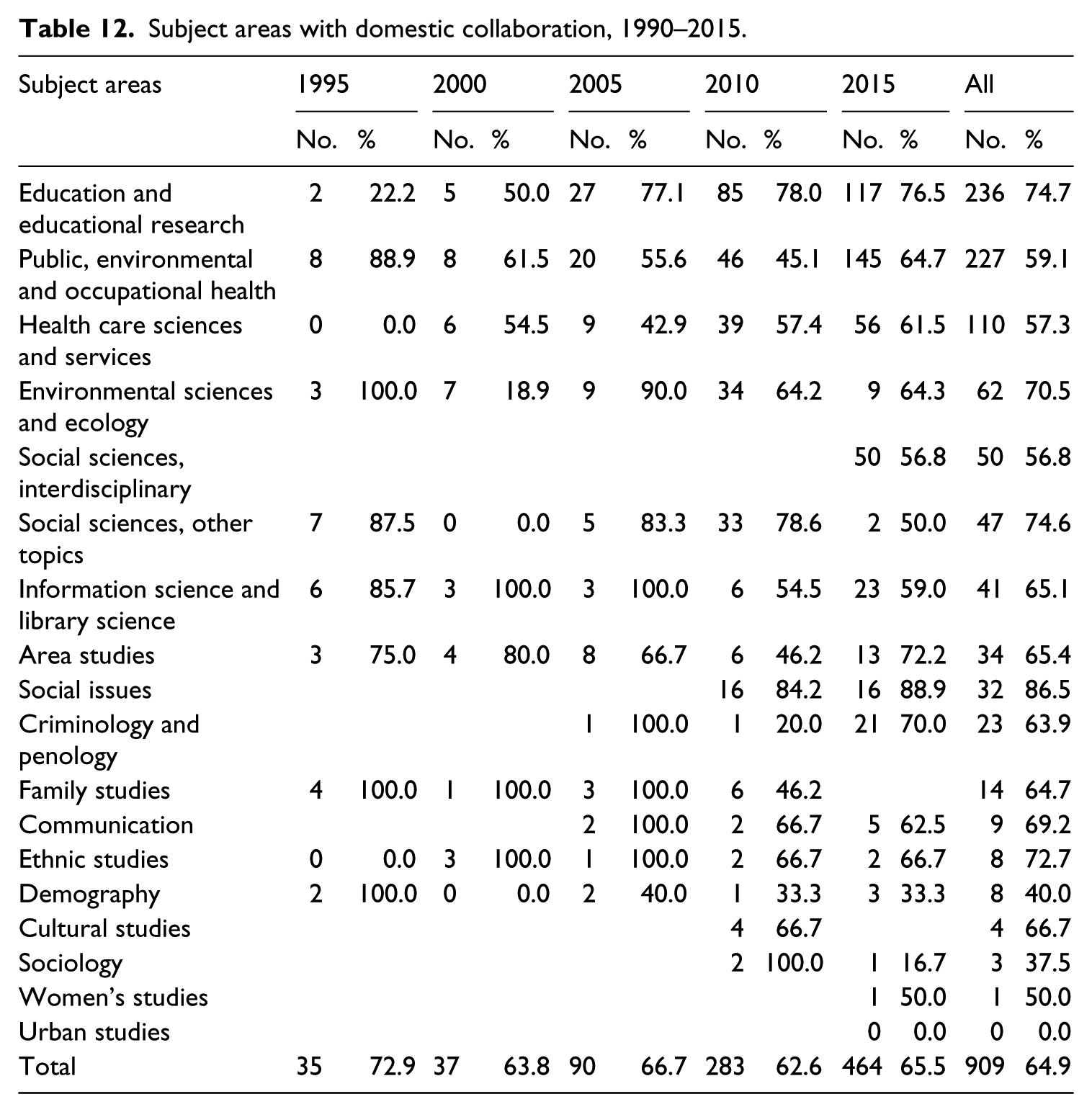
In the period following apartheid, the number of subject areas that encouraged domestic collaboration increased considerably (Table 12). There were 17 subject areas in the democratic period in this respect, compared to 7 in apartheid times. The domestic collaboration across subject areas can be examined in two ways. First, in terms of the number of publications, and second, in terms of the percentage of publications within the subject areas. The highest number of publications with domestic collaboration occurred in education and educational research, public, environmental and occupational health, and health care sciences and services. In terms of the percentages of publications within subject areas, there were social issues, education and educational research (with the highest number of publications), social sciences (other topics), ethnic studies and environmental sciences and ecology (up to 70% of the publications within subject areas).
The years within this period presented some specific characteristics of domestic collaboration. Since 2010 there has been an increase in the number of publications. An increased number of publications, not in percentile terms, were produced in domestic collaboration between 2010 and 2015. Since 2010, some subject areas had a higher proportion of papers that were produced in domestic collaboration. These were education and educational research, social sciences (other topics) and social issues. In recent years (for example 2015), a higher level of domestic collaboration (two-thirds or more publications) occurred in education and educational research, social issues, area studies, and criminology and penology.
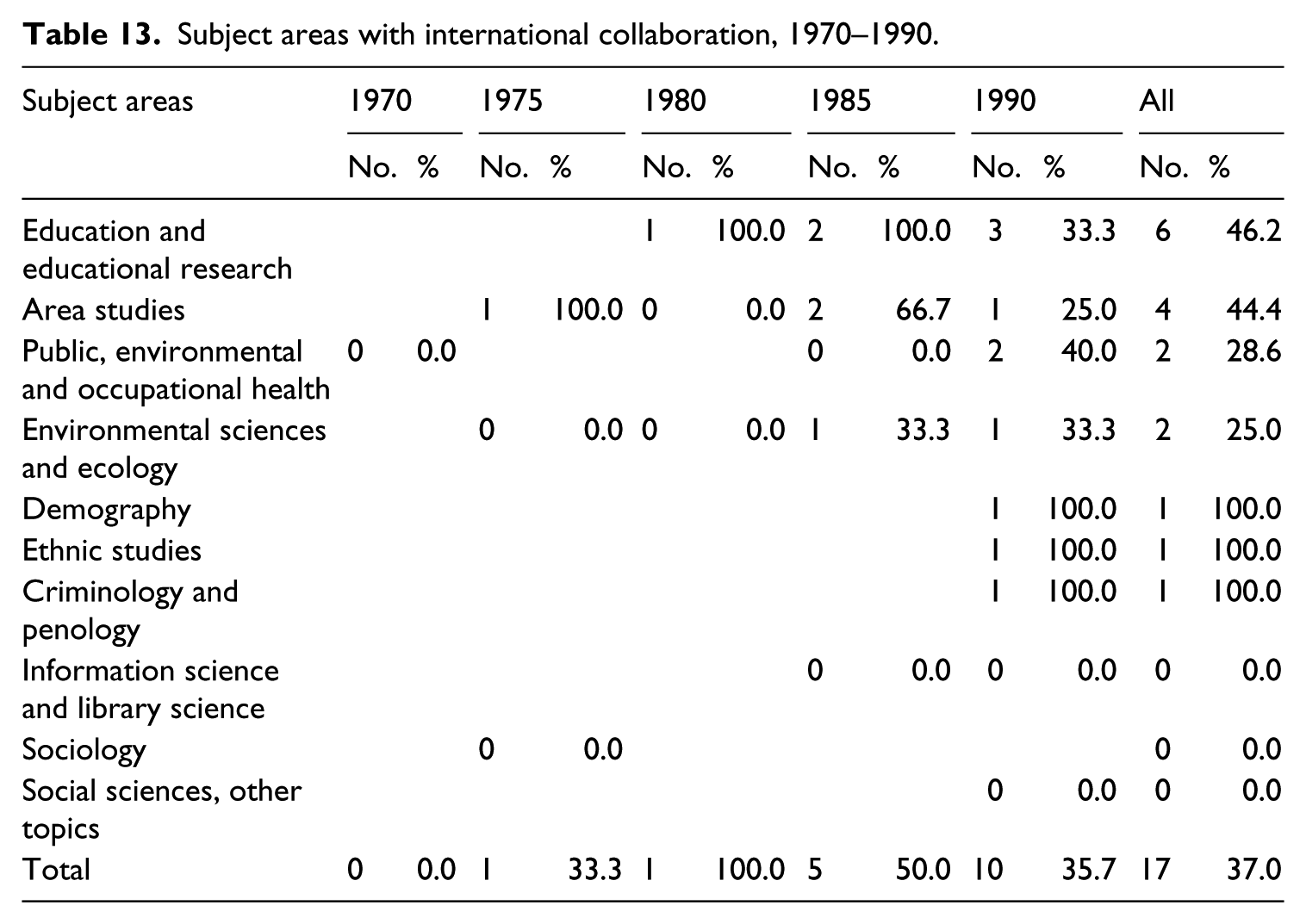
As indicated earlier, about one-third of the collaborative papers published between 1970 and 1990 had international participation. In comparison to domestic collaboration, there were fewer subject areas that attracted international collaboration in the apartheid period (Table 13). The number of publications for each subject area was not large enough to make any percentile analysis. Education and educational research, area studies, public environmental and occupational health, and environmental sciences and ecology were among the subject areas that attracted international participation. International collaboration clearly became significant only in 1990, during the closing years of apartheid.
Subject areas with international collaboration, 1970–1990.
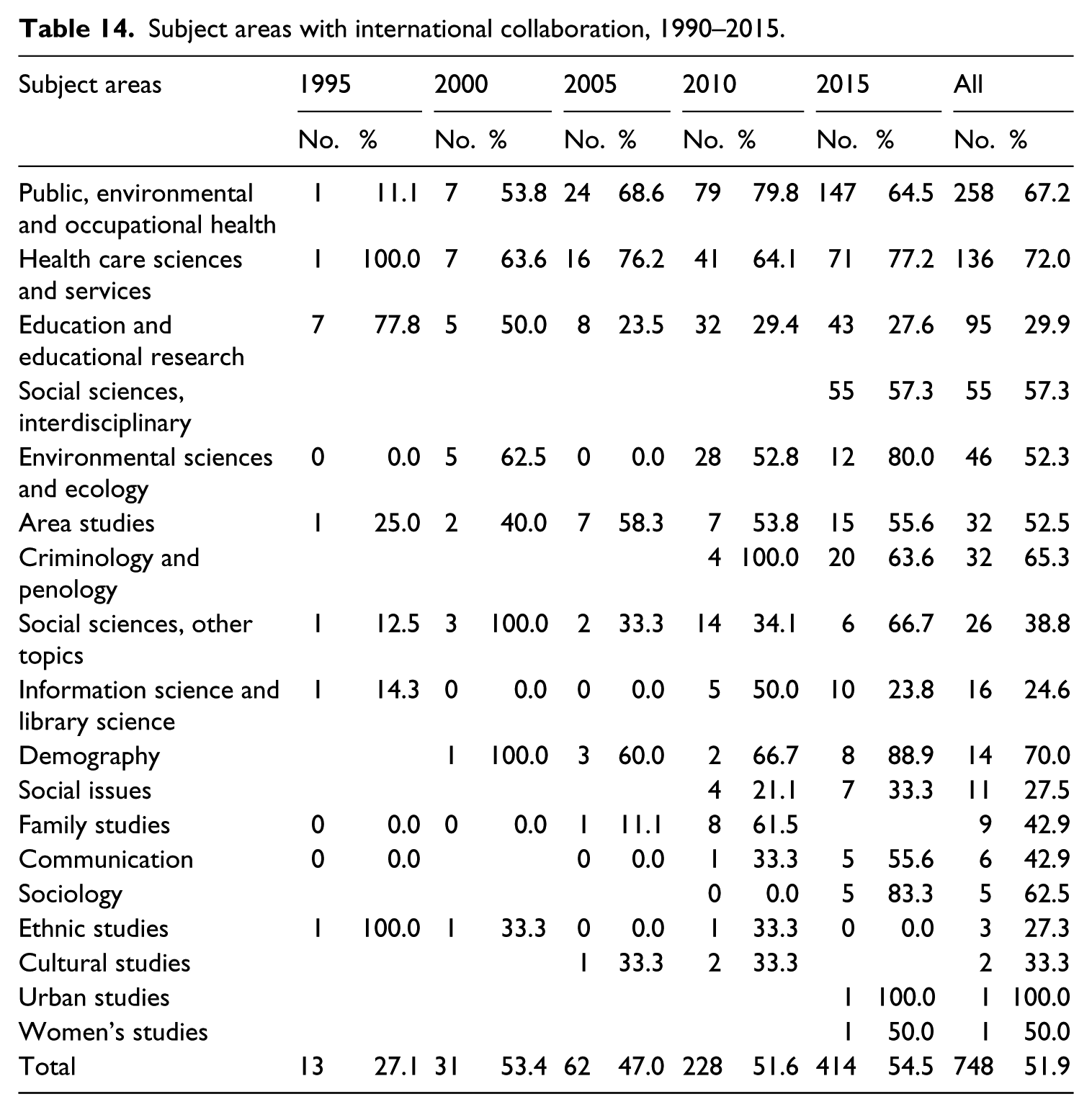
In the new phase of the democratic South Africa, international collaboration in the social sciences has become significant. As seen earlier, half of all the collaborated papers had international collaboration. The subject areas that had a higher number of collaborative publications were public, environmental and occupational health, health care sciences and services, education and educational research, and social sciences (interdisciplinary) (Table 14). Annual data indicate that since 2005 there has been an increase in the level of international collaboration in sociological research.
Subject areas with international collaboration, 1990–2015.
Discussion
The findings presented above bring to light the characteristic features of sociological research in South Africa. Collaboration has emerged as a prominent variable in sociological research. The data referring to the two periods of apartheid and democracy showed some comparable findings. The number of single-authored papers declined. The number of joint-authored publications increased. There was a steady increase in the number of authors who worked towards research publications during the selected periods. However, the decrease in single-authored papers, increase in joint-papers, and increase in the average number of authors were more evident in the second period of analysis (democracy). This signifies the growing relevance of collaborative enterprises in sociological research in South Africa.
Collaboration was examined at two levels, domestic and international. About two-thirds of the collaborated papers were the product of domestic collaboration (for all publications of both periods). Internal-institutional (within the same institution) dominated external-institutional collaboration (with different institutions within the country). Perhaps scholars find it easier to work with colleagues in the same institution than with those in other institutions located within the country. This also refers to the contacts and networks scholars establish with those in other institutions.
During the apartheid period, there was only very limited international collaboration in sociological research. The apartheid policies dissuaded international scholars from associating with South African scholars. It was a ‘closed-off’ period for South Africa because there had been an academic boycott from other countries that did not approve of the apartheid policies (Nordkvelle, 1990). International collaboration grew substantially in the new South Africa. This applied not only to sociological research. Collaboration in the natural sciences also advanced in the post-apartheid period (Sooryamoorthy, 2010, 2015a).
The major research partners of South African scholars came from only a few countries. The findings also showed the continental regions of the international partners. During the apartheid period in which international collaboration was not strong, partners came mostly from two regions, North America and Europe. Some partners also came from Africa and Asia as well. The countries were mostly the United States, the UK and Canada. This has changed in post-apartheid times. When the first international authors were taken into consideration, a large majority of them were Europeans, followed by North Americans. Scholars from African countries made up about one-fifth of the international partners, showing an increase in recent years. For the second international partners North Americans ranked first, followed by Europeans and Africans. The countries of origin (of both first and second international authors) were the United States, the UK, Canada, Australia, the Netherlands, Zambia, Ghana and Kenya.
Further integrated analysis of international collaboration for all authors, by continent, revealed that scholars from North America, Europe and to a small extent Africa associated with South African scholars in the apartheid era. The order changed for the democratic period: Europe, North America and Africa. It is significant that Africa became a major international partner in the new South Africa.
What this finding about international collaboration implies is that the countries that had research collaboration in the past continued to maintain it. In addition, African countries have become research collaborators with South Africans in the production of sociological research. This is characteristic of the democratic South Africa, which has strengthened its association with other African countries. The associations of African countries such as the African Union (AU) and Southern African Development Community (SADC) have contributed to this.
Some subject areas were more prominent than others during the periods of analysis. Publications in area studies and education were more numerous than other subject areas during the apartheid period. Education and educational research continued to assert its dominance in the post-apartheid democratic period. At the same time, in the new democratic South Africa publications in the areas of public, environmental and occupational health, area studies and health care sciences grew in number. But the figures for recent years showed that some subjects (area studies) declined whereas others (education, social sciences and criminology, for instance) improved. It indicates the current interests of social scientists in these subject areas, in relation to other subjects. Education and crime have been two important issues for South Africa, and are rooted in its historical legacy. These are indicative of the current preferences and choices of South African social scientists, and the contemporary social issues the country is facing.
Another focus of this article was to find out the relationship between collaboration and subject areas. A relationship was found between:
Domestic collaboration and the subject areas of education and educational research, information science and library science, social sciences, and area studies during the apartheid period;
Domestic collaboration and the number of subject areas in the democratic period;
Domestic collaboration and the subject areas of education and educational research, public, environmental and occupational health, health care sciences and services, social issues, social sciences, ethnic studies and environmental sciences and ecology during the democratic period;
International collaboration and fewer subject areas during the apartheid times; and
International collaboration and the subject areas of public, environmental and occupational health, health care sciences and services, education and educational research and social sciences (interdisciplinary) during the democratic period.
The issue of the production of knowledge and collaboration is an interesting area of study (Abramo et al., 2011; He et al., 2009; Navarro and Martin, 2004). This was examined in the data here. Using Karl Pearson’s correlation test the relationship between the production of publications across years and collaboration was tested. The results showed that the year of publication (a proxy to the number of publications as the publications have been generally increasing since 1970) collaboration showed that: no correlation between the year and domestic collaboration; significant positive correlation existed between the year and international collaboration; and the year and number of countries involved was positively correlated. As a direct cause-effect relationship cannot be ascertained, it can be interpreted in two ways: either an increase in the number of publications leads to international collaboration; or the international collaboration of South African scholars leads to increased production of publications. Either way this is beneficial to South African sociological research, in particular for the subject areas where international collaboration has occurred.
What implications of collaboration in sociological research can be envisaged? Prior research suggests that collaboration can lead to increased research activities, encouraging scholars to be more productive (Abramo et al., 2011; Basu and Aggarwal, 2001; Navarro and Martin, 2004). In a way, collaboration leads to an increased level of research productivity. It also increases visibility, which is reflected in the number of citations that collaborated publications attract (Didegah and Thelwall, 2013; Persson, 2010; Puuska et al., 2014). This has been true in the case of the South African publications analyzed here. The average number of citations for all publications was 5.33 (SD = 12.24). For the collaborated papers (domestic or international), it was 6.35 against 3.68 for papers without any collaboration. The difference was significant in the t-test (p = .000). A difference in citations was also observed between domestic and international collaboration. The mean number of citations for papers with international collaboration was 7.43 against 4.56 for papers without international collaboration, which was statistically significant. On the other hand, no significant difference between domestically collaborated and not domestically collaborated publications (5.56 and 7.82) was found in the number of citations earned. This citation-related finding speaks about the visibility of research publications that is enhanced by participation of international scholars. Perhaps South African scholars can gain from, both in the production and visibility of publications, international collaboration, furthering the growth of sociological research in the country.
Conclusions
Sociological research in South Africa went through its historical apartheid period before it entered a new political environment of democracy. Of course, the political context in which scholars worked influenced their production of knowledge. This was evident from the analysis, in terms of their collaborative preferences and the relationship among the subject areas, collaboration, partnering countries and visibility of research. Distinctive features were identified from the data, which referred to both the apartheid and democratic periods. Scholars in the country have recognized the importance and usefulness of collaboration in the production of sociological knowledge. This is more pronounced in recent years than it was in the past. Collaboration of South African scholars with their international peers is also expanding to countries that were absent during the apartheid period. Scholars now associate with other African scholars. Also identified in the study were the subject areas that attracted international collaboration. This will have a far reaching impact, not only on some subject areas of research but also on the productivity levels of South African scholars who work in those areas. The visibility of publications was found to be enhanced in joint-publications, which will encourage South African scholars to team up with international partners. Finally, in domestic collaboration the preferred mode is internal-institutional over external-institutional.
Footnotes
Funding
This research received no specific grant from any funding agency in the public, commercial, or not-for-profit sectors.