



Abstract
While recent concepts from the sociology of science stress novel sites of knowledge production (e.g. government, industry), they ignore international organizations’ (IOs) growing research capacity. Conversely, prevailing theories of IOs stress their regulative and normative influence in national policymaking, equally neglecting their scientific work. Using bibliometric data for a large sample of 1325 international organizations, this work examines, for the first time, the evolution of scientific output from international intergovernmental research organizations, intergovernmental organizations, and nongovernmental organizations in the period 1950–2015. The analysis finds a striking increase in scientific activity since the late 1980s and particularly since the early 2000s across organizational types, sectors (e.g. law, nutrition), research fields (e.g. life science, social sciences), output formats (e.g. articles, books), and geographic areas. Indeed, some of these organizations are among the most productive science producers worldwide. Additional analyses of IOs’ research collaborations suggest strong cross-organizational diversity reflecting wider trends of scientific internationalization and integration. The article argues that IOs’ scientization requires a thorough revision of theories of institutional change in science and research systems and of theories about the nature and role of IOs. These organizations reflect, and, indeed, spearhead, wider trends of the rationalization of social order and evidence-based global governance.
Introduction
The increasing importance of science has become a pervasive feature of modern societies. Along with general educational expansion, scientific progress in particular is believed to spur individual and social development and to provide policymaking with objective evidence and expertise (Drori et al., 2003). Despite the lack of solid evidence for the actual value of education, especially regarding the progress of scientific activity in higher education (Ramirez et al., 2006), countries around the world boost higher education expansion, with the number of both private and public universities worldwide dramatically rising since the Second World War (Buckner, 2014; Schofer and Meyer, 2005).
While the university may remain the locus classicus of research professionalization and scientific knowledge production (Baker, 2014; Frank and Meyer, 2007), various concepts have been proposed by sociologists of science to direct attention toward novel sites of scientific activity. One of the most widely discussed proposals is the ‘new production of knowledge’ or ‘Mode 2 science’ (Gibbons et al., 1994; Nowotny et al., 2001). This framework assumes a shift from an academic, disciplinary, and autonomous university-based organization of primarily fundamental knowledge – described as Mode 1 – to a more organizationally diverse, transdisciplinary, applied, and reflexive kind (Mode 2). Yet empirical analyses are needed to test the framework’s broader applicability.
Within these frameworks of a more diversified research infrastructure, little attention has been given to international organizations (IOs), both intergovernmental and nongovernmental, which have proliferated at an impressive pace since the Second World War, now reaching more than 60,000 organizations worldwide (UIA, 2016). The lack of research on IOs’ knowledge work is surprising, especially since IOs are increasingly acknowledged as important actors in national and global policymaking and as conducive to scientific expansion (Finnemore, 1993; Schofer, 2004). Studies from international relations (IR) and global policy are primarily interested in IOs’ regulative and normative authority, much less in their role as knowledge providers (see Zapp, 2017a, for a review). The understanding of IOs as cognitive or epistemic actors, theorists or knowledge brokers largely remains outside the mainstream approaches (Barnett and Finnemore, 2004; Meyer et al., 1997). The few empirical investigations of the scope of IOs’ scientific activity are limited to individual organizations and, within these, specific research or policy sectors, rarely addressing longitudinal trends (Ravallion and Wagstaff, 2012). Yet, these exceptional analyses suggest a striking increase in the importance of scientific knowledge production at the international organizational level. This work considerably extends these lines of research by investigating whether there is a general trend of expansive scientific commitment at the international level.
This article seeks to contribute to a greater understanding of the role of IOs as a novel site of scientific knowledge production. In the second section, we introduce concepts from the sociology of knowledge that hypothesize on the various transformations in national science and innovation systems. At the heart of these arguments is the increasing diversity among knowledge-producing organizations, with IOs remaining a major blind spot. In the third section, we review research on IOs from international relations (IR) and specific policy fields. While sociologists of knowledge ignore the international sector, IO scholars lack a focus on the knowledge dimension.
We present the empirical analysis in the fourth section by charting the evolution of scientific activity with scientific output data from Scopus (Elsevier) for three extensive sub-samples of IOs, which include international intergovernmental research organizations or institutes (IRIs), intergovernmental organizations (IGOs), and international nongovernmental organizations (INGOs).
The results presented in the fifth section indicate a dramatic increase in the number of scientifically active IOs. From the late 1980s onwards, particularly the early 2000s, the pattern for this time period is striking across all three organizational types, a wide range of world societal sectors (from education to natural resources), research areas (from the physical to the social sciences), output formats (from articles to conference papers), and geographical areas, principally Europe, North America, and Asia. Additional analyses suggest strong cross-organizational collaborations between various kinds of IOs and more conventional (national) organizations reflecting wider trends of scientific integration (Powell et al., 2017; Wagner and Leydesdorff, 2005).
Our discussion highlights two issues: first, the dramatic increase in scientific activity, including the growing collaboration with conventional science producers (e.g. universities), which should prompt sociologists of science to revise contemporary diagnoses of the transformation of scientific infrastructure by paying attention to this new kind of international actor, especially IRIs. In parallel, scholarship from globalization and global policy studies needs to include a more systematic reflection on the role of a growing field of highly scientized IOs and their impact on national and international policy agendas through knowledge production.
We define this general transformation as scientization, i.e. an explicit emphasis on the ultimate value of the rational analysis of all physical and social phenomena, here, indicated by an increase in scientific publications (Drori et al., 2003; Meyer et al., 1997). We explain such scientization by pointing to an interplay between micro-level factors of increasing massification of higher education and organizational competition with a premium on research performance, and wider trends of the rationalization of policymaking and social planning in modern societies.
New sites of scientific knowledge production
Over the past two decades, sociologists of science have started to rethink the modes and sites of (scientific) knowledge production. The ‘triple helix’ envisions knowledge production as an outcome of growing university–industry–government relationships (Leydesdorff and Meyer, 2006). Other concepts such as ‘post-academic science’ (Ziman, 2000) or ‘academic capitalism’ (Slaughter and Rhoades, 2009) also stress greater diversity in knowledge generation. Proponents of the so-called ‘New Production of Knowledge’ or ‘Mode 2’ approach hold that scientific locales multiply and interactions in expanding networks intensify. Joining together the knowledge-producing enterprise are governments, industry, think tanks, consultancies, associations, and activist groups alike, far beyond universities alone. Such diversity of organizational forms engaged in knowledge production contrasts with the traditional academic dominance of the university in Mode 1 (Gibbons et al., 1994; Nowotny et al., 2001). Although detailed analyses of such growing diversity under Mode 2 conditions are scant, those few available, on Danish social sciences and German educational research, for example, identify sprawling organizational landscapes cutting across categories of governance levels (international/national/subnational), organizational types (public/private), missions (scientific/commercial), functions (primarily knowledge-producing/knowledge-using), and disciplines (Kropp and Blok, 2011; Zapp and Powell, 2016, 2017).
As predicted by Mode 2 and many notable social theorists interested in micro- and macro-processes alike (e.g. Giddens, 1990; Knorr-Cetina and Preda, 2001), the role of science and expert systems has become more prominent in society and, particularly, policymaking. The notion of evidence-based policymaking has spread quickly around the world (Normand, 2016). Virtually all policy sectors are now informed by scientific advice, allowing some areas like health, social policy, and education to witness a distinctive ‘evidence turn’ during the past two decades in many OECD countries; organizations like the Campbell Foundation and Cochrane have also been founded to assure such knowledge transfer and application (Zapp and Powell, 2017).
Science policy is also strongly involved in another major transformation of science and innovation systems. A growing number of countries around the world have begun to implement some form of performance-based research funding or research evaluation system (Hicks, 2012). Although with different goals, mechanisms, and effects, research examining this contemporary shift in the governance of higher education and science systems finds increasing international competition, and a strong emphasis on productivity and output, as well as quality and excellence (e.g. Hazelkorn, 2015).
These more recent phenomena take place against the backdrop of wider long-term transformations. Scientific expansion has been a striking worldwide phenomenon for the entire post-Second World War period. This is true for the expansion of higher education, both in terms of university foundings and student enrolment (Buckner, 2014; Schofer and Meyer, 2005), and the institutionalization of a science policy infrastructure (Finnemore, 1993; Zapp, 2017b).
Strong expansive trends can also be found in the evolution of scientific output. Scientometricians, while among the first to mark the advent of ‘big science’ in the 1960s, predicted fast saturation of the exponential growth of science publications (de Solla Price, 1963). However, despite major wars and economic crises, new systematic estimates of the number of worldwide publications in science, technology, engineering, and mathematics from 1900 to 2011 show that there has been no decline or slowing of exponential growth to the present day (Powell et al., 2017). This remarkable growth reflects two contrasting and simultaneous trends: a ‘shifting center of gravity’ (once constituted solely by Europe, now increasingly including North America and, more recently, Asia) in combination with the rising competition across nations and international collaboration among scientists (Zhang et al., 2015).
Analyzing over 20 million records from the Science Citation Index Expanded (SCIE) dataset, these authors find that the number of research papers published in scientific journals over the 20th century grew extraordinarily rapidly. Starting from below 10,000 in 1900, the annual number of new publications grew to about 50,000 in 1955. This early trend, often referred to as ‘big science’, was then transformed into what Powell et al. (2017) call ‘mega-global science’: an exponential annual growth rate of 3.49% between 1980 and 2011 led to half a million publications in 1990 and about 1.1 million new SCIE publications in the year 2011 alone.
While the university, and, more recently, the ‘super research university’ (Mohrman et al., 2007), continues to occupy a central role among science producers, more fine-grained analyses for various countries reveal stable patterns of parallel mural and extramural scientific growth and collaboration, confirming some of the predictions from the Mode 2 literature (Dusdal, 2017; Powell and Dusdal, 2017). Here, non-university research institutes, military facilities, hospitals, and corporate laboratories add up to a complex research infrastructure.
Summing up these conceptual and empirical works, science has seen worldwide institutionalization and a growing number of professionalized researchers produce an expansive volume of scientific knowledge indicated by surging rates of publications. Such diagnoses are welcome in describing general trends of the increasing diversification of research production and contemporary academic drift and scientization. Yet, the burgeoning international level has been neglected in these analyses. For science studies, the lack of a focus on international intergovernmental research institutes, one of three sub-samples in this analysis, is particularly surprising.
Ironically, as much as knowledge theorists ignore IOs, we will see in the following section that scholarship on IOs has largely missed out on the ‘knowledge turn’ within its study objects. The next section introduces the dominant approaches to explain the nature, evolution, and impact of IOs, with a particular focus on their role as knowledge producers and providers.
Shifting roles for international organizations
International relations and global governance scholars, the traditional lines of inquiry interested in IOs, have long neglected the knowledge dimension in the international sector. As instruments of powerful nation-states (as in realist and classical Marxist traditions; e.g. Boswell and Chase-Dunn, 2000; Ikenberry, 2001; Waltz, 1979) or rational solutions to reduce transaction costs and coordination problems in an increasingly complex international community (as in liberal traditions; e.g. Keohane and Nye, 2000; Krasner, 1983), little attention was given to what happens within IOs and how they operate.
With the rise of a constructivist perspective in IR and a more integrated research agenda on globalization, particularly from the so-called world polity scholarship, the focus shifted from ‘hard’, i.e. coercive or regulative, governance mechanisms to ‘softer’, i.e. normative and cognitive, mechanisms. Here, IOs come into play as hosts of epistemic communities (Haas, 1992), diffusers and teachers of norms (Finnemore, 1993; Wendt, 1999; Zapp and Dahmen, 2017), meaning-generating bureaucracies (Barnett and Finnemore, 2004), theorists, and rationalized others (Meyer et al., 1997). They serve as knowledge producers and providers involved in epistemic governance supported by a highly qualified and specialized staff (Anderfuhren-Biget et al., 2013; Chabbott, 2003; Zapp, 2017a).
Interpreting the role of IOs in such a manner has shifted focus away from the traditional areas of security and economics; a more nuanced view now arises where autonomous and authoritative organizations are directly involved in an increasing number of globalized policy sectors, such as social policy, education, and health. Most importantly, this new perspective has also opened analytical avenues interested in the longitudinal and cross-sectional trends in the IO population. These include a striking expansion of IOs in the postwar period for both intergovernmental organizations (IGOs) and specifically nongovernmental organizations (INGOs) (Boli and Thomas, 1999). The number of IGOs has risen from only 37 in the early 20th century to 7710 a hundred years later. These include regional bodies in all world areas, development banks, trade organizations, environmental agencies, and a wide range of other multilateral secretariats (see Lechner and Boli, 2014, for a review). Similarly, INGOs, while below 200 organizations before the First World War, now span the globe in a vast associational network of more than 60,000 organizations (UIA, 2015).
Obviously, many of these organizations are involved in science indirectly as promoters (e.g. UNESCO) and professional science associations (Finnemore, 1993; Schofer, 2004). Their direct contribution to science as research producers remains, however, largely unspecified. We know surprisingly little about the actual scientific output and impact of IOs. Only for a few organizations and a limited number of policy and research fields do we have a more detailed picture of IOs’ research capacity and publication record.
Following the ‘knowledge turn’ at the World Bank (WB), for instance, Ravallion and Wagstaff (2012) and Zapp (2017a) analyzed the general increase in articles, books, chapters, and working papers published by the WB for the period 1978–2006 and discovered striking results. Not only has the overall portfolio expanded, it now includes books and working papers. More importantly, all types of publications display a remarkable upward trend, particularly from the late 1980s and early 1990s on. The number of working papers, books, and peer-reviewed journal articles has more than tripled since the late 1980s (Ravallion and Wagstaff, 2012; Zapp, 2017a). In addition, official reports become more scientific. A typical World Development Report, for example, as published in the last 10 years, might have up to 500 pages and an average of 850 scientific references, including a remarkable increase in self-references, indicating the growing in-house science production.
Regarding the impact of WB output, the World Bank Economic Review, for example, is the most widely read scholarly economic journal worldwide; it holds a five-year impact factor of 2.48 and grants free distribution to more than 9500 subscribers in non-OECD countries. Together with other journals like WB Research Observer, Development Outreach or Handshake, WB publications enjoy the largest worldwide circulation in that research field. The WB’s working papers series reaches a download count of 1.4 million. Moreover, aggregated publications from the WB rank among those of the IMF, Berkeley, Chicago, Harvard, and MIT; the aggregated impact of WB research staff comes first in the percentage of articles cited, third in average citations (behind Harvard and Chicago universities), and sixth in its aggregate h-index for the period 1995–2010. Compared to university departments, the WB ranks first in education, for example, if based on article count and second if based on the h-index (Ravallion and Wagstaff, 2012; Zapp, 2017a).
Large-N studies interested in the expansion of science production at the aggregate IO level are, however, to our knowledge, absent. We know, from the Union of International Associations’ (UIA) Yearbook of International Organizations (YIO) (2015), about the gradual increase in IOs’ publications in the period 1996–2006 from 20,000 to more than 35,000 (UIA, 2006, 2008, 2016). However, these data are not disaggregated for the various types of IOs. More importantly, publications included in the YIO are not necessarily scientific, but include a wide range of formats, from technical manuals to reports and statistical compendia. 1 YIO data do not, therefore, give an indicator of IOs’ research capacity.
Summing up the insights from relevant IO scholarship, we argue that the more recent theoretical contributions have considerably refined our understanding of IOs’ impact in a globalized world. Yet, despite a stronger focus on the specific knowledge mechanisms at work, they remain largely uninformed by empirical knowledge on the evolution, scope, and volume of scientific knowledge production at the IO level. The few empirical findings at hand are intriguing in terms of pace and volume of scientific growth and prompt us to advance a first systematic attempt to provide comprehensive groundwork in this direction. We argue that international organizations in general have become an important novel level of research production. This trend occurs beyond those IOs deliberately founded to produce research (intergovernmental research institutes), including IGOs and INGOs across a wide field of policy sectors and related research fields. The following section describes our sampling and counting methodology.
Methodology
Organizational sample
Analysis is based on a sample of 1331 international organizations representing three different kinds of IOs. A first sub-sample represents international nongovernmental organizations (INGOs). The sampling of INGOs presents a daunting task in comparison to other IO types; varying definitions of what constitutes an INGO remain unresolved, which consequently impacts estimates of their numbers as well (Bromley, 2010).
I decided to use a list of 500 INGOs selected for their worldwide importance and innovation by the NGO Advisor, a Geneva-based independent organization associated with the Global Journal and working in collaboration with the University of Geneva. Excluding scientific output, NGO Advisor researchers instead select and rank INGOs based on a rigorous methodology comprising 165 criteria with a focus on impact, innovation, and governance (NGO Advisor, 2016).
The organizations selected come from various global governance sectors including such diverse topics as water, education, housing, health, crime and violence, human rights, environment, law, and demining. These issues cover, almost prototypically, the wide range of themes or world-societal sectors dominant in global governance and world polity discourses (Boli and Thomas, 1999; Deacon, 2007) and are, therefore, used as our sampling strategy for all IO types (see below).
I decided to use such sectoral distinction to add more sociological thrust to the analysis. We conceive of such sectors of IOs as analogous to national societal sectors (Scott and Meyer, 1991) or organizational fields, as ‘in the aggregate, … a recognized area of institutional life’ (DiMaggio and Powell, 1983: 148). At the international level, such burgeoning organizational fields have been detected for education (Chabbott, 2003), health (Inoue and Drori, 2006), and other social policy sectors (Yeates, 2014).
The number of INGOs covering specific sectors differ widely. As the analysis is, however, not interested in testing between-sector hypotheses, we consider such differences unproblematic. We also acknowledge that the INGO database is limited. NGO Advisor does not include business, industry or religious NGOs. Given the difficulties in sampling INGOs, we consider these limitations tolerable.
A second sub-sample consists of international intergovernmental research institutes (IRIs). The basic selection criterion was the direct affiliation with an international and intergovernmental body. This was necessary as an additional consideration of IRIs as nongovernmental could not be identified. Using additional sectoral/world-societal attributes introduced above, sample size was reduced to N = 221 organizations with varying sizes for sectoral groupings.
A third sample (N = 604) consists of international intergovernmental organizations (IGOs). They were selected as belonging to the world-societal sectoral categories introduced above for INGOs to allow for some consistency (see also Table 4).
For IRIs and IGOs, selection was done using the Yearbook of International Organizations (YIO) published by the Union of International Associations (UIA). Since 1953, the Yearbook has been the United Nation’s official registry of IOs and has a mandate to have as complete coverage as possible of all kinds of IOs. The current online dataset contains information on roughly 68,000 IOs in 300 countries and territories, making it the most extensive directory of IOs available (UIA, 2015). Generally, the YIO is highly reliable, consistent over time, and has been used extensively in research. The online version of the YIO allows for keyword search, which was done using the sectoral categories introduced above. An initial sample consisted of 1856 organizations, which was manually reduced to eliminate all organizations that do not belong to the type of international and intergovernmental organization strictly speaking. 2
I acknowledge some organizational blur. The UIA is dependent on self-categorization information provided by organizations. Categorical definitions may vary internationally and may depend on legal, financial, governance, and organizational criteria. In some obvious cases (N < 50), we decided to regroup specific organizations based on theoretical considerations and based on their mission statements in the YIO. These include, for example, laboratories and other research facilities, operating under an IGO statute (see Table 5 for examples). As they are, by definition, founded to produce research, they have been added to the IRIs sub-sample. Here, sampling is rather conservative as some important international and intergovernmental educational organizations such as the European University Institute or the International Islamic University of Malaysia have been excluded.
Figure 1 shows the foundings of IOs from the sample. Following the general expansive trend of IO foundings (UIA, 2015), most IOs came into existence after the Second World War, with a second boost after the 1990s.

International organizations’ foundings, 1945–2017.
Table 1 describes the sample by organizational type, publishing activity, and geographic area. The final sample includes only publishing IOs (N = 609 IOs), with 66% of publishing IRIs and 39% of publishing IGOs. Finally, 46% of INGOs show publishing activity. The sample comprises IOs with an average of 70% headquartered in Western countries. It is important to note, however, that many IOs, particularly IGOs and INGOs, although based in Western countries, have a global mission (e.g. UN agencies or development INGOs). Interestingly, IRIs can certainly be considered a European and North American phenomenon.
Sample description.

Table 4 below also provides the distribution of IOs across sectors. We can see that most IRIs cannot be categorized by any specific sector. Strong sectors do, however, include environmental and socio-scientific fields (e.g. legal studies, education). IGOs have their most frequent mission in industrial and economic fields, followed by environmental and resource-related concerns. INGOs cover their typical areas: health, human rights, empowerment, and emergency.
Counting method
Scientific output was measured as the number of scientific publications published by an organization drawing on the bibliographic database Scopus (Elsevier). Scopus was chosen as it covers a longer time period (back to the 1950s) and a wider set of journals than Web of Science (WoS; Clarivate Analytics). Scopus claims to comprise over 18,000 titles from all disciplines, including 16,500 peer-reviewed journals, as well as book chapters and other non-journal publications. 3 Initial tests comparing Scopus with WoS systematically yielded fewer results for the latter.
Publications contained in Scopus were included based on authors’ indicated organizational affiliation (including full name, abbreviation, AE/BE versions, and address). We included only publications linked to the current affiliation title. If organizations underwent a change of name during their existence, data loss is implied.
I opted for whole counting of publications, i.e. weighted equally across co-authors giving one credit for each participating organization. Since we are not interested in impact factors, whole counting is considered the most straightforward indicator. We are aware of the problems associated with whole counting, most prominently the fact that whole counting is not additive, implying higher overall totals due to interorganizational collaborations. Yet, any alternative to whole counting, including whole-normalized counting and complete-normalized counting, comes with additional challenges, especially authors’ multiple affiliations.
Results: International organizations as science producers
I now turn to the findings of our analysis. I present major longitudinal trends of general publication expansion before specifying patterns for a top tier of the subsets and investigating ties of cross-organizational collaboration.
General expansion and pattern
International organizations’ scientific output had been negligible until the 1980s when steady increase begins for all three organizational types, most notably IRIs and IGOs (Figure 2). Considerable expansion does not, however, take place until the early 2000s. Within less than five years (2000–2005) all three types multiply their annual output by factor four. For example, IGOs produce in the years 2001 and 2002 more than in all the prior years under observation.
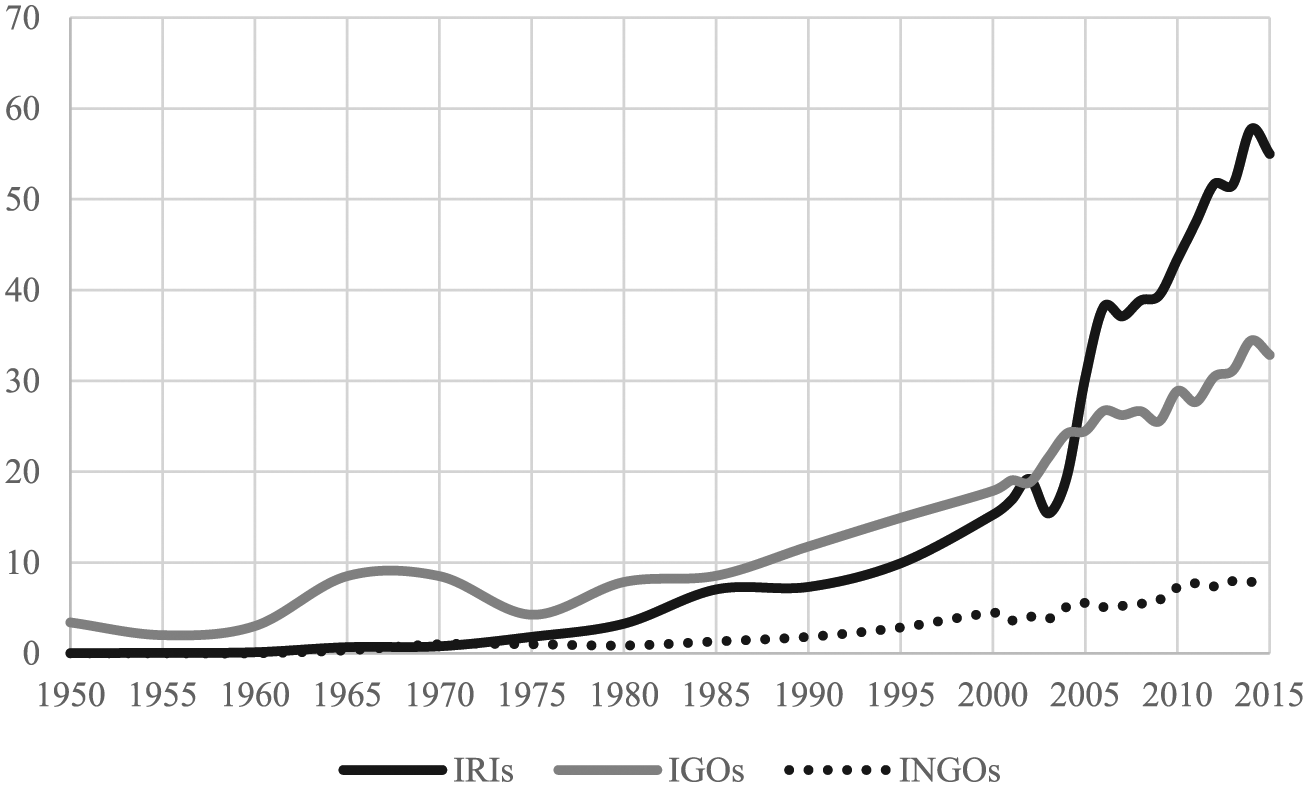
Evolution of scientific output in IRIs, INGOs, and IGOs, average, 1950–2015.
The relatively small averages (between 10 and 72 publications per year) are explained by the great variance in scientific production. Standard deviations (average distance to the mean) range from 136 (INGOs) to 2627 (IRIs). A fairly small number of IOs accounts for a considerable share in output production. The top 10, for example, make for 74% of publications within the IRIs group, 83% among IGOs, and 63% among INGOs (see below).
Turning to the type of publication, IOs, as any other science producer (Powell et al., 2017), prefer articles as the main format (Table 2). All three types of IOs show the same kind of publishing behavior. Articles lead by far, followed by conferences, book chapters, and books. Numbers for books are very low for INGOs, probably due to the considerable costs involved.
Output by publication type, research field, and IO type; by volume.

Source: Scopus; own account.
In which fields do IOs publish? IRIs show a clear focus on the physical sciences, publishing more than double in these sciences than in all other three fields combined. Although their output is more evenly distributed, IGOs are also mostly active in physical sciences. The second most important sectors are health and social sciences. Similarly, INGOs feature a considerably less dispersed portfolio, with health as the main research field (Table 2).
Next, I paired IOs’ area with their output. Europe, North America, and Asia account for the vast majority of publications, although considerable portions of output have also been produced by IO researchers in the Middle East/Northern Africa and Latin American/Caribbean regions (Table 3).
Output by area and IO type; by volume.

Source: Scopus; own account.
Turning to what I have described above as world-societal sectors, we observe that energy and resources lead the ranking with more than 33,000 publications (Table 4). Other important sectors include environment, health-related, macro-economic, and educational topics. The output of more scientific issues (e.g. environment, ICT) match that of more socio-scientific sectors such as those related to children and families, peacebuilding and governance, democracy and human rights.
IOs by sector; publications by sector.

Own account.
Top-tier expansion
Focusing on the top 10 IO science producers only, averages surge, while following the same overall expansive trend, particularly for the 2000s (Figure 3). The 10 most productive IRIs have produced between 5000 and 7000 publications annually in the period 2010–2015. IGOs reach an annual 3963 in the year 2015, while non-governmental top science producers still publish up to 523 per year (2015).
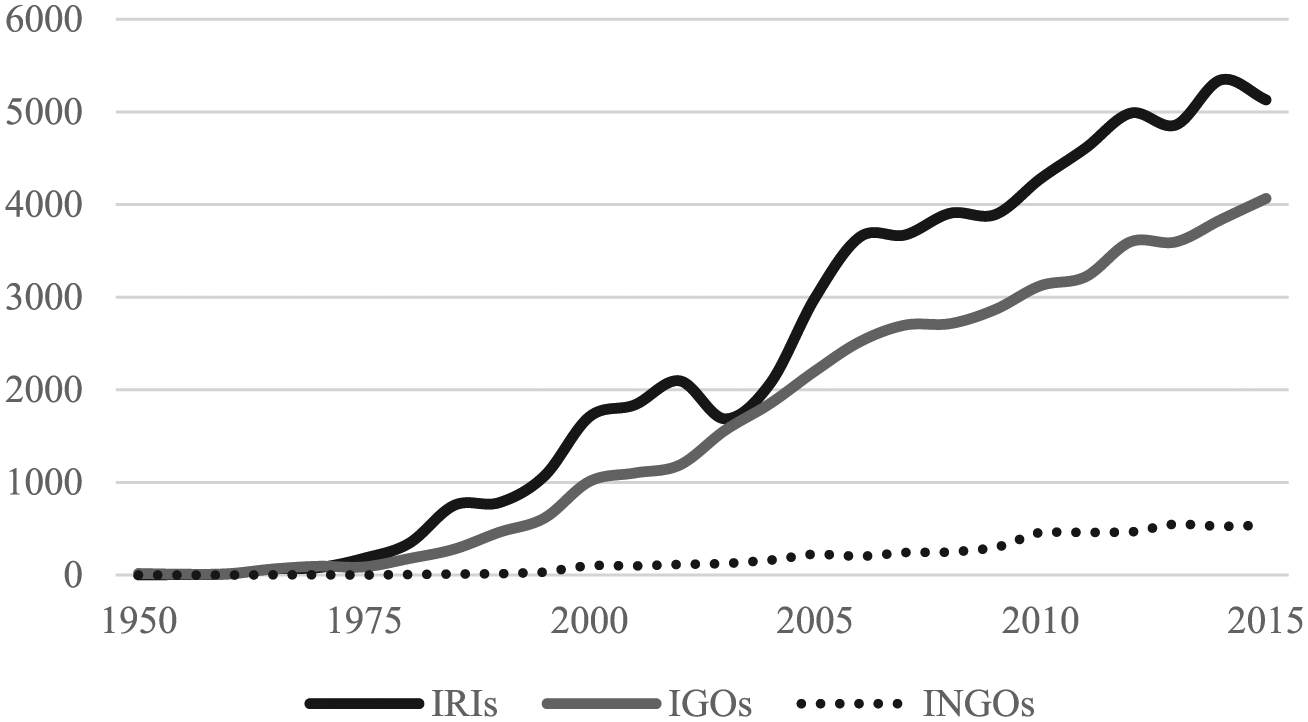
Evolution of scientific output in top 10 IRIs, INGOs, and IGOs, average, 1950–2015.
Specifying these top producing IOs from the sample, Table 5 lists the 10 most productive organizations. Among the group of intergovernmental research institutes, we find mostly European organizations. Some of them have been around for a while such as the Moscow-based Joint Institute for Nuclear Research (1956). Others like the European Synchrotron Radiation Facility (1994) are more recent establishments. Most of the output-heavy IGOs are well known to IR scholars. The World Health Organization (WHO), WB and International Monetary Fund (IMF), UN Educational, Scientific and Cultural Organization (UNESCO), the UN Children’s Fund (UNICEF), and the UN Food and Agricultural Organization (FAO) are all part of the UN system built in the immediate postwar era. The field of INGOs is less prominent, except the long-standing Save the Children and OXFAM. Bangladesh-based BRAC leads the ranking followed by US-based and sustainability-related CERES. Other US-based INGOs include PCI and ASHOKA, which both work in the fields of empowerment broadly speaking.
Top 10 research producer by type (total, all types of publication).

Source: Scopus 2017.
Although some categorizations might be surprising, we must recall that the main criterion for inclusion was based on an organization’s self-description and mission statement. Consequently, IGOs such as the European Space Agency and the European Center for Disease Prevention and Control might resemble other organizations from the IRIs group (e.g. the EC Joint Research Center or the European Molecular Biology Laboratory); however, their primary mission does not include research.
Cross-organizational collaborations
Continuing our focus on the top 10 IOs from the three groups, we were interested in their most frequent collaboration partners. We, first, assess whether collaboration features clear geographic patterns.
The so-called ‘center of gravity’ in science production (Zhang et al., 2015) also holds for IOs. The most productive collaborations happen within three areas: Europe, North America, and Asia (Figure 4). In general, proximity seems to matter. For example, IRIs, a predominantly European phenomenon, find their collaboration partners mostly in Europe.
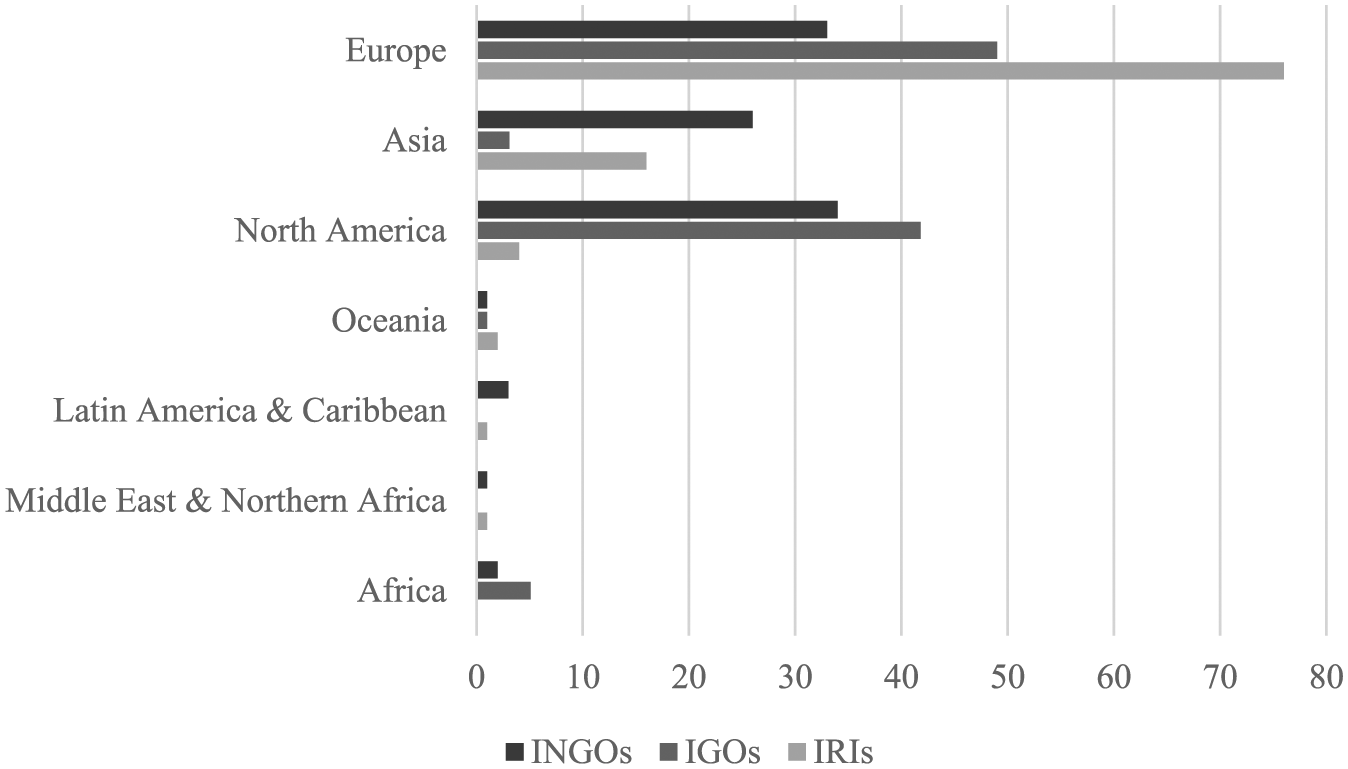
Top 10 publishing IOs’ most frequent collaboration partners, by area (in 000s).
Further specifying the importance of spatial proximity, we looked at collaboration partners’ country of origin for the most prolific IOs (Table 6). Indeed, these IOs tend to collaborate most with organizations from the (multiple) host countries. The Russia-led Joint Institute for Nuclear Research has strong ties with other research organizations from the Russian Federation, but also North American and other European partners. Geneva-based WHO finds most of its research partners in Switzerland before collaborating with US and UK organizations. Similarly, BRAC, the most important INGO from the sample, remains mainly local, while the US and the UK follow as the second and third most important research partners.
Top science producing IOs’ collaboration partners by country.

Own account.
Finally, I investigate cross-organizational collaboration distinguishing between nine types of scientific organizations, including the three-type distinction used in our own sample as well as the more traditional organizational forms, e.g. public/private universities, research institutes, and industrial/corporate research (Figure 5). Public universities are the most frequent collaborator for all three types. On average, 40,000 publications have been co-authored with colleagues from public HE institutions. IRIs and IGOs further show great affinity with public institutes such as the German Max Planck Institutes or the French Centre National de la Recherche (for IRIs), US Centers for Disease Control and Prevention or the Finnish National Institute for Health and Welfare (for IGOs). Interestingly, INGOs show much more frequent collaboration with private universities including several entities associated with Johns Hopkins University or Bangladeshi Dhaka University.

Top 10 publishing IOs’ most frequent collaboration partners, by type (in 000s).
Importantly, there is significant collaboration across the three types from our sample. IGOs, IRIs, and (albeit fewer) INGOs consider IRIs an important research partner. In turn, INGOs frequently cooperate with IGOs and other INGOs as do IGOs among each other.
Discussion: Rethinking international organizations
Analyses yield a striking trend of expansive science production for the selected period and the selected sets of international organizations. All types of organizations show increasing scientific output starting in the 1980s and with particular momentum since the 2000s, reflecting the wider trend found in national science systems (Powell et al., 2017). Unsurprisingly, IRIs lead the field. Their role as research producers is obvious, the fact that they only started to publish considerable amounts of articles relatively late less so (see below). IGOs have strongly entered the publication arena with some organizations like WHO, WB, and UNESCO being strong specialized publishers in their respective domains. Although quantitatively less salient, INGOs show a surprising trend of scientization, too.
For both INGOs and IRIs, the vast majority of selected organizations are now scientifically active and almost 40% of IGOs are. As for IOs in general, excessive publication activity is mostly a Western phenomenon (Zhang et al., 2015), although Asia and Africa account for a fifth of the publishing sample.
Research articles are by far the strongest type of scientific output, confirming findings from other large-scale scientometric studies; IOs also show similar disciplinary behavior, with the natural sciences being more publication-heavy than the social sciences (Powell et al., 2017). However, both health and the social sciences are important fields. Indeed, one of the most surprising findings stems from the sectoral analysis. Health, economics, and education are among the most active areas for IOs. This is in line with earlier work on the surging production and use of scientific knowledge in global development and particularly education (Chabbott, 2003; Zapp, 2017a).
To give an idea of the capacity of these organizations, we may compare them with the ‘winner’ of the schooled society, the modern research university (Baker, 2014). The Joint Institute for Nuclear Research, for example, publishes as many articles in the fields of physics and astronomy as Yale University (between ~18,000 and 18,500). The World Bank outstrips the London School of Economics and Political Science by more than 4000 articles in the social sciences and economics, and UNESCO is head-to-head with the renowned Institute of Education London (~5300 articles). Finally, the 10 most productive INGOs produce almost as much as prestigious Université Paris VII, Denis Diderot (~5500).
Obviously, these comparisons are limited for a number of reasons. The number of staff is an important variable, which we cannot fully account for due to the lack of data for most IOs. Ravallion and Wagstaff (2012), for example, count 100 members as part of the WB research staff, a number that has only slightly increased since then (~120; World Bank, 2017). How many of its 10,000 employees worldwide are, however, deliberately involved in research (publication) is difficult to ascertain. The same goes for most of the organizations in our sample, but also for many traditional institutes and universities. Second, these comparisons are based on volume (instead of ‘impact’) and on English-speaking articles (instead of other outputs in other languages); they assume higher education organizations’ and international organizations’ main function is conducting and publishing research. This is certainly true for many research or even ‘super research’ universities (Mohrman et al., 2007) as it is for many IRIs. Yet, just like universities are also sites of teaching and learning, IOs assume multiple roles. IRIs, while being primarily research-oriented, are also supposed to create industry links and spin-offs, and train young researchers. IGOs administer transnational and global problems, provide forum for exchange and resolution, while INGOs work the ‘grass roots’ providing assistance and relief in the field.
Interestingly, age is not a strong predictor for becoming a high-output IO. Certainly, top producers like the Joint Institute for Nuclear Research, the WHO or BRAC have been around for decades, yet others such as the European Centre for Disease Prevention and Control (2005), the European Law Institute (2011), the International Prevention Research Institute (2009), the Global Fund to Fight AIDS, Tuberculosis and Malaria (2001), and ACUMEN (2001) are fairly recent establishments which started to publish right after their creation.
Further, IOs behave just like other research organizations, making cross-organizational and cross-type collaboration a routine activity as we saw in Figures 4 and 5 and Table 6. IOs collaborate among each other, both among their kin and other international types, as they do with national public and private research producers. This is certainly a research avenue of interest to researchers concerned with the diversification of knowledge production. Here, national industry and state actors, including military and hospitals, and the ‘democratization’ of science (e.g. Dusdal, 2017; Leydesdorff and Meyer, 2006; Nowotny et al., 2001) have been extensively studied, while there is little interest in the emergence of the kind of post-national model of science production found in this article. Collaborative patterns are particularly interesting as IOs might pursue particular kinds of research.
Despite a preference for proximity, IO research is, above all and obviously, international. The EU, for example, has been much discussed in its attempt to create a distinctly European Knowledge Area (Chou and Gornitzka, 2014). With the institutionalization of its own research funding infrastructure, comprising the expansive Framework Programs and, more recently, the European Research Council, the EU has begun to reshuffle social structure in the European science community by creating new incentives outside national confines, new scientific elites and networks (Hoenig, 2017).
IO research promotion can, however, not only lead to expansion, but also to paradigmatic shifts in national scientific communities. The OECD, for example, has been observed to fundamentally alter national research traditions through the implementation of large-scale testing such as PISA. For instance, in Germany, the OECD has triggered the emergence of a new generation of ‘empirical’ educational researchers, the introduction of national education standards, a comprehensive reporting system, federal research programs prioritizing quantitative educational research, and the founding of several research organizations and prestigious projects (Zapp and Powell, 2016). Such examples of how IOs influence the cognitive development of research infrastructures, which are traditionally analyzed as nation-centered and state-centered, might multiply with the increasing scientization of IO work.
In general, the universality and timing of the trend across types, fields, sectors, regions, and organizational generations are striking and suggest a strong period effect, which itself begs an explanation of the causes and consequences of such sudden scientization. I advance two causal arguments for such a ‘scientific drift’ at the level of IOs.
One argument assumes a demographic or cohort effect. The massification of higher education has seen a first boost in OECD countries in the 1960s, and more recently in virtually all other world areas (Schofer and Meyer, 2005). Increasingly, IO employees, who are generally highly qualified (Anderfuhren-Biget et al., 2013), are scientifically socialized, holding a PhD and move between academia and the international sector. The professionalization of development and educational development in particular is one telling example (Chabbott, 2003). However, this alone might not explain the observed output increase as high levels of qualifications among IO staff and scientific socialization of IRI staff in particular are not a phenomenon of the last 15 years. A more recent element has to be added. Here, the growing importance of excellence in higher education, usually conceptualized around universities (Hazelkorn, 2015), might translate, at the micro level, into output-oriented career planning where often unstable employment conditions prompt a more competitive and strategic self-perception of academics (Hicks, 2012). A similar rationality might operate at the IO level (and particularly for IRIs) where most of the staff might be under similar short-term contract constraints.
At the same time, precarious employment is less common in large IGOs. Also, both the IGO and even less the nongovernmental sector are certainly not affected by the excessive premium on excellence and performance. Moreover, it is important to note that the very aim of many recently-founded organizations from the sample is to produce and provide scientific knowledge. I may, therefore, propose another more general explanation.
A second argument is based on wider cultural assumptions about the rationalization of social life and a particular understanding of IOs. Here, IOs, and particularly IGOs and INGOs, need to be considered ‘rationalized others’ providing advice to nation-states on any number of areas of modern life (Meyer et al., 1997). As we saw through our focus on various world-societal sectors, these include legal, economic, social policy, political, medical, recreational, religious and not least, educational domains. More concretely, IOs deal, for example, with such thorny issues as child labor, gender discrimination, gay and lesbian rights, environmental protection, abortion, and undoubtedly education and research themselves (see for reviews Elliott, 2007; Lechner and Boli, 2014; UIA, 2016). In these struggles, they stand for emblematic modern goals: universalism, individualism, rational voluntaristic authority, rationalizing human progress, and world citizenship (Boli and Thomas, 1999). Thus, their values greatly match with the principles of modern science.
Again, these values have not been a key motivation in IO work until only recently. What has altered IOs’ behavior might have been an emphasis on science as a legitimation of policymaking, which has seen rapid diffusion in the past two decades under such labels as evidence-based policy and practice or the scientization of politics (see Drori et al., 2003; Normand, 2016, for reviews). Policymakers borrow the authority and legitimacy of scientific research to bolster political action and, conversely, science has found opportunities to refill drained funding lines. To increase their own legitimacy and leverage in global governance, IOs make use of their expertise, now proven through high academic output.
What supports such an explanation is, of course, the universality of the trend making a purely functionalist or realist interpretation of the role of IOs in global governance less plausible. Does complexity and planning necessity increase uniformly across all world-societal sectors? Why is it that these real-world challenges augment so dramatically only in the last 15 years?
Extending our line of explanation, IOs have shifted from regulative and normative authority through treaties and naming and shaming to a more cognitive kind of authority represented in their accumulation of rationalized knowledge. This would also help to explain why IOs create and fund expensive research organizations or departments inside their formal structure or even fund entire universities. BRAC university has been founded by the homonymous INGO. The UN and EU decision-makers are surrounded by an increasing array of scientific advisory bodies, some of them among the top producers in our sample.
These insights might be of particular interest to IR scholarship, the locus classicus of IO studies. As described above, realist and neoliberal approaches (Ikenberry, 2001; Keohane and Nye, 2000) do not pay much attention to the cognitive or epistemic role of IOs in the international realm. While constructivists have started to make use of a focus on knowledge production and meaning-making (Barnett and Finnemore, 2004), these works still seem to present such features as special cases or exceptions to an otherwise less relevant rule. Our analyses have, however, revealed a general burgeoning phenomenon, which should prompt us to think of IOs as knowledge generators making substantial contributions to the state of the art in respective fields and, more importantly, to the applied enterprises of policymakers, to which IOs often address their messages.
Conclusion and outlook
This work has provided the first bibliometric analysis of the scientific output of a comprehensive sample of 1325 international governmental, nongovernmental, and research organizations. The characteristics of these IOs are unique: their scientific activity is non-for-profit (vs. industry), mostly (but not exclusively) applied (vs. academic) and their funding is (albeit in some way public) truly international. Findings show a pervasive trend of scientific expansion since the early 2000s across all IO types, geographic areas, publication formats, and scientific domains. The quantitative volume often surpasses top national academic organizations.
Sociologists of (scientific) knowledge may benefit from a systematic consideration of IOs in their analyses, as would IO scholars from a more thorough discussion on the importance of science in explaining the role of IOs in global governance.
The lines of inquiry offered in this article are to be seen as tentative and need further empirical support. I propose three strategies.
First, although I share the concerns about measuring impact in science, the exclusive focus on quantity is an imperfect strategy. In order to get a more accurate picture of IOs as novel actors in a genuinely internationalized scientific infrastructure, further scientometric analyses (e.g. citation counts, impact measures) could shed light on the qualitative importance of their contribution.
Second, additional variables at the organizational level (e.g. budget, staff, sector, mission, location, age, scope, and internal publication strategy) could help explain the variance in organizational output across (types of) organizations and over time.
At the macro level, the concept of sectors (e.g. education, resources) applied here is not to be seen as a static heuristic. The very task would consist in identifying the fluidity of these sectors, their emergence, organizational density, thematic boundaries and intersections, as well as their increase/decrease in importance measured through scientific activity. Social network analyses, for example, could provide valuable insight in the dynamic fabric of international scientific collaborations among (types of) IOs and more traditional science producers.
Footnotes
Acknowledgements
The author would like the following colleagues for valuable assistance: Jennifer Dusdal, Justin Powell, Marcelo Marques, Vladislav Muller, and Evan Schofer.
Funding
This research received no specific grant from any funding agency in the public, commercial, or not-for-profit sectors.