




Abstract
This article focuses on the shift from informal to formal employment in the sugarcane plantations of Alagoas, Northeast Brazil, and its unintended consequences. Drawing on the employment experiences of sugarcane cutters, the authors stress the main mechanisms that produce precarity within formal employment structures. Precarity is forged by means of employers’ hiring practices, which turn formal employment contracts into insecure and temporary ones, disciplinary techniques used to control workers’ daily productivity within this labour-intensive production process, and the parasitic uses of the unemployment insurance system. While job formalisation has given access to more social protection, it has also created a permanently temporary workforce, which is rehired discontinuously by the plantations. The authors’ analysis of the link between formal employment, precarity and state protection more particularly leads to a reconsideration of Ulrich Beck’s ‘Brazilianization thesis’.
Introduction
In The Brave New World of Work (2000), Ulrich Beck discusses the dismantling of the modern welfare state under the title of the ‘Brazilianization of the West’. Beck particularly draws attention to the ways in which the ‘traditional work society’, with its lifelong and full-time work paths, is giving way to a much less stable ‘risk society’, in which the job for life is disappearing alongside the crumbling of welfare structures. In Beck’s view, large parts of the economically active population in Europe and North America will have to earn their living in precarious conditions. Their future, according to Beck, may already be ‘glimpsed in Brazil’. Countries such as Brazil, ‘with their high proportion of informal, multi-activity work, may reflect back the future of the so-called “late-modern” countries of the Western core. This change in who predicts whose future is what I mean by the “Brazilianization of the West”’ (2000: 93). This ‘Brazilianization of the West’ – that is, the massive shift towards informal, insecure employment structures that have until the most recent period been more characteristic of the Global South – is in this view virtually inevitable.
In recent years, this narrative of the new world of work, in which large parts of the population work à la brésilienne, has become a powerful trope. But although this narrative seemingly emphasises historical and global awareness, it also leads to fairly crude and simplified readings of social and economic transformations (Strangleman, 2007, 2015; Vanderstraeten, 2006). Despite a focus on the ‘Brazilianization of the West’, Beck hardly devoted attention to the changing world of work in Brazil or in other parts of the Global South. Most of the empirical material he marshalled in defence of his main ideas consists of labour market statistics on Germany. Moreover, several statements about Brazil are at odds with the complexities of the contemporary labour market in Brazil.
Large fractions of the Brazilian workforce have in recent years been incorporated into standard employment forms that include social entitlements (Berg, 2010; Maurizio, 2014). This formalisation is perceived to have taken place between 2003 and 2010, when ‘eight out of ten new jobs were formal ones, totalling 16 million in eight years’ (Cardoso, 2013: 64). Under the presidency of Lula da Silva, in particular, much emphasis has been put on the strict enforcement of labour law. However, as we will see, the available evidence also suggests that the rapid expansion of the formal labour market has not gone hand in hand with the extension of secure employment.
Against the background of these complexities, it might be useful not to take standard images of particular national traditions as given and to predict their rapid global diffusion (‘the Brazilianization of the West’), but to question how precarious forms of work are produced and reproduced within particular national contexts. Our study contests standard notions of precarity simply understood as a new trend towards informalisation, destandardisation and deregulation of work taking place within advanced-capitalist countries with the demise of Fordism (Beck, 2000). Instead, we understand precarity as a historically constituted social fact, which can manifest itself in a variety of ways (Munck, 2013). An empirically and historically informed analysis of the world of work in Brazil may therefore help us to shed light on the meaning and consequences of precarity.
We focus on the agro-industry of Brazil, as this economic sector has been heavily influenced by the recent labour market reforms and has undergone changes which have hitherto hardly received sociological attention. Against the background of a brief historical overview, this article particularly builds upon extensive fieldwork conducted between 2012 and 2015 in two sugarcane plantations in the state of Alagoas, the leading producer and exporter of sugar in Northeast Brazil. We analyse the ways in which job formalisation reconfigures the historical precarity in the plantations. We highlight the patterns of permanently temporary employment with which workers have become faced, the disciplining mechanisms devised by employers and the consequences thereof, and the employers’ parasitic use of state protection through unemployment entitlements that reproduce the patterns of precarious work.
First, we briefly outline the transition from non-paid to paid labour in the sugar plantations in Brazil. We also outline the legal forms of contract which currently structure Brazil’s wage-earning economy. Against this socio-historical and legal background, the main body of our article is devoted to an analysis of the precarisation of work in formalised labour markets and the coping strategies which workers (are forced to) use in order to come to terms with their precarious position. In the concluding section, we briefly reflect upon the path dependency of such complex arrangements within the sugar agro-industry of Northeast Brazil.
A brief history of work in the sugar plantations of Northeast Brazil
In Northeast Brazil, sugarcane plantations were established by the Portuguese during the early colonial period (16th century). Despite several crises, the plantations have remained important economic actors in the region ever since.
For the ‘ambitious’ colonists, providing sufficient labour for the production process turned out to be one of the most pressing problems. At the end of the 16th century, the plantation owners began to rely on a coerced labour force composed of enslaved Africans to carry out the manual labour on the plantations. In the era between 1500 and 1850, millions were enslaved and brought from the African continent. By the time slavery was finally legally abolished nationwide in 1888, over 3.5 million slaves had been shipped to Brazil, more than to any other region in the Americas (Skidmore, 1999: 17). According to most prudent estimations, the sugarcane regions in the Northeast had the highest ratio of slaves to wage labourers in the country (see De Andrade, 1980).
After the Abolition, the search for a stable labour supply entered into a new phase. As, however, most of the emancipated slaves remained in the sugar zone, they were a ready source of cheap labour. They often became so-called moradores de condição, i.e. resident workers who received a house and a subsistence plot from the planters, mostly on the edges of the plantation, on condition that they should work in the sugarcane plantations during part of the week, receiving a low pay or no pay at all (Scheper-Hughes, 1993; Wolford, 2010).
The relation between the moradores and their senhores de engenho (the landowning elite) was defined by an informal system of rights and obligations, which could easily be manipulated by the senhores (De Heredia, 1988; Eisenberg, 1974; Sigaud, 1979). By providing the moradores with dwellings and subsistence plots, the plantation owners could not only force the residents and their households’ members to work on the plantations, workers who became moradores were also immobilised: they could not work for any other plantation owner or employer. They permanently faced, moreover, the threat of eviction. It is amply documented how landowners did not hesitate to recur to the use of physical violence to enforce their dominant position (Dabat, 2007; De Heredia, 1988; Heath, 1981). The ‘contract’ with the moradores thus entailed both forms of labour management and social control. This regime made it possible to maintain a compliant labour force, whose collective actions could not threaten to raise the costs of labour in highly labour-intensive production processes (Scott, 1976).
Production regimes that heavily relied on moradores were able to survive well until the mid-1900s in Alagoas (De Heredia, 1988). But in the second half of the 20th century, the state-sponsored centralisation and modernisation of the agricultural production brought about considerable changes in production techniques and work relations. Especially during the military dictatorship (1964–1985), government interventions through the Institute for Sugar and Alcohol supported the replacement of traditional sugar mills (engenhos) by modern factories (usinas) and led to the rapid increase of the amount of land cultivated on the plantations. Plantation owners increasingly planted sugarcane on the sites where moradores had taken up residence; new production techniques were also adopted that decreased the planters’ reliance on manual labour.
This evolution not only gave rise to the decline of agricultural employment, but also to a rapid ‘purification’ of what had been ‘disguised wage relations’ (Goodman et al., 2011: 204). By the end of the military period, employment within the agro-industry had declined, but a much larger percentage of rural workers now depended on wage income for their subsistence than had two decades earlier. Moreover, a large proportion of these workers now lived in adjoining localities rather than on the sugarcane plantations where they had to work (De Andrade, 1997).
In the course of the 20th century, the formalisation of work also took off. As of 1943, wage work became regulated by the Consolidação das Leis do Trabalho (Consolidation of Labor Laws, CLT). While the CLT regulations were initially mainly applied to formalise work contracts in the industrial sectors, the Estatuto do Trabalhador Rural (Rural Workers Act) of 1963 was meant to grant similar rights to labourers working in the agricultural sectors. It has, however, often been maintained that these regulations remained dead letter for the rural workers in Brazil until the 1990s or early 2000s (Pereira, 2009; Silva, 1999; see also Schaffner, 1993).
For people working under the CLT regulation, the Carteira de Trabalho e Previdência Social (hereafter work card) is a mandated document. Each time workers enter into contractual relations with employers, they need to present their work cards to the employer, who in turn needs to sign them and add information, such as job description, type and length of the contract and wage. The term fichados is mostly used to refer to the formally employed workers, i.e. the workers possessing signed work cards. The information included in the work cards entitles individuals to the rights specified by the CLT or negotiated by the workers’ unions (eight-hour working days, minimum wage, paid holidays, unemployment and health insurance, retirement rights, eligibility for union membership). Workers without signed work cards, on the other hand, are not officially registered and not entitled to any of the social benefits of being formally employed. In the plantations, they have become known as the clandestinos, i.e. informal workers who are often recruited on a daily or weekly basis via labour intermediaries (Sigaud, 1979).
This evolution did not reduce precarity, understood as employment instability in the plantations, neither for the many informal nor for the formal workers. While the moradores were replaced by ‘pure’ wage workers, the relative security represented by the access to subsistence plots was also lost (De Andrade, 1980: 96). Rural workers now became dependent solely on wages, but the labour market in which they had to sell their labour power did not provide secure, steady work. 1 Moreover, the diffusion of wage work went along with work intensification: in a six-day working week most workers were paid based on a piece-rate system determined by the employers. In fact, workers often had to do the most menial tasks of the harvest for a fraction of the pay they were promised. But they had little recourse to complain, if they wished a contract for the following days or weeks, or the following season (De Heredia, 1988; Wolford, 2010: 172–173).
In the last decades of the 20th century, in an increasingly competitive global sugar market, many usinas in Alagoas reorganised, rationalised and downsized their labour force (Padrão, 1997). As a consequence of the ensuing conflicts, formal contracts have in recent decades become increasingly common. Labour inspections have put pressure on sugar companies, among others by broadcasting a blacklist of employers that flouted labour laws. In 2008, for example, under the presidency of Lula da Silva, labour inspections denounced the working conditions in 15 sugar companies and plantations in Alagoas. Labour prosecutors accused these usinas of subjecting workers to ‘conditions analogous to slavery’ (as specified in article 149 of the Brazilian Penal Code), including illegally long working days, informal contracts and degrading working conditions (PRT/AL, 2008: 3–10). A National Agreement to improve working conditions in the sugarcane plantations was signed in 2009; it criminalised informal recruitment and enforced various labour standards. These inspections and efforts to regulate and protect jobs also constituted a response to the infamous accusations of a ‘Brazilianization of work’.
Currently, the highest formalisation rates within the Brazilian agriculture are found in sugar production. This sector now employs nearly 1 million formal workers (Fernandes et al., 2013). Its restructuring has also transformed the nature of precarious work, resulting in a range of unintended consequences. It is in this context that our fieldwork in two of Alagoas’s sugarcane plantations took place.
Fieldwork and methods
This study focuses on the careers and employment experiences of the sugarcane workers residing in Alagoas’ Zona da Mata region. The historical development of this region is closely intertwined with the sugarcane plantation economy; its economically active population still heavily relies upon jobs in the surrounding plantations. Among the 21 sugar-producing companies in activity in this region, we selected two large companies with quite different histories, plantation areas and work practices as research sites (C1 and C2). C1, whose establishment dates back to 1894, grows sugarcane in the northern part. The production process in C1 is highly labour-intensive, while the hilly terrain in this part makes the mechanisation of the cane cultivation and harvesting difficult (see Figure 1). C2 was founded in 1973. Its plantations are located on the southern plateau of the sugar zone, where capital- instead of labour-intensive production techniques could more easily be introduced. C1 ranks fourth in sugar production in Alagoas (2.5 million bags of sugar/year 2 ) and serves both the national and the global market, while C2 ranks tenth (1.5 million) and produces only for the global market. Both research sites were chosen on the basis of previous research in this area; the experiences with job formalisation in both companies are exemplary of the employment structures in the sugarcane plantations in Alagoas (Queiroz, 2013).

The cane cutter and rows of cut cane at C1 (January 2015). The manual cutting of cane by means of machetes is hard physical labour that is only conducted by men. Women have been systematically excluded from the harvesting since the restructuring of Alagoas’s agro-industries in the 1990s.
As part of our fieldwork, we collected detailed information about the work histories of the cane cutters. After having acquired prior information about the neighbourhoods inhabited by rural workers, we combined door-knocking and snowballing strategies, as both are recommended to access ‘hard-to-reach’ populations (e.g. Biernacki and Waldorf, 1981; Davies, 2011). To tackle the limitations of these two strategies, variation in age, contractual condition and place of residence were important selection criteria. The fieldwork was also carried out in different periods of time – June–July 2012, January 2013, December 2014–February 2015 – to take into account that work in the plantations is strongly characterised by seasonality.
Altogether, 39 in-depth interviews with male cane cutters were made (see the Appendix). In addition, semi-structured interviews were conducted with overseers and HR managers at C1 and C2, as well as with the secretary of the Alagoas Federation of Agricultural Workers (FETAG/AL). In the interviews with cane cutters, we enquired into their current employment situation, but also paid much attention to the sequence of jobs within their careers, including experiences within older institutional forms (as moradores or clandestinos). We moreover asked for contractual conditions, social entitlements, and the ways in which (changes in) these entitlements affected their work and life.
Upon consent, each interviewee had his work cards photographed. These documents are used to annotate formal contracts, serving as a proof of the formal arrangements and the work history. The documents allowed us to collect specific information about date, duration, types and numbers of employment contracts not always recalled during the interviews, thus enabling triangulation with the oral sources of information. When necessary, we conducted a second interview with the workers to clarify the sequence of jobs within their careers. It might be added that conducting the interviews and collecting this information proved difficult and time-consuming. Not surprisingly, the job insecurity with which the cutters are confronted often surfaced during the interviews in the form of distrust, suspicion and self-censorship.
Although we interviewed local workers employed by C1 and C2, their work histories often involved other sugar companies across Alagoas’s sugar zone as well. The variety of jobs and contract sequences in the careers of the cane cutters is impressive, but this variety is the result of specific mechanisms, which build on historical institutions and contemporary organisational practices. The interviews and documents were analysed using sequence analysis (Abbott, 1995). We point to typical employment patterns within the work histories, especially with regard to the succession of formal contracts (see the Appendix). On this basis, we explore the unintended consequences of job formalisation in Northeast Brazil’s sugarcane plantations.
Formalising permanently temporary workers
Traditionally, sugarcane harvesting occurs annually from September to March in Alagoas and other regions in Northeast Brazil. Hiring peaks in the harvesting period (summer), when thousands of rural workers are employed for cane cutting, whereas the level of employment is much lower in the off-season period (winter). During the 2013–2014 harvest, the sugarcane agro-industry of Alagoas officially employed 68,040 formal workers in its agricultural production (CNTA/DIEESE, 2015). In the subsequent harvest, the two companies (C1 and C2) covered by our fieldwork employed 1500 and 900 rural workers respectively.
Following current CLT regulations, three types of employment contracts are used. The permanent contract is the standard form, which guarantees, in principle at least, secure employment. The seasonal contract is a fixed-term contract whose duration follows the harvest period. It is dissolved at the end of the harvest, but as this end is difficult to determine, usinas are able to adjust the duration of this contract to their needs. Severance payments and other entitlements are reduced in this type of contract. The probationary contract, finally, is a fixed-term contract, with a length of up to 90 days, which should in principle only apply to inexperienced cane cutters, although this type of contract is frequently also used to hire experienced workers. After the trial period, this contract may become one of indefinite duration. From the interviews, it is clear that the formalisation of jobs did lead to important changes for the workers – but it mostly did not bring about secure, permanent employment.
When cane cutters are asked to reflect on the formalisation of their jobs and the ensuing changes, they often highlight the ‘arrival’ of social rights: What changed is that we now have rights. When we are working for six months, we have the right to the [unemployment] insurance, don’t we? We also have FGTS,
3
some severance payments. We have all the rights, don’t we? The clandestino didn’t have the rights a fichado has nowadays. Today we have rights and in the past we didn’t. Today we work for six months and when we are fired we can make use of unemployment insurance. (Sebastião, 26)
But they also speak of the high degree of job instability to which they are exposed. They are often fired by the usinas, following the seasonality of the work in the plantations, but they also actively search themselves for better-paid work elsewhere in the sugar zone: When you are a cane cutter, there is no fixed employer. This year you work at one usina, then in another … You work at one than in the next season you want to go to another, and that’s how it goes … Running from place to place, to get work wherever they pay more … (Mario, 33)
The arrival of standard contracts and social rights indeed brought about new forms of insecurity. According to a 59-year-old labour union representative, who was able to observe the transition towards formality at first hand, the installation of labour courts and related institutions in the early 1990s was fundamental to foster compliance with labour regulations. With the enforcement of formal employment contracts, he added, workers: … returned as fichados. However, they did not have the same employment duration anymore … Any morador had 8, 10, sometimes 20 years of job consecutively. Now … workers stay the period employers want and then they’re sacked. (FETAG secretary, 59)
As formalisation gradually replaced informality, new employment patterns emerged. According to information from the HR managers and overseers in the sugarcane plantations, their rural workforce is segmented between temporary (80%) and permanent (20%) wage workers. The workers with a permanent contract are expected to carry out a wide range of tasks year-round, including planting, crop treatment (sowing, weeding and liming) and cane cutting. Their wages reflect these different activities. During the harvest period, the piece-rate system (payment by result) is at play, whereas during the slack season, their wages mostly do not surpass the official minimum wage (which is in May 2017 937 BRL or 294 US$). They nevertheless enjoy the entitlements of a full-time job, such as year-round contributions to pension, paid holidays and full severance pays in case of dismissal. Conversely, the temporary workers are only recruited for the labour-intensive harvest. As the season ends, they are dismissed. After an idle period, a few workers may be rehired for the remaining off-season jobs. Recruitment policies vary: some companies hire exclusively migrant workers during the harvest, whereas others mainly hire local workers. In our case, C1 predominantly hired locals, while C2 employed both local and migrant workers from Alagoas’s hinterlands.
The temporary workforce endures a pattern of permanently temporary employment, i.e. a cyclical dynamic of seasonal work and discontinuous employment, which negatively affects income and pension contributions. João, 38 years old, a cutter who started working in the cane fields at the age of 10 and was formally employed for the first time when 28, experienced an entire decade (2002–2012) of temporary jobs: I’ve been working during the winter, then after three to four months of work, I was fired. Then I was unemployed for one month and was hired for the summer [harvest] again. That is how … I’ve been working continuously 10 years, from winter to summer …
For the cane cutters, to work ‘from winter to summer’ means to combine temporary contracts with recurrent periods of unemployment. The work cards display the work histories of permanently temporary workers very clearly. Many workers have accumulated dozens of contracts in the years in which they ‘enjoyed’ formalised temporary jobs. As work cards can contain up to 10 different contracts, many workers had already assembled several booklets in the course of their career (Figure 2).
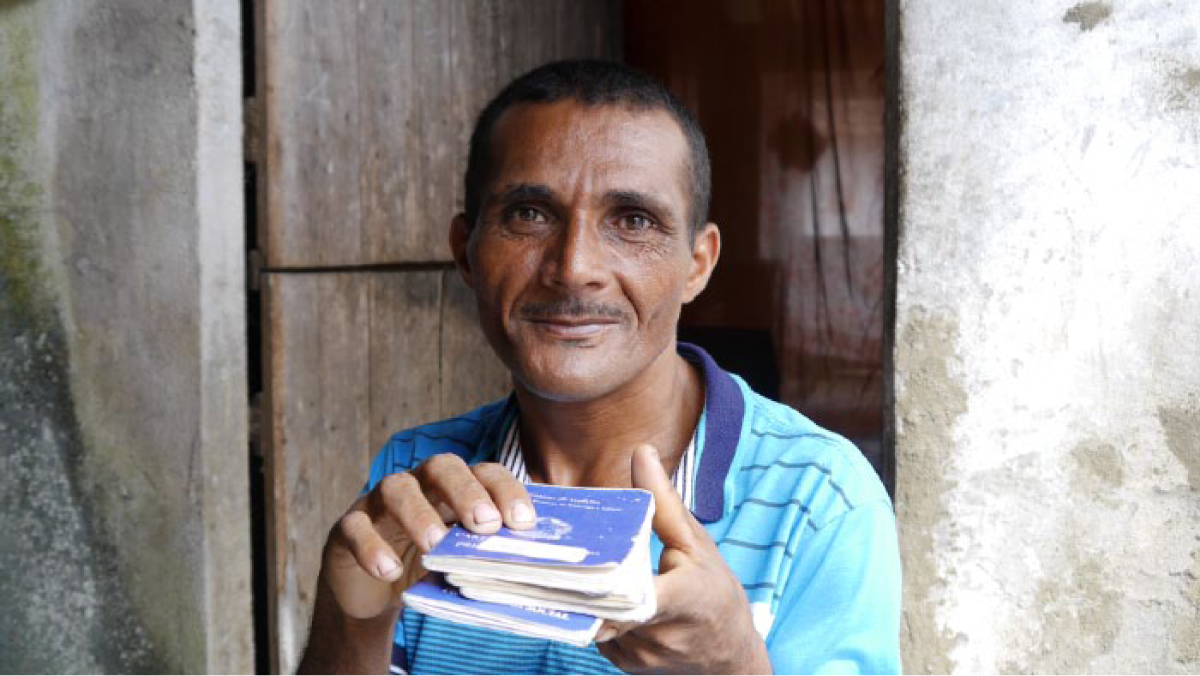
A cane cutter and his work cards (February 2015). The booklets record his trajectory as a permanently temporary worker at C2.
The work cards and work histories indicate that most cane cutters have to come to terms with a long series of insecure and unstable jobs. The annotations in the work cards are documented evidence of contractual flexibility; they clearly depict how work histories are marked by a cyclical pattern of unstable, temporary jobs. In this sense, formalisation has led to the creation of a class of permanently temporary workers, who have a precarious ‘job for life’ (see also Plancherel et al., 2010). As the data presented in the Appendix show, three patterns can be detected in the wide variety of work histories: some are permanent workers, others had permanent contracts in the past but now work with temporary ones, while most of the workers are confronted with a long sequence of temporary positions.
Although formal contracts are now in standard use in the Brazilian agro-industry, the standard job has thus become that of a permanently temporary worker, who conducts the same kind of work under different kinds of contracts and in different plantations during his entire career, and who is willing to accept these precarious conditions, while ‘a breadwinner has to endure anything’ (Cosme, 43).
Crocodiles on the plantations
Many prevalent socio-economic theories attest to the rationality for employers of employing permanent workers, even in a seasonal industry (for an overview, see Collins and Krippner, 1999; Ortiz, 2002; Schaffner, 1993). Employers generally make use of long-term employment contracts when they require specialised skills or know-how on an assured basis. Permanent contracts also reduce the cost of supervision of labour. Workers who receive wages that are more stable than the norm are expected to put in more effort in order to retain their jobs. The use of temporary contracts, conversely, often seems to require elaborate forms of control. In the sugarcane plantations, a variety of strategies was indeed used to control and increase workers’ daily productivity. Piece wages, dismissal threats and other disciplinary mechanisms were a central topic during the interviews we conducted.
CLT allows for piece-rate wages provided that the resulting wages do not fall below the official minimum wage. In order to keep their jobs during the harvest, the workers are forced to meet particular production quotas, typically defined in terms of tonnes cut per day (in our case: minimally 4.2 tonnes in C1 and 7 tonnes in C2). With an increasing piece-rate system, however, they are also encouraged to be more productive. When they cut beyond the minimum quota, the workers receive higher rates per tonnes cut (5.00 BRL resp. 6.43 BRL per tonne in C1 and 6.53 BRL resp. 7.03 BRL per tonne in C2). In both companies, many of the interviewees were cutting above 7 tonnes per day in order to receive between one and a half and two minimum wages per month.
The tight control of the labour process also puts pressure on workers. Workers’ cane cutting is measured daily and recorded by overseers. The production data, which are sent at the end of the day to the HR offices, allow employers to easily track workers’ productivity. Overseers control whether workers are cutting cane according to a ‘best way’ in terms of quality (close to the ground, separating stalk from leaves, disposing canes in an appropriate manner for later mechanical collection) and quantity, thereby pressing workers to keep an average above the production quota. Those who fail to meet the quota are dismissed. This form of dismissal is known among cane cutters as jacaré (crocodile), a metaphor that refers to the sudden ‘attack’ that might immediately lead to unemployment: If you fail at the machete, they don’t miss a chance; if you falter, you are fired. The jacaré grabs you and you’re kicked out. This is the jacaré. The severance pay is quite small. They kick us out and yet pay a pittance. (Josué, 33)
Jerônimo, 49, an overseer who is himself hired by means of a seasonal contract and who supervises a team of 38 seasonal workers during the harvest, explains that: Jacaré is how it’s called because it swallows workers during the harvest … It fires those with low productivity during the first and second months … Because we have a quota of 7 tonnes a day. But good workers can cut 15, 20 tonnes … If a worker cuts 4 tonnes and 200 kg he already covers the [daily] minimum wage. This is not what the company wants, but it lets him stay. Instead, those cutting 3 or 3.5 tonnes … the jacaré pulls them out faster … Actually, the company tracks closely those who don’t reach the quota, then it orders their dismissal. The weak ones are fired and we recruit others … Those fired have their rights [severance pay], but these poor guys are now idle, they are unemployed …
From the workers’ perspective, the jacaré is a disciplining mechanism that reminds them of their weak job protection. Overseers also assert that not only productivity, but also punctuality and assiduity are controlled. The seasonal workers are disciplined and forced to work hard to keep their temporary jobs. The resulting uncertainty fragments the workforce: workers tend to avoid overt resistance, while they fear dismissal. They are constantly reminded of the fact that they can be easily replaced by others awaiting employment; they all know that they have to compete with a vast, ‘local’ but also migrant labour force from adjoining regions. This large reserve army of workers functions both to depress wage rates and to remind permanent and seasonal workers of their vulnerability. As Benedito, 40, emphasises: Cane cutting is our work and without it we wouldn’t survive. On the other hand, it’s a slave’s work. If you miss one day, the jacaré grabs you, as we say in our language. If you miss work too much, the usina terminates your contract and you are kicked out by the jacaré.
Disciplinary mechanisms, such as the jacaré, provide the factories’ management with additional tools both to control labour and reduce its costs. In this sense, the formalisation also imposes ‘moral’ duties on workers. Given the job insecurity created by formal employment contracts, their entry into the formal economy and its guarantees comes alongside a sense of obligation; they feel that they have to be productive and reliable in order to safeguard their jobs and social entitlements. Marcos, 30, comments: If I give my work card for a job at the usina, then I have that commitment. I have to work, haven’t I? Because I asked for a job. It’s a commitment for me. In the time of the clandestino this was not the case. You worked one day, and the next day, you didn’t come … because you didn’t have a commitment … there was no quota. You could cut 1, 2 tonnes and leave … Now you have this commitment, from Monday to Saturday, of being at work … if I miss one day they also cut my weekly rest.
Formalisation replaced the informal relations between workers and employers, but it also brought about new mechanisms of labour control, including pressures to interiorise obligations to be reliable, to not complain and to work hard.
Unemployment insurance
The usinas can easily fire workers. The costs they face themselves are low, especially for workers hired on probationary and seasonal contracts. Recurrent unemployment is another feature of this labour market. As a result, many tensions arise between workers and employers. Since 2007, workers’ collective actions have been escalating in Alagoas’s sugar plantations. 4 In response to these conflicts and strikes, new recruitment strategies have seen the light of day.
Presently, the usinas not only make use of temporary contracts to hire the permanently temporary workforce. We could observe that they also use permanent contracts to seasonally hire the workforce. This hiring strategy allows employers to transfer the advantages of permanent contracts to temporary workers without having to bear the costs of steady jobs. In this regard, there is no simple dichotomy between permanent and temporary employment in the Brazilian agro-industry.
Following the current regulations, only contracts of indefinite duration entitle a worker to unemployment benefits, provided that they have been employed for at least six months. As the sugarcane harvesting lasts about the same period, employers can easily make use of this clause. Permanent contracts in due course frequently turn out to be temporary contracts. Employers deliberately terminate permanent contracts so that workers can claim unemployment insurance: I signed a contract of indefinite duration. We are only fired when the employer decides … Who has unemployment insurance gets it, and who doesn’t is re-hired during the winter … Employers wait 30 to 40 days and hire again. (Bruno, 28)
Employers strategically hire and fire workers using permanent contracts to take advantage of unemployment insurance. Insured workers can receive up to five monthly sums paid by the state. Full coverage for workers thus typically coincides with the off-season period. However, workers are only entitled every other year to the unemployment insurance. Moreover, as payments are based on the last three monthly wages, workers are pressed to work hard – not only to secure their jobs and avoid the jacaré, but also to secure better insurance payments and severance provisions upon dismissal. As Paulo, 35, commented, ‘whenever we’re about to get an insurance, we work harder … the more we cut, the greater the [severance] benefits, the FGTS’. The regulations thus reinforce existing pressures to work hard and be productive. As Joaquim, 34, pointed out, ‘to receive an insurance, you have to cut the quota every day until the end of the contract’. Bruno, 28, who was himself receiving unemployment benefit during the interview, reiterated this point: [The insurance payment] is according to individual productivity throughout the season … Now I am receiving R$ 950,00 during five months … When the insurance ends, the season will be starting again, then if I want to get hired I can do that …
For the workers and their family households, the severance provisions and unemployment insurance payments have become the main source of income during the off-season period. These social security benefits provided by the state also allow workers to ‘take an escape’ – ‘tomar uma fuga’ as they say – in order to recover after the hard, physically exhausting work during the harvest. These benefits allow workers not to have to seek employment during the slack season, when the workplace conditions are perceived as unfavourable and the wages as unsatisfactory: Whenever I get the insurance I don’t work here … This period is a bit crap … The wage is very low. It’s cold, you are soaked all day long in the plantation … the bus doesn’t drop you off near the field, you have to walk a lot under the rain … There is no good job. I mean, there are jobs, but who goes there? … The employers only hire us during the summer, during the winter we don’t go … If you don’t have the insurance, you go. If you have it, you don’t go, because you are receiving, you won’t be hired again because you aren’t stupid, are you? (Marcos, 30)
When workers are entitled to unemployment insurance, they often ‘take a break’ and only seek employment during the next harvest season. During the insured period, they do not seek formal employment as they would otherwise lose the entitlement. Although they are unemployed, the insured cane cutters are thus immobilised until the next season. 5 The cutters’ cyclical pattern of employment and unemployment reveals not only a link between the precarity of job insecurity and social protection, but also discloses the cutters’ economic dependence on the precarious formalised jobs in the plantations, and consequently, on the rural employers reinforcing ‘moral’ duties.
Even for workers with permanent contracts, periods of recurrent unemployment are quite common. These indefinite, permanent contracts often turn out to be temporary contracts. The temporality of these permanent contracts is generally known to all beforehand – workers, employers, unionists and state officials. With permanent contracts, the cane cutters are able to benefit from social protection during the slack season, as these contracts entitle them to severance payments and unemployment benefits. But they also provide ways in which the usinas are able to reduce the labour cost by parasitically feeding off the social security system.
The sugarcane plantations thus achieve leverage over the workers through providing access to social protection schemes. They consciously manage the permanent contracts in ways that allow for much flexibility. Closely tracking who is (or is not) entitled to unemployment insurance and other benefits allows employers to seasonally adjust the workforce and reduce the labour costs during the slack season when there is less manual work. In Brazil’s sugarcane plantations, unemployment insurance is not just an entitlement protecting workers in the case of involuntary unemployment, it also is a mechanism for the reproduction of a permanently temporary workforce. It is, moreover, a mechanism for the creation of immobilised workers, tying cane cutters to the usinas. As insured workers wait to be hired for the next season, employers reduce recruitment costs by rehiring them – a ready labour force which is reproduced by permanently temporary employment.
Conclusion
In the sugarcane plantations of its Northeast region, manual labour has been important in Brazil since the early colonial period (16th century). Plantation owners have long been able to achieve leverage over the moradores or clandestinos. At present, the production process still heavily relies on the manual work of cane cutters. At the plantations, labour management still goes hand in hand with social control. As before, contracts are used and abused to exert control over the workforce. Even when set against the historical context of slavery on the plantations, precarity has not disappeared as a result of recent changes in the labour market regulations.
As we have seen, a formal contract allows employers to subject the workforce to new forms of social control. Plantation workers who are formally contracted mostly do not have a steady, stable job and corresponding source of income. Their ‘job for life’ is a permanently temporary one. Despite the process of job formalisation, the plantation workers have to make do with seasonal jobs for most of their working lives, as long as they are able of body and fit for labour. They have to come to terms with cyclical patterns of precarious employment, permanently temporary contracts and complex mechanisms of social control put to use by the usinas.
It is difficult to uphold the claim that formalisation has enhanced job and wage security within the plantation economy of Northeast Brazil. What has been formalised is a precarious, permanently temporary situation or a ‘job for life’ characterised by insecurities and instabilities within the formal labour market. Various mechanisms allow employers to stabilise the workforce; even the system of social protection is used to reproduce permanently temporary workers. Strategies for coping with job precarity indeed lead to the reproduction of the cyclical pattern of discontinuous employment. Precarity has thus been reconfigured in recent decades. Our findings suggest that current forms of precarity ensue from both age-old control structures and new standardisations in the labour market. These forms can only be understood on the basis of a contextualised and historicised account of work in the plantations.
The starting point of this article was the ‘Brazilianization thesis’ put forward by Beck (2000). Following Beck, the welfare states in the West are heading towards structures of inequality and precarity that have until recent years been more characteristic of South America. It is clear, however, that the Brazilianization thesis is mainly directed towards the West (Germany), not towards South America (Brazil). It invokes a negative stereotype of the periphery – in order to alarm political elites in the West. We do not question that precarious work is ubiquitous in Brazil; we rather would like to conclude that analyses of precarity will gain from analyses of its path dependency – not only with regard to Brazil, but also with regard to the West.
Footnotes
Appendix
Interviewees’ data ordered by employment situation and date of interview (age, number of work cards, contractual history, last employer; N = 39; wc = work cards). Of course, the names of the interviewees are pseudonyms to protect their identity.
Acknowledgements
We are grateful to Tim Strangleman, Kate Hardy and the anonymous reviewers for their detailed comments on earlier versions of the article, and to Alice Anabuki Plancherel for her invaluable advice during the fieldwork. We also would like to thank the interviewees who have given their time to share their experiences in the plantations of Alagoas.
Funding
This research received no specific grant from any funding agency in the public, commercial, or not-for-profit sectors.
