




Abstract
In Sacred and Secular (2011 [2004]) Norris and Inglehart argued that improvements in material living conditions and higher degrees of existential security lead to a decline in religiousness both on the macro-level of the comparison between countries and on the individual level. Since then, a number of studies have examined this relationship and confirmed the assumptions of the existential security thesis. This article revisits this thesis using data from the sixth wave of the World Values Survey (2010–2014). The multi-level analysis reveals two key results. Consistent with previous studies, a strong correlation was found between better life conditions and lower levels of religiousness on the macro-level. Individual life conditions and threatening experiences, however, have only a very small impact on religiousness. Possible explanations for the discrepancy between macro-level and micro-level results are discussed in the final section.
Introduction
During the last decades, cross-national survey research has contributed enormously to increase our knowledge of the state and development of religious life in different parts of the world. These findings have helped to review classical theories on religion, in particular the thesis of secularization, and stimulated new theoretical approaches for explaining decline and persistence of religion in a global perspective. One of the most ambitious endeavours in this regard is Pippa Norris and Ronald Inglehart’s book Sacred and Secular (2011 [originally published in 2004]). In this book, Norris and Inglehart defend the thesis that the huge differences in regard to the level of traditional forms of religiosity (participation in religious community rituals, prayer, belief in God, etc.) that can be observed between different parts of the world are influenced, to a considerable extent, by the degree of existential insecurity people experience in the society where they live. In the following, we will review the theoretical foundations and the existing empirical research on this subject area.
According to many social scientists, one of the central functions of religion is to help human beings cope with the existential problems and uncertainties in their life. The notion of ‘existential problems’ does not only refer to the limitation of human life by death and the uncertainty about what comes after that, but also to the manifold situations that oppress people and threaten their life, such as war, natural disasters, social disorder, illness and material deprivation (Malinowski, 1954; Riesebrodt, 2010; Yinger, 1957). The connection between religiousness and uncertainty has been considered also an important factor for explaining religious change during the process of modernization. A well-known formulation of this line of thought is Max Weber’s thesis of the disenchantment of the world. For Weber, intellectual rationalization means that ‘there are no mysterious incalculable forces that come into play, but rather that one can, in principle, master all things by calculation. This means that the world is disenchanted. One need no longer have recourse to magical means in order to master or implore the spirits, as did the savage, for whom such mysterious powers existed. Technical means and calculations perform the service’ (Weber, 1946: 139).
Norris and Inglehart (2011) have taken up this argument in their cross-national comparative research on religion and value-change, referring to it as the existential security thesis. According to this thesis, the huge differences between different world regions in regard to religiosity are related to the level of existential security. The more people are exposed to existential risks, the more religious they will be. The better they are protected against existential risks by a stable income, comprehensive welfare state provisions and an efficient medical system, the more religiousness will decline. The starting point for Norris and Inglehart’s analysis is the negative correlation between levels of socio-economic development of countries and the degree of religiosity of their population that emerges in cross-national comparative surveys. Since higher levels of development usually lead to better and more secure life conditions, the negative correlations between GDP per capita (or HDI) and country scores on religiousness are considered as an indirect confirmation of the existential security thesis. The positive correlation between higher degrees of social inequality and religiosity is interpreted in terms of this thesis (Norris and Inglehart, 2011) as well. Several researchers have confirmed the existential security thesis for different sets of countries and indicators such as infant mortality, access to water, prevalence of infectious diseases, homicide rate, corruption index, peace index, a multidimensional poverty index, etc. (Barber, 2011; Rees, 2009; Ruiter and Van Tubergen, 2009). Accordingly, it was found that higher welfare spending goes together with lower levels of religiousness (Gill and Lundsgaarde, 2004; Scheve and Stasavage, 2006).
The relationship between religiousness and existential security on the individual level has been less studied so far. To refute the critique that the evidence for their thesis is based only on macro-level data (e.g. Haller 2002), Norris and Inglehart presented an analysis of the Gallup World Poll from 2007 which includes measurements of existential difficulties on the individual level (e.g. having not enough money to buy food, suffering from severe health problems). This analysis confirms for the case of the USA that respondents who experience more existential difficulties attend religious service more frequently. Surprisingly, for the remaining 120 countries the association between religiousness and the existential security items is calculated in one single-level regression, without controlling for macro-level country effects (Norris and Inglehart, 2011). Thus, it is not possible to determine to what extent the emerging coefficient is due to the individual-level association between deprivation and higher religiosity or to macro-level effects, that is, to the fact that in less developed countries people are more frequently confronted with existential insecurities, and at the same time people are more religious in such countries. In two studies the assumptions of the existential security thesis were investigated both on the individual and on the macro-level by adequate statistical procedures. In a multi-level analysis including data from 60 countries, Ruiter and Van Tubergen (2009) showed that lower levels of individual income, unemployment and war experience are positively correlated with higher frequency of church attendance. Immerzeel and Van Tubergen (2013) tested the security thesis in 28 European countries and found similar correlations: respondents who are unemployed as well as persons whose parents were unemployed when the respondent was 14 years old are more religious than others. Also respondents who have lost their husband/spouse turned out to be more religious than others. As a further indicator of existential insecurity, subjective health was included in the model. The results confirmed the author’s assumption that poor health goes together with higher subjective religiosity; however, the analysis showed that persons with poor health attend religious services less frequently than others. According to the authors, this result might be due to the fact that persons with poor health are more constricted to go to church.
The assumption that bad life conditions and material deprivation go together with more intense forms of religiosity has a long tradition in sociology. Since Ernst Troeltsch (1992 [1931]), a plethora of sociologists have claimed that persons belonging to the underprivileged classes have an affinity to sects and sect-like movements, because the strict morality and the social cohesion in the religious community help them to cope with poor life conditions (e.g. Niebuhr, 2004 [1929]; Stark and Bainbridge, 1996). The link between insecure and deprived life conditions and religiosity is not as clear, however, as the supporters of the existential security thesis believe. Already at the beginning of the 20th century Max Weber was arguing with the example of the Protestant ethic that strong religious and moral convictions can have a special appeal to the middle classes, supporting their striving for upward social mobility (Weber, 1978 [1922]). Research on the relationship between religion and class position in the United States has shown that in a considerable part of the American denominations there is a tendency towards class-segregation, but there is no clear indication that the importance of religion as such differs between the social strata (Höllinger, 2009; Keister and Sherkat, 2014; Reimer, 2009; Roberts and Yamane, 2012). The expansion of Pentecostalism in the developing countries around the world has stimulated debates in this direction as well. Several scholars have argued that the fervently emotional religious services, the spiritual healing rituals and the strict morality of Pentecostal churches help people from the lower strata to cope with the precarious life conditions in the emerging mega-cities in the global South (e.g. Anderson, 1979; Chesnut, 1997; Corten, 1996; Mariz, 1994). Others claim that the disciplining of life and the Prosperity Gospel propagated in Neo-Pentecostal churches supports the emergence of a new work ethic that is similar to the classical Protestant work ethic (Burdick, 1993; Martin, 1990). According to the first position one should expect that Pentecostalism is a preferred option of the lower classes; according to the second position one should rather expect that Pentecostalism has a stronger appeal to the middle classes in quest of upward mobility. The ‘10-Country Survey of Pentecostals’ carried out by the Pew Forum on Religion and Public Life (2006: 35) indicates that the situation differs from country to country: in some countries, Pentecostal Christians belong more frequently to the lower income strata; in others they come more frequently from the middle classes.
Previous survey research has shown that the link between class position and religiosity is rather weak when populations are compared as a whole. In most of these studies less educated persons and people from the lower income strata were found to be somewhat more religious; however, usually the correlations are low and many times insignificant (e.g. Pollack, 2008; Pollack and Rosta, 2015; Ruiter and Van Tubergen, 2009). If one considers education and personal income as proxies of existential security, the findings suggest that the connection between existential security and religiosity is generally weak on the individual level.
Also the relationship between health and religiousness is disputed in the medical and social-scientific literature. It may well be the case that people who are affected by life-threatening illnesses turn more strongly to religion than they did before. The literature on religious coping has demonstrated that religion in fact can help people to cope with different types of adversities (Ano and Vasconcellos, 2005; Pargament, 1997). On the other hand, a religious conduct of life can help people to live healthier and therefore to have better health. A number of empirical studies have confirmed that the orientation to the moral guidelines of a religion and the integration into a religious community contribute to higher marital stability, higher social capital and healthier ways of life; a healthier way of life in turn leads to higher life expectancy (Bucher, 2007; Koenig et al., 2012). Books that give a general overview of the large field of clinical studies on the relationship between health and religiosity show that this relationship depends strongly both on the type of physical or mental illness and on the type of religiosity (Klein and Berth, 2011; Koenig et al., 2012). In cross-sectional population surveys one finds more frequently positive associations between religiousness, subjective well-being and subjective health than the opposite (Koenig et al., 2012).
Research questions, hypotheses, measurements and sample
In this article we will investigate the impact of existential (in)security on individual religiosity using data from the sixth wave of the World Values Survey (WVS) (2010–2014). This survey includes a number of items on individual difficulties that allow for testing the existential security thesis not only on the macro- but also on the micro-level. Specifically, the following problems are considered in our analysis: experience of material hardship; experience or fear of suffering a crime; fear of losing one’s job or not finding work; having a bad state of health and loss of one’s marital partner. Building on the research discussed above we want to test the following hypotheses:
Hypothesis 1: We expect that people who live in economically less developed and more inegalitarian societies that are characterized by high levels of existential insecurity are more religious than people who live in highly developed and more egalitarian countries where the majority of the population enjoys good and secure life conditions. This association may be due to causal effects in both directions: On the one hand, the experience of existential security may reduce the need for religious life support. On the other hand, following the argumentation of Max Weber’s Protestant ethic (1930), it may also be the case that the process of disenchantment and the concomitant decline in religiosity in some parts of the world have paved the way towards socio-economic development and thus also towards a reduction of existential life risks.
In view of the antithetical theoretical arguments and the contradictory empirical findings in regard to the relationship between existential insecurity and religiousness on the individual level, we have no clear assumption on this point. Therefore, we formulate two hypotheses:
Hypothesis 2a: People who are or have been affected by experiences of existential insecurity such as material deprivation, unemployment, risk of becoming victim of crime and bad state of health are more religious than people who have not been affected by such experiences.
Hypothesis 2b: Life-threatening experiences and existential crises may lead to religious conversion or to more intense forms of individual religiosity (as described, for example, in William James’s book Varieties of Religious Experience). However, more common forms of existential insecurity such as the ones examined in the World Values Survey (material deprivation, unemployment, bad state of health, etc.) have no or only a minor impact on individual religiousness.
For our analysis, a religiousness-scale composed of four items was used as dependent variable: (a) How often do you pray? (b) How often do you attend a religious service? (how often do you go to a mosque, do you visit a temple?) (c) How important is religion for you? (d) How important is God in your life? In order to give the same weight to each item, all variables were recoded into four categories; thus the scale ranges from 4 to 16 points. The scale has a good reliability for the combined dataset (Cronbach’s alpha = .83) and for around two thirds of the individual countries (Cronbach’s alpha between .60 and .90). In 10 countries (all of them non-Western) Cronbach’s alpha is only between .30 and .50. 1 This finding reflects that the universalistic claim of cross-national-comparative survey research that religion can be measured and compared with one single empirical concept across all cultures of the world is problematic. Also the assumption that religion fulfils the same social functions across different cultures may be questioned. These problems and limitations must be considered when interpreting the results of the following empirical analyses. 2
Existential insecurity on the individual level is measured by the following variables and scales:
Material deprivation: In the last 12 months, how often have you or your family gone (a) without enough food? (b) without medicine that you needed? (c) without cash income? (Cronbach’s alpha = .80; scale range: 1-10).
Risk of becoming victim of crime: This dimension is captured by a scale composed of five dichotomous (or dichotomized) variables: In the last 12 months, (a) have you felt unsafe from crime in your home? (b) have you been victim of a crime? (c) has someone from your family been victim of a crime? (d) Do you feel secure in your neighbourhood? (e) How often does robbery occur in your neighbourhood? (scale range: 0 to 5).
Job insecurity: In less developed countries, a substantive part of the population works in the informal sector of the economy as street vendor, day labourer, etc. Here, the question about employment status (employed vs unemployed) does not capture the actual work situation well. Thus, we use a question on subjective job security: Are you worried to lose your job or not to find a job? (scale range: 1 to 4).
Bad status of health: How would you describe your state of health? Dichotomized to poor vs very good, good or fair.
Loss of partner: Marital status widowed vs single, married or divorced.
On the macro-level existential insecurity is measured by five indicators: the country means on the material deprivation and risk of crime scales and on the job insecurity variable, the Human Development Index (HDI) for 2014 and the Gini Index for income inequality.
Out of the 60 countries that participated in the sixth wave of the WVS, 49 were selected for our analysis. Some countries had to be excluded because one or more of the religiousness indicators were missing in the national dataset. A few countries were omitted because the religiousness scale is not at all reliable (Cronbach’s alpha < .15). The sample comprises around 65,000 respondents from 10 Catholic or Protestant Western countries (thereof seven European and three non-European Anglo-Saxon), seven Eastern European Orthodox countries, eight East and South Asian countries (with predominantly Taoist, Buddhist and Hindu population), 10 Arabian, Middle Eastern and Central Asian Muslim countries, five Sub-Saharan African countries (predominantly Christian and Muslim) and five Latin American countries (predominantly Catholic). Country means on the religiousness-scale and on the macro-indicators of existential insecurity can be seen in Table A1 in the Appendix.
Empirical findings
The connection between religiousness and existential insecurity on the macro-level
In the first step of our analysis we calculated bivariate macro-level correlations between religiousness, i.e. countries’ averages on the religiousness-scale, and the five indicators of existential insecurity. As can be seen in Table 1, higher levels of material deprivation, job insecurity, crime risk and social inequality, and lower levels of human development go together with higher degrees of religiosity. These findings are consistent with our expectations and correspond to similar findings from a number of previous studies (cited in the introduction). The correlation between religiousness and HDI is somewhat stronger (r = .66) than the correlations between religiousness and the other variables (r = between .40 and .50). As one should expect, there are also relatively high correlations between low HDI, and higher levels of material deprivation and job insecurity.
Macro-level correlations between religiousness and existential insecurity (n = 49 countries).

Source for HDI 2014 and Gini Index (most recent available data): World Data Bank online tool; for some countries, data had to be taken from other online sources.
Figure 1 illustrates the correlation between religiousness and human development (HDI) for the countries in comparison. The figure shows that countries belonging to certain geographical and religious culture areas have similar patterns of religiousness and development. The majority of Catholic and Protestant Western (European and Anglo-Saxon non-European) countries and of the East Asian Confucian, Taoist and Buddhist countries are highly developed and highly secularized. On the other hand, most countries belonging to the southern hemisphere (in particular to Sub-Saharan African and to South Asian countries) are economically less developed and strongly religious. Muslim countries from different parts of the world, Latin American Catholic and Eastern European Orthodox countries are in an intermediate position both in terms of religiousness and socio-economic development, with considerable variations for the single countries.

Religiousness and human development.
Determinants of religiousness on the macro- and on the micro-level
In the second step of our analysis, we investigated by means of hierarchical linear regression to what extent individual religiousness depends on factors located on the country level and on the individual level. On the macro-level, three predictors were considered: HDI (which turned out to be the strongest single predictor of religiousness according to the correlation matrix in Table 1), the Gini Index for income inequality, and the country averages for risk of crime. Due to the high bivariate correlations between HDI, material deprivation and job insecurity the latter two variables were not included into the regression in order to avoid the problem of multicollinearity.
On the individual level, the five indicators of existential insecurity described in the preceding section were included: experience of material deprivation, subjective job insecurity, risk of becoming victim of crime, subjective health and loss of one’s marital partner (= marital status widowed vs others). Age (four age groups), sex, education and family income (three categories) were added as control variables. Education and family income can be considered also as proxies of existential security on the individual level. All variables were grand-mean centred (see Table 2). From exploratory country by country analyses we could observe that the correlation between religiousness and age varies considerably between countries. In the highly developed Western societies young people are substantially less religious than old people; in less developed countries this association is much less pronounced. Thus, the cross-level interaction between age and HDI was included in the model.
Descriptive statistics.

The empty model of hierarchical regression shows that almost half of the total variance of religiousness is explained by differences between countries (ICC = .476). In order to determine the proportion of variance explained by different sets of variables, three models were calculated (see Table 3). In the first model, the three macro-indicators were entered into the regression. HDI has a highly significant impact on religiousness. The other two variables, Gini Index and risk of becoming a victim of crime, do not have a significant influence when analysed together with HDI. Together, these three variables explain 47% of the total macro-level variance.
Macro- and micro-determinants of religiousness (results of hierarchical linear regression).
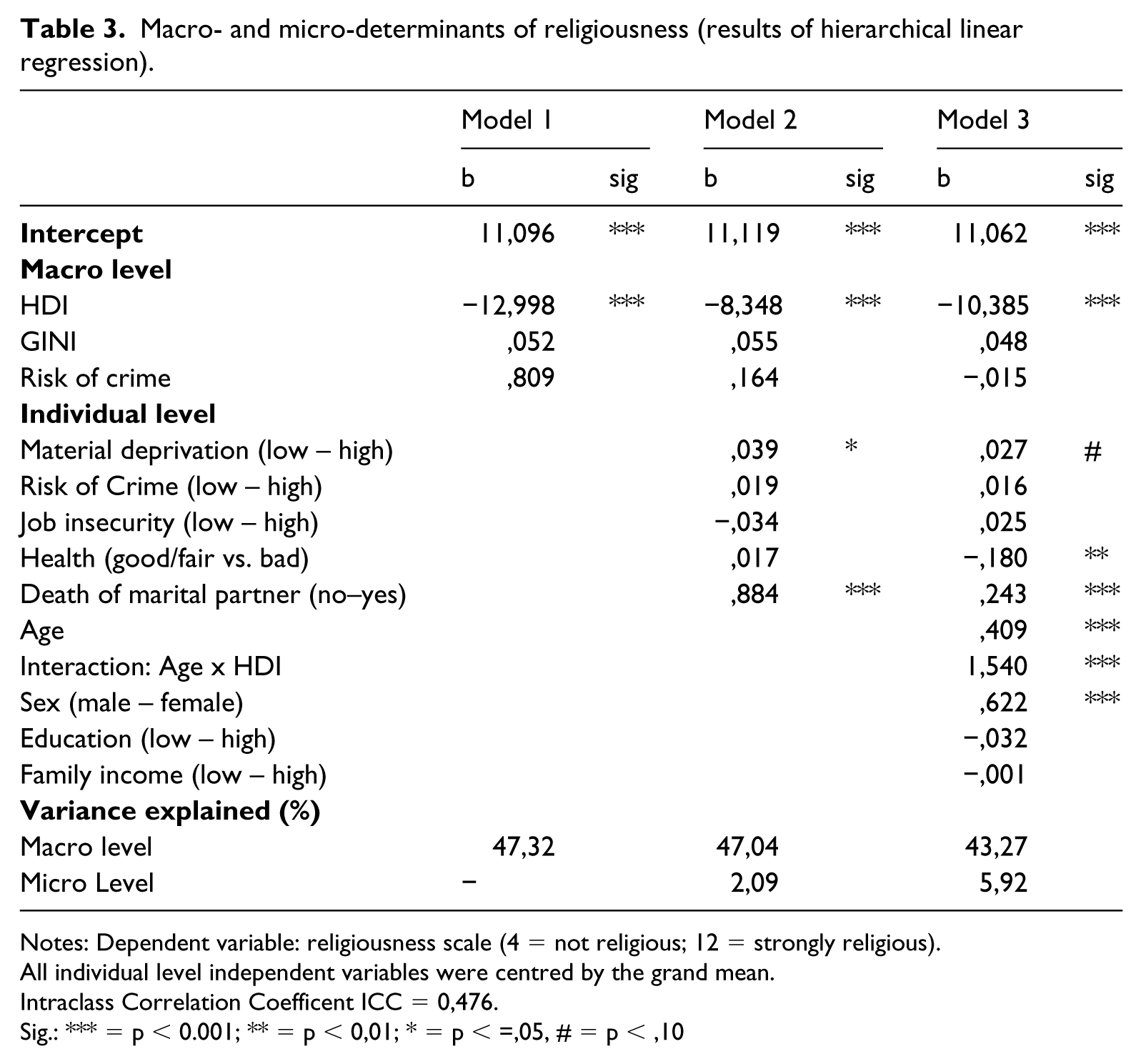
Notes: Dependent variable: religiousness scale (4 = not religious; 12 = strongly religious).
All individual level independent variables were centred by the grand mean.
Intraclass Correlation Coefficent ICC = 0,476.
Sig.: *** = p < 0.001; ** = p < 0,01; * = p < =,05, # = p < ,10
In model 2, the five indicators of existential insecurity on the micro-level were added into the model. As can be seen in Table 3, out of the five variables only ‘death of one’s marital partner’ has a relatively strong and significant impact on religiousness. The other four variables have little or no impact on religiousness. Compared to the high proportion of variance explained by the macro-level variables, the individual-level indicators of existential insecurity explain only a very small proportion (around 2%) of the total individual-level variance.
In model 3 all macro- and micro-level variables, including control variables and the interaction between HDI and age, were entered into the regression simultaneously. The pattern of associations between religiousness and the macro-level variables remains similar to that found in the first two models. On the micro-level, some substantial changes can be observed. The effect of individual material deprivation on religiousness becomes smaller. Subjective health becomes significant, but the connection runs in the opposite direction to the expectation of the existential insecurity thesis: respondents who report having a good state of health turn out to be more religious than people with poor health. The change from model 2 to model 3 is obviously due to the confounding effect of age, i.e. to the fact that both religiousness and health correlate with age. For the same reason, also the effect of loss of one’s partner (marital status = widowed) becomes smaller in model 3, but it remains significant. Detailed analyses reveal that not only widowed, but also married persons are more religious than the divorced and never married. Thus, higher religiousness among widowed persons may be due not only to the loss of one’s marital partner, but also to different patterns of religiousness among married and formerly married persons compared to singles and divorced. Also level of education has a small, but significant impact on religiousness, this is not the case however for family income. 3
In contrast, both sex and age have a significant impact on religiousness. Females are clearly more religious across the countries in comparison, with the exception of some of the Muslim societies where women are not allowed to participate in public religious life. Older people are generally more religious. However, as the significant cross-level interaction between age and HDI indicates, the strength of association varies across countries. In the highly developed European and East Asian countries as well as in Latin American countries (which have a medium level of development) the bivariate correlation between age and religiousness is between .15 and .40; in the less developed countries of Sub-Saharan Africa and South Asia, this correlation is below .10. The strong decline of religiousness from the oldest to the youngest age cohort in the highly developed countries indicates that a generation change towards a less religious society is taking place and has taken place during the past decades. In the less developed countries of Africa and South Asia no such changes are occurring (so far). Here, religion continues to be highly important both for old and for young people.
Summing up the results of our multi-level analysis we want to stress once more that religiousness is influenced to a much higher extent by the macro-level social conditions of the society one lives in than by one’s individual social position and life conditions. Even in the third model, the proportion of variance explained on the micro-level remains rather small. Only two out of the five indicators of existential insecurity (loss of one’s marital partner and material deprivation) are associated with higher levels of religiousness and thus confirm the existential security thesis on the individual level. The relationship between health and religiousness runs against the assumption of this thesis. Two indicators, job insecurity and subjective risk of crime are not related to religiousness at all.
Discussion
In this article we have investigated to what extent religiousness is influenced by collective living conditions on the one hand, and by individual living conditions and critical life events on the other hand. Our analysis confirms the findings of previous studies that the level of religiousness is clearly higher in less developed and more inegalitarian countries where a substantial part of the people are exposed to material deprivation, crime and other forms of existential risks, than in higher developed countries where such existential threats are less common. The striking new finding of our analysis is that within countries individual experiences of life risks, such as material deprivation and risk of becoming victim of crime, have no or only a marginal effect on a person’s level of religiousness. This result questions the assumption maintained by Norris and Inglehart and other researchers that existential insecurity is an important factor for explaining higher levels of religiosity both on the macro and on the micro level.
We propose three explanations for this contradictory result:
Experiences of existential insecurity may in fact lead to religious conversion and to a new, enduring commitment to religion, as a number of empirical studies have shown (e.g. Chesnut, 1997; Corten, 1996; James, 1902). It may be the case, however, that this applies primarily to traumatic life events such as experience of war, being affected by a life-threatening disease, losing a child through an accident, etc.; and even here, the turn to religion occurs only in certain circumstances. The items that measure existential insecurity in the World Values Survey − ‘having too little to eat’, ‘feeling unsafe from crime at home’, ‘being afraid to lose one’s job or not to find a job’, ‘having a bad state of health’, etc. − refer to issues that are commonplace for many people, especially in less developed countries, and do not create a stronger need for religion. According to this position, the connection between critical life events and religiousness can be captured rather by qualitative, biographical, interpretive empirical methods than by cross-sectional quantitative questionnaire surveys.
But, if more common and less severe experiences of existential threat such as ‘feeling unsafe from crime at home’ do not have an impact on religiousness on the individual level, why then is there such a strong correlation between the same variables at the aggregate-level of country comparison? One explanation is this: in countries where people are frequently confronted with difficult life situations (such as hunger and experience of crime) there emerges a general feeling that our human fate is determined by exterior forces which we are not able to influence ourselves. This feeling may become a driving force for the belief in divine powers and for religious activities carried out in order to cope with existential life problems. This religious world reference becomes part of the collective memory and shapes the religious beliefs and conduct of life of all members of society, largely independent of their social position within society and of individual life experiences. When material and social life conditions become better and more secure as a result of technical and economic progress and of the existence of welfare state benefits, the feeling of dependence on external forces becomes weaker, and society as a whole becomes less religious. This argumentation is supported by our findings (presented in Table 3): the degree of religiousness of individual persons is determined to a much higher extent by the society (country) where they live than by individual factors.
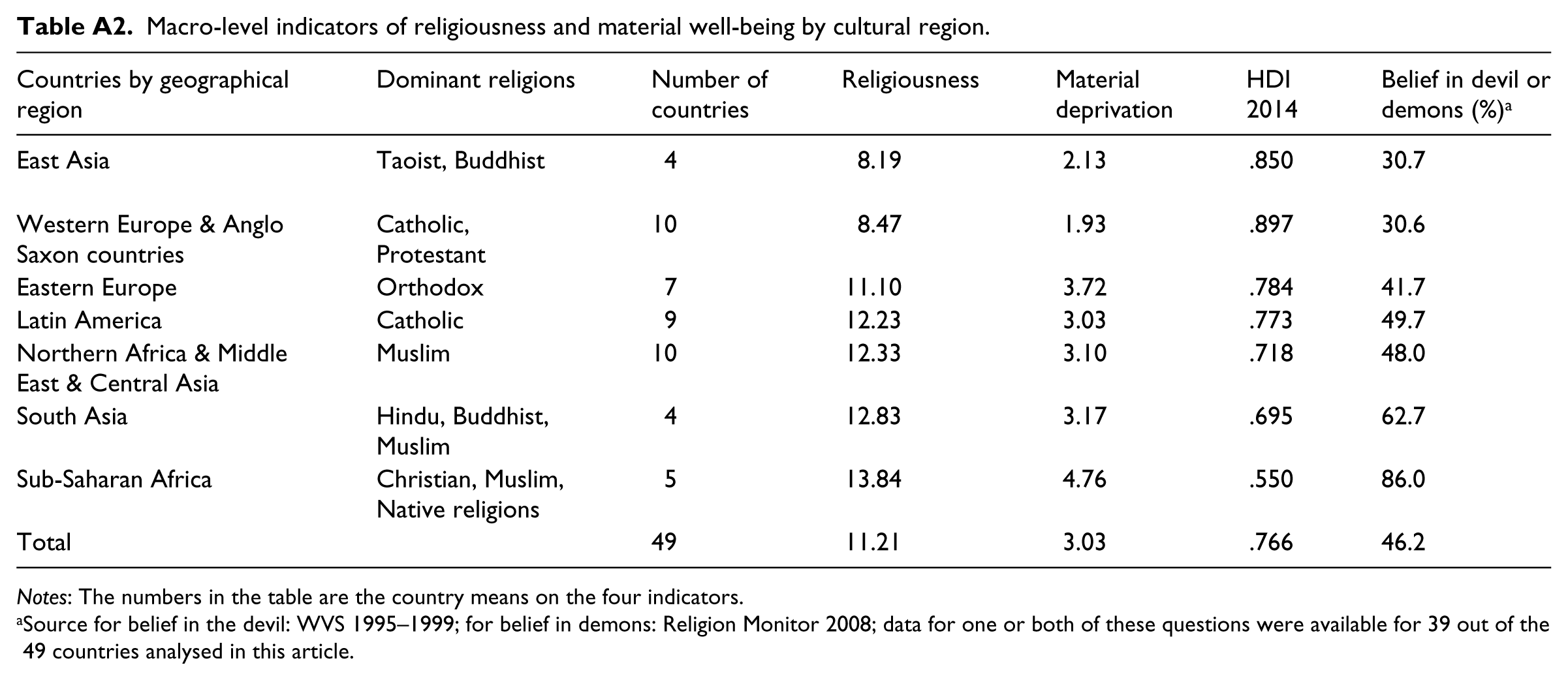
There is another possible explanation for the results of our study: our analysis has shown that there exists a strong negative correlation between the level of socio-economic development (measured in terms of the HDI) of countries and their level of religiousness (r = –.66). Norris and Inglehart interpret this finding as a confirmation of their theory, since they consider human development as a proxy of existential security. However, the macro-correlation between socio-economic development and religiousness may not – or not only – be due to the factor of existential security, but (also) to other aspects. One important factor is human consciousness. At this point we would like to come back to Max Weber’s concept of disenchantment as a central prerequisite for the development of a new form of rationality that made technical progress possible. We cannot discuss this issue in detail here. On a high level of generalization, one can assume that the transformation of consciousness and the process of religious disenchantment has started earlier in those parts of the world that were shaped by an axial civilization and by one of the world religions than in other parts of the world (e.g. Eisenstadt, 1982). In the ethnically fragmented societies of Sub-Saharan Africa, the transition from magical and spiritualist tribal religions towards Christian or Muslim monotheism took place only in the course of the last centuries, many times only during the 20th century (Van Binsbergen, 2003). Also in Latin America and South East Asia the heritage of the former magical-spiritualist religions continues to be strongly alive even if the culture of these regions has been shaped by one of the world religions for several centuries (for Latin America: Höllinger, 2009; for South East Asia: Smart, 1998). This assertion is confirmed by findings from the fourth wave of WVS (1995–1999) and the Religion Monitor 2008. According to these surveys, 85% of the respondents in Sub-Saharan African countries, more than 60% of South Asians and around 50% of Latin Americans believe in the devil and/or in demons (see Table A2 in the Appendix). In the Islamic countries, this rate is similar to that of Latin America. In Western Europe, in the Anglo Saxon countries of America and Australia, but also in the Confucian-Taoist and Buddhist countries of East Asia, however, only 30% of the population maintain such beliefs. As we can see in Table A2, there is a high correspondence between the rank orders of religious disenchantment, religiousness (measured in terms of the concept used in our analysis) and socio-economic development (measured by the HDI) of the religious-cultural macro-regions of the world: lower levels of belief in spiritual forces go hand in hand with lower levels of religiousness and higher levels of socio-economic development.
Summarizing, we would like to emphasize again that individual religiousness seems to be determined to a clearly higher degree by the social and cultural milieu one lives in than by individual life experiences. In the majority of cases, people suffering from difficult life conditions are not more religious than other persons living in the same society. Thus, our results definitely do not confirm the existential insecurity thesis on the individual level. In our opinion, also the strong empirical connection between material well-being and social security on the one hand and declining importance of religion on the other hand should be interpreted not only in terms of this thesis. Rather one should assume that there exist mutual interdependencies between the socio-economic development of society (and the associated level of social security) and the dominant forms of religion in this society. Changes in this relationship can take their starting point from both sides.
Footnotes
Appendix
Macro-level indicators of religiousness and material well-being by cultural region.
| Countries by geographical region | Dominant religions | Number of countries | Religiousness | Material deprivation | HDI |
Belief in devil or demons (%) a |
|---|---|---|---|---|---|---|
| East Asia | Taoist, Buddhist | 4 | 8.19 | 2.13 | .850 | 30.7 |
| Western Europe & Anglo Saxon countries | Catholic, Protestant | 10 | 8.47 | 1.93 | .897 | 30.6 |
| Eastern Europe | Orthodox | 7 | 11.10 | 3.72 | .784 | 41.7 |
| Latin America | Catholic | 9 | 12.23 | 3.03 | .773 | 49.7 |
| Northern Africa & Middle East & Central Asia | Muslim | 10 | 12.33 | 3.10 | .718 | 48.0 |
| South Asia | Hindu, Buddhist, Muslim | 4 | 12.83 | 3.17 | .695 | 62.7 |
| Sub-Saharan Africa | Christian, Muslim, Native religions | 5 | 13.84 | 4.76 | .550 | 86.0 |
| Total | 49 | 11.21 | 3.03 | .766 | 46.2 |
Notes: The numbers in the table are the country means on the four indicators.
Source for belief in the devil: WVS 1995–1999; for belief in demons: Religion Monitor 2008; data for one or both of these questions were available for 39 out of the 49 countries analysed in this article.
Acknowledgements
We would like to thank Jörg Stolz, Markus Hadler, Dieter Reicher and the anonymous reviewers of International Sociology for their helpful comments on preliminary versions of this article. The dataset for the hierarchical regression will be provided by the corresponding author upon request.
Funding
This research received no specific grant from any funding agency in the public, commercial, or not-for-profit sectors.