



Abstract
To explore how people attribute meanings to climate change in Taiwan, this study applied social representations theory (SRT) to develop a self-report semi-structured questionnaire that was used to collect data. To fill a research gap, structural equation modeling (SEM) was adopted to examine the determinants of social representation factors that may affect the public’s intentions to engage in pro-environmental behaviors (PEBs). Exploratory factor analysis results obtained from 180 valid online responses indicated four factors for social representations of climate change, namely Emerging Climate Change Risk, Media Coverage and Influence, Psychological Distance, and Pro-environmental Behavior Intentions. The results of SEM analysis obtained from the total of 245 valid online and paper-and-pencil responses revealed that Emerging Climate Change Risk and Media Coverage and Influence helped explain the public’s PEBs intentions, but Psychological Distance did not. This exploratory study provides preliminary knowledge of public understanding of and response toward climate change in the Taiwanese society and demonstrates a novel application of SEM analysis to test the direct effects of social representations of climate change on PEB intentions.
Introduction
The growing body of evidence from international surveys shows that environmental concerns are a global phenomenon for all social strata, all races and all educational levels, and people in developed as well as developing nations (Mohai et al., 2010). Most environmental problems stem from human behavior and may be affected by pro-environmental behavior (PEB) (Fan et al., 2018). Climate change is treated as a major threat to society, economics, and natural ecosystems (Espeland and Kettenring, 2018). It is confirmed by most scientific evidence that climate change is mainly caused by human damage to the environment (Schneider, 2011). However, climate change is unprecedented in terms of scale and time, whether in magnitude or complexity. Climate change is a global problem, and its impact may last for centuries; thus, the risk representations of climate change are unique (Breakwell, 2010). Thus, human-induced climate change has gradually evolved into a novel risk (Griskevicius et al., 2012). Moreover, since climate change is a relatively slow, cumulative, and invisible process, it is impossible to experience it directly (Weber, 2006); therefore, the perception of threats to climate change varies depending on the local environment in which people live. The social representations of climate change differ substantially between local environments (Gifford, 2011; Helgeson et al., 2012).
Despite the fact that climate change is generally perceived as a higher risk in developing countries than in most western countries (Kim and Wolinsky-Nahmias, 2014), the populations of the United Kingdom, Australia, and most European countries consistently perceive climate change as a serious problem (Eurobarometer, 2014; Leiserowitz et al., 2014; Pidgeon, 2012). By contrast, the populations of the United States and China generally show much lower concern about climate change (Leiserowitz et al., 2014). Similarly, risk judgments of climate change not only vary between different countries but also strongly between individuals in the same country (Smith and Leiserowitz, 2012; Whitmarsh, 2011). However, people’s shared belief in their collective power to effect change is crucial to solving collective problems such as climate change. Collective efficacy is a stronger predictor of people’s PEBs (Chen, 2015a).
Evaluating and integrating risk perception of stakeholders into remediation and outreach efforts can have greater insight, increase the likelihood of success, and ultimately benefit the society by protecting its members from environmental hazards (Harclerode et al., 2016). Previous studies and numerous politicians have argued that the general public plays a key role in mitigating and adapting to climate change, whether as citizens or as consumers (UNEP, 2011; Wibeck, 2014). However, the climate change issue is basically ‘both temporal (long term and developmental) and unseen (not always visible)’ (Doyle, 2007: 129), and thus understanding it is difficult for most of the public. Worse still, climate change is an issue that ‘multiplies the time and spatial scales of the problem; the ethical, social and cultural values involved in decisions; and the urgent need for concerted action to mitigate greenhouse gas emissions’; therefore, communicating climate change to the general public is difficult (Carvalho, 2008: 8).
Social representations theory (SRT), proposed by Moscovici (1973), focuses on the social psychological processes involved in the construction of everyday knowledge of risk and the common sense understanding of the emergence of contemporary risk concerns (Smith and Joffe, 2013). According to SRT, people’s social representation of risk relies heavily on factors other than cognitive information processing (Joffe, 2003). SRT has been widely applied to environmental issues (Castro, 2006), including biotechnology, hydrogen energy, and environmental risks (Bauer and Gaskell, 2002, 2008; Callaghan et al., 2012) as well as people’s responses to renewable energy technologies (Batel and Devine-Wright, 2015). To more thoroughly understand how people’s perceptions of climate change are shaped, studies have adopted SRT to analyze how people give specific meanings to climate change (Cabecinhas et al., 2008; Leiserowitz, 2006; Lorenzoni et al., 2006; Olausson, 2011; Smith and Joffe, 2013). Some studies have adopted a large-scale survey (Cabecinhas et al., 2008; Leiserowitz, 2006; Lorenzoni et al., 2006) and others have adopted focus groups (Olausson, 2011; Smith and Joffe, 2013) to investigate people’s perceptions of climate change by means of word association and content analysis.
Analyzing the aspects of emission caps, carbon taxes, and clean development mechanisms may shed light on the necessity of involving newly industrialized countries and joint reduction into global climate protection schemes in order to stabilize the global climate system (Yue and Sun, 2003). Rapid economic growth and urbanization processes have caused severe soil, water, and air pollution problems in Taiwan, which threaten human health to varying extents. In addition, some typical ‘dirty industries,’ such as the semiconductor and petrochemical sectors, have selected Taiwan as their ‘safe haven.’ The quality of life and that of the environment have been sacrificed to make Taiwan among the world leaders in these industries. The film Plus or Minus Two Degrees Celsius: The Truth Formosa (Taiwan) Must Face, produced by the renowned Taiwanese television host Sisy Chen, focuses on the effects of climate change in Taiwan and has led the public to consider the possibility that Taiwan residents may become ‘climate refugees’ in the future (Chen, 2016a).
To fulfill its obligation as a member of the ‘global village,’ the Taiwanese government has implemented the National Energy Conservation and Carbon Reduction Master Program in response to the Copenhagen Accord, which was reached at the 2009 Climate Change Conference in Copenhagen, Denmark. Due to green energy being an international development and because of the close relationship between climate change and energy consumption, people must now strive to conserve energy and reduce carbon emissions and thereby reduce the impact of climate change on humans (Chen, 2016b). As Lowe et al. (2006: 436) stated: ‘whilst lay perceptions of climate change and other environmental issues are relatively well understood, knowledge of the forces that shape the perceptions and responses of the public is limited.’ Moreover, people’s environmental concerns do not always translate into pro-environmental behavior (Tam and Chan, 2018).
Understanding how people construct and describe climate change is vital, but few studies have focused on exploring the public social representations of climate change that are specific to Taiwanese society. In order to examine how people attribute meanings to climate change, this article summarizes the following four themes of SRT that are used to analyze how people attribute meanings to climate change in Taiwanese society based on previous studies (Cabecinhas et al., 2008; Leiserowitz, 2006; Lorenzoni et al., 2006; Olausson, 2011; Smith and Joffe, 2013).
Do Taiwanese citizens perceive that climate change is a risk and is occurring in Taiwanese society?
What is the impact of the media’s coverage of climate change and the knowledge received from the media, including relevant information and scientific evidence in Taiwan?
Is there suspicion that the climate change taking place in Taiwan is largely attributable to human behavior (attribution)?
Do Taiwanese people engage in environmental protection behaviors in their daily lives to reduce greenhouse gas emissions? What factors could influence the PEB intentions for residents of Taiwan?
This study developed a self-report semi-structured questionnaire to gather word associations regarding climate change from members of the public. A total of 180 valid semi-structured online questionnaire responses were collected regarding social representations of climate change as perceived by the public in a Taiwanese sociocultural context. In addition, although studies have applied SRT to explore how the public understands and explains climate change and related social representation viewpoints (e.g., Cabecinhas et al., 2008; Leiserowitz, 2006; Lorenzoni et al., 2006; Olausson, 2011; Smith and Joffe, 2013), the relationships between the social representation viewpoints and the public’s intentions to engage in pro-environmental behaviors (PEBs) have not been examined or verified. This study adopted the structural equation modeling (SEM) analytical technique to examine the determinants of social representation factors that may affect the general public’s intentions to pursue environmental protection, in order to fill the research gap. A total of 65 valid paper-and-pencil questionnaire responses were also collected and used to produce reliable estimates for SEM. In sum, data from a total of 245 valid questionnaires were used to identify the determinants of social representation factors that influenced the public’s PEBs.
The article proceeds as follows. The second section introduces the theoretical background of SRT and different perspectives of climate change social representations from previous studies. The third section introduces the data collection process including the development of a self-report semi-structured questionnaire. The fourth section presents the data analysis and the analytical results of exploratory factor analysis and structural equation modeling analysis. The last section presents the research discussion and conclusions, including the contribution of this study.
Theoretical background and literature review
A more thorough understanding of how people’s perceptions of climate change are shaped may facilitate efforts to improve public intentions to mitigate climate change. Previous studies have adopted SRT to analyze how people attach specific meanings to climate change (Cabecinhas et al., 2008; Leiserowitz, 2006; Lorenzoni et al., 2006; Olausson, 2011; Smith and Joffe, 2013). This section first introduces SRT and then examines different perspectives regarding social representations of climate change outlined previously, such as the psychological distance, risk perception, and media communication of climate change; skepticism toward climate change; and concepts of PEBs and personal morality.
Social representations theory (SRT)
SRT was proposed by Moscovici (1973) and asserts that people rely upon familiar, everyday experiences to understand unfamiliar, uncertain information. People are often overwhelmed with unfamiliar information and potential threatening phenomena. To cope with this potential pressure and to more thoroughly understand novel phenomena, people attempt to render them in more familiar terms. People use a variety of symbols, metaphors, and iconic images that are circulated in a sociocultural context to inform their apprehension of unfamiliar risk issues (Smith and Joffe, 2013). SRT is a ‘social knowledge theory’ that focuses on how individuals, groups, and societies collectively assign meanings to social issues, ideas, and practices (Markova, 2008: 483). In other words, social representations are shared by a common sense of what is meant by the collective meanings of a concept, and this common cognition links society, organizations, and groups. These social representations are usually associated with social, cultural or symbolic phenomena; that is, they characterize certain phenomena. Social representations focus on the occurrence of phenomena that provoke debates, intense emotions, conflicts, ideological struggles, and changes in shared social thinking. Based on the aforementioned four themes derived from previous studies (e.g., Cabecinhas et al., 2008; Leiserowitz, 2006; Lorenzoni et al., 2006; Olausson, 2011; Smith and Joffe, 2013), the psychological constructs relevant to how the general population assign a meaning to climate change were described as follows.
Psychological distance of climate change
A key feature of climate change risks is that they are psychologically distant for many people (Liberman and Trope, 2008; Milfont, 2010). As mentioned earlier, climate change is a relatively slow, cumulative, and invisible process, so experiencing it directly is impossible (Weber, 2006). Consequently, people worldwide differ substantially in terms of the threat perceptions of climate change, which depend on their own local environments (Gifford, 2011; Helgeson et al., 2012). Leiserowitz (2006) and Lorenzoni et al. (2006) have determined that the social representations of geography and psychological distance were expressed both in British and American populations on the topic of climate change. Liberman and Trope (2008) outline proposed construal level theory, which outlines four key dimensions of psychological distance: spatial or geographical distance; temporal distance; distance between the perceiver and a social target (i.e., another individual or group); and uncertainty, that is, how certain is it that an event will happen. Milfont (2010) reported that climate change, in terms of space or geographical distance, time distance, the distance between others or groups, and uncertainty, is perceived as psychologically distant.
Risk perceptions of climate change
Between 1987 and 1990, the US mass media highlighted major hazards to the global environment, including climate change, ozone depletion, rainforest destruction, and species extinction. As a result, these hazards became an important issue on the US risk agenda and were quickly adopted by other countries (Mazur, 1998). According to SRT theory, the social representation of risk is mainly dependent on factors beyond cognitive information processing (Joffe, 2003). Experiential and sociocultural factors explain significantly more variance in risk perception than either cognitive or sociodemographic characteristics (van der Linden, 2015). Sociological studies have determined that contextual factors are related to contemporary social risk issues (e.g., Beck, 1992), and SRT focuses on how to construct the risks the public face each day. Risk perception is usually a concern regarding future events (Sjöberg, 2000). Many studies have argued that risk perception is a key variable in predicting whether people willingly participate in reducing the impact of climate change (e.g., Leiserowitz, 2006; O’Connor et al., 1999; Semenza et al., 2008; Spence et al., 2011, 2012; Tobler et al., 2012).
Media communication of climate change
Although SRT (Moscovici, 1973) has been applied in many different disciplines and fields, media researchers are generally unfamiliar with it (Berglez et al., 2009; Höijer, 2010; Olausson and Höijer, 2010). SRT in media and communication research is relevant to climate change in several respects. The media are a valuable communication channel that conveys knowledge and views, in particular visual images, which furnish the public with key scientific information linked to climate change. The core assumption of SRT is that social representation is not the popularization, distortion or diffusion of scientific knowledge but ‘how the general public knows about a particular thing’ (Bauer and Gaskell, 2008: 338; Callaghan et al., 2012). The mass media have been identified as exerting a substantial influence on public understanding of climate change (Carvalho, 2010). Abstract, obscure, and complex information regarding climate science is usually simplified by the media (Höijer, 2010). This involves the role of intermediary communication: that is, how the media shape social thought and produce shared understandings and a general consensus. This is the primary meaning of mediated communication: how the media naturalize social thinking and generate collective cognition. SRT provides an analytical model of communications theory that is linked to society and includes individuals, the media, and the public.
The news media are the main source of public information concerning climate change; watching climate change-related news provided by the mass media is even a predictor of climate change concerns, behavioral intentions, and personal mitigation behaviors (Cabecinhas et al., 2008). News reports on climate change play a critical role in influencing public understanding of this issue. However, compared with analyses of media content alone, studies on the media’s central role in shaping audience perceptions of climate change (including its causes and consequences), responsibility for addressing climate change issues, and the social representations of climate change are relatively limited. Moreover, criticism of the media is widespread (Olausson, 2011). Smith and Joffe (2013) determined that what the British public most commonly think of climate change is consistent with the social representations of climate change conveyed by the main visual media.
Skepticism toward climate change
It is quite common that the general public doubt the authenticity or severity of environmental degradation (Zhou, 2015). A previous study indicated that if people more thoroughly understand the causes of climate change and its possible effects, their risk judgments regarding it then transform (Sunblad et al., 2009). However, a sizeable and growing proportion of people deny the existence of anthropogenic climate change (Leviston et al., 2011). Denial becomes a strategy of self-deception when climate change is actually perceived as part of a modern lifestyle and the capitalist ‘paradigm of consumption’ (Lorenzoni et al., 2007: 454). The inherent link between climate change and contemporary consumption styles points to the need for behavioral change. Unfortunately, behavioral change is perceived as a sacrifice, a sacrifice of ‘wants’ disguised as ‘needs,’ which leave skepticism and denial as the means of justifying the status quo and maintaining harmful habits (Lorenzoni et al., 2007). Some studies have indicated that, for political conservatives, the more they know about climate change, the higher the negative correlation with their climate change beliefs (McCright and Dunlap, 2011; Malka et al., 2009). Both Poortinga et al. (2011) and Whitmarsh (2011) have reported that older and more conservative respondents are more likely to express climate skepticism, and that people’s values are also important determinants.
Social psychological research on persuasion and learning, and risk literature, emphasize that the same information can be processed differently depending on cognitive abilities, prior knowledge, values and worldviews, and broader social and institutional factors (e.g., Petty and Cacioppo, 1986; Poortinga and Pidgeon, 2005). However, van der Linden (2015) argued that personal experiential and sociocultural factors can explain more variance in risk perception of climate change than either cognitive or sociodemographic characteristics.
Substantial scientific evidence indicates that some human behaviors have affected the climate, and that this climate change may present risks for humans and other species. The Intergovernmental Panel on Climate Change published its Fourth Assessment Report in 2007 to illustrate the assessment of individual trends for climate change, the causes of climate change, and the impact of climate change (Pachauri et al., 2007). However, in addition to ‘ice melt’ and ‘natural disasters,’ ‘a suspicious attitude’ is one of the most prominent concepts linked with ‘global warming’ among Americans (Lorenzoni et al., 2006). Approximately 40% of Britons think that the climate system is overly complex and unpredictable for scientists, making it difficult to forecast (MORI, 2007). The survey indicated that 1 in 10 people in the United Kingdom refused to accept that climate change is caused by human behavior (Upham et al., 2009). Some studies have focused on how the media deliver messages through many channels to influence skeptical public perceptions regarding climate change (Oreskes and Conway, 2010; Pearce, 2010).
Pro-environmental behavior and personal morality
Pro-environmental behavior is probably best viewed as a mixture of self-interest and of concern for other people, the next generation, other species, or whole ecosystems (Bamberg and Möser, 2007). The norm-activation theory, as proposed by Schwartz and his colleagues (Schwartz, 1973, 1977; Schwartz and Howard, 1981), was originally applied to explain prosocial behavior. Personal norms refer to a person’s feeling of ‘moral obligation to perform or refrain from specific actions’ (Schwartz and Howard, 1981: 191). A person’s pro-environmental behavior can be treated as a special case of prosocial behavior because it also implies that people engaging in these behaviors will eventually benefit others, though often the good done is not directly perceived (De Groot and Steg, 2009; Steg and De Groot, 2010). Previous research underscores the importance of activated personal norms for understanding people’s pro-environmental behavior (e.g., Thøgersen, 2006). Climate change and energy consumption are strongly related to personal morality (Chen, 2015b, 2016b; Lorenzoni and Pidgeon, 2006; Wardekker et al., 2009), so personal morality is also a factor for consideration. Pro-environmental social norms may play a crucial role in both maintaining carbon intensive lifestyles and soliciting changes toward more sustainable ways of living (Steentjes et al., 2017).
Data collection
The main aim of this study was to investigate the social representations of climate change in Taiwan. To obtain a preliminary understanding of how residents of Taiwan shape their perceptions of climate change and the social representations of climate change, this study developed a self-report semi-structured questionnaire to elicit the public’s word association regarding climate change and to investigate the social representations of climate change that the public perceive in Taiwanese society. The semi-structured questionnaire survey included a qualitative phase with open-ended questions and a quantitative phase with close-ended questions. The qualitative phase of word association is vital because it elicited open-ended perceptions regarding climate change. The participants were requested to provide the first five thoughts or images that came to mind upon thinking of the words ‘climate change.’ On the basis of relevant studies (Cabecinhas et al., 2008; Leiserowitz, 2006; Lorenzoni et al., 2006; Olausson, 2011; Smith and Joffe, 2013) and the literature review in the previous section, this study generated a 23-item self-report close-ended questionnaire corresponding to the aforementioned four themes obtained from the exploration of these relevant studies in the quantitative phase. The items were measured using a seven-point Likert scale with 1 indicating strongly disagree and 7 indicating strongly agree.
A Google Forms semi-structured questionnaire form was developed to collect online questionnaire responses. This self-report research questionnaire was distributed on LINE, a freeware instant communications app for electronic devices such as smartphones, tablets, and personal computers. Data were collected for a month from 6 March to 5 April 2017, in Taiwan. Participants took 20–30 minutes to complete the questionnaire. A total of 180 valid online questionnaires were returned for research analysis. The results of the qualitative phase indicated that ‘global warming and rising temperatures’ had the greatest associations to climate change. This was followed by general associations to ‘natural disaster’ (e.g., floods, rainstorms, and droughts), and ‘melting polar glaciers and rising sea levels.’ ‘Extreme climate’ and ‘grain and food shortage’ had the fourth and fifth greatest associations to climate change, respectively. The last three categories were ‘ecological balance damage,’ ‘greenhouse effect and carbon dioxide emissions,’ and ‘water resources.’
In order to produce reliable estimates for SEM, it is recommended to have a minimum sample size of 200 (Hair et al., 2008). In addition to the online research questionnaire, a paper-and-pencil questionnaire was also conducted to recruit more participants to respond to the 23-item self-report close-ended questionnaire. Two business school classes from Tatung University, Taiwan, were sampled, with 65 undergraduates participating in the self-reported survey. Therefore, 245 valid questionnaires were used in total for research analysis in the quantitative phase. A large proportion of the respondents lived in northern Taiwan (91.4%) among the 245 participants, a large proportion were female (54.7%) and a respondents were predominantly unmarried (64.5%). The majority were in the age ranges 20–29 years (34.3%) and 40–49 (26.1%). Across the overall sample, the majority of respondents held university degrees and above (95.1%). Although the characteristics of the sample for residential area, gender, marital status, age category, and educational level were not representative of the population as a whole, the raw survey data collected in this empirical study retained key theoretical and practical research implications.
Data analysis and results
Exploratory factor analysis
Exploratory factor analysis (EFA) is a data reduction technique. EFA is used to discover the underlying structure of a relatively large set of variables and to identify representative variables for use in subsequent multivariate analysis. Exploratory principal factor analysis with varimax rotation was performed on the scores of the 23 items of the questionnaire to include the original items under various factors. Factors with eigenvalues greater than 1 were considered significant (Rust and Golombok, 1989). Questionnaire items with factor loadings greater than 0.50 were considered highly significant (Hair et al., 1987).
This analysis resulted in four identified factors with eigenvalues greater than 1 and both the Kaiser–Meyer–Olkin measure of sampling adequacy test (0.884) and the Bartlett’s test of sphericity (p < 0.001) indicated that the data were sufficiently interrelated and appropriate for exploratory factor analysis. The four extracted factors explained 65.46% of the variance in response to the survey. Table 1 provides the detailed scale items of the self-report questionnaire and summarizes the factor-analytic results from the varimax-rotated procedure for the 23 items. The resulting four social representation factors of climate change were termed Emerging Climate Change Risk, Media Coverage and Influence, Psychological Distance and Pro-environmental Behavior Intentions.
Rotated component matrix of factor analysis for the social representations of climate change.
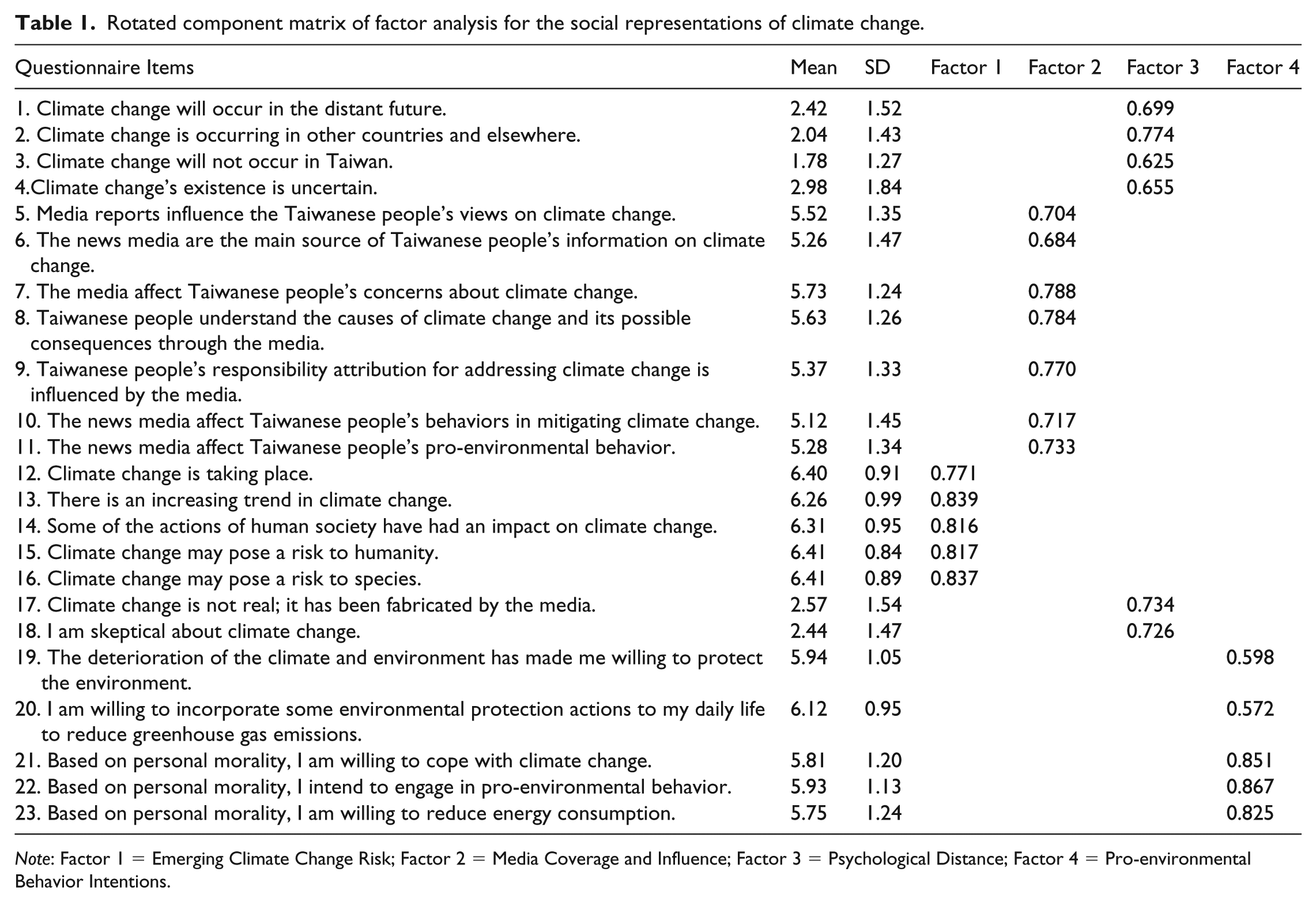
Note: Factor 1 = Emerging Climate Change Risk; Factor 2 = Media Coverage and Influence; Factor 3 = Psychological Distance; Factor 4 = Pro-environmental Behavior Intentions.
Structural equation modeling (SEM) analysis
SEM was used to analyze the impact of the factors obtained from EFA on the public’s intentions to engage in PEBs. As suggested by Anderson and Gerbing (1988), confirmatory factor analysis (CFA) was conducted first to ensure the adequacy and effectiveness of the measurement model. SEM analysis was then conducted to examine the relationships among the four extracted factors to understand what social representations influence the public’s intentions to engage in PEBs. In order to examine the determinants of social representation factors that may affect the general public’s intentions to pursue environmental protection, Pro-environmental Behavior Intentions was treated as an endogenous variable and the other three extracted social representations factors were treated as exogenous variables.
Confirmatory factor analysis (CFA) results
CFA was performed to test the reliability and validity of the measurement model. The overall fit statistics of the measurement model are as follows: fit function χ2 / df = 340.690 /213 = 1.599 < 2; both goodness-of-fit index (GFI) = 0.895 and adjusted goodness-of-fit index (AGFI) = 0.864 are close to 0.90; comparative fit index (CFI) = 0.964 and normed fit index (NFI) = 0.910 are both greater than 0.90; and root mean square error of approximation (RMSEA) = 0.050 ⩽ 0.05. The overall fit statistics of the measurement model were considered acceptable (Hu and Bentler, 1999).
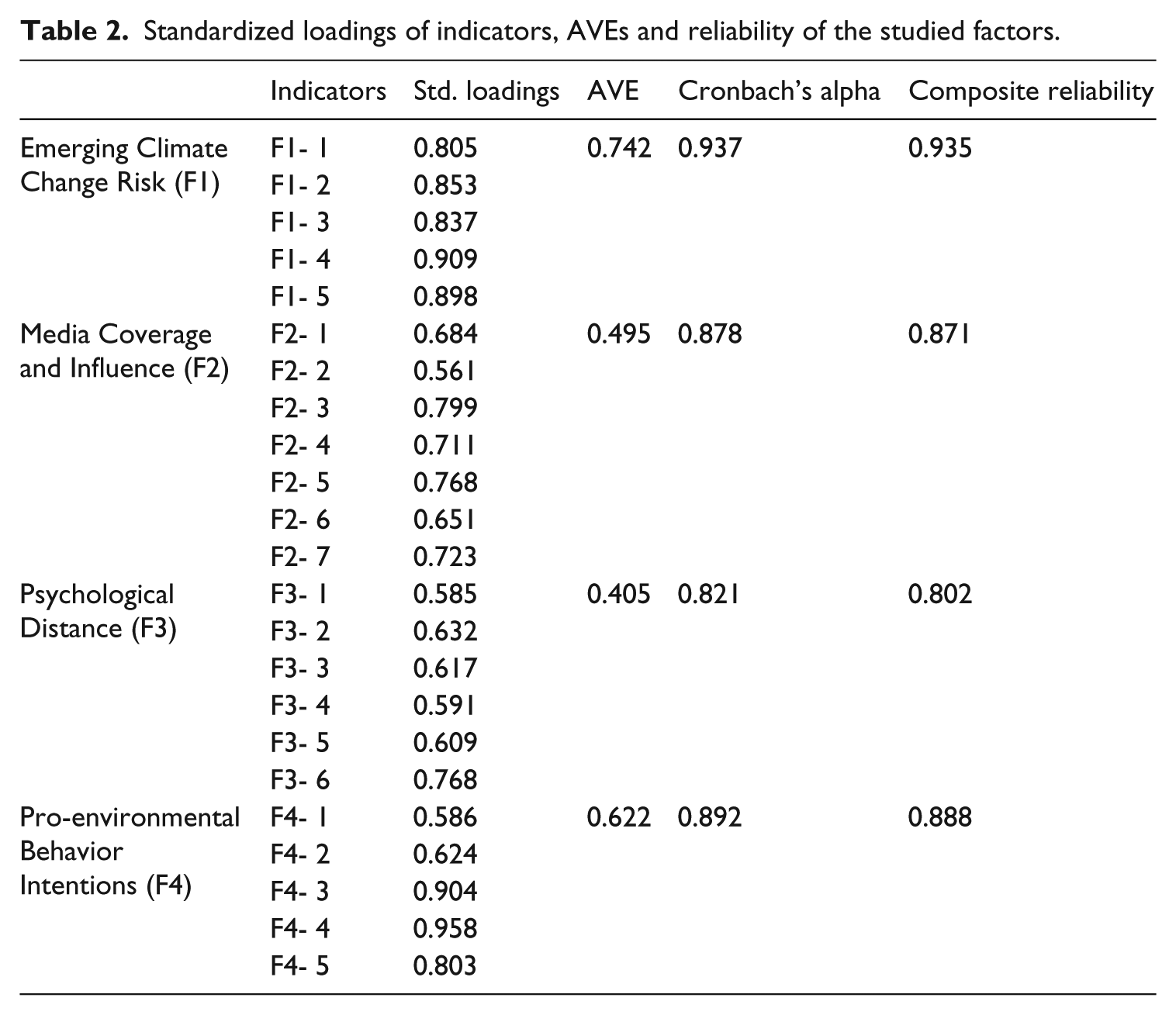
Convergent validity can be checked from the measurement model by determining whether the estimated pattern coefficients for each indicator on its assumed underlying structural factor are significant. Convergence validity is achieved when t-value is greater than 1.96 (α = 0.05). The standardized loadings of the studied construct indicators obtained from CFA are presented in Table 2. As shown in Table 2, each item’s factor loading exceeds 0.50 and the t-values of the completely standardized loadings for the items measuring the same construct are statistically significant at the α = 0.01 level. Therefore, the indicator variables of this study have convergent validity.
Standardized loadings of indicators, AVEs and reliability of the studied factors.
When the square root of average variance extracted (AVEs) are greater than the correlations among each pair of constructs, the non-diagonal elements in the corresponding rows and columns, then discriminant validity is satisfactory (Fornell and Larcker, 1981). The descriptive statistics, correlation matrix and the square root of AVEs of the studied constructs are presented in Table 3. As shown in Table 3, the square root of AVEs is greater than the correlations among each pair of constructs, suggesting that the studied constructs have discriminant validity.
Descriptive statistics and correlation matrix of the studied factors.
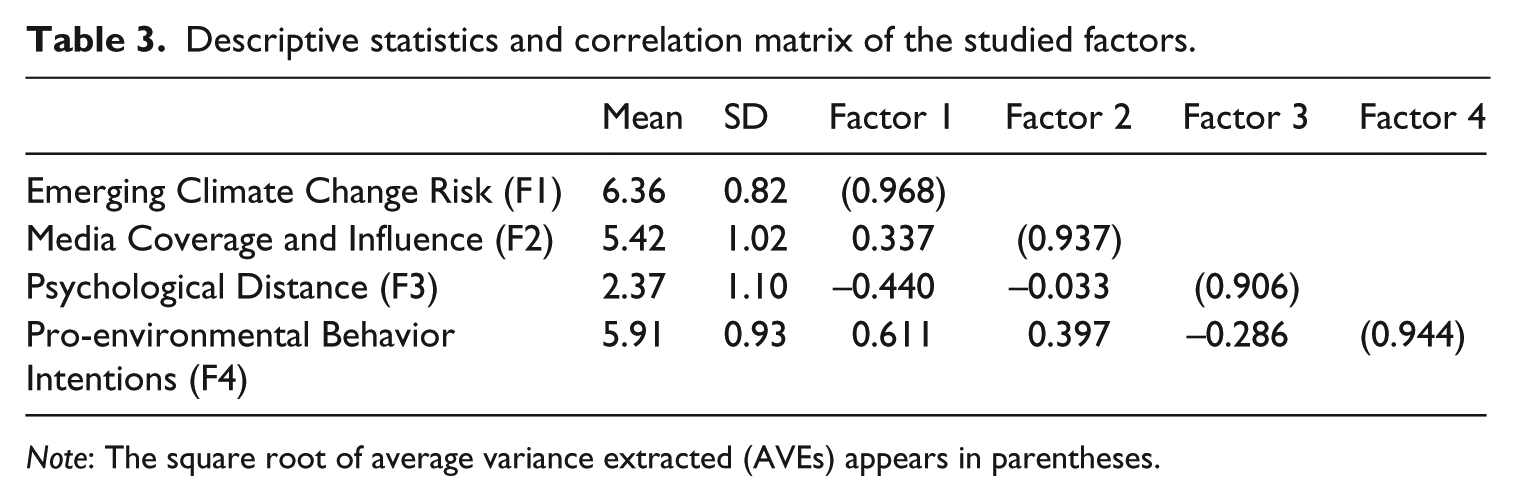
Note: The square root of average variance extracted (AVEs) appears in parentheses.
Cronbach’s alpha, designed as a measure of internal consistency, is most appropriately used when items feature different substantive areas within a single construct (Schmitt, 1996). As shown in Table 2, the reliability of the extracted factors in this empirical study was confirmed with the coefficient alpha higher than the recommended level of 0.70 (Nunnally, 1978). Hence, the internal consistency of each extracted factor was achieved. In addition, the composite reliability values of the extracted factors are also higher than the recommended threshold 0.70. Therefore, all four factors extracted are reliable for further analysis.
Structural equation modeling (SEM) analysis results
The standardized path coefficients of the structural model are shown in Figure 1. The explanatory power (squared multiple correlation; SMC = R2) is 37.9%. The paths from the social representations of Emerging Climate Change Risk (b = 0.478, t = 5.140) and Media Coverage and Influence (b = 0.199, t = 2.868) to Pro-environmental Behavior Intentions were positively significant in the expected direction. However, the path from Psychological Distance (b = −0.059, t = −0.752) to Pro-environmental Behavior Intentions was not significant. In summary, all the causal relationships of this structural model were supported except for the path from Psychological Distance of climate change to Pro-environmental Behavior Intentions.

The path coefficient estimates of structural equation modeling analysis.
Discussion and conclusions
Social representation is essentially a system of values, ideas, and practices, which specifies how collective cognitions are produced and transformed through communication with a focus on the sociocognitive processes or mechanisms involved. The present study draws on research to discover respondents’ social representations of climate change and how the social representation factors influence public intentions to engage in PEBs in Taiwan. By means of exploratory principal factor analysis, the empirical data collected from Taiwan reveal four extracted social representation factors of climate change (i.e., Emerging Climate Change Risk, Media Coverage and Influence, Psychological Distance, and Pro-environmental Behavior Intentions).
In terms of social representations, a consensus exists in the respondents that climate change is occurring and results in risk (mean = 6.36). Consistent with many previous studies, the social representation of Emerging Climate Change Risk is a vital determinant for predicting the public’s Pro-environmental Behavior Intentions (e.g., Leiserowitz, 2006; O’Connor et al., 1999; Semenza et al., 2008; Spence et al., 2011, 2012; Tobler et al., 2012). The results imply that when people perceive that climate change may pose a risk to humans and other species and admit that it is an increasing trend and is occurring now, they exhibit increased Pro-environmental Behavior Intentions.
Consistent with the study of Cabecinhas et al. (2008), a close relationship exists between media uses and social representations of climate change. In contemporary Taiwanese society, the news media are the principal source of public information regarding climate change. Watching climate change-related news shapes public concern regarding climate change concerns and their personal mitigation behaviors and PEBs. With respect to social representation, media coverage and influence play a critical role (mean = 5.42). The results further reveal that news reports of climate change benefit the local society by shaping the public’s collective cognition regarding climate change and transform their mitigating behaviors and encourage them to adopt climate change-related behaviors.
Consistent with the studies of Leiserowitz (2006) and Lorenzoni et al. (2006) in the United Kingdom and United States, the social representation of Psychological Distance was exhibited by the Taiwanese public regarding the topic of climate change. Climate change in terms of space or geographical distance, time distance and the distance between others or groups (Milfont, 2010) as well as uncertainty and skepticism (Liberman and Trope, 2008) is perceived as not psychologically distant in Taiwan (mean = 2.37). By contrast, if the public feels skeptical about climate change and believes it is merely media manipulation then they are unlikely to engage in PEBs. In other words, climate change is perceived as potentially occurring in the near future, and it could affect Taiwanese society. However, such social representations of Psychological Distance are not determinants of the public’s degree of intention to cope with climate change by engaging in PEBs.
The social representation of Pro-environmental Behavior Intentions reflects that personal morality plays a key role in activating the public in Taiwan to exhibit PEB intentions. Personal morality is closely linked to the intention to cope with climate change and implement PEBs, including addressing energy consumption. The results are consistent with previous studies that reported that climate change and energy consumption are strongly linked to personal morality (Chen, 2016b; Lorenzoni and Pidgeon, 2006; Wardekker et al., 2009).
In summary, SRT has clarified the public’s understanding of climate change and public responses to it in Taiwan. The consensus among the public is that climate change is occurring and threatens modern Taiwan. Regarding social representations, climate change was perceived as an emerging risk. Based on these research findings, the Taiwanese government and environmental protection groups should encourage people to face the challenges of climate change and educate them on how to conduct concrete practices to engage in PEBs. In addition, climate change is regarded as not being psychologically distant, although not to the extent of being the salient determinant of the public’s Pro-environmental Behavior Intentions. This means that psychological distance may facilitate engaging in PEBs only when the problem itself is dangerous and threatening. Moreover, the mass media are not only the main source of the public’s information influencing Taiwanese views and concerns regarding climate change but also affect the Taiwanese public’s responsibility attribution and intentions to mitigate climate change. Therefore, the mass media should provide people with correct and objective information about climate change and take responsibility for disseminating how to engage in PEBs. Finally, the deterioration of the climate and environment has made people eager to protect the environment – particularly those who have a higher degree of personal morality. It is not uncommon for personal morality to play a role in undertaking PEBs, and therefore, concepts of individual moral responsibility should also be promoted in daily life.
The main contributions of this research are twofold: (1) enhancing intercultural validation by applying SRT to explore how the public understands and explains climate change and related social viewpoints in Taiwanese society, and (2) advancing methodological predictive power by adopting SEM analysis to test the direct effects of social representations of climate change on PEB intentions. This exploratory study provides preliminary knowledge of the public’s understandings of and responses toward climate change in Taiwanese society. The main limitation of the present study is its cross-sectional data and the fact that it fails to track changes in public perceptions of the dimensions of social representations over time. Future studies should use a longitudinal design to trace the changes in any dimensions of social representations applied in this study. The second limitation of this study is that although both online and paper questionnaire surveys were conducted, most of the target respondents lived in northern Taiwan and were university educated and unmarried young adults who frequently use the Internet. A large-scale nationwide investigation should be conducted in the future to enhance representativeness. The third limitation of this study is that a discrepancy may exist between the public’s intentions to engage in PEBs and their actual PEBs when reported by means of a self-reported questionnaire. Actual PEBs must be investigated in future studies. Finally, this is an exploratory study for applying SRT to examine how the public understands and explains climate change and the related social representation viewpoints in a Taiwanese sociocultural context. Caution should be exercised about generalizing the results to other societal contexts. However, SRT and semi-structured questionnaire surveys should be employed in the contexts of other countries to gain improved understanding of how their citizens attribute meaning to climate change and to examine the determinants of social representation factors that may affect their intentions to engage in PEBs.
Footnotes
Funding
This work was supported by a grant from the Ministry of Science and Technology, R.O.C. (MOST 105-2410-H-036-003-MY3).
