



Abstract
This article explores how visual approaches to globalization as expressed and enacted in everyday life may enrich and complement the more abstract and mainly quantitatively supported discourses around this convoluted phenomenon. Visual methods, with their focus on empirically observable aspects of culture, indeed have the capacity to uncover forms of global interconnectivity in urban settings, by looking carefully at the material environment and artifacts as cultural expressions and at visual practices and performances of people within those spaces. Observing globalization in urban public space involves a wide variety of resources, methods, techniques and technologies, each with their specific affordances and limitations. Therefore this contribution is less a detailed study about globalization than it is about how to study aspects of globalization through its visual dimensions and by using visual means and methods to capture data and to communicate insight in novel ways.
Introduction: A visual approach to the global everyday
This article proposes to interrogate the visual dimensions of globalization processes as expressed in material cultural elements of a varied nature, as well as through visible and recordable aspects of human behavior in urban public spaces. It aims to enrich and complement the more abstract discourse of globalization and transnationalism with empirically grounded insights regarding concrete expressions and enactments of cultural encounters in urban contexts.
While communication scholars have taken an interest in the (visual) study of globalization processes, they have so far focused predominantly on mass-mediated expressions (films, advertisements, TV programs) and more recently on social media and new media technologies (YouTube, Twitter, Facebook). However, the actual sites where globalization takes place in a day-to-day manner, in particular the urban context, have received far less attention as concrete expressions of globalization. A study of the globalization as experienced in the everyday should definitely comprise aspects that are not pre-mediated by mass media (behavior in public spaces, ‘grassroots expressions’ such as graffiti and other signs of resistance or appropriation). Such a view ‘on the ground and in the open’ may finally complement the dominant, more narrow mass media focused and quantitative discourses on globalization.
Therefore this article will focus on how to research the visible expression of this meeting of values, norms and expectations in the public realm of the rich ‘hubs of culture’ that metropolitan areas typically are, and thus try to fill a void in the study of globalization and cultural exchange as it is enacted and experienced in the everyday.
Visual methods and techniques may take on a more central – though not exclusive role – in the effort to shed light on some unexplored and underexposed avenues of globalization and cultural exchange by focusing on the key roles played by city dwellers, urban planners, designers, advertisers, commercial forces, cultural institutions, local authorities, tourists, artists, protesters, etc. as social agents in the (re)production of these cultural processes on a day-to-day basis. Visual methods, with their focus on observable and unspoken aspects of society, have the capacity to uncover immaterial traits of society (norms, values, expectations) by looking carefully at material artifacts as cultural expressions and at visual practices and performances of people.
Globalization as a multidimensional phenomenon: Aspects and views
Globalization, the ever increasing worldwide flow of ideas, practices and material objects boosted by organizations and transnational institutions and resulting in increasing interdependency between people and nations across the globe is not a phenomenon that can simply be embraced or rejected. This transformation towards an intensified global interconnectivity has numerous interrelated economic, political, cultural, ideological, environmental and technological facets (Lechner and Boli, 2005; Steger, 2014).
Although in many people’s minds globalization is mainly a process of ‘Westernization’ and more in particular ‘Americanization’, this narrow view is no longer adequate. While brands such as Coca Cola, Starbucks, Google and Amazon continue to figure as the most visible icons of globalization, many products, ideas, religions and ways of life from other parts of the world are also spreading at a rapid pace. The current Global Market Empire is clearly characterized by geopolitical multipolarity (McMichael, 2017). Today globalization refers to the ‘myriad forms of connectivity and flows linking the local (and national) to the global – as well as the West to the East, and the North to the South’ (Steger, 2014: 2).
Unsurprisingly, scholars, as well as political actors, activists and the general public, are divided and ambivalent as to the nature and impact of globalization and its effects on national and ethnic cultures and on humanity as a whole. Fierce debates reveal many divergent views with respect to its origins, scale, causation, effects and outcomes. Disputes on globalization tend to center around economic aspects, while the broader cultural dimensions of globalization processes receive less consideration. More focused, localized and diversified empirical research is needed to untangle and examine the multiple, unanticipated and even seemingly contradictory effects of some processes of cultural exchange and their presumed hegemonic, homogenizing or heterogenizing aspects.
While several aspects of globalization do have from less desirable up to devastating consequences (enlargement of the poverty gap, cultural mainstreaming, unmitigated consumerism, ecological calamities), global problems (e.g. climate change, forced migration, economic crises, poverty, armed conflicts) nevertheless need global solutions, implying transnational efforts and different forms of solidarity, thus forms of interconnectivity.
Three paradigms or positions seem to dominate the discussion on globalization, each of which involves a different take on the phenomenon: differentialism – emphasizing barriers between cultures which reject cultural flows to some degree, up to polarization and culture clashes; hybridization – emphasizing the integration of local and global flows, cf. the glocalization idea discussed below; and convergence – emphasizing the growing similarities between cultures as a result of exposure to the cultural flows, or homogenization (Nederveen Pieterse, 1996; Ritzer and Atalay, 2010).
Nederveen Pieterse (2015), for one, does not subscribe to the idea that we are currently experiencing a ‘clash of civilizations’ (cf. Huntington, 1993) and he also challenges the view that globalization invariably leads to cultural homogenization. Rather, he posits that we are witnessing the emergence of a ‘global mélange culture’ as a result of varied processes of blending and hybridization. This assessment suggests a more positive outlook on the possible outcomes of globalization, one where identities are transformed but not eradicated and conflicts may still be contained.
A similar mildly positive view on the effects of globalization as a process of hybridization rather than homogenization can be found in the concept of glocalization (Robertson, 1995), which refers to unique manifestations and blends of the global and the local in specific geographical areas. However, others have reacted to this rather optimistic view which may indeed conceal the sometimes very invasive and imperialistic influence of powerful agents of globalization (nations, corporations, lobbyists) on local cultures, an instance of globalization for which Ritzer (2003) uses the term grobalization (which is further exemplified by his term ‘McDonaldization’) (Ritzer, 2009). Thornton (2000) likewise opposes the seemingly unproblematic concept of glocalization as it ‘may too easily resolve the critical tension between global and local values’ and thus legitimize the outcome while suppressing any opposition.
Different perspectives on (aspects of) globalization do not only reveal widely divergent views on the causes, agents and effects of globalization processes but they also host a number of internal disagreements even amongst its respective adherents. Held et al. (1999) described three schools of thought with respect to globalization as maintained by different groups in society. First is the hyperglobalist perspective, which holds that we have entered a new epoch in human history characterized by the dwindling importance and impact of nation-states, and fueled by the economic logic of a global market. However, there is dispute among hyperglobalists as to what extent this is a positive evolution, i.e. whether the whole of humanity will be better off, or whether this will mainly create and reinforce inequalities. Proponents of the skeptical perspective tend to discard belief in the emergence of a global culture or governance structure and instead argue that we are mainly witnessing more fragmented and regionalized situations, dominated by disguised versions of neoliberal economic strategies by the West, at the expense of large parts of the rest of the world. The transformationalist perspective takes into account a much wider range of factors and is consequently characterized by a more hesitant position with respect to the possible outcomes of globalization.
The term globalization is in fact a misleadingly simple concept to refer to a group of processes of tremendous complexity and magnitude. By the same token the anti-globalization or counter-globalization movement, with its mission to reform unbridled forms of capitalism and competition, is somewhat misnomered, since it does not propagate cultural differentiation per se, nor nationalist or regional sentiments, but rather a more supportive attitude towards all people and cultures as well as towards issues in need of a global solution (refugees, climate change). Moreover the term ‘anti-globalists’ may host widely divergent criticisms of globalization (not just anti-corporate or anti-neoliberal globalization sentiments). So proclaiming to be ‘for’ or ‘against’ globalization without further qualification, one may find oneself in the unsought company of groups opposing globalization for quite different reasons (religious fundamentalists, extreme nationalist groups) (Stiglitz, 2003).
Globalization stands for ‘change’ in many unpredictable ways and in many different domains. It should not be reduced to a one-dimensional process whereby local cultures are gradually supplanted by one dominant ‘world culture’. As Steger (2014: 11) observed: ‘globalization is an uneven process, meaning that people living in various parts of the world are affected very differently by this gigantic transformation of social structures and cultural zones’. Cultural change and exchange is of all times and places, and thus the attempt to maintain an ‘authentic version’ of culture may in itself be a problematic position. Furthermore, local cultures and traditions are not necessarily less oppressive and more democratic. Globalization processes do not necessarily impede local cultures, and at times may reinvigorate local cultures in creatively adapting or fiercely resisting the influx of new goods and ideas. Cultures in a globalizing world seem to have weakened (or transcended) their former geographical ties (for a large part thorough global media technologies, trade, tourism, etc.), a process which Tomlinson (2007) indicated as ‘de-territorialization’. This for one makes the study of cultures and cultural change more complex and demanding.
The focus on cultural aspects of globalization should however not obfuscate the fact that below the surface of the visually observable and the verbal rhetoric (which often takes the moral high ground), and behind a strongly propagated belief in technology as a prime driver of progress for all, often lies a project of power expansion and recolonization (McMichael, 2017).
Measuring dimensions of globalization: Indexes and rankings
In an effort to make the elusive and multifaceted concept of globalization more tangible and measurable, different instruments have been developed, usually in the form of indexes. These indexes are used to rank individual cities as well as whole countries with respect to their supposed level of globalization (Dreher et al., 2008; Lockwood and Redoano, 2005). Most globalization-related indexes are constructed around what are considered the key dimensions of globalization: the political, the social, the economic, and their various links with the technological. Behind those lists and scores are ‘indicators’ of sorts – with a varying degree of validity – which are often not known in detail even to people who tend to ascribe value to them.
The urbanized world is clearly fascinated by rankings, lists and awards: the most livable city, the smartest city, etc. As Speed (2014) observed: ‘the gold standard of city rankings is to become “a world city” ’, a sought after title which is acquired by ranking highly on various measures of ‘interconnectedness’ with the rest of the world. In a similarly vein, Kaika (2017: 89) is critical of the call for ‘safe, resilient, sustainable and inclusive cities’, which in her view ‘remains path dependent on old methodological tools (e.g. indicators), techno-managerial solutions (e.g. smart cities), and institutional frameworks of an ecological modernization paradigm that did not work’. While urban scholars and social scientist may be very critical about the provenance and the value of these indicators, they often do play an important role in political discourse.
Current indexes of globalization such as the KOF Index (Swiss Economic Institute), the A.T. Kearney Index, the Foreign Policy Index and the CSGR Globalisation Index (University of Warwick) try to gauge the level of globalization by a rather restricted – and sometimes even arbitrarily chosen – number of economic, social and political indices and variables (e.g. foreign investments, trade restrictions, international tourism, internet use, foreign population, number of McDonald’s restaurants, number of embassies and international treaties, and so on) (Dreher et al., 2008) (see Figure 1).

The KOF Index of Globalization introduced in 2002 (Dreher, 2006) and updated by Dreher et al. (2008) intends to measure the economic, social and political dimensions of globalization through quantifiable and weighted indicators. Note how even the ‘social’ indicators are in fact very ‘economic’ in nature.
The Urban Elite Global Cities Index – a collaboration of A.T. Kearney, Foreign Policy and the Chicago Council on Global Affairs – proposes a ranking based on five weighted dimensions of globalization: business activity (30%), human capital (30%), information exchange (15%), cultural experience (15%) and political engagement (10%) (Figure 2). It is worth noting that ‘cultural experience’ accounts only for 15% and is narrowly defined to include: museums, visual and performing arts, major sporting events, international travelers, diverse culinary establishments and sister city relationships.

The 2016 Global Cities Index listing the top 25 cities with their scoring breakdown on five dimensions.
Although the ambition to become a ‘global’ city or a ‘smart’ city (or both) is on the agenda of many politicians, institutions and industries, it is still up for debate to what extent this is a desirable status and for whom exactly. A ‘truly global city’ as defined by management consulting firm A.T. Kearney is ‘measured by its ability to attract and retain global capital, people, and ideas, as well as sustain that performance in the long term’ (A.T. Kearney, 2016: 1). It is clear that such a vision embodies a particular kind of globalization from the perspective of an economic elite. Moreover the KOF Index implicitly supports a particular form (aspect or version) of globalization (= ‘Westernization’) as non-Western globalizing trends are not measured (e.g. Islamic – or more broadly religious – forms of globalization and non-Western industries) (Potrafke, 2015) (see Figure 3). A.T. Kearney even comes up with the idea of the ‘perfect’ city, constructed out of the attributes of different high performing cities. Similar highly normative exercises fuel today’s debate about what constitutes a ‘smart city’. Again, ‘smart’ in what sense and at what cost?

2014 KOF Index of Globalization: Countries’ Indices and Variables Weights. The ranking of countries rather than individual cities does provide a quite different view: Ireland and Belgium top the 2014 KOF list while Dublin only takes the 40th position and Brussels the 23rd position on ‘The World According to GaCW 2012’ list. Brussels ranked 12th on the A.T. Kearney Global Cities 2016 chart (see Figure 2).
It is interesting to note that some of the items of these existing indexes (e.g. the KOF Index, see Figure 1) refer to phenomena that are to some extent visually observable in the urban realm (e.g. population mix, tourism [people, facilities], multinational shopping chains, embassies, import), but still many more aspects and manifestations of globalization escape these rather crude operationalizations of such a very complex and multifaceted phenomenon.
Evidently, cities and their diverse populations also require a view that is more rooted in the day-to-day experience of city dwellers of all walks of life and of different levels of wealth.
Quantitative and geolocated data: Visualizations of globalization
A first step towards a more visual approach of globalization are visualizations of quantitative data. These can be simple histograms like Figure 2 (Global Cities Index) or more complex hybrids of iconic and symbolic information, combining geographical positions with quantitative data and relationships (see Figure 4). Globalization as a concept and a circumscribed empirical reality gave rise to a number of visual representations of the nature and impact of this multifaceted phenomenon. However most of these visualizations are still based on quantifiable aspects of an economic nature.

This figure shows Silvio Carta and Marta González’s visualization of world cities and their interconnectedness, based upon the GaWC data of 2010. The Globalization and World Cities Research Network (GaWC), founded by the Geography Department at Loughborough University, focuses primarily on researching and charting the relations and transactions between cities, not just on the structure or attributes of world cities as separate entities. The dots and their size locate the cities on a geographic projection of the world, revealing the spread and importance of the individual cities with regard to their Alpha City status (top tier of world cities ranking). But this chart goes further than simply locating cities on a map with an indication of their globalization level as an individual attribute. The lines between the dots reveal the interconnectedness between Alpha Cities.
More ‘imaginative’ attempts than words and numbers to grasp the nature and extent of globalization as a particular concept and phenomenon involve different, often very sophisticated visualizations of numeric and geographic data (e.g. see the many creative visualizations at the GaWC website: www.lboro.ac.uk/gawc/). Such sophisticated tools help to elevate the study of this complex phenomenon to a higher level of observation and understanding but often obscure the many intermediate operations such as the implicit conceptualization of what is and is not considered an aspect of globalization, the exact weighing of factors, the choice of indicators and their combination, the validity of the measurement instruments, etc.
It is clear that the visualization of non-visual data or aspects of phenomena does reveal thought-provoking spatial and relational patterns, for example: where the most globalized cities are situated, where there are clusters of globalization as defined by the Alpha City algorithm and which parts of the world are unserved.
So using data visualization is an important step towards adding a visual dimension to the study of globalization, as it may help to provide a macro view and allows us to keep track of existing relations and emerging patterns. However these visualizations are still mainly based on a limited set of quantitative data and algorithms. Returning to the initial argumentation of this article, one should acknowledge that beyond the quantitative and the spectacular ‘iconic’ (e.g. iconic images of the landmarks of a city) lies the everyday experience of people within those urban contexts.
An in situ visual approach to globalization may help to uncover the ‘real life’ impact and the specific contexts of these processes at different locations, for the same ‘scores’ for different cities or countries on a particular parameter may in fact stand for very different realities. Such a more qualitative and fine-grained visual approach may complement and balance the dominant large scale and broad brush quantitative approach.
Methods and technologies for capturing and communicating visual aspects and expressions of globalization
Visible aspects and markers of globalization
While Manfred Steger’s concept of a ‘global imaginary’ (2008) does not refer primarily to visual dimensions of globalization but to a widely shared consciousness of belonging to a global community, the ‘visual’ does play an important role in the emergence of such feelings of interconnectedness (and in fostering or challenging value systems in general), both through directly observable artifacts and behaviors and through mediated accounts (mainly, though not exclusively, of a lens-based nature).
Researching globalization ‘at street level‘ requires looking closely at many layers and aspects of urban life. Numerous signs and symptoms can be found in public space offering direct or indirect indications of the nature and experience of different aspects of globalization. These need to be explored and identified as potentially meaningful visible tokens (‘visual indicators’) of the meeting, merging, reaffirmation or resistance of (sub)cultures as they are set and enacted in the everyday. Such a more inductive and situated approach could add valuable insights to our knowledge and understanding of the complex and multifaceted nature of the phenomena that are grouped under the label globalization.
Studying human behavior in public space (often particular hubs of interaction: squares, parks, stations, markets) mainly involves observing physical actions and expressions, as apparent in individuals and between individuals and groups of people sharing a space. A particular point of interest are social behaviors and how cultural aspects have an impact on these activities. Observing and registering human behavior and the material impacts of that behavior (e.g. ‘erosion measures’ and ‘tactical’ alterations/interventions) may reveal the actual, changing and amalgamated experience of partaking in a globalizing world.
The valid operationalization of particular concepts, processes and points of interest into concretely observable performances and artifacts as visual indicators is a crucial and demanding aspect which will require a solid and varied knowledge base involving local experts of a variety of backgrounds. Any concrete study needs to clearly indicate what aspects of globalization are being looked at and how these can be approached (via indicators and appropriate methods to try to capture them). Researchers could, for example, be interested in the impact of a more global context on the way sociability is enacted in public spaces, or on how new technologies influence these behaviors as well as create new behaviors, or on what elements in the visually observable environment point at processes of hybridization, differentiation and convergence, etc. Different observable marks of distinction with respect to class, religion, ethnicity, political or sexual preferences and the whole realm of social (and a-social) behaviors like eating, sporting, talking, commuting, shopping, working, protesting, singing, dancing, arguing, fighting, looking, playing, meditating may all be connected to particular aspects or dimensions of globalization processes.
Concise overview of visual methods and resources to study globalization
The difficulties involved in investigating the ‘meeting’ of cultures and the experience of living in a globalizing environment are for a sizeable part methodological in nature. City dwellers may rightfully be questioned about their views and experiences (through surveys or interviews), but the data gathered in this way do not always give a full and reliable view of what actually ‘happens’ in these urban spaces (though they may offer important information on existing perceptions, motivations, etc.). Likewise, mere quantitative approaches offer a macro view based on aggregated data of only those aspects that can be quantified or are already available in numeric form.
Visual methods, with their focus on observable and unspoken aspects of society, have the capacity to uncover immaterial traits of society (norms, values, expectations) by looking carefully at material artifacts as cultural expressions and at visual practices and performances of people.
A ‘street level’ visual approach to globalization (see Figure 5) can productively make use of the broad variety of visual sources, methods and techniques that have been utilized and developed by visual social scientists (Margolis and Pauwels, 2011; Pauwels, 2015; Wagner, 1979). This rich array of methods ranges from collecting and analyzing existing or ‘found’ visual data from a variety of sources, to the purposeful production of visual materials by the researcher in an exploratory, random or systematic fashion, to using visual materials to elicit responses from respondents or to even ask respondents to produce visual materials in response to a research assignment. Finally, researchers may choose to use their visual materials and skills to communicate their findings and insights in novel, more experimental and experiential ways like visual essays, interactive exhibitions and the like.

Globalization observable at street level. A person dressed like the DreamWorks figure ‘Shrek’ invites passers-by to enter the Thai massage parlor located in an historic building in the center of Prague.
Collecting and analyzing found visual materials
Visual media products depicting public space and human presence are being produced and made available at an increasing rate by a multitude of actors and for a variety of reasons. Therefore numerous aspects of globalization invariably are being visually documented and expressed – largely unintentionally – on a daily basis. So as a first visual mode of research into globalization, researchers may try to tap into this rich and varied offer of pre-existing or ‘found’ materials. This category of visual materials produced outside of an explicit research context is immensely broad and varied and so are the potential uses we can try to put them to. Each image source in this category provides the researcher with specific opportunities and problems in terms of what they can really reveal about the subject under study. Historic documentary images, maps, CCTV footage, satellite images, advertisements, but also more private collections of family snaps or travel photography and artistic expressions like art photography, street photography or feature films may be looked upon as documents of sorts with their own strengths and limitations, and thus require specific expertise to productively use them to study aspects of globalization. Of course ‘found’ materials may also include those visual materials that explicitly take globalization as a subject of critical commentary: cartoons (see Figures 6 and 7), several recent documentary films, images of protest against forms of globalization (see Figures 8 and 9).

Cartoons often succeed in summarizing complex processes and ideas in poignant ways. These cartoons refer to causes and effects of ‘Corporate Imperialism’ and the growing gap between the Global North and South.

Activist image taken from the Langelle Photography website (‘Using the power of photo-journalism to expose social and ecological injustice’) depicting one of the 80,000 demonstrators’ critical response to the 2007 summit of the Group of 8 (G8), uniting the leaders of the world’s richest nations, held at Heiligendamm in Germany (near Rostock 2007).
Found materials may contain useful synchronic (cross-cultural) or diachronic (historical) indications of processes of globalization, though researchers will have to make sure that they can acquire sufficient contextual information about these visual artifacts that originated outside their control. Yet, such ‘found’ materials allow studying events that predate a current research interest or that pertain to aspects of culture that otherwise would remain inaccessible for the researcher as an outsider. Some of these existing visual sources of information about the urban context in constant flux will be easily accessible (many web-based collections of individuals) while other sources will require difficult negotiations with respect to their access for research purposes and the way they can be used (e.g. surveillance camera footage and material from ‘official’ sources in general).
Researcher-generated visual data production
A more controlled and potentially more focused approach to studying globalization may include various types of newly produced visual data by the researchers and their specialized collaborators (see Figures 10 and 11). Producing new visual data for answering specific research questions, however, poses limitations with respect to both time (the present) and space (physical and cultural accessibility). Visual data production strategies vary from exploratory and ad hoc recordings of events and artifacts by the researcher (to obtain a valuable first but necessarily somewhat culturally biased impression of the field under study), to more systematic recordings based on rigid sampling methods and using detailed shooting scripts (Suchar, 1997). Knowledgeable researchers walking the city attentively with a camera will indeed be able to quickly gauge essential dimensions and aspects of different globalization processes and effects, but these preliminary ideas often need to be further corroborated by more systematic observations.

A researcher-produced image of gentle activism. First Nations representatives’ appropriation of the Coca Cola logo to express their claims to that part of British Columbia.

Researcher-produced image. A travel agency in Dubai, the images (depicting visual icons of London and Paris) and the list of destinations may serve as signifiers of a particular form of ‘interconnectedness’ of this place with the rest of the world.
To mitigate or minimize bias (preconceptions and predispositions) from the researcher’s side, several techniques have been developed to introduce a more ‘randomized’ approach to the data production process (see also Sorenson and Jablonko, 1975). Such techniques can be useful in avoiding the problem of recording only what seems interesting at first sight (or to counter preconceptions about what it takes to ‘cover the field’ in a somewhat representative way). ‘Sampling’ in visual research may occur both before or during the data production. A researcher could, for instance, use a sampling method (probability, selective or convenience) to select research units that will be studied (e.g. houses or households in a neighborhood) from a database, or draw a grid on a map to select the sites that will be photographed. Alternatively one could decide to record every tenth house in a street, etc., all visible billboards along a predetermined route, or take pictures after a predetermined numbers of steps along the way (e.g. Harper’s ten step approach, 2012).
These are all examples of sampling decisions that are made prior to the shooting for which a degree of ‘representativity’ of the data to be collected is pursued. But researchers operating within the mimetic mode and geared towards performing micro analysis of image content often also try to standardize the way visual data are recorded, which in a certain sense could be understood as a form of sampling of data during the shooting. To ensure that the research units are being treated in a consistent manner throughout the process of data collection, mimetically oriented visual research often uses ‘shooting scripts’ (Suchar, 1997), which meticulously describe exactly what should be included in the images, from what position and at what time. This approach may help to increase the informational value of the record and ensure a certain formal uniformity among the visual records so that they are able to be compared and processed more easily. Shooting scripts may help to bring research choices out into the open and are of great benefit to those who actually need to produce the records. However, to a certain extent this technique is also limited to what is preconceived to be important. Therefore, it is preferable for shooting scripts to be based on an extensive pre-study (cf. ‘prior ethnography’, Corsaro, 1982).
For visually researching globalization in cities, it may suffice to record the data at one point in time per site (time slice) or involve multiple recordings of the same spot or situation over time to gain a diachronic or longitudinal perspective. The first option can be suited for synchronic research where, for example, the material culture of shopping areas at different cities are being compared at a certain time. When trying to record complex and volatile processes and situations continuous recordings (film/video) or sequences of static images may be needed. Interval photography can be used for documenting changes in human behavior that occurs at a same spot over a limited amount of time (e.g. a couple of hours at a set interval – one image every 10 seconds or 10 minutes, for instance, depending on the nature of the phenomenon one wants to capture). These images can then be placed next to one another for meticulous analysis. Another option however is to display them in rapid succession one after the other as a time lapse movie which allows the observation of flows and patterns of behavior (Pauwels, 2015). The term repeat photography (Rieger, 2011) is commonly used for projects that document slower occurring changes and thus require longer time spans in between two recordings (e.g. several months, years, or decades), which implies that the image maker has to return to the same spot to seek the same framing. Interval recordings of micro-social behavior (e.g. interactions on a city square or in parks) may be very helpful to document, for example, culturally specific negotiations and expressions in occupying and using particular spaces. Repeat photographs may prove particularly instrumental in documenting slowly occurring material and physical changes.
Re-photography projects may start from pictures made by the researcher (‘prospective studies’) or depart from existing pictures (‘retrospective studies’) which are often produced outside a research context (drawn from archives, magazines, family albums, or picture postcards) (Rieger, 2011: 140).
Such longitudinal visual research may involve re-photographing ‘sites’ (e.g. exteriors and interiors: streets, gardens, homes, factories, residential areas), re-photographing ‘events, activities and processes’ (changes in rituals, work processes or activities of a varied nature), as well as re-photographing ‘people’ (their changing physical appearances, belongings and doings). A challenge for re-photography as a long-term endeavor is that research subjects may disappear or become inaccessible or invisible. Structures may become broken down or hidden from view by a newly erected structure. Events may cease to exist. Participants may die, move away or refuse further involvement. Sites may have shifted from public to private ownership or vantage points may be inaccessible because of changes in traffic situations, e.g. trees that have grown bigger, and so on.
Participatory visual research: Actively involving the subjects of globalization
Some methods of visual data production may also involve the subjects of globalization in more active ways and tap into their experience of a situation in a unique way. For example, researchers could compile a set of visual stimuli (e.g. images of different cities with varying degrees of globalization, or images of potentially problematic effects of globalization, or a set of images that depict the same urban spots over time, marking clear changes in material culture and inhabitants) and use this as a stimulus in a non-directive interview. This approach, known as photo elicitation (Collier and Collier, 1986) (although in fact a more generic term like visual elicitation is more appropriate since the visual stimuli can also be films or drawings, or other visual artifacts), thus generates often unpredictable reactions, factual information and projective comments (triggered by elements in the images, rather than explicit questions by the interviewer), and discloses the views and concerns of the respondents in a more sensitive and open-ended way. Carefully chosen and pre-tested visual material of a photographic or non-photographic nature (prints, drawings) when competently used can thus broaden the visual interview from an informational round regarding what has been visually recorded to a data collection session about the significance of the recorded material to the respondent. The focus of attention then shifts from interpreting and commenting upon external manifestations (of globalization) to an ‘internal’ perspective, as it were (what this activates with the interviewee). Using visuals as interview stimuli will always yield ‘verbal’ feedback or data which need to be further analyzed in much the same way as responses captured during open (verbal) interviews and focus groups.
However, city dwellers may also be asked to produce visual materials in response to an assignment initiated or facilitated by a researcher: an approach called respondent-generated image production (RGIP) (Pauwels, 2010), and to comment on them afterwards. A selection of culturally diverse individuals living in the same city might be asked to make images of places and things that make them feel at home or comfortable, and conversely images of what they see as problematic or disconcerting. These visual testimonies or statements of how different individuals experience and view the globalizing urban context usually need verbal elucidation by its producers as to the ‘why’ of certain depictions but also will contain information that transcends the conscious intentions of its makers. Scrutinizing the visual outcomes of such assignments by the researcher in combination with the comments of the respondents may yield unique insights into the personal and cultural experience of the respondent, both through what they include and leave out of the (static or moving) pictures and through study of the formal choices of the images (e.g. framing, camera distance). Respondent-generated images should not be confused with user-generated (visual) content (e.g. visuals that are spontaneously shared on social media), which is being produced outside a specific research context or community project.
The visual outcome of an RGIP project – even when resulting in a complete film or photo series – is not a scientific end product (but in fact just ‘data’) and researchers who work with such materials are left with the difficult task of meticulously analyzing the images for both significant content and style (as cultural patterns may reside in both).
Whereas the purpose of respondent-generated image production in a research project is primarily to acquire unique data about the respondents’ world (their visualized experiences and environment as an entry point to their culture) and thus to generate scientific knowledge, the primary aim of more activist versions of this method, often indicated by terms such as ‘photovoice’ (Wang, 1999) and ‘community or collaborative video’ (Mitchell and de Lange, 2011), is to initiate a positive change in the world of the participants, ideally by raising awareness of a problem in a community, empowering community members or marginalized individuals, or by trying to exert influence on authorities or policymakers to improve a problematic situation. In particular the problematic aspects of some emanations of globalization as well as their effects on local communities have been the subject of many activist participatory projects, e.g. PhotoVoice (https://photovoice.org/), an organization ‘that designs and delivers tailor-made participatory photography, digital storytelling and self-advocacy projects for socially excluded groups’, or Empowering the Spirit (http://empoweringthespirit.ca/), which promotes and exemplifies photovoice as ‘a participatory action research method that employs photography and group dialogue as a means for marginalized individuals to deepen their understanding of a community issue or concern’.
Respondent-generated image production not only comprises the use of camera-based images, depicting aspects of the respondent’s material world, but also includes a variety of drawing methods and techniques whereby the respondent or participant may be prompted to give a concrete shape to more internal processes and views.
Analyzing visual data
When analyzing and interpreting the collected and generated visual data (as indexes, symbols, icons and symptoms of culture) both visual and spatial semiotics (Krase and Shortell, 2011) can play a crucial role, but other theoretical and analytical frameworks (e.g. iconology, rhetoric, discourse analysis, material culture studies, linguistic landscape research) can also be brought into play to allow differentiated readings of the visual environment often steered by a validated set of ‘visual indicators’ that were constructed in a grounded theory approach, while also more ‘holistic’, syntagmatic readings can be performed on the data.
The visual analysis of non-verbal behavior as captured by visual media can benefit from different domains of study such as proxemics, which is the study of social and personal space as a ‘specialized elaboration of culture’ (Hall, 1966: 1) and an important theoretical framework to examine the spatial dimension of non-verbal behaviors of people in urban (indoor and outdoor) settings; but it is also suited to interrogate the physical design of space in houses, buildings and cities as a whole. Other potentially useful theoretical approaches to the study of human behavior include chronometrics (the study of how time is differently structured and experienced by different people and cultures), kinesics (the study of facial expressions, gestures and body movements; Birdwhistell, 1970), choreometrics (study of movement and dance; Lomax, 1975) and haptics (the study of interactions involving the sense of touch, though only partly visible; DeVito et al., 1999).
Once collected and organized, the researchers face the difficult task of making sense of the visual materials in relation to their specific research interests. The primary purpose of a social scientific visual analysis is to discover significant patterns in the depicted (the ‘what’) and manner of depiction (the ‘how’), in order to subsequently develop plausible interpretations that link observations to past or current social processes and normative structures. Visual analysis thus, in general, concerns the study of observable elements in the image or visual representation: people, attributes, physical circumstances, their organization and multiple interrelations, but it should also include the study of the formal qualities of the visual artifact as a source of information about the culture of the producer. Although the depicted reality and its particular formal transformation often constitute the main focus of analysis, the broader context of the referent beyond the image frame should not be left unconsidered. Many elements within the image are but indications of aspects that are not directly visible or present within the frame: the broader culture within which the image originated, background information about the image producer and about the primary audiences and uses of the images, specific political, social or physical circumstances, etc.
Data visualization and conceptual visual representations in visual research
Visualizing quantitative data and using graphical representations of concepts or complex relations may serve both intermediate analytical steps and the final presentation and communication of insights and findings. Visual research approaches thus are not by nature uniquely qualitative. However, as has been made clear in the first part of this article, when discussing current indicators and visualizations of globalization, this complex phenomenon may benefit from a series of visual approaches that are focused on aspects that are visually observable in real life.
While the current hype around ‘big data’ also seems to contribute to the idea that empirical research is becoming ‘more visual’, one should be aware that it mainly pertains to making visible that which is not visual in nature (visualization of quantitative data) and that it does not take advantage of the many visual dimensions of culture and society as a prime source of data. Moreover, it should be emphasized that visual research which departs from visually observable data (e.g. people in public spaces) often resorts to counting and measuring particular aspects of captured reality (densities, distances, times), thus involving a transformative process to more manageable quantitative data (which then again may be ‘visualized’ in more abstract and conceptual ways). This should be done with the greatest care, as different types of visualizations invariably embody certain assumptions towards the referent (the subject of the depiction) and the subsequent uses of the visual representation.
Multimodal communication of visual research on globalization
The visual study of globalization is not limited to employing various data collection methods and techniques, but the visual dimension of this approach extends to the final presentation of the research: from using images and (quantitative) data-visualizations in conventional articles, up to visual essays and fairly self-contained films (MacDougall, 2011; Pauwels, 2006) or multimedia products. Next to the reproductive and evidentiary (‘mimetic’) qualities of camera-based technologies, social scientists are gradually exploring the visually expressive (predicative or metaphoric) qualities of the (photographic) image and of other visual and multimodal elements in novel, more experimental and experiential ways. The visual essay, anthropological and ethnographic filmmaking, as well as other arts-based formats and traditions (e.g. digital storytelling, exhibitions, performances, multimedia installations) try to push the boundaries of what is gradually being accepted as ‘scholarly’ output (Pauwels, 2012).
Today the term ‘visual essay’ is used for a variety of formats which have moved far beyond the paper-based pictures and text combinations or linear short movies. Boosted by new media technologies and networking opportunities, the visual essay has developed into a contemporary vehicle for voicing and visualizing all sorts of personal reflections, new ideas, arguments, experiences and observations, thereby taking any possible hybrid variation and combination of a manifesto, critical review, testimony or just a compelling story.
Expressive formats such as the visual essay and social scientific film require a judicious integration of distinct competencies relating to highly diverse domains. Whereas some of the previously discussed forms of camera-based research can suffice with a limited knowledge and skill with respect to producing visual records with the required level of detail in a standardized way, the more visual and multimodal expressive modes such as the visual essay format and full-fledged social scientific films require a far higher level of visual competency. Such visual expertise involves many aspects (technological, analytical, creative, semantic, etc.) and a multifaceted aptitude to constructively integrate these visual elements with other expressive systems (e.g. sound, music written or spoken texts) and with the norms and expectations of the discipline.
Two recent multimodal attempts towards scientific expression in the context of the study of globalization are David Redmon’s film Mardi Gras: Made in China (2005) (Figure 12), a powerful visual study of aspects of globalization as experienced and enacted by different groups of people and centered around the ‘cultural biography’ of an object, the Chinese-produced beads that are used in New Orleans’ Mardi Gras festivities, and ‘Worlds of (In)difference’, a forthcoming visual essay on globalization and sustainability by Luc Pauwels (2019) (Figure 13) which tries to express and problematize different aspects of globalization through purposefully made expressive photographs and deliberate juxtapositions of images (and an introductory text) to construct an implicit argumentation).
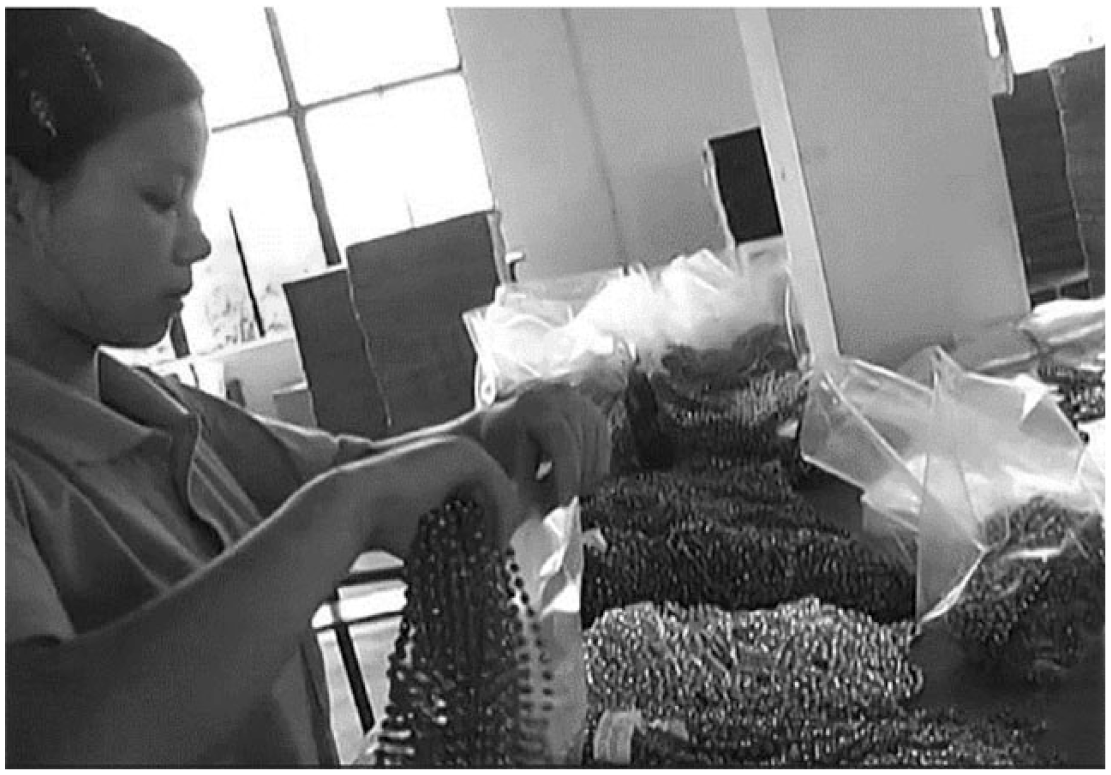
Frame from Mardi Gras: Made in China (Redmon, 2005): ‘This examination of cultural and economic globalization follows the life-cycle of Mardi Gras beads from a small factory in Fuzhou, China, to Mardi Gras in New Orleans, and to art galleries in New York City.’ In the book Redmon wrote about this film (Beads, Bodies, and Trash, 2015) the author explains that his purpose was to teach ‘readers to think critically about and question everyday objects that circulate around the globe: where do objects come from, how do they emerge, where do they end up, what are their properties, what assemblages do they form, and what are the consequences (both beneficial and harmful) of those properties on the environment and human bodies?’ Both the book and film are convincing illustrations of a ‘cultural biography approach’ (Kopytoff, 2003 [1986]) or as Redmon calls it, ‘a commodity chain analysis’ which follows the trajectory of an object to its origins.

Privileged spaces of global cities. A Rotterdam-based upscale restaurant’s name (The World) and tag line (All Day Meeting & Eating) on the shiny marble exterior inadvertently epitomizes a ‘world of difference’ in priorities between the social elites and the less fortunate in a globalizing world. Metaphorical images such as this one could typically serve in more ‘expressive’ scholarly products such as a visual essay when combined with an evocative text grounded in an appropriate academic discipline.
Expanding the scope: Emerging technologies and multisensorial challenges
Finally, it is important to mention that various emerging technologies which co-construct and steer the present day experience of living in globalizing cities (smartphones, surveillance cameras, action cameras, personal and public screens and sensors, GPS devices, Google Earth and Street View, drones, smart glasses) can also be employed to study globalizing urban contexts and can yield valuable and new types of data within each of these methods. The urban context is being documented visually for so many different reasons by authorities, institutions and organizations, but equally by tourists and locals (Instagram, Flickr) on a daily basis. In addition, researchers can actively intervene and attach visual and geolocative devices to static and moving objects, to respondents and to themselves. As such the experience and use of a globalizing city by concrete persons is being documented in its crucial visual (or visualizable), spatial and temporal dimensions.
Obviously there are more senses than the visual involved in experiencing the globalizing environment, which also involves of a variety of sounds, smells, haptic sensations and their complex interplay. Visual researchers are increasingly aware that notwithstanding its central role in cognitive and communicative processes, the visual should not be studied in isolation. Consequently they try to expand their approaches to include as much as possible the other senses and the many expressive modes that are involved. However, as one can experience the contributions of each of these senses in direct encounters (e.g. when walking in a urban environment), it is much harder to permanently capture them for further study. Even the most hybrid and advanced (multi)media still only succeed in addressing two out of our five senses (sight and hearing), and largely fail to record and transmit tactile, olfactory or gustatory sensations. What is technologically more feasible and brought into practice are measurements of bodily functions (heart rate, sweating, brain activity, movements) while receiving visual or auditory stimuli in real life or in experimental set ups. In the social sciences, multisensory and multimodal research remains for a large part in the realm of good intentions, and sometimes it merely involves relabeling practices which have always been multimodal or multisensory (analyzing audiovisual products).
Conclusion: The limits and prospects of a visual approach to globalization
This article examined the visual dimensions of globalization both as a directly observable and as a ‘mediated’ field. Empirical (non-visual) data on aspects of globalization can first of all be ‘visualized’ in the sense of being transformed from symbolic (numbers) into more iconic and metaphoric form (visualizations) and thereby provide a better understanding of interrelations and trends as well as adding a spatial (often geographical) dimension to the data. However, one can also depart from visible elements of (urban) culture (artifacts and behavior) and instigate the production of visual records of those aspects for further scrutiny. Finally, a visual approach may not only document a phenomenon in rich detail (while inevitably a selective and reductive act) but also involve more metaphorical and constructive approaches that go beyond depicting the world, but seek to reveal a specific take on a phenomenon rather than simply illustrating aspects of it. Such an ‘expressive’, interpretative effort embodies the transition from mere data to the visual (multimodal) materialization of insight. While this article started by looked at existing visualizations of globalization which are important as ‘found data’, it should be clear that visualizations may also be produced by researchers to analyze their data (of a visual or non-visual nature) and/or as researcher-produced end products to communicate their research in a partly visual manner.
While a visual approach to globalization may open new perspectives, in particular with respect to how these phenomena and processes intersect with the experiences and appearances of everyday life, one does need to acknowledge its limitations. Visual observations and depictions of the physical world primarily reveal the ‘outer shell’ of society: they provide very particularistic data, specific instantiations of particular processes in particular locales and times (and in that respect they are more truly empirical than some other types of data), they also provide more holistic types of interrelated data (elements in context), but they largely remain just observable effects and symptoms which don’t easily lay bare the multiple interacting and underlying causes. Material culture researchers and researchers skilled in spatial semiotics and local cultures may be able to ‘decode’ to some extent the signs and symptoms in the physical environment and succeed in relating observable cultural artifacts and human activities to the deeper, immaterial layers of culture, thus uncovering the realm of values, expectations and aspirations. With respect to analyzing human behavior in public space, one can answer a lot of important questions regarding who (age groups, subcultures, mixed or mono-cultural) uses particular places in a city and in what ways, what kind of activities and interactions are taking place, etc. However, in particular with respect to behaviors that involve technological devices, one may see people ‘doing things’ but distant observations do not always reveal exactly what they are doing (e.g. on their smartphone) and why. As Tomlinson rightly notes: ‘We have to be careful not to confuse mere cultural goods with the practice of culture itself – which involves the interpretation and the appropriation of meanings in relation to such goods’ (Tomlinson, 2007: 356–357). So it does not suffice to simply record the presence of certain cultural goods and activities; rather one has to try to go deeper into how exactly these goods (e.g. smartphones, public screens, signs) are being used in a particular social setting or culture and how they affect the deeper roots of culture. Visual research may provide various useful entry points to such a study, but often needs to be complemented by other methods, both established (surveys, interviews) and emerging (e.g. those monitoring online behavior).
Whether globalization is a useful concept to address contemporary processes of social and cultural change (or far too broad or limited to encompass a complex and hybrid phenomenon of such magnitude) is subordinate to the observation that these phenomena of change and interconnectedness do offer multiple visible (visually observable) entry points and unique opportunities for research. In other words, one does not have to buy into dominant notions of what globalization stands for or what constitutes a ‘global’ or ‘world city’ to recognize the vast potential that resides in the thoughtful application of visual methods for researching cultural changes as spurred by flows of interconnectedness, nor to recognize the value of looking at the everyday reality of those rather abstracted, and sometimes obscurely quantified processes.
Visual approaches to globalization and cultural exchanges may help to enrich and complement the more abstract discourse of globalization and transnationalism with empirically grounded and localized insights regarding concrete expressions and enactments of cultural encounters in urban settings. They may provide a more valid, unobtrusive way to assess and understand the impact of culture and cultural exchange in the daily life of inhabitants of cities around the world and add a unique ‘localized’, cross-cultural empirical perspective to the many divergent views and discussions about the presumed beneficial or detrimental nature of these processes.
Footnotes
Funding
This research was funded by the FWO (Flanders Research Foundation), Grant G025613N.
