



Abstract
Although it is widely held that working conditions in the informal economy are worse than in the formal economy, little evidence has been so far provided. The aim of this article is to fill this lacuna by comparing the working conditions of informal employees with formal employees using the 2015 European Working Conditions Survey. Multilevel mixed-effects logistic regression analysis provides a nuanced and variegated appreciation of which working conditions are worse for informal employees, which are no different, and which are better for informal than formal employees. The article concludes by discussing the theoretical and policy implications.
Introduction
Employees with no written contract or terms of employment are widely assumed to suffer from worse working conditions than formal employees. This is because unscrupulous employers who employ unregistered employees are doing so not only to evade paying tax and social contributions owed but also to evade a whole raft of labour laws (e.g. on minimum wages, working time, holiday and sick leave entitlement, health and safety, protection in case of redundancy). However, perhaps because it is so widely held that working conditions in the informal economy are worse, the evidence is scarce. Therefore, the aim of this article is to fill this lacuna. To achieve this, the working conditions of informal employees with no written contract or terms of employment in the 28 member states of the European Union (EU28) will be compared with formal employees using an extensive data set, namely the 2015 European Working Conditions Survey (EWCS) involving 30,269 face-to-face interviews with employees.
This article therefore advances knowledge on the informal economy in three ways. Firstly, and theoretically, by evaluating whether the working conditions of informal employees are worse than formal employees, this article tests an assumption which lies at the very heart of dominant theories of the informal economy, namely the long-standing modernisation theory which depicts informal work as low-skilled unproductive work conducted under poor conditions (La Porta and Shleifer, 2014), and the recently dominant political economy theorisation which views work in the informal economy as unregulated precarious work conducted under poor conditions as a survival strategy (Castells and Portes, 1989; Davis, 2006). Secondly, and empirically, this article advances knowledge by reporting the first known evaluation of the working conditions of informal employees relative to formal employees using extensive data. And thirdly, and in policy terms, it starts to question whether the current policy approaches used to tackle the informal economy address those working conditions found to be worse.
In the next section therefore, a brief literature review of the recent advances in knowledge on the informal economy is provided to reveal how many previous dominant assumptions have not held once subjected to evidence-based evaluation. Following this, it will be shown that there has been little, if any, evaluation of the widespread assumption that working conditions are worse for informal than formal employees. To begin to evaluate this common assumption, the third section presents the methodology here used, namely a multilevel mixed-effects logistic regression analysis using an extensive 2015 survey of working conditions across the 28 member states of the European Union (EU28). The fourth section then reports the results. The finding is that akin to many previous assumptions about the informal economy, a more nuanced and variegated appreciation is required of which working conditions are worse for informal employees, which are no different, and which, if any, are better for informal than formal employees. The fourth and final section then concludes by discussing the theoretical and policy implications of these findings.
Reflecting the consensus in the literature, the informal economy here refers to paid activities not declared to the authorities for tax, social security and/or labour law purposes when they should be declared (European Commission, 2014; Khan, 2017; Schneider, 2013; Slack et al., 2017; Williams and Windebank, 1998; Windebank and Horodnic, 2017). This definition, nevertheless, covers a wide array of employment relationships. It includes not only formal employers not declaring some and/or all the transactions they undertake for tax evasion purposes, and employers under-declaring their formal employees by paying some of their wage as an official declared wage and the rest as an additional undeclared (envelope) wage so as to evade the full tax and social insurance contributions (ILO, 2015; Williams, 2017), but also employers who employ workers without a legal written contract or terms of employment. In this article, it is these unregistered employees without a legal written contract or terms of employment, which allows employers to evade not only tax and social insurance payments but also labour laws, that are the focus of attention.
Working conditions in the informal economy: Literature review and hypotheses
Given the recognition that the informal economy is a persistent feature in European economies and beyond, scholarship in recent decades has sought to understand its changing magnitude and determinants, who participates in the informal economy, and the motives of employers, workers and consumers. These studies have shown how previous widely held assumptions about the informal economy, when subjected to evidence-based evaluation, do not hold. Firstly, it has been revealed that the informal economy is neither universally growing nor declining but growing in some places and declining in others (Autio and Fu, 2015; Dibben and Williams, 2012; Schneider and Williams, 2013). However, what is certain is that the informal economy is large and persistent in both developed and developing countries.
A recent study by the ILO (2018) estimates that more than 60% of the world’s working population have their main job in the informal economy, but that the share of informal employment in total employment ranges from 94% in countries in Africa and Asia such as Burkina Faso, Benin, Nepal, Rwanda, Angola and Chad, to 5% or lower in countries in Europe such as Slovenia, Iceland and Luxembourg. Similarly, Williams et al. (2017a) estimate that the average share of undeclared work in total labour input in the European Union member states is 12% but ranges from less than 5% in the United Kingdom and Germany to more than 15% in Poland, Lithuania, Romania, Latvia, Bulgaria and Hungary. Estimating the share of the shadow economy as a percentage of GDP in 2015, Medina and Schneider (2018) obtain similar results, namely lower shares in Western European countries (e.g. less than 10% in Germany, the Netherlands, the United Kingdom, Austria and Ireland) and higher shares in Southern, Central and East European countries (e.g. more than 25% in Cyprus, Malta and Greece).
Secondly, although the conventional assumption was that groups more marginalised and excluded from formal employment engage in the informal economy, scholarship has revealed that although some are driven by exclusion from the formal economy, others voluntarily exit it (Cross and Morales, 2007; Gerxhani, 2004; Williams and Horodnic, 2017). Indeed, investigating the European Union, Williams et al. (2017b) conclude that there is a dual informal labour market with an exclusion-driven ‘lower tier’ significantly more likely to be populated by the unemployed and those living in East-Central Europe and an exit-driven ‘upper tier’ more prevalent amongst those with fewer financial difficulties and those living in Nordic nations.
Studies of the prevalence of the informal economy, who engages in such work and their motives, therefore, have all revealed the need to transcend simplistic understandings and to adopt more nuanced and variegated portrayals of the informal economy. Until now, however, no studies have addressed the widely held assumption that the working conditions for informal employees are worse than for formal employees.
The origins of this widespread assumption that informal employees have poorer working conditions than formal employees are two theories which have dominated discourse on the informal economy. Firstly, modernisation theory, which dominated discourse during the twentieth century, represents the informal economy as a leftover from a pre-modern mode of production. Informal work is from this theoretical perspective depicted as unproductive and low-skilled work conducted under pre-modern working conditions (La Porta and Shleifer, 2008, 2014). During the late twentieth century, a political economy thesis then came to the fore which recognised that the informal economy is an inherent feature of late capitalism used by formal businesses to reduce costs through outsourcing and subcontracting to this sphere (Castells and Portes, 1989; Davis, 2006), and to have resulted from the deregulation of work and diminishing state involvement in welfare (Agarwala, 2016; Castells and Portes, 1989; Gallin, 2001; Siegmann and Schiphorst, 2016; Taiwo, 2013). Informal work was thus seen as a form of precarious work conducted under exploitative conditions by subjugated labour as a survival practice (Davis, 2006; Slavnic, 2010; Taiwo, 2013). In both theories, informal work is perceived as precarious work conducted under worse working conditions than work in the formal economy.
The outcome is that informal employees have been characterised as: not having access to employment rights such as annual and other leave, sickness pay, redundancy and training (Evans et al., 2006; ILO, 2015; TUC, 2008; Williams and Lansky, 2013); lacking access to a range of other legal rights such as the minimum wage, tax credits and working hours directives (Dellot, 2012; TUC, 2008; Williams and Windebank, 1998); being unable to build up rights to pensions and other contributory benefits, and access occupational pension schemes (Dellot, 2012; Gallin, 2001; ILO, 2002; Williams and Lansky, 2013); lacking access to health and safety standards in the workplace (Evans et al., 2006; Gallin, 2001; ILO, 2002, 2015; TUC, 2008); having lower job security (Katungi et al., 2006; Kovács, 2015; Williams, 2001); lacking collective bargaining rights (Ferreira, 2016; ILO, 2002); losing employability due to their lack of evidence of engagement in employment (Barbour and Llanes, 2013; Dellot, 2012); unable to gain access to credit such as mortgages or loans since they have no evidence of their income (Williams, 2014a); unable to get an employer’s reference (ILO, 2002; TUC, 2008), and suffering from a constant fear of detection and risk of prosecution (Williams, 2014a).
Despite this characterisation of informal employees, no known studies have evaluated and compared their working conditions with formal employees. As such, there is no evidence-base. Yet a survey of 24 employment experts in 12 EU member states for the project Precarious Work and Social Rights still concludes that informal employment is the most common form of work associated with precarious work (McKay et al., 2012; Thörnqvist, 2014). These experts view informal employees as having the lowest level of protection with respect to job security, job conversion, working time limits, discrimination protection, pensions, welfare, training and decent pay, and the second lowest protection as far as representation is concerned (McKay et al., 2012). This depiction of the poor working conditions of informal employees is further reflected in other studies. A qualitative study of the UK food industry reveals the poor working conditions among migrants in low-skilled informal jobs in the food industry, generalising out from this case study to argue that ‘informalisation’ is characterised by job insecurity, work intensification, worker expendability, worker subordination and employment intermediation (Scott, 2017).
The widespread perception, therefore, is that informal employees have poorer working conditions than formal employees. First, informal employees are depicted as working in poorer physical environments such as noisy or high temperature workplaces (Coletto and Bisschop, 2017; Gallin, 2001; Harriss-White, 2017; Yimyam and Jirapattarapimol, 2007).
Poorer physical environment hypothesis (H1): employees in poorer physical work environments are more likely to be informal employees.
Second, the view is that work intensification is greater for informal employees in terms of working to tight deadlines, the pace of work not being controllable, and emotional demands higher (Scott, 2017; Urzi and Williams, 2017).
Higher intensity of work hypothesis (H2): employees having a higher intensity of work are more likely to be informal employees.
Third, there is a view that working time is poorer in terms of the duration of work (e.g. long working hours or days), atypical working times (e.g. shift or weekend work), flexibility (e.g. arranging time-off, working in free time to meet work demands) and control over working time arrangements (Clark and Colling, 2017; McKay et al., 2012; Murphy and Turner, 2017; Scott, 2017; Skrivankova, 2010).
Poorer working time quality hypothesis (H3): employees with poorer quality working time are more likely to be informal employees.
Fourth, there is a consensus that informal employees experience a worse social environment in the workplace, including adverse social behaviour (e.g. verbal abuse, threats, sexual harassment, physical violence), and a lack of social support from colleagues (Clark and Colling, 2017; Hodosi, 2015; Scott, 2017; Urzi and Williams, 2017).
Poorer social environment hypothesis (H4): employees in a poorer social environment in the workplace are more likely to be informal employees.
Fifth, informal employees are viewed as less able than formal employees to be able to use their skills and their discretion, including a poorer cognitive dimension (e.g. solving unforeseen problems, conducting complex tasks, learning new things), less latitude for taking decisions (e.g. the ability to choose or change the order of tasks, speed of work, choice of work colleagues), less organisational participation (e.g. consultation regarding objectives, involvement in decision-making about work organisation and processes, ability to influence decisions) and a lack of training (Mešić, 2016; Pfau-Effinger, 2017; Scott, 2017).
Poorer skills and discretion hypothesis (H5): employees less able to use skills and discretion are more likely to be informal employees.
And sixth and finally, the job prospects of informal employees are viewed as poorer than formal employees in terms of career prospects, job security and the solvency of the businesses in which they are employed (Barsoum, 2015; Eroglu, 2017; Ferreira, 2016; La Porta and Shleifer, 2014; Sasaki et al., 2016; Scott, 2017).
Job prospects hypothesis (H6): employees with poorer job prospects are more likely to be informal employees.
Until now, however, these are all largely perceptions of the working conditions of informal employees compared with formal employees, rather than evidence-based findings.
The catalyst for questioning these views of working conditions in the informal economy are two agency-oriented theories. On the one hand, neoliberal theory depicts informal employees as rational actors who, having weighed up the costs and benefits of informal and formal work, choose to operate in the informal economy. In doing so, they avoid the costs, time and effort needed to be formal, and benefit from working conditions not available to them in the formal economy. These benefits include flexible hours, opportunity for economic independence, better wages, greater autonomy to decide on work priorities and work routines, a more flexible work environment, and a greater sense of identity (De Soto, 1989, 2001; Gerxhani, 2004; Maloney, 2004; Snyder, 2004). On the other hand, drawing inspiration from institutional theory (North, 1990), a more ‘social actor’ approach has emerged that views informal work as illegal but socially legitimate endeavour. Informal work arises when the formal institutions are not in symmetry with the norms, values and beliefs that constitute the informal institutions (Horodnic and Williams, 2018; Kistruck et al., 2015; Webb et al., 2009; Williams and Shahid, 2016; Williams et al., 2015). These institutional theorists argue that even if working conditions in the informal economy are not regulated by formal institutions (codified laws and regulations), they are regulated by the wider shared norms, values and beliefs of informal institutions (Bonnet and Venkatesh, 2016; Williams and Horodnic, 2016). Moreover, given that Williams et al. (2017b) find evidence that twice as many informal employees in the EU28 choose to operate in the informal economy as do so out of necessity, there are both theoretical and empirical rationales for evaluating the related but so far untested assumption that working conditions are poorer in the informal economy. To fill this gap, we therefore test the six hypotheses above that the working conditions are poorer among informal than formal employees.
Methodology
To evaluate these hypotheses, an extensive data set is used, namely the 2015 European Working Conditions Survey (EWCS). The sample used in the EWCS is representative of those aged 15 and over (16 and over in Bulgaria, Norway, Spain and the UK) living in private households and in employment who did at least one hour of work for pay or profit during the week preceding the interview. In each country a multistage stratified random sampling design was used based on region (NUTS 2 or equivalent) and the degree of urbanisation. The sixth edition of the EWCS covers the 28 EU member states, Norway and Switzerland and Albania, the Former Yugoslav Republic of Macedonia, Montenegro, Serbia and Turkey and comprises 43,850 interviews. Here, the focus is upon the 30,269 employees interviewed in the 28 member states of the European Union (EU28).
To analyse the working conditions of informal compared with formal employees, the dependent variable is based on the question ‘What kind of employment contract do you have in your main job? a) an indefinite contract; b) a fixed-term contract; c) a temporary employment agency contract; d) an apprenticeship or other training scheme; e) no contract; f) Other.’ This evaluates whether respondents work without a contract of employment, coded 1 if the respondent does not have a contract of employment and zero otherwise.
To understand who engages in unregistered employment across the working population and businesses, independent socio-demographic variables are examined (gender, age, and their household’s ability to make ends meet, as well as the household size) as well as business characteristics (sector and economic activity) that have been previously found to be associated with working in the informal economy in the European Union (Williams and Horodnic, 2016, 2017, 2018).
To evaluate the working conditions of informal employees relative to formal employees, six job quality indices and 14 additional sub-indices developed by Eurofound (2013, 2016) are used. These are: the physical working environment index which assesses physical risks in the workplace; the work intensity index (with three sub-indices: quantitative demands in terms of work intensity; autonomy over the pace of work; and emotional demands); the working time quality index (with four sub-indices: duration of working hours; atypical working times; working time arrangements; and flexibility in working times); the social environment index which assesses the social support and the occurrence of adverse social behaviour; the skills and discretion index (with four sub-indices: cognitive dimensions; decision latitude; organisational participation; and training opportunities); and the prospects index (with three sub-indices: prospects for career advancement, and job security on a personal and organisational level).
The six job quality indices are measured on a scale from 0 to 1. With the exception of the work intensity index, the higher the index score, the better the job quality. Thus, except for the work intensity index, and considering that some of the individual variables within a dimension were measured on different scales (i.e. 5- or 7-point Likert scale, categorical scale), in the first step the answers were normalised and rescaled with value 0 for the lowest level of the variable (the worst condition for the worker) and gradually increased to 1 for the highest level of the variable (the best condition for the worker). For the work intensity index, the values were set in reverse. In the second step, we computed the dimensions as average values of the individual variables and the index as an average of their dimensions. Therefore, all indicators and sub-dimensions were given the same weight when calculating the mean for each job quality index.
For both the descriptive statistics and regression analysis, a weighting scheme was used which takes the relative size of the workforce in each of the countries into account, as recommended in the EWCS 2015 technical report (Eurofound, 2016). For the descriptive statistics, we analysed all cases available for each analysed variable (don’t know and refusal were excluded). For the multivariate analysis meanwhile, and to avoid exclusion of some individuals because they did not provide answers to every question on employment status, socio-demographic characteristics and/or working quality indices and sub-indices, we used multiple imputations (Bartlett and Carpenter, 2013; Rubin, 1987). Considering that missing data are a mixture of continuous and categorical data, we have chosen the chained equation approach. This approach allows one to specify the particular distribution to impute for each type of missing data (Bartlett and Carpenter, 2013). Details about the distribution of missing data are available in the Appendix. Twenty imputations were simulated through a system of chained equations for every missing value. However, as a robustness check we have conducted a multivariate analysis using only the crude data (i.e. individuals responding to each and every variable included in the regression analysis). The results for the socio-demographic characteristics and the working conditions indices remain the same, with only one notable difference for one indicator within one model (specified in the next section), displaying the robustness of the findings.
Findings
In a previous analysis of a 2013 special Eurobarometer survey, 5% of employees in the EU report that they did not have a written contract or terms of employment (Williams and Kayaoglu, 2017), while an analysis of European Social Survey data on 30 countries for the period between 2004 and 2009 arrives at the same figure (Hazans, 2011). This analysis of the 2015 EWCS finds similarly that 6% of employees in the EU28 report having no contract of employment.
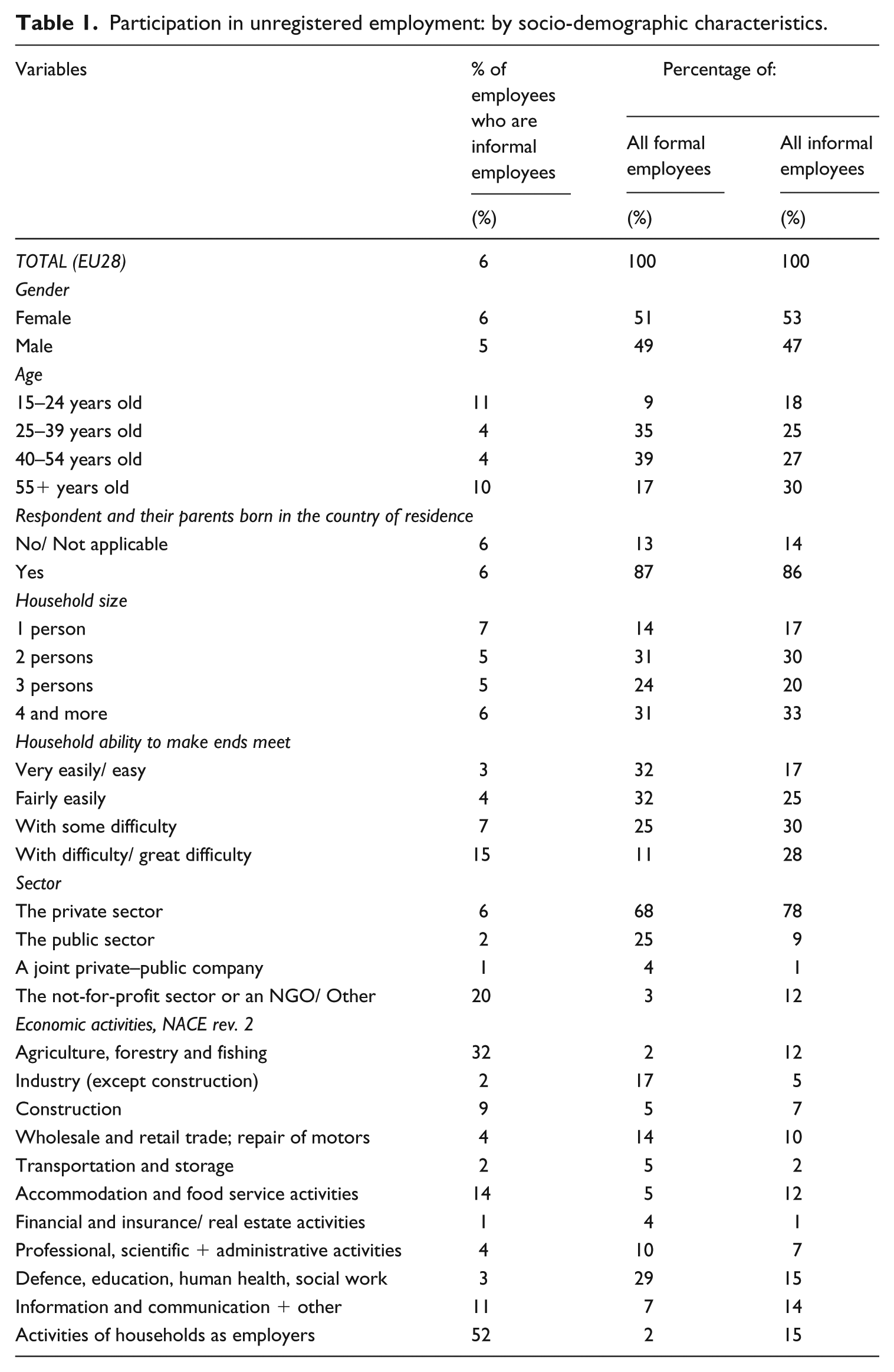
Who, therefore, engages in unregistered employment? Table 1 reveals little difference between men and women. However, there is a U-shaped curve with younger and older age groups more likely to work without a contract. While no significant variation is revealed with respect to household size or migrant status of the respondent, those in households having difficulty making ends meet are more likely to be unregistered employees. As far as business characteristics are concerned, 78% of these informal employees are in the private sector compared with just 68% of all employees. Perhaps surprisingly however, 20% of all employees in the not-for-profit sector, NGO or other sectors are working without a contract, although due to the size of this sector (3% of all employees), only 12% of all informal employees are in this sector. Turning to the industrial sectors, three sectors can be identified in which unregistered employment is concentrated, namely households as employers (in which 52% of employees are unregistered), agriculture, forestry and fishing (32%), and accommodation and food service activities (14%). Nevertheless, unregistered employment exists in all economic sectors, with no one sector having more than 15% of all informal employees.
Participation in unregistered employment: by socio-demographic characteristics.
To start to analyse the working conditions of informal employees, Figure 1 displays the values of the job quality indices for the full sample of employees compared with the employees working without a written contract. Figure 1a examines each of the six main job quality indices and reveals perhaps surprisingly that employees less able to use skills and discretion, and with poorer job prospects, are more likely to be informal employees. However, those having a poorer physical work environment, higher intensity of work, poorer quality working time, and poorer social environment are not more likely to be informal employees.

Job quality indices scores.
To analyse this in more in-depth, Figure 1b starts to break down these indices into their component parts. Examining the work intensity index, this reveals that the quantitative demands (i.e. working at high speed, working to tight deadlines, etc.) of informal employees are lower compared with formal employees, their pace of work is less dependent on their boss, colleagues or other demands from passengers, customers and so forth, and they face less emotional demands (i.e. hiding feelings at work, handling angry clients, etc.). In terms of the working time quality index, meanwhile, Figure 1c show that informal employees score better in terms of duration (i.e. working fewer hours), atypical working time (i.e. less night work, weekend work or shift work) and flexibility (e.g. they can arrange more easily to take an hour off during working hours to take care of personal or family matters). However, they have worse working time arrangements (i.e. being requested to come to work at short notice; witnessing changes and control of their working times). Analysing the skills and discretion index, furthermore, Figure 1d shows that informal employees score better only with respect to their latitude for taking decisions (i.e. ability to choose or change the order of tasks, the speed or rate of work, the methods of work, etc.). The cognitive dimension of their work (i.e. solving unforeseen problems, learning new things) is poorer compared with formal employees, and so too is their organisational participation and participation in training. Finally, and in terms of the job prospects index, informal employees have poorer career prospects for advancement, lower job security and a perceived higher possibility of downsizing in the organisation in which they work.
To evaluate whether these specific poorer or better working conditions of informal employees are statistically significant when other variables are taken into account and controlled for (e.g. socio-demographic and business characteristics), Table 2 reports the results of a regression analysis. Given the hierarchical structure of the data (individuals nested within countries), a multilevel model mixed-effects was used. As the dependent variable is dichotomous, a multilevel mixed-effects logistic regression is employed (Snijders and Bosker, 2012). The first stage in the analysis estimated a baseline random intercept model with no explanatory variables to identify the appropriateness of a multilevel approach. The analysis of the crude data indicated that about 22% of the variance in informal employment is accounted for at the country level (Wald = 13.69, df = 1, p < 0.01), indicating significant variation between countries in the prevalence of informal employment. A similar figure of 22% of variance in informal employment accounted for at country level is obtained for the imputed data. Given this justification for using multilevel mixed-effects logistic regression analysis, the second stage involved adding the variables of interest. As such, Model 1 of Table 2 examines the socio-demographic characteristics together with the job quality indices. Models 2 to 5 then evaluate the working conditions of informal employees in more detail by breaking down each job quality index in turn.
Multilevel mixed-effects logistic regressions of the likelihood of unregistered employment, by socio-demographic characteristics and job quality indices.

Notes: Significant at *** p < 0.01, ** p < 0.05, * p < 0.1. The models run on crude data (i.e. keeping only the individuals for which data are available for each and every variable included in the multivariate analysis) provide broadly the same results with the exception of I4. Social environment index for which the significance has vanished in Model 4. Reference categories are shown in parentheses.
Source: own calculations based on data from EWCS (2015).
Starting with the characteristics of informal employees, the finding is that younger groups, those in single person households and in households who find it difficult to make ends meet are significantly more likely to work unregistered. However, no significant association was found with respect to gender or immigration status. This confirms the findings of previous studies using other data sets (Kresniki and Williams, 2017; Williams and Kayaoglu, 2017).
Analysing the working conditions of informal compared with formal employees, Model 1 of Table 2 examines the six main job quality indices. The finding is that employees with poorer physical work environments, employees less able to use skills and discretion, and employees with poorer job prospects are more likely to be informal employees (confirming H1, H5 and H6). Employees with poorer quality working time are not more likely to be informal than formal employees (refuting H3), and employees having a higher intensity of work and a poorer social environment are significantly more likely to be formal than informal employees (refuting H2 and H4).
Whether this remains the case in a finer-grained analysis of the 14 sub-indices is examined in Models 3–5. Model 2 disaggregates the work intensity index, Model 3 the working time quality index, Model 4 the skills and discretion index and Model 5 the job prospects index. The physical working environment index, however, is composed of only one dimension, and the finding is that employees with a poorer physical working environment are significantly more likely to be informal employees (confirming H1). They are more exposed to deleterious noise and vibrations, temperatures and smoke, and/or subjected to physically demanding work than formal employees.
Model 2 breaks down the work intensity index, which overall revealed that employees having a higher intensity of work are significantly more likely to be formal than informal employees (refuting H2). Analysing the three sub-indices, the finding is that employees with higher quantitative demands in their jobs, such as working at a high speed, working to tight deadlines, having little time to get the job done and having frequent disruptive interruptions, are significantly more likely to be formal than informal employees. Also, those with less autonomy over the pace of their work (more direct commands from people such as customers, passengers, pupils; lower production targets; automatic speed of a machine; and more direct control of their work) are significantly more likely to be formal than informal employees; and employees witnessing higher emotional demands in their job (e.g. handling of angry clients, customers; being in emotionally disturbing situations; the job demanding that they hide their feelings) are more likely to be formal than informal employees.
Turning to whether employees with poorer quality working time are more likely to be informal employees, which overall revealed no significant difference between informal and formal employees (refuting H3), the four sub-indices are analysed. The finding is that employees with greater durations of working time (e.g. long hours, no recovery period, long working days) are no more likely to be informal than formal employees, nor are employees working atypical working times (e.g. engaging in night work, weekend work and shift work) or employees with less control over and fewer changes in working time arrangements (e.g. ability to choose between schedules, short notice about changes in working time). However, employees with less flexibility in arranging their working times (e.g. easy to arrange an hour off, work in free time to meet work demands) are significantly more likely to be formal than informal employees.
Examining the social environment of the workplace, the overall finding is that employees in poorer social environments (e.g. witnessing adverse social behaviour) are significantly more likely to be formal employees (refuting H4). However, when using crude data, the significance vanishes in Model 4 and therefore, the results needs to be interpreted cautiously. Turning to employees less able to use skills and discretion, the overall finding is that these are more likely to be informal employees (confirming H5). To provide a finer-grained understanding, four sub-indices are analysed. The finding is that employees less able to use cognitive skills in their job (i.e. solving unforeseen problems, carrying out complex tasks, learning new things, working with computers, smartphones and laptops, ability to apply their own ideas at work) are significantly more likely to be informal employees. Moreover, employees with higher latitude for taking decisions, namely the ability to choose or change tasks, methods or speed of work, having a say in choice of work colleagues, are significantly less likely to be informal employees. Those employees with poorer levels of organisational participation, such as being consulted before objectives are set for their own work, to be involved in improving the work organisation and/or the work processes of their own department or organisation, and to feel they can influence decisions that are important to their work, are not more likely to be informal than formal employees. However, those employees with poorer paid and on-the-job training are significantly more likely to be informal employees.
Finally, employees with poorer job prospects were overall significantly more likely to be informal employees (confirming H6). When this is broken down into its three sub-indices to develop a more variegated understanding, the finding is that employees with poor career prospects are significantly more likely to be informal employees, as are those with poorer job security significantly more likely to be informal employees but employees in organisations with a greater perceived probability of downsizing are not more likely to be informal employees.
Discussion and conclusions
Reporting the 2015 EWCS, the finding is therefore that 6% of employees in the EU28 report having no contract of employment. However, younger employees, those in single person households and those in households who find it difficult to make ends meet are significantly more likely to be informal employees.
Examining the working conditions of informal employees compared with formal employees, the finding is that they are significantly worse on five of the 16 dimensions of job quality, not significantly different on five of the 16 dimensions and significantly better on six dimensions. The working conditions of informal employees are significantly poorer than formal employees with regard to their physical work environment; ability to use cognitive skills; training; career prospects; and perceptions of job security.
No significant differences exist between informal and formal employees, however, in relation to their duration of work; atypical working time (e.g. night work, weekend work, shift work); control over and changes in working time arrangements; organisation participation; or the perceived possibility of the downsizing of the company in which they are employed (i.e. the number of employees at their workplace decreasing).
Informal employees have significantly better working conditions than formal employees, meanwhile, in relation to quantitative demands; autonomy regarding the pace of work; level of emotional demands; flexibility in arranging their working time and their social environment at work; and their latitude in taking decisions.
The outcome, therefore, is a need for a more nuanced understanding of the working conditions of informal employees. Based on the finding that informal employees have significantly better working conditions than formal employees on some dimensions, such as having more flexibility in arranging their working time, fewer quantitative demands put on them, and less exposure to adverse social behaviour, it might be the case that the employment relations involved in informal work are more complex than has been sometimes assumed (Williams, 2018). There thus appears to be a case for considering the relevance of the more agency-oriented theoretical perspectives, such as how despite not being regulated by formal institutions, informal institutions regulate work conditions in the informal economy (Webb et al., 2009).
Despite revealing the need for a more nuanced understanding of working conditions in the informal economy, there are nevertheless limitations to the conclusions that can be drawn, and caveats required. First, this survey does not allow some key job quality issues to be evaluated, such as the workers’ wage rates, or their experiences in taking holidays and sick leave for instance. Future quantitative surveys need to evaluate these key dimensions of job quality (i.e. wage rates, dismissal, holiday pay and sick leave) when comparing the working conditions for informal and formal employees. Second, more in-depth qualitative research is also required regarding the social relations within which informal work takes place. Until such qualitative research is undertaken, it will be difficult to more fully explain the working conditions of informal compared with formal employees. Given the long-standing recognition that many informal employees work for close social relations previously known to them (Williams and Windebank, 2001), this could examine whether the working conditions of informal employees are better when the employee and employer know each other and become worse as the social relations become more distant (cf. Alacovska, 2018; Williams, 2010).
Third, it would also be useful for future studies of working conditions to focus upon other forms of informal work, such as under-declared employment and informal self-employment, as well as for studies to be undertaken in other global regions, especially developing countries, and other spatial scales such as particular nations, regions and localities. Indeed, it would be useful to look at whether the working conditions of those working in informal economy differ for those engaged in different types of informal employment. Although this study does not allow such comparison given that only employees without a written contract of employment in their main job were analysed, future studies could investigate the working conditions of, for example, those involved in informal employment as a second job (i.e. ‘moonlighters’) (Kimmel and Conway, 2001), or the informal self-employed. Similarly, and given that the type of informal employment and general working conditions vary across different European regions (Eurofound, 2017; Pfau-Effinger, 2009; Renooy, 2008; Williams, 2014b), comparing the working conditions of formal versus informal workers within EU regions or countries could offer a more nuanced picture. And fourth and finally, there is a pressing need to evaluate whether the different policy approaches and measures currently used (e.g. labour inspections, data mining) address all the working conditions here shown to be significantly worse among informal employees (e.g. physical environment, lack of use of cognitive skills, and training). Although beyond the scope of this article, in-depth research on this policy aspect is required in future studies.
In sum, this article has uncovered the need for a more nuanced understanding of the precise working conditions which are worse for informal than formal employees. If this study therefore encourages more research to further advance such a finer-grained and variegated understanding, then it will have fulfilled one of its intentions. If there is also greater evaluation of whether the current policy approaches being used address the specific working conditions that are worse for informal employees, then it will have fulfilled its wider intention.
Footnotes
Appendix
Variables used in the analysis.
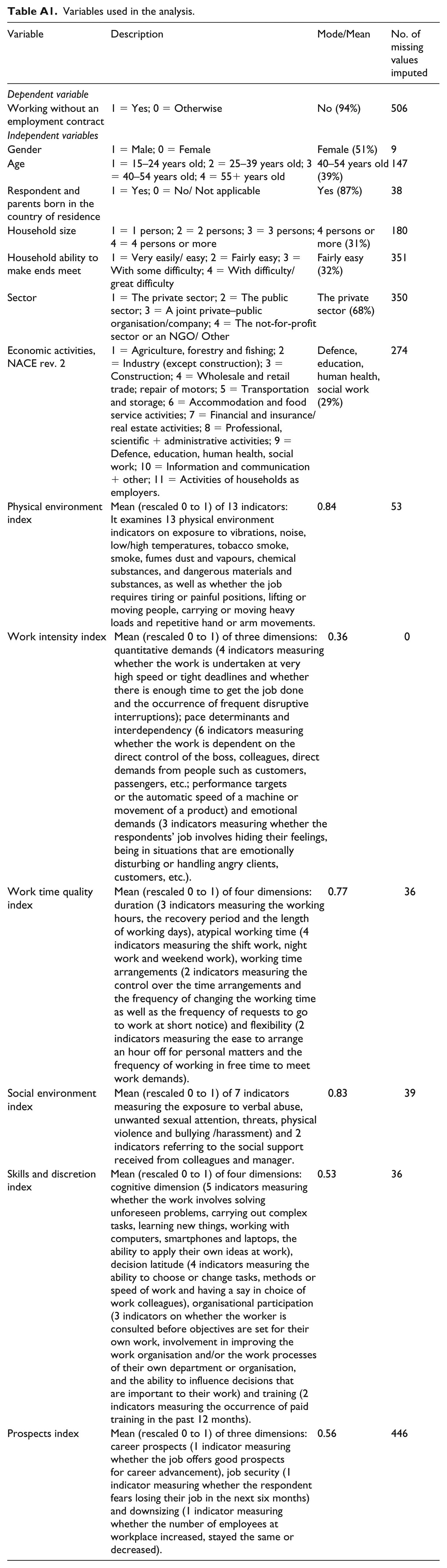
| Variable | Description | Mode/Mean | No. of missing values imputed |
|---|---|---|---|
| Dependent variable | |||
| Working without an employment contract | 1 = Yes; 0 = Otherwise | No (94%) | 506 |
| Independent variables | |||
| Gender | 1 = Male; 0 = Female | Female (51%) | 9 |
| Age | 1 = 15–24 years old; 2 = 25–39 years old; 3 = 40–54 years old; 4 = 55+ years old | 40–54 years old (39%) | 147 |
| Respondent and parents born in the country of residence | 1 = Yes; 0 = No/ Not applicable | Yes (87%) | 38 |
| Household size | 1 = 1 person; 2 = 2 persons; 3 = 3 persons; 4 = 4 persons or more | 4 persons or more (31%) | 180 |
| Household ability to make ends meet | 1 = Very easily/ easy; 2 = Fairly easy; 3 = With some difficulty; 4 = With difficulty/ great difficulty | Fairly easy (32%) | 351 |
| Sector | 1 = The private sector; 2 = The public sector; 3 = A joint private–public organisation/company; 4 = The not-for-profit sector or an NGO/ Other | The private sector (68%) | 350 |
| Economic activities, NACE rev. 2 | 1 = Agriculture, forestry and fishing; 2 = Industry (except construction); 3 = Construction; 4 = Wholesale and retail trade; repair of motors; 5 = Transportation and storage; 6 = Accommodation and food service activities; 7 = Financial and insurance/ real estate activities; 8 = Professional, scientific + administrative activities; 9 = Defence, education, human health, social work; 10 = Information and communication + other; 11 = Activities of households as employers. | Defence, education, human health, social work (29%) | 274 |
| Physical environment index | Mean (rescaled 0 to 1) of 13 indicators: |
0.84 | 53 |
| Work intensity index | Mean (rescaled 0 to 1) of three dimensions: quantitative demands (4 indicators measuring whether the work is undertaken at very high speed or tight deadlines and whether there is enough time to get the job done and the occurrence of frequent disruptive interruptions); pace determinants and interdependency (6 indicators measuring whether the work is dependent on the direct control of the boss, colleagues, direct demands from people such as customers, passengers, etc.; performance targets or the automatic speed of a machine or movement of a product) and emotional demands (3 indicators measuring whether the respondents’ job involves hiding their feelings, being in situations that are emotionally disturbing or handling angry clients, customers, etc.). | 0.36 | 0 |
| Work time quality index | Mean (rescaled 0 to 1) of four dimensions: duration (3 indicators measuring the working hours, the recovery period and the length of working days), atypical working time (4 indicators measuring the shift work, night work and weekend work), working time arrangements (2 indicators measuring the control over the time arrangements and the frequency of changing the working time as well as the frequency of requests to go to work at short notice) and flexibility (2 indicators measuring the ease to arrange an hour off for personal matters and the frequency of working in free time to meet work demands). | 0.77 | 36 |
| Social environment index | Mean (rescaled 0 to 1) of 7 indicators measuring the exposure to verbal abuse, unwanted sexual attention, threats, physical violence and bullying /harassment) and 2 indicators referring to the social support received from colleagues and manager. | 0.83 | 39 |
| Skills and discretion index | Mean (rescaled 0 to 1) of four dimensions: cognitive dimension (5 indicators measuring whether the work involves solving unforeseen problems, carrying out complex tasks, learning new things, working with computers, smartphones and laptops, the ability to apply their own ideas at work), decision latitude (4 indicators measuring the ability to choose or change tasks, methods or speed of work and having a say in choice of work colleagues), organisational participation (3 indicators on whether the worker is consulted before objectives are set for their own work, involvement in improving the work organisation and/or the work processes of their own department or organisation, and the ability to influence decisions that are important to their work) and training (2 indicators measuring the occurrence of paid training in the past 12 months). | 0.53 | 36 |
| Prospects index | Mean (rescaled 0 to 1) of three dimensions: career prospects (1 indicator measuring whether the job offers good prospects for career advancement), job security (1 indicator measuring whether the respondent fears losing their job in the next six months) and downsizing (1 indicator measuring whether the number of employees at workplace increased, stayed the same or decreased). | 0.56 | 446 |
Funding
This article is part of a project that has received funding from the European Union’s Horizon 2020 research and innovation programme under the Marie Skłodowska-Curie grant agreement No 746358.
