



Abstract
Due to the interest in formal relationships at work or to the difficulty to define what personal means, personal bonds in the social sciences have been an understudied topic. Even less has been the interest in connecting such bonds with the internationalization of careers and knowledge. In this article, the authors aim at filling this gap by studying what role personal bonds have played in the internationalization of the social sciences in Latin America. They identify factors that affect personal bonds as well as translations that scholars produce to capitalize on these ties. The most relevant of such translations, academic mobility, has to be interpreted, from a peripheral standpoint, as operating within a logic of leveling, a process that highlights structural asymmetries in the global social sciences. The authors describe both dimensions of this process and, in the concluding section, offer some policy implications and future research directions.
Introduction
Since the 1990s, we have been conducting empirical research on the internationalization of the social sciences and scholarly careers, particularly in Latin America. Frequently, comments about personal relations with colleagues, students, and even adversaries have emerged. Often unasked, repeatedly scholars brought this aspect of their careers to the fore. It called our attention to the fact that, while recognizing the importance of personal bonds, in their narratives, these international connections were usually unrelated to the local and global structure of the social sciences, or to the international division of academic labor. However, in many biographical and institutional analyses, usually retrospectively, the interplay between the personal and the international emerge time and again (e.g., Jaramillo-Jiménez, 2017; Suárez, 2018; Vessuri, 1994, 2003). Why is it that the personal bonds of academics are recognized in the history of the science while neglected as a topic in the sociology of science, at least in Latin America? How do personal bonds shape international connections and, in an opposite direction, to what extent has the internationalization of science shaped those bonds? Here, we aim at filling this gap by introducing the theoretically informed concept of leveling and showing, with qualitative empirical evidence from research undertaken during the last decades in Latin America, its adequacy for understanding personal bonds in the internationalization of the social sciences from a peripheral perspective. The main hypothesis is that personal bonds play a relevant role in the internationalization of Southern social scientists’ careers and production. In particular, these bonds allow for exchange experiences through which Southern scholarly production is leveled up while the Northern counterpart is leveled down to produce a flatter environment for collaboration. Put differently, Southern scholars’ international experiences show the extent to which the universal character of knowledge should be questioned in order to produce meaningful encounters.
In this article, we first define theoretically personal bonds and connect them with the center–periphery structure of global science. We do so because this global structure creates important asymmetrical relations and epistemic imbalances that cross the personal dimension of academics’ working lives (Heilbron and Gingras, 2018; Santos, 2018). Then, we discuss empirical evidence from different research projects we have conducted in Latin American countries since the 1990s. Consequently, we introduce the notion of leveling to explain the sort of intellectual work that is necessary in order for personal bonds to become relevant in knowledge production and circulation. Finally, we outline future steps at policy-making and organizational levels that would benefit from this study in understanding personal bonds and social science research at the international level.
Literature review
Studying the role of personal bonds in the internationalization of the social sciences intersects literature on personal bonds, on personal relationships at work, on the personal and interpersonal dimension of scientific and academic labor, and finally on the internationalization of this scholarly work. In this section, we begin by defining what a personal bond is and focusing on the personal dimension of work. Then, we concentrate on the specifics of science to observe the impacts in the most relevant scholarly activities: teaching, researching, and mentoring. Finally, we deal with literature that has paid attention to the international dimension of academics’ careers and their personal bonds. Particularly, we shed light on their implications for scholars in the periphery, facing symbolic and material constraints.
While the idea of personal bonds or relationships has been crucial in the development of sociology, scholarly literature has tended to think of it in dichotomic and simplistic terms. As Bridge and Baxter have argued, the discipline has dealt with the dualities between the personal and role bonds: ‘gemeinschaft vs. gesellschaft, primary vs. nonprimary, particularistic vs. universalistic, social vs. interhuman, intimate vs. formal, interpersonal vs. non interpersonal, personal vs. impersonal’ (1992: 201). In practice, however, these distinctions are useless because many relationships are more complex. In fact, ‘many kinds of personal relationships can function simultaneously with both personal and role components [such as] friends who are also work associates’ (Bridge and Baxter, 1992: 201). Following this observation, we define a personal bond as a social relationship in which two or more people establish a shared and distinctive body of interpersonal norms, worldviews, rules, and expectations that are not predetermined by their group or institutional background. Although they can be seen as a residual category (personal is what is not institutional or social), personal bonds are the basic units of social relationships that end up stabilized through legal, social, or political frameworks.
Personal bonds have been underestimated as a research topic. According to Ferris et al., ‘there had not been a comprehensive effort to identify the key underlying dimensions of effective work relationships’ (2009: 1397). Likewise, Leiter et al. recognize that ‘the impact of personal factors in forming work relationships has been relatively neglected’ (2015: 25). Yet, relations at work have been analyzed and their impact on performance highlighted. Albrecht and Hall state that perceptions of trust, credibility, supportiveness, and influence are important for people to interact successfully in work settings over time. These qualities ‘help to increase the relational certainty that work associates perceive toward one another, often strengthening relational bonds and lessening the risk involved with potentially face-threatening interactions’ (1991: 275–276). Similarly, Romain and Odom describe the effect that attunement between partners has on their joint projects: Through the interpersonal process of collaboration, the partners develop a sense of attunement and shared mind. New ideas and perspectives emerge as a product of shared thoughts, feelings, and values. They may represent the partner’s perspective when she or he is absent or join the partner in advocacy to strengthen the voice. The partners experience complete empathy for one another, honor what makes them vulnerable and nurture a deeper connection. (2019: 262)
Moreover, personal bonds seem to be crucial for innovation because ‘the natural course of innovation seems to follow the pathway of interpersonal behavior. Talk about new ideas, social-personal and work topics likely forms positive causal loops’ (Albrecht and Hall, 1991: 286). Given this, friendship appears as the safest context for taking the risk of innovation. Friends share codes that allow for efficiently translating the unfamiliar and facilitating more efficient sense-making (Albrecht and Hall, 1991: 285).
When it comes to knowledge production, some scholars have emphasized the role of the personal and interpersonal. Shapin argues, ‘the closer you get to the heart of technoscience, and the closer you get to the scenes in which technoscientific futures are made, the greater is the acknowledged role of the personal, the familiar, and even the charismatic’ (2008: 5). Likewise, for Harvey et al., the newest forms of knowledge production ‘conceptualize knowledge as deriving not merely from individual thought but from collective processes of networking, negotiation, interpersonal communication and influence’ (2002: 751). Cetto and Vessuri (2005) have also recognized the personal dimension of science by arguing that scientific bi- or multi-lateral cooperation programs are often based on the personal experiences of scholars – something rather unrecognized in the literature on internationalization.
The personal dimension of scientific relations is important because it creates specific conditions for some important cognitive phenomena. Regarding cutting-edge research, personal contact is considered a superior way of communicating ideas because some skills that newcomers have to develop are hard to get without guidance from experienced researchers (Iaria et al., 2018: 986). This sort of mentoring is important beyond frontier research. Kirchmeyer (2005) has argued that mentoring relationships characterized by intimacy and strong interpersonal bonds ‘are best able to perform psychosocial functions, such as acceptance and confirmation [which] may be particularly important for advancing careers . . . where advancement depends on the protégé learning social skills and establishing contacts’ (2005: 644). Even teaching requires personal and interpersonal bonds: Teachers have a basic need for relatedness with the students in their class. It is discussed that teachers internalize experiences with students in representational models of relationships that guide emotional responses in daily interactions with students and change teacher wellbeing in the long run. (Spilt et al., 2011: 457)
Among peers, personal bonds are also relevant. Emotional engagement is highlighted by Basov and Minina when studying work collaboration. They found that ‘cross-boundary organizational collaborations corresponded with personal ties [and] appeared to correlate most strongly with emotional attachments between individuals’ (2018: 373). The reason for this is that this type of relationship guarantees a solid foundation for social interaction, such as ‘feelings of attachment, guidance, reassurance of worth, opportunities for nurturance, social integration, and reliable alliances’ (Bell et al., 1990: 11).
The intertwinedness of personal bonds, scientific careers and the international dimension of them has been studied from different perspectives. First, some analyses focus on the life of great thinkers, including their personal complexities, passions, and decisions. Escalante-Gonzalbo (2018) has translated and analyzed the Lippmann Colloquium proceedings that are considered the origins of neoliberalism. He describes how invitees were selected, based on friendship and intellectual kinship, and the elitist attitude of participants that explains, at least partially, some disdain for democracy (2018: 19–31). Analyzing Bourdieu’s influence, Lenoir points out that: The exchanges essential to any scientific research enterprise . . . were governed by a very sociological type of management of personal and interpersonal relations. . . . The generosity, receptiveness and attention with which he treated each individual no doubt heightened this influence, reinforcing both the validity and legitimacy of his authority and the symbolic foundations of the collective belief and adherence to the collective he embodied in such an exemplary manner. (2006: 30)
Occasionally, scholars who reflect on their personal connections attempt to highlight the closeness and humanity of academic celebrities whose lives have become a role model. Markovits, recalling his days with Karl Deutsch, argues that: This distancing in academic interests between Karl and me had absolutely no parallel in our personal relationship in which, if anything, our friendship grew even more intense. Even when he could no longer speak in his normal voice, he continued to do so with his face which, like a sun, always shone, ever exuding warmth and optimism without a trace of bitterness or anger. (2014: 310)
In the cases where scholars’ lives include travel, exiles or diasporas, the international dimension of their lives are brought to light because they are presented as crucial for shaping their intellectual heritage. Offe (2006) has depicted how the travels to America of Tocqueville, Weber, and Adorno were fundamental to understanding the United States and its role in the world and, indirectly, ‘the precarious faith of freedom in the modern capitalist societies’ (2006: 8–9). Burke (2017) has analyzed the role of exiles and migrants in knowledge circulation and recognizes that these categories used to be problematic for some thinkers, such as Arendt or Mannheim, who saw their experiences as traumatic. These examples show what Vessuri has called open sociality. It refers to the increased incapacity of academics to frame their work and lives within national environments and the need to do it at the international level, but, most importantly, to the conflicts between differing forms of perception of the quality of scholarly work (2010: 151).
In autobiographies prominent scholars themselves describe their lives and intellectual contributions. These ‘self-observations and insights point to new questions and constructs, and eventually to new research paradigms’ (Rudmin, 2010: 299). Sometimes, autobiographies focus on specific parts of scholars’ lives, as Keith when he writes his ‘personal reflections on academic engagement with political life’ (2008: 320). In other moments, these memoirs reconstruct how an entire life led to the development of some groundbreaking work or paradigm. Parsons (1970) is probably one of the best examples. By invitation of Daedalus’s editors, he reflects on his intellectual contribution, analyzing his education and other personal decisions, such as accepting financial support from his family to go to Heidelberg – and hearing about Weber – by chance (1970: 826–827). In the same issue, Erikson applies his own psychological method to his life and the personal connections emerge clearly, such as that with his training therapist, Anna Freud (1970: 738–739). Similarly, in Homan’s (1984) autobiography, the entanglement of the personal, the social and the intellectual is is nicely recognized.
A book that is no more than an intellectual autobiography must tend to boredom, so I have added topics to enliven the subject and to show that I was never a wholly disembodied mind. In particular I have added much about my command of small warships, for that provided me with much vivid familiarity with the more elementary forms of social behavior. I have also added some chapters about my own social background and social life. They do not have much to do with the intellect, but a social scientist cannot live on ideas alone: he must batten on the stuff of society itself. (1984: xi)
Biographical accounts of leading Latin American social scientists, such as Blanco (2006), Germani (2004), and Camero Medina and Andrade Carreño (2008), follow the steps of the narrative of exceptional scholars whose careers and personal talent transformed the social sciences mostly during the 20th century. Also from a Latin American perspective, some have reflected on personal issues related to disciplinary development, such as Martín’s (2014) considerations on being a sociologist in the South and the effect of academic dependency, and López Leyva’s (2014) autobiographical sketch of becoming a political sociologist in Mexico. Likewise, Estrada Saavedra (2014) shows how personal decisions about his career affected his understanding of collective action as well as his theoretical commitments.
Pioneering work on the intersection between biographical accounts and institutional development of science and technology in developing contexts has been undertaken by Vessuri (1994, 1997, 2003). She highlights how the ethnic origin and temperament of Salomón Horovitz, a researcher in plant genetics, were crucial for his relationship with the American representatives in Caracas and the Rockefeller Foundation, which was exporting a certain model of scientific research (2003: 110). Similarly, in the debate with Horovitz, the support of Derald Langham, a US scientist working for the Venezuelan Ministry of Agriculture as director of research programs in Venezuela, by the staff at the American Embassy in Caracas was influenced by his nationality and personal bonds he established with them. She found that ‘Langham’s contacts with the American embassy, with the Rockefeller Foundation, with Nelson A. Rockefeller’s firms in Venezuela, and with Standard Oil and other weighty American interests in Venezuela, undoubtedly helped him in local agricultural circles’ (Vessuri, 1994: 268).
Referring to Nicolás Bianco’s trajectory in the institutionalization of immunological research in Venezuela, Vessuri (1997) comments that: Bianco’s international associations were absolutely necessary to his success as an organizer and discipline builder on the domestic front. . . . Personal, nationalistic and scientific interests formed a synergistic combination that defined his idiosyncratic work agenda. His attempt to avoid some of the domestic and external pitfalls that jeopardize the development of scientific capacity in Venezuela was informed as much by [family, friendship and] politics as it was by science. (1997: 316)
In more general terms, Vessuri (2008) has also explored the personal consequences of undertaking graduate studies abroad for Latin American social scientists: Among [other] reasons . . . personal growth, by understanding how another national research system works, helps them become aware of how their country works, compared with others. It also helps them to learn another language and to get confident when managing their path in another context of investigation. The impact on their behavior with respect to publishing research results is a further reason for the stay in more developed centers abroad. (2008: 19–20)
When the focus is on the personal dimension of scientific production, it is not difficult to leave the macro-structuring features of global academia unobserved. To some extent, personal bonding in the scholarly world is shaped by the uneven structures of knowledge production and, in turn, academics’ personal bonds may reproduce – or attempt to subvert – these structures. The fact that knowledge production is unevenly distributed throughout the world is well known (Alatas, 2003; Beigel, 2010; Keim, 2011). Accordingly, circulation of knowledge (be it embodied in people or materialized in publications) should be contextualized within the above mentioned asymmetries, regardless of the direction of the flows (North–South, South–North, or South–South), as Collyer et al. (2019) and Ruvituso (2020) have shown. The challenge, however, is to connect a macro-level phenomenon (asymmetrical relations in global academia) with micro-level processes (personal bonding). To face this, as we shall illustrate, we have categorized the micro-practices of Southern academics in their more-or-less quotidian international encounters as contributing either to situate the knowledge from the North in its local conditions of possibilities (level down) or to recognize the potential universalization of the knowledge from the South (level up). Although this is a simplification of its multifaceted character, it can shed light on the contradictions, tensions, and negotiations that internationalization requires.
Before introducing our empirical data and a theoretically informed discussion, in the next section we present the method used to gather and analyze data on personal bonds in the social sciences. We also provide an epistemological justification of working life narrative, the qualitative approach on which we rely for different research projects throughout the last three decades.
Method
Data for this article have been gathered throughout decades of qualitative research undertaken in Argentina, Chile, Mexico, Colombia, and Venezuela by the authors. As Table 1 shows, these projects focused on different dimensions of the production, circulation, and use of knowledge in the region, relying on in-depth interviews, life histories, biographical accounts, ethnographic research, and participant observation. In this period, the authors interviewed around 189 scholars and their interviews were transcribed, codified, and analyzed. Theoretical sampling (Taylor and Bogdan, 1998) was used consistently, since it provides the opportunity to identify key actors whose narrative has special significance for the different topics of the projects. In these projects, a thorough review of relevant literature, from local and international sources, was conducted and, when necessary, authors engaged in gathering and analyzing statistical information and public documents (e.g., national regulations, international recommendations).
Research projects on internationalization of science in Latin America, 1996–2020.
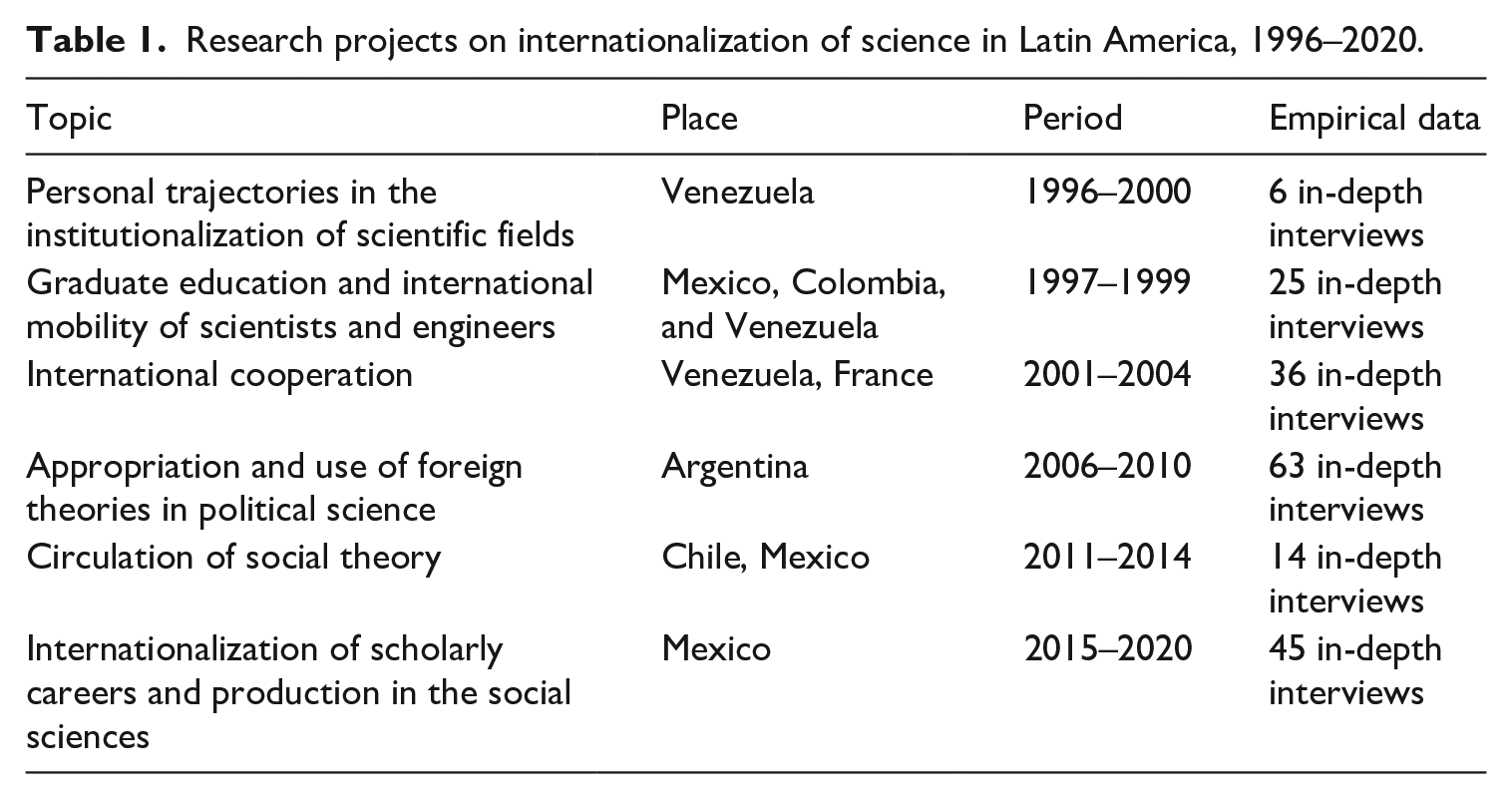
Personal bonds were not the focal point of any of these projects; yet, they were mentioned spontaneously many times. During interviews, they were often presented as anecdotes – e.g., random encounters with colleagues in conferences or fieldwork conducted abroad in which some met their partners. For this article, these anecdotes are ‘incidents in a peculiarly un-private private life. They narrate happenings of the social that are, for all their apparent “intimacy”, more or less readily convertible into public (social scientific) goods that can be put into circulation’ (Michael, 2012: 28). Put differently, we decided to resignify these short narratives and give them new meanings in light of a different research question: how had personal bonds been relevant in the process of internationalizing their scholarly production?
By recoding qualitative material gathered during decades of research in Latin America, we have been able to identify some practices and perceptions that have allowed us to better understand how personal bonds, in peripheral contexts, have played different roles through time. In order to make sense of these findings, we have relied on a working life history approach.
Narratives of working life are important for, at least, three reasons. First, actors use these narratives not only to give meaning to their past but more importantly because they ‘lead to plans of action in the real world’ (Goodson, 2012: 8). Second, narratives help researchers to observe both the micro-actions that structure daily life and the meso- and macro-constraints that are always present in the academic field. Finally, life history allows for understanding ‘the patterns of social relations, interactions, and historical constructions in which the lives of women and men are embedded’ (Goodson, 2012: 6).
Working life narratives open the opportunity to think of academic trajectories as having some organizing principles according to which scholars make sense of their decisions and restrictions (Duberley et al., 2006). Thus, Porter has recognized that: While individuals often figure as convenient units of study in history of science, and biography as a genre has flourished in recent years, only rarely are scientists depicted as whole persons for whom science is part of the meaning of a life. Biographies, even by historians, typically sequester the science in separate chapters, if they include it at all. We would argue that the culture of science shapes and is shaped by the people who practice it and that the scientist, as a human type, has a history that matters. (2006: 314)
In exploring the personal bonds of scholars from the Latin American region and their impact on the internationalization of their careers, we attempt to fill this gap and connect the rich literature on personal relationships with the also varied analyses of scientists’ lives and careers.
Data and discussion
By focusing on personal bonds, we identify six factors closely related to them, as shown in Figure 1. (1) Worldviews (such as values or ideologies) that people share for other non-academic reasons, such as political affiliation or commitment to some sort of social cause. (2) National councils’ funding policy, according to which there are some restrictions to co-organize events with foreign institutions, that forced scholars to rely on their personal bonds to keep or strengthen their networks. (3) Joint research projects, in which scholars tend to participate as partners in large international teams. (4) Preparing edited volumes with contributors from different countries, which only rarely includes an open call for contributions and often relies on personal bonds to determine who should be invited to the project. (5) Academic conferences, probably the most obvious space where personal bonds are established and reinforced. Finally, (6) graduate exchange experiences, which include, on the one hand, the experience of scholars as PhD students abroad and, on the other, the possibility of supervising or helping foreign students during academic stays in peripheral countries. 1 As the diagram shows, only the last four factors are symmetrical, which means that personal bonds, in turn, have helped these mechanisms to emerge and work. For example, scholars make friends when collaborating with large, international teams, but their friendship was later crucial to keep on working on new applications and projects.
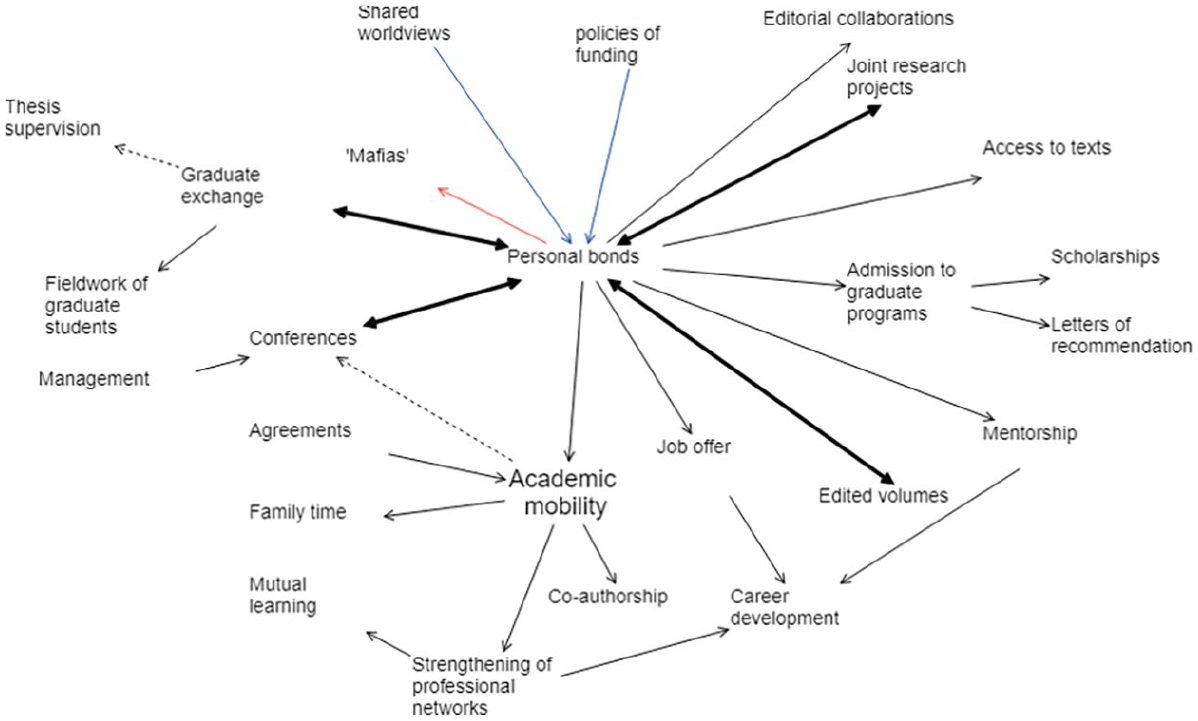
Internationalization of scientists’ personal bonds.
Personal bonds may have an impact on academic work when they are translated into different scholarly products. According to our data, bonds materialize into (a) invitations to be part of editorial boards, (b) access to texts that cannot be reached in peripheral institutions, (c) support for admission to graduate programs (scholarships, letters of recommendation, etc.), (d) mentorship, (e) job offers, and (f) academic mobility. 2 Permeating all these is the notion of trust that facilitates things for some and makes them more difficult for others outside the reach of trust. Not surprisingly, through these last three mechanisms (d), (e) and (f), scholars have been able to strengthen their CVs and to develop a more international career. In turn, more international careers can be translated into a more successful local career, but this implies a series of new translations that require scholars to have and develop the skills to understand different scientific fields and their actual and potential connections. Put differently, scholars whose academic capital was acquired abroad need to be able to mobilize such capital within the logic of the local field in which they are working.
As clearly emphasized in Figure 1, our research has found that by far the most relevant element in this network of translations for peripheral scholars is mobility. Not only was this issue the most mentioned during the interviews, but it was also the one that allowed interviewees to reflect in-depth on the importance of internationalization and the academic politics behind it. First, nobody argued against the idea that personal bonds explained mobility but also the other way around, in view of the weight given to their commitment to scholarly life (e.g., responsibility) and shared views on some issues. As one Cuban sociologist, working in Mexico, puts it, When I’m planning a seminar, I know who I will invite. When someone has a project, I know that he will call me. That happens not because there is a pre-established network. My real networks don’t need formalization. It’s about people with whom you have affinity because you know how they think. (Interview3.10/Passage9)
Second, at the individual level institutional agreements for mobility programs are perceived as being less important than personal bonds to encourage circulation of academics and internationalization. As informants put it, there is no way that people move to another institution for a semester or a year if there is nobody there with whom they already had a relationship: My mentor didn’t believe in formalization. On the contrary, he used to say that it corrupted relationships. I chose to connect with colleagues without any interest in the formal dimension of it. (Interview3.15/Passage16) I always say that the main challenge is that institutions sign a lot of agreements that end up in a drawer. They’re for statistics but nothing comes from them. (Interview3.17/Passage26)
Third, academic mobility was related by many interviewees to having more time for family. What at first can be seen as a factor for more pressure (i.e., getting high-level research published or having exchange with talented colleagues) may be perceived as an opportunity to decrease the pace of work that scholars have at their institutions: I didn’t want to return! The libraries, archives, the academic life there, it’s very intense. I took my daughters and it was a family reunion. There was a combination between family and work. I was always attending conferences, and going for a walk. I liked it! (Interview3.30/Passage56)
Not surprisingly, the relationship between mobility and family brings to the fore a crucial aspect of the internationalization of the social sciences, the gender issue. While male academics rarely highlighted the family aspect of their international experience, female scholars often emphasized the need to postpone plans, to adapt them to their partners and children or even the possibility to give up their aspirations. Recalling her interest in having a stay abroad, a researcher says, I had my first child in 2004 and my second one in 2006. Then, it was a moment in which my career stopped. I didn’t interrupt my career, but my priorities were somewhere else. I just met the basic expectations as I could. More baby bottles, less articles, impossibility to travel. (Interview3.5/Passage17)
Since mobility is connected with co-authoring articles and strengthening academic networks, the gender biases in mobility have important consequences for women throughout their careers. One could argue, as one sociologist stated, that women’s careers seem to have a different speed, in detriment to their likelihood of getting the higher institutional and disciplinary positions: I was highly internationalized because, after that project, it came another from IDES, in Canada, to continue to research on labor informality, so I kept on working . . . but things happen! I became mum of two children and I slowed down. (Interview3.15/Passage13)
Fourth, scholars see a clear connection between mobility and co-authorship. Our evidence supports the idea that mobility allows for face-to-face knowledge exchange that opens the opportunity to see how other colleagues argue, think, work, explain, debate, write, criticize. Only when academics know this personal side of their colleagues, can they start to think if co-authorship of articles or books is desirable. As a Mexican sociologist recalls: I was interested in being part of a group on social mobility. In Argentina, there was a colleague who invited me to Universidad de Buenos Aires to lecture on statistics. He’s very active, mobilizes resources, gathers people, is very kind, so everybody wants to work with him. We are working on comparative studies on social mobility and we’ll publish a book soon about empirical comparative studies about Argentina, Mexico, Peru, Chile and Brazil. (Interview3.8/Passage23)
As mobility increases, the amount of co-authored works also rises. As Heilbron and Gingras (2018) argue, the proportion of social science and humanities articles written in international collaboration increased from around 2.5% in 1980 to around 20% in 2014. There is a clear tendency toward more co-authored works, although most collaborations continue to happen between Northern countries: in 1980, 89% of European researchers collaborated with colleagues from the US, Canada, and Australia. Almost four decades later, the same countries comprise 77%. Evidence of our research shows that Latin American academics highlight mobility as the most important element of internationalization and that personal bonds translate into co-authored works mostly in those cases in which scholars were able to manage to get time abroad. Why is it that, instead of looking for opportunities to publish as their main goal, scholars in peripheral contexts tend to give more value to mobility than to co-authorship? We would like to explore here one hypothesis.
Mobility allows researchers from peripheral regions to engage in a kind of encounter that has been mistaken by the literature on scholarly practices. It has been usually understood as another instance to disseminate knowledge, to enact networks, to hear innovative research, and to engage in professional bonds, such as serving on councils and steering committees. This, however, is a Northern perspective on it, one in which exchanges are perceived symmetrically.
For scholars in the peripheries, relations enabled by mobility mean something more, or perhaps something different. Provocatively, we argue that mobility produces a particular phenomenon within the internationalization of science and the circulation of knowledge: leveling. Trust in international collaboration (e.g., signing agreements, submitting edited volume, applying for funds) depends to a large extent on the successful leveling that momentarily breaks asymmetries between countries, institutions and colleagues and produces a rather decontextualized feeling of peer-ness.
By leveling, we mean a process through which metropolitan scholars and their work are temporarily leveled down while their peripheral counterparts are leveled up. Leveling down metropolitan works has several overlapping dimensions that do not operate always at the same time. It includes (a) embodying ideas, putting faces to texts and theories that circulate more widely than the scholars who stated them, and (b) engaging in formal and informal exchanges from Q&A sessions to chitchatting in coffee breaks. As a Mexican sociologist said, ‘when you meet them, you start to know them, to know face-to-face those you had listed in the reference section of your works. You can talk and eat a tuna sandwich with them’ (Interview3.6/Passage12). In the words of an Argentinean law scholar, I went to a conference at UNAM and I found there a colleague from Cornell who works on labor relations. She asked me to take her to the hotel. We got stuck in a traffic jam so we had two-and-a-half hours in my car to talk about many things. One of them was to organize at Cornell, in the US, [a] little time before NAFTA’s signature, a conference with experts on labor relations. I invited all the Mexicans who had been doing research on that and she invited the Americans and Canadians. (Interview3.14/Passage39)
Personal contact allows peripheral researchers to see science in the making, where metropolitan scholars may be presenting vague new ideas, loosely articulated arguments that later on will end up being an article or a book. Occasional encounters at academic events, such as giving lectures when attending seminars abroad, is a contribution to the development of peripheral scholars’ ideas and a seemingly even exchange between peers in which both parties benefit.
I believe attending conferences is very important because internationalization means to be always in the conferences, applying to one or two, and that forces you to have something for that date. . . . It gives me structure. (Interview3.3/Passage25) Given the lack of discussion here on this, I was forced to look abroad, to get in touch with colleagues in the US and Europe and I found a bi-annual conference on public policy, a multidisciplinary conference that I began to attend. (Interview3.4/Passage5)
Leveling down in this context does not refer to failing to recognize the quality of the work done in metropolitan centers, but rather to situate it, to acknowledge how it emerges in specific contexts and within specific networks. It is not surprising to hear peripheral scholars return to their countries, or after an international encounter in the periphery, with some kind of frustration or, at least, a demoted assessment of their Northern colleagues’ contributions. The big names that they had gone to listen to are, most of the time, only colleagues working under advantageous circumstances but with very similar uncertainties in terms of knowledge production: [In the conferences] one starts to recognize the advantage of debate, not only among peers, but with the idols, those in the cutting-edge of the discipline. Being able to discuss with them is crucial for consolidating a professional trajectory. (Interview3.16/Passage13) I have a colleague, from Stanford, who organized, an annual, international event and he focused it on inequality and poverty. He wrote to me: ‘Please help me, because there’ll be no Mexicans in the conference. And I don’t want only gringos.’ So I contacted some colleagues in Mexico. (Interview3.8/Passage11)
On the other hand, leveling up peripheral scholars’ works means more things. First, mastering the lingua franca of science, English, at least to the level to be understood by those who listen, students or colleagues. In successful stories, the result can be seen as a defense of academic cosmopolitanism in which mobility translates into a profound, personal experience (Vessuri, 2010): I had the experience of changing language, of having to study other languages. I had to discuss, argue, and understand things in another language. I had to engage in dialogues and get involved in an environment in which the evident was not evident any longer. (Interview3.30/Passage55)
Second, leveling up requires peripheral scholars to criticize metropolitan scholars’ arguments in innovative ways and, above all, in their own terms. To do so, peripheral scholars tend to adapt their research and writing strategies to meet the expectations and, perhaps more importantly, to make their research appropriable by metropolitan colleagues: There’s a dilemma when you come here [peripheral context] as a researcher. For example, I’m publishing an article in Politics & Society, a case study, with a general view, because otherwise you can’t publish there. I co-authored the article with a US colleague just to keep in touch and because she works [in] comparative politics. I still think in their terms, in the context of their debates. In the introduction I discuss labor in the context of globalization, not about Argentina. I still think as they do! (Interview1.54/Passage65) When I published in Quality & Quantity was like Wow! For faculty here, that was incredible, because it’s one of the most important journals in the world and not a place where we [peripheral scholars] publish regularly. Also, because we don’t publish often in English but things which are locally important. (Interview1.32/Passage86)
Third, leveling up also includes showing the difficulties and obstacles of producing original knowledge in the periphery: We do practical work, we apply theories produced elsewhere. There’s no original, autonomous creation in local political science. It is dreadful. (Interview1.6/Passage12) Latin American classes were funnier, more appealing for students or even more critical, more humanistic: interesting ideas but without empirical support. Foreign colleagues were more concerned with tested knowledge. (Interview1.20/Passage106) In the developed world, you have more possibilities. Ours is craftwork. (interview1.23/Passage35) Seen from the periphery, the importance of publishing is different. Although there are similar rules, similar incentives, similar requirements, there are different patterns here. (Interview1.50/Passage49) When you are here [a peripheral context] you know that you’ll be an academic of less influence, that my intellectual work will have necessarily less quality . . . you will have less intellectual ambition. (Interview1.54/ Passage78)
Further, within the peripheral regions, some scholars face even bigger problems since their situation is more precarious than that of their colleagues. This is the case of female scholars, for example, who often suffer the consequences of gender biases in their workplaces: I didn’t have a scholarship. I took too much to finish my master, four years, because I was working and studying. Then, the PhD. When I finally had my first sabbatical, at UAM, I had two children, so leaving [for] abroad was very difficult. (Interview3.13/Passage7)
Fourth, one of the most difficult aspects of leveling up is to introduce non-Western literature and make the links with taken-for-granted knowledge in the field. Thus, mobile peripheral scientists seek to bridge local/peripheral production with their metropolitan counterparts, in works that are original and necessarily in-between. They not merely introduce new literature, but translate it into metropolitan debates and intellectual traditions: The emergence of the solidarity movements with Chile after the Pinochet coup d’état of September 1973 in Western Germany coincided with the wide circulation of the dependency approach until the mid-1980s. . . . The networks woven by the Germans with Latin America during the 1960s and early 1970s and the institutional support for Latin American studies, accompanied by a new Third World perspective within social movements, achieved an unprecedented possibility of political and academic recognition of Latin American social sciences. (Ruvituso, 2019: 26)
Fifth, for peripheral scholars to level up their work, they provide data on phenomena that were gathered in peripheral contexts, preferably showing how this new information defies accepted evidence or claims: We had an event in Seville in which we decided to have five axes to focus when studying border processes: sociability, institutionality, integration, diplomacy and inter-governmental relations. This because we know that we have this process of migration in this area [Tijuana] and that’s why Europeans are avid for including these elements in the discussion. (Interview3.25/Passage24)
Sixth, leveling up sometimes means to disseminate peripheral knowledge under the rules of mainstream science (e.g., presenting a paper in an international conference) by observing that the scholar respects the conventionalities of the field, such as meeting deadlines or receiving face-to-face criticisms: There’re some scholars who don’t want to be criticized. There were cases in which they were criticized because that’s common practice. Here, it’s difficult that you get criticized. But you go abroad and get harsh criticisms. (Interview3.16/Passage42)
Succinctly, leveling up is crucial for a peripheral scholar to appear as a trustworthy partner for future projects with his metropolitan counterparts: At a conference, someone introduced Prof. X to me. Immediately, he said that there would be an EU-funded project about Latin America. A colleague and I had obtained funds from CONACYT, but without funds for a survey. I said ‘We’ve just got funds for a research on sub-national democracies’. He told us, ‘Oh, perfect! The money I received can be used to fund a survey. I gather a group in Spain and you in Mexico and do this research.’ We had several meetings here and in Salamanca, and this is a most successful example of internationalization. (Interview3.9/Passage20) I’ve worked remotely with colleagues from Spain but it’s necessary to meet to consolidate as a group and see whether we have empathy to work for the years to come. (Interview3.28/Passage40)
While leveling could be attempted in other initiatives, such as collaborating in editing volumes or applying for funds, the narratives of our informants suggest that it can be easier in face-to-face situations, which tend to become a test for whatever future initiative. These situations are trials in which peripheral scholars have to level up their status to the point where they are considered peers.
Luhmann has used those contacts [with Latin American colleagues] to go and say ‘Well, what transformation does this Eurocentric theory need when put in touch with other realities?’ For Luhmann these travels to Latin America were attractive, because they allowed him to see how applicable his theory was beyond Europe. He saw these travels as opportunities to ask, to approach. (Interview2.8/Passage43)
Within the politically correct global academia, peripheral scholars are always taken as peers. However, this does not seem to be the case when we interviewed them. They oscillate between the astonishment due to exchanges with academic celebrities and the disappointment of not finding the insightful ideas that they expected to be exposed to: A colleague and I submitted a paper for the 1994 ISPA World Conference, and I was shaking because the panel would be chaired by Lijphart. For me, he was someone who existed only in books. For me, the conference was like a dream, like seeing The Beatles playing next to me: Lipset, Linz, Lijphart, Morlino. (Interview1.37/Passage45) Curiously I think that those professors who impacted me weren’t those in my [research] areas because I think that [my] undergraduate education . . . was superior to, and more specialized than, the one in the United States. Actually, what surprised me most [were] sociology of organizations and American Politics; topics not known to me. (Interview1.15/Passage161)
They also fluctuate between feeling unrecognized or misunderstood because of the lack of some skills taken as crucial within mainstream science and the sense of sharing a common disciplinary space, of being peers: I felt the need to take courses, to pay for courses on Statistics, on SPSS because I was suddenly excluded from the other members of the research group, who are strong in quantitative analysis. So I was obliged to develop those skills. (Interview3.28/Passage18) [Within this network] there’s a strong thing where, along with personal bonds, we have cultivated this relationship. You learn about how Europeans live and they learn about us . . . it’s a process. (Interview3.25/Passage32)
Thus, academic mobility is, from a geopolitical point of view, a fabricated moment of gathering achieved by a process of leveling to artificially flatten the field and create an instance of peer-ness and power balance.
Concluding remarks
In this article we argued that personal bonds translate into multiple products and processes within scientific careers, from PhD supervision to co-authorship. We also recognized that internationalization through personal connections is crossed by institutional and international asymmetries. This reinforces an important finding in the literature: scholars in peripheral contexts tend to value face-to-face encounters with foreign colleagues, particularly those that take place in Northern countries, more than co-authorship or membership in international research teams. We do not mean that these two strategies are irrelevant, but we need to contextualize them. What we call leveling is an important dimension of any international encounter. It implies, as we showed, to level down the Northern production while leveling up the Southern contributions in a specific, situated occasion, e.g., conferences or visiting lectureships. These occasions are key for greater openings to less asymmetric and more fruitful exchanges in the social sciences. Therefore, two implications can be highlighted.
Northern or international professional associations, mainly responsible for organizing academic conferences, need to discuss multilingualism, non-traditional forms of paper presentation, and organization of conferences beyond the safe borders of the conventional model of doing and thinking in the North. Further understanding of collaborative platforms and software, reinforcement of mechanisms to support peripheral scholars and students’ trips and fieldwork, active engagement with editorial projects emerging in the periphery, and transparent policies and procedures of metropolitan publications to encourage submissions from peripheral academics, are some of the issues that deserve more attention.
On the other hand, Southern institutions need to contribute to leveling up by (1) investing more heavily in journal and book databases, (2) awarding grants for researchers to spend time abroad, while acknowledging the specific difficulties of some sectors of the academic world (e.g., female scholars) to enjoy these opportunities, (3) developing bi- or multinational initiatives (e.g., permanent visiting positions) that capitalize on personal bonds established by academics, (4) actively helping researchers to translate or copy-edit their work to facilitate submission to leading journals, and (5) supporting local/regional publishing projects (such as new journals or book series). Arguably, one of the most urgent decisions is to reconcile the institutional goals and imperatives with the individual resources and interests. To do so, institutional and public policies must recognize the weight of personal bonds in academic careers and implement mechanisms to capitalize on them.
Footnotes
Declaration of conflicting interests
The authors declared no potential conflicts of interest with respect to the research, authorship, and/or publication of this article.
Funding
The authors received no financial support for the research, authorship, and/or publication of this article.
