



Abstract
Successful career outcomes depend on maintaining positive relationships with and evaluations from supervisors and peers. Recognizing that structure frames behaviors and perceptions, this study explores the impact of organizational structure and practices on the relationships of 598 women in 298 Korean companies using longitudinal data from 2010 to 2016. The results from fixed-effects models show that corporate structure and practices shape female managers’ relationships with supervisors and peers. Gender equality practices improve relationships with both men and women. By contrast, diversity programs have negative effects on female managers’ relationships with female supervisors and peers, and work–life programs show mixed results. However, in firms with female executives and firms that encourage men to use parental leave, diversity programs and work–life practices stimulate positive relationships with both male and female supervisors and peers. This study suggests that organizational contexts, rather than intrinsic gender preferences, shape women’s relationships in the workplace.
Introduction
Despite women’s increased participation in the labor force, gender gaps in power and status persist (Stainback et al., 2016). Research identifies women’s network isolation as an enduring source of gender inequality (Castilla, 2011; Ibarra, 1997). However, workplace expectations and biased perceptions toward women make it difficult for them to build positive reputations that would lead to supportive workplace relationships. Such isolation from the network of resources, information, and ‘reputation-building’ opportunities challenge women in attaining positive career outcomes (Briscoe and Kellogg, 2011; Correll et al., 2014).
Employers have sought to integrate women by increasing the proportional representation of women or implementing diversity and work–life programs. Contrary to expectations, organizational initiatives have been best guesses at best and thus show inconsistent effectiveness (Kalev et al., 2006). Some work–life programs demonstrate at least moderate success in increasing the proportional representation of women (Briscoe and Kellogg, 2011). In others, women who take advantage of the available policies generally receive lower evaluations, lower chances of promotions, and lower wages (Correll et al., 2014; Joshi et al., 2015). Diversity programs also exacerbate gender stereotypes, such that peers and supervisors expect diminished performance and commitment from women (Kalev et al., 2006). Arguably, no shortage of corporate practices acknowledge women’s challenges, but these practices have been lacking consistency in increasing women’s representation in management – or even helping them stay in the workforce.
The uneven impact of organizational practices raises the question as to how corporate practices may actually contribute to preserving the gender gap and how they can be realigned to overcome women’s isolation at work. Thus, this study traces the pattern of social isolation experienced by women to workplace practices reproducing biased gender perceptions: the isolation of women from workplace networks through the dissemination of biased gender roles and status. Despite good intentions, firm practices may contribute to preserving inequality through accentuating gender status characteristics (Ridgeway, 1997). To examine how culture and structure delineate emerging relationships, we identify four organizational factors that affect gender beliefs and evaluations (Joshi et al., 2015; Kanter, 1977; Mesmer-Magnus and Viswesvaran, 2006): (1) organizational culture, (2) diversity programs, (3) work–life programs, and (4) female representation.
Using longitudinal data on female managers in South Korea, this study delves into the structural impact on women’s relationships with other female and male employees across and within ranks. The results from our fixed-effects models will highlight how elusive cultural processes within organizational boundaries contribute to a pattern of network inequality by signaling female workers’ diminished commitment and competence. Finally, these findings will be extended to propose that organizational orientations signaling observable change in female status mediates the effective implementation of firm practices, thereby achieving the goal of integrating women into the workplace networks.
Empirical context: Female managers in Korean firms
Korea has experienced rapid industrial growth since the late 1960s as well as exponential growth in female education and labor force participation. Legal protections for female laborers began with the 1987 Equal Employment Opportunity Act, which requires employers to provide women equal opportunities and treatment in employment. The 2001 Labor Act provides one paid menstruation leave day per month to all female workers; the 2011 Act on Equal Employment and Support for Work–Family Reconciliation guarantees a year of childcare leave for all parents and a 90-day paid maternity leave and one year of childcare leave. Firms must also provide male employees a 10-day 1 paternity leave upon the birth of a child as well as a year of childcare leave for all parents.
Female labor force participation in Korea reached 50% in 2016 (United Nations Development Program, 2016). However, representation of women in leadership positions remains unequal, which Kim (2005) attributes to deep-seated patriarchal values. According to a study in 2012, women’s managerial representation in Korea is quite low in mid-level (9%) and rare in both senior-level (2%) and executive-level (2%) (Kim, 2012). Furthermore, a vast majority of the female executives in Korean firms inherited their positions through ties to shareholding families. Thus, Korea provides an opportunity to understand conflicting struggles between egalitarian institutional accommodations and hierarchical gender values entrenched in the patriarchal system. Implications from this study will extend to female integration in other industrialized contexts, where women operate within male-centered corporate culture and practices.
Literature review and research hypotheses
Gender bias and women’s workplace relationships
Widespread gender beliefs serve as the primary axis in which employees’ expected performances are evaluated (Ridgeway, 1997). People generally expect men to have superior performances, commitments, and power and perceive women as lacking essential qualities requisite for high-ranking positions (Buchanan et al., 2018). Both male and female supervisors provide male employees more job-related support than women unless they are specifically informed of the strong qualifications of their female employees (Maume, 2011).
Ideal worker schema rooted in the workplace culture further support the existing bias (Blair-Loy, 2003). Ideal workers demonstrate undivided devotion to work and limit external commitments to maintain focus and responsiveness to workplace needs (Reid, 2015; Williams et al., 2013). They are rewarded for their devotion and long hours with favorable evaluations, promotions, and higher pay (Blair-Loy and Wharton, 2004; Bourdeau et al., 2019). Nonetheless, the ideal worker norm is based on obsolete gender expectations, where men are sole breadwinners and wives take care of family-related concerns (Williams, 2000). The time-intensive characteristics of workplace culture naturally create more barriers for women because childcare and household duties are still considered female responsibilities (Jolly et al., 2014).
With the growing share of dual-career households and women’s increasing presence in the formal workforce, firms are adopting work–family policies to accommodate employees who have demands outside of work. The organizational manifestation of devoted workers, however, is at odds with egalitarian policies designed to offer flexibility to employees. Employees who use them receive lower wages (Joshi et al., 2015), lower performance evaluations (Wharton et al., 2008), and lower likelihood of career advancement (Correll et al., 2014) than those who work without interruptions. While employees are dissuaded from taking advantage of the available policies, women accept lower pay, advancement, and reputation in exchange for balance between work and family. Paradoxically, women’s use of work–family policies only reinforces the existing bias, justifying the assumption that women are less committed organizational citizens than men (Ridgeway and Correll, 2004).
The prevailing expectation of ideal workers aggravates women’s disadvantage by contributing to women’s isolation in workplace relationships. Women’s deviations from the ideal worker norm result in biased perceptions of self and others, shifting preferences and behaviors among employees (Ridgeway and Correll, 2004). Contrary to the idea that homophilous attraction creates solidarity based on shared characteristics such as gender (McPherson et al., 2001), the corporate environment – where women are treated as tokens and men dominate – constrains women’s preferences for similar others. Consistent observations in workplaces indicate that women prefer to maintain heterogeneous relationships with higher-status male employees to get access to information and resources (Ibarra, 1992, 1997). Men, however, continue to maintain extensive homogeneous contacts with other men and defer forming ties to women until they gain recognition for their competence and commitment (Scandura, 1998).
Recognizing women’s isolation, firms have implemented diversity practices such as female networking and affirmative action programs designed to catalyze the formation of coalition networks among women based on similarity (Kalev et al., 2006). Contrary to expectations, female leaders treat female subordinates more harshly than they treat male subordinates, and they often discourage women’s access to upper echelons by evaluating female employees negatively (Derks et al., 2016). Such leaders have fulfilled their career aspirations by disaggregating themselves from their gender stigma, while internalizing and legitimizing the male-driven organizational culture (Derks et al., 2011). As a corollary, female employees’ inclinations to form professional relationships with female supervisors decline significantly (Artz and Taengnoi, 2016; Baumgartner and Schneider, 2010). Therefore, women do not necessarily succeed in forming professional relationships with either male or female members, leaving women significantly disadvantaged in their access to high-status and diverse contacts.
Women’s struggles in their interpersonal interactions in workplaces reflect the structural constraints they face. According to Greenberg and Mollick (2017), ‘induced structural constraints in which choices are made about social actors’ can complicate perceived relationships. Women’s inclinations to align themselves with men in corporate organizations suggest that the demographic composition and the status of their gender category deter them from forming cooperative relationships with other female – as well as male employees (Duguid et al., 2012). Thus, women would be willing and able to champion other women in male-dominated contexts when status-reinforcing practices are under control and their gender is no longer a liability:
Hypothesis 1: Controlling for contextual factors, female managers evaluate their relationships with female supervisors more positively than male supervisors.
This hypothesis is based on our understanding that perceived social value attached to gender influences women’s access to relational resources. The marginalization of women in workplace networks demonstrates the organized processes in which gendered structure distorts female workers’ experiences in their access to relational resources. Controlling for stigmatizing culture and practices, we suggest women would be better integrated into their workplace and develop a supportive community of professional relationships.
Corporate practices and gender relations in the workplace
An underlying assumption of this study is that individual perceptions are socially constructed and nuanced social meanings attached to gender guide the creation of relational ties. Since having a supportive personal community of network ties entails receiving support from both male and female supervisors and peers, the next set of empirical predictions investigates organizational culture and structural orientations under which positive inter- and intra-gender relationships are warranted. We expect that interaction structures that diminish perceptions of gender differences in roles and status would produce positive relationships with both male and female employees, whereas arrangements that accentuate perceptions of social differences would lead to negative relationships (Burt, 1998; Ridgeway and Correll, 2004).
Organizational culture
Organizational culture may be defined as ‘a pattern of shared basic assumptions that . . . has worked well enough to be considered valid’ and has been transmitted to others as rational in relation to organizational functioning (Schein, 2010: 17). It is formed and reproduced within the frame of interaction, providing meaning to patterns of social behaviors. Among a range of social actions, the development of relational ties at the workplace is mutually constitutive with organizational culture (Pachucki and Breiger, 2010).
First of all, workplace networks affect organizational culture (Whelan, 2016). Studies focus on the ways in which different patterns of relationships enable the transfer of knowledge about the culture of organizations (Krackhardt and Kilduff, 2002). Through social relationships, individuals come to interpret the potential meaning of norms within groups, and the frequency of exposure shapes the likelihood of reaching an agreement on aspects of cultural norms (Shepherd, 2017). Therefore, networks of relationships have been considered a powerful vehicle through which inferences about organizational identities and culture are made, facilitating the diffusion of innovations, knowledge transfer, and overall organizational productivity (Lomi et al., 2014; Srivastava and Banaji, 2011; Van Knippenberg and Mell, 2016).
At the same time, organizational culture shapes and constrains workplace relationships. Women’s exclusions from men’s task- and friendship-oriented networks exemplify a mechanism in which organizational culture marginalizes women’s presence within workplace relationships by informing perceptions of female status (Burt, 1998; Ibarra, 1993). Considering culture as a set of observable factors that individuals learn through socialization (Padavic et al., 2020; Whelan, 2016), we identify five attributes of formal and informal organizational culture that would improve women’s perceived status through promoting the culture of gender parity.
CEOs’ interest in gender equality
The creation and maintenance of organizational culture begins with chief executives’ leadership (Schein, 2010). CEOs achieve gender parity by redistributing rewards within organizations (Baron et al., 1999). Employees in firms where leaders impose their values in the formation of gender equality culture report fewer incidences of gender discriminatory actions, including sexual harassment (Kim and Shin, 2014).
Horizontal communication
Communication structure reflects and reproduces gender relations in organizations (Acker, 1990). For instance, men convey their dominance by interrupting women’s speech, preventing them from voicing their opinions (West and Zimmerman, 2015). While a hierarchical communication structure intensifies the gender gap in decision-making, evaluations, and rewards (Ridgeway and Smith-Lovin, 1999), horizontal communication improves social relationships by allowing equal participation.
Schedule control
Although both men and women experience time demands and work–life conflicts, gender tenaciously shapes the ability to take control over time, stigmatizing women as less committed and less competent than men (Perlow, 2019). Nonetheless, women elide tensions and face less discrimination when firms allow employees to predict their schedules through benefits like paid sick leave (Blair-Loy et al., 2015; Kelly et al., 2014).
Men’s use of paternity leave
Studies suggest that firms where men use parental leave have greater equality in gender relations (Gornick and Meyers, 2003; Kotsadam and Finseraas, 2011). This has been attributed to its impact on the view that only women will compromise their professional commitments to meet familial responsibilities (Haas and Hwang, 2008). As a result, in firms that encourage men to take extended paternity leave, both female and male workers are less likely to judge other co-workers according to traditional gender norms (Andersen, 2018), reducing the possible tensions between employees for prioritizing non-work responsibility.
Meritocracy
A firm’s performance and reward system can affect gender relations. It is difficult for women with caregiving responsibilities to enter a managerial position in an organization that bases promotion on seniority (Reskin and McBrier, 2000) or hours spent in the office (Perlow, 2019). Formalization of a personnel system that emphasizes individual achievements reduces discrimination against women (Cappelli and Keller, 2014).
Combining the insights on gender-sensitive organizational culture, Hypothesis 2A is as follows:
Hypothesis 2A: Gender equality culture positively affects female managers’ relationships with supervisors and peers.
Diversity programs
Diversity programs have been adopted to increase gender equity, but evidence of their actual impact is mixed. Some studies show that they bring more women into organizations; others show that they activate bias toward women by solidifying group boundaries and intergroup tensions (Dobbin et al., 2011; Kalev et al., 2006). For instance, female networking activities, such as formal or informal opportunities for women to meet other women to share career information, have been mostly ineffective in improving women’s representation (Kim et al., 2012). Conversely, mentoring programs have been effective in helping women move into managerial positions by providing career strategies or increasing their visibility (Dobbin et al., 2011; Kim, 2012). The inclusion of female interviewers has been also shown to improve gender disparities in the hiring process and thus undermine the negative impact of homophily when men oversee hiring (Cook and Glass, 2014). Given the mixed findings regarding the impact of diversity practices, we propose the following hypothesis:
Hypothesis 2B: Diversity programs both positively and negatively affect female managers’ relationships with supervisors and peers.
Work–life programs
Work–life programs that firms provide include childcare leave, family care leave, and flexible work programs. In addition, Korean law requires firms to provide one day of paid menstrual leave a month to female workers. While work–life programs increase job satisfaction and commitment, employees are reluctant to use work–life programs for fear that doing so will harm their careers (Coltrane et al., 2013; Correll et al., 2020). Under the cultural schema of work devotion (Padavic et al., 2020), the violation of the norm by using available work–life programs creates tensions among employees. Based on the discussion, we present the following hypothesis:
Hypothesis 2C: Work–life programs negatively affect female managers’ relationships with supervisors and peers.
Female representation
The proportion of women in an organization signals the distribution of power across gender. Kanter (1977) argues that achieving numerical balance in gender helps to reduce bias and stereotype against women. Female representation in management promotes gender integration and alters corporate practices and perceptions of female leadership (Joshi et al., 2015). Furthermore, increasing the numeric proportion of women in top management amends gender-based role expectations and the subjective status of women in workplaces (Ely, 1994; Mun and Brinton, 2015). Based on the discussion, we propose the following hypothesis:
Hypothesis 2D: Female representation in managerial positions positively affects female managers’ relationships with supervisors and peers.
Interaction effects: The provision of best practices
Work–life and diversity programs can backfire for female workers who take advantage of them (Briscoe and Kellogg, 2011). Kalev and her colleagues (2006) note corporate practices show ‘disappointing’ results in reducing inequality, while managerial bias against and social isolation of women continue to dampen female integration. In order to effectively implement organizational practices, firms must create an organizational environment that reflects the formal ‘goals’ conveyed through the availability of diversity and work–life practices (Kalev et al., 2006). That is, diversity and work–life programs increase equality if firms embrace the responsibility to achieve gender equality through routine practices. This suggests the success of organizational practices rests on whether the workplace environment reflects organizations’ willingness to counter the existing gender status. Here, we present two interacting variables that proxy organizational resolve for change: female representation in executive positions and family-friendly culture where men are encouraged to take childcare leave.
Female representation in upper ranks serves as an explicit and observable signal that female identity is not a liability (Mun and Brinton, 2015; Munsch et al., 2014). Ely (1994) finds that female leadership has a positive impact on the social identity of women in organizations. This insight leads us to the following hypothesis:
Hypothesis 3A: Diversity and work–life programs stimulate positive relationships with supervisors and peers if firms also have an observable change in female status through representation.
A corollary for Hypothesis 3A is that an implicit family-friendly organizational culture, where men can easily take extended childcare leave, moderates perceived distinctions between male and female workers. While studies show that caregiving fathers are more harshly sanctioned than mothers for deviating from traditional gender norms (Berdahl and Moon, 2013; Rudman and Mescher, 2013), our construct is about women’s perceptions of gender stigma in organizations and whether women are stereotyped as incompetent for prioritizing domestic responsibilities. Interaction structures that help moderate perceptions of gender role differences would lead to positive professional relationships by amplifying social and status similarities between men and women. Therefore, our hypothesis is as follows:
Hypothesis 3B: Diversity and work–life programs stimulate positive relationships with supervisors and peers if those policies are implemented in corporations with family-friendly culture.
Data and method
Data
This study uses the Korean Women Manager Panel (KWMP) data 2 across all waves of data between 2010 and 2016, where the same individuals are observed over time. Biennially collected by the Korean Women’s Development Institute, the KWMP is a sample of companies with 100 or more employees, stratified by size and industry. The panel survey consists of two parts. One is the female manager survey in which individual female managers answer questions about their demographic characteristics, workplace relationships, and career experiences. The other is a company survey, where human resources managers from the study participants’ employing firms answer questions about organizational structure, culture, and policies.
Table 1 presents descriptive statistics and data sources for study variables. We created the dataset for this study by merging the individual-level data with time-varying characteristics of respondents’ firms. The estimation sample is four balanced biennial waves of the KWMP on 598 female managers employed at 298 Korean companies, consisting of 2392 observations. The respondents in the estimation sample stayed in the same firm over the observation period.
List of variables.
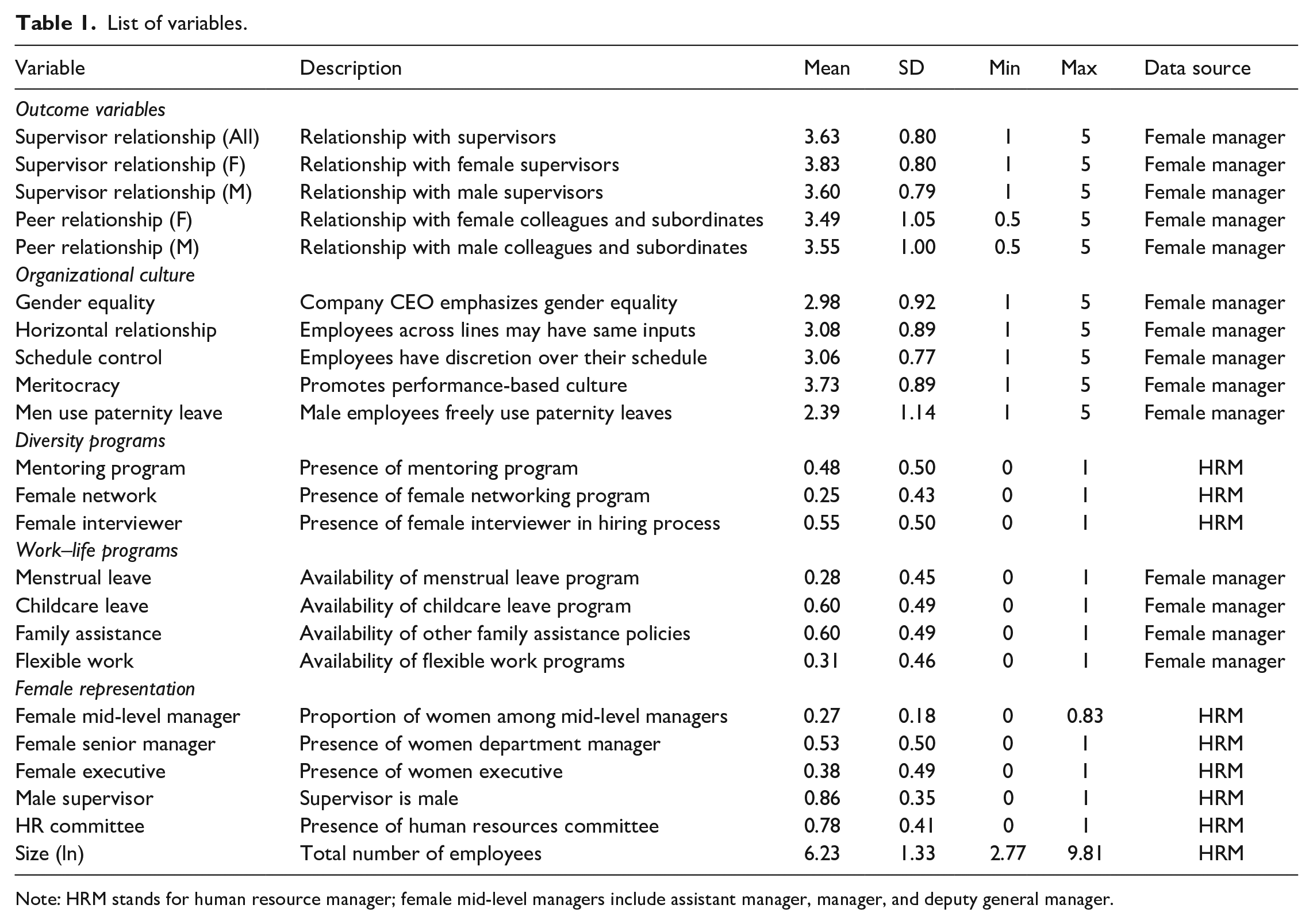
Note: HRM stands for human resource manager; female mid-level managers include assistant manager, manager, and deputy general manager.
Measurement
Dependent variables: Relationship with supervisors and peers
The dependent variables are female managers’ evaluation of their perceived workplace relationships. We divide their relationships into four types by gender and rank groups: female supervisor, female peer, male supervisor, and male peer as positive career experiences depend on having a supportive community of workplace relationships.
The provisions of social support are highly associated with sustaining relational satisfaction (House et al., 1988). Therefore, we measure supervisory relationships by how female managers assess the quality of instrumental and emotional support from their direct supervisors. The supervisor relationship is computed by taking the average response across the following five questions (1 = strongly disagree to 5 strongly agree): ‘My supervisor (1) does not discriminate based on gender when he/she evaluates performance; (2) provides equal opportunities to male and female employees; (3) understands personal emergencies and allows me to alter working hours; (4) understands work–family conflicts and helps me to balance work–life demands; (5) cares about my problems.’ Then, we measure female managers’ peer relationships with female and male employees using female managers’ responses to the following statement: ‘I have difficulty in communicating with colleagues and subordinates.’ Separate responses are recorded for colleagues and subordinates by gender, where 1 denotes very difficult and 5 denotes very easy relationships.
Independent variables
Our hypotheses focus on four sets of independent variables: organizational culture, diversity programs, work–life programs, and female representation.
Organizational culture
We use a set of measures to capture female managers’ perception of organizational culture. Female managers indicate the extent to which they agree with the following statements (1 = strongly disagree to 5 = strongly agree): (1) Gender equality: ‘CEOs emphasize gender equality,’ (2) Horizontal communication: ‘Communications across ranks occur in a flexible manner and managers encourage employees to share their inputs,’ (3) Schedule control: ‘Employees leave the office on time, do not need to overwork to survive, and are allowed to use leave when necessary,’ (4) Meritocracy: ‘Reward and promotion is performance-based,’ (5) Paternity leave: ‘Male employees freely take paternity and childcare leave.’
Diversity programs
The presence of diversity programs is measured with three binary variables: mentoring program, female network, and female interviewer in hiring processes. Each is coded 1 when human resources managers confirm the presence of each diversity program in the firm.
Work–life programs
The presence of work–life programs is measured with four binary variables: menstrual leave, childcare leave, flexible work, and family assistance. Each is coded 1 when female managers confirm the presence of each program in the firm. Flexible work is coded 1 when the company offers either flextime or flexplace programs to employees. Family assistance includes family medical leave, reduced working hour policy during pregnancy, and on-site childcare facilities.
Female representation
Female representation is measured with three variables reflecting women’s workplace authority. The proportion of women in mid-level management is measured as a continuous variable, and two dummy variables measure the presence of women in senior and executive levels, respectively.
Control variables
Human resources committee is coded 1 when the company has such a committee. Organizational size is the log of total employees.
Analytical strategy: Fixed-effects estimation
We use fixed-effects regression models to estimate the change in professional relationships with respect to the change within firm structure and practices over time. Given a manager–firm matched longitudinal dataset, the fixed-effects models remove the effects of time-invariant characteristics. The idea is that if there are omitted variables and those variables are correlated with any variables in the model, fixed effects control for the effects that remain constant or fixed over time. The nature of the fixed-effects estimation controls for both observed and unobserved time-invariant attributes of respondents in respective firms, and the residual variance explains the effects of time-varying variables over the observed time (Allison, 2009). The formal fixed-effects models can be summarized as follows:
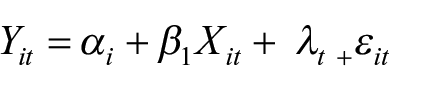
where i = female manager; and t = time. Here, Y stands for one of the relationship variables of female managers with other organizational members; X represents a set of time-varying vectors on organizational culture, diversity programs, work–life programs, and female representation; α is a set of fixed effects for evaluating female managers; and ε is an idiosyncratic error term. The year dummy, λt, is also added to account for time-dependent effects of the stated variables. Finally, to control for the clustering, our analysis uses robust standard errors.
Results
Gender and supervisor evaluation
Table 2 presents fixed-effects models of the female managers’ evaluation of their supervisors. These models in Table 2 examine how supervisor gender affects evaluations, while controlling for contextual variables known to predict employee preconceptions about gender. Model 1 shows the effects of organizational culture on the evaluation, while Model 2 reports the effects of diversity programs, work–life programs, and female representation. Model 3 includes all the variables used in Model 1 and Model 2.
Fixed-effects estimates of the evaluation of supervisors by female managers.
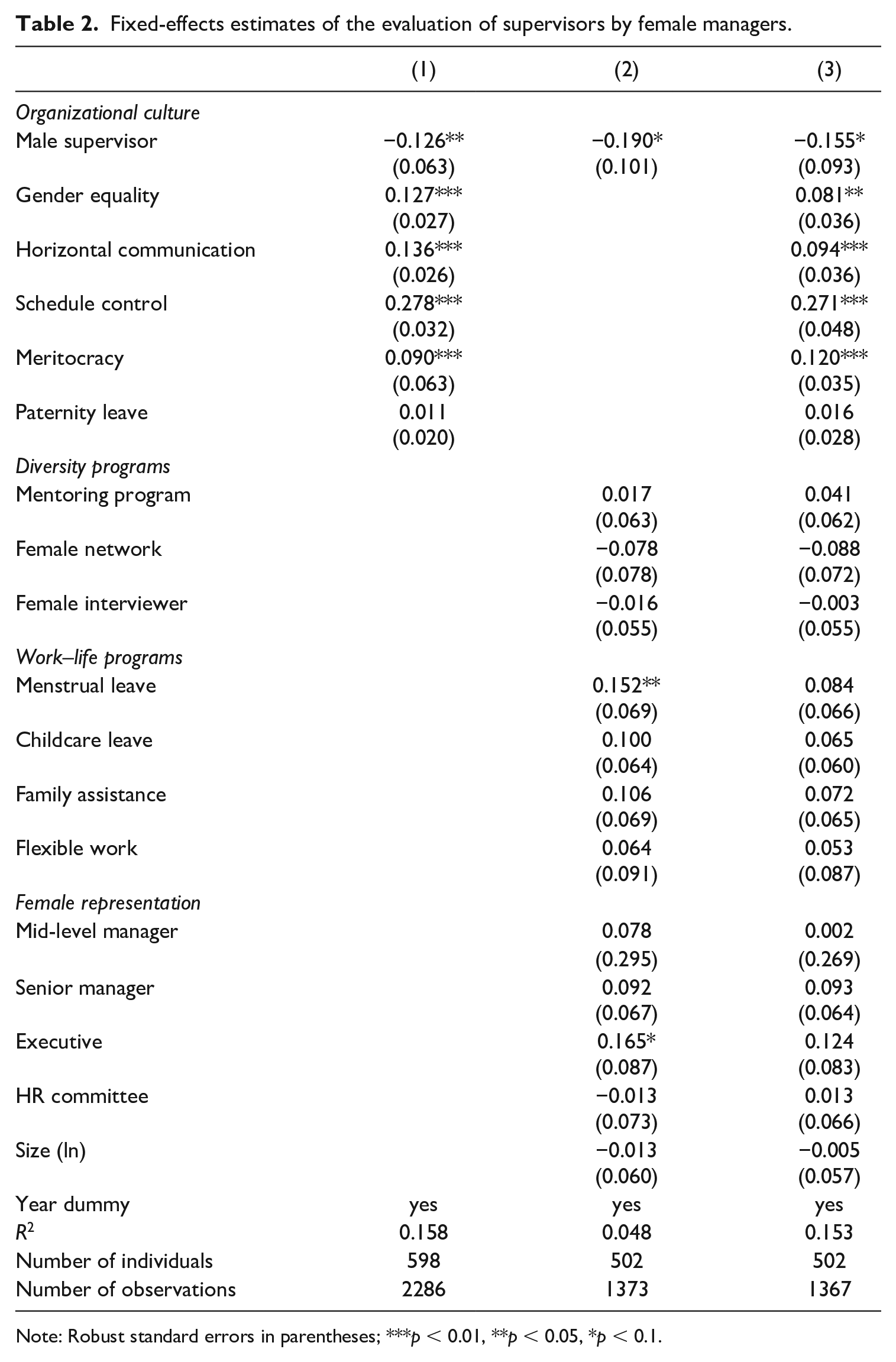
Note: Robust standard errors in parentheses; ***p < 0.01, **p < 0.05, *p < 0.1.
All models in Table 2 show that, controlling for time-varying firm characteristics represented through control variables, female managers tend to assess female supervisors more positively than male supervisors. Model 1 controls for the perceived evaluation of organizational culture. Here, the coefficient for male supervisor is negative, and it is statistically significant. Although the coefficient for male supervisor becomes significant at the 10% level, we observe similar patterns in Model 2 and Model 3. This finding is consistent with the homophily literature indicating that people show preferences for similar others based on shared experiences, values, and trust (McPherson et al., 2001). While previous studies determined the presence or absence of gender homophily without acknowledging time-invariant and time-variant organizational characteristics, our fixed-effects models alleviate this bias by accounting for the effect of idiosyncratic firm practices and structures on employee relations.
Table 2 shows that organizational culture and practices also affect female managers’ evaluation of supervisors. Female managers are more likely to assess their supervisors favorably if they perceive that their firms promote gender equality, horizontal communication across ranks, predictable work schedules, and meritocracy. In the following sections, we will further discuss the impact of organizational practices on perceived relationships of female managers with different subgroups of employees.
Organizational practice and employee relationships
In Table 3, we present models on female managers’ evaluation of their female and male supervisors and their relationships with female and male peers. Models in Table 3 include all controls from Table 2, except the measure of supervisor gender.
Fixed-effects estimates of the supervisor evaluation and peer relationship.
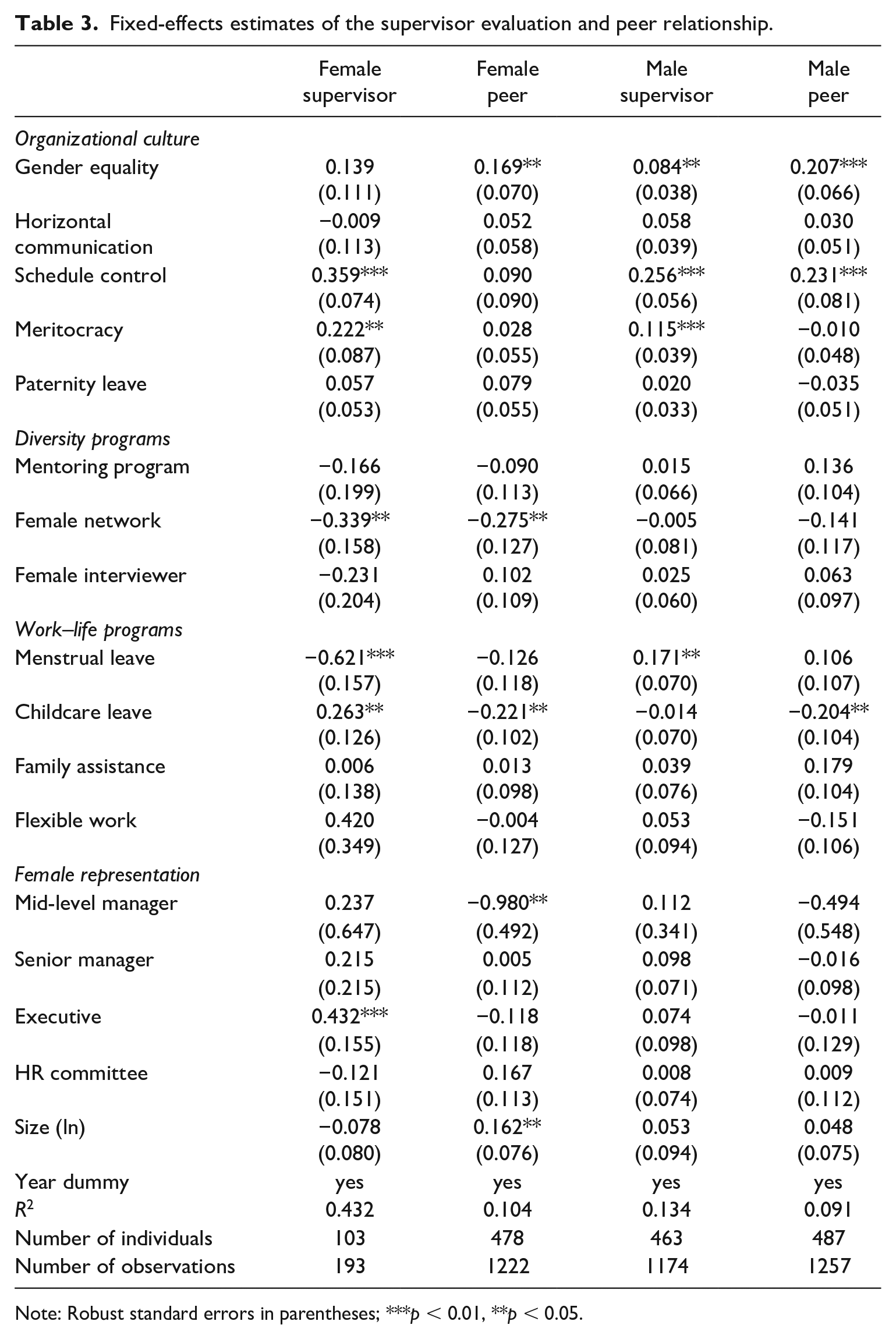
Note: Robust standard errors in parentheses; ***p < 0.01, **p < 0.05.
Organizational culture
Our analyses indicate that organizational culture significantly shapes female managers’ assessment of their relationships with supervisors and peers. CEOs’ emphasis on gender equality, schedule control, and meritocracy has positive effects on the outcome variables in Table 3. First, CEOs’ support for gender equality increases female managers’ evaluations of their male supervisors and improves relationships with both female and male peers. As CEOs’ support increases by one unit, female managers’ evaluation of male supervisors increases by 0.084 units, if all other variables in the model are held constant. In addition, female managers’ relationships with both female and male peers improve by 0.169 units and by 0.207 units, respectively, for every unit increase in CEOs’ support for gender equality.
Second, female managers who have schedule control evaluate both their female and male supervisors more positively and describe better relationships with male peers. As female managers’ schedule control increases by one unit, their evaluation of female supervisors rises by 0.359 units and of male supervisors by 0.256 units, if all other variables are held constant. It also significantly improves their relationships with male peers by 0.231 units, holding other variables constant. Previous studies note that employees benefit from workplace expectations that discourage using time devotion as a marker of a successful employee (Perlow, 2019). Our finding substantiates this assertion by demonstrating that employee discretion over their schedule improves relationships with supervisors and peers, particularly with male members. This suggests that time-detached firm culture boosts positive inter-gender associations by fostering the formal perception that employees have responsibilities beyond workplaces, diminishing the gender stereotype that deems women as uncommitted organizational citizens.
Finally, meritocracy improves female managers’ evaluations of their relationships with female and male supervisors. Female managers are more likely to evaluate female supervisors and male supervisors more favorably when they perceive their firms as exercising merit-based reward practices. Meritocracy has stronger effects on improving the evaluation of female supervisors (β = 0.222) than of male supervisors (β = 0.115). That is, women are more likely to assess a female supervisor positively in organizations where performance determines promotion chances. Meritocracy has no statistically significant effect on female managers’ relationships with either female or male peers.
Diversity programs
Diversity programs show little or no effect on the evaluation of relationships with male supervisors and peers. However, female networking programs have a negative effect on relationships with female supervisors and female peers. The presence of female network programs decreases female managers’ evaluation of female supervisors (β = −0.339) and also deteriorates their relationships with female peers (β = −0.275). The findings confirm our hypothesis that group-specific diversity practices strain female managers’ relationships by highlighting their membership in the traditionally disadvantaged group.
Work–life programs
Programs that address work–life balance for employees show mixed effects on organizational relationships. Childcare leave positively affects relationships with female supervisors, but it deteriorates relationships with both female and male peers. There are two likely explanations for this: peers may perceive colleagues who take childcare leave as more committed to family and children than to their work (Blair-Loy, 2003), and they may resent having to take on extra work because of a peer’s leave.
Likewise the use of menstrual leave appears to significantly diminish female managers’ relationships with female supervisors but improves relationships with male supervisors. The magnitude of the effect of menstrual leave is about four times greater for female supervisor (β = −0.621) than for male supervisor (β = 0.171). While further study is warranted, we speculate that female managers more strongly disapprove of unsympathetic reactions from female supervisors, who may not endorse female workers’ use of menstrual leaves because they feel it bolsters gender stigma.
Female representation
Female representation in management has varying impacts. Female representation shows no effect on female managers’ relationships with male supervisors or peers. However, it shows significant effects on their relationships with women. First, the presence of a woman in top management increases the evaluation of relationships with female supervisors. Holding other covariates at their mean level, the presence of female executives increases the evaluation of female supervisors (β = 0.432). In contrast, the proportion of women in mid-level management has a negative effect on female managers’ relationship with female peers. The relationship with female peers and subordinates deteriorates as the proportion of mid-level managers increases (β = −0.980). This accords with previous research showing that female employees consider other in-group members as a potential threat and competition for limited opportunities in managerial positions (Duguid et al., 2012). A possible explanation is that the proportion of mid-level managers without compatible representation of female members in upper organizational echelons fails to translate into constructive associations among female employees.
Interaction effects
As hypothesized, most work–life and diversity programs implemented to support women have negative effects on female managers’ relationships with their supervisors and peers, while organizational culture and female representation positively influence relationships. While we could conclude that work–life and diversity programs are futile at best, we might also ask under what conditions do diversity and work–life programs produce positive outcomes?
Previous studies suggest that diversity programs work better when combined with other supporting organizational orientations (Kalev et al., 2006; Perry-Smith and Blum, 2000). Similarly, the effect of diversity and work–life programs may have different outcomes depending on women’s observable and unobservable status within firms by changing the perception that femininity is a liability.
Female executive
In Table 4, we add an interaction term (Female executive) to the variables on diversity and work–life programs presented in Table 3. The interaction coefficients show whether effects are significantly different among firms with female executives from those without female executives. While the presence of a female executive did not significantly change the nature of relationships with male supervisors and peers, female managers’ relationships with female supervisors and peers are more responsive to the presence of a female executive. In companies with female executives, childcare leave significantly increases the evaluation of a female supervisor, and flexible work arrangement improves relationships with both female supervisor and peers. Likewise, mentoring programs improve relationships with female peers in companies with female executives. In contrast, firms with female executives, like those without, show decreased evaluations of female supervisors if the participant believes their firm allows menstrual leave.
Interacting female executive with diversity programs and work–life programs.
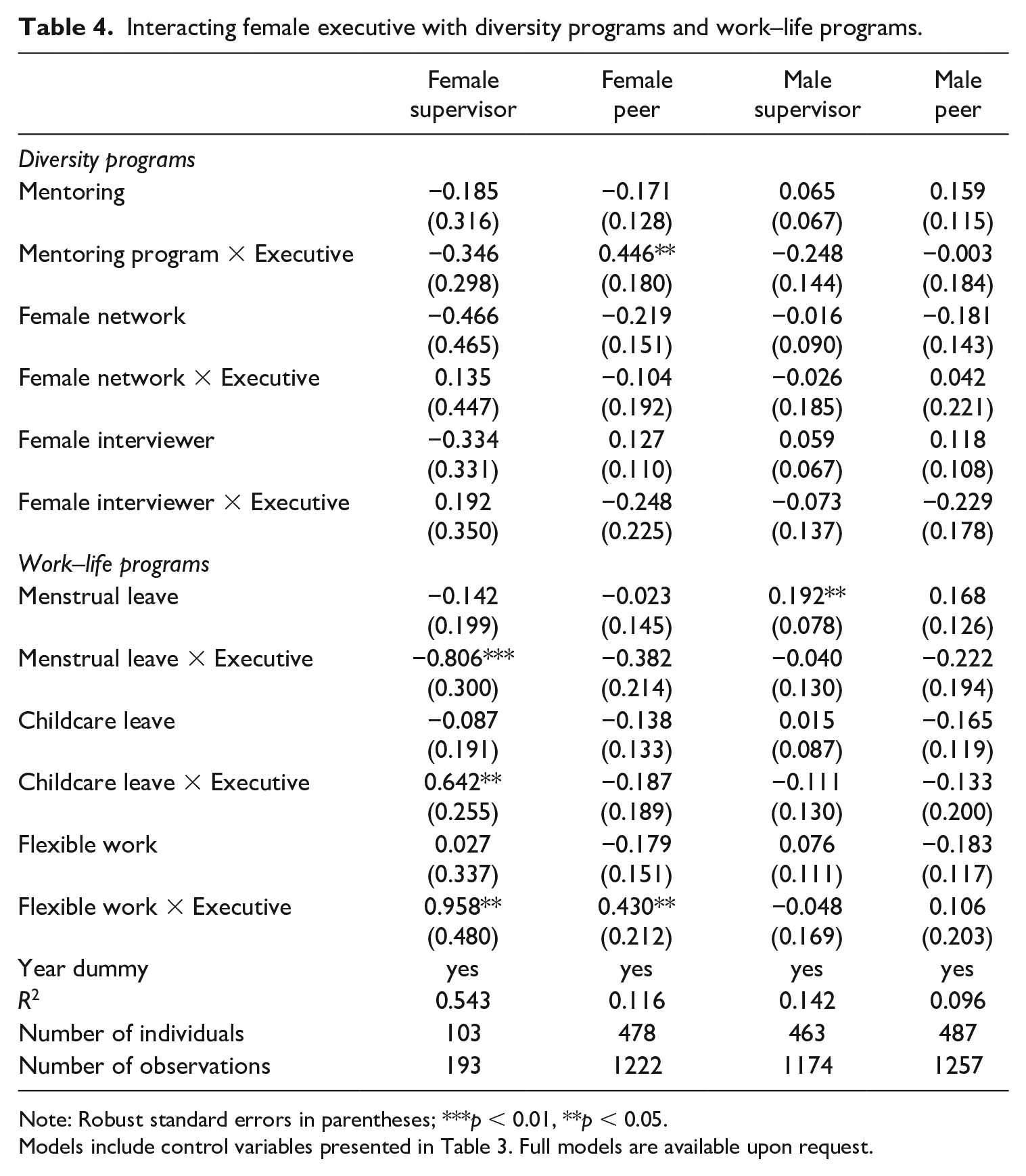
Note: Robust standard errors in parentheses; ***p < 0.01, **p < 0.05.
Models include control variables presented in Table 3. Full models are available upon request.
Men’s use of paternity leave
We examine the interaction effects between men’s use of paternity leave, diversity policy, and work–life programs (Table 5). The interaction between having a mentoring program and effective paternity leave exerts a positive influence on relationships with female supervisors. An organizational culture that encourages men to take childcare leave improves female managers’ relationships with male supervisors. Childcare leave alone negatively influences female managers’ relationships with male supervisors, but when more men are likely to take extended childcare leave, the perceived availability of childcare leave significantly improves women’s relationships with male supervisors. We surmise this is because tensions between gender groups are lower in environments where men take paternity leave.
Interacting paternity leave with diversity programs and work–life programs.

Note: Robust standard errors in parentheses; ***p < 0.01, **p < 0.05.
Models include control variables presented in Table 3. Full models are available upon request.
Conclusion
Ample research identifies women’s social isolation as one of the key factors in perpetuating gender inequality in the workplace. However, questions remain as to how workplace practices contribute to preserving and reproducing women’s marginalization despite the availability of practices to alleviate the imbalance. Rather than interpreting the results as indicating which programs work and which do not, this study focuses on the social processes within the workplace that reinforce women’s exclusion. Our findings emphasize that the effectiveness of specific corporate policies should be understood in light of how they accentuate the perceptions of the normative gender order. Furthermore, the implementation of diversity and work–life programs alone may often be insufficient to integrate women into workplace networks, and the effective implementation of corporate programs depends on the extent to which an organization overall embraces responsibility for change.
We explore a mechanism behind the association between organizational context and interpersonal relationships of female managers. First, diversity-enhancing organizational culture stimulates healthy inter- and intra-gender dynamics. Second, organizational measures designed to target female employees negatively affect female managers’ relationships. However, childcare leave both improves and strains professional relationships. Third, female representation in an executive position augments homophilous interactions with female supervisors but representation in mid-level management deteriorates women’s relationships with female peers. Lastly, we find that homophilous relationships between female members of firms are more context-dependent than heterophilous relationships between female and male members.
Finally, this study shows that the presence of female executives and men’s use of paternity leave improve women’s workplace relationships with both men and women. Specifically, mentoring, childcare leave, and flexible work programs support positive relationships with both supervisors and peers when enacted in firms that have women in leadership roles and minimize the motherhood penalty. Although diversity and work–life programs that target female members only – namely, female network and menstrual leave measures – consistently show negative or no significant effects, there is a reason to suspect that these policies can become a positive force if organizations actively alleviate gender imbalance.
In spite of the mixed consequences associated with diversity and work–life programs, the availability of these formal measures is still important for women’s career outcomes. Yet the salience of gender stereotypes conveyed through corporate practices dampens gender inequality in accessing relational resources. The structural processes by which individuals make inferences about gender status frustrate women’s efforts in building networks with men, as well as their proclivity for homophilous associations with other women. Social meaning attached to gender and workplace practices must be reconfigured if diversity and work–life programs are to have the intended results. That is, corporate practices should insinuate positive group status to employees.
The findings suggest how policy might address inequality rooted in network disadvantage and improve representation of traditionally disadvantaged populations. While firms should vigorously promote corporate practices for diversity and work–life balance, additional measures to enhance female status must complement these practices. For instance, women should be consciously recruited into high-ranking positions until gender parity in representation is attained. Additionally, organizational culture in the form of patriarchal order should be remedied since workplace practices rooted in traditional expectations systematically constrain women’s opportunities. These include – but are not limited to – shifting overwork expectations, disaggregating long work hours as a sign of competence, or encouraging fluid communication structures. When formal policies interact with the enhanced status of women, women will experience the development of supportive network contacts, thereby gaining access to diverse opportunities, knowledge, and perspectives germane for their organizational advancement.
Limitations of our study are worth mentioning. First, it is assumed in our analysis that female managers’ assessments of their relationships are comparably reciprocated. More extensive data that include reciprocal evaluations of relationships and comparing women’s evaluations to men’s with respect to organizational arrangements would provide a more far-reaching insight into seeking remedies to gender segregation. Also, there are limitations in the treatment and measurement of gender. Gender relationships in our panel data have been surveyed in a restricted way, assuming that both men and women are heterosexual. The consideration of a person’s diverse sexual orientations or gender identities would further expand the efficacy of corporate policies in integrating workplaces.
Our study demonstrates that corporate structure and practices can facilitate women’s access to relational resources. The caveat is that organizational initiatives would be most effective in integrating women when arrangements that signal opportunity and change complement formal practices. Future work, therefore, must incorporate combinations of interaction structures between formal policies and implicit norms in alleviating inequality in organizational outcomes.
Footnotes
Declaration of conflicting interests
The authors declared no potential conflicts of interest with respect to the research, authorship, and/or publication of this article.
Funding
The authors disclosed receipt of the following financial support for the research, authorship, and/or publication of this article: This work was supported by the Ministry of Education of the Republic of Korea and the National Research Foundation of Korea (NRF-2020S1A5A2A01042471).
