



Abstract
This article analyzes the strategic potential and empirical challenges of private governance in promoting decent work in global agriculture by curtailing buyer power and fostering labor agency, drawing lessons from Fairtrade International-certified flower plantations in Ecuador. The study explains (1) Fairtrade’s logic in promoting ‘trade fairness’ and ‘worker empowerment’ and operationalization of these values via its certification standards, (2) the power relations shaping certification practices in global flower markets and Ecuadorian plantations, and (3) the grounded implications of participation for firms and workers. Important lessons emerge. First, while Fairtrade pursues a promising avenue for challenging the buyer control that erodes supplier and worker power, it has only marginally reduced floral buyer power due to retailer resistance, low-bar certification competition, and programmatic regulatory gaps. Second, although Fairtrade’s empowerment approach has strengthened labor agency within and beyond the workplace, bolstering individual empowerment has proved easier than fostering associational power. As I show, certification practices and outcomes are mediated by commodity-specific global market politics and localized enterprise, labor force, and legal contestations which explain why program aspirations are often not realized. Standard systems can reshape internal trade relations and organizations but cannot alone ensure global trade equity or robust labor representation.
Introduction
Numerous transnational non-governmental organization (NGO) certifications address labor conditions in global production using voluntary standards and regulations. Yet concrete gains from these programs have been disappointing, and workers in agriculture continue to lack decent work and labor rights around the world (Food and Agriculture Organization (FAO), 2017). This article analyzes the strategic potential and empirical challenges of agricultural labor standard systems drawing lessons from Fairtrade International’s (FTI) plantation certification. Fairtrade provides an insightful case since it coordinates one of the most well-established and ambitious agricultural certifications (Auld et al., 2015). Sales of Fairtrade labeled products are valued at over US$11 billion per year, with 254 certified plantations employing 193,000 workers largely in the cultivation of flowers, tea, and bananas (FTI, 2021).
This article integrates two major theoretical traditions to illuminate the politics, practices, and limits of NGO labor certification. The political economy approach reveals how corporate dominance undermines the position of workers in global production and the global, national, and local political challenges certification programs face in stemming labor abuse in agriculture and other sectors (Anner, 2019; Barrientos, 2019; Gereffi and Lee, 2016; Selwyn, 2013). While this framework spotlights the external forces delimiting certification impacts, it often downplays the internal program features that condition outcomes. The institutionalist approach addresses this gap by explaining the organizational logic, values, standards, and operational features of NGO certification systems and the implementation challenges they encounter in seeking to improve global labor conditions (Amengual et al., 2019; Auld et al., 2015; Bartley, 2007; Locke, 2013; Lounsbury et al., 2021). While institutional scholars are rightly criticized for focusing on reified organizational models, my study avoids that trap by ‘grounding’ analysis in ‘the concrete places, power relations, and institutions which shape program translation and outcomes’ (Graz, 2021; see also Bartley, 2021). My integrated analysis addresses the call for bridging analytical divides in private governance scholarship (Grabs et al., 2021).
FTI has received significant attention given its historical certification leadership and ambitious global social justice agenda (see Raynolds and Bennett, 2015). While some scholars analyze the organizational commitments and operational practices of Fairtrade’s plantation program (Arnold, 2021; Raynolds, 2017; Riisgaard, 2015), most investigate Fairtrade impacts for workers in Asian tea (Besky, 2013; Makita, 2012; Siegmann et al., 2019), African horticulture (Cramer et al., 2017; Krumbiegel et al., 2018; Nelson and Martin, 2015; Riisgaard, 2009), and Latin American bananas (Brown, 2013; Frundt, 2009; van Rijn et al., 2020). This study deepens our understanding of Fairtrade plantation certification by linking an analysis of the program’s central goals on paper and in practice. I analyze (1) FTI’s logic and certification standards in promoting ‘trade fairness’ and ‘worker empowerment’, (2) the power relations shaping Fairtrade’s engagement in buyer-driven flower markets and grounded practices on Ecuadorian plantations, and (3) the implications for workers’ power and opportunities for reworking their material conditions. This article expands our empirical knowledge by illuminating the understudied experience of Fairtrade flower enterprises in Ecuador. Cut flowers represent an important case given the commodity’s prominence in the exports of several Latin American and African countries (ITC, 2015), standing as Fairtrade’s second most important plantation product (FTI, 2021), and historical association with poor labor conditions (ILRF, 2010).
The study reveals not only the opportunities but also the constraints for FTI and other programs seeking to improve conditions for workers in global production. There are two central findings. First, while Fairtrade’s prioritization of trade fairness provides a unique and promising avenue for challenging the buyer power that often undermines advances for workers, it only marginally reduces floral buyer control due to retailer resistance, competition from low-bar certifications, and programmatic regulatory gaps. Second, while Fairtrade’s empowerment approach has strengthened labor agency within and beyond the workplace, bolstering individual empowerment has proved easier than fostering associational power in Ecuador. Certification practices and outcomes are mediated by commodity-specific global market politics and localized enterprise, labor force, and national contestations which explain why program aspirations are often not realized. In short, private standard systems can reshape internal trade relations and organizations but cannot alone ensure external systems of global trade equity or robust labor representation. Improving labor conditions in global production requires increasing workers’ structural power via mandatory, as well as voluntary, measures holding buyers accountable for supply chain conditions and increasing workers’ associational power through labor union and advocacy group support at local, national, and international levels.
Global production, NGO certification, and labor
The political economy approach reveals how corporate dominance undermines the position of workers in global production. Gereffi (1994) demonstrates how major retailers govern ‘buyer-driven’ global value chains. In the agro-food sector, supermarkets control global market access and production conditions in their supply chains via extensive regulations and quality standards (Dolan and Humphrey, 2000; Ponte, 2009). Predatory purchasing practices fuel the race to the bottom (Anner, 2019). In agriculture, corporate buyers induce exporting governments to limit employment regulations and legal entitlements and compel suppliers to curtail costs by undercutting wages, job security, and labor rights thus generating labor violations in agro-export sectors around the world (Alford et al., 2017; Barrientos, 2019; Selwyn, 2013). To foster decent work, global production scholars advocate challenging buyer control through the economic upgrading of suppliers and social upgrading of workers (Barrientos et al., 2011).
As Selwyn (2013) argues, social upgrading requires improving agro-export workers’ associational power (their capacity to organize and act collectively) and structural power (their labor market position and centrality in production). Although labor scholars detail formidable barriers – how globalization undermines unionization, national labor regimes constrain labor agency, and workplace control silences workers (Appelbaum and Lichtenstein, 2016; Hammer and Fishwick, 2020; Taylor and Rioux, 2018) – successful labor campaigns show how workers’ can increase their power through national and global regulatory institutions (Brookes, 2019). For example, Alford et al. (2017) find that while South African fruit workers’ integration into global markets generates constraints, it also creates potentially powerful leverage for interlinked local, national, and global labor contestations.
Political economists study the potential of private governance to promote economic and social upgrading in global production (Gereffi and Lee, 2016). NGO certifications are more likely to challenge global power inequalities and labor violations than typically superficial corporate programs (Anner, 2012; Appelbaum and Lichtenstein, 2016; Barrientos and Smith, 2007). Yet, improving global labor standards and rights has proved a formidable task. Research suggests that to be effective, NGO labor certifications need strong local and transnational civil society and labor ties (Anner, 2012; Barrientos and Smith, 2007; Riisgaard and Hammer, 2011) and supportive national policy environments (Amengual and Chirot, 2016; Bair, 2017; Bair et al., 2020). While political economists identify the external forces delimiting certification impacts, they often downplay the internal program features that also condition outcomes. Thomas (2021), for example, finds that Rainforest Alliance, Utz, and Ethical Tea Partnership programs fail to improve conditions for Sri Lankan tea workers, yet overlooks how their weak labor standards might shape this outcome.
An institutionalist approach helps frame analysis of the organizational logic, values, standards, and compliance mechanisms employed by voluntary programs. Numerous studies examine the problem-solving nature of transnational governance systems and the complex relationship between rule making and implementation (see Djelic and Quack, 2018). An institutionalist lens reveals how divergent value commitments are enacted and intertwined through material practices and how tensions between logics shape organizational arrangements (Lounsbury et al., 2021). Auld et al. (2015) show how agro-food certifications prioritize different logics in their institutionalized rules and procedures, contrasting programs following a ‘logic of control’ with those pursuing a ‘logic of empowerment’. Institutionalist research highlights the role of NGOs, corporations, and other stakeholders in creating labor certification systems and associated differences in their priorities (Bartley, 2007), the stringency of their standards (Bennett, 2018; Fransen, 2012), and effectiveness of their compliance systems (Amengual et al., 2019; Locke, 2013). Institutionalists concur with political economists that certification initiatives have largely failed to improve labor conditions around the world, but typically attribute this to weak organizational design, standards, and implementation procedures (Grabs et al., 2021).
There is growing recognition that understanding the prospects and limits of certification programs requires moving beyond abstract institutionalist models to ‘ground’ analysis in the concrete places, power relations, and institutions which shape their translation and outcomes (Graz, 2021; Lounsbury et al., 2021). Bartley (2021) explicitly merges political economy and institutionalist approaches in arguing that certification initiatives are grounded in the global power relations that shape their practices, including their ‘corporate saturation’, and the local political realities that shape their implementation. Arnold and Loconto (2021) reveal the importance of analyzing how certification organizations envision their standards and how they are put into action within specific political economic milieus. My study follows a similarly grounded approach in analyzing FTI’s ‘trade fairness’ and ‘worker empowerment’ commitments and arrangements on paper and their realization in practice.
FTI plantation certification
FTI (2021) is one of the few certification programs to address trade AND production conditions, seeking to ‘promote fairer trading conditions and empower producers to combat poverty, strengthen their position and take more control over their lives’. The organization articulates and concretizes the connections between its vision, operational framework, and assumed outcomes in its formalized ‘theory of change’ (Loconto et al., 2021). Fairtrade’s theory of change explains its central goals to ‘make trade fair’ and ‘empower small farmers and workers’ and their operationalization via standards which ‘establish the rules for fair trading practices and engagement in Fairtrade’ (FTI, 2015b: 8). These standards are third-party certified. FTI includes National Fairtrade Organizations which license buyers and regional Producer Networks in Africa, Asia, and Latin America. Fairtrade-certified products are sold for over US$11 billion per year predominantly in Europe and North America (FTI, 2021). Key Fairtrade products like flowers, tea, and bananas come from certified plantations across three continents. 1
Fairtrade scholarship 2 builds on, and often integrates, political economy and institutionalist approaches, helping to frame my analysis. An extensive literature analyzes Fairtrade’s small farmer program, explaining its organizational logic, standards, and practices and the political economic factors shaping implications for peasant producers (Bacon, 2005; Jaffee, 2007; Renard, 2005; Renard and Loconto, 2013). Tampe (2018), for example, shows how Fairtrade facilitates the upgrading of cooperatives and farmers.
A growing literature analyzes Fairtrade’s plantation program values and practices. Raynolds (2017) traces peasant, labor, and corporate contestations in shaping the rise of Fairtrade plantations. Drawing on convention theory (Boltanski and Thévenot, 2006), Riisgaard (2015) and Raynolds (2017) show how Fairtrade’s plantation program seeks to promote alternative civic and relational norms, relations, and institutions and challenge mainstream market and industrial conventions. They argue that corporate pressures have amplified tensions between alternative and mainstream conventions and fueled compromises in Fairtrade labor certification, raising concerns that Fairtrade may be reproducing mainstream socioeconomic relations (Staricco, 2017). Fairtrade plantation certification has become a complex oversight system comprising numerous bureaucratic rules oriented to bolstering accountability (Arnold, 2021) using metrics and measures which reinforce expert knowledge and visions of success (Lyall and Havice, 2019). Although Fairtrade has a stronger empowerment logic (Auld et al., 2015) and higher labor (Bennett, 2018) and gender standards (Raynolds, 2021) than competing agricultural programs, some propose that Fairtrade certification should become more ‘worker driven’ (Siegmann et al., 2019).
Impact studies generally find that Fairtrade certification increases plantation wages and benefits (Krumbiegel et al., 2018; van Rijn et al., 2020), but gains vary by commodity and country (Cramer et al., 2017; Nelson and Martin, 2015). Fairtrade’s grounding in local political contestations and institutions help explain these divergent outcomes. In Asian tea plantations, conflicting Fairtrade, state, and union priorities (Besky, 2013) and powerful patronage systems (Makita, 2012) limit worker gains (Siegmann et al., 2019). In Latin American banana plantations, Fairtrade operations are mediated by variable national labor regimes (Brown, 2013) and union power (Frundt, 2009) which shape worker benefits. Fairtrade increases worker participation in labor organizations (Riisgaard, 2009; Smith, 2015; van Rijn et al., 2020), but on flower plantations in Africa and Latin America, worker representation and bargaining power are strengthened with little increase in union power (Riisgaard et al., 2012).
Methods
This study integrates an organizational analysis of FTI’s plantation certification goals and standards, a sectoral analysis of Fairtrade certification practices in Ecuadorian rose production, and a labor analysis of certification’s implications for floral workers in Ecuador. (1) To explicate FTI’s ‘trade fairness’ and ‘worker empowerment’ goals and certification standards, I analyze organizational documents pertaining to plantation certification and information garnered through interviews with key Fairtrade program officers in Latin America and Europe. (2) To understand the implementation of Fairtrade certification in Ecuador’s flower sector, I trace the actors and politics shaping certified flower markets and plantation practices. Market data come from documents and interviews with flower associations, floral buyers, certification organizations, Ecuadorian government officials, and NGO representatives. Plantation data come from research on five certified Ecuadorian flower enterprises, including semi-structured interviews with three to five senior managers and company document reviews. (3) To identify and explain the implications of Fairtrade certification for flower workers, I draw on additional research on four of the certified plantations. My research included semi-structured interviews with six to eight elected worker representatives and reviews of worker organization reports on company grounds. Information on the experiences of rank-and-file workers derives from a random sample survey of 36 workers on each plantation conducted in workers’ homes and communities. Surveys included close and open-ended questions and inquiries soliciting extended narratives. I triangulate data from multiple sources to verify interview statements with documentary evidence, identify incongruities between program aspirations and realities, contextualize certification within Ecuadorian realities, unravel political contestations, and understand the differential views and experiences of managers and workers.
Fairtrade certification in Ecuadorian flower enterprises
Ecuador, the world’s third largest floral exporter, specializes in roses. The country exports 12,000 tons of roses annually worth US$649 million: 45% to the United States, the rest largely to Europe (Expoflores, 2019). About 116,000 Ecuadorian workers, 60% of whom are women, are employed in flowers (Ecuador Ministry of Agriculture (EMA), 2016). While industry and government officials tout the floral industry’s contributions in generating export earnings and rural employment, critics document a history of worker exploitation and labor rights violations (FENACLE, 2011; ILRF, 2010).
Ecuador and Kenya pioneered Fairtrade-certified floral production, exporting labeled roses to Switzerland in 2002. Flower certification was encouraged by Swiss supermarkets looking to expand their Fairtrade offer and European solidarity groups seeking to curtail floral labor abuse (Arnold, 2021; Riisgaard and Hammer, 2011). Given their market success, Fairtrade roses were soon made available across Europe (Fairtrade Labelling Organizations International (FLO), 2005). Fairtrade flowers were launched in 2015 by Canadian independent florists and in 2008 by Fairtrade’s affiliate, Fair Trade USA, with little North American advocacy group or supermarket engagement.
Ecuador now has 10 Fairtrade-certified flower plantations (FTI, 2019). These plantations produce very high-quality long-stem roses which are sold with and without the certification label, based on buyer preferences. 3 Ecuador’s Fairtrade companies are distinguished in global markets by their high-end product, sophisticated capital-intensive cut/grow/pack operations, and ability to tailor new varieties and products for different buyers. They are mostly family businesses which are midsized by international standards but fall in the top quartile of Ecuadorian floral companies (EMA, 2020). Ecuadorian Fairtrade flower plantations cultivate from 26 to 86 acres, employ from 114 to 520 workers, sell from 7.3 to 27 million stems, and earn from 2.7 to 9.4 million dollars annually.
Fostering trade fairness and challenging buyer power
Institutionalizing trade fairness
FTI aspires to ‘make trade fair’ as its name suggests. Unlike most certification programs which only address production, Fairtrade regulates buyer–supplier relations in certified markets. In its early years, Fairtrade pursued a strategy of advancing trade equity based on the simple idea that eliminating middlemen would increase peasant producer profits, but sourcing from plantations has required the articulation of a more complex logic (Arnold, 2021). To this end, Fairtrade’s 2015 theory of change draws explicitly on Gereffi’s (1994) ‘buyer-driven’ conceptualization to explain its logic for intervening in trade, detailing how ‘buyer-driven’ global markets fuel worker marginalization (FTI, 2015b: 25–26). Aligning with this problem definition and labor scholarship, program policies address the ways dominant corporate buyers undermine workers’ structural position directly and indirectly by limiting suppliers’ profits and capacity to invest in workers by withholding information, controlling market access, and offloading risks (FTI, 2015b: 10). Fairtrade’s trade fairness commitments are operationalized via over 50 criteria regulating buyer–supplier relations which comprise its Trader Standard (FTI, 2015a). Fairtrade pursues four key avenues for making trade fair and upgrading the position of suppliers and workers, by fostering (1) supportive trading relations, (2) market stability, (3) equitable market access, and (4) worker benefits from trade. Table 1 outlines these objectives and associated certification standards.
Fairtrade International make trade fair objectives and trade standards for flowers.
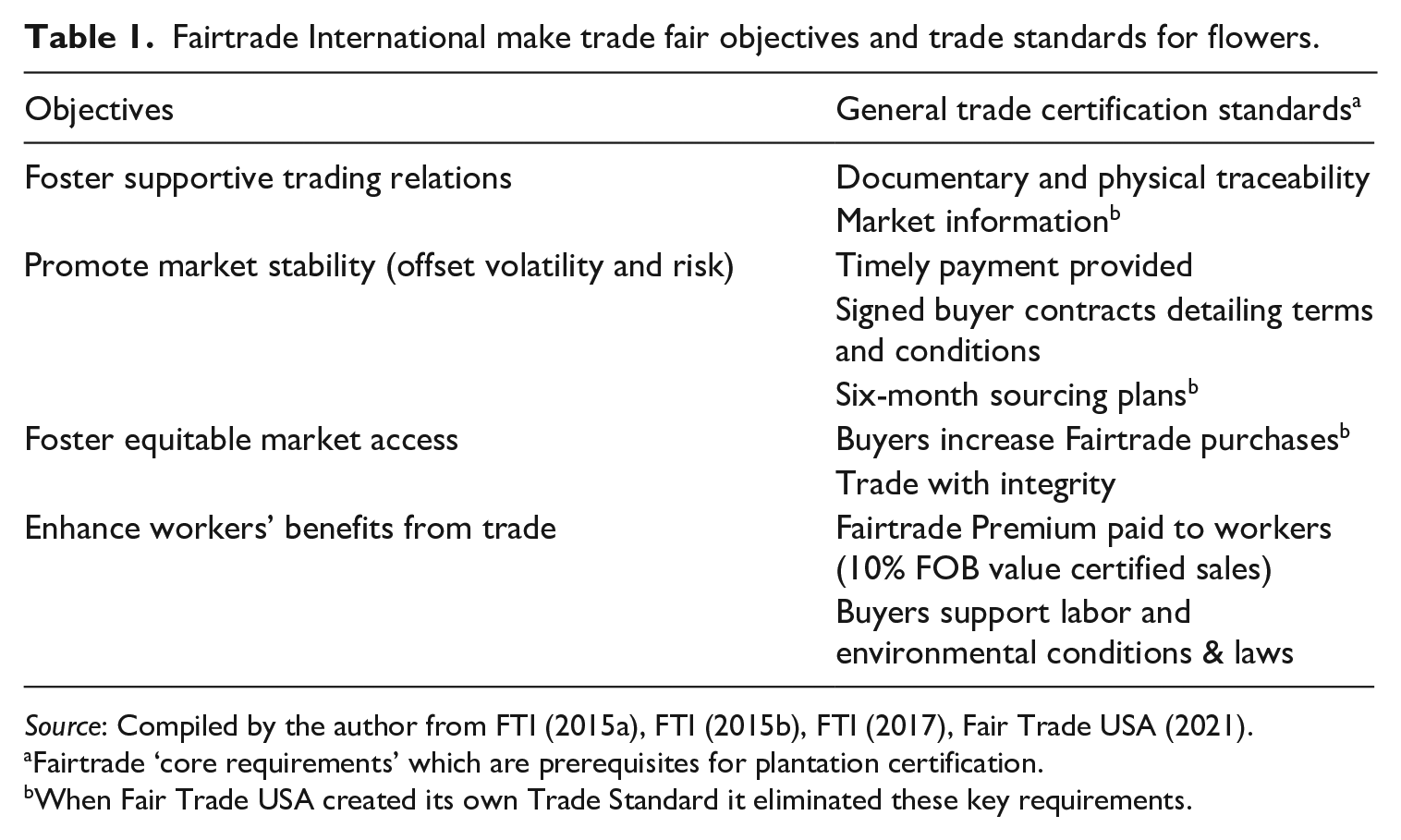
Source: Compiled by the author from FTI (2015a), FTI (2015b), FTI (2017), Fair Trade USA (2021).
Fairtrade ‘core requirements’ which are prerequisites for plantation certification.
When Fair Trade USA created its own Trade Standard it eliminated these key requirements.
Political economic context shaping certification practices
The global cut-flower market generally follows the buyer-driven model that Fairtrade aims to address. Supermarkets dominate markets for Fairtrade and non-certified flowers increasingly bypassing North American wholesalers and European auction houses but still employing importers to manage complex logistics (Riisgaard and Hammer, 2011; Union Fleurs, 2018). Ecuador’s Fairtrade plantations rely increasingly on US floral buyers, since European retailers have largely shifted to African suppliers producing larger volumes of cheaper roses. 4 Most Ecuadorian Fairtrade producers currently sell over half of their certified roses in the United States, in all cases a greater percentage than their non-certified flowers. The perishability of flowers, which require continuous cool chains, rapid ground and air transit, and timely sales, increases buyer control (Union Fleurs, 2018). Transit from Ecuadorian greenhouses to US retail shelves takes 48 to 55 hours and accounts for roughly half the flowers’ cost, with any delays threatening profitability.
The 2011 resignation of Fair Trade USA – Fairtrade’s US National Labeling Organization – from the global system complicates certified market governance. The exodus has put downward pressure on trade standards, confused network actors, and stalled certified US floral sales. 5 Ecuadorian plantations are still certified according to Fairtrade standards, 6 allowing them to sell in Europe and North America. 7 But US buyers may be licensed in accordance with either FTI’s or Fair Trade USA’s (2021) weaker trade standards. As Figure 1 illustrates, the US market includes five FTI and six Fair Trade USA licensed buyers of Ecuadorian flowers. In the United States, certified roses are sold primarily by Whole Foods (which sources directly) and Sam’s Club (where an importer manages floral sales). Both major retailers transferred their licensing from FTI to Fair Trade USA when the weaker certification became available.

Fairtrade International and Fair Trade USA-certified flower commodity networks linking Ecuador and the United States.
Grounded realities: Certification standards, practices, and outcomes
Buyer-driven and competitive governance relations in the global certified floral market help explain Fairtrade’s trade intervention practices and their implications in Ecuador. Fairtrade’s first avenue for reshaping trade is by fostering supportive exchange relations via traceability and information sharing (see Table 1). In roses traceability already exists. Although plantation managers say they need more market information, they have no more insight into markets for certified flowers than other flowers. This is because the buyers required to uphold certification standards are often importers, not the retailers who control markets, and because Fair Trade USA licensed buyers have no information sharing obligations. Fairtrade producers report that their certified rose markets are governed largely by conventional practices with mainstream retailers dictating prices, quantities, and schedules. One company owner explains, Just because these are Fairtrade certified flowers, does not mean the retailers are committed to being fair. Buyer power remains a major problem. It is business as usual for the supermarkets. They will not commit to major purchases; they use their sourcing flexibility to buy the cheapest roses, pitting us against other producers.
Fairtrade’s second trade intervention, to promote market stability by offsetting volatility and producer risks, has brought minor improvements for Ecuadorian rose producers. Rose payments are generally timely, making payment standards nonessential. Buyer purchasing contracts (required by both Fairtrade and Fair Trade USA) are important since flower sales negotiations are often verbal, yet only slightly reduce risks since they are not legally binding. Although buyers may avoid major commitments and shift suppliers over the long term, plantation managers credit Fairtrade standards requiring buyers provide 6-month sourcing plans for promoting short-term market security, 8 and chide Fair Trade USA for eliminating sourcing plan requirements. Neither certification specifies flower prices. 9 Ecuadorian producers sell certified roses for about 10% above their average price, but 10% below their highest priced flowers. Company managers identify retailers’ price control as central to their oligopolistic power, where ‘major buyers decide their price point and we figure out how to meet it or lose our market’.
Although Fairtrade’s third trade intervention aims to foster supplier upgrading and equitable market access by requiring buyers increase certified purchases and trade with integrity, markets for Ecuadorian Fairtrade roses have not grown substantially and are governed largely by competitive practices. Fair Trade USA has dampened market growth by not requiring that buyers increase purchases. Although Ecuadorian plantations have only been able to sell 10% to 30% of their roses with the certification label in recent years, plantation managers credit certified niche markets for helping offset market declines. Fairtrade and Fair Trade USA require buyers trade with integrity, but managers report that dominant supermarkets discount payments, 10 undervalue certified flowers, and promote competing low-bar certifications. 11 As one company owner-manager explains, ‘Supermarkets do little to grow Fairtrade sales. Whole Foods restricts our markets by offering cheaper Rainforest Alliance flowers . . . they are not increasing their purchases, nor are other retailers’. 12 Four Ecuadorian Fairtrade rose companies recently acquired Rainforest certification to satisfy US supermarkets, but any certified market advantages are likely to be undercut by inhouse labels, like Whole Foods’ ‘Sourced for Good’. Flower company managers are understandably frustrated, concluding that supermarkets are simply ‘green washing’, using certification to bolster their brands without altering their profit-maximizing practices.
While trade interventions may benefit workers indirectly, Fairtrade’s fourth objective and associated standards aim to directly benefit workers. Although workers have a pivotal role in production, given roses’ fragility and high value, Ecuadorian workers’ structural power is limited by competition from poorly paid African workers and unemployed Ecuadorian workers (as elaborated below). To bolster workers’ position, Fairtrade and Fair Trade USA require that buyers support good practices and pay a Fairtrade Premium to workers. Although buyers do not actively promote better production conditions in Ecuador, the Fairtrade Premium (calculated at 10% of the FOB value of labeled flowers) is paid, ensuring that workers benefit financially from certified sales. Fairtrade Premiums serve as a profit-sharing mechanism, fostering trade fairness directly for workers and increasing their power within certified networks. Yet since the Premium accrues only on the 10%–30% of Fairtrade roses bought with the label, limited sales limit worker returns. Ecuadorian flower workers recognize that Premiums are tied to sales and advocate for increasing sales within the Fairtrade system via frequent staff contacts, occasional sponsored trips to market countries, and their Producer Network representation. Workers have little contact and no representation in Fair Trade USA. Ecuadorian workers recognize that their avenues for pressuring retailers and consumers to boost certified sales are limited and that they have little structural power in global markets.
In sum, although Fairtrade’s ‘make trade fair’ organizational logic, objectives, and standards align well with global production tenets (Gereffi, 1994) and evidence regarding the negative consequences of buyer control in floral supply chains (Riisgaard and Hammer, 2011), my analysis finds that trade fairness efforts have only marginally strengthened the structural power of suppliers or workers in Ecuador. Fairtrade standards target key leverage points for challenging buyer power, but dominant retailers have largely been able to maintain conventional buyer practices and limit supplier upgrading. Fairtrade’s trade fairness efforts are weakened by the licensing of importers, rather than dominant retailers, and by retailers’ continued competitive practices, including US buyers’ promotion of certifications with weak (Fair Trade USA) or no (Rainforest Alliance) trade regulations and European buyers’ move to cheaper African suppliers. The Fairtrade Premium provides an important vehicle for social upgrading, ensuring that workers benefit directly from trade fairness efforts and share in the profits from certified sales. While the Premium increases workers’ institutional power – their stake and voice within certified production networks – it has not significantly increased workers’ broader structural power in global flower markets, as evidenced by their inability to increase certified sales and premiums.
Fostering worker empowerment and labor rights
Institutionalizing worker empowerment
FTI’s second major priority is to ‘empower small producers and workers’ in the Global South (FTI, 2015b: 6). The organization’s definition of empowerment—‘the expansion of assets and capabilities of people to participate in, negotiate with, influence, control and hold accountable the institutions that affect their lives’ (World Bank, 2002)—acknowledges the resources underpinning and gradations of agency (Kabeer, 1999) and centrality of employer and governmental accountability (Barrientos and Smith, 2007). Fairtrade details its empowerment logic in its theory of change. The program focuses on augmenting both the individual agency and rights of marginalized peoples, by strengthening their ability to voice ‘their own aspirations and priorities’ and ‘develop and implement’ strategies to achieve their goals (FTI, 2015b: 9), and their collective agency and rights through enhancing their structural and associational power, helping workers ‘build independent, democratic organizations, improve their negotiating position with buyers/employers, achieve economic stability, make joint investments and increase their collective influence’ (FTI, 2015b: 6). Fairtrade’s worker empowerment commitments are put into practice via its Hired Labor Standard governing plantation production (FTI, 2014). Acknowledging the difficulties in fostering worker gains, these standards include 200 rules, nearly twice as many as in its peasant producer standards (Arnold, 2021). Table 2 outlines Fairtrade’s three key objectives and associated avenues for fueling worker empowerment, by strengthening (1) individual knowledge and capacity; (2) collective capacity, assets, and capabilities; and (3) worker organization, representation, and labor rights.
Fairtrade International’s empowerment objectives and hired labor standards.

Source: Compiled by the author from FTI (2014) and FTI (2015b).
Fairtrade ‘core requirements’ which are prerequisites for plantation certification. No comparison with Fair Trade USA standards is provided since all Ecuadorian plantations studied are Fairtrade certified.
Political economic context shaping certification practices
Fairtrade’s empowerment efforts in Ecuadorian flower plantations are shaped by local socioeconomic and labor market realities, and workers’ resulting structural power, as well as by local organizational realities, and workers’ resulting associational power. Rural Ecuador is characterized by high poverty (47% poverty rate), low education (averaging 7 years), and limited government services (42% of households lack safe water) (World Bank, 2021). Peasant agriculture’s decline over recent decades has heightened dependence on wage income (Martínez Valle, 2021), but rural wages do not afford a decent living standard (Ulloa Sosa et al., 2020). The flower sector provides important job opportunities, particularly for rural women with limited alternatives (Korovkin, 2003), and full-time year-round work (Martínez Valle, 2021), but jobs are scarce, and 22% of rural adults are underemployed (Instituto Nacional de Estadisticay Censos (INEC), 2013). Unions are rare in rural Ecuador. Although the constitution protects freedom of association and collective bargaining, Ecuador has a poor labor rights record, including governmental labor violations (Center for Global Workers’ Rights (CGWR), 2020). Unionization is opposed by agribusinesses and not well supported by rural workers (Martínez Valle, 2021). Ecuadorian workers’ limited structural and associational power heightens the importance of Fairtrade’s empowerment efforts, configures their implementation, and shapes the experience of flower workers.
Grounded realities: Certification standards, practices, and outcomes
Fairtrade’s first empowerment avenue focuses on enhancing individual knowledge and capacity (see Table 2). School requirements are unnecessary given widespread primary education in Ecuador. But Fairtrade’s worker training standards are quite important since flower workers have limited formal education (averaging 8 years), knowledge of their human or labor rights, or capacity to assert those rights through institutional channels. Workers identify training programs as a major factor distinguishing Fairtrade enterprises from other plantations and key vehicle for addressing individual constraints – their lack of ‘understanding’ of activities beyond their community, ‘capacity’ to address life challenges, and ‘ability to advance’. 13 As noted in Table 3, most instruction is provided by managers and focuses on company procedures. While this training fosters managerial control it also strengthens labor’s workplace power by increasing understanding of company operations, benefits, and grievance procedures. All workers get outside training on worker health and safety, fair treatment, labor laws, and Fairtrade policies; women get domestic violence training. Workers credit trainings with increasing their knowledge and voice. Most workers are aware of company procedures, legal entitlements like minimum wages and overtime pay, and key Fairtrade standards. Although workers are familiar with empowerment, human rights, and labor rights concepts, their practical applicability is less clear.
Fairtrade-certified flower plantation annual worker training program a .

Source: Compiled by the author from company documents.
Excluding job assignment training.
Training hours were available for only one company and should be read with caution; records from multiple companies confirm topics and trainers.
Worker representatives, who get substantial extra training, demonstrate the strongest individual knowledge, voice, and capacity. In addition to leadership training, Workers’ Committee members get some labor negotiation training, and Fairtrade Premium Committee members get considerable management training. While only representatives get augmented training, gains are spread since 26% of workers have served as representatives. Fairtrade training and committee activities clearly increase workers’ voice and empowerment. As an indigenous woman explains, ‘I used to be afraid to speak, then I got elected to the Committee. I was scared. I had to lead meetings, make decisions. But others listened . . . I gained confidence. Now I am applying for supervisor’. In addition to fostering job promotions, Premium Committee members often apply training-derived management skills to family businesses. While representatives appear able to use their enhanced knowledge, voice, and capabilities to advance their individual interests in the workplace, and in some cases at home, there is little evidence that they have increased their ability to make claims on local governmental or other institutions.
Fairtrade’s second empowerment objective focuses on bolstering collective capacity, worker and community assets, and capabilities and is operationalized via standards regulating the use of the Fairtrade Premium. The Fairtrade Premium generates US$80,000 to 150,000 annually from buyer fees for workers on each certified plantation in Ecuador. Unlike most profit-sharing systems, the Premium Fund is a collective asset legally owned by all workers. A Premium Committee, comprising 6 to 10 elected worker representatives and a few non-voting management advisors, meets monthly to administer the Fund. This Committee solicits project ideas from workers, develops proposals, organizes a vote in the all-worker General Assembly to allocate funds, and manages project activities. The Fairtrade Premium fosters workplace-level collective capacity via democratic engagement in project selection. Committee-level collective capacity is enhanced further via project planning and management.
Fairtrade Premium projects address key gaps in Ecuadorian rural resources and services, strengthening the assets and capabilities of workers, their households, and communities. Although the worker General Assembly may allocate 20% of funds to individual payments, the majority goes to collective projects. On Ecuadorian floral plantations the Premium averages about US$550 per worker annually, which is significant, but insufficient to address local needs. Funding goes largely to educational, health, and low-interest loan programs. Surveyed workers credit the Fairtrade Premium with significantly improving their well-being, with 96% participating in capacity-building activities, 89% accessing medical services, 59% accessing loans, and 38% accessing scholarships. A Premium Committee representative recounts, Our projects pursue the vision of workers . . . we like working here because of this. If my wife is sick, she can go to the company doctor. Our projects help the family live better. We are working on a housing project. This is complicated, but it is the dream of workers to own a good house.
Premium programs reduce workers’ shared marginalization, and some, like the housing project referenced above are very ambitious, demonstrating workers’ collective capacity to pursue major life goals.
Fairtrade’s third empowerment objective – to strengthen worker organization, representation, and labor rights – is operationalized through standards requiring democratic representation, freedom of association, and proactive support for unions and collective bargaining. These efforts to strengthen workers’ associational power and labor rights are critical in rural Ecuador where government officials and employers restrict unions and only 2 of 866 flower plantations are unionized. Fairtrade requires company Freedom of Association protocols, worker Right to Unionize Guarantees, union workplace access, and non-reprisal regulations. Although Fairtrade endorses unions, representation via enterprise-based Workers’ Committees is permitted where there is no sector union, as in Ecuadorian flowers. All Ecuador’s certified floral plantations have Workers’ Committees. Worker Committees, comprising 8 to 10 elected representatives, meet regularly alone and with the all-worker General Assembly to review complaints and plan activities. The Committee meets with management every 2 months to resolve concerns. 14 One representative explains, ‘Our job is to dialogue with management, we take workers’ concerns to them and negotiate resolutions. Managers have never said no to us . . . our demands are reasonable’. Over 90% of surveyed workers are familiar with the Workers’ Committee and its representative function. Most workers and all managers say that Workers’ Committees increase labor/management communication and workers’ collective voice, but as suggested above these negotiations are framed by what is considered ‘reasonable’ in the context of limited worker power. 15
My research finds that flower workers disagree as to whether Workers’ Committees go beyond articulating concerns, to claiming rights. Committee records show a maturation in claims-making: early negotiations focused on issues like cafeteria food and worker outings; recently negotiated resolutions address work hours, salaries, bonuses, transportation allowances, and supervisor mistreatment. 16 Sixty percent of surveyed workers assert that Workers’ Committees advance their interests, describing how they ‘improve the work environment’, ‘respond to complaints’, ‘bring changes’, and ‘defend us’. But 40% disagree, suggesting that Committees are ‘too friendly’ with management, ‘not willing to fight for us’, and avoid issues that ‘upset managers’. These are legitimate concerns since enterprise-level Workers’ Committees are exposed to management influence and clientelist pressures. Fairtrade standards seek to limit manager influence on Workers’ Committees through contacts with the Fairtrade Liaison and other outside experts and rules fostering organizational independence. 17 Workers’ Committees national and international networks help counter enterprise isolation. The annual National Assembly brings together all of Ecuador’s flower Workers’ Committees to identify joint needs, share workplace gains, and prepare action plans. 18 Ecuadorian Workers’ Committees have also bolstered their collective capacity, negotiating skills, and international alliances through participation in Fairtrade’s Latin American Producer Network (CLAC), including CLAC’s Workers’ Network and Board of Directors.
Although Workers’ Committees have gained strength in Ecuador, Fairtrade has made little progress in supporting unionization. Plantation managers oppose Fairtrade’s efforts, saying if they must work with the major rural union, FENACLE, 19 they will exit Fairtrade, abandoning certification or shifting to Fair Trade USA or Rainforest Alliance which require only ‘respect’ for freedom of association. Managers argue that Workers’ Committees already ensure representation, since Committee resolutions are legally binding under Ecuadorian law. Worker Committee representatives also distrust national unions, fearing that affiliation would undermine their achievements and autonomy. 20 Although over half of surveyed flower workers see freedom of association as a priority, many are wary of national unions, fearing that they might usurp Fairtrade Premiums or threaten their jobs. FTI is working with labor advocates to promote rural unions and labor rights, but anti-union action by Ecuadorian government officials has curtailed these efforts, restricting organizing by ASTAC, a promising plantation union option (CGWR, 2020).
In sum, while flower workers on certified plantations have greater workplace power, labor agency, and associational power than most plantation workers in Ecuador, gains are sharply limited by contextual forces. Fairtrade’s focus on bolstering workers’ empowerment via standards supporting their assets, capacities, and ability to hold employers and local institutions accountable aligns well with the individual and collective needs of rural Ecuadorian workers (Martínez Valle, 2021). Fairtrade certification has increased individual empowerment through workforce training and participation, enhancing workers’ knowledge, voice, and workplace power, and through Premium programs, enhancing assets and capacities beyond the workplace. Empowerment of worker representatives is particularly evident. I find that Fairtrade’s individual and collective empowerment efforts are complementary, not competing as some argue (Lyall and Havice, 2019), since standards collectivize gains. Workers’ individual empowerment is linked to enhanced collective capacities via the Fairtrade Premium’s joint ownership and programs. Fairtrade Workers’ Committees provide an important vehicle for representation, collective voice, and associational power. These Committees have been strengthened by experience, national-level collaboration, and international Fairtrade networks, yet they are not well integrated into national trade unions (Riisgaard et al., 2012). Workers’ Committees ability to go beyond articulating concerns to claiming rights is limited by the fact that their existence depends on managements’ decision to maintain Fairtrade certification and their associational power and union alliances are restricted by employers and the Ecuadorian government.
Conclusion
This study reveals the challenges and opportunities for NGO certifications to improve conditions for workers, drawing insights from FTI-certified flower plantations in Ecuador. My analysis highlights the importance of merging institutionalist and political economy approaches (Grabs et al., 2021) to understand both how certification programs envision the problems they address and interventions they advance on paper and the commercial and market forces they face which delimit their operations on the ground. Methodologically I accomplish this by investigating Fairtrade’s organizational logic and strategic goals as encapsulated in their theory of change, their detailed standards, and the implications of certification for plantations and workers in Ecuador. The study thus responds to recent calls to ‘ground’ analysis of transnational private governance, recognizing that global, national, and local political contestations shape the translation of their standards and localized practices configure their outcomes (Bartley, 2021; Graz, 2021). As I demonstrate, Fairtrade certification practices and outcomes are mediated by commodity-specific global market politics and localized enterprise, labor force, and national contestations which explain why program aspirations are often not realized.
FTI prioritizes trade fairness in its name, theory of change, and trader standards. This focus represents a unique and strategically powerful approach to challenging the buyer power that undermines the position of suppliers and workers in global production (Alford et al., 2017; Barrientos, 2019; Gereffi, 1994; Selwyn, 2013), one typically ignored by NGO certifications and corporate programs which largely shift responsibility to suppliers (Amengual et al., 2019; Anner, 2019; Locke, 2013). Yet this study finds that Fairtrade has not significantly reduced buyer power or competitive market practices in the flower sector. This is due to the continued power of dominant supermarkets to undercut Fairtrade from within, with ‘corporate saturation’ (Bartley, 2021) evidenced most clearly through retailer avoidance of Fairtrade licensing, and from outside, through competition from supermarket labels and business-friendly certifications with negligible buyer standards. Fairtrade Premiums ensure that workers profit from certified sales, thus fueling social upgrading, but workers’ structural power is limited since managers (not workers) determine Fairtrade participation and buyers (not workers) determine Fairtrade purchases. Private standard systems can reshape internal trade relations but cannot ensure broader systems of trade equity. Fostering trade fairness and challenging buyer power requires mandatory regulations which rein in predatory purchasing practices and hold buyers accountable for supply chain conditions.
Fairtrade’s empowerment agenda, as presented in its theory of change and associated hired labor standards, is expansive and promising in seeking to increase individual knowledge and capabilities and collective capacities and associational power. This agenda addresses the individual vulnerabilities of rural workers around the world (FAO, 2017; Kabeer, 1999) as well as their collective weakness (Alford et al., 2017; Barrientos, 2019; Selwyn, 2013). My research finds that Fairtrade certification has significantly increased individual empowerment in the Ecuadorian context through worker training and participation, enhancing worker voice and power in the workplace, and through the Premium which enhances assets and capacities beyond the workplace. While Fairtrade’s individual empowerment efforts reinforce collective empowerment within certified enterprises, gains in broader association power are more limited. Fairtrade is one of the few certifications to rigorously support freedom of association and require worker representation (Bennett, 2018), but as this study shows, enhancing labor rights without external union support is a formidable task. Fairtrade Workers’ Committees, buttressed via their national and international networks, provide a critical avenue for internal representation and collective voice, yet they have difficulty claiming rights, since their existence depends on managements’ decision to maintain Fairtrade certification and their union alliances are curtailed by employer and governmental antagonism. This case reinforces concerns regarding the multifaceted ways employers and governments can restrict worker gains from even the most robust programs (Bair et al., 2020). There is much still to be done before workers can individually or collectively hold accountable the major institutions that affect their lives.
Footnotes
Acknowledgements
I am indebted to the Fairtrade certified farm owners, managers, and workers in Ecuador and the NGO representatives who informed this study. The views presented here are those of the author and should not be attributed to these individuals or organizations.
Declaration of conflicting interests
The authors declared no potential conflicts of interest with respect to the research, authorship, and/or publication of this article.
Funding
The author disclosed receipt of the following financial support for the research, authorship, and/or publication of this article: This work was supported by the National Science Foundation, SBE-Sociology Program [grant number 0920980].
