




Abstract
The Globally Important Agricultural Heritage Systems – established by the Food and Agriculture Organization of the United Nations in 2002 – is a certification expected to conserve traditional agro-ecosystems and associated biodiversity, natural resources, outstanding landscapes, and cultural heritages that are at risk of extinction in the current market system. Employing the Nishi-Awa Steep Slope Land Agriculture System in Tokushima Prefecture, Japan, designated as Globally Important Agricultural Heritage System in 2018, as the case study, this research explores the potential and contradictions of Globally Important Agricultural Heritage System to incorporate alternative values such as traditional knowledge, biodiversity, landscape, healthy diets, and cultural heritages into the dominant hierarchy of values that favor market competitiveness. Based on original field surveys, literature review, and qualitative analyses, the study demonstrates that while the Globally Important Agricultural Heritage System certification is expected to bring considerable economic opportunity through an increase in international tourists and price appreciation of the local agri-food products certified by a local agri-food labeling system (established by the public and private actors in the designated area), this system does not explicitly guarantee the values claimed in Globally Important Agricultural Heritage System certification. Therefore, the Globally Important Agricultural Heritage System scheme to conserve the claimed values in designated areas is faced with a contradictory situation in a market economy.
Introduction
The gradual market liberalization of agri-food products worldwide has impelled governments and agri-food producers to adopt economies of scale and modern technologies to decrease production costs at the expense of ecological and social sustainability in rural communities. Small-scale family farmers in unfavored areas, such as mountainous regions, struggle to compete in the global pricing system and experience the deterioration of natural resources, eroded traditional knowledge systems such as traditional farming methods, and rapid depopulation.
The World Agricultural Heritage, formally known as the Globally Important Agricultural Heritage Systems (GIAHS), was established by the Food and Agriculture Organization of the United Nations (FAO) in 2002. It is a certification that is expected to conserve traditional agro-ecosystems and associated biodiversity, natural resources, outstanding landscapes, and cultural heritages that are at risk of extinction in the current market system (Calboli and Wee Loon, 2017; FAO, 2018a; Fernandez et al., 2020). In recent years, these elements are being increasingly considered as essential components of the United Nations (UN) Sustainable Development Goals (United Nations, 2021).
This study is structured as follows: the second section is dedicated to the theoretical perspectives and research questions while in the third section, the methods employed are explained. In the fourth section, the results are demonstrated in three subsections. First, the objectives and brief history of the GIAHS, the organization and process of designation, the interpretation of the Japanese Ministry of Agriculture, Forestry, and Fisheries (MAFF) standards, and the designated sites are illustrated to analyze the rationality of the ‘rule-maker’ and ‘intermediary’. Second, Japanese agri-food policies that seek both traditional approaches and modernization and entail today’s crises in the sector and rural community are described to examine the rationality of the ‘intermediary’. Third, the case of GIAHS Nishi-Awa in Tokushima Prefecture, Japan, demonstrates that while the GIAHS certification is expected to bring key economic opportunities through an increase in international tourists and price appreciation of the local agri-food products certified by a local labeling system (established by the public and private actors in the designated area), this labeling system does not explicitly guarantee the values claimed in GIAHS certification as a result of the ‘translation’ of standards by the ‘intermediary’. The concluding points are shared in the last section.
Theoretical perspectives and research questions
Following the Fordism era where global agricultural production and food distribution were highly planned and coordinated by the States’ interventions, Neoliberalism as a new dominant ideology and political economic strategy was embraced by the administrations of many countries from the third quarter of the twentieth century (Bonanno, 2017; Bonanno and Busch, 2015). Departing from the tenets of Keynesian interventionist agri-food policies, Neoliberal administrations employed policies that reinforced the free functioning of the market, favoring the corporate presence and its investment in the belief of the neutrality and benign nature of the market to solve socio-economic problems. In a Neoliberal society, trade barriers and States’ regulations were relaxed, if not eliminated and replaced by third party controls, while higher competitiveness and cost containment were considered desirable for all components of the society. In the agricultural sector, further trade liberalization and international competition brought about the substitution of capital for labor, expansion of farm size, and decrement of agro-biodiversity in the fields (Carolan, 2012).
However, Neoliberal agri-food policies and their consequences faced significant contradictions. The concept of contradiction refers to ‘the existence of conflicting demands that create incompatible and therefore socially destabilizing outcomes’ (Bonanno and Constance, 2008). The growing inequity in food security, eroding agro-biodiversity, increasing climate risks, and depopulating rural societies are just a few examples among these contradictions of Neoliberal agri-food policies and the free functioning of the market. While a series of alternative movements and institutions such as organic farming, geographical indications, Slow Food, farmers markets, and civic agriculture fought to change these trends, the agri-food corporations were often successful in colonizing these alternative initiatives and limiting their impacts (Bonanno and Busch, 2015). The conventionalization of organic farming has imposed small-scale family farmers to compete with large-scale business farms that propelled them to specialize on few crops, increase their farm size, or leave the sector (Guthman, 2004). The traditional agri-food products registered under the geographical indication systems are also under threat due to modernization and corporate domination (Sekine, 2018, 2019). When these alternative agri-food initiatives are molded in the context of Neoliberalism or the market economy, they are involved in the logics of higher competitiveness and cost containment, and eventually lose their original significance.
However, if alternative agri-food initiatives are explicitly designed to favor or protect small-scale family farmers, traditional practices and culture, agro-biodiversity, and landscapes under global supportive institutions (such as the GIAHS of the FAO), may unwanted consequences within the market economy be eliminated or at least contained? This leads us to the first research question of this study:
Research Question 1. Can the efforts made to conserve the GIAHS in the market economy and mobilize the logics of the market economy be successful or would they fall short, if not fail?
In literature on regulatory governance and global standards, discussions have taken place regarding broad social contexts laid in the agenda-setting, negotiation, implementation, monitoring, and enforcement of regulations and standards, and their outcomes in production, redistribution of income, wealth, power, status, and prestige (Bingen and Busch, 2006; Mattli and Woods, 2009). While small-scale operations such as those performed by family farmers and artisanal food processors might be excluded from the negotiation process of certain standards and therefore from the market regulated under stringent standards (Bingen and Busch, 2006: 13), the more open, accessible, transparent, and accountable regulations tend to serve broad societal interests rather than being captured by interests of powerful stakeholders (Mattli and Woods, 2009: x–xi).
When global standards are implemented at the local level, they can be modified or translated into practices according to a particular local context, such as economic interests and power relations among stakeholders (Arnold and Loconto, 2021). Employing the ‘regulator-intermediary-target’ (RIT) model, Abbott et al. (2017) irradiate the role of ‘intermediaries’ (I) between the ‘rule-maker’ or ‘regulator’ (R) and the ‘rule-taker’ or ‘target’ (T) to achieve the regulatory goals. They argue that regulatory intermediaries are often contested and controversial (Abbott et al., 2017: 15), and may have positive and negative impacts on regulatory outcomes (Abbott et al., 2017: 16).
In the case of the GIAHS, the agencies of nation states play the ‘intermediary’ role between FAO as the ‘rule-maker’ and local stakeholders in designated sites as the ‘rule-taker’. As FAO does not ensure availability of global certification for the agri-food products produced in GIAHS sites, intermediaries tend to encourage or leave local stakeholders to adopt other certification schemes such as geographical indications and other local agri-food labeling systems to appeal the values and qualities of these products (Kajima et al., 2017; Sekine, 2021d; Uchiyama et al., 2017). While local stakeholders expect that these schemes would result in a higher evaluation of their products in the market economy and therefore contribute to the economic viability of their communities, these efforts sometimes fail to meet the global standards of the GIAHS and secure ecological, social, and cultural sustainability (Sekine, 2021d).
Based on this theoretical perspective, a second research question arose:
Research Question 2. How are the GIAHS standards set by the FAO as the ‘rule-maker’ translated by the ‘intermediaries’ and practiced by the ‘rule-takers’, and which positive or negative outcomes are expected?
Finally, to propose suggestions for future agri-food policies, a third research question was formulated:
Research Question 3. What factors are needed to improve the GIAHS standards and related local regulations to better approach their regulatory goals in and beyond the market economy?
Employing the Nishi-Awa Steep Slope Land Agriculture System (situated in Tokushima Prefecture, Japan, and designated to be part of the GIAHS in 2018; hereafter GIAHS Nishi-Awa) as the case study, this study explores the potential and contradictions of the GIAHS to incorporate alternative values such as traditional knowledge, biodiversity, landscape, healthy diets, and cultural heritages into the dominant hierarchy of values that favor market competitiveness. The alternative values here refer to the values that are often not ensured in the current market economy that favor the values of competitiveness, cost reduction, and higher profitability. The study analyzes the interactions among the FAO as a ‘rule-maker’, the MAFF as an ‘intermediary’, and the local association that manages the designated site as a ‘rule-taker’ in the process of translating values embedded in the GIAHS standards into local practices.
Methods
To address the research questions, in addition to a literature review, the author conducted a series of in-person interviews using semi-structured questionnaires containing open-ended questions with key informants in the Nishi-Awa region of Tokushima Prefecture, Japan, in 2019. The key informants included members from the Tokushima-Mt. Tsurugi GIAHS Promotion Association (hereafter the Association); Tsurugi Town, which serves the secretariat of the association; 12 farmers from nine families including one that operates a local restaurant and another that runs a small inn; and a farmers’ shop and a local cafeteria that procure agri-food products produced in the GIAHS designated area. Based on the information provided by the Association, the author selected these interviewees with different roles and characteristics to capture the heterogeneity and dynamics of the community of the GIAHS. For instance, the interviewed farmers included those who continue traditional farming practices such as making Koeguro (See Picture 4 in Appendix 1) while others gave up these traditional and backbreaking methods. In addition, the members of farming families included female and male interviewees who have had different life courses, such as those who have stayed in the community throughout their lives, who once moved to urban areas and returned to the community, and who were born in urban or rural areas and migrated to the community.
The author remunerated the Association for their assistance to organize the field interviews. Furthermore, the informants were compensated by the Association for participating in the interviews at the Association’s standard charge. They were informed about the objectives of the interviews, provided their written or verbal consent, and allowed the author to record and/or take notes, which were transcribed before the qualitative analysis. All interviews were conducted in Japanese and accurately translated into English when cited in this study. The information and discourses collected through the interviews were analyzed to understand and intertwine their practices and decisions and the rationalities behind them.
Results
Values and organizations of the GIAHS and the Nationally Important Agricultural Heritage System
The sites designated as GIAHS have ‘remarkable land use systems and landscapes, which are rich in globally significant biological diversity evolving from the co-adaptation of a community with its environment and its needs and aspirations for sustainable development’ (Koohafkan and Altieri, 2011: 1). The objective of this patrimonization of agricultural systems is to protect heritage foods and their associated ecosystems, farming systems, heirloom varieties, traditional knowledge and cultures, rural communities, and small-scale family farmers who are vulnerable to globalization, urbanization, and recent climate calamities.
The organization and process of GIAHS certification is illustrated in Figure 1. The jurisdictive agency for the GIAHS in each country, which is usually the agriculture or environment ministry, preselects the candidate sites and certifies them as Nationally Important Agricultural Heritage Systems (NIAHS). In Japan, the MAFF oversees the certification of Japanese NIAHS (hereafter J-NIAHS) based on the coordination of its regional offices and advice from the Japan Scientific Committee. The applicants are local organizations comprising stakeholders in the territory, possibly including local governments, who are expected to implement action plans to conserve designated systems. The FAO encourages the governments of its member states to nominate candidates for the GIAHS, and its Scientific Advisory Group reviews the submitted applications and nominates experts to visit the fields before approval or disapproval (FAO, 2021b).
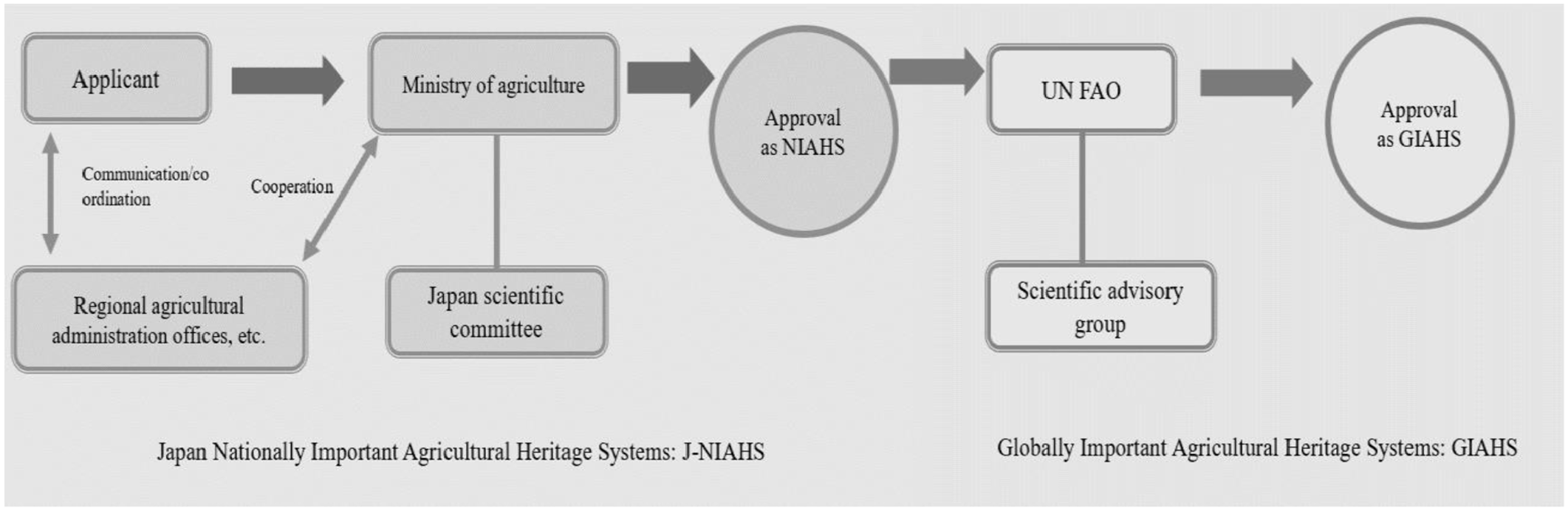
The organization and process of GIAHS and J-NIAHS certification.
The Scientific Advisory Group of the GIAHS evaluates and screens the GIAHS candidate sites on the basis of five standards (Table 1): (1) ‘food and livelihood security’, which requires that the agricultural system contributes to secure food and/or livelihood of local communities; (2) ‘agro-biodiversity’, which requires the system to be endowed with globally significant biodiversity and genetic resources for food and agriculture; (3) ‘local and traditional knowledge systems’, which require the system to maintain local traditional knowledge and practices, ingenious adaptive technologies, and natural resource management systems; (4) ‘cultures, value systems, and social organizations’, which require the system to include those elements that are associated with resource management and food production and contribute to conserving natural resources and promoting equitable use and access to them among stakeholders in the communities; and (5) ‘landscapes and seascapes features’, which require the systems to represent landscapes or seascapes developed through the interaction between humans and the environment over time. These are the standards set by the FAO as the ‘rule-maker’ in GIAHS regulation.
The standards of GIAHS and J-NIAHS.
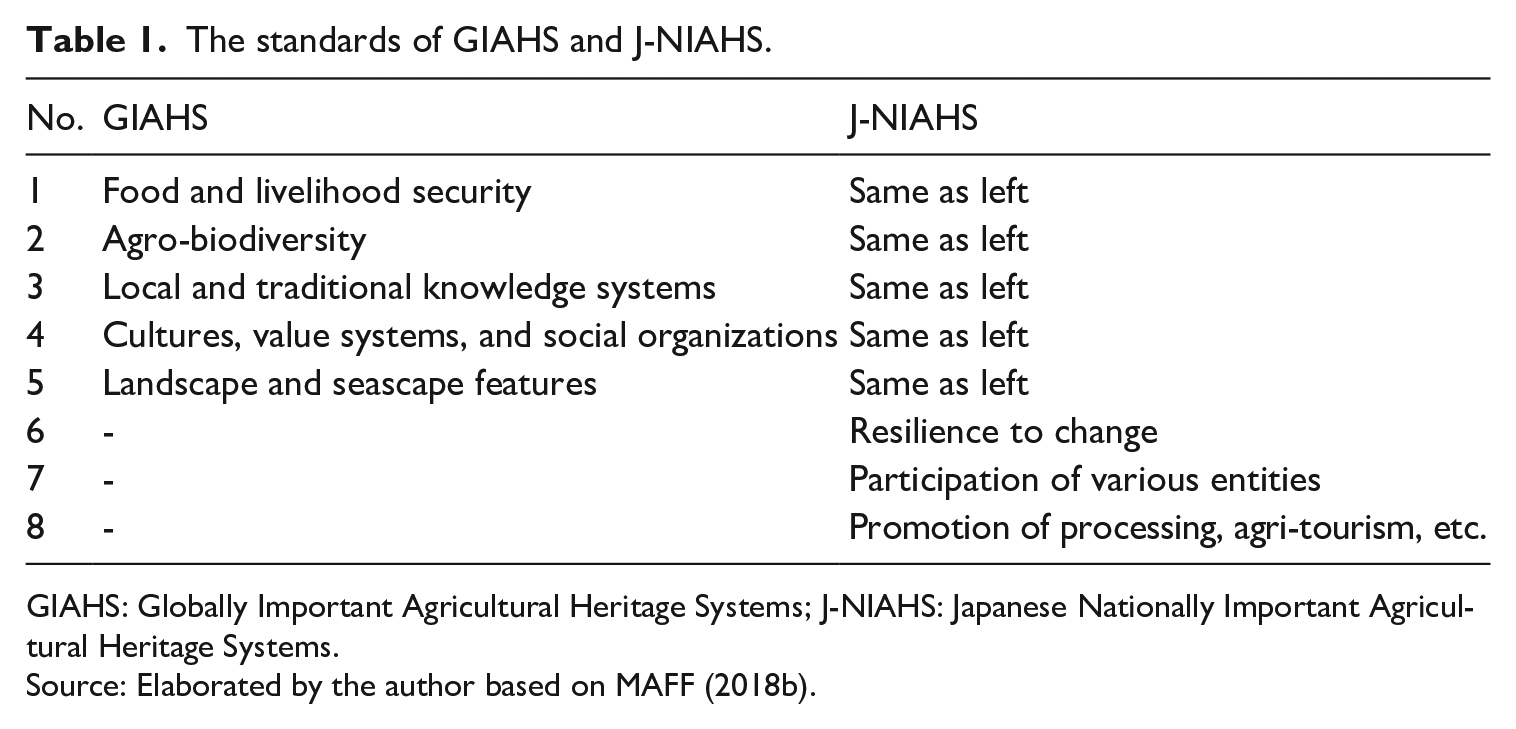
GIAHS: Globally Important Agricultural Heritage Systems; J-NIAHS: Japanese Nationally Important Agricultural Heritage Systems.
Source: Elaborated by the author based on MAFF (2018b).
In addition to these standards, the MAFF as the ‘intermediary’ imposes three additional standards (Table 1): both the J-NIAHS and GIAHS designated in Japan meet all eight standards. Standard (6) ‘resilience to change’ requires the systems to be resilient to natural disasters that have been increasingly damaging and influencing Japanese agriculture in recent decades, as well as other social changes to ensure generational sustainability. Standard (7) ‘participation of various entities’ requires the systems to create new systems that include non-local entities to support local aging and decreasing stakeholders who must ensure the agricultural systems are intact for the next generations. Standard (8) ‘promotion of processing, agri-tourism, etc’. requires the systems to promote agri-food products with brands and/or tourism initiatives that employ historical values, agri-food products, traditional cultures, and landscapes to revitalize the local economy.
Here, we can observe the translation of values developed by the FAO for the GIAHS into the national context by the MAFF. Standards (6)–(8) reflect the policies of the MAFF that actively promote pro-market economy policies, new technology-driven innovation, corporatization, and international tourism to revitalize the declined rural economies (see the next subsection). The FAO does not prohibit the GIAHS from adopting new technologies and innovative agricultural practices as it emphasizes the idea of ‘dynamic conservation’ of living heritages, which makes the GIAHS different from the conservation methods of United Nations Educational, Scientific and Cultural Organization’s (UNESCO) Cultural World Heritage based on the 1972 World Heritage Convention (FAO, 2018b). FAO’s position as the ‘rule-maker’ creates room for ‘intermediaries’ to maneuver the GIAHS regulation and capture it to be a supportive tool for their own policies.
As of November 2021, there are 62 designated GIAHS in 22 countries and 15 candidate sites in eight countries under evaluation (FAO, 2021a). Among the designated sites, 36 (58.1%) are from seven Asian countries, eight (12.9%) are from six African countries, six (9.7%) are from three European countries, four (6.5%) are from two Middle East countries, and three sites (4.8%) are from three Latin American countries (FAO, 2021a). China and Japan are the most dominant countries in GIAHS designation as the former has 15 sites (24.2%) and the latter has 11 sites (17.7%) (Table 2).
The list of GIAHS in Japan.
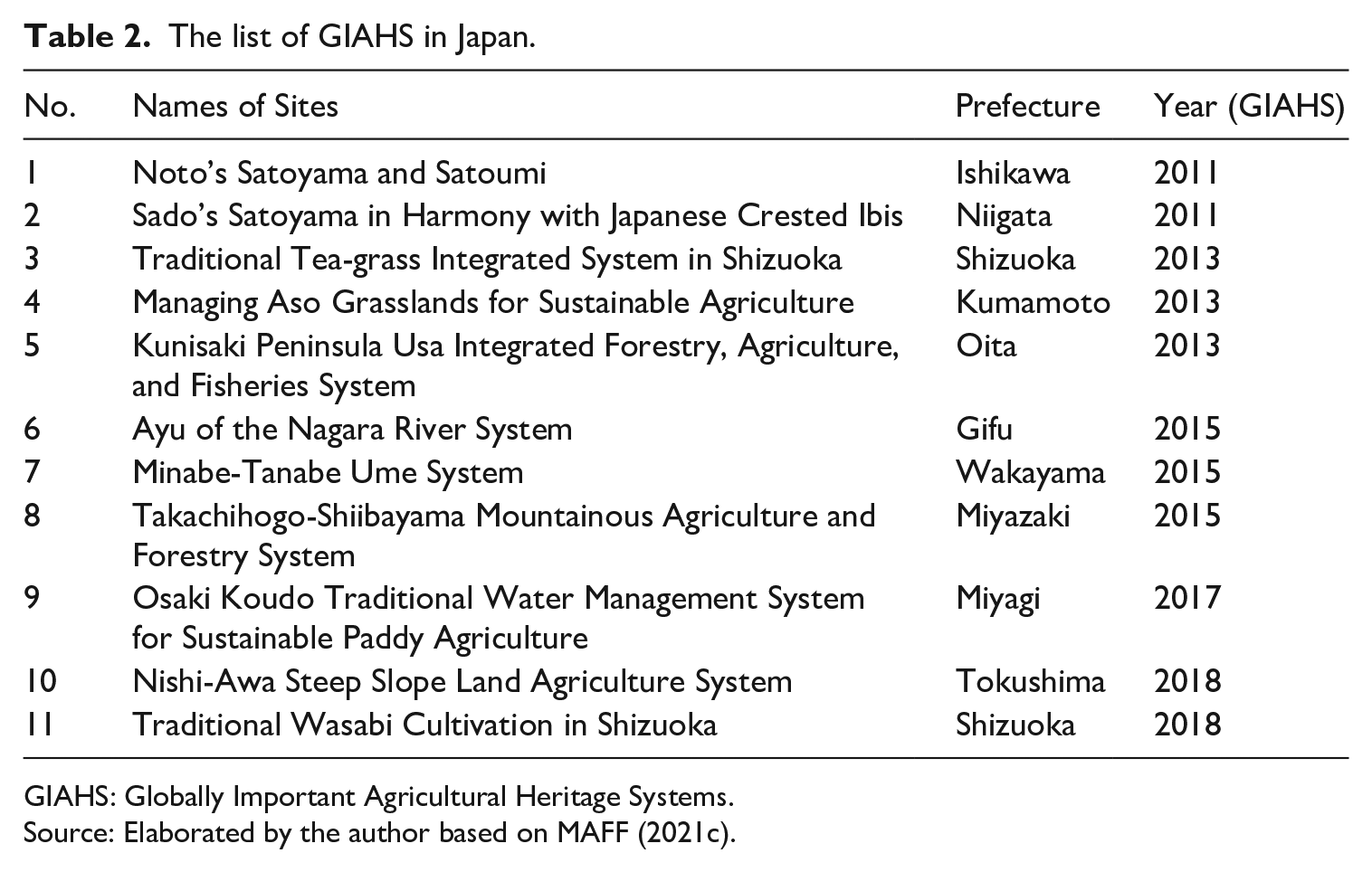
GIAHS: Globally Important Agricultural Heritage Systems.
Source: Elaborated by the author based on MAFF (2021c).
Stakeholders in the designated sites of GIAHS often expect their agri-food products to become value-added and enjoy price appreciation based on the UN organization’s endorsement of their quality and possible international recognition. An objective of the GIAHS program is to also promote agri-food products of the sites to reinforce their economic viability. However, the official logotype and pictogram of the GIAHS (Figure 2), licensed by the FAO and used to raise awareness on the values of the designated systems at local, national, and international levels, cannot be labeled on the commercial products and therefore cannot contribute to increasing their visibility in the markets (Fernandez et al., 2020). Consequently, the average consumers do not sufficiently recognize the connection between qualities of agri-food products from GIAHS sites and the values of the GIAHS (Kajima et al., 2017; Uchiyama et al., 2017). In addition, according to a recent study by the Cabinet Office (2021) of the Japanese government, 62.6% of Japanese citizens do not recognize the GIAHS.
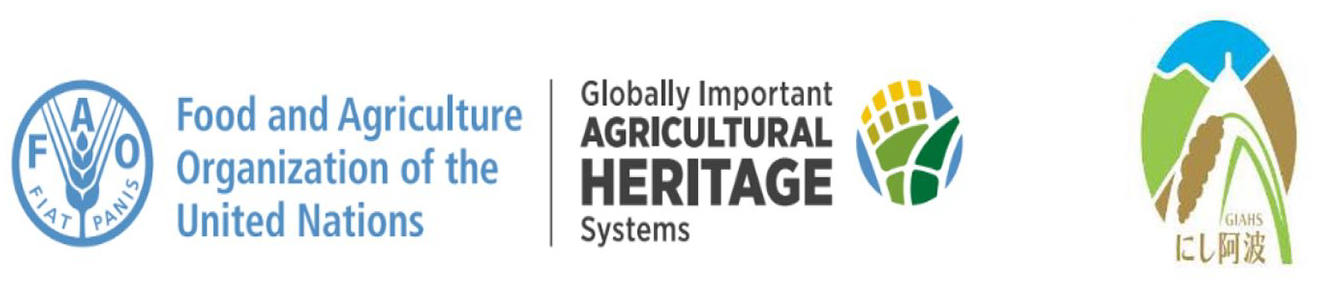
FAO’s GIAHS logotype and pictogram, and the Nishi-Awa GIAHS Logo.
To overcome this gap, GIAHS stakeholders often employ alternative quality certification schemes, including geographical indications and other territorial labels such as Slow Food Presidia, to promote their agri-food products (Fernandez et al., 2020). For instance, the salt produced in the Agricultural System of Valle Salado de Añana, Spain, a GIAHS, is sold with the Presidia label, while sake (alcohol made from rice), Hakusan Kikusake in Noto’s Satoyama and Satoumi, a GIAHS in Ishikawa Prefecture, Japan, is registered as a geographical indication (Fernandez et al., 2020; Kajima et al., 2017). The heirloom rice varieties produced in Ifgao Rice Terraces in the Philippines, a GIAHS, are certified as geographical indications (Sekine, 2021d). In all GIAHS sites in Japan, the local stakeholders established their original logos and associated agri-food labeling systems to promote their products under the name of GIAHS but without an official logotype or logo of the GIAHS (MAFF, 2018a, 2018b). This can be understood as hybridization of standards employed by ‘rule-takers’. However, the rigorousness and impacts of these original agri-food labeling systems to guarantee the quality anchored to GIAHS standards is under-investigated. This study strives to bridge this gap with the case study of GIAHS Nishi-Awa.
Japanese agri-food and rural policies: Seeking tradition and modernization
While embracing a market liberalization policy that prioritizes economic growth and industrialization/financialization of society over the last decades, Japan has experienced a surge of imported agri-food products and long-standing stagnation of the rural economy and declined agricultural production (Sekine and Bonanno, 2016). The Japanese agricultural sector and rural society are facing a crisis for decades. Key indicators signify the exceptional status of the Japanese agricultural sector worldwide: a food self-sufficiency ratio at 37% in calorie base in 2020, over 70% of farmers aged older than 65 years since 2019, 35.9% of farmers having left the sector between 2010 and 2020, and around 10% of the farmland being abandoned in 2015. The Japan Policy Council (2014; i.e. the ‘Masuda Report’) predicted that 896 (49.8%) of the 1799 Japanese municipalities would disappear by 2040 because of the decline in fertility rate. 1 Most of those listed as ‘possibly disappearing municipalities’ in this report were in disfavored areas such as mountains and islands.
Despite these warning indicators, the government continued to further liberalize the market, signing new free trade agreements or economic partnership agreements such as the Comprehensive and Progressive Agreement for Trans-Pacific Partnership, which came into effect among 11 countries in 2018; the Japan–European Union (EU) Economic Partnership Agreement in 2019; the Japan–United Nations (US) Trade Agreement in 2020; and the Regional Comprehensive Economic Partnership Agreement in 2022 among 10 countries (Ministry of Foreign Affairs of Japan, 2021). To revitalize Japanese farmers and promote international competitiveness, the government promoted neoliberal policies that allowed corporations, including foreign trans-national corporations, to enter the agricultural production sector; incentivize farmers to increase their farm size and adopt the most advanced technologies such as digitalization, artificial intelligence, robotics, cyborgs, and unmanned tractors; and encourage them to export their products and diversify their farm activities, including food processing, direct sales, and agri-tourism (Sekine, 2016, 2021b).
However, the perceived continuously shrinking agricultural sector and declining rural communities have led to criticism concerning the effectiveness and appropriateness of the government’s policies (Sekine, 2021c). In 2020, the Cabinet approved the fifth Basic Plan for Food, Agriculture, and Rural Areas, which referred to public supports for small- and-medium-sized farms and farms located in disfavored mountainous areas. In addition, the government presented the Green Food System Strategy namely Measures for Achievement of Decarbonization and Resilience with Innovation (MeaDRI), which aims to neutralize the carbon footprint of agriculture, forestry, and fisheries by 2050 and promote organic farming in the UN Food Systems Summit in 2021 (Sekine, 2021a). The government also continues to financially support FAO’s GIAHS program in line with the UN Decade of Family Farming to support small-sized family farmers (MAFF 2021c). Therefore, today’s Japanese agri-food policies are driven by neoliberalism and technocracy as well as by initiatives for organic farming and small-scale family farming. Cognizant of the lack of labor in the agricultural sector in general, and especially in small-scale family farming in unfavored areas and labor-intensive organic farming contexts, the government promotes the adaptation of the most advanced technologies such as digitalization and robotics in these sectors. This is the rationality of the Japanese government’s behavior as the ‘intermediary’ of the GIAHS regulation system.
A case of GIAHS: Nishi-Awa Steep Slope Land Agriculture System
Topography, history, and society
The Nishi-Awa steep slope land agriculture system was designated as J-NIAHS by the MAFF in 2017 and as part of the GIAHS in 2018 by the FAO (interview with the Association on 27 September 2019). Located in the west area of Tokushima Prefecture, Shikoku Island, Japan (Figure 3), the region called Nishi-Awa comprises four municipalities: Mima City, Miyoshi City, Tsurugi Town, and Higashi-Miyoshi Town; around 80,000 residents and 10,000 farming families occupy this region (interview with Tsurugi Town on 27 September 2019). Only 0.7% of the territory is dedicated for farming, while 84.7% is occupied by forests (Tokushima-Mt Tsurugi GIAHS Promotion Association, 2017a; Tokushima-Mt Tsurugi GIAHS Promotion Association, 2021). As of 2021, it comprises around 970 ha (estimation) of steep slope farmland, 192 villages, and around 2500 households. The average size of the farmland in the mountainous area of Nishi-Awa region is 0.38 ha/household (Naito, 2021). The villages in the area are between 300 m–700 m from sea level (interview with the Association on 27 September 2019). The angles of inclination of farmlands are between 30°–40° (Picture 1). This area of Nishi-Awa is isolated by Mt. Tsurugi and the Yoshino River and has been home to small villages of small-scale farming families for over four centuries (Picture 2). The human history of this area dates back to the Jomon period (B.C. 13,000 to B.C. 2400) (interview with the Association on 27 September2019). An American Japanologist, Alex Kerr, called Nishi-Awa the ‘Japanese Shangri-La’.
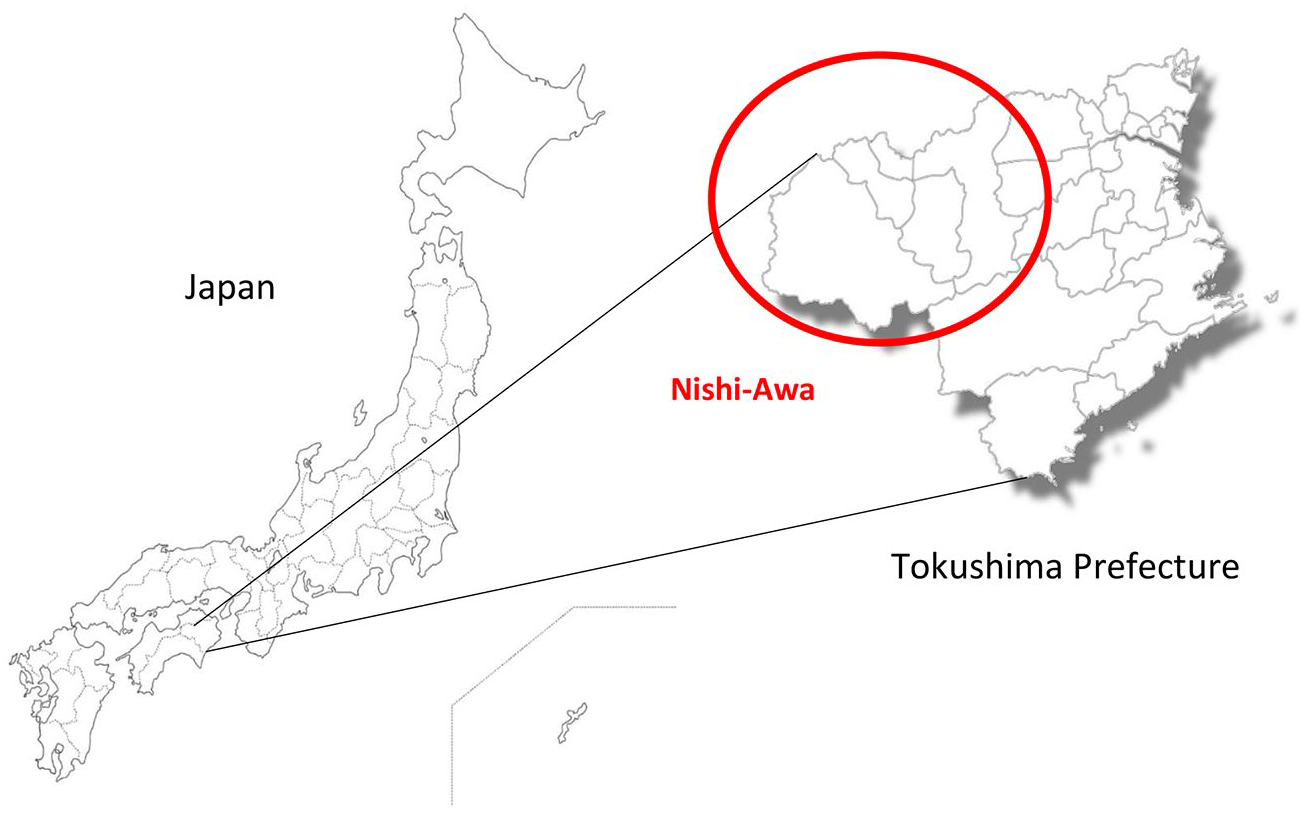
The location of Tokushima Prefecture and Nishi-Awa Region in Japan.
The region is on the Japan Median Tectonic Line, which is the longest Japanese fault system that is formed by four tectonic plates’ movements and causes earthquakes, landslides, and landslips on mountains (Tokushima-Mt. Tsurugi GIAHS Promotion Association, 2017b). This topology makes it difficult for local farmers to form terraces for pond rice fields. To survive in the region, they maintained inclined farmlands and carried out swidden farming in ancient times (interview with the Association on 27 September 2019). As villages produced different varieties of crops according to their topology, micro-climate, and farming practices, they exchanged their crops with each other. Based on subsistence agriculture, forestry, and hunting wildlife, as well as local exchanges, the communities in the area were relatively autonomist. The common natural and social conditions contributed to creating the cultural and linguistic uniformity of the mountainous Nishi-Awa area, which differs from those of lowland areas. The residents in lowland areas called the villages in the mountainous area ‘villages in the sky’ (interview with the Association on 28 September 2019; Hayashi, 2015).
However, the modernization and commercial agriculture brought gradual changes in the area. In the seventeenth century, tobacco leaf production started in the Edo era and became an important cash crop (Naito, 2021). At that time, the steep slope farmland in the mountainous area of Nishi-Awa was converted from subsistence crop production to tobacco leaf production. The production was further propelled when the government established a national monopolistic cooperative to promote the tobacco industry and built one of its factories in the Nishi-Awa region in the nineteenth century, during the Meiji era. Despite the partial commercialization of livelihoods, local farmers continued to use local resources such as grasses and woods collected on grasslands and forests for fertilizers, house construction, and fuels, and produced their subsistence crops such as grains, vegetables, and fruits that helped them maintain their livelihood through basic subsistence and in a manner that was circular with local natural resources.
In the second half of the twentieth century and the early twenty-first century, the socio-economic condition of the area was considerably transformed, and livelihoods were further commercialized (interview with the Association on 27 September 2019). While traditional livelihoods and relations with local natural resources were relatively better maintained than in urban areas, agro-chemicals increasingly replaced organic materials, and commercial fuels such as petroleum and electricity conquered wood fuel. The tobacco industry, which brought cash income to farming families in the area, also declined because of the increase in imported tobacco and the decrease in its consumption among Japanese smokers (Shimizu, 2004). These conditions impelled the farmers and rural population to leave the area and move to lowland urban areas in search of better economic opportunities, which caused severe depopulation and aging in the area (interview with the Association and farmers on 27–28 September 2019).
The promotion of agri-tourism and local agri-food products became an important component for the communities to revitalize the local economy and society in the area. The designations of J-NIAHS and GIAHS are considered a good opportunity for the area to promote its traditional agricultural system, biodiversity, and culture, and improve socio-economic conditions while protecting local resources and landscapes. Some farmers testified that their farmlands, which were formerly dedicated to tobacco leaf production, were transformed into grasslands to harvest grass called kaya for multiple purposes, which formed the core values of GIAHS Nishi-Awa (interview with farmers on 27–28 September 2019).
Claimed values of GIAHS Nishi-Awa
As explained in the third section, the J-NIAHS and GIAHS in Japan formally meet the eight standards (Table 1). Table 3 provides a summary of the elements that constitute the GIAHS Nishi-Awa Steep Slope Land Agriculture System, which is categorized by these eight standards.
The elements of GIAHS in Nishi-Awa, Japan.

GIAHS: Globally Important Agricultural Heritage Systems.
Source: Elaborated by the author based on interviews in 2019, FAO (2018b), Tokushima-Mt. Tsurugi GIAHS Promotion Association (2017a, 2017b).
First, ‘food and livelihood security’ is the core of GIAHS Nishi-Awa, as small-scale farmers – mainly women and elderly people – produce small quantities of a wide range of crops for their subsistence as well as exchange among farmers, their relatives, and neighbors. Their products are sold via agricultural cooperatives or farmers’ markets, generating cash income for the farmers. They select and reproduce seeds of indigenous crops for the following year.
Second, ‘agro-biodiversity’ is maintained as farmers grow around 140 different varieties of crops, such as grains, tubers, and vegetables – some of which are indigenous varieties. As it is difficult to cultivate rice in the area, which is the staple food in many Japanese regions, farmers in the area produce over 40 varieties of grains, such as Japanese barnyard millet, foxtail millet, proso millet, finger millet, great millet, and buckwheat (Picture 3) on steep slope farmland. As farmers keep their seeds for self-use and exchanges with other farmers, this collective system functions as territorial gene banks. In addition, the grasslands, maintained by farmers to provide grass called kaya for agricultural purposes, are reserved for wild flora and fauna, including 282 species of plants, 241 species of insects, 28 species of birds, and animals.
Third, ‘local and traditional knowledge systems’ play crucial roles in GIAHS Nishi-Awa. Farmers harvest the kaya grass (mainly Miscanthus sinensis) in the fall, dry them under sunlight, and make traditional conical grass stacks called Koeguro (Picture 4), in which the grass used becomes the reserve of microorganisms (interview with farmers on 27–28 September 2019). In the spring, the grass are cut and buried in soil and/or used to cover soil as mulch, which protects the soil from erosion, improves the soil structure, provides organic matter, preserves soil moisture, and so on. The grass were also used for the roofs of traditional thatched houses, which still exist and are used for tourism inns in the area. In addition, as it is difficult to build terraces because of the topography, farmers build stone walls and ridges along contours that function as dams to preserve water and prevent soil runoff because of rainfall. Farmers regularly lift up the soil that gradually runs off from the steep slope land; they do so by hand using adapted farming tools (Picture 5), since farming in the area is difficult to mechanize. These farming tools are hand-made individually by a local smith.
Fourth, ‘cultures, value systems, and social organizations’ are important components of the system. Traditional food cultures and recipes (Picture 6) exist based on indigenous crops and techniques to preserve them, such as sun-drying and keeping tubers in caves. In addition, traditional songs are sung to ease the arduous farm work, and agricultural festivals and events are passed down from one generation to another in each hamlet. These serve to unify residents involved in steep slope land agriculture and include ritualistic aspects such as praying for rain.
Fifth, the system contains ‘landscape and seascape features’. On the steep slope of Mt. Tsurugi, we can see a uniquely beautiful mosaic landscape comprising farmlands, grasslands, housing, and forests (i.e. the ‘Japanese Shangri-La’; Picture 1). The traditional conical grass stacks called Koeguro (Picture 3) are iconic elements of the unique landscape.
Sixth, ‘resilience to change’ is realized by the knowledge of the system that allowed residents to flexibly adapt to the natural environment, weather-related disasters, and social changes. In recent years, the Tokushima-Mt. Tsurugi GIAHS Promotion Association invited volunteers from abroad and organized international work-camps to maintain and preserve local resources. It also receives students and trainees from corporations who contribute to the preservation of local resources.
Seventh, ‘participation of various entities’ can be observed in the Association that comprises four municipalities, two agricultural cooperatives, agricultural research institutions, the Tokushima Prefecture, the Tokushima University, the local chamber of commerce and private corporations, tourism corporations, and local school boards.
Eighth, ‘promotion of processing, agri-tourism, etc.’ is the central activity in GIAHS Nishi-Awa. Several farmers and their groups produce and sell their fresh and processed agri-food products in farmers’ markets and so on. Moreover, the Association established an original agri-food labeling system and the GIAHS logo to brand local products. Several farmers run farmers’ inns and receive domestic and foreign tourists, including school-aged children. Moreover, local stakeholders organize study tours for tourists and publish educational materials. The number of domestic and foreign tourists visiting the area has increased sharply in recent years. 2
Local agri-food labeling system: Translation of standards
Despite these positive activities, the number of farmers has declined, and their incomes are stagnating, leading to a lack of successors before the designation. To improve the economic viability of farmers in the area, the Association established its own agri-food labeling system and logo (Figure 2) in 2019 (interview with the Association on 27 September 2019). The logo comprises the symbolic elements in GIAHS Nishi-Awa, such as an ear of millet grain; a grass stack Koeguro; steep slope land, mountains, and sky; as well as the logotype ‘GIAHS’ in English and ‘Nishi-Awa’ in Japanese characters.
The requirements to be certified in this agri-food labeling system – GIAHS Nishi-Awa steep slope land agriculture system brand certification – are quite simple: ‘the products must be agricultural products grown with kaya
These points may seem to be unnecessary concerns; however, one farmer testified that he supplies dried and cut kaya grass as mulch on his farmlands but does not form Koeguro, which requires backbreaking work and time (interview with a farmer on 28 September 2019). In this case, the production of his products labeled as ‘GIAHS Nishi-Awa Brand’ cannot contribute to the GIAHS standard (5) ‘landscape and seascape features’. This relaxed standard can attract more local farmers and products to be included in the labeling system. However, as shown, if the local agri-food labeling system is not intentionally designed to incentivize farmers to keep the code of conduct to maintain the values of GIAHS Nishi-Awa, it would be difficult to maintain them in the mid- and long-term periods.
This certification is free-of-charge for farmers as local municipalities provide financial support. However, farmers must renew their licenses every 5 years and pay for the sticker priced at JPY0.80/sticker (USD0.72/sticker), which the farmers have to stick individually by hand (interview with farmers on 27–28 September 2019). The certified products count 140 varieties of agricultural products and processed foods produced in the area (Picture 7). These products are sold in local farmers’ markets, local restaurants and cafeterias, supermarkets in Tokushima Prefecture and its adjacent prefectures, and in major cities such as Osaka (interviews with farmers, restaurant owner, and cafeteria staff on 27–28 September 2019).
While the prices of millet grains appreciated by 566% from JPY300 /300 g/bag (USD2.72/300 g/bag) to JPY1700/300 g/bag (USD15.45 /300 g/bag) thanks to GIAHS designation (interview with the Association on 28 September 2019), other vegetables did not enjoy price appreciation (interview with farmers on 27–28 September 2019). Farmers pay a 20% commission from their sales to a local direct sale shop (interview with farmers on 27–28 September 2019). This means that the most symbolic products (such as grains) are appreciated, while other vegetables (such as radish and pumpkin) that exist in other places are not considered as symbolic products even though they are labeled with the local GIAHS logo.
The annual sales of semi-subsistence farming of two families are around JPY1 million (USD9090), of which two-thirds come from fresh agricultural products sales and one-third come from processed agri-food products sales (interview with farmers on 27 September 2019). They must pay their production cost of around 50% from these sales. If they run farmers’ inns, they may have an additional income of JPY0.2–JPY0.3 million per year (USD1818–USD2727/year) in addition to their pensions and some subsidies if they are qualified (interview with farmers on 27 September 2019). Among the farming families in the site, often one or several (mostly male) member(s) are employed in lowland cities; they work during ages between 15 and 65 years to remit a good amount of their salaries to their families and then receive pensions after their retirements. According to the interviewed farmers, the number of foreign tourists has not increased since GIAHS designation (interview with farmers on 27 September 2019). Notably, the COVID-19 pandemic has considerably impacted international and domestic tourism since 2020.
Given the low cost of rural life, semi-subsistence livelihoods, and life in their inherited houses, the level of income is sufficient for a decent life in the area. However, the annual income of around JPY0.7 million (USD6363) is much lower than that of former tobacco farmers and that of the so-called ‘working poor’ (workers who earn JPY2 million /person/year (USD18,181/person/year)) in Japan. A commercial farmer admitted that the values highly appreciated under GIAHS standards and the local labeling system in local markets, such as the use of kaya, cannot be recognized in remote and conventional markets in big cities such as Osaka and Nagoya, even with the labeling of the local GIAHS logo (interview with a farmer on 28 September 2019).
An interviewed commercial farmer admitted that his income was slashed by half compared to his former income as a salary man of a private corporation (interview with a farmer on 28 September 2019). Although this retired farmer in his early sixties was waiting for his childhood friends who left the village to return and start farming, he said that stable employment is more attractive for most of them (interview with a farmer on 28 September 2019). Other farmers testified that their employed children working in lowland cities were satisfied with their situations and did not intend to return to succeed farming (interview with farmers on 27 September 2019).
However, there are also newcomer families who did not originate from the area but decided to live there because of clean and ample water and air, which were not accessible when they lived in a lowland big city (interview with farmers on 27 September 2019). Another farmer in her seventies said that she prefers where she lives even though it takes about 30 minutes to reach the hospital by ambulance during an emergency (interview with a farmer on 27 September 2019). She added that if she lived in a big city, an ambulance may not be able to find her a hospital during an emergency given the large population and numerous emergencies. This shows that farmers living in the GIAHS Nishi-Awa area recognize the value of their way of life despite their income levels. The findings suggest that the translation of standards in the case of GIAHS Nishi-Awa by the ‘intermediary’ and implementation of these translated standards at the local level by the ‘rule-taker’ may not completely meet the local reality.
Discussion and conclusion
Based on the theoretical perspectives on translation of global standards (Arnold and Loconto, 2021) and the RIT model in regulatory governance (Abbott et al., 2017), this study demonstrated the process and organizations that translated international standards and values into a local context and extended the relevance of the theoretical perspectives to GIAHS regulation, with an empirical case of GIAHS Nishi-Awa. As the GIAHS regulatory goals are to conserve traditional agro-ecosystems and associated biodiversity, natural resources, outstanding landscapes, and cultural heritages that are closely tied with small-scale family farmers, GIAHS standards and its translation into national and local contexts in the case of Nishi-Awa are not exclusive for local small-scale family farmers which differ from other stringent global standards (Bingen and Busch, 2006: 13). However, the translation of GIAHS standards by the MAFF as the ‘intermediary’, driven by market-oriented policies, and the implementation by the Association as the ‘rule-taker’ may eloign the achievement of GIAHS’s regulatory goals.
In response to the research questions, this study points out that first, the FAO – as a ‘rule-maker’ – established the five standards and schemes of GIAHS designation, and the MAFF – as an ‘intermediary’ – translated the rules according to the national context, and transformed the scheme into a tool not only for the conservation of ecological and socio-cultural diversity but also for the economic development of declining rural communities. The original design of the GIAHS allowed for translation in this direction by the ‘intermediaries’. Furthermore, the Association as a ‘rule-taker’ also participated in the process of translating values embedded in GIAHS standards into local practices. This means that the Association adopted inclusive but relaxed standards that do not necessarily correspond to all eight standards of the J-NIAHS and GIAHS in Japan at the expense of a more rigorous code of conduct. The decision made by the Association may be driven by the rural culture that prioritizes inclusiveness than exclusiveness and by the willingness to offer diverse economic opportunities to salvage local communities.
However, the success of grains, which received price appreciation thanks to GIAHS’s reputation, may harm the agro-biodiversity of GIAHS Nishi-Awa as the farmers may change their portfolio of polyculture production into a grain-dominated one. The commercialization of crops may also threaten the local food culture as grains become lucrative products and therefore unaffordable as staple foods for local low-income populations.
Second, despite these concerns, the income levels of semi-subsistence farmers in the area continue to be lower than that of other professions in lowland cities and many do not have successors. The stakeholders in GIAHS Nishi-Awa are highly concerned about the future of their communities, local natural resources, traditional knowledge, biodiversity, landscape, healthy diets, and cultural heritages, while the propositions by the government to adopt the quite expensive state-of-the-art technologies do not seem to be feasible solutions for the small-scale family farmers in montane areas. Although the objective of the GIAHS is to raise social awareness on the values of these elements in the dominant hierarchy of values that favor market competitiveness, the GIAHS scheme to conserve the claimed values is faced with a contradictory situation in a market economy context. While certain products such as grains experience price surge and lead the potential risk to change farmers’ portfolio of production (and therefore local agro-biodiversity and landscape), the overall limited recognition of their products in domestic and international markets as well as the unstable flow of domestic and foreign tourists visiting the site due to the COVID-19 pandemic require a reconsideration of the strategies brought by the ‘intermediary’ and ‘rule-taker’. This fact demonstrates that even though an alternative agri-food initiative is explicitly designed to protect small-scale family farmers, traditional practices, and associated values under the GIAHS, unwanted consequences within the market economy cannot be eliminated, and this may create new challenges.
Third, the implications of this study to policy-makers and the stakeholders of GIAHS from international to local levels are as follows: (1) GIAHS regulation needs appropriate interventions from the FAO as the ‘rule-maker’ to more stringently define the qualities of products that are marketed under the name of GIAHS and mobilize additional regulatory measures in the product certification/labeling systems, such as requirements of specifications and/or participatory regulatory systems that are coherently guided by GIAHS regulation. This revision in the current GIAHS regulatory governance would improve the transparency and therefore the public trust on GIAHS and the quality of related products.
(2) The MAFF (the Japanese government), as the ‘intermediary’, is also required to revisit its strategies to centralize market-driven solutions to overcome the crises caused by the very centralized market-driven solutions and experienced by farmers and communities especially in the disadvantaged areas such as mountainous regions. Instead of these solutions, it can strive to improve other supportive policies such as direct payment schemes complying with environmental and social sustainability requirements up to the level of the European Union, for instance, and promote non-economic values of the J-NIAHS and GIAHS in its territory.
(3) The Association of GIAHS Nishi-Awa as the ‘rule-taker’ can regain abilities of policy decision-making independent from the strategies imposed by the ‘intermediary’ that emphasize the role of market economy and reconstruct the local agri-food labeling system dedicated for products in the GIAHS site, in accordance with the ‘rule-maker’. Furthermore, it can disseminate the traditional knowledge in local farming systems and mainstream the idea of GIAHS in other regions in and out of the country; it can also call for robust and orchestrated policies based on the GIAHS regulatory systems to the government, to ensure the sustainability of livelihoods and ecosystems in the designated site. These possible policies and practices are concomitant of the market economy but can potentially transform and transcend it.
A limitation of this study is that it does not reveal the concrete and detailed process of translation of GIAHS standards, those who influenced the process (as well as when, how, and with what objectives), or the outcomes in mid- and long-term perspectives. Further analyses on power relations among stakeholders in the GIAHS regulatory governance and beyond remain as the author’s future research agenda.
Footnotes
Appendix 1
Acknowledgements
The author appreciates the cooperation of all informants that made this publication possible.
Declaration of conflicting interests
The author declared no potential conflicts of interest with respect to the research, authorship, and/or publication of this article.
Funding
The author disclosed receipt of the following financial support for the research, authorship, and/or publication of this article: This work was supported by Japan Society for the Promotion of Science KAKENHI Grant-in-Aid for Early-Career Scientists [grant number 18K14542].
