




Abstract
The study focuses on the relation of economic inequality and political democracy, specifically exploring the democratic consequences of income concentration. It places income concentration among a composite of factors of democracy and considers democracy within a set of results of economic inequality. The study first surveys how the relationship of income and other economic inequality to democracy is theorized and researched in sociology and economics. It then outlines a conceptual framework for analyzing economic inequality’s relationship with and especially net balance of consequences for democracy. It collects and analyzes cross-national data by empirical analyses and reports and discusses the results. Its key result is that income inequality is consequential mostly in an adverse way for political democracy and social freedom. The article’s intended contribution is to better understanding and explaining the relations of economic inequality to democracy among contemporary societies.
Introduction
Is economic inequality such as income or wealth concentration consequential for political democracy in contemporary Western and comparable societies and, if so, to what degree? And vice versa: does political democracy matter for income or wealth concentration and generally economic inequality and deprivation and, if it does, how much so in these and other societies? This article while keeping in mind the second question centers on the first issue – the consequences that income and by implication wealth concentration has for democracy in contemporary societies.
As it stands, the first issue appears as a critical macroscopic sociological question of the existence or non-existence and viability or non-viability of democracy and hence freedom, equality, and justice in society, in consequence of income or wealth concentration. Arguably, if income or wealth concentration is consequential adversely and greatly so for democracy, then the latter’s existence or viability in contemporary Western and comparable societies raises a question mark, clouds itself in uncertainty and perhaps is ultimately negated or threatened especially in longer time horizons. Thus, insofar as the concentration of income or wealth inexorably leads to that of power, this outcome as profoundly undemocratic undermines or threatens liberal democracy and so universal liberty, equality, and justice in society. Conversely, so long as the concentration of power perpetuates and reinforces that of income or wealth, this forms a self-perpetuating vicious cycle of non-democracy and severe economic inequality – or a virtuous circle for the holders of concentrated material assets and political resources – rather than self-sustaining democracy and an egalitarian economy.
The question of the consequences of economic inequality in the form of income or wealth concentration on democracy occupies a prominent place in the contemporary literature and debates in the field of sociology and related fields such as economics and political science, as relevant selected instances illustrate. For instance,Goldberg (2001) expresses concerns that the rising concentration of wealth and thus income especially in the United States under neoconservatism (‘neoliberalism’) reaffirms the ‘continuing relevance of Tocqueville’s fears about the emergence of a new aristocracy’ and thus poses a serious threat to democracy and social justice, as does the ‘authoritarian welfare state’ as the project and indeed ‘success of the New Right’. More broadly, Wright (2013) argues that modern capitalism tends to withdraw ‘crucial decisions from public deliberation’, to link concentrated private wealth with equivalent political power, and to create ‘workplace dictatorships’, and as a result to reproduce ‘severe deficits’ in democratic processes and values. Wright (2013) elaborates that capitalist democracy is inherently incapable of protecting political decision-making from the ‘exercise of power’ founded on concentrated capitalist wealth, and so this problem is inherent in ‘capitalism’s inequalities of wealth and the structural power of capital’ rather than being ‘peculiar to the institutional design of the political game in the US’.
More recently, Piketty (2014) observes that the concentration of income and wealth and in consequence of power intensified since the 1980s through accelerating the growth of capital incomes relative to those of labor with the ‘victories’ of Thatcherism in England and Reaganism in the United States, as manifestations of an antiegalitarian, illiberal, and anti-democratic conservative counterrevolution. Notably, Piketty (2014) 1 theorizes that income and wealth concentration engenders adverse consequences for democracy and meritocracy in that capitalism inherently engenders ‘arbitrary and unsustainable inequalities’ profoundly subverting modern democratic societies’ ‘meritocratic values’ as their bases. As a corollary, Piketty (2014) infers that the concentration of capital and income tends to reach ‘extremely high levels’ that have the potential to undermine democratic societies’ core ‘meritocratic values and principles of social justice’. Furthermore, most recently, Piketty (2020) 2 issues the warning that illiberal xenophobic populism may become victorious in the electoral process and by its radical actions result in destroying global capitalism and democracy, so long as democratic societies do not profoundly transform the current capitalist system in a ‘less inegalitarian, more equitable, and more sustainable’ form (similar warnings are implied in Gethin et al., 2022). In this connection, Müller (2014) observes that populism is on the ‘rise across the West: from the American Tea Party to the Front National in France’ and beyond and characterizes populism as ‘a profoundly illiberal and, in the end, directly undemocratic understanding of representative democracy’.
Acemoglu (2005) suggests that economic inequality undermines democracy and facilitates autocracy and political repression, observing that ‘a very unequal distribution of income and wealth’ is entirely compatible with ‘a similarly unequal distribution of political power’ via dictatorships and other oppressive systems. Conversely, Acemoglu et al. (2010) predict that economic equality produces positive consequences for democracy in that if income or wealth inequality diminishes and is low, then a society tends to turn ‘democratic rapidly’. They elaborate that instead societies with high economic inequality levels are prone to be ‘nondemocratic (either oligarchic or a military dictatorship)’ featuring ‘little spending’ on civilian public goods and ‘substantial’ expenditure on the military (Acemoglu et al., 2010). Acemoglu and Robinson (2006) exemplify the connection of the concentration of income and wealth with that of power, including oligarchy, by the example of the US post-bellum South in which a ‘labor-intensive, low-wage, low-education, and repressive economy’ resembling slavery coexisted with its elites’ ‘political control’, particularly, ‘an oligarchic structure’ enabling their ‘monopolization of political power’, simply with non-democracy and un-freedom.
In this context, Stiglitz (2012) suggests that the sociopolitical price of rising economic inequality in the United States through the growing concentration of wealth/income in the ‘upper 1 percent (or the upper 0.1 percent)’ includes potentially making America ‘a land of an inherited oligarchy’ or ‘plutocracy’ and enabling capitalists to play the ‘dictator game’ (and in that sense capitalist dictatorship). Stiglitz (2016) adds that the concentration of income and wealth is linked with that of power in the United States as a whole, stating that its high, growing economic inequality is mainly associated with political factors such as changes in the ‘rules of the game’ and in the ways of their implementation, rather than being just the ‘result’ of market and technological forces. Notably, Stiglitz implicitly warns that income and wealth concentration may cause undemocratic consequences like political and social exclusion, while predicting that increasing economic equality will have opposite effects such as reducing exclusionary and related tendencies in society, just as improving the performance of the US economy. In a similar vein, Mokyr (2014) warns referring to the United States that growing income and wealth concentration ‘in a winner-take-all’ society, whatever its effects on economic dynamism, represents ‘a ticking political time bomb’. In addition, Bénabou, Ticchi, and Vindigni (2015) observe that since Reaganomics rising income inequality in the compounded capitalist-theocratic ‘American regime’ results in the forming of a ‘Religious-Right alliance’ between the capitalist class and religious lower classes, undermining democratic liberties, just as obstructing ‘belief-eroding discoveries and ideas’, and thus suggest that growingly unequal economic distribution generates anti-democratic as well as anti-rationalistic consequences.
Generally, Scheuer and Wolitzky (2016) infer from the relevant literature that the tendency for ‘high levels of economic inequality’ though income and wealth concentration to lead to ‘political instability’, including undemocratic outcomes, has become a ‘fundamental observation’ in contemporary political economy. In comparative terms, Haggard and Kaufman (2017) note the ‘growing concern’ about the ‘adverse’ democratic political impact of high economic inequality such as income and wealth concentration in certain contemporary societies. Especially, they register (even if partly question) the above fundamental observation and even proxy consensus in the extant literature that societies that are relatively equal or not highly unequal in economic terms are more likely to experience ‘transitions’ to liberal democracy while the opposite holds for those exhibiting ‘highly concentrated’ income and assets. In addition, they allow for the possible adverse effects of high income and asset concentration on the ‘quality of democratic rule’ once these transitions to democracy are implemented. 3
Vermeiren (2021) explicitly connects economic crisis and economic inequality within advanced capitalism identifying the ‘two most important challenges’ to egalitarian and democratic capitalism since the Great Depression in ‘spiraling’ income and wealth inequalities since the 1970s and the 2008 global financial crisis. Vermeiren therefore implies that ‘soaring’ income and wealth inequalities are likely to have adverse consequences for democratic capitalism or capitalist democracy, and identifies certain factors, including macroeconomic policy, social policy, corporate governance, and financial policy, shaping the ‘dynamics’ of crisis and growing inequality in the economy. Still, Vermeiren (2021) maintains the ‘prospects for the emergence of a more egalitarian and sustainable form of democratic capitalism’ in which by assumption income and wealth concentration would be lower. Spragens (2021) analyzing the relation of capitalism and thus by implication economic inequality to democracy (and the concomitant laissez-faire versus mixed economy dispute) suggests that the capitalist market necessitates ‘regulation and supplementation by collective action’ in the function of democracy, along with societal well-being and justice, through enhancing the democratic aims and values, as well as prosperity and fairness, of society. Notably, Spragens (2021) implies that economic inequality inherent to especially laissez-faire capitalism, along with the ‘unfairness of the human condition’, may contradict and undermine the ‘liberal ideals of liberty and equality’ and hence liberal and egalitarian democracy. Spragens (2021) considers the capitalism/inequality and democracy problematic (and the laissez-faire versus mixed economy dispute) a mixture of several debates, such as those concerning optimal economic prosperity, distributive justice, and the ‘constitutive purposes and ideals of a good democratic society’.
In general, the actual or potential consequences of income or wealth concentration for democracy in contemporary Western and comparable as well as other societies have become a growing dilemma or persisting puzzle during recent times, especially in the United States and Britain since the 1980s and post-2016. Two tendencies have contributed to this dilemma and the resulting sociological problem of the viability of democracy and social freedom in relation to income or wealth concentration. The first tendency is that toward accelerating income and wealth concentration and hence rising economic inequality in many contemporary Western and comparable societies deemed democracies (the ‘free world’), with the United States, the United Kingdom, and to a lesser extent other Anglo-Saxon countries as the most dramatic instances since Reaganism and Thatcherism and, for the first, post-2016. 4 The second involves the tendency to autocracy and other dictatorships, authoritarian ideology and politics, intensifying government repression, and the surge and influence of political and religious extremism and irrationalism in some of these and other societies, particularly the United States and to some degree Britain after the 1980s and post-2016 and Brexit. 5
Overall, heightened income and wealth concentration in the United States since Reaganism and likely post-2016, Britain during and after Thatcherism and possibly Brexit and to a lesser extent other Anglo-Saxon and Western societies reportedly threatens to become consequential, notably in an adverse and strong manner, for democracy and freedom in society especially in longer terms. 6 Furthermore, some observers suggest that the present outcome of such a process of concentration is ‘plutonomy’ as an apparent equivalent of plutocracy and oligarchy, thus a variation of (capitalist) ‘dictatorships’ or ‘a dictatorial business class’ and hence a distortion of democracy in the United States and other Anglo-Saxon countries. 7 Moreover, even some segments of the US wealthy (the Patriotic Millionaires as ‘“proud” “traitors to their class”’) declare their ‘concern about the destabilizing concentration of wealth and power in America’.
High income and wealth concentration produces a broad spectrum of negative and strong consequences for society, including both its economy and its political and other non-economic systems according to the extant, especially sociology and economics literature. For illustration, the literature finds that income/wealth concentration negatively affects economic growth and development. 8 Also, it reports that such concentration produces or aggravates economic crises and stagnation, exacerbates unemployment, sustains poverty, and hampers economic mobility as especially observed for the United States versus and Europe. 9 In addition, the literature suggests that income/wealth concentration has other related adverse effects on the economy, such as reducing economic welfare and consumption, perpetuating (and being perpetuated by) distributive injustice and exploitation and causing capital-labor violent and other conflicts. Overall, income and wealth distribution affect in important ways these and other macroscopic economic outcomes that hence in various degrees become the function of such a process, including its concentration, judging by the literature. 10
Furthermore, following the literature, income and wealth concentration produces a broad variety of adverse non-economic consequences, such as those on polity, civil society, or the private sphere and culture. One set of negative social and related consequences consists of generating nonmaterial or spiritual inequalities and estrangement and reducing happiness or subjective well-being, in particular health, in society. Another set involves perpetuating or aggravating political inequality and thus contravening and distorting democracy which precisely broad equality in polity or an egalitarian political culture in society typifies. 11 Especially, by virtue of eventuating in or interrelating and mutually reinforcing with concentrated political power, the concentration of income and wealth becomes a factor that is incompatible with, and adversely and ultimately destructive to, democracy and so freedom in society, according to the literature cited previously. 12
In sum, income and wealth concentration while itself generated by a variety of economic and social forces generates a large set of consequences for society, for both its economy and its non-economic domains, judging by the literature. The present study centers on the consequences such a process of economic distribution, more specifically income concentration, produces for democracy as these are evidently an important subset of this larger set of societal effects. Thus, it is solely these consequences that the study seeks to explore, identify, and specify – whether income and by implication wealth concentration is consequential for liberal democracy and liberty in society.
However, multiple social, including economic and non-economic, determinants determine and predict political democracy according to the literature. Thus, while the underdevelopment and poverty of the economy perpetuate autocracy and more broadly dictatorship, state repression and other undemocratic outcomes, a high-level or rapid process of economic development, growth, and modernization, using such measures as income, wealth, or gross domestic product (GDP) per capita, foster and sustain democracy in the literature. In extension, a variety of social, non-economic determinants of democracy exist in the literature, including education, political culture, social expenditure, protection, and the welfare state, military spending and militarism, legal system, historical, including colonial, heritage, the presence of middle classes, urbanization, mass popular protests, type of religion, natural resources, population, and so forth. 13 Altogether, just as having its own effects on the economy and society, its multiple and diverse economic and societal determinants render political democracy a result or function of them rather than of a single factor, such as level of economic development that most economists tend to overstate in a quasi-mechanical manner, judging by the literature. In this context, the current study centers on income (and indirectly wealth) concentration as one among these multiple determinants and aims to identity and specify its net consequences for democracy from a complex of effects.
Alternatively, the factors of income and wealth concentration or economic inequality, poverty, material deprivation, and related macroeconomic aggregates, as well as of growth and mobility processes in the economy, in the literature, occasionally include political democracy. More precisely, while its effects are weak in some studies, democracy operates mostly as a negative factor of income and wealth concentration by reducing them primarily via income redistribution, just as a positive predictor of economic growth and especially social mobility by enhancing them according to the literature. 14 Furthermore, democracy belongs to the factors alleviating and perhaps resolving poverty and material deprivation exploitation, injustice, discrimination, and exclusion in the literature. 15 A characteristic tendency in the literature is that liberal periods, policies, and groups feature less income/wealth concentration or alternatively more economic equality than their conservative opposites within a society as in the United States. This also holds for democratic Western societies compared with their non-democratic counterparts such as many third-world nations, except for persistent ‘America exceptionalism’ primarily associated with authoritarian conservatism. 16 A paradigmatic exemplar of such a link from liberalism/democracy to lower income/wealth concentration in the literature consists of the Scandinavian model of welfare capitalism or social democracy. 17 Clearly, this link is beyond the scope of this study which instead posits and explores the inverse linkage or path from higher income/wealth concentration to lower liberal democracy, and conversely, while keeping in mind reverse causality from the second to the first phenomenon. In sum, with some exceptions in studies finding no links or week between the two, income/wealth concentration and political democracy have largely negative consequences for or inverse relations to one another and generally interrelate to various degrees in the literature.
This study focuses exclusively on and solely explores and identifies the consequences of income and by implication wealth concentration for democracy in view of the present state of the sociology and related literature. Accordingly, it aims to explore and determine whether, how, and to what degree income concentration, among a set of multiple democratic determinants, is consequential for democracy within a set of effects of this and other forms of economic inequality. The main body of the article enfolds as follows. The second section proposes a theoretical framework for studying the relationship of economic inequality and democracy, specifically the consequences of income concentration for the latter. Description of types and sources of data and of dependent, independent, and control variables proceeds in the third section. Reporting the results of empirical analyses is the content of the fourth section. The study concludes in the fifth section.
Theoretical framework
The following offers a theoretical or analytical framework for studying the relation between economic inequality, specifically income/wealth concentration, and political democracy, specifically the consequences the first generates for the second. For this purpose, one can adopt and apply Merton’s (1968: 86, 105) sociological concept of ‘multiple consequences’, especially of the ‘net balance of functional consequences’, that social institutions and rules, for example, ‘persisting cultural norms’, have for society, including its polity and civil society, thus political and social democracy and social order (also, Alexander and Colomy, 1990; Fararo, 2001; Klein and Lee, 2019; Mark, 2018; Munch, 1990; Smelser, 1997). Merton suggests that such a concept acknowledges that social processes and structures have both positive or functional and negative or dysfunctional consequences for society, thus avoiding conventional functionalism’s concentration on the first, which leads to estimating the ‘net balance of an aggregate of (multiple) consequences’. He implies that such a ‘net balance’ can be either positive or negative depending on which of multiple functional consequences prevail within the aggregate, alongside the ‘empirical possibility of nonfunctional (zero) consequences’ (Merton, 1968: 105). Hence, a sociological phenomenon is positively consequential (functional) for the social system if the ‘net balance’ of its multiple consequences is assessed to be substantially positive, and negatively so (dysfunctional) in the opposite assessment.
The following applies the theoretical concept of ‘net balance of an aggregate of consequences’ to economic inequality such as income and wealth concentration and political democracy as a system of freedoms and rights. Applying this concept theoretically permits that economic and related inequality conceivably may generate multiple, including positive and negative, and thus divergent consequences for democracy, as well as civil society and social order (Klein and Lee, 2019; Mark, 2018). In turn, the consequences of poverty and exclusion typically resulting from economic inequality for democracy tend to be overwhelmingly negative, including, as observed for the United States under conservatism, pervasive, and severe repression by criminalizing poverty, as are those of precarious work and material insecurity on political stability (Desmond and Travis, 2018; Herring, 2019; Lamont, 2018; Lersch et al., 2020).
Empirically, the above concept allows that economic inequality may have an aggregate of consequences, functional and dysfunctional, for democracy, and that their net balance can be positive or negative depending on whether the first or the second prevail or are primary in that aggregate. What is relevant empirically is whether the net balance of consequences that economic inequality has for democracy, like that of any social phenomenon for the latter and society, is positive or negative, rather than its separate repercussions, namely, its democratic ‘assets and liabilities’ each taken separately. What matter is if economic inequality is, after all its multiple and diverse functional consequences are considered, positively or negatively consequential for democratic society (and conceivably inconsequential).
In general, one can analyze the above problem in terms of interactions between parts of society, that is, subsystems of the social system, specifically the influence of one on the other, including that of its economy on its polity through the consequences that economic inequality produces for political democracy. This is represented in the functionalist AGIL scheme of society as the total social system and its integral elements and functional imperatives or prerequisites (Parsons, 1951, 1967 also, Alexander, 1998; Fararo, 2001; Munch, 1990; Swedberg, 1987). In this scheme, its economy, fulfilling the functional imperative of adaptation of society A, functions in interaction or ‘interchange’ with its polity that fulfills goal-attainment G, as well as its civil society or societal community performing integration I, and its culture that performs latent-pattern maintenance and conflict management L, in certain hierarchical relations in which social integration generally holds primacy by imposing ‘imperatives’ on the other system elements (Parsons, 1951, also, Fararo, 2001; Foster et al., 2015). All these elements of society hence represent partial social systems, thus being structural or institutional subsystems of the total societal system (Parsons, 1967; Parsons and Smelser, 1965; also, Fararo, 2001; Luhmann, 1995).
Applying this AGIL scheme, the ‘interchange’ between society’s economy and polity involves that between certain dimensions of the first with its functional imperative (A), including economic inequality in the form of income and wealth concentration (A1), as well as the level of economic development measured by GDP per capita (A2), and a definite type of the second and its own function, specifically liberal democracy (G). 18 Such an interchange within the AGIL scheme therefore encompasses the interaction of income and wealth inequalities in the economy with democratic processes and outcomes in the polity (Table 1 illustrates these relations.) This application focuses on the consequences that the economy’s inequality (A1), particularly income concentration, produces for the polity’s democracy and thus freedoms (G), which are linked with civil society and its function of integration (I) and individual liberties, specifically privacy as an indication of personal freedom especially in the moral sphere, and culture and its function of latency (L) and cultural freedoms.
The functionalist AGIL model of the social system, its elements, and functional prerequisite.
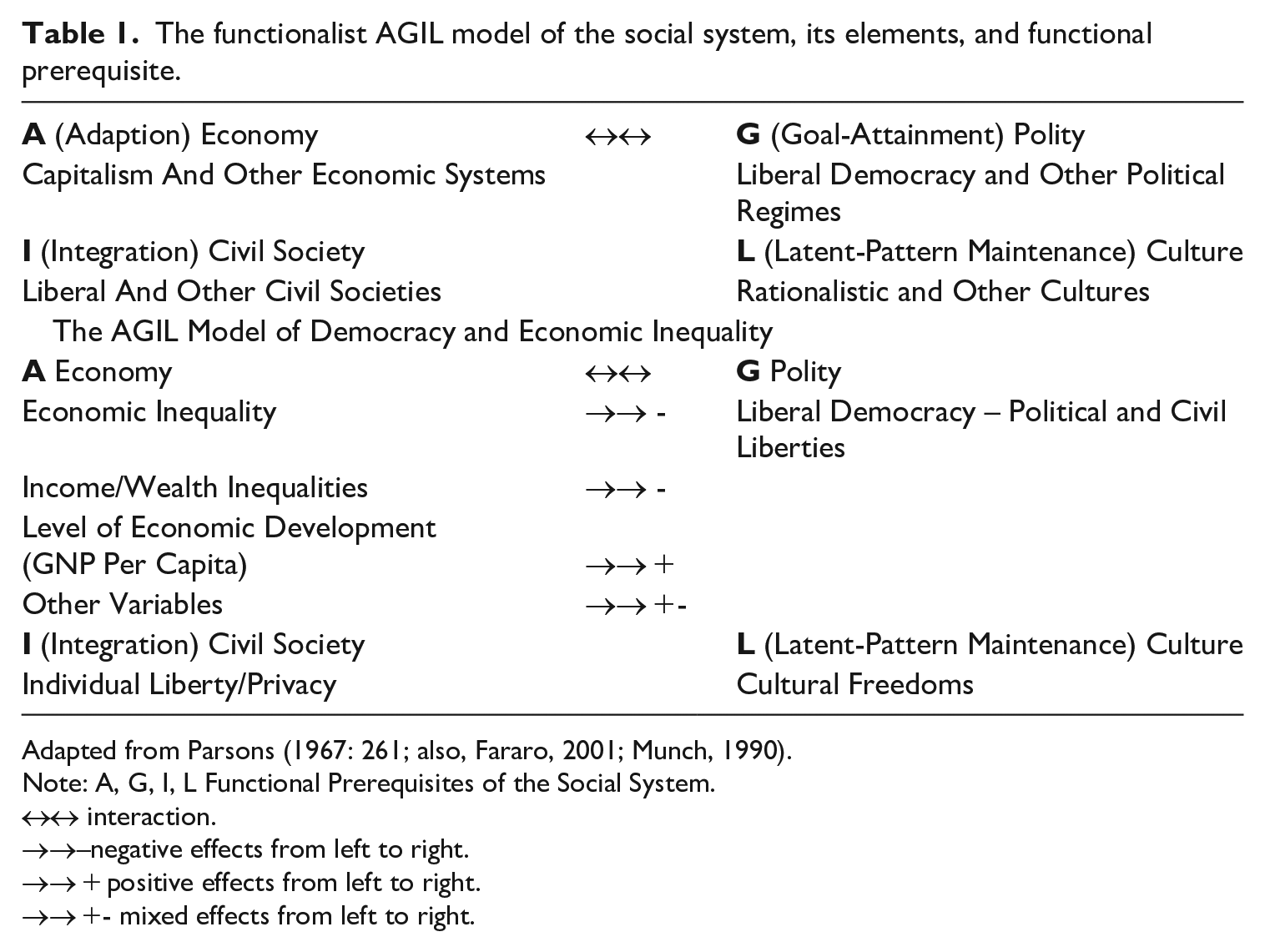
Adapted from Parsons (1967: 261; also, Fararo, 2001; Munch, 1990).
Note: A, G, I, L Functional Prerequisites of the Social System.
↔↔ interaction.
→→–negative effects from left to right.
→→ + positive effects from left to right.
→→ +- mixed effects from left to right.
Based on the prevailing theoretical arguments and relevant empirical findings reviewed earlier, the present framework postulates that the interaction will be negative between economic inequality as an element of the economy and its societal adaptation and liberal democracy as a type of polity and its collective goal-attainment within the AGIL scheme of society. Specifically, the preceding leads to the argument that income (and by implication wealth) concentration (A1) generates a negative net balance of consequences for democracy and so for political liberties and rights (represented by a minus sign in Table 1). Conversely, consistent with the previous theory and research, the above framework argues that high levels of development of the economy and so of wealth (A2) produce a positive net balance of consequences for democracy and freedom in the polity within the AGIL scheme of society. In addition, it posits that a strong political culture as an element of civil society and its performing of integration according to the AGIL scheme, as well as an aspect of the polity and its ‘goal-attainment’, and a high level of education considered part of culture and its ‘latent-pattern maintenance’ of the social system both tend to have a positive net balance of democratic consequences. In a further application of the AGIL scheme to the polity (G) itself treated as a system, the framework assumes that within the latter, one of its own subsystems, such as the government provision of social protection and related civilian public goods and to that extent the welfare state (G1) has by virtue of promoting and extending social citizenship rights a positive net balance of consequences for democracy. Conversely, it supposes that another subsystem of the political system (G2), namely, high military expenditure and generally intense militarism, engenders a negative net balance of consequences for democracy, just as negatively impacting civilian well-being and the welfare state.
In sum, applying the AGIL scheme of society and its imperatives, the present framework theorizes that high-income concentration in its economy (A1) generates a negative net balance of consequences for democracy. Conversely, it argues that a high level of development and of wealth of the economy (A2), a strong political culture in civil society (I), and a higher educational attainment in culture (L) all produce positive net balances of consequences for democracy in the polity (G). In addition, it posits that within the polity, the welfare state or the government provision of social protection and other civilian public goods (G1) has a positive net balance of these consequences while large military expenditure expressing strong militarism (G2) has a negative one.
In comparative terms, the present theoretical framework argues that Western and related societies having the lower levels of inequality, specifically of income concentration, in their economy have the higher degrees of democracy in their polity than others, ceteris paribus. A stronger version of this argument states that societies with the lowest level of income concentration and thus the most egalitarian economy show the highest degree of democracy, so the freest polity, and in extension of individual liberties in civil society and of corresponding freedoms in culture, and conversely, all else being equal. A regional specification of this statement is that the Scandinavian region attains both the lowest level of income concentration in its economy and the highest degree of democracy in its polity and of freedom in its civil society and culture. A reverse argument is that Western and related societies with the higher levels of income concentration have the lower degrees of democracy than others, all else being equal, with indeed those having the highest level of the first exhibiting the lowest degree of the second and of freedom in civil society and culture. The present theoretical framework serves to generate specific propositions or research hypotheses which the next sections formulate and test.
The next empirical analysis will assess how plausible this theoretical framework and resulting hypotheses are by investigating by conducting a regression analysis the specific consequences of income concentration on democracy, and thus by implication on political, civil, and individual liberties, in Organization for Economic Cooperation and Development (OECD) countries from 2006 to 2019.
Data, methods, and variables
The ensuing describes data on political democracy and income concentration or inequality for OECD countries during 2006–2019. First, data on political democracy consist of its indexes for OECD countries during 2007–2019, which thus form a time series and cross-national panel, whose source is the Economist Intelligence Unit, a relatively widely used set of estimates within business and in part academic settings. The Economist Intelligence Unit obtains democracy indexes on a 0–10 scale from the ratings for 60 indicators, grouped into five categories: electoral process and pluralism; civil liberties; the functioning of government; political participation; and political culture. Each category has a rating on a 0 to 10 scale, and the overall Index is the simple average of the five category indexes.
As usual, larger (smaller) indexes thus calculated reflect higher (lower) degrees of democracy. Democracy indexes exist for all presently 36 OECD countries and all years from 2007 to 2019, yielding more than 500 observations. The time series and cross-national panel of democracy indexes for 2007–2019 postdate that of data on income inequality to address possible reverse causation running from the first to the second variable.
Second, data on income inequality comprise Gini coefficients on disposable and equivalized household income after taxes and transfers for OECD countries during 2006–2017, thus forming another time series and cross-national panel, whose official, highly reliable, and widely used source is OECD Social and Welfare Statistics: Income distribution. Recall that in theory, Gini coefficients have a range from 0 as an indicator of complete equality in income distribution to 1 or, as indexes, 100 indicating complete inequality or total concentration, while they move between these two extremes. It follows that smaller (larger) Gini coefficients reflect lower (higher) income concentration or inequality. Gini coefficients exist for all 36 OECD countries for all or most years from 2006 to 2017, so with some annual missing cases, which yields close to 400 observations. The time series and cross-national panel of Gini coefficients for 2007–2017 precedes in time that of data on democracy to address potential reverse causation from the second variable to the first.
Two methods or analytical strategies undergird the empirical analysis. First, a descriptive exploratory analysis explores and describes the relation of income concentration to democracy and political and other freedom in OECD countries during 2006–2019. This analysis involves individual country descriptions, rankings, and between-country comparisons with respect to democracy and income inequality. Especially, by comparing country rankings on democracy and on income inequality during this period the analysis attempts to ascertain if the two variables relate to each other among OECD countries (because of their public knowledge, obvious interpretation and secondary relevance, the results of a descriptive exploratory analysis are presented in an appendix in the Supplemental material).
Second and more important in causal terms, a regression analysis estimates the net balance of aggregate consequences that income concentration or inequality produces for democracy by regressing the second on the first variable. Following the standard procedure, an initial bivariate regression analysis operating only with income inequality as the primary predictor or regressor extends into multivariate analyses through the introduction of additional potential predictors that become control variables as specified below. Overall, by using time-series data on democracy and on income inequality for different periods the regression analysis addresses possible reverse causation enfolding from the first to the second variable. Specifically, the time-series of democracy indexes succeeds temporally that of data on income inequality, namely, Gini coefficients, as well as those pertaining to additional potential predictors. Such temporal succession helps estimating the net balance of consequences that income inequality at an earlier period of a decade or so produces for democracy later of almost one and a half decades.
Dependent, independent, and control variables in this study are as follows. The dependent or outcome variable is political democracy related to but distinguished from economic or industrial and other democracy. What operationalizes or expresses this variable is a composite index as an average of indexes of democratic categories described above. In this study, democracy specifically signifies liberal and universalistic democracy commonly considered the solely genuine form of modern democratic government and a free polity, and distinguished from illiberal and exclusionary, including conservative and theocentric, ‘democracies’ regarded as spurious ones. The independent variable or explanatory factor is income concentration and thus a salient form of economic inequality. The study similarly operationalizes or expresses this variable by Gini coefficients as a conventional and widely used measure of income concentration or inequality.
The control variables include level of economic development or wealth, education, political culture, social protection, and military expenditure as additional potential determinants of democracy in view of the theoretical considerations, including the conceptual framework outlined earlier, and empirical findings from the literature. 19 (A supplementary file contains data for these control variables.) Above all, the literature indicates that high levels of economic development (measured by GDP per capita) or wealth has, as a rule, positive consequences for democracy, thus political and civil liberties, aside from certain variations (Acemoglu et al., 2019; Barro, 1999; Bollen and Jackman, 1985; Fearon, 2011; Haggard and Kaufman, 2017; Lipset, 1994; Muller, 1995; Parsons, 1966; Usmani, 2018).
In addition, the literature usually assumes and reports that high levels of education have positive democratic and related consequences (Acemoglu et al., 2019; Bruch et al., 2010; with inconclusive empirical effects in Barro, 1999). Furthermore, the literature posits and finds that a developed political culture represents a necessary condition of and thus has strongly positive consequences for democracy, while generally distinguishing the first from the second in theoretical terms (Berezin, 1997; Bonikowski et al., 2021; Jepperson, 2002; Schofer and Longhofer, 2011). These theoretical grounds justify keeping political culture, as situated or grounded in civil society and societal culture (as within the AGIL scheme adopted in the present theoretical framework), separate from democracy, even if the above democracy indexes apparently comprise the first into the second. Also, some strands of the literature assume or imply that generous government expenditure on social protection and more broadly the welfare state and civilian public goods through the extension of social citizenship rights has generally positive consequences for democracy and political freedom (Acemoglu et al., 2019; Blanchard, 2004; Kleven et al., 2020; Korpi, 2003; Sutton, 2004). Conversely, according to most of the sociological and related literature, large military spending and more broadly strong militarism produces negative consequences for democracy, as well as on civilian well-being and the welfare state (Acemoglu et al., 2010; Cable et al., 2008; Dell and Querubin, 2018; Gifford, 2006; Hooks and McQueen, 2010; Steinmetz, 2005).
The later empirical analysis will explore primarily the net balance of consequences that income concentration or inequality produces for democracy, while abstracting from those of GDP per capita, education, political culture, social protection, and military spending, thus controlling for these predictors treated as control variables. Hence, one expects that this balance will be negative holding constant these variables.
The preceding yields the following simple model

in which β1 is the estimated net balance of consequences of income concentration for democracy, β2–β6 the balances of GDP per capita, education (percentage of population with tertiary education among 25–34-year-olds), political culture, social protection, and military spending, respectively, and ε the residual or unknown variables.
The above gives the OLS equation

where Y is the democracy estimated by its indexes, α the intercept, X1 the income inequality measured by Gini coefficients, and X2–X6 the GDP per capita, educational attainment, political culture, social protection and military spending, respectively.
The preceding theoretical arguments and empirical observations help generate corresponding hypotheses. Hypothesis 1 states that the higher income concentration is, the lower political democracy will be, and conversely, among Western and comparable societies like OECD countries. This hypothesis focuses only on the consequences that income concentration or inequality measured or at least approximated by Gini coefficients has on political democracy indicated by corresponding indexes. It specifically posits that the consequences of income concentration or inequality on political democracy are likely to be negative. In other words, Hypothesis 1 predicts that the higher Gini coefficients of income distribution are, the lower political democracy indexes will be, and vice versa, among OECD countries. This hypothesis both logically derives from the theoretical framework outlined previously and is consistent with the empirical observations cited from the extant literature (especially Piketty, 2014, 2020 also, Acemoglu et al., 2010; Vermeiren, 2021; Wright, 2013). To that extent, it is both theoretically relevant and empirically grounded.
As a corollary and elaboration of Hypothesis 1, Hypothesis 2 states that the higher income concentration is, the lower political democracy will be, and conversely, among OECD countries, even when controlling for additional potential democratic determinants as control variables specified above. Thus, this hypothesis centers on the consequences of income concentration or inequality that Gini coefficients measure or approximate on political democracy that corresponding indexes indicate. Specifically, it hypothesizes that the consequences of income concentration or inequality on political democracy are likely to be negative even when considering GDP per capita, education, political culture, social protection, and military spending as other potential democratic factors. Hypothesis 2 expects that the higher Gini coefficients of income distribution are, the lower political democracy indexes will be, and the other way round, among OECD countries, even when holding constant these other factors. Like the previous, this hypothesis ensues from the above theoretical framework and accords with the empirical findings in the cited literature (especially Acemoglu et al., 2019; Schofer and Longhofer, 2011; Steinmetz, 2005; Sutton, 2004; Usmani, 2018), thus being both theoretically and empirically plausible. The following section tests these hypotheses by reporting the results of empirical analysis.
Results
The results of an empirical, regression analysis of the consequences of income concentration for democracy align with those of exploratory descriptive analyses serving as the basis and starting point (reported in Appendix 1 in the Supplemental material). They essentially validate the theoretical framework’s argument that high-income concentration generates a negative net balance of consequences for democracy. Specifically, they corroborate the hypotheses derived from this framework as the ensuing shows.
Table 2 gives the results of a regression analysis of democracy indexes during 2007–2019 and Gini coefficients from 2006 to 2017 for 36 OECD countries, thus yielding several hundred observations. The regression of democracy indexes on Gini coefficients (Model 1) produces a negative and statistically significant coefficient (−.86, p < .001), indicating adverse consequences in this regard. Substantively, when income inequality grows by 1 point via Gini coefficients it reduces political democracy by almost .9 points, all else being equal. Figure 1 illustrates this adverse consequence of income inequality for political democracy by representing annual 2006–2017 Gini coefficients on the X-axis and yearly 2007–2019 democracy indexes on the Y-axis. Generally, income inequality negatively accounts for around one quarter of the variance in democracy (R2 = 0.24).
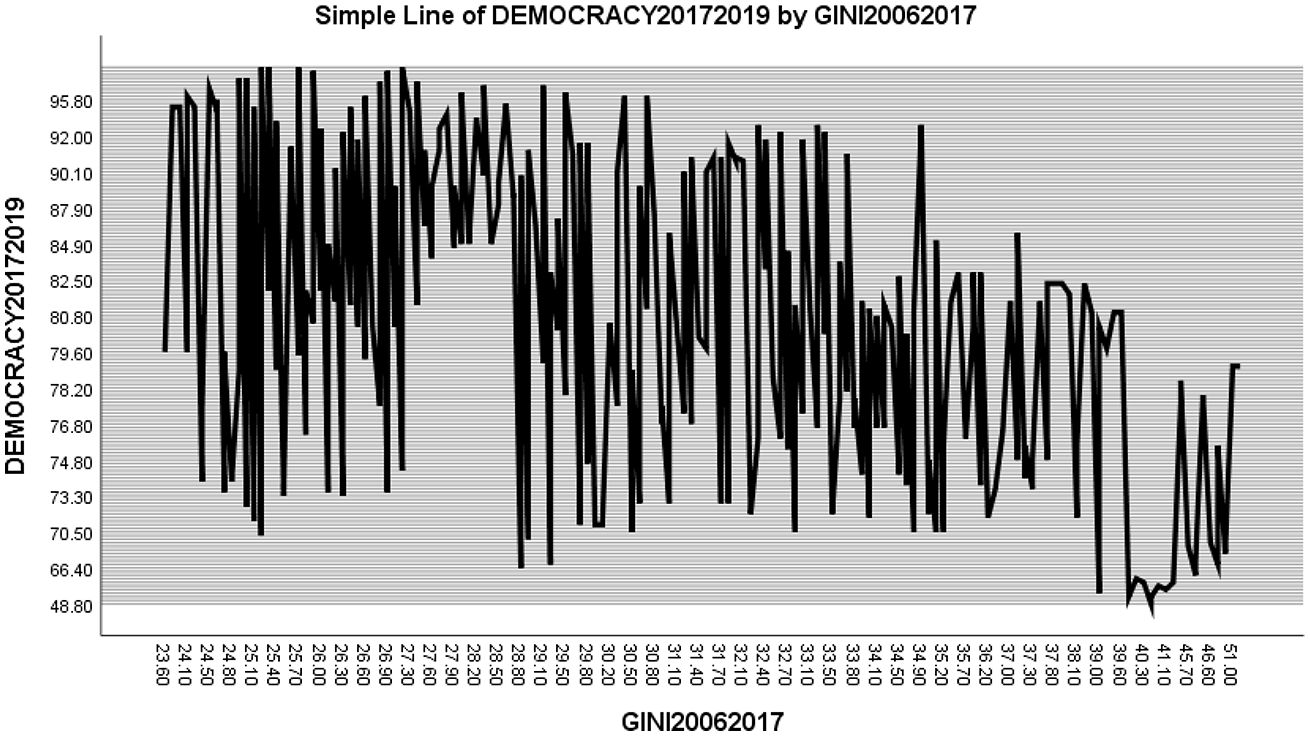
Relations between annual Gini coefficients and yearly democracy indexes, OECD countries, 2006–2019.
Coefficients from regression of democracy on income inequality and selected control variables.
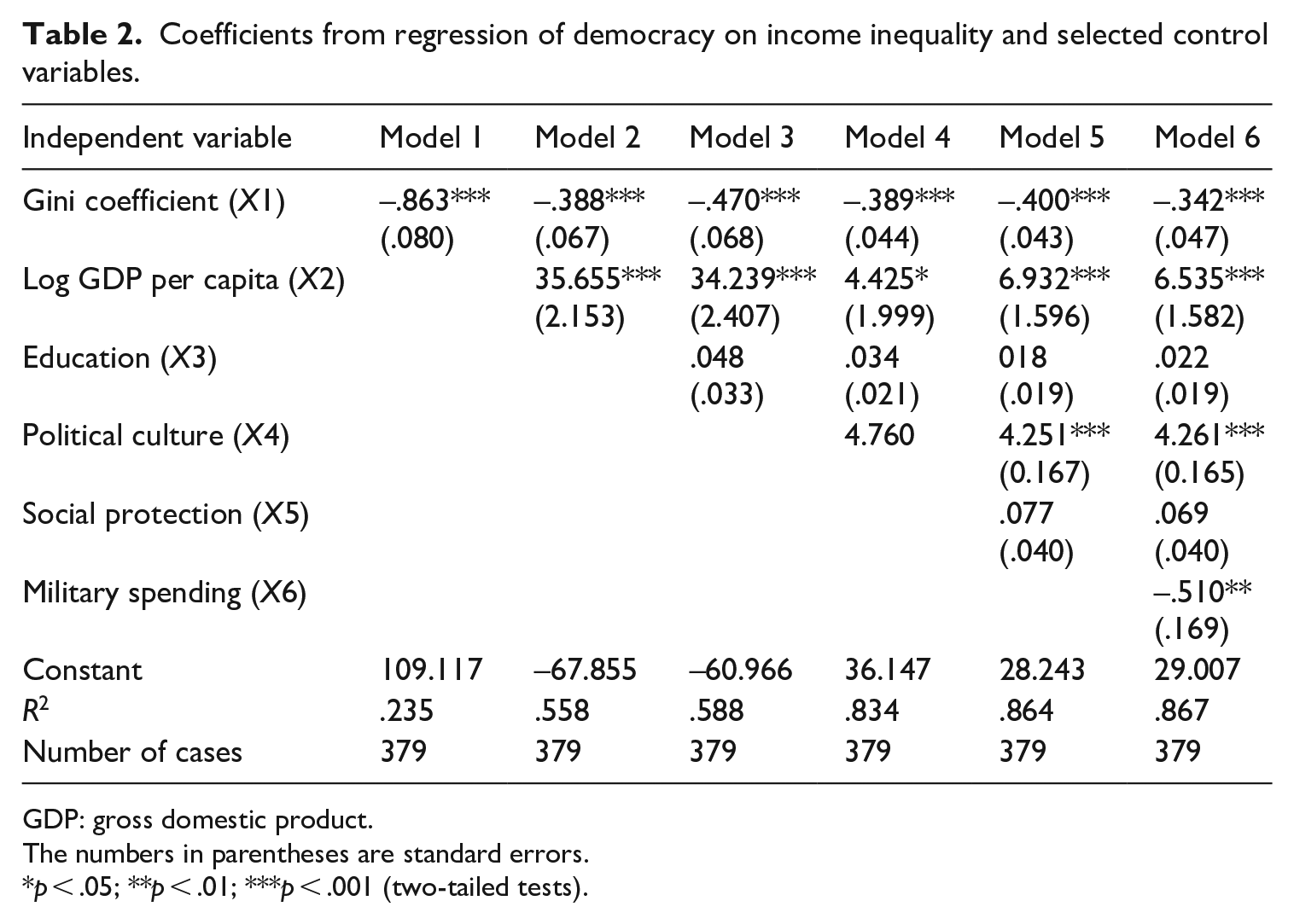
GDP: gross domestic product.
The numbers in parentheses are standard errors.
p < .05; **p < .01; ***p < .001 (two-tailed tests).
This finding therefore supports Hypothesis 1 stating that high (low) income concentration has adverse (positive) consequences for political democracy among OECD countries. More specifically, it confirms the expectation that high Gini coefficients of income distribution associate with low political democracy indexes, and conversely, among these countries.
Furthermore, after adding control variables to the regression analysis, the above result stands. First, the coefficient on Gini coefficients stands as both negative and significant (−.39, p < .001) when including GDP per capita as a standard measure of the level of economic development (Model 2). (In passing, the coefficient on GDP per capita is positive and significant, consistent with the expectations from the literature.) In substantive terms, even when controlling for GDP per capita as the crucial factor from the literature, income inequality decreases political democracy by nearly 0.4 points when it increases by 1 point. Combined with the level of economic development, income inequality explains over half of the variance in democracy (R2 = .56).
Second, when holding constant GDP per capita and educational attainment as another control variable (Model 3), the regression of democracy indexes on Gini coefficients generates a negative and statistically significant coefficient (−.470, p < .001). (Incidentally, the coefficient on educational attainment is positive and insignificant, partly in accord with the expectations from some strands of the literature.) In substantive terms, while controlling for both GDP per capita and education, income inequality rising by a 1 point diminishes political democracy by almost 0.5 points. Altogether, joined with the level of economic development and education, income inequality explains nearly 60% of the variance in democracy (R2 = .59).
Third, the coefficient from the regression of democracy indexes on Gini coefficients remains negative and significant (−.39, p < .001) when holding constant GDP per capita, education and political culture as an additional control variable (Model 4). (In turn, the coefficient on political culture is positive and significant fully in accord with the expectations from the literature.) Substantively, a 1-point increase in income inequality reduces political democracy by about 0.4 points even when considering level of economic development, education, and political culture. In conjunction with level of economic development, education, and political culture, income inequality accounts for over 80% of the variance in democracy (R2 = .83).
Fourth, when controlling GDP per capita, education, political culture, and social protection and thus the welfare state yet another control variable (Model 5), still the regression of democracy indexes on Gini coefficients results in a negative and significant coefficient (−.4, p < .001). (By the way, the coefficient on social protection is positive and insignificant, so partly consistent with the expectations from the literature.) In substantive respect, even when taking into consideration the level of economic development, education, political culture, and social protection, a 1-point increase in income inequality continues to reduce political democracy by 0.4 points. Altogether, income inequality in combination with the level of economic development, education, political culture, and the welfare state explains nearly 90% of the variance in democracy (R2 = .86).
Fifth, when holding constant GDP per capita, education, political culture, social protection, and military spending and thus militarization as a further control variable (Model 6), the coefficient in the regression of democracy indexes on Gini coefficients persists as negative and statistically significant (−.34, p < .001). (In passing, the coefficient on military spending is negative and significant in accord with most expectations from the literature.) Substantively, even when controlling for level of economic development, education, political culture, the welfare state and militarization, if income inequality rises by a 1-point it still weakens political democracy by over 0.3 points. A combination of income inequality with level of economic development, education, political culture, the welfare state, and militarization accounts for nearly 90% of the variance in democracy (R2 = .87). In methodological terms, this amount of explained variance implies that the model of democracy comprising income inequality, along with the level of economic development, education, political culture, the welfare state, and militarization, into a set of predictors is nearly complete and well-specified. Table 3 reproduces the correlation matrix that reveals weak or moderate correlations between Gini coefficients and the other predictors or among these latter, with the sole exception of that between GDP per capita and political culture, thus revealing not many severe problems of multicollinearity.
Correlation matrix for income inequality and selected control variables.

GDP: gross domestic product.
Finally, Table 4 shows that the regression of average democracy indexes on average Gini coefficients (36 cases) produces a virtually identical estimate to that in Table 2 (Model 1) and permits an equivalent interpretation. The coefficient on average Gini coefficients is negative and statistically significant (−.86, p < .001) so that substantively a 1-point increase in income inequality diminishes democracy by nearly 0.9 points. Figure 2 illustrates such adverse consequences of income concentration by placing average Gini coefficients for 2006–2017 on the X-axis and average democracy indexes for 2007–2019 on the Y-axis.
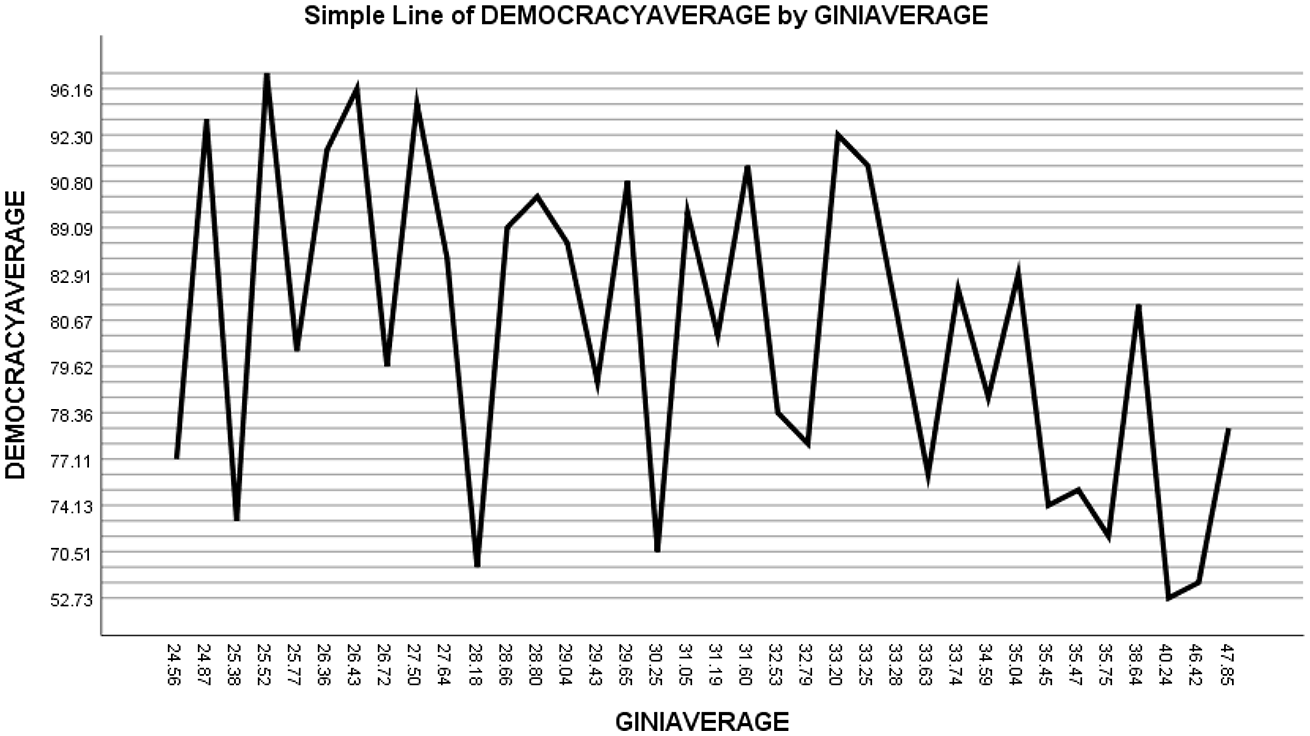
Relations between average Gini coefficients and average democracy indexes, OECD countries, 2006–2019.
Coefficients from regression of average democracy indexes on average Gini coefficients.

The numbers in parentheses are standard errors.
p < .05; **p < .01; ***p < .001 (two-tailed tests).
To that extent, all these additional findings of a multivariate regression analysis corroborate Hypothesis 2 positing that high-income concentration have negative consequences for political democracy, and vice versa, among OECD countries, even when taking account of multiple control variables. Specifically, they validate the prediction that higher (lower) Gini coefficients of income distribution relate to lower (higher) political democracy indexes among these countries even when controlling for GDP per capita, education, political culture, social protection, and military expenditure as further potential factors.
Conclusion
The present analysis essentially validates its proposed theoretical framework, such as its key argument that high levels of income (and wealth) concentration tend to generate a net balance of clear, unambiguous, and usually strong adverse consequence for political democracy and hence freedoms and rights in polity and society. More specifically, the analysis corroborates the specific hypotheses, as derived from this theoretical framework and congruent with prior empirical findings in the literature, relating high (low) Gini coefficients of income distribution with low (high) political democracy indexes, notably even when accounting for such additional potential factors as GDP per capita, education, political culture, social protection, and military expenditure.
Looking at the contemporary debates and theories particularly related to the topic and in a comparative setting of Western and comparable societies like OECD countries, the empirical findings of this analysis especially accord with Piketty’s (2014) well-known theoretical argument, prediction, and warning that ‘extremely high levels’ of the concentration of capital and income can potentially subvert modern democratic societies in respect of their basic ‘meritocratic values and principles of social justice’. They also reaffirm Piketty’s (2020) more recent theoretical assumption and admonition insofar as democratic societies fail to substantially change the present capitalist economy as to become ‘less inegalitarian, more equitable, and more sustainable’, both global capitalism and liberal democracy face the specter of their destruction at the hands of erupting conservative xenophobic populism if it triumphs under and then eliminates democratic process in Western and other societies (also related statements in Gethin et al., 2022 and supporting statements in Müller, 2014). In addition, the findings align with Acemoglu’s (2005) theoretical proposition and empirical observation that ‘a very unequal distribution of income and wealth’ is inherently consistent with ‘a similarly unequal distribution of political power’, including dictatorships and other oppressive regimes. More specifically, they support Acemoglu et al.’s (2010) theory and prediction that societies with high levels economic inequality tend to turn ‘nondemocratic’, including or a military dictatorship, and conversely, when becoming ‘democratic rapidly’ when income or wealth inequality decreases or is low. Also, they corroborate Wright’s (2013) argument that capitalism’s economic inequalities translates into the near-absolute ‘structural power of capital’ and hence renders capitalist democracy inherently incapable of insulating political decision-making from concentrated capitalist wealth allowing the corresponding ‘exercise of power’. Furthermore, they are in accord with Vermeiren (2021) who postulates that ‘soaring’ income and wealth inequalities undermine a ‘more egalitarian and sustainable form of democratic capitalism’ and hence capitalist or liberal political democracy, and consistent with Spragens (2021) implicitly positing that high economic inequality associated with laissez-faire capitalism can threaten the ‘liberal ideals of liberty and equality’ in polity and society.
Particularly, with respect to the United States, the findings of this analysis remind of Goldberg’s (2001) concerns that increasing wealth/income concentration in this country during neo-conservatism confirms Tocqueville’s classical analysis fearing the ‘emergence of a new aristocracy’ and thus degeneration of democracy and social justice, as well as the threat to both by the ‘authoritarian welfare state’ of the New Right. Relatedly, they highlight Acemoglu and Robinson’s (2006) characterization of conservative America such as the post-bellum South as a compound of ‘labor-intensive, low-wage, low-education, and repressive economy’ with elite ‘political control’, including ‘an oligarchic structure’ that allows ‘monopolization of political power’. In extension, they support Mokyr’s (2014) warning that ‘in a winner-take-all’ US society growing income and wealth concentration is ‘a ticking political time bomb’, and Stiglitz’s (2012) admonition that such tendencies can generate the potential for America to become an inherited oligarchy or plutocracy and eventually a capitalist dictatorship due to capitalists playing ‘dictator games’. They also reaffirm Bénabou et al.’s (2015) observation that rising economic inequality in the capitalist-theocratic ‘American regime’ leads to a ‘Religious-Right alliance’ between the rich and the religious poor against democracy and science, and so on.
Taken together, as it has been stated and emphasized repeatedly in this study and the relevant literature overall, the concentration of income and wealth usually has authoritarian and dictatorial politics as a consequence. As a result, one can realistically expect authoritarian and dictatorial policies in core countries of the West in the foreseeable future. Indeed, one can already identify authoritarian and dictatorial policies in such Western core countries, primarily the United States under the post-2016 ultra-conservative, radical right autocratic regime and earlier, as during and since Reaganism, and to some degree in Brexit Great Britain as well as during Thatcherism (Alvaredo et al., 2018; Bonikowski et al., 2021; Gethin et al., 2022; Jacobs and Dirlam, 2016; Lamont, 2018; Piketty, 2014; VanHeuvelen, 2020). And one can expect that such illiberal and undemocratic tendencies will persist, even expand and intensity in these and probably via contagion or contamination in other Western core and less central countries experiencing the high or growing concentration of income and wealth (Piketty, 2020). In this regard, one cannot overstate and overemphasize that the rising concentration of income and wealth tends to have strong authoritarian and dictatorial, including autocratic, consequences, all else being equal.
Finally, the present analysis’s contribution to the field is twofold, theoretical and empirical. Its theoretical and partly methodological contribution consists in proposing and applying a relatively novel conceptual framework for studying the relation between economic inequality such as income concentration and political democracy, namely, the consequences of the first factor on the second. As elaborated, the novelty of this framework is that it adopts and applies the concept of a ‘net balance of the aggregate of consequences’ to the effects of income concentration and political democracy. The advantage of this concept is that it theoretically allows or recognizes that income concentration and economic inequality generally might have both positive and negative consequences for political democracy and hence proposes estimating or extracting a balance of the two effects, simply a net democratic effect. Its empirical contribution consists in providing new cross-national evidence of the impact of income concentration and thus economic inequality on political democracy in contemporary Western and similar societies within OECD. Specifically, it offers evidence that the ‘net balance of the aggregate of consequences’ that income concentration has on political democracy is essentially negative within these societies.
A caveat or disclaimer is that the present theoretical framework may need further elaboration and refinement and that the findings can represent more suggestive rather than definite evidence. This therefore suggests the need of further theorizing the problem, collecting data for broader time periods, and providing wider country coverage beyond OECD to include other countries, as directions for future theory and research concerning economic inequality and political democracy.
Supplemental Material
sj-docx-1-iss-10.1177_02685809221109041 – Supplemental material for Consequences of income concentration for democratic processes in contemporary Western and comparable societies: Evidence for OECD countries, 2017–2019
Supplemental material, sj-docx-1-iss-10.1177_02685809221109041 for Consequences of income concentration for democratic processes in contemporary Western and comparable societies: Evidence for OECD countries, 2017–2019 by Milan Zafirovski in International Sociology
Supplemental Material
sj-docx-2-iss-10.1177_02685809221109041 – Supplemental material for Consequences of income concentration for democratic processes in contemporary Western and comparable societies: Evidence for OECD countries, 2017–2019
Supplemental material, sj-docx-2-iss-10.1177_02685809221109041 for Consequences of income concentration for democratic processes in contemporary Western and comparable societies: Evidence for OECD countries, 2017–2019 by Milan Zafirovski in International Sociology
Footnotes
Declaration of conflicting interests
The author declared no potential conflicts of interest with respect to the research, authorship, and/or publication of this article.
Funding
The author received no financial support for the research, authorship, and/or publication of this article.

Supplemental material
Supplemental material for this article is available online.
Notes
Author biography
References
Supplementary Material
Please find the following supplemental material available below.
For Open Access articles published under a Creative Commons License, all supplemental material carries the same license as the article it is associated with.
For non-Open Access articles published, all supplemental material carries a non-exclusive license, and permission requests for re-use of supplemental material or any part of supplemental material shall be sent directly to the copyright owner as specified in the copyright notice associated with the article.
