



Abstract
Among multiple factors that can influence people’s food security, the gender inequality factor has attracted inadequate attention in high-income countries, particularly in Japan. To analyse how and why gender inequality issue has been neglected in food policy in Japan, I propose the notion of the ‘post-war Japanese eating model’ based on the sociologies of family and food. I demonstrate how Japanese society has persisted with this eating model by examining two dominant dietary discourses, the Japanese dietary pattern and Hōshoku (deterioration of dietary practices). The former reinforced the post-war Japanese eating model, despite the prevailing agricultural and nutritional accounts. Regarding the latter discourse, Hōshoku was overestimated, resulting in enlarging the contradiction between norms (the Japanese dietary pattern) and practices. Given the increasing difficulty in performing such practice, their dietary norms need to be reconstructed through awareness of reflexive or ‘semi-compressed’ food modernity facing Japan.
Introduction
Food security has become a global agenda. Food security can be achieved by not merely ensuring food availability, but by eradicating all forms of inequalities regarding food access and its utilisation for an active and healthy life (Food and Agriculture Organisation (FAO), 2009). Gender inequality, such as the unfair distribution of food within households, has been identified as one of the critical food insecurity factors, particularly in low-income countries (Sen, 1985). In high-income countries, a large body of studies have pointed to the gendered nature of everyday family meals – often viewed as natural – (Avakian, 1997; Charles and Kerr, 1988; Counihan, 1999; Counihan and Kaplan, 1998; DeVault, 1991; Flowers and Swan, 2015; Murcott, 1983), and further studies are expected to describe how the complex relationships between food and gender are expressed in different regional contexts (Mauriello and Cottino, 2022).
In contrast, food insecurity discourse in high-income countries has been focused primarily on its economic sub-dimension, notably income constraint, while other social factors have been ignored (Ashby et al., 2016; Bartelmeß et al., 2022), including gender inequality. For example, the French National Food Conference (États Généraux de l’Alimentation or EGA) was organised in 2017 as a pioneering initiative for social debate on food security and ultimately led to the promulgation of the New Food and Agriculture Law in 2018. However, as Paturel and Bricas (2019: 2) note, ‘the question of gender relationships with regard to food is seldom raised in debates on sustainable food [security]’, mainly due to ‘the conventional patriarchal thrust’ that leaves the relegation of the non-economic dimensions of eating to the domestic sphere unchallenged.
This question is particularly problematic in Japan, the country with the largest gender inequalities of high-income countries (World Economic Forum (WEF), 2022). Recently, similarly to other high-income countries (e.g. France, the United Kingdom), Japan has started developing a comprehensive food policy to ensure food security, which will be reflected in the coming amendment of the Basic Act on Food, Agriculture and Rural Areas in 2024 (Council of Food, Agricultural and Rural Area Policies (CFARAP), 2023). However, gender-based inequality has not been considered in food security debates or catered for in previous food policies (see Kimura, 2011, 2016). Single mothers are a primary example of this contradiction. They suffer from strong dilemmas due to their dietary situations, which are characterised by huge handicaps (notably, a 51.4% poverty rate: Organisation for Economic Cooperation and Development (OECD), 2022) and gendered norms as the family meal providers. This difficulty has been compounded by gender-unconscious food policies, including those related to food aid (Ueda, 2023a). Although food insecurity as material deprivation has been largely overcome in Japan (2.8% food insecurity rate: FAO, 2022), social deprivation in the relative sense (Townsend, 1979), such as being unable to have conviviality and culturally proper meals, still exists and deserves special attention in future food policy.
How has such dietary inequality been caused in Japan? What should be the target of critical reflection in developing future gender-conscious food policy? The objective of this article is to answer these questions. I first propose an analytical concept to promote such reflection, namely, ‘the post-war Japanese eating model’, based on the sociological literature on family and food. Theoretical exposition is then followed by an empirical demonstration, with two notable discourses that characterise the dietary situation in contemporary Japan: the Japanese dietary pattern since the 1980s and Hōshoku (deterioration of dietary practices) since the 2000s. Both cases fixate on the post-war Japanese eating model, but their gendered nature has not been scrutinised in dominant food discourses. I conclude that the self-consciousness of this post-war eating model can be an effective starting point for reconstructing suitable dietary norms in our reflexive modernity.
The post-war Japanese eating model
The methodological description is divided into two sections. I first describe an analytical framework and then detail the data for empirical demonstration. Here, the post-war Japanese eating model refers to the eating model that was popularised under the post-war Japanese family system. This new concept was premised on two theoretical traditions (the sociology of the family and the sociology of food), as well as the notion of reflexive modernity, which has closely interacted with these two theories.
The post-war Japanese family system
In the late 1980s, Japanese sociologist Emiko Ochiai proposed the thesis of ‘the post-war Japanese family system’ by elaborating on the theory of the modern family. In this theory, a family is viewed as a social unit that (a) values the domestic/private sphere in contrast to the public one; (b) is bonded together by familial love; (c) divides labour according to gender, with the husband as wage-earner and the wife as homemaker; (d) bestows on its children strong love and affection; and (e) is characterised by the nuclear family. In contrast to the extended family model predominant in the preceding era, the modern family in Japan was developed among the bourgeoisie at the beginning of the twentieth century (about a century after Western countries) and then popularised from 1955 to 1975 to become the post-war Japanese family system (Ochiai, 1989; Ochiai and Filler, 2005).
Although not always keeping the theory of the modern family in mind, historians of Japanese food cultures have noted new dietary practices that emerged and were then normalised within the bourgeois modern family of the early twentieth century (such as Akitani and Yoshida, 1988; Cwiertka, 2007; Yanagida, 1990). They included values that were attached to food, such as eating three times a day; cooking family meals that were nutritious, tasty, and diverse in terms of recipes and ingredients; occasional dining out for leisure; meals at regular hours (governed by office work hours); convivial eating with family members; and a rice-based meal with a few dishes, such as miso soup and pickled vegetables. These dietary norms still define ‘eating well’ in contemporary Japan (Ueda, 2022a), but further consideration is needed before taking this current condition for granted.
The continuation of this post-war system was supported by three pillars (Ochiai, 2019; Ochiai and Filler, 2005): (a) demographic structure, in which a generation with a large population, born in a period of high fertility and low mortality (1925–1950), reached the age of playing the primary roles in both work and family formation; (b) ‘reproductive egalitarianism’ that standardised women’s life course of getting married at a set age and giving birth to an average of two children; and (c) the enactment of a sexual division of labour that encouraged women to become housewives.
However, these conditions no longer exist. The first condition was simply the transient result of demographic change, whereas the ‘dehousewivesation’ of Japanese women (Ochiai, 2019) since the 1990s has led to a decrease in marriage and fertility and an increase in divorce, as well as unstable life conditions among the divorced women. Eventually, the nuclear family rate dropped from its peak of 64% in 1975 to 57% in 2015. It had been 60% in 1955, before the establishment of the post-war family system (National Institute of Population and Social Security Research (NIPSSR), 2020). Despite this fact, since the 1980s, the Japanese government has chosen to fixate on and reinforce the post-war Japanese family system under a policy oriented towards a so-called ‘Japanese-style welfare society’, rather than restructuring its family policies.
Ochiai (2014) characterised this peculiar condition in Japan as the result of ‘semi-compressed modernity’ when she linked it with the international debate on reflexive modernity. ‘Reflexive modernity’, or ‘the second modernity’, refers to the period when one must confront the side effects of the first modernity (Beck, 1992; Giddens, 1990). Scholars have recently started investigating the plurality of modernisation, which has differing logics regarding change, the duration of the process, and its consequences (Beck and Grande, 2010). In Asian countries, it has taken place in a ‘compressed’ manner, both temporally and spatially (Chang, 2016: 33).
If one characterises the first and second modernities by two fertility transitions, Japan can be situated in a middle position, with a stable period of about 20 years between the two modernities (1950−1970s), as compared with about 50 years in Europe (around the beginning of the twentieth century to the 1950s) and almost no period in other East Asian countries. Based on this demographic, Ochiai (2014) concludes that ‘Japan’s semi-compressed modernity had made it difficult for Japan to extricate itself from its first modernity and take a step forward towards a new stage of social development’ (p. 224). Since food is an integral part of family life, further work is needed to understand how this situation applies to the analysis of contemporary eating.
The sociology of food
The sociology of food can be another intellectual resource. Although acknowledging the recent emergence of ‘food studies’ with differing cultural orientations, I refer specifically to the French school of thought (see Poulain, 2017). This tradition has been developed since the 1980s and is strongly based on the Maussian paradigm, with a view to going beyond the limited focus on food in the sociologies of taste or consumption, and to investigating food as a ‘total human fact’ (Morin, 1973).
These sociologists interpret food modernity in the following manner: (a) Traditional dietary norms, which used to be reproduced within families and communities, are no longer considered legitimate and are constantly examined in the light of new information about these practices. (b) This weakening of the regulatory function creates a state of ‘gastro-anomy’, a term introduced by Claude Fischler (1990: 70) to distinguish it from gastronomy, in which eaters confront an overabundance of changing and contradictory norms and resultant food anxiety (Poulain, 2002a: 53). (c) New regulatory bodies, such as the nutritional sciences, heritages and politics, are then required to alleviate such gastro-anomic symptoms (Poulain, 2012), which creates a picture of various contemporary phenomena, including the medicalisation, heritisation, or politicisation of food.
The eating model is a good analytical theme for understanding the nature of gastro-anomy. In contrast to traditional nutritional or economic assessment, the eating model paradigm has a focus on the total – temporal, spatial, social, quality, affective, and normative – aspects of eating (Herpin, 1988; Poulain, 2002a, 2002b; Ueda, 2022b). Empirical studies in Western countries have pointed to the ‘destructuration’ of the eating model, a growing gap between norms and practices, and the rise of nutritional sciences and traditional heritages, which are linked to new regulatory bodies, all of which reflect the deepening effects of gastro-anomy (Fischler and Masson, 2008; Poulain, 2002a). Note that the ‘norms’ here refer to how the person desires to eat and that their relationships with dominant discourses and his or her actual dietary conditions deserve special attention.
Recent studies have extended to Asian countries (e.g. Malaysia, Vietnam, Indonesia), with the purpose of characterising the evolution of eating models that emerged as the result of ‘compressed food modernity’ (Ehlert and Faltmann, 2019; Khusun et al., 2023; Poulain et al., 2014). Although having promising potential for international comparison, to what extent do the changes in the eating model observed in Western countries are also observed in Japan, where modernisation occurred much earlier than in other Asian countries but later than in Western countries? Although exploration of this middle position of Japan has already been initiated in the sociology of family, how can its implications be extended to the sociology of food?
Empirical data
To answer these queries empirically, I describe two dominant dietary discourses: first, the Japanese dietary pattern and, second, Hōshoku, deterioration of dietary practices, to characterise the post-war Japanese eating model and its dynamism.
The data used for analysing the former discourse included not only official documents (such as those published in 1980, 1983, and 1985) but also their background reports. Informed by the perspective of the post-war Japanese eating model, I paid close attention to the gendered nature of the Japanese dietary pattern, which has been mainly analysed only from agricultural and nutritional views.
Followingly, I scrutinised the Hōshoku, by using national statistics, including the National Health and Nutritional Survey conducted by the Ministry of Health, Labour and Welfare (shortly, ‘Nutrition Survey’), the Food Education Survey by the Ministry of Agriculture, Forestry and Fisheries, the Family Income and Expenditure Survey (‘Expenditure Survey’), and Survey on Time Use and Leisure Activities (‘Time Survey’) by the Ministry of Internal Affairs and Communications. Within the same analytical framework, I put a particular focus on to what extent women’s eating models have evolved and how this degree of change has been interpreted – or overestimated – by the proponents of the Hōshoku discourse.
Japanese dietary pattern
Thanks to rapid economic growth from the mid-1950s, the automobile and semiconductor industries achieved the largest production in the world, and the Japanese economy enjoyed its ‘Golden Age’ in the 1980s. Nationalism prevailed and numerous publications emerged in the field of Nihon-Jin-Ron, or cultural theories of Japaneseness. As was the case with ‘Japanese-style management’ and the ‘Japanese-style welfare society’, the ideal conditions were already set for the idea of the ‘Japanese’ dietary pattern. The US Senate’s McGovern Report (Select Committee on Nutrition and Human Needs, 1977) became a convenient trigger for this development. The report was aimed at improving the dietary habits of Americans. Although there were only a few mentions of Japan (namely ‘its lower consumption of animal fats’), the McGovern Report was welcomed by Japanese experts as a valid justification for the coming Japanese dietary pattern. This overinterpretation would not have been possible without the rise of nationalism in the 1980s.
I describe below how the Japanese dietary pattern discourse has been developed in agricultural and nutritional accounts while neglecting its gendered nature, the result of which was to reinforce the post-war Japanese eating model, despite it being obsolete. While a critical reading of this discourse was performed in some studies (Togawa, 2011, 2013), I aim to link this discourse with the sociological debate, notably the reflexive food modernity.
Agricultural justification
Due to the Westernisation of dietary habits and the agricultural policy that supported its evolution, rice consumption started decreasing in the early 1960s, while the consumption of livestock products and the resultant dependence on imported products increased (Figure 1). In particular, rice surplus became an unprecedented issue for Japanese agricultural policy, the goal of which had always been to increase its production. The discourse about the Japanese dietary pattern finally began with the Orientation for Agricultural Policy in the 1980s (Agricultural Policy Council, 1980: 12; hereafter called 1980 Orientation) as a counterreaction to such an agricultural shock: Dietary habits in Japan have some different features from those in the Western countries, including their nutritional balance (fewer calories and higher starch ratio) and protein composition (an equal ratio of vegetable protein to animal protein, a large portion of which is from marine products), which we shall call the ‘Japanese dietary pattern’. Further efforts are needed to make this pattern take root in the population, both from nutritional and food self-sufficiency perspectives.
This Japanese dietary pattern is defined here as ‘a combination of the traditional dietary pattern based on rice, vegetables, fish and soybeans, with an increased intake of meat, dairy products, eggs, oils and fruits’ (Agricultural Policy Council, 1980: 12). This seems ordinary for the contemporary Japanese, but it was quite unusual for the Japanese before 1980. For example, agricultural economist Seiki Nakayama (1961 (1960)), who was deeply involved in agricultural policymaking from the 1960s, did not hesitate to normalise the Westernised diet by devaluing the Japanese rice-based meal pattern due to its low intake of protein and fat, low food expenditure, and the ‘poor’ cultural tradition of utilising livestock products. In contrast, public officials, scholars (agricultural economists and nutritionists), and agri-food professionals involved in the discourse regarding the Japanese dietary pattern became aware of the side effects of the Westernised diet (e.g. the weakening of national food security) and proposed a new dietary norm that harmoniously combined the Westernised diet with the so-called ‘traditional’ rice-based diet.
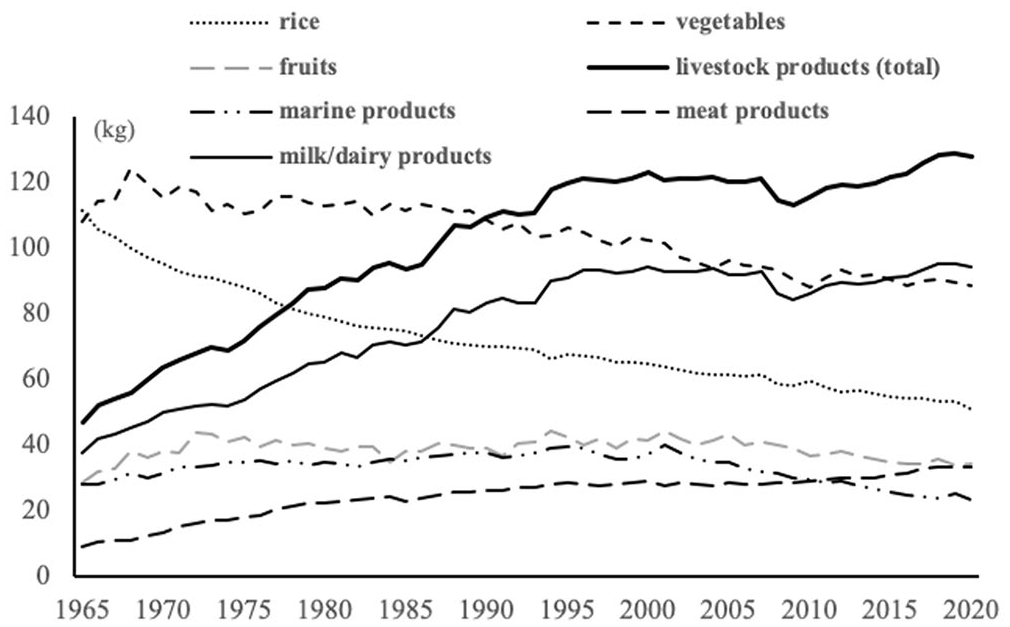
Per capita consumption by food item in Japan (1965−2020).
Perhaps it is beneficial to link this shift in dominant discourses with food modernity theories. As observed by folklorist Kunio Yanagida (1990), the rice-based meal pattern, which is typically a combination of rice and a couple of dishes (including miso soup and pickles), was a modern invention, not the ‘traditional’ meal pattern that had prevailed in pre-modern Japan. The notion of a rice-based meal pattern was later elaborated on by agricultural economists (Akitani and Yoshida, 1988; Nakayama, 1961 (1960)), who reconfirmed not only the hegemonic place of rice as a staple food but also the increasing importance of side dishes, including livestock products. Although the consumption of livestock products was limited before the 1950s, the Westernising tendency was already inherent in the rice-based meal pattern, as opposed to an intuitive belief that the Westernised diet conflicted with the rice-based meal pattern. In sum, both the rice-based meal pattern and the Westernisation of the diet are important features of the first food modernity, whereas the awareness of the side effects due to the excessive progress of the latter in the Japanese dietary pattern discourse is a symptom of the second food modernity.
Nutritional justification
The Japanese dietary pattern was also justified by the experts on a nutritional basis in the 1980 Orientation, which was not without evidence. In the early 1980s, Japan became the country with the longest longevity in the world and its nutritional balance (in terms of its protein–fat–carbohydrate (PFC) ratio) reached an ideal level (Figure 2). However, the experts also recognised that, given the dietary transition in Western countries, this situation was transient and the risk of nutritional problems was about to increase.
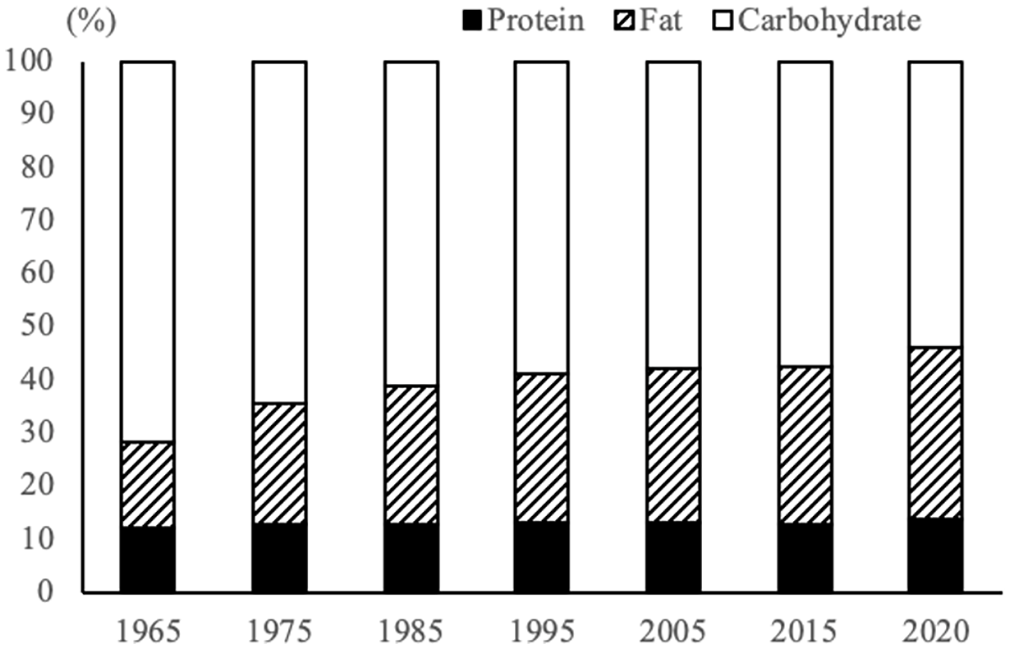
PFC balance in Japan (1965−2020).
It is in this context that the Ministry of Health developed the Dietary Guideline for Health Promotion in 1985 to fix this healthy meal pattern. In its development process, the Ministry of Health must have been aware of the Ministry of Agriculture’s Japanese dietary pattern. Thus, for differentiation purposes, it was strategically focused on the nutritional aspects of diet (Toyokawa, 1987). To understand the implications of the 1985 Guideline, the preceding Proposition for the Japanese Dietary Pattern in 1983 also deserves special mention. This 1983 Proposition was developed as a part of a policy to promote the Japanese dietary pattern and, despite its apparent commonality with the 1980 Orientation, a new element was integrated (Table 1).
Dominant dietary norms in Japan’s food policy 1980–2000.
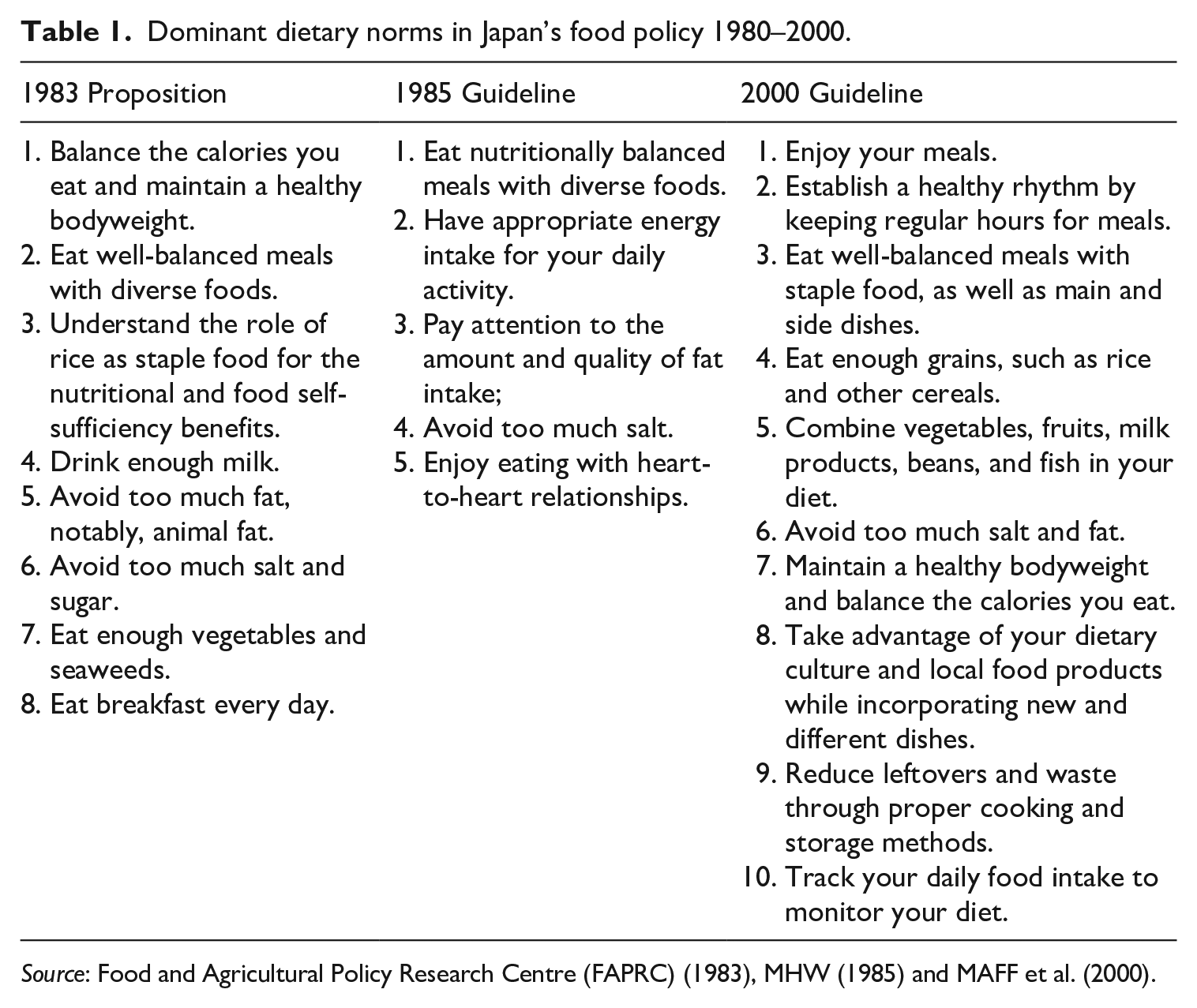
Source: Food and Agricultural Policy Research Centre (FAPRC) (1983), MHW (1985) and MAFF et al. (2000).
Although the Japanese dietary pattern in the 1980 Orientation was focused primarily on nutrients and food groups, ‘eat breakfast every day’ was newly normalised in the 1983 Proposition. A closer look at its background report (FAPRC, 1983: 16–17, 20–21) reveals that various components of the eating model – eating together with family members, keeping regular hours for meals, eating slowly, family cooking and enjoying meals – were initially proposed by nutritionist Miyuki Adachi, one of the committee members, to be included in the Japanese dietary pattern.
Keeping in mind this underlying intention behind the ‘eat breakfast’ advice in the 1983 Proposition, we now scrutinise the 1985 Guideline, which consisted of five principles and corresponding practical advice. While the first four principles were essentially the same as in the 1983 Proposition, some notable features were introduced. First, a particular dish composition of ‘staple, main dish and side dish(es)’ was normalised in the explanatory section as a primary example of the first principle. This demonstrated the important evaluative shift from nutrients or food groups to ‘meal patterns’, which required further consideration of Japaneseness, despite the intention of the allegedly ‘nutritional’ advice. Similarly, non-nutritional norms were also smuggled into the fifth principle and its explanatory section, such as ‘the table as a site for family interaction’ and ‘taste of home cooking with heart’. It is not difficult to view it as the extension of the ‘eat breakfast’ norm in the 1983 Proposition.
Gendered nature of the normalised meal patterns
Having mentioned the important inclusion of certain meal patterns (dish combination) in the Japanese dietary pattern discourse, I shall now clarify how its gendered nature was neglected in the development process of the discourse. The ‘staple, main dish and side dish(es)’ meal pattern (see Figure 3) is equivalent to a healthy meal in current nutritional policy, but it was not a self-evident category before the 1980s. The change in its status was made possible by one of the committee members of the 1983 Proposition, Miyuki Adachi’s (1984) work, which targeted the primary household constituent at the time and its meal provider, housewives, and proved the nutritional merits of such a meal pattern. Without this evidence, it would have been impossible to incorporate this meal pattern into the official dietary guidelines. This seminal work thus deserves careful investigation.
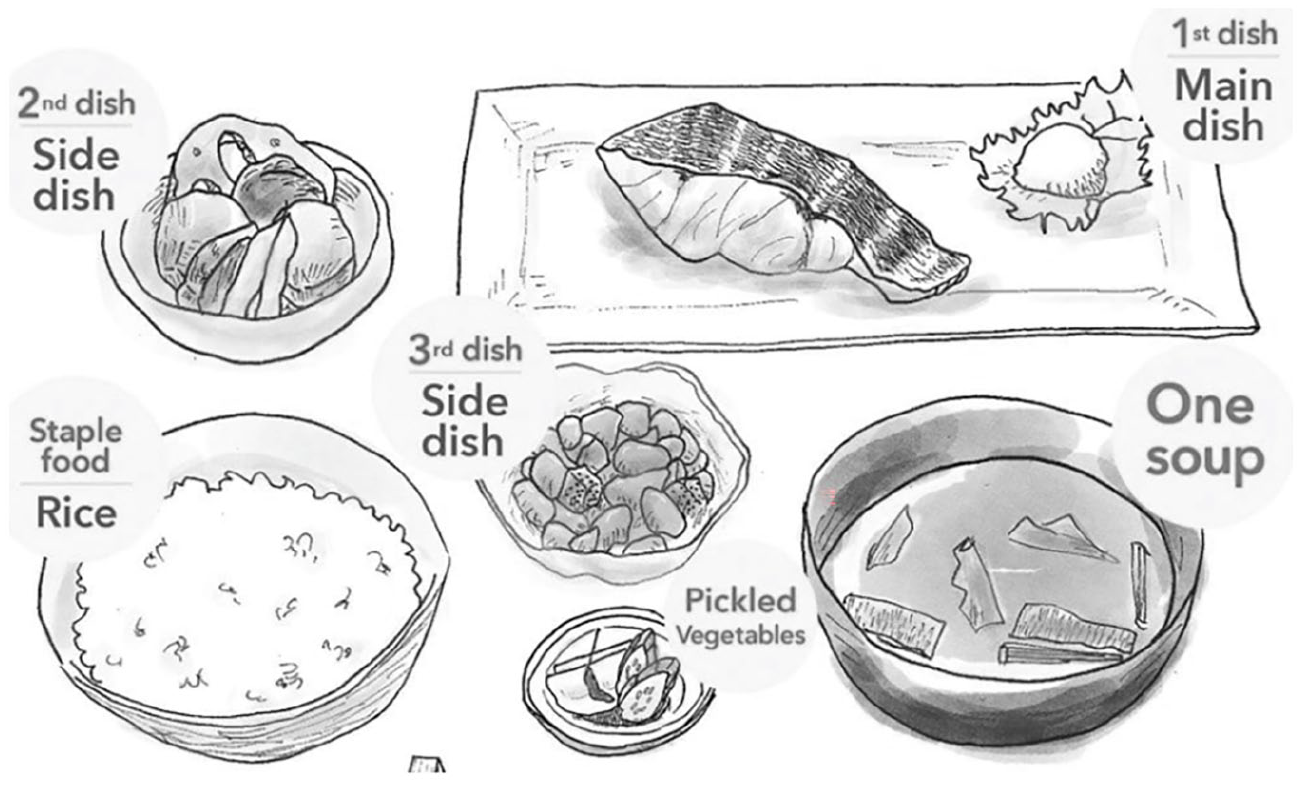
A normalised meal pattern in Japan.
The first question is why this meal pattern was selected among various choices characteristic of Japanese food cultures. In Adachi’s article, this meal pattern was selected for its practicality on the grounds that it was ‘recognisable for everyone’ (p. 5). Some literature on food culture was referenced, but it is unclear how these historical insights were incorporated into the process of selection. Nevertheless, this meal pattern requires two or more dishes (aside from rice), which is more demanding than the ‘one soup’ or ‘one dish’ consumed historically by most people during the first food modernity (Cwiertka and Yasuhara, 2020).
Second, the contemporary dietary condition was neglected, in addition to historical facts. Meal surveys of the 1960s showed that only 40%−60% of the population consumed two or more dishes, while less than 10% consumed the four dishes (including soup) required for the ‘staple, three dishes and soup’ pattern called ichi-ju-sansai (Hirayama, 1967, 1971). Even Adachi’s meal survey of the early 1980s indicated that 40%−60% of the population was not eating three or more dishes (including rice). Furthermore, the respondents to this survey were housewives, the primary household constituent of the post-war Japanese eating model, and it is highly likely that the practice rate of this meal pattern would be much lower in other households (the young, single, etc.) than in those with housewives. Although being recognisable for everyone, this meal pattern was not realisable for everyone.
Third, it is also important not to specify the number of dishes in this meal pattern, even though ichi-ju-sansai (with three dishes and soup: Figure 3) was widely exemplified in official documents. Ichi-ju-sansai has been a target of social criticism (Ako, 2015; Doi, 2016; Noda, 2021; Ueda, 2022c, 2023b). Historically, this meal pattern was the most simplified menu served in tea ceremonies and was later popularised through restaurants and family ceremonial meals. Although post-war economic development led to making family meals richer and more diverse, the above-mentioned surveys revealed that ichi-ju-sansai was not the basic ordinary family meal before the 1980s (Adachi, 1984; Hirayama, 1967, 1971). It was not until the mid-1980s that ichi-ju-sansai became normalised for family meals, and this sudden change was facilitated by two factors, namely (a) the social counterreaction to the ‘dehousewivesation’ of women and (b) the increasing hegemony of the nutritional sciences in food discourses (Ueda, 2022c). This explains why social criticism is particularly made by working mothers, who have less time to prepare family meals and suffer from the contradiction between the (unnecessarily) reinforced dietary norm and their practices.
To go back to Adachi’s article, the ambiguity regarding the number of dishes consequently helped to effectively promote the dietary norms that characterise the post-war Japanese eating model while avoiding such social controversy. It is important to keep in mind that the ‘staple, main dish and side dish(es)’ pattern has been included in the official guidelines with purely nutritional justification and without critical awareness of its gendered ideology.
Implications from the food modernity perspective
In sum, the Japanese dietary pattern was first conceptualised as the combination of certain food groups that were suitable for food and nutrition security, but its notion was later extended to cover the entire eating model without adequate socio-cultural justifications. How can we interpret this normative shift from the food modernity perspective?
First, the Japanese dietary pattern discourse was a counterreaction to the deepening state of gastro-anomy in Japan, as one member of the 1983 Proposition committee commented, ‘There is a growing anxiety about what we should eat, and this helplessness cannot be removed by a multitude of popular dietary guidelines’ (FAPRC, 1983: 46). The Japanese dietary pattern thus became the first official dietary guideline that covered the entire eating model in post-war Japanese food policy. This was a good case for the politicisation of eating, a typical symptom of reflexive food modernity (Poulain, 2012, 2019).
Second, while the focus of the eating model was inevitable due to the underlying gastro-anomic situation, its gendered nature was not adequately addressed in proposing official dietary norms. In the preparation stage for the 1983 Proposition, the committee initially advocated a view that problematised ‘the weakening of housewives’ ability for meal preparation’. This was soon refuted by committee member Miyuki Adachi, who said that ‘it is not only the responsibility of housewives but also the commitment from other family members that needs to be ensured to recover such family abilities’ (FAPRC, 1983: 42, 57).
Despite their gender consciousness in this aspect, the committee was not aware of the historical fact that their proposed dietary norms (home cooking, eating together with family, a ‘staple, main and side dish(es)’ meal, etc.) were also gendered products of the post-war Japanese family system. In other words, the Japanese dietary pattern discourse became a political instrument to maintain and reinforce the post-war Japanese eating model, as was the case with Japan’s anachronistic social welfare policy in the 1980s (Ochiai, 2012, 2014).
A series of Japanese dietary pattern discourses were later merged into the Dietary Guideline for the Japanese in 2000, with essentially the same content, and was granted more institutional force under the food education policy in 2005. As a consequence, its incongruity with social reality has continued to increase. The consumption of livestock animals and the fat ratio of energy intake kept increasing (Figures 1 and 2), while the food and grain self-sufficiency rates had decreased to 42% (on a calorie basis) and 29% (on a weight basis) by the end of the 1990s, respectively, a development that was sped up by Japan’s increasing integration into the global liberal trade regime (Committee on Basic Problems of Food, Agricultural and Rural Areas (CBPFARA), 1998). Reinforcing the norms of the post-war Japanese eating model has done little to stop this social change.
Hōshoku or deterioration of the dietary practice
In the eyes of the public, eating models have evolved not only in terms of meal content but also in terms of the total eating model (e.g. meal skipping, loss of family cooking, and solo eating), all of which began to be conceived under an encompassing trend of hōshoku from the 2000s. Hōshoku became a key term in social debate, including in TV documentaries, and a series of pioneering private surveys on contemporary eating (Adachi, 1983; Nippon Hōsō Kyōkai (NHK), 1982, 1999; Nippon Hōsō Kyōkai Research Institute (NHKRI), 2006).
Although being poorly defined, it is possible to identify some shared premises in the hōshoku discourse. With the same pronunciation in Japanese as ‘satiation’ or ‘individualism’, hōshoku, ironically, points to the negative consequences of free food choices. Moreover, the use of the term hō (collapse or deterioration) implies the universal existence of a particular eating model, which was established under the post-war Japanese family system, as well as the ‘responsibilisation’ of mothers who could no longer achieve such ideals. Finally, although it seems similar to the ‘destructuration’ of eating models that became a matter of sociological subject in France (Poulain, 2002a), hōshoku is different in the sense that it is not a conscious expression of the underlying food modernity. To advance the debate about hōshoku, I will analyse below the spatial, temporal, and content transition of eating models in Japan based on national statistics.
Meal skipping
According to the Nutrition Survey, 14% of men and 10% of women had a habit of meal (breakfast) skipping in 2020. Generally, breakfast skipping was more prevalent among men and the young than among women and the elderly, with the highest rate of 28% being for men in their 20s (the same survey in 2021). Although some considered this eating behaviour of the young as evidence of hōshoku effects (NHKRI, 2006: 16), it needs to be relativised from a historical perspective. A question item about meal skipping was introduced into the Nutritional Survey in the mid-1970s and it is thus possible to trace this trend (Figures 4 and 5).

Male breakfast skipping rate (1977−1994).

Male breakfast skipping rate (1995−2019).
It is noteworthy that in 1977 the rate of breakfast skipping for men in their 20s already amounted to one in four. Although the rate has continued to increase, the increase in meal skipping among the young men should not be overestimated. A rather important trend is the growing prevalence in the 30 years and over age group since the 2000s, which is also true of women (although the data are not presented in Figures 4 and 5). In sum, the actuality of hōshoku is not the growing practice of meal skipping for the young but its expansion to the middle-aged and elderly.
Meal outsourcing: From eating out to taking in
Proponents of the hōshoku discourse tend to problematise a decrease in home cooking, which is often associated with mothers’ responsibilities. This trend is verified here in terms of the place of eating. According to the Expenditure Survey, the rate of family meal outsourcing increased from 10% in 1963 to 32% in 2019. Eating out contributed to an early increase in meal outsourcing from the mid-1960s to the end of the 1980s, but since the 1990s (the collapse of the economic bubble), its rate has remained stable at around 16%−18%. The prevalence of outsourcing during this latter period was mainly due to taking in (ready-made meals to be taken home), the rate of which almost doubled from 7% in the early 1990s to 13% in 2019 (Figure 6).
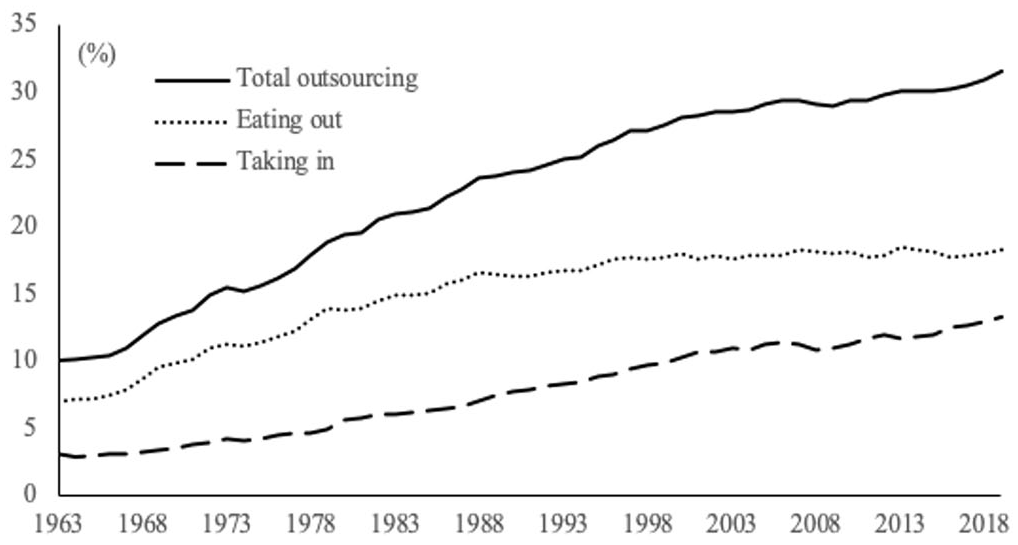
Rate of family meal outsourcing (1963−2019).
This overall trend needs to be studied more closely by gender and by meal. The question about eating out in the Nutrition Survey serves this purpose. First, lunch is the largest contributor to the increase in meal outsourcing, and it is more closely related to work style than household responsibility. For example, the rate of outsourcing by women during the first 20 years (1972−1994) was 40%−50% for lunch versus only 10%−18% for dinner. Certainly, the rate of dinner outsourcing for women increased 1.7 times from 1974 to 1994 but, to rephrase it, the percentage of ‘women who outsource dinner at least once in three (surveyed) days’ was merely 18% in 1994. While these insights were obtained from dietary intake data, a more in-depth view of dinner outsourcing can be obtained from the questionnaire included in the Nutrition Survey in 1986, which targeted specifically at women’s frequency of buying ready-made meals. This questionnaire reported 11% women who did so ‘three or more days a week’ and 30% ‘once or twice a week’. It is somewhat surprising that mothers were demoralised during this period due to relying on ready-made meals only once or twice a week while having a heavy work-life burden.
Second, this trend has not changed much during the past two decades. The question about taking in has been regularly included in the Nutritional Survey since 2001 (see breakdown by age and gender in Figure 7). An increase in taking in for dinner was certainly observed among mothers (women in their 30s−50s); however, its rate (taking in on a single surveyed day) was below 5% at its highest point. The increase was larger for men and the elderly (for men in their 50s−60s over 7% since 2014), the latter of which might have been associated with the mainstreaming of one-person households since 2010.
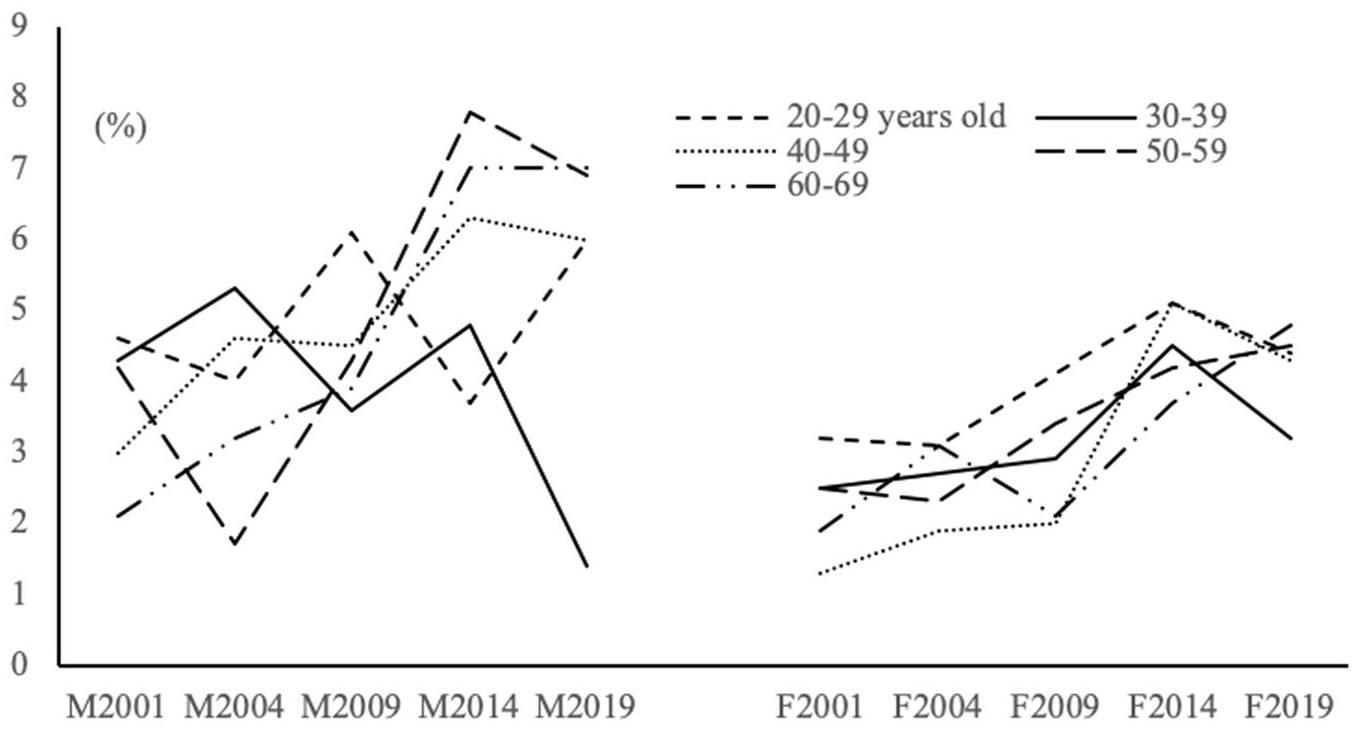
Male and female taking-in rate for dinner (2001−2019).
In economic theories, mothers’ meal outsourcing is considered a natural consequence of the increased cost of home cooking resulting from the decrease in household size and women’s social promotion (Kusakari, 2011); however, the above results showed that this scenario did not occur in Japan as radically as assumed by the hōshoku proponents. It would be more accurate to interpret this phenomenon as a long-lasting normative effect that originated from the post-war Japanese eating model, which implicitly idealises home cooking and mothers being responsible for preparing meals.
Delayed and quick eating
The temporal aspects of eating, notably the timing of family dinners, are also targets of the hōshoku discourse. According to the Nutrition Survey, the mainstream starting time for dinner was ‘before 7 pm’ in 1985 (men: 55.6%, women: 57.6%) but ‘after 7 pm’ 10 years later (men: 63.1%, women: 57.6%). Moreover, the same survey in 1997 showed that 20%−30% of the men in their 20s−30s became unable to start dinner ‘before 9 pm’. Dinner time came to be delayed further for working men (20s−40s) in the next 10 years until 2006, with no substantial change for either men or women since then (Time Survey: 2006−2021). A major factor in this change was undeniably the long working hours (particularly for men) since the post-war economic growth (Takami, 2019).
A similar transformation can be observed for meal duration. Although its stability (about 100 minutes per day) for more than 40 years has been historically highlighted in the Time Survey reports, there has been non-negligible change depending on gender and age (Figure 8). In addition to the large gap (30−40 minutes) between the young and the old, the meal duration of the working population (20s−60s) decreased by 5 to 10 minutes in the past 20 years, while it remained unchanged for the non-working 70s age group.

Meal duration per day (2001−2021).
Solo eating
Solo eating is one of the most controversial trends in the hōshoku discourse (Adachi, 1983; NHK, 1982). The Nutrition Survey has irregularly included the question about persons to eat with. In the 1980s, the prevalence of children’s solo eating increased from 21% to 31% for breakfast, while it remained at around 4% for dinner (according to the survey data in 1982 and 1993). Adults (non-one-person households) who had no opportunities for ‘eating together with all the family members in the past three days’ already amounted to 46% for breakfast and 28% for dinner in 1992, even prior to the hōshoku discourse. This strict definition of solo eating (‘all the family members’) implied that, similarly to the above temporal transition, fathers were absent at the family table for dinner during the period.
On the other hand, the Food Education Survey, which included the regular question about solo eating (without any family member) from 2009 to 2021, reported a slight increase in solo eaters (‘eating alone more than three days per week’) for breakfast (43%–45%) and a decrease for dinner (31%–22%). However, the socio-demographic differences were large, with 61%−71% male solo eaters in their 30s−50s for breakfast and 35%−46% for dinner, implying the absence of fathers at the family table according to the same survey in 2021.
If ‘eating together’ is extended to all friends and colleagues (Time Survey: 2001−2021), the rate of solo eaters increased both for breakfast and dinner during almost the same period (Figure 9), partly due to the mainstreaming of one-person households since 2010. In sum, what deserves attention since the 2000s is not the conviviality within families (and the mothers’ responsibility) but the prevalence of solo eating – the ‘lack of intimacy’ (Ochiai, 2014) – on a wider social scale.
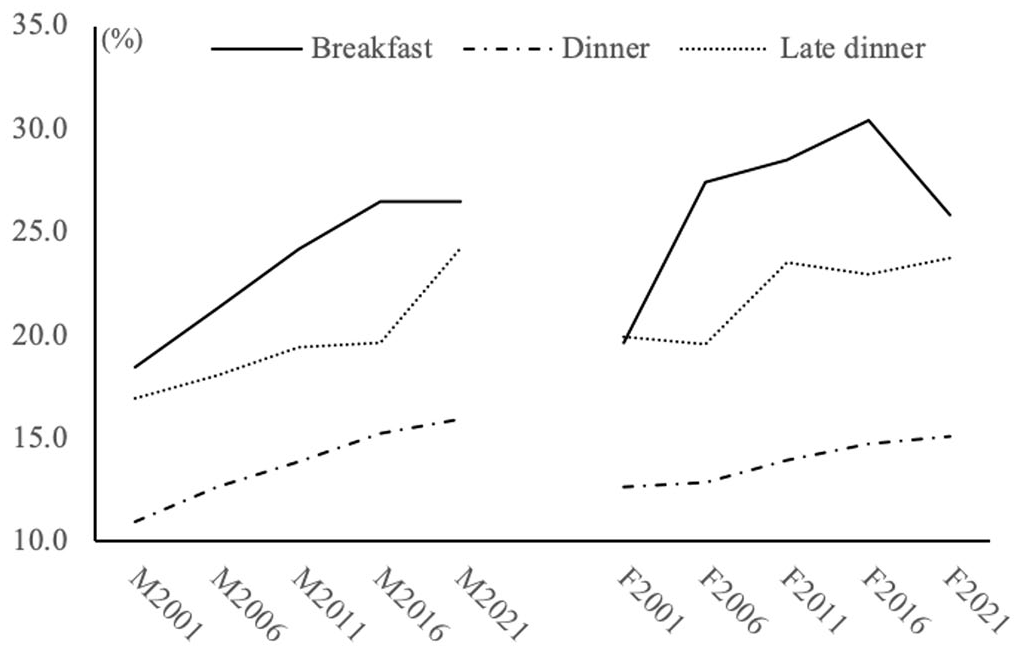
Solo eating rate (2001−2021).
Simplification of meal pattern
As mentioned above, 40%−60% of the population were not practising the ‘staple, main dish and side dish(es)’ pattern in the 1980s (Adachi, 1984). Interestingly, 33% were still non-practitioners (excluding ‘almost every day’ practitioners) in 2009, when the historical comparison of meal patterns finally became possible (Figure 10). In the past 10 years (2009−2021), the simplification of meal patterns might have progressed because the rate of such practitioners decreased from 67% to 38%.
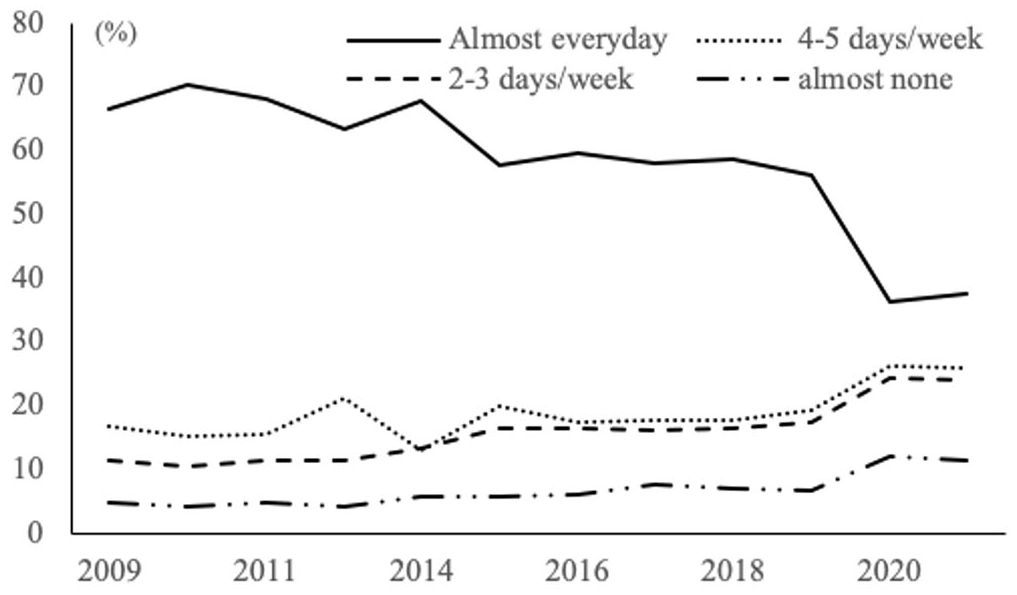
Frequency of ‘staple, main dish and side dish(es)’ intake.
A closer investigation by socio-demographic state is possible in the Nutrition Survey. Generally, men, the young and those with low incomes were less likely to practise the ‘staple, main dish and side dish(es)’ pattern. Almost half of those in their 20s and those with low incomes were unable to follow this pattern on more than 3 days per week (according to the survey data in 2016 and 2019).
The real nature of hōshoku
The series of empirical investigations revealed the real nature of the hōshoku discourse. The first issue is the insufficiency of longitudinal data on eating models and empirical justification for the hōshoku debate, which highlights its normative nature rather than a real change. Second, one can observe some degree of evolution in eating models (such as meal skipping, solo eating, and the simplification of meal patterns); however, the degree has been somewhat oversimplified by neglecting various differences (age, gender, and meal type) and the underlying demographic changes.
In general, the degree of change was larger for men and the young than for mothers, and for breakfast and lunch more than for dinner. It is, thus, unjust to attribute this change solely to the weakened role of mothers in providing family meals. Rather, mothers’ practice of dinner preparation has been more stable than assumed theoretically, indicating their painstaking efforts to conform to the gendered norms regarding family meals.
Third, having characterised its real nature, hōshoku can now be viewed as a form of destructuration of the eating model. ‘Destructuration’ refers to an enlarging gap between dietary norms and practices (Poulain, 2002a), and it is not simply the deterioration of dietary practices as assumed in the current hōshoku discourse. This growing contradiction around hōshoku discourse is the fundamental symptom of the second food modernity. In principle, such a contradiction can also be a positive driving force for reconstructing people’s dietary lives. However, these dietary norms, which originated in the post-war family system, are currently detached from contemporary eaters’ reflexive monitoring and often turn into negative pressure, particularly on women.
Conclusion
In this article, I have proposed the notion of the ‘post-war Japanese eating model’ and demonstrated how the social persistence of this system has manifested in dominant dietary discourses in contemporary Japan. Despite the dominant agricultural and nutritional accounts, the Japanese dietary pattern discourse did little more than reinforce the post-war Japanese eating model. Hōshoku has been conceived as the alleged deterioration of dietary practices, but, in reality, this discourse idealised the Japanese dietary pattern and, thus, enlarged the contradiction between the elevated norms and the actual practices of contemporary eaters.
The post-war evolution of eating models in Japan has been characterised with varying terms, such as ‘Westernisation’, ‘modernisation’ (not in a strictly sociological sense), and ‘an affluent society’. However, none of these has been effective in highlighting the gender inequality in food security. The perspective of the post-war Japanese eating model enabled a linkage of food studies with the sociology of family (Ochiai, 1989, 2014) to invite a critical analysis of complex relationships between food in/security and gender factors in contemporary Japan.
One of the key themes from this perspective was the destructuration of eating models, a growing gap between dietary norms and practices, as a typical symptom of reflexive food modernity (Fischler, 1990; Poulain, 2002a). In this article, we investigated a national context in Japan on how such destructuration has been facilitated by the Japanese post-war eating model and the dilemmas concerning family meals have been unequally produced between women and men. In this sense, the national condition in Japan has much in common with those in other Western contexts, in which family cooking has been an evident sign of the submissive and subordinate role of women (Charles and Kerr, 1988; DeVault, 1991; Murcott, 1983).
However, women’s role as family meal provider can also be considered from more proactive or, at least, plural perspectives (Avakian, 1997; Counihan, 1999; Counihan and Kaplan, 1998; Flowers and Swan, 2015). Indeed, when an evaluative attention is given to whether one can achieve ‘eating well’ that is currently conceived by the Japanese population (Ueda, 2022a), national statistics and relevant studies reveal that Japanese women are leading such better-off dietary lives when compared to men, with less meal skipping, more home cooking, and having more proper meals. Moreover, it can also be viewed from the agency perspective that a larger norm–practice dilemma among women becomes a greater resource for future evolution of their dietary practices. The opposite side of this issue is that Japanese men have historically been excluded from the everyday family kitchen sphere and the opportunity to cultivate their food capabilities (Cwiertka, 2007; Kimura, 2011).
Admittedly, the dietary norms constructed under the Japanese post-war eating model – such as eating together with family members and preparing a proper meal with two or more side dishes – still enrich the content of ‘eating well’ for many Japanese today and one should not deny their importance. However, some of these practices have become increasingly difficult to perform due to demographic and family structural changes, while the legitimacy of others (e.g. the hegemonic place of rice as a staple) has also been challenged in the light of new dietary information. What is, therefore, necessary for contemporary eaters is to assist their ‘reflexive monitoring’ (Giddens, 1991), that is, a constant examination of their food practice and a flexible update of their dietary norms, by making them aware of the reflexive or ‘semi-compressed’ food modernity, not to maintain the hegemony of the post-war Japanese eating model.
This article was focused on Japan, but it would be interesting to see how and why the contradiction between the dominant dietary norms and eating practices has emerged in other Western and non-Western (especially East Asian) countries. Although such data are currently limited, future international comparisons might clarify the nature of the ‘semi-compressed’ food modernity facing Japan. In so doing, gender literature, which was partially referenced but still limited to a country insight in this manuscript, also needs to be extensively mobilised to understand the relative nature of dilemmas in dietary lives of Japanese women (and men). Another limitation was that the focus of this article was on eating models (only the consumption aspect) not the food system. Indeed, the Japanese post-war eating model was not possible without the productivist food system, but I will defer that discussion to a later date.
Footnotes
Declaration of conflicting interests
The author declared no potential conflicts of interest with respect to the research, authorship, and/or publication of this article.
Funding
The author disclosed receipt of the following financial support for the research, authorship, and/or publication of this article: This work was supported by the Japan Society for the Promotion of Science [grant number: 21J01732, 22K14956] and the Lotte Foundation (LF000805).
