



Abstract
Along with most of the Organisation of Economic Cooperation and Development, New Zealand has experienced significant changes in local and regional development policy and practice since the wide-spread adoption of neoliberal reforms in the 1980s. Policy interventions have restricted the powers of local governments, rationalised state support for more marginal areas and ultimately led to a scenario in which local communities are obliged to become more pro-active in the determination of their local economic futures. This paper discusses how neoliberal changes have impacted on New Zealand government policy and spatial development. In the second part of this paper, based on field research, the implications of these changes on smaller, more marginal urban centres less well positioned to adapt to a context of neoliberalism and change are investigated. Evidence is drawn from statistical indicators of change and from a study of 68 small towns to identify common catalysts and barriers to economic development and diversification. The study reveals the key role which entrepreneurs, in particular those who desire to encourage others to come and locate in their town, can play in the economic wellbeing of their towns in an era of reduced state support.
Introduction
State economic policy in many parts the world has, in recent decades, been characterised by what Chorianopoulos and Iosifides (2006: 409) refer to as ‘the proliferation of the neoliberal rationale’. The limitations of the Keynesian state and its associated spatial policies, political conservatism and the search for more market-based and supply-side solutions to development challenges have encouraged a rethink of regional and local development policies in many parts of the world (Mudge, 2008; Peck, 2013). In urban areas, the phasing in of what has been termed ‘new urban policy’ and ‘neoliberal urbanism’ has been marked by the replacement of redistributive policies in favour of the ‘privatization of urban governance’, an emphasis on partnerships, training and supply-side support (Addie, 2009; Peck et al., 2009; Sager, 2011; Swyngedouw et al., 2002). Terms such as the ‘entrepreneurial city’ and ‘spaces of neoliberalism’ are indicative of this shift (Brenner and Theodore, 2002). The growing significance of the role of non-state actors and the private sector in particular in local development (Brunetta and Caldarice, forthcoming; Harrison, 2014), the weakening of regionalism (Elcock, forthcoming) and growing gaps between places (Hildreth and Bailey, forthcoming) are features of the era. New Zealand too has been heavily impacted on by the ‘neoliberal turn’ since the 1980s (Shone and Ali Memon, 2008). The New Zealand government has followed a more aggressive approach in terms of applying neoliberal thinking with respect to spatial development policy than many other countries (Peet, 2012). New Zealand’s historically high levels of state-led spatial intervention and community economic support have all but vanished since the 1980s in favour of adherence to market-led development. While state spatial interventions have continued, albeit in reduced forms in many countries, in New Zealand, the contraction of central state support and the limited capacity of local government have meant that local communities have had to look inward to their own resources and capacities to ensure the future of their communities (Haggerty et al., 2008; Larner, 2000; North, 2002; Peet, 2012).
This first half of this paper explores New Zealand’s neoliberal policy shift and the resulting contraction of spatially focussed economic support. The current, limited nature of state economic support and the role played by local government are also outlined. Attention then focuses on a statistical examination of demographic and economic changes in selected regions in the country’s space economy, undertaken to illustrate the changes which small towns have been experiencing as a result of both the evolution of the economy and policy change. Attention then shifts to focus on how selected small town localities have grappled with the twin challenges of declining state support and the need to seek economic diversification as traditional extraction and rural industries have declined. While some towns have benefitted from new rounds of investment, including tourism or from proximity to an urban core, many have faced the reality of decline and have selectively responded through locally led regeneration with access to only minimal levels of state support. As we argue, in this context, where local government action is increasing constrained by the narrowing scope of available support measures and resource challenges, it is often local entrepreneurs and the community leaders who support them that are instrumental in driving change. New Zealand’s local development experience is of particular interest as it differs from that in many other parts of the Organisation of Economic Cooperation and Development (OECD) given the financial restrictions on local government action, which are largely self-funding through local rates, and the focus of regional development interventions which is on growth as opposed to redistributive goals (Schöllman and Nischalke, 2005). Discussion on ‘new regionalism’ (Markey, 2011) and the response of ‘shrinking cities/towns’ (Rieniets, 2009), particularly with regard to the role local agents and entrepreneurs can play in the economic survival of towns peripheral to the economic cores are useful points of reference.
New Zealand: Background details
New Zealand is a small country comprising two major islands in the south Pacific. In 2013, New Zealand’s population was estimated at 4,462,671 (StatsNZ, 2013), and by 2004, 85.8% of the total population was urbanised with 71.1% of that total living in the 16 largest urban centres (i.e. places with more than 30,000 people) and some 540,000 people lived in the smaller urban centres (StatsNZ, 2004). The NZ Treasury (2012) has described the country as being fairly unique among developing countries, having a small economy situated some distance from the major global centres of economic activity and with correspondingly low levels of economic integration with the rest of the world. Relative to most of the rest of the OECD, New Zealand’s economy weathered the post-2008 economic crisis comparatively well (IMF, 2010). Despite this healthy economic position, the National Party (conservative)-led government has chosen to embark on a new round of austerity measures designed to further ‘liberalise’ the economy which include the effective curtailment of regional policy and apparent restrictions on local government autonomy, in what appear to be efforts to both enhance central control and encourage market forces.
Theoretical and policy context
While it is apparent that neoliberalism, as it is applied around the world, is not a single approach and is a concept which is difficult to define, certain key characteristics are apparent, which include the favouring of free market solutions to economic problems, inflation control, a belief in neoclassical economics, and taxation and business regulation (Mudge, 2008; Peck, 2013; Peck and Theodore, 2012). Within this context, regional and local development has tended to become more market and supply-side focussed in nature with emphasis placed on concepts such as ‘smart growth’, clusters, and globalisation. Increasingly, as writings on ‘new regionalism’ argue, local actors and agencies need to play a more assertive role in their use of place-based assets in a globalised economy (Markey, 2011). In areas and towns failing to experience regional economic convergence, or being subject to economic and population loss as encapsulated in arguments about the ‘shrinking city/town’ phenomenon (Rieniets, 2009), interventions such as devolution, regional governance and civic responsibility have a key role to play in local development responses (Jackson, 2010). Grassroots economic development and the role of local entrepreneurs are often critical in community wellbeing and survival (Hollander et al., 2009; Wilson, 2011).
In this context, New Zealand has a particularly interesting political-economic history having swung from having had one of the most protected and controlled economies in the OECD and from being a champion of social democracy and the welfare state prior to the 1980s to one of the least interventionist countries in the world (Challies and Murray, 2008; Conradson and Pawson, 2009). According to Peet (2012: 151) ‘New Zealand is a particularly interesting case because of its well-deserved reputation as a social democratic, welfare state that went neoliberal with a vengeance in the mid-1980s’. In addition, the focus on ‘national wellbeing through economic internationalization’ as opposed to being a shareholding democracy makes the New Zealand brand of neoliberalism distinctive (Larner and Walters, 2000: 361).
Although New Zealand had enjoyed a degree of economic prosperity after the Second World War, by the 1970s the boom was over. The loss of the privileged export market of food products to the UK following the latter’s accession to what is now the EU, rising unemployment and public debt laid the basis for restructuring in the 1980s (Peet, 2012). Under the Labour government, a neoliberal policy known locally as ‘Rogernomics’, named after the then Minister of Finance, was introduced in 1985. These changes, which were extended by the new National government after 1990, impacted on all aspects of the economy and its management. State-owned enterprises were replaced by policies of corporatisation and then privatisation, state services were trimmed and state expenditure was cut (Challies and Murray, 2008; Lewis, 2012). In parallel, industrial and agricultural subsidies and control boards were suspended, the currency was allowed to float and more flexible labour market conditions were introduced (Lattimore and Eaqub, 2011). The efficiency and accountability of the civil service was enhanced through a performance-based system, and the independence of the central bank was enshrined through a series of key Acts (Bale and Dale, 2013; Mascarenhas, 1993). The new focus on public sector management created an enterprise culture influenced by economics of organisation, not private sector methods, making the country distinct from other OECD countries in this regard (Mascarenhas, 1993).
The effects of these changes were profound. State expenditure fell 25%, the New Zealand dollar was devalued 20%, manufacturing lost 30% of jobs, sheep production – the key export commodity – fell 30% and unemployment rose from 2% to 11% by 1991 (Abbott, 2007; Challies and Murray, 2008; Lattimore and Eaqub, 2011). Thereafter however, employment levels slowly rose and the country’s non-tradeable sectors – construction, financial services and retail – started to experience growth, export diversification slowly grew with a movement into higher value industrial and agricultural products (Abbott, 2007; Lattimore and Eaqub, 2011). While the economy did eventually recover, the 1980s was regarded as a ‘traumatic’ period from which many small towns, dependent on resource exploitation and productivist farming, have never fully recovered (Abbott, 2007).
In terms of regional and local development, the move from a command and control economy in which regional development interventions and industrial support had played an important role to a market-based one was profound (Abbott, 2007; Lattimore and Eaqub, 2011), with the ‘responsibility for regional futures often shifting from the level of central government to the level of the regions themselves’ (Conradson and Pawson, 2009: 78; Elcock, forthcoming). Regional policy was not initially totally abandoned but was rather significantly downscaled, in terms of focus and funding and by the 1990s had transformed from one driven by top-down intervention to one geared more towards support for local initiatives through the funding of a series of Business Development Centres designed to support small businesses, with a focus on innovation and export potential (Scott and Pawson, 1999). From the late 1990s, the language of ‘partnership’ came to characterise regional thinking, and emphasis was placed on multi-level collaborative arrangements between government, agencies, local institutions and community and volunteer groups (Haggerty et al., 2008; Larner and Butler, 2007). Moves to encourage regional partnerships, regional innovation through support for regional polytechnics and local collaboration, however, tended to favour regions with the greatest capacity to mobolise partnerships and identify joint projects, with little progress being noted in the more marginal areas (Schöllman and Nischalke, 2005). By the earlier years of the present century, these initiatives were scaled down, as is discussed below.
With the introduction of austerity measures from the 1980s, at one level past regional development interventions were severely curtailed whilst at another the rationalisation of state services, such as the railways, timber industry and postal services in particular, weakened the economic vitality of dozens of small towns (Wilson, 1995) and in some cases, whole regions, such as the West Coast of the South island which had been heavily dependent on state-owned resource extraction activities (Britton et al., 1992; Conradson and Pawson, 1997). The result of this policy shift, according to Pratt and Lowndes (2005: 139), was that ‘the market-focussed policies of government in the 1980s and 1990s meant New Zealand’s provinces were largely left to shape their own economic destiny without central assistance’, not dissimilar from happened in Australia (McDonald, 2014). Since 2008, regional policy has been further downgraded, such that in 2013 the national budget for this policy was reduced from just under $4 million p.a. to $200,000 (NZ Treasury, 2013). This has led to a scenario in which state support for local level development has fallen, while local governments often lack the resources or political will to engage in local level economic development in the more struggling areas and civil society is obliged to play a greater role in terms of self-help (North, 2002).
Current central government development support
Aside from government support for the export industry and lead sectors, very limited government community and economic development support continues to be undertaken by two ministries. The activities of the Ministry of Social Development (MSD) almost entirely focused on benefit support with limited funding set aside for usually short-term community initiatives. These include an interagency initiative to extend a range of government services into rural areas (Heartland Services, 2013) and funding has also been made available to address youth-related issues (www.msd.govt.nz). Similarly, the subsidiary Department of Internal Affairs (DIA) funds community development advice and staff positions for up to three years in selected, deprived areas, adding about nine towns on a rotating basis per year. The other key ministry, the Ministry of Business Innovation and Enterprise (MBIE) focuses on improving government processes to support businesses and in particular to assist them to enter the export market, and more recently to access energy, communication and natural resources (Ministry of Business, Innovation and Employment: www.med.govt.nz). Funds have also been targeted to support sports events and cycle trails (NZ Treasury, 2013). The extremely limited nature of central state support for localities has meant that the mandate for development in the peripheral areas, in particular, has devolved to the local level and finds accord with the privatisation and rationalisation of activities elsewhere (Peck, 2013; Sager, 2011).
The current local government context
Local government in New Zealand has a mandate to engage in local-level economic activity; however, such actions have been constrained by a range of considerations, which reflect the market focussed environment in which they now operate. Recent legislative changes which are outlined below, and the fact that unlike in many other OECD countries New Zealand local government is predominantly self-funded, largely through rates income, narrows the scope and capacity for action. As there are numerous calls on limited finances, councils therefore find it challenging to prioritise economic development in the struggling areas. In practice, local government economic support tends to focus on issues such as marketing, general infrastructure provision and acting as a conduit for central government support for small business development in the larger centres. Local government operations are influenced by the key Local Government Act which is discussed below.
The Local Government Act of 2002 defined the role of local government and most importantly introduced the requirement that councils promote the economic, social, cultural and environmental ‘wellbeings’ of their communities (New Zealand Government, 2002). Although this suggests a key economic role for local governments, in 2012, there was a partial reversal of the above-mentioned provisions, and in spite of opposition from local authorities, the central government amended the Act (New Zealand Government, 2012a) bringing in measures which have narrowed the mandate of local government and enhanced the powers of the Minister to intervene in the affairs of local governments. Government argued that these steps were needed as local governments do not operate efficiently, nor are they focussing on their unique service provision role, in addition the four wellbeings were seen as ‘diverting; local government in areas of central government and private sector responsibility’ (New Zealand Government, 2012b: 1). The amendments to the Act replace the above-mentioned wellbeing requirements detailed in the ‘purpose statement’ with the new and significantly narrowed down responsibility namely that they ‘meet the current and future needs of communities for good quality local infrastructure, local public services, and performance of regulatory functions in a way that is most cost-effective for households and businesses’ (New Zealand Government, 2012a, 2012b). These market-based reforms did not go unopposed, Local Government New Zealand argued that there was ‘limited evidence to inform the development of these proposals’, or to arrive at the conclusion that councils had not focussed on core services (Local Government New Zealand, 2012). It could be speculated that the amendments to the Act reflect both government’s desire for a more market-led approach in which local government power is further curtailed and that central government have given themselves the ability to intervene, ostensibly in favour of market interests or public good, which bears some parallel with recent experience in the UK (Elcock, forthcoming).
Given the constraints on both central and local government capacity to act at the local level, and with the possible exception of local action in the better resourced cities, in small towns, local entrepreneurs, community leaders and community groups clearly have a critical local development role to play which is explored in the next half of this paper.
Case study evidence: The small town context
Having examined the context of legal and policy change and the reduction in state support for regional and local development in New Zealand, attention now shifts to examine the outworking of these processes on local areas. Evidence of demographic and economic changes in selected regions which have occurred in recent years as a result of broad economic change, including the probable effects of shifts in state policy, is examined, before moving on to identify, from a series of case-study towns, how local communities are responding to the economic and policy context in which they find themselves. Evidence from the case studies is presented in a discussion around series of core themes which emerged from a field-study.
While the pursuit of free market policies has undoubtedly facilitated economic growth in the key business sectors with growth potential, including the agro-industry, services and tourism sectors in larger centres such as Auckland, Tauranga and Queenstown, smaller, more peripheral centres are seldom able to benefit directly from new rounds of investment. Exceptions would be tourism and commuter towns, while most have to pursue their own creative, locally driven economic alternatives. What is happening parallels Addie’s (2009: 536) finding that ‘a neoliberal articulation of urban democracy that discursively legitimises development from above’ has also encouraged a counter-trend in terms of the ‘grass-roots activities’ and the integral role of the rural entrepreneur in rural development (Bryant, 1989). The re-articulation of regional and local development in a neoliberal context parallels international findings (Mudge, 2008; Peck, 2013). It is also apparent in the literature that socially minded entrepreneurs, or what Wilson (2011: 700) terms the ‘benevolent entrepreneur’, have key roles to play in terms of community development and engagement.
The study outline
The study was based on field research in 68 small towns, ranging in size from tiny settlements of only 150 people, to towns with populations up to 5000 (see Figure 1). The research drew on available statistical data on business and population change, sourced from census and business directories, and a series of in-depth, semi-structured interviews with local key informants (including businesses, local government, local business support agencies, NGOs and community leaders).
New Zealand: Cities and selected small towns.
Material reviewed included reports about economic and employment changes. Interviews focused on issues of economic and employment change, the existence and effectiveness of local initiatives, if any, the use and reuse of available economic spaces and observable features of townscapes, such as dereliction or space reuse. Interviews also attempted to gauge employment and unemployment levels in various sectors, local skills use, business mix, the presence or absence of catalytic initiatives and the role of voluntarism. An effort was made to ascertain the degree to which ‘second modernity’ type enterprises were emerging, i.e. local foods, environmentalism, new ‘adaptive’ businesses and multi-functionalism (Knox and Mayer, 2009; Wilson, 2001). Links to globalisation, the use of internet trading and efforts to diversify local economies were also explored. An effort was made to establish from local businesses what they noted as catalytic rather than rely on reports from local support agencies which might have a biased perception of their impact. Evaluations of economic change were informed from available statistical data, such as that presented below and from triangulation with interviews with key stakeholders.
Statistical evidence
Drawing on statistical evidence of both population and economic change in small towns, predictably the fastest growing small towns were generally in the proximity of the larger population nodes of the North Island cities and Christchurch in the South Island due, primarily, to the dormitory effect of lying within the commuting belt of a core city (Nel, 2012; StatsNZ, 2008). In addition, towns which had experienced tourism related growth also enjoyed economic and population growth. The reverse was however generally true in resource-dependent and manufacturing towns. The American Casey Institute (2006) similarly noted that rapid growth generally takes place in small towns with scenic landscapes and proximity to metropolitan areas in the USA. While patterns of growth and decline are most like due to inevitable economic shifts and not state policy, the reduction in state policy has inevitably weakened local capacity to respond to processes of change.
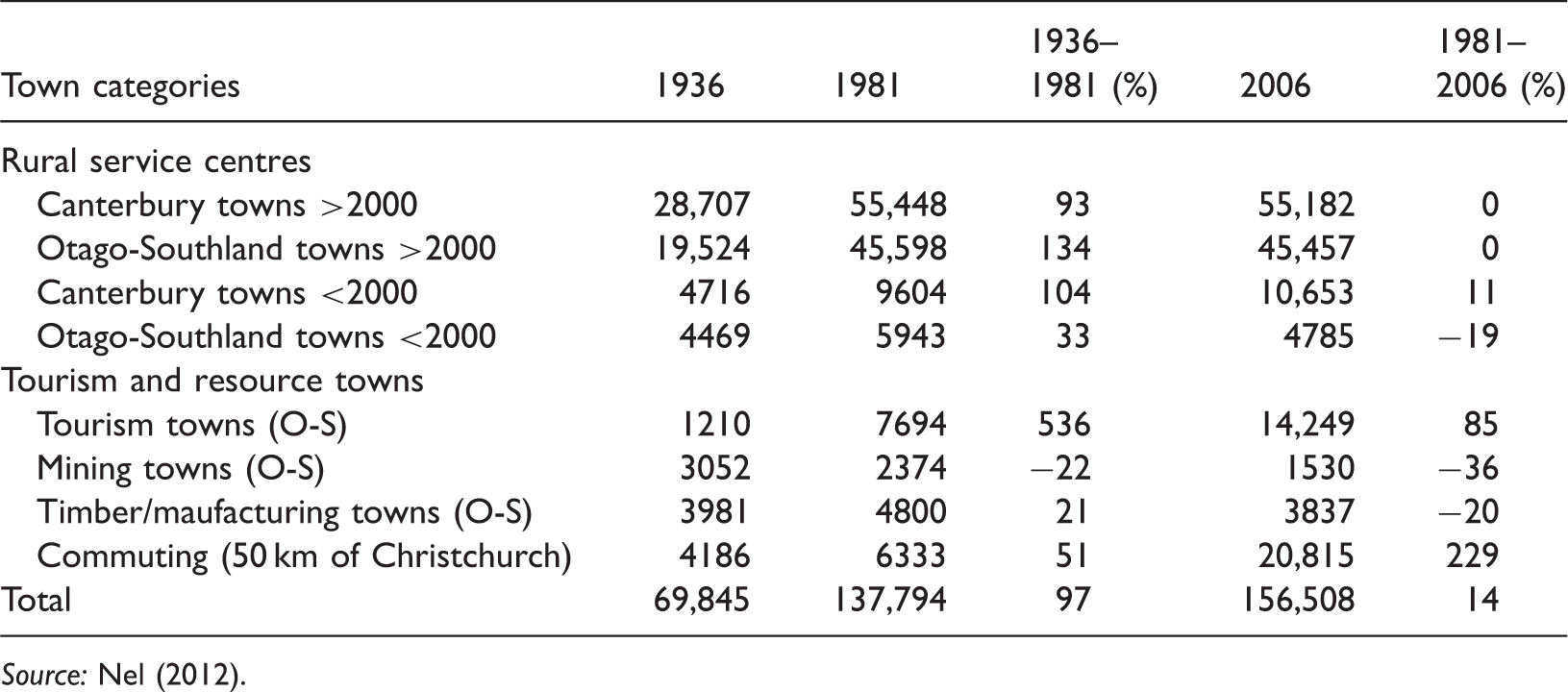
Table 1 summarises the aggregate patterns of small town (i.e. taken to be places with less than 5000 people) population growth and decline across a range of categories of small towns in the Canterbury and Otago/Southland regions in the South Island, which cover some 30% of the surface area of New Zealand, in the period 1936–2006. These three regions were selected for analysis based on the availability of data and the overlap with many of the towns visited as part of the fieldwork. Table 1 clearly shows that rural service centres experienced a phase of growth which now seems to have passed, whilst resource-based and manufacturing towns have, at an aggregate level, experienced decline over the last 70 years. By contrast, tourism towns and commuting towns lying within 50 km of Christchurch have experienced the fastest growth. Figure 2(a) and (b) shows the changing numbers of registered business in these categories of small towns. Figure 2(a) shows that the larger centres and those in Canterbury (which currently has a buoyant rural economy based on dairying) appear to have experienced higher levels of sustained business growth while business numbers in smaller centres or those in Otago have either declined or plateaued, with the exception of the key tourism towns. Figure 2(b) clearly differentiates between the high growth experienced in tourism and commuting centres and the absolute decline in resource- and manufacturing-based towns.
(a) Changing aggregate business numbers in rural service centres (in Canterbury and Otago/Southland in all centres with more or less than 2000 people). (b) Changing aggregate business numbers in tourism, commuting, resource and industrial towns in Canterbury and Otago/Southland. Aggregate population change in key categories of Canterbury and Otago/Southland towns. Source: Nel (2012).
Selective growth in the areas with beneficial locational features, i.e. tourism or proximity to a core centre and the challenges of economic survival in other areas are evident from these statistics. Next, the study attempted to identify, from interviews how ‘lagging’ towns, which experienced both business and population loss, such as those identified above, are responding to these changes.
Survey results
Economic diversification
In multiple cases, the study revealed that examples of new economic activities can be found in most small towns ranging from the manufacture of stationary equipment, to pies and salami through to the establishment of new niche or fringe tourism activities, transition town initiatives and retail, including boutique shopping (clothing and antiques most commonly) and internet trading. However, it should be noted that in most cases, these new areas of economic activity created only a limited numbers of jobs, seldom replacing the loss of employment from a traditional core industry in cases where such had been experienced (i.e. the closure of a mine or timber mill). Despite this, where ‘islands’ of new economic activity did occur they created a degree of employment, vibrancy and hope in that town which helped to retain and sometimes attract new residents. For example, one new business in the small town of Lawrence, at the time of the study, employed 40% of the local work-force, and though not replacing the previous century’s productivist employment levels in gold mining and agriculture, the new business has none the less helped to retain local economic activity and boost local resilience (Key Informant (KI) 1 and 2, 2010). By contrast, in tourism and commuting towns, substantial population and business increases have taken place, often from a very low base.
The role of support agencies
It was apparent from interviews undertaken in the 68 towns that given the government’s current focus on assistance for export-focussed industries, which tend to be the larger companies in bigger centres, the normally smaller firms in small towns generally do not attract such assistance. Even local councils tended to focus on the larger population centres in the areas under their jurisdiction, leaving smaller towns feeling under-supported. Though some councils did focus on working with industry to create employment opportunities for the marginalised, i.e. youth (www.mayorstaskforceforjobs.co.nz), such as Otorohanga and Kawerau which, in the case of the latter, were also assisting local industry to diversify into bio-fuel production, it should be noted that these projects were driven by the passion of individual mayors and were in smaller local government areas than the national norm (KI 3, 4, 5, 6, 7, 2012). This key role played by local leaders in rural economic development parallels findings noted previously by Sorenson and Epps in Australia (1996) and Henderson (2002) in the USA.
Most small towns had a variety of community-driven initiatives, some self-initiated while others had managed to access central government MSD or DIA funding for facilitation assistance to address community needs (KI 8, 2012; KI 9, 2013). In such cases, economic development was generally a side-line to broader community activities and resulted in projects such as markets and community gardens. Places which received such government facilitation support included Ranfurly, Kurow, Kaitangata and Mataura. Community-based actions included interventions by Māori/Marae-based organisations and environmental groups such as in Hampden and Raglan (KI 10, 11, 2010: KI 12, 13, 2011; KI 9, 2013). However, in many such cases, it appears that while social and amenity improvement outcomes were generally well achieved, economic diversification outcomes tended to be elusive.
Community-based events are also a common feature in the life of small towns. They are generally co-ordinated by a variety of support agencies, usually for social purposes, including fundraising or for town promotion to visitors. Few towns used events as an opportunity to lure potential investors to relocate to their small town, though there were exceptions, notably the town of Hampden where volunteers run events to promote the values of sustainable living. These themed activities have successfully attracted some overseas migrants to relocate to the town (KI 10 and 11, 2010). Likewise, the heritage precinct events in Oamaru have attracted new investors (KI 14, 2011). It is apparent that there is benefit to mixing the social objectives of events with the goal of luring new entrepreneurs to locate in a town. Indeed, O’Sullivan and Jackson (2002) and Bradley and Hall (2006), in their UK-based investigations, noted the capacity of events and festivals to attract in new business.
In some towns, business associations, funded through membership fees or through forming a special rating district, such as in Hawera, Fielding and Paeroa, have helped to enhance their towns’ visual appearance and amenities and have supported town promotion (KI 15, 16, 17, 18, 2012). This was seen to have a positive effect but focussed on existing business retention rather than on the attraction of new investors. Nevertheless, in cases where the business association became active in facilitating access to physical space for new comers and engaged directly with new businesses coming into the area, economic diversification did occur. An example is the town of Tirau, where the business association was driven by a local entrepreneur who personally improved accessibility to retail space and encouraged new investment (KI 18 and 19, 2011). In Geraldine and Matakana, the drivers of economic growth were private developers who built small retail malls to expand the local economic base, with the existing business association playing a supportive role (KI 20, 2012; KI 21, 2011).
The role of entrepreneurial-driven local economic development
From the field work, and in the light of very low levels of external support, it became apparent that more critical than the existence of business support groups is the importance of private business entrepreneurs with a particular penchant to encourage other both existing and potential new businesses and to make property available to new entrepreneurs. Examples of such provision of space would include the provision of malls and markets in Matakana, Geraldine, the Oamaru Whitestone heritage trust and the above-mentioned antique dealer in Tirau supplying retail space to other businesses. An interesting variation is the town of Lyttleton shattered by the Christchurch earthquake, where local businesses creatively used new physical spaces such as shipping containers, building to house and attract entrepreneurs (KI 22, 23, 2011).
Over and above promoting the growth of their own businesses, these entrepreneurs also play a role in encouraging economic diversification, and frequently enhance the social wellbeing of their community through supporting community activities and encouraging others to locate to the town. Such individuals exemplify the process of ‘entrepreneurial-driven local economic development’ (LED) and through their support for other businesses and the host community accord with what Wilson (2011) terms ‘benevolent entrepreneurs’. It was particularly notable that these entrepreneurs tended to show a very high degree of determination, tenacity and what one referred to ‘a willingness to risk finance’ (KI 24, 2011) which helped them weather the conflict that often occurs due to small town resistance to change. Some businesses would openly attract other businesses often, forming small business groups, for example in Tirau and Omarama. Others acted more independently, leading by example and de facto attracting others to locate near them, examples include a boutique retailer in Shannon, surf lifestyle businesses in Raglan and a restauranteur in Moeraki (KI 12, 13, 25, 26, 2011). In most cases, these entrepreneurs argued that by attracting other business activities, both their own business and their town would benefit economically. In interviews with new businesses, this type of support was reported as being more effective than advisory assistance from support agencies (KI 5, 14, 25, 2011). This need to mobilise local entrepreneurship has been previously highlighted by O’Toole (2006).
There are also interesting cases of community-based organisations engaging in social entrepreneurship which had positive impacts on economic diversification, either through generating businesses or through playing a role as landlord to entrepreneurs. Examples include the above-mentioned community group in the Whitestone heritage area in the old harbourside of Oamaru which has assisted new heritage themed businesses to locate in their area (KI 14, 27, 2011). Another example is the small town of Clinton which has had success through a community-based group of farmers from the town’s hinterland forming a co-operative to buy, re-open and operate the closed local petrol station and convenience store (KI 28, 2010).
Entrepreneurial behaviour is also an aspect of corporations and a few played a key role in promoting economic development for the wider good. However, most corporations focused on social development objectives such as support for schools, sports, environmental and art projects. Only a few corporations made a significant contribution to economic development, for example a large Māori trust in the Mangakino region generated significant local employment opportunities in resource based activities (KI 29, 2012). Another example was the decision of a gold mine (in Waihi) to fund various economic and community development positions in anticipation of mine closure (KI 30, 31, 2012; K1 32, 2013). There are a few examples of independent economic development trusts funded by industry closures. One example was a timber corporate, leaving the mill town of Kawerau and donating land and funds to establish a trust to create an industrial park and to provide business support and workspace, which operates, as a self-funding entity (KI 5, 6, 33, 2012). In a neoliberal era, as elsewhere (Chorianopoulos and Iosifides, 2006; Addie, 2009), the private sector is clearly playing a more defined role in urban development.
Barriers to change
Unfortunately, many towns simply lack the above-mentioned entrepreneurial ‘sparkle’, and despite their efforts to develop or diversify, their economies have not managed to achieve these ideals or attract new activity. In certain cases, these towns continue to rely on traditional businesses while the continued existence of a historically important industry often reduces the motivation to promote economic diversification. Similarly, some towns have a comfortable position as a retirement or dormitory town for a nearby larger area and do not show a high level of motivation to pursue economic change or diversification.
Several towns are struggling economically and now have a large percentage of derelict spaces and empty shops. The limitations associated with the absence of a dynamic entrepreneurial presence are compounded by various factors, including the inability to access physical spaces to host business, even where vacant property exists. Often buildings are held by others, normally absentee landlords, not desiring the site to be re-used or seeking higher rents, resulting in underutilised spaces (KI 34, 2011; KI 9, 2013). This problem is compounded by various factors including: local or central governments’ inability to force intervention in cases of no-use and recently the government’s requirement, post the Christchurch earthquake to have all publically accessed buildings earthquake assessed and strengthened. This is often uneconomic in small towns with very limited rental income potential, resulting in the risk of demolition and a lack of willing investors to redevelop sites (KI 34, 2012). These considerations contrast with the advice of Powe et al. (2007) who identified, among other factors, the importance of access to land for commerce and industry for the maintenance of competitiveness.
A further blockage to the entrance of new entrepreneurs would appear to be a natural reluctance of local people in some towns to accept change or new business settlers. While some towns offered support to new residents, similar supports where not targeted to new entrepreneurs who often felt the brunt of community resistance to the changes they sought to introduce (KI 35, 36, 2011). This endorses Fleming et al.’s (2003) and Florida’s (2005) identification of the importance of tolerance to achieve growth. Other towns simply lacked the energy or ability to identify and develop their own economic potential, or even to request facilitation assistance (KI 14, 2011; KI 37, 2012).
Discussion and conclusion
From the preceding discussion, it is apparent that market-based shifts and changes in spatial economic policies in New Zealand, as in many other parts of the world, have had a critical impact on the wellbeing of small town communities (Mudge, 2008; Peck, 2013). Reductions in state support for regional and local development in New Zealand and greater openness to a competitive market environment in an era characterised by globalisation and increasing rural multi-functionalism have led to both economic and population decline in resource-based and single industry towns, and the growth of tourism and commuting centres. There seems to be something of an inevitability that ‘Neoliberalization is both predicated on and realised through uneven spatial development’ (Peck et al., 2009: 52). Within this context, local communities have frequently had to become more pro-active, particularly in towns which have experienced economic challenges, to try and ensure their future economic and social wellbeing. As has been noted in parallel studies in Canada, Australia and the USA, local communities and entrepreneurs need to become more proactive in LED processes (Wilson, 2011).
It is apparent that not all ‘lagging’ towns are passively accepting their fate. Rather what appears to have happened is that reduced state support and the urgent need to address local economic challenges has, in many cases, encouraged local pro-active action by individuals and agencies to either attempt to restore economic vitality or to take advantage of new niche opportunities. The outcome of local action is mixed, and while social outcomes appear to be more easily achieved, economic objectives are often more difficult to attain. In terms of the latter, it often appears to have been individuals who have been the key catalysts of change, in particular dynamic, community-minded entrepreneurs who have encouraged other businesses and supported community projects, what Wilson (2011) identifies as the ‘benevolent entrepreneurs’. Mayors and local agencies had a supportive role to play but results tended to be mixed and more productive when focused on attracting these dynamic entrepreneurs.
The New Zealand case offers a unique opportunity to examine what is happening in marginalised small towns isolated from the economic mainstream within a free-market environment in which there is less state support than is found in many OECD countries. Nonetheless, broader economic forces, as elsewhere, have helped shaped their destiny, albeit in locally specific ways (Chorianopoulos and Iosifides, 2006; Sager, 2011). Within these small towns, bursts of economic activity can be observed but notably are commonly led by a specific types of entrepreneur, who often want to attract others to co-locate to their town, and may use the provision of physical space as a lure. It is therefore interesting to discern the nature of this economic activity and what appears to be catalytic to their appearance. This knowledge may assist in the targeting of what limited support is available to attract this type of entrepreneur. The role played by the private sector and the divergent experiences between different places have parallels with the European case (Brunetta and Caldarice, forthcoming; Harrison, 2014).
This New Zealand case study reflects trends noted in similar contexts, which include economic and demographic challenges faced by small towns, the loss of traditional industries and the selective growth of service-related activities, experienced in small towns in the USA, Canada and Australia (Argent, 2002; Barnes and Hayter, 1992; Collits, 2003; Woodhouse, 2006) and the need to develop new rural value chains (Ratner and Markley, forthcoming). One of the more striking findings that match the conclusion by Polèse and Shearmur (2006) in Canada is that despite LED interventions and positive gains, this cannot always reverse inevitable small town decline. As a result, planning responses to deal not just with growth but also ‘shrinking cities/towns’ needs to be actively pursued (Hollander et al, 2009). In parallel with Australia and Canada, loss of state support and economic shifts has encouraged community-based LED responses (Barnes and Hayter, 1992; O’Toole and Burgess, 2004). This scenario resonates with arguments about ‘new regionalism’ based on local actors, assets and institutions (Markey, 2011) and the importance of ‘new economic geography’ according to which devolution, regional governance and civic responsibility play a key role (Jackson, 2010). Such initiatives draw attention to the importance of community resilience, and local counter movements to neoliberalism (O’Toole, 2006; Roy, 2011; Udayagiri and Walton, 2003; Wilson, 2014).
Footnotes
Funding
The financial support of the University of Otago is acknowledged.