



Abstract
This study arose from a knowledge exchange project whereby business support and knowledge exchange opportunities were provided to rural small businesses as an academic outreach programme. We review how academic support to small businesses in rural Southwest Scotland was delivered. Academic support for micro-business in Southwest Scotland is an under-researched topic. The owners volunteered to share their experiences of this support with the wider business community and university staff acted as consultants and researchers, mentoring the businesses and developing insights into rural business support. The article describes the processes and outcomes of the project, and the factors which affected the ability of the businesses to take advantage of academic business support. We utilised a case-study approach, in-depth interviews and follow-ups over a one-year period, later adding a longitudinal perspective. Our findings indicate that rural factors, business life cycle stage, sectoral skills availability along with the specific market and organisational context combine to create challenges for small business owners and impact on their ability to access and benefit from business support services. The results are significant for business engagement strategies of universities and for business support policy for small and micro-businesses in geographically isolated regions. The participant-consultant roles of the researchers facilitated the development of rich, ‘insider’ insights into this neglected topic.
Introduction
How to help small and medium sized enterprises (SMEs) grow is both a perennial and topical subject in this journal (Sivaev, 2013) and this is characterised by a lack of structure, extreme complexity, duplication, difficulties of access and navigation. SMEs in rural areas often receive little in terms of business support, or knowledge exchange opportunities, from academics or consultants operating in the Higher and Further education sectors (see Consorte-McCrea and Newing, 2015 and Mc Ewan, 2015). This is so particularly in isolated rural areas such as Dumfries and Galloway in South West Scotland. Rural SMEs are important in relation to economic growth and community resilience (Steiner and Atterton, 2014). One potentially viable model from a small business perspective is learning through engagement with higher education (HE) Institutions (Johnston et al., 2007). HE Institutions have a role to play in local economic development.
This article reports on an Academic Business Support project operationalised by enterprise Staff in the University of West of Scotland (UWS) during 2010. This innovative collaborative project was entitled ‘Inside Your Business Project’ and was carried out by the authors who are enterprise staff of the University’s Business School in Dumfries, in conjunction with the Dumfries and Galloway Chamber of Commerce, who provided business development analysis and support to member businesses. 1 Business Schools can play an important part in the development of local economies (Cox and Taylor, 2006). The project provided support to a number of businesses but in particular to a beauty salon in Dumfries, which we have chosen as an illustrative example of the project. 2 The drivers for each participating business reflected their desire to increase the number of customers and improve their marketing. The project was supported by the South of Scotland Business Services (SOSBS) project which is a European Regional Development Fund /Scottish Funding Council initiative to support small business development and skills utilisation in Scotland (SOSBS, 2008; Scottish Government, 2008). The importance of this article is that such small scale research projects are seldom evaluated and written up for publication.
The initial project took place between July and December 2010. We gathered data on each business, identified their main challenges and hosted a seminar for the Dumfries and Galloway Chamber of Commerce and the wider business community to present the project goals and outcomes. Both of the supported businesses shared their experiences of collaboration in the seminar. Phase two of the project from October 2010 to March 2011 involved the business-owners implementing suggested solutions in the areas of organisational development, marketing, web development and e-commerce. The project resulted from the Scottish Government’s vision of a rural Scotland as being outward looking and dynamic (Scottish Government, 2011). The project was conceived because most businesses in rural Scotland do not qualify for one-to-one assistance through Scottish Enterprise because they are too small or lacking in the requisite high growth potential to receive help.
An initial round of seminars revealed a demand from other businesses for similar development support. As a result of this feedback, a number of seminars, workshops, and clinics in Business Planning, Marketing, IT and E-commerce, Social Media, Tourism and Funding were delivered to small and micro-businesses in Southwest Scotland during 2011 and 2012. These were funded in part or wholly by SOSBS. We believe that this collaborative approach forms the basis of a viable business support model for rural SMEs and that other academic institutions can learn from and develop their own support programmes. This article reports on the successful project and updates the story to 2015.
Decisions to engage with business support services can be affected by individual and contextual factors which intervene to affect the ability of firms to take advantage of the support offered (Blackburn, 2012; Business, Innovation & Skills (BIS), 2013). In this case the individual business characteristics and limitations associated with the rural environment impacted on the businesses in terms of their locations, distance from the academic institution, availability of workforce skills and market access. Some of these factors may be considered to be part of a ‘rural penalty’ (Malecki, 2003).
The established literature suggests that SMEs can suffer from resource deficiencies, such as lack of a skilled workforce and challenging rural demographics affecting customers and access to suppliers and business support (Anderson et al., 2010b; Smallbone et al., 2003; Smith and Anderson, 2008; Storey, 1998; Sung and Ashton, 2005; Scottish Government, 2005). Some common barriers to small business development include their focus on daily tasks and lack of planning which make it difficult for them to anticipate future skills’ needs (Storey, 1994). Plans for growth can affect changes in structure and specialisation which in turn demands more training, education and skills (Cooney, 2012; Kitching and Blackburn, 2003; Webster et al., 2005). This article addresses some of the challenges which the rural SMEs suffer and the resource constraints they manage.
In the next section we describe the rural context of the study. This is followed by a brief overview of relevant literature. Firm characteristics, their triggers for involvement and the project details and outcomes are then detailed. The article concludes with a discussion of the outcomes of the support provided.
Rural economic context in Southwest Scotland
Published studies of small and rural business in Southwest Scotland and in particular Dumfries and Galloway area are rare (an exception is Moyes et al., 2015). 3 In Scotland, SMEs (less than 250 employees), make up 99.2% of enterprises. They provide 59.2% of employment and 37.4% of business turnover (Scottish Government, 2010). In 2006, micro-businesses (less than 10 employees) comprised 92% of firms in Dumfries and Galloway (Dumfries and Galloway Federation of Small Business, 2010). Across the UK, micro-businesses contribute approximately 20% to employment and value added (European Commission, 2010; Dumfries and Galloway Council, 2011; Dumfries and Galloway Joint Planning Board, 2009).
Dumfries and Galloway is the third largest area (6,425 sq. km) in Scotland, forming the southwest corner of Scotland. It is one of the most sparsely populated areas in Europe. Population density is 60 people per square mile compared with the Scottish average of 168. Over one in four of the population lives more than 30 minutes travel from a large town. Dumfries is the largest town in Dumfries and Galloway with a population of approximately 32,000 (South of Scotland Alliance, 2009). The population of Dumfries and Galloway in 2002 was 147,310 and is projected to decline (7.2%) over the next 10–15 years (McQuaid et al., 2005). The region has one of the fastest ageing demographics in Scotland with a high proportion of people over retirement age, and it experiences a continuing out-migration of young people and in-migration of older people (Crichton Foundation, 2006; South of Scotland European Partnership, 2006). The implications of its population forecasts are significant in terms of the region’s labour market and its ability to provide the skills required by business.
The Economy of Dumfries and Galloway is dependent upon a number of key industries and sectors: agriculture, food, forestry, manufacturing, tourism, ferry services and the public sector (Keyindicators, 2007). These are important in terms of their economic contribution, gross added value and the provision of jobs in the region.
Dumfries and Galloway shares characteristics with many rural regions as described in the Rural Development Committee report of 2001. These rural-specific factors are identified as potential barriers to employment and business development. These include lack of access to transport, poor public transport provision, high costs of transport and childcare, problems of access to training and education, restricted availability of employment opportunities, few large employers and jobs and skills mismatches. Lower than average wages, poor quality jobs and seasonal work patterns are the norm for many employees (South of Scotland Alliance, 2009).
The health and beauty therapy sector is a growth area and contributes approximately £1700 million per annum to the economy of the UK. Scotland has 6% of the UK hair and beauty workforce. The sector is generally regarded as resilient despite the recent recession. Beauty tourism is an area of growing demand (Hairdressing and Beauty Industry Authority, 2010; Mintel, 2010).
Literature overview
This section provides an overview of relevant literature underpinning the study but is not intended to be an exhaustive review of the literature. Its purpose is to provide a conceptual and theoretical underpinning.
SME characteristics, performance, training and development
The Bolton report of 1971 established the importance of the SME sector to economic performance (Blackburn, 2012). Since then, UK and Scottish governments have provided support to the SME sector recognising its contribution to the economy as a driver of economic growth and its potential to increase productivity (BIS, 2013; Gold et al., 2010; Small Business Service, 2004). Carree and Thurik (2010) discuss the contribution of entrepreneurs to the local economy by introducing innovation, creating change, enhancing competition and encouraging rivalry.
Empirical studies have attempted to identify the range and interplay between factors which affect firm performance, noting the impact of context, firm characteristics, product management, ownership, leadership and management values (Ashton and Sung, 2006; Edwards et al., 2010; Holt and McPherson, 2006; Sung et al., 2009). These studies reinforce the importance of taking a holistic and detailed contextual approach to research on business performance.
Intentions for growth can lead to training and development being seen by SMEs as strategically critical and this may involve areas such as organisational development, job redesign, and tools to manage growth such as marketing or product development. Whilst training and development have been seen as important to SME success, criticisms are often directed at SMEs concerning the low level of engagement in training (Grugulis, 2007; Rainbird et al., 2004). However, increasing attention is being given to learning within the networks which SMEs access (Anderson et al., 2010a; Gold et al., 2010; Kutzhanova et al., 2009).
When considering successful SME performance several academics have discussed the differences between entrepreneurship and small business management (Deakins and Freel, 2009; McElwee and Robson, 2005). Research suggests that business sustainability requires management skills and an increasing reflection on personal and business development. The presence of reflective practices characterises successful entrepreneurs and is now a requirement of many professional bodies (Anderson et al., 2010a; Megginson and Whitaker, 2007).
The literature overview led to a desire to gain insights into the challenges facing rural businesses in Dumfries and Galloway and to develop an understanding of the participating owners’ business priorities. Another objective was to explore how the business-owners access and use support services and how these could be delivered in the future.
Methodology
As an enterprise team, we adopted a team-based consultancy approach with author 1 conducting the skills development and social media aspects of the work, author 2 the marketing mix, whilst author 3 conducted workshops. This entailed multiple interviews and follow up telephone calls and email communication. We adopted a tripartite model of engagement, teaching and learning, research and knowledge exchange activity (Kemp, 2015). We also enrolled the services of a dissertation student to examine the literature.
To develop material we adopted a case-study approach which enabled a detailed analysis of the business contexts and needs and allowed the collection of rich data (Moyes, 2012; Yin, 1994). A range of business analysis tools (Chartered Institute of Personnel and Development (CIPD), 2009; Council for Excellence in Management and Leadership (CEML), 2002; Small Firms Development Initiative, 2004), was used in phase one to create an interview topic guide and structure the analysis of each business. Two initial semi-structured interviews of approximately two-hours duration were held at the owners’ premises. These meetings were recorded and transcribed before being analysed and coded.
An informal approach, compatible with the nature of small and micro-businesses, was adopted for the business reviews using the Problems, Opportunities, Insights, Needs, and Threats methodology. These focused on providing information to the business owners about academic input to SME development, and advice on the issues and challenges identified by the owner-manager. The approach used was similar to that developed as the Business Improvement Tool for Entrepreneurs (CEML, 2002). This tool is used to develop a business conversation and encourage a sensitive dialogue without jargon.
Phase two of the research project developed out of beauticians (who is the subject of the illustrative case study) desire to progress further with her business development and implement several of the suggested solutions. The research interviews were supplemented by several impromptu meetings between the owner and university staff at business networking events, and they were complemented by email contact and informal visits. These reflect the development of a close relationship over time.
The proximity of the campus to the salon also facilitated a high level of interaction. The CEML argue the need for any intermediary guidance or support agency ‘to join the SMEs in their world’ (2002). During phase two of the project marketing expertise was provided by the research team and sources of evidence such as marketing plans were considered in order to better understand the business context.
We present the beautician’s story below.
The Beauticians Story…
The beautician has operated her business for 30 years and was one of the first to attend a private college to study beauty before college places were commonplace. She began her business in Ecclefechan, a small Dumfriesshire village, before moving to Dumfries where she has operated from the current premises for past 20 years. Her goal is to deliver high quality beauty treatments to customers.
Her salon employs 10 staff comprising the owner-manager, a manager, two senior therapists, five therapists and a receptionist. It was one of the first in the Dumfries area. Over the past 10 years the business has experienced a more competitive market due the opening of new salons. She reports that Beauty salons that are quickly set up, often have young girls in them straight from college with no mentor… the local college was producing 30–40 therapists a year up until last year… the saturation has had a huge effect on the industry in Dumfries and Galloway… I did an overview of what was happening and took my service level and jumped it way up to the point that it was completely detached from the others.’
The beautician had begun to formulate plans and develop five-year corporate goals involving expansion. In order to achieve these goals the owner voiced a desire to grow the business by attracting new customers, retaining existing customers, increasing turnover and for staff to more fully understand the business. The business support project provided an opportunity to review and address some of these aspirations.
The beautician provided further reviews one year later in May 2012 and again in 2015. This will be discussed in due course.
Observations, findings and qualitative re-storying
This section describes the themes encountered and includes characteristics, drivers and main challenges encountered. Issues include networking, labour market, workforce skills, customers, suppliers, competitors, marketing, information and communications technology resources, management skills and business development challenges. Detailed outcomes of phase two interventions are detailed and evaluated for the beauty salon. We capture the passion that the project initiated and in conducting our analysis we later appreciated that the salon owner actively helped in re-storying the success story. We are interested in the knowledge exchange and skills development processes – what was done, why it was done and why it worked.
A major part of the knowledge exchange project was to work with the businesses and in particular offer business advice on leadership, structure and staffing; marketing; e-commerce; and future business opportunities with the intention of helping them reorganise and restory their business. To illustrate the process we present and discuss the results of the process in relation to the beauty business.
Leadership, structure and staffing
Discussions of the main challenges revealed organisational development, marketing and e-commerce as priority areas requiring action. A range of potential solutions was identified, some of which were implemented during phase two of the project (October to March 2011). The review led to organisational restructuring which involved the refocusing of the owner-manager’s leadership role and the delegation of 50% of her therapist duties (equivalent to 1.5 days). Changes to skills utilisation across a range of staff empowered the staff to become more active in suggesting treatment options and recommending products to clients. This process included the recruitment of a part-time trainee therapist. The review helped the owner realise ‘that I am
Marketing
The business was focused on the product rather than customer service. Recent research finds that organisational performance can be improved by applying a more customer-focused approach (Gummesson, 2002; Mele, 2007; Moyes, 2012). The review examined marketing, product, service, customer relationship management systems, and activities to support brand promotion and distinctiveness. The corporate market was identified for further development. Customer feedback processes such as comment cards, on-line provision and log books were also reviewed. A mystery shopper survey was carried out and the business supported a student research project to gather market and customer intelligence.
E-commerce
Improved e-commerce functionality was required to support strategic goals of business development and improved customer relationship management; however, these skills were currently unavailable to the business. The owner attended an e-commerce seminar and an IT consultant was engaged to redesign the website. The website launch in December 2010 included a new on-line booking system, the introduction of a loyalty scheme and the development of a smart-phone application which allowed access to appointments and personal records.
Future business development opportunities
Longer-term challenges and priorities were considered. These included: staff engagement, skills development, branding and quality accreditation such as quality awards (national and local), beauty industry awards, and other business quality awards such as Investors in People (IiP) or ‘Green’ awards.
A key feature of the process was an end of project review / evaluation which we discuss next.
End of project evaluation in May 2011
The business-owner showed a high level of dynamism in taking several of the suggested solutions forward. Developments in branding, benchmarking and quality award accreditation were implemented. The owner gave very positive feedback on the business development review, and performance improvements were noted. These include increased customer visits, turnover and customer-base which now include new customer groups such as male customers. Higher sales and revenue are being experienced. The owner commented on the benefits of business support: ‘It was an eye-opener. No idea this sort of help was available. It was a chance to talk with someone who is interested, like-minded, and enthusiastic – not stuffy, who wants to help! The hardest thing for small businesses is prioritising and focusing on just one thing but the project has offered help. It is refreshing – loads of input and ideas. So time management and prioritising is an issue. Tapping into wider fields of knowledge and knowing who can help, has been useful – had the best week for 5 years and fully booked for the second week for some time.’
Follow up evaluation, April 2012
One year later the salon owner described the business, as having an ‘energised and enthused staff with time to plan and develop new areas.’ She attributed this to freeing up management time for her and for her manager and the knock-on effects of this for staff. As well as significant changes in footfall, new marketing initiatives targeting existing and new customer segments were also successful. One of the effects has been for her ‘to be able to think “out of the box”‘ regarding issues such as targeting awards and benefits of the knowledge exchange as making her more conscious of how she invests time, taking a more considered view ‘keeping tabs on things’ and evaluating potential returns before becoming involved in new projects, all of which reflect a more systematic approach to managing the business. An element of reflection and monitoring has begun to form a bigger part of her decision-making process. Several new business developments are underway. One of the most surprising outcomes of the project for the owner has been: ‘…Networking; I didn’t expect to meet as many professional people wanting to make a difference.’
The final review in 2015 saw major planned changes to the business in that the beautician, although still energised, is planning to relocate her business to another town in the South of Scotland area to be closer to her daughter and other family members. She will retain the established brand.
As academics we gained much from the knowledge exchange process because of the processes implemented and followed. For example it has enabled us develop a more nuanced understanding of how one might deliver enterprise education and knowledge exchange in rural communities. The beautician actively participated in the process and engaged with the process and became a participant in telling her own story to other business owners via events and seminars organised by the Council and Chamber of Commerce. The Round Table and Council were animated by the project and this led to further knowledge exchange projects and a greater number of small businesses targeted.
In the traditional consultancy-based model of knowledge transfer and exchange the business owner commissions a learning intervention usually from a consultant (or academic). This is a commercial transaction where the business owner sets the boundaries of the work. For example, this may be to write a new business plan or propose a strategy or to problem solve an operational issue. As shown in Figure 1 it is a linear client–consultant relationship.
The client-based consultancy model.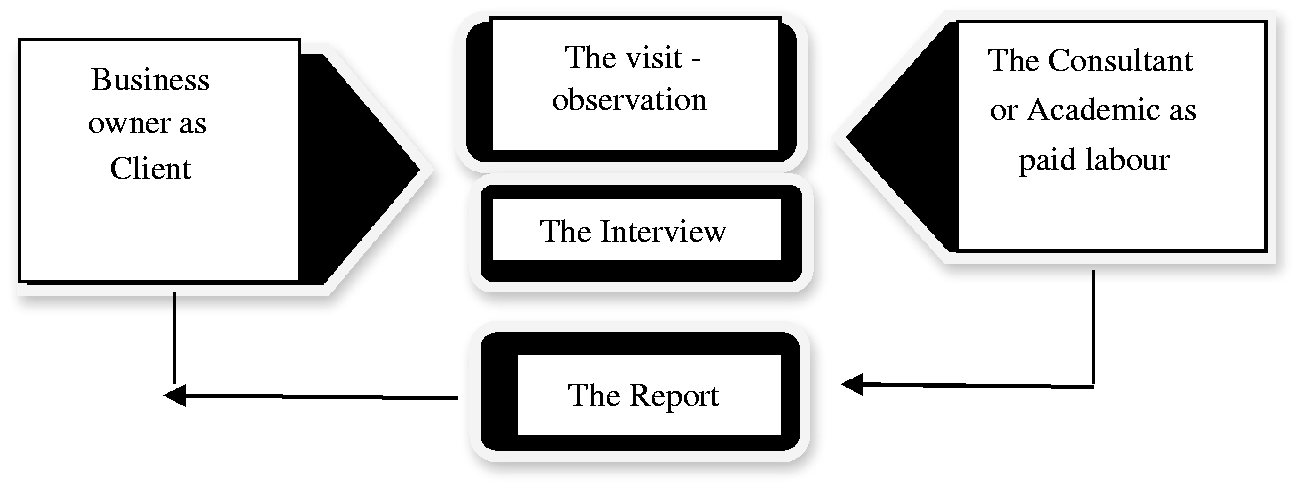
In the above model the consultant transfers negotiated knowledge to the business owner who is the owner of the knowledge and can use or choose not to use the knowledge. The consultant has gained new knowledge but as an academic often cannot disseminate it because of client confidentiality clauses. The exchange is a private, commercial concern. Alternatively, in the standard academic/respondent relationship the knowledge exchange relationship differs as the business owner tells their story to the academic who produces outputs and this leads to more information and knowledge being transferred to the public domain. The academic takes the knowledge and transforms it into a case study which informs their teaching and may write it up as a conference paper and journal article for wider dissemination to their peer group and to students. The business owner may also derive benefit from the exchange by being invited as a guest lecturer to transfer knowledge directly to students.
However, in this case a different more participative model emerges in which the value flow is more equal and multi-faceted. See Figure 2 for a visual representation of the different contexts.
The academic as researcher model.
Within this new frame we see that both the business and the researcher/consultant derive value, but that value is further enhanced through multiplicative collaboration effects. For example, in our case the business-owner has not only transformed her business, but also her approach to networking in which she participates as a giver as well as a receiver of knowledge. The researchers have developed expertise in business mentoring through which more businesses will benefit and through participative consultation have been able to monitor and adjust for impacts of interventions. Academic outputs resulting from this project include teaching case studies, guest lectures, conference papers and a journal article.
Conclusion and limitations
A year-long involvement with the businesses revealed several commonalities and contrasts in the challenges to developing the business. Several of these development themes were also identified as common challenges for the wider business community and led to the provision of short courses and workshops for local businesses.
The reviews created sustained relationships between academic staff and business owners and facilitated a real time response to problems which, when implemented, paid dividends. This enabled the beauty salon owner to develop a more systematic and planned approach to monitoring the business and to address some of the typical resource limitations of small businesses. Drawing on the knowledge capital gained from this project, we are currently developing a model and associated checklist for businesses in rural areas for wider dissemination of learning outcomes.
Unique business idiosyncrasies and the differing effects of the rural penalty impact on the extent to which businesses can access and benefit from support interventions. This study demonstrates how one of the key regional development aims of developing indigenous businesses can be embedded through HE intervention and reflects an important element in the modernisation and partnership agenda of universities (Communication [COM], 2010: 553, final). However this has resource implications as these interventions are required to be individually tailored and as such many rural businesses struggling in the recession may not be able to resource or finance the necessary programme of knowledge exchange, reorganising and re-storying their businesses. From a Business School perspective such a knowledge-exchange model as described herein is a costly and time intensive intervention.
There are practical limitations created by the individual dynamic nature of small business owners and their pragmatic approach to research (Yin, 1994). The owners’ time is valuable to them and they have to be able to identify what they get out of the process (Hill and Stewart, 2000). Stewart and Beaver (2004) highlight the folly of assuming that the shared characteristics of ‘smallness’ and ‘fairness’ (Anderson and Ullah, 2014; Ullah and Smith, 2015) will lead to similarity of experience. Even small organisations provide a rich variety of contexts and different challenges for researchers (Edwards et al., 2010). Self selecting participants may also skew results by demonstrating a higher level of dynamism and desire for implementation and interaction with support agencies that is common among SMEs (Storey, 1998). In this case, the salon owner engaged in close involvement and, as a result, experienced significant business support benefits. Whilst the project was successful there are concerns over the viability of commercialising such bespoke knowledge transfer projects because it is unlikely that SMEs would be able to meet the commercial income rates which would be required to be charged by colleges and universities.
Footnotes
Declaration of conflicting interests
The author(s) declared no potential conflicts of interest with respect to the research, authorship, and/or publication of this article.
Funding
The author(s) received no financial support for the research, authorship, and/or publication of this article.