



Abstract
The paper presents an analysis of the latent need for further Combined Authorities across England and finds that there are many potential functional areas, like the Cambridge and Peterborough Authority, which merit them on grounds of size or growth. They often correspond to Local Enterprise Partnership or past Multi-Area Agreement areas and stand among many abortive devolution proposals of the last four years. Their travel-to-work areas frequently conflict with shire counties’ present boundaries, a problem which provides the strongest obstacle to new ‘larger-than-local’ governance arrangements. The present government’s abandonment of the requirement for new non-city Combined Authorities to have a directly elected mayor would remove a main barrier to establishing new devolution agreements across England, which is delayed by the need for a promised policy paper from government.
Keywords
Introduction
The English city regions story is far from complete. While much of this special issue is concerned with the strength, limitations and variability in the powers of the first six Combined Authorities (CAs), there is also a little-known story about how all areas of England were invited to form CAs, leading to serious consideration by all but a handful of areas. Many of the resulting proposals fell by the wayside when local authority (LA) councils were unable to agree with each other, or, probably more significantly, flinched over Whitehall’s then insistence on the element of an elected mayor leading each one. A central government policy paper on future CAs was awaited at the time of writing.
To most policy analysts it will be worthwhile entrenching the role of CAs. They have arguably a firmer legal basis for undertaking some unique tasks of co-ordination than did Labour’s regional machinery. But if they were to be strategic and efficient, their boundaries should respect housing market and travel-to-work areas (TTWAs). Including now the Sheffield City Region CA, four of the seven CAs bear close resemblance to previously recognised city regions that were former Metropolitan Counties. Arguably then, the CAs as they currently exist, including Tees Valley and the ‘West of England’, simply represent a longwinded way of restoring the new Counties of 1974 by re-combining Metropolitan and some other Boroughs, though with deviations awaited east of the Pennines in Yorkshire and the North East Local Enterprise Partnership (LEP) (as recorded in other papers of this issue). Only the Cambridgeshire and Peterborough CA breaches these statements, though it is a LEP area.
It is worth noting that ‘larger-than-local governance’ is not prevalent within Scotland and Wales. Both have city region deals (equivalent to city deals rather than devolution in England) following the abolition of city region strategic planning in Scotland and early steps in Wales from an advisory group of 2015.
The importance of more CAs
To some readers, it may be that the existing pattern of seven CAs, extended to the area North of Tyne in an election of May 2019, is enough. CAs were first established under Labour legislation of 2009 and recognised most areas of contiguous development in ‘conurbations’, following the perceived success of the Greater London Council being superimposed over 33 otherwise independent LAs. Starting with Greater Manchester in 2011, they were centred on all the original seven ‘Core Cities’ of England. Further, many people could not necessarily see the point of a solution for complex urban areas being extended to other areas including ‘rural’ areas.
This is, however, to miss several very important points
Given the then overall interest in devolution, the government’s invitation of 2016 for LAs to combine in new proposals for CAs was deliberately sent to all LAs in England outside London, and remained open until March 2019, pending a further government statement in theory awaited at time of publication. A more complete coverage of England might defend the interests of the extant CAs themselves against criticism of a ‘piecemeal’, fragmented or ‘patchwork quilt map’. Once the first CA mayoral elections had been held in May 2017, including four Conservative mayors, then the scheme both acquired more standing in government and became palpably attractive to further areas, which eyed both the financial provisions of the combination agreements, the preferential treatment of CAs in some national grant schemes and their status in the national Industrial Strategy, including responsibility for writing new Local Industrial Strategies for the Department of Business, Energy & Industrial Strategy (2017). After the BREXIT referendum, there is a greater case for policy attention to areas outside the present CAs. It was evident that the EU was more supported in large cities, and that the predominance of voting for BREXIT in most other areas was an expression of their greater economic uncertainties since 2008, rooted in their previous loss of factory jobs, coupled with the absence of the more dynamic private services of metropolitan areas. In turn, research indicates that they are more vulnerable to BREXIT (McCann et al., 2017); this contributed to some policy reaction in 2017 against the previous ‘City-centric’ view, a ruling consensus that ‘Cities were the growth engines “and would generate a” trickle-down’ to wider surrounding areas. The Centre for Cities (Swinney et al., 2018) respond that because of the influence of ‘cities’ over their hinterlands they should continue to receive priority, but in this case they mean the 62 ‘cities’ of more than 135,000 population. The Labour Party have made the criticism that CAs should not develop on a one off piecemeal basis, though shadow ministers were aware of the value of the CAs as going concerns and the role of the Labour mayors. Somewhat independently, other arms of public sector governance have tended to settle on use of the sub-regional scale across England. Thus, the approximate 1974 pattern is followed today by different government departments, in affording 37 police authorities (outside London), 38 LEPs and 44 areas for NHS sustainability and transformation plans, while Localis (Airey and Booth-Smith, 2017) argued for strategic planning in 47 units explicitly similar to the 45 of 1974. These act as a further recommendation for co-terminous CAs in parts of England, especially with today’s emphasis on LA joint working with health and police over social care and services. Beyond all this, however, lie the many regular arguments for much greater devolution in England at large, to bring government to the democratic standards and economic performance of other countries; and that, if the benefits of devolution to a strategic authority are worth having, then the political requirement should be to make them available to taxpayers of all areas.
Building combinations on the map of England
The generation of new CAs, important as they might be, is heavily dependent on the existing structure of local government. In fact, this paper will argue that some renewed 1990’s division of town and country left a structure making the proposition more difficult. One illustration was the main failure of 2018, in the government’s inability to approve the longstanding ‘Solent’ proposal for a CA including Portsmouth, Southampton and surrounding areas in October (LGC+ 5/10/18).
Many policy papers in recent years have addressed the concept of ‘place-shaping’ or ‘a sense of place’ as a corrective to perceptions of governmental remoteness. Yet, unlike the important Royal Commission on Local Government in England (1969), the ‘Maud Report’, almost no national documents address where the places to be ‘shaped’ are to be located and thus where the boundaries run between them. That is because the new government of 2010, persuaded by lobbying documents preceding the election, was ideologically dominated by a Localism which sanctified a bottom-up approach. In this, local bodies were invited to come up with their own alliances, and (secondarily) therefore boundaries, to provide sets of areas, hopefully covering the country with LEPs, CAs and Clinical Commissioning Groups.
Rescaling and restructuring in England have overwhelmingly consisted of a functional approach to boundaries. Technically, this point has a long history: among the first ‘functional areas’ were those of Labour Exchanges, whose attendees naturally knew nothing of the small and/or archaic boundaries of the numerous pre-1974 LAs, leading instead to officials’ local ad hoc descriptions of areas on paper. In turn, Department of Employment grouped these into the first ‘Travel-to-Work Areas’, as areas for which sensible unemployment rates could be calculated. These rates were then used under the Local Employment Act, 1960–6, for the allocation of assistance, including for example government location of large car factories. After this, Newcastle University won the contracts for calculating TTWAs from the 1971–2011 Censuses on a ward-level basis, and they continued in use until rates for that purpose for whole post-1974 LAs came to be acceptable, and indeed ONS will know them as a less used geography now.
For all the talk of greater use of ‘functional regions’, TTWAs, in their strict sense, have been neglected precisely by the use of whole LAs as building bricks, and appear to have been unknown to the civil servants and ministers approving new LEPs and CAs. Analysts who construct Housing Market Areas also use local data rather than boundaries of the LAs. In this paper we will deliberately use TTWAs as the primary indicator of the centres and respective broad areas for potential individual CAs, before viewing the secondary issue of the best fit of the available building blocs, i.e. in the present geographical structure of LAs.
The history of TTWAs attests to widening daily communication across the map. Of first importance has been a widening and intensification of the scale of daily life. On a consistent statistical measure over time, the number of TTWAs in England (Nomis 1 ) has fallen from 224 (including London) in the 1981 Census to 154 in the latest Census from 2011. The changes in the workforces of the largest TTWAs were due more to the expansion of daily travel rather than to any expansion of employment. From 1981 to 2011 the eight core cities of England registered an employment increase of only 1.5% overall, due mainly to an increase in female jobs (many held by commuters) of 13.9%. Employment in the surrounding areas in their respective city regions grew more rapidly, until a very marked upturn, of 14.1%, occurred in the core cities themselves during 2012–17. We can explore whether there was a similar dynamic around the medium-sized candidates to be centres of new CAs.
Latent ‘functional regions’
The cry arises from urban specialists and think-tanks for a future management of England which handles the growing development needs around the major nuclei through shared governance of functional areas. Although work trips are becoming relatively less important with the growth of part-time work, work at home and leisure trips, nonetheless TTWAs, which are defined from the ward level upwards, provide the single best indicator of shared activity, across functional areas, admittedly with a slightly arbitrary measure of self-containment of 75%. (Office for National Statistics with M. Coombes, 2016). On this basis what then are the next geographical priorities for CAs across England?
The question can be answered by using the identities provided by the set of TTWAs defined from the last Census of Population, 2011, to attain 75% self-containment, i.e. that 75% of workpeople work in the same TTWA as their residence and vice versa. After eliminating TTWAs centred in the established CAs and those areas of Yorkshire and the North East which have had CA agreements, then the largest among these units of employment (based on the sum of employees working in the areas in 2017) that is so far lacking a CA agreement is centred on Leicester, as shown in Table 1, column 1. As, in this case the TTWA boundaries are similar to the County of the same name. This would suggest a CA combining the City and County, congruent with the Multi-Area Agreement (MAA) of 2009, the current LEP and a so far abortive CA proposal. The second entry of the table supports the case for combination around Nottingham, the only English ‘Core City’ not to have been involved in final CA negotiations, although the last originally to join the group. These two areas are followed in the table, which covers the largest 15 relevant TTWAs of England, by centres of ‘East Anglia’ and the recent South East Region.
Characteristics of the largest TTWAs that lack equivalent Combined Authorities (England).
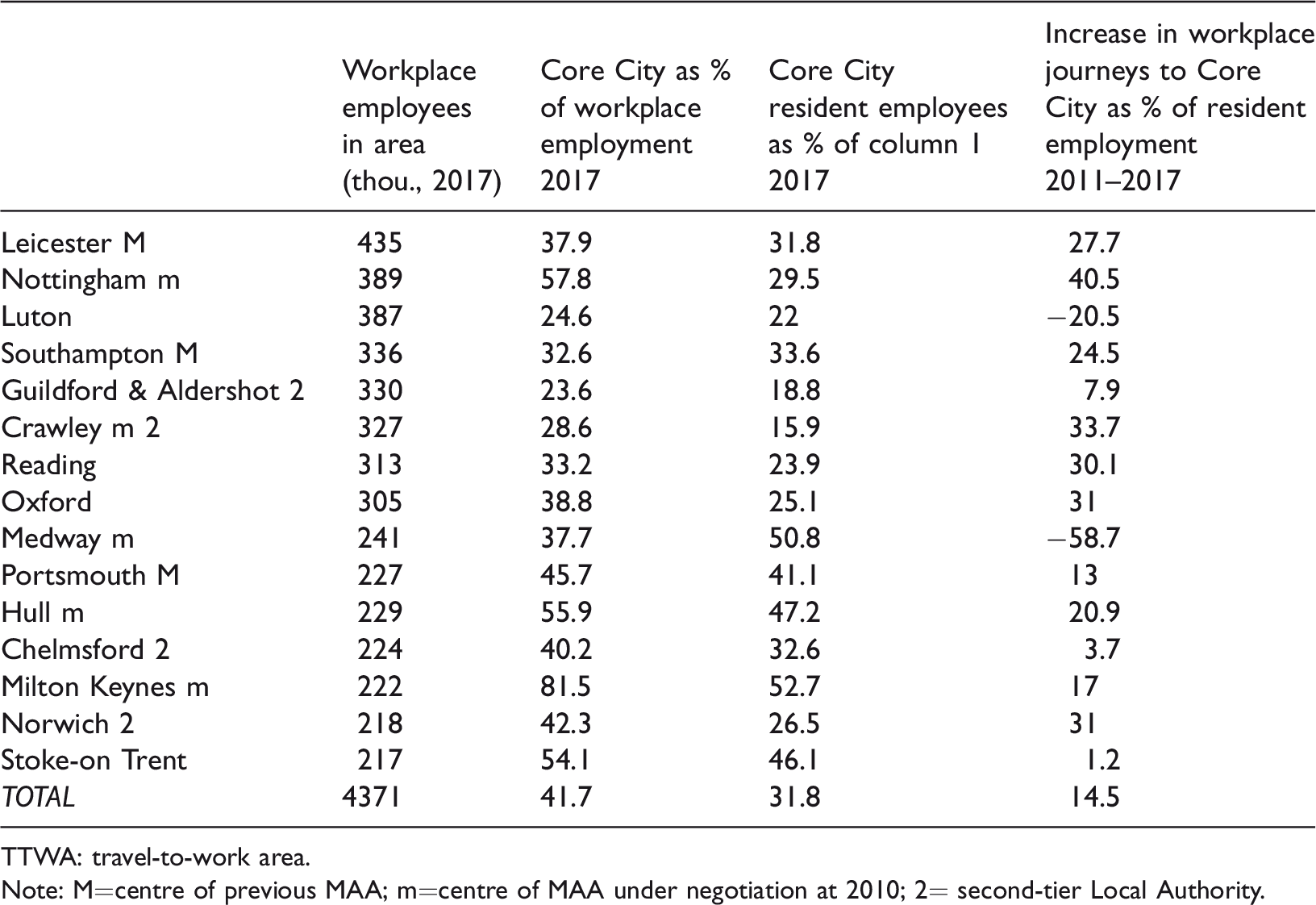
TTWA: travel-to-work area.
Note: M=centre of previous MAA; m=centre of MAA under negotiation at 2010; 2= second-tier Local Authority.
The need for combination is reinforced by further data from Nomis, showing how (at column 2) the core LA of each area, in most cases an independent upper-tier Unitary, has a limited share of the workplaces of its respective TTWA, an average of about 40%, and an even lower share of resident employees (column 3), averaging around 30%. The influx of workpeople to the cores is reflected in much lower shares of residents in jobs, except in some ‘older’ centres. The resulting interdependence of core LA and the surrounding area is emphasised further by the last six years’ apparent increase of net travel-to-work into the core area (column 4), equivalent to about 15% of the core LA’s recent resident workforce, most marked in the cases of Nottingham, Crawley (close to Gatwick Airport) and Reading, but negative in a few areas.
From this most recent data the case for CA status is strongest in the cases of Nottingham, Milton Keynes, Norwich and Oxford – based on the 2017 difference between cols. 2 and 3.
The case made here is that buoyant activity and growth extending well outside the named centres make the important argument for having the overview of an operational CA, potentially offering co-ordinated planning of some of the most important areas of national development – notably part of the Oxford-Cambridge Corridor and other areas at that approximate distance from London noted by many authors, most recently by Green (2018) It has long been recognised that locations within the ‘golden arc’ extending north from Southampton and then east to Felixstowe are the most favoured in Britain for investment…. and within the South East, dynamic clusters of economic activity are recognised around Cambridge, Milton Keynes, Reading, Oxford and Portsmouth. (365–366)
The reality from which functional combinations might be rescued
The problem of fashioning CAs from the present type of LA structure did not have to have been like this, in that the original Maud Report solution was to combine authorities into large mainly Unitary sub-regional Councils. Recent testimony from Conservative politicians involved in the rejection of Maud’s mainly single tier solution indicates profound localism and thus severe dissension over the resulting proposed amalgamations. The eventual solution then was for an entirely two-tier approach; however, the Banham Commission (the Local Government Commission for England 2 ) promoted many larger second-tier Authorities to independent Unitary status ad hoc in 1996–8, although there was no change in the number of LAs until Labour’s promotion of interested whole counties to Unitary status in 2007–9. Only now is this level of fragmentation being willingly rejected in places.
A fragmented pattern of 120 upper tier LAs covering England (outside London, Figure 1) was exposed by the abolition of regional agencies. It was their closure by the incoming government of 2010 that led gradually to the perceived, renewed need for ‘wider-than-local’ governance, anticipated by the problem of otherwise ‘relying on districts for the Planning of England’ (Townsend, 2009).

CAS as at February 2019 from the available building blocs – upper-tier local authorities.
The original initiative for sub-regional co-ordination came from Communities and Local Government under Gordon Brown’s government, establishing precursors to CAs alongside Labour’s regional machinery in the shape of 15 MAAs 3 between 2008 and 2010, with five more under negotiation. A sea-change of coalition government thinking used pre-existing Labour legislation of 2009 to permit CAs, beginning with Greater Manchester in 2011, with three more existing prior to an Act of January 2016, which required the addition of directly elected mayors to CAs in conjunction with negotiated devolved funding and powers.
Not all readers will be familiar with what were the available building blocs for CAs (Figure 1)
36 unitary Metropolitan Councils (dark green) which from 1974 had formed the second tier of new Metropolitan Counties until the latter’s abolition in 1986. 29 ‘shire counties’, amended in 1974, which were equipped with a full second tier of newly combined district councils below them until 46 urban-focussed single tier ‘Unitary Councils’ (also dark green) were extracted from the shire counties by authority of the Banham Commission between 1996 and 1998 and In light green, a further five Counties and four other areas became unitary councils in 2009.
Most of the eight areas that elected mayors in May 2017, 2018 or 2019 (areas ringed in red) represented the restoration of units first created in 1974. Four of the eight mayors, in Greater Manchester, the Liverpool City Region, the West Midlands and the Sheffield City Region cover the same areas as former Metropolitan Counties (with one change) and two relate closely to two new counties also established in 1974 for functional river-based sub-regions, Tees Valley and West of England (the former Avon county).
The sixth mayor, the first one covering a shire county but including also a Unitary council, was for ‘Cambridge and Peterborough’. This makes the point that the ‘Unitary councils’ that were extracted from previous shire counties frequently found, when seeking a combination after 2014, that their nearest potential partner comprised the rest of their original county. If by any chance the Banham Commission had not given ‘independence’ to Peterborough in 1998 (in the way that Norwich failed to gain ‘independence’) then that ‘combination’ would not have been available. There are other cases where a partner is not available for simple geographical reasons.
So, the green shades of Figure 1 both define and restrict the scope for combination, except for one further major development. That was the use of second-tier district boundaries under the 2016 Act to extend proposed CAs beyond upper-tier areas into adjoining counties, which we can refer to as the ‘Chesterfield problem’. In this case, Chesterfield, as a second-tier Authority, was part of the Sheffield City Region LEP and proposed CA, while simultaneously located within the upper-tier County of Derbyshire. In this and similar proposals aiming typically to enfold commuter areas with a central city, political problems have been met especially as regards splitting the transport financing of County Councils.
In turn, however, government came to welcome, increasingly in 2018, a separate and arguably rival kind of re-organisation of all of a county’s second-tier districts into a single Unitary authority or into two or more CAs (striped green on the figure). The whole process, as studied below, was producing ‘bottom-up’ consideration of re-organisation open to any area and without unanimous agreement up to the Act’s closing date of March 2019. The main analysis for this section is based on the content of all items of re-organisation recorded in the Local Government Chronicle Daily News 4 (specific evidence from this source is cited below by reference to the date of the item – for example ‘(LGC+ 12/6/16)’), and a classification of the occasions of difficulty or delay met by actual proposals.
The compromised process of combination beyond the present CAs
Given the latent need for CAs especially around towns and cities in the East Midlands and the south, as we identified through TTWAs, how could such functional areas be at least approximated by use of the LA building blocs identified in the last section? It is worth referring back to the precedents we mentioned for recognising sub-regions before 2010; indeed, there is plenty of circumstantial evidence of some continuity of identity and definition from MAAs into LEPs and then into prospective CAs, as one suggested minimum requirement for all three groupings was the inclusion of at least two upper-tier authorities.
MAAs were an English political framework that aimed to encourage cross boundary partnership working at sub-regional levels to work with partners and government collectively to improve local economic prosperity. The similar nature of cross-boundary working for LEPs took further the practice of following boundaries taking in some lower-tier districts, some of which actually entered two LEPs simultaneously (Pugalis and Townsend, 2014). These are among the boundary questions up for review in a concurrent review of LEPs.
The ‘Chesterfield problem’ has proved more fatal for CA proposals than for LEPs notwithstanding that there have been many proposals for CAs to use lower-tier boundaries. A partial answer to that has been ‘Associate status’, which allows most commuting districts around the West Midlands CA a vote on its board. This takes in much of the functional region around Birmingham (leaving a combination of Staffordshire and Stoke-on-Trent as the main CA still missing in the former West Midlands Region).
In the north, MAAs had included by 2008 or 2009 precursors of all the eventual CAs and also ‘Pennine Lancashire’ and the Fylde Coast, both with the parent County Council of Lancashire, while ‘Hull and the Humber’ were in negotiations at the time of the 2010 election. The current Minister for the North, Jake Berry, has stressed (LGC+ 28/11/17) that filling gaps in the CA pattern across the north is a priority; he urged those areas to ‘seek extra powers using the government’s forthcoming devolution framework’ (still awaited); this would follow a number of different formulations to date for Lancashire, and the possible revival of schemes for the Cheshire and Warrington LEP area.
A typology of CA proposals applied in the East Midlands and south
This paper has already identified a priority for new CAs in the East Midlands and the south, so accordingly it is of interest that the East Midlands already had MAAs for Leicester and Leicestershire, with one in negotiation for ‘Nottingham’. Further south lay MAAs for three important areas:
PUSH; the Partnership for Urban South Hampshire, including Portsmouth, Southampton and eight second-tier Authority areas Bournemouth, Dorset and Poole including seven second-tier Authority areas North Kent, including Medway Borough and three second-tier Authority areas Milton Keynes South Midlands The ‘Gatwick Diamond’ and ‘Regional Cities East’
Also under negotiation in 2010 were
Most extant MAAs were converted into LEPs, though in some of those and other cases they took in second-tier districts from Unitary Counties. We can construct a typology of proposals and apply it in the East Midlands and south as follows:
A Regional proposal
The most major recent proposal, (LGC+ 25/4/18) for four-county working across the former East Midlands Region, stands in reaction to the powers of the West Midlands (conurbation) Mayor, once elected in 2017 from the government Conservative Party. The history here includes a proposal for a North Midlands CA based on government encouragement and existing joint LEP working for the cities of Nottingham and Derby and the counties of the same name, hence the original title ‘D2N2’. The ‘Chesterfield problem’ was augmented by lobbying from Conservative MPs and a change to Conservative Party control in the 2017 local elections leading to Derbyshire and Nottinghamshire fighting off the proposal, and proposing Unitary county councils throughout the East Midlands (LGC+ 13/6/17). In turn the Cities of Derby and Nottingham created tension by proposing their own CAs taking in surrounding districts. However, all this is now partially subsumed under a proposal of April 2018 for four Counties, i.e. adding Leicestershire and Lincolnshire, to discuss developing a strategic body which would ‘operate like a CA’ and pave the way for a devolution deal within a general drift to ‘restructuring upwards’.
Major urban areas attempting to break out of historic counties
This group of proposals represented the most promising solutions to extend expanded devolved governance to southern cities, but also succumbed to the ‘Chesterfield problem’. They are all centred on Unitary Authorities and three of the five proposals of this kind are similar on the map to working MAAs of 2010. All share their centres with important TTWAs identified above as candidates for CAs.
PUSH; the Partnership for Urban South Hampshire, including Portsmouth, Southampton and eight second-tier Authority areas
The area has a natural axis in the shape of the M27, but, while immediate neighbours of the Portsmouth and Southampton, e.g. Eastleigh and Havant, lie close in to the two unitaries, nonetheless the available district boundaries take in wide areas even beyond Winchester and Petersfield. An announcement for this ‘Solent’ LEP area was close in 2016 (LGC+ 2/6/16) but succumbed to political disagreement over a wider County aspiration and was eventually ruled out in October 2018 because of the opposition of County MPs (LGC+ 5/10/18).
Bournemouth, Dorset and Poole, including seven second-tier Authority areas
This area, congruous with a former County and later MAA and LEP, undertook debate over a devolution bid and ultimately became the first to settle for a different use of the legislation to re-organise the whole area in to two unitary authorities.
North Kent, including Medway Borough and four second-tier Authority area
In this proposal (Townsend, 2017: 349) the former MAA area was extended to include Maidstone, which is certainly in the TTWA, seeking greater emphasis on economic development, infrastructure and transport than was evident in planning for Kent as a whole. The proposal appears to have been forgotten by 2017 and was confounded by some ideas for a wider Thames Estuary scheme.
South Essex
(Townsend, 2017: 349), now lapsed, had no precedent as an MAA but closely fits the TTWA of ‘Southend’, including Basildon and the eastern part of the Unitary Thurrock Borough, recognised by its proponents as having a different economy from the more rural ‘Greater Essex’, where the County Council might have different interests.
Bedford, Milton Keynes, Central Bedfordshire and Luton
A proposal from these areas reached only an early stage in 2016. This general area of active development has been involved in repeated government initiatives and is now mostly part of the South East Midlands LEP.
Other proposed alliances at the upper-tier level of counties
Norfolk and Suffolk
Government pressure to restore in effect the one-time East Anglia Region as an ‘Eastern Powerhouse’ CA comprising Norfolk, Suffolk and Cambridgeshire, was met by rejection by the latter (LGC+ 26/1/16), nonetheless leaving Norfolk and Suffolk with a negotiated draft agreement (Figure 1) expected to succeed. However, this failed because the government ‘had failed to realise the difference between devolution in conurbations and two-tier areas, with individual districts breaking off and meddling by MPs, spurred by widespread opposition to an elected mayor’ (LGC+ 7/11/16)
Devon and Somerset
This proposal takes the name, identity and some of the same interests as the ‘Heart of the South West’ LEP; if it were to lose support due to the doubts about an elected mayor from rural areas, then the non-contiguous boroughs of Plymouth, Exeter and Torbay were interested in their own CA.
Surrey, West Sussex and East Sussex
One of the arguments for this combination lay in a plan for economies of scale in a combined health and social care administration, but it was trying to avoid the term elected mayor, and met problems from Brighton wishing to remain separate from the group.
Alliance at upper-tier level; re-unification of former shire counties
Swindon and Wiltshire
As explained in the case of Cambridgeshire and Peterborough, it was possible to claim combined status simply by reuniting two or more authorities of a 1974 upper-tier authority which had been separated through a large borough attaining independence. Swindon had been part of Wiltshire but after withdrawal as a unitary authority was ‘re-united’ with it in a LEP and a now distant attempt at a CA proposal.
Leicester and Leicestershire
Prior to the recent scheme for co-operation across the whole ‘East Midlands’, Leicester, a Labour Unitary City which had been withdrawn from the otherwise Conservative County, joined the County in an MAA and in processing a devolution proposal, though subject to concerns over an elected mayor. The latest re-organisation proposal is for two Unitaries; the City and the rest.
Greater Lincolnshire represented ‘re-unification’ with the Unitary boroughs of south Humberside based on Scunthorpe and Grimsby in a similar fashion. Although there were concerns from districts, for example over an elected mayor, this proposal got as far as a CA agreement before it was withdrawn (Figure 1).
The forces delaying combination
The 10 CAs for which orders had been passed in the period since the 2015 general election (including three subsequently abandoned) are a minority among the history of proposals. There is, in fact, widespread agreement that the process of establishing CAs almost ground to a halt during 2016–17, with in 2018 the important case of the Solent falling by the wayside in 2018. There have still been no completed and operational CAs in the whole area of the former East Midlands, East Anglia, the South East and South West apart from the West of England CA, covering most of the former County of Avon. Yet we have mentioned proposals existing at one stage or another of the period 2015–18 from almost all areas. What have been the main factors in this failure?
General problems for rural counties
Beyond the main city regions, the spur to CAs in shire counties, arising from national political interest in devolution, led to some confusion over the relevance of these type of arrangements in rural local government, and lower priority in Whitehall negotiation. Proposals for combination in county areas were nearly all in difficulty because of the tenuous nature of relationships across amorphous areas, a lack of district support or reactions against the need for elected mayors.
Basic economic geography has played a surprisingly large role, distinct from the imprint of ‘functional regions’, those areas which simply share the same town as their centre. A suggestion from Portsmouth for a ‘devolved south’, which spoke of a coastline with ‘a common economy based on marine, financial and aerospace industries’ (LGC+ 16/10/15), proved abortive. PUSH’s argument for the ‘Solent’ CA emphasised how cities of the south of the county ‘created the jobs’ and that it would benefit the ‘under-performing, under-achieving parts of Hampshire’ (LGC+ 10/6/16). Similarly, Cambridgeshire contrasted the university’s metropolitan-oriented economy with the large rural areas of the rest of East Anglia, from which it detached itself. Further south, Thurrock Borough saw that a ‘South Essex’ unit was ‘not only coherent from a partnership and strategy perspective, crucially it is an economic geography that business recognises’ (LGC+ 26/2/16).
LA finance was also a determining factor. There are examples from all over the country of authorities being attracted to, or shunned from, proposed groupings according to their relative council and business tax income per head. The inclusion of poorer rural areas in pooled financing has been seen as leading to perceived unfair burdens from cross-subsidisation from wealthier areas. For example, Harrogate saw no financial advantage from joining a CA of more rural areas (LGC+ 23/2/16).
The fear of planning decisions for individual areas being dictated by wider, CA sub-regional policies is present – although strategic planning is not a standard feature of all the CA agreements so far, which are bespoke. The literature on city regions recognises conflicts between local and regional needs. For example, Turok (2011) explored ‘the contrast between the regional housing agenda and the needs of established local communities for jobs, skills and local services’. Thus, Warwickshire turned down an invitation for non-constituent membership of the West Midlands CA over the question of ‘taking Birmingham’s housing’ (LGC+ 29/10/15).
The role of politics in these ‘bottom-up’ arrangements has become yet more apparent. The overall perceived ‘loss of sovereignty’ frequently led to council votes in which groups of councillors revolted against a proposed CA recommended by their own Leaders, resolving to pull out of or at least delay its formation. At the extreme, individual councils have set their face against the rest of a CA grouping, culminating in one of the major unitary authorities, North Somerset, refusing to join the West of England CA (see Figure 1). Politically, combination has been fiercely resisted by many districts both within and across party lines, with some MPs, concerned not to offend local sentiment, opposing a mayor who would be a rival focal point to themselves, while others still have been concerned over the likely party composition of a CA (LGC+ 13/6/17). The potential role of MPs in blocking the parliamentary order for a new CA increased after the 2017 election, as proven by their decisive intention to block the Solent CA: extending unitary government in Hampshire had led to a ‘blood bath in the county Tory party’ (LGC+ 2/6/16). Amid these tensions, the speed of approach expected by the government provided little time for public consultation, and properly conducted surveys were mainly carried out only over district re-organisations (see below) rather than over the wider CAs, which are less capable of public understanding.
On a separate matter, the same timetable has been used for sometimes related proposals for re-organisation and amalgamation within administrative counties (Figure 1). These have led to wider territorial disputes. Groups of districts, some proposing their own ‘unitary’, have set their face, at least at one stage, against their county’s conversion to unitary status (in Buckinghamshire, Cumbria, Derbyshire, Dorset, Hampshire, Lancashire, Leicestershire, Norfolk, Northamptonshire, North Yorkshire and Nottinghamshire). Abortive proposals for unitary government in Oxfordshire led to ‘internecine warfare [breaking out] out across swathes of local government’ (LGC+ 26/2/16).
The requirement for an elected mayor
This latter kind of local government reform may merely carry forward the problems of divided political parties, committees and bureaucracies of conventional governance. Of course, the established success of the elected mayors for London propelled London-based politicians to foster this feature of devolution, even though, as prime minister, Gordon Brown wrestled inconclusively with this as a proposal, and the majority of single authorities’ referenda whether to have a mayor have resulted in rejection. This one factor lay behind most of the political difficulties noted above. Reports from throughout the country nearly all spoke of the requirement for a mayor as a negative or at least a delaying factor in adopting a CA, even for those that did go ahead. The need for a mayor reportedly exerted a definite block on progress in Berkshire, Cheshire and Warrington, Gloucestershire, and Hampshire. Admittedly, there were eight cases in which devolution was agreed without the requirement of a mayor, Cornwall (Figure 1), and at one stage West Yorkshire and the Sheffield City Region,
Further, the British Academy (2017) retrospectively reported from five relevant meetings concern where mayors had in effect been imposed, and that there were very low levels of public engagement with the post of mayor and a general lack of public enthusiasm. This was reflected in the average election turnout of 27.5% in the six mayoral elections of May 2017. In a wide-ranging report on the establishment of the existing CAs, the National Audit Office (2017) recognised many gains, but was clear that the requirement for elected mayors had aroused deep-seated negative reactions. Ingenious ideas had been put forward to avoid using the word ‘mayor’, such as ‘regional commissioner’ or ‘named person’.
CAs – Taking stock at the end of 2018
At the grand level (Morphet, 2017), ‘devolution in England was going to be setting the direction of travel for its domestic agenda and at the forefront for its programme for democratic and economic renewal’ (Betts, LGC+ 13/5/18). However, the impact of the Brexit referendum on government appears to have stalled the generation of new ones, among the many government policies it has affected.
That was not the promise of the Conservative and Unionist Party (2017) manifesto for the 2017 general election, which said that for ‘combined authorities that are based around our great cities, we will continue to support the adoption of elected mayors’, but made the highly significant statement that ‘we will not support them for the rural counties’, a change for which the County Councils Network claimed credit. This government relaxation for ‘rural’ rather than ‘urban’ areas brought some areas closer to agreement but has not so far released a flow of new CA agreements. It invites dispute between local government groupings over what is a ‘great city’. The confinement of future mayors to ‘great cities’ led to speculation about the future status of members of the Key Cities Group, notably Derby, Hull, Oxford and Southampton. The Group was initially formed in summer of 2013 and has now been championed, revamped and expanded by Peter Box, Leader of Wakefield Borough (Key Cities Group, 2018).
The devolution framework promised in the Conservative manifesto should set out the suite of powers that are available for all future areas, and on what terms they will be devolved. The need for a thorough departmental review is palpably obvious, but the promise of one from the Ministry of Housing, Communities and Local Government (MHCLG) was subject to mounting delay in the closing months of 2018. Admittedly, there have been repeated flimsy efforts to develop voluntary co-operation between LAs, one of the latest being from the new Housing Minister saying at the Conservative Party conference: ‘Our general thrust is for groups of LAs to come together to form a kind of strategic partnership for a particular region or area so that we can fund the infrastructure that’s related to it’ (PLANNING, 2018 12 October). The change of senior MHCLG minister to James Brokenshire has itself led to uncertainty, as has his response to the ONE YORKSHIRE devolution proposal from Yorkshire LAs (Yorkshire Council Leaders, 2018), and a dispute over the powers of the Mayor of Cambridgeshire and Peterborough. Meanwhile Labour CA mayors have established a major voice in national debates, for example over railway matters, which may not be attractive to London.
There are a number of technical issues which in any case have met only partial solution from an otherwise ‘hands-off’ administration, even though it is abundantly clear that dropping the requirement for a mayor would make for lighter work in reviving some of the lapsed proposals for CAs with devolved powers. Clarification is needed as to (i) a minimum population size for a CA; (ii) a clear policy about the topology of establishing CAs; can an individual LA which is surrounded by LAs intending to join a CA stand out against incorporation? Conversely, can an LA which is not contiguous with, i.e. separated from, the body of a prospective CA join to form an exclave of the CA?; (iii) most fundamentally, can a second-tier district join a CA formed otherwise outwith its parent County?
Conclusions
Notwithstanding political issues, the major point is that the economic forces for re-combination can be strong, and now focus on urbanisation around medium-sized cities, by virtue of their strengthening travel-to-work and housing market areas and their putative potential economies of scale and of finance. The Cambridge and Peterborough CA, far from being an outlier, stands foursquare, in terms of size, among the obvious next candidates for CA status. With its 379,000 TTWA employees it would be fourth in Table 1, behind Leicester and Nottingham as well as the Luton TTWA in Table 1. This group would be followed by Southampton (unfortunately rejected as a longstanding CA proposal) and Guildford and Aldershot, Crawley (i.e. the Gatwick Airport nucleus), Reading and Oxford in an important, recognised belt of existing growth. Potential CAs tend to be more distinct and numerous in coastal TTWAs in general, and on the southern and south-west coasts in particular.
Geographically, however, many of these candidates tend to display the pattern, not of Unitary Boroughs adjoining each other which could easily combine, but, as latent new urban Unitary areas seeking alliance with adjoining districts in Conservative-held Counties. A striking feature at the time of writing has been that no working CA crosses extant county boundaries to take in some and not others among its component districts. Geographically, the observation of some longstanding county boundaries remains intact after the process of combination. This ‘Chesterfield problem’ is serious, because the ‘division of town and country’, dealt with in a ‘top-down’ approach by the Redcliffe-Maud Commission but often restored by the Banham Commission, is still crucially a major issue across the map of southern England and the East Midlands, when it did not necessarily prevent the formation of successive MAAs and LEPs in their key areas.
While local government was pleased that further devolution was mentioned at all in the last Conservative manifesto, complex re-organisation looks unlikely before the next general election, due to the extra problem that individual MPs have more bargaining power to block proposals when the government has a small parliamentary majority. On the other hand, austerity and severe council financial issues are pushing more and more county areas, not just the prominent case of Northamptonshire, to look at mergers of second-tier districts into Unitary Authorities, diverting effort and attention from the possibilities of higher order CAs, and indeed losing some economies of scale when upper-tier services are divided up. If CAs are at all valuable to their council and business tax payers, it is inequitable that some areas of England are left without the benefits they offer because of incidental problems in aligning members of different councils at a particular time.
Footnotes
Declaration of Conflicting Interests
The author(s) declared no potential conflicts of interest with respect to the research, authorship, and/or publication of this article.
Funding
The author(s) received no financial support for the research, authorship, and/or publication of this article.