



Abstract
Confronted with a sluggish growth and very high rates of rural unemployment, South Africa has put local beneficiation at the core of its strategy for employment-intensive re-industrialisation. Its industrial policy action plan identified agro-processing as one of the priority areas for this strategy because of its potential employment multiplier in rural areas. Despite the appeal of its industrialisation potential, beneficiation strategy is often contested and its effectiveness as a viable engine of industrialisation in African countries is recurrently questioned. This paper presents an empirical evaluation of the income and employment effects of an agro-processing beneficiation programme launched by the Department of Science and Technology for the processing of abundant mango harvest in the area of Tzaneen in Limpopo province. Using inverse probability weighting estimation on a sample of 385 households residing in and around the beneficiation target area, we find clear positive income effects of the agro-processing project for the beneficiary households. The success of this project in the domestic and international agro-processing markets suggests that local beneficiation strategy can provide a sound basis for rural industrialisation if adequately prepared.
Keywords
Introduction
Like many of its African neighbours, the South African economy has largely remained dependent on mineral exports, even though the country possesses appreciable industrial capabilities and even technological leadership in some areas (Ashman et al., 2011; Fakir, 2015; Stoddard, 2013). Despite the country’s repeated attempts to diversify its export profile from the late 1980s on, mining and related products still account for a large percentage of total exports. Those exports make only a small contribution to total employment, while unemployment rates remain dismally high in the country. 1 In order to respond the challenges caused by this dependence on raw material export, the South African government has put beneficiation at the centre of its re-industrialisation and development strategy. Some critics have however questioned the soundness of the beneficiation strategy for industrialisation in South Africa (Hausmann et al., 2008).
Under downstream beneficiation as a policy paradigm, governments of resource-rich developing countries seek to reverse the effects of dependency on the exports of raw materials by acquiring the technological capabilities to add value to their primary products domestically (Beissac et al., 2015). Beneficiation is the process of developing the downstream value-chain activities linked to primary commodities within the producing country, with the aim to capture the advantages linked to the value addition (as opposed to exporting those commodities as raw materials). Because of backward and forward linkage effects that emerge from ancillary activities supporting core beneficiation, the development of downstream processing contributes to improving industrial and manufacturing capabilities (Cramer, 1999; Hirschman, 1968).
The beneficiation strategy for industrialisation in African countries is, however, surrounded by much theoretical debate, and the related empirical literature shows mixed evidence of its effectiveness (Cramer, 1999; Page, 2012). Some scholars, such as Jaffee and Morton (1995), Hausmann et al. (2008) or Collier (2010), argue that beneficiation is unlikely to succeed as an industrialisation policy because the skills, capabilities and production factors required for the beneficiation process to shift the comparative advantage are usually quite distinct from those that are available as a result of existing endowment in primary resources. 2 Their arguments are mostly rooted in the well known Heckscher–Ohlin theory of factor endowment and comparative advantage. Industrial production needed for the beneficiation is presented as being usually skills- and capital intensive, and thus at odds with the factor endowments of developing countries (Collier, 2010; Cramer, 1999; Page, 2012). Kelegama and Foley (1999), on the other hand, assert in line with Hirschman (1968)’s argument that beneficiation creates the potential for shifting the comparative advantage of the country in question from a focus on primary resources to more valuable processed products exportable to the global market.
As the primary source of beneficiation policy in South Africa, the 2013 Industrial Policy Action Plan has identified agro-processing as one of the priority beneficiation industries for spawning structural transformation because of its labour intensity (Davies, 2016). To give substance to that strategic approach, the South African Government, through its Department of Science and Technology (DST) has launched an agro-processing demonstration centre in Nkowankowa (NDC) aim to develop beneficiation activities in the fruit processing industry. The objective of the project was to use beneficiation to stimulate and support local income diversification by providing small businesses and informal traders with opportunities to supply the factory. The rationale of this beneficiation programme was that such operations would create employment through a local rural industrialisation process. Its operational focus was to take advantage of the abundant supply of mangoes in the region in order to process them into mango juice pulp and dry mango products. This eliminates the loss of harvest due to seasonality of production and to the lack of local conservation facilities. This study aims to explore the extent to which this initiative has been effective in shifting demand for mango production and giving a boost to the economic life of local entrepreneurs and mango suppliers in Nkowankowa as well as neighbouring localities in the Tzaneen area in Limpopo.
In the context of the beneficiation debate, our analysis focuses on exploring which socio-demographic characteristics of local respondents are likely to foster the success of the beneficiation programme in terms of local income source diversification and enhancement. We estimate the income and employment enhancement effect of this exploratory beneficiation programme introduced in the Nkowankowa as part of a government-led strategy to spur the country’s rural industrialisation through downstream value addition. The remainder of this paper is structured as follows: the next section reviews the literature on the role of agro-processing in structural transformation and development policy objectives. The ‘Methodology’ section presents the methodology used for the evaluation. The ‘Findings’ section presents the results, while the final section provides some concluding remarks and corollary policy recommendations.
Agro-processing in development policy
Agro-processing, entrepreneurship and structural transformation
Development in agro-processing is an important factor in shaping social and economic change, including diversification and specialisation of human activities. As argued by Mather (2005) and The World Bank (2007), agro-processing has been increasingly recognised as an important engine for rural development because of the role that it can play in the structural transformation. Mather (2005), in particular, highlights its potential for generating enhanced demand for smallholder farming production, upgrading primary production through small-scale food processing, and improving food price stability and food security. In fact, as already pointed out by Lewis (1954), industrialisation is dependent upon improvement in agriculture and economies in which agriculture remains stagnant do not experience industrial development.
For the production of an agricultural surplus to give the necessary thrust to the economic transformation, the subsistence farming production must gradually shift to large-scale production for the market. The economies in question have to develop the knowledge and facilities to process agricultural products further, to add value to them and ensure a better conservation. This can range from methods that help limit the losses at the harvesting of fresh agricultural products, to some form of (semi-) industrial processing and transformation into higher value-added food products that can serve not only the local market but also the export markets (Collier, 2007). This move to processing activities enables a social transformation of citizens from subsistence peasants to agricultural entrepreneurs, if they are given the right incentives and market opportunities. A successful industrialisation process is thus to be preceded by a deliberately planned increase in agricultural productivity, as argued by Arthur Lewis (1954) and Timmer (1988), because agricultural productivity increase does not automatically follow from the transfer of labour from agriculture to industry. Agro-processing has also been identified as a potential source of entrepreneurial opportunities: The World Bank (2007) and Mhazo et al. (2012) indicate that the processing of agricultural products acts as an extension of primary agricultural activity in rural areas in developing countries.
Due to their forward and backward linkages, agro-processing industries have a high multiplier effect in terms of job creation and value addition (Da Silva, 2009). 3 The linkages created by agro-processing also contribute to the diversification of income sources for poor households in rural areas. In addition, agro-industrial development offers an array of opportunities in terms of export performance and food safety (Henson and Cranfield, 2009). The potential offered by agro-processing to create linkages across sectors is significant, even at a small industry level. That is the reason why its development has been acknowledged as critically important to the expansion and diversification, not only of the agricultural sector itself, but also of other sectors as well (Lambert, 2001). Agro-industrial development is also important for developing countries because it contributes to stimulating higher productivity of the agricultural sector. It also is effective in converting rural and marginalised communities into actors of their own change. In the light of these various arguments, South Africa’s move to incorporate it into the new growth path (NGP) strategy was thus a justifiable choice in terms of its transformative potential.
Stimulation of agro-processing as a policy for employment creation
Being the largest employer in the manufacturing sector, the food processing industry was identified by the Department of Trade and Industry (DTI) as a priority area for employment policy support (DTI, 2014). 4 In a report commissioned by the Competition Commission, Roberts (2009) has however shown that the agro-processing sector is highly concentrated, with a few players dominating each of the branches. This results in a limited participation of small and medium-sized agro-processing enterprises in the agro-food value chain (DAFF, 2012). To help local entrepreneurs take part in this industry, the government has adopted a strategic vision aimed to support the emergence of a class of thriving, rural-based agro-processing SMEs, which will make a significant contribution to the country’s imperatives of job creation, poverty alleviation and food security.
This industrialisation strategy based on agro-processing support is also part and parcel of the National Development Plan 2030 (NDP30) strategic vision and is directly linked to the achievement of the following outcomes identified by government in the Medium Term Strategic Framework, as pointed out by DAFF (2015):
Offering decent employment through inclusive growth; Training a skilled and capable workforce to support an inclusive growth path; Building an efficient competitive and responsive economic infrastructure network; Vibrant, equitable, sustainable rural communities contributing towards food security for all; Protection and enhancement of environmental assets and natural resources.
Such an industrialisation deepening based on the existing agricultural strengths of the economy has an additional potential of generating socio-economic spillovers among potential local suppliers, entrepreneurs, labourers and other stakeholders. 5
The Nkowankowa beneficiation project
The NDC fruit-processing project was launched in 2010 by the South African Government through the DST, with funding from the European Union’s Sector Budget Support. It started operations in 2011 as a test project aimed to probe how best local agro-processing beneficiation interventions can contribute to job creation and poverty alleviation in naturally endowed but poorly resourced locations in rural and peri-urban areas of the country. The aim of the operation is to take advantage of the abundant supply of mangoes in the area, in order to process it into pulp for domestic and export market. The target of this programme was to enhance value creation and eliminate harvest loss through the beneficiation of three main sources of mango supply in Nkowankowa 6 : the commercial farmers in the area, the so-called bakkie-traders 7 and the bucket- and wheelbarrow suppliers. Moreover, by employing local residents in its various operational and ancillary activities, the NDC agro-processing facility provides direct job beneficiation for the surrounding communities.
As a local beneficiation initiative intended to demonstrate the role of technology and innovation in local economic development, the programme involved two primary aspects, namely local entrepreneurship development and the actual industrial operation of the agro-processing factory. The current analysis focused on the direct socio-economic benefits for two specific groups of beneficiaries: local entrepreneurs supplying mangoes to the factory and local residents who benefited from employment opportunities at any time since the factory implantation. We acknowledge the scope limitation of this framework as a measure of the developmental impact, since the project involves other beneficiaries as well, i.e. households in the Nkowankowa area, and a group of entrepreneurs who received business and management training before the factory was opened. Notwithstanding the absence of these other groups from this analysis, it is important to underscore that the benefits they derived from the NDC programme have further ramifications to a broader range of activities in the Tzaneen economy as a result of diverse linkages with the direct beneficiaries. While undertaking this evaluation, it is thus important to keep in mind the remarks put forward by Byrne (1993), that in complex systems, the cause of observed changes can seldom be the intervention taken alone. In general, the intervention contributes to outcomes in conjunction with all existing components of the social system and in relation to other systems and their sub-systems that intersect with the main system of interest.
In terms of achieving the transformational objective, the NDC factory has been steadily expanding its mango pulp and dried mango production since it started operations in 2011. An independent laboratory assessing the quality of its production has validated the quality standard of NDC products, with standard grade products for local market while choice grade production was made for the export market. The NDC has entered into supply contracts with some of the most reputable national brand juice retailers in the domestic market and has a sustained production. Critical for this success has been a meticulous capability building process during the preparatory phase, which ensured that all operational processes were put in place and all of its personnel adequately trained before the operation began. Managerial and human resource processes were equally put in place to deal with the operational issues and manage the concomitant risks. NDC also trained and assisted small-scale farmers in mango production in order to secure adequate input supplies for future mango seasons. Through a continuous process of risk assessment and mitigation measures, NDC has navigated through various challenges, including fraudulent supplies and disruptive strikes, but has learned from the processes and strengthened its governance structures to become a viable rural based agro-processor with a very promising growth potential.
Methodology
Methodological framework
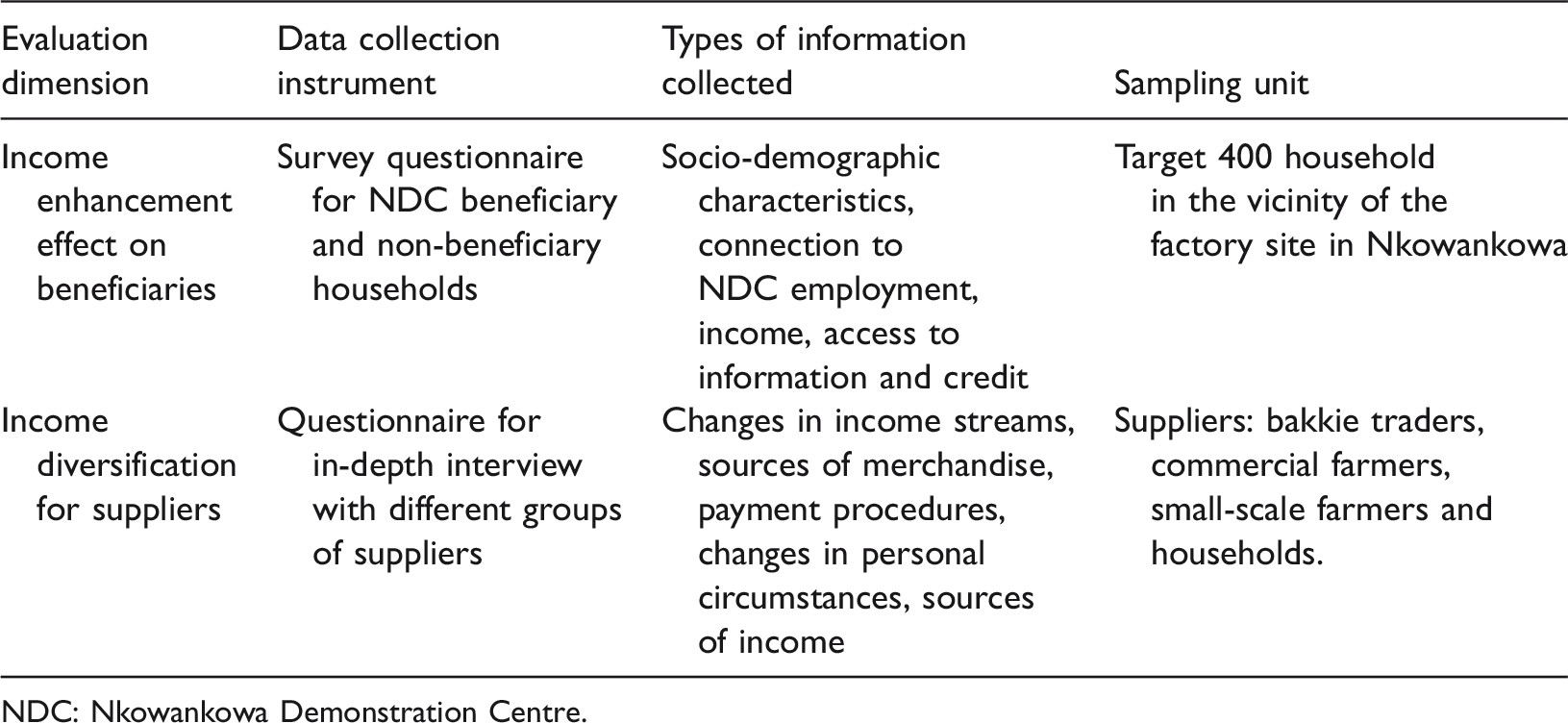
The overall objective of the study was to establish to what extent the NDC beneficiation programme had affected the capacity of respondents involved with it either as suppliers or employees to enhance their income diversification. The study also analyses how the new entrepreneurial and employment opportunities made available to local inhabitants for supply of mangoes and labour to the factory contributed to enhancing their household income. This was done by conducting in-depth interviews with suppliers using a semi-structured questionnaire and by analysing a household survey of 385 households living in the vicinity of the factory, including beneficiaries and non-beneficiaries of the project employment opportunities. The questionnaire was designed to capture business activity and income diversification outcomes in the sample of suppliers and employment beneficiaries. The supplier questionnaire was administered to a sample of suppliers provided by the project management of the NDC. This sample was drawn on the basis of a list of suppliers who had sold mangoes to the agro-processing factory at any time between January 2013 and December 2015. It is important to note that the socio-economic changes reported by respondents cannot be automatically attributed to their interaction with the NDC fruit processing in the area, because of the absence of baseline data and/or a possible counterfactual experiment created at the inception of the intervention. The absence of initial data eliminates the option of both an experimental or quasi experimental design. A summary of the methodology and the data collected is presented in Table 1.
Study methodology framework.
NDC: Nkowankowa Demonstration Centre.
Some of these indicators collected during the interviews were retrospective in nature, asking information on the beneficiary’s quality of life before the factory started operating. This poses the well-known recall problem. Respondents’ recollection of states and events over a period of time are influenced by a lot of factors and other events occurring simultaneously that could either cloud their memory or bias their recollection. The implications of these limitations of the study design on the meaning of the results of the study are therefore fully acknowledged.
Sampling
The target population consists of 1670 households, 380 suppliers, 148 local residents who work for the factory and 52 local entrepreneurs. The sampling targeted 400 households, 189 suppliers and 148 local factory workers on the basis of lists provided by NDC management. The list of suppliers to the fruit processing factory contained 189 possible contact numbers out of which 66 were reachable. The aim was to talk to as many of them as possible because there was no guarantee that the telephone numbers provided on the list were still valid. All 66 suppliers who were contactable by mobile phone were interviewed, giving a response rate of 35%. The rest of the telephone numbers could not be reached. The realised sampling was therefore a convenience sample, whereby every effort was made to interview all respondents who were contactable by mobile phone, but only those who could be reached were interviewed. Traditionally, this would imply a high probability of a larger sampling error than would be obtained with probability-based sampling schemes. However, the nature of our convenience is such that a sampling bias is highly unlikely because there reachability of telephone numbers on the list was totally random. The process of people switching numbers, losing cell phones or moving out of the catchment area is completely unpredictable and thus mitigates the bias of the convenience approach.
For the beneficiation in terms of employment opportunities, this study used a household survey covering 385 households living in the vicinity of the factory, of which 97 reported having at least one household member who benefited from the employment opportunity offered by the NDC project any given time since its implantation in the area. Responses were ultimately collected from 88 local factory workers and 301 non-beneficiary households drawn randomly as a control group.
Data analysis strategy: Propensity score matching and inverse probability weighting (IPW) approach
In order to establish a causal relationship between an intervention such as this implantation of an agro-processing factory in a rural environment and subsequent economic benefits, it would ideally be necessary to provide counterfactual evidence based on what the situation would be if the intervention had not taken place (Rosenbaum and Rubin, 1983). Failure to distinguish between the causal effects of an intervention and the effects of unobserved heterogeneity between beneficiaries and non-beneficiaries could produce biased estimates and lead to inadequate interpretation of outcomes. This methodological difficulty can be overcome through the use of the non-parametric propensity score matching (PSM) proposed by Rosenbaum and Rubin (1983). The PSM approach has the advantage of accounting for the endogeneity of the decision to join the intervention. It therefore relies on the estimation of the probability to adopt the new intervention, conditional on the observed covariates (Dehejia and Wahba, 1999). One of its limitations is its reliance on the assumption that all variables influencing participation in the intervention, which are correlated to outcomes, are observable.
The main feature of the PSM procedure is the creation of conditions comparable to a randomised experiment, in which evaluation is restricted to local comparison between beneficiary and non-beneficiary households having otherwise similar characteristics. Matching beneficiaries and non-beneficiaries based on observed covariates might however not be feasible or could be difficult when the set of covariates is large. In order to reduce this problem of dimensionality, Rosenbaum and Rubin (1983) suggested that instead of matching along the outcome covariates
Like PSM, IPW relies on building a logistic (or probit) regression model to estimate the probability of the beneficiation observed for a particular individual in either treatment category. It then uses the predicted probability as a weight in subsequent analyses (Cassel et al., 1983). Individuals with a high predicted probability of treatment receive a lower weight, compared to individuals with a low predicted probability. As in the PSM procedure, the IPW probability model is based on household characteristics that affect both the probability of benefiting from the programme and the income generation (Rosenbaum and Rubin, 1983). The goal is to estimate as closely as possible the counterfactual or potential outcomes if all households in the target population were assigned either category of treatment (beneficiaries versus non-beneficiaries). An individual with a low predicted probability of being a programme beneficiary, who actually becomes included as beneficiary, will thus represent a larger group of individuals who did not get involved in the programme so that the matched groups will be representative of the target population (Cassel et al., 1983). The income effect is subsequently computed as the average income difference between the treatment group and the constructed counterfactual of non-treated.
Findings
Procedural approach
In this section we present the results related to two groups of beneficiaries: households that benefited from employment opportunities with the factory and the suppliers of mangos to the NDC factory. For the first category of beneficiation, we estimate the income effects of the NDC employment opportunity by computing the average income difference between the beneficiaries and the non-beneficiaries with the IPW method. The household survey data provide a rich description of the demographic and socio-economic factors that characterise the living conditions of the surveyed households. A close analysis of these factors enables a reliable identification of all major factors related to income generation and income sources. Those socio-demographic characteristics that influence income generation of respondents include: age of household heads, education level of household heads, age, gender and marital status of household heads, employment status, access to credit, access to information, household size and availability of additional sources of income other than labour income. They also include activities and occupation of household members, the acquisition of household assets as well as the degree of deprivation and budget constraints.
When designing the questionnaire, it was expected that collecting reliable information on socio-demographic characteristics of households would enable us to attribute at least a portion of the observable differences in income growth and change in living conditions to variations in those social and demographic factors. That way, the socio-economic effects of the introduction of the factory on the same dimensions of income and poverty would be isolated from other effects due to heterogeneity and be estimated by comparing between beneficiaries and non-beneficiaries of the factory employment programmes who have otherwise similar characteristics. Those socio-demographic characteristics served as income and poverty covariates that were used to estimate the propensity scores applied in the IPW.
Estimation of income improvement effects with IPW
As discussed in the previous section, the effect of NDC programme on incomes cannot be assessed without first disentangling them from confounding factors that equally affect the target communities and influence their income generation potential. In order to estimate the income change effects of the factory employment opportunities of residents, we apply the non-parametric IPW estimation technique, which enables a comparison between beneficiaries and non-beneficiaries on the basis of their similarity in socio-demographic characteristics. This estimator offers the tools to account for observable heterogeneity between beneficiaries and non-beneficiaries in order to reduce the endogeneity bias inherent in the impact estimation of a non-randomised assignment of interventions.
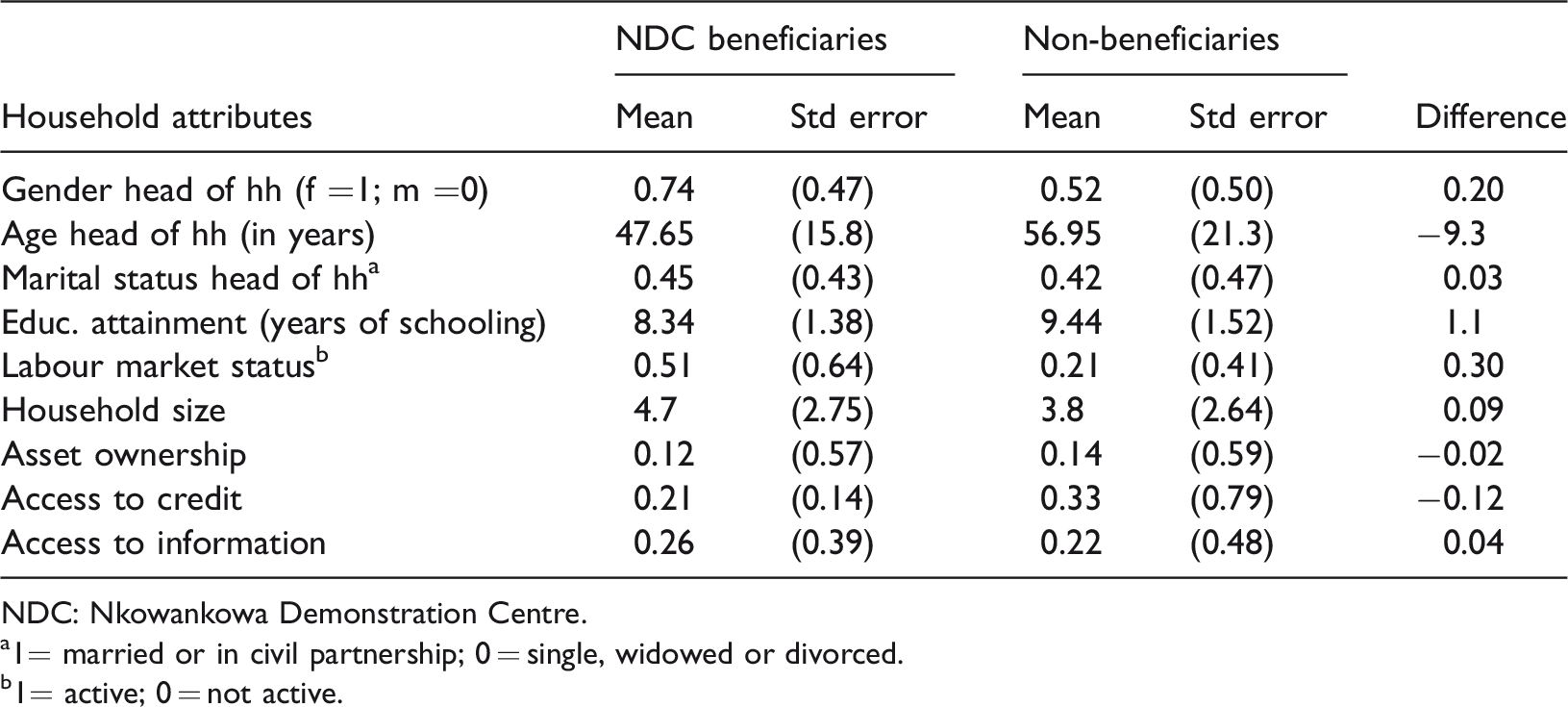
The summary statistics of socio-economic characteristics of beneficiary households are, however, hardly distinguishable from those of non-beneficiary households at any statistically significant level, as can be seen in Table 2. Even though the computed mean age difference of 9.3 years seems rather sizable, it is not statistically significant, given the large within-group variations (standard deviation of 15.8 years for beneficiaries and 21.3 years for the non-beneficiaries). This is not surprising, since the recruitment for employment in the factory was done randomly on a first-come first-served basis among the candidates who lined up applying for jobs. The level of education, for example, played no significant role in determining access to NDC employment opportunities. This is due to a very low variation in educational attainment data: an overwhelming majority of respondents have a similarly low level of educational attainment across the beneficiation status, with only 1 in 10 having attained high school diploma level or higher. If anything, employment beneficiaries tend to display a somewhat lower average income, with a seemingly larger variance, but the usual analysis of variance does not enable to establish a conclusive interpretation of differences at the conventional levels of significance. In summary, the socio-demographic attributes of respondents present similar variations whereby the within-group differences are larger than the differences between groups, so that they are statistically undistinguishable across beneficiation status.
Summary statistics of household attributes affecting income generation.
NDC: Nkowankowa Demonstration Centre.
1= married or in civil partnership; 0 = single, widowed or divorced.
1= active; 0 = not active.
These abovementioned socio-demographic covariates used in the probability model to estimate the income effect due to NDC employment opportunities yielded the following outcomes: the ATE estimated from the survey data is a monthly income advantage of ZAR 2727 (ZAR 2823 with probit) with a potential outcome mean of ZAR 2380 (ZAR 2245 with probit) for NDC beneficiaries. The p-values of our estimations are all far below 1% significance level. With respect to the self-reported change in income levels between current income and income before the setting up of the factory in 2010, after controlling for education level, access to credit, income inertia, age and household size, beneficiaries still seem to have experienced more income improvement than their non-beneficiary counterparts, even though the estimated magnitude of these differences is dependent on subjective appreciation of respondents. The survey also showed that there were only a handful of NDC employment beneficiaries who derived relatively higher income from working for the fruit processing plant but whose current incomes did not represent any significant improvement relative to their previous living conditions. These observations seem to suggest that among the categories of households with the lowest incomes, most of those who did not interact directly with the factory were left unaffected (no indirect income spillovers) and some of them even became worse off. At the same time, some of those who interacted with the NDC and benefited from its operations, managed to increase their income as a result of working for the fruit processing plant, but not to the extent of raising their living conditions above those of their peers who derived their income from elsewhere.
Employment and income effects: Self-reporting on income improvements attributable to NDC employment
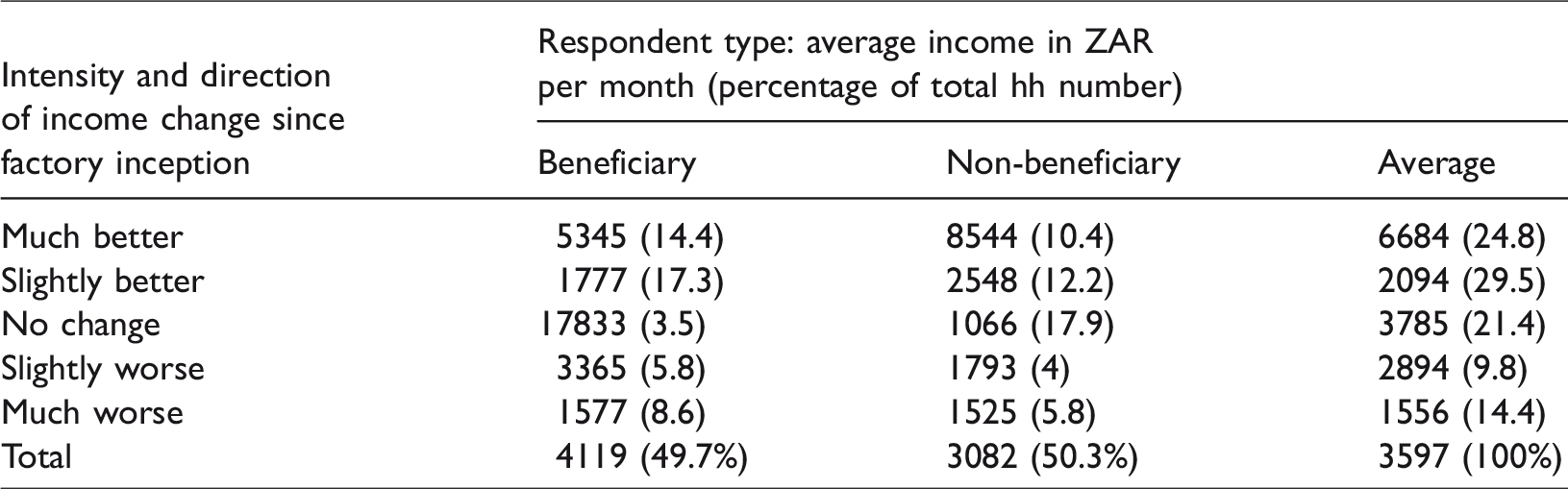
The estimated income differences represent an average that does not tell individual stories and experiences of the nature of the income improvements. Survey respondents’ self-reported perception of income change adds detail to the estimated average, because income improvement affected different beneficiaries in diverse ways. The collected data of respondents who reported their household budgets display an almost equal distribution of responses between beneficiaries (49.7%) and non-beneficiaries (50.3%) as can be seen in Table 3. About 32% of respondents reported to have experienced a significant improvement in their living conditions as a result of working for the fruit processing factory. In comparison, 18% of respondents who worked for the factory were either worse off or did not see any improvement in their living conditions. Here, we note that people who report improvement in their living conditions have a relatively higher disposable income and a higher budget spent on food. Respondents who report to be worse off than before working for the NDC have a lower average food budget but display greater budget disparities.
Comparative descriptive statistics of income change between beneficiaries and non-beneficiary households.
We can break down the results further in terms of gender distribution between male-headed households and female-headed households. We then note that among beneficiaries who experienced income improvement or did not become worse off, female-headed households tend to have a higher average monthly income than their male-headed counterparts (Table 4). Among the non-beneficiaries, female-headed households with the highest average income also appear to have experienced the highest income improvements. Despite forming the bigger proportion of respondents, female-headed households are not more represented among respondents who reported to have seen their incomes get slightly- or much worse since the implantation of the NDC factory in 2010. The frequency of female-headed households with income deterioration is roughly the same as that for male-headed households among factory beneficiaries and is only half that of male-headed households among the non-beneficiaries. Also noteworthy is the average income of non-beneficiaries who saw the highest income improvement, both in male- and female-headed households, which remains higher with respect to the incomes of their beneficiary counterparts.
Gender distribution of income change between beneficiaries and non-beneficiary households.

The summary interpretation of these income changes suggests therefore that only less than a third of respondents saw a moderate to significant improvement of their living conditions, mostly as a result of working for the factory, while almost one in five was worse off or didn’t experience any life improvement despite working for the factory. More than a quarter of respondents also reported not to be better off and not to benefit from anything directly linked to the factory. Another one fifth of respondents represents those whose living conditions improved despite their not benefiting directly from the NDC agro-processing factory.
Understanding the income diversification effects of NDC on mango suppliers
One of the objectives of NDC was to provide opportunities for income diversification to Nkowankowa residents by signing contracts with informal mango suppliers to procure input at fair prices. Embedding the beneficiation in the local community’s socio-economic priorities was put at the centre of the planning because of its importance for long-term success of the factory’s operations. Adaptation mechanisms and frequent mutual consultations were applied to reach an agri-business model based on community empowerment, which forms the strength of the NDC operational strategy of putting the profitability objective in line with community beneficiation and empowerment, as suggested by Ustriyana (2015).
Discussions with informal market suppliers of mangoes have shown that supply contracts with NDC offered them – for the first time – a fair trade price for their produce. Fair pricing practiced towards its formal and informal mango suppliers created a bond between the agro-processing factory and its immediate vicinity, which laid a foundation for inclusion and sustainability of the realised gains. In order get a clear picture of the income diversification benefits that this opportunity generated, we analyse the in-depth interviews conducted with NDC mango suppliers according to their categories identified in the introduction: commercial farmers, small-scale farmers, bakkie-traders and bucket- and wheelbarrow traders.
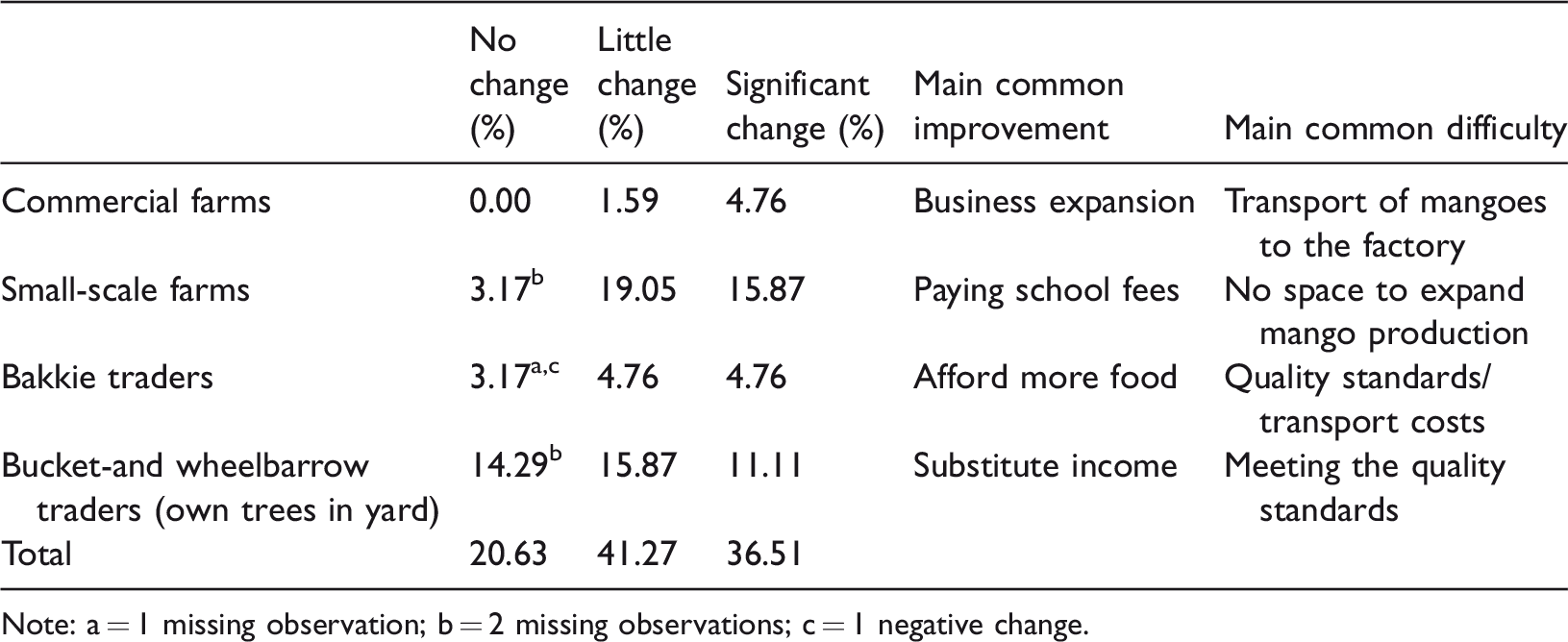
An overview of the subjective reporting of changes in household income diversification as well as the associated constraints is reported in Table 5. Among the positive changes that were beneficial to suppliers, it is worth noting that small-scale farmers form the largest portion (almost 16% of all respondents) of beneficiaries who experienced significant change in their ability to diversify income sources. Another 19% reported limited positive change. This means that 35% of all respondents were small-scale farmers who reported either limited or significant positive change to their ability to diversity their income sources.
Change to household income from diversified sources.
Note: a = 1 missing observation; b = 2 missing observations; c = 1 negative change.
Informal suppliers (bucket traders) form the second largest group reporting significant change in income diversification, with 11% of the total. Together with those among informal traders reporting moderate changes, informal traders represent more than a quarter (27%) of all local entrepreneurs who benefited from their opportunity to supply mangoes to the NDC factory. Changes to business for bakkie-traders and commercial farmers are represented by lower numbers of respondents, but have larger implications for new employment creation because of the larger sizes of the corresponding businesses. Here, it is equally worth noting that in contrast to other supplier categories, all commercial farmers reported positive changes to their businesses, with most of them reporting a substantial change, even though the intervention gave indiscriminate opportunities to all local businesses. Considering that all commercial farmers who benefiting from the NDC factory reported to reside at a distance of more than 10 kilometres, this may point to a situation in which relatively wealthy economic actors from outside the area stood to benefit more than the target low-income residents of the local communities. They had the ability to capture more benefits because they were already in possession of financial and logistic means to take advantage of economic opportunities.
Extra income accruing to local community members possessing only a small number of mango trees in their private yards or orchards remained limited in scope but was perceived positively. Additional benefits from that supply opportunity came mainly in the form of supplemental income that allowed them to afford more basic purchases and pay school fees for their school-going children.
In terms of market configuration, most respondents report to supply only to the NDC fruit processing and know that their customer offers better prices and business opportunities than competing factories. Other fruit processing firms sometimes send them back with their supplies or do not pay them in time. As for of employment creation, the potential was almost limited to sustaining employment stability of the suppliers themselves, with only eight suppliers reporting to have hired additional workers to help them temporarily in supplying mangoes to the factory during the abundant harvest season. The total employment creation registered in our sample, across all groups of traders, is 201 people who signed a temporary contract. At an average of ZAR 150 per working day, the corresponding reported wage is however relatively modest.
Concluding discussion
In this study, we have attempted to examine the effectiveness of the agro-processing beneficiation policy through an outcome evaluation of the income diversification effects of the Nkowankowa Demonstration Centre operations. Our analysis of various data collected through in-depth interviews with beneficiaries, household surveys, focus group discussions and key informant interviews, suggests that the implantation of NDC as a beneficiation programme has undoubtedly triggered positive changes in Nkowankowa by stimulating local entrepreneurship. This has led to considerably reducing harvest losses and providing employment opportunities for local residents, while giving local informal entrepreneurs some welcome opportunities to supply mangoes to factory at attractive prices.
Thanks to a good preparatory capacity building, which included intensive training and support of potential input suppliers, the NDC has been able to successfully connect with the local economy for sourcing its raw materials and labour inputs. Currently, NDC is the biggest player in the mango pulping industry in the Limpopo province and is looking to diversify into other fruit varieties. Thanks to its quality benchmarking, it has secured a steady domestic as well as international customer base and has therefore managed to offer a stable market for local mango suppliers at fair prices. As a consequence, local residents have benefited from its operations, either as mango suppliers or as factory employees, and this has enabled them to diversify their income sources and ease their financial constraints. The seasonal windfall income generated from the opportunity offered by NDC has enabled local mango producers to smooth their budgets and opened new possibilities that enabled them look forward to bettering their living conditions.
Critical to the success of this beneficiation programme has been its ability to plan its operations beforehand and put in place adequate operational and human capacity processes, including solid connection with local commercial as well as small-scale farmers for a steady supply of inputs. The fact that NDC sources approximately 50% of its mangoes from local informal suppliers is also indicative of the inclusive nature of its beneficiation vision. In addition to supporting its suppliers in expanding their production, NDC has provided on-the-job training to the recruited employees, which has helped them in performing the technical tasks of their job assignment. Despite its limitation in scope, the NDC success is evidence that agro-processing as a beneficiation strategy can be a viable source of industrial activity, provided that it is adapted to the specific local context, as suggested by Cramer (1999).
For an agro-processing intervention to succeed in its beneficiation mission, it is therefore not sufficient to match the deployment of plant and equipment with locally identified natural and agricultural resources, as already pointed out by Hausmann et al. (2008). A vigorous training programme aimed to develop complementary human capabilities and infuse among local residents a sense of ownership and long-term association with the project must thus be planned in advance. This is necessary in order to ensure that the resulting operations add sufficient value to the resources in a sustainable manner. Continuous training programmes aimed to match the value-adding operations of the intervention with the skills present or readily trainable in the local community are also necessary to consolidate the employment gains for the intended local community beneficiaries.
Finally, successful development of agro-processing as a beneficiation strategy also requires a thorough alignment of skills, competencies and resources with the needed production in order to trigger the shift from primary production to the industrial processing of primary products. It equally requires securing access to export market and producing at quality standards that enable to retain domestic as well as foreign consumer loyalty (Cramer, 1999).
Footnotes
Declaration of Conflicting Interests
The author(s) declared no potential conflicts of interest with respect to the research, authorship, and/or publication of this article.
Funding
The author(s) disclosed receipt of the following financial support for the research, authorship, and/or publication of this article: Research funding from the Department of Science and Technology, Republic of South Africa, is gratefully acknowledged.