



Abstract
The socio-economic impacts of events, while mostly positive can often bring many detrimental implications to destinations and communities that host them. The statutory role of Local Authorities in Ireland to authorise and license large scale outdoor public events places Local Authorities in an ideal position to monitor and better manage the socio-economic impacts events can create at local level. This comparative examination draws attention to the current level of planning for the socio-economic impacts of events by Local Authorities at a nationwide level in Ireland. A multi-methodological approach was employed through a quantitative content analysis of Local Authority event management plans and guidelines and qualitative semi-structured interviews with Local Authorities in the Republic of Ireland. The findings drew attention to an overall dearth of socio-economic planning for events by Local Authorities. This lack of planning subsequently highlights a fundamental need for Local Authorities in Ireland to pay greater attention to generating greater levels of socio-economic sustainability in the legal process of planning for event management given their statutory role. This study presents an opportunity for improvement by Local Authorities and Event practitioners not only in Ireland but at International levels.
Introduction
The economic development opportunities that are derived from the national events industry in Ireland is exponential. Green (2017) and Fáilte Ireland, the National Tourism Development Authority of Ireland (2018) highlighted the significance of the Irish event industry outlining that the live entertainment and events industry at a national level is continuing to grow. Events in Ireland generate over €1.7 billion in economic activity and attract over 4 million holidaymakers each year, of which 300,000 are from overseas markets. It is also responsible for creating over 11,000 jobs in the live entertainment and events industry. As such, the recognition of events as important valuable instruments for economic growth, development and regeneration and social integration and inclusion has resulted in events becoming integral to Ireland’s tourism offering so much so that they have become critically important to Ireland’s socio-economic health (Maguire and McLoughlin, 2019). In light of this booming sector contributing towards national development, it also offers the perfect opportunity to showcase all that Ireland has to offer in respect of its culture, heritage, its people and its place (Fáilte Ireland, 2018).
As a form of soft power, events have become a principal feature and are strategically utilised by national and local level governments when it comes to developing, promoting and managing the tourism industry offering (see Wise and Harris, 2019). Concerning Ireland specifically, Maguire and McLoughlin (2019) commented that a number of Government initiative have been devised in Ireland in order to support event industry growth and competitiveness and ultimately aid Governments in achieving their broad economic and social objectives. They further elaborated that the reputation of events as a major direct contributor of economic activity and social change throughout the country is a testament to Ireland’s unique tourism offering and the efforts of Government in supporting event developments and opportunities. Thus, while tourism activities such as events are an important component of soft power in Ireland given their ability to influence the planning practices and affect policy outcomes through the attraction of unique societal cultures and values, a significant challenge facing Local Authorities is deciding how best to monitor, manage and sustain event industry growth. There is also a need to take action to secure both social and economic benefits of events and shape the future competitiveness of the events industry going forward (see Aquilino et al., 2019). Wallstam et al. (2018) discussed that policymakers in destinations regularly struggle to identify effective ways to evaluate the impacts of planned events. However, if the growth of the event industry is to continue, there is a fundamental need to develop new approaches to anticipate and prepare for the future.
Local Authorities in Ireland are now tasked with strengthening more economically and socially focused planning at local level. This power role enables Local Authorities to guide the process of planning for events management more effectively. The National Planning Framework (NPF) for Ireland 2018–2040 emphasises the need to protect communities and cultural heritage (NPF, 2018). This national framework articulates the Government’s overarching commitment to achieving sustainable development through ‘planning for our social, economic and cultural development’ (NPF, 2018). As a result, Government at national and local level in Ireland have committed to ensuring future developments are planned in a way that better supports people’s quality of life. This has become a crucial concern for Local Authorities and event practitioners now more than ever before as a result of the increased awareness of event growth and development to contribute to the production of socio-economic event costs including problems related to traffic congestion, accessibility, crime and vandalism, inflation and inequalities of wealth between hosts and residents (Maguire and Hanrahan, 2016). These potential consequences can all lead to the creation of friction between hosts and event attendees and often a loss of cultural values and host community hostility towards event developments (Deery and Jago, 2010; Gursoy et al., 2004; Maguire and Hanrahan, 2016). Jepson and Clarke (2015) deliberated that such issues can adversely affect host community support for and participation in events. Hence, the socio-economic impacts of events according to Maguire and Hanrahan (2016) and Maguire and McLoughlin (2019) must be planned for, monitored and managed to avoid the socio-economic costs and to maximise socio-economic benefits events can generate.
In line with the NPF for Ireland (2018), Local Authorities are also required by law to produce Local Economic and Community Plans (LECPs) which outlines strategic community and economic development frameworks for local communities. The establishment of LECP’s are aimed at developing, co-ordinating and implementing a coherent and integrated approach to local and community development (Dublin City Council, 2016). Therefore, keeping this Government commitment in mind, the need for Local Authorities to play an important functional role in planning for socio-economic issues in the context of planning for event management is crucial, considering that such socio-economic issues can be pertinent within the national events industry. This functional statutory role is essential to ensure event developments occur within acceptable limits, having regard to host communities and to the requirements of national legislation while maximising event benefits to local economies.
As Local Authorities have a legal remit to license events; and facilitate and regulate the process of planning for large-scale outdoor public events in Ireland, they are in an ideal position to ensure its future socio-economic sustainability. However, the changing environments in which events operate often add to the complexity of planning for event management. In particular, the reputation of events to heavily impact on host communities (Burdge and Vanclay, 1996; Deery and Jago, 2010; Hall, 1997; Jepson and Clarke, 2016; Maguire and Hanrahan, 2016; Ritchie, 1984; Sharpley and Stone, 2011; Small et al., 2005) has created a fundamental need to ensure events are planned in an effectively more safe and sustainable manner. A consistent sustainable approach to planning for event management in Ireland is vital to safeguarding the future sustainability of the event industry and ensuring long-term community support and participation in event developments. Through a socio-economic sustainable approach to planning for event management, Local Authorities could transform the way events are planned and managed going forward and focus on planning events in a manner that minimises negative social impacts while maximising positive economic and social outcomes. This research sets forth to determine whether or not planning for the socio-economic impacts of events are being prioritised at local level in Ireland. This article will discuss the need to plan for the socio-economic impacts of events and the role of Local Authorities in planning for event management in Ireland. The methodological approach will also be discussed. The application of a content analysis approach allowed the author to clearly illustrate which of the 32 Local Authorities and City Councils assessed prioritised planning for the socio-economic impacts of events within the legal process of planning for event management in Ireland which was supported with qualitative interviews with Local Authority event personnel. This article concludes with presenting opportunities for future longitudinal research.
Planning for the socio-economic impacts of events
The expansion of events on a global scale has created many encouraging and adverse impacts on host destinations, communities, residents, cultures and economies (Deery and Jago, 2010; Gursoy and Kendall, 2006; Maguire and Hanrahan, 2016; Maguire and McLoughlin, 2019; Sharpley and Stone, 2011). It has been well documented that events play a vital role as a form of economic, public and soft power (Grix et al., 2019). As a form of soft power, events present a positive opportunity to promote social change and cooperation and economic growth and development throughout the country. However, the need to plan for the socio-economic impacts of events has followed recognition that events place increasing demands on host communities and local services and have as such become a focal point for event practitioners and policy makers (Wood, 2005). Planning for the socio-cultural impacts of events is therefore crucial to minimising the consequences and maximising the positive role events play in the lives of host communities and economies.
It has long been reported that the economic benefits of events often forms key objectives and motivations behind planning, managing and hosting events (Thomas and Wood, 2004) and these have been identified as the principle driver underpinning the support for and increasing popularity of events at local, national and international level (Dwyer et al., 2000). Dwyer et al. (2006) and Etiosa (2012) regarded economic impacts as the most important impact event practitioners and host communities look at from a positive perspective. However, a fundamental task for event practitioners and policy makers at national and local levels in modern society is to identify, predict, monitor and manage economic event impacts in a way that optimises benefits for host communities and destinations while also minimising economic costs (Maguire and Hanrahan, 2016; Maguire and McLoughlin, 2019). Scholars argue that events can increase destination competitiveness (Konstantaki and Wickens, 2010), boost investment (Gursoy et al., 2004) and leverage opportunities for further economic growth, as evidenced by the figures presented in the intro relaying the impact of events to Ireland.
Through a strengthened and effective approach to planning for socio-economic event impacts, many positive contributions can be produced. The benefits of events to enhance local community image, promote community values, act as a vehicle for improving social relationships and as a valuable source of income generation and employment, community rejuvenation, cultural preservation, civic cohesion, pride and community satisfaction have been well renowned (Arcodia and Whitford, 2007; Gursoy et al., 2004; Janeczko et al., 2002; Kim et al., 2015; Maguire and Hanrahan, 2016; Nunkoo and Ramkisson, 2011; Waitt, 2003; Wood, 2006). Events also have a profound ability to increase revenue at local and national levels by attracting visitors, increasing financial performance and generating greater multiplier effects within a region (Fredline et al., 2005; Jamal and Robinson, 2009; Wall and Mathieson, 2006). Thus, the benefits obtained by host communities from event activities can increase the likelihood of communities to support event developments (Jepson and Clarke, 2016; Small et al., 2005). Such benefits have been noted to encourage increased community participation, expand cultural perspectives, improve community quality of life and provide a higher standard of living while decreasing social inequalities (Fredline et al., 2006; Richards et al., 2013; Thomas and Wood, 2004). Jepson and Clarke (2014) highlighted the importance of local community support and inclusion in the creation of festivals and events. However, Dwyer et al. (2006) and Gursoy and Kendall (2006) contrasted that communities are unlikely to support tourism and event development when there is a negative relationship with the perceived costs of such developments. Therefore, the importance of building links and fostering relationships between Local Authorities and local people has been advocated (NPF, 2018). Thus, planning to maximise the benefits of events while minimising the potential for consequences according to Griffin (2009), is essential to sustainably planning of event management.
The value of planning for such impacts to maintain and strengthen the quality of life of host communities is incremental. However, the socio-economic costs of events can often outweigh the socio-economic benefits from a community perspective. The issues of traffic disruption and congestion, crime rates, vandalism, property damage, overcrowding, littering, noise and the pressure events can place on local services can adversely affect community quality of life, create impediments to access and an inequality of wealth between host communities and tourists (Fredline et al., 2006; Gursoy et al., 2004; Li and McCabe, 2012; Maguire and Hanrahan, 2016; Turco et al., 2010; Weaver and Opperman, 2000). These impacts have raised a fundamental need to measure, monitor and plan for the impacts of events. These consequences have been noted to result in community alienation, disruption of lifestyle, loss of identity and can create a negative community image (Fredline and Faulkner, 2001; Gursoy et al., 2004). Furthermore, the importance of planning for socio-economic impacts is incremental to achieving sustainability (Maguire and Hanrahan, 2016; Richards et al., 2013) and can have a remarkable influence on the success or failure of events.
Events can create increased leakages (Janeczko et al., 2002) which can occur through taxation, foreign ownership and investment, savings and spending on non-locally sourced products and have been regarded as decreasing the economic impact of events to host regions (Andersson and Lundberg, 2013). Yet, despite the benefits of events to raise destination profiles and attract capital and inward investment, improve destination awareness and encourage long-term promotional benefits and additional trade (Dwyer et al., 2003; Janeczko et al., 2002; Maguire and Hanrahan, 2017), the economic costs associated with price inflation, resident exodus and hostility and interruption to normal businesses (Dwyer et al., 2000), which ultimately has a knock on effect on host community quality of life and standard of living require much needed attention. Therefore, for events to be economically sustainable requires Local Authorities to monitor the economic impacts of events. Wood (2005) discussed how measuring the economic data from events can make it easier to justify expenditure on events and inform government’s decisions in relation to events and public funding. Given the legal role of Local Authorities in supporting economic development and enterprise (Planning and Development Act, 2015), Local Authorities should be placing a fundamental onus on managing the economic impacts of events.
Without such broad and complex socio-economic event issues being managed or addressed, detrimental socio-economic implications can occur to event industries, practitioners, communities and policy makers. The Croke Park stadium concerts (Garth Brooks) in Ireland is a prime example illustrating the need to plan for the socio-economic event impacts. It was this complex relationship between events and host communities in Ireland that has raised concerns in relation to community participation and the degree of socio-economic planning within existing event planning and licensing processes. Maguire and Hanrahan (2016) discussed how the social issues of events can often be overlooked in favour of the economic advantages. They discussed how this was first evident in 2014 in the case of the Croke Park Stadium concerts (Garth Brooks) in Dublin Ireland, which saw the community residing around Croke Park Stadium to object to five nights of sold out concerts for a capacity of 80,000 people per night. These objections were based on the perceived social impacts that this event had the potential to create before, during and after the proposed events and the tendency of Local Authority to overlook this together with a pre-existing agreement between the Croke Park residents and Croke Park stadium under the planning permission granted for Croke Park to hold no more than three events on consecutive evenings. While Dublin City Council granted permission for three concerts following a long drawn out event licensing process, the artist made the decision to cancel all five concerts, resulting in a loss of earnings reported to be worth €50 million to the local economy (Maguire and Hanrahan, 2016; Maguire and McLoughlin, 2019). Maguire (2018) noted how this situation seems avoidable through a clear transparent participative process for event management planning. This issue led to the recognition that there are limitations to the licensing regulations (DHPLG, 2015), which followed with a number of amendments being made to the Planning and Development (licensing of outdoor events) Regulations (2001), which are now outlined under the Planning and Development (Amendment) Regulations 2015. However, a similar Croke Park community problem over a Rolling Stones concert arose again in 2018, highlighting that problems seem to be afoot within the Local Authority process of planning for event management in Ireland. However, Maguire (2018) noted the importance of learning from past failures in order to improve future attempts to leverage events to stimulate economic development and social change in regional and local social agendas.
These cases, according to Maguire and Hanrahan (2016) raised questions in relation to the whether or not event planning guidelines, strategies or tools are being implemented by Local Authorities to protect host communities from the direct impacts of events. It is important to focus on the lessons learned from this event to avoid future problems and recognise what has been or what needs to be put in place to mitigate such problems from occurring in the future. Therefore, the need to implement a sustainable approach to planning to manage the socio-cultural impact of events is crucial to the future sustainable development and planning of events in Ireland.
Local Authority role in planning for events in Ireland
With the continued growth of large-scale public outdoor events taking place throughout Ireland at local level in recent years, there is an increased need to manage the process of planning for events management. As the second layer of democratic government, Local Authorities in Ireland play a significant role in planning for event management. They are now some of the biggest players in the event field with almost every Local Authority employing an event manager or team. Planning for events at local level in Ireland is predominantly determined by the Planning and Development Regulations 2001–2015 (licensing of outdoor events). This legislation places a fundamental and statutory onus on Local Authorities throughout Ireland to play a key role in the approval or disapproval of large-scale outdoor public events through event licensing. Through the authorisation of events, Local Authorities have the ability to control the process of planning for event management and the delivery of public services necessary for event management in Ireland. This provides Local Authorities with a statutory obligation to perform a wide and complex variety of roles particularly in the arena of large-scale outdoor public events. However, the extent of government involvement varies according to event size and type and the Local Authority interest, resources and commitment to events (Wood, 2005).
The planning system in Ireland is operated by 31 Local Authorities referred to as County, City or City and County Councils. Each Local Authority has a legal responsibility to facilitate and regulate the process of planning for large-scale outdoor public events in Ireland. This role gives Local Authorities the power to grant or refuse permission for an event license. The process of Local Authority planning for events is governed by the Planning and Development Regulations 2001–2015 (licensing of outdoor events), which details the planning procedures to be adhered to when planning for large-scale public events in Ireland. Within the system of Local Government, the responsibility of planning for event management falls to a number of departments due to the complex nature of events. Such departments include planning, environmental health, emergency services, tourism and recreation and roads and transport (Ali-Knight et al., 2008; Callanan and Keoghan, 2003; Ferdinand and Kitchin, 2016). Therefore, the success of planning for events in Ireland lies in a functional planning system that guides Local Authorities in their event management planning functions.
The need for Local Authority involvement in planning for event management
The statutory obligation of Local Authorities to grant or reject an application for an event license (Planning and Development Regulations 2001–2015) highlights the imperative role of Local Authorities in the process of planning for event management. Traditionally, within the Irish event planning process, the Local Authority role has been inclined to focus on the provision and maintenance of public infrastructure, which paved the way for events. Such infrastructure includes publicly owned parks and amenity areas, roads, water and sewerage facilities. However, since the introduction of the Planning and Development (licensing of outdoor events) Regulations (2001), the responsibilities of Local Authorities towards events have been heightened, giving Local Authorities the power to license events and facilitate the process of planning for event management. They are now required to regulate and monitor events to ensure planning takes place in a manner that safeguards the environment, reduces risks to health and safety and protects socio-economic values of host communities and enhances the tourist experience (Getz and Page, 2016). Therefore, the significance of Local Authority involvement in planning for event management is essential to managing the process of planning for events at local level in Ireland.
As such, the growing acceptance of socio-economic sustainability as an approach to event planning (Holmes et al., 2015; Jones, 2014; Raj and Musgrave, 2009) is essential to manage the impacts of events and should be placed at the forefront of Local Authority planning. The increased security challenges facing events internationally has raised concerns for many event managers and policy makers internationally (Ali-Knight et al., 2008). The need for Local Authorities to develop policies and plans to better equip event managers in planning for and controlling security threats in host communities and destinations has been documented (Richards et al., 2010). In light of events becoming the preferred target for terrorist attacks, the issue of security has been placed centre stage in event management planning. It is therefore necessary that Local Authorities in Ireland be better equipped to prepare for and respond to such potential issues. This emphasises the need for Local Authorities to take a proactive approach towards event management planning. Therefore, to effectively manage the process of planning for event management there may be a need to employ event managers within the legally structured Local Authority system.
Methodology
This research sets forth to provide a nationwide baseline comparative examination on the level of socio-economic planning for events by Local Authorities in Ireland within the legal process of planning for event management in Ireland. The rationale behind focusing on Local Authorities is down to the legal requirement of Local Authorities in Ireland to license events and to facilitate the process of planning for event management in Ireland under the Planning and Development (licensing of outdoor event regulations) 2001. However under the planning and development act 2000–2010 and the NPF for Ireland Local Authorities also have legal obligations to plan for the economic, social, cultural and environmental development of respective counties (Department of Environment Heritage and Local Government, 2010; Maguire and Hanrahan, 2016, 2017; Maguire and McLoughlin, 2019).
In order to examine the level of socio-economic planning for event management by Local Authorities within the legal process of planning for event management, a content analysis of local authority event management planning guidelines was examined. The content analysis approach allowed for the constant comparison of results throughout the research process which in turn enabled the identification of variations and gaps in relation to local authority planning for the socio-economic impacts of events in Ireland. The author identified and analysed event management planning guidelines according to a number of criteria that emerged following a review of key literature.
The quantitative content analysis framework allowed for a valuable cross representation of results in relation to the provision of core guidelines to management to the socio-economic impacts of events by Local Authorities. This permitted the authors to clearly examine and determine the level of planning for the socio-economic impacts by the legally obligated Local Authorities. The content analysis methodological approach was the principal quantitative analysis tool applied to this research as it has been noted to represent quantification on a limited scale yet it is still anchored in the quantitative research paradigm (Maguire, 2018; Maguire and McLoughlin, 2019). Neuendorf (2016) discussed that content analysis takes on an analytical approach to understand a number of controlled variables, while Berg (2007) discussed that it tends to emphasise the procedures of analysis while enhancing validity of findings by minimising biases (Hall and Valentin, 2005; Maguire and McLoughlin, 2019). Thus tourism and event researchers are increasingly using content analysis as a means of critical investigation when faced with textual forms of data such as written documents including tourism and event strategies, policy documents and guidelines (Maguire, 2018; Maguire and Hanrahan, 2016; Maguire and McLoughlin, 2019). Hence this approach was considered ideal for examining the level of socio-economic planning by Local Authorities in Ireland within the legal process of planning for event management as it allowed for a valuable cross comparison and representation of results in relation to the provision of core sustainable socio-economic planning guidelines to manage the socio-economic impacts of events.
Analysis centred on criteria outlined in Table 1 for both positive and negative socio-economic impacts which were informed and developed using international literature, principle guidelines, tools, and regulations. The criteria were incorporated into a content analysis framework and the assessment is discussed in light of current relevant international theory. Utilising the content analyses was a fitting way to accumulate data. The data generated through the content analysis approach was further supported through qualitative in depth semi-structured interviews with 30 Local Authority event personnel. To facilitate constant comparisons throughout the research process, data was inputted into a content analysis tool. The data from each category was analysed and discussed in light of international literature.
Positive and negative socio-economic impacts.
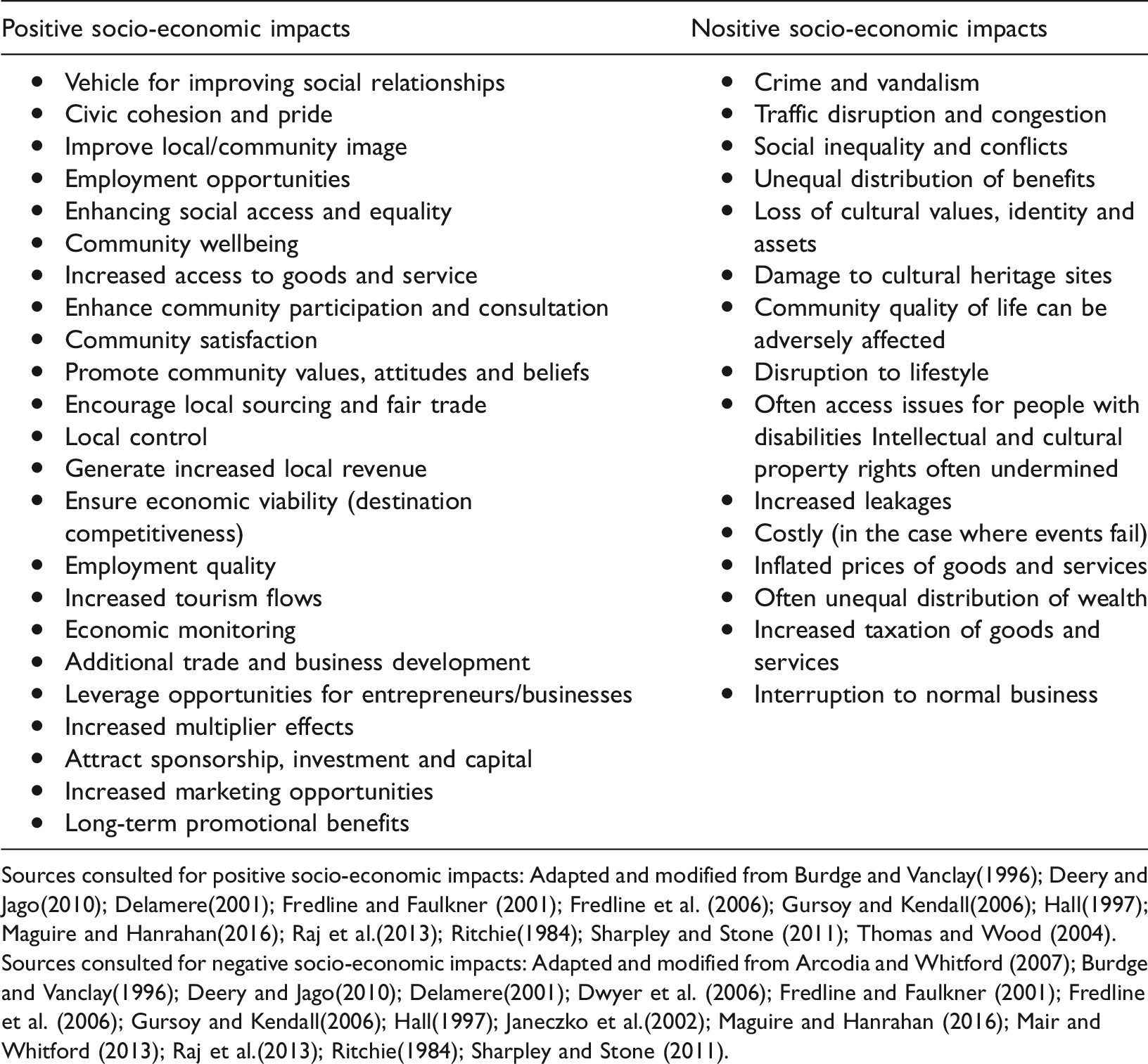
Sources consulted for positive socio-economic impacts: Adapted and modified from Burdge and Vanclay(1996); Deery and Jago(2010); Delamere(2001); Fredline and Faulkner (2001); Fredline et al. (2006); Gursoy and Kendall(2006); Hall(1997); Maguire and Hanrahan(2016); Raj et al.(2013); Ritchie(1984); Sharpley and Stone (2011); Thomas and Wood (2004).
Sources consulted for negative socio-economic impacts: Adapted and modified from Arcodia and Whitford (2007); Burdge and Vanclay(1996); Deery and Jago(2010); Delamere(2001); Dwyer et al. (2006); Fredline and Faulkner (2001); Fredline et al. (2006); Gursoy and Kendall(2006); Hall(1997); Janeczko et al.(2002); Maguire and Hanrahan (2016); Mair and Whitford (2013); Raj et al.(2013); Ritchie(1984); Sharpley and Stone (2011).
A quantitative content analysis approach was employed with a complete population sample (31) of Local Authorities in the Republic of Ireland. This allowed for a nationwide baseline comparison examining the level of planning for the socio-economic impacts of event management at local level. The 31 Local Authorities were examined according to the criteria outlined in Table 1 to provide a nationwide comparative analysis. To facilitate a continual comparison of results throughout the research process through the content analysis approach taken, data was inputted manually into a content analysis matrix. This enabled the authors to highlight any variations and gaps between Local Authorities nationwide. This structured procedure allowed the authors to identify and illustrate clearly the current level of planning for the socio-economic impacts of events by Local Authorities as part of the legal process of planning for events management in Ireland. Although a relatively time consuming process, this flexible and unobtrusive technique offered a fitting way to accumulate the necessary data and provide an opportunity for future longitudinal research, enabling researchers to apply the same techniques to the same problems at different points of time.
The findings provided a useful and beneficial insight into the guideline provision for core socio-economic event impacts by Local Government Authorities. To briefly explain Table 2, the first and last letter of the county they represent abbreviates the Local Authorities displayed in the matrix. For example “DL” abbreviates the first and last letter of County Donegal. This table illustrates clearly the variations between Local Authorities for the provision of socio-economic event planning at local level. As evident from Table 2, only five of Ireland’s Local Authorities provided planning guidelines for event management. No Local Authorities provided specific sustainable planning guidelines for event management. There was a clear lack of planning guideline provision to prioritise important socio-economic considerations such as crime and vandalism, interruption to normal businesses and employment opportunities by Local Authorities even though event activities have been noted to create greater levels of crime and vandalism in host communities and disruption to normal businesses (Deery and Jago, 2010; Delamere, 2001; Dwyer et al., 2000; Fredline and Faulkner, 2001; Fredline et al., 2006; Gursoy and Kendall, 2006; Janeczko et al., 2002; Maguire and Hanrahan, 2016; Raj et al., 2013; Sharpley and Stone, 2011). The comparative examination of results will be discussed further in the context of current relevant international theory.
Example matrix of content analysis framework.

Results and discussion
The methodological decisions employed by this study permitted an examination on the provision of planning for the socio-economic impacts of events by Local Authorities in Ireland. Nationwide perspectives were provided on the levels of planning provided by the legally required Local Authorities for socio-economic impacts. This allowed the authors to determine whether or not Local Authorities in Ireland are fulfilling their role in relation to socio-economic planning at local level in Ireland.
A content analysis approach enabled the authors to focus on 31 Local Authorities and City Councils in the Republic of Ireland to examine the provision of planning guidelines for the socio-economic impacts of events. To implement a sustainable event, the United Nations Environment Programme (2012) discussed how the socio-economic impacts of events should form a core part of government planning. Local Authorities in Ireland are legally required to license and regulate events (DHPLG, 2017; Maguire and Hanrahan, 2016), ensuring they are planned in a way that minimises harm to event stakeholders including the local community (Damster and Tassiopoulos, 2005). Furthermore, through the NPF (2018) the National Government of Ireland has a commitment to ensure future development is planned a way that supports people’s quality of life. This is essential now more than ever before as a result of the increased awareness of event growth and development to contribute to the production of diverse and complex socio-cultural impacts. For example, problems such as traffic disruption and congestion and crime and vandalism can create friction and host community hostility in a host community (Deery and Jago, 2010; Gursoy et al., 2004). As discussed by Jepson and Clarke (2015) social issues can have implications for host community support and participation in event development. Therefore, it is essential that the social impacts of events be planned for, monitored and managed.
However, analysis revealed that no Local Authority made provisions for monitoring the socio-cultural impacts of events: ‘It’s not our responsibility to plan for or monitor socio-cultural event impacts’ (LA Event Personnel 3). ‘The socio-cultural impacts of events wouldn’t be a significant priority in the council; we tend to focus more on event risk’ (LA Event Personnel 17).
Findings (Table 3) illustrate that Local Authorities are overlooking the importance of monitoring the socio-cultural impacts of events. This is concerning considering Local Authorities frequently use events to achieve a diverse range of social and cultural objectives (Whitford, 2009) and often use residents and host cultures to market and promote the destination to visitors and tourists (Bowdin et al., 2012). Yet, monitoring social and cultural impacts is essential to identify and address potential socio-cultural problems and help Local Authorities to reinforce the positive benefits of events amongst the host community while mitigating against negative socio-cultural impacts.
Planning for the Social Impacts of events.

Analysis has revealed that only 13% of Local Authorities made provisions for the issues of traffic disruption and congestion, while the issue of crime and vandalism at events has been largely ignored in Local Authority event management plans and guidelines. Although, such issues can often be inescapable at events (Ali-Knight et al., 2008), they require attention in light of the negative affect they can often have on the community quality of life (Deery and Jago, 2010; Jepson and Clarke, 2014). As identified by Raj and Musgrave (2009), the issue of traffic disruption and congestion has also been noted to impede local access. Yet, securing local access has also received no attention from Local Authorities. This is concerning considering event developments have been well regarded to create access issues and an inequality of wealth between host communities and tourists (Weaver and Opperman, 2000). From these results it is clear that Local Authorities are overlooking such issues and neglecting to plan for such vital social considerations. This is even more poignant given that such issues may have influenced the decision of Croke Park residents to object to five nights of sold out concerts for a capacity of 80,000 people per night in 2014. This highlights the clear need for Local Authorities to plan for the social impacts event activities create to avoid similar incidents in future. Had social planning provisions been in place within Local Authorities in Ireland prior to the Garth Brooks concerts, community objections and event cancellations may have been prevented. The provision of Local Authority robust planning guidelines for event management could prove useful in facilitating Local Authorities in the legal process of planning for event management in a more socially and economically sustainable manner.
Furthermore, only 16% of Local Authorities made provisions for planning for people with disabilities. While events are historically regarded as social gatherings for the integration of all social classes (DeLisle, 2009), current research regarding this area is limited (Abbott and McConkey, 2006; Bowdin et al., 2012). The United Nations World Tourism Organisation (UNWTO, 2016) acknowledged that tourism and its activities should be accessible to all citizens irrespective of their disabilities. Moreover, the recent NPF for Ireland (2018) recognise the need to plan for a more diverse and socially inclusive society that targets equality of better opportunities and a better quality of life for all citizens through improved integration and greater accessibility in the delivery of sustainable communities (NPF, 2018). As such, the importance of equality and accessibility has been realised with their inclusion in a number of indicator systems and guideline documents (Global Sustainable Tourism Council, 2015). If Local Authorities wish to maintain the competitiveness of the national event industry and sustainably plan for event management, detailed guidelines are needed in relation to planning for people with disabilities at events.
Community participation and consultation is said to be essential to the success and sustainability of events (Fredline et al., 2006; Muganda et al., 2012). Under the Planning and Development Regulations 2001–2015, Local Authorities are required to consult with host communities (Department of the Environment Community and Local Government (DECLG), 2012) in relation to large-scale outdoor public events through the public appraisal of event management plans. Findings illustrate that Local Authorities are neglecting to recognise the value of planning for community participation and consultation despite national legislation requiring them to do so. In consideration that events affect host communities to varying degrees (Sharpley and Stone, 2011), it is important to develop guidelines and strategies to incorporate meaningful community participation and consultation (Maguire and Hanrahan, 2016). This would put Local Authorities in a better position to make more informed decisions in relation to event licensing and managing the socio-cultural impacts of events.
Ireland’s culture is a key factor in influencing and attracting visitors to host destinations (Fáilte Ireland, 2015). It is often viewed as the key attribute and unique selling point of host destinations. Yet, no Local Authority acknowledged the need to protect and preserve cultural sites, identity and assets of destinations. Nor did they recognise the need to protect intellectual and cultural property rights. This illustrates how Local Authorities are not protecting the traditional culture and the community way of life from the direct impacts of event developments. Local Authorities need to realise the importance of supporting and protecting local residents, communities and indigenous tourism and event products from event impacts. However, there are currently no guidelines in place to assist organisers in this task. This finding signifies the clear need for the Department of Housing Planning and Local Government (DHPLG, 2017) whose role is to ‘Support Local Government in its role of promoting the wellbeing and quality of life of citizens and communities through the efficient performance of functions and delivery of good value services at local level’ (p. 1) to come together with Local Authorities to draft social and cultural guidelines for Local Authorities to implement in order to preserve the integrity of local events, which in turn could be adopted by all Local Authorities.
The analysis also identified a further lack of planning provision in the following areas of the framework, all of which have been identified as important valuable components for socially planning or events:
Local sourcing and fair trade Employment opportunities for local residents supported Ensuring local satisfaction Ensuring community wellbeing at events Support for protecting community quality of life Local control
As such, Local Authorities need to plan for the socio-cultural impacts of events to facilitate a more socially and culturally sustainable path towards the development of events. This is of particular importance at a time when the national event industry is increasingly growing in size and scale attracting record numbers of international and domestic visitors (Green, 2017). Thus, social planning should form a core priority of Local Authorities legislative planning and licensing regime given the significance of events in Ireland. This is necessary if the event industry is to be sustained and avoid implications to the way events could be planned in future, which may be with little or no thought given to the socio-cultural aspects of host communities and destinations. Through sustainable planning guidelines for event management, Maguire and Hanrahan (2016) and Maguire and McLoughlin (2019) believe that Local Authorities can address the socio-cultural impacts of events through evidence-based decision making and planning.
The economic impacts of events have received much attention in event management literature due to the ability of events to stimulate economic activity and contribute greatly to economic development and growth (Dwyer et al., 2006; Hall, 1997; Ritchie, 1984). As a result of the continued national growth of the event industry in Ireland there is a growing need for the economic impacts of events to be monitored and managed. However, equally, results revealed that no Local Authority made provisions for monitoring the economic impacts of events with respondents explaining: ‘No we don’t measure the economic impact of events locally; local businesses might hold that information’ (LA Event Planner 22). ‘No it would be too difficult to calculate the economic impact of events locally due to the recurring nature of events and the varying scale of events’ (LA Event Planner 8).
These responses indicate that Local Authorities may not recognise the need to monitor the diverse economic impacts created from events. However, Wood (2005) highlighted that by measuring the economic data on events, it is easier to justify expenditure on events. Therefore, with the strategic use of events by Local Authorities, measuring and monitoring economic impacts of events should form a core component of Local Authority strategic planning for event management. Planning for the economic impacts of events according to Dwyer et al. (2003) can ensure event development and activities enhance the quality and value of event destinations. Furthermore, it can assist in developing and promoting balanced sustainable growth (Maguire, 2018). Thus, it was even more concerning when results revealed a dearth of planning by Local Authorities for the economic impacts of events (Table 4).
Planning for the Economic Impacts of Events.

The economic impacts of event activities form key objectives and motivations for the development of events (Pugh and Wood, 2004; Wall and Mathieson, 2006; Wood, 2005). However, without sufficient management of the economic impacts, event industries can endure diminished economic return. Therefore, it is necessary that economic impacts be prioritised to safeguard the economic legacy of host localities. While the positive and negative impacts of events have been documented extensively in the literature (Dwyer et al., 2000; Gursoy et al., 2004; Raj and Musgrave, 2009; Wood, 2005), it is clear that the relationship between the event industry and local economies is significant. The lucrative economic impacts of events in terms of employment opportunities, revenue generation, local development, business opportunities and tourism flows (Dwyer et al., 2006; Raj and Musgrave, 2009) are symbolic. Although the economic benefits at events are mostly optimised, Janeczko et al. (2002) warn that events and event activities cause inflation, leakages and often create an interruption to normal business. Thus, the need to monitor and manage the impacts of events by Local Authorities is critical to ensuring the future economic sustainability and viability of the Irish event industry.
With many destinations and communities having an economic reliance on events (Jago et al., 2010; Lawson et al., 1998), it is concerning that evidently; there is an overwhelming lack of planning for the economic impacts of events by Local Authorities in Ireland. The continued growth in visitor arrivals to events in Ireland necessitates that the economic impact of events be managed and monitored. If Local Authorities are to attempt to mitigate or minimise the negative economic impacts of events and maximise positive economic contributions of events, ideally they should address the following areas, which have been completely ignored by Local Authorities.
Management of leakages Controlling inflation Enhance tourism flows Measures to increase revenue Support for long-term promotional benefits Preventing the interruption to normal business Enhance economic viability of host destinations
More often than not, with increased revenue generated from event activities comes the potential for increased leakages (Janeczko et al., 2002) and inflation of goods and services at host locations (Dwyer et al., 2000). However, the management of leakages and control of inflation is of critical importance for the future economic sustainability of event industries (Maguire and Hanrahan, 2017). Furthermore, in light of the reputation of events to increase tourism flows and offer opportunities for local businesses and additional trade, a focus on planning for the economic impacts of events in needed. Ki-Lee and Taylor (2005) argued that additional trade along with opportunities for long-term promotional benefits are vital to the development of a competitive and profitable event industry. Local Authorities are in a position to support additional trade and local businesses through the provision of a range of services including the provision of public spaces, infrastructure, signage and lighting. In particular, the changing role of Local Authorities means they are now responsible for supporting economic development and local enterprises through the movement of local enterprise offices within the Local Authority network (Local Government Management Agency, 2017; NPF, 2018). However, just one Local Authority supported local business: ‘Events generate immense economic activity locally and that’s why we feel the need to ensure that local businesses use any opportunities presented at events to maximize trade and business opportunities’ (LA Event Personnel, 10).
While Local Authorities appear to be in an ideal position to support local businesses through the provision of many services, it is clear from this research that the majority of Local Authorities (97%) are not supporting local business despite the Local Authority role in supporting enterprises.
The event industry in Ireland is contributing greatly to local and national economic development (Fáilte Ireland, 2015). However, events are often dependent on sponsorship. Local Authorities offer sponsorship opportunities to event organisers for the development of events through a range of funding and grant programs (Fáilte Ireland, 2015). Yet, just 6% of Local Authorities made provisions for supporting sponsorship opportunities for event developments. The findings highlight that more support is needed to ensure economic viability of host destinations. With the low level of planning for the economic impacts of events acknowledged in the study, and the changing role of Local Authorities in supporting economic development and enterprise, there is a clear need for a guiding philosophy within Local Authorities to facilitate a transition towards economic sustainability within the national events industry. Local Authorities need to address the economic impacts of events and sustainably plan for event management. However, to do this, there is a need for Local Authorities to have funding, staff, knowledge and training on the impacts of events in order to effectively sustainably develop and plan for events. Furthermore, Maguire and McLoughlin (2019) noted that the use of indicator systems would enable Local Authorities to monitor and manage economic activities of events and thereby facilitate an evidence-based approach to planning for event management at local level. Yet, it is worth noting that Local Authorities in Ireland are facing challenges in relation to funding and staffing (Maguire and McLoughlin, 2019), which may in turn have implications for the way Local Authorities carry out their functions in this regard.
Crucially, there is now a need for Local Authorities to examine the economic impacts of the recent UK referendum to leave the EU will have on Ireland’s tourism industry. Almost 3.3 million British tourists visited Ireland, together with 1.5 million tourists from Northern Ireland, with spending equating to €1.3 billion in 2015 (Irish Tourist Industry Confederation, 2014). Of this, 156,504 tourists from the UK market attended events (Green, 2017). Reports have documented how tourism will be one of the first economic sectors in Ireland to feel the economic fallout from ‘Brexit’ as the value of the sterling would make holidaymaking and indeed event attendance in Ireland more expensive for British Tourists. This, again, highlighted a greater need to manage and monitor the economic impacts associated with tourism and events.
In light of the lack of socio-economic planning for event management in Ireland, there is a fundamental need for greater efforts to be made towards the development of practical solutions and a sustainable approach to the management of socio-economic impacts of events. Through the provision of consistent comprehensive and robust socio-economic planning guidelines for events management, Local Authorities could guide the democratic process of planning for events management more effectively and efficiently according to Maguire (2018). Following the emergence of clear issues within the current legal process of planning for event management, in particular for the socio-economic impacts of events, in the case of the Croke Park Stadium concerts. There is a need to revisit the way events are planned in future, taking greater consideration of the need to consult with communities and plan to maximise positive social and economic impacts of events and minimise the potential for negative socio-economic event impacts.
Conclusion
This article has presented an examination and discussion on the degree of planning provided by Local Authorities for monitoring and managing the socio-economic impacts of events. A content analysis approach was employed to provide a nationwide comparative analysis of 31 Local Authorities and city councils in Ireland through an examination of Local Authority event management planning guideline documents. This approach was further supported through the use of qualitative interviews with Local Authority event personnel. The need to plan for the socio-economic impacts of events has been well discussed together with a discussion on the Local Authority role in the legal process of planning for event management in Ireland.
As an economically viable industry, the events industry in Ireland is a fundamental component of Ireland’s service economy. However, the socio-economic impacts that can be created by event activities have been noted to impact adversely upon host communities and destinations which has subsequently highlighted the need to protect and preserve host communities, destinations and cultures of an increasingly popular industry which is vital to securing the future long-term competitiveness and socio-economic sustainability of the industry. It is clear from the analysis that there is a complete lack of planning for the socio-economic impacts of events by Local Authorities despite the reputation of event activities to impact upon societies and economies that play host to events. Even though events offer the perfect opportunity to showcase all that Ireland has to offer in respect of its culture, its people and its place the impact that such events can create to its culture, its people and its place cannot be underestimated and overlooked. The current lack of planning needs to be addressed as a matter of urgency. It is vital that event impacts be planned for, measured, monitored and managed. Through a consistent sustainable approach to planning for event management, Local Authorities would be in a more informed position to ensure events would be planned in a way that maximises socio-economic benefits while minimising the potential for any socio-economic consequences.
The analysis highlighted the urgent need for practical solutions and a sustainable socio-economic approach to planning in order to transform that current state of planning for the socio-economic impacts of events. Without such an effective solution and consistent planning guidelines there will be no way to guarantee and secure the future sustainability, longevity and competitiveness of the national events industry nor would Local Authorities be able to guide the democratic process of planning for event management effectively. If sustainable guidelines were to be written into national legislation to become a core component of the legal process of planning for event management, event practitioners and promoters would be in a much clearer position to ensure planning takes place in a way that respects culture, people and place and adheres to the requirements of national legislation. This research presents an opportunity for current event management planning practices to be built upon and improved when it comes to socio-economic planning within the legal process of planning for event management in Ireland. An opportunity for future research in relation to examining the level of socio-economic planning for event management by Local Authorities is also presented, thereby facilitating a longitudinal analysis. The value of socio-economic planning could also hold valuable lessons, for socio-economic planning for events management by policy makers not only in Ireland but at international level.
Footnotes
Declaration of Conflicting Interests
The author(s) declared no potential conflicts of interest with respect to the research, authorship, and/or publication of this article.
Funding
The author(s) received no financial support for the research, authorship, and/or publication of this article.
