



Abstract
The sub-national governance of economic development in the UK has, since 2010, been reconfigured towards city-regions and ‘place-based’ approaches at least notionally embedded in specific local needs and resources. In the context of asymmetric decentralisation and fiscal austerity, this raises questions about places outside or peripheral to this framework, and the risk of further divergence in relative capacities to ‘do’ economic development. While changes in England are subject to extensive critique, institutional arrangements in Scotland have received less attention, having avoided comparable dramatic restructuring. The governance of economic development has however undergone significant evolution, with elements of both centralisation and regionalisation apparent. This paper maps emerging sub-national geographies in Scotland through the lens of state rescaling and multi-scalar governance. Analysing processes of change, it argues that the UK Government’s extension of ‘City Deals’ to Scotland made more explicit tensions within an existing city-regional approach and prompted greater attention to implications for peripheral and non-city regions. The introduction of Deals for non-city regions, a system of regional economic partnerships, and a new enterprise agency for the rural South, can all be seen as attempts to reconcile this focus on city-regions as drivers of growth with a desire for ‘regional equity’, and as the latest developments in an ongoing search for the appropriate scales for policy.
Introduction
A broad shift towards the city-region as the focus for sub-national economic development policy has been well documented across a number of developed economies. While this concept has a long history (Coombes, 2014), it has experienced a resurgence in both academic and policy circles over the past two decades driven by a variety of economic, social and political factors, leading to a growing consensus that it represents the ideal focus of strategic policy (Rodríguez-Pose, 2008). At the heart of this scalar shift is a concern with the ways in which spaces of governance map on to ‘functional economic areas’ and the geographies which are meaningful for businesses and residents (Healey, 2002: 1780). As a result, this ‘challenges established administrative delineations, boundaries, identities, and ways of working’ (Lloyd and Peel, 2008: 41).
In the UK, this has been manifested most overtly in the varied processes of restructuring and rescaling of economic governance in England, including the abolition of Regional Development Agencies in favour of Local Enterprise Partnerships, city, growth and devolution deals, the creation of combined authorities and directly elected ‘metro mayors’. These developments have been subject to extensive critique, on a number of grounds, among others that rather than devolving they mask a significant centralisation of power (Hambleton, 2017), that the geographies replicate existing institutional boundaries rather than any economic logic (Rees and Lord, 2013) and that they risk further entrenching the existing disadvantages of more peripheral places (Harrison and Heley, 2015).
While the evolution of sub-national governance in Scotland has been less dramatic (or is at least less advanced), here there can also be seen the piecemeal emergence of a geographically uneven system of governance, driven by a city-region agenda, although refracted through different institutional, historical and political context. This has hitherto attracted relatively little scrutiny, ongoing work on the nature of Scottish city deals notwithstanding (e.g. Waite et al., 2018). Scotland presents a potentially interesting case study of rescaling as a devolved territory within the historically centralised United Kingdom, having a history of both ‘hard’ and ‘soft’ evolving city-regional governance arrangements – i.e. both formal territories of government and non-statutory or ‘bespoke’ spaces for dealing with specific issues (Allmendinger et al., 2014; Haughton and Allmendinger, 2008) – and with a majority of its land mass (and a significant minority of its population) being rural and in some cases remote.
This paper seeks to address this gap by presenting a contextual analysis of the changing geographies of strategic economic development across Scotland. This is based on a documentary analysis of relevant strategic and policy documents since the advent of devolution in 1999 and a review of the academic literature that has engaged with the changes in economic governance over this period. This begins by briefly setting out the conceptual framework for considering recent changes in the UK, before sketching out the historical evolution of sub-national governance within Scotland over the past three decades, and moving on to trace the emergence of a ‘city region’ agenda prior to, and then through, the extension of the UK Government’s programme of City Deals to Scotland. There then follows an outline of some of the current developments being promoted to deal with the tensions apparent between the city-centric focus of Scottish economic development policy and the concurrent pursuit of regional or spatial equity. Through tracing the processes behind this episode of rescaling, it attempts to highlight the actors and interests at different scales that have driven and shaped the multiple and overlapping spaces now emerging.
State rescaling, multi-scalar governance and sub-national economic development in the UK
Over recent decades there has been a global trend towards devolution or decentralisation of economic development activity with responsibilities being transferred to sub-national governments or agencies (Rodríguez-Pose and Gill, 2003; Tomaney et al., 2011), and the creation of ‘new state spaces’ (Brenner, 2004, 2009) at the sub-national scale. While this was closely associated with the ‘new regionalism’ of the 1990s, more nuanced views of this process – balancing a perceived ‘hollowing out’ of the nation state (Jessop, 1997) with a concurrent ‘filling in’ (Goodwin et al., 2005; Shaw and MacKinnon, 2011) at sub-national scales – suggest that it can be more usefully thought of as a set of ongoing changes in the qualitative nature of the state (O’Neill, 2008). This accommodates an understanding that rescaling can vary widely in its nature and extent across different policy areas (Pike et al., 2015, 2012; Tomaney et al., 2011), and that the national state retains a key set of roles in shaping the context for economic development activity and as a direct actor (see, e.g. Cumbers, 2000; Harrison, 2008; Martin, 2015).
This trend towards the ‘vertical’ fragmentation of governance has been accompanied by a proliferation of non- and quasi-state actors and partnerships. As a result the capacity to exercise regional agency in economic development increasingly rests upon the ability to effectively mobilise key networks of power beyond the local or regional scale in ‘spatial assemblages’ (Allen and Cochrane, 2007: 1163). This has stimulated increasing attention to the dynamics between different actors within a framework of multi-level (or multi-scalar) governance (Bache and Flinders, 2004; Jessop, 2005) that emphasises the relationships between and interdependence of these bodies operating across different scales (although not necessarily in neatly ‘nested’ hierarchies). While this more relational work can be seen as a challenge to territorial notions of state rescaling, these are not necessarily incompatible. Rather territorial units can be considered as ‘bounded portions of relational space’ (Dell’Agnese, 2013: 122), where administrative boundaries do have meaning for actors and shape policies and interventions, but are porous, constructed through a variety of processes, and increasingly overlap with other types of ‘soft’ spaces. This also points towards the need to consider, as argued by Goodwin et al. (2005), ‘the struggles occurring within and between different spatial scales’ (421).
The logic of devolution has also become increasingly bound up with notions of a potential dividend from ‘place-based’ approaches to development that rest on ‘the identification and mobilisation of endogenous potential, that is, the ability of places to grow drawing on their own resources, notably their human capital and innovative capacities’ (Tomaney, 2010: 6). While traditional ‘top down’ regional policy emerged as a way to support lagging regions in response to mass unemployment (Armstrong and Taylor, 2000), the new paradigm stresses the promotion of locally based strengths and assets through tailored development strategies based on local knowledge (Barca et al., 2012). This also stands in contrast with more ‘space-neutral’ perspectives that tend to favour the further concentration of economic activity in those places that already demonstrate strong growth, justified by their proponents on the basis that we should ‘care about the effect of policies on people more than on places’ (Overman, 2017: 7), although advocates of place-based perspectives tend to reject the validity of this dichotomy (McCann, 2019). The movement towards this model has, however, at least in the UK been closely tied in practice to the reduction in resources at a regional level driven by central governments’ pursuit of austerity (Pike et al., 2017), although some advocates of place-based approaches also recognise the continuing necessity of spatially redistributive interventions for any effective attempt to address uneven development (Bentley and Pugalis, 2014).
Notwithstanding the evolving devolution settlements in place for Scotland and Wales, the governance of the UK remains highly centralised relative to many other development economies with a long-term trend towards increasing central dominance (Diamond and Carr-West, 2015) Nevertheless, there have been a wide variety of approaches adopted to local and regional economic development, at least partially driven by mounting evidence of increasing regional socio-economic disparities and a pronounced North–South divide within England (McCann, 2016). This has seen 38 changes to the economic development landscape since the 1970s (National Audit Office, 2013). Most recently, these have included the establishment of Regional Development Agencies by the new Labour Government in 1997, their abolition by the incoming Coalition in 2010 and replacement by Local Enterprise Partnerships that serve smaller geographical areas, have fewer resources and were intended to be led by the private sector (Peck et al., 2013; Pike et al., 2015). This has been accompanied by an approach to decentralisation based on ad hoc and asymmetric ‘deal-making’ that have been criticised as opaque (Pike and O’Brien, 2015; Tomaney, 2016) Moreover, the focus of this approach has increasingly been on city-regions, although through a variety of models of governance (Harrison, 2012). This cycle of approaches has been likened to a pendulum swinging between different forms of decentralisation for larger or smaller sub-national units, with the city-region just the latest scale to be settled on (Pike et al., 2016).
Scotland’s status as a distinct political and institutional space within the United Kingdom (Devine, 2017), particularly in the two decades since devolution, has led to a somewhat different institutional landscape and insulated it to some extent from the latest rounds of ‘compulsive reorganisation’ (Jones, 2010) pursued by UK Governments. Nevertheless, here there has also been a continual process of reorganising and rescaling governance arrangements, shaped by actors at regional, Scottish and UK levels. This, and its implication for the capacity of different places within Scotland to pursue economic development, is the focus of the remainder of the article.
The hollowing out of Scottish regions
Economic development was one of the policy areas devolved to the Scottish Parliament and Executive (as then was) that came into existence in 1999. This inherited a set of arrangements that saw responsibility for sub-national economic development shared between local authorities on the one hand and two enterprise agencies – structured as regional networks – on the other.
From the mid-1970s Scotland had a two-tier system of local government with nine regional councils responsible for strategic planning and some major services. The four largest (in population terms) were effectively based around the four largest cities and their hinterlands. The abolition of these regions in 1995 – in favour of a system of 32 unitary authorities – has been described (Docherty and Begg, 2003) as a retreat from the ‘pioneering’ city-regional orientated governance arrangements that had previously existed, in contrast with the prevailing European trend towards more consolidated and integrated arrangements at the city-region level. The contemporary justification for this was that the regions were too large and remote to be representative, and led to confusion and duplication. More critical accounts have pointed to the (Conservative) UK Government’s politically motivated desire to break up the large (Labour-controlled) urban regional councils and to create a fragmented system compatible with a more ‘competitive’ model of local government (Boyne, 1997; Docherty and Begg, 2003; Midwinter, 1995; Turok and Hopkins, 1998).
At the same time however, it was recognised that there would be some need for a strategic level of regional governance, so even as ‘regions’ were being abolished, they were being reconstructed through a variety of regional partnerships involving multiple local authorities. This meant that in transport, a number of voluntary multi-area Transport Partnerships were set up, broadly aligned with the old regional council areas (Docherty and Begg, 2003) while in planning, the Scottish Office (1995) mandated areas around the main cities to work together to produce regional Structure Plans. This was, in part, a tacit acknowledgement of the significant under-bounding of the major cities – most notably of Glasgow – that resulted from the restructuring. The approach to local government reorganisation was, however, geographically variegated. While the large regional authorities covering the central belt, Aberdeen and Dundee, were broken up, the Highland, Fife, Scottish Borders and Dumfries and Galloway ‘regions’ became the ‘local’ unitary authorities, with the lower district tier abolished (Docherty and Begg, 2003).
While the current local authorities have from their inception had some responsibility for economic development (Fairley, 1996), this has sat alongside the role of two economic development agencies – Scottish Enterprise (SE) and Highlands and Islands Enterprise (HIE). These were established by the Enterprise and New Towns (Scotland) Act 1990, although their predecessors had been in existence since the 1970s and 1960s, respectively. The Act gave both agencies the general functions of furthering the development of Scotland’s economy, safeguarding employment, enhancing skills, promoting industrial efficiency and international competitiveness, and improving the business environment, with the crucial distinction that HIE had a geographic remit confined to the Highlands and Islands and additional responsibility for social development. The establishment of SE in particular marked a break from its predecessor (the Scottish Development Agency) which became strongly involved in a number of area-focused regeneration programmes, particularly around Glasgow (Robertson, 2014). From their inception both new agencies operated through a network of Local Enterprise Companies (LECs) with a degree of autonomy and local capacity. These operated at a quasi-regional level, but again, this varied across Scotland. In the SE area some LECs were aligned with the regional councils, although the Strathclyde region was split between multiple LECs. Following the 1995 local government reforms, some LECs – e.g. Dumfries and Galloway, Scottish Borders and Fife – found themselves in alignment with single unitary authorities, while others covered multiple areas. SE Edinburgh and Lothian, for example, included the four areas that had previously made up Lothian Regional Council. The geographies of these LEC areas were criticised at the time as being essentially arbitrary (Danson et al., 1989).
These arrangements persisted beyond the advent of devolution – with the enterprise agencies coming under the direction of the Scottish Executive – until the minority Scottish National Party (SNP) administration elected in 2007 embarked on a restructuring of the enterprise networks shortly after coming to power. This abolished the LECs with the majority of their functions transferred upwards to more centralised enterprise agencies, although their remits for local economic development (or ‘regeneration’) and small business support were passed to local authorities. Training and skills functions became the responsibility of national skills agency (Skills Development Scotland). These changes were justified by the Scottish Government on the grounds of eliminating ‘duplication and unnecessary bureaucracy’ seen as resulting from the existence of 21 separate LECs, and focusing the agencies on ‘their core purpose of assisting economic development in Scotland’ (Scottish Parliament, 2007: col 2071–2072), in similar language to that used by the Conservatives in their abolition of regional councils. It was noted that the shape of the reforms were close to those previously advocated by business organisations (Henderson and Tinning, 2007).
In Lowland Scotland this abolition of the LECs (mostly operating over multiple local authority areas) therefore represented a loss of formal institutions for economic development at the ‘regional’ scale (while Highland and Islands LECs were also abolished, HIE remained somewhat more decentralised with a network of local offices). These reforms reduced the role of national bodies in economic development at a local level, as SE in particular became more focused on delivering the Scottish Government’s national priorities. The impacts of this were geographically uneven, however, with the initial loss of local skills and expertise less significant where councils had strong economic development services, and national agencies retaining a key role where economic development projects related closely to national priorities such as national growth sectors (Audit Scotland, 2011). Overall the 2007 reforms can be seen as a further ‘hollowing out’ (Jessop, 1997; Shaw and MacKinnon, 2011) of the intermediate regional scale between local authority and the Scottish levels.
Reconstructing city regions
Despite and alongside this dismantling of regional governance structures during the 1990s and 2000s, it is possible to track the emergence of a cities agenda during this period, kick-started by the Review of Scotland’s Cities (Scottish Executive, 2002a, 2002b). This was a relatively low-key exercise that did not offer any strong recommendations (Turok, 2008), but did lead to the establishment of a Cities Growth Fund, with local authorities challenged to produce ‘City Visions’ as a basis for securing funding from the Executive (Peel and Lloyd, 2005). While the modest resources committed to this programme were insufficient to support any meaningful change (MacLennan et al., 2018), this was the catalyst for the establishment of cross-authority coalitions to bid for funding – most notably around Glasgow, where eight authorities came together to form Clyde Valley Community Planning Partnership (Arbuthnott, 2009). This also marked a shift towards seeing cities as drivers of economic growth, as opposed to problems for regeneration policy, to the extent that this soon became seen as the ‘new conventional wisdom’ (Turok, 2007), as well as emphasising the functional connectivity of cities and interactions with their hinterlands from an explicitly city-regional perspective (Lloyd and Peel, 2008). LECs were also directed to work more collaboratively at a city-region level (Scottish Enterprise, 2005) particularly related to the concentration of, and perceived potential for further growth in, ‘knowledge intensive’ sectors at this scale (Wright, 2005).
The SNP’s election in 2007 led to the prioritisation of sustainable economic growth as the ‘one central purpose to which all else in government is directed and contributes’ (Scottish Government, 2007: 3), although the now renamed Scottish Government’s (2007) first economic strategy had little to say on regional aspects of development, beyond proposing to: ‘facilitate greater collaboration between Edinburgh and Glasgow and their surrounding areas to develop a city-region with the scale and quality of assets … that can compete with leading cities globally for mobile people, business and investment’ (33).
While this was clearly influenced by contemporary notions of central Scotland as a ‘polycentric urban region’ (Bailey and Turok, 2001), it did not lead to the establishment of any specific governance arrangements spanning the central belt, beyond a short-lived Glasgow-Edinburgh Collaboration Initiative. A review of planning in 2008 instead led to the designation of groups of local authority areas around the four main cities as Strategic Development Planning Authorities. This left the existing planning areas around Glasgow and Aberdeen unchanged, while the Dundee planning area was conjoined with Perth and Kinross and also incorporated the north-eastern part of Fife; likewise the Edinburgh-based region became ‘South East Scotland’, expanding to include the remaining part of Fife and the Scottish Borders (Scottish Government, 2013). Notably neither Inverness (despite being one of the five cities identified in the 2002 Cities Review) nor Stirling (which had previously included Clackmannanshire in its Structure Plan area) was designated as city-regions for strategic planning purposes.
By the time of its next iteration four years later, the Government Economic Strategy was proclaiming ‘a renewed focus on cities and their regions’ as the drivers of economic growth ‘for the benefit of the whole of Scotland’ (Scottish Government, 2011a: 70) – mirroring the wider prominence of an uncritical ‘metrophilia’ in policy circles (Waite and Morgan, 2018). This period also saw the establishment of the Scottish Cities Alliance, a formal partnership between the Scottish Government (2011b) and the ‘core’ urban local authorities. By the time the UK Government’s programme of City Deals was extended to Scotland, there was therefore a well-established political narrative around the centrality of cities to economic growth, with the Cities Alliance providing a platform for local authorities to articulate a desire for greater powers, influenced by developments in England (Christie, 2018).
The Glasgow City Deal was announced by the UK Government in July 2014, apparently on the basis of little communication with the Scottish Government which was challenged to (and immediately did) match a promised investment of £500m (Local Government and Communities Committee, 2018). Given that this came two months before the Scottish independence referendum, during a campaign in which economic debates featured prominently, this can reasonably be viewed as an attempt to demonstrate the potential benefits of remaining in the UK in terms of the potential to access resources from the UK Government. This also followed an intervention in the independence debate by the English ‘Core Cities’ group – ‘devolving more power to cities to let them create jobs and grow their economies is a more radical constitutional agenda than establishing a border at Carlisle’ (quoted in Gardham, 2014) – that aimed to reinforce a sense of Glasgow as having common concerns and priorities with the likes of Liverpool, Manchester and Newcastle. Glasgow City Council (then Labour-controlled and so opposed to independence) also joined this group in 2014, and pushed for a city deal at least in part on the basis that they felt there was a risk of being left behind by these cities (Christie, 2018).
Despite the lack of integration between UK and Scottish Government strategies, the city deal concept did align closely with the city-region focus of the Scottish Government that had been growing in prominence over the previous decade. The 2015 Government Economic Strategy notes that ‘Scotland’s cities and their regions are home to two-thirds of the Scottish economy and over half of Scotland’s population, and have a disproportionate impact on the national economy’ (Scottish Government, 2015: 67), while the revised Agenda for Cities is even more explicit in claiming that ‘our cities and their regions power Scotland’s economy for the benefit of all’ (Scottish Government, 2016a: 8). Further City Region Deals – for Aberdeen, Inverness, Stirling, Edinburgh and the Tay Cities (i.e. Dundee and Perth) – have subsequently been agreed by the two governments (Waite et al., 2018). While initial deals (Glasgow in particular) were primarily based around investments in infrastructure, there has been a subsequent shift towards a broader range of projects, for example related to skills and labour markets. There is also a suggestion that deal-making will be an ongoing process, with the prospect of follow-up deals already being mooted by some city-regional actors (Waite et al., 2018).
Filling in the gaps?
The city-centric narrative of growth that predated and was reinforced by the City Region Deals did, however, implicitly draw attention to the omission of non-metropolitan regions from this schema, particularly in light of the Scottish Government’s (2015) stated aim of ‘ensuring all parts of Scotland benefit from sustainable economic growth and contribute to it’ (67). While earlier strategic documents articulated similar concerns, since Nicola Sturgeon became leader of the SNP and First Minister in 2014, the principle of regional ‘equity’ has gained prominence as a part of a broader agenda that prioritises ‘inclusive growth’, reflective of growing international consensus on the need for a more broad-based understanding of economic development (McCann, 2016). Commitments to operationalise this principle as a key consideration for the Scottish Government (2017a) and its agencies indicate an attempt to go beyond previous rhetorical aspirations in this direction. In addition, through making specific reference to the dynamics of cities, their wider regions and rural areas (Scottish Government, 2015), this does appear to be an attempt to balance out the increasingly explicit focus on cities. This is reflected in three broad sets of developments that attempt to incorporate Scotland’s ‘non-city regions’ into the emerging system of economic governance.
First, Scottish Ministers have stated on several occasions that they are ‘committed to growth deals covering all of Scotland’ (Scottish Parliament, 2018: col 4–6). This commitment has been echoed by the UK Government’s representative – ‘we need to commit to the space beyond the cities. That should mean that the mosaic of Scotland is all coloured in’ (Local Government and Communities Committee, 2018: 39). This is significant as the process for establishing a ‘deal’ requires an agreement in principle from the UK Government before any detailed negotiations take place with the UK Civil Service (Amos, 2018).
The first ‘non-city’ growth deal in Scotland was formally agreed for Ayrshire in March 2019. In addition, both governments have agreed heads of terms and indicated the levels of funding to be provided for a ‘Borderlands Inclusive Growth Deal’ – although not yet details of the specific projects to be supported – covering the five local authority areas on either side of the Scotland/England border – Dumfries and Galloway, Scottish Borders (also involved in the Edinburgh and South East deal), Northumberland, Cumbria (County) and Carlisle (City). Other proposed deals for Moray, Argyll and Bute, Falkirk and the Island authorities are at various stages of development.
Second, legislation has been taken forward to establish an enterprise agency for the South of Scotland, announced as part of a wider ‘end to end’ review of enterprise and skills support (Scottish Government, 2016b, 2017a, 2017b). The creation of a new agency with the ability to ‘do things differently’ is presented as a response to the ‘unique challenges’ faced by the region (Scottish Government, 2017b) – an implicit acknowledgement that the approaches common to many economic development interventions may be less appropriate to rural regions (Burnett and Danson, 2017). In the South of Scotland, this has been manifested in a perception that the area was disadvantaged relative to the Highlands and Islands by the lack of an agency with a broader community development remit like HIE, and a more general feeling that the South did not enjoy the same level of national profile and resources as the Highlands despite facing similar challenges of rurality and remoteness (Scott, 2004). This view has a long history, with David Steel (then MP for Roxburgh, Selkirk and Peebles) having agitated in the 1960s for the establishment of a Borders Development Board with powers equivalent to the HIDB (Hansard, 1969). More recently, the centralisation of SE, and its focus on high-growth firms and national targets, was also widely seen as being to the particular detriment of the more rural south (Scottish Affairs Committee, 2015), and contributing to its marginalisation from national (Scottish) economic development processes. There are indications that the remit of the new agency will be broadly similar to that of HIE (i.e. incorporating an aim to further the region’s ‘social’ as well as economic development and to support community organisations) with a comparable level of per capita funding (Rural Economy and Connectivity Committee, 2019).
Third, the Scottish Government (2017a) has promoted the creation of a nation-wide system of Regional Economic Partnerships (REPs), based around the City Region Deal regions where they exist, but an arrangement apparently also sought with single local authorities – such as Falkirk – that sit outside this system (the REP and Deal geographies are illustrated in Figure 1). The South of Scotland will also form a REP region. REPs will be collaborations between local authorities, the private sector, national agencies, education and skills providers and the third sector and are presented in part as a mechanism for the Scottish Government and the enterprise agencies to engage more with regional needs and circumstances – a movement at least towards the language of more ‘place-based’ development. However, there are also some clear expectations for REPs – they will, for example be expected to have private sector representation, and to use the Scottish Government’s(2017a) inclusive growth tool to inform any future funding bids. The language of partnership, collaboration and flexibility therefore sits somewhat uneasily alongside a fairly explicit reminder of where control over resources lies – while there is no statutory duty for local actors to form these partnerships, the relatively centralised nature of government within Scotland gives the Scottish Government significant leverage in shaping the metagovernance (Bailey and Wood, 2016; Jessop, 2016) of regional economic development and in setting the ‘rules of the game’ (Haughton and Allmendinger, 2008; see Jessop, 2000). The introduction of REPs also appears likely to reinforce the significance of the new geographies emerging through the growth deals, as these will no longer simply be groups of local authorities coming together to deliver specific sets of projects, but will become spaces for wider ranging strategic collaboration, including being responsible for the preparation of Regional Economic Strategies (Scottish Government, 2018).
Emerging regions for economic development in Scotland. Note: The South of Scotland will be covered by a new enterprise agency and constitute a Regional Economic Partnership area. The Borderlands Inclusive Growth Deal area covers the South of Scotland and local authorities in England. The Scottish Borders local authority is a participant in both the Borderlands and Edinburgh/South East deals.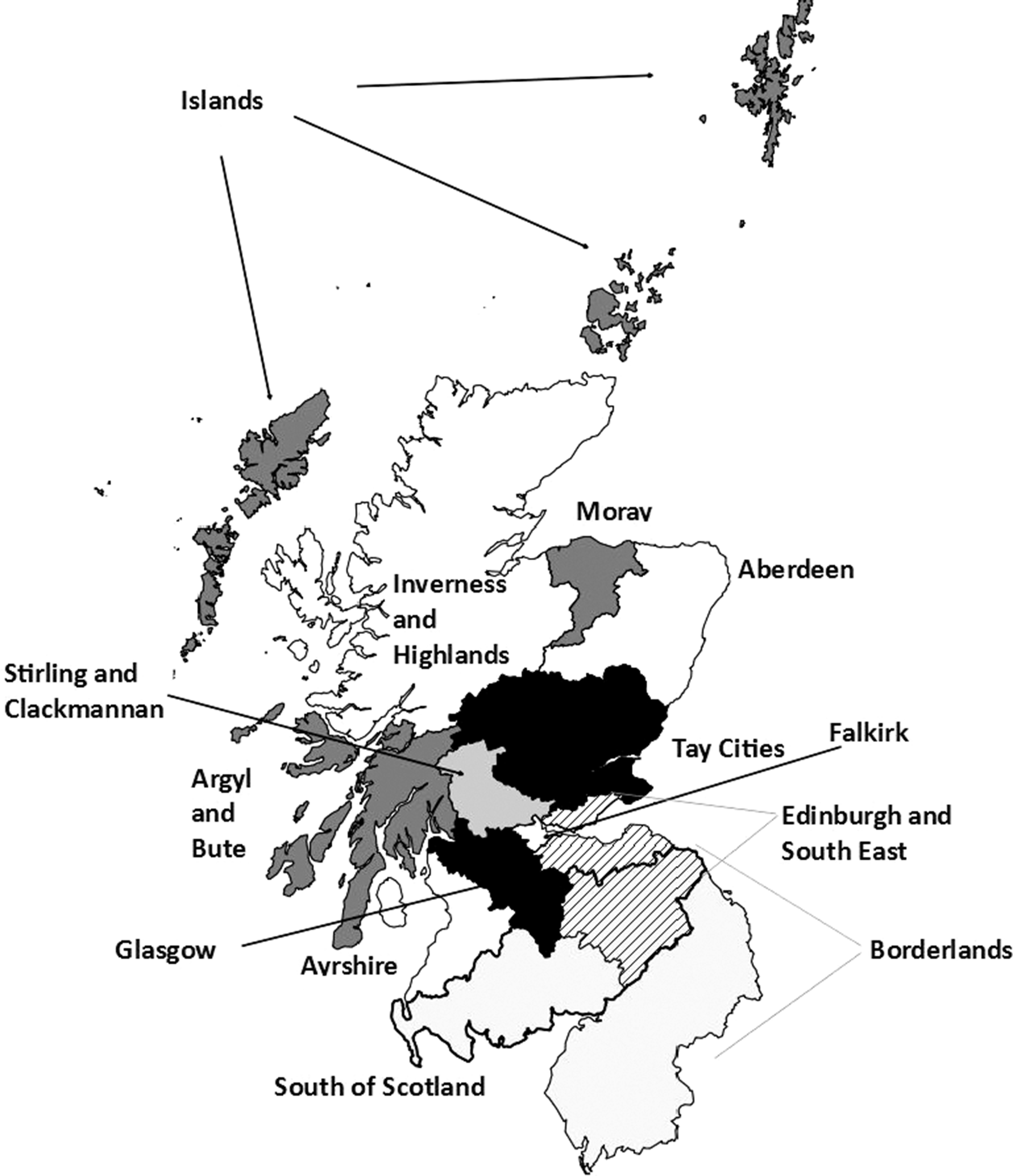
Rescaling sub-national economic governance in Scotland: Drivers and tensions
This ongoing episode of rescaling – the re-emergence of the ‘regional’ as the scale for governing economic development in Scotland – can be seen as emerging from the interplay of local, national (Scottish) and external (United Kingdom) mechanisms. The key process in this regard has been the extension of the UK Government’s programme of City Deals to Scotland, beginning with Glasgow in 2014. This was at least partly influenced by the looming referendum on Scottish independence, opposed by both the Conservative UK Government and the Labour Party who controlled (either outright or in coalition) all of the local authorities constituting the Glasgow City Region. This also aligned with well-established Scottish policy narratives that emphasise the central role of cities in driving economic growth and has been embraced by local authorities in other areas who have seen their access to resources reduced through austerity.
The emergence of this particular set of geographies is likewise the product of both ‘bottom up’ and ‘top down’ processes. The deal ‘regions’ are self-assembled coalitions of local authorities who have been successful in drawing down resources from higher scales. These groupings however have longer histories, sometimes with origins in centrally mandated strategic planning arrangements (see Table 1). The eight local authorities in the Glasgow City Region, for example, are the same eight designated as a Structure Plan area by the Scottish Secretary in 1995 following the abolition of Strathclyde Regional Council. Similarly the division of Fife between the Edinburgh and Tay Cities regions can be traced back to the strategic planning regions established in 2008. In the South of Scotland, collaboration between the two local authorities originated in the administration of European funding (Atterton and Steiner, 2014).
Evolution of Scottish City Regions, 1974–2018.

aCity region boundaries are expressed in terms of current unitary local authority areas. From 1974 to 1995 a system of district councils existed below the regional council level; these did not necessarily correspond with the unitary authorities established in 1995.
bExcluding parts of these LAs that fall within National Park boundaries; National Park Authorities are the planning authorities for these areas.
As in England, therefore, the emerging patchwork of Scottish economic ‘regions’ has been shaped by pre-existing groups of local authorities responding to the opportunities presented by the potential for City Region Deals, in much the same way that many of the successful early LEP proposals were continuations of earlier upper-tier local authority areas or existing multi-area arrangements (Pugalis and Townsend, 2013; Townsend, 2012). In practice, these geographies are the result of ‘realpolitik’ (Rees and Lord, 2013) as opposed to a systematic assessment of the country’s ‘functional economic areas’ – although some existing strategic planning boundaries were influenced by this type of work (Derek Halden Consultancy, 2002) – or of the needs of different places. While the desirability of governance arrangements aligned with functional regional economies has not been as prominent in the recent moves towards Deals and REPs in Scotland compared to, for example, in the UK Government’s abolition of RDAs in favour of smaller LEPs (HM Government, 2010), there is nevertheless allusion to this logic in several earlier strategic documents (e.g. Scottish Government, 2015, 2016a).
This raises questions about the economic logic behind structuring the new regional arrangements around ‘cities’ in the Scottish context. Glasgow and Edinburgh are clearly major conurbations, significantly underbounded (especially in Glasgow’s case) by their local authority areas, although the extent to which the current city-regions align with their functional areas may be open to question. Likewise Aberdeen is a substantial city, and centre of agglomeration in the energy sector, and Dundee’s travel to work area also extends beyond the city’s local authority boundaries. Beyond these four main cities however, are settlements such as Stirling (with a population of 36,500, awarded ceremonial city status in 2002). While the extensive literature on city-regions provides little clarity on the scales at which the agglomeration and other processes making them ‘drivers of growth’ might be expected to operate at, the logic of a focus on cities begins to look less convincing when the urban centres are of such limited size, and any distinction between ‘city-regions’ and simply ‘regions’ begins to break down. This is reinforced by, for example, the hybrid nature of the Inverness and Highland deal, with some projects specifically focused on the development and growth of Inverness and its immediate hinterland while others cover the wider Highland region. Likewise the proposed extension of deals to all parts of Scotland, the indication that there will be no fundamental difference in principle between City Region and non-city Growth Deals, and the opacity of the criteria and processes for supporting projects, taken together suggest a fundamental lack of clarity about the aims, rationales and justifications for distributing resources on this basis.
The rise of the city-region in academic and policy discourse also raises questions about the place of the rural in this framework. Proponents of city-region approaches have been accused of regarding these hinterlands as simply servicing urban areas and overlooking the distinct types of assets that these places possess (Bryden and Refsgaard, 2008). This conception of cities as the ‘locomotives’ of growth and competitiveness, and rural areas as the ‘carriages’ pulled along behind (Shucksmith, 2008), can, along with political pressures, risk the adoption of ‘city-first’ approaches in practice (Harrison and Heley, 2015). The establishment of a development agency for the South of Scotland can be seen as a recognition of a need to consider alternative models of development for rural regions, the importance of appropriate governance arrangements and of institutional thickness (Amin and Thrift, 1995) as a basis for place-based development.
There is evidence that the metro-centric premises and discourses deployed in support of City Region Deals (Waite et al., 2018) have been contested. For example, Falkirk is a small local authority area in central Scotland, bordered by four city-regions – probably having closest links with Edinburgh, but previously part of Central region with Stirling and Clackmannanshire – but local actors have sought to remain aloof from these developments, seeing this as preferable to being on the fringes of a city-centric approach. In evidence to a Scottish Parliament (2017: col 16–17) inquiry into city deals, Falkirk’s head of economic development clearly stated their position: ‘We are not bound—we do not want to be—by any particular structure, such as city deals, nor do we want to be aligned to any particular city. We see ourselves as playing a national role’
On the other hand, the potentially competitive aspect of the city-region approach is articulated by the director of the prospective Ayrshire Growth Deal: The more investment that happens in or close to the centre of Glasgow, the more likely it is to suck up demand in the Scottish economy. That will make it even harder for areas such as Ayrshire to achieve their potential, and that is one of our concerns. (Scottish Parliament, 2017: col 11)
This episode of filling in at the regional level must also be viewed in the context of austerity and its impact on local authorities. Although, mediated by the devolution settlement, the impact on Scottish local authority funding has been less severe than experienced by their English counterparts (Hastings et al., 2015), revenue funding from the Scottish Government to LAs (which constitutes over 60% of their income) has fallen by 7.6% in real terms since 2010, in the face of inflationary pressures, growing demand for some services, and the costs to LAs of delivering policies set at a Scottish or UK level (Accounts Commission, 2017). Authorities have adopted a range of responses to these financial pressures, including retrenchment (Hastings et al., 2015). As a non-statutory function, economic development activity is perhaps particularly vulnerable in this regard and there is evidence for sustained downward trend in aggregate expenditure and staffing in economic development by local authorities (Improvement Service, 2018). The local impacts of reductions in public spending have tended to be seen through the lens of ‘austerity urbanism’ (Peck, 2012) that sees cities as a key site for the processes of fiscal retrenchment to play out, based on their disproportionate levels of public sector expenditure and employment and concentrations of deprived populations reliant on state support and welfare programmes. In Scotland however, there are indications that austerity – at least through the mechanism of local authority budgets – has led to some rural areas experiencing among the greatest per capita reductions in spending (Gray and Barford, 2018; Hastings et al., 2015). This points towards austerity as a de facto ‘hollowing out’ of the local scale, with the likelihood that the potential capacity of local authorities themselves to exercise agency in shaping their local economies is significantly diminished, particularly outside the cities.
There are therefore a number of convergent and competing processes at work in these evolving arrangements that raise serious questions about the potential impacts of the latest round of restructuring governance. Since devolution, there has been a tendency to focus on aggregate national indicators of economic performance, with less attention paid to Scotland’s diverse economic geography (Sutherland, 2016). While it is difficult to assess the impacts of institutional or policy frameworks on outcomes, there are indications that some areas where centrally determined policies or priorities were less appropriate – perhaps most notably the largely rural South of Scotland – may not have been well served. The establishment of a dedicated enterprise agency for the South, and the creation of formal regional partnership structures, can therefore be welcomed as an overdue move towards a more place-based approach that recognises differing circumstances. There is however a fundamental tension in the apparent pursuit of regional equity through the creation of regional partnerships whose role is to compete for central resources through deals and to influence the activities of national agencies in their areas. As Waite et al. (2018: 85) put it ‘If bidding for funding to higher orders of government is the form through which regional and urban policy is destined to take’, then those representing these new regions ‘will need to learn to play the game’. The leadership and political capacities of actors in different places to effectively do this are likely to be highly divergent, particularly given the wide variation in size between the emergent geographies, based around partnerships of willing local authorities rather than any evidence-based or explicit logic. The extent to which this approach risks further economic divergence within Scotland will depend on the weight placed on reducing these disparities by the Scottish and UK Governments, who will, after all, still control the allocation of resources. At the same time the rescaling from the ‘local’ to the ‘regional’ as spaces of governance, based on multi-scalar partnerships, raises questions of accountability – as decisions on economic development priorities become further removed from mechanisms of local democratic representation – particularly given the opacity of the deal-making processes so far.
Conclusions
This paper has attempted to shed some light on the evolution of sub-national economic governance in Scotland, an ongoing process of rescaling that has hitherto been somewhat under-analysed in comparison with the more high-profile changes in England. The developments described here can be seen broadly as a particular manifestation of a search for the ‘missing middle’ (Harding, 2000; Shaw and Greenhalgh, 2010) – for a level of regional strategic governance between fragmented local government and the ‘national’ as an appropriate scale of intervention – and as the latest swing of the pendulum between different approaches, driven and justified by the failure of previous rounds of restructuring (Jones, 2019). As such it has some features in common with other examples of state rescaling. However, there are also some distinctive features that may be useful in understanding the processes driving such changes.
First, the story set out here points towards the role of dominant understandings and discourses of economic development in shaping governance arrangements as well as particular interventions. The emergence of city-regional deals as the preferred model for sub-national economic development can be seen as the culmination of a view of growth being driven by cities that has been percolating through Scottish policy thinking for 15 years at least, influenced by the international popularity of this concept. This is now, however, coming into conflict with a growing emphasis on growth that is ‘inclusive’ (including in a spatial sense) and a concern for some degree of inter-regional equity, apparently driven by a change of political leadership in the ruling party, in contrast with a previous focus on aggregate national indicators.
Second, and related to this, the emerging system has resulted from the alignment of and tensions between the priorities of actors at different scales. It has been driven by top down processes in that, as in England, the catalyst for this has been the programme of deal-making instigated by the UK Government, which itself draws attention to the role of (electoral) politics as the looming Scottish independence referendum is likely to have been a factor in this. This is complicated, however, by the existence of devolved government – as in Wales, these deals are tripartite relationships between groups of local, devolved and ‘national’ actors (Beel et al., 2018; Waite and Morgan, 2018) in a multi-scalar governance system of growing complexity. At the same time, there is a ‘bottom-up’ aspect to these arrangements as the Scottish and UK Governments appear to have adopted a laissez-faire approach to the formation of the new city- and non-city regions that are the basis for the unfolding set of deals. While this framework for the governance of regional economic development is clearly, to use Harrison’s (2008) formulation, ‘centrally orchestrated’, local authorities have had the opportunity to exercise agency in the creation of these new geographies through their participation (or non-participation) in deal coalitions. Through the proposed system of REPs, there is the prospect that these soft spaces (Haughton and Allmendinger, 2008) of multi-scalar governance are now being solidified into something more permanent, as the Scottish Government attempts to exert some control over the emergent system.
Third, this also acts to highlight the evolutionary and path-dependent nature of regional governance arrangements. While a conception of city-regions as the ideal scale for strategic economic development rests on some notion that they are likely to be functional economic areas, the processes by which these cohere as spaces of governance appear to be strongly influenced by historical relationships and collaborations between existing administrative areas as opposed to any systematic analysis of Scotland’s economic geographies or causes of regional disparities in performance. The shape of these new geographies has potential implications, particularly through shaping the prioritisation of particular investments in infrastructure, for the spatial patterns of future development. While local actors clearly have the ability to exercise some degree of agency in the formation of these new regional spaces, any exploration of this would need to consider the ways in which a succession of overlapping governance arrangements – local authority reorganisation, strategic planning areas, multi-authority collaborations – have been formed and resisted over time.
Footnotes
Declaration of Conflicting Interests
The author(s) declared no potential conflicts of interest with respect to the research, authorship, and/or publication of this article.
Funding
The author(s) received no financial support for the research, authorship, and/or publication of this article.
