




Abstract
Although rebalancing the UK economy has long been a focus of UK governments, this has recently used the rhetoric of ‘levelling up’. Amongst other policy instruments, the UK’s Modern Industrial Strategy has been an indicator of the core economic priority areas, with selected local areas also invited to produce their own local industrial strategies to provide a more nuanced delivery of those goals. This article considers the economic profile of five of the Combined Authority areas tasked with delivering the first of these local industrial strategies. By examining the profile of educational attainment, and the core sectors, it examines how well equipped they are to capitalise on these key growth sectors. The article finds that in many cases, the combined authorities have sectors which are comparatively under-represented in terms of the national economy, and have a population which is broadly ill-equipped to access job opportunities in those sectors.
Introduction
Recent years have seen rising attention in different parts of the world to the territorial dimensions and distribution of social and economic advantage and disadvantage. In states including the USA, France and the UK this has permeated political discourses, for example, through references to ‘haves and have nots’. The spatial distribution and extent of those groups is to some extent contested – for example, in the UK, whilst McCann (2016) recognises a growth gap which demonstrates a broad ‘North-Divide’, others such as Dorling and Thomas (2004) argue that the fruits of economic success remain concentrated in the core cities – leading to what Veltz (1996) dubbed an ‘archipelago economy’ in which areas in between the city-islands of growth are cast aside in ‘seas’ of despair. In time, this has led to the establishment in the popular conscience of a ‘Left Behind Britain’ (Sykes, 2018), as a powerful spatial imaginary (Davoudi et al., 2018; Nurse and Sykes, 2019). Whilst as a reality ‘on the ground’, the conditions captured by the notion of ‘Left Behind Britain’ are not particularly new, and have evolved over several decades, it was catapulted to prominence in the popular conscience as commentators, pundits, politicians and academics alike all sought to make sense of the UK’s decision to leave the European Union in 2016.
The 2010s witnessed similar experiences in the USA following the election of Donald Trump to the US Presidency against broader expectations and the rise of populist movements of contestation in places like France (Delpirou, 2018). Here there are no shortage of explainers. This includes the rise of a national populism (Eatwell and Goodwin, 2018) which expresses a frustration about immigration, and arguments which see this as the perhaps inevitable end product of a globalising world (Sturzaker and Nurse, 2020). Others, see the phenomenon as being exacerbated by an overt focus on the cities as the focus of urban regeneration agendas (Centre for Towns, 2017; Jones and Evans, 2013; Tallon, 2013) to the expense of towns and smaller urban places. Overarching those themes is what some have perceived as a broader political contempt for the residents of those towns – beginning with the Blair government in the mid-2000s which, viewing them as ‘safe’ seats, abandoned the concerns and interests of traditional Labour voters in smaller places in the pursuit of Blair’s ‘Third Way’; and accelerating throughout the 2010s as persistent voter rejections of top-down government initiatives were roundly ignored (Sturzaker and Nurse, 2020). Elsewhere (Nurse and Sykes, 2019) we have argued that there is at least some credence in many of the arguments and tropes which have emerged as explainers of this reality – however all carry some inherent flaws. Thus, the truth is likely to be a complicated mix of these things, requiring nuanced accounts.
Since 2010, accompanied by a rhetoric informed by the context above, the UK’s Conservative led, or dominated, administrations – under various Prime Ministers – have attempted to intervene at the national, city-regional and city scales at various times. For much of this period, the Government’s focus has been on functional economic areas (Department for Communities and Local Government (DCLG), 2010), which replaced the larger Government Office Regions first through Local Enterprise Partnerships (LEPs) and subsequently, in some areas, Combined Authorities. The newly minted LEPs in particular were to be business-led and provide an economic development angle for their areas – helping to define what economic priorities should be. The pivot towards Combined Authorities from the mid-2010s onward was also to form a central plank of the Government’s Northern Powerhouse and Midlands Engine agendas (Sturzaker and Nurse, 2020) which were conceived as a vehicle to foster the rebalancing of national growth away from London towards the places identified by Dorling and Thomas (2004), McCann (2016) and others.
Across this period, and reflecting the rhetoric of devolution and localism which underpinned the Coalition-era (2010–2015) reforms, the LEPs and Combined Authorities were largely left to define the terms of their economic growth. Indeed, as an indicator of this, the Devolution Deals signed by the leaders of each Combined Authority each specified economic priority areas which ostensibly reflected pre-existing local economic strategies.
Although successive budgets set out priority areas for the national economy, the first real articulation of a prolonged national economic strategy came through the Industrial Strategy launched in 2017 (HM Government, 2017). This strategy promised in its own words to ‘put the United Kingdom at the forefront of the industries of the future’ (HM Government, 2017: 32) by approaching four Grand Challenges, namely: Artificial Intelligence and Data, Clean Growth, Mobility, and the Ageing Society. Upon its launch the Industrial Strategy had a clear spatial articulation, recognising the growth gaps identified by McCann (2016), whilst also rhetorically recommitting to the Northern Powerhouse – something which had perhaps been in question following the ousting of former Chancellor of the Exchequer George Osborne in 2016. The National Industrial Strategy also introduced a number of other instruments into the policy lexicon including the Transforming Cities fund and Local Industrial Strategies (LISs).
In the first instance, LISs were to be delivered at the Combined Authority scale with LEPs also able to bring forward ‘long-term plans based on clear evidence … aligned to the national modern Industrial Strategy’ (HM Government, 2017: 220). Here the underpinning goal would be to capitalise on local strengths to feed into the national strategy. Like many of the preceding reforms of the 2010s (Sturzaker and Nurse, 2020), the uptake of the LIS was piecemeal, and reflected a mixture of economic strength and ambition in bringing forward strategies. However, with the first LIS published in March 2019, there remain a number of open questions about their utility.
Whilst the aims of the National Industrial Strategy seek to engage with major international growth sectors, there remain fundamental questions with how they connect with those areas of the deprived or ‘Left Behind Britain’. In this article therefore, we ask: How compatible are those places and their workforces which these new growth sectors? To what extent are the aims of the Modern Industrial Strategy (MIS) and its implementation through LISs either a place-based or place-blind approach? Thus, to what extent might these new industrial strategies represent any form of socio-economic salvation? To achieve this, the article now discusses how sub-national development policy has developed in recent years whilst also introducing the place-based and blind concepts.
Shifting ideas about place-based development policy
The policy challenges dealt with throughout this article are not new, nor exclusive to the UK. Indeed the period since the 1940s has seen an ongoing evolution in ideas about how regional development can be fostered through state policy.
The high-water mark of mid-20 century spatial-Keynesianism – termed in French les Trente Glorieuses (Desjardins, 2018; roughly 1945–1975) – was typified in many countries by an active regional policy supported by substantial resources from the central state. Interrelated policy goals typically included the aspiration to deliver infrastructure and rebalance economic activity across the national territory, develop clusters and poles to promote economic development and industrial modernisation, raise living standards in less developed regions, and to mitigate migration flows to certain rapidly expanding areas.
From the 1970s onwards, economic restructuring and the series of events which ushered in the post-Fordist period, led to a reduced appetite for a redistributive form of regional policy (Bachtler and Yuill, 2001). This decline resulted in the reality, and ultimate recognition in the mid-1980s, of an ‘urban crisis’ (Couch et al., 2011), and in many countries also led to a shift towards urban policy.
Often this urban policy reflected the ideological shifts of the time – notably a reduced role for the state alongside less intervention in the operation of markets and thus contrasted with the underlying analytical and normative premises of regional policy as it had been previously practiced. With most state spatial policy refocused to address ‘urban problems’, and accelerated in the wake of economic turbulence, mass unemployment and urban unrest in the early to mid-1980s, regional policy at a more strategic and visionary spatial and temporal scale was in retreat. Instead, thinking at the regional scale became mainly concerned with ‘emergency’ interventions, leading Desjardins (2017: 66) to speak of ‘L’aménageur comme pompier’ (the regional planner as ‘firefighter’). Often, this approach went hand-in-hand with a spatialised form of market fatalism which assumed that ‘place-based’ policy and programmes were likely to be palliative at best, and at worst divert state resources from places where they could most effectively support productivity or address market failure.
During this period European regional policy was emerging. The first Commissioner for Regional Policy, George Thomson (1973), who oversaw the production of the Report on the Regional Problems in the Enlarged Community, made a ‘moral, environmental and economic case for a Community regional policy’ which ultimately led to the establishment of the European Regional Development Fund in 1975 to respond to such issues. Importantly, arriving just prior to the neoliberal ascendency and rise of the ‘New Right’ in the UK, this provided sustenance throughout the 1980s for the idea of regional policy, notably after 1989 with European regional policy’s financial support.
During this period there was also an ongoing debate between those advocating ‘place-blind’ or ‘place-based’ approaches to state development policy and how best to achieve the rebalancing, or ‘levelling up’ (Tomaney and Pike, 2020), of economies such as the UK’s.
The place-blind school argued that uneven growth and development is a natural phenomenon and that different places experience different growth trajectories (Gill, 2010). What is needed therefore is the provision of ‘spatially-blind improvements in the basic institutions of law and order, regulation of land, labour and property markets, macroeconomic stability and the provision of basic services such as education and health’ (O'Brien et al., 2015). Here, attempts to meddle in the natural functioning of markets and uneven patterns of growth are considered likely to be counterproductive and have effects such as encouraging poor people to remain in poor areas (Glaeser and Gottlieb, 2008), and of increasing economic activity in less productive regions (Glaeser, 2008). By contrast the place-based approach emphasises the importance of the attributes of places in accounting for growth and capital accumulation. Here, the argument is that ‘economic and social behaviours are fundamentally embedded in place, and as such are subject to local economic, social, cultural and institutional contexts’ (O'Brien et al., 2015: 78). In other words, local context matters, and therefore the same application of policy can have markedly different outcomes (McCann and Rodríguez-Pose, 2011).
Reports published by the Organisation for Economic Co-operation and Development (OECD, 2009a, 2009b) and the European Commission (Barca, 2009) advocated place-based approaches to development, and a ‘new paradigm’ (Bachtler, 2010) of regional policy emerged concerned with both equity and efficiency while addressing socio-cultural as well as economic factors. Crucially in contrast with earlier models, the goal is not regional convergence achieved through redistributive regional policy, but the fulfilment of regional potentials for growth, by encouraging opportunity rather than addressing disadvantage (OECD, 2009a).
A key dimension of this thinking is the emphasis on endogenous assets rather than exogenous investments (OECD, 2009a) and a focus on designing institutions at ‘the right scale’ to promote the governance and stakeholder capacity necessary to unlock the ‘territorial potential’ of places (Bachtler, 2010; CEC, C. O. T. E. C., 2008). Yet, as some argue can be seen from the implementation of these ideas at the European scale, pursuing such ambitions within a limited number of sectoral objectives (i.e. such as those in the UK’s national industrial strategy) can risk removing the necessary freedom to tailor interventions to local context which is key to models of place-based development (Fothergill et al., 2019; Mendez, 2013).
Ultimately, this reflects the tensions which can arise between place-blind sectoral policies for industry and innovation which nonetheless have a spatial impact and manifestation, and place-based approaches per se which see industrial activity and innovation capacities as arising for endogenous attributes of place (an issue to be returned to below). The following section now explores how this thinking permeates the recent trajectory of sub-national economic development policy in England.
Recent regional and local development in England – Mirroring shifting paradigms of place-based development
The shifts in conceptualisation and practice outlined above are well-represented by processes of institution building and rescaling in England since the 1990s.
From 1997, the incoming New Labour government, in-keeping with its ‘third way’ philosophy, sought to address issues of interregional disparities and equity. This work attempted to address geographically uneven growth, and a competitiveness agenda which encouraged endogenous growth in the face of globalisation. The Regional Development Agencies (RDAs) established in 1998 were consistent with the ‘new paradigm’ (Bachtler, 2001) of regional policy, pursuing a strategic approach adapted to the needs and advantages of each region. This approach did not address specified sectors solely in those regions most in need. Instead every region in England was given an RDA, each tasked with working on its own place relevant sectoral priorities. This was not a sector-based industrial policy but rather a place-based approach which considered ‘the region as a space in and of itself, whose economic conditions respond to its capabilities, in terms of its skills base, industry clusters and innovative capacity’ (Sykes and O’Brien, 2018: 10).
Though the RDAs were abolished in 2010, the philosophy of the new place-based approach endured. For example, Michael Heseltine’s (2012) report for the Coalition government – No Stone Unturned in Pursuit of Growth – which went on to inform sub-national policy thinking, noted that: For the UK to face up to the challenge of increasing international competition, we must reverse the long trend to centralism.
However, more recently the reassertion of the UK ‘national’ scale in the aftermath of the UK’s EU referendum of 2016 has introduced new factors and contexts which interpolate notions and practices of place-based development. For instance, we can observe how the need for ‘Brexit’ to be presented as a success economically has been largely expressed at the state-wide scale of the UK with less attention given to the predicted regional distribution of its losses. Indeed, many of the English city-regional mayors have publicly criticised their exclusion from discussions which may adversely affect their areas (Blake, 2018).
Nonetheless, much of the architecture for place-based territorial development (e.g. LEPs, Combined Authorities in some areas, and initiatives like the Northern Powerhouse) remain intact at present. Importantly, however, henceforth they will have to co-evolve and co-exist with new initiatives such as the UK Modern Industrial Strategy (HM Government, 2017) which effectively sets out the UK’s economic priority areas in the period following its departure from the EU. Building upon an interest in specific sectors which can be traced across the Conservative’s tenure (Berry, 2020), the MIS identifies ‘Grand Challenges’ around ‘Artificial Intelligence and data; ageing society; clean growth; future of mobility’ (HM Government, 2017). These sectors are, by the Government’s own admission, selected to capture the ‘high-paid, high-skilled jobs of the future’ (HM Government, 2017: 5). Importantly, however, not all places may be able to benefit from and contribute to their pursuit (Fothergill et al., 2019), and in commenting on the draft Industrial Strategy, the Commons Select Committee on Business, Energy and Industrial Strategy recommended that ‘the Government steps back from its current trajectory of focussing on sectoral “deals” which risk a return to the discredited credo of “picking winners”’ (Business Energy and Industrial Strategy Committee, 2017). It has been similarly noted by observers that the place-based component of the final Industrial Strategy: Building a Britain Fit for the Future (IS) White Paper has been whittled down in comparison with the draft Green Paper.
In promoting potential growth sectors at the national scale, the Modern Industrial Strategy is largely place-blind in nature. Reflecting this, groups such as the Industrial Communities Alliance (2017: 7) have stated that ‘an industrial strategy is welcome and should be of benefit to older industrial areas, where much of what remains of UK manufacturing is still located’. However, they also argue that ‘it would be wrong to assume that industrial strategy is a substitute for regional policy’ and ultimately, support the argument that a place-blind approach could end-up inadvertently reinforcing existing patterns of uneven development.
The place-blind nature of the MIS is both a sensitive and potentially problematic issue, not least given the prevalence of narratives about ‘left behind regions’ or ‘places that don’t matter’ (Nurse and Sykes, 2019; Rodriguez-Pose, 2017; Sykes, 2018). It comes as the implications of the UK’s withdrawal from the EU, and as the funding allocations and priorities of post-2020 EU Cohesion Policy become clearer, and UK territories will become completely dependent on whatever decisions the British state makes. Importantly, it also jars with the ‘levelling up’ agenda instigated by Johnson upon his ascent to power in 2019. This agenda, whilst arguably a re-badging or reimagining of many of the Conservative reforms of the 2010s, hinted at a shift away from the swinging cuts to local government budgets which characterised the 2010–2020 period (Centre for Cities, 2019), and instead ostensibly advocates a distinctly place-based approach to bring greater government spending to bear in the regions away from London (Walker, 2019).
As a means to bolster any place-based element of the MIS, a number of English sub-regional areas have been tasked with producing LISs. This is characteristic of the post-2010 Conservative reforms in that the opportunity is limited at first (i.e. to the major cities before being expanded to the country at large). In launching the call for LISs, the Business Secretary Greg Clark said: We know that growth does not happen in the abstract, it happens in the cities, towns and counties of our country, all with their own unique strengths and heritage. Local Modern Industrial Strategies, designed by local businesses and people, will capture the strengths and opportunities of an area and provide the long-term plan for how we ensure we seize those opportunities. (Clark, 2018)
There are also potential disparities in the expectation that ‘places should harness the expertise of universities, independent experts, the civil society sector and other stakeholders to develop a granular understanding of the local economy’ (HM Government, 2018: 8) and to identify areas of strength and weakness – in itself an indicator of place-based thinking. However, this presumes that all places are equally equipped with such capacity, and overlooks rural communities in particular – even when such places are in-fact unique contributors to some of the growth areas identified in the MIS (Phillipson and Turner, 2019).
Overall the underlying ‘theory’ of LISs thus aligns closely with that of the ‘new paradigm’ (Bachtler, 2001) of regional policy outlined earlier in this article. Though there is an acknowledgement that some places may be better placed, or more ‘equal’, than others to respond to the ‘Grand Challenges’, the expectation that local areas must nonetheless align with the national ‘Industrial Strategy’ may potentially constrain the capacity to tailor interventions to local context which is key to models of place-based development.
Informed by the context and themes outlined above, the rest of this article reviews some of the areas in England preparing LISs. In doing so, it analyses some of the socio-economic characteristics of these areas to consider how far the broad MIS thematic priorities can be considered to align with ‘their own unique strengths and heritage’ as suggested by a review of relevant available statistical evidence.
Methods
To examine the extent to which the UK government’s approach to industrial strategy is place-based we will consider the state of the industrial composition in some of the places which are preparing, or capable of preparing such strategies. Specifically, we will focus on the original Six Mayoral Combined Authorities (Cambridgeshire and Peterborough, Greater Manchester, Liverpool City Region, Tees Valley, West of England and West Midlands) which are named in the National Industrial Strategy as having a specific competence to compile a LIS. Of those, three (Cambridge and Peterborough, Greater Manchester and West Midlands) are part of the first round of ‘trailblazer’ LISs whilst at the time of writing, others including the Liverpool City Region also have LISs under preparation.
The six Mayoral Combined Authorities allow us to explore a number of issues raised through the discussion above. Covering population of 7.3 million people, there are a variety of spatial realities which can be observed, and which allows for a reflection on the nature and purpose of the industrial strategies. This includes core cities and smaller towns, areas from England’s north and south, relative prosperity and poverty (e.g. Liverpool and Manchester contain some of the most persistently deprived areas of the country (Parkinson, 2019)). Though there are some instances of comparative rurality, we acknowledge there is an urban bias in this selection, but would argue that this is a reflection of the urban bias inherent in the Government’s post-2010 devolution agenda at large (Sturzaker and Nurse, 2020).
The selected Mayoral Combined Authorities also allow us to reflect on how the MIS and LISs respond to the ‘Left Behind Britain’ which sits at the heart of the UK Government’s levelling up agenda and which emerged, if not entirely unproblematically (Nurse and Sykes, 2019), in the aftermath of the 2016 EU referendum. For example, two of the combined authorities (Greater Manchester, West Midlands) hold parliamentary constituencies which comprised part of the Labour Party’s mythical electoral ‘Red Wall’ – where the collapse of electoral support for the party led to a landslide defeat in the 2019 General Election. Going further, Tees Valley Combined Authority is perhaps even more emblematic of these views where, to the surprise of many at the time, the Conservative Ben Houtchen won election for Metro-Mayor in 2017 (Sturzaker and Nurse, 2020) – something now recognised as prefiguring the broader electoral collapse in the 2019 General Election.
Acknowledging these debates, below we consider the performance of each individual district within the selected combined authorities. This reflects the range of economic conditions which can exist within a broader combined authority construct – from economic strength, to the situation in others which might be characterised as parts of ‘Left Behind Britain’.
To explore what the national and LISs might mean for those places, we consider their performance against two core datasets – education levels and sector composition. To consider the education levels of those places we analyse Qualifications and Students (table KS501EW) from the 2011 Census (Nomis, 2011), and discuss the percentages of population who have attained a level 4 (i.e. university level) qualification, or none at all. As we will see, in all cases these two are the largest individual classifications, and moreover serve as a proxy to consider the proportion of the population who might be able to access certain sectors of the economy – not least those promoted through the industrial strategy.
In analysing sector composition we firstly discuss the sectors which are explicitly or implicitly identified as covering/supporting the growth areas in the national industrial strategy discussed earlier. Specifically, this includes manufacturing, IT and Communication, and Professional and Scientific and Technical and Health. Secondly, we also include a number of other ‘core’ sectors namely: retail, business administration and support, and education. Health is also included as a core sector, though we acknowledge the crossover benefits with sections of the MIS. To achieve this, we use the sector compositions from the 2018 Business Register – the latest available at the time of writing. Although the rounded numbers of the Business Register provide less fine-detail when compared to the 2011 Census, using this data as an alternative provides two main benefits. Alongside being more up-to-date, and therefore providing a more recent reflection of the economic reality of those places, the business register also provides a greater breakdown of some core sectors. In particular ‘retail’ is disaggregated into three sectors, compared to one in the 2011 census, and thus provides a better vehicle for analysis of the overall dominant sectors in each district. For sector composition we not only examine the relative sector size within each district, but we also consider the Location Quotient. This allows us to consider not only whether a sector is particularly large or small within a local context, but also the extent to which it is large or small in the context of national sector-performance. Although we find similarities between the two, they are not always the same.
Our analysis takes these two datasets in tandem along two premises. The first is to consider the extent to which the industries and sectors being prioritised in national and LISs are locally accessible to the people living in those areas. In short: to what extent does the MIS truly represent the ‘levelling up’ that would be recognised in traditional acts of spatial Keynesianism (Pike et al., 2016)? The second is to explore the spatial accessibility of areas to the sectors outlined in those industrial strategies – particularly at the national level. To use the words of the Commons Select Committee: has the MIS already picked winners? Here, we consider whether the national industrial strategy is actually a form of spatial selectivity (Jessop, 1990), in which, rather than levelling up, certain areas are effectively predisposed to success because of their existing industrial and educational compositions.
Education and sectoral performance in the original mayoral combined authorities
The data on education and levels of qualification (Table 1) present an image of two polarised worlds. In all areas, the highest two categories are ‘no qualifications’ and ‘level 4 and above’ (i.e. university educated). Combined, they comprise roughly 50% of the population in every area, and no other levels of qualification come close (i.e. GCSEs, A-Levels or apprenticeships, as the core exit points of the UK education system). The two categories also enjoy a near-direct relationship (r2: −0.92) – in other words, the greater the population with no qualifications, the lower the population with degree-level qualifications. Although we will return to this later, this statistic presents the first significant challenge to delivering a high-end industrial strategy across the board.
Educational attainment – 2011 census, table KS501EW (Nomis, 2011).
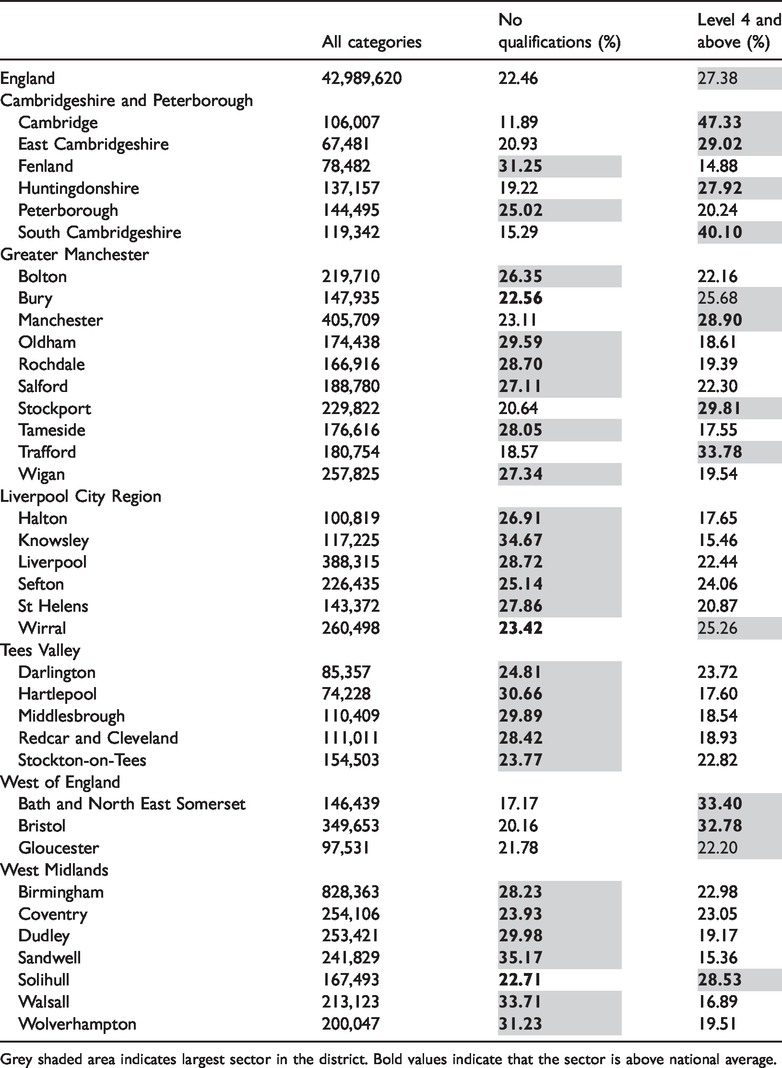
Grey shaded area indicates largest sector in the district. Bold values indicate that the sector is above national average.
In almost every combined authority district the largest of those two qualification levels (none, or degree-level) would exceed the national average – i.e. it has a greater than normal number of non-qualified residents, or degree-level qualified residents respectively. The exceptions to this are Bury, Gloucester and Wirral. There are also clear spatial elements to this data. For example, all of the districts in Tees Valley have no qualifications as the largest groups, whilst two other regions (Liverpool City Region, West Midlands) also have above-average no qualifications in all of their districts. One combined authority (West of England) finds all its districts with degree-level as the largest group. Within this data there are significant extremities. For example, in Cambridge 47.33% of people have a level 4 qualification or higher, with just 11.89% of people with no qualifications. Similarly, South Cambridge, which encompasses Cambridge, has 40.1% and 15.09% – perhaps an indicator of the housing market in Cambridge proper. At the opposite end, in Sandwell 35.17% of residents have no qualifications compared with 15.36% of residents with a degree, whilst in Fenland only 14.88% of residents are degree educated.
On its own there are limits to what this data can tell us, but it does reveal that in most of the original Mayoral Combined Authorities is a significant proportion of residents who lack qualifications. This potentially presents a significant barrier to direct employment in the high-skill industries promoted through the National Industrial Strategy. There is, of course, some potential for employment opportunities and economic benefit through unskilled jobs associated with those industries and multiplier effects in-line with the basic expectations of Keynesian interventions, though the extent of these trickle out/down effects have long been questioned and challenged (Ahiakpor, 2001; Thornton et al., 1978). It also lends some support to the idea that there might be districts where a pre-existing skills base might be more attractive to businesses in high-skilled industries (Wood and Dovey, 2015), in turn feeding the argument that the MIS leads to picking winners.
The employment figures across key sectors (Table 2) including those prioritised in the National Industrial Strategy and largest employers, alongside the location quotient (Table 3) for those sectors (i.e. how concentrated employment is in the context of the national economy) tells us even more about how adaptable these areas are to the expectations of the National Industrial Strategy.
Industrial composition (%) by selected key sectors – 2018 Business Register (Nomis, 2018).
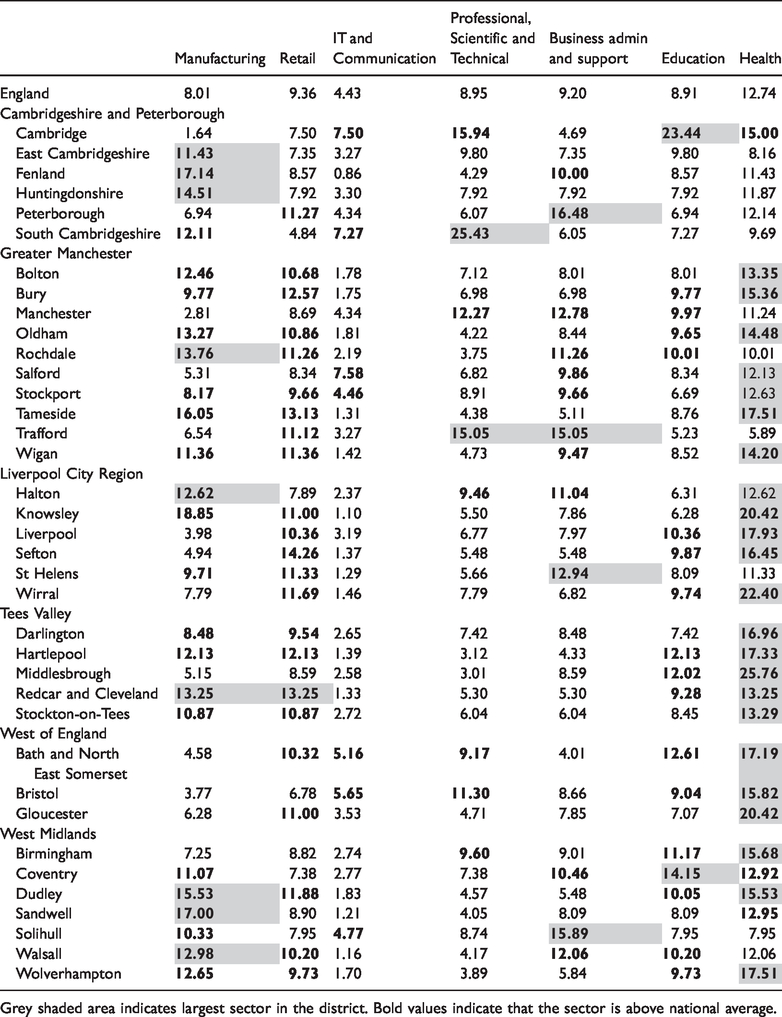
Grey shaded area indicates largest sector in the district. Bold values indicate that the sector is above national average.
Location quotient of selected key sectors – 2018 Business Register (Nomis, 2018).
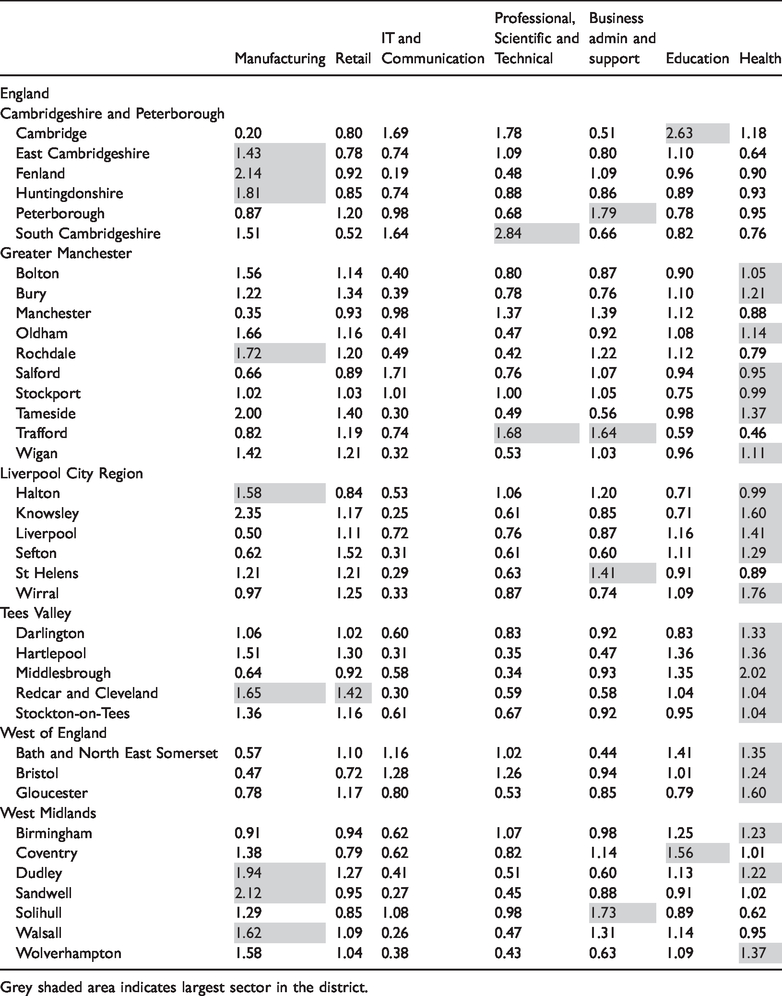
Grey shaded area indicates largest sector in the district.
Above all, we can observe that across all but one of the selected Mayoral Combined Authorities (i.e. all except Cambridgeshire and Peterborough) there is an overwhelming reliance on sectors which are not directly prioritised in the National Industrial Strategy. In particular the public sector (health and education) comprise between 20% and 25% of the workforce in most areas, rising in University towns which we will return to later. In most cases the LQ data suggests that, with some exceptions, these areas are not particularly under or over exposed compared to the national economy suggesting the vital role that these sectors play in job creation. Similarly, and reflecting the UK’s shift to a service economy, across most combined authority areas the retail sector is also dominant. When considering the entirety of Section G (retail) in the 2011 census, which combines all sectors retail is the largest sector in most areas. However, when considering the 2018 business register which disaggregates the sectors (Motor trade, wholesale and retail), the retail sector still dominates. Indeed, in Liverpool City Region, Tees Valley and West of England retail accounts for the largest private sector employer in at least half of districts. As with the public sector, there is a degree of universality here, with the LQ suggesting that no area is particularly under or over exposed to the UK economy.
When we consider the sectors which are directly prioritised through the National Industrial Strategy we can observe a number of things. The first is that whilst the digital sector is a comparatively small sector of the English economy overall, even against this backdrop it is particularly under-represented in the combined Authorities. Indeed, Cambridge and South Cambridgeshire, along with Salford are particularly strong performers, with Bath and Bristol the other authorities which are over-represented. Beyond this, the other districts perform below the national average – many markedly so. This is in line with the work of Gallent et al. (2015) who suggest that creative industries can often find succour in rural areas, even despite issues around digital connectivity (Townsend et al., 2013) and being overlooked by traditionally urban-focused agendas (Rantisi et al., 2006). Moreover, the data lend support to the work of Wood and Dovey (2015) who suggest that digital sectors often thrive around clusters. Here we would argue that in many areas, the digital sector is growing from a low base, whereas existing clusters appear evident.
Similarly, the ‘Professional, Scientific and Technical’ sector, another cornerstone of the nascent Industrial Strategy is broadly under-represented in many of the mayoral combined authorities. Although in two districts (South Cambridgeshire and Trafford) it forms the largest employment sector, at the other extreme, some districts (e.g. Middlesbrough, Hartlepool, Oldham) have professional sectors which are barely a third of the national average and are outstripped by others (e.g. South Cambridge) by a factor of 8. It is these figures which expose the spatial imbalances of the UK’s high-end sectors. Here, the Location Quotient also reveals how under and over exposed the professional sector is to the overall economy. For example, south Cambridge has a LQ of 2.84 – the highest of any sector in any district – whilst many others, particularly in Northern England have LQs of 0.3–0.4, suggesting they are weak performers at the national scale.
The main sector prioritised in the MIS which shows promise for the combined authorities is manufacturing – representing the largest sector in at least one district in all but one combined authority area. In those districts where manufacturing is the largest sector it is also particularly concentrated, with LQs between 1.5 and 2.15. However, there is also a strong manufacturing base beyond this – and in most other districts manufacturing outstrips the national performance. The exception to this is in the Cities (notably Bristol, Cambridge, Liverpool, Manchester) where manufacturing is particularly under-represented. Here Cambridge is particularly notable, with manufacturing operating at only one-fifth of the national average. Importantly, this suggests that this element of the MIS is not a city-focused agenda, and perhaps lends the most support to the ‘levelling up’ agenda which ostensibly underpins the UK Government’s current thinking.
When we consider the relationship between the proportion of residents with no qualifications or a degree level education, respectively, with each of the key sectors discussed above (Table 4) a number of issues become apparent. Before we go further, we acknowledge that there are health warnings to this data. The first is the danger of the ecological fallacy in that broader trends do not always speak to individual cases. We acknowledge this and particularly note that, for example, a person with no qualifications may work in a high-skilled industry, or vice versa. However, we argue that an analysis of the relationship between these variables is important – not least in an attempt to understand and dissect assertions that the MIS might be attempting to ‘pick winners’. In other words, can we begin to determine where places might be predisposed to success on these terms? Importantly we also acknowledge that this data may present a chicken/egg situation (i.e. which came first: the sector, or the people who work within it) which has important consequences for growing an industrial sector.
Correlation between Education level and size of Industrial sector.

In broad terms, across most of the sectors prioritised through the National Industrial Strategy the outlook for many of the districts is not particularly positive. For example, we observe a strong link between the proportion of population educated to degree level and the size of both the digital, and professional/scientific/technical sectors (r2 0.78 and 0.84, respectively), with a similarly strong negative relationship between no qualifications and the size of those sectors. Again, and particularly acknowledging arguments relating to the clustering of the digital sector (Wood and Dovey, 2015) these sectors appear to thrive in places with a high number of qualified workers – something that may be indicative of the ‘buzz’ Wood and Dovey identify. Reflecting this, given so many of the combined authority districts have a larger number of residents with no qualifications, creating the conditions to generate such a ‘buzz’ might not be straightforward. As such we can begin to ask how accessible certain elements of the Modern Industrial Strategy are to these places? Notably whether in promoting industries that are often not particularly present in their areas, the area might be unattractive to those industries, and if when the industry is present, a significant number of residents may simply not be qualified to access employment opportunities within it?
Conversely, it appears that manufacturing industry may represent the best opportunity for many districts in the combined authorities to capitalise on the priority areas of the national industrial strategy. This is reflected in the positive, albeit modest relationship between the size of the manufacturing sector and those with no qualifications. More importantly, however, and without succumbing to the ecological fallacy, it is far more likely that, much like the digital sector, manufacturing companies are likely to find a large potential employment base that is able to furnish employees able to take up roles which do not require any particular qualifications (i.e. on production lines). In line with the discussion above regarding location quotients, there are also a number of sectors where there is no real correlation between qualifications and size of the sector. In other words, they appear to be fairly uniform across all areas we studied. The most extreme example of this is the Business and Support sector – itself the largest sector in four districts – which shows that there is almost no relationship between qualification group and the strength of the sector. Similarly, the health and education sectors both have r2 values of around 0.25 – reflecting their position as the largest employers regardless of area. Finally, the retail sector suggests that there is a slight reliance on the service economy in areas where there are larger numbers of people with no qualifications. Although this relationship is not as strong as others in the professional sectors, it does lend credence to the argument that the sectors championed through the industrial strategy tend not to thrive in areas with populations which lack qualifications.
Analysis
An analysis of education levels and the strength of existing industrial sectors in the six original mayoral combined authorities suggests that there is a critical gap between the national industrial strategy, the LISs which were brought forward as a vehicle to spatialise this agenda, and the ‘levelling up’ agenda which underpins the broader stated policy ambitions of the Conservative governments of recent years. At its core, this analysis suggests there is a disjuncture between the education levels within many of the combined authority districts and the strength of the sectors promoted through industrial strategy. In short, and building upon the work of both Fothergill et al. (2019) and Tomaney and Pike (2020), we suggest that many combined authority districts are critically underequipped to capitalise on the industrial sectors prioritised through the national industrial strategy whilst a small number of others, many of which are already industrial leaders in those fields, are well positioned to capitalise on the key growth sectors.
In turn, this raises a number of issues. The first is that, of course, it is not wrong for combined authorities to want to grow or expand into an industrial sector as part of an economic strategy – even, or indeed especially, if this is from a low base. However, against the backdrop of a levelling up agenda which is sold as prioritising ‘left-behind’ communities, growth in many of those sectors would largely not be aimed at, or to the immediate benefit of, the larger numbers of their residents with no qualifications. Yes, there is the opportunity for multiplier effects, but the advancement of any trickle-out argument seemingly ignores the evidence that such approaches often don’t work (Thornton et al., 1978). There is also a ‘chicken or the egg’ element to this line of thinking – i.e. which is necessary to grow a high-end industrial sector: the graduates to work in it, or the jobs in the sector? However, whichever is the answer, our analysis suggests that in both cases combined authority districts often find themselves on the back foot. Often they lack both the sectors, and the employment base.
A second issue is that some of the growth sectors identified through the industrial strategy appear to be not necessarily urban agendas. In those cases – the most extreme being the digital (IT and Communication) sector – most combined authority districts lag well behind the national average. Whilst this may be because a small number of districts (e.g. Cambridge) vastly outperform others, even if we consider this a great number of urban districts still under-perform. In doing so, that LISs are currently specifically aimed at the Mayoral Combined Authorities also overlooks that often rural areas can be key areas of strength for creative and digital industries – often in spite of being overlooked by successive urban-focused agendas (Rantisi et al., 2006).
Combined, however, our analysis leads us to the conclusion that, given many of the original mayoral combined authorities seemingly lack either of the ingredients of the high-end sectors pursued through the national industrial strategy – namely a highly-educated workforce, or a well-performing sector – whilst other areas have both of those in abundance – the ability to conjure the endogenous growth of Bond-Smith et al. (2018), seems limited. In this, therefore, rather than the place-based approaches which might characterise some of the rhetoric behind the industrial strategy approaches, the reality is that the broader approach seems place-blind. Here, instead we can observe that combined authorities who pursue growth in the target markets of the national industrial strategy may, without an educated workforce, find their efforts stunted in the face of other places already predisposed to success. In short – it appears the winners might already be picked.
There are policy remedies which can perhaps break this cycle, not least the skills agendas pursued by many of the Metro mayors (e.g. Rotheram, 2016; Sturzaker and Nurse, 2020) but for now the limited scope of the national Modern Industrial Strategy presents a double edged sword. On one hand, it prevents some areas from focusing on their true key strengths in favour of sectors that appear highly likely to go elsewhere, and on the other, if areas pursue those sectors, it appears unlikely that it will be to the benefit of their existing residents who are often poorly-equipped to take up any resulting employment opportunities.
Conclusion
An analysis of the sectoral performance of the five original Mayoral Combined Authorities suggests that there are clear differences in the sectoral strengths of the districts within those authorities, with often strong links between sectoral composition and education levels. This, we argue, leaves the residents of some areas particularly under or over-equipped to access opportunities for work in the (often high-end) sectors prioritised through the industrial strategy. Despite its claims to focus on local priorities, we argue that the under-representation in national sector composition, alongside the inability of many (often low-educated) residents to work in those sectors means that the national industrial strategy approach is place-blind in nature. Here, and rather than encouraging the endogenous growth that capitalises on existing strengths (e.g. manufacturing) areas may feel pressured to pursue sectors they have either no current competency in, nor the qualified populace to service those industries. Similarly, other areas are already set-up for success with highly-educated workforces and sectors which thrive at the national scale.
Ultimately, there is nothing wrong with attempts to grow a sector from a small base, or to prioritise education efforts in an effort to access a particular sector. However, against the background of a ‘levelling up’ agenda which purports to address many of the concerns raised in the aftermath of the UK’s vote to leave the European Union we would question the extent to which the approach pursued through the industrial strategy is an attempt to engage with those left-behind communities, or simply business as usual.
Footnotes
Declaration of Conflicting Interests
The author(s) declared no potential conflicts of interest with respect to the research, authorship, and/or publication of this article.
Funding
The author(s) received no financial support for the research, authorship, and/or publication of this article.
