




Abstract
There has been an age old assertion that once public policies are formulated, the policies will automatically be implemented to achieve their stated objectives. To unravel this, the article through comparative empirical analysis discussed the dynamics that influenced local economic development implementation in Ghana. It emerged that four key dynamics: politics, leadership commitment and will, land tenure system and administrative, institutional and procedural mechanisms differently shaped local economic development implementation in the three local government units. Whereas these factors promoted local economic development implementation in some of the assemblies, it hindered its successful implementation in others. The findings of this article are of significance to local economic development and local governance practitioners and politicians as they strife to implement local economic development policies.
Introduction
There is a persistent myth or perhaps naïve assumption that once policies are formulated, their implementation is something utterly simple and automatic (Lane, 1993: 93). But this assumption does not hold water because policy implementation is a complex stage of the policy process involving multiple actors with several veto points making policy implementation not an easy and straightforward process and a calculated choice of appropriate techniques (Turner and Hulme, 1997: 77). In view of this complexity and multiplicity, Grindle (1980: 18) has described policy implementation as a highly political activity within the policy process because actors with vested interests in a policy engage in negotiations over the goals of the policy and conflict over the allocation of resources. The implementation phase is thus seen as an arena in which those responsible for allocating resources are engaged in political relationships among themselves and with other actors to influence the allocation of resources. The ability of an actor to influence the implementation process depends on a range of factors including the strength of interest in the policy, the numerical strength, the fiscal resources commanded, and the organisational capacity (Turner and Hulme, 1997: 77). The prevalence of politics in implementation has led Thomas and Grindle (1990: 1165) to reject the popular linear model of implementation which is related to the Whitehall myth of implementation which opines that implementation is simply about doing what has already been decided. Failure to implement is interpreted either as ‘a lack of political will’, the wooliest phrase in the developmental lexicon, or as weak institutional capacity (Turner and Hulme, 1997: 79).
Local economic development (LED) as a public policy is simply defined as ‘the process by which local governments, local businesses and other actors outside a locality join forces and resources to enter into new partnership arrangements with each other or other stakeholders to create new jobs and stimulate economic activities in municipalities, towns and villages’. The LED is therefore a bottom-up process which is driven by local actors using local resources to develop the economic capacity of localities to improve the economic status and the quality of life of indigenes for poverty reduction in the localities (Republic of Ghana, 2013: 1–2, 2014: 3). The argument for LED is premised on the development impasse between the centre and the periphery of states, the failure of hitherto development approaches to yield the needed dividend and the unsatisfactory outcome of structural development adjustment programmes (Nel, 2001: 1004). Geddes (2004) posited that LED attracted attention in the United Kingdom and the European Union in the 1980s as a result of the rising problems of unemployment caused by economic restructuring and the backwardness in industrial activities. From this, LED is a problem solving oriented policy because it aims at creating new employment opportunities, income generation and infrastructure aimed at improving the quality of life of people within a given territory.
A review of the literature indicates that much ink has been poured on the subject matter of LED in Ghana. However, most of the studies focused on financing LED (Agbevade, 2018a), LED strategies and challenges (Agbevade, 2018; Agbevade, 2018b; Mensah et. al. 2013a), Institutional and policy frameworks (Mensah et al., 2013b), LED and poverty reduction (Agbevade, 2020; Azunu and Mensah, 2019); LED, value chain and poverty reduction (Agbevade, 2018d), institutionalizing LED (Akudugu, 2018) conceptualizing and implementation (Akudugu and Laube, 2013). A key area of LED that has not been given prominence in literature is the dynamics that shapes the LED implementation process. It is instructive to note that a lot of LED initiatives have been rolled out, some have achieved the intended goals and others have not. This article unravels the factors responsible for the diverse implementation outcomes using three of Ghana’s local government units (LGUs) namely: the Accra Metropolitan, Keta Municipal and Shai-Osudoku District Assemblies.
The article is structured into six sections. First section is devoted to reviewing the existing literature on LED and LED implementation, second deals with the profile of the study areas. The third section discusses the methodology employed whiles the fourth section is committed to the findings and discussions and their implications for the theoretical, empirical and comparative literature. Fifth section offers recommendations for effective implementation of LED and the final section highlights some key lessons learnt with the conclusion.
Section 1: The concept of local economic development
LED as an alternative to top-down approach to development emerged from the global North during the late 1960s and the early 1970s (Blakely, 1994: 50). The adoption was attributed to factors such as development impasse, the failure of preceding development approaches and the unsatisfactory outcome of structural development adjustment programmes (Nel, 2001: 1004). On the continent of Africa, scholars such as Helmsing (2003), Nel (2001: 1004), Rodriguez-Pose and Tijmstra (2005: 3) and Yatta (2015) argued that factors including economic challenges, changes in the national and international economic environment, forced structural adjustment programmes, natural and political shocks and their outcomes namely, poverty, unemployment, a fall in industrial activities, debt crisis, colossal currency devaluation and the inability of governments to intervene at the local level culminated into the implementation of LED as a development strategy. In Ghana, the emergence of LED is attributed to the penchant of successive governments since independence to reduce poverty and to bring development to the door-step of the citizenry. This resulted in the adoption of decentralization policy with emphasis on economic decentralization and policies such as the Ghana Regional Appropriate Technology Industrial Service project, 1987, National Action Plan for Poverty Reduction, 1995, Vision 2020, 1996–2020, the Millennium Development Goals, 2000, President’s Special Initiatives on garment and textiles and agriculture (Cassava and oil palm), 2001–2007, Ghana Poverty Reduction Strategy (GPRS 1), 2003–2005, Growth and Poverty Reduction Strategy (GPRS 2), 2006–2009, the Ghana Shared Growth and Development Agenda (GSGDA I), 2010–2013, GSGDA II, 2014–2017, One District One Factory (1D1F), 2017 (Amoako-Tuffour, 2008: 4–7; Ayee, 2007: 15; Mensah et al., 2013a, 2017; Ninsin, 2007: 98). In the words of Mensah et al. (2013a: 146), although similar factors necessitated LED implementation across the globe, however, the developed and developing countries responded differently. While the former responded through heavy investment, big business support and large project development undertaken by well-resourced local agencies, the latter took the form of community-based initiatives, utilizing indigenous skills and seeking primarily to ensure survival, rather than participation in the global economy.
LED like other development terminologies defies a universally accepted definition. Scholars have defined it based on how they deployed it in their studies. However, common threads that run through all these definitions is that LED is a partnership between actors, it uses the available local resources to create new employment opportunities, generate income, provides infrastructure and has the ultimate aim of reducing poverty (Blakely, 1994: 49; The United Nations Human Settlement Programme (UN-HABITAT) and EcoPlan International Inc., 2005: 2; World Bank, 2003: 1).
From the various definitions, Agbevade (2018d: 9) gleaned six key characteristics of LED. These are: first, it is an ongoing process that involves several actors or stakeholders sometimes with competing and conflicting interests. Second, LED is participatory in nature with the involvement of all actors. However, the extent of actors involvement is contingent on its strength and resources it commands. Third, it is territorial in approach. Thus, it focuses on localities and not sectors. Fourth, it uses the available resources of a locality to drive the employment creation, income generation, infrastructure development and poverty reduction agenda of the area. Fifth, it is bottom-up in nature rather than the widely accepted top-down model of development and sixth, it is aimed at improving the quality of life of people within a locality through the economic stimulation with its resultant creation of decent jobs, income generation and poverty reduction.
Aside the main benefits of LED identified in the definitions, scholars have grouped the benefits into two outcomes which are: social and economic (Rodriguez-Pose and Tijmstra, 2005). Socially, the implementation of LED strategies has empowered local societies and generated local dialogue as the local citizens participate in decisions affecting them. The LED process also made local institutions more transparent and accountable thereby strengthening the growth and development of civil society organisations. From the economic perspective, LED strategies generated sustainable employment in enterprises more capable of enduring changes in the global economic environment and also they contributed to attaining goals of decent work.
Policy implementation and local economic development
Policy implementation can be described as the translation of a plan into action. It focuses on operationalizing the plan; that is the how, rather than the what. Implementation also means the delivery of a specific programme or the purposeful set of activities undertaken to include the distinct components of a public policy or programme into a service or community setting (Burke et.al, 2012: 2).
In public policy terms, implementation refers to the series of activities undertaken by government and its institutions to achieve the goals and objectives stipulated in policy statements. Policy implementation sits within the ‘policy cycle’, which involves policy design followed by policy delivery and then policy review. In practice, however, the lines between these stages in the policy cycle are mostly not clear (Burke et.al, 2012: 2).
There are a handful of studies that focused on LED implementation. Most of these concentrated on the significance of financing, the use of strategic planning, the role of actors, LED strategies, prerequisites for effective LED implementation and the challenges to successful LED implementation.
On financing, Rusu (2014) indicated that the successful implementation of LED hinges a lot on financial stability. In his view, the absence of finance will make the implementation of LED impossible. Rusu’s assertion was further corroborated by Bateman (2013) that financial institutions play a pivotal role in the promotion of LED and this role is needed for the growth and sustainable development of the local economy. In terms of sources of financing LED, LGUs got funds either through Internally Generated Funds (IGFs), from higher government tiers, intergovernmental transfers, donor or private sector funding (Agbevade, 2018a: 61; Patterson, 2008: 11–15). Patterson (2008: 11–15), further argued that there were no secured sources of funding LED hence LGUs’ continuously reliance on unpredictable charitable donors such as the World Bank, European Union, United States Agency for International Development, and Department for International Development. In the words of Akudugu and Laube (2013) and Mensah et al. (2017), LED programmes always suffered whenever these charitable organisations withdrew. The ability of the LGUs to attract funds for LED programmes depends on the category of the unit, the political commitment of the leadership to woo investors to the area as well as how the locality is marketed to the outside world and the strategic location of the locality to national politics (Agbevade, 2018: 65–67).
The efficacy of strategic planning in the implementation of LED has been echoed in the literature (Rodriguez-Pose and Tijmstra, 2005: 2–3; UN-HABITAT and EcoPlan International Inc., 2005: 3; Yatta, 2009: 301–306). The UN-HABITAT and EcoPlan International Inc. (2005: 3) for instance espoused that strategic planning is a necessity for the success of LED and consequently posed four strategic questions namely, ‘where are we now?; where do we want to go?; how are we going to get there?; and how do we know when we have arrived?’ Strategic planning is considered significant in LED because it serves as a blue print for LED implementation and a more flexible and effective approach to simultaneously enhance economic growth and poverty reduction (Rodriguez-Pose and Tijmstra, 2005: 2–3).
Closely related to strategic planning is the adoption of LED strategies. LED strategies are defined as planned actions for specific development goals of a community derived from the available opportunities – economic and social. Strategies are vital in the implementation of LED in that they provide clarity of thought and generate consensus during the LED process (Blakely and Bradshaw, 2002: 158). The UN-HABITAT and EcoPlan International Inc. (2005: 2) also sees LED strategies as process-oriented and non-prescriptive endeavours which incorporate three elements, namely:
local values such as poverty reduction, basic needs, local jobs, integration of social and environmental values; economic drivers which include value added resource utilization, local skills training, local income retention and regional cooperation; and development which encompasses the role of structural change and the quality of development.
Helmsing (2003) indicated that there are three new generations of LED initiatives, which are, community economic development, enterprise development and locality development (Helmsing, 2003) and it is from these initiatives that LED strategies are derived. Strategies such as ‘One Village One Product’ in Malawi, beekeeping in the West Nile in Uganda, tourism, Multi-Purpose Community Centres in South Africa among others have been examined in Africa (Edoun and Jahed, 2009; Enzama, 2008; Rogerson and Rogerson, 2010). In Ghana, strategies such as micro-credit provision, agro-processing, structural development, health and educational activities, upgrading the skills of artisans, provision of market, capacity development, business permitting, etc. (Agbevade, 2018b; Mensah et al., 2013b; Oduro-Ofori, 2016; Ofei-Aboagye, 2009) have been implemented. LED has had minor impact due to the focus on ‘hardware’ aspect of LED which was infrastructure instead of the ‘software’ aspect which encompasses training programmes, access to credit and other intangible strategies that promote LED (Oduro-Ofori, 2016). Rogerson and Rogerson (2010) cautioned that the effectiveness of the strategies depends on their ability to create an enabling local business environment for small enterprise development. Rodriguez-Pose and Tijmstra (2005: 17) continued the discussion on enabling environments by outlining three forms of enabling environments in LGUs. These are economic hardware, economic software and organisational capacity. They stressed that the existence of these enabling environments catapults the flourishing of LED.
The importance of actors in LED implementation has also been amplified. Actors are stakeholders with a vested interest in a policy. Studies by the Bateman (2013), Ofreneo (2007), Rusu (2014) and The World Bank (2003) examined the different roles of LGUs in the promotion and implementation of LED. Rusu (2014) for instance indicated that LGUs should provide the necessary conditions such as basic infrastructure and urban development services for the private sector to effectively function. Bateman (2013) on the other hand advocated local state ownership of key enterprises and assets that would produce and ensure revenue flow for LED implementation. Ofreneo (2007) advocated for the capacity development of LGUs for a result-oriented LED implementation. The World Bank (2003) admonished that LGUs should actively interrogate their economic base, understand local obstacles to economic growth and investment and also pursue strategically planned programmes and projects. Oduro-Ofori (2016) proposed participation, facilitation, regulation and adjustment as major roles of LGUs in the promotion of LED. Rogerson and Rogerson (2010) counselled that the actors, especially small towns and LGUs should be strengthened to make them attractive and viable, and there should be engagement between LGUs and entrepreneurs to ensure local sourcing and supplier linkages. LGUs must also assist the informal economy within their jurisdictions through business support fora such as training in business management (Nyawo and Mubangizi, 2015: 1–15).
The successful implementation of LED also requires interdependence of the various actors and instruments such as local taxation, public private partnership (PPP), local public spending and borrowing and inter-communality as factors necessary for the success of LED (Helmsing, 2003: 68; Yatta, 2009: 301–306). Put differently, the success of LED calls for collective and public action because of the multiplicity of actors and its associated complexity of joint action.
Studies have also been undertaken on the prerequisites for successful LED implementation. Blakely and Bradshaw (2002: 56) identified resource and capacity as factors that determine the success of LED implementation. They, however, pointed out that most LED interventions have concentrated on the resource aspect to the detriment of the capacity component. They argued that when capacity is given the needed priority, it has the advantage of making up for the limited resources in LED because the capacity has the tendency to turn the resources into development opportunities. On the other hand, Lasimbang (2008) enumerated the use of local materials, avoidance of waste, diversification of local economic activities, subsistence production and the creation of niche market as prerequisites for successful implementation of LED policies.
Appropriate and strong institutions have also been identified as linchpins in LED implementation. The UN-HABITAT and EcoPlan International Inc. (2005: 4) proposed four activities that governments should undertake for effective LED implementation. These activities are: first, the combination of governance with culture to gain respect, legitimacy and acceptance of the local citizens; second, the need for clear decision rules and procedures in government; third, safe political environment; and fourth, an enabling environment that should have a high ease of business entry and efficient regulation enforcement. In a similar vein, Agbevade (2018e) posited that weak state institutions coupled with excessive politicization negatively impacted LED implementation in Ghana.
Challenges to the implementation of LED have also been identified. They include the lack of resources, inadequate qualified personnel, human hindrances such as attitude to work, inadequate information systems, lack of systematic feedback and the absence of clear-cut responsibility, absence of poverty reduction targets and integration of the various LED partners, unavailability of land, poor land tenure system, access to finance, difficulty in accessing business permit certificate, implementation of rival LED policies, politicization of LED policies (Agbevade, 2018e: 121; Blakely and Bradshaw, 2002: 180–189; Hofisi et al., 2013; Nyawo and Mubangizi, 2015: 1–15).
Profile of the study areas
As at the time of the study, Ghana had a total of 216 local governance units called metropolitan, municipal and district assemblies.
The Accra Metropolitan Assembly (AMA) was established in 1988. The AMA as it exists was created in 2012 with Legislative Instrument (LI) 2034 following the carving out of the La Dadekotopon Municipal Assembly. It is the district capital, the regional capital for the Greater Accra Region as well as the national capital and the economic hub of Ghana.
The Keta Municipal Assembly with Keta as the municipal capital is one of the 25 administrative districts in the Volta Region. It was carved and created out of the former Anlo District by LI 1475 in 1989. It was upgraded to a municipal status in 2007 with LI 1868. It lies within Longitude 0.30°E and Latitudes 5.45°N and 6.005°N. It is located to the east of the Volta estuary, about 160 km from Accra.
The Shai-Osudoku District Assembly is situated in the South-Eastern part of Ghana in the Greater Accra Region. The district was created following the LI 2137 in June 2012 which mandated the splitting of the Dangbe West District Assembly into two districts namely, the Ningo Prampram and Shai-Osudoku District Assemblies.
Table 1 above shows key statistics of the three selected Metropolitan, Municipal and District Assemblies used for the study.
Methodology of the study
The article is an empirical study which employed qualitative data and in-depth interview. In addition, multiple case study was deployed involving three of Ghana’s local governance units: Accra Metropolitan, Keta Municipal and Shai-Osudoku District Assemblies. To know what worked, what did not and why in the three assemblies, uniform data were generated and comparatively analysed. Key respondents were the Metropolitan Municipal and District Coordinating Directors (DCDs), Planning Officers, Business Advisory Centre Officers as well as officials in charge of specialized programmes related to LED and LED participants. Primary and secondary sources of data such as face-to-face interviews, review of official government and local governance reports were used. Questions posed to respondents were aimed at soliciting views on the factors that shaped the implementation of LED in the three sub-national units.
Findings of the study
Local governance in Ghana is influenced by political, economic, cultural, geographical, leadership and natural resources (for example land) factors. The political factor stands out because whatever happens at the national level politically impacts the local governance system through the political recruitment process (hiring and firing, and transfer of central and local government personnel) and the transfer of fiscal resources from the centre to the periphery. For instance, a change in government equally affects the leadership of the various LGUs.
LED implementation was shaped by four main dynamics in the three assemblies. These were: political, leadership will and commitment, land tenure system and administrative, procedural and institutional issues.
Political dynamics
The political factors shaped LED implementation in two forms, namely elections and political transition with its associated political recruitment.
In the AMA, political expediency coupled with 2016 being an election year shaped LED implementation in that, in the National Democratic Congress (NDC) government’s bid to secure votes, the government initiated 10 PPP programmes in market infrastructure hence LED activities became vibrant. It was found that in the Keta Municipal Assembly, LED activities were active during the electioneering period because politicians who want to win elections either as constituency executives, aspiring members of parliament, etc. injected a lot of fiscal resources into community-based organisations’ activities to boost their chances of winning elections. The Shai-Osudoku District Assembly’s experience took the form of local governance elections where the person who got elected as an assembly member determined the vibrancy of LED. For instance, in the Agomeda electoral area, the assembly member before the 2014 local governance election was effective in LED programmes, therefore, the residents actively participated in LED programmes thereby making LED vibrant during the period.
In terms of political transition, the defeat of the NDC in the 2016 elections and subsequent formation of new government on 7 January 2017 by the New Patriotic Party (NPP) shaped the implementation of LED in the three LGUs. This is because it brought about political recruitment where new Metropolitan Municipal and District Chief Executives (MMDCEs) were appointed as well as the transfer of some key personnel of the Metropolitan Municipal District Assemblies. In the AMA, the newly appointed Metropolitan Chief Executive requested for a hold on all PPP initiatives for review in August 2017 thereby resulting in a halt of the programmes. Though Article 35(7) of the Constitution of the Republic of Ghana, 1992 stipulates that ‘a government shall continue and exercise projects and programmes commenced by previous governments’ (Republic of Ghana, 1992: 36). By this action, LED implementation took a nose dive in the Accra Metropolis following the political transition in January 2017. In the Keta Municipal Assembly, the political transition rather brought life into LED implementation due to the eagerness of the newly appointed Municipal Chief Executive and Municipal Coordinating Director to implement LED as well as the interest in the government’s flagship programme christened ‘One District One Factory’ (1D1F). In the Shai-Osudoku District Assembly, the political transition and its concomitant political recruitment could be traced to 2001 where the District Chief Executive and DCD at the time were interested in LED implementation hence brought a lot of actors such as the Millennium Development Authority and the residents (especially the Agomeda and Dodowa Mango farmers) on board hence LED saw a ray of light. However, following the retention of President Kufuor in the 2004 elections, he appointed new District Chief Executive and DCD whose interest in LED was the opposite of their predecessors hence LED implementation was negatively impacted. According to the Dodowa Mango Farmers Association, “the new District Chief Executive and the District Coordinating Director were not interested in what their predecessors did with us and they never invited us to meetings. As we speak, our association is not as vibrant as it used to be”.
Land tenure system dynamics
The issue of land tenure system also exacerbated the dynamics. Most lands in the Accra metropolis are owned by families, clans and stools and therefore, the AMA must acquire them from the owners before it can use them. However, the assembly did not acquire the land title to the 10 proposed PPP sites. This retrogressively shaped LED implementation. In the Keta Municipal Assembly, the land tenure system negatively impacted LED implementation because the residents who participated in LED programmes could not get lands to operate their businesses. In the words of some of the LED beneficiaries, “our biggest challenge is land for business operations after LED training”. In the Shai-Osudoku District Assembly, land tenure system was not an issue due to, for instance, the Kpong Irrigation Scheme which owns about 3028 hectares of land distributed it among 2480 rice farmers and the Golden Exotics Limited. The Asutuare Rice Farmers Association indicated, “we do not have problem with land for rice farming because of the involvement of the Kpong Irrigation Scheme and membership of the Association”. From the above, it could be inferred that while land tenure systems negatively shaped LED implementation in the Accra Metropolitan and Keta Municipal Assemblies, the reverse was the case in Shai-Osudoku District Assembly.
Leadership will and commitment dynamics
With regards to leadership will and commitment, the Municipal Chief Executives, Municipal Coordinating Directors and assembly members in the Keta Municipal Assembly from 1988 to 2016 did not have the needed commitment and will to implement LED programmes. As a result, LED did not receive the needed executive support. However, with the change in government following the 2016 general elections and the subsequent appointment of a new Municipal Chief Executive and the transfer of new Municipal Coordinating Director to the municipality in August, 2017, LED started receiving the needed attention. According to the Municipal Coordinating Director, “the top hierarchy has demonstrated commitment to LED. The Municipal Chief Executive contributed GH₵ 2,000.00 (approximately US$ 400.00) in October, 2017 from his personal resources for the commencement of a leatherwork training workshop for the youth of the municipality. We patronize the products, the sandals am wearing was made by a beneficiary of the leatherwork training workshop”.
Administrative, procedural and institutional dynamics
The Accra Metropolis had administrative, procedural and institutional systems negatively influencing LED implementation. This is because, the metropolis saw itself as a superior local governance unit hence did not pay heed to the Public Investment Division’s PPP process, it also did not get fire and environmental approval from the Ghana National Fire Service and Environmental Protection Agency respectively. These coupled with the outcome of the 2016 general elections resulted in the truncation of the assembly’s LED programmes at the ‘submission of procurement documentation and evaluation of procurement document stage of the Public Private Partnership Flow Chart in Ghana’.
It is clear that the AMA had administrative, procedural, institutional, land tenure system as well as politics shaping the implementation of its LED initiatives. The Keta Municipal Assembly had politics through political recruitment and political leadership in terms of style, interest and approach and land tenure system impacting the implementation of LED. The dynamics impacting LED at Shai-Osudoku District Assembly were not different from that of the other two assemblies because political leadership and recruitment as well as micro politics also brought some dynamics in the implementation of LED. Putting the three assemblies together, the implementation of their LED interventions was shaped by national and local politics through political recruitment and resource allocation as well as leadership and land tenure system.
Discussions of the findings
This section of the article seeks to discuss the findings and their implications for the theoretical, empirical and comparative literature.
The implementation of LED in the three local governance units was shaped by various factors. These factors brought about some dynamics in the Assemblies which are discussed below.
First of such dynamics is politics. Politics is ubiquitous and as such it impacted the LED programmes of the three localities. The implementation of LED was shaped by multiple actors with diverse interests. Some of these actors and their interests are discussed below.
First of such actors are politicians who viewed the implementation of LED programmes as a collective good that contributes to their electoral success and political advantage. In the words of Wolman and Spitzley (1996: 130–131), politicians engage themselves in LED activities for two reasons; namely: credit claiming which is defined as an act to generate a belief in a relevant political actor(s) that one is personally responsible for causing the government, or some unit thereof, to do something that the actor(s) considers desirable and blame avoidance which stems from the fact that politicians wish to avoid the accusation of standing by and doing nothing while the indigenes are unemployed, less infrastructure in the locality and high level of poverty. These political interests were reflected in the study. For example, the desire of the central government (NDC) to secure votes during the 2016 general elections and the substandard markets in the Accra Metropolis impelled it to develop interest in the Accra Metropolis’ PPP projects through supporting the Assembly to hasten the process for the implementation of the PPP projects. However, the defeat of the incumbent government (NDC), in the 2016 elections with its associated political transition saw a halt in the LED process in spite of the legal provision in Article 35(7) of the 1992 Constitution which enjoins successive governments to continue projects started by their predecessors (Republic of Ghana, 1992: 36). In the Keta Municipality, the interest of the local politicians to win local level elections resulted in their investment in LED activities across the municipality. However, in the Shai-Osudoku District Assembly, the politics of LED took the form of political recruitment into the Assembly through transfers and appointments.
Second, the residents’ interests were in the areas of their survival during LED projects with emphasis on PPPs. This is because PPP projects always came along with relocation which in most cases threatened their social and economic survival. As a result, they often resist such development programmes. This was experienced in the Accra Metropolis where the residents were reluctant to release their lands for the PPP projects. Apart from the threat to their social and economic survival, their non-participation in the LED process was another reason. The Accra Metropolis’ case reechoes the position that LED policies are often promulgated through centralized decision-making process involving the actors. Conflicts within the LGUs are minimal, decision making processes tend to be closed until the LED projects are about to be implemented. The finding is in tandem with the assertion that implementation is the stage of the policy process where those interested in particular policies are best able to participate. Also politics based on factions, patron-client ties, and other affective forms is highly suited to ‘individualized demand on the bureaucratic apparatus for the allocation of goods and services’ (Grindle, 1980: 18).
The reverse was the case in the Keta Municipal and Shai-Osudoku District Assemblies because the residents were involved in the LED process. The different experiences of the study reinforces the merits of involving LED project beneficiaries in the local governance and development intervention processes.
Another dynamic was the land tenure system in the Accra Metropolitan and Keta Municipal Assemblies which impacted negatively on the implementation of LED. The land tenure system saw the truncation of the 10 PPPs scheduled for 2016 and LED beneficiaries in the Keta Municipality not accessing land to operate. It is clear that the Accra Metropolis had the political leadership and commitment to the implementation of LED; however, it failed to involve, unite and win the commitment of the localities for the LED policy as a result of the land tenure system. This contradicts the views espoused on leadership in LED, local governance and politics which point that leadership should provide opportunity as well as the needed vision, direction and purpose for all the actors to contribute to the LED process. In addition, leadership is expected to think outside the box by envisaging likely challenges and winning the confidence of the followers for generating future growth (Ahwoi, 2017: 182; Republic of Namibia, 2008).
Ayee (2017: 41) espoused that the absence of transformational leaders with clear vision and goal has been the bane of Ghana’s recent political leadership. It is therefore espoused that political commitment alone is not enough for the success of LED programmes; they must be backed with the appropriate vision, goal, foresight to envisage problems and involvement of all actors in the entire LED process.
The leadership dynamic in the Keta Municipality was different from that of the Accra Metropolis. This was because the Keta Municipality had a leadership which was not committed to LED implementation between 1988 and 2016. Ayee (2017: 57) averred that leadership is paramount and cannot be taken for granted. The success of LED interventions requires the commitment and support from the highest level of government (Ayee, 2017: 57; Republic of Namibia, 2008). However, from August 2017, LED implementation restarted in that the newly appointed Municipal Chief Executive and Municipal Coordinating Director showed commitment to LED due to their human-centred nature and the need to implement the NPP government’s flagship programme of 1D1F. The personality of the Keta Municipality leaders influencing their support to LED affirms the view espoused by Ayee (2007) that leadership is influenced by the personal characteristics of the leader. The commitment to LED due to the 1D1F programme also reinforces the view of Mahama (2013: 46–47) that political parties upon winning political power translate some of their campaign manifestoes into policies. The implications for the Keta Municipality findings are that local governance and LED will find it difficult to flourish because of the absence of a concrete roadmap for local development. As a result, political leaders implement policies that are convenient to them and their party.
Leadership impacted the implementation of LED in the Shai-Osudoku District Assembly. Following the implementation of LED in 2003, the District Chief Executive and DCD at the time had interest in the LED policy and consequently involved stakeholders especially the mango farmers in the process. However, after the general elections in 2004, new District Chief Executive and DCD were appointed as a result of political transition appointments. Subsequent leaders failed to involve the actors in the LED process. The activities of political recruitment in the form of appointments and transfers at the LGUs resulted in leadership inconsistency in LED policy implementation and sometimes policies suffering setbacks because people were not appointed on the merit principle but rather other criteria such as family, ethnic origin and political affiliation. It is clear that leadership, politics, bureaucratic administration and land tenure system brought some dynamics in the implementation of LED in the three LGUs. However, leadership largely shaped the implementation because the nature of leadership at a particular point in time decided the direction of LED in the assemblies.
Recommendations
From the above discussions, the following five forceful recommendations are made for the attention of governance and development experts, LED practitioners, policy makers, government and its institutions, local government administrators, politicians, students and researchers in local governance, and LED.
Parliament should formulate a policy on land tenure system where LGUs can jointly own lands with traditional authorities within their jurisdictions for LED and other local development purposes. This will lessen the challenges associated with residents and local authorities accessing land for LED purposes. LED implementation should not be tied to the tenure of office of the MMDCEs and DCDs in local assemblies; rather, it should be continued even when there is a change in leadership at the local level. Related to this recommendation is that the central government should desist from interfering in recruitment through transfers at the local governance level. This does not auger well for the continuation of LED policies. The independence of state institutions such as the Public Investment Division of the Ministry of Finance and Economic Planning should be protected. This should be done by ensuring permanent tenure for the key officers. Their independence will allow them to apply rules and regulations without fear or favour. Politicians at all levels should desist from the over-politicization of LED interventions. They should rather make resources available to the local authorities to facilitate the implementation of LED. Central government’s involvement in the implementation of LED should not be driven purely by the electoral fortunes it stands to gain, but rather should fall within the general development plan of the nation and the LGUs in particular.
Lessons learnt and conclusion
From the foregone discussions, the article highlights the following three lessons which have implications for LED implementation in Ghana:
The existence of actors in the implementation of LED is not sufficient for its successful implementation. The actors must be willing to cooperate with each other and they must also have the requisite resources and capacities in the right mix, at the right time and deployed for the right purpose. The success of LED depends a lot on the commitment of LGUs’ leadership and political commitment in promoting, marketing the resource endowment and the economic potential of the locality to the outside world. The marketing assists not only in attracting the needed investment into the area but also show cases the assemblies’ products and the economic potential to outsiders. The implementation of LED was impacted by not only local level politics but national politics as well.
In summary, the article sought to unearth the dynamics that shaped the implementation of LED in three of Ghana’s LGUs. The study distilled that LED implementation was shaped by politics, political leadership, will and commitment, land tenure system, institutional and procedural mechanisms. These factors did influence how LED was implemented in the Accra Metropolitan, Keta Municipal and Shai-Osudoku District Assemblies. Politics stands tall among all the dynamics. The article therefore supports the assertion by Turner and Hulme (1997: 81) that the politics will not be removed from the policy implementation process but it can be made to produce policies and outcomes which are more equitable and effective and which make more efficient use of scarce resources.
Key statistics of the study areas.
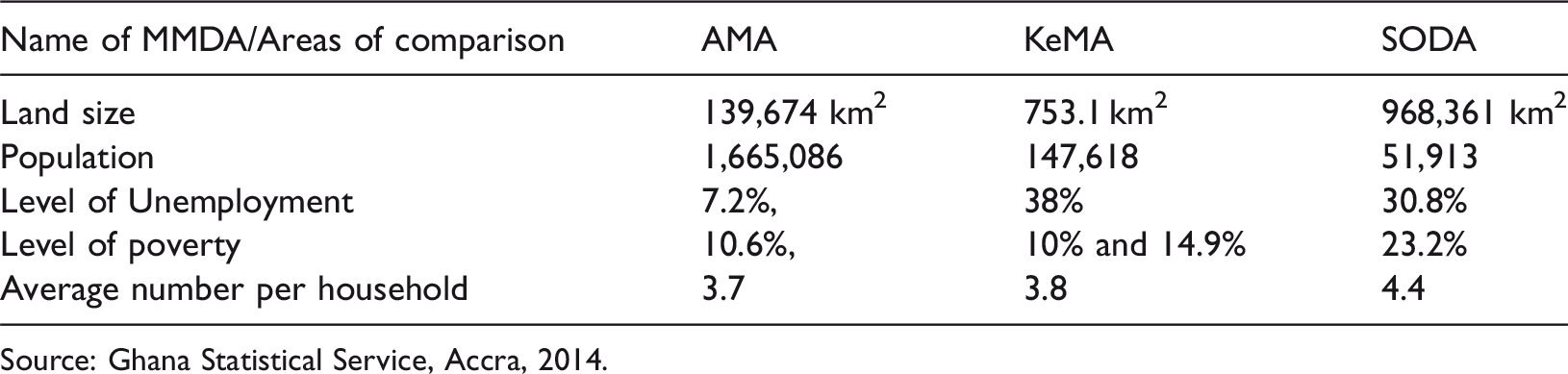
Source: Ghana Statistical Service, Accra, 2014.
Footnotes
Declaration of Conflicting Interests
The author(s) declared no potential conflicts of interest with respect to the research, authorship, and/or publication of this article.
Funding
The author(s) received no financial support for the research, authorship, and/or publication of this article.
